Tag Archives: orca

Sights and Smells

I wonder what’s different.

The transportation for one. Greyhound no longer brings their gargantuan buses this far up Vancouver Island, and as we careen down the narrow two-lane road with six inches of shoulder, I can see why. The playlist blasting in my ears has changed, though I brought back some classics like Death Cab for Cuties’ Bixby Canyon Bridge and Snow Patrol’s Make This Go on Forever.

A myriad of greenery blurs outside the window. I watch these forests differently, too. Oh, my heart still flutters at the boughs of red cedar hiding secret pathways to 6,000-foot peaks. But I also see acres of young hemlocks scrunched together like matchsticks in neat little packages. Phrases like “stem exclusion” and “30-year harvest cycles” whisper with sullen voices. Countless watersheds line the east side of Vancouver, but the Tsitika River I just rumbled past is the only one that hasn’t been logged. Tsitiaka winds through the tallest mountains on the Island and reaches saltwater at a little place called Robson Bight.

Orcas. It always comes back to orcas.

For two days, I have ferried, flown, and ridden from Gustavus to Juneau to Seattle to Victoria and am now just an hour from Port McNeil. Despite my evolving playlist and old-growth forest opinions, it still feels impossible that my first trip to Port McNeil was 17 years ago. Surely it was just a couple of weeks ago that I hopped off the Greyhound. Wasn’t it last weekend that I drove a Nissan Pathfinder up this road with a cat and rabbit in the back seat?

These roads, islands, and waterways hold a lot of the stories and experiences that explain the evolution from basketball boy to kayaker, guide, naturalist, bum, redneck-hippy, writer, conservationist, and whale aficionado. I’m counting on it providing a few more.  

Ferried. Flown. Ridden.

I count the number of petroleum-driven vehicles that propelled me from Gustavus to the footsteps of Port McNeil, Johnstone Strait, and my precious Hanson Island. All to go on one more monkish retreat in the woods and waters of my youth. All to catch one more ride on a boat powered by an outboard motor or go paddling in a kayak made of, you guessed it, fossil fuels.

Too small to tip elections in favor of Mother Earth, I run to my favorite hiding place, sheltered by, you guessed it, Mother Earth.

Blackfish Sound

If the trees are passing judgment on my life choices, they keep it to themselves. If those replanted hemlocks are packed like matchsticks, what happens if one of them lights? I woke to the news that California was burning during the wet season.  A world getting drier, warmer, crazier, more unpredictable. Surely, it would be the earthquakes that doomed southern California. We beat San Andreas Fault to the punch.

***

Don’t cry. Whatever you do, don’t cry.

All those old names:

Blackfish Sound, Pearce Passage, Weyton Pass, Blackney Pass, Queen Charlotte Entrance.

Bold Head and Cracroft Point. Blinkhorn Peninsula and Kaikash Creek.

I know them all, have stared covetously at their little faces for eight years, promising I’d see them again. I’m sure they’ve been getting on just fine without me.

I confess I left my guilt on the Port McNeil dock, catching one more 45-minute ferry ride to Cormorant Island and the town of Alert Bay—the end of public transportation. I wait two days for a weather window that finally comes as low pressure turns to high and the wind pivots from southeast to northwest.

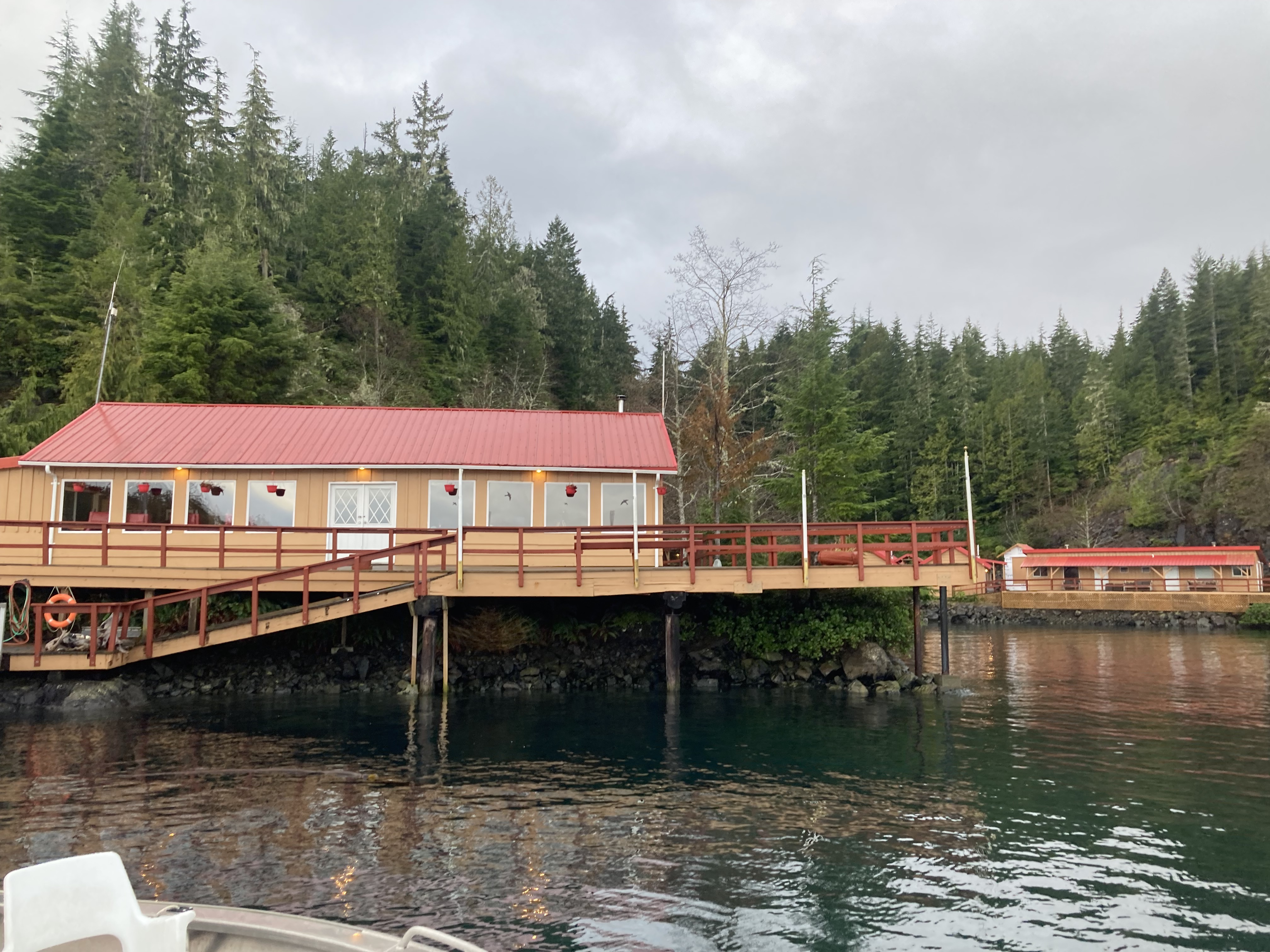
Every town run from Orca Lab to Alert Bay took me past Double Bay, its long boardwalk, floating dock, and cherry red rooftops. I shoulder my pack and follow the other caretaker, Laurene, up the dock. She directs me to a cabin on the right side of the horseshoe-shaped boardwalk, perched on the rocks with a view of Blackfish Sound and the first layer of the Broughton Archipelago’s islands.

The door opens, and the pack thumps from my shoulders. The cabin is bigger than my Gustavus design, with a half-loft upstairs, a functional shower, even a flush toilet. I would have settled for half-a-shabin and a cot. It’s not the high-end amenities that made the pack fall.

Don’t cry. Whatever you do, don’t cry.

Next to the kitchen table is a shelf. On it rests a radio receiver that looks all too familiar. Whether donated or purchased from Orca Lab, the ocean blares from the speakers—water gurgling, a distant boat engine, crackling shrimp. I swear I hear A pod.

“We have a hydrophone at the mouth of the cove,” Laurene explains, unaware I have been transported back in time. “There’s a volume knob on the right—”

“I know,” I interrupt. Not the best first impression.

I cross the room and crank the volume. How many nights did I fall asleep to this? She leaves me to unpack. I move quietly across the floor as if I’m in church. Clothes upstairs, tortillas and cheese in the fridge. Curry paste in the cabinet. I open the wood stove and smile. A pile of ash has calcified on the bottom and shrunk the stove’s space in half—a chronic problem with burning wood soaked in saltwater.

I pry the ash free and grab a handful of piled kindling. With eyes closed, I bring a stick of red cedar to my nose and inhale like an addict, listening to the hydrophone as my head spins and heart palpates. Our sense of smell pales in comparison to most mammals. Yet its ability to conjure memories is undisputed.

There is a smell to Hanson Island I have found nowhere else. Something in the ground, the water, the trees. Perhaps it’s as simple as it remains one of the few islands in the region that has not been clear-cut. Old-growth smells for a land that measures lifespans in centuries and seasons in seconds.

***

I weave between cedar and fir, balance on fallen skyscraper hemlocks, and plunge through salal undergrowth. I squish deer scat between fingers and spy on harlequin ducks perched on rocky beaches. Rumor has it a wolf has taken up residence on Hanson Island. I scan the hills with blind optimism for hazel eyes, ears cocked for the howl that proclaims that there are still things green and wild and true on this burning planet.

The rising northwesterly brings the forest to life with creaks and cracks. I settle against the hollowed-out trunk of a cedar, its innards charred from a long-ago lightning strike. Yes, even here, there can be fire from time to time. The stubborn cedars simply refuse to rot and fall, standing even in death in defiance of the decay and rebirth that comes for all.  

I scratch at the charred bark and sniff. Any smell of fire is gone. The forest around me vibrant and healing. I watch the treetops, content to let the afternoon crawl away. There will be time tomorrow to check in and learn what is expected of me here, how I can give back to this place that dreams of becoming a sanctuary and educational retreat. It took enough petroleum to get me here. I will live, write, and eat in a shelter made of wood. I’ll try to leave this place better than I found it.
Wet earth soaks into wool pants, a pleasant shiver travels up my spine. Ravens cackle, eagles retort. Somewhere, an orca explodes to the surface. I feared two months wouldn’t be enough time to find what I was looking for. But as eyes close and my soul rises to the island’s tallest canopy, I know it’s already been found.

Risk and Living

The tender splashes over the side, and the southeast breeze tugs at the bowline. I tie it to a cleat and give the anchor a firm pull. Find me a boat owner who’s more paranoid about their anchor than me.

Boat anchorages for this forecast don’t get much better than Lemesurier Island’s Hooter Cove. Tucked on the island’s west side beneath a steep hillside, it’s insulated from all but the worst southeasterlies.

Lemesurier Island on a nicer day

I wiggle into the little inflatable and paddle awkwardly for shore. I can’t imagine the designers of the Seahawk 2 had this in mind when they marketed her. Judging by the photo on the box, their grand plans included two full-grown men squeezing into this glorified raft for a magical day fishing on their favorite lake.

The raft zigzags at a glacial pace, and I keep glancing at the trees to confirm that I am indeed making progress. Even if I didn’t have my pack, rifle, and long legs, there doesn’t seem to be room for another dude in this thing, and I have no clue where you’d stash a fish bigger than a goldfish.

I nudge into the barnacle-coated rocks. Seahawk’s already sprung a pair of leaks, and we’ve agreed it’s a good idea to always take the hand pump. Despite the comical marketing and questionable durability, Zach and I have become strangely attached to the goofy inflatable that fits neatly in the back of our 20-foot skiff. I stash Seahawk above the tideline and, for the countless time this fall, pull my rifle from its drybag.

It’d be nice to have one more deer. The weather and daylight window for the day are tight, made worse by me forgetting my deer call on the bedside table and delaying our departure another 15 minutes. The ride to Lemesurier is just bumpy enough to remind me that the evening forecast calls for 20 knots and growing to 25 by Thanksgiving morning.

It’s mid-morning by the time I drop Tanner and Zach at their hunting spots and anchor. Four hours in the woods can vanish with astonishing speed. Depending on where you find deer and the difficulty of the drag, sometimes the day is done just as fast as it began.

I pause in spite of the tight schedule and look skeptically back at the skiff.

“It’s not drifting, is it?”

“No, it can’t be.”

“In your head. It’s all in your head.”

Some grow bolder the longer they tramp the woods, climb the mountains, and cross the straits, but I am not one of them. The more time out here, the more whitecaps and steep scrambles I traverse, the more cautious I’ve become. Too many close calls. Too many stories about boats with capable captains caught off guard by a rogue wave or experienced hikers disappearing on trails they’ve hiked dozens of times. I think about some of the stuff I got away with in my 20s and wonder how many of my nine lives remain.

Yet, here I am, boating across aptly named Icy Strait in weather that could best be described as “iffy,” and tramping down the beach after buck tracks in freshly fallen snow.

“Well,” I reason as I brush aside foliage and step into the forest. “There’s a balance between risk and living. Why live here if you’re going to be inside all day?”

I blink in the dim light and look around dumbfounded. I’ve never walked these woods despite passing this island dozens of times. This is Hank’s refuge, his go-to spot to hunt and shelter in a small, off-grid cabin. I’d heard him talk plenty of times about how much bigger and open the Lemesurier forest is compared to the Inian Islands, but I had to see it to believe it.  

Stately hemlocks with just a smattering of spruces tower high above an open floor devoid of menziesia, huckleberry, and devil’s club. The trees are spread wide, a myriad of deer trails weave hither and thither.

I look up the hill. I can see forever. So many great perches. I gain some elevation and settle on the soft moss, the rifle propped on a rotting deadfall.

I scan the full 360-degree view. This may not be as advantageous as I want. I can see forever, but so can the deer, and they’re a whole lot harder to see at 200 yards than me.

The big old trees give the impression of being watched. This place feels familiar, comfortable, like I’ve been here before. Not here exactly, but on an island pinned between the British Columbian mainland and Vancouver Island. A place I’ve thought about – for better or worse – every day for more than a decade.

It is no slight to Juneau, Gustavus, or southeast Alaska to say that the sweetest moments of my life came on Hanson Island, British Columbia, where I sat up nights starring over inky Blackfish Sound while orcas called from Robson Bight.

These Lemesurier trees echo Hanson Island’s mega old growth, where wizened red cedar and chunky fir trees persevere. Instead of looking for antlers, I daydream about magical harbor seal encounters and lugging batteries.

I can’t quit this place, and when I vowed to return, I had no idea it might happen so fast.

***

I had every intention of going somewhere warm for the winter. Hawaii sounded good, and I trolled the usual “workshare” websites and pestered my Hawaii friends for job opportunities. Something kept getting in the way. Schedules didn’t line up, the timeline either too long or too short (or too expensive).

Eventually, I did what usually happens when I have a new search engine open. I typed in “orca.” I scrolled through the workshare, and my heart skipped several beats when I saw Orca Lab’s profile staring back at me. After several minutes fantasizing about going full hobo and returning for the summer, I kept moving, scrolling past several opportunities along the B.C. coast that toted the chance of seeing “wild orcas.”

I stop at an overhead drone shot of red-roofed buildings and a floating dock. Orca Lab isn’t the only site of human habitation on Hanson Island. Double Bay is on the opposite side of the island in an appropriately named bay that cuts deep into the shore. It had been an inactive fishing lodge during my Orca Lab days and snapped up by a philanthropist some years ago with the ambitious idea of bringing Corky home. While far too old to ever go full ‘Free Willy’ and return to her pod, living out her final days in a large net pen adjacent to her native habitat seemed the least humanity and SeaWorld could offer after decades of imprisonment.

Help us Create an orca sanctuary. Caretakers needed for January and February.

***

Deer-less and cold, I hustle back to Hooter Bay, hoping Zach and Tanner saw more than my single doe/fawn pair. Knots of anxiety bend my stomach as the water comes into view. Terrible scenarios fill my head, including a broken anchor chain, a punctured Seahawk, a shifting low front, a chilly night, and a long walk to cell phone service.

But the skiff is there, and Seahawk is reasonably inflated. I paddle out and have to admit that the wind is picking up.

“There’s a balance between risk and living. Why live here if you’re going to be inside all day?”

The anchor pops off the bottom—big pull. Reset my grip—big pull. Reset. I pause, catch my breath, and look back at Lemesurier. It’s been several weeks since I reached out to Double Bay Sanctuary, and I’m dragging my feet on my final answer. Two months isn’t a big commitment, and it’s not like sitting in the middle of nowhere is some monumental life change. There’d even be two other people there. I wouldn’t have to go full hermit this time around.

Snow swirls around my head, and my fingers go numb. The anchor comes into view, and the skiff sways in the growing chop. I stare at the anchor, considering the balance between risk and living.

“Why do this?” I ask the cove.

“Why not do this?” the forest answers.

“Because… I don’t want to chase ghosts. I don’t want to be Uncle Rico.”

There’s no question who my celebrity lookalike is. While there are times I’d prefer to be comped to Damon or Pitt, at least Napolean Dynamite got to eat tater tots and dance. But it’s Napolean’s antagonizing Uncle Rico I’m scared of becoming.

Yes, I’d dreamed of going back, of cruising up Highway 19 in time to catch the evening ferry from Port McNeil to Alert Bay. Yet, if I was going to do this, it won’t be to relive some glory day or a feeble attempt to recapture my Orca Lab magic – the rambling equivalent of throwing a football over mountains or wondering what would have happened if coach put me in during the fourth quarter. After 18 months trying to look forward instead of backward, the last thing I needed was an excuse to relapse.

***

The anchor clangs, the boat drifts free, engine in gear. Choppy waves meet me at Lemesurier’s northwest corner. Low gray light and fog hide the setting sun. Tanner is right where he’s supposed to be, a marvelous 3×3 buck resting on the boulder-strewn beach. I abandon the helm and help lug his prize over the hull, trying to keep covetous envy out of my voice.

A deer of comparable (but still smaller) dimensions.

“Where’s Zach?”

Tanner drops his pack and checks the stern for rocks before we pull away.

“Just heard him on the radio, says he’s on a beach east of here.”

I shake my head: fading light, growing waves, temperature below freezing. We may find what our skiff can do on this 15-mile run home.  

I wouldn’t have given the crossing a second thought ten years ago. Invincible and drunk on life, I took Orca Lab’s teeny boat into all sorts of weather, tying it to the rocks off Cracroft Point and hustling to replace a battery or restart a generator while the tide fell and waves pounded. I took green water over the window and felt the hull wobble under an overloaded cargo of groceries, laundry, water, fuel, and batteries.

We cruise just offshore. Water sprays the windshield, and I taste salt.

“Where’d you find’em?” I ask, trying to take my mind off the weather.

“In a muskeg just a few hundred feet above the beach,” answers Tanner, not taking his eyes off the shore. He points towards a pebbly beach below a cliff. “There he is.”

Zach leaps aboard the lurching skiff with the ocean roaring in our ears. Spinning towards home, the bow dips unnervingly in the stacking four-footers. Tanner’s buck receives a dose of salt brine.

“We could use a little more weight in the stern,” I say grimly.

We shelter behind the little windshield and bounce like pool toys. I glance west into fading light. It’s gonna be close.

The boat goes quiet as we stare over sooty seas. My fingers go numb on the wheel, and we crawl forward. Home looks far away.

“There’s balance between risk and living. Why live here if you’re going to be inside all day?”

Lemesurier disappears in fog. Glacier Bay comes into view. I replay the route again and again. Lemesurier to Point Carolus. Across Sitakaday Narrows to Lester Point. Lester to Halibut Point. Halibut to the Bartlett Cove dock. The chop subsides near Carolus. Push the throttle down. 10 knots. 15 knots. 20 knots. The outboard purrs. We’re gonna make it.

I forget the weather and cold as my mind retraces another marine route that’s burned into my memory. A path that scoots across Cormorant Channel and through the Pearce Islands before hitting Weyton Pass at the slack. It meanders through the Plumper Islands and past a sea lion haul-out before navigating the tidal islets off Hanson Island. But instead of continuing down Blackfish Sound for Licka Point, I turn into a bay with two heads cutting deep into the island that will never let me go.

Hanson Island

***

Carolus’ rocky reef goes whizzing by. Sleet pelts our faces, but it seems that the worst is behind us. We breathe a little easier, our nervous jokes a little funnier. It’s impossible to always know where the line is between risk and living. The line moves without warning. A sunny day can be overrun with fog or variable seas replaced with small craft advisories.

We sprint across Sitakaday, and comprehension hits harder than the iciest salt spray. I cannot let fear stop me from loving the places that resonate. There are challenges around returning to Hanson Island. Memories and nostalgia would wiggle into my heart and try to drag me down—that oscillating line between risk and joy.

Bartlett Cove dock pokes out of the fog. Did I let the fear of a snapping anchor line or bouncing waves stop me? No, I tied the line tight, double-checked the weather, and trusted my skiff and friends. We cannot sit at home in fear of what may happen.

I am an unreliable narrator still learning the quirks and priorities of a reborn 36-year-old who stresses about his boat and runs after every report of orcas. Some things just won’t change. For 18 months, I looked forward, reclaimed home, and fell deeper in love with Icy Strait. I want the same for Hanson Island, for it to be part of past, present… perhaps future.

The skiff slides into the dock. The motor goes silent, and I flex my throbbing fingers as the blood returns and numbness fades. Did it—a bit of risk for another day in the woods. The sensation and payoff are inescapable, makes me thirsty for more. We walk up the ramp, keenly aware that we forgot to call for a ride home.

I pause against the railing and look across the water. Lemesurier and its big old trees peak out of the fog, and I give them a solemn nod, thankful not just for home but the opportunity to live a life that permits me to fiercely love two places. There is room for Hanson Island in this new life. Room to write a new chapter and make it part of home. I clap my stinging hands, heart filling with cautious excitement.

A great blue heron lands on the railing and stares with prehistoric eyes. The same bird that flew over the Shabin on my first visit and whose vestige now adorns the kitchen. I am not one for signs and imagery, but I take his presence as positive affirmation.

“Thanks,” I whisper. “It’s good to be going home.”

Hanson Island

Wabi-Sabi

Eyes snap open, heart racing. Where am I? The boat vibrates, a cradle gently rocking, and I’m swaddled in the bunk of room 807. For the last three months, memories and reminders of what is and what is no longer come rushing in the morning. They have all the subtlety of a 747. A soft, blue light bleeds through the porthole. Along the British Columbia coast, mornings are coming later and later as the calendar flips to October.

My name is David. I am a naturalist aboard the National Geographic Venture. I am loved. I am treasured. I am ok.

I grope for my phone and pull up the GPS app. The islands, passes, and channels look up at me, friendly little faces with names that bring comfort and order to my life. Broughton and Blackfish. Johnstone and Harbledown. Parson, Blackney, and Robson Bight. My second home. My first home. The place where this human, whoever he is, was born. It was in the waters of Johnstone Strait that I bobbed in a kayak during the summer of 2007. The A36s came swimming by, stately tall dorsal fins guiding me. Not north like they do in all the stories, but south.

Aboard the National Geographic Venture, I return to these places every fall. Not as a caretaker or paddler or biologist, but something of an educator. A representative of this place that has meant so much to me. But like everything, this sanctuary comes with some baggage.

I step onto the bow with a coffee cup gripped in my hand and greet an early morning drizzle. The boat chugs through Blackfish Sound. Hanson Island is off the port, Orca Lab just a mile behind me, cloaked in morning fog.

And there are the Plumper Islands off north Hanson Island with their little passes and reefs I memorized during three winters of town runs from the Lab to Alert Bay. Another lifetime ago in so many ways.

I pull out the spotting scope and train it on the shoreline of the Plumpers. There they are. Humpback after humpback hits the surface and are greeted by flocks of greedy gulls that divebomb the forage fish pushed to the surface. The harsh edges of this clump of islands float in and out of the fog, the world blurry and slightly out of focus.

There’s a Japanese phrase, wabi-sabi. It means impermanent, imperfect, but aesthetically appreciated. A spoon’s wooden handle worn smooth from years of use. A torn and stained pair of Carharts with oil, blood, grease, dirt, and grass stains worn into the fiber. A stained cabinet edge from a beloved cat’s insistent nuzzling.

This stretch of coast is my, “wabi-sabi.” These islands, these whales, the tantalizing promise that a six-foot dorsal could appear at any moment. But inside I also feel wabi-sabi. Incomplete, under construction, and loved all the same.

I get to talk about it today. Share this place and this history with 80 people. They’ll give me a microphone and hang on my words. A chance not just to share but influence.

But there’s no way to speak of Hanson Island, Paul Spong, orcas, or quiet nights in Robson Bight without sharing my own history. And so that means opening a vein and scratching the scab that’s just starting to heal. How will it feel when I see the picture of us grinning at the camera with a rabbit and a cat clutched in our arms?

***

I step behind the little pulpit in the middle of the Venture’s forward lounge. I glance at the TV in front of me, my presentation loaded and staring back. There’s the lab, framed in cedar and fir. I remember the day I took this photo, a spring day in 2016 when I knew our time at the lab was coming to an end.

A down payment was soon due on 4.2 acres of Gustavus clay. An era was coming to an end. A final gulp of wanderlust. My tumbleweed wanted roots, and we were learning what it took to grow them. It meant saying goodbye to black nights with chatting orcas and salt spray on the windows.

I don’t know if I made the right choice.

I pick up the mic and begin to speak. There’s the photo of Paul next to the projector, focused and handsome. A black and white photo of Skana the orca he was hired to perform “research” on. Paul playing his flute to her beneath the headline “Friend Wants Orca Freed!”

I talk about Paul heading up Vancouver Island and setting off in a kayak around Hanson Island with nothing but a flute. Did he have a life jacket? I never asked. Something tells me he didn’t.

I tap a button and the calls of the northern Resident orcas’ blast through the lounge. A Clan and G Clan. Pings, squeaks, and whistles. Calling me home. I never truly left. This is still my home. My first love. And just because life has changed doesn’t make that love and time any less significant. It’s part of me. My journey. Part of my wabi-sabi. The lump rises in my throat. Damn it I miss this place.

A couple slides later and there we are. There she is. A smile on her faces as she looks out the lab over Blackney Pass. A photo of Brittney asleep in the cabin with Porter on her lap, Penny the bunny nestled in her little house. But opening this vein, scratching this scab isn’t bringing tears. The lump is gone from my chest. And I realize I am celebrating the adventure. The beautifully braided journey we made. My mind will not let my heart take that away.

The spoon’s worn handle feels comfortable in my hand.  

I finish with a crescendo. Underwater footage of orcas at the rubbing beaches. I love this shot. A female settles right in front of the camera and rests on the bottom. She gives a few happy wiggles along those smooth rocks that mean so much to them for reasons we don’t fully comprehend. Their calls once again ring through the lounge.

 I break.

A tear slides down my cheek, then another. I’ve been scared to think about my time in British Columbia, much less talk about it. But sometimes what we fear is what we need to do. Destigmatize our traumas and pain and instead glorify all that was great and beautiful and precious.

I catch a few wet eyes looking back at me.

“Thank you for your time. For letting me share this place and these animals that mean so much, that makes me who I am. It’s a pleasure to get to come back here. If you’ve had enough whale talk, I totally get it. But I’m happy to take questions and talk as long as you want.”

I suppress a grin and allow my ego a couple cartwheels as hands shoot into the air.

The Lab

Inside the lab, all I can smell is cedar. It’s the first thing I remember about it and I imagine it’ll be the last thing too. The tall legged chair has a low back that digs into my Sacral vertebrae. Paul didn’t have 6’4” Wookies in mind when he designed this place.

Precious little has changed about the lab since I first walked through its doors nine-years ago. The computers have gotten fancier and the tape deck has been replaced by the miracle that is digital recording, but that’s about it. The windows are still stained, the dorsal fin shaped piece of driftwood still sits in the corner, the Auckland Town Hall “Save the Whales” poster is still tacked to wall. It took place at 7pm on June 10th, 1981 if you were wondering. I was -7.5 years old.

No, this place feels the same. The Orcas still call at all hours of the day. Tonight they’re in the strait. Cracroft Point in both ears, Parson Island in my left. A ping in both ears, an echo in the left. A whistle in both, an echo on the left. I close my eyes and I can see them. By their volume and echoes I can place them. Vancouver Island side, probably milling which would explain the random changes in volume. I lean back in the chair, feel it dig into my back, and let the whales take me away.

And as I do, the dull ache returns. Not in my back, but in my chest. The one that’s emerged each time I’ve looked at something fondly the past week. That nasty, horrible reminder, that my time’s almost up. I’ve spent 23 non-consecutive months here. It would be cliche to say it feels like I just got here yesterday. But dang it, it does.

I came for the Orcas. I came to learn everything I could about them at the feet of a master. I came because I thought Paul Spong held the secret to spending your life studying them. Nine years ago I arrived wanting to learn how to be someone else. Now, I’m leaving finally ready to be myself. I am not a scientist. I’m not cut out for research papers or grant proposals or laboratories. I’m not cut out for non-profit fundraising and holding onto my own foundation by the fingernails. I wanted to be. Thought I was supposed to be. But I’m not. I’m no more a scientist than a basketball player.

And that’s ok. Orca Lab told me that lovingly, patiently. Over countless nights in the lab, watching Parson Island fade into darkness. I may stand at the side of great scientists and leaders and advocates, but that is not my voice. My voice, my home, my Hanson Island as it were, is right here. With my fingers tapping against keys, uninhibited by the rigors and (necessary) walls of science. We need both. Science tells us we should care. But it is our emotions that make us do so.

And so saying goodbye to this place will not be as simple as closing the door to the cabin for the last time and missing the southeast storms and snap of cedar in the fire. It’s saying goodbye to the place that gave me purpose. I’m not unique in this regard. I’d wager that everyone that has set foot on this place has a story they can tell about how their life has been altered by Orca Lab, Paul, and Helena. What unspeakable beauty is there in that? That in a world where hatred, arrogance, and selfishness seems to be growing at an exponential rate, there is a place that can teach us how far love and compassion and appreciation can carry us.

“I feel most secure when the woodshed is stocked and there’s a fresh loaf of bread on the shelf.” – Paul Spong.

Subject to Change

I’m paddling through a minefield. Not a dangerous one mind you. Not one that threatens me immediate harm. No, this is a magic minefield. A minefield of humpbacks. They’re serenading me, us. Every few seconds we hear another breathe. The water’s north of Young Island in Glacier Bay are full of them. How many? Five? Ten? Twenty? Thousands? It doesn’t matter. They are many. They are here. They are near.  To the left of our kayaks the latest whale breaks the surface. He’s fifty yards away, his nose pointed straight at us. My God. For the millionth time in my life I watch the back arch, the body hesitate, and the tail rise high in the air. As tall and proud as a Spanish clipper. She’s diving straight towards us. My heart pounds, my legs feel weak. I strike the surface with my paddle, my stroke noisy. I want him to know where I am. For there to be no doubt. We point the bows of our kayak towards the nearest point of land half a mile away. There’s nothing to do but paddle, our course subject to change.

Subject to change… I’ve heard that before. Or did I read it? I read it. Just this morning, killing time before the trip. Pouring over the nautical charts of Glacier Bay. The maps that make my mind race and imagination cartwheel. All of this magic bay’s coves and inlets. Here a delineation in the shoreline. A potential beach to pull out on. A potential site for a miracle to occur, for a life to change. At the base of a glacier, represented by white are the words: “area subject to change.” Subject to change, I love that. As if NOAA finally threw up their hands and gave up.

“Forget it, we’ll never get this right. Just tell them we don’t know.”

Perhaps the bay is still speaking to us. Out of the mouths of the epochs with the voice of the ice age. Reminding us, prodding us to not get comfortable. We need upheaval, to be subject to change. To not just wait for the significant calving events of life, but to embrace them. We need galloping glaciers but we need retreating ones too. The wisdom and strength to accept them.

Five minutes go by. Still no whale. He could be in front of us, behind us, below us. Every stroke could be bringing us into her path or away from it. In a kayak there’s nothing to do but paddle. With me is a family of four. Mom, Dad, their college aged son and daughter. From the mountains of Utah. But they paddle strong, their hearts are wild, their minds open. Glacier Bay is rocking some minds today. I hope it’s doing the same to them. Somewhere is a forty foot submarine. Carbon based, cloaked in blubber, eating half a ton of food per day. I don’t want to distract her. Attached to her tail is a muscle. The caudal peduncle. Fun to say, but it fails to give credit to what it can do. It’s the strongest muscle in the animal kingdom. To send a humpback rocketing from the water like a rocket it generates the same amount of energy a 747 does taking off. Anything carrying that sort of power needs respect, demands it. Teeth or baleen.

Three miles up the Lamplugh Glacier. The site of a massive rock slide. Last Sunday half a mountain fell onto the glacier. How much? 68 million SUV’s worth. Who knew a sport utility vehicle could be such a great unit of measurement. They’re the passenger of the glacier now. Of the most powerful geologic force nature can muster. You can have your volcanoes, your earthquakes. Give me the glacier. Carving, destroying, creating. In no hurry. For what artist works on any schedule but its own? The news makes me quiver. I take some radical steps, a few creative liberties. What happens when that rock reaches the glacier’s face? It will surely fall to its feet. 68 million SUVs worth. But I know how glacier’s advance. They need a protective layer of rock and dirt at their base. A lateral moraine that insulates from the salt water. If enough snowfall is accumulated above, the glacier can advance, impervious to the melting power of the saltwater. What if the Lamplugh charges… no, gallops, a galloping glacier sounds better. What if it charges across the west arm, obliviating Russell Island and roars south, changing everything about Glacier Bay that we’ve known for 50 years. What if this simple rock slides makes my world, this bay, subject to change?

Still no whale. I glance at my watch. Eight and a half minutes. The unknown more nerve wracking than the knowing. Every few strokes I tap the side of my boat.
“We’re here!” I think.
I hope my taping transmits this message. A rumble, a deep bass. I swivel around. There she is. Close, so close. Fifty yards. Pointed straight at us again. She’s massive. Of course she is. Humpbacks exhibit sexual dimorphism, the females bigger than the males. Guide mode switched on, I almost blurt out the factoid for no good reason.
“Right behind us!” I call. I try to keep my voice calm. But how are you calm with forty tons directed right at you? Ahead of us is the kelp, the closest thing to a sanctuary. This is my world. Wanting, desiring, craving to be close… but not too close. I still want control of the situation, to know that I’m out of the way. She couldn’t care less. We paddle hard, the whale invisible behind us. Forty feet that disappears with nary a ripple. Add it to the list of Glacier Bay miracles.

We reach the kelp’s open arms and I exhale. The family coasts in behind me. Their faces are alive. Exhilaration with a sprinkle of fear. Perfect, just the way it should be. Just the way Glacier Bay, Alaska as a whole expects it. I don’t want to feel safe out here. I don’t want to be in charge. Thank God there are still places where man does not dominate. We paddle on. For that’s all you do in a kayak.

I glance at the daughter. She’s in the back of the double kayak, her father in the front. She’s not that much older than I was on a certain misty and overcast day in Johnstone Strait, British Columbia. The day everything changed. When an Orca by the name of Kaikash surfaced off the bow of my kayak and sent the compass of my world spinning out of control. Who knows whose life will change with the flip of a switch, with a single surfacing, a single rock slide, a single galloping glacier. But when it does, who will be brave enough to accept it and embrace it with open arms.

The Hanson Island Equivalent of the Milk Run

Johnstone strait is empty. A gentle northwest wind ripples down the passage, pushing my tiny boat east. Have I ever seen the strait completely devoid of human existence? I can’t remember, I certainly haven’t in summer. There were nights when the the fishing fleet anchored against the Vancouver shoreline drowned out the stars with their anchor lights. I’d lay on the deck at the Cracroft Point outcamp looking across the strait, the lights bobbing like little lanterns from Robson Bight to Telegraph Cove.

But today it’s just me, in my glorified bathtub of a boat. The wind and damp air makes me shiver beneath my sweater. The strait feels odd in winter, devoid of boats, kayaks, and Orcas. I glance hopefully at the green carpeted shoreline of Vancouver Island, looking for the rhythmic rise and fall of a scimitar shaped fin.

The mountains free fall thousands of feet straight into the ocean. Their peaks smothering the sun as we pivot around the winter solstice. But their shadows turn the strait emerald green. It was this color that I remembered more than anything during my six year hiatus from this place. The trees bearded in lichen, their shadows falling into the water. They silhouette the black and white backs of the whales when they’re here. Complimenting each other perfectly, like the entwined fingers of two lovers.

The boat plows through a rain cloud and drops pepper the windshield. I’m on my way from Alert Bay to the lab, with a couple of pit stops along the way.

“On your way home, could you run the generators at CP and Parson Island?” Paul asks as if he’s asking me to pick up a gallon of milk at the store.

Our power issue has become something of a saga. With all of technologies marvels, line of sight is still tantamount to keeping our daisy chained internet connection established. The signal runs from Alert Bay and on a line above me and the boat to CP, its white lighthouse and the lab’s green shack materializing out of the fog. The signal is bounced from CP across the water a mile to Parson Island. This allows the connection to round the eastern corner of Hanson Island. From Parson it’s a straight shot to the lab. But if we lose power at either CP or Parson, the system crumbles like Jenga. And with the solar panels choked for sunlight, a spotty inverter at CP, and a cranky generator on Parson, keeping the HD cameras up and streaming has become a daily battle. The rain abates as the boat brushes up against the rocks at CP. The tide is low and I crawl on hands and knees up the rocks and into the woods where the generator lives, connected by extension cords to the insatiable solar batteries.

It’s only three in the afternoon but the sun long ago vanished behind Vancouver Island’s mountains. The rain cloud I’d passed is barreling for me. With little ceremony I pull the cord on the generator, set the choke, and climb back into the boat. The 50 hp Yamaha engine roars to life and I pull away from the rocks, leaving nothing but waves lapping against the shore.

The journey up Parson Island to the batteries takes you up a cliff face and through a rich display of Cedar, Spruce, and Hemlock, adorned in lichens that stick to your hat and drip water down your back. The fog settles in  as I step out onto the cliff face where the camera, radio, and batteries are stored. Hanson Island just a quarter mile away vanishes behind the veil. With much protesting the generator powers up. Its voice like that of a smoker, coughing, hacking, and wheezing as it dispels precious power to the battery bank.

The rain has caught up. I wrap my arms around my knees and pull my hat tight over my ears, waiting to see if the generator will run reliably. The calm water swirls with countless eddies and currents, bustling this way and that, their origin and destination no one’s business but their own. Atop them sit murres and murrelets, gulls and auklets. The land is silent save for the gull’s squawks and the exasperated yells of the murres. The weather threatens snow. It feels cold enough. In the distance I can make out the tendrils of smoke from our cabin through the fog. But as tired and cold as I am, I’m not ready to go home just yet. The sun slides clear of the mountain peaks for a moment and turns the fog gold, the rain drops glow like diamonds.

From my vantage point I can see out into Johnstone Strait, the stretch of water that has changed and defined my life, has changed so many lives. But not in winter. In winter the land and ocean seems to hibernate. Queuing up for another summer that will bring the boats, the kayaks, the people, and the animals that pull them like great magnets. But for now, it’s great to watch it sleep.

Finding Light

Brittney has a great capacity for love. This compassion stretches deep through the animal kingdom. Every feather, every ball of fluff. Whether they have no legs, four legs, or eight legs, she cares for them all. A couple years ago she stopped killing spiders (or more accurately having me kill spiders) and insisted that they be relocated outside. Her fear of our wall climbing, web spinning roommates was no justification for murder. She still scrolls through the Juneau Humane Society website, cooing over ever whiskered face while our cat Porter looks at her with a betrayed look on his face.

Factory farming, greyhound racing, the egg industry, and of course, captivity all have room for remorse in her heart. And while many would turn their head, or acknowledge their plight and move on, Brittney doesn’t seem capable of that. She won’t rest until every “fur baby” is safe, happy, healthy.
10329311_10152867795949852_7120445375934915455_n
“Do you think they know that there’s people in the world that care? She asks as she fills out another petition to abolish greyhound racing. That there are people trying to help them?”

“I hope they do,” I say. Though I don’t know how they can.
I look at the picture on the screen, a greyhound with dark empty eyes alone in a crate, it’s head resting on a beam. It looks defeated. I feel sadness when I see this, but anger is my primary emotion. Anger and disgust. At the greed of man. Our selfishness. At the lengths we will go for profit. Our obsession and worship for the man made ideal, money. Somehow it’s become the measuring stick for our species. We’ll obliterate whatever is in our way to obtain it. Greyhounds, orcas, the very world we live in. How is it that we’ve forgotten that we cannot live without the natural world we insist on pillaging? Infinite growth in a finite world. Not the American dream, but the global fantasy.

I look back down at the picture, my mind returning to the present. The knot in my chest tightens, my heart rate increases. How could man look at this and not be enraged? Yet here is the proof that ambivalence lives.

It’s another storm ridden night at the lab. Similar Paul points out, to the night Corky was captured. It was a wave capped, howling winter gale when her family innocently swam into Pender Harbour and had their life change forever. In the name of corporate gain and human entertainment. How can we look at ourselves in the mirror?

Do you think they know that there’s people in the world that care?

Corky seems to. Why else would she withstand this torture, humiliation, and pain for so long? Does she believe there are others beside the ignorant masses that stand on the other side of the glass and snap photos with their camera phones?

“Corky’s plight makes me sad,” says Brittney, “but I feel more impassioned by factory farming, by animal testing. There’s millions of animals that die inhumanely, that live terrible lives. It’s 2015, but we’re more barbaric than ever.”

“Look what we do to our own species.” I answer, “we can’t stop murdering each other and we’re asking that same species to have compassion for other animals?”

Yet this is where we are. I pour whiskey over ice and settle on the couch. Here I am, in the middle of the natural world, and I can’t escape. ISIS, immigration, Donald Trump, SeaWorld, climate change. Running to the woods won’t make them go away.

“It’s important,” I remind Brittney, “not to get bogged down in the negative.” I’m reminding her as much as myself. “Our media, our world feeds off of negativity. It gets clicks, draws traffic in a way that heart warming, positive stories don’t. Seek these out, hang on to them. Celebrate the victories, the joy, the beauty. Because it is there. Even in darkness there is always some light.”
537318_10152372664114852_545974904_n
The chainsaw roars. I follow the ebbing tide down the beach, accepting the sacrifice of a massive Fir tree. It’s a beautiful piece of wood, undoubtedly an escapee from a passing barge. It didn’t deserve to be cut, but at least its death won’t be in vain. The sharpened teeth on the saw litters the rocks with wood shavings as I cut into the sweet smelling wood.

At the end of the log I stand and stretch the ache in my back, looking over Blackney Pass, over paradise. I drop the chainsaw and feel my heart lift. Blackney teems with life. Hundreds of gulls swarm a fifty yard patch of ocean in numbers so thick they look like a great feathered cloud. The bait ball has not gone unnoticed. An armada of eagles roar in from the trees, great black wings punctuating the ball of white. I count at least thirty eagles, shuttling back and forth between the trees near the cabin and the ocean. Again and again they swarm overhead, the silvery flashes of sand lance clasped tightly in their talons. Life, sustenance.
10540_10152009960619852_192033272_n
Brittney and I fall under their trance, the log lays forgotten at my feet. A lump rises in my throat. Why does this feeding frenzy have tears coming to my eyes? Because after everything the land has endured. Clear cutting, fish farms, live captures, predator control. They’re still here. The orca’s are still here. Is the world perfect? No. But here is a victory, here is joy. Here is a chance to celebrate.

“Do you know what I see?” I ask pointing out at the surging biomass before us.

Brittney looks at me, her eyes softened, the light glowing in her pupils.

“Hope.”


My Life as an Orca DJ

It starts with dolphins. They giggle like jackals, punctuated by the dull thuds of their echolocation. I shut my eyes and let the sounds of dolphins, crashing waves, and 30 knot winds rock me back to sleep. Moments later my eyes open. I sit up, Brittney’s feet swing out of the bed. The dolphins aren’t alone. The hee-haw of a donkey floats through the speaker that sits on the shelf just above our bed. G clan’s back.

1917778_229391884851_28180_n
“My turn,” Brittney mutters like the mother of a new born and staggers down the stairs, out the door, and to the lab. Moments later her voice comes out of the speaker as she begins the recording, mixing with the sounds of swirling water and cackling dolphins.

“This is Brittney, this is Hanson Island 2015, digital recording number…” my head hits the pillow and I drift away.

For the next few hours I fade in and out, coming to just long enough to see Brittney isn’t back and that the whales are still calling. They’re faint, maddeningly faint, but there. Three hours after they first pulled Brittney from the bed I rise. It’s a moonless December night with the clouds building for another low front, 7 am and still pitch black.

Brittney takes little convincing to go back to bed. She’s been at it since four and the whales seem to have barely moved. Their voices still distant in Johnstone Strait, at the limits of the Critical Point hydrophone. What compelled them to sit in one place and talk about it for so long? I wrap my sweater around me and feel the lab vibrate as another gust hits the south facing windows. I wipe the sleep from my eyes and brace myself as another tug rolls into range. The sound grows to a deafening roar, the orca’s voices extinguished. Feeling guilty I pull the headphones off and rub the headache emerging from my temple. If only they had such luxury.

The tug moves on and they’re still there. G clan somebody. I31s perhaps? Even Paul and Helena can’t say for sure. These late nights remind me of summer. When late night recording sessions were the norm rather than the exception. It’s warmer in July though. And the sun’s there to keep you company starting at about four in the morning. I am the night shift orca DJ, playing the hits of the A, G, and R clan on 92.1 the WHALE.

At long last the darkness lightens a shade, the whales almost inaudible, Vancouver Island distinguishable as a darker shade of black against a slowly lightening sky. The sun finds a gap and a splash of color transforms the world from black and grey. It’s all worth it. The water and mountains light up like ta water color and the orca’s go quiet. Maybe they too are watching the sun rise.

The sunrise doesn’t last long, extinguished by another fog bank rolling in. Waves topped with whitecaps intensify, the rain strikes like pebbles. Twenty minutes with no calls, than twenty-five, thirty, are they gone? A couple summers ago the A36s played a horrible trick on me, sitting silent in Robson Bight until I would end the recording before letting out a whispered giggle, letting me know that they were still awake and I should be too.
The I31s don’t have their sense of humor though. I end the recording and walk back to the cabin. The tree tops swirl and the waves thunder into the rocks twenty feet away on the high tide. My job, my office, my life. And to think a few years ago I was ready to work in a lab, studying herring bioenergetics. Let someone else wear the labcoat. I’ll go to the office in slippers and flannel.

Sea World, Blue World, Where in the World do we Go From Here?

After much posturing, debating, and protesting, the end of Sea World is in sight… kind of. Last week, the California Coastal Commission approved Sea World’s new “Blue World” expansion which would nearly double the size of the orca’s pools at the San Diego location. Approval comes with an enormous catch, Sea World would be forbidden from breeding orcas of wild lineage or housing more than 15 orcas in the new pools. We’ll bypass Sea World’s bleats about depriving the whales of their right to breed as “inhumane and unnatural” (nothing more natural than artificial insemination) to avoid the risk of choking on irony, and discuss where Sea World, and its opponents go from here.

“It’ll all be over in a few decades,” I thought. But rereading the Commissions vague restrictions I had more questions than answers. Sea World can build the tanks, but it cannot be populated with whales containing genetic material from wild whales or whales captured in the wild. Every Sea World orca, at least that I can find, has at least a grandparent of captive origin. The DNA of free whales runs through the veins of every whale in those pools. Technically, no one qualifies for the Blue World pool.

What the commission is implying I believe, is no offspring whose parents were born in the wild can reside in the new enclosure. No sons or daughters of Tillikum or Corky. Second generation, captive born whales would qualify for the new enclosure is my understanding. Which raises even more questions. For example, what does Sea World do with Corky, the northern Resident female from A5 pod who was captured in 1969? If wild caught orcas don’t qualify, Sea World would be looking at transporting her across country to Orlando or San Antonio. As would her tank mates Orkid, Ulises, Kasatka, Nakai, Ikaika, Keet, and Shouka. A massive whale shuffle would be on Sea World’s hands to move captive born animals to San Diego.

But the ruling also prohibits the trade or transfer of whales to and from the park. Does this include transfer of whales between San Diego and the other two locations? No article that I could find specifies. But if you cannot move any whales in or out of the San Diego location, why the stipulation on the genetics? The ruling needs more specificity before Sea World or animal rights activists can truly claim victory.

We have tragically reached a point where most of these whales cannot go home. For many, Sea World is the closest thing they’ll have. A cocktail of Icelandic, Resident, and even Transient have been stirred into the genetic cauldron leaving many of the park’s inhabitants with no identity. Refugees of the natural world. While the argument can rage about how Corky or Tillikum would fare if they were returned, there is no such case for the majority of Sea World’s prisoners. Where does an Icelandic/Resident mix go? And what pod would even consider accepting this man made whale Frankenstein?

The Commissions ruling is a ray of hope. It may not lead to the quick death of orca exploitation, but it’s a step in the right direction. I would love to see a more concise ruling on what Sea World can and cannot do with the additional 4 million gallons of tank they wish to build. If it means that those eleven whales in San Diego are the last ones that have to endure captivity on the west coast, fantastic. Maybe Sea World would even try to save face and agree to a net pen retirement for Corky. But if all it means is that Sea World has to shuffle whales a little more across the country, than little has been done but increase the number of mom and calf separations.

Sea World is slowly fading, but they’ve made it clear that they will not go quietly. An appeal will probably emerge, we’ll hear more about how wonderfully they treat their animals, and ticket sales will continue to drop. Let us continue to diplomatically educate those that buy tickets and boycott those that sponsor them (No Budweiser till Corky’s out!). The animal rights movement has moved at an exponential pace the past few years and I can’t wait to see where it leads next.

The Spirit Walker I

The water shimmered, reflecting shades of gray and green in the morning light. Fog hugged the peaks of the Beartrack Mountains like a cloak, wrapping their peaks in an ever flowing blanket. A determined ray of sun stabbed through the fog and mist, its finger crawling along the liquid mirror of the ocean, moving up the barnacle covered rocks emerging from the midnight high tide. The ray moved beyond the rye grass, turning their grains gold as they floated past, their early morning dew glowing like flakes of gold. It moved past the strawberries above the tide line and the tattered remains of an unmade bear bed abandoned just hours ago, its mattress of moss still warm. From the flat plane beyond a trio of Spruce trees the light finally rested against pale yellow canvas.
Within the tiny tent came the rustles of early morning life, a cough and a groan emerged as cold, stiff appendages protested the early disturbance. Here it was warm, comfortable. Eventually the growl of a zipper floated across the landscape joining the early morning calls of the ravens, murrelets, and gulls. A head adorned in gray wool appeared, brown and white curls peaking beneath, emerald green eyes squinting even as the few fingers of light retreated back beyond the clouds.
Reed stepped clear of the tent and staggered slowly around the trees, ambling down the beach, his gait slow and uneven as he stumbled over loose rock. One hundred yards down, buried in the rye grass lay a pair of black, cylindrical bear cans. Prying the lid off one of them, Reed settled himself upon a broad flat rock and watched the sun struggle to reappear as water rose to a boil making the oats in the sauce pan quiver and dance.
Stretched before him lay the middle and upper segments of Glacier Bay. From his vantage point on Young Island the land opened out before him like a picture book. The long seductive legs of the Y shaped bay tapered off in the distance leading to the destructive and creating forces of the glaciers. After 50 years there were few estuaries, inlets, and passes that he had not explored, slept in, or felt the stinging ice of a sudden storm seeking out every weakness in his jacket and tent. In his mind he could trace the land like the lines on his weathered and wrinkled hands.
Today marked the beginning of his seventh decade on earth. Nearly every summer had been spent here. Biologist, writer, guide, educator, and student. The more time he spent with the bay the less he seemed to know. She was full of surprises. Storms the most skilled meteorologist would be flummoxed by. Dispatching bears, precipitation and tide rips to do her bidding. She weeded out the unprepared and those too quick to romanticize her beauty and splendor. She stole kayaks off the beach with 19 foot tides, hid armies of Devils Club beyond the tree line, and set loose armadas of mosquitos with every opportunity.
Reed had learned from her, evolving as the bay itself evolved. The ice that was her architect never ceasing to carve, create, and destroy its own work of art, biding its time until it grew tired of the masterpiece and sent glaciers charging south to wipe the canvas clean.
A fine mist began to fall and Reed tilted his head back, letting the minuscule droplets fall on his face, the water dripping from his long grey eyebrows, his bleach white beard absorbing the moisture like a sponge. He managed a deep breath and felt the stabbing pain in his chest again, the knife twisting into his lungs, the throbbing magnifying in intensity as it had been for months.
Thirty minutes later, his tent and gear stored fore and aft, he slid his kayak into the shallows sending out ripples that stretched before him to mark the trail he’d follow. With a grunt he struggled into his fiberglass boat, hearing and feeling his knees crack and pop as he manipulated his long legs, stretching them out before him, toes groping for the rudder pedals. Jamming his paddle into the fine sand he pushed clear of the beach, the keel whispering as it brushed over the rocks on the still falling tide. Working against the ebb he paddled north, into the bay that had dominated his life, it was fitting that it should end here.
The minutes bled into hours, time marked only by the creeping movement of the sun still hidden beyond the clouds. The rain came and went as a fine mist, too impatient or lazy to commit. As the day slowly passed, the years seemed to vanish, the pain in his back melting, the stiffness in his legs forgotten. The melody of his youth escaped his lips, the songs of John, Paul, George, and Ringo floating across the water to fall on the boughs of the spruce and hemlock he paddled past.
For lunch he joined the otters in the kelp bed, wrapping stalks of bull kelp around the hull, anchoring himself in place as he produced bread, peanut butter, and a carefully rationed beer. These aquatic forests reminded him of the Tlingit, the rightful tenants of the bay. It was in these forests that they had gone to seek shelter when the wind blew too hard, blanketing themselves in kelp to nestle within the hulls of their boats patiently waiting for the ocean to relax. Such was their faith in the sea, their breadbasket, livelihood, and highway, that even in her most angry moment they would not abandon her.
Freeing himself from the kelp, Reed paddled on, a laminated map pinned under bungee cords in front of him, spelling out the names long ago given to the land in a fruitless effort to bring human order to a world we cannot even begin to understand. Each one conjured up memories, a comfort food for the brain. Long ago he’d started to rename the points, bays, and coves for what he had experienced and witnessed. Just as the Tlingits had given the bay practical names, so had he. They had christened the bay with descriptions and stories. “Place where the glacier broke through,” and “giant rock beneath the green bluff.” He had followed their example, and as south Marble Island grew larger and larger he entered, “passage where the orca hunted sea lion.”
He continued north, infant waves growing in the mid afternoon that had long ago hidden any evidence of what had taken place on an early Spring day years ago. Reed had been just twenty-six, his first season as a kayak guide when they’d stumbled upon the dramatic production of the food chain. The watery wolf pack had exploded from nowhere; perhaps from the underworld in which they’re latin name was derived, to send torrents of white water high into the sharp blue sky. In the chop and whirlpools they rammed their victim, the sea lions eyes wide with terror as the four of orcas circled, dove, and resumed their attack, the youngest looking on.
There was no malice in these creatures, Reed thought as he sat paralyzed 200 yards away, no sadistic pleasure in their hunt. This was life. The only way to survive, to continue the game that had been set in motion eons ago when their parents had followed the retreating glaciers. Had watched as they pealed back the curtain to reveal the labyrinth of islands and channels that would be their home for centuries.
The battle raged for an hour but there was no debate over how the drama would unfold. No sudden plot twists, no unexpected hero overcoming the odds. Nature has little interest in theatrics. Minutes later the ocean had covered up the deed, washing away any evidence, and on the sea lion haul out a mile away, life continued, unchanged.
A gust of wind tugged him back to the present, the tide shifting to flood, the breeze bounding north with the current like a sled dog. The pain in his chest intensified, his toes numb from bracing against the boat. Aiming perpendicular to the rising waves Reed paddled gamely for shore, the trees gaining definition and height as he pulled closer.
By the time the keel had kissed the shore the sun had finally broken through the dissipating clouds, turning the ocean from gray to sapphire and punctuated with rising white caps as the wind grew in intensity. Reed hauled his kayak up the beach. His feet slipping over slick seaweed that held to the rocks like glue. With a final heave he laid the kayak to rest beyond the beach grass in the protective shadow of the alders that signified safety from even the most motivated high tide.
His gear stashed and food stowed down the beach, Reed stretched out on the smallest, smoothest rocks he could find, letting the wind dry the sweat from his cheeks and forehead. Removing the wool hat he ran his hands through his thin and wispy hair. The medication would have made the last of it fall out they’d told him. If he was going to go, he was going with every last strand of hair he could hold on to. The rocks felt more comfortable than any mattress, the pounding of the waves more soothing than any fan. He closed his eyes and laid back, and felt himself drift away.
The pain in his lungs was gone. His body smooth, muscular, and powerful. His legs felt fused together as they pumped in unison. In the darkness he could feel the cold, rushing liquid speed past his face. And though he knew the water could be no warmer than 50 degrees he felt no chill, no shiver radiating up his spine. Just out of sight to his left and right swam his family, his identity, his pod. A whispered voice, high pitched and authoritative floated through the currents and Reed angled his rostrum up as he felt a gentle burn building in his lungs. The water lightened, turning from black to deep blue, a rush of air and his nostrils flexed, opening his airway, spent oxygen returning to the atmosphere. With a gasp he sucked in a fresh breath, sinking below the waves, feeling his dorsal fin cutting the surface and tickling his back. His mother dove beneath him. Her call commanded him to follow and he obeyed without question feeling his sister and nephew behind him, somewhere ahead was his brother. From his moment of birth he wanted for nothing, had lusted for nothing, born into a family that would supply him with all he would ever want.
His mother whispered again and the chatter from his nephew died away, the pod went silent. Oxygen from his last breath would have to sustain him as it pounded through massive arteries. He could hear it now in the ocean’s stillness, a splashing straight ahead and above. The sea lion bobbed on the surface, paddling away from the haul out, bound for who knew what. His timing couldn’t have been worse. Reed’s mother was a master, a specialist in his kind, she had a family to sustain, and if the intuition in her womb was true, there would be another to feed in a matter of months. For five minutes they swam on, a single pump of his tail propelling him further than ten strokes would with his paddle. His mother’s flipper brushed against him, his brother’s dorsal fin grazing his stomach, everything he’d ever need was here.
With a single screeching yelp, they shot upward, bubbles rushing past his face, the light returning, a single ping forward bounced back in a heartbeat, it was a sea lion, it was above, it was dinner, it was survival. He hit it dead on, feeling it’s bones crack against his rostrum, felt it fall away as he broke clear of the water, into dazzling light, saw his own human face alight with shock, wonder, and amazement, the snapshot burning into the back of his head as he fell into the waves, heard his nephew’s excited chitters and dove into darkness for his next charge.
Reed’s eyes snapped open, with a great gasp he exhaled as if coming to the surface after a deep dive. For a moment his head jerked back and forth, orientating. The sun was dipping beneath the mountains of the upper bay, turning the sky crimson, the wind had submitted to the atmosphere’s higher calling, the ocean settling as it prepared for a restful night.
Reed stretched out his flippers…. no, his arms and reached up above his head, his fingers brushed against something that was not rock and his hand froze. He could feel something long and wiry, and another object, firm and pointed. He grabbed a handful of the artifacts and brought them to his face, eyes wide in shock. Rolling onto his side he stared at the sea lion whiskers and claws on the rocks next to him.
Reflexively he stared back out at “passage where orca hunted sea lion,” the memories flooding back. He shook his head and felt water drip down his neck. Bringing a hand to his thin hair he found it soaking wet. As he wiped the water from his mouth he let out a scream as his hand pulled back, a deep red red liquid staining his skin. The tide had risen several feet as he’d slept – is that what it was? – and he staggered to the waters edge. Cupping water in his palms he splashed his face watching the water turn red as he feverishly scrubbed his cheeks and beard clean.
Getting to his feet Reed felt his knees shuddering. With as deep a breath as his lungs would allow he tried to steady himself, to dam the tidal waves of adrenaline ripping through his body like the ocean in full flood on a spring tide. Climbing the beach he returned to the pile of claws and whiskers, each arranged in a neat pile between the rocks where he’d laid. For the longest time he stood on the beach until the water lapped at his feet. Finally Reed knelt down, water spilling over the top of his boots and gently plucked a whisker and claw between thumb and forefinger, carrying them above the water’s reach toward his camp, his mind spinning, his head dizzy.