Tag Archives: writing

Rivers and Scales

I forgot the bear spray. The realization makes me pause, mud squelching around the 2×12 boardwalk. It’s ten minutes after seven in the morning, the trailhead parking lot empty. There will be no two-legged company on the Bartlett River and I’m hoping any four-legged anglers will be okay sharing. For a wild minute, I consider the thirty-minute round trip home for a peppery can of security.

There’s no reason to fear bears, there are plenty of reasons to respect them.

Vowing to be extra respectable, I brush past devil’s club and barrel down the well-worn trail. 25 minutes to the river mouth. Another 20 to the first fishing hole. Moisture hangs in the air from last night’s drenching and the forecast signals summer’s conclusion. Inches of rain are promised in the coming days. All the more reason to get that final cast in before the river washes out.

The trail curls around shaded hemlocks and punches past thick spruce trees in their prime – subtle markers that bulldozing ice covered this place a few centuries ago. Far from stasis, the forest pulses towards old growth, patiently grinding house-sized boulders and thick clay layers the glacier left behind.

The same pattern that happened here centuries ago are now occurring in Glacier Bay’s upper reaches where silty rivers are steadily clearing as alders dig into the gravelly outwash. Salmon will find those streams the second they’re suitable for spawning. Maybe a generation of the coho battling up the Bartlett will someday stumble across those milky rivers.

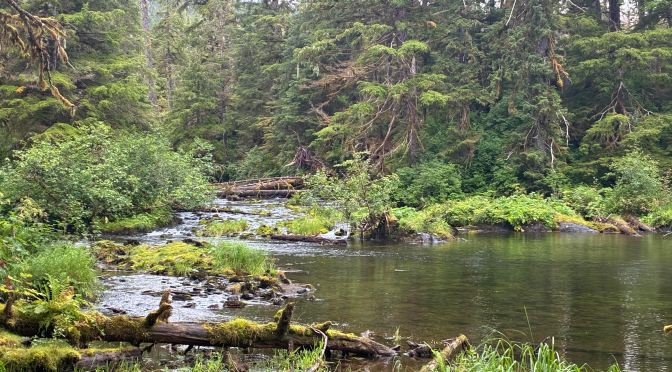
The trail leaves the forest near the winding river mouth. Sweeping curves like paintbrush strokes cut through a soggy meadow of cow parsnip, willow, and the occasional spruce trees. Any semblance of path disintegrates into a slippery “choose your own adventure” of mud that never dries. Furrows in the grass lead to the woods like on ramps from the frequent forays of bears, moose, wolves, coyotes, and river otters. Fermenting pink salmon line the stream in various scavenged states, and a rising gale can’t mask the smell of decay.

Watching the cow parsnip for transiting bears, I slip and slide along the riverbank with the eagerness of Christmas morning. I’m dying to feel a probing tug on the hook of my pink skirted Kodiak Custom and hear the high-pitched whine of line as the water explodes with silvery bolts.

I pause at the final turn to wipe the sweat away. Heat rises from my wool sweater despite the thickening rain. I squat. Both knees crack once. Not bad two days shy of birthday number 38.

There are easier ways to do this. I could take the skiff out, invest in a gill net, finally figure out the paperwork for a subsistence license. Despite her family rarely wielding the “gear chuckers,” Teanna has already canned, frozen, and eaten more salmon than I will in my entire life. It’s a lot of sweat equity hauling out six fish at a time in a 100-liter backpack. Back in August, I’d picked a mountain three miles inland for an alpine hunt; lugging my tent, sleeping bag, and 45 pounds of venison back to sea level.
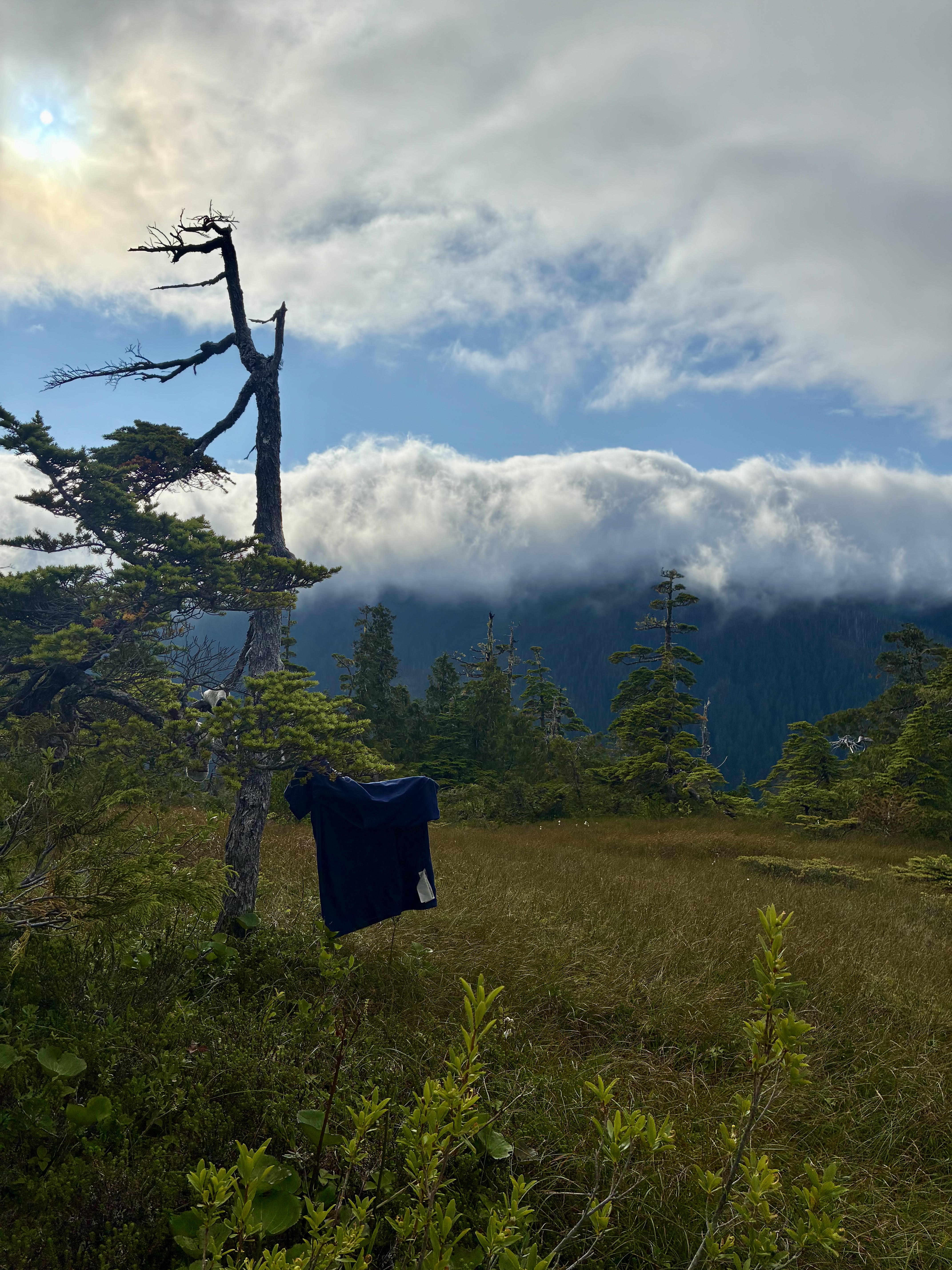
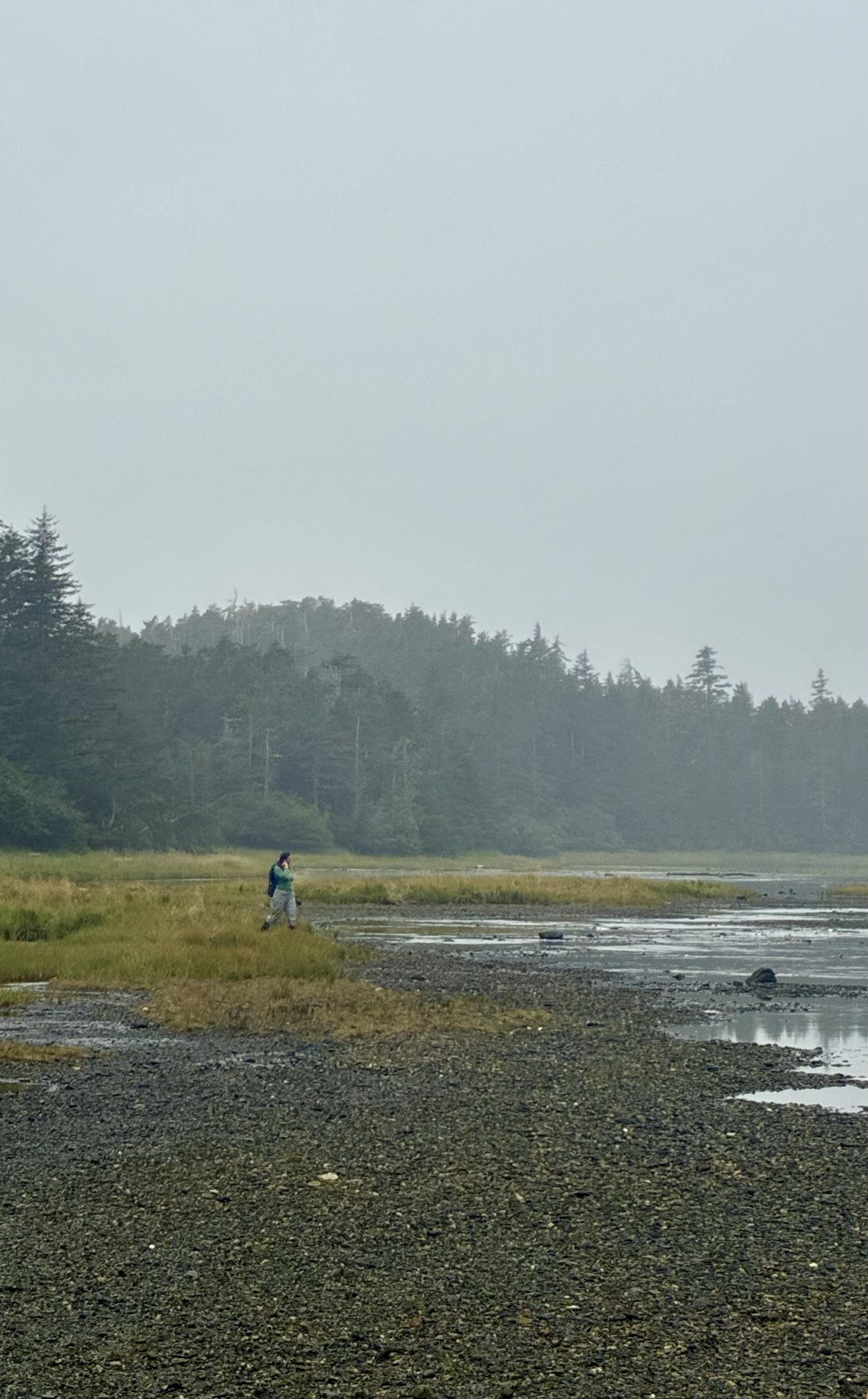
Two weeks ago I’d coerced Teanna into carrying fishing poles through the muskeg along Chichagof Island’s outer coast because I had some harebrained fantasy of catching coho near some tidal slough that wound up being filled with gulls, a pair of brown bears and, to her delight, dozens of eagle feathers.  
I bounce on my toes and feel my twitching leg muscles. That alpine hunt beat me up, but I’d felt like myself again after a good night’s sleep. To the shock of the high schoolers (and myself), I’d dunked at open gym last week.

Everything feels okay. Knees continue to hold up despite the beating I gave them in my teens and early 20s. The back feels alright. There’s some healthy grays coming in around my temples, but I’m not pulling it out by the handful.

I glide the final paces to the first fishing hole. Maybe that was the reason I resisted the gill net and accessible mountains. My body still gave autonomy over those choices, permitting me to beat it up in the name of deer and salmon.

I give the meadow on the far bank a glance before casting. A mama black bear and her cub have been hanging out on this stretch. Teanna, the one person not carrying bear spray on our camping trip last weekend, naturally saw those two plus a brownie and cub on the quarter mile of river she walked alone and with a backpack full of coho. When I marveled at how non-plussed she seemed, she’d only shrugged, given me the mischievous smile she saves for such occasions, and reminded me that the brown bear is one of her crests.

There’s no reason to fear bears, there are plenty of reasons to respect them.

First cast, alone on a river lined with yellowing cottonwood and watching eagles. The pink-skirted lure sinks behind a submerged boulder. Seconds later there’s a flash of silver, the line pops, and I hear the euphoric whir of line being pulled through the water.

“Thank you, fish.” I run my hands over cold scales, the smell of river and life around me. The promise of fillets on dark winter evenings.
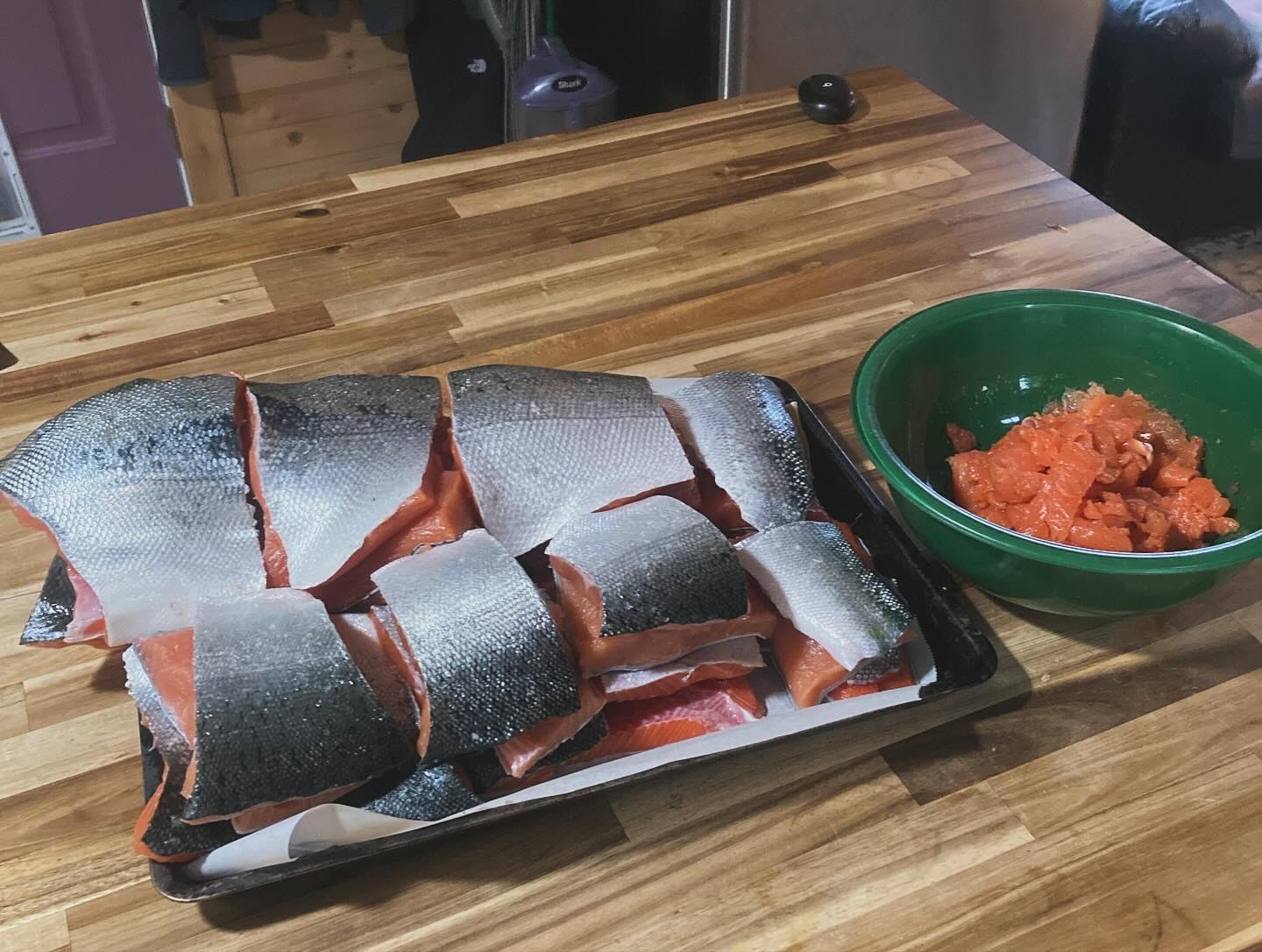
But nothing else grabs the Kodiak Custom. I move on after ten quiet minutes, and at the next bend again feel the line run on the first cast. The rain now falls in sheet; the heavy wool jacket I’d promised to cover in fish scales and deer hide soaked through. It’s absurd to carry fish up the river only to bring them down, but far be it for me to leave free lunch lying around.

 At my third spot, I plunge into the river until water crawls above the knees of my waders. Surely I can’t expect a bite on my first cast again. But there’s the streak of silver. A coho rockets from the water with my pink lure in its jaws. Perhaps the river is telling me something on my final trip. One fish from each hole, a chance to feal my creaking joints and say goodbye to every foot of precious river.

The narrative dies 100-yards upriver. Here I find the mythical “bite.” Coho tickle the lure on every cast. Soon I’m placing the fifth fish on the bank and feeling an ache.

One more.

My friends and I wait all year for these magical weeks. Last night at Kyle’s birthday, all anyone talked about was salmon. We chatted salmon while we ate salmon, and schemed ways to catch more salmon. Today ensures that the freezer and canning jars will be full. There’s no more reason to cast. I remind myself that the hardest word for us to say is, “enough.”

Fish number six takes the lure on the next cast. I look up from the fight and drink in the world. The rain lessens to a drizzle. Ravens call from the forest, and a squadron of seagulls waits to scavenge whatever I leave behind. I want the fish to spit my lure and give me the pretense to linger.

But is this not the day, the moment I’ve waited for? One of the pillars that has kept me rooted in this place? I picture driving home, of Teanna looking up from her weaving with a smile and a wave. How she’ll wrap her arms around me no matter how wet and stinky I am and listen to me recap the morning’s every step.

The fish slides across mud and rock, and I whisper the same benediction.

“Thank you, fish, for giving your life to feed mine. I’ll think of you every time I eat this winter. Please go peacefully into the next life.”

I open the stomach, remove the heart, and watch the pulsing nerves. The river swirls, its wisdom mixing with cries of impatient gulls and the splashes of coho swimming up, up, up.

What we Need the Most

The muskegs are too crunchy. Softly frozen, slightly squishy. Squelching and squeaky. I may as well be banging a tambourine and shouting for a buck to come within rifle range. I think my luck has run out.

Yesterday was the best day I’ve had in the woods. It started before I’d left the beach. A three-year-old buck with spritely forked antlers had been grazing the tideline when I rounded the bend. My rifle wasn’t even loaded. Larry Landry’s skiff wasn’t even anchored. He kindly puttered over and got the buck to camp. He was even generous enough to sound happy for my good fortune.

Back along the beach. Into the woods. I hike for an hour, turn, and find another buck 30 yards away. I feel a little sheepish, and drag the buck along the beach instead of asking Larry or Bill to scoop me up. I’m dripping sweat by the time I reach the cove’s three-sided shelter. My body protests from dragging the buck over basketball boulders and around townhouse erratics.

The way it should be. I want to hurt, to feel the muscles stiffen and for there to be no comfortable position when I lay down. A penance of sorts, a show of respect for the animal that gave its life so I can savor backstrap medallions on dark December days.

I’ve wanted to hunt Pinta Cove since I picked up a rifle. The place holds special meaning. Tucked into Chichagof Island’s northern shoreline near Point Adolphus’ whale-rich waters, I’ve led kayaking trips here and camped in its old-growth trees. When I made my solo paddle to Sitka, it was Pinta Cove that welcomed me after crossing Icy Strait. I’d stood exhilarated and empowered on slippery tidal rocks, savoring the control and freedom that came with my little wooden kayak.

It has exceeded every expectation. Stately old spruce trees lead to swathes of muskeg with plenty of hidey holes in between. This perfect deer habitat vibrates with the mid-November rut, and neighbors Bill and Lewis also drag bucks from the woods. We secure the shelter’s opening with a tarp and crank the wood stove. It’s not cozy, but there’s enough heat to take the edge off our shivers and coax some moisture from our dripping clothes.

Talk centers on the deer we saw, the ones we didn’t, and if the weather is good enough to justify another full day of hunting. We’re running in 16-foot skiffs, sturdy enough as long as the weather stays moderate. Anything more… and the five-mile crossing home starts to feel real big real fast. Larry suspects his skiff has a hidden leak, but I’ve never seen someone so blasé about a slowly sinking boat.

“I’ll check it in the middle of the night,” he says, tucking a headlamp over his neck and under a long white beard.

I’m riding with Bill, and he needs no convincing to spend another day in deer-quiet woods. No one savor the solitude of the forest better than he does.

“Are you going for a third, Dave?” he asks.

I shrug, feeling greedy and a little proud of my double buck day. “I may as well take the rifle for a walk. What else am I going to do? Sit in the shelter?”

I stretch my barking hamstrings and shake some warmth into my toes as I burrow in my sleeping bag. Elated and exhausted as I am, something keeps me from drifting off.

***

When I asked Teanna her favorite meal, she’d answered, “canned venison,” with no hesitation. I’d swooned, and fallen more head over heels for the girl born in Ketchikan and raised on Haida Gwaii. International borders and archaic flight schedules meant it took four flights and four (dollar) figures for us to see each other, and neither of us were interested in a long-distance relationship that required a night in Vancouver’s airport.

So I’d asked if she’d ever consider moving to a swampy glacial outwash in the traditional homeland of the Huna Tlingit. She’d teased me about a Haida girl moving north and glowed when I mentioned the strawberries that carpeted the beach meadows every July.

Haida Gwaii would always be her home, the place where her ancestors lived and flourished for thousands of years, and she brought pieces of her home with her: tight coils of cedar bark, skeins of wool, and multiple looms that required custom packaging to get safely through customs. I watched spellbound as she split dried cedar bark into strands thinner than hair and deftly spun them into wool. From the wool came dainty Chilkat designs, and she could sit for hours, fingers working patiently down the loom until shadows filled the room.

We harvested garden carrots in September, and I dragged her to my favorite Bartlett River fishing holes. I want her to know how much it means that she’s uprooted her life and ventured geographically and emotionally from her comfort zone. Desperately, I look for any sign that affirms the colossal jump she’s taken and fidget at anything that resembles a bad omen. I panic when she hooks her first coho only to have it spit the hook a foot from shore. As if that could somehow undo all we’ve already done.

But beyond the garden and cohos and cranes and introducing her to a never-ending parade of neighbors and friends lies the hurdle I have no power over. The woman I’d taken to calling my Haida Princess may love venison, but her relationship to the animal that gifts it had become contorted and painful.      

***

Crunchy muskegs. Falling moisture that isn’t rain but not quite snow. Thunder clapping footsteps alert deer to my position. Deer wish to see and hear, but be neither themselves.

“So why,” I ask, “would they be in the muskegs?”

I veer right, ducking beneath scraggly devils club and into open forest. Here the ground is soft and unfrozen. My Xtratuffs don’t make a sound as I step over roots and around fallen trees. Blueberry and menziesia bushes fill the space between stoic spruces. These woods feel, “deery.” I can’t say exactly what it is, but something in this open forest sharpens my senses and tenses my muscles. I pivot from feeling lost and helpless to convinced that deer hide behind every hemlock.

Two go bounding past, and I catch rusty antlers rising high over tawny fur. They’re gone as quick as they come. Adrenaline resettled, I swallow disappointment. Every deer feels like the last. A happy accident that will never happen again.

I keep moving. Over a small drainage and up a mossy hillock. Light pierces the forest from a muskeg the size of a baseball diamond. My GPS’s satellite imagery shows bigger woods on the far side, but I’m nearing the limit of my range. Approaching noon and two miles from the beach, I calculate how long it would take to field dress and drag a deer to Pinta Cove.

My window is closing, and I fight the urge to tramp past the muskeg and into newer territory. A deer trail winds into the muskeg. I step into the clearing and freeze.

Holy shit. That’s the biggest deer I’ve ever seen.

He dominates the tiny space. Gargantuan antlers stretch like fingers toward the sky. He’s broadside, frozen in surprise at my appearance. He must’ve been following the same trail from the other side. Preposterous luck brought us here at the exact same moment.

Seconds feel like hours. Reflex is to blow the call, but there’s no need. I glance down to find the safety, and fully expect him to be gone when I look up. He may as well be a boulder. Unflinching, he gives the fumbling hunter every chance.

Scope to my eye. I don’t aim, but muscle memory centers the crosshairs above the shoulder. Lung, heart, lung. They say you should slowly squeeze the trigger as you exhale to keep the shot from pulling. I never remember. See deer. Hit deer. I squeeze with everything I have.

I watch with ringing ears as he stumbles, gathers himself, and flees the way he came. Branches snap and bushes crack as he goes tearing through the trees. Everything shakes. I stare at the place he disappeared, commit it to memory, and start a timer.

A wounded deer may continue to flee if it hears you approach. But if he’s allowed to rest nearby, he may peacefully pass feet from where he’s been hit. I vow to wait ten minutes, marking my location and scanning the tree line. I wait for my heart to settle and feel it elevate instead.

Five minutes is all I can take. I cross the muskeg and pick up the trail. Pinpricks of blood stain the snow amongst snapped blueberry bushes. His footsteps are easy to follow in the scattered snow, and the blood trail becomes stronger and stronger. I find him resting in a stand of devils club 100 yards from the muskeg. The shot wasn’t perfect, but it had been close enough.

Fat, wet flakes fall as I soak my knees and grip his fur. I let out a hoot of amazement as I marvel at the gigantic antlers. The buck is built like me. Tall and lanky, he doesn’t fit the typical profile of a stocky blacktail deer. His beautiful antlers are longer than my forearm, and I admit to coveting them. I munch Clif Bars without tasting them and shiver in the wet snow. I have a long way to go with a heavy, heavy deer. My mind turns to Teanna.

Three deer in two days will be something I always remember, but bringing home burger and backstrap will force her to confront a grief she hasn’t told me that she’s ready to face. Two years previous, she’d been bent over a leg of venison when the phone rang. Before her aunt picked up the phone, Teanna knew what news was coming. The smell of raw venison, the feeling of cold flesh on her hand, became synonymous with the news that her mother was gone.

I would bring that memory to our door. I feel guilty, as if I have cruelly forced her to recall her saddest and darkest moments. I crouch beside the buck, and some of my elation melts with the falling snow. The smell of the rut clings to my sweater and rises through the gathering fog on a gentle breeze.

Wings rustle, and a raven lands above me, looking down on devils club, dinner, and a man who is coming to understand how little he knows. I gaze at the charcoal black bird and search the dark face for darker eyes.

“Shanteh?” I ask.

Haida culture is matrilineal, children inherits their mother’s moiety. Teanna is a raven. Like her mother, grandmother, and every other of her mother’s female ancestors since time immemorial. A raven of the brown bear, wolf, double finned killer whale clan. 

I think back to the ravens that followed me on previous hunts, or paused to watch with quizzical eyes as I walked the docks or explored the forests. Was she watching me? Keeping tabs on the man who would one day tell her daughter he loved her? Perhaps more than one Haida woman now resided in the Icy Strait corridor.

Words fail me. Whatever hero complex that once inhabited me has long been purged. One of the hardest truths I’d learned was that there are things my love and affection cannot fix. There are times I can help and perhaps make hard days a little brighter, but sometimes there’s nothing to be done but hold her tight, hear her tears, feel her pain, and accept that’s the best I can do. It’s a helplessness I struggle to swallow, but am learning to choke down like a child eating vegetables. Trying to fix what I cannot only makes things harder.

My knife slide across the deer’s belly under watching eyes. I clutch the heart in my numbing fingers and savor the warmth. I still can’t speak, but I lift the heart skyward. The raven’s call echoes through timeless trees, and she takes to the air, leaving me with a lonely drag and conflicted heart.

***

Lewis drops me and my three deer off in the driveway. I give a wave and stamp warmth into my toes. The work begins now. I’ve never processed a deer at home, let alone three and I’m really not sure how to begin. I arrange the deer in what I feel are respectful poses because I don’t know how else to start.

Teanna pads down the trail. Despite the fact that she knew what I was coming home with, I feel the instinctive need to shield the deer from view. Her jaw is set, and amber eyes shine with defiance and strength. One deer at a time, we share the long hours of cutting, grinding, canning, and wrapping the emissaries of the forest that will feed us all winter long. I watch her out the corner of my eye for signs of distress or pain, but Teanna stands by my side as butcher paper flies and the smell of deer sinks deeper into our home’s hemlock paneling.

I thought I’d given her no choice but to face her grief head on.

“It’s mom telling me that it’s time,” she says. “Those 3 deer finding you was a sign that it’s time. I will always associate the grief and heartache of losing mom when I see, butcher, and eat deer. But now, you’ve shown so much respect and care for me and everything around us, it puts my heart at ease knowing those memories can become synonymous with ceremony, rather than violence.”

I see ravens all the time. Hopping along the roadside and standing sentinel in the trees. Teanna has taken to leaving salmon scraps for the mated pair nesting by the house. I don’t know how many of the ravens Shanteh is watching through. The mystical and magical don’t need explanation. It’s enough to feel that every raven watching me is a reminder of the person I love and the long, winding trails we took to each other.

“Hi Shanteh,” I call to the dark flapping wings. “Good to see you. Your girl is happy and loved and safe.”

Jello Shot Edicts

Sparks fly into inky sky, and the fire burns just bright enough to sharpen the pine tree’s silhouettes. Little tea lights in clear little buckets and mason jars lead the way down the road and through the trail like scattered jelly beans.

Breanna and I ping-pong between the cabin, shabin, and fire pit, toting folding tables, food, and tequila. I don’t remember what year the ‘Wassail’ tradition began in the Good River neighborhood. In essence, jolly residents travel from house to house for cocktails and food to celebrate the winter solstice and the promise of returning daylight. It’s the closest we get to a bar crawl around here. The tradition has steadily grown as friends from other Gustavus Neighborhoods make the pilgrimage down our meandering roads that this year are covered in an inch of ice.

The last time I hosted, the cabin had a single floor and no insulation. The wood stove was in place but not ready for installation. Everyone crowded on the plywood floor and gazed at exposed rafters, slapping me on the back and promising me it was going to be a beautiful home. I smiled and tried to imagine the place in some semblance of completion.  

***

Christmas lights complete the trail to the bonfire. Headlamps filter through the trees, laughter and song precede the incoming revelers. We’ve filled two tables with venison sliders, chips, cookies, punch, and lime-flavored Jello shots.

“I’m pretty sure we’re the first people in Wassailing history to serve Jello shots.” I say as we high-five.

We sample our handy work.

“Damn,” I wince, “we made’em strong.”

“Too strong?” Breanna asks.

“Nah. Perfect.”

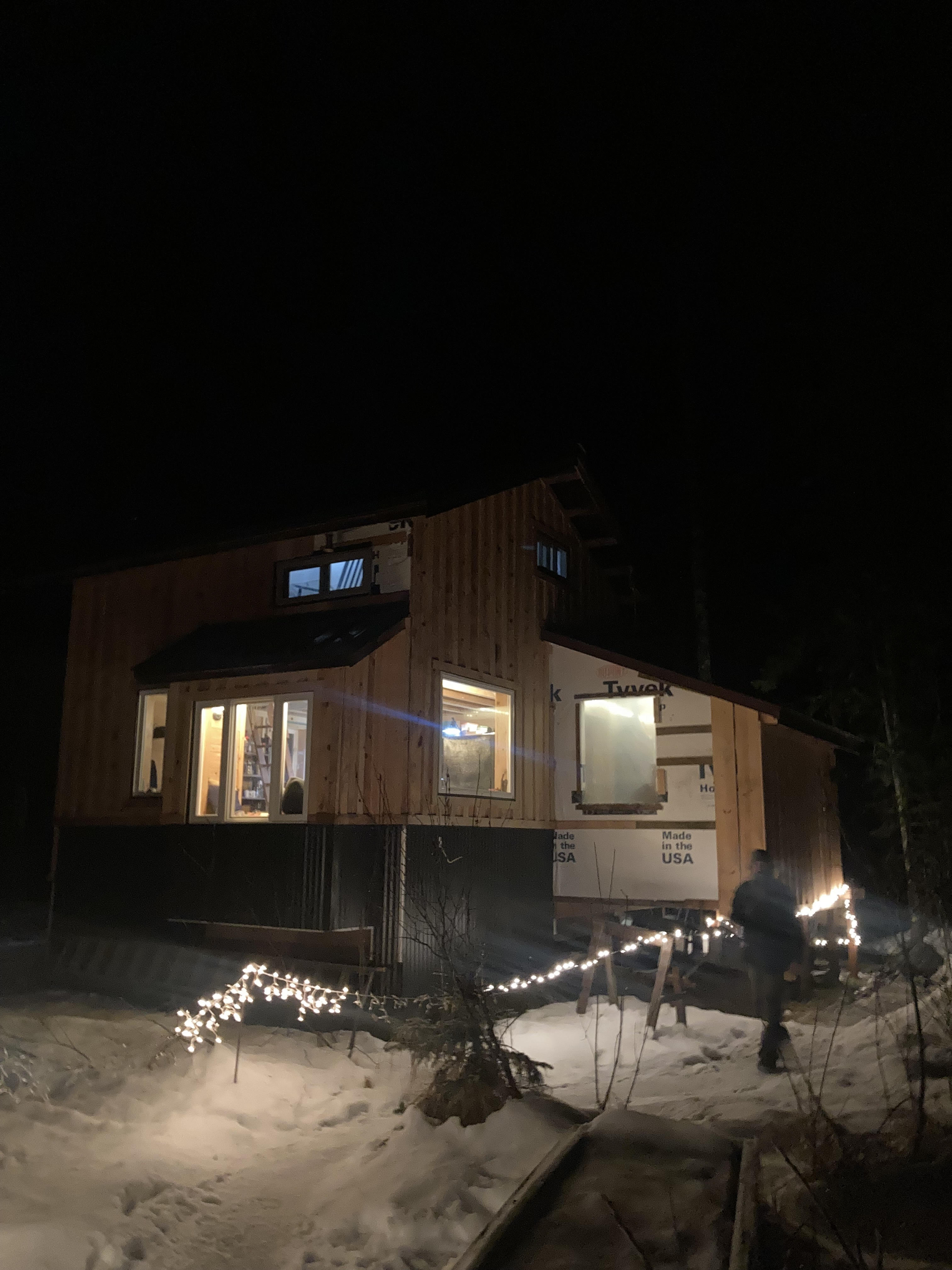
Breanna pours cocktails while I dispense food and keep stealing glances at the cabin. I love how it looks from this angle, with the soft glowing lights peering out the windows.

I missed this tradition last year, choosing to spend Christmas with my folks in Eagle River. I needed distance. Couldn’t wake up December 25th to Minerva and a quiet home. I listen to everyone’s laughter and watch the Jello shots steadily disappear. I was afraid we made too many, now it’s looking like we’re gonna run out before demand does.

The majority of the people slurping Jello and munching potato chips have picked me up in some capacity over the last year. Checked in on me, invited me to dinner, or simply listened. I breathe through a knot in my chest and join the crowd clustered around the fire.

Don’t get me wrong, I love these people. And man, does it feel good to be a part of this rambunctious neighborhood. I remember growing up and hearing some version of the phrase, “The holidays can be a difficult time of year.” That never made sense for a guy who never had much reason to be sad; it makes more sense now.

I crack a beer and chatter about where to find deer when the weather turns cold and windy, my favorite fishing spots on the Bartlett River, and if the rain will ever turn back into snow. Food and drink exhausted, the crowd rambles on. Breanna and I shove the remnants in the cabin and follow the footprints toward the next house.

It took a while to accept that someone else wasn’t going to fix this, share the weight, or better yet, remove it entirely from my shoulders. Grief and hardship don’t work that way. Contrary to Hollywood and countless musical tracks, burdens can’t be lifted by outside sources. But friends, family, laughter, jokes, hugs, and, yes, Jello shots make it a hell of a lot lighter. You’re not alone if the holidays feel a little heavy. It’s okay to ask for help, to lean on loved ones, it’s okay if you’re not okay. Believe that one day you will be.

***

“Slippery out here,” I mutter as we shuffle down the road for Tim and Katie’s.

There are no street lights in Gustavus. Stars and northern lights pop when the clouds allow. On overcast nights with little snow, the roads are just a different shade of black. Small candles lead the way, providing just enough illumination to see one foot in front of the other.

Darkness is the theme of the solstice, a celebration not of the lack of light but of the promise that brighter days are on the way. It may be imperceptible at first. What differences can a few seconds make? But those seconds add up, they turn to minutes, half an hour, an hour. Sometimes life emulates the pivoting sun: impossible to discern the longer days or if the sun is getting warmer. But those long, sun-kissed days are coming. Until then, there’s nothing to do but follow the candles down the road. May they lead you to a warm home.

Climb That Mountain

It’s been almost four years since the inception of Raincoastwanderings. I had no delusions of grandeur, of it drawing a large audience or translating into a job at Orion or Outside. It wasn’t going to make me Krakauer or Kerouac. And just as I predicted, it hasn’t. The biggest posts get maybe a couple hundred views, and I assume most of those are from my dear mother loyally visiting on different browsers to inflate the numbers. But that’s ok, for almost four years my mantra has been, “if one person is reading, I’ll keep writing.”

Raincoastwanderings has been a sort of public practice for me. If I knew one person was reading, that was enough for me to sit down and try to construct a narrative that was appealing and entertaining. Flooded with typos early on (and still making frequent appearances), I look back at some of those old posts and grimace. But this blog online journal marks the moment I sat down and vowed that I was going to make a legitimate go at this writing thing. The community that has supported and encouraged me over the years is humbling. So to all of you who have put up with me spamming your Facebook feed and inbox, thank you very much.

With that said, Raincoastwanderings is going on hiatus. Over the past few months it’s been difficult to give the site the attention it needs as I’ve been consumed with editing and submitting my first novel. That process is done for the moment and I’m now in the position of waiting and praying that some editor believes as much as I do in my 80,000 word baby. The good news and bad news is that for the next two months I still don’t foresee having much time for Wanderings.

I’ve been contracted by a travel company to edit and rewrite the Denali section of their upcoming travel book. The chapter is due in late June and it’s the opportunity that I’ve been working towards since I started writing. There is absolutely no way that I would have this chance without this forum and the people that have loyally followed it. So again, thank you for your encouragement, kind words, constructive critiques, and good humor. It has been a blast to keep this going all these years and I fully intend on returning to it once I hit ‘submit’ on the Denali chapter. Until then, I do intend on writing occasionally for the Inian Islands Institute and my work will hopefully be posted in their online journal. If you’re so inclined you can check here for occasional updates on the amazing work they’re doing.

Several Christmases ago, a certain individual (who rest assured is not reading this) climbed atop Mt. Soapbox and let me know that I couldn’t, “ride my skateboard forever.” Five years later I’m getting paid to ride the skateboard I’ve allegedly outgrown. And if the book ever gets published, he’s going to wake up to a box of them on his front porch, sitting on a skateboard.   

In the words of Jack Kerouac, “because in the end, you won’t remember the time you spent working in the office or mowing your lawn. Climb that damn mountain.”

Thank you all. Bless the harbor seals.

The Lab

Inside the lab, all I can smell is cedar. It’s the first thing I remember about it and I imagine it’ll be the last thing too. The tall legged chair has a low back that digs into my Sacral vertebrae. Paul didn’t have 6’4” Wookies in mind when he designed this place.

Precious little has changed about the lab since I first walked through its doors nine-years ago. The computers have gotten fancier and the tape deck has been replaced by the miracle that is digital recording, but that’s about it. The windows are still stained, the dorsal fin shaped piece of driftwood still sits in the corner, the Auckland Town Hall “Save the Whales” poster is still tacked to wall. It took place at 7pm on June 10th, 1981 if you were wondering. I was -7.5 years old.

No, this place feels the same. The Orcas still call at all hours of the day. Tonight they’re in the strait. Cracroft Point in both ears, Parson Island in my left. A ping in both ears, an echo in the left. A whistle in both, an echo on the left. I close my eyes and I can see them. By their volume and echoes I can place them. Vancouver Island side, probably milling which would explain the random changes in volume. I lean back in the chair, feel it dig into my back, and let the whales take me away.

And as I do, the dull ache returns. Not in my back, but in my chest. The one that’s emerged each time I’ve looked at something fondly the past week. That nasty, horrible reminder, that my time’s almost up. I’ve spent 23 non-consecutive months here. It would be cliche to say it feels like I just got here yesterday. But dang it, it does.

I came for the Orcas. I came to learn everything I could about them at the feet of a master. I came because I thought Paul Spong held the secret to spending your life studying them. Nine years ago I arrived wanting to learn how to be someone else. Now, I’m leaving finally ready to be myself. I am not a scientist. I’m not cut out for research papers or grant proposals or laboratories. I’m not cut out for non-profit fundraising and holding onto my own foundation by the fingernails. I wanted to be. Thought I was supposed to be. But I’m not. I’m no more a scientist than a basketball player.

And that’s ok. Orca Lab told me that lovingly, patiently. Over countless nights in the lab, watching Parson Island fade into darkness. I may stand at the side of great scientists and leaders and advocates, but that is not my voice. My voice, my home, my Hanson Island as it were, is right here. With my fingers tapping against keys, uninhibited by the rigors and (necessary) walls of science. We need both. Science tells us we should care. But it is our emotions that make us do so.

And so saying goodbye to this place will not be as simple as closing the door to the cabin for the last time and missing the southeast storms and snap of cedar in the fire. It’s saying goodbye to the place that gave me purpose. I’m not unique in this regard. I’d wager that everyone that has set foot on this place has a story they can tell about how their life has been altered by Orca Lab, Paul, and Helena. What unspeakable beauty is there in that? That in a world where hatred, arrogance, and selfishness seems to be growing at an exponential rate, there is a place that can teach us how far love and compassion and appreciation can carry us.

“I feel most secure when the woodshed is stocked and there’s a fresh loaf of bread on the shelf.” – Paul Spong.

Overcoming Doubt and Listening to Abbey (Not the Road)

It’s hard to imagine having a mid/early/late life crisis here. In a place where on any given morning the ocean turns sapphire, the forest yields every shade of green imaginable, and Orca’s call in the dead of night. But it happens. We’re reminded that our unconventional life is a societal outlier. 27-year old’s are supposed to have reliable mailing addresses. Maybe a mortgage and a baby room. Quaint, bustling, hard working, picturesque. It’s the American dream, the American way. At least it was until it wasn’t.

But this doesn’t stop us from considering that maybe we are doing this all wrong.  Seeds of doubt can germinate and grow quickly if we allow them to. Swimming upstream can be tiring. A writer? Who reads anymore? What makes you think that what flows from your mind and through your fingers will capture a world that would rather scroll Facebook than turn pages? This is all well and good, but shouldn’t you shelve the dream, move on, get a real job.

As an uninspiring “mentor” from my church going high school days told me, “you can’t ride the skateboard forever.” He admonished when I told him what I was doing with my life. “Have you ever seen a 60-year old on a skateboard? You’d think something was wrong with him.” Every now and than his voice gets in my head. My fingers tremble, my words seem trite, uninspiring. I pour another cup of coffee, sit with the Harlequins in the cove, take a deep breath, refocus.

Our fear and self doubt manifests itself in different ways. I bang my head against the writer’s block, Brittney scrolls through house plans. She looks at property, checks the bank account, shakes her head, and refreshes the Real Estate page. We have a target now, a landing strip. Gustavus, Alaska. 400 people, 400 moose, one life changing national park. Now if we could stop flying long enough to land. A body in motion stays in motion, one at rest stays at rest. After five years together, we’re still in motion. New Zealand, Juneau, Gustavus, Seattle, British Columbia. I love it. I’ve pushed past my fear, my self doubt, at least for now. Be a writer or starve to death trying. Brittney says she’s ready for the house. My little tumbleweed wants roots. I can’t blame her. Gustavus fits us as good as we do each other. A warm sweater on a crisp fall day.  I love sweaters, I’m wearing one right now. But at some point in the next hour I’ll want to take it off. I’m not ready to wear it forever.

I could have it all right now. The house, the mortgage, the lawn in need of trimming. But I wandered off that road a long time ago.

“Petroleum is Alaska’s present and future.” I was reminded throughout high school. The gateway to, if not fame, certainly fortune. On the backs of industrial giants, we will ride Alaska into an age of wealth and opportunity that we can only imagine. We’ll dig the spurs in deep, push her into a gallop. For nothing should stand in the way of growth, monetary opportunity. All this, I was told, could be mine.

“If you want to make money, live a comfortable existence, petroleum engineering is your best choice.” Grab a straw, stick it in the ground, suck that sweet nectar until it’s empty. Life, liberty, oil subsidies, and the pursuit of happiness.

 What if I don’t want a comfortable existence?

No one talked about what those that wanted to sit on the rocks and count Orca’s should do. Or if you loved the philosophy of fitting everything into one rusting Pathfinder that you prayed would start.  If it doesn’t fit? Give it away. You don’t need it. There was one definition of success, and it could be found in your bank statement.

Now? Oil is going for under $2 a gallon. The state is bankrupt, people panicking. The kids that grabbed their straws are realizing the glass is emptying fast. If the money disappears will they still enjoy what they do? I sincerely hope so. Will the industry rebound? Maybe, probably, I don’t know. Ask British Petroleum, Shell, or a state senator and they’ll say it has to. Alaska needs it, can’t live without it. The voice of the addict. Without oil, Alaska will be like Maine. A nice place to live but not a great place to make money.

As my friend (and writer) Kim Heacox says, “what’s wrong with that?”

I hold Brittney’s hand, squeeze it softly, pull the computer away from her. I know that look, know that fear, understand that desire to have a place to call home. She wants to build an apothecary, bring natural healing to Gustavus. She wants open mic nights, a vegetable garden, the slow bike race on the fourth of July. But she also wants Hanson Island, the open road, the freedom that we enjoy that we’re debt free. She admits she’s not ready to give that up yet. Maybe in a year or two, or three, or thirty. I want all those things too. But we can’t have both. Maybe if we invest those Permanent Fund checks our bankrupted state keeps giving us we can…

Not everyone is meant to live like this. That’s fine. That’s a relief. There aren’t enough Hanson Islands  or Gustavuses to go around. I ferried and drove to Orca Lab on the miracle of petroleum pulled from the ground and refined in a factory that pushes more carbon into the air than the globe has seen in millennia. Does that make me a hypocrite? Maybe, probably, I don’t know. Edward Abbey said the job of the freelance writer was to criticize and inspect the country in which he lived. Consider me his disciple, just trying to do what he expected. Good old Abbey. Doing what he loved until the very end. His buddies snuck him out of his death bed in the hospital he hated more than roads through national parks and let him say goodbye in the desert.

They inscribed on his tombstone: Edward Abbey. No comment. I like that.

Where do I want to say goodbye? Gustavus or Hanson Island? I can’t decide. Mercifully I don’t have to, and God willing, I won’t have to for a long time. We’ll see how far our skateboard carries us.

Making Alaska Safe for Cows

The concrete bends right, but straight ahead lies an unassuming road. Covered in dirt and gravel, trees arch across the entrance, casting deep shadows beneath the tunnel of greenery. No street sign marks the little road as we bypass the hairpin turn and shining sun for the shelter of the trees. Ten minutes later we reach the end of another skinny one lane road masquerading as a driveway, grass stubbornly growing down the middle track. A series of wooden buildings and a small stretch of lawn lay surrounded by the forest, the structures seeming to melt slowly into the woods’ outstretched arms.

The picnic table on the lawn groans under the weight of plates filled with venison, salad, rhubarb cobbler, and brownies. From the nearby trees the squirrels chatter jealously and I look up in down the table. I find myself surrounded by men of words, science, kayaks, and hilarity.

Across the table from me sits Kim Heacox, part John Muir part 13-year old boy though his birth certificate insists that he’s a few decades ahead. He’s the reason I’m here, the reason there’s a blog (I really don’t like the word blog, how about “Thought Journal”), the reason I write. On my left sits Hank Lentfer, responsible for the venison on my plate and several books in our library, followed by Zack Brown who had walked off the Stanford campus, PHD in hand and hiked and paddled until he reached the Gustavus shore. And finally, Peter Forbes, writer, non profit adviser, farmer. Nervously, I glance around the yard, undoubtedly there’s a kid’s table where I should be seated with my knees up to my ears.

Instead I find myself a part of a community that I have done nothing to become a member of. No initiation, no rights of passage, simply because of our deep love for this place, for the woods, for the future of the world. Because no one ends up in Gustavus by accident. You inherit a family you didn’t know you had. I cut my venison and listen as Kim’s boundless energy spirals the conversation from topic to topic.

“The best thing about visiting down south,” he says, “is the chance to watch all of those Alaska shows and see how we’re supposed to be living.” He finishes with such earnest sincerity that everyone looks up as if to confirm his sarcasm.

“I really like the one in Homer.”

“The guys with the cows! And the guns! Gotta move the herd across the flats before the tide comes in.” His voice twists into a passable southern accent, “is that a wolf?” he mimics a gun being fired, “got him!” And there’s humor in the tragedy of his recreation. “Gotta make Alaska safe for the cows!”

“The only problem, is that doesn’t look very good on a license plate. Alaska the Last Frontier sounds a lot better than: Alaska! Slowly Becoming Safe for Cows.” I say and his laughter is infectious.

It’s impossible to sit at the table and not be inspired. Hank and Kim’s books fill thousands of pages, tapestries of words and phrases I can only dream of writing. But here I was, doing my best to turn my mind into a sponge; listening, writing, and most important of all it seemed, laughing.

As the bugs fill the night sky and the sun ducks beneath the trees everyone slips into the house, the guitars come out, Zack pulls out a violin, and Eric Clapton makes the windows shake. I sit at the table, thumbing through an Orion magazine as Hank and Kim belt out Midnight Rider and as I glance out the window at the blue tinged yard in the evening twilight reach a beautiful epiphany.

It was Orca Lab all over again. A beautiful, undeserved gift. Replace the trees with ocean, the music with hydrophones, and it was the same. Emotion wells inside me at the incredible mentors, heroes, and now friends that had entered my life and the inspiration and motivation they’d filled within.

A Worthy Excuse

The sun finally glides below the outstretched tendrils of stand of spruce trees that line the yard, casting our house abruptly into twilight. A twilight that arrives at 8:00. Down the hall the washer growls and snarls as it tosses salt soaked wool and polyester in preparation for tomorrow.
On the edge of the couch I crouch, hunched over a laptop, back bent strangely as the muscles still struggle to loosen after digging into the seat of my kayak. The beer’s helping though as I take a sip, squint through my sun fatigued eyes, and type furiously.
Deadlines are never fun. What I really wanted to do was submit to the waterfall of hot water that Brittney was reveling in at that very moment. But the paper I’d snagged off the freelance website was basically done, good enough in fact.
The laptop snaps closed decisively and Porter raises his head a quarter of an inch, fully attuned to the room’s shifting energy. He shoots an optimistic look towards the sliding door and his playground beyond. A land of voles and dogs on what he hoped were reinforced tethers.
“And coyotes.” I remind him as I slip through the door and slide it shut behind me.     Too apathetic to even shoot me a steely eyed glare with his glacial eyes, he drops his head back to the edge of the couch, tail twitching indignantly.
In Gustavus virtually everything is within two miles and the Pathfinder sits neglected in the dandelion infested gravel driveway. A pair of easter green bikes lay haphazardly placed on the small concrete slab we’ve taken to calling a porch. 
    Brittney’s chain falls off reliably every half mile while the ring that holds my handlebars has been replaced by duct tape, the hand grips pointing down towards the ground, leaving me to grasp the very center of the handles like some lost and befuddled Lance Armstrong. But it moves when you peddle and the grocery store with our version of “lightening fast” internet isn’t far away.
How ironic, that in a few months, we’d be on an island in which we comprise two-thirds of the population and we’d be luxuriating in fiber optic cable internet. Granted, indoor plumbing and hot running water will have gone the way of the amish, but Netflix would be but a click away.
While here, in the crux of civilization, population 360, you had to bike a mile to reach a connection that would load your gmail sometime between now and sunrise.
The gravel road is inundated with dust. Even rain forests can have droughts, we just measure them in days instead of weeks and months while the salmon swim in holding patterns waiting for the rivers to rise and open the doorway home.
I glide through the stopsign at the lone intersection as the clock strikes nine and glance over my shoulder. Saturday night and the only restaurant in town was shutting down, another wild weekend. I look back ahead and hear my breaks squeak. Unbeknownst to me. My twilight cycle is not solitary.
A high patch of grass sits fifty yards ahead on the road’s left bank, a comma between two gravel driveways. Settled in the middle is a Gustavus lawn mower. The moose glances up nonchalantly, its mouth moving in the hypnotizing manner of ungulates, somehow horizontal and vertical simultaneously. At my sudden stop she takes an uncertain step towards me.
If she wants the road it’s all hers and I slide my bike to the left and onto the drive, opening up an avenue up the road or across toward the wooded ditch on the far side. She considers her options for a moment longer, and with an air of completely deserved entitlement begins to saunter across the road for the ditch, her hooves echoing on the concrete.
I watch her slow gait away, wishing she could stay longer instead of conceding to the higher powers of the willow on the far side that demanded her attention. Never breaking stride she vanishes into the wooded ditch, deceptively hidden from view like a magician’s illusion.
Hoping back aboard the bike I peddle past, she’s completely invisible, but this is not a stealthy phantom and her heavy footfalls let loose the crash and crack of brush cracking and bending to her will.
The yard in front of the store is thankfully moose free and I open the laptop to finish the days work, my mind already in a lava hot shower, steam billowing like campfire smoke.
“Here’s the assignment,” I scribble fast, “hope it works for you. Had to wait for a moose to clear the road before I could send it off.”
I smile at the beautiful inconveniences of my eden and hit the send button as the moose crashes through ditch 100 feet away.