Tag Archives: Canada

The Question

There’s not much in the way of trails around here. Not that it’s too important on this island. Enough old growth is still around that the undergrowth is open in a lot of places. It’s easy to get lost, easy to get carried away walking through those big old trees. Especially on days like today after a heavy rain last night. The afternoon sun slashes through the trees like a sword through fabric, illuminating the mist rising from the moss choked floor. Water droplets cling to cedar needles like diamonds on a necklace. An iridescent glow in each one holding a little flicker of the sun.

Today I’m poking along a stretch that’s part trail part tree root. I hop a stream threatening to be promoted to class five rapids after the downpour. Soon after the trail becomes more defined. I take a deep breath. It feels so good buried in the woods. In Japan they have what they call forest bathing. In simple terms it is nothing more complicated than being in the presence of trees. The idea is that the air doesn’t just taste better in the woods, it actually is better. Essential oils like phytoncide found in trees actually improve immune system function. The forest isn’t just a tonic for the soul like the apostles Muir and Thoreau wrote about. It’s like taking vitamins.

I’m walking this trail to see someone who knows that better than anyone. I’ve written about Walrus several times before. For those that don’t know who this incredible man is, here’s the cliff notes version. Walrus is a walking talking hybrid of Radagast and Dumbledore. He inhabits what he likes to call, “Canada’s longest active logging road block.” He settled on Hanson Island after years in Greenpeace and helped Hanson Island—Yukusam in the Namgis tongue—gain protection from logging. Today he has a long white beard, eyebrows as long and thick as caterpillars, and a high pitched laugh that is infectious.

In my backpack is ten pounds of dog food for his creme colored bear of a dog named Kessler and fruit, carrots, and granola for his master. I tighten the straps of the pack and dig in my boots on the muddy trail as the incline steepens. Walrus’ road block came to rest about a hundred feet shy of the highest point on the island. Every now and then I hike food up the hill to him. It became dire last week when Walrus walked down the hill to the series of rubber totes he keeps near Dong Chong bay to collect some food he’d left only to find that something had gotten to Kessler’s food. 10 pounds worth. Be it bear or wolves we still don’t know. But neither of us has seen a deer in weeks. And deer don’t disappear because of mischievous black bears. So we’d brought Kessler an emergency bag of dog food last week. And had restocked for him in Alert Bay a couple days ago.

As I climb my mind drifts, thoughts mixing with the ravens and Stellar’s Jay above me, my mind drifting to what I’d been reading before I left the lab. In the last week a tanker ran aground near Bella Bella. The support vehicle sent to assist swamped. The containment booms set out to minimize the impact were as useful as a fishing net. The spill was minimal, as minimal as one can be at least, an insult to the very phrase, “low impact.” A low impact oil spill is like minor surgery. It isn’t minor if you’re the one getting cut open.

I’d followed the stories through a guy named Mark Worthing. A Walrus disciple and friend of Orca Lab who has committed his life  to keeping the final stands of old trees in British Columbia standing. In his free time he fights back against the proposed oil tanker line that would cut through the Great Bear Rainforest, one of the pearls of world. The only region in North America where wolves were not almost exterminated. It’s a place where people find Spirit Bears in the woods and God in a sunset. It’s also a maze of islands, reefs, and rocks that gets hammered by 50 knot winds in the winter. All it takes is one tanker. One mistake. One gashed hull. And it’s gone. Ask Prince William Sound. And so Mark fights, because life would seem pointless if he wasn’t fighting for something much bigger than himself.

And then there’s Zack Brown back in Alaska, founding a research and education institute on the Inian Islands to the west of Gustavus. He hiked and paddled from San Francisco to Gustavus in a tidy three months. He’s a voice for climate activism, a voice for change, and he does so eloquently, something that doesn’t always happen when we speak passionately. I used to idolize athletes, now I idolize activists. If only they made trading cards.

My legs are shaking. I set the backpack down on a rock and plop down in the mud next to it. Sweat runs down my face, steam rises from my back. What am I doing? I gave some money to Bernie Sanders, ride my bike when I can, talk about saving the world. But is that enough? It’s a question every conservationist has asked themselves. We see a world that’s in danger. In danger of being steam rolled over by the great construction firm of progress. Lumber over woods. Oil over spirit bears. And we wonder if what we’re doing is adequate. It’s hard when our efforts aren’t visible. Riding your bike doesn’t correlate to a healthy calf in the southern Resident Orcas. Nor does eating vegetarian ensure a healthy salmon run.

I pull the pack back on and start back up the incline. It’s a question I’m still struggling with as my breathing becomes more and more ragged. I spend my summers representing the natural world from the seat of my kayak, and the winter writing about it. My audience is only a couple hundred people, maybe that’s a start. Maybe the people I show sea lions and humpbacks to in the summer are starting dominoes back home. Maybe they took something back from Glacier Bay besides pictures and cover photos.

I round a final corner and Walrus’ cabin comes into view. His area is ringed with a Salal fence, the flexible trunks of the bush intricately bent and woven together to keep the deer away from the garden. Does it work? It does not. You would think a 90 pound dog would keep them out. But Kessler has been known to watch deer amble by ten feet away with nothing more than a sniff. He jogs up to me as I approach, ears up, tail down. We go through this song and dance every time. He can never remember me. He gives a half bark, turns and runs. From the cabin I hear Walrus call out and I smile. The question still lingers, but for today I have a purpose. I’m bringing the caretaker of Hanson Island lunch. And for now, that’s enough.

Hanson Heartbeat

The windows creak and groan. The world outside them is pitch black but I know tree branches the shape of withered arms stretch their wood clad fingers toward the cabin’s walls. The ocean pounds. It sounds so close I expect the next wave to come barreling over the porch and set us adrift in the sound. It’s the first storm of many, I’ve spent the summer dreaming about them. There’s something in the forty knot winds and blasting rain that’s soothing, secure. Hunkered down with the fire roaring and the cat asleep on the back of the couch. Just as long as the boat’s ok where it’s tied up in the back of the cove. It is isn’t it? I should go check.

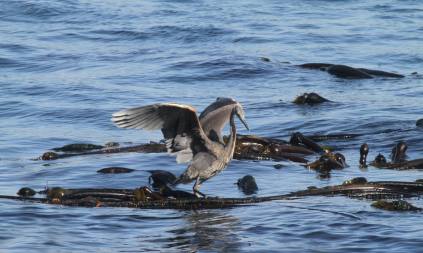
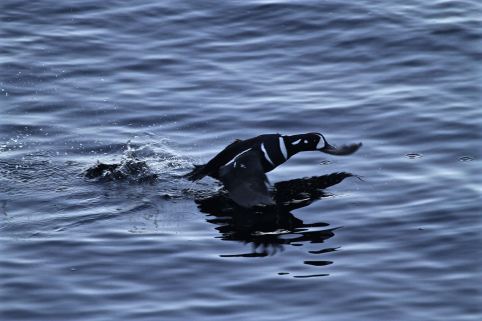
By morning it’s subsided. The low pressure monster taking a deep breath, preparing for the next exhale. Harlequin ducks poke their multi-colored heads out from behind the rocks, Sea Lions return to the haulout, Herons again perch on the worn out kelp that has been buffeted by waves for the last 12 hours. And like all the critters, we poke our heads out our door. All the roofs are still in place, the lab still humming along. All that’s changed is the growing collection of fallen branches and golden fingers of the Cedar trees that populate and soften the forest floor.
harlequin
If only the rest of the world was like this. Half a day of insanity and turmoil before everything returned to it’s relaxed state. Humpbacks in the pass, seals munching fish, deer scavenging for the kelp that just couldn’t hold on anymore. But human nature doesn’t work like this. Every day some new scandal flashes across the screen. It is the quintessential train wreck. I want to look away so bad but can’t. My stomach tightens as I scroll through article after article, my heart pounding against my ribs, eyes becoming glazed and unfocused.

How has it come to this?

Assault, repealing amendments, threats of political violence, the laundry list could go on for pages. Dear God, what century is this?

I step out onto the rocky face opposite the lab. The point here sticks out into Blackney Pass just a little further, but the difference is noticeable. Sea lions cruise by, calm and serene. They’re exhalations are like small explosions, as if there’s something stuck in their throat. After watching them gulp salmon whole it wouldn’t be a surprise. But it’s just business as usual for the pinnipeds. Eat salmon, have a nap, yell at your neighbor on the rocks.

Six big boys swim past not ten yards off the rocks. Even from the relative safety of the point I stiffen. I’ve spent enough time in a kayak to know these guys make me uneasy. I’ve been followed, growled at, and watched them zoom inches below my seat, feeling the kayak rise and fall as they passed. But they seem as unsure as I am. They stop off the rocks and we stare into each others eyes.

They’re a comical looking animal when you see them straight on, bobbing like corks. They have this perpetual look like they’re always surprised. Like the monster just jumped out of the shadows in a slasher movie. I wait for them to dive away and leave me be. But they stay. The curious magnetic quality of sea lion dynamics occurs, more and more appear out of nowhere. Appearing from their hidden trap door on the ocean floor. Seven, eight, nine, ten. We speak without making a sound.

There calmness unsettles me. I want to scream at them. “Do you realize what’s going on? Do you know what could happen on November 8th? Didn’t you read what he said now?”

The group blinks in polite puzzlement before disappearing beneath the waves. Thirty seconds later they’re back. My breathing is unsettled. I went for this walk for two reasons. To harvest mushrooms and leave the rest of the world behind for a bit. You’d think that’d be easy on Hanson Island, but it isn’t. There’s a sense of helplessness being so far away from it all in times like this. There’s nothing you can do but refresh the news and pray. I stare at the sea lions and they snort in my direction, nostrils flaring.

 I wish I could be more like you.

Wish I could be content with some salmon and a smooth rock to lay my head. Though I’m glad I don’t have to watch for a black pointed dorsal coming up behind me all the time.

    “So be like us,” they answer. “Just let go.”

    “I wish I could.”

    “It’s easy.”

    “I wish it was.”

    “Stop wishing and do. Control what you can control. Chop some wood, watch us swim, count the humpbacks. Be present.”

The sun streams in through the clouds. Vancouver Island is hidden but the clouds in front of it sparkle with late morning sun. There are chocolate pancakes in my belly. I write fifteen feet from the ocean. An ocean in which, right now there are two seals, a sea lion, and a humpback visible (who I should probably photograph and ID). I’m in control of our power, our fresh water, and some of our food supply. My heat comes not from propane but wood. I am in the most beautiful place on earth. If I cannot let go here, where can I?

I think of the miracles of this world, of this place. That humpback will soon leave for Hawaii. A 3,000 mile journey without a Lonely Planet book or compass. He or she will hit it square on the dot. No questions asked. Amazing. I memorize the beauty in the sad eyes of the harbor seal and the bouncing optimism of the Harlequins. The prehistoric cackle of the heron, the Pterodactyl incarnate.
heron
Breathe, be still, be present.

I smile, inhaling salt air and high tide. My hands run up and down the trunk of a Cedar tree. I close my eyes, and feel myself, at long last, let go. Surrendering to the pulse of the island.

Photos By Brittney Cannamore

Tumbleweeds, Home, and Root Vegetables

It hasn’t rained in days. The air has been crisp and cold. The window each day in which the shining sun brings substantial warmth is minimal. It’s fall in southeast Alaska. And when it’s not raining, there’s no more lovely time or place in the world. So this time when we leave, it’s hard. It’s never been hard before. Because for the first time we have a home. A home than can be measured in years instead of months.

And yet…

The island calls. That blissful, green, old growth island with Cedar and deer and mink. Our spot in Gustavus doesn’t have a wood stove. And there’s something about cracking cedar over your knee, the vapor of your breath floating above a knitted hat. Something about coffee on the porch, the ocean ten feet away, the sound of sea lions drifting on a growing wind. The promise of an afternoon gale. Hanson Island, Orca Lab, the promised land. I cannot bear to pull myself away from Gustavus, yet I’m giddy at the thought that I will be snug in that little cabin on the rocks in 72-hours, a fire roaring and the heat spreading to warm every crack and cranny. I wouldn’t be in Gustavus if it wasn’t for the island

For this is a place that changes lives. Starting with Paul Spong way back in 1970 and has continued for more than four decades. Hundreds, shoot, maybe thousands have made the pilgrimage to this place and had their lives rocked and upended. This place changes people the way glaciers change land. And I count myself as lucky to have spent two years of my life on Hanson. I would not be the man I am today without it. And it is that which will make the final goodbye so hard. It has sculpted me into someone that holds the final green and blue vestiges of this earth as valuable as any mineral man has ever valued. It is this lesson why I must someday let go.

Hank Lentfer is me in 20 years. Or maybe I’m Hank Lentfer 20 years ago. I’d like to think so. He’s the man I want to be in a couple decades at least, let’s leave it at that. The guy with the quick wit and busy hands that can build or fix anything. He built his house, starting with a 16×16 frame and turning it into a wooden work of art. In my non Hanson Island life I’d see someone driving a Ferrari or BMW down the street and feel an inkling of jealousy mixed with a desire to have one of my own. In the post Hanson Island life I have the same feeling when I see Hank’s garden and root cellar. Inside the cellar are two garbage cans (they’re clean) stuffed with carrots he grew. Another two garbage cans worth of potatoes are nearby. Mason jars are stacked like Jenga blocks on the shelves holding everything from Coho to cranberries. Call it root vegetable envy.

For years Hank and his wife Anya went without hot running water and still have no indoor plumbing to speak of. There’s an outhouse out back or you’re free to just let’er fly off the porch if you wish. Heat comes from a wood stove, the fridge in the arctic entryway is a new acquisition. All these choices were made not out of financial necessity but by choice. Because contrary to the modern world’s opinion, they aren’t necessities.

There’s something inspiring and beautiful about doing so much with so little. But even more, I think there’s something so beautiful about being so happy with so little. It’s a desire Brittney and I both have, all we have to do is learn how. And who better to teach us then Hank and Anya?

All of that however, means saying goodbye to where it all started. A tree’s roots cannot cover hundreds of miles, not matter how sweet the soil may be.

But not yet.

For tumbleweeds need no roots, they travel with the wind, blown south to that little halibut hook shaped island every fall. Where there’s no root cellar but humpbacks sing in the evening. No glaciers but dew clings to the boughs of Cedar branches like diamonds on a necklace. The very smell of Cedar will forever remind me of Paul, Helena, and the A30s calling in the dead of night. Hanson Island’s fingerprints are all over my heart and soul, and there they’ll stay until my final breath. Whatever my life may bring, whatever words are ever published and bound between two covers will be because of Paul’s smile and Helena’s cinnamon rolls. Every paddle stroke is because the A36s blessed me with a passion that will stand the test of time.

My heart feels light and my soul jitterbugs as the ferry cuts through Lynn Canal bound for Juneau. In 72 hours I’ll hear Paul’s laugh, see Helena’s face, and drag that infernal rabbit cage onto the rocks off the June Cove. Because we couldn’t have a dog like everyone else. Because we couldn’t sit still. Because Hanson Island will forever hold us under its spell.

Living “Rustically”

Spring on Hanson Island is bittersweet for us. As we celebrate the sun crawling higher and higher above the mountains of Vancouver Island, we trot outside, palms and heads held skyward. We lay out on the south facing deck all afternoon, soaking up the sun and getting the greatest outdoor bathtub in the world up and running. After a long, windy winter that was defined by the height of the waves and the thunder of the wind, these sunlit days are nothing short of Nirvana.

But in the back of our minds, we know the countdown has begun. That these days are fleeting, and the days of cleaning, organizing, and packing are fast approaching. We have less than a week remaining before, like the geese flying above, we flock north.

Didn’t we just get here? Weren’t we just winging our way south, watching the the islands and inlets crawl by? Winter always seems to slip through our fingers like sand. Blink and its April. This is our life. Every six months we pack everything and shove a resigned kitty and rabbit in the car, our penance for loving two places that are far from easy to reach.

But before we return to a land with bigger glaciers and smaller trees, we reflect on another winter that has taught us much. It’s hard to think of Hanson Island as rustic. Sure, there’s no warm running water or indoor plumbing. But we have a full size fridge, wireless internet, and the ocean at arms reach. In many ways, living in a New York apartment would feel more oppressive, more difficult. The constant artificial lights, the blaring car horns, the masses of humanity. More restraining than the borders of this little island. Where I walk into the forest and hear a Thrush and Woodpecker, or sit on the deck and hear the breath of an Orca a mile away. Things like warm water and flush toilets feel unnecessary. Give me creatures over convenience, stars over street lamps.

Which is all well and good, until the generator won’t turn over on a cloudy morning, the lab batteries failing and the lights flickering. Or the boat engine suddenly refuses to start as the water’s churn in Blackney Pass. Or you wake up in a cold sweat in the middle of the night, the window panes rattling the waves pounding, and your fear of the boat getting swept away in full swing. Than an apartment with running water, reliable lights, and a corner store sound pretty good.

So I remind myself of what these inconveniences do. They pull me back to my roots. Remind me that the things we take for granted we shouldn’t. That it’s important to know where our electricity, our fuel, our freshwater come from. And even more, it gives you a personal stake when the only one that can fix it, is you.

A month ago, the generator, died. Not an old generator mind you, but a brand new one. My generator knowledge began and ended with: “turn the key, push the choke in, go back inside.” I went inside, found the dusty owners manual, and marched back to the generator shed without the faintest idea of what I was doing. I opened the maintenance door and stared at its innards. I traced the fuel line, opened the spark plug compartment, and shook my head. If I lived in a city, I’d call the power company and wait impatiently for someone to fix the problem. I had no one to complain to, no one to lean on but me.

Thirty minutes later, my fingers coated with fuel, oil, and grime, I slammed the maintenance door shut. With a knot of apprehension, I filled the generator with gas, pulled the choke, and turned the key. Fifteen seconds later, the blasted thing came to life. I walked back to the cabin with a sense of accomplishment. I love having our source of fresh water, our power, our food squarely in my control. As hard as it can be, it gives me an emotional investment in their sources. Inconvenient or not, I’m grateful.

I want that sort of control, that responsibility when I have my own place. I want solar panels, ground water, a garden, and a wood stove. I have Hanson Island to thank for that. For giving me an intimate connection to the services that it’s so easy to take for granted. After 27-years of turning taps and opening the fridge with little knowledge of where their sources originated, I don’t think I can ever live that way again. Maybe I’ll just have to be rustic forever.

Unexpected Good News is the Best News

I wanted to write about something happy. Something hopeful and uplifting. But for the last couple months, it’s been hard not to feel cynical. What with all the political news, the hate and xenophobia that has infested and captivated all of us whether we’re for it or against it. Even here, on Hanson Island. I quit social media cold turkey for a few days. Every time I logged on I got mad, frustrated, defeated.

But not today. Not tomorrow, probably not for the rest of the week. I needed good news, needed a victory, something to reinstall my faith in humanity. It was SeaWorld of all places, that delivered it. Yesterday the aquarium giant announced an end to the breeding of captive Orcas and “circus style” performances. The finish line is still in the distant future, but at least it’s now visible.

There is of course, a PR spin on this, pivoting around the tenants of “world class care” and “more natural encounters.” We can peruse and scrutinize this is we want, but it’s been clear since the moment that Tilikum grabbed Dawn Brancheau’s ponytail, that SeaWorld couldn’t continue in its current state. Ever since it’s been a gradual slide. From the proposed ending of the circus shows in San Diego, to the “Blue World” proposal. Yesterday, SeaWorld in a way, admitted defeat. Though they’ll never come out and say it, announcing an end to captive breeding and by association, an end to Orca’s in captivity is admitting what animal activists have been saying for years. There is no ethical or conceivable way to keep a massive and intelligent animal in captivity.

Tilikum’s pending death may have had something to do with the announcement. The loss of one of their few breeding males would make the genetic logistics of their breeding program even more difficult and SeaWorld may have been planning for such an announcement. This is all speculation of course. Maybe they looked at their plummeting stocks, attendance records, and a new generation raised on Free Willy and realized there was no future.

But today, I’m not concerned with why SeaWorld is doing what they’re doing, or what their motives were. Today is one of celebration with potential domino effects sweeping across the globe. The end of breeding includes SeaWorld subsidiary Lolo Parque, home to four other Orcas and puts added pressure on the Miami Seaquarium, a small aquarium that is home to  Lolita, a southern Resident who has been in captivity nearly as long as Corky of the northern Residents. Without big brother to hide behind, the spotlight falls more brightly on Miami to, if nothing else, end their performance shows.

With SeaWorld’s focus on low adrenaline and educational shows, the door remains cracked for Corky to come home. After more than 45-years in captivity the prospect of Corky rejoining the A5s and swimming a hundred miles a day seems daunting. But just west of OrcaLab is a long, deep cove called Dong Chong Bay. It was here that Springer, an orphaned and lost Orca was successfully reintroduced to the wild. It would be both poetic and fitting for Corky to live out her days in the bay, chasing wild fish, hearing and associating with her family under the excellent care and attention that SeaWorld has touted for years.

As we celebrate, it’s important to remember the war is not over. Dolphins, Sea Lions, otters, penguins, and polar bears remain large parts of the SeaWorld empire. And while Orcas have deserved the lion’s share of the activism and spotlight, the time has come to tell them that more can be done. The dolphin trade remains one of the more despicable and darker aspects of human kind, with the dolphins life in captivity no better than the Orcas.

I never thought this day would come. I assumed SeaWorld would go down with the ship, beating the drum of education and quality care until they disappeared from existence. But, out of nowhere, they did the right thing. And for that they need to be applauded, commended, and encouraged to do more.

A Love Note for the Raincoast

Everyone has a natural habitat. A place that fuses perfectly with their soul, their love, their passions. Some may spend their entire life looking for it, opening and closing doors, rambling from place to place, searching for the location that moves in rhythm to their beating heart. I grew up in Eagle River, Alaska. A town that sits at the mouth of a valley, carved out by glaciers millennia ago. I loved watching the mountains turn the color of flames every fall as the birch trees downed their autumn best. Loved the female moose that would come down from those wise old mountains every spring to give birth in the safety of our neighbors yard. I loved my family, loved my friends, loved my school.

I had to get out.

Everyone needs to get out of their hometown, at least for a little while. If for nothing else than to look at some different mountains or buildings or street signs. I went north. To Fairbanks. 50 below and blowing snow.

“Not even close,” I thought.

I have since found a land where I fit snugly in its hand. In some ways, it’s not that much different from where I grew up. Glacier’s are the architect, but the valleys are filled with water, and rain falls more than snow. For years I hung a map of my natural habitat in my dorm room. Greens and blues dominated the map, towns and settlements little more than punctuation in the epic tale that requires nothing but imagination.
The raincoast, how I love it. From Vancouver Island up her spine of islands and into the shining face of the Alexander Archipelago, through southeast Alaska, following the march of the glaciers. And it is here that I pinball back and forth. From Hanson Island to southeast Alaska. Fjording fjords. Cruising past canals. Passing through passes. I could live a thousand years and never tire of exploring the silent coves and hidden secrets of this land, never camping in the same place twice, no two sunrises the same, each Orca encounter more enthralling and exhilarating than the last.

I love Alaska, I love British Columbia. For how can I refuse the chance to sit inches above the water and stare at the glacier’s that still stand guard at the headwaters of many an Alaskan fjord? And how can I ever turn away from the rich smell of cedar infused forest in the early morning light, the fog burning off of Blackfish Sound? The world becoming whole, feeling both old and new with each passing day.
8086_10151351163234852_1520975010_n
Early on in the winter we knew that six more months wouldn’t be enough. The glacier’s of our summer home beckon, our jobs as kayak guides await. But… what can I say? Hanson Island gets into your blood, syncs with your heart and spirit the way few places can. Can you love two places so fiercely you can’t live without either?

Early December, a rare calm day along the B.C coast. Brittney and I sit in the cabin, watching the sun struggle above the mountains of Vancouver Island. Before either of us open our mouths we know what the other will say. That two winters is not enough. That we need another winter with ears cocked to the speakers, waiting for the first whisper of an Orca’s voice. Another winter watching the deer trace the shoreline, sucking up every strand of kelp that washes ashore.
11008650_10155365472945858_1720255889708099310_o
“We’re so blessed,” Brittney says. “Our biggest problem is we can’t chose between the two places that we love.”

It’s true. For all our talk of buying property, settling down, being “normal,” Hanson Island doesn’t encourage normalcy. How can it? It’s founded on the tenants of faith in yourself, conviction, and passion. Pillars that don’t lead to nine to five jobs and mortgages in the suburbs. Every day I look out the window to where the lab stands on the rocks. I think of the time, the effort, the sacrifice, and risk that Paul, Helena, and countless others poured into this place. Out of a love for whales, for quiet places and open spaces, from a belief that man still can coexist with the world we seem determined to exterminate. To be a small piece in that, what a tremendous honor, to know these people not just as passing acquaintances, but as friends and mentors. It is this above all that pulls me back.

“I came for the place, I stayed for the people,” wrote Kim Heacox in The Only Kayak.

Ironically he was writing about Glacier Bay, the other place that pulls at our heartstrings. A place filled with beautiful people. A community defined by the bay, the Beatles, and bluegrass.
37367_467283714851_8103409_n
But we’re not ready to chose, not ready to force it. I want to drag myself out of bed at three in the morning because there’s Transients in Robson Bight. I want the tide and weather to determine when I go grocery shopping. I want to hear Paul’s smiling voice on the other end of the phone. When we walk away, we’ll never live like this again. Never have sea lions as neighbors, or have Harlequins knock on our front door. We are unique, we are blessed, we are insanely lucky.

Every day in the summer we’re asked the same question, “what do you do in the winter?”

And when we answer the follow up question is always the same, “what do you do there?”
292906_10151433415214852_720328661_n
How to explain that it is not what we do but why and for who we do it  that makes it so special. I watch the sun rise, listen to the ocean, talk to the trees, bond with the mink, and glorify the Orca. And above all, give thanks that I can have both places for another year.

Overcoming Doubt and Listening to Abbey (Not the Road)

It’s hard to imagine having a mid/early/late life crisis here. In a place where on any given morning the ocean turns sapphire, the forest yields every shade of green imaginable, and Orca’s call in the dead of night. But it happens. We’re reminded that our unconventional life is a societal outlier. 27-year old’s are supposed to have reliable mailing addresses. Maybe a mortgage and a baby room. Quaint, bustling, hard working, picturesque. It’s the American dream, the American way. At least it was until it wasn’t.

But this doesn’t stop us from considering that maybe we are doing this all wrong.  Seeds of doubt can germinate and grow quickly if we allow them to. Swimming upstream can be tiring. A writer? Who reads anymore? What makes you think that what flows from your mind and through your fingers will capture a world that would rather scroll Facebook than turn pages? This is all well and good, but shouldn’t you shelve the dream, move on, get a real job.

As an uninspiring “mentor” from my church going high school days told me, “you can’t ride the skateboard forever.” He admonished when I told him what I was doing with my life. “Have you ever seen a 60-year old on a skateboard? You’d think something was wrong with him.” Every now and than his voice gets in my head. My fingers tremble, my words seem trite, uninspiring. I pour another cup of coffee, sit with the Harlequins in the cove, take a deep breath, refocus.

Our fear and self doubt manifests itself in different ways. I bang my head against the writer’s block, Brittney scrolls through house plans. She looks at property, checks the bank account, shakes her head, and refreshes the Real Estate page. We have a target now, a landing strip. Gustavus, Alaska. 400 people, 400 moose, one life changing national park. Now if we could stop flying long enough to land. A body in motion stays in motion, one at rest stays at rest. After five years together, we’re still in motion. New Zealand, Juneau, Gustavus, Seattle, British Columbia. I love it. I’ve pushed past my fear, my self doubt, at least for now. Be a writer or starve to death trying. Brittney says she’s ready for the house. My little tumbleweed wants roots. I can’t blame her. Gustavus fits us as good as we do each other. A warm sweater on a crisp fall day.  I love sweaters, I’m wearing one right now. But at some point in the next hour I’ll want to take it off. I’m not ready to wear it forever.

I could have it all right now. The house, the mortgage, the lawn in need of trimming. But I wandered off that road a long time ago.

“Petroleum is Alaska’s present and future.” I was reminded throughout high school. The gateway to, if not fame, certainly fortune. On the backs of industrial giants, we will ride Alaska into an age of wealth and opportunity that we can only imagine. We’ll dig the spurs in deep, push her into a gallop. For nothing should stand in the way of growth, monetary opportunity. All this, I was told, could be mine.

“If you want to make money, live a comfortable existence, petroleum engineering is your best choice.” Grab a straw, stick it in the ground, suck that sweet nectar until it’s empty. Life, liberty, oil subsidies, and the pursuit of happiness.

 What if I don’t want a comfortable existence?

No one talked about what those that wanted to sit on the rocks and count Orca’s should do. Or if you loved the philosophy of fitting everything into one rusting Pathfinder that you prayed would start.  If it doesn’t fit? Give it away. You don’t need it. There was one definition of success, and it could be found in your bank statement.

Now? Oil is going for under $2 a gallon. The state is bankrupt, people panicking. The kids that grabbed their straws are realizing the glass is emptying fast. If the money disappears will they still enjoy what they do? I sincerely hope so. Will the industry rebound? Maybe, probably, I don’t know. Ask British Petroleum, Shell, or a state senator and they’ll say it has to. Alaska needs it, can’t live without it. The voice of the addict. Without oil, Alaska will be like Maine. A nice place to live but not a great place to make money.

As my friend (and writer) Kim Heacox says, “what’s wrong with that?”

I hold Brittney’s hand, squeeze it softly, pull the computer away from her. I know that look, know that fear, understand that desire to have a place to call home. She wants to build an apothecary, bring natural healing to Gustavus. She wants open mic nights, a vegetable garden, the slow bike race on the fourth of July. But she also wants Hanson Island, the open road, the freedom that we enjoy that we’re debt free. She admits she’s not ready to give that up yet. Maybe in a year or two, or three, or thirty. I want all those things too. But we can’t have both. Maybe if we invest those Permanent Fund checks our bankrupted state keeps giving us we can…

Not everyone is meant to live like this. That’s fine. That’s a relief. There aren’t enough Hanson Islands  or Gustavuses to go around. I ferried and drove to Orca Lab on the miracle of petroleum pulled from the ground and refined in a factory that pushes more carbon into the air than the globe has seen in millennia. Does that make me a hypocrite? Maybe, probably, I don’t know. Edward Abbey said the job of the freelance writer was to criticize and inspect the country in which he lived. Consider me his disciple, just trying to do what he expected. Good old Abbey. Doing what he loved until the very end. His buddies snuck him out of his death bed in the hospital he hated more than roads through national parks and let him say goodbye in the desert.

They inscribed on his tombstone: Edward Abbey. No comment. I like that.

Where do I want to say goodbye? Gustavus or Hanson Island? I can’t decide. Mercifully I don’t have to, and God willing, I won’t have to for a long time. We’ll see how far our skateboard carries us.

A Summer Sampling

The wind roars so hard the windows creak and strain against their frames. Rain pelts the walls so hard it sounds like someone is hurling handfuls of pebbles at them. Every few minutes we can hear a dull thud, first on one side of the cabin, than the other. I’ve never heard anything like it before, and I’m not feeling brave enough to go out and investigate. I’ll chalk it up to an ornery log refusing to settle on the rocks. By the time we crawl beneath the blankets—the cat nestled as he always is on Brittney’s pillow—the storm has reached a crescendo.
Periodically throughout the night we rise and feel our way down the dark stairs to the living room. Penny’s house is nestled in a corner, a blanket thrown over the top to insulate her. We’re not sure how cold is too cold for a rabbit, so we throw wood on the fire periodically throughout the night to keep it comfortable. She barely moves as I poke my fingers through the bars and rub the soft spot between her ears. She opens one eye indignantly, her pupil reflecting the dancing flames behind us.
“Sorry,” I whisper, and creep back up the stairs, under the blankets, and into the warmth.
By the time the first tendrils of dawn are creeping above the mountain’s of Vancouver Island, the storm has exhausted itself. The tree branches tremble in a weary sort of way, the ocean placid and innocent. All it takes is a few hours to go from 45 knots to five, the low pressure system skidding to a halt.
I open the front door. The air feels surprisingly warm on my face. The life of the island looks out cautiously. A cluster of Harlequin ducks emerge around the point, bobbing on the tiny ocean ripples. They’re spunky little things, but where they go when the ocean roars like a lion is beyond me. But every morning, here they are, wholly unimpressed with the storm.
Out of the woods steps a deer. It’s not just any deer. This is Frodo, and he’s the most social of his kind I’ve ever met. Our porch overlooks a little cove, and Frodo has taken to trolling back and forth along it on every low tide. He’s scavenging for kelp fronds, and as he hears the boards creek he looks up. His expression is benign, a piece of kelp hanging ridiculously out the side of his mouth, looking at me. Every other deer I’ve encountered would turn and run at my approach. But Frodo moves casually toward the porch, nose glued to the rocks, sniffing for breakfast.
We have our morning routine down to a science. Feed the pets, brew coffee, drink coffee/ Brew more coffee. But this morning as we pull open the curtains and look over Blackney Pass, something feels different. The sun burns off a thin layer of clouds, and light floods the living room. And for the first time in months, the fingers of sun feel warm. This is not the biting cold of an easterly outflow that clears the skies and buries the mercury. This feels good. And we walk out onto the deck near the lab where the late morning sun heats the porch and turns the cove emerald.
It’s the first sign of Spring, and we stand dumbly for a few moments, soaking up the warmth. Even the building afternoon breeze feels welcoming, and we exercise outside for the first time since last summer. Porter watches with a concerned look on his face. What could possess them to behave in such ridiculous fashion?
We move about in shorts for the afternoon, the sun beating down on the solar panels, the generator quiet for the first time in days. It’s days like this where nothing beats Hanson Island. The cove swollen with Harlequins, deer, and harbor seals. The salt air filled with the arguments of sea lions, the debates of eagles, the giggles of gulls.
But it’s still January, and as the sun disappears in the late afternoon the wind intensifies. The temperature drops, and we cut up another round of cedar, because the temperature in the cabin has dropped several degrees in just an hour. Soon the wind is shaking the windows again, the night air cold and biting. Regularly scheduled programming. We load the wood stove and Brittney gets the tea kettle whistling. Summer may be getting closer, but winter’s not done with us yet.

50 Horsepower of Deceit and Betrayal

The sun crawls above the mountains on Vancouver Island, the rays piercing the flimsy curtains and flooding our bedroom with sunlight. Every day the sun inches a little higher above those mountains, every day it’s a little earlier. I reluctantly stir, not ready to leave the warm embrace of the down comforter. Brittney stretches and swings her feet over the edge. With an effort I open one bleary eye.

Town day.

At least that was the theory. Johnstone Strait had been pulverized by 40 knots winds for the last week, leaving the shelves of our fridge bare. No more crackers, no more lettuce, no more beer. We’ve got to make it today. The cedar boughs looking in our second story window flutter gently in a light breeze. Today offered a 12-hour window, a respite from the parade of low pressure systems that define the winter climate.

We crawl out of bed, scarf oatmeal, chug coffee, and ready the boat. We cram the tiny space behind our little wooden seats with empty jerry cans and garbage bags filled with laundry and trash (it’s important to remember which is which). The water’s of Blackney aren’t as pristine as we’d like, but it’s going to get worse before it gets better. The engine comes to life on the first turn and we putter out of the back of the cove. Our departure sends the resident Harlequin Ducks scurrying for cover among the rocks and Brittney bleats out an apology on our behalf as we leave them squabbling in our wake.

But town isn’t the first stop. We turn southeast, angled for Cracroft Point, the shelter, and the solar batteries which are once again drained of power. We skip past the sea lion haulout and round the corner of Hanson Island, the expanse of Blackney Pass opening up before us and dotted with whitecaps. We hit the first bounce as we pass the two islands that sit just off of Hanson Island, affectionately known as Little Hanson.

We’re maybe a hundred yards off of north Little Hanson when the engine revs, sputters, and dies. I swivel around, expecting to see a meddlesome strand of kelp trailing from the propeller, but it looks clean. In just a few seconds, the combination of an ebbing tide and southeast wind has turned us sideways to the waves, the tiny boat rocking violently as it falls into the wave’s trough. I turn the ignition, and the engine roars back to life. But as I slip it into gear it cuts out.

Oh god.

Brittney’s face is the picture of calm, and I try to look equally at ease, “that’s odd,” I quip.

I bring the outboard engine up and lean as far out over the stern as I dare, looking for anything that could be fouling up the propeller. The black blades gleam spotless in the morning sun. Everything looks normal. I take a step back and trip over an empty jerry can, my shifting momentum causing the boat to rock all the more.

It’s not the first time I’ve been on a boat when the engine died. My last summer as a deckhand in Juneau our boat died, only to get picked up by an afternoon storm and deposited on the rocks. The same nervous feeling begins to crawl into my gut and I glance at little Hanson’s shoreline as the waves push us towards it. Better that way than out into Johnstone Strait.

There’s little room to maneuver, but I drop to my knees and pull out the boat’s gas tank from it’s slip beneath the engine as far as I can. Adrenaline courses through my body, an ambitious wave breaks over the stern and I feel the icy chill run down my legs. I give the fuel line a cursory look, everything looks connected. I grab the fuel pump like a dying man grabs his rosary, and give it a series of frantic squeezes. Please please please.

I climb over our mountain of laundry and turn the key. Cough, sputter, die. Shit. This whole time Brittney has sat quietly in her seat, watching.

“Is there anything I can do?” She asks.

“I don’t know if there’s anything either of us can do.”

I reach into my pocket and find the phone. Cell service is always a coin toss out here. But a trio of bars appear like beacons of hope. I dial Paul.

“We’re ok,” I begin with more confidence than I feel, and I lay out the situation. We agree that we should get to shore, try to find a sheltered spot, and he’d call the mechanic, the coast guard, or however else may be able to get us out of this. We’re going to shore no matter what. The ocean’s decided that for us. On the other side of the two little islands is a wind shadow, the water shines turquoise and placid. If we can make it there, it would be infinitely easier to figure out what’s gone wrong.

I grab the paddle, thanking any deity listening that it was onboard, and climb onto the nose of the boat. We inch down the shoreline for the small channel between the islands and a respite. We round the point and my heart drops. Draped across the channel is a massive log. It spans the entire distance between the two islands, just low enough to keep us from passing. We try to turn the boat and paddle out but it’s hopeless. The wind and the waves have complete control, and I brace myself as we collide with the log.

I call Brittney onto the bow, expressions of hopelessness spreading across our faces. We can’t stay here. The tide is ebbing and in a few minutes the boat will be left high and dry, trapping us for 12 hours. I do the only thing I can think of. I leap onto the log, bow line in my teeth, and together we slowly pivot the boat around so that the bow is facing the oncoming swells. With Brittney on the bow, I scurry along the rocks, pulling the boat along while she uses the paddle to push us off the emerging rocks. A tiny indention in the rocks offers just enough protection and we hug the windward side of the rock, the boat bouncing off the shore.

The phone rings. Paul again. His theory is that it’s the fuel line or water filter. But it takes both of us just to keep the boat from slamming against the shore. There’s nowhere safer to go. The ocean has us pinned in the tiny channel that will be devoid of ocean within the hour. I toss Brittney the stern line and the paddle and leap back aboard. I throw everything I can onto the seats, trying to give me enough room to operate. For a moment I stare at the engine, 50 horsepower of deceit and betrayal. I pull the gas tank free once more, trying to ignore the rocking of the boat, the grinding of the hull against the rocks.

Focus. Deep breath. Slow down.

I touch the fuel lines tenderly, gently pulling. And one swivels and pops loose. Hope floods my body. This is it. This has to be it. I reset the O-ring, pull the cap over the tube, and tighten. Brittney’s almost bent double the paddle braced against the boat, battling valiantly. I hesitate. Do I tell her to jump aboard, send us adrift, and pray the engine starts?

“Hold on!” I yell. I throw the gas cans and laundry into a heap, press the trigger, and lower the engine so that it’s just immersed in the water. Knowing the precious propeller is inches from the rocks, that every second brings it closer to the bottom, I pull the choke, say a prayer, and turn the key. The engine comes to life.

“Get on!” I yell. Brittney tosses the paddle aboard and follows after it, pushing the boat off the rocks as we back slowly out of the channel. Blackney Pass has turned into a swirling cauldron while we were adrift and we move slowly out into deeper water, the nose pointed for Cracroft Point. As I reach for the phone the water around us explodes, a flash of black and white. For a wild moment I think of orcas, but they’re too small. The Dall’s porpoise follow us like guardians across the channel, surfacing a foot away.

Did they sense our apprehension? Our fear? Were they celebrating with us? I let out a deep breath and grab the wheel like a lifeline as our little task force battles against the tide and the waves for the Cracroft shore.

Here We Go Again

A couple of summer’s ago Brittney was in Seattle when she and a couple of friends stopped in a sushi restaurant for lunch. One of her friend’s asked the waitress before ordering if the salmon roll was made from farmed or wild salmon.

“Oh it’s farmed,” said the waitress without a sliver of embarrassment, “but that’s good because it doesn’t have any of the toxins or parasites of wild fish.”

You can’t make this stuff up. Nobody ordered the salmon.

It’s incredible that in an age where virtually every question can be answered by a piece of metal that fits in our pocket, we remain so uninformed, so ignorant, using the power of wi-fi for cat videos and time lapsed food recipes.

And while I’m sure the server was just trying to say what she thought Brittney and her friends wanted to hear. The farmed fish propaganda was far from true. Quite the opposite actually.

Since their arrival in the water’s off Vancouver Island in the early 80s, the salmon farm industry has been cloaked in a web of controversy, cover ups, and deceit. Fish farmers swore that with their technology, that the farmed Atlantic salmon could not escape.

They did.

When fisherman began to find Atlantic salmon in their nets, the industry promised that they could not procreate in the wild.

They did. The more aggressive Atlantic salmon rooting out their native Pacific brethren from their already threatened streams.

The location of the pens near estuaries has led to a decades long fight to bring attention to sea lice. These sea lice, while relatively benign to fully grown fish, latch on to young, defenseless salmon fry and have threatened the livelihood of several Pink salmon stocks.

The latest news from those on the front line is perhaps the most disturbing of all. A virus that decimated the farmed salmon industry in Chile back in 2007 has been found in both farmed and wild salmon along the B.C coast.

The good news is the whistle blower, biologist Alexandra Morton uncovered the virus early. “We never found the whole virus, just pieces of it,” she reported to the CBC. One reason for this though is the closed door policy of the farmed fish industry. A closed door and hush hush policy is never an indicator of respectable or ethical practices. There’s a reason slaughter houses run off anyone with a camera. Morton and her team were able to take samples from “healthy” farmed salmon, usually ones that were already on the market. Potentially sick or diseased salmon that could be in the pens as we speak are hidden from sight.

The fish farm industry’s silence in damning enough evidence and the latest in a line of embarrassing failures in which the Canadian government has looked the other way. No criminal charges were filed against Imperial Metal’s, the company responsible for the burst Mount Polley dam in August of 2014 https://raincoastwanderings.com/2015/03/07/worth-so-much-more/.

In fact, Imperial Metal’s is now refilling the site of the burst dam. That’s what happens when you “donate” $234,000 to B.C Liberals. Remind me of this the next time I complain about America’s corrupt political system.

“What evil, thieving people,” we say. We shake our fist and…. what? We go back to our cat videos, we look out the window and the world looks the same. A storm rages right now in Blackney Pass and shakes the window. If there is a deadly salmon virus rolling along the flooding tide right now, it’s not giving itself away. What will it take for change? Will we wait until it’s too late? Until wild salmon are nothing but a myth? Our grandchildren wondering if they ever really existed?

Let’s not let that happen. Boycott farmed salmon, hell, boycott the stores that sell farmed salmon. Take away the demand, destroy the supply. And speak up. Let Justin Trudeau and the Liberal Party know that what is happening in the water’s off B.C is bullshit. That no profit is worth the potential death of an entire ecosystem. Do it now, before you leave your computer, before your busy day continues and it slips from your mind. Let’s stand with Alex Morton and the tireless watch dogs that have been battling this for years. Write to the Liberal Party here: https://www.liberal.ca/contact/

To my American and global readers remember, the ocean is not a closed system. A pandemic doesn’t care about international boundaries, the distance from B.C to the southeast panhandle is not  great. If it breaks out here, there’s no reason that it can’t travel north, south, east, west. We must stop caring about just ourselves and what is happening just in our backyard. The natural resources of this planet belong to all of us. And when one stock is threatened, we are all threatened.

We are a race that has cut ourselves off from the natural world. But we are not above it. We are, in the end, at its mercy. We cannot survive without it.

Photo from: http://alexandramorton.typepad.com/.a/6a0120a56ab882970c01a73d74643c970d-pi6a0120a56ab882970c01a73d74643c970d