Tag Archives: adventure

Risk and Living

The tender splashes over the side, and the southeast breeze tugs at the bowline. I tie it to a cleat and give the anchor a firm pull. Find me a boat owner who’s more paranoid about their anchor than me.

Boat anchorages for this forecast don’t get much better than Lemesurier Island’s Hooter Cove. Tucked on the island’s west side beneath a steep hillside, it’s insulated from all but the worst southeasterlies.

Lemesurier Island on a nicer day

I wiggle into the little inflatable and paddle awkwardly for shore. I can’t imagine the designers of the Seahawk 2 had this in mind when they marketed her. Judging by the photo on the box, their grand plans included two full-grown men squeezing into this glorified raft for a magical day fishing on their favorite lake.

The raft zigzags at a glacial pace, and I keep glancing at the trees to confirm that I am indeed making progress. Even if I didn’t have my pack, rifle, and long legs, there doesn’t seem to be room for another dude in this thing, and I have no clue where you’d stash a fish bigger than a goldfish.

I nudge into the barnacle-coated rocks. Seahawk’s already sprung a pair of leaks, and we’ve agreed it’s a good idea to always take the hand pump. Despite the comical marketing and questionable durability, Zach and I have become strangely attached to the goofy inflatable that fits neatly in the back of our 20-foot skiff. I stash Seahawk above the tideline and, for the countless time this fall, pull my rifle from its drybag.

It’d be nice to have one more deer. The weather and daylight window for the day are tight, made worse by me forgetting my deer call on the bedside table and delaying our departure another 15 minutes. The ride to Lemesurier is just bumpy enough to remind me that the evening forecast calls for 20 knots and growing to 25 by Thanksgiving morning.

It’s mid-morning by the time I drop Tanner and Zach at their hunting spots and anchor. Four hours in the woods can vanish with astonishing speed. Depending on where you find deer and the difficulty of the drag, sometimes the day is done just as fast as it began.

I pause in spite of the tight schedule and look skeptically back at the skiff.

“It’s not drifting, is it?”

“No, it can’t be.”

“In your head. It’s all in your head.”

Some grow bolder the longer they tramp the woods, climb the mountains, and cross the straits, but I am not one of them. The more time out here, the more whitecaps and steep scrambles I traverse, the more cautious I’ve become. Too many close calls. Too many stories about boats with capable captains caught off guard by a rogue wave or experienced hikers disappearing on trails they’ve hiked dozens of times. I think about some of the stuff I got away with in my 20s and wonder how many of my nine lives remain.

Yet, here I am, boating across aptly named Icy Strait in weather that could best be described as “iffy,” and tramping down the beach after buck tracks in freshly fallen snow.

“Well,” I reason as I brush aside foliage and step into the forest. “There’s a balance between risk and living. Why live here if you’re going to be inside all day?”

I blink in the dim light and look around dumbfounded. I’ve never walked these woods despite passing this island dozens of times. This is Hank’s refuge, his go-to spot to hunt and shelter in a small, off-grid cabin. I’d heard him talk plenty of times about how much bigger and open the Lemesurier forest is compared to the Inian Islands, but I had to see it to believe it.  

Stately hemlocks with just a smattering of spruces tower high above an open floor devoid of menziesia, huckleberry, and devil’s club. The trees are spread wide, a myriad of deer trails weave hither and thither.

I look up the hill. I can see forever. So many great perches. I gain some elevation and settle on the soft moss, the rifle propped on a rotting deadfall.

I scan the full 360-degree view. This may not be as advantageous as I want. I can see forever, but so can the deer, and they’re a whole lot harder to see at 200 yards than me.

The big old trees give the impression of being watched. This place feels familiar, comfortable, like I’ve been here before. Not here exactly, but on an island pinned between the British Columbian mainland and Vancouver Island. A place I’ve thought about – for better or worse – every day for more than a decade.

It is no slight to Juneau, Gustavus, or southeast Alaska to say that the sweetest moments of my life came on Hanson Island, British Columbia, where I sat up nights starring over inky Blackfish Sound while orcas called from Robson Bight.

These Lemesurier trees echo Hanson Island’s mega old growth, where wizened red cedar and chunky fir trees persevere. Instead of looking for antlers, I daydream about magical harbor seal encounters and lugging batteries.

I can’t quit this place, and when I vowed to return, I had no idea it might happen so fast.

***

I had every intention of going somewhere warm for the winter. Hawaii sounded good, and I trolled the usual “workshare” websites and pestered my Hawaii friends for job opportunities. Something kept getting in the way. Schedules didn’t line up, the timeline either too long or too short (or too expensive).

Eventually, I did what usually happens when I have a new search engine open. I typed in “orca.” I scrolled through the workshare, and my heart skipped several beats when I saw Orca Lab’s profile staring back at me. After several minutes fantasizing about going full hobo and returning for the summer, I kept moving, scrolling past several opportunities along the B.C. coast that toted the chance of seeing “wild orcas.”

I stop at an overhead drone shot of red-roofed buildings and a floating dock. Orca Lab isn’t the only site of human habitation on Hanson Island. Double Bay is on the opposite side of the island in an appropriately named bay that cuts deep into the shore. It had been an inactive fishing lodge during my Orca Lab days and snapped up by a philanthropist some years ago with the ambitious idea of bringing Corky home. While far too old to ever go full ‘Free Willy’ and return to her pod, living out her final days in a large net pen adjacent to her native habitat seemed the least humanity and SeaWorld could offer after decades of imprisonment.

Help us Create an orca sanctuary. Caretakers needed for January and February.

***

Deer-less and cold, I hustle back to Hooter Bay, hoping Zach and Tanner saw more than my single doe/fawn pair. Knots of anxiety bend my stomach as the water comes into view. Terrible scenarios fill my head, including a broken anchor chain, a punctured Seahawk, a shifting low front, a chilly night, and a long walk to cell phone service.

But the skiff is there, and Seahawk is reasonably inflated. I paddle out and have to admit that the wind is picking up.

“There’s a balance between risk and living. Why live here if you’re going to be inside all day?”

The anchor pops off the bottom—big pull. Reset my grip—big pull. Reset. I pause, catch my breath, and look back at Lemesurier. It’s been several weeks since I reached out to Double Bay Sanctuary, and I’m dragging my feet on my final answer. Two months isn’t a big commitment, and it’s not like sitting in the middle of nowhere is some monumental life change. There’d even be two other people there. I wouldn’t have to go full hermit this time around.

Snow swirls around my head, and my fingers go numb. The anchor comes into view, and the skiff sways in the growing chop. I stare at the anchor, considering the balance between risk and living.

“Why do this?” I ask the cove.

“Why not do this?” the forest answers.

“Because… I don’t want to chase ghosts. I don’t want to be Uncle Rico.”

There’s no question who my celebrity lookalike is. While there are times I’d prefer to be comped to Damon or Pitt, at least Napolean Dynamite got to eat tater tots and dance. But it’s Napolean’s antagonizing Uncle Rico I’m scared of becoming.

Yes, I’d dreamed of going back, of cruising up Highway 19 in time to catch the evening ferry from Port McNeil to Alert Bay. Yet, if I was going to do this, it won’t be to relive some glory day or a feeble attempt to recapture my Orca Lab magic – the rambling equivalent of throwing a football over mountains or wondering what would have happened if coach put me in during the fourth quarter. After 18 months trying to look forward instead of backward, the last thing I needed was an excuse to relapse.

***

The anchor clangs, the boat drifts free, engine in gear. Choppy waves meet me at Lemesurier’s northwest corner. Low gray light and fog hide the setting sun. Tanner is right where he’s supposed to be, a marvelous 3×3 buck resting on the boulder-strewn beach. I abandon the helm and help lug his prize over the hull, trying to keep covetous envy out of my voice.

A deer of comparable (but still smaller) dimensions.

“Where’s Zach?”

Tanner drops his pack and checks the stern for rocks before we pull away.

“Just heard him on the radio, says he’s on a beach east of here.”

I shake my head: fading light, growing waves, temperature below freezing. We may find what our skiff can do on this 15-mile run home.  

I wouldn’t have given the crossing a second thought ten years ago. Invincible and drunk on life, I took Orca Lab’s teeny boat into all sorts of weather, tying it to the rocks off Cracroft Point and hustling to replace a battery or restart a generator while the tide fell and waves pounded. I took green water over the window and felt the hull wobble under an overloaded cargo of groceries, laundry, water, fuel, and batteries.

We cruise just offshore. Water sprays the windshield, and I taste salt.

“Where’d you find’em?” I ask, trying to take my mind off the weather.

“In a muskeg just a few hundred feet above the beach,” answers Tanner, not taking his eyes off the shore. He points towards a pebbly beach below a cliff. “There he is.”

Zach leaps aboard the lurching skiff with the ocean roaring in our ears. Spinning towards home, the bow dips unnervingly in the stacking four-footers. Tanner’s buck receives a dose of salt brine.

“We could use a little more weight in the stern,” I say grimly.

We shelter behind the little windshield and bounce like pool toys. I glance west into fading light. It’s gonna be close.

The boat goes quiet as we stare over sooty seas. My fingers go numb on the wheel, and we crawl forward. Home looks far away.

“There’s balance between risk and living. Why live here if you’re going to be inside all day?”

Lemesurier disappears in fog. Glacier Bay comes into view. I replay the route again and again. Lemesurier to Point Carolus. Across Sitakaday Narrows to Lester Point. Lester to Halibut Point. Halibut to the Bartlett Cove dock. The chop subsides near Carolus. Push the throttle down. 10 knots. 15 knots. 20 knots. The outboard purrs. We’re gonna make it.

I forget the weather and cold as my mind retraces another marine route that’s burned into my memory. A path that scoots across Cormorant Channel and through the Pearce Islands before hitting Weyton Pass at the slack. It meanders through the Plumper Islands and past a sea lion haul-out before navigating the tidal islets off Hanson Island. But instead of continuing down Blackfish Sound for Licka Point, I turn into a bay with two heads cutting deep into the island that will never let me go.

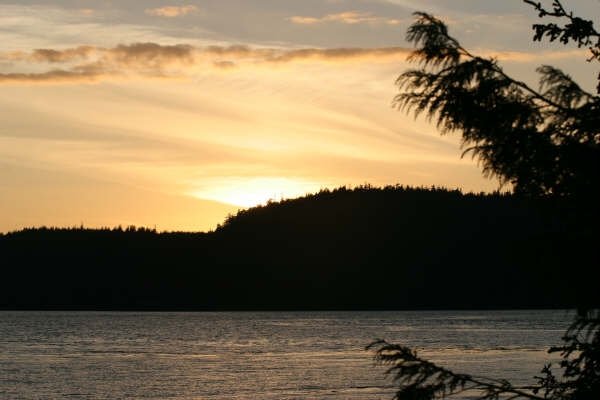
Hanson Island

***

Carolus’ rocky reef goes whizzing by. Sleet pelts our faces, but it seems that the worst is behind us. We breathe a little easier, our nervous jokes a little funnier. It’s impossible to always know where the line is between risk and living. The line moves without warning. A sunny day can be overrun with fog or variable seas replaced with small craft advisories.

We sprint across Sitakaday, and comprehension hits harder than the iciest salt spray. I cannot let fear stop me from loving the places that resonate. There are challenges around returning to Hanson Island. Memories and nostalgia would wiggle into my heart and try to drag me down—that oscillating line between risk and joy.

Bartlett Cove dock pokes out of the fog. Did I let the fear of a snapping anchor line or bouncing waves stop me? No, I tied the line tight, double-checked the weather, and trusted my skiff and friends. We cannot sit at home in fear of what may happen.

I am an unreliable narrator still learning the quirks and priorities of a reborn 36-year-old who stresses about his boat and runs after every report of orcas. Some things just won’t change. For 18 months, I looked forward, reclaimed home, and fell deeper in love with Icy Strait. I want the same for Hanson Island, for it to be part of past, present… perhaps future.

The skiff slides into the dock. The motor goes silent, and I flex my throbbing fingers as the blood returns and numbness fades. Did it—a bit of risk for another day in the woods. The sensation and payoff are inescapable, makes me thirsty for more. We walk up the ramp, keenly aware that we forgot to call for a ride home.

I pause against the railing and look across the water. Lemesurier and its big old trees peak out of the fog, and I give them a solemn nod, thankful not just for home but the opportunity to live a life that permits me to fiercely love two places. There is room for Hanson Island in this new life. Room to write a new chapter and make it part of home. I clap my stinging hands, heart filling with cautious excitement.

A great blue heron lands on the railing and stares with prehistoric eyes. The same bird that flew over the Shabin on my first visit and whose vestige now adorns the kitchen. I am not one for signs and imagery, but I take his presence as positive affirmation.

“Thanks,” I whisper. “It’s good to be going home.”
Hanson Island

The Wettest Paddle

My gloved fingers fumble with the catches on the stern hatch. I bury my chin deeper into my rain jacket, a vain attempt to stem the never ending stream of water that’s been barreling down on us for 48-hours. I don’t know where we are, and I’m nowhere near curious enough to dig the map out of its dry bag. But I’ve stared at it enough to know what I’m looking at. Or more accurately, what I should be looking at.

Mount Wright, a 6,000 foot cathedral that guards the east arm of Glacier Bay is just two miles to the south, but it’s taking the day off. As is Adams Inlet, the first of three inlets that alternate on each side of the arm. After years of waiting I was finally seeing the fabled east arm. The inlet known as Muir Inlet, our superhero and the patron saint of glaciers. I had set off with Brittney and three friends, set on finding God in a glacier and Muir in a sun ray. But so far all I’d found was rain. Rain and clouds.

The hatch cover finally comes free and I pull from its depths three identical bear cans. We’re not stopping long. We’d been paddling for just over three hours and watched the wind and rain approach from the West. Naively we tried to outrun it, but you can’t outrun anything in a kayak except your common sense.

Brittney comes over and digs through one of the cans, pulling out tortillas, cheese, and kale. For a moment we stare at the tortillas as a gust of wind buffets us. We’re on a ridiculous little glacial outwash that will soon be obliviated by the rising tide. Eagles and Ravens perch eerily on a cemetery of uprooted stumps and logs. We slice the cheese and tear the kale.

“Now.”

Brittney opens the ziploc bag and I grab a pair of tortillas. As soon as they’re free she slams the seal shut, but too late. The surviving tortillas will be taking rainwater with them. We wrap the cheese and greens inside in record time and sit huddled against the wind, devouring our lunch before it disintegrates in our hands.

Worst rain I’ve ever experienced. I scribbled in my journal later that night. Hands so wrinkled and pruney they resemble elevation contours on the map. 

But we’re counting ourselves lucky. Because the wind is coming from behind, sweeping us up the arm and toward McBride Inlet. In a bay defined by change, McBride is the champion sprinter. A map from 1990 shows no inlet at all, but a glacier that dominates the upper end of the arm. Almost 30-years later she’s described with adjectives like “catastrophic retreat.” She’s left a narrow mouth at the base of the inlet that at low tide you could lob a rock across. On a flood the inlet turns into a vacuum sucking in water, ice bergs, gulls, seals, and wayward kayakers.

Lunch takes less than five minutes. One of the first lessons of Glacier Bay is that the best way to stay warm is to paddle. It may seem counter intuitive—surely huddling under a tarp is warmer—but all gear, no matter how rubberized or seam sealed, will eventually fail in a torrent such as this. Best to keep moving and turn your upper body into its own personal Toyo. So we hop back on the Muir Highway and let the wind whisk us north.

There’s four of us now. That morning Ellie was forced to return early after slicing open her thumb. After getting her on the day boat we’d set out from Sebree Island, knowing it would be our second 20-mile paddle day of the trip. Three of the four are kayak guides: myself, Brittney, and Jessie Markowitz. We’re equally crazy, and there seems to be an unspoken agreement that none of us are going to be the one that taps out first. That left Jessie’s boyfriend Jake, an accomplished outdoorsman, skier, and climber in his own right as our voice of reason. And as he was positioned in the front seat of a double, there was precious little rebelling he could do without rudder pedals.

We hop from point to point, Jessie and Jake’s double setting the pace. Every few minutes I glance behind me, praying to see a lift in the weather. The fog and rain has socked in the entire bay. And while we’d never admit it, all of us kind of wished we were the one with the sliced thumb on the warm day boat with all the coffee we could drink.

Around Wachusett Inlet the rubberized raingear begins to fail. I feel the water seep into my mid-layer and with a shudder feel the first needle-like prick of rainwater reach my back. But Wachusett looks beautiful, a thin layer of fog is set afire by the sun, enough to give you hope and we bob in its mouth for a few long moments. The inlet cuts seductively right a mile in, leaving you wanting more. I know better. On the best of days Wachusett blows like the dickens, I don’t want to see the sort of wind that’s around that corner. We keep pushing. Past Kim Heacox’s old stomping grounds in Goose Cove, past Sealers Island and towards Nunatak.

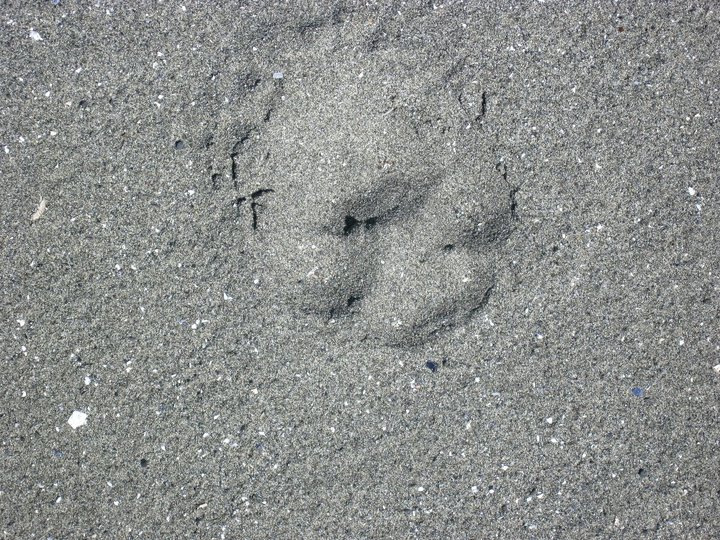
We take a breather and find Brown Bear tracks as big as my outstretched hand in the sand. After the rain, a bear seems tame. Alaskan visitors have a Goldilock’s complex with bears. They want them not too far, not too close, but just right. Just right usually being within range of a 300mm DSLR.

Keep paddling. The Arctic Turn I’m paddling lives up to its name. No rudder, no skeg, no problem. She turns with a simple bend in the hips, drag free. We pass false point after false point. Each time convinced that this one will be McBride Inlet. Ice bergs float by, encouraging us further. Sirens in the fog, beckoning towards their home. Further, just a little further.

Everything hurts. 

We near yet another point. Jessie and Brittney are convinced that this one is the mouth of McBride. I’m not convinced. You have a lot of time to discuss these things when you’re traveling at 2.5 miles per hour. We round the corner to find more trees. No inlet, no Glacier God, no ghost of Muir dancing in the outwash in a wool trench coat. We pull out the map and Cliff Bars. I check my watch: just over seven hours of paddling. My hands feel fused to the paddle. And yet, and this is the weird thing, it feels so good out here.

What is wrong with me? I’m frozen, cold, most everything from the waist down went numb a long time ago. Whatever isn’t numb is wet. We’re convinced the next point leads to McBride. I suggest a vote. Brittney, Jessie, and I try to say yes first. Jake sighs, shrugs his shoulders, and sticks his paddle in the water. Welcome to the bay.

We hit the next point, turn, and there it is. Bergs swirl in the mouth of McBride. We paddle for shore, and the rainfall intensifies. And I yell at the Bay. At the Bay I love so much. How dare you punish our persistence like this? After everything we just did?

But of course Glacier Bay has little regard for my well being and prune covered hands. This place does not give, it sharpens and refines, just as the glaciers have done to her. Just as they will again if we’ll allow it. Just as they do to us.

We pull the boats above the tide and a miracle happens. The rain relents, the clouds being to lift. White Thunder Ridge emerges on the other side, dramatic slate gray cliffs loom further north. It is a beauty that must be witnessed. A beauty that can only be appreciated after paddling through fog and rain for seven hours. Like a bride on her wedding day the view is worth the wait.

Dry clothes are currency, and we lay out everything we can. We set up tents and pray the rain stays away. A sucker hole appears-a knot sized patch of blue sky—but  it brought friends. We cheer the blue colored beauties and cook pasta. We eat outside the confines of a tarp. And we fall under the spell. I find myself wandering in a daze down the beach. A mystic force pulling me towards the ice like some sort of ancestral magnet. How, I wonder, could people experience this and not be changed? How can someone look into the face of nature and be brought to their knees? I’m convinced that 100 senators in 50 doubles for a couple days would clear up a lot of problems.

But for a few days we’ll be blissfully ignorant of North Korea, Charlottesville, and the rest of the world’s silliness. Just us and McBride glacier’s offspring filtering out the inlet and sweeping south.

The Birthday Post

For the first time in a year, I got carded. Granted, some of that may have something to do with spending the last six months buying drinks from the same two people (not a lot of choices when there’s only two “bars” in town). But on the eve of my 28th birthday, it served as some sort of inverse reminder. Youth is fleeting. Now I know, my elders and betters will roll their eyes at such a proclamation.

“28? You have your whole life ahead of you.”

To which I say, of course. But we must all admit, that in a society obsessed with youth, with staying young, where waging war against wrinkles is a billion dollar industry, it’s hard not to look at your birthday as some sort of landmark. A road sign twisted and rusted on the highway of life, reminding us that this precious gift slides by far too fast.

I’ve spent the last few days in Seattle. A fine city as far as cities go. It’s big on brew pubs, grunge music, and Macklemore. Though it could do with some deer, perhaps a pack of wolves prowling along I-5. It’s my little snapshot of how normal people live. You know, the ones with satellite TV, high speed internet, and cars that don’t resemble the rusted hull of the Titantic.

I stood in a mall with glistening floors and walls. Music blared through speakers, a movie preview played on a loop from a cluster of wide screens, dozens of adds battled for my attention. But as I dutifully manned my post by the Old Navy entrance, I watched my fellow mall patrons and decided on a little sociological experiment. How many, I wondered, would be on their phones?

The answer was almost all of them. Eyeballs sucked to the screen as if Apple had designed a gravity app more powerful then the moon. What, I wondered could they all be looking at? I didn’t have the phone Brittney and I share. And I must admit there was a decent chance that if it had been in my pocket instead of her purse I may have pulled it out. And what would I have done? Jumped on the internet I guess. Refreshed espn.com even though I knew that there was nothing there I needed to see. People sat side by side on benches, heads bowed as if in prayer, not saying a word. Couples walked hand in hand, free hands holding the creations of Samsung. What are we doing on these things?

Which leads me back to my birthday road sign. If life is so precious, so fleeting and quick, why don’t we spend more time in the present? Why are we so quick to escape to an alternate reality? Later we pass by a Windows PC store. Near the door stood a man. He’s facing the big pane windows but he can’t see him. Something looking like a futuristic toaster is secured to his face. The heck?

“Alternate reality,” Uncle Chris explains to me.

No way.

Maybe it’s just the next wave of video games. Essentially that’s all it is. A really realistic game. And if they made a sports one? Heck yes I’d try that out. Again I must admit to my love of a certain baseball computer game. It’s my escape when I can’t read about Trump, climate change, or acidifying oceans anymore. My own, if you will, alternate reality where the Minnesota Twins finish above .500. So really I’m no different. And maybe that is the wakeup call.

And perhaps that’s what I’ve learned in the last year. That despite my little migratory life from the seat of my kayak, I’m not all that different from the mall patrons and commuters of the city. And that’s ok, that’s a good thing. If I’m no different then those I want to reach, then getting them to listen, to put down their phone and read what comes out of my head should be easy. Maybe one of them will load raincoastwanderings from their phone! The irony.

Because I want the mall dwellers to read what I write. I want to inspire and touch people’s lives. The mall is not a bad place just as a phone that can tell you what time the Vikings play isn’t. What I want, what I aspire to, is to remind people that there’s a big blue and green world beyond the sliding doors. A world you can enter without strapping a toaster to your head. And that, most importantly, we cannot live without it. That the natural world, like every day we are gifted, is precious.

Snow

She lay in an old shipping container. The kind found on the back of trucks roaring up and down the concrete riverbeds we call interstates and highways. But this one had been laid to rest here. Tucked away in a corner of a lot in Bartlett Cove. Through the trees I can hear the wind, smell the air breeze, ear cocked for the sound of a humpback. How out of place the egg white box of metal looks here. No flowers or grasses growing around it. Just a strip of gravel turning dusty in the early July heat.

Inside lie her bones.

I feel a thrill of excitement as Chris Gabrielle pulls a key from her pocket and unlocks the deadbolt. Together we lift the big metal latch, its joints creaking and groaning as the big door slides open. I don’t notice the smell at first. But as Chris flicks a light switch and ignites a small bare bulb, it overwhelms me. It is musty, sweet but sickly. Something about it smells alive, even in her death. I walk into the container, breathing shallow, fighting the urge to cover my nose with my shirt.

After almost ten years, she still lives in some way. Organic matter and oils still seeping out of her ribs, humorous, and vertebrae. I can’t help myself. I reach out and touch one of the vertebrae. As big as a tire and bleached white, I run my hands up and down all that remains of Snow. Here along the racks and shelves, were all that was left of her forty-five foot, thirty-five ton body.

The year is 2001. Somewhere in the mouth of Glacier Bay swims Snow. Inside her new life is growing. Is she aware that she’s pregnant? That in half a year there will be a miniature her swimming and breathing? The baby will drink a milk that is 50% fat, the consistency of yogurt. I wonder if she heard the cruise ship. If she had any inkling of its approach. If she could have gotten out of the way. If the ship could have. The nose of a cruise ship is so far from the engines in the stern that they create “sound holes,” right off their bow. There’s a good chance Snow never knew what hit her.

Janet Neilson (then Janet Doherty) found her. Dead whales are rarely found. Usually they disappear. Sink to the bottom and vanish, presumed missing. But it’s as if Snow wanted to be found. Janet discovered her floating off Point Gustavus, not far from where an anonymous cruise ship passenger reported feeling a thump. They towed Snow to the beach, necropsied her body, and discovered a fractured brain case and crushed vertebrae.

Gustavus mourned, the park service gave press releases, security footage was seized, attorneys went to work.

“The crime wasn’t in accidentally striking the whale,” said a park employee, “the crime was in failing to report it.” I’m not sure Snow would agree. Neither do I.

In the middle of the shipping container is an old iron claw bathtub, the porcelain chipped and rusting. But it doesn’t leak, at least not yet. Chris hands me a great bucket of industrial kitchen degreaser and instructs me to fill the tub with the stuff and soak Snow’s bones one at a time. Oil, she explains, is still seeping out of her bones. The goal was to remove the rest of the organic matter from the bones so that they could be preserved for years. An exhibit was being prepared down by the beach. Where in a way, she could live forever.

On sunny days I climb onto the roof of the container, lining her ribs up neatly to bleach in the never ending Alaskan sun. I soak the vertebrae overnight in the degreaser, greeted each morning by the strong smell of leaching oil, a pearly iridescent sheen on the surface of the tub.

Down another road, behind a locked gate is her skull. My stomach twists the first time I see it. I run my hand across the deep fracture in the skull. If a passenger felt the collision, than surely the crew did as well. But who wants the headline: “Cruise Ship Kills Whale in National Park?” Bad for business. But thirty-five ton bodies don’t always disappear. I pressure wash her skull, obliviating the moss attempting to grow on her. When the yard empties I crawl beneath the skill and lay in her mouth, imagining. Rows of baleen, gallons of sea water, tons of wriggling herring.

And I’m indebted to them. The cruise ships I mean. Wouldn’t be here without them. Wouldn’t have had summer work in Juneau when I graduated from college. Would not be sitting at this wooden table in Gustavus watching the storms roll through, the moose calves grow up, and the rain pound on the roof. I owe my beautiful little life, in some way, to an industry that makes me uncomfortable. That kills whales, that leaves a massive carbon footprint. That shows a million people Alaska every year, even if it is a watered down, fast food version. 14,000 people a day in Juneau. But what’s the alternative? I can’t take 14,000 people kayaking in Bartlett Cove. Is seeing this place from ninth story better than not seeing it at all?

Edward Abbey would say no. But I should be confident enough to form my own opinion. But I can’t. Because like this bay, nothing is black and white. A single receding glacier does not signify climate change, just as an advancing one does not disprove it. We must step back, way back. Look at the big picture objectively, rationally. We don’t like the big picture. Step far enough back and we become mitigated, aware of how insignificant we are.

That’s the beauty of the kayak, the hiker, the backcountry camper. You have no choice but to confront your own significance. At how small you are away from the billboards and street lights. It’s uncomfortable. Change always is. Tough to be uncomfortable from the ninth story.

I don’t know what the answer is. Abbey wouldn’t be impressed.

Snow stands whole once again. Without her flesh she looks serpentine. Two tiny bones bent at obtuse angles are suspended by wires two thirds of the way along her vertebrae and a foot below it. They’re all that remains of her legs. In time evolution will remove them from whale’s entirely. Like our appendix they are vestigial, no longer of any use.

Every day a park ranger gathers a crowd in front of Snow to give a presentation. People flock to the talks until the trail is not passable. They are independent travels, for the cruise ships do not dock here. Our kayak sheds are right next to the skeleton and I often squeeze through the raptly listening crowd. Like the cruise ships and wilderness, the talk makes me uncomfortable. I hear the ranger joke about how Snow embarked on, “the longest over land migration a whale has ever done” to be rearranged and put back together by a professional.

The crowd titters and laughs, something about it makes my blood boil. I hear them talk about the collision as a horribly tragedy. But in the same way a loved one developing an illness is tragic. Unavoidable, no way to prevent it. Never have I heard a ranger say that the cruise ship failed to report the collision. That it was not until security footage was seized and viewed did they admit to striking the whale. Perhaps they do and I have simply missed it. I don’t wish to criticize or demean. For the rangers do a job I know I couldn’t. I don’t know why I think people need to know that part of the story, but leaving it out feels like an insult to her memory.

On one of the displays is a grainy picture showing the bow of the ship, a gray pixelated sliver in the water shows Snow, her back arched, attempting to dive. Maybe she did know.

“Snow moments before tragedy,” reads the caption. Meanwhile ten miles away two cruise ships a day enter the park, passing Point Gustavus, bound for the glaciers of the west arm. Do the passengers on board know the story? Do the rangers share that story when they board every morning at the south end of Sitakaday Narrows?

I don’t know what the answer is.

All I know is that it hurts my heart to have Snow here, condemned to life as a silent ambassador. How much more she could be, churning up the waters of Bartlett Cove.

Another sunny July day. Six years since Chris opened that container and introduced us. We walk the familiar trail toward the kayak sheds. Past the old Tlingit canoe, Snow’s display coming into view.

“Have you met Snow?” I ask.

Everyone has the same reaction, a quick intake of breath, mouth open, rooted to the spot. Their first view of Snow is head on, as if she’s diving right toward you, forcing you to confront her here and now. They snap pictures and lean across the ropes, aching to touch her. Invariably the question comes.

“How did she die?”

“A cruise ship hit her.” My guiding style is one of light hearted comments. Jokes and stories over facts and figures. But not here. No over land migration jokes at Snow’s expense. Here just the full truth. “They knew they hit her but didn’t report it.”

I don’t like starting the day with something so sad. But at the same time, what a reminder that we cannot expect to leave the world the way we found it. The warming acidic water of the world should be a good enough reminder. Every kayak on the beach crushes barnacles and mussels. The leave no trace etiquette is an impossible dream. From man to mosquito, no creature was meant to leave an environment as they found it.

We linger a moment longer and turn toward the beach where I hand out life jackets, spray skirts, boots, and paddles. The water is alive with life. Sea otters cracking open shells on their stomachs, sea lions growl in frustration, a timpani of birds. I slip into my kayak and feel the world slide into place. My heart rate slows and my breath becomes steady. I don’t know what the answer is, and in this moment I don’t need one.

Two Bears for Mark

I’m curled in my sleeping bag, the Alder trees at the back of my tent shelter me from the early morning sun. I’m somewhere in the world between dream and reality. So when I hear the sound of Mark’s boots making their way through the Reed grass, I’m not sure if it’s real or imagined until I hear his voice. His tone is calm and measured, but something in it makes my eyes snap open and heart rate quicken before he finishes his sentence.
“David? I hate to disturb you, but there appears to be two brown bears walking towards us along the beach.”

Hate to disturb me? I glance at my watch: 6:45 in the morning. Not that it matters. I want to be disturbed if there’s pair of brownies on the beach no matter the time of day. I unzip my tent and am greeted by my two hundred roommates. They’re small and elusive, rusty red and jet black. But the high pitched beat of their wings all sound the same in my ears. I’m inundated with the gnats immediately. But I brush them out of the way, pulling my bug net and can of bear spray along with me.

Mark is cool and collected as he points down the beach to the place where he last saw the bears. A lot calmer than I’d expect a guy from New York city to be during his first Brown bear meeting. Actually that’s not fair. It’s not like Mark Adams has never left the concrete behind. He’s hiked the mountains of Peru, gone where no white man has ever been in Madagascar. When you write like he does, people send you everywhere.

Which is why we’re here in the early morning light at the north end of Russell Island in Glacier Bay National Park. Mark’s writing a book about Harriman’s Alaskan expedition in 1899 and John Muir’s travels. When he needed a kayak guide, I was blessed with the opportunity to lead him into the wilderness. To travel as Muir did, one paddle stroke at a time. To explain and describe the land and creatures as they passed. And of course, to bring us back in one piece. The first part had been easy. The bears would make it tricky.

I walk down the rocks, trying to get a better angle of the beach. What a sight I must be. The weathered and experienced Alaskan guide, rubbing sleep from his eyes and pulling up his pajama pants that are a size too big. The pants are absurd. Navy blue with a pattern of wolves howling at the moon. The sort of thing you wear on rainy Saturday mornings while drinking coffee. Not fighting bears.

I step onto the tallest rock I can find and stare into the tall Rye grass at the back of the meadow. My body’s awake but not my eyes. I rub them again, trying to focus and keep my expression calm and collected. This happens all the time of course.

Two little brown ears pop up among the grasses. Little satellite dishes that recede the thin long face of a brown bear. Instinct kicks in. I clap my hands and call out good morning. I don’t shout, I want to save some volume, just in case. The bear looks at me, head tilted sideways, politely curious. As if he’s rising on an elevator another bear appears next to him. They’re skinny and young. Probably just got kicked out by Mom within the last month. Four year olds. Teenagers. Young, dumb, ready to take on the world. I can relate.

They saunter back into the woods as I call. Nonchalant and relaxed. I turn and beam at Mark. We’ve talked a lot about bears the last couple of days. I’m glad we saw one. He’s got his little waterproof notebook out, scribbling notes. A few minutes go by and there’s no sign of the bruins. I put on more respectable pants and pull out the Coleman stove, putting water on for coffee. I’m forgetting something… mugs!

Leaving Mark with the stove and food, I jog back up the beach and to the tent, digging for the thermoses. No sooner do I reach the tents and Mark’s voice floats up the beach.
“David? Your friends are back.” Uh-oh.

I come back down the beach, my pace a little quicker this time. I find a big rock and jump on top of it. I spread my legs and stand tall. Stretching my thin 6’4” frame as far as I can. I shout, I clap, I wave my arms. The bears spare me a half-second look and go crashing back into the Alder. From my vantage point I can see the trees shaking fifty yards back from the beach. They’ve cleared out.
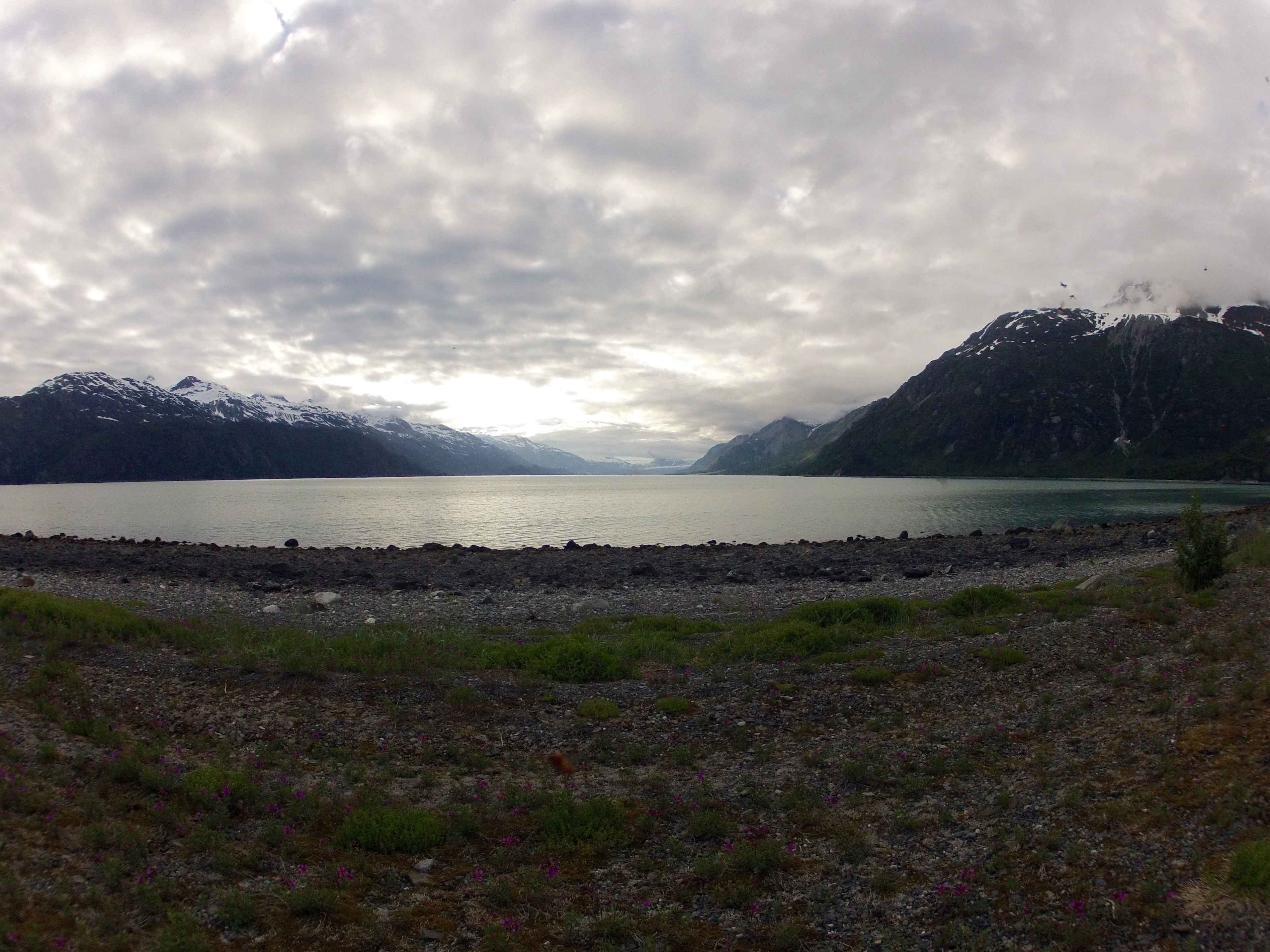
GOPR2088.jpg

(The beach the night before the bears. The bears came out of the Alder near the blue/green tent)
I reach Mark and the stove, setting the thermoses down and pouring the boiling water into a Nalgene we’re using as a coffee maker. While the coffee steeps I run back up the beach for socks. The bugs are eating my Chaco attired feet alive. I reach into a dry bag and freeze. Something is snapping twigs in the Alder feet from me. Boots forgotten I step back, clapping and shouting. I’d started at a six, my volume’s at ten now. I reach into my pocket for the bear spray. It’s not there. It’s on the beach with Mark.
As calm as I can I shout down the beach, “Mark, can you bring the bear spray up with you please.”
I feel caught. Food and author on the beach, tents and kayak near the trees. In my head I can hear the voice of the park biologist Tonya Lewis. “Don’t let the bears get your food.” I run back down the beach, clapping and shouting the whole time. A plan forms in my mind. Grab the food cans and stove. Pile it at the waters edge, break down the tents. Get the hell out of here. If they want the beach this bad, it’s all there’s. I meet Mark halfway, his arms laden with bear cans, the stove, and water bladder. I grab a handful of gear, turn, and feel my heart drop. The bears are back. Feet from Mark’s tent. For the first time in my life, there’s a bear between me and my kayak.

I grab the bear spray from Mark and charge up the beach, calling at Mark to follow me. In my panic, a tapestry of expletives flow from my mouth like water down a mountain. “You… bear! Get the… away from my… kayak!”

One of these bears is brave. Too brave for my liking. While one slinks into the woods just out of view, the bolder one moves between the tents. Three more strides and he’s at the kayak. I grab a baseball sized rock and close the distance to forty feet, Mark at my heels. “Look as big as you can.” I tell him.

I shout more words you can’t say in church. I pull the safety off the bear spray. The rock cocked like I’m Nolan Ryan, the bear my Robin Ventura. I’ve never fired bear spray at a bear before. Had proudly told Mark 36 hours ago that bears were misunderstood, shy gentle creatures. Leave it to nature to make me look bad.

I’m ten yards away. First and 10. Russell Island Bears versus Gustavus Kayakers. It’d be a route if it comes to that. I finger the bear spray and shout again, I feel my throat getting raw. At last the bear turns.

I’ve looked into the eyes of many wild animals. Orcas, humpbacks, moose, sea lion, seal, deer. But only a bear’s gaze has the ability to make me feel like I’m two feet tall. Nothing is more untamed, more wild. Daring you, defying you, to tell it otherwise. “This is my house,” they say. “Do you want to see what happens in my house?”

I don’t, and I have a feeling neither does Mark. Although his guide getting ripped limb from limb would make a hell of a chapter. The bear turns and gives a little huff. My knees go weak. The bear spray rising above my hip. Dimly I register that there’s no wind. A clear shot if it comes to it. The bear turns and starts to walk away from the kayak. My heart’s in my throat. Keep walking, keep walking.

He slips into the Alder like a phantom. But for how long? I cover the last few feet to the tent. Mark has stood calmly by the whole time. No panic, no fear. What’s going on inside is a mystery, but he’s a heck of a lot calmer on the outside than I am.

We drag our tents through the meadow and over the rocks, our sleeping bags and clothes still inside. We’ll dismantle them near the water. Right now I want as much room between me and the Alder grove that I can.

Fifteen minutes later we float 100 yards offshore in our double kayak. I glance at my watch and laugh. I’d set a timer for the coffee. It’s been steeping for 52 minutes. I hand Mark a thermos, a Cliff bar, and an apple as he scribbles notes. “Got it get it down while it’s hot.” He says.

The bears are on the beach, right at the water’s edge, digging for tidepool Sculpin and munching on Blue Mussels. They’re a lot cuter with 150-feet of water between us. My heart rate slows. This is all they wanted. Two hungry bears, learning to survive without mom. Trying to find a route to the low tide and the protein. We were just in the way.

I rub the side of the kayak, relieved and relaxed. I didn’t want my career defined by one wrecked kayak. The morning is gorgeous. The water is turquoise, that electric color that only the glaciers can mix. As we float Mark pays me the highest compliment he can. “This may be the most beautiful place I’ve ever been… nice choice.” As the bears work their way back into the woods I grin like a hyena and strike my paddle against the smooth surface.

GOPR2087.jpg

Somewhere Unoccupied

It’s good to be back. I squirm and fidget in the plastic seat, trying to make my life jacket sit against the combing. Again and again the jacket slides up. I give up, letting the combing press against my lower back. It doesn’t matter. Bartlett Cove is paper flat. Clouds are thrown across a deep blue sky at random. The only sound is my paddle in the water. Glacier Bay. I’d tell you to never change, but change is all you do.

On days like today I stop just beyond the dock. I look out into the mouth of the cove and drink in the lower bay. I stare out into Icy Strait, at the islands of Lemresier and Chichagof. I feel my heart slow down, my chest inflate, my body at peace. It’s a sensation that only a kayak can bring. Maybe it’s the angle, seeing this place from the vantage point of the Murre and Murrelet, otter and sea lion. Perhaps it has something to do with the knowledge that it is up to you and not diesel fuel and outboards to get where you want to go. Or maybe it’s something deeper. Something buried deep within our chromosomes. A treasure within each of us, waiting to be discovered.

Whatever it is, life is different from the seat of a kayak. It magnifies the soul while reminding you how small you are. What a wonderful reminder. There are no advertisements, no one telling you what you deserve or what you need. What you need is all around. Beyond Lester Point the upper portions of Glacier Bay come into view. The east and west arms beckon. A labyrinth of tide rips, adiabatic winds, and endless waves of mosquitoes await.

 Come on in. But leave security and your ego at the door. Leave your boots on. Keep your eyes open. Breath deep. Be free.

Some of the most memorable moments of my life have happened here. Just off the shore of Lester and Young Island. They’ve chiseled me like a piece of wood. Sculpted and refined me. A project never finished. There was the day the sea lion surfaced a foot behind me. That cunning, malevolent look in his eye, teeth curled into a snarl.     He still gives me the shivers. Still makes me tense when a sea lion approaches. Orcas in the middle of the channel. The perfect end to the perfect day. A humpback in the mist, the sound of his breath reaching out through the infinite nothingness. A siren, beckoning me closer. If I dare.

Swim with me. Commune with me. Guess where I’ll be next. Take another shifty look beneath your paddle. Look for my shadow.

The humpbacks. Too many memories and stories to retell them all.

“What’s the closest you’ve ever been?”

Such a simple question in theory. But mere numbers cannot begin to convey what it feels like to watch the water come alive. To watch it quiver as the head and back of a 40 ton creature breaks the surface ten feet away. To describe the simultaneous rush of euphoria and terror. Your gut screaming for you to run and to stand still. How three seconds can last lifetimes. What it’s like to watch a tail as wide as a Cessna break the surface. The sound of rushing and dripping water. And than… gone. Just like that. No trace, no markings save for some rippling water. It defies description. How does something so big just… disappear?

Somehow, through the beauty and grace of the universe, this became my job. To paddle among these animals. To learn the tides and eddies as intimately as a lover. And to pass that love on to others. To pull them gently from their comfort zones and into a world that continues to persevere. And above all, to show them that wilderness is something to worship. To love and cherish. That all we need to do is tap into those ancient desires deep within each of us. It’s not something to be feared, for respect and terror are not exclusive. Follow her rules, read her tides, understand her weather, and you will be rewarded beyond your wildest dreams.

This is home. Perhaps I cannot trace my ancestry back to the fog choked mountains of southeast Alaska. But I’ll love it as if I can.

Rolling the Dice

Every guiding company has them. A page of carefully worded phrases meticulously written out by a lawyer in some office, far removed from the natural world. The infamous risk waiver. A bucket of ice water at the start of the trip. A necessary reminder that the world we are traveling to is unscripted. That it can be harsh, dangerous, and unforgiving. That even the best of us, the most prepared, the most cautious, are not immune.

For those of us that live it every day, we have our own, unwritten risk waiver. Every time we go out our doors and into the woods, up the mountain, or onto the water, we sign it. It’s our unspoken agreement with the world we love. An acceptance that it can betray us at any moment. For if it can happen to Forest Wagner, it can happen to anyone.

Forest lives in the woods. There isn’t a mountain he can’t climb, a fjord he cannot paddle, a situation he can’t handle. Two weeks ago he was attacked by a bear while leading a group of students near Haines in southeast Alaska. He wasn’t been foolish or careless, disrespectful or arrogant. You roll the dice enough with Alaska, and sometimes it comes up snake eyes. What are the odds that there’s a mama bear with spring cubs over that blind ridge? 1 in 100? 1 in 1,000? How many blind ridges do you hike over before the odds catch up?
304523_10151351163614852_290551_n
Forest’s influence and inspiration stretches across the state, across the globe. He’s taught thousands how to survive in the back country, inspired many to follow their passions as mountaineers, kayakers, river rafters, and skiers. From all accounts, even after he’d been attacked and bitten along his side and leg and fallen off a cliff face, it was he who spoke to the medivac on the cell phone. Calm, clear, and collected, he talked his students through the whole process. His own Wilderness First Responder.

“I can climb down if you need me to.” He told the medivac. As if he’d done nothing more than sprain his ankle on a morning run through the suburbs.

Why him and not me? Two days ago I hiked the mountain ridge behind my parent’s house. Bear and moose sign coated the game trail. Again and again I rounded blind corners. Bear bells jingling and bear spray bumping against my leg offered little comfort. I’d be lying if I said I wasn’t thinking about Forest around every corner. Wrong place, wrong time. Our unspoken agreement, our signed risk waiver with the natural world.
37367_467283714851_8103409_n
I wouldn’t have it any other way. Beneath the sugary, frosted coating that reality TV has given Alaska, nothing has really changed. To truly experience this land, to know it with genuine intimacy means to throw ourselves at its mercy, and accept that we may not receive any. Forest knows this, I know this, Brittney knows this, and so does any other guide or outdoor enthusiast that climbs her mountains and paddles her shores. For if the wilderness was always safe it would not be wilderness. With risk comes appreciation and respect. How charismatic would the bears and wolves be if they were harmless? Would we love them, photograph them, even their tracks worthy of our marvel and imagination? Would glaciers be sublime if they didn’t send blocks of ice as big as buildings into the water to crush and reshape everything in their path?
37235_467271534851_7897543_n
So this summer I’ll strap on my boots and push my kayak into the water. I’ll grab my fishing pole and walk the salmon stream, knowing that I share the land with bears, moose, and whales. I’ll grab my dice, take the odds, and see what happens. The alternative is a life that is fraught with other dangers. Forest wouldn’t have it any other way.

He’ll be back, it’ll take more than a bear to pry him away from his natural habitat. I have no doubt he’ll summit Denali again, climb the alpine, and return stronger and more confident than ever. The wilderness needs ambassadors like Forest and the mountains of Alaska just wouldn’t be the same without him.

Cranky Border Guards and Getting Busted on the Ferry

If objects at rest tend to stay at rest, and objects in motion stay in motion, than it’s no wonder I feel exhausted. Our travel itinerary for the last twelve days has pulled us thousands of miles on every medium of transportation this side of sled dog on ice pack. Small boat from Hanson Island to Alert Bay, ferry to Port McNeil, drive to Nanaimo, ferry to Vancouver, drive to Seattle (and past the crankiest border guard), drive to Bellingham, ferry to Juneau, ferry to Gustavus, fly to Juneau, and lastly, fly to Anchorage.

After a winter of sitting quietly on a rock in the middle of nowhere with nothing more pressing than to run into town once every two weeks, our manic travel itinerary left us both in a haze. A haze that provided plenty of magical, confusing, and absurd moments. It all starts, I suppose at the B.C/U.S border. We’d spent the day driving south down Vancouver Island after pulling ourselves away from Hanson Island and watching the little cluster of cedar buildings disappear for the next for six months. But the weather turned sunny as we moved down island and spirits were as high as they could be at the prospect of reaching Seattle that evening and spending some time with Brittney’s aunt and uncle.

Joy was further magnified when we reached the border crossing to see four open stations and only a handful of cars in line. With Brittney behind the wheel we glided up to the kiosk, passports in hand.

“Hello!” called Brittney handing over the passports, speaking loud enough to be heard over the quiet whistle our precious pathfinder makes at low RPM.
The U.S border guard didn’t smile, didn’t nod, or in any other way acknowledge or return the most basic and acceptable of human greetings. Instead he snatched the passports from her hand and stared at them as if he’d just picked up something dead and repugnant. After X-raying them for several long moments, his head jerked violently to the side, a great bird of prey ready to grab us and the pets in his talons. His eyes stare into the tinted back window.
“Um, I can open that for you if you want…” Brittney offers.
“Ok.” It speaks!
She rolled the window down, exposing an embarrassing cluster of bags, boxes, and of course, a rabbit, her eyes wide and nose bouncing as the window slides down.
He stares into the labyrinth of our worldly possessions.
“Is that a rabbit?” He sounds disgusted, maybe a little amazed. Surely he’s asking ironically. What he must have been like in high school.
“Yes?” Brittney answers.
Why do we always seem to draw the nastiest of border guards?
“Why are you here?” He snarls.
Seriously? A little ember of rebellion catches some try tinder in my chest. What a hack. Just ask us where we’re from, what our business is, and let’s be on with it. You can be professional without being an asshat. I badly want to say, “why are any of us here man? What’s it all about, man?” But refrain.

Brittney tells him, and before the words are out of her mouth, he’s tossed the passports back into the car and turned away. Wherever he is right now, I’m willing to bet he isn’t smiling.

But we were free, that’s all that mattered. Free to pick up a six pack of glorious IPA after a winter of Kokanee. As we moved further south the road got wider, the trees fewer, the shopping malls greater, and the things I needed to possess to be happy more expensive. If the billboards were to be believed.

“Money doesn’t buy happiness,” Said comedian Daniel Tosh, “but it buys a Waverunner… try to frown on a Waverunner.” Fair point.

We enjoyed a few wonderful days in Seattle, and all too soon, were making the drive north again to the border town of Bellingham to catch the ferry. For the pets, it was the greatest hurdle. Three days cooped up in the car with each other for company. Twice a day we were allowed to go down to the car deck, feed them, and promise that we were almost there. Kind of.

The journey aboard the ferry Matanuska was not a lonely one. A bouncy, adorable two year old with no concept of personal space joined us on the covered back deck of the ferry known as the solarium. A gaggle of wilderness guides based in Haines, including some familiar faces were also aboard, and we prepared for a merry ride north. As we neared Ketchikan, the southernmost town in southeast Alaska however, a ferry employee gave us some grave news. 250 high school band members would be boarding in Ketchikan, swelling the ferry to the bursting point and undoubtedly putting us over the U.S Coast Guard regulated number of tubas. We did what guides do when they’re not on the ocean, the rivers, or the woods. We bought some beer.

Sure. I mean, technically no alcohol was supposed to be consumed in the solarium, but it’s Alaska, surely it’s more of a wink wink, nudge nudge sort of rule. Nope. Half an hour into what looked to be an enjoyable ride from Ketchikan to Petersburg, a lady in a uniform so starched it could stand up on its own materialized in front of us. I had taken the necessary precautions and poured my beer into a nalgene bottle, giving the impression that I was drinking the muddiest, nastiest water in the 49th state. But I remain amazed at how quickly bottles and cans disappeared as she appeared. It was like watching cockroaches scurrying from the sudden flick of a light.

“We had a chaperone complain that there was some open containers of alcohol up here.”
Dead silence.
“Is that true.”
Slowly we shook our heads, muttering “no” while failing to meet her steely gaze. Put us in the woods, in a kayak on four foot seas, and we wouldn’t bat an eye. But here, we were emasculated, or efemulated in Brittney’s case. When in doubt, deny.
“Really?” Stunning that she didn’t believe us. “Cause I don’t think that anyone would just complain for no reason.”
“Maybe they mistook a soda…” one of the other guides mutter.
The lady marches into the middle of the circle. Brittney’s bends her torso over her legs, her Arc’teryx jacket folded over a Sierra Nevada Celebration IPA. The lady tilts her head, “what’s that than?” She points to a big glass bottle beneath one of the lawn chairs someone had been sleeping on.
“That’s… creamer.” Someone says just above a whisper.
“Uh-huh.” She marches over, a soldier of marine enforcement and picks it up. Technically we weren’t lying. Bailey’s is indeed, a creamer. “Consumption of alcohol is not permitted on Alaska state ferries.” She says, much kinder than we probably deserve after lying to her face. “I have to take this, but you can have back when you leave the vessel. I just need to have a name.

Still we’re silent, no one willing to claim any responsibility. We’re all in college again, a militaristic RA confiscating our good time. At last, one of our friends raises his hand. “You can put Mike on it,” he says meekly.

50 Horsepower of Deceit and Betrayal

The sun crawls above the mountains on Vancouver Island, the rays piercing the flimsy curtains and flooding our bedroom with sunlight. Every day the sun inches a little higher above those mountains, every day it’s a little earlier. I reluctantly stir, not ready to leave the warm embrace of the down comforter. Brittney stretches and swings her feet over the edge. With an effort I open one bleary eye.

Town day.

At least that was the theory. Johnstone Strait had been pulverized by 40 knots winds for the last week, leaving the shelves of our fridge bare. No more crackers, no more lettuce, no more beer. We’ve got to make it today. The cedar boughs looking in our second story window flutter gently in a light breeze. Today offered a 12-hour window, a respite from the parade of low pressure systems that define the winter climate.

We crawl out of bed, scarf oatmeal, chug coffee, and ready the boat. We cram the tiny space behind our little wooden seats with empty jerry cans and garbage bags filled with laundry and trash (it’s important to remember which is which). The water’s of Blackney aren’t as pristine as we’d like, but it’s going to get worse before it gets better. The engine comes to life on the first turn and we putter out of the back of the cove. Our departure sends the resident Harlequin Ducks scurrying for cover among the rocks and Brittney bleats out an apology on our behalf as we leave them squabbling in our wake.

But town isn’t the first stop. We turn southeast, angled for Cracroft Point, the shelter, and the solar batteries which are once again drained of power. We skip past the sea lion haulout and round the corner of Hanson Island, the expanse of Blackney Pass opening up before us and dotted with whitecaps. We hit the first bounce as we pass the two islands that sit just off of Hanson Island, affectionately known as Little Hanson.

We’re maybe a hundred yards off of north Little Hanson when the engine revs, sputters, and dies. I swivel around, expecting to see a meddlesome strand of kelp trailing from the propeller, but it looks clean. In just a few seconds, the combination of an ebbing tide and southeast wind has turned us sideways to the waves, the tiny boat rocking violently as it falls into the wave’s trough. I turn the ignition, and the engine roars back to life. But as I slip it into gear it cuts out.

Oh god.

Brittney’s face is the picture of calm, and I try to look equally at ease, “that’s odd,” I quip.

I bring the outboard engine up and lean as far out over the stern as I dare, looking for anything that could be fouling up the propeller. The black blades gleam spotless in the morning sun. Everything looks normal. I take a step back and trip over an empty jerry can, my shifting momentum causing the boat to rock all the more.

It’s not the first time I’ve been on a boat when the engine died. My last summer as a deckhand in Juneau our boat died, only to get picked up by an afternoon storm and deposited on the rocks. The same nervous feeling begins to crawl into my gut and I glance at little Hanson’s shoreline as the waves push us towards it. Better that way than out into Johnstone Strait.

There’s little room to maneuver, but I drop to my knees and pull out the boat’s gas tank from it’s slip beneath the engine as far as I can. Adrenaline courses through my body, an ambitious wave breaks over the stern and I feel the icy chill run down my legs. I give the fuel line a cursory look, everything looks connected. I grab the fuel pump like a dying man grabs his rosary, and give it a series of frantic squeezes. Please please please.

I climb over our mountain of laundry and turn the key. Cough, sputter, die. Shit. This whole time Brittney has sat quietly in her seat, watching.

“Is there anything I can do?” She asks.

“I don’t know if there’s anything either of us can do.”

I reach into my pocket and find the phone. Cell service is always a coin toss out here. But a trio of bars appear like beacons of hope. I dial Paul.

“We’re ok,” I begin with more confidence than I feel, and I lay out the situation. We agree that we should get to shore, try to find a sheltered spot, and he’d call the mechanic, the coast guard, or however else may be able to get us out of this. We’re going to shore no matter what. The ocean’s decided that for us. On the other side of the two little islands is a wind shadow, the water shines turquoise and placid. If we can make it there, it would be infinitely easier to figure out what’s gone wrong.

I grab the paddle, thanking any deity listening that it was onboard, and climb onto the nose of the boat. We inch down the shoreline for the small channel between the islands and a respite. We round the point and my heart drops. Draped across the channel is a massive log. It spans the entire distance between the two islands, just low enough to keep us from passing. We try to turn the boat and paddle out but it’s hopeless. The wind and the waves have complete control, and I brace myself as we collide with the log.

I call Brittney onto the bow, expressions of hopelessness spreading across our faces. We can’t stay here. The tide is ebbing and in a few minutes the boat will be left high and dry, trapping us for 12 hours. I do the only thing I can think of. I leap onto the log, bow line in my teeth, and together we slowly pivot the boat around so that the bow is facing the oncoming swells. With Brittney on the bow, I scurry along the rocks, pulling the boat along while she uses the paddle to push us off the emerging rocks. A tiny indention in the rocks offers just enough protection and we hug the windward side of the rock, the boat bouncing off the shore.

The phone rings. Paul again. His theory is that it’s the fuel line or water filter. But it takes both of us just to keep the boat from slamming against the shore. There’s nowhere safer to go. The ocean has us pinned in the tiny channel that will be devoid of ocean within the hour. I toss Brittney the stern line and the paddle and leap back aboard. I throw everything I can onto the seats, trying to give me enough room to operate. For a moment I stare at the engine, 50 horsepower of deceit and betrayal. I pull the gas tank free once more, trying to ignore the rocking of the boat, the grinding of the hull against the rocks.

Focus. Deep breath. Slow down.

I touch the fuel lines tenderly, gently pulling. And one swivels and pops loose. Hope floods my body. This is it. This has to be it. I reset the O-ring, pull the cap over the tube, and tighten. Brittney’s almost bent double the paddle braced against the boat, battling valiantly. I hesitate. Do I tell her to jump aboard, send us adrift, and pray the engine starts?

“Hold on!” I yell. I throw the gas cans and laundry into a heap, press the trigger, and lower the engine so that it’s just immersed in the water. Knowing the precious propeller is inches from the rocks, that every second brings it closer to the bottom, I pull the choke, say a prayer, and turn the key. The engine comes to life.

“Get on!” I yell. Brittney tosses the paddle aboard and follows after it, pushing the boat off the rocks as we back slowly out of the channel. Blackney Pass has turned into a swirling cauldron while we were adrift and we move slowly out into deeper water, the nose pointed for Cracroft Point. As I reach for the phone the water around us explodes, a flash of black and white. For a wild moment I think of orcas, but they’re too small. The Dall’s porpoise follow us like guardians across the channel, surfacing a foot away.

Did they sense our apprehension? Our fear? Were they celebrating with us? I let out a deep breath and grab the wheel like a lifeline as our little task force battles against the tide and the waves for the Cracroft shore.

My Life as an Orca DJ

It starts with dolphins. They giggle like jackals, punctuated by the dull thuds of their echolocation. I shut my eyes and let the sounds of dolphins, crashing waves, and 30 knot winds rock me back to sleep. Moments later my eyes open. I sit up, Brittney’s feet swing out of the bed. The dolphins aren’t alone. The hee-haw of a donkey floats through the speaker that sits on the shelf just above our bed. G clan’s back.

1917778_229391884851_28180_n
“My turn,” Brittney mutters like the mother of a new born and staggers down the stairs, out the door, and to the lab. Moments later her voice comes out of the speaker as she begins the recording, mixing with the sounds of swirling water and cackling dolphins.

“This is Brittney, this is Hanson Island 2015, digital recording number…” my head hits the pillow and I drift away.

For the next few hours I fade in and out, coming to just long enough to see Brittney isn’t back and that the whales are still calling. They’re faint, maddeningly faint, but there. Three hours after they first pulled Brittney from the bed I rise. It’s a moonless December night with the clouds building for another low front, 7 am and still pitch black.

Brittney takes little convincing to go back to bed. She’s been at it since four and the whales seem to have barely moved. Their voices still distant in Johnstone Strait, at the limits of the Critical Point hydrophone. What compelled them to sit in one place and talk about it for so long? I wrap my sweater around me and feel the lab vibrate as another gust hits the south facing windows. I wipe the sleep from my eyes and brace myself as another tug rolls into range. The sound grows to a deafening roar, the orca’s voices extinguished. Feeling guilty I pull the headphones off and rub the headache emerging from my temple. If only they had such luxury.

The tug moves on and they’re still there. G clan somebody. I31s perhaps? Even Paul and Helena can’t say for sure. These late nights remind me of summer. When late night recording sessions were the norm rather than the exception. It’s warmer in July though. And the sun’s there to keep you company starting at about four in the morning. I am the night shift orca DJ, playing the hits of the A, G, and R clan on 92.1 the WHALE.

At long last the darkness lightens a shade, the whales almost inaudible, Vancouver Island distinguishable as a darker shade of black against a slowly lightening sky. The sun finds a gap and a splash of color transforms the world from black and grey. It’s all worth it. The water and mountains light up like ta water color and the orca’s go quiet. Maybe they too are watching the sun rise.

The sunrise doesn’t last long, extinguished by another fog bank rolling in. Waves topped with whitecaps intensify, the rain strikes like pebbles. Twenty minutes with no calls, than twenty-five, thirty, are they gone? A couple summers ago the A36s played a horrible trick on me, sitting silent in Robson Bight until I would end the recording before letting out a whispered giggle, letting me know that they were still awake and I should be too.
The I31s don’t have their sense of humor though. I end the recording and walk back to the cabin. The tree tops swirl and the waves thunder into the rocks twenty feet away on the high tide. My job, my office, my life. And to think a few years ago I was ready to work in a lab, studying herring bioenergetics. Let someone else wear the labcoat. I’ll go to the office in slippers and flannel.