Tag Archives: Wildlife

Feed Me Twice

Time stops when antlers fill the scope. This muskeg looked empty before I crept behind a mossy tussock, blew the wooden deer call swinging from my neck, and summoned a doe from her hidden bed. I watch her unseen; a rare privilege to see a deer that doesn’t see you. A grunt grabs my attention. Forked antlers pad up the mossy hill.

“This is how it’s supposed to work,” my brain whispers. “Blow the call, attract a doe, and watch the buck come trotting in.”

The buck disappears beneath a slight depression and reappears at 20 yards. Either he doesn’t see me or doesn’t care. He’s full-grown – five years old in blacktail society – and lord of this expansive muskeg. Mature bucks aren’t supposed to show their faces in the middle of the day, but all bets are off when the rut is on. I have tricked him by imitating the call of a fawn in distress. Bleating fawns bring does, does bring bucks. As if a bolt-action 30.06 loaded with copper-tipped shells wasn’t enough of an advantage.

***

Yet, there is no moral ambiguity. My rifle misfired an hour ago when a large buck trotted past in pursuit of a pair of does. I can still see his startled expression when he looked up the hill. I reloaded in a panic and pulled the second shot. That had been enough. He’d bolted the way he’d come, and no bleating fawn would bring him back.

Hunting is challenging, even with a rifle, Google Earth, tide charts, and hand-carved deer calls. Blacktails camouflage beautifully into the brush and rarely move when the sun is high. Infinitely better ears and noses, they melt into the woods long before our primitive eyes spot them. I had patiently waited above their trail for that exact moment. It’s hard not to feel cheated. That life isn’t fair.

***

Minerva lays sprawled on the carpet. Her expression matches mine. Limp, apathetic, beaten, and lost. I refresh the New York Times, watch Wisconsin turn a little redder, shake my head, and close the laptop. I scratch behind her ears and pick up the guitar with an apology. Her eyes widen, and she bolts for her favorite hiding place beneath the bed. If I ever think my guitar playing is improving, I can rely on her to keep me humble.

I strum the opening chords to Brand New’s ‘137,’ a song about nuclear weaponry and destruction. Perhaps still a tad hyperbolic, but it feels appropriate at 9:00 pm on November 5th.

We’re so afraid. I prayed and prayed when God told me to love the bomb.

I want justice.

I want clean water, clean air. A habitable planet. For quiet spaces and open places to take precedence over fear, greed, and hatred. I gaze out the black windows toward the invisible willow sluice where moose nurse their calves and snipes build their nests. Closeted away on this swampy glacial outwash makes it hard to articulate or understand how people could choose profit and bigotry. I once yearned to understand. To comprehend and seek common ground with a sect that claimed Christ as lord but slammed their doors against anyone who didn’t look like them. Who chose to worship manifest destiny and convicted felons over the simple edict of “love thy neighbor” and “do unto others.”

Let’s all go and meet our maker. It won’t matter whose side you’re on.

I will not get justice. Any environmental or conservation progress has been reduced to fantasy. The best we can hope for is a fighting retreat. The Helm’s Deep culvert has been breached, and I don’t know if we can count on Gandalf arriving at first light on the fifth day.

***

Zach and I silently crack beers. Two days later and he’s still sporting the camo-tinged “Hunters for Harris & Walz” ballcap our buddy Sean made. There’s no reason to rehash what we already know. No need to talk about carbon levels, alternative energy, or the sixth extinction. What hope we had at reversing them has melted like so many glaciers.

We try to cheer each other up and allow one another to be angry. To curse and chuck an empty beer can at the hemlock paneling. It’s impossible not to think about Zach’s 18-month-old boy and what kind of world he’ll inherit. I feel guilty and selfish at my childless existence but thankful my parentage extends no further than a cuddly ragdoll cat.

Our vision narrows to the world we can comprehend: Icy Strait, Glacier Bay, Cross Sound. The mountains waiting to be explored and quiet mornings in the muskegs. Living at the north end of an ecosystem that runs from Alaska to northern California has some advantages in a warming world. Southeast Alaska is projected to receive more rain in the coming decades. A bit soggy, perhaps, but better than the well running dry or having the remaining reservoirs snapped up by corporations.

Mellower winters and protected old growth will be good for deer. Perhaps the salmon runs can persevere in the rivers free from clearcutting. We yearn to escape. To go on a wilderness bender. To return to one of the few places that makes sense. We pull up YouTube and watch videos of Sitka blacktail deer, counting the days until our turn to walk in the woods.

***

The buck fills the scope. Ten yards away, yet I receive only a sideways glance. The doe meandering up the hill has all his attention. He turns broadside. Crosshairs settle on his chest just behind the front leg. My finger flexes. The gun clicks. Panic returns. Another misfire. How old is this ammo? How many times have I taken it into the field? Even bullets have expiration dates.

Work the bolt, the dud flipping through the air and nesting in the moss. I didn’t reload after the previous mishap. I chamber my last shell. The buck takes an uncertain step towards the trees. Crosshairs on his heart.

“Please, please, please, please.”

The barrel recoils. I don’t hear the shot or the dull pain in my shoulder.

The doe glances over. There’s no fear in her face, only polite curiosity. Acrid smoke fills my nose. My heart pounds and my hands tremble. I’m no longer cold. No longer wet. A red mist envelops his chest as he collapses on the moss. Blood stains his soot-colored coat. His final breath escapes through the exit wound. The cloudy vapor hangs like a whale’s spout. But there is no arching back, no flipping tail, no pronouncement of life.

I collapse into the moss with ringing ears. My breath comes in tiny gasps, feeling relief more than anything. It’s only a few strides to his resting place. I grip the thick fur. My forehead touches his. Empty eyes, a pale tongue pokes from his mouth.

The doe saunters away, oblivious to the exchange that has taken place. Not comprehending or not understanding. She blissfully nuzzles at a the moss and comes up with a strand of something green and leafy.

I want my whole world to be this steep mountainside clinging to the north end of Chichagof Island, for every need and desire to be filled in the spaces between treeline and tideline. To watch the seasons come and go until the day I can no longer rise, and the snow gently covers what remains.

I guess I want to be a deer.

My knife slides across the belly’s white fur. His fading heat warms my fingers and steadies my hand.

I whisper my Deer Prayer, “You are the forest made flesh. I promise to think of you whenever I eat. To honor your memory. May wherever you are be peaceful and free of pain.”

I cup his heart in hands covered with blood and slippery with fat. My bullet pierced the aorta and pulmonary vein, but some of it may still be edible. The organ goes into a Ziploc along with the liver. Our hunting culture has few commandments, but one is to eat the heart and liver that evening while the story is told.

Field dressing complete, I sit on my heels and rub my hands clean. The doe has finally moved off, but I can still hear her rustling in the brush. There’s something eerie how, once a shot has been fired and a deer has fallen, how tame they become. In normal circumstances, the doe would have fled when she saw me. Now, she lingers. Paying her last respects? That sounds better than being oblivious.

There is contradiction in my hunting. Snuffing life from the very creature that represents all I crave and value. Their innocence and gentleness, self-sufficiency, and quiet beauty. The desire to get closer and closer, to reach out and almost touch this forest talisman and then decide which dies and which survives.

I stare into the dark eyes, already glassy with death.

“This isn’t fair,” I tell him. “Little in this life is.”

The muskeg faces the Fairweather Mountains. The Inian Islands and Hobbit Hole bow before them like fiefs declaring fealty. I grip the broad antlers and take a few unsteady steps up the hill. How can I feel enthralled and guilty at the same time?

Perhaps that’s why these muskegs and animals enthrall me but insist that I carry a rifle. The contradictions force me to examine my connection to place and attempt to comprehend it.

To understand how an easterly breeze catches my scent and how a northerly outflow bites the skin and sends deer running for cover. To examine the fairness in my own life and, most of all, escape. To connect with a part of me that pumps with vigor independent of elections, divorces, and frayed friendships. Because out here, deer or no deer, things make sense in a way they don’t where there’s cell phone service and wi-fi.

They say heating with wood warms you twice. Once when you split it and again when you burn it. If so, then deer feed me twice. Once in the woods and again on the plate. We depart the muskeg and dip into a small ravine. Sweat drips, and quads tremble. Hoof tracks crisscross snowy patches, ravens call on the wind, and squirrels chatter from hidden towers. Across another muskeg and down the mountain I wish I called home.
Between Ocean and Snow

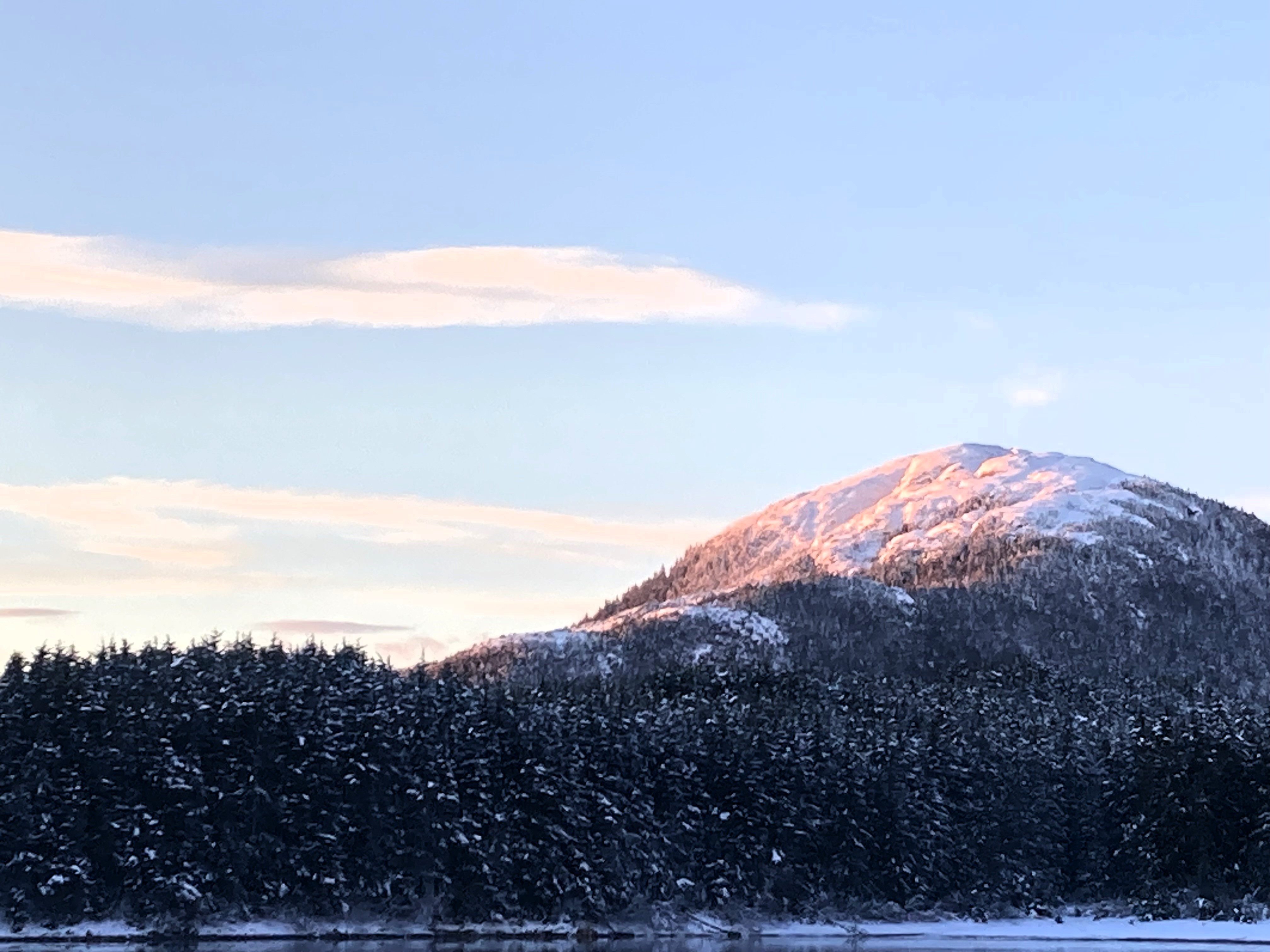
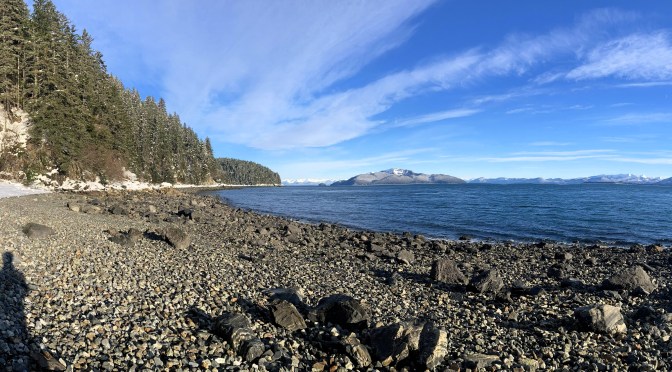
The rising sun turns the hillsides purple. My kayak cuts through the water, leaving an ever-expanding “V” in its wake. Even with a down jacket, I can feel the bite of morning cold. The low tide leaves an exposed strip of rocks and kelp, frozen and crunchy, patiently awaiting the sun and thaw.

For 72 hours the Icy Strait Corridor has endured an unrelenting snowfall. Winds buffeted the trees and left huge drifts piled along the beach meadows. I shoveled five times trying to keep up with the snow’s metronome consistency.

Boats in Juneau’s harbor sank, the land frozen in winter’s fist. Trees bend double beneath the load. Cracks echo through the forest as these proud sentinels break under the weight.

At last, we have a respite, a window of calm before the outflow returns with gusts of 40 knots.

I have waited for this day. Snug and warm next to the woodstove I would peer through the windows at the blizzard and wonder how any animal could survive such conditions. This is my chance to find out.

The benefits of old-growth forests could fill volumes of text. The contrast between the muskegs and woods is shocking. Four feet of snow fill the open areas of the island with perhaps half that amount beneath the trees. It is these big trees, their massive boughs enveloping the land in a protective embrace that give the deer a chance. These causeways give them routes to the beaches, where they can slog through the drifts and find relief below the tide line. The table is set. Rockweed and bull kelp torn from their holdfasts wash ashore and provide some of the only accessible forage when snow of this magnitude hits.

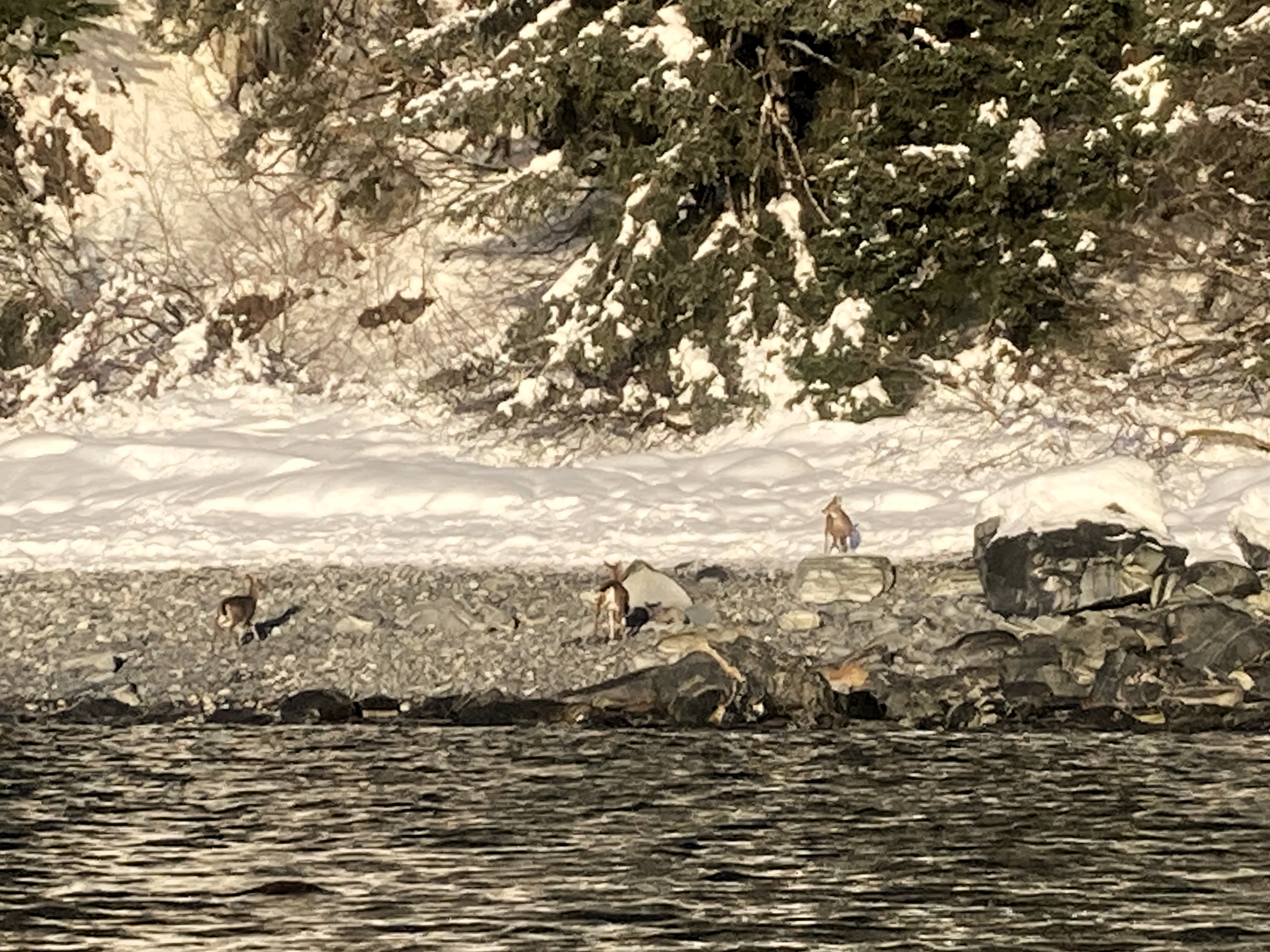
I paddle south along the island’s southern peninsula, scanning the beaches. The first one yields a doe and fawn that scatter into the woods as I glide past. Eight more deer congregate along a 300-yard stretch while a small cove no more than 50 yards wide holds another six.

I bring the binoculars to my eyes and watch, the boat bobbing in the gentle swell. The rut is over, and the bucks have dropped their antlers. It will be something of an easter egg hunt in the coming months to find them hidden in the moss.

These deer are in my parking spot. I’d planned on landing here and climbing to the other side of the island to inspect the long stretch of east-facing beaches bathed in morning light. I hover offshore and watch them through the binoculars. Five adults and a yearling. They look in good shape, still fat and healthy.

Deer are ruminants, meaning they chew their food multiple times and have specific bacteria in their gut to maximize their caloric intake. But every food type has its own bacteria, and there’s a delay as these new bacteria colonize the stomach. Switching overnight from a diet of forest groceries to kelp can have dire consequences. A deer can eat kelp all day, but until the bacteria catch up, they may as well be eating dirt.

The six are foraging voraciously along the shoreline. How long had they waited for this opportunity? It’s easy to imagine them hiding beneath large hemlocks, watching the never-ending snow pile among them with stomachs growling and fat metabolizing. Landing will scatter them back into those snow-laden woods and I can’t bring myself to do it.

I paddle onto the next little cove.

This one too is spoken for. Three more deer graze among the rockweed. They’re so engrossed in their work they don’t notice me for several minutes. A large rock cuts this cove in two, and when they move to the far side, I ease my kayak into the beach, step out, and drag it to the snowline. I peek over the rock and see three sets of ears tuned to my frequency. Upwind of them they maintain a curious demeanor. A shift in the wind will send them scurrying, perhaps getting a whiff of the venison meatballs I’d eaten the night before.

I step towards the woods, sink through the snow’s crust, and posthole to my hip. It’s a quarter mile to the other side and it takes fifteen minutes of panting, gasping, and trudging to reach it. Sweat drips down my face and my lungs burn. How do these deer do it? By the time I reach the edge of the woods, I’m exhausted. It takes several minutes before I feel ready to climb down the cliff face to the rocks below. I remind myself to look for snowshoes when I get home.

My clumsy ascent sounds like a gong on the beach below. I watch two more deer scatter through gaps in the trees.

Whitecaps adorn Icy Strait, and Lemesurier Island looms in the distance, its forest frosty and frozen. I glass the beach ahead and see a lone deer near a washed-up hemlock deadhead.

Surprising. I figured there’d be more. I hug the waterline as I pass the hemlock, the deer watching suspiciously. On the other side of the log, another deer materializes, I stop, look up the beach, and they seem to apparate. One, two, three, four… eight. Eight more clumped in two groups of four.

I never think of deer as social animals, but they are. They may not have reliable herds, but there’s no doubt they enjoy each other’s company. Clicks and loose friendships form, safety in numbers, community. It resonates. Reminds me how alone I am.

There’s a difference between alone and lonely. I have enjoyed my solitude, the quiet, and the reflection. But there is no denying that I still reflexively reach for my phone when I remember an old inside joke, hear a new song from one of our bands, or find an Instagram reel she needs to see. Old habits, they die hard.  

The beach bends, and I creep among the boulders, peaking over the top of the last one. The 30th deer of the day has her head buried in the snow, rising every minute to slurp down another slippery string of kelp. I advance when her head’s down and freeze when it rises until I’m 50 feet away.

I settle on a boulder, open my backpack, and invite myself to lunch. As I munch trail mix and guzzle water a fawn stumbles out of the woods and joins its mother among the kelp. The scene brings an emotional response I wasn’t ready for. The pair moves to a young hemlock, and they strip the needles the way a bear forages for berries.

Icy Strait sparkles. The snow-covered mountains and hills pop. Eagles soar on the thermals. You can hear the land exhaling after the deluge of the previous days. There’s a tug at my heart, a desire to share this moment with someone. Some of House Stark’s words hover in my head.

“When the snows fall and the white winds blow, the lone wolf dies but the pack survives.”

The tide is rising, and the sun setting. I leave the little family to their work, padding back down the beach past watchful eyes and into the woods. Through the trees, I see a glimmer of red. No matter how far up the beach I bring my kayak, I never stop worrying until I see it right where I left it.

The trio of deer have disappeared, leaving the beach unoccupied. I launch and enjoy the sun on my face as it begins its downward trajectory over the Pacific. I feel full and content as I paddle for home, again overwhelmed by the incredible beauty of this place. The southern end of the Fairweather Range peaks above the islands to the north, with 14,000-foot peaks, and an icefield you can hide Rhode Island in.

I stop in front of the next cove and smile. The deer are still here. No longer foraging they lay among the sunbaked rocks. I can feel their contentment, their relief. The new bacteria in their stomachs beginning to work, metabolizing the kelp and hemlocks and blueberry twigs. Feeling warmth for the first time in days. A chance to breathe, to rest and recuperate.

I knew today was coming, had the 16th circled on my calendar even as the snow continued to pile up. The deer have no such luxury. What concept of time do they have? How long had the last three days felt for them? For those little fawns experiencing the first truly hard moment of their life? But now, the sun was out. More storms are coming, another foot of snow is expected in a few days.

Why worry now? With bellies full and warm rocks to rest on.

Storms come and storms go. We can’t always forecast when they’ll begin, end, or start again. Some may never end. Some may never come. I saw myself in these deer, huddled beneath a big hemlock, waiting for the blizzard to end, not knowing when. Clinging to the faith that the clouds will lift, the sun will return. There will be warm rocks and bull kelp for everyone.

I begin to feel that sun. Stepping out of the woods and powering through the drifts, knowing relief is near if I plunge forward just a little further. I can feel their eyes on me. And through the distance and isolation, sense the eyes and love of my own pack. The winds may howl, but I am not alone. The bow spins, the water parts around the keel and points for home, grateful that when the sun sets and the tide touches snow that I don’t have to retreat to the woods for shelter.

Inside the cabin, I pull out my notepad and consult my notes. 12 miles traveled in total, and somewhere between 38 and 45 deer depending on how confident I am I’m not double counting.

Minerva coils around my legs, reminding me it’s almost dinner time. I step outside and am greeted by a crescent moon. The hills are bathed in purple again. The winds have begun to rise, and the trees start to bend. I wrap my jacket around me, step back inside, and whisper thanks to the neighbors hovering somewhere between ocean and snow.

Owed Nothing, Given Less

It still doesn’t quite feel like Spring. At night the wind still blows and swoops beneath the elevated porch to chill the wooden floor. My toes are still perpetually cold, the rain still shivers as it runs down the spine. The ocean feels empty. I find relief in the cold. We inhabit the one thin band of North America that’s colder than average. While the rest of the continent is thrown into climate chaos it feels as if we’ve been set aside. The Raincoast anointed and protected. We shiver and run the woodstove while Gustavus is bombarded by blizzard after blizzard. It feels as it always has. And with it returns my desire to disappear from a world on the edge of chaos.

How many times through the history of man has a generation stood on the precipice and wondered if this is the end? We’ve had the Plague, Nazi’s, ice ages, a Cold war, and Vikings. Human history is littered with beastly actions and selfish desires. Perhaps that is what makes this whole affair so sour. It is but a cruel reminder that we are not improving. I have accepted that mankind will never be satiated. Whatever we can reach we will punch, scratch, and devour until we get it. Whether it’s oil in the Refuge or the last piece of cake at a wedding. Evolution has sculpted us to look out for ourselves first, our family second, and others never. That doesn’t make us different. That makes us animals.

But as our opposable thumbs allowed us to rise above the crushing weight of Darwin’s theory, the fundamentals of human ecology shifted. We no longer had to look out for just ourselves every waking moment. Civilization at its core is designed so that we would no longer have to live such a cut throat existence. We shouldn’t have to be like Brown Bears, who murder the cubs of others so they can mate with the sow and pass on their genes. We could rise as one. Carry each other and embrace our differences. Together we could be stronger, tougher, invincible.

Except that isn’t what happened.

For that DNA is still encrypted within us to get what’s ours, what we deserve, what we’re owed. We’re still trying to eat each other’s young.

“The world owes you nothing,” my Father once told me.

But what world was he speaking of? We talk about it not being a perfect world, a hard world, an ugly world, a difficult world. A world that is unfair and harsh and unforgiving. And when I walk the concrete world I agree. Indeed that world owes me nothing. In fact if I want anything from that world I must pry it from its cold dead hands.

A couple weeks ago my brother was in a car accident. He wasn’t hurt, but his car was totaled. In no way was he at fault for the accident. Yet at the end of the day his insurance company gouged him for $2,000 while he wound up with an older car than he had.

The world owes you nothing.

The world that profits from the misfortunes of others is a broken one. A world where pharmaceuticals and insurers dangle the carrots their patients need to survive over a pit of debt and overage bills. A world rich off the loans of millions of students. Forget owing you nothing. That world doesn’t even offer anything.

But as I sit at this table, in this little wooden house, and watch the tide rise and fall. I see a world that is not harsh or unforgiving. I see a world that is simply the way it is. The ocean is not out to profit from my misfortune. If I make a mistake while I paddle or ride on its surface, it will punish me. And punish me harshly. But not for the benefit of itself. The ocean is not getting rich off my mistakes. It is simply the ocean. The wind is howling, and at any moment a tree could come crashing through the window. It could shatter the glass, pin me to the ground, snap my back in two.

This I can live with. I’ve accepted that at some point this beautiful green and blue world could pull the oxygen from my lungs and extinguish my soul. Better them than the pharmaceuticals or Blue Cross/Blue Shield.

My world owes me nothing, because it’s already given me everything. It’s given me fresh air and clean water. Soil to grow my food and an ocean that brings me salmon. A forest full of lumber to build shelter and a never ending parade of adventure and mystery. The world we left provides more than the world we’ve created. It didn’t have to be that way. We could have done civilization right. But whether you believe we’ve been here 6,000 years or 600,000, whether it began in a garden with a snake or a puddle of primordial ooze, we have failed. And we are paying the ultimate price.

The older I get the more simplistic I wish to become. I dream of gardens, of water tight roofs and insulated walls that keep the heat in. I dream of late nights with my best friends drinking home brewed beer. I dream of big laughs, big dreams, and the irreplaceable joy of looking at life and saying “enough.” I dream of a world where land is not seen in terms of quantitative value but spiritual value. That we would discuss how a place feels instead of what we can squeeze from it. I dream of a people that sees a green and blue world and feels an innate desire to come home.

Because we’re coming home no matter what. This. This concrete world we’ve created, it’s going to come crashing down. It could be tomorrow, it could be in a century, but it’s going to happen. And we’ll go down with it. With one last weekend of football and a cold Bud Lite. And when the lights go out and the faucets run dry, what will be left? Will the world that owes you nothing be there to pick you up?

I’ve said it before and I’ll say it again. I’m not just trying to save the trees, whales, and bears. I’m trying to save myself. It’s a selfish fight. I’m still in this for myself. I’m not that different. In a few months the sound of a chainsaw will rip through our four acres of paradise. Cottonwood, Spruce, and Hemlock will fall with a crash so that I may build and live where they stood. Man is a destructive species.

I’m building to prove to myself that man can still do it. That self sufficiency is not just the stuff of hippy co-ops and and cheap jokes. But I’m also doing it because I don’t have a choice. I have been weighed and measured by the concrete world and found wanting. So I will build on the world that has accepted me, that will accept any of us. Mother nature is a forgiving caretaker. She makes but one request. Take care of me, respect me, and in turn, you will have all you’ll ever need. Don’t mistake need for want. There is no iPhone tree. When the lights go out and the cell towers fall, I’ll be looking for a carrot and a cistern.

Midnight Humpbacks

Another year with no trick or treaters on Hanson Island. I shudder to imagine what we’d do if we heard a knock on the door right now. We’d glance terrified at one another, bodies taut, legs weak, hands shaking. What the hell? No one whose ever knocked on the door of a cabin on the rocks at 10:00 at night has ever done so with good intentions. But the night is calm and seems to be low on ghoulish or spiritual skullduggery. After a stormy month, it’s nice to hear the quiet. There’s not even boat traffic. All that comes out of the hydrophones is the occasional gurgle of water and the unexplained static like crackles.

But despite the quiet and despite the darkness, we’re not alone. Outside the door are sea lions and seals and mink and dolphins, and tonight, humpbacks. They never seem to favor the Hanson shore during the day. When they could be photographed and possibly identified. No, they wait until the sun disappears and the clouds devour what little moon there is. But in the pitch black, we can hear them. Their deep booming breaths shake the window as they surface somewhere out beyond the curtain of night.

And time and time again I rise from my seat and step out onto the porch. It’s not like I can’t hear them from inside. But somewhere embedded in my DNA is an instinct as natural as breathing. Go to the whales. I stand on the edge of the porch, my bare feet gripping the slippery wood. Out of habit I count the blows. One… two… three… Three!? When was the last time there was three humpbacks in front of the lab? In between their surfacings is the sound of sea lions. Their exhalations are minuscule next to their cetacean neighbors. They’re like flies. They zip and dive around the humpbacks, why no one really knows. Maybe their picking off stray fish, using the whales for protection from Transients, or maybe it’s a game. Some sort of Sea Lion chicken to see who can get closest to a 15-foot flipper and not get bludgeoned to death.

There’s something about whales at night. I love whales at night. Let’s be honest, I love them at all hours, but something about hearing them but not seeing them hits me hard. Humpback or Orca, hydrophone or above water makes no difference. I love to listen. It goes back to a night more than ten years ago, not far from where I live and write.

Eleven Years Ago:

It’s past midnight. The only dark stretch of this July night. I’m asleep in a two man tent with my Father when my eyes snap open. I sit upright in my sleeping bag, that DNA kicking on for the first time. I know what I heard, the only question is; was it in my dream. I only have to wait a few seconds when I hear it again.

Blows. Lots of them.

I spring out of my sleeping bag—Dad right behind—and step out onto the rocks. Johnstone Strait is ten feet away and five feet down. And somewhere in that eternal blackness, they’re swimming. Orcas. I hear them but can’t see them. It’s infuriating. We’ve traveled hear to see them, not hear them swim tantalizingly by just feet away. From my knees I stretch out into the nothingness above the water, eyes straining, heart praying. But they’re moving on. Going west.

Two days later I got my wish when the A36s, a trio of male Orcas swim past in the morning. From the seat of my kayak I watched Kaikash, Plumper, and Cracroft cruise by. If only I’d known their names that day. I would have paddled out and introduced myself.

Today I don’t mind. Let them approach in the dark and scurry across to the shadow of Harbledown Island in the sun. Even as I write the humpbacks continue to move back and forth in Blackney Pass. Sometimes close, sometimes further away. But in the stillness I can hear them, mixing with the sounds of the hydrophone, the crackling of the fire, and the snoring of the cat.

Home.

Somewhere along the way, this place became home. One of them at least. It can be easy to take some of the miracles of Hanson Island for granted when it’s at your feet 24-hours a day. But not tonight. Not when the humpbacks surface and reawaken the boy inside that fell in love with it all eleven years ago.

Rolling the Dice

Every guiding company has them. A page of carefully worded phrases meticulously written out by a lawyer in some office, far removed from the natural world. The infamous risk waiver. A bucket of ice water at the start of the trip. A necessary reminder that the world we are traveling to is unscripted. That it can be harsh, dangerous, and unforgiving. That even the best of us, the most prepared, the most cautious, are not immune.

For those of us that live it every day, we have our own, unwritten risk waiver. Every time we go out our doors and into the woods, up the mountain, or onto the water, we sign it. It’s our unspoken agreement with the world we love. An acceptance that it can betray us at any moment. For if it can happen to Forest Wagner, it can happen to anyone.

Forest lives in the woods. There isn’t a mountain he can’t climb, a fjord he cannot paddle, a situation he can’t handle. Two weeks ago he was attacked by a bear while leading a group of students near Haines in southeast Alaska. He wasn’t been foolish or careless, disrespectful or arrogant. You roll the dice enough with Alaska, and sometimes it comes up snake eyes. What are the odds that there’s a mama bear with spring cubs over that blind ridge? 1 in 100? 1 in 1,000? How many blind ridges do you hike over before the odds catch up?
304523_10151351163614852_290551_n
Forest’s influence and inspiration stretches across the state, across the globe. He’s taught thousands how to survive in the back country, inspired many to follow their passions as mountaineers, kayakers, river rafters, and skiers. From all accounts, even after he’d been attacked and bitten along his side and leg and fallen off a cliff face, it was he who spoke to the medivac on the cell phone. Calm, clear, and collected, he talked his students through the whole process. His own Wilderness First Responder.

“I can climb down if you need me to.” He told the medivac. As if he’d done nothing more than sprain his ankle on a morning run through the suburbs.

Why him and not me? Two days ago I hiked the mountain ridge behind my parent’s house. Bear and moose sign coated the game trail. Again and again I rounded blind corners. Bear bells jingling and bear spray bumping against my leg offered little comfort. I’d be lying if I said I wasn’t thinking about Forest around every corner. Wrong place, wrong time. Our unspoken agreement, our signed risk waiver with the natural world.
37367_467283714851_8103409_n
I wouldn’t have it any other way. Beneath the sugary, frosted coating that reality TV has given Alaska, nothing has really changed. To truly experience this land, to know it with genuine intimacy means to throw ourselves at its mercy, and accept that we may not receive any. Forest knows this, I know this, Brittney knows this, and so does any other guide or outdoor enthusiast that climbs her mountains and paddles her shores. For if the wilderness was always safe it would not be wilderness. With risk comes appreciation and respect. How charismatic would the bears and wolves be if they were harmless? Would we love them, photograph them, even their tracks worthy of our marvel and imagination? Would glaciers be sublime if they didn’t send blocks of ice as big as buildings into the water to crush and reshape everything in their path?
37235_467271534851_7897543_n
So this summer I’ll strap on my boots and push my kayak into the water. I’ll grab my fishing pole and walk the salmon stream, knowing that I share the land with bears, moose, and whales. I’ll grab my dice, take the odds, and see what happens. The alternative is a life that is fraught with other dangers. Forest wouldn’t have it any other way.

He’ll be back, it’ll take more than a bear to pry him away from his natural habitat. I have no doubt he’ll summit Denali again, climb the alpine, and return stronger and more confident than ever. The wilderness needs ambassadors like Forest and the mountains of Alaska just wouldn’t be the same without him.

A Summer Sampling

The wind roars so hard the windows creak and strain against their frames. Rain pelts the walls so hard it sounds like someone is hurling handfuls of pebbles at them. Every few minutes we can hear a dull thud, first on one side of the cabin, than the other. I’ve never heard anything like it before, and I’m not feeling brave enough to go out and investigate. I’ll chalk it up to an ornery log refusing to settle on the rocks. By the time we crawl beneath the blankets—the cat nestled as he always is on Brittney’s pillow—the storm has reached a crescendo.
Periodically throughout the night we rise and feel our way down the dark stairs to the living room. Penny’s house is nestled in a corner, a blanket thrown over the top to insulate her. We’re not sure how cold is too cold for a rabbit, so we throw wood on the fire periodically throughout the night to keep it comfortable. She barely moves as I poke my fingers through the bars and rub the soft spot between her ears. She opens one eye indignantly, her pupil reflecting the dancing flames behind us.
“Sorry,” I whisper, and creep back up the stairs, under the blankets, and into the warmth.
By the time the first tendrils of dawn are creeping above the mountain’s of Vancouver Island, the storm has exhausted itself. The tree branches tremble in a weary sort of way, the ocean placid and innocent. All it takes is a few hours to go from 45 knots to five, the low pressure system skidding to a halt.
I open the front door. The air feels surprisingly warm on my face. The life of the island looks out cautiously. A cluster of Harlequin ducks emerge around the point, bobbing on the tiny ocean ripples. They’re spunky little things, but where they go when the ocean roars like a lion is beyond me. But every morning, here they are, wholly unimpressed with the storm.
Out of the woods steps a deer. It’s not just any deer. This is Frodo, and he’s the most social of his kind I’ve ever met. Our porch overlooks a little cove, and Frodo has taken to trolling back and forth along it on every low tide. He’s scavenging for kelp fronds, and as he hears the boards creek he looks up. His expression is benign, a piece of kelp hanging ridiculously out the side of his mouth, looking at me. Every other deer I’ve encountered would turn and run at my approach. But Frodo moves casually toward the porch, nose glued to the rocks, sniffing for breakfast.
We have our morning routine down to a science. Feed the pets, brew coffee, drink coffee/ Brew more coffee. But this morning as we pull open the curtains and look over Blackney Pass, something feels different. The sun burns off a thin layer of clouds, and light floods the living room. And for the first time in months, the fingers of sun feel warm. This is not the biting cold of an easterly outflow that clears the skies and buries the mercury. This feels good. And we walk out onto the deck near the lab where the late morning sun heats the porch and turns the cove emerald.
It’s the first sign of Spring, and we stand dumbly for a few moments, soaking up the warmth. Even the building afternoon breeze feels welcoming, and we exercise outside for the first time since last summer. Porter watches with a concerned look on his face. What could possess them to behave in such ridiculous fashion?
We move about in shorts for the afternoon, the sun beating down on the solar panels, the generator quiet for the first time in days. It’s days like this where nothing beats Hanson Island. The cove swollen with Harlequins, deer, and harbor seals. The salt air filled with the arguments of sea lions, the debates of eagles, the giggles of gulls.
But it’s still January, and as the sun disappears in the late afternoon the wind intensifies. The temperature drops, and we cut up another round of cedar, because the temperature in the cabin has dropped several degrees in just an hour. Soon the wind is shaking the windows again, the night air cold and biting. Regularly scheduled programming. We load the wood stove and Brittney gets the tea kettle whistling. Summer may be getting closer, but winter’s not done with us yet.

The Luxuries of Wilderness

The boat grazes the rocks and rocks and Brittney steps onto the bow. The gentle landing is short lived as a three foot wave picks us up and throws with a dull thud against the shore. Line in hand Brittney leaps clear of the bucking boat and lands nimbly on the jagged rocks of Cracroft Point. The engine pulled up and the line unsecured, the boat is at the mercy of Johnstone Strait, a strait that seems apathetic towards the BC weather’s promise of a calm afternoon. White caps dot the surface and their thunderous crashes against the point’s steep shore is intimidating. I grab the bag and leap for the shore as another wave lifts the boat and sets it down, landing just clear of the water as the wave swirls around my boots.

Brittney handles the line like a cowboy handling a mustang, goading the boat into a small crevice in the rocks and out of the path of the largest breakers. She’s got this. Without a backwards glance I scurry into the woods, wielding a bottle of oil in one hand and a flathead screw driver in the other. The generator demands an oil change. A few feet inside the treeline the sound of the wind and waves is muffled, as if I’m listening to it with a pillowcase pulled over my head. Trying not to rush, I flip the generator on its side and unscrew the covering.

It’s incredible how much goes into keeping this place running. And even more amazing how inept it can make you feel. Between the electronics, the power sources, and internet connections, not to mention the mechanical nuances of boat repair, tree climbing, diving, and deciphering whatever voodoo it is that allows us to stream the hydrophones 24/7. Paul and Helena are probably the only two people on earth that know how it all works. It’s staggering to imagine anyone else with the combination of skills they’ve acquired in thirty some years. In the last two winters I’ve learned how to set up inverters, decipher internet connections, and giving myself more than a couple of nice shocks as I learned the difference between AC and DC. I’ve nicked the tip of the iceberg.

The oil comes out as black as night and as thick as molasses. Better late than never I suppose. I funnel the remaining oil into an old bottle and refill the generator with clear, syrupy  10W-30. Brittney appears at my side, the boat nestled in its crib.

We glorify wilderness. We consider ourselves disciples from the school of John Muir and Edward Abbey. And yet… look at what goes into surviving out here. Granted, I wouldn’t be crouched over the generator if there wasn’t an internet connection to maintain. But I can’t imagine the time and effort that it would require without 50 horsepower strapped to the boat, or a grocery store 45-minutes away. Even the men that sparked my love of wilderness had some indulgences. Abbey spent a lot of time living in a trailer, a propane stove and cot at his disposal. Heck, even John Muir had a rotating cast of savvy and tree smart Tlingit’s escorting him on his paddle trips through the Alaskan archipelago. Is the glorification of wilderness a luxury? Would Travels in Alaska and Desert Solitaire been written without them?

The oil in the funnel burps and I sit the generator upright, dipping the dipstick into the oil reservoir, the pale gray plastic coming back with a clear, reassuring shine. Would I deify the forest and ocean if my days were dedicated to ensuring my survival? I don’t know. Muir was mortified at the audacity of his Tlingit guides to shoot at deer on the beach as they paddled past. He would rock the boat so that there shot would go wide. A respect and love of nature to be sure. But for his Tlingit guides, it had to be analogous to going to the fridge only to have someone slam it shut. Not everyone has the luxury of hardtack and tea.

I screw the covering back on the generator and pull the start cord. It roars to life on the second try, spitting blue/white exhaust into the air, the southeast breeze sending it into the forest. Is my love of nature threatened by the very things that help me adore it? The avocados from Mexico and bananas from Belize that spare me the cumbersome task of crawling through the woods in search for all that is edible. Would I miss the forest for the trees and the tasty mushrooms that grow on their trunks?

This isn’t meant to belittle Muir or Abbey, two men I admire as both writers and preservationists. But would such men have been the same if they’d stalked across the western frontier a century earlier? Would that convenience have existed if Muir had been born a seal hunter? The glaciers not a monument to be marveled but a threat to his existence? Perhaps it’s as simple as saying that they were the right people, at the right time, writing the words that needed to be written to stave off humanity’s insatiable consumption of the very thing that makes us whole.

I pull the boat out of its protective crevice and the ocean roars up around it. I hold her as steady as I can until Brittney leaps aboard. With a heave I push the boat clear of the rocks and slide across the ocean soaked bow, clamoring over the top and into the relative protection of the cabin. The engine roars to life. A marvel of human engineering and brilliance. But without the miracle of organic compounds slowly compressed over millions of years it would be nothing more than a five hundred pound paperweight.

Maybe the Tlingit and Kwakiutl Indians loved wilderness the same way the European nature writers did, simply in a different way. Perhaps their love had  matured after centuries of marriage to the natural world. Their love expressed in the familiar and comfortable way a couple does after being married for thirty years, while Muir, Abbey, Brittney and I are in the honeymoon stage, breaking free of the society and concrete that compresses our chests and sends us running for the woods.

Water rolls over the top of the boat as the nose dips into the trough of a wave. Blackney Pass is sheet of white caps. I steer for Parson Island, we’ll take the longer, more comfortable way home.


Waiting For Corky

“On no they’re not.”
“It’s true,” I answer, “they’re phasing out the circus performance bit. They say they’re going to do a more education and conservation based thing… of course, it’s SeaWorld, so who knows what that means.”

Paul and I stand on the rocks feet above Robson Bight. Two steps and we’d be free falling fifty feet to the bottom. Free whales swim here. They go right past the rocks we stand on, an arms length from shore. Every time I come here I try to will them into the bight. It’s never worked. Orcas are very into themselves.

But now our minds are not on the hydrophone resting in the kelp, or the batteries on the cliff that fuel it. They’re on a whale thousands of miles away that deserves to be here. Paul furrows his brow, there’s skepticism in his expression, doubt after decades of banging against the gates of SeaWorld, asking that Corky be allowed to come home.

“Maybe it’s just a spoof article,” he says. “Where did you read it?”
I confess that I can’t remember the source. But I’m convinced it wasn’t the Onion.
We pick our way down the rocks for the boat and the lab.
Paul lets out a laugh. “Wouldn’t that be something? SeaWorld stops performances, yesterday Obama vetoes the Keystone pipeline. What is happening?”
“Maybe we’ve been transported to a parallel universe.” I offer.
“That’s it. What’s going to happen tomorrow?”
    “Donald Trump is gonna get eaten by wolves.”
“And through a loophole in his will all his money gets donated to conservation.”
“He meant to write all proceeds to the conservative party but misspelled it.”

Deep down, SeaWorld hasn’t changed. Their orcas are still commodities, big swimming black and white dollar signs. SeaWorld isn’t changing. They’re rebranding. And what choice did they have? They’ve lost a third of their visitors. Their value is worth half what is was before Blackfish. The ship is sinking and there aren’t enough lifeboats. But rather than call for help, SeaWorld has decided to bail water until they’re six feet under. This isn’t surprising. It’s still despicable. But it’s encouraging. They’re grasping at straws.

SeaWorld continues to operate under the delusion that they will be relevant and profitable a decade from now. Accepting the Blue World proposal by the California Coastal Commission would have given the San Diego park an expiration date. No new orcas. The beginning of the end.

But SeaWorld has no intention of letting Corky, the captive northern Resident of A5 pod come home. It’s a step closer to retirement for her though as human commanded tricks will not be part of the new Orca show. But Corky doesn’t have time. She’s been in that tank for four decades. Her time, and a chance at a happy ending is running out. These new, low adrenaline performances won’t start until 2017. By the time SeaWorld determines that this new marketing scheme isn’t going to save the company, it may be too late.

But as SeaWorld circles the drain, perhaps they’ll be willing to accept anything that will salvage whatever positive PR reputation they have left. What better way to change hearts and minds than retire a whale?

I don’t know if Corky can survive in the true wild. She’s been swimming tight circles for so long, I don’t think she can physically stand up to the rigors of being a wild whale. But a net pen in her native land? Where she can taste the ocean. Hunt wild fish and hear the sounds of her family. Who wouldn’t get behind that?

“They can do Corky shows live from Dong Chong Bay (the bay just west of Orca Lab on Hanson Island) and broadcast it over the internet.” Paul offers as we pull into the cove next to the lab.
He’s says it like a joke but it’s not. What it would mean for her to come back. After all these years, and have her living next door. A few hours later all is quiet. The water calm, the sun setting. Paul is back in Alert Bay and it’s just me and Brittney.

Suddenly we both sit up, our heads cocked. When you live at OrcaLab you develop this passive listening. You aren’t aware that you’re tuned into the hydrophones but you always are. And when an orca makes a noise, it makes you jump.

And there they are. What are the odds? We tear over to the lab and pull on headphones, our trembling hands adjust the dials on the soundboard. They’re in the Bight, right where Paul and I stood talking about Corky just five hours ago. Now her family, A5 pod is there. Swimming feet off the rocks I’d been standing on.

Goosebumps spread up my arms. They shouldn’t be here in early November. But here the A5s were. Back in the strait on today of all days. Keeping Corky’s bed warm for her. As their calls echo off the underwater cliffs I fight back a lump in my throat, trying not to feel guilty. After all, it’s Corky that should be here, not me.

With All Five Senses

We are visual animals. What we see is what we get. Our sense of smell, taste, hearing, and touch takes a backseat to what hits the retina, is fragmented and sent to our brains. And yet the world is so much more than what we see. Or why would we ever get off the couch, board the plane and travel? We don’t want to just see it for ourselves, on a deeper level we want to taste, hear, touch, and smell. And yet… when we arrive our supporting senses again fall away.

For nearly half a decade I’ve watched the behemoth vessels of Princess, Holland America, Norwegian and (gulp) Disney, trace the inside passage. From ten stories up the panoramic view must be breath taking. Never ending acreages of trees, oceans, whales, birds, and bears drifting below the eyes of those that have never seen the natural world in its element. Before their eyes is what brought them here. Is that enough to make one appreciate the land? To change lives? To understand what all can be lost if we don’t change and change fast?

Do we need more? Trees and mountains may inspire as they roll by. But they are visual descriptions, easy to imagine, see, digest, and forget. From atop the ship or within the walls of the lodge, so much is lost. Layers upon layers of the natural world lay hidden just beneath the surface, invisible.

They require us to step off the gangway, out the door, and into the woods and fjords. When we do we find what was hidden was the smell of the ocean, masked by exhaust. The sound of the gulls covered by engine noise. The bite of glacially fed canals, the taste of salt drifting seductively below. We must leave behind 4G and wi-fi and sit in our ancestral home while we still can

I can’t pretend like I’ve always known this.

For three years I worked as a whale and bear guide in Juneau, side by side with the great white boats. While every day brought transcendent moments of beauty, a part of me felt empty. With the rumble of boat engines we felt compelled to add our own commentary and exclamations to the scene. It’s understandable as excitement bubbles over. But the anthropogenic noises of the boat, our feet, and the babble from other boats added layer upon layer to the acoustic scene until the sound of the whales was nearly extinguished. The click of the camera the running questions, the chirp of the iPhone removed the intimacy.

I didn’t think I could be a kayak guide. Didn’t think I’d be able to handle watching whales vanish over the horizon while I paddle slower than I walk. I went into the summer unsure of how I’d adapt. Many days I came home without seeing a plume of whale exhaust, or the shadow of a bear. But when I did, an extraordinary thing happened.

Without the white noise of man’s busy hands, we fell silent. No horsepower no clicking cameras, no thundering feet on metal, no screams and shouts. We were muted by the silence of the natural world. A world so still that from 50 yards you can hear a bear’s claws on the rocks as it turns over boulders. A moment so powerful you don’t as much hear the whale breath but feel it as it explodes from the deep end of the kelp bed yards from your bow.

Sometimes we’d just bob meditatively on the tide. Glacier Bay holding us in a trance, hearing the voices we needed to hear; Murrelet, sea lion, harbor porpoise. It would be rude to interrupt.

I began to understand.

It’s not the pictures of the whale that I need. It’s the sound of their breath, audible from miles away. The slimy comfort of the kelp fronds wrapped around my kayak. The smell of salmon so strong that it permeates the ocean’s surface as they pulse beneath the surface. It’s blueberries on my tongue, Common Murres in my ears, whale breath in my nose.

It took slowing down, not speeding up. Paddle strokes over four strokes. Smaller boats, smaller town, smaller mindset.

One of the first questions of the day is invariably, “what will we see today?”

“Nature is unscripted,” I explain, “I can only tell you what we may see.”

“But,” I go on, “I promise you’ll feel the tide, hear more than you ever imagined, and won’t get the smell of salt out of your nose for days. Believe me, in the end, that’s what you really want.”

Coming Home

For all its ocean facing windows, the lobby of the lodge is always dim. Dark wooden walls cast a permanent shadow that the orange fluorescent lights can’t begin to penetrate. An awning stretches over the long balcony, protecting al fresco diners from the rain, and blotting out whatever rays of sun make it through the gray clouds.
Those with their back to the windows have their faces vanish into dark, inscrutable shadow, features and expressions hidden and mask like. So when I walk into the lodge the pair are not immediately obvious. Their rain gear and boots hidden in the darkness. But their boundless enthusiasm as I approach squelches any doubt that it’s me they’ve been waiting for. As they sit back down and the paperwork appears the shadows hide the signs that should have been obvious. The mother’s shivering hands and arms, the wool hat pulled tightly over her head without a single curl or braid protruding beneath the material.
Her son scribbles names and home addresses well she berates him the way only a mother can. Not spitefully, but in the way that makes him, even at 24 roll his eyes and sarcastically mutter, “mooooom!”
As we rise it takes her a few extra moments to gather herself and lift her thin body off the couch. Only now in the better light does it become obvious and my expression, comprehending for only moments betrays me.
Yes. She’s going through chemotherapy, had been since she was diagnosed with lung cancer just three months ago.
“Never smoked a cigarette in my life,” she says as if I’d have the nerve or insensitivity to ask. “I lived in Juneau for three years back in the early eighties and I wanted my kids to see it before…” she trails off. She doesn’t tell me what stage of treatment she’s in and I don’t ask, I don’t want to know.
Like many, their fear and terror is covered by humor. They laugh long and loud at my every quip and comment, as if Dave Letterman and not Dave Cannamore was their guide.
“I don’t know how much I’ll be able to paddle,” she confesses.
“It makes no difference to me how far we go,” I answer, “I’m just so happy you made it back.” I’d float fifty feet off the dock all night if they want to.
We reach the sheds that house our kayak gear and a gentle mist begins to fall from the clouds that habitually threaten rain. The drops fall in a resigned, uninspired sort of way, the stormy cumulus far from enthused, sending precipitation earthwards as if it didn’t know what else to do that evening but soak  the leaves of the alders.
Her son is easily as tall as me, a cello player in San Francisco who looks like he could play small forward for the Warriors in his spare time. We firmly tell Mom to stay put and lug the double and single kayak down the beach toward the slowly flooding tide and she gently folds herself into the front cockpit. For the first time she doesn’t look tired and worn. Her eyes gleam with the excitement of untold patience after waiting for this exact moment. I push them clear of the rocks and follow, my kayak bobbing in their wake.
“I used to go kayaking all the time when I lived in Juneau,” she says as we move past the dock, aiming for the mouth of Bartlett Cove. “I would take my cat with me.”
I try to imagine Porter perched on the bow of my kayak, clawed paws slipping and sliding on the fiberglass, scratching the gel coat or worse, attacking the human responsible for depositing him in a vessel surrounded by his sworn enemy.
There are people that you want to see it all. Breaching humpbacks, hunting orcas, frolicking sea lions, sneaky seals, flying pterodactyls, and as we paddle I mentally will the inhabitants of Glacier Bay towards us. Calling to them to understand how precious their presence would mean to all of us.
We paddle and the conversation is easy. No factual tic tacs needed to stimulate talk between the two boats. Mother and son bicker good naturedly as he struggles to master the rudder peddles on his maiden voyage. Talk turns to baseball, two die hard Giants fans bemoaning their lack of starting pitching depth.
My stomach turns, replace San Francisco with Minnesota and this was my Mom and I. She in her early 50s, he his mid 20s. I’m about to open my mouth, to reveal the parallel when the whale arrives.
The bait ball had been swirling for fifteen minutes, the gulls’ insinuations and the protests of murrelets had become a white noise. The humpback had given no warning before ripping through the surface, sending white wings scattering as herring gull, kittiwake, and mew rise a few feet higher and out of reach of the ballooning mouth. The impact on us is instantaneous. No one hollers or calls out, it’s more of a silent, “ohhhh” from all three of us that stops our conversation mid sentence. The calm evening water allows the sound of the next breath to echo off the trees on the Lester shore, the water falling from the back and flukes as the whale rises higher momentarily before falling away beneath the waves.
The rain continues to fall at random intervals as we paddle, her stamina exceeding her expectations. As it falls heavier she leans back in her seat, face pointing upward, allowing the cool water to strike her face beads sliding down and into her lap. As we return an hour later, her stroke stronger than ever she looks reborn. I tell her about John Muir, how he slept on the glaciers when he was ill and walked down the next morning feeling like he had a new lease on life.
“Maybe theres more treatment in the wilderness than we know,” I suggest.
She likes the sound of that, “forget the chemo, just bring me a huge iceberg to munch on. Make sure theres some vodka to go with it though.”
She laughs as their boat nears the shore, I hop out and catch their kayak by the nose, raising it up to land softly on the rocks and barnacles. As the moment comes to step clear of the boat she pauses, not to gather her strength, but to savor. She runs her hands lovingly along the combing, her fingers brushing the forest green finish, a loving look in her eyes.
“It feels so good to be back here, you don’t know how much places like this mean to you until you don’t know how much longer you’ll be able to see them.”
She isn’t talking to either of us, but the silence that follows is total. Even the birds have gone silent as if in respect to this fiery and passionate woman.
It’s most telling where we run to when we can make out the expiration date on our lives. We don’t run to the Oracle, the Eiffel Tower, the Golden Gate Bridge or any other man made marvels. We come home. To the place that, deep inside, we still acknowledge as sacred, as special, as holy, even if we’ve long forgotten exactly why. It’s why we marvel at glaciers and eyes gleam as we glass the water for that six foot dorsal fin. Because the natural world gives us something that we can never create, can never imitate. And when we know time is up, what better place to spend it, than right at home.