Tag Archives: wilderness

Accepting Happiness

Five years ago today we walked through a dew soaked forest. Not much has changed. Everything has changed. This particular forest is in Juneau, Alaska, on a peninsula sandwiched between the ocean and Mendenhall valley. The east wind carries the breath of the glacier. The land thaws and stretches at the close of winter. There’s a cleansing smell to the forest in Spring. New growth blooms, the plants thaw and produce a rich sweet smell. You don’t breath as much as drink. I feel high on the fresh oxygen of the forest.

It was a time of new beginnings in more ways than one.

Brittney and I get off the trail and into cell phone range. She has one thing on her mind. She’s ready to start our family. She pulls out her phone, dials, and asks the question. Yes, we can bring him home.

We drive to the humane society and collect Porter. He growls, he hisses, he cowers in the corner of my beloved Ford Ranger. But he’s ours. We’re taking him home.

cropped-img_09261.jpg

Home is a trailer. A trailer with smoking electrical outlets, tree trunks for a foundation, and an empty propane tank. The bedroom is barely large enough for a mattress. It’s a dump. A wonderful dump that costs $500/month.

I’ve been out of college for a year and am going nowhere. It feels good. Whale watch guide in the summer, Kennel Supervisor at the Gastineau Humane Society in the winter. There I met Porter, introduced him to Brittney, and watched her fall in love with him at first sight.

We carry our handful of possessions into the house. Laptops, cat, mattress, a couple bags of clothes. We eat Subway that night. I prop my laptop on a crate and low and behold, find someone’s unprotected internet connection. I should feel guilty about that. But I’m too excited to put on the Timberwolves game (they were playing the Blazers, they won) and wolf down a foot long Chicken Bacon Ranch.

Porter prowls the house as we eat. He walks into every room, sits, rises, and resumes his prowling. After an hour he walks over to us and looks into Brittney’s face with a mixture of suspicion and hope. They stare at each other and Brittney taps her knee. With a leap he lands on her lap and curls up.

Brittney looks at me with tears of gratitude. My heart swells and I look around this dump of a house perfectly content. It remains one of the most peaceful and happy moments of my life, for the simple reason that such simple things could bring such immense joy.

That moment has shaped me.

Whenever I begin to worry about money, or security, or the future, I think back to that night. And I remember that no amount of cash, no job and no amount of “success” will ever bring that sort of tranquility.

And so I look at the world, and I don’t understand. Every day I’m inundated with angry people. I read articles about people in positions of power with millions of dollars to their name. People that have achieved every possible definition of worldly success. Yet they are not satiated. They don’t seem happy. They appear petty and angry, defensive and apathetic. They display all the characteristics of the middle school bully desperate to cover up their own inefficiencies by belittling those around them.

I see people worth millions of dollars slurping at the glass of capitalism. Sucking up every dollar they can find like the Coke at the bottom of their glass. Will that extra drop unlock the key to happiness?

I see people get up every day and go to work at jobs they hate so they can buy things they don’t need. I see people buy what they call starter homes. When Brittney and I went to pick out her wedding ring the lady behind the counter referred to our choice as, “a nice starter ring.”

I guess that makes me a starter husband.

I look at the world and I don’t understand. I don’t understand how people can kill each other for believing in a God they don’t. I don’t understand how people can be enraged over what bathroom a transexual uses or what gender a person wants to kiss. I don’t understand how people can use their precious few decades living in fear and making the lives of others miserable.
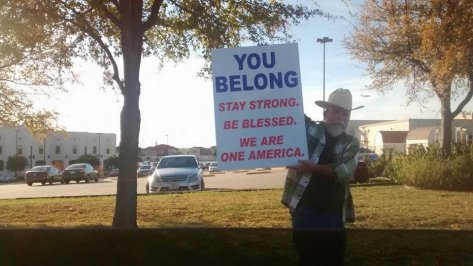
cym69maw8aahxaq-jpg-large

There are rags to riches stories. At least by American standards they’re rags to riches. Riches of the wallet. Riches of the driveway where a brand new Ford pickup sits. Riches of the living room where a plasma screen TV sits. A Christian nation that has forgotten the story of Solomon. Cram whatever you want into your life, it will never be enough. Perhaps we think it’ll be easier to pursue happiness with a V8 engine.

I don’t understand, I have never understood, I’m done pretending to understand.

Last summer we walked into the Shabin. It’s not all that different from the trailer we walked into on Porter’s first night except the outlets don’t smoke.

We have no tape measure so we measure its square footage by laying head to foot. It’s two and a half David’s long by a Brittney and David wide. It’s not much. But it will keep us warm. It will give us the chance to learn how to build a home of our own. More importantly it will allow us to live as self-sufficiently as possible. Four acres can make a hell of a garden. Starter gardens. There’s something I can get behind.

14344259_625434280948199_462564656092446778_n.jpg

We step out of the Shabin and onto the small covered porch. A wind rustles through the Cottonwood Trees and the leaves whisper their affirmation. The nearest highway is 65 miles away, the airport is closed for the night, the only sound is the trees and Thrush. A Great Blue Heron flies over, its prehistoric cry fills the silence.

I feel as if I’ve unlocked some sort of magic. I wonder what creates this feeling in others. Maybe V8 engines and seven figure incomes can elicit such emotion, but I doubt it.

Maybe the key to happiness is not pursuing it but instead accepting it. Accepting that a foot long sub, a free internet connection, a rescue cat, and the love of your life is all you really need.

_MG_9391

The Park Service is Going Rogue (And Kayak Guides Should Too)

Last summer was the 100th anniversary of the National Park Service. In Glacier Bay National Park, they spared no pomp or circumstance. Every poster, every talk, every presentation was prefaced, footnoted, and concluded with a reminder that they had hit the century mark. It got kind of comical after awhile. When someone reminded me that it was the 100th anniversary I feigned surprise:

“Really? They should have told someone about it!”

It was all capped with the opening of a traditional Tlingit Tribal House near park headquarters, complete with carved canoes paddled by the Huna Tlingit across Icy Strait and into Bartlett Cove. The day dawned with fog choking visibility to less than a mile. Flights were canceled. Lisa Murkowski was trapped in Juneau, 65-miles from her photo op. Sweet sweet justice.

As I floated in my kayak that day and watched the triumvirate of canoes emerge from the mist and heard the chants and beating of drums, the hair stood up on my neck. It was one of the most impressive and moving moments I’ve ever experienced. A powerful reminder that this place has meant something of incalculable significance to humanity for centuries.

But I also felt a twinge of annoyance that the NPS had chosen to do this on their anniversary. After decades of animosity between the federal government and Huna Tlingit, I felt conflicted on how I felt that it was done on the Park’s day. Perhaps I was picking nits. After all, the NPS had footed the bill for the place. I’m just some punk kayak guide who fancies himself a writer and by extension is a critic of the human condition. I’ve questioned the Park’s intentions before, scoffed at the cruise ship industry running amok in the west arm, and the damn “UnCruises” and their new “high usage” back country areas.

Fast forward a few months.

All of a sudden my critiques feel like the meaningless spats between a married couple. Was I really complaining about the Park Service leaving their metaphorical dirty dishes in the sink? Was I really all worked up because now 50 people were allowed to walk along a trail next to Reid Glacier instead of 12? My life was so simple I had the time to bitch about the Norwegian Pearl interrupting my morning as I looked down Johns Hopkins Inlet.

Now I look at the Park Service the same way Rey looks at Luke Skywalker.

https://www.youtube.com/watch?v=j3XZiJyePEI

It’s like a mixture of “I Am Spartacus” and “This is Sparta!” Between the Badlands National Park going rogue on Twitter to the new “Alt-National Park Service” movement, I’ve never been prouder to be affiliated with the Park Service. Right now I’m just hoping there’s going to be a “backcountry” in four years and argue about.

Knowing the people I do that work for the NPS, this defiance shouldn’t be a surprise. For many, if not all of them, their work is not just a job. No, people work for the parks because they genuinely care. Trump didn’t expect that. He assumed they were a bunch of good little worker bees that wouldn’t say a word as long as they kept their jobs. Guess what buddy? You just kicked the hive to discover the bees were hornets, and they’ll be damned if you’re going to take America’s honey from them.

But he’s going to try to muzzle them. We’ve seen it already with the EPA and when he forbid the Park Service from tweeting after they posted a photo comparing how small Trump’s hands crowd was at the inauguration.

One of the biggest jobs in Glacier Bay during the summer falls to the Interpretive Rangers. A crew of patient, knowledgable, and energetic folks who step onto each cruise ship that passes the park boundary to tell people what the hell they’re seeing and handle such cracker jack questions as:*

“does the water go all the way around that island?”

“Is that glacier made of salt? Is that why the water’s salty?”

“Are there polar bears on the glacier?”

“Do you believe in climate change?”

(*these are real questions)

Ah, yes, climate change. First, stop asking, “do you believe?” This is not a religion. There is no Church of Global Warming. You can chose to accept the facts or not. They exist whether you “believe” in them or not. It’s science, irrefutable science.

For the past eight years, NPS rangers have been able to calmly and accurately regurgitate the facts of respected scientists from across the globe, explaining the uncontrolled growth of Carbon Dioxide in the atmosphere, the uncontrollable rise in ocean temperatures, and the extreme unlikelihood that human beings are innocent.

But of course the angry Oompa Loompa isn’t going to let people discuss a Chinese conspiracy on his dime. Which isn’t actually anything new. Park rangers were forbidden from discussing the effects of Climate change during Bush’s second term. Maybe, just maybe it had something to do with Dick Cheney’s ties to the oil industry. Just maybe.

So the Park is once again going to be shackled by the irrational opinions of the man in the White House. So while the Park Service may have to have a more muted level of public resistance. Though I would anticipate several “off the record” conversations aboard those cruise ships this summer. But the kayak guides have no such shackles. We can say what we want and do what we want as long as we don’t harass marine mammals and get five star reviews on TripAdvisor.

So the mission statement has changed a lot from: give people a nice lunch, talk about John Muir, and maybe see a Humpback to a full blown: Edward Abbey and the Monkey Wrench Gang recruitment poster.

Wilderness guides have the incredible opportunity to impact people from across the globe (as long as they’re not from Middle Eastern countries where Voldemort doesn’t have any business ties). When people come in contact with the physical world and dig their toes in the sand or walk through a forest framed with Devils Club, their hearts and minds open. There is a golden opportunity to get through to people, or at the very least, get them to listen. I’ve convinced “if it can’t be grown it must be mined” Republicans that maybe, just maybe, Common Murres are worth more than coal, at least for an afternoon.

The point is, people listen to the guide. Partly because their lives depend on it, partly because it is insanely obvious that we give a shit about these places. We care so much about something so much bigger than us and it shines through. And if the Park Service really can’t talk publicly about the threats this wanna be emperor is creating for these places, it’s up to us speak even louder, scream it at the top of our lungs to everyone we meet.

People are desperate to act and fight back. Many of them will be rushing to their parks this summer to get a good look at America’s Greatest Idea in case they disappear. They won’t. The Park Service has made that clear. The American people have too. Did you notice how fast that bill to sell off public land disappeared? Being a guide has always been about trying to change people and impact their lives. That’s still the case. But it’s something bigger now. Now I’m arming people to fight back, to take their experiences and wield them as a weapon. And as the Park Service continues to resist, it will be an honor to stand beside them every step of the way.

Telling Stories

He wore cowboy boots. Amazing how quickly one can come to a whole list of conclusions by a shoe type, an accent. In this case the accent matched the boots. A drawl that can come from only one place. A drawl that says, “I will not be amused when you remind me that Alaska is three times bigger than Texas.”

So I skip it, not that it was ever funny. I worked with this boat captain several years back. Before every trip he would make the guests go around and say where they were from. When someone announced they were from Texas we’d burst out with all the pent up enthusiasm we could muster, “welcome to America my friend!” They either loved it or hated it. I haven’t used that line in forever. I gloss over that one too.

They introduce themselves. Bruce and Gail. Even their names sound like Texas. But they’re friendly, oh so friendly. Bubbly, energetic, polite, talkative. In their mid-60s and on their third trip to Alaska. They love it here. They’ll remind me of that ten more times before the day is done and I’ll appreciate it every time. They’ll marvel at the beauty, coo at sea lions and otters, stare with hungry eyes at a breaching whale a quarter mile away. To hear them talk it may as well have shaken their hand.

Perhaps they sensed it like I did. That when it came to politics, to life, our ethics, we stood on opposite ends of the spectrum. But here is the beauty, the magic, the power of this Bay. It makes all that stuff irrelevant. Here is common ground. The otters are arbitrators. What would it be like if our Senate and House of Representatives met here, inches above the water. Would some of this melt away? Let’s make a Republican paddle with a Democrat and see what happens. Forget crossing the aisle, see if you can cross Bartlett Cove.

For seven hours the talk is easy. The conversations are light. They own a ranch, 2,000 acres of Texas desert beauty. Bruce grass feeds his herd. He brings inner city kids out every year, teaches them to hunt the deer that flood their property. He show them everything from pulling the trigger to cleaning, packing, and preparing. Reminding them  that food does not appear on the Wal-Mart shelves through some sort of Harry Potter spell.

“Get’em away from their phones.” Says Gail. “Too many kids spend their whole lives doing this.” She mimes tapping away on an iPhone, her head bent low, chin to her chest. “They never look up to see the world. They walk right past it.”

They’re involved in wildlife conservation. Fighting to keep the areas near their ranch wild. Teddy Roosevelt Republicans. How amazing, that the father of conservation was conservative, was buddies with John Muir. I mention the parallels and Bruce nods.

“Amazing man. Did you know that while he was president he explored the Amazon? While he was their he got so sick that he told the others in his party to leave him behind. That they couldn’t afford to carry him… the president! Tell me if that’d ever happen now?”

The trip ends. But they’re not sick of me yet and invite me up to the lodge to have a drink. For a moment I hesitate. But I’m intrigued, so intrigued by what is happening here. By the opportunity to have what Melanie Heacox would call, “the interpretive moment.” Sometimes a cold beer in the revelry of a magic day is that moment.

Halfway through the first beer the door cracks.

“Where’s one place that you really want to visit in Alaska?” Gail asks.

“There’s a place,” I begin, “in the northeast corner of the state, the Arctic National Wildlife Refuge.” Only politicians use the acronym, slurring it into a gravelly, guttural grown, “Ahhnwarrrr.”

Gail’s face alights. “It looks beautiful.” She says. Like most people, she’s seen the pictures. They’ve been to Denali, the Alaskan Serengeti.

“This is supposed to be like Denali on steroids.” I say.

Bruce leans forward. He’s a talker, not one to sit back and listen. “What’s up there?” He asks.

“Everything and nothing.” The silence hangs for a moment and I step off the ledge. “In the refuge is the 1002 area. That’s where they want—”

“That’s where the oil fields are.” Bruce finishes. I nod but say nothing.

“That’s where it is?” Gail says with a gasp. “That’s where the oil is supposed to be?”

I nod again and watch her face change but don’t say anything, waiting for her to come to her own conclusion. But Bruce continues, “You could put what, five drilling platforms up there? Two acres each. Ten acres total. Take what you needed and… the land land grows back. We see it in Texas all the time. Three years after you leave you can barely tell they were there at all.”

Our talks all day have been civil. And even now there’s no threat in his voice. Nothing that’s inviting confrontation. If only we could always talk like this. Maybe we’d get somewhere.

“If it’s done responsibly—”

“Not always as easy as you’d think.” I say. I could talk about Caribou, I could talk about carbon dioxide in parts per million, sea level rise, or erosion. But something whispers in the back of my head. “Tell stories.”

“Let me tell you about how north slope oil exterminated a pod of Orcas. In Prince William Sound is a unique population of Orca Whales. They’re called the AT1 pod. When the Exxon Valdez struck Bligh Reef, the AT1’s swam through the slick the next day.”

“Orca’s have no sense of smell,” I explain, “they had no idea what they were passing through… they haven’t reproduced since. There’s only a handful of them left. Three or four I think. Within a few years, they’ll be all gone. For me, I can’t put a price on that.”

It’s hard to tell what sort of impact the story has.

“One drunk boat captain.” Bruce says.

“All it takes is one.” I answer, “Prince William Sound will never be the same.”

I point out over Bartlett Cove, in the distance beyond the forests of Lester Island are the Fairweather Mountains. The view the three of us have been marveling at them all day. “There’s precious few places like this left on the planet. We need them. We can’t exist without them.” They agree, they understand better than most that nature equals life.

“Beneath the Brady Icefield,” I continue, which is just beneath the Fairweather’s, are mineral deposits. Possibly oil. This view we’ve been raving about all day, what if there was an oil well at its feet? What if a mine tailling dam burst? If we drill in the refuge, what’s to stop this place from being next?”

I’m not expecting a deathbed conversion. Not expecting them to change their voter registration to democrat. To start a non profit climate change research association. But I want to be heard. Just like they do. Like we all do.

“We’re coming,” I say, “from completely different ends of the spectrum. That’s ok.”

“We have no love for Trump.” Gail interjects.

“Bless you,” I smile. “But it’s important that we can sit and talk civilly about these things. That we do it respectfully. This is how change happens. This is how we keep amazing places like Glacier Bay, like the refuge whole.”

I doubt I’ll ever see Bruce or Gail again. And at the end of the day, doubt that anything in their minds has changed. Strip all this stuff away and we’d be friends, were friends for an afternoon. They’re sweet people, loving people, giving people. They work hard, play hard, the sort of people that would pick you up and set you back on your feet without a second thought.

But that look in Gail’s eyes when she realized that Ahnwarrr was the refuge. That that was the place under siege. Maybe something stuck there, in the back of her head. And maybe next time it comes up she won’t see oil rigs, drills, or platforms. Maybe she’ll see the Caribou running across the tundra, and a young kayak guide, his eyes full of meaning talking about how badly he wants to run with them.

Two Bears for Mark

I’m curled in my sleeping bag, the Alder trees at the back of my tent shelter me from the early morning sun. I’m somewhere in the world between dream and reality. So when I hear the sound of Mark’s boots making their way through the Reed grass, I’m not sure if it’s real or imagined until I hear his voice. His tone is calm and measured, but something in it makes my eyes snap open and heart rate quicken before he finishes his sentence.
“David? I hate to disturb you, but there appears to be two brown bears walking towards us along the beach.”

Hate to disturb me? I glance at my watch: 6:45 in the morning. Not that it matters. I want to be disturbed if there’s pair of brownies on the beach no matter the time of day. I unzip my tent and am greeted by my two hundred roommates. They’re small and elusive, rusty red and jet black. But the high pitched beat of their wings all sound the same in my ears. I’m inundated with the gnats immediately. But I brush them out of the way, pulling my bug net and can of bear spray along with me.

Mark is cool and collected as he points down the beach to the place where he last saw the bears. A lot calmer than I’d expect a guy from New York city to be during his first Brown bear meeting. Actually that’s not fair. It’s not like Mark Adams has never left the concrete behind. He’s hiked the mountains of Peru, gone where no white man has ever been in Madagascar. When you write like he does, people send you everywhere.

Which is why we’re here in the early morning light at the north end of Russell Island in Glacier Bay National Park. Mark’s writing a book about Harriman’s Alaskan expedition in 1899 and John Muir’s travels. When he needed a kayak guide, I was blessed with the opportunity to lead him into the wilderness. To travel as Muir did, one paddle stroke at a time. To explain and describe the land and creatures as they passed. And of course, to bring us back in one piece. The first part had been easy. The bears would make it tricky.

I walk down the rocks, trying to get a better angle of the beach. What a sight I must be. The weathered and experienced Alaskan guide, rubbing sleep from his eyes and pulling up his pajama pants that are a size too big. The pants are absurd. Navy blue with a pattern of wolves howling at the moon. The sort of thing you wear on rainy Saturday mornings while drinking coffee. Not fighting bears.

I step onto the tallest rock I can find and stare into the tall Rye grass at the back of the meadow. My body’s awake but not my eyes. I rub them again, trying to focus and keep my expression calm and collected. This happens all the time of course.

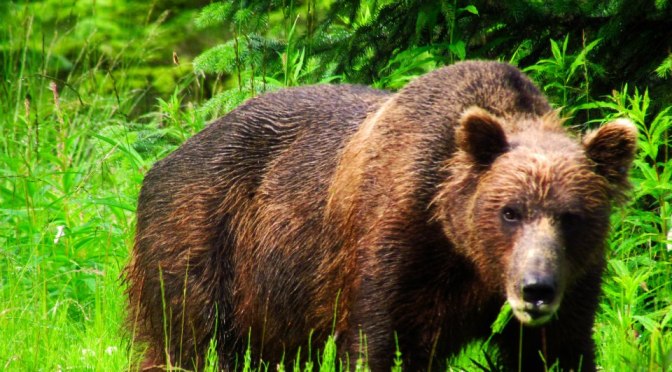
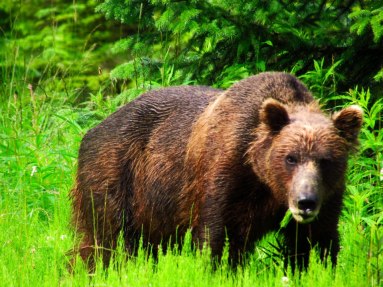
Two little brown ears pop up among the grasses. Little satellite dishes that recede the thin long face of a brown bear. Instinct kicks in. I clap my hands and call out good morning. I don’t shout, I want to save some volume, just in case. The bear looks at me, head tilted sideways, politely curious. As if he’s rising on an elevator another bear appears next to him. They’re skinny and young. Probably just got kicked out by Mom within the last month. Four year olds. Teenagers. Young, dumb, ready to take on the world. I can relate.

They saunter back into the woods as I call. Nonchalant and relaxed. I turn and beam at Mark. We’ve talked a lot about bears the last couple of days. I’m glad we saw one. He’s got his little waterproof notebook out, scribbling notes. A few minutes go by and there’s no sign of the bruins. I put on more respectable pants and pull out the Coleman stove, putting water on for coffee. I’m forgetting something… mugs!

Leaving Mark with the stove and food, I jog back up the beach and to the tent, digging for the thermoses. No sooner do I reach the tents and Mark’s voice floats up the beach.
“David? Your friends are back.” Uh-oh.

I come back down the beach, my pace a little quicker this time. I find a big rock and jump on top of it. I spread my legs and stand tall. Stretching my thin 6’4” frame as far as I can. I shout, I clap, I wave my arms. The bears spare me a half-second look and go crashing back into the Alder. From my vantage point I can see the trees shaking fifty yards back from the beach. They’ve cleared out.
GOPR2088.jpg

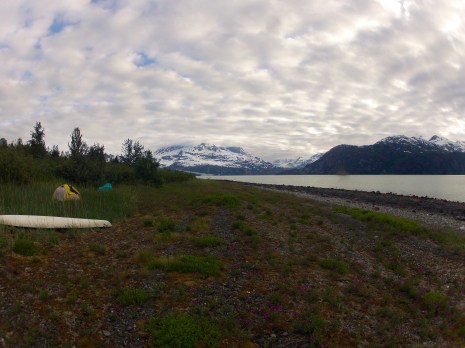
(The beach the night before the bears. The bears came out of the Alder near the blue/green tent)
I reach Mark and the stove, setting the thermoses down and pouring the boiling water into a Nalgene we’re using as a coffee maker. While the coffee steeps I run back up the beach for socks. The bugs are eating my Chaco attired feet alive. I reach into a dry bag and freeze. Something is snapping twigs in the Alder feet from me. Boots forgotten I step back, clapping and shouting. I’d started at a six, my volume’s at ten now. I reach into my pocket for the bear spray. It’s not there. It’s on the beach with Mark.
As calm as I can I shout down the beach, “Mark, can you bring the bear spray up with you please.”
I feel caught. Food and author on the beach, tents and kayak near the trees. In my head I can hear the voice of the park biologist Tonya Lewis. “Don’t let the bears get your food.” I run back down the beach, clapping and shouting the whole time. A plan forms in my mind. Grab the food cans and stove. Pile it at the waters edge, break down the tents. Get the hell out of here. If they want the beach this bad, it’s all there’s. I meet Mark halfway, his arms laden with bear cans, the stove, and water bladder. I grab a handful of gear, turn, and feel my heart drop. The bears are back. Feet from Mark’s tent. For the first time in my life, there’s a bear between me and my kayak.

I grab the bear spray from Mark and charge up the beach, calling at Mark to follow me. In my panic, a tapestry of expletives flow from my mouth like water down a mountain. “You… bear! Get the… away from my… kayak!”

One of these bears is brave. Too brave for my liking. While one slinks into the woods just out of view, the bolder one moves between the tents. Three more strides and he’s at the kayak. I grab a baseball sized rock and close the distance to forty feet, Mark at my heels. “Look as big as you can.” I tell him.

I shout more words you can’t say in church. I pull the safety off the bear spray. The rock cocked like I’m Nolan Ryan, the bear my Robin Ventura. I’ve never fired bear spray at a bear before. Had proudly told Mark 36 hours ago that bears were misunderstood, shy gentle creatures. Leave it to nature to make me look bad.

I’m ten yards away. First and 10. Russell Island Bears versus Gustavus Kayakers. It’d be a route if it comes to that. I finger the bear spray and shout again, I feel my throat getting raw. At last the bear turns.

I’ve looked into the eyes of many wild animals. Orcas, humpbacks, moose, sea lion, seal, deer. But only a bear’s gaze has the ability to make me feel like I’m two feet tall. Nothing is more untamed, more wild. Daring you, defying you, to tell it otherwise. “This is my house,” they say. “Do you want to see what happens in my house?”

I don’t, and I have a feeling neither does Mark. Although his guide getting ripped limb from limb would make a hell of a chapter. The bear turns and gives a little huff. My knees go weak. The bear spray rising above my hip. Dimly I register that there’s no wind. A clear shot if it comes to it. The bear turns and starts to walk away from the kayak. My heart’s in my throat. Keep walking, keep walking.

He slips into the Alder like a phantom. But for how long? I cover the last few feet to the tent. Mark has stood calmly by the whole time. No panic, no fear. What’s going on inside is a mystery, but he’s a heck of a lot calmer on the outside than I am.

We drag our tents through the meadow and over the rocks, our sleeping bags and clothes still inside. We’ll dismantle them near the water. Right now I want as much room between me and the Alder grove that I can.

Fifteen minutes later we float 100 yards offshore in our double kayak. I glance at my watch and laugh. I’d set a timer for the coffee. It’s been steeping for 52 minutes. I hand Mark a thermos, a Cliff bar, and an apple as he scribbles notes. “Got it get it down while it’s hot.” He says.

The bears are on the beach, right at the water’s edge, digging for tidepool Sculpin and munching on Blue Mussels. They’re a lot cuter with 150-feet of water between us. My heart rate slows. This is all they wanted. Two hungry bears, learning to survive without mom. Trying to find a route to the low tide and the protein. We were just in the way.

I rub the side of the kayak, relieved and relaxed. I didn’t want my career defined by one wrecked kayak. The morning is gorgeous. The water is turquoise, that electric color that only the glaciers can mix. As we float Mark pays me the highest compliment he can. “This may be the most beautiful place I’ve ever been… nice choice.” As the bears work their way back into the woods I grin like a hyena and strike my paddle against the smooth surface.

GOPR2087.jpg

Rolling the Dice

Every guiding company has them. A page of carefully worded phrases meticulously written out by a lawyer in some office, far removed from the natural world. The infamous risk waiver. A bucket of ice water at the start of the trip. A necessary reminder that the world we are traveling to is unscripted. That it can be harsh, dangerous, and unforgiving. That even the best of us, the most prepared, the most cautious, are not immune.

For those of us that live it every day, we have our own, unwritten risk waiver. Every time we go out our doors and into the woods, up the mountain, or onto the water, we sign it. It’s our unspoken agreement with the world we love. An acceptance that it can betray us at any moment. For if it can happen to Forest Wagner, it can happen to anyone.

Forest lives in the woods. There isn’t a mountain he can’t climb, a fjord he cannot paddle, a situation he can’t handle. Two weeks ago he was attacked by a bear while leading a group of students near Haines in southeast Alaska. He wasn’t been foolish or careless, disrespectful or arrogant. You roll the dice enough with Alaska, and sometimes it comes up snake eyes. What are the odds that there’s a mama bear with spring cubs over that blind ridge? 1 in 100? 1 in 1,000? How many blind ridges do you hike over before the odds catch up?
304523_10151351163614852_290551_n
Forest’s influence and inspiration stretches across the state, across the globe. He’s taught thousands how to survive in the back country, inspired many to follow their passions as mountaineers, kayakers, river rafters, and skiers. From all accounts, even after he’d been attacked and bitten along his side and leg and fallen off a cliff face, it was he who spoke to the medivac on the cell phone. Calm, clear, and collected, he talked his students through the whole process. His own Wilderness First Responder.

“I can climb down if you need me to.” He told the medivac. As if he’d done nothing more than sprain his ankle on a morning run through the suburbs.

Why him and not me? Two days ago I hiked the mountain ridge behind my parent’s house. Bear and moose sign coated the game trail. Again and again I rounded blind corners. Bear bells jingling and bear spray bumping against my leg offered little comfort. I’d be lying if I said I wasn’t thinking about Forest around every corner. Wrong place, wrong time. Our unspoken agreement, our signed risk waiver with the natural world.
37367_467283714851_8103409_n
I wouldn’t have it any other way. Beneath the sugary, frosted coating that reality TV has given Alaska, nothing has really changed. To truly experience this land, to know it with genuine intimacy means to throw ourselves at its mercy, and accept that we may not receive any. Forest knows this, I know this, Brittney knows this, and so does any other guide or outdoor enthusiast that climbs her mountains and paddles her shores. For if the wilderness was always safe it would not be wilderness. With risk comes appreciation and respect. How charismatic would the bears and wolves be if they were harmless? Would we love them, photograph them, even their tracks worthy of our marvel and imagination? Would glaciers be sublime if they didn’t send blocks of ice as big as buildings into the water to crush and reshape everything in their path?
37235_467271534851_7897543_n
So this summer I’ll strap on my boots and push my kayak into the water. I’ll grab my fishing pole and walk the salmon stream, knowing that I share the land with bears, moose, and whales. I’ll grab my dice, take the odds, and see what happens. The alternative is a life that is fraught with other dangers. Forest wouldn’t have it any other way.

He’ll be back, it’ll take more than a bear to pry him away from his natural habitat. I have no doubt he’ll summit Denali again, climb the alpine, and return stronger and more confident than ever. The wilderness needs ambassadors like Forest and the mountains of Alaska just wouldn’t be the same without him.

For His Old Branches II

The rain falls as a fine drizzle, turning the surface of each rock and log smooth and slick. My body feels unbalanced, the chainsaw in one hand, oil and two stroke fuel in the other. Beyond the crunch of my boots against the loose rock the world is silent. Blackney Pass stands calm and tranquil. The vista slows my heart and mind. This view. How easy to glance past it after all these months. The islands and channels are worn into my mind like the creases and callouses on my hands. Swanson, Harbledown, Baronet, Cracroft, Blackfish. What names. They stir the imagination, fall smoothly from lips and tongue like water over stones. For years I stared at maps, brushing my fingers over their namesakes, their crude imitations of green and blue put to paper. Now? I see them every day. May the novelty never fade.

I bend over the chainsaw and pull the cord. Through my ear muffs I can hear and feel the vibrating base of the saw as it comes to life. Oil, fuel, and metal. In my hands, with the simple pull of a trigger, I become master of the woods. Capable of felling trees that have patiently grown for a millennia, evicting squirrel, thrush, and deer as the roar of progress and the thunder of manifest destiny march through the woods. But for this I have no desire. I could no sooner fell a growing Cedar than take a man’s life.

I head down the beach. I’m searching for a sacrifice. For a gift willing to disappear from the physical world through the chimney of our cabin leaving only a small pile of ash as a talisman. The log is weathered and worn, maybe a little water logged. But its location is good, and cutting this one opens up space to negotiate the nicer, friendlier logs behind it. I pull the safety, click the button, and the war cry of humanity echoes off the standing trees. I cut with my head down, the trigger pressed halfway. The sharpened chain cuts clean and smooth. No knots. No warping. What a tree it must have been. Before it was reduced to this. Reduced to laying naked on the rocks, it’s branches stripped, its roots severed. I love reading the stories of the old hand loggers. The one’s that went up Tribune channel just north of here. Each tree was selected with care. It had to be. For each one had to be felled just right and rolled into the ocean. Clearcutting wasn’t just unnatural, it was impossible. Hard work. Anything but glamorous. That I could do. No one hand logs anymore. Carve a road into the hills and forests. Strip the forest. Every. Last. Tree. This log I’m cutting is nothing more than a refugee.

Brittney joins the ritual. She wraps her arms around the rounds as they roll free and patiently walks them up the beach, dropping them with a thud that shakes the forest floor. The rain continues to fall, mixing with the sweat on my brow and back. Cutting wood always makes me perspire. I have no idea why. I’m just standing here after all.

I work with my back to the water, the incline slightly uphill. After a time I stop and rise, stretch my back, and turn. A tug and its massive tow fills the strait. It chugs south with diligence. The rumble of the massive diesel engines echo in my chest. My eyes fall on the tow and a snarl spreads across my face. A log tow. Hundreds, maybe thousands of logs lay piled a hundred feet high. A hundred logs high and a hundred wide. Plucked from the raincoast, heading south to await their fate. As what? I’d be lying if I said I knew. Homes? Mulch? Toilet paper? It makes little difference in the moment as a wave of disgust washes over me.

The chainsaw vibrates and slides over the rocks, bumping against my foot, reminding me of my hypocrisy, that I’m standing in three inches of sawdust. That I live in a wooden cabin. That the kayak my father is lovingly crafting for me is made of it. What if the wood for my kayak was once on a barge like this? What if it had been pulled south, past this lab. So that I could one day paddle the inlets it had once looked over.

What’s enough? What is ethical? What is right? The oil companies had a field day a few years back when Shell’s big oil platform pulled into Seattle. Hundreds of big hearted, environmentally conscious people took to the water in kayaks, many of them plastic. Floating thanks to an industry that allowed them to be there. Does that make them hypocrites? Does it muffle or mute the cause they stand for? Do I have a right to feel angry when a log tow goes by? Is it enough to say that I’m doing what I can and accept that it’s impossible to not impact the environment negatively in some way?

There’s no answer from the ocean. Hard to hear with these ear muffs on and the saw rumbling. Avocados from Mexico, bananas from California. Oil, carbon, trees, methane, melting ice caps, Republicans. Dear God. And I’m worried about a couple of trees?

“Do what you can with what you have.”

Who said that? Roosevelt I think. Teddy or Franklin? I can’t remember.

A pillar of Christianity is that we are imperfect and that Jesus does not require us to be. We need forgiveness because we’ll keep screwing up. I look down at the log and feel a shiver run down my neck as the sweat and raindrops cool on my shirt. I think about the book I’m writing, that I want to see published. More than one if I can pull the wool over the eyes of an editor. Books that will be published… on paper since stone tablets went out of style years ago.

Just because I’m an imperfect environmentalist doesn’t mean I shouldn’t, or can’t talk about it. For if we wait until we’re not harming it at all, we’ll be delivering the message on horseback in between long treks through the forest, hunting with sharpened sticks and rocks. Next summer I’ll sit in my wooden kayak, and I’ll do so without guilt. From its seat I can be an agent of change. I can touch the lives of thousands of people as I lead them into the wonder of Glacier Bay. Reminding them gently, patiently, that if we lose this we lose ourselves.

I pick up the chainsaw. I’d be lying if I said I felt good about it as the sawdust started to fly again. One by one we carry the rounds up the hill and to the chopping block to where our woodshed (made of wood) stands. Beyond it is the forest. A forest rebounding from logging. At its heart stands Grandma Cedar, the ancient tree that has survived so much, has seen it all. A forest that, if we keep talking about it, will never hear the sound of a chainsaw in its depths again.

The Wolf

I am not a brave person. At least, I don’t consider myself one. I rarely feel bold, or filled with valor, or the innate desire to take risks, and stick my neck out. I get nervous walking through the woods in the dark, even here, where there’s been exactly one bear sighting in decades. My imagination, which is often my ally betrays me in these moments. I feel the hair rise on my neck, the goosebumps spread across my body, a spasm of fear running down my legs.

I don’t believe in spirits floating among the living. At least, I think I don’t. But the lab is built on the same ground that was once a Namgis summer camp. A small grave was found in the rocks, somewhere near here, the body of a young girl entombed within. That’s what Walrus says. I never asked him where the grave was. I don’t want to know. But it’s much easier to believe in restless spirits, the thrill of the supernatural, the magnification of fear when the dark surrounds you with creaking and swaying trees. Glowing eyes in the dark. Deer, they have to be deer. But what if they aren’t?

The water’s rough. The waves roll up on themselves, ringed with foam and frothy white caps like pearls on a necklace. Rain falls as a fine mist. In our tiny boat, the waves roll by at eye level, the boat pitching over the crest and through the trough of each swell. Up and down the hills, again and again. Why does it seem like we’re always going into the wind? The water is deep, churning, cold, dark. This seems like a lot of work to go through to run a generator. But such is our assignment today. To cross Blackney Pass for Cracroft Island. To add the magic of unleaded gasoline to help us maintain power at the lab.

It’s the same body of water we were crossing when the boat engine died a few weeks ago. And for an hour we were at her mercy. Enough to make you think twice when the land fades away off the starboard side and you begin the mile wide crossing. I’d be lying if I said it wasn’t in the back of my mind, with the waves growing and the ocean soaking our windshield. No boldness or valor or bravery here. Loyalty and dedication maybe. I’m more Hufflepuff than Gryffindor.

What would it be like if we lost the engine here? If the boat filled with water? If we had to jump clear, life jackets clinging grimly to our necks? To come face to face with our greatest fear? I’ve never had a near death experience. At least not that I remember, and I’d like to think I would. How terrible and thrilling, to come face to face with my own mortality. Would I be cognizant of my final breath? Aware that it was the last one this body would ever draw for me? Would I watch this grim physical home for my soul drift into the depths as I floated above, great wings growing out my shoulders? Or does everything just go blank? A reel of film that’s reached its end, spinning pointlessly on its spools.

But today is not that day. Across Blackney Pass. In the shadow of Cracroft Island, the water is calm, a soothing emerald color. It’s far too rough to land on the rocks by the shelter. So we motor into a quiet cove on the opposite side, out of the wind. Was it really just a year ago that we blazed this trail? Just me, Paul, a couple of hacksaws, and a general idea of what direction to bushwack. By some miracle our zigs and zags led us straight to the CP shelter. We climb onto the bow and tie the boat to a massive log draped across the rocks.

I step into the woods and stop. I’m not alone. Something lays on the ground at my feet. A jigsaw of vertebrae and ribs and fur. It’s been dead awhile, the body barely recognizable. The skull lays just off to the side, neatly picked clean as if it were a name tag, identifying the creature to which it had belonged.

“There’s a carcass in here!” I shout.

Brittney shoves the ferns aside and stops next to me, mouth agape. The smell wrinkles our noses, but neither of us step back. For a long while we simply stare, a silent vigil, disturbers of the animal’s peaceful sleep.

“What is it?” Brittney asks. She’s kneeling near the clump of fur and vertebrae, awestruck. She’s neither squeamish nor disgusted but fascinated. Even in death, her compassion for things furry continues.

I break off a stick and flip the skull over to reveal the jaw. The mandibles and lower jaw bones are gone, but the unmistakable canines of a predator remain. We let out silent gasps.

The wind rattles the tree tops. It’s going to get worse out here before it gets better. I leave Brittney with the departed, and vanish into the woods. The whole way to and from the shelter, I think of nothing but the creature. I’d never seen anything like it, on the day that I’m contemplating my own mortality. It can’t be a coincidence.

I return to find that Brittney hasn’t moved. It was a wolf pup she announces with conviction. I agree. What else has teeth and claws like this? We sit in silence, my mind trying to put the wolf back together.

“How do you think it died?” Brittney asks.

Like the girl’s tomb, I don’t want to know. The ocean is not twenty-feet away. Is it possible that one of my own species is responsible for this? Was this cub the victim of some human’s potshot with a rifle? A vigilante dedicated to predator control? Maybe that’s unfair, but I can’t think of any explanation for how he chose right here to lay down and die. We leave him where he lays, to continue his noble work of returning to the soil, feeding the web of life around him. A sacrifice that won’t go unnoticed.

One more stop. Parson Island. The water has settled a bit while we were in the woods. And the journey across Baronet Passage is a calm one. I disappear into the woods and up the hill, one more generator to go. My mind returns to the wolf cub and I feel pity for the little creature, that his life was taken so early. I pray he died right, with honor, dignity. Perhaps he just didn’t want to be a wolf anymore. Was ready to be something bigger than himself. Isn’t that what I want? What we all want? For what is more fulfilling than giving of ourselves to something bigger. To make the world a better place.

The land where the wolf lays resting was clearcut some thirty years ago. The land stripped. Every. Single. Tree. No more squirrels, no more birds. No wolves. No cougars. No life. No character. But the land is recovering, like it always does. And will flourish with magnificent old Cedar trees again, if we allow it. Maybe all he wanted was to speed up the process. Infuse the earth with his carbon and nitrogen, accelerate the growth of those great trees so that the generations to come can run and hunt and howl beneath their great branches.

I reach the cliff. From here I can see past Cracroft Island and into Johnstone Strait, up into Baronet Passage, out into Blackfish Sound and Queen Charlotte Strait. Pristine silence. Quiet places. Open spaces. The little cove on Cracroft is indistinguishable. The wolf’s resting place invisible, his sacrifice anonymous from here. But I know. Brittney knows. The tree’s know. Sometimes the greatest sacrifice is the one not recognized.

I say a little prayer before I pour gasoline into the generator. Before the war cry of my species infects the land.

“Thank you,” I say, my voice drifting across the water. “For making this world a better place, for reminding me of what is good and pure and wild. For infusing the earth with your spirit. I hope to leave this place better than I found it too.”

I bend over and pull the cord. The generator roars to life. Without a backwards glance I turn and vanish into the woods. The Cedar and Salal covers my tracks. The growl of the generator echoes in my ears.

50 Horsepower of Deceit and Betrayal

The sun crawls above the mountains on Vancouver Island, the rays piercing the flimsy curtains and flooding our bedroom with sunlight. Every day the sun inches a little higher above those mountains, every day it’s a little earlier. I reluctantly stir, not ready to leave the warm embrace of the down comforter. Brittney stretches and swings her feet over the edge. With an effort I open one bleary eye.

Town day.

At least that was the theory. Johnstone Strait had been pulverized by 40 knots winds for the last week, leaving the shelves of our fridge bare. No more crackers, no more lettuce, no more beer. We’ve got to make it today. The cedar boughs looking in our second story window flutter gently in a light breeze. Today offered a 12-hour window, a respite from the parade of low pressure systems that define the winter climate.

We crawl out of bed, scarf oatmeal, chug coffee, and ready the boat. We cram the tiny space behind our little wooden seats with empty jerry cans and garbage bags filled with laundry and trash (it’s important to remember which is which). The water’s of Blackney aren’t as pristine as we’d like, but it’s going to get worse before it gets better. The engine comes to life on the first turn and we putter out of the back of the cove. Our departure sends the resident Harlequin Ducks scurrying for cover among the rocks and Brittney bleats out an apology on our behalf as we leave them squabbling in our wake.

But town isn’t the first stop. We turn southeast, angled for Cracroft Point, the shelter, and the solar batteries which are once again drained of power. We skip past the sea lion haulout and round the corner of Hanson Island, the expanse of Blackney Pass opening up before us and dotted with whitecaps. We hit the first bounce as we pass the two islands that sit just off of Hanson Island, affectionately known as Little Hanson.

We’re maybe a hundred yards off of north Little Hanson when the engine revs, sputters, and dies. I swivel around, expecting to see a meddlesome strand of kelp trailing from the propeller, but it looks clean. In just a few seconds, the combination of an ebbing tide and southeast wind has turned us sideways to the waves, the tiny boat rocking violently as it falls into the wave’s trough. I turn the ignition, and the engine roars back to life. But as I slip it into gear it cuts out.

Oh god.

Brittney’s face is the picture of calm, and I try to look equally at ease, “that’s odd,” I quip.

I bring the outboard engine up and lean as far out over the stern as I dare, looking for anything that could be fouling up the propeller. The black blades gleam spotless in the morning sun. Everything looks normal. I take a step back and trip over an empty jerry can, my shifting momentum causing the boat to rock all the more.

It’s not the first time I’ve been on a boat when the engine died. My last summer as a deckhand in Juneau our boat died, only to get picked up by an afternoon storm and deposited on the rocks. The same nervous feeling begins to crawl into my gut and I glance at little Hanson’s shoreline as the waves push us towards it. Better that way than out into Johnstone Strait.

There’s little room to maneuver, but I drop to my knees and pull out the boat’s gas tank from it’s slip beneath the engine as far as I can. Adrenaline courses through my body, an ambitious wave breaks over the stern and I feel the icy chill run down my legs. I give the fuel line a cursory look, everything looks connected. I grab the fuel pump like a dying man grabs his rosary, and give it a series of frantic squeezes. Please please please.

I climb over our mountain of laundry and turn the key. Cough, sputter, die. Shit. This whole time Brittney has sat quietly in her seat, watching.

“Is there anything I can do?” She asks.

“I don’t know if there’s anything either of us can do.”

I reach into my pocket and find the phone. Cell service is always a coin toss out here. But a trio of bars appear like beacons of hope. I dial Paul.

“We’re ok,” I begin with more confidence than I feel, and I lay out the situation. We agree that we should get to shore, try to find a sheltered spot, and he’d call the mechanic, the coast guard, or however else may be able to get us out of this. We’re going to shore no matter what. The ocean’s decided that for us. On the other side of the two little islands is a wind shadow, the water shines turquoise and placid. If we can make it there, it would be infinitely easier to figure out what’s gone wrong.

I grab the paddle, thanking any deity listening that it was onboard, and climb onto the nose of the boat. We inch down the shoreline for the small channel between the islands and a respite. We round the point and my heart drops. Draped across the channel is a massive log. It spans the entire distance between the two islands, just low enough to keep us from passing. We try to turn the boat and paddle out but it’s hopeless. The wind and the waves have complete control, and I brace myself as we collide with the log.

I call Brittney onto the bow, expressions of hopelessness spreading across our faces. We can’t stay here. The tide is ebbing and in a few minutes the boat will be left high and dry, trapping us for 12 hours. I do the only thing I can think of. I leap onto the log, bow line in my teeth, and together we slowly pivot the boat around so that the bow is facing the oncoming swells. With Brittney on the bow, I scurry along the rocks, pulling the boat along while she uses the paddle to push us off the emerging rocks. A tiny indention in the rocks offers just enough protection and we hug the windward side of the rock, the boat bouncing off the shore.

The phone rings. Paul again. His theory is that it’s the fuel line or water filter. But it takes both of us just to keep the boat from slamming against the shore. There’s nowhere safer to go. The ocean has us pinned in the tiny channel that will be devoid of ocean within the hour. I toss Brittney the stern line and the paddle and leap back aboard. I throw everything I can onto the seats, trying to give me enough room to operate. For a moment I stare at the engine, 50 horsepower of deceit and betrayal. I pull the gas tank free once more, trying to ignore the rocking of the boat, the grinding of the hull against the rocks.

Focus. Deep breath. Slow down.

I touch the fuel lines tenderly, gently pulling. And one swivels and pops loose. Hope floods my body. This is it. This has to be it. I reset the O-ring, pull the cap over the tube, and tighten. Brittney’s almost bent double the paddle braced against the boat, battling valiantly. I hesitate. Do I tell her to jump aboard, send us adrift, and pray the engine starts?

“Hold on!” I yell. I throw the gas cans and laundry into a heap, press the trigger, and lower the engine so that it’s just immersed in the water. Knowing the precious propeller is inches from the rocks, that every second brings it closer to the bottom, I pull the choke, say a prayer, and turn the key. The engine comes to life.

“Get on!” I yell. Brittney tosses the paddle aboard and follows after it, pushing the boat off the rocks as we back slowly out of the channel. Blackney Pass has turned into a swirling cauldron while we were adrift and we move slowly out into deeper water, the nose pointed for Cracroft Point. As I reach for the phone the water around us explodes, a flash of black and white. For a wild moment I think of orcas, but they’re too small. The Dall’s porpoise follow us like guardians across the channel, surfacing a foot away.

Did they sense our apprehension? Our fear? Were they celebrating with us? I let out a deep breath and grab the wheel like a lifeline as our little task force battles against the tide and the waves for the Cracroft shore.

Here We Go Again

A couple of summer’s ago Brittney was in Seattle when she and a couple of friends stopped in a sushi restaurant for lunch. One of her friend’s asked the waitress before ordering if the salmon roll was made from farmed or wild salmon.

“Oh it’s farmed,” said the waitress without a sliver of embarrassment, “but that’s good because it doesn’t have any of the toxins or parasites of wild fish.”

You can’t make this stuff up. Nobody ordered the salmon.

It’s incredible that in an age where virtually every question can be answered by a piece of metal that fits in our pocket, we remain so uninformed, so ignorant, using the power of wi-fi for cat videos and time lapsed food recipes.

And while I’m sure the server was just trying to say what she thought Brittney and her friends wanted to hear. The farmed fish propaganda was far from true. Quite the opposite actually.

Since their arrival in the water’s off Vancouver Island in the early 80s, the salmon farm industry has been cloaked in a web of controversy, cover ups, and deceit. Fish farmers swore that with their technology, that the farmed Atlantic salmon could not escape.

They did.

When fisherman began to find Atlantic salmon in their nets, the industry promised that they could not procreate in the wild.

They did. The more aggressive Atlantic salmon rooting out their native Pacific brethren from their already threatened streams.

The location of the pens near estuaries has led to a decades long fight to bring attention to sea lice. These sea lice, while relatively benign to fully grown fish, latch on to young, defenseless salmon fry and have threatened the livelihood of several Pink salmon stocks.

The latest news from those on the front line is perhaps the most disturbing of all. A virus that decimated the farmed salmon industry in Chile back in 2007 has been found in both farmed and wild salmon along the B.C coast.

The good news is the whistle blower, biologist Alexandra Morton uncovered the virus early. “We never found the whole virus, just pieces of it,” she reported to the CBC. One reason for this though is the closed door policy of the farmed fish industry. A closed door and hush hush policy is never an indicator of respectable or ethical practices. There’s a reason slaughter houses run off anyone with a camera. Morton and her team were able to take samples from “healthy” farmed salmon, usually ones that were already on the market. Potentially sick or diseased salmon that could be in the pens as we speak are hidden from sight.

The fish farm industry’s silence in damning enough evidence and the latest in a line of embarrassing failures in which the Canadian government has looked the other way. No criminal charges were filed against Imperial Metal’s, the company responsible for the burst Mount Polley dam in August of 2014 https://raincoastwanderings.com/2015/03/07/worth-so-much-more/.

In fact, Imperial Metal’s is now refilling the site of the burst dam. That’s what happens when you “donate” $234,000 to B.C Liberals. Remind me of this the next time I complain about America’s corrupt political system.

“What evil, thieving people,” we say. We shake our fist and…. what? We go back to our cat videos, we look out the window and the world looks the same. A storm rages right now in Blackney Pass and shakes the window. If there is a deadly salmon virus rolling along the flooding tide right now, it’s not giving itself away. What will it take for change? Will we wait until it’s too late? Until wild salmon are nothing but a myth? Our grandchildren wondering if they ever really existed?

Let’s not let that happen. Boycott farmed salmon, hell, boycott the stores that sell farmed salmon. Take away the demand, destroy the supply. And speak up. Let Justin Trudeau and the Liberal Party know that what is happening in the water’s off B.C is bullshit. That no profit is worth the potential death of an entire ecosystem. Do it now, before you leave your computer, before your busy day continues and it slips from your mind. Let’s stand with Alex Morton and the tireless watch dogs that have been battling this for years. Write to the Liberal Party here: https://www.liberal.ca/contact/

To my American and global readers remember, the ocean is not a closed system. A pandemic doesn’t care about international boundaries, the distance from B.C to the southeast panhandle is not  great. If it breaks out here, there’s no reason that it can’t travel north, south, east, west. We must stop caring about just ourselves and what is happening just in our backyard. The natural resources of this planet belong to all of us. And when one stock is threatened, we are all threatened.

We are a race that has cut ourselves off from the natural world. But we are not above it. We are, in the end, at its mercy. We cannot survive without it.

Photo from: http://alexandramorton.typepad.com/.a/6a0120a56ab882970c01a73d74643c970d-pi6a0120a56ab882970c01a73d74643c970d

The Luxuries of Wilderness

The boat grazes the rocks and rocks and Brittney steps onto the bow. The gentle landing is short lived as a three foot wave picks us up and throws with a dull thud against the shore. Line in hand Brittney leaps clear of the bucking boat and lands nimbly on the jagged rocks of Cracroft Point. The engine pulled up and the line unsecured, the boat is at the mercy of Johnstone Strait, a strait that seems apathetic towards the BC weather’s promise of a calm afternoon. White caps dot the surface and their thunderous crashes against the point’s steep shore is intimidating. I grab the bag and leap for the shore as another wave lifts the boat and sets it down, landing just clear of the water as the wave swirls around my boots.

Brittney handles the line like a cowboy handling a mustang, goading the boat into a small crevice in the rocks and out of the path of the largest breakers. She’s got this. Without a backwards glance I scurry into the woods, wielding a bottle of oil in one hand and a flathead screw driver in the other. The generator demands an oil change. A few feet inside the treeline the sound of the wind and waves is muffled, as if I’m listening to it with a pillowcase pulled over my head. Trying not to rush, I flip the generator on its side and unscrew the covering.

It’s incredible how much goes into keeping this place running. And even more amazing how inept it can make you feel. Between the electronics, the power sources, and internet connections, not to mention the mechanical nuances of boat repair, tree climbing, diving, and deciphering whatever voodoo it is that allows us to stream the hydrophones 24/7. Paul and Helena are probably the only two people on earth that know how it all works. It’s staggering to imagine anyone else with the combination of skills they’ve acquired in thirty some years. In the last two winters I’ve learned how to set up inverters, decipher internet connections, and giving myself more than a couple of nice shocks as I learned the difference between AC and DC. I’ve nicked the tip of the iceberg.

The oil comes out as black as night and as thick as molasses. Better late than never I suppose. I funnel the remaining oil into an old bottle and refill the generator with clear, syrupy  10W-30. Brittney appears at my side, the boat nestled in its crib.

We glorify wilderness. We consider ourselves disciples from the school of John Muir and Edward Abbey. And yet… look at what goes into surviving out here. Granted, I wouldn’t be crouched over the generator if there wasn’t an internet connection to maintain. But I can’t imagine the time and effort that it would require without 50 horsepower strapped to the boat, or a grocery store 45-minutes away. Even the men that sparked my love of wilderness had some indulgences. Abbey spent a lot of time living in a trailer, a propane stove and cot at his disposal. Heck, even John Muir had a rotating cast of savvy and tree smart Tlingit’s escorting him on his paddle trips through the Alaskan archipelago. Is the glorification of wilderness a luxury? Would Travels in Alaska and Desert Solitaire been written without them?

The oil in the funnel burps and I sit the generator upright, dipping the dipstick into the oil reservoir, the pale gray plastic coming back with a clear, reassuring shine. Would I deify the forest and ocean if my days were dedicated to ensuring my survival? I don’t know. Muir was mortified at the audacity of his Tlingit guides to shoot at deer on the beach as they paddled past. He would rock the boat so that there shot would go wide. A respect and love of nature to be sure. But for his Tlingit guides, it had to be analogous to going to the fridge only to have someone slam it shut. Not everyone has the luxury of hardtack and tea.

I screw the covering back on the generator and pull the start cord. It roars to life on the second try, spitting blue/white exhaust into the air, the southeast breeze sending it into the forest. Is my love of nature threatened by the very things that help me adore it? The avocados from Mexico and bananas from Belize that spare me the cumbersome task of crawling through the woods in search for all that is edible. Would I miss the forest for the trees and the tasty mushrooms that grow on their trunks?

This isn’t meant to belittle Muir or Abbey, two men I admire as both writers and preservationists. But would such men have been the same if they’d stalked across the western frontier a century earlier? Would that convenience have existed if Muir had been born a seal hunter? The glaciers not a monument to be marveled but a threat to his existence? Perhaps it’s as simple as saying that they were the right people, at the right time, writing the words that needed to be written to stave off humanity’s insatiable consumption of the very thing that makes us whole.

I pull the boat out of its protective crevice and the ocean roars up around it. I hold her as steady as I can until Brittney leaps aboard. With a heave I push the boat clear of the rocks and slide across the ocean soaked bow, clamoring over the top and into the relative protection of the cabin. The engine roars to life. A marvel of human engineering and brilliance. But without the miracle of organic compounds slowly compressed over millions of years it would be nothing more than a five hundred pound paperweight.

Maybe the Tlingit and Kwakiutl Indians loved wilderness the same way the European nature writers did, simply in a different way. Perhaps their love had  matured after centuries of marriage to the natural world. Their love expressed in the familiar and comfortable way a couple does after being married for thirty years, while Muir, Abbey, Brittney and I are in the honeymoon stage, breaking free of the society and concrete that compresses our chests and sends us running for the woods.

Water rolls over the top of the boat as the nose dips into the trough of a wave. Blackney Pass is sheet of white caps. I steer for Parson Island, we’ll take the longer, more comfortable way home.