Tag Archives: pets

Reinventing Your Exit

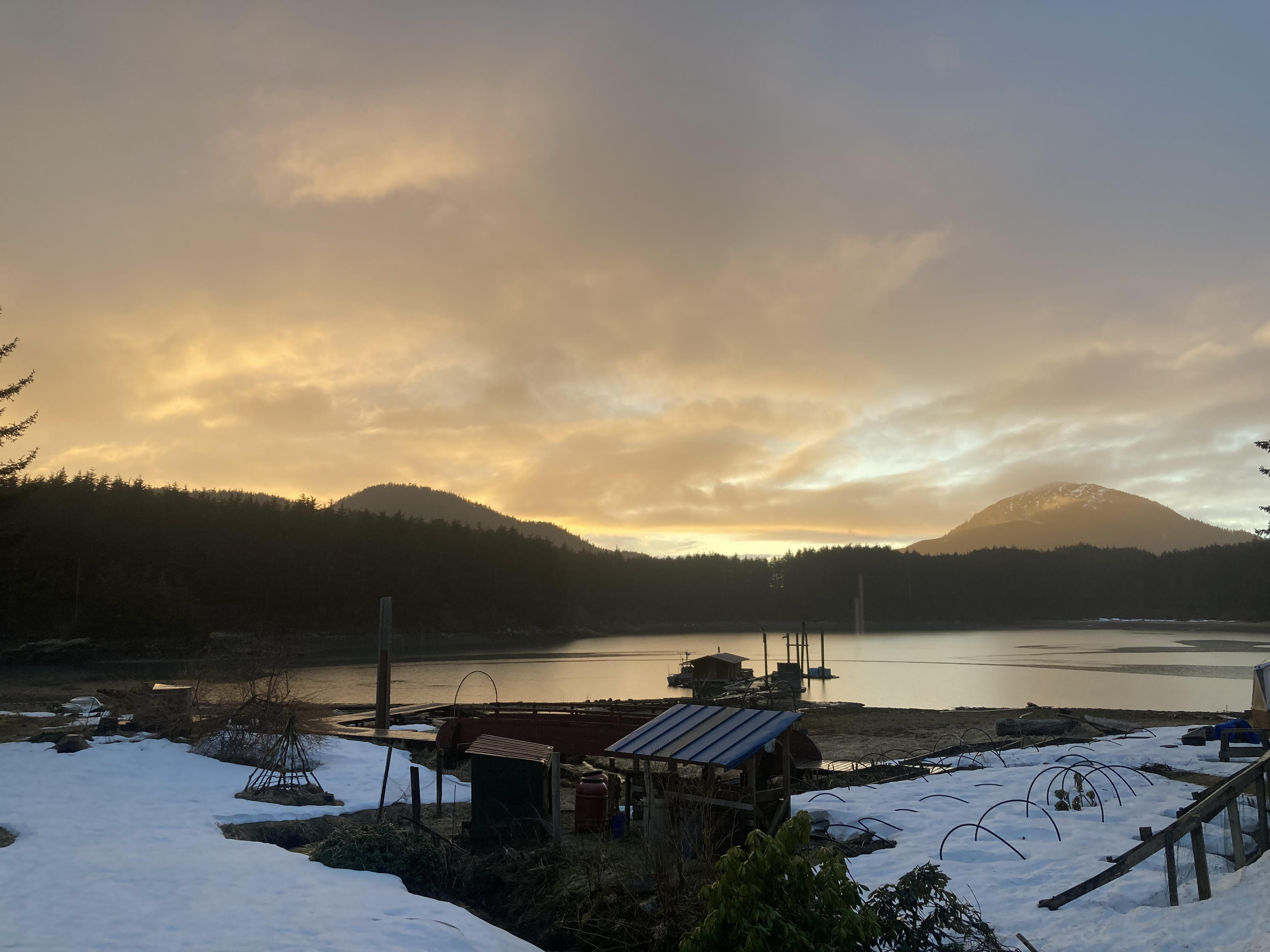
The water goes calm. A spring sun emerges from the clouds and reflects off my glasses. I set down the clipboard, and a breeze rustles the pages. Wind and blizzards battered the Inians for weeks. The hydro failed more than it functioned. The solar panels were dormant. For one heart-stopping morning, the diesel generator wouldn’t turn over.

Fifty degrees and sunny feels like Tahiti.

The manuscript dances in another gust. Minerva yowls from the top of the dock. She fears the dock, mistrusts anything that floats. But she’ll stand sentinel until I decide I’ve had enough. That won’t be for a while.

My head thuds against the sauna. I am “crouch to drink from a mountain stream and pinch a nerve in your neck” years old. It may be days before my Xtra-tuffs are dry, but it can’t stop me from vibing on yesterday’s ranging along the Inian hills.

***

I find the deer in a grassy muskeg the color of wheat. Catching my scent, he slips behind a gnarled pine. Something brings him back. He weaves through brush and poses on the hillock. His nostrils flare, mouth open to taste my scent. We stare for eons or several seconds—long enough to confirm he’s the biggest deer I’ve seen. My index finger instinctively twitches.

If it was November…

He has important deer business to attend to. He turns reluctantly, but once he’s committed, gracefully bounds away. Postholing snow be damned. I follow the winding tracks for a mile, give up, and turn south. Down a steep ridge and up the north side where wet drifts congregate beneath old growth. I pause. It was here, wasn’t it?

I lean against the log and look at the little valley. I see the spike buck wandering up the steep ravine with his head glued to the patchy snow. The rifle cold and shaking in my hands. The Ravens are gone. Whatever’s left of the gut pile is buried. It doesn’t feel like five months since I fired two shots on a misty November day. I still don’t know how the first one missed. Find me a hunter who doesn’t have one of those stories.

Snow soaks my wool pants. I recline and look at the spot where he fell. He has given me life, energy, and hope in the form of stews, meatballs, backstrap roasts, and way too many burgers.

“Thanks,” I whisper.

It sounds empty. Hollow. Throwaway gratitude. But maybe gratitude can’t always be measured in syllables.

***

I’ve read my book 15 stinking times. I can’t decide if it’s getting worse or if I’m just sick of these stupid characters. I hear an engine. Unless you count my five-minute conversation with the Elfin Cove fuel attendant (I don’t), I haven’t seen a human in ten weeks.

So when the cherry red skiff pops through the cut, I feel like Tom Hanks floating on a raft. What are the niceties of human interaction? Eye contact is good, right? And hugs? Ayla leaps off the boat, curly Q tail raised high, permitting me a cursory sniff. Salix dozes in Laura’s arms; Zach has that shit-eating grin on his face.

“What’re you doing on my property, Brown?”

He holds up a Sierra Nevada Pale as tribute. We hug around life jackets. After so many goodbyes, it’s nice to say hello.

They have brought love, laughter, and fresh produce. I grab a package of venison for dinner, and we cluster around the worn Hobbit Hole table.

Laura points to the thicket on my head, “I like the hair, D. A real homesteader vibe.”

The mop wobbles when I laugh. I’ll pay Kathy whatever it takes to draw her out of hair-cutting retirement and thatch this mess. I have to share everything at once, a faucet that can’t be turned off.

We move to the sunny deck with open beers. We’re regrouping. So many goodbyes and farewells over the last few years. A pack of friends that once ran so deep they couldn’t fit in the house has dwindled. Life changes, the sun sets, and things that once seemed permanent vanish like smoke. Neighbors move, friends break up and disappear, and spouses…

It can be hard to know when to hold on and when to let go. The three of us have experienced all these farewells differently, but Gustavus is still home. We want to fish the streams, harvest carrots, and hunt the woods. Heat our homes with wood and piss off our front porches. We vow to find others who want to do the same.  

“I won’t make grand statements or promises I can’t keep,” I tell them. “I won’t say I’m never leaving, but I have no intention of going anywhere. If that ever changes, you’ll be the first to know.

Deal.

***

I watch the skiff putter through the Gut and wave goodbye. My Hobbit Hole stint is winding down and time does that funny thing where it feels like I’ve just arrived and spent lifetimes here. I confess I don’t want to leave. I want the groundhog to see his shadow (or not see his shadow?) and grant me six more weeks of winter to write, hike, and paddle my way through this comfortable existence. Minerva doesn’t want to go either. Not that she’s explicitly told me, but the Hobbit Hole’s predator-free nooks and crannies are kitty heaven.

But if Gustavus is truly home, then it’s time to go. I won’t find what I’m looking for here. Here, I can reset and rip myself to the studs. But I cannot build. The skiff disappears, and my heart swells with gratitude for friends, family, and neighbors who make sure I never get too low and remind me sunnier days are coming.

The list of people, places, and critters that have kept me afloat could fill pages. I doubt I’ll ever be able to fully articulate how much it’s meant. Maybe gratitude can’t always be measured in syllables.

Minerva braves the dock and coils around my legs. The float accordions in the waves, and she beats a hasty retreat towards the house. If she’s brave enough to take on the dock, I suppose I can go home, dig through the totes and mementos that demand my attention, and keep on trucking. I follow Minerva but pause long enough to soak up evening sun and hooting spruce grouse. It’s time to stop tearing down and saying goodbye. I’m ready to build up and say hello.
Porter the Cat Explains His Departure

When the Gastineau Humane Society hired me in the fall of 2011, I made a promise. No matter what cute and furry critter came across my path, I wouldn’t adopt it. My life was transient with a new girlfriend, a seasonal job as a deckhand, and a financial and housing picture that at best was out of focus.

Naturally, I adopted a little white bunny with brown spots within two weeks. Mistaking her for a boy, I originally called her Bilbo before a kindly veterinarian informed me that, if gender mattered in my naming choices, I’d fallen in love with a lady bunny. So, I pivoted to “Pennybright” after a female hare from the beloved “Redwall” series of my youth. As my infatuation with the Beatles grew, this eventually turned into Penny Lane for short.

Having failed to keep my simple bargain, Brittney reasoned that it was only fair that she got a pet too. She had eyes on a cat, my only stipulation being her cat wasn’t allowed to eat my bunny.

Throughout the winter Brittney would peruse the cat rooms of the Humane Society. I was closing most nights and took to letting a few choice kitties along with Penny roam the hallways for exercise. Two cats in particular got along well with Penny, but for Brittney, they weren’t the right fit.

***

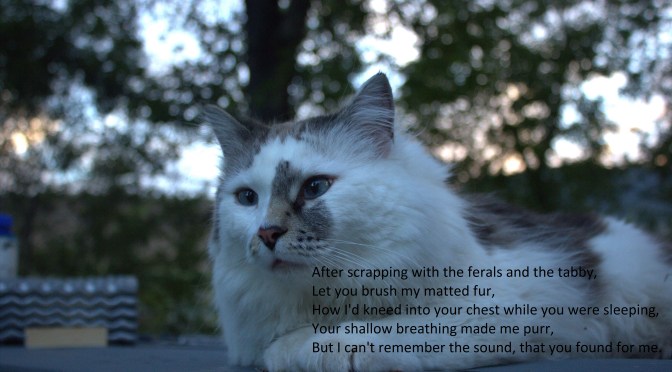
December of 2011 was frigid with nighttime temperatures dropping into the single digits. I arrived at work one clear and chilly day to find a new cat in quarantine. He had been roaming the streets for weeks and had taken shelter in someone’s garage in search of relief from the cold. He’d been caught in a cat trap and had worn down his claws so badly trying to escape that we thought he’d been declawed.

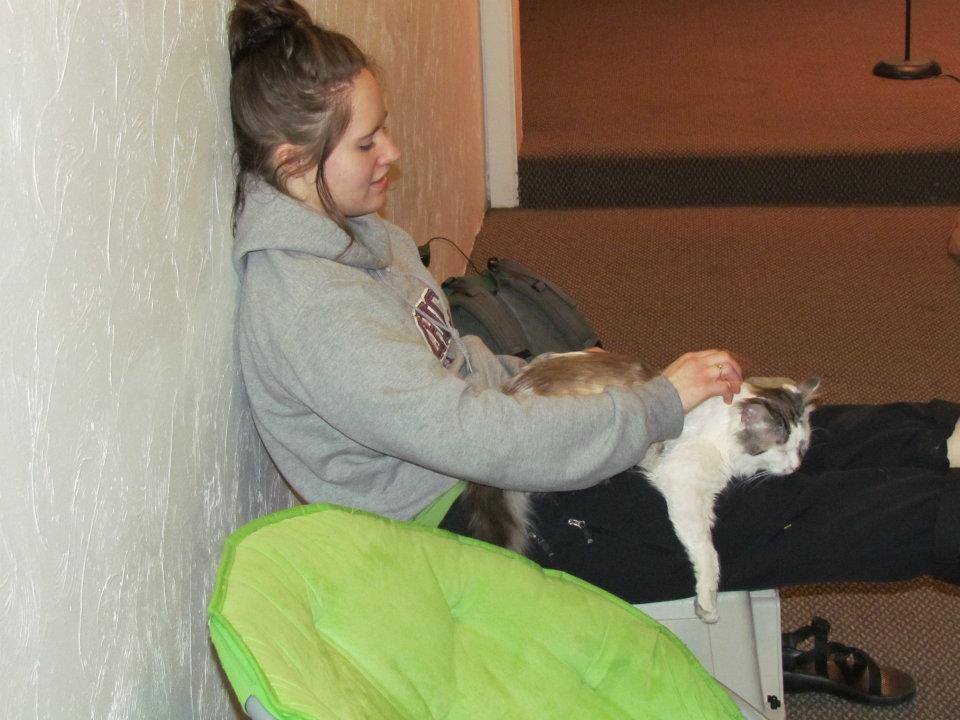
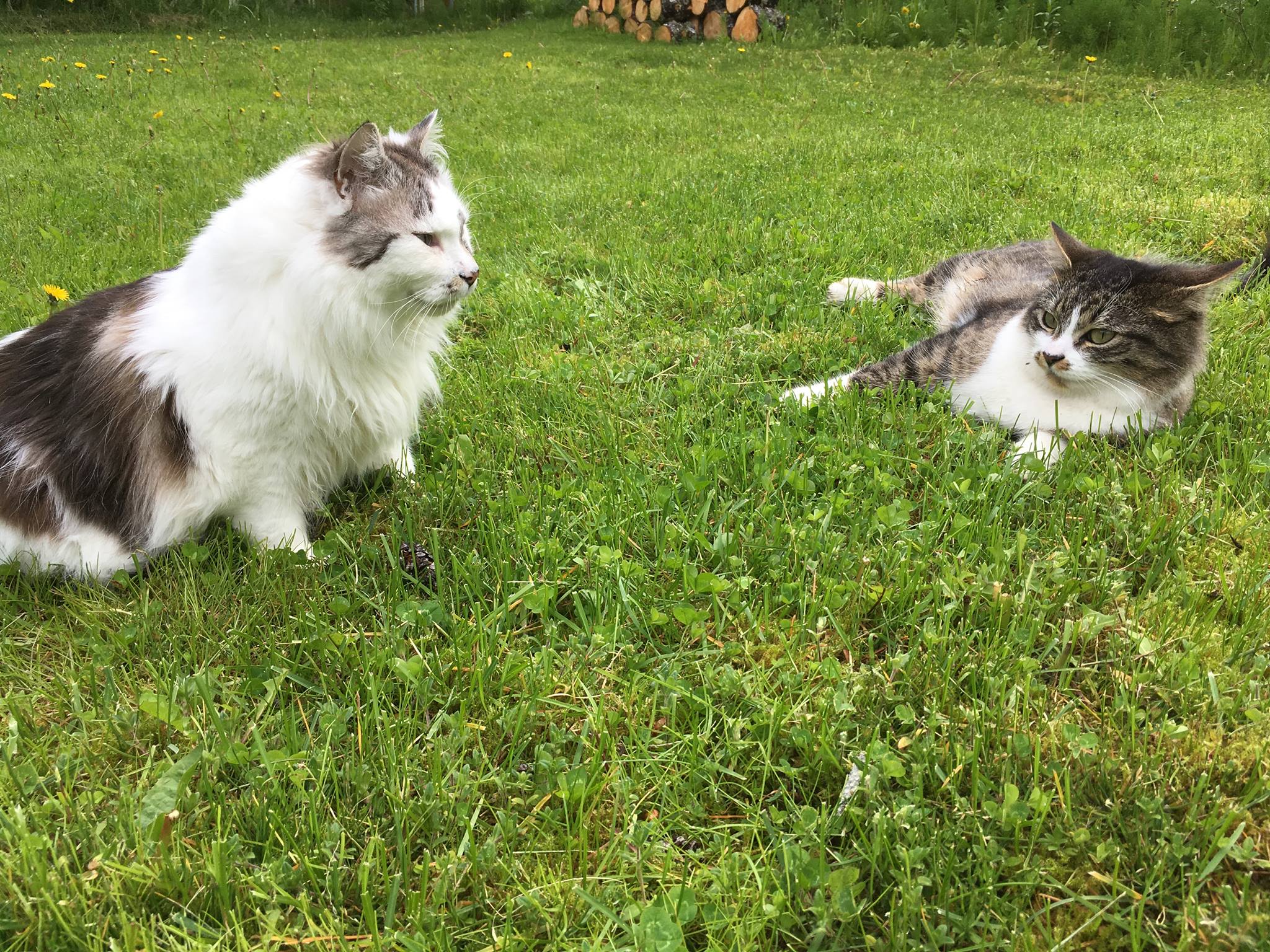
Beautiful blue eyes and striking white fur accented with brown streaks made for an attractive kitty. He seemed like Brittney’s vibe, so that night she stepped into quarantine to meet her kitty soulmate. But he wanted nothing to do with her, which made her try even harder to win his affection. Bit by bit, Porter came around. And on our first night in our first apartment, it was her lap he leaped on, stretching out his long legs and falling asleep.

***

Over the following eleven and a half years, Porter has been a constant in my life. He has crossed the Canadian border no less than ten times. Gone on road trips and slept in tents. Ridden on ferries, skiffs, and sailboats Hiked to sea lion haulouts, battled mink, and dodged moose. His protective nature over Penny was heartwarming, on multiple occasions, he put himself between her and curious dogs.

He was there the day Penny passed away in 2017. And has tried without success to make my cat Minerva his best friend, though she has always had little interest in that arrangement.

On cold nights he’d fall asleep on our pillows or burrow between us like a little furry space heater.

A mason jar cannot be opened without him underfoot and expectant glances waiting for his portion of salmon skin or venison scraps. No unguarded stick of butter or leftover meat is safe. The kitchen counter was his domain whether we liked it or not.

The house was not deemed livable until I’d built a ramp that allowed the now creaky Porter to reach the bedroom and continue his tradition of sleeping on the bed.

Besides Brittney, no soul has defined and influenced my young adulthood as much as that stinking cat.

***

Today I say goodbye to one of my best friends. Porter is still healthy. He’s at least 13 years old, but he just keeps on cranking. He sleeps more than he used to, and his outdoor wanderings are getting shorter. But there’s no drop in his appetite and his fur remains soft and silky. But when I return home in six weeks, Porter will be gone. Like any separation, there’s the question of who the kids will live with.

In this case, the choice is easy. Porter is so clearly her cat first and foremost. Their bond has grown from his icy ambivalence into a love I truly believe he reciprocates. This is a cat that once leaped into 43-degree water to swim to her. That bond can’t be separated.

I’m thankful in a way. My last night with him was one where he was happy and healthy instead of sick, in pain, and scared. I got to leave him at his best. Purring and begging for food.

***

On our final evening together I pull two salmon tail fillets from the oven and Porter takes his usual position by his food bowl. He nuzzles the corner of the cabinet. In less than a year he has created a brown smudge on the plywood from his obsessive rubbing. He has left a legacy that will remain in the house for the rest of my life.

He expects a chunk of salmon skin, and indeed I tear a fillet of skin in half, handing half to him and half to Minerva. But as they begin to mow down, I go a step further. I flip a fillet onto a small plate and set it on the floor next to him. His eyes turn the size of saucers. Without stopping to purr, much less swallow, the feeding frenzy begins. It’s not a large fillet, but it’s still the equivalent of me eating a steak roughly the size of my head.

Porter downs it in less than five minutes. I’ve wondered if he would ever consider himself “full” or if he would just keep eating until he exploded. If I’d spent a chilly winter scrounging for voles in someone’s garage, maybe I’d never pass up food again.

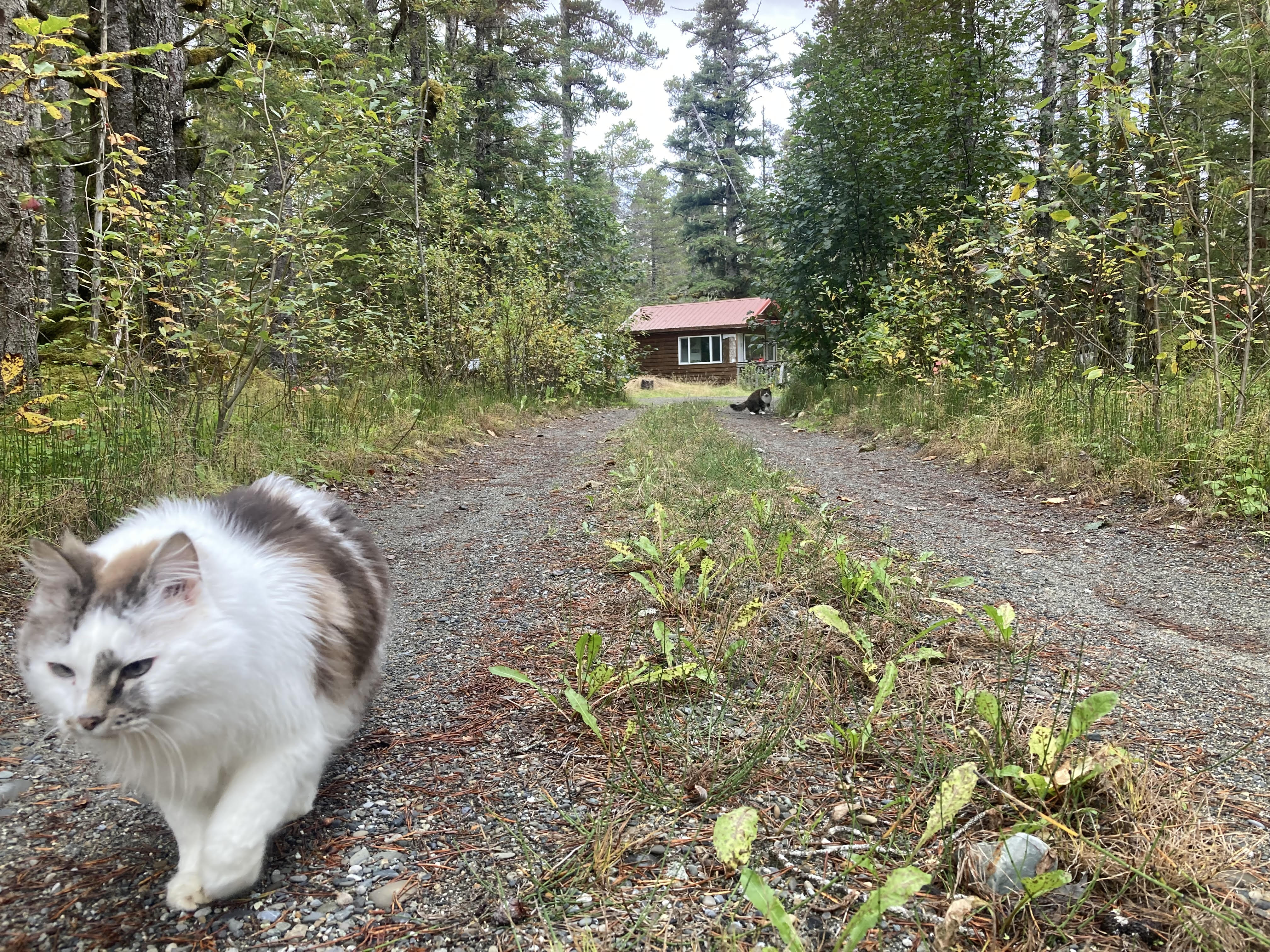
This morning we took a final walk around the property. Porter’s steady plod isn’t as quick as it once was. But he will loyally follow until I turn around. Minerva prefers to wait until we’re ahead and then come tearing after us, rolling in the dirt and clambering up trees. But I love Porter’s steady gait. One step in front of the other, always just a few feet behind.

I kneel and he trots over, nudging my knee and purring, arching his back, and raising his face for chin scratches. I envy his ignorance. It’s just another walk. The backpacks in the mudroom are a mild inconvenience. I’ll come back. I always do. I scoop him up and bury my face in his fur. He always smells good. His purrs vibrate against my face.

“Being your dad has been one of my greatest pleasures.”

He begins to wiggle and squirm.

“I am always going to love you. You will always have my heart.”

Squirming intensifies.

“I hate that I have to say goodbye.”

Claws dig into my arm.

“And I hope you never forget me. Because I’ll never forget you.”

“Yowl!”

***

Back home I grab the treat bag. 11:40. I need to go. Porter looks up at me, purring away and waiting for the treats to rain down on him.

“One more time,” I whisper.

I scatter a handful around the room, and he proceeds to hunt them down one at a time. I open the door, grab my packs, and walk down the trail. In my pocket is a Ziploc with a few tufts of hair. I couldn’t resist giving him a haircut to ensure that – along with that smudged cabinet corner – there will always be a little piece of Porter in the house and in my heart.

The Question

There’s not much in the way of trails around here. Not that it’s too important on this island. Enough old growth is still around that the undergrowth is open in a lot of places. It’s easy to get lost, easy to get carried away walking through those big old trees. Especially on days like today after a heavy rain last night. The afternoon sun slashes through the trees like a sword through fabric, illuminating the mist rising from the moss choked floor. Water droplets cling to cedar needles like diamonds on a necklace. An iridescent glow in each one holding a little flicker of the sun.

Today I’m poking along a stretch that’s part trail part tree root. I hop a stream threatening to be promoted to class five rapids after the downpour. Soon after the trail becomes more defined. I take a deep breath. It feels so good buried in the woods. In Japan they have what they call forest bathing. In simple terms it is nothing more complicated than being in the presence of trees. The idea is that the air doesn’t just taste better in the woods, it actually is better. Essential oils like phytoncide found in trees actually improve immune system function. The forest isn’t just a tonic for the soul like the apostles Muir and Thoreau wrote about. It’s like taking vitamins.

I’m walking this trail to see someone who knows that better than anyone. I’ve written about Walrus several times before. For those that don’t know who this incredible man is, here’s the cliff notes version. Walrus is a walking talking hybrid of Radagast and Dumbledore. He inhabits what he likes to call, “Canada’s longest active logging road block.” He settled on Hanson Island after years in Greenpeace and helped Hanson Island—Yukusam in the Namgis tongue—gain protection from logging. Today he has a long white beard, eyebrows as long and thick as caterpillars, and a high pitched laugh that is infectious.

In my backpack is ten pounds of dog food for his creme colored bear of a dog named Kessler and fruit, carrots, and granola for his master. I tighten the straps of the pack and dig in my boots on the muddy trail as the incline steepens. Walrus’ road block came to rest about a hundred feet shy of the highest point on the island. Every now and then I hike food up the hill to him. It became dire last week when Walrus walked down the hill to the series of rubber totes he keeps near Dong Chong bay to collect some food he’d left only to find that something had gotten to Kessler’s food. 10 pounds worth. Be it bear or wolves we still don’t know. But neither of us has seen a deer in weeks. And deer don’t disappear because of mischievous black bears. So we’d brought Kessler an emergency bag of dog food last week. And had restocked for him in Alert Bay a couple days ago.

As I climb my mind drifts, thoughts mixing with the ravens and Stellar’s Jay above me, my mind drifting to what I’d been reading before I left the lab. In the last week a tanker ran aground near Bella Bella. The support vehicle sent to assist swamped. The containment booms set out to minimize the impact were as useful as a fishing net. The spill was minimal, as minimal as one can be at least, an insult to the very phrase, “low impact.” A low impact oil spill is like minor surgery. It isn’t minor if you’re the one getting cut open.

I’d followed the stories through a guy named Mark Worthing. A Walrus disciple and friend of Orca Lab who has committed his life  to keeping the final stands of old trees in British Columbia standing. In his free time he fights back against the proposed oil tanker line that would cut through the Great Bear Rainforest, one of the pearls of world. The only region in North America where wolves were not almost exterminated. It’s a place where people find Spirit Bears in the woods and God in a sunset. It’s also a maze of islands, reefs, and rocks that gets hammered by 50 knot winds in the winter. All it takes is one tanker. One mistake. One gashed hull. And it’s gone. Ask Prince William Sound. And so Mark fights, because life would seem pointless if he wasn’t fighting for something much bigger than himself.

And then there’s Zack Brown back in Alaska, founding a research and education institute on the Inian Islands to the west of Gustavus. He hiked and paddled from San Francisco to Gustavus in a tidy three months. He’s a voice for climate activism, a voice for change, and he does so eloquently, something that doesn’t always happen when we speak passionately. I used to idolize athletes, now I idolize activists. If only they made trading cards.

My legs are shaking. I set the backpack down on a rock and plop down in the mud next to it. Sweat runs down my face, steam rises from my back. What am I doing? I gave some money to Bernie Sanders, ride my bike when I can, talk about saving the world. But is that enough? It’s a question every conservationist has asked themselves. We see a world that’s in danger. In danger of being steam rolled over by the great construction firm of progress. Lumber over woods. Oil over spirit bears. And we wonder if what we’re doing is adequate. It’s hard when our efforts aren’t visible. Riding your bike doesn’t correlate to a healthy calf in the southern Resident Orcas. Nor does eating vegetarian ensure a healthy salmon run.

I pull the pack back on and start back up the incline. It’s a question I’m still struggling with as my breathing becomes more and more ragged. I spend my summers representing the natural world from the seat of my kayak, and the winter writing about it. My audience is only a couple hundred people, maybe that’s a start. Maybe the people I show sea lions and humpbacks to in the summer are starting dominoes back home. Maybe they took something back from Glacier Bay besides pictures and cover photos.

I round a final corner and Walrus’ cabin comes into view. His area is ringed with a Salal fence, the flexible trunks of the bush intricately bent and woven together to keep the deer away from the garden. Does it work? It does not. You would think a 90 pound dog would keep them out. But Kessler has been known to watch deer amble by ten feet away with nothing more than a sniff. He jogs up to me as I approach, ears up, tail down. We go through this song and dance every time. He can never remember me. He gives a half bark, turns and runs. From the cabin I hear Walrus call out and I smile. The question still lingers, but for today I have a purpose. I’m bringing the caretaker of Hanson Island lunch. And for now, that’s enough.

Finding Light

Brittney has a great capacity for love. This compassion stretches deep through the animal kingdom. Every feather, every ball of fluff. Whether they have no legs, four legs, or eight legs, she cares for them all. A couple years ago she stopped killing spiders (or more accurately having me kill spiders) and insisted that they be relocated outside. Her fear of our wall climbing, web spinning roommates was no justification for murder. She still scrolls through the Juneau Humane Society website, cooing over ever whiskered face while our cat Porter looks at her with a betrayed look on his face.

Factory farming, greyhound racing, the egg industry, and of course, captivity all have room for remorse in her heart. And while many would turn their head, or acknowledge their plight and move on, Brittney doesn’t seem capable of that. She won’t rest until every “fur baby” is safe, happy, healthy.
10329311_10152867795949852_7120445375934915455_n
“Do you think they know that there’s people in the world that care? She asks as she fills out another petition to abolish greyhound racing. That there are people trying to help them?”

“I hope they do,” I say. Though I don’t know how they can.
I look at the picture on the screen, a greyhound with dark empty eyes alone in a crate, it’s head resting on a beam. It looks defeated. I feel sadness when I see this, but anger is my primary emotion. Anger and disgust. At the greed of man. Our selfishness. At the lengths we will go for profit. Our obsession and worship for the man made ideal, money. Somehow it’s become the measuring stick for our species. We’ll obliterate whatever is in our way to obtain it. Greyhounds, orcas, the very world we live in. How is it that we’ve forgotten that we cannot live without the natural world we insist on pillaging? Infinite growth in a finite world. Not the American dream, but the global fantasy.

I look back down at the picture, my mind returning to the present. The knot in my chest tightens, my heart rate increases. How could man look at this and not be enraged? Yet here is the proof that ambivalence lives.

It’s another storm ridden night at the lab. Similar Paul points out, to the night Corky was captured. It was a wave capped, howling winter gale when her family innocently swam into Pender Harbour and had their life change forever. In the name of corporate gain and human entertainment. How can we look at ourselves in the mirror?

Do you think they know that there’s people in the world that care?

Corky seems to. Why else would she withstand this torture, humiliation, and pain for so long? Does she believe there are others beside the ignorant masses that stand on the other side of the glass and snap photos with their camera phones?

“Corky’s plight makes me sad,” says Brittney, “but I feel more impassioned by factory farming, by animal testing. There’s millions of animals that die inhumanely, that live terrible lives. It’s 2015, but we’re more barbaric than ever.”

“Look what we do to our own species.” I answer, “we can’t stop murdering each other and we’re asking that same species to have compassion for other animals?”

Yet this is where we are. I pour whiskey over ice and settle on the couch. Here I am, in the middle of the natural world, and I can’t escape. ISIS, immigration, Donald Trump, SeaWorld, climate change. Running to the woods won’t make them go away.

“It’s important,” I remind Brittney, “not to get bogged down in the negative.” I’m reminding her as much as myself. “Our media, our world feeds off of negativity. It gets clicks, draws traffic in a way that heart warming, positive stories don’t. Seek these out, hang on to them. Celebrate the victories, the joy, the beauty. Because it is there. Even in darkness there is always some light.”
537318_10152372664114852_545974904_n
The chainsaw roars. I follow the ebbing tide down the beach, accepting the sacrifice of a massive Fir tree. It’s a beautiful piece of wood, undoubtedly an escapee from a passing barge. It didn’t deserve to be cut, but at least its death won’t be in vain. The sharpened teeth on the saw litters the rocks with wood shavings as I cut into the sweet smelling wood.

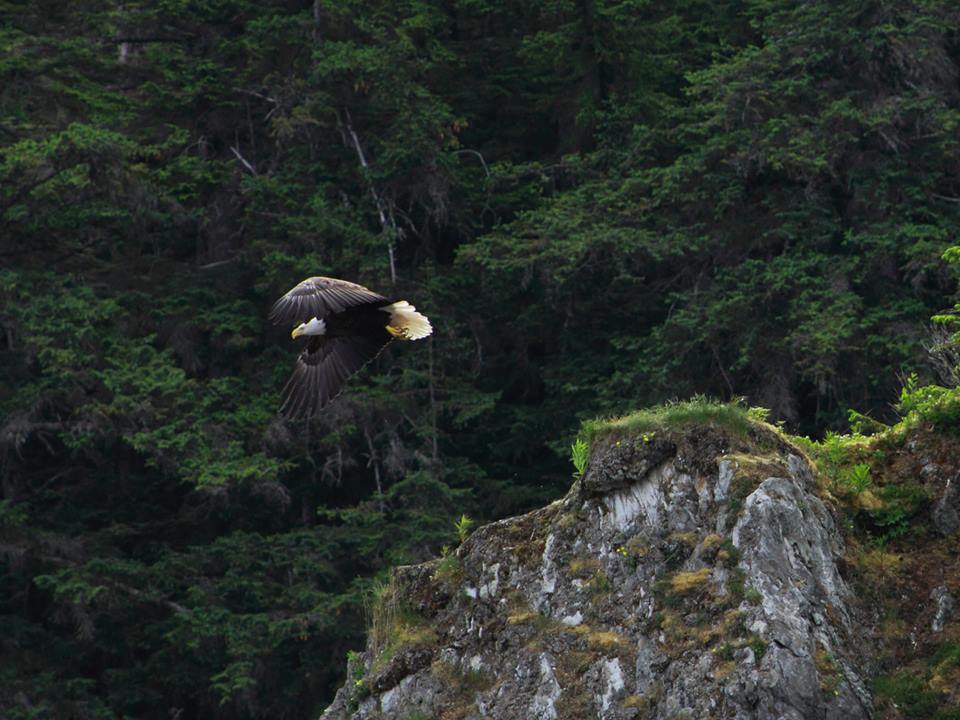
At the end of the log I stand and stretch the ache in my back, looking over Blackney Pass, over paradise. I drop the chainsaw and feel my heart lift. Blackney teems with life. Hundreds of gulls swarm a fifty yard patch of ocean in numbers so thick they look like a great feathered cloud. The bait ball has not gone unnoticed. An armada of eagles roar in from the trees, great black wings punctuating the ball of white. I count at least thirty eagles, shuttling back and forth between the trees near the cabin and the ocean. Again and again they swarm overhead, the silvery flashes of sand lance clasped tightly in their talons. Life, sustenance.
10540_10152009960619852_192033272_n
Brittney and I fall under their trance, the log lays forgotten at my feet. A lump rises in my throat. Why does this feeding frenzy have tears coming to my eyes? Because after everything the land has endured. Clear cutting, fish farms, live captures, predator control. They’re still here. The orca’s are still here. Is the world perfect? No. But here is a victory, here is joy. Here is a chance to celebrate.

“Do you know what I see?” I ask pointing out at the surging biomass before us.

Brittney looks at me, her eyes softened, the light glowing in her pupils.

“Hope.”


Why We Have Pets

Anyone who reads raincoastwanderings knows that Porter and Penny, our pet cat and rabbit are prominent characters in our life. No boat is too small, no car ride too long to prevent us from dragging them up and down the Pacific Northwest and to places no sane person would try to bring a rabbit cage. We do this, because to us, they’re as much a part of the family as we are. With all the inconsistencies and upheaval that our wanderlust driven lives create, they have become our anchor, stabilizing. Wherever we are is home. It wouldn’t be the same without them, there personalities, and the mystified looks of border guards and ferry passages exclaiming, “you have a rabbit?”
For me, this philosophy originated in my youth. We didn’t have cats or rabbits. We were dog people. Golden Retriever people to be precise. I learned to stand by pulling myself up on the hair of our dog Niki. She would stand patiently as I pulled out chunks of hair and tried to balance on wobbling legs. When I was about nine we got another retriever. We named him Buddy after Air Bud fame and he became my shadow. Sleeping on my bed, pulling me on my scooter, and catching the pancakes we balanced on his nose.
As sad as it was when Niki finally passed away peacefully in her sleep at 13, Buddy was the first real loss in my life I was old enough to comprehend and feel. Being far away and unable to say goodbye made it even harder. Between my tears, grief, and frustration, the concept of owning pets felt so pointless. I was angry that my dog had been taken after less than ten years. Why pour all this love and emotional attachment into something that you’ll outlive by decades?
Because when the garage door opened when I got home and there was no rusty red blur streaking from under the growing crack, I realized it was no longer a home. It was too empty, too quiet, too easy to walk across the backyard without the fear of tripping on tennis balls. Because Buddy had brought out the best I had. Unconditional love, acceptance, trust, a never-ending cauldron of joy. So with heavy hearts, we got another one. We never stopped missing Buddy, but we couldn’t stand a house without a dog.
We got a puppy. A rescue from a shelter a few miles north. We named him Jake though I can’t recall how we chose his name. I write all this because Jake passed away last night in my mother’s arms after fighting gallantly against Lymphoma for five months.
It’s not fair. It’s cruel. It’s a broken world. Jake was the unofficial third son. My brother and I nicknamed him Buster after the Arrested Development character. And in some ways he was Buster. He was a mama’s boy with two older brothers, and would go into fits of sorrow whenever Mom left the room. But you couldn’t deny his heart, his enthusiasm, and the patience that made him a wonderful service dog at Providence hospital. It was at the hospital that he shined brightest, touching the lives of countless sick and hurting people. He was everything you wanted your dog to be. And after seven years that went far too fast, there’s that painful emptiness in the Cannamore house again.
Why? We know we have to say goodbye before they do. There will be a last time I hold Penny in my arms, a final scratch behind Porter’s ears. There will be pain, there will be tears, there will be a hole in our life. But it’s better to recognize the hole than to walk around for the rest of my life pretending its not there.
The last thing Mom is thinking about today is another dog. It’s time to remember Jake. His bark, his irrational fear of heating grates, and those long gangly limbs that took up Dad’s side of the bed. But when the time comes to make the house a home again, there will be four more furry legs with floppy ears and golden fur. Armed with tennis balls and love. Rest soundly little brother. I’ll miss you.

A Movie Script Ending

An odd curse seems to precede my arrival to Hanson Island. Some dark foul spirit that blazes the trail and harbors ill will to Paul’s boat. In ’08, ’14, and now ’15 the June Cove has been struck with engine trouble just days before the ferry spits me out in Alert Bay. Thanks to this demon, I’ve still never arrived at OrcaLab on the day I intend to. Which is why the four of us  (Brittney, me, Porter, and Penny) found ourselves curled up in Paul and Helena’s Alert Bay home for Halloween watching the curves of Hanson Island fade into the darkness through the bay windows. So tantalizingly close.
It wasn’t all bad. We watched baseball, took one more hot bath, and handed out candy to the handful of trick or treaters that came knocking on the door. Still to be determined was when we’d cover the last few miles. Dave Towers (Yes Jared Towers Dad) was to be our taxi driver. But the southeast gusts for the following morning did no breed optimism. So we settled down for another day in the bay. We slept in. I found the Vikings game on TV. And was just getting comfortable when the phone rings.

“Hey Dave, it’s Dave. How’s the weather looking out your way?”
I walk to the window and stare out at the strait. There’s still whitecaps, the trees in the yard dance. Maybe not as bad as an hour ago? “I think it’s dying down, it’s supposed to be a little better this afternoon.”
“Great! Can you leave in an hour?”
My eggs are just starting to bubble in the frying pan, I’m wearing pajamas, all we have for food is a bag of oranges. “Can you make it two?”
“No problem… oh and it’s an open skiff. Be sure to dress warm.”
David hangs up and I stare at the phone. A rabbit and a cat in an open air skiff? I think back to last fall when we tried to put Porter in Penny’s cage. The mess, the horror, the terror, I’m still getting over it.
90 minutes later our bags are piled in the boat. Penny’s cage is between my legs, a towel draped over the corner that’s facing the bow as a windbreaker. Porter sits on Brittney’s lap, wrapped in a jacket, a look of incredulity on his face. David looks over our little menagerie with a mix of amusement and confusion.
I shrug, “we couldn’t just get a dog like everyone else.”

We cruise out of the harbor and round the corner, heading east into Johnstone Strait. The wind has vanished, the sky is dry, I breath a sigh of relief. Porter buries his face in Brittney’s jacket, but Penny stands on her hind legs, trying to see around the towel. She’d drive the boat if we let her, fearless.
We weave through the islands and passes, their names echoing in my head like old friends. Pearce Passage, Plumper Islands, Blackfish Sound. I can trace the route on the palm of my hand. It’s been a week and a half with three ferries, one border crossing, and too many trips through the backpack digging for clean socks, but as we round the final point and the wooden buildings come into view, every second is worth it. My chest feels light, my fingers tingle. Was it joy? Relief? Excitement? As if every positive emotion is swirling inside simultaneously.
“Dr. Spong,” I’m beaming as we embrace and I look over his shoulder at our cabin. Smoke billows from the chimney, Helena leans nonchalantly against the railing. Brittney and I try not to get too close to her. Not out of animosity, but because of her vicious pet dander allergy that makes my sweater a chemical weapon.
In a matter of minutes our bags our piled in the living room near the wood stove. Every smell, every memory coming back tack sharp. The speaker connected to the hydrophones pumps in the sounds of swirling water and a distant tug. Sonic comfort food. Macaroni and Cheese for the ears. Within the hour we’re splitting wood, scanning for humpbacks, falling back into the beautiful rhythm of the island. I walk past Brittney bent over the chopping block, Porter sprinting up in down the hill, his euphoria matches ours.
“Do you feel like you’re floating three inches above the ground?”
The shadows grow long, the sun dipping behind the island painting the mountains in a soft glow. I step out onto our porch, drinking in the view. A mile down the sea lions roar and bark, the noise rising to a crescendo. With no warning dozens of them launch themselves into the water. I furrow my brow, what on earth is making them all – and I see them.
Dorsal fins. Five of them. Just off the rocks, smooth curved dorsals with knife sharp points. Biggs. Transients. Oh my God. For a heartbeat I’m rooted to the spot, too stunned to move. On our first night? Muscle memory takes over. I skid across the deck, throwing open the door to our cabin and scream, “Biggs at the sea lion haul out!” I’m gone before Brittney can respond, tearing over to Paul and Helena’s, heart pounding, I haven’t seen orcas in months. I repeat the message and head for the observation deck, camera in hand.
The light is so dim every photo is like a blurred and pixelated photo of Sasquatch. There a mile away. It doesn’t matter. As the last of the daylight fades we strain our eyes to follow the group as they go around the corner, leaving the sea lions in a frenzy. The movie script ends, the whales vanish, and we stand in near darkness. No roads, no cars, no stores. Just us, the trees, the ocean, each other. Back where we belong.

Same Destination, Different Path

The sun breaks through, faces turning upward, mouths open, drinking in the sunshine.  A respite, finally. No better way to leave. We’re on the Alaska Ferry’s equivalent of the milk run. The grand tour of southeast Alaska with little concern for time of day. Juneau at 4 am, Hoonah at 9, Sitka in the evening, in and out of Kake under the cover of night. Weaving through the mouse maze. West, east, and slowly, tantalizingly south.
We’re not alone. High school volleyball and wrestling teams are bedded down in every lounge when we stagger aboard in the early morning twilight. It had been my idea to stay up until our 4 am departure from Juneau, a decision I’ve been regretting since midnight. Through bleary eyes, sleep clinging to our eyelids we maneuver the minefield of snoozing adolescents, looking for any gap on the floor for a pair of sleeping pads.
Mercifully teenagers aren’t early risers, and most of us are still asleep when the purser’s desk begins to scold us over the intercom in a voice reminiscent of Mr. Feeny. “It’s time to turn these lounges back into lounges! Chaperones, get those lounges cleaned up!”
He must get a kick back every time he says lounge. But as I look around the room at the draped arms and legs protruding out of the corners and between seats, I’d say the room is living up to its name the way it is.
By the time we’re squeezing through the minuscule pass between Baranof and Chichagof Islands, the sun is burning through the fog, the day turning from Late October to June in minutes. With the shore just yards away from both sides of the boat we curl up on the solarium and let Alaska dazzle us for the countless time. Ravens chatter in the woods like invisible sentinels. A pair of Kingfisher’s chase each other above the treetops, their punk rock haircuts matching the throaty screeches perfectly. A humpback surfaces. The hemlocks grow tightly together. Every now and than a flash of red among the green, a Cedar. An outlier, we’ll be surrounded by them soon. As if magnetically drawn by the sun’s cameo, the high schoolers filter to the open deck.
Electronics are sparse among them. In the cafeteria playing cards appear, they talk, joke, laugh, are kids. Not drones with their head’s pulled down to an HD screen with the world around them invisible. It makes me smile. No cell service, unplugged from the world but not each other. When phones do appear it’s to take pictures of the scenery, often with them and their friends in the foreground.
Selfies are the new currency of flirting. All a boy must do to receive the attention of his chosen girl pack is leap into the photo, eager to participate in the immortalization of the moment through the magic of sim cards and 10 GB hard drives. Can’t say I’d so anything different if I was them.
The water stays calm as we leave Ketchikan in the evening and push into Canadian waters. Once again, we leave under the cover of night as the ferry pulls into Prince Rupert at 4 in the morning. This means crossing the border and explaining what the hell we’re doing in this country will be done through two sleep deprived and bloodshot eyes. We’re fourth in line getting off the ferry and I scarf down our remaining two apples for breakfast in lieu of turning them over.     We reach the customs lady and I roll down the window. Usually Porter sees any open window as a gateway to his god given freedom. And after two days confined to the car I expected Brittney to have to pin him down to keep him from crawling up the lady’s uniform. But he sits politely on Brittney’s lap, the perfect gentleman, as if understanding the gravity of the situation and our history with cranky and stoic border guards.
But they seem as groggy as us. The only loss is the little pink can of mace Brittney has had on her key chain since she worked mornings at a coffee shop. Bear spray, we’re told, would’ve been permissible, but since her mace was designed to use on humans, we were a threat to the unsuspecting Canadian citizens.
The inhabitants of Prince Rupert spared a terrible mace induced terrorist attack, we drive into the sleeping town. It’s too much to hope that our pet friendly hotel would leave their door unlocked at 5 am. So we grab coffee and hole up in the parking lot, waiting for the sun to rise and the lights to come on.
It feels good to be transient again. With our bags piled up behind Penny’s house in the back of the Pathfinder, the cat on our lap. Home is the four of us together. Two hours later the door unlocks and we record history’s earliest hotel check in, dropping our bags on the floor and collapsing onto the beds. Penny leaps euphorically as she hops into every corner, free of her house for the first time in 48 hours. Everything must be smelled, tasted… and chewed. With a $200 pet deposit we watch her like a hawk.
Brittney retreats to the shower, our hot water days numbered, and I watch Porter try to keep his eyes open as he curls up on the bed. The simplicity of my joy, my contentedness, brings peace. We search for happiness everywhere, sometimes demanding much, sometimes little. Sometimes, it’s as simple as an early check in, a sleeping cat, and the knowledge that no matter where I go with these three, I’m already home.

Porter Supertramp

Porter stares longingly out the sliding door. Like a kid with his face pressed against the glass, watching the rain fall in sheets for the second straight week. Frustrated, he paws at the door until we open it. Outside he stops short of the soaked grass, rain pelting the tin roof, reminding him, all of us, that summer is over. With a dejected look he walks back into the warmth.
It’s been that sort of fall in southeast Alaska. Sometime in August the heavens opened the floodgates and it hasn’t stopped raining since. Puddles litter the dirt roads and driveways like little lakes. Rivers flow between them, connecting them, turning the road into a washboard, car shocks moaning in protest, CDs skipping.
And once again, we’re on the move. Packing this, debating that, Porter and Penny wide eyed with alarm. Moving again? At least this time the posters can stay on the wall, unneeded clothes can hang in the closet. Last summer every box and duffel had to return to the exact same spot in the Pathfinder or it wouldn’t fit. Not this time. We have a whole year of our lives meticulously planned. We know where we’re coming back to. Where our next paycheck is coming from. Sell outs.
But for now it’s time to wander. To cheer silently when the beat up old Pathfinder coughs to life. The cat taking his position in the driver’s lap, Penny poking her nose through the gaps in her house, always looking forward. It’s time for ferries, lunches out of plastic bags, for Prince Rupert to have hotels with lenient pet policies. Most importantly, it’s time for Hanson Island. For quiet coves and sleepy sunrises, Harlequin ducks chittering good morning. For silent walks through the forest, listening to the whispered messages of the cedars. It’s felt like a lifetime since we were there, or maybe just yesterday, it varies.
How much longer do we want to do this? Whenever we talk about what we’re going to do “going forward,” the subject settles on buying property, settling, wrapping ourselves in Gustavus’ warm embrace. Hanson Island stops us cold. Reminding us of town runs, sea lion haul outs, and transients on Critical Point at 3:00 in the morning. And we know we’re stuck. That houses will have to wait. We have the rest of our lives to be domesticated. To fence ourselves in. We’ll be ready someday. Ready to drop our roots among the birch on the glacial outwash near the bay we love so much.
But not yet. We understand that what we have on that little island is a once in a lifetime opportunity. That a chance like this will never come around again. How do you willingly give that up? I don’t think we can. So when people ask if this is our last winter there we smile and shake our heads.
“Probably not.” We answer. “Paul and Helena may have to kick us out.”
When do you know that you’re ready? What if we’re destined to bounce between two places that we love forever, unable to commit? What a beautiful problem to have. Some winter it’ll feel right. We’ll stay put. We’ll go to every Gustavus potluck, every fundraiser, make new friends, discover what we never knew we had. But Hanson Island will forever be a part of us. An essential nutrient in our life. A place we’ll always long for, always love.
Right now I can’t wait to get back. To wrap myself in that island as long as I can, to enjoy it for as long as possible, knowing that our time there has an expiration date. That worrying about it won’t make it any better. Nothing to do but take as deep a breath as I can, savor every sunrise, every 50 knot storm, every night hauling the boat up the beach on the rising tide. Because we’ll never get to live like this again.

A Worthy Excuse

The sun finally glides below the outstretched tendrils of stand of spruce trees that line the yard, casting our house abruptly into twilight. A twilight that arrives at 8:00. Down the hall the washer growls and snarls as it tosses salt soaked wool and polyester in preparation for tomorrow.
On the edge of the couch I crouch, hunched over a laptop, back bent strangely as the muscles still struggle to loosen after digging into the seat of my kayak. The beer’s helping though as I take a sip, squint through my sun fatigued eyes, and type furiously.
Deadlines are never fun. What I really wanted to do was submit to the waterfall of hot water that Brittney was reveling in at that very moment. But the paper I’d snagged off the freelance website was basically done, good enough in fact.
The laptop snaps closed decisively and Porter raises his head a quarter of an inch, fully attuned to the room’s shifting energy. He shoots an optimistic look towards the sliding door and his playground beyond. A land of voles and dogs on what he hoped were reinforced tethers.
“And coyotes.” I remind him as I slip through the door and slide it shut behind me.     Too apathetic to even shoot me a steely eyed glare with his glacial eyes, he drops his head back to the edge of the couch, tail twitching indignantly.
In Gustavus virtually everything is within two miles and the Pathfinder sits neglected in the dandelion infested gravel driveway. A pair of easter green bikes lay haphazardly placed on the small concrete slab we’ve taken to calling a porch. 
    Brittney’s chain falls off reliably every half mile while the ring that holds my handlebars has been replaced by duct tape, the hand grips pointing down towards the ground, leaving me to grasp the very center of the handles like some lost and befuddled Lance Armstrong. But it moves when you peddle and the grocery store with our version of “lightening fast” internet isn’t far away.
How ironic, that in a few months, we’d be on an island in which we comprise two-thirds of the population and we’d be luxuriating in fiber optic cable internet. Granted, indoor plumbing and hot running water will have gone the way of the amish, but Netflix would be but a click away.
While here, in the crux of civilization, population 360, you had to bike a mile to reach a connection that would load your gmail sometime between now and sunrise.
The gravel road is inundated with dust. Even rain forests can have droughts, we just measure them in days instead of weeks and months while the salmon swim in holding patterns waiting for the rivers to rise and open the doorway home.
I glide through the stopsign at the lone intersection as the clock strikes nine and glance over my shoulder. Saturday night and the only restaurant in town was shutting down, another wild weekend. I look back ahead and hear my breaks squeak. Unbeknownst to me. My twilight cycle is not solitary.
A high patch of grass sits fifty yards ahead on the road’s left bank, a comma between two gravel driveways. Settled in the middle is a Gustavus lawn mower. The moose glances up nonchalantly, its mouth moving in the hypnotizing manner of ungulates, somehow horizontal and vertical simultaneously. At my sudden stop she takes an uncertain step towards me.
If she wants the road it’s all hers and I slide my bike to the left and onto the drive, opening up an avenue up the road or across toward the wooded ditch on the far side. She considers her options for a moment longer, and with an air of completely deserved entitlement begins to saunter across the road for the ditch, her hooves echoing on the concrete.
I watch her slow gait away, wishing she could stay longer instead of conceding to the higher powers of the willow on the far side that demanded her attention. Never breaking stride she vanishes into the wooded ditch, deceptively hidden from view like a magician’s illusion.
Hoping back aboard the bike I peddle past, she’s completely invisible, but this is not a stealthy phantom and her heavy footfalls let loose the crash and crack of brush cracking and bending to her will.
The yard in front of the store is thankfully moose free and I open the laptop to finish the days work, my mind already in a lava hot shower, steam billowing like campfire smoke.
“Here’s the assignment,” I scribble fast, “hope it works for you. Had to wait for a moose to clear the road before I could send it off.”
I smile at the beautiful inconveniences of my eden and hit the send button as the moose crashes through ditch 100 feet away.

Escape From Hanson Island

For a week the weather services proclaimed that Wednesday, April 15th would be calm, clear, and peaceful. It would be a fitting and tranquil journey from the lab to Alert Bay, a promising start to what would be a week long expedition that would eventually lead to Gustavus, Alaska. On Tuesday night I checked the weather one final time, more out of sentimentalism than anything else, and saw Johnstone Strait caked in red. “30 knot southeasterly winds,” it boldly proclaimed. I rolled my eyes and glanced out the window, the cedar boughs were fluttering in a benign and apathetic way, I shut the curtains and crawled under the covers.

The next morning we awoke to the windows rattling, though the rain showed merciful restraint. We packed and began to debate tersely the best strategy for placing a bulky rabbit cage, a squirming cat, and countless bags and boxes unto the deck of a pitching boat.

An hour later the June Cove pulled around the corner, bobbing in the churning bathtub that was Blackfish Sound. We threw our belongings unceremoniously aboard with rabbit and cat perched atop the pile, and watched the lab fade from view. In the stress and rush to load the boat before the waves could put it on the rocks, there was little time for nostalgia and farewells. Instead of casting a final look at the lab deck, where I had been bombarded by sun, rain, and a rotating cast of marine life, I diligently jabbed a long two by four into the rocks as the bow of the boat slowly turned toward open water.

The water deepened and waves broke over the bow, foam and white caps littering the ocean. Paul peers through the blurred windshield as we hit the crest of a wave and slide down, the screech of nails emanates from Penny the rabbits cage as she slides back and forth. Completely unperturbed, she continuously tries to stand on her hind legs as the boat rolls, dead set on glancing out the window.

Paul glances over at where I stand, staring out the window into the crashing waves, willing the boat forward. He catches my eye and grins, “the escape from Hanson Island!” he shouts and the tension breaks.

Perhaps it was best like this. No tears, no long, lingering hugs. Leaving Hanson Island is removing a band aid, it’s best to just rip it off. Thirty minutes later we reached the relative peace of the dock, the first of four boat rides behind us. Again there would be no lingering as Paul needed to rush back to the lab before the tide ebbed too far, exposing the June Cove to a night of gale force winds.

And just like that, it was done. We stood where we had eight months ago, with an overstuffed Nissan Pathfinder and a pair of pets staring confusedly out the window while the wind buffeted us.

To our immense relief, our reliable Pathfinder sputtered, coughed, and after several heart stopping seconds, roared to life and we wove along the shoreline to Paul and Helena’s home for the night.

We curled up in the lap of luxury. Hot baths, ice cream, cold beer, electric heat, baseball, it may as well have been the Ritz Carlton hotel for all we cared. But it was hard not glance out the massive windows down Johnstone Strait as the light slowly faded, the outline of Hanson Island still visible and know that it would be months before we were forced to contend with the beautiful inconveniences that only life on an island can bring.

Perhaps the weirdest moment came when we finally crawled into bed. The room was as silent as a tomb and it was completely unsettling. For months we’d been passively listening through the night as the hydrophones reported the sounds of the ocean. The rushing water of a gale, the crackle of a dragging hydrophone, the low pitched growl of a tug, the whistles of dolphins, and the call of an orca that sent you flying from the covers. Now it was all gone, the silence leaving a strange ringing in our ears.