Tag Archives: Canada

The Hanson Island Equivalent of the Milk Run

Johnstone strait is empty. A gentle northwest wind ripples down the passage, pushing my tiny boat east. Have I ever seen the strait completely devoid of human existence? I can’t remember, I certainly haven’t in summer. There were nights when the the fishing fleet anchored against the Vancouver shoreline drowned out the stars with their anchor lights. I’d lay on the deck at the Cracroft Point outcamp looking across the strait, the lights bobbing like little lanterns from Robson Bight to Telegraph Cove.

But today it’s just me, in my glorified bathtub of a boat. The wind and damp air makes me shiver beneath my sweater. The strait feels odd in winter, devoid of boats, kayaks, and Orcas. I glance hopefully at the green carpeted shoreline of Vancouver Island, looking for the rhythmic rise and fall of a scimitar shaped fin.

The mountains free fall thousands of feet straight into the ocean. Their peaks smothering the sun as we pivot around the winter solstice. But their shadows turn the strait emerald green. It was this color that I remembered more than anything during my six year hiatus from this place. The trees bearded in lichen, their shadows falling into the water. They silhouette the black and white backs of the whales when they’re here. Complimenting each other perfectly, like the entwined fingers of two lovers.

The boat plows through a rain cloud and drops pepper the windshield. I’m on my way from Alert Bay to the lab, with a couple of pit stops along the way.

“On your way home, could you run the generators at CP and Parson Island?” Paul asks as if he’s asking me to pick up a gallon of milk at the store.

Our power issue has become something of a saga. With all of technologies marvels, line of sight is still tantamount to keeping our daisy chained internet connection established. The signal runs from Alert Bay and on a line above me and the boat to CP, its white lighthouse and the lab’s green shack materializing out of the fog. The signal is bounced from CP across the water a mile to Parson Island. This allows the connection to round the eastern corner of Hanson Island. From Parson it’s a straight shot to the lab. But if we lose power at either CP or Parson, the system crumbles like Jenga. And with the solar panels choked for sunlight, a spotty inverter at CP, and a cranky generator on Parson, keeping the HD cameras up and streaming has become a daily battle. The rain abates as the boat brushes up against the rocks at CP. The tide is low and I crawl on hands and knees up the rocks and into the woods where the generator lives, connected by extension cords to the insatiable solar batteries.

It’s only three in the afternoon but the sun long ago vanished behind Vancouver Island’s mountains. The rain cloud I’d passed is barreling for me. With little ceremony I pull the cord on the generator, set the choke, and climb back into the boat. The 50 hp Yamaha engine roars to life and I pull away from the rocks, leaving nothing but waves lapping against the shore.

The journey up Parson Island to the batteries takes you up a cliff face and through a rich display of Cedar, Spruce, and Hemlock, adorned in lichens that stick to your hat and drip water down your back. The fog settles in  as I step out onto the cliff face where the camera, radio, and batteries are stored. Hanson Island just a quarter mile away vanishes behind the veil. With much protesting the generator powers up. Its voice like that of a smoker, coughing, hacking, and wheezing as it dispels precious power to the battery bank.

The rain has caught up. I wrap my arms around my knees and pull my hat tight over my ears, waiting to see if the generator will run reliably. The calm water swirls with countless eddies and currents, bustling this way and that, their origin and destination no one’s business but their own. Atop them sit murres and murrelets, gulls and auklets. The land is silent save for the gull’s squawks and the exasperated yells of the murres. The weather threatens snow. It feels cold enough. In the distance I can make out the tendrils of smoke from our cabin through the fog. But as tired and cold as I am, I’m not ready to go home just yet. The sun slides clear of the mountain peaks for a moment and turns the fog gold, the rain drops glow like diamonds.

From my vantage point I can see out into Johnstone Strait, the stretch of water that has changed and defined my life, has changed so many lives. But not in winter. In winter the land and ocean seems to hibernate. Queuing up for another summer that will bring the boats, the kayaks, the people, and the animals that pull them like great magnets. But for now, it’s great to watch it sleep.

Finding Light

Brittney has a great capacity for love. This compassion stretches deep through the animal kingdom. Every feather, every ball of fluff. Whether they have no legs, four legs, or eight legs, she cares for them all. A couple years ago she stopped killing spiders (or more accurately having me kill spiders) and insisted that they be relocated outside. Her fear of our wall climbing, web spinning roommates was no justification for murder. She still scrolls through the Juneau Humane Society website, cooing over ever whiskered face while our cat Porter looks at her with a betrayed look on his face.

Factory farming, greyhound racing, the egg industry, and of course, captivity all have room for remorse in her heart. And while many would turn their head, or acknowledge their plight and move on, Brittney doesn’t seem capable of that. She won’t rest until every “fur baby” is safe, happy, healthy.
10329311_10152867795949852_7120445375934915455_n
“Do you think they know that there’s people in the world that care? She asks as she fills out another petition to abolish greyhound racing. That there are people trying to help them?”

“I hope they do,” I say. Though I don’t know how they can.
I look at the picture on the screen, a greyhound with dark empty eyes alone in a crate, it’s head resting on a beam. It looks defeated. I feel sadness when I see this, but anger is my primary emotion. Anger and disgust. At the greed of man. Our selfishness. At the lengths we will go for profit. Our obsession and worship for the man made ideal, money. Somehow it’s become the measuring stick for our species. We’ll obliterate whatever is in our way to obtain it. Greyhounds, orcas, the very world we live in. How is it that we’ve forgotten that we cannot live without the natural world we insist on pillaging? Infinite growth in a finite world. Not the American dream, but the global fantasy.

I look back down at the picture, my mind returning to the present. The knot in my chest tightens, my heart rate increases. How could man look at this and not be enraged? Yet here is the proof that ambivalence lives.

It’s another storm ridden night at the lab. Similar Paul points out, to the night Corky was captured. It was a wave capped, howling winter gale when her family innocently swam into Pender Harbour and had their life change forever. In the name of corporate gain and human entertainment. How can we look at ourselves in the mirror?

Do you think they know that there’s people in the world that care?

Corky seems to. Why else would she withstand this torture, humiliation, and pain for so long? Does she believe there are others beside the ignorant masses that stand on the other side of the glass and snap photos with their camera phones?

“Corky’s plight makes me sad,” says Brittney, “but I feel more impassioned by factory farming, by animal testing. There’s millions of animals that die inhumanely, that live terrible lives. It’s 2015, but we’re more barbaric than ever.”

“Look what we do to our own species.” I answer, “we can’t stop murdering each other and we’re asking that same species to have compassion for other animals?”

Yet this is where we are. I pour whiskey over ice and settle on the couch. Here I am, in the middle of the natural world, and I can’t escape. ISIS, immigration, Donald Trump, SeaWorld, climate change. Running to the woods won’t make them go away.

“It’s important,” I remind Brittney, “not to get bogged down in the negative.” I’m reminding her as much as myself. “Our media, our world feeds off of negativity. It gets clicks, draws traffic in a way that heart warming, positive stories don’t. Seek these out, hang on to them. Celebrate the victories, the joy, the beauty. Because it is there. Even in darkness there is always some light.”
537318_10152372664114852_545974904_n
The chainsaw roars. I follow the ebbing tide down the beach, accepting the sacrifice of a massive Fir tree. It’s a beautiful piece of wood, undoubtedly an escapee from a passing barge. It didn’t deserve to be cut, but at least its death won’t be in vain. The sharpened teeth on the saw litters the rocks with wood shavings as I cut into the sweet smelling wood.

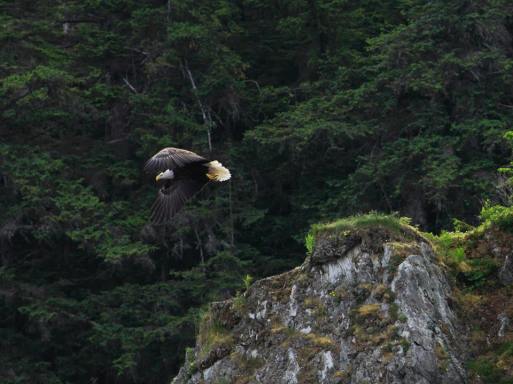
At the end of the log I stand and stretch the ache in my back, looking over Blackney Pass, over paradise. I drop the chainsaw and feel my heart lift. Blackney teems with life. Hundreds of gulls swarm a fifty yard patch of ocean in numbers so thick they look like a great feathered cloud. The bait ball has not gone unnoticed. An armada of eagles roar in from the trees, great black wings punctuating the ball of white. I count at least thirty eagles, shuttling back and forth between the trees near the cabin and the ocean. Again and again they swarm overhead, the silvery flashes of sand lance clasped tightly in their talons. Life, sustenance.
10540_10152009960619852_192033272_n
Brittney and I fall under their trance, the log lays forgotten at my feet. A lump rises in my throat. Why does this feeding frenzy have tears coming to my eyes? Because after everything the land has endured. Clear cutting, fish farms, live captures, predator control. They’re still here. The orca’s are still here. Is the world perfect? No. But here is a victory, here is joy. Here is a chance to celebrate.

“Do you know what I see?” I ask pointing out at the surging biomass before us.

Brittney looks at me, her eyes softened, the light glowing in her pupils.

“Hope.”


Silent Nights in Robson Bight

IMG_5288It starts with the flutter of a Hemlock bough, almost imperceptible. It registers for the briefest moment and falls into some unlabeled file in the back of the mind. It’s subtle, quiet, it’s how every storm begins. Now two hours later the waters of Blackney are streaked with white caps and the young hemlock bends at the waist. Harlequin ducks make a desperate gambit from one cove to the other, riding breakers two to three times bigger than they are. They’re tough little things, impervious to the weather. Whatever is in the next cove over, I hope it’s worth it for them.
After a week and a half of sun, the clouds feel intrusive, cutting into our precious allotment of daylight.

The roar of the ocean feels deafening after a week of calm seas. A week that gave us the chance to return to the orca’s holy land, Robson Bight. On the map, Robson Bight appears as just a little divot in the Vancouver Island shoreline, unassuming and natural. But it’s here, in the back of the bight, where Erich Hoyt camped in the 70s. Fearless and casual, he’d sit in his row boat in the dead of night, floating on the tide, waiting for the orcas to swim by. As we cruise across the mouth of the bight for the site of the hydrophone on the east side, I try to imagine how I’d feel. What would it be like, to float on blackness, thin paneled wood between me, the ocean, and 15 behemoths? After hours with whales, many of them with nothing but fiberglass separating us, I’m not sure I’m ready to surrender my primary sense when we meet.

The site of the hydrophone in Robson Bight is on a steep cliff that drops straight into the ocean. It doesn’t descriminate, picking up the sound of tugs as soon as they clear Weynton Passage some five miles to the west. At Orca Lab we call it the Critical Point hydrophone. After the whales enter through Queen Charlotte Strait, it is on this end of the bight that they choose to either continue east into the strait, or turn back to the west toward the lab and open ocean.

But now, in the quiet stillness, nothing seems critical or pressing. Brittney and I relay the car batteries up the cliffside. Critical Point is the most vital but also the most susceptible hydrophone in the array. It has the widest range, but its solar panels are draped in shadow for most of the winter by the massive mountains at the back of the bight. For five nights we’ve been nudged awake by the unmistakable chirps of a hydrophone about to run out of power. Invariably it’s Critical Point that needs to be extinguished, leaving us sonically blind in most of the strait.

It’s easy enough to swap the batteries and install the new ones, all one needs is a wrench and an understanding that touching positive and negative terminals will lead to the shock of your life and possibly frayed eyebrows. Batteries firmly in place, I call Paul.

“Where are you now?” He asks, you can always hear a smile in his voice.

I grin back and fall into the moss putting my feet up on the rocks, drinking in Robson Bight, the rays of sun cutting through the mountains, anointing them with breathtaking halos.

“Just on the Critical Point cliff, soaking in the sun.” The honor and novelty of being here, of working for the guy that wrote the book on Orca behavior is never lost on me. This is so cool.

An hour later we’re riding the ebbing tide to the west, I’ve memorized the strait like some learn city blocks. There’s the cliff, always dead heads on the ebb coming around the corner. The Sophia’s, reef off the west end. Nice deep water off Cracroft Point.

We round the corner into Blackney Pass, the water churning as it rushes for the open maws of Blackfish Sound and Queen Charlotte Strait. Miniature whirlpools splatter the entrance, a heavy tide rip in the middle. I can count on one hand the number of times I’ve seen Blackney in a state that I’d be willing to kayak. The water never rests.

Gulls, murres, guillemots, and murrelets manipulate Blackney’s upwelling, dive bombing for forage fish pulled to the surface. Off to the right is Barontet Passage, a long slender channel that runs east on the northern end of Cracroft. The resident orcas never go that way, but occasionally the transients – what was that?

Without bothering to slow down I yank the wheel to the right, turning ninety degrees, the bow pointing toward the opening of Baronet. A hundred yards later I slow down. Something caught my eye. Something bigger than a sea lion. I think it was just a humpback, there’s been a couple hanging out between Parson and Cracroft.

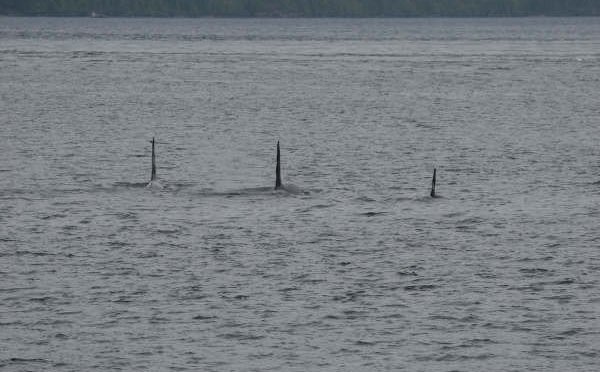
There’s a dorsal fin.

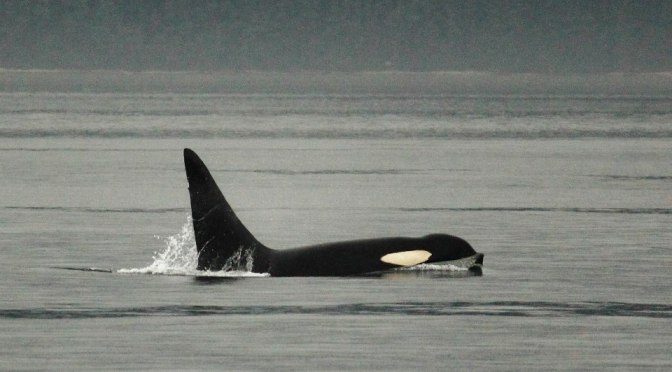
“It’s an orca.” My heart stops, resets, and accelerates. Brittney’s already digging for the 400mm lens. I don’t mean to say it with such intensity, but I can’t help it. Eight years later, orcas still do this to me. May they always.

I turn the boat so they’re on our port side. The boat we’re in is only about ten feet long and when you sit, you’re barely four feet above the surface. You may as well be in Erich Hoyt’s row boat. And on the rambunctious currents of Blackney, you couldn’t ask for a worse platform to photograph.

“Can’t you keep it level?” Brittney asks as the orcas-four in all-break the surface.

The group heads the same direction we’ve just come from. I know we’re a land based research facility, but screw it. When is this going to happen again? We follow respectfully, years on the whale watch boats paying off, the camera whirs to life with every surfacing. I dig in my pocket, and one hand on the wheel, both eyes looking out the window, call Paul again.

“Hey Paul, guess what we found.”

I hear the smile in his voice as we round Cracroft Point and once again, travel east into the strait.

When The Storm Breaks

The weather breaks. The sun tears through the cloud curtain. First a lone ray of light strikes Parson Island, than another, and another as like fingers thousands of miles long, they creep across Blackney Pass until they fall on our windows. The aftermath of a 50 knot storm. Porter sticks his whiskered nose out the door. He’s suspicious and disgruntled after being confined to the cabin for two days as rain pelted the windows and the walls rattled.
We step onto a beach littered with logs washed ashore in the night. Fir bark, affectionately known as “fishermen’s coal” punctuates severed trunks of cedar and spruce. We pile the bark greedily in our arms. In a few days they would dry and capable of supercharging the fire at night when temperatures are dropping below freezing.
The bark drying on the sheltered picnic table near the cabin, I grab an ax and send splinters of wood flying. Heating by wood stove offers the luxury of warming you up twice. Once when you cut it, and again when you burn it.
I used to take heat for granted. Why wouldn’t you when for 25-years all you had to do was turn a knob, flip a switch and be rewarded with steamy warm air emitting from the magical grate in the floor? That heat, that energy had to come from somewhere. Coal? Hydropower? A wizard in the wall? I couldn’t tell you. But here I’m intimately connected to where my heat comes from, my electricity. Sunshine means the computers charge, the hydrophones switch on, Netflix is operational.
Too many cloudy days and we pay the price. Hydrophones flicker, cycle, and scream in their static voices until we turn them down. To keep the lights glowing and Orca Live streaming we turn to the massive red monstrosity in the shed. The generator, good old unleaded gasoline and 10W30 motor oil. As the unprecedented climate change intensifies, there’s a sensation of guilt each time I pull the choke, turn the key, and see pale white exhaust shoot into the atmosphere. At least I know where it’s coming from I guess. Thankfully, on sunny days, the generator sits unused, ignored. For what can be more renewable and reliable than those rays of sun beating down from above?
“When we know where our food, our energy comes from,” says Zachary Brown, founder of the Inian Island Institute in Alaska, “we no longer take them for granted. When we have an intimate connection to these commodities, we pay attention.”
Food for us is a different story. Banana’s from Belize, avocado’s from Mexico. At least the Kokanee and apple’s are Canadian. We do what we can. We grow kale, collard greens, and potatoes that are waiting patiently for Thanksgiving. It’s no different in the summer when we live in a town of 400 in southeast Alaska. A town with an award winning recycling program, where people have gardens instead of lawns, and avocado’s cost 5 bucks apiece. Avocados that arrive on the same barges that I shake my fist at in the winter time as the plod past the lab, filling the hydrophones with their roar, the air with their exhaust.
What’s the answer? What’s enough? Are my bananas and avocados ethically harvested? I’m vegetarian but should I be vegan? Maybe I should just eat the salal that grows between the cabin and the ocean.
Brittney used to agonize like this when she was in school. She’d come home from another humanities class: People and Plastics and Animal Rights courses. Nestle stealing groundwater, animals testing on rabbits, a fresh water crisis, orcas in captivity, taps running dry, corn fed factory farms. What to do, how to promote change, progress.
We aren’t superman. We can’t fight all of this. Instead we must select those injustices, those policies and acts that raise the hair on our neck. That quicken our pulse, that pull at our conscience. Whether it’s animal rights, oil pipelines, alternative energy, letting Corky come home, Syrian refugees. We must pick our battles, our medium for fighting them, and go to work.
Deep in the woods of Hanson Island lives a man. An anthropologist, a writer, an activist, a hero. He calls himself Walrus. As the forests of north Vancouver Island were leveled by the chainsaw, he took a stand by sitting down. He seated himself on a logging road that wound into the heart of Hanson Island, of Yukusam, and could not be moved. This was his fight, his passion. He won. He lives in a cabin now at the site of his barricade. “The longest active logging blockade in British Columbia,” he says.
This is the life of the activist. It’s Rachel Carson typing out Silent Spring as cancer ate at her because someone had to write it, Paul Spong camping in front of the Vancouver Aquarium, insisting that Skana go home, Michale Pollen and Food Inc, Marches for Lolita, Will Allen perfecting urban farming. Different people, different passions, huge change. May we someday be counted among them.

Waiting For Corky

“On no they’re not.”
“It’s true,” I answer, “they’re phasing out the circus performance bit. They say they’re going to do a more education and conservation based thing… of course, it’s SeaWorld, so who knows what that means.”

Paul and I stand on the rocks feet above Robson Bight. Two steps and we’d be free falling fifty feet to the bottom. Free whales swim here. They go right past the rocks we stand on, an arms length from shore. Every time I come here I try to will them into the bight. It’s never worked. Orcas are very into themselves.

But now our minds are not on the hydrophone resting in the kelp, or the batteries on the cliff that fuel it. They’re on a whale thousands of miles away that deserves to be here. Paul furrows his brow, there’s skepticism in his expression, doubt after decades of banging against the gates of SeaWorld, asking that Corky be allowed to come home.

“Maybe it’s just a spoof article,” he says. “Where did you read it?”
I confess that I can’t remember the source. But I’m convinced it wasn’t the Onion.
We pick our way down the rocks for the boat and the lab.
Paul lets out a laugh. “Wouldn’t that be something? SeaWorld stops performances, yesterday Obama vetoes the Keystone pipeline. What is happening?”
“Maybe we’ve been transported to a parallel universe.” I offer.
“That’s it. What’s going to happen tomorrow?”
    “Donald Trump is gonna get eaten by wolves.”
“And through a loophole in his will all his money gets donated to conservation.”
“He meant to write all proceeds to the conservative party but misspelled it.”

Deep down, SeaWorld hasn’t changed. Their orcas are still commodities, big swimming black and white dollar signs. SeaWorld isn’t changing. They’re rebranding. And what choice did they have? They’ve lost a third of their visitors. Their value is worth half what is was before Blackfish. The ship is sinking and there aren’t enough lifeboats. But rather than call for help, SeaWorld has decided to bail water until they’re six feet under. This isn’t surprising. It’s still despicable. But it’s encouraging. They’re grasping at straws.

SeaWorld continues to operate under the delusion that they will be relevant and profitable a decade from now. Accepting the Blue World proposal by the California Coastal Commission would have given the San Diego park an expiration date. No new orcas. The beginning of the end.

But SeaWorld has no intention of letting Corky, the captive northern Resident of A5 pod come home. It’s a step closer to retirement for her though as human commanded tricks will not be part of the new Orca show. But Corky doesn’t have time. She’s been in that tank for four decades. Her time, and a chance at a happy ending is running out. These new, low adrenaline performances won’t start until 2017. By the time SeaWorld determines that this new marketing scheme isn’t going to save the company, it may be too late.

But as SeaWorld circles the drain, perhaps they’ll be willing to accept anything that will salvage whatever positive PR reputation they have left. What better way to change hearts and minds than retire a whale?

I don’t know if Corky can survive in the true wild. She’s been swimming tight circles for so long, I don’t think she can physically stand up to the rigors of being a wild whale. But a net pen in her native land? Where she can taste the ocean. Hunt wild fish and hear the sounds of her family. Who wouldn’t get behind that?

“They can do Corky shows live from Dong Chong Bay (the bay just west of Orca Lab on Hanson Island) and broadcast it over the internet.” Paul offers as we pull into the cove next to the lab.
He’s says it like a joke but it’s not. What it would mean for her to come back. After all these years, and have her living next door. A few hours later all is quiet. The water calm, the sun setting. Paul is back in Alert Bay and it’s just me and Brittney.

Suddenly we both sit up, our heads cocked. When you live at OrcaLab you develop this passive listening. You aren’t aware that you’re tuned into the hydrophones but you always are. And when an orca makes a noise, it makes you jump.

And there they are. What are the odds? We tear over to the lab and pull on headphones, our trembling hands adjust the dials on the soundboard. They’re in the Bight, right where Paul and I stood talking about Corky just five hours ago. Now her family, A5 pod is there. Swimming feet off the rocks I’d been standing on.

Goosebumps spread up my arms. They shouldn’t be here in early November. But here the A5s were. Back in the strait on today of all days. Keeping Corky’s bed warm for her. As their calls echo off the underwater cliffs I fight back a lump in my throat, trying not to feel guilty. After all, it’s Corky that should be here, not me.

The Parson Island Relay

The breath catches in my chest, my legs wobble, and my arms shake. I try to take another step forward and feel the ground slide beneath me. Mud and its ally gravity pull me to the ground. My elbows bounce off the cedar boughs and spruce branches that carpet the hillside, my head bangs against the cardboard box in my arms. I groan and lay motionless for a moment, grateful that no one but the trees and squirrels were present to see my fall. The sound of a humpback surfacing floats through the trees from Blackney Pass 100 feet away. I roll over and look up at the tops of the trees, massaging my chin and wiping sweat from forehead.

For the last twenty minutes I’ve been participating in a maniacal relay. In the six cardboard boxes are batteries. Batteries that are getting heavier every time I pick them up. Between the soothing breaths of the humpback and my more labored ones, I’ve developed a rhythm. Fifty steps. Drop. Return. Grab the next. Fifty steps. Drop. Return.

Paul and I had unloaded the batteries on Parson Island, the island across Blackney Pass from Hanson Island and OrcaLab. Now he’s scurrying back to the lab to grab Brittney to monitor the boat as the tide falls. Free us to  move the tedious batteries up to the Parson Island camera site. As we move the batteries into the woods we’re already panting, sweating, and shedding our wool sweaters. It’s a quarter mile to the camera site, most of it uphill.

“They say,” Paul gasps, “that battery technology has really improved the last few years…” he weighs the battery in his hands, “I don’t feel a difference.”

I have to agree. I could wait for Paul to get back so we can carry the batteries up the hillside together. But I’ve never been patient.

Which is why I’m laying on my back, staring up at the treetops, letting the remnants of last nights rain fall from the needles and onto my face. Despite the burning in my legs and the distance still to go, it’s impossible to not be moved by the sublimity of the scene. An eagle chitters and the humpback explodes to the surface again, its breath sounding like a trumpet, the echoes bouncing off the rock cliffs. I smile and permit my eyes to close for just a moment, feel my spirit sink into the forest floor. I could lay here forever.

“Everyone deserves to see this.”

Which is coincidentally, why I’m here in the first place. The new camera atop the Parson Island cliff demands more power than the eight Kirkland brand car batteries can provide in the winter when the sun disappears for days on end. The batteries in my arms should help the camera stream throughout the winter with minimal help from the balky generator stashed under tarps and rocks.

Fifteen minutes later, the batteries are at the top of the hill. The sound of an engine floats across the water, Paul’s back. We relay the batteries together. Past a thicket of Salal and around Cedar trees. The sunlight moves through the forest, the only marker of time as the afternoon wears on.

“After scurrying over rocks, hauling batteries up hills, and everything else you make me do,” I say, “I’ll never be able to have a real, respectable job… thank you”

He laughs and claps me on the shoulder, “come on boy, no rest for the wicked. And apparently,” he lifts another battery into the rubbermaid tub we’re using as a sling, “we are really wicked people.”

As we work the humpback continues to trace the Parson shore line. It’s surfacings the perfect background music. Soothing and relaxing to counteract our labored breathing as the relay continues. Finally we break through the salal bushes and onto the cliff overlooking Blackney Pass. The water has become a mirror. I don’t think I’ve ever seen it so calm, like liquid glass gently vibrating. I can hear the mutterings of murre’s. Random rays of sun stab through the clouds like knives and illuminate the gentle rain that has begun to fall. I’m struck dumb by the beauty. How can this not change people? We unpack the batteries and begin to hook them up. Maybe this camera will.

Thirty minutes later the job is done. With our arms full of soggy and decomposing cardboard we move back down the hill. I know this trail far too well now. Walking it twelve times will do that. We board the boat and disturb that perfect stretch of water. The humpbacks have moved away from Parson Island toward Johnstone Strait. Any day now they’ll swim east down the strait and set course for Hawaii. Leaving us with the sea lions and harbor seals for company.

We leap neatly from the boat and onto the rocks and look out over the water. Brittney gasps. An incredible rainbow has sprung into being. As Paul motors away back toward Alert Bay he slow the boat, his phone extended through the window, photographing the picturesque scene. Even after forty some years it’s still not old to him.

I sit down on the rocks and drink it in. This. This is what makes me happy, fulfilled. Hauling batteries through the woods, humpbacks in my office. Porter gives a soft meow and jogs up beside me, rubbing his face against my arm. My hand goes to my forehead and I feel the dried sweat glued to my skin. Now if only I could find some hot running water around here for a quick shower.

Same Destination, Different Path

The sun breaks through, faces turning upward, mouths open, drinking in the sunshine.  A respite, finally. No better way to leave. We’re on the Alaska Ferry’s equivalent of the milk run. The grand tour of southeast Alaska with little concern for time of day. Juneau at 4 am, Hoonah at 9, Sitka in the evening, in and out of Kake under the cover of night. Weaving through the mouse maze. West, east, and slowly, tantalizingly south.
We’re not alone. High school volleyball and wrestling teams are bedded down in every lounge when we stagger aboard in the early morning twilight. It had been my idea to stay up until our 4 am departure from Juneau, a decision I’ve been regretting since midnight. Through bleary eyes, sleep clinging to our eyelids we maneuver the minefield of snoozing adolescents, looking for any gap on the floor for a pair of sleeping pads.
Mercifully teenagers aren’t early risers, and most of us are still asleep when the purser’s desk begins to scold us over the intercom in a voice reminiscent of Mr. Feeny. “It’s time to turn these lounges back into lounges! Chaperones, get those lounges cleaned up!”
He must get a kick back every time he says lounge. But as I look around the room at the draped arms and legs protruding out of the corners and between seats, I’d say the room is living up to its name the way it is.
By the time we’re squeezing through the minuscule pass between Baranof and Chichagof Islands, the sun is burning through the fog, the day turning from Late October to June in minutes. With the shore just yards away from both sides of the boat we curl up on the solarium and let Alaska dazzle us for the countless time. Ravens chatter in the woods like invisible sentinels. A pair of Kingfisher’s chase each other above the treetops, their punk rock haircuts matching the throaty screeches perfectly. A humpback surfaces. The hemlocks grow tightly together. Every now and than a flash of red among the green, a Cedar. An outlier, we’ll be surrounded by them soon. As if magnetically drawn by the sun’s cameo, the high schoolers filter to the open deck.
Electronics are sparse among them. In the cafeteria playing cards appear, they talk, joke, laugh, are kids. Not drones with their head’s pulled down to an HD screen with the world around them invisible. It makes me smile. No cell service, unplugged from the world but not each other. When phones do appear it’s to take pictures of the scenery, often with them and their friends in the foreground.
Selfies are the new currency of flirting. All a boy must do to receive the attention of his chosen girl pack is leap into the photo, eager to participate in the immortalization of the moment through the magic of sim cards and 10 GB hard drives. Can’t say I’d so anything different if I was them.
The water stays calm as we leave Ketchikan in the evening and push into Canadian waters. Once again, we leave under the cover of night as the ferry pulls into Prince Rupert at 4 in the morning. This means crossing the border and explaining what the hell we’re doing in this country will be done through two sleep deprived and bloodshot eyes. We’re fourth in line getting off the ferry and I scarf down our remaining two apples for breakfast in lieu of turning them over.     We reach the customs lady and I roll down the window. Usually Porter sees any open window as a gateway to his god given freedom. And after two days confined to the car I expected Brittney to have to pin him down to keep him from crawling up the lady’s uniform. But he sits politely on Brittney’s lap, the perfect gentleman, as if understanding the gravity of the situation and our history with cranky and stoic border guards.
But they seem as groggy as us. The only loss is the little pink can of mace Brittney has had on her key chain since she worked mornings at a coffee shop. Bear spray, we’re told, would’ve been permissible, but since her mace was designed to use on humans, we were a threat to the unsuspecting Canadian citizens.
The inhabitants of Prince Rupert spared a terrible mace induced terrorist attack, we drive into the sleeping town. It’s too much to hope that our pet friendly hotel would leave their door unlocked at 5 am. So we grab coffee and hole up in the parking lot, waiting for the sun to rise and the lights to come on.
It feels good to be transient again. With our bags piled up behind Penny’s house in the back of the Pathfinder, the cat on our lap. Home is the four of us together. Two hours later the door unlocks and we record history’s earliest hotel check in, dropping our bags on the floor and collapsing onto the beds. Penny leaps euphorically as she hops into every corner, free of her house for the first time in 48 hours. Everything must be smelled, tasted… and chewed. With a $200 pet deposit we watch her like a hawk.
Brittney retreats to the shower, our hot water days numbered, and I watch Porter try to keep his eyes open as he curls up on the bed. The simplicity of my joy, my contentedness, brings peace. We search for happiness everywhere, sometimes demanding much, sometimes little. Sometimes, it’s as simple as an early check in, a sleeping cat, and the knowledge that no matter where I go with these three, I’m already home.

Porter Supertramp

Porter stares longingly out the sliding door. Like a kid with his face pressed against the glass, watching the rain fall in sheets for the second straight week. Frustrated, he paws at the door until we open it. Outside he stops short of the soaked grass, rain pelting the tin roof, reminding him, all of us, that summer is over. With a dejected look he walks back into the warmth.
It’s been that sort of fall in southeast Alaska. Sometime in August the heavens opened the floodgates and it hasn’t stopped raining since. Puddles litter the dirt roads and driveways like little lakes. Rivers flow between them, connecting them, turning the road into a washboard, car shocks moaning in protest, CDs skipping.
And once again, we’re on the move. Packing this, debating that, Porter and Penny wide eyed with alarm. Moving again? At least this time the posters can stay on the wall, unneeded clothes can hang in the closet. Last summer every box and duffel had to return to the exact same spot in the Pathfinder or it wouldn’t fit. Not this time. We have a whole year of our lives meticulously planned. We know where we’re coming back to. Where our next paycheck is coming from. Sell outs.
But for now it’s time to wander. To cheer silently when the beat up old Pathfinder coughs to life. The cat taking his position in the driver’s lap, Penny poking her nose through the gaps in her house, always looking forward. It’s time for ferries, lunches out of plastic bags, for Prince Rupert to have hotels with lenient pet policies. Most importantly, it’s time for Hanson Island. For quiet coves and sleepy sunrises, Harlequin ducks chittering good morning. For silent walks through the forest, listening to the whispered messages of the cedars. It’s felt like a lifetime since we were there, or maybe just yesterday, it varies.
How much longer do we want to do this? Whenever we talk about what we’re going to do “going forward,” the subject settles on buying property, settling, wrapping ourselves in Gustavus’ warm embrace. Hanson Island stops us cold. Reminding us of town runs, sea lion haul outs, and transients on Critical Point at 3:00 in the morning. And we know we’re stuck. That houses will have to wait. We have the rest of our lives to be domesticated. To fence ourselves in. We’ll be ready someday. Ready to drop our roots among the birch on the glacial outwash near the bay we love so much.
But not yet. We understand that what we have on that little island is a once in a lifetime opportunity. That a chance like this will never come around again. How do you willingly give that up? I don’t think we can. So when people ask if this is our last winter there we smile and shake our heads.
“Probably not.” We answer. “Paul and Helena may have to kick us out.”
When do you know that you’re ready? What if we’re destined to bounce between two places that we love forever, unable to commit? What a beautiful problem to have. Some winter it’ll feel right. We’ll stay put. We’ll go to every Gustavus potluck, every fundraiser, make new friends, discover what we never knew we had. But Hanson Island will forever be a part of us. An essential nutrient in our life. A place we’ll always long for, always love.
Right now I can’t wait to get back. To wrap myself in that island as long as I can, to enjoy it for as long as possible, knowing that our time there has an expiration date. That worrying about it won’t make it any better. Nothing to do but take as deep a breath as I can, savor every sunrise, every 50 knot storm, every night hauling the boat up the beach on the rising tide. Because we’ll never get to live like this again.

Sea World, Blue World, Where in the World do we Go From Here?

After much posturing, debating, and protesting, the end of Sea World is in sight… kind of. Last week, the California Coastal Commission approved Sea World’s new “Blue World” expansion which would nearly double the size of the orca’s pools at the San Diego location. Approval comes with an enormous catch, Sea World would be forbidden from breeding orcas of wild lineage or housing more than 15 orcas in the new pools. We’ll bypass Sea World’s bleats about depriving the whales of their right to breed as “inhumane and unnatural” (nothing more natural than artificial insemination) to avoid the risk of choking on irony, and discuss where Sea World, and its opponents go from here.

“It’ll all be over in a few decades,” I thought. But rereading the Commissions vague restrictions I had more questions than answers. Sea World can build the tanks, but it cannot be populated with whales containing genetic material from wild whales or whales captured in the wild. Every Sea World orca, at least that I can find, has at least a grandparent of captive origin. The DNA of free whales runs through the veins of every whale in those pools. Technically, no one qualifies for the Blue World pool.

What the commission is implying I believe, is no offspring whose parents were born in the wild can reside in the new enclosure. No sons or daughters of Tillikum or Corky. Second generation, captive born whales would qualify for the new enclosure is my understanding. Which raises even more questions. For example, what does Sea World do with Corky, the northern Resident female from A5 pod who was captured in 1969? If wild caught orcas don’t qualify, Sea World would be looking at transporting her across country to Orlando or San Antonio. As would her tank mates Orkid, Ulises, Kasatka, Nakai, Ikaika, Keet, and Shouka. A massive whale shuffle would be on Sea World’s hands to move captive born animals to San Diego.

But the ruling also prohibits the trade or transfer of whales to and from the park. Does this include transfer of whales between San Diego and the other two locations? No article that I could find specifies. But if you cannot move any whales in or out of the San Diego location, why the stipulation on the genetics? The ruling needs more specificity before Sea World or animal rights activists can truly claim victory.

We have tragically reached a point where most of these whales cannot go home. For many, Sea World is the closest thing they’ll have. A cocktail of Icelandic, Resident, and even Transient have been stirred into the genetic cauldron leaving many of the park’s inhabitants with no identity. Refugees of the natural world. While the argument can rage about how Corky or Tillikum would fare if they were returned, there is no such case for the majority of Sea World’s prisoners. Where does an Icelandic/Resident mix go? And what pod would even consider accepting this man made whale Frankenstein?

The Commissions ruling is a ray of hope. It may not lead to the quick death of orca exploitation, but it’s a step in the right direction. I would love to see a more concise ruling on what Sea World can and cannot do with the additional 4 million gallons of tank they wish to build. If it means that those eleven whales in San Diego are the last ones that have to endure captivity on the west coast, fantastic. Maybe Sea World would even try to save face and agree to a net pen retirement for Corky. But if all it means is that Sea World has to shuffle whales a little more across the country, than little has been done but increase the number of mom and calf separations.

Sea World is slowly fading, but they’ve made it clear that they will not go quietly. An appeal will probably emerge, we’ll hear more about how wonderfully they treat their animals, and ticket sales will continue to drop. Let us continue to diplomatically educate those that buy tickets and boycott those that sponsor them (No Budweiser till Corky’s out!). The animal rights movement has moved at an exponential pace the past few years and I can’t wait to see where it leads next.

The Last of the 36s

Every four years or so a new catalog comes out. Not a clothes catalog or card catalog but a whale catalog. A yearbook of sorts. Every whale in the Northern Resident Population represented. Their face is their dorsal and saddle patch, organized into neat, orderly matrilines that define their lives.
The previous catalog came out in 2010 and was never out of reach on the Hanson Island observation deck. Its pages tattered and folded, annotations and revisions scrawled in black ink noting deaths, births, and disappearances. Over time the ringed binder that held the thick pages together began to fray and tear until the page holding the A5 pods tore at the plastic binding. Surge, Fife, Havannah, and the others threatening to tumble clear of the book and onto the wooden planks.
The time to retire the 2010 catalog has arrived. The updated 2014 edition sits on my computer now, hogging a considerable amount of disk space, documenting all 298 of the northern resident orcas. The first page of the report has always been reserved for the A36s. But as I scroll to the matriline a hollow emptiness fills the page. There’s just one whale left. Kaikash, A46. The tell tale cut on the top third of his dorsal. I can hear his calls echo through the white, unblemished page where two other six foot dorsals used to stand. His brothers Cracroft and Plumper have passed on, leaving Kaikash as the lone surviving grandchild of A1, better known as Stubbs.
Having a bond to an individual whale may seem silly. But when you know them all by name, their history, their voices, it’s hard not feel a connection. Even though they have no idea I exist. But those three brothers; Plumper, Kaikash, and Cracroft kicked my anthropomorphism into overdrive. Kaikash and Cracroft were the cool ones, the lady killers. Plumper, with his less imposing name, the awkward middle child. But they stuck together. Plowing up and down the strait, massive dorsals held high. The boys club, not a female in sight, persevering without mom.     That’s how they looked to me on a rainy August day in 2007. I didn’t know who they were yet but it didn’t matter as they swam past me and my kayak, making me forget all about basketball shoes and hardwood glory. Turning my life upside down. Leading me to OrcaLab, to whatever it is that I do with myself.
Cracroft past away in 2010. And last August Plumper struggled against the tide in Blackfish sound, gave up, and drifted back the way he’d come, his brother following loyally. Which left Kaikash to fend for himself. The death sentence for most orcas, unable to survive without mom, brother, sister, and cousin. But here he is. That dorsal still defiantly displayed on page one, the final relic of the A36s, of my rebirth, of my story. I can’t imagine there’d be a blog without those three.

Last summer I hammered away at the chopping block near the lab. As the tide rose and the sun beat down a kayak group pulled into the back of the cove. I stared in amazement. Hundreds of miles of beach and they have to pick the one that’s inhabited? I keep swinging, halving and quartering the rounds, wooden shrapnel flying left and right. After lunch an older man picks his way across the beach and boldly walks up to the wood shed.
“Excuse me.” He calls, waving his arms.
I pull out my headphones, sweat running down my face. “Yeah?” He better not be asking me to wait until they leave to keep chopping.
“This is OrcaLab right?”
I nod, “sure is. I’m not sure where Paul is right-”
“Oh that’s ok. I know you’re all busy. I just wanted to ask one question. Years ago my family adopted a whale through a foundation, I think he swam around here. He was A5.”
“That was Top Notch.” I answer.
“Was?”
“Yeah… he died, quite awhile ago, shortly after his Mom. That’s how it usually happens unfortunately.”
He bites his lips, eyes on the ground like he’s dropped something. “I figured,” he mumbled, “thanks.”
So it goes in the Orca world. Friends we barely even know saying goodbye. Vanishing. No wakes, no farewells, just an empty spot on the page, and a greyed out square.

I move past Kaikash’s lonely spot and keep flipping through the catalog. “298 is a lot of whales,” I think, “more than there’s ever been since the study started.” I reach the page with the A4s, and my melancholy vanishes. There she is. Springer, A73. The miracle whale. From death bed to motherhood. Her baby Spirit’s picture just below, a strong black line connecting them. Nearly every pod has young calves, a good sign. More stories to be told, more memories to be made. Death just as much a part of living as birth. They all start out like Spirit. I smile and close out of the catalog.
“They’re just like us,” I think.