Tag Archives: British Columbia

Chop Wood and Haul Water

You don’t hike through salal; you swim through it. Buried in an acre-sized grove, I stand on tiptoe, gazing at the island of hemlock ahead. In my mind, salal was just a hybridized version of discount alder. A nitrogen fixer thriving wherever sunlight poked through the clouds.

I breaststroke another few feet, struggling against the plant’s willowy but strong branches. The individual plants weave together like plywood, forming dense barriers that feel like drowning. I try a few more desperate strokes, pause, and look around. There’s supposed to be a trail somewhere.

I plunge beneath the surface, crawling under branches instead of through. Things look clearer down here. Something resembling a deer trail cuts through the maze. More tunnel than path, it’ll have to do. I reach for my phone and stare at the little orange triangle. GPS tells me the Hanson Island summit is just a few hundred feet ahead. I wiggle a few more feet, wondering why I didn’t do this long ago.

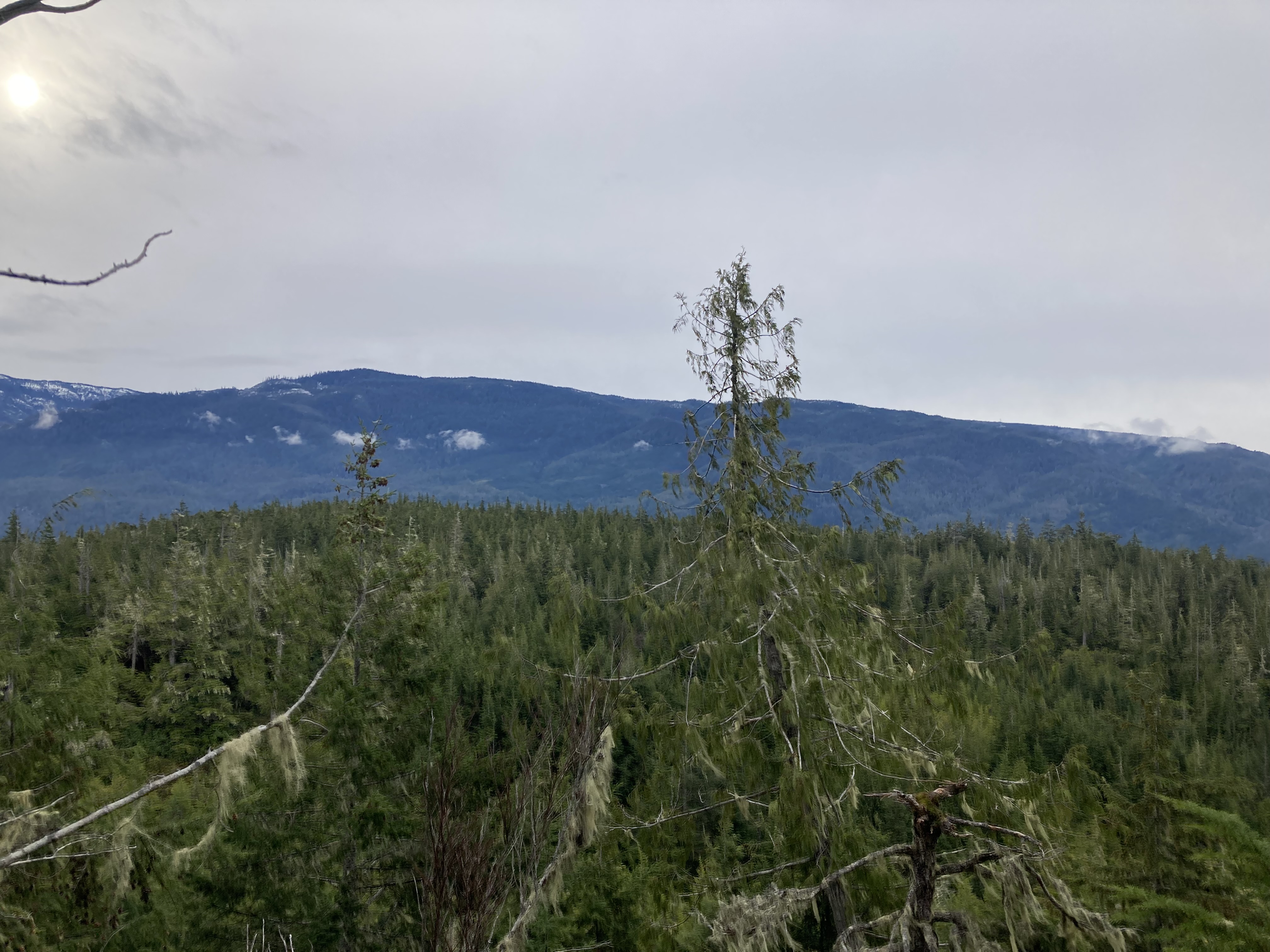
I’d be lost without my phone. It’s hard to admit, even by myself, without so much as a raven to judge me. The salal thicket blindfolded me, the small drainage spun me, and the few windows of sky reveal nothing. I follow the crutch in my hand, allowing it to guide me up one more embankment. A trio of big cedars with intertwined limbs shade a clearing festooned with deer beds. I push through one more wall of salal and gaze from the summit at Vancouver Island’s distant ridges. The hillside steepens, leaving just enough room for a viewshed and a clearing of rocks and lichen. I squeeze fatigued legs to my chest and stare at undulating greens and blues.
***

Harlequin ducks squeak in protest as I paddle by. They take to the water, necks bobbing forward and back as if to give themselves the illusion of more speed. Their rubber ducky chatter conceals their daredevil hobby of surfing southeasterly waves seconds before they break on the rocks. They dive like seals and fly like puffins, frantically beating their wings centimeters above the water. Every tidal rock holds another cluster of them, chattering away and admonishing the yellow kayak gliding past.

(C) Oregon Department of Fish & Game

Hanson Island crawls by. Every beach beckons to be explored, and twice, I slide into cobbled shores and poke into the woods. I’ve boated these waters dozens of times, always in too much of a hurry to pause. Always hustling either to Alert Bay or back to Orca Lab, usually in fading light or racing the next low-pressure system barreling up Johnstone Strait.

I’m hell-bent on savoring; I linger in non-descript woods for no reason other than they exist. At last, I swing into a narrow bay with steep shores plastered with ochre stars. A lone white buoy bobs at the head, and I pull into a small beach pockmarked with softball-sized rocks.

There’s the trail, just as I’d left it, through stands of alder and up a single-lane logging road recolonized by hip-tall hemlocks. I follow the steady incline under fallen trees and around puddles. A smattering of fish cut from plywood marks the trail with engraved names like “Bobby ‘Sparkplug’ Joseph” that demand exposition.

Past a slippery “bridge.” Clear-cuts glare at me—old ghosts rotting in choking shadow from dozens of same-aged hemlocks racing for sunlight. I stop at one such graveyard and try to remember. Had I noticed these old fallen trees in 2015? ‘16? ‘17? Had I been too naïve and unencumbered? Did the umbrella of protection now stretching across the beloved island somehow nullify the millions of board feet already removed?

I continue past spindly young cedars and gurgling streams, stopping at a fence woven with alder and salal. The gate swings open at a touch and the rusty old bell rings. A cedar shingle sign with weathered words welcomes me to “Earth Embassy.”

Trees sway in the wind, but it’s peaceful in the small courtyard between the old ramshackle buildings. Amongst the weathered old shingled walls, fraying tarps, and a bulletin board tacked with water-stained pages stand two new metal signs.  

“Respect this property,” the first sign commands, going on to recognize the site as the home and resting sight of one, David “Walrus” Garrick.

I wait for the creak of a wooden door and Walrus’s long gray beard and mischievous eyes. I listen for the echo of his dog Kessler’s booming bark or the rattle of the steller Jay fed peanuts every morning. But it’s just me in this quiet shrine with the work of one man’s lifetime.

The closest thing we had to a neighbor, I frequently made the hour-long hike from Orca Lab to Walrus’s. Equal parts Gandalf and Dumbledore with a liberal sprinkling of Original Trilogy Obi-Wan, Walrus would crack beers and tell stories he’d undoubtedly told a million times.

Wide-eyed, I’d listen to this living oracle talk about the founding of Greenpeace, protesting seal hunting in the Arctic and working as a cook on the first anti-whaling vessel before the Discovery Channel and Sea Shepard mainstreamed it.

The stories culminated in this place. His final act. The one he’ll be remembered for.

“The longest active roadblock in Canadian history,” he boasted, gesturing at his uninsulated cabin with a leaky vapor barrier, no insulation, and a smoky woodstove.

As Swanson, Cracroft, Parson, and Vancouver Island were stripped clean of timber, Walrus crawled sans-GPS through the salal to document the one thing that could spare the island known in the Kwakwaka’wakw language as Yukusam (‘shaped like a halibut hook’).
***

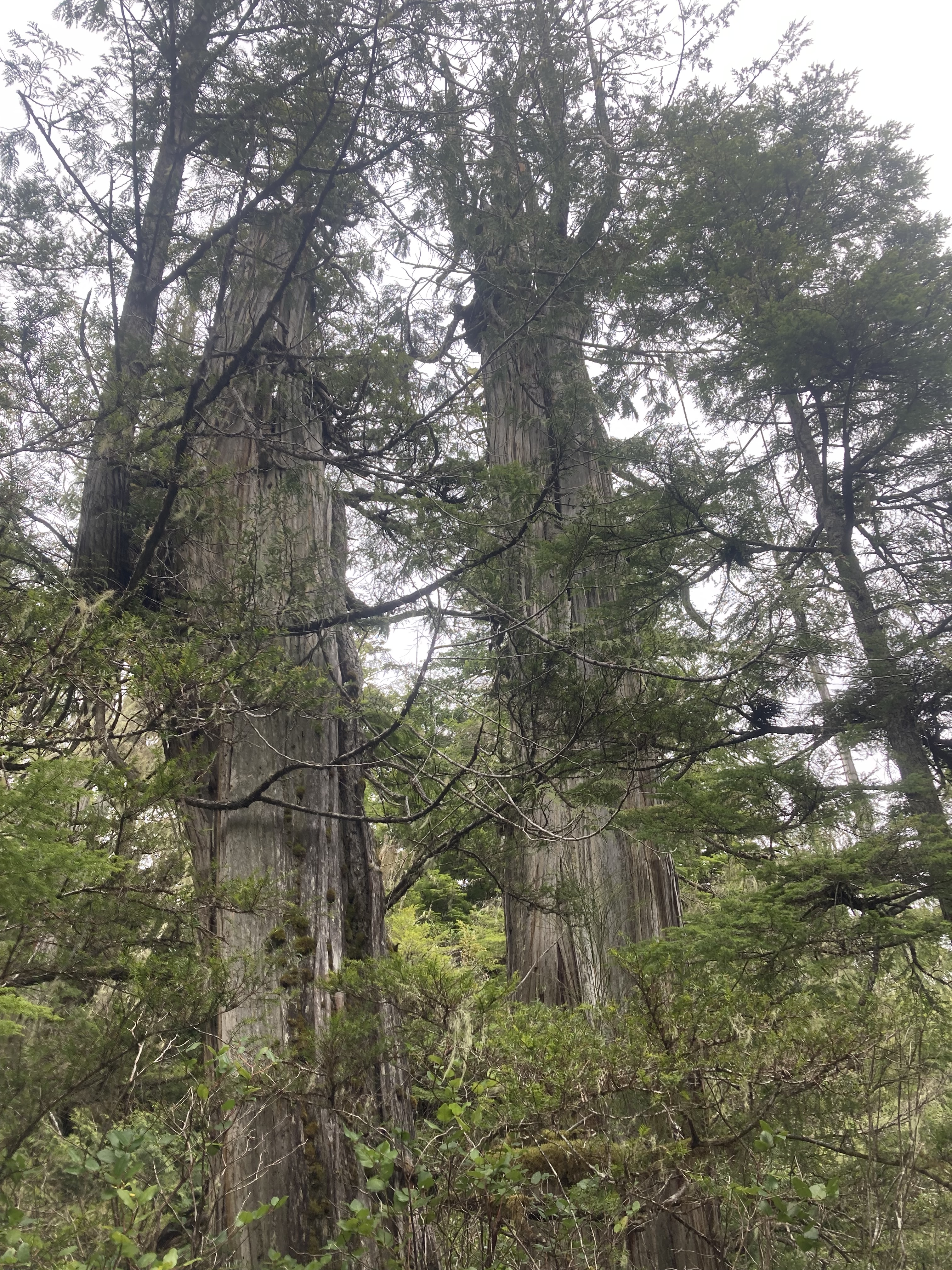
Red cedar is more than a sweet-smelling, rot-resistant wood that burns hot. Christened the ‘Tree of Life’ by the B.C. Coast’s First Nations, the tree was both canoe, house post, clothing, and basket. Centuries before the idea of forestry was an Anglo-Saxon fantasy, a natural ethos of conservation was a mainstay in Indigenous culture.

Life may have revolved around salmon, but cedar was the tool. Young cedars growing straight and true were set aside. They could be a basket today but, in a few generations, may be large enough to become a canoe, totem, or a corner house post.

Other trees were selected for bark harvesting. Outer bark was collected by making long, skinny incisions, which could then be dried and weaved into water-resistant clothing, baskets, even hats. The same oils that make cedars rot exceedingly slow even served as a natural bug repellent.

Instead of killing it, the harvesting increased the growth rate as the tree covered the exposed area. A cedar could rebound, survive, and even thrive if not too much was taken. The most formative and compelling case for conservation. The best argument that sometimes the word “enough” is the most important.

Prospective logging companies brushed aside the importance of Yukusam’s, “culturally modified trees” (CMTs), claiming that their in-house research showed there were only a couple hundred. Walrus and his team lived out of their active roadblock and pushed into every unlogged nook and cranny, documenting over 2,000 CMTs. For a region and people that had endured disease, assimilation, fish farms, potlatch imprisonments, and the heinous era of residential schools, CMTs are one of the remaining cultural touchstones. Carpet bombing Yukusam would be akin to nuking one of the few remaining strongholds.

Lawyers lawyered. Judges judged. Juries… juried?

And in the end, the remaining Yukusam old-growth was set aside. Walrus continued to live on his active roadblock, building gardens, cultivating shiitake mushrooms, and befriending the local steller jay population. The next generation of Kwakwaka’wakw filtered through the homestead, where elders taught cedar bark harvesting techniques.

Photo courtesy of Sharon Eva Grainger

These same Alert Bay residents pushed fish farms out of much of Kwakwaka’wakw territory, spurring returns of chum and pink salmon not seen in decades. It would be foolish and irresponsible to credit Walrus with this local revolution, but I wonder if seeing the power of a small team of forest-dwelling activists was another dry piece of kindling on an already growing fire.

***

For three winters, Walrus told me to climb the trail to Yukusam’s highest point. I’d smile, nod, and instead would walk back down the abandoned logging road for Orca Lab, unable to ascertain why. As my final winter as caretaker came to a close, I hiked to Walrus’s for the last time with a backpack laden with groceries. A nasty cough was making it harder and harder for him to lug supplies from sea level to 350 feet. Every couple of weeks, I’d arrive with a loaf of bread, eggs, and a couple beers.

“Did you get up the hill?”

I shook my head, feeling his disappointment, before grasping his hand and wondering if I’d ever see the sweet, eccentric Jedi Master again.

The cough forced Walrus to leave the longest active roadblock a few years later. In 2023, he took his final breath, finally able to breathe deep again.

***

The trail back to Walrus’s is easier to follow on the way down. I tour the old garden and study the pages clinging to the bulletin board. There are maps of the island showing the arterial trails he used to get from one CMT grove to another. Pictures of trees in mid-harvest and cross-cuttings of felled cedars, their age measured in centuries—quotes and documentation of Springer’s homecoming (another story for another day).

Near the front door is a notebook tucked safely in a Ziploc. Inside the little guestbook are the words of those who have visited this place since he passed. I clutch the little memento and stand before his resting place.

Before enlightenment, chop wood and haul water.

After enlightenment, chop wood and haul water.

I open to the next blank page and stare for a long time at the empty lines beneath my scribbled, “Dear Walrus,”

 It is somehow lifetimes and seconds since I was here… the longest active roadblock remains intact.

I finally made it up the hill. You were right, it is beautiful. I should’ve done it sooner, but I’m thankful I could return and make it happen.

I’m not who I am without Yukusam. It was orcas that drew me, but that’s not what brought me back. This place is green because of you. Cedars stand because of you, though I’m sure you’d brush that aside with a laugh and a cracking beer.

Chop wood and haul water.

The phrase catches my heart; no five words better summarize my post-Orca Lab life. Wood for a fire, wood for 2x6s, and rafters and plywood. The promise of a warm house.
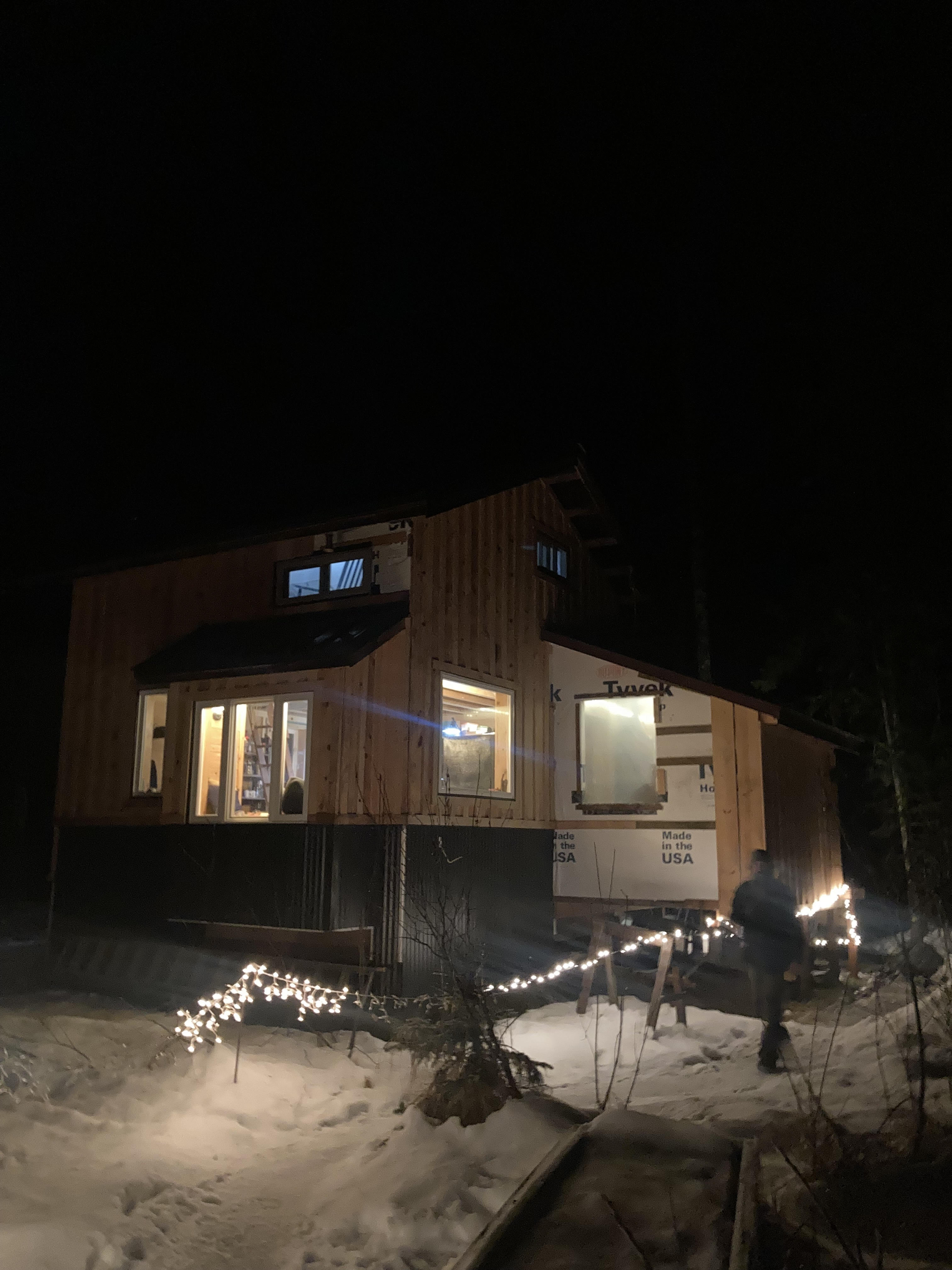
But the words are not simply literal. I repeat them like a mantra, a meditation, a reminder that some things must not be forgotten, no matter where in the journey we are. Ways of life that tether us to place and home and earth. Edicts as sturdy as a cedar house post.

Chop wood. Haul water. Climb the hills. Get dirty knees. Paddle the beaches. Drink the beer. Smile quickly. Laugh loudly. Forgive easy. Let go of anger.

A raindrop hits the page. I bend over and try to say goodbye.

Thank you for all you taught me. It took a while for some of it to sink in; I’ll never be done learning, never be done making mistakes, but I’ll never stop trying. I chop wood and carry water because of you. Rest easy, my friend. The beer is on me next time.

(C) Globe & Mail

I return the journal to a house built by trees to protect trees and retreat down a forgotten logging road that will never continue, forever stymied by a fence woven with sinewy salal and shaded by cedars growing in dignified defiance.  
Sights and Smells

I wonder what’s different.

The transportation for one. Greyhound no longer brings their gargantuan buses this far up Vancouver Island, and as we careen down the narrow two-lane road with six inches of shoulder, I can see why. The playlist blasting in my ears has changed, though I brought back some classics like Death Cab for Cuties’ Bixby Canyon Bridge and Snow Patrol’s Make This Go on Forever.

A myriad of greenery blurs outside the window. I watch these forests differently, too. Oh, my heart still flutters at the boughs of red cedar hiding secret pathways to 6,000-foot peaks. But I also see acres of young hemlocks scrunched together like matchsticks in neat little packages. Phrases like “stem exclusion” and “30-year harvest cycles” whisper with sullen voices. Countless watersheds line the east side of Vancouver, but the Tsitika River I just rumbled past is the only one that hasn’t been logged. Tsitiaka winds through the tallest mountains on the Island and reaches saltwater at a little place called Robson Bight.

Orcas. It always comes back to orcas.

For two days, I have ferried, flown, and ridden from Gustavus to Juneau to Seattle to Victoria and am now just an hour from Port McNeil. Despite my evolving playlist and old-growth forest opinions, it still feels impossible that my first trip to Port McNeil was 17 years ago. Surely it was just a couple of weeks ago that I hopped off the Greyhound. Wasn’t it last weekend that I drove a Nissan Pathfinder up this road with a cat and rabbit in the back seat?

These roads, islands, and waterways hold a lot of the stories and experiences that explain the evolution from basketball boy to kayaker, guide, naturalist, bum, redneck-hippy, writer, conservationist, and whale aficionado. I’m counting on it providing a few more.  

Ferried. Flown. Ridden.

I count the number of petroleum-driven vehicles that propelled me from Gustavus to the footsteps of Port McNeil, Johnstone Strait, and my precious Hanson Island. All to go on one more monkish retreat in the woods and waters of my youth. All to catch one more ride on a boat powered by an outboard motor or go paddling in a kayak made of, you guessed it, fossil fuels.

Too small to tip elections in favor of Mother Earth, I run to my favorite hiding place, sheltered by, you guessed it, Mother Earth.

Blackfish Sound

If the trees are passing judgment on my life choices, they keep it to themselves. If those replanted hemlocks are packed like matchsticks, what happens if one of them lights? I woke to the news that California was burning during the wet season.  A world getting drier, warmer, crazier, more unpredictable. Surely, it would be the earthquakes that doomed southern California. We beat San Andreas Fault to the punch.

***

Don’t cry. Whatever you do, don’t cry.

All those old names:

Blackfish Sound, Pearce Passage, Weyton Pass, Blackney Pass, Queen Charlotte Entrance.

Bold Head and Cracroft Point. Blinkhorn Peninsula and Kaikash Creek.

I know them all, have stared covetously at their little faces for eight years, promising I’d see them again. I’m sure they’ve been getting on just fine without me.

I confess I left my guilt on the Port McNeil dock, catching one more 45-minute ferry ride to Cormorant Island and the town of Alert Bay—the end of public transportation. I wait two days for a weather window that finally comes as low pressure turns to high and the wind pivots from southeast to northwest.

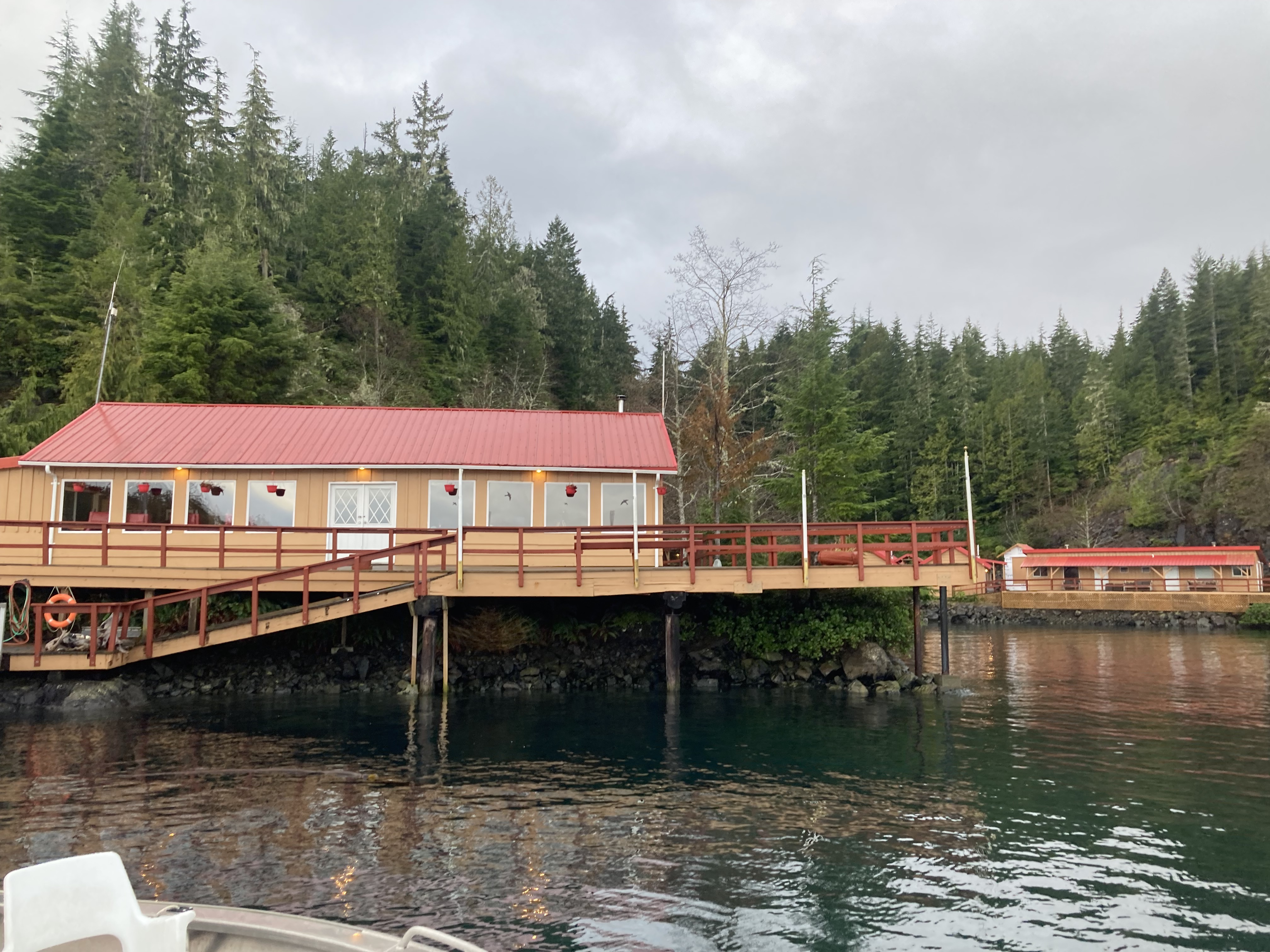
Every town run from Orca Lab to Alert Bay took me past Double Bay, its long boardwalk, floating dock, and cherry red rooftops. I shoulder my pack and follow the other caretaker, Laurene, up the dock. She directs me to a cabin on the right side of the horseshoe-shaped boardwalk, perched on the rocks with a view of Blackfish Sound and the first layer of the Broughton Archipelago’s islands.

The door opens, and the pack thumps from my shoulders. The cabin is bigger than my Gustavus design, with a half-loft upstairs, a functional shower, even a flush toilet. I would have settled for half-a-shabin and a cot. It’s not the high-end amenities that made the pack fall.

Don’t cry. Whatever you do, don’t cry.

Next to the kitchen table is a shelf. On it rests a radio receiver that looks all too familiar. Whether donated or purchased from Orca Lab, the ocean blares from the speakers—water gurgling, a distant boat engine, crackling shrimp. I swear I hear A pod.

“We have a hydrophone at the mouth of the cove,” Laurene explains, unaware I have been transported back in time. “There’s a volume knob on the right—”

“I know,” I interrupt. Not the best first impression.

I cross the room and crank the volume. How many nights did I fall asleep to this? She leaves me to unpack. I move quietly across the floor as if I’m in church. Clothes upstairs, tortillas and cheese in the fridge. Curry paste in the cabinet. I open the wood stove and smile. A pile of ash has calcified on the bottom and shrunk the stove’s space in half—a chronic problem with burning wood soaked in saltwater.

I pry the ash free and grab a handful of piled kindling. With eyes closed, I bring a stick of red cedar to my nose and inhale like an addict, listening to the hydrophone as my head spins and heart palpates. Our sense of smell pales in comparison to most mammals. Yet its ability to conjure memories is undisputed.

There is a smell to Hanson Island I have found nowhere else. Something in the ground, the water, the trees. Perhaps it’s as simple as it remains one of the few islands in the region that has not been clear-cut. Old-growth smells for a land that measures lifespans in centuries and seasons in seconds.

***

I weave between cedar and fir, balance on fallen skyscraper hemlocks, and plunge through salal undergrowth. I squish deer scat between fingers and spy on harlequin ducks perched on rocky beaches. Rumor has it a wolf has taken up residence on Hanson Island. I scan the hills with blind optimism for hazel eyes, ears cocked for the howl that proclaims that there are still things green and wild and true on this burning planet.

The rising northwesterly brings the forest to life with creaks and cracks. I settle against the hollowed-out trunk of a cedar, its innards charred from a long-ago lightning strike. Yes, even here, there can be fire from time to time. The stubborn cedars simply refuse to rot and fall, standing even in death in defiance of the decay and rebirth that comes for all.  

I scratch at the charred bark and sniff. Any smell of fire is gone. The forest around me vibrant and healing. I watch the treetops, content to let the afternoon crawl away. There will be time tomorrow to check in and learn what is expected of me here, how I can give back to this place that dreams of becoming a sanctuary and educational retreat. It took enough petroleum to get me here. I will live, write, and eat in a shelter made of wood. I’ll try to leave this place better than I found it.

Wet earth soaks into wool pants, a pleasant shiver travels up my spine. Ravens cackle, eagles retort. Somewhere, an orca explodes to the surface. I feared two months wouldn’t be enough time to find what I was looking for. But as eyes close and my soul rises to the island’s tallest canopy, I know it’s already been found.

Risk and Living

The tender splashes over the side, and the southeast breeze tugs at the bowline. I tie it to a cleat and give the anchor a firm pull. Find me a boat owner who’s more paranoid about their anchor than me.

Boat anchorages for this forecast don’t get much better than Lemesurier Island’s Hooter Cove. Tucked on the island’s west side beneath a steep hillside, it’s insulated from all but the worst southeasterlies.

Lemesurier Island on a nicer day

I wiggle into the little inflatable and paddle awkwardly for shore. I can’t imagine the designers of the Seahawk 2 had this in mind when they marketed her. Judging by the photo on the box, their grand plans included two full-grown men squeezing into this glorified raft for a magical day fishing on their favorite lake.

The raft zigzags at a glacial pace, and I keep glancing at the trees to confirm that I am indeed making progress. Even if I didn’t have my pack, rifle, and long legs, there doesn’t seem to be room for another dude in this thing, and I have no clue where you’d stash a fish bigger than a goldfish.

I nudge into the barnacle-coated rocks. Seahawk’s already sprung a pair of leaks, and we’ve agreed it’s a good idea to always take the hand pump. Despite the comical marketing and questionable durability, Zach and I have become strangely attached to the goofy inflatable that fits neatly in the back of our 20-foot skiff. I stash Seahawk above the tideline and, for the countless time this fall, pull my rifle from its drybag.

It’d be nice to have one more deer. The weather and daylight window for the day are tight, made worse by me forgetting my deer call on the bedside table and delaying our departure another 15 minutes. The ride to Lemesurier is just bumpy enough to remind me that the evening forecast calls for 20 knots and growing to 25 by Thanksgiving morning.

It’s mid-morning by the time I drop Tanner and Zach at their hunting spots and anchor. Four hours in the woods can vanish with astonishing speed. Depending on where you find deer and the difficulty of the drag, sometimes the day is done just as fast as it began.

I pause in spite of the tight schedule and look skeptically back at the skiff.

“It’s not drifting, is it?”

“No, it can’t be.”

“In your head. It’s all in your head.”

Some grow bolder the longer they tramp the woods, climb the mountains, and cross the straits, but I am not one of them. The more time out here, the more whitecaps and steep scrambles I traverse, the more cautious I’ve become. Too many close calls. Too many stories about boats with capable captains caught off guard by a rogue wave or experienced hikers disappearing on trails they’ve hiked dozens of times. I think about some of the stuff I got away with in my 20s and wonder how many of my nine lives remain.

Yet, here I am, boating across aptly named Icy Strait in weather that could best be described as “iffy,” and tramping down the beach after buck tracks in freshly fallen snow.

“Well,” I reason as I brush aside foliage and step into the forest. “There’s a balance between risk and living. Why live here if you’re going to be inside all day?”

I blink in the dim light and look around dumbfounded. I’ve never walked these woods despite passing this island dozens of times. This is Hank’s refuge, his go-to spot to hunt and shelter in a small, off-grid cabin. I’d heard him talk plenty of times about how much bigger and open the Lemesurier forest is compared to the Inian Islands, but I had to see it to believe it.  

Stately hemlocks with just a smattering of spruces tower high above an open floor devoid of menziesia, huckleberry, and devil’s club. The trees are spread wide, a myriad of deer trails weave hither and thither.

I look up the hill. I can see forever. So many great perches. I gain some elevation and settle on the soft moss, the rifle propped on a rotting deadfall.

I scan the full 360-degree view. This may not be as advantageous as I want. I can see forever, but so can the deer, and they’re a whole lot harder to see at 200 yards than me.

The big old trees give the impression of being watched. This place feels familiar, comfortable, like I’ve been here before. Not here exactly, but on an island pinned between the British Columbian mainland and Vancouver Island. A place I’ve thought about – for better or worse – every day for more than a decade.

It is no slight to Juneau, Gustavus, or southeast Alaska to say that the sweetest moments of my life came on Hanson Island, British Columbia, where I sat up nights starring over inky Blackfish Sound while orcas called from Robson Bight.

These Lemesurier trees echo Hanson Island’s mega old growth, where wizened red cedar and chunky fir trees persevere. Instead of looking for antlers, I daydream about magical harbor seal encounters and lugging batteries.

I can’t quit this place, and when I vowed to return, I had no idea it might happen so fast.

***

I had every intention of going somewhere warm for the winter. Hawaii sounded good, and I trolled the usual “workshare” websites and pestered my Hawaii friends for job opportunities. Something kept getting in the way. Schedules didn’t line up, the timeline either too long or too short (or too expensive).

Eventually, I did what usually happens when I have a new search engine open. I typed in “orca.” I scrolled through the workshare, and my heart skipped several beats when I saw Orca Lab’s profile staring back at me. After several minutes fantasizing about going full hobo and returning for the summer, I kept moving, scrolling past several opportunities along the B.C. coast that toted the chance of seeing “wild orcas.”

I stop at an overhead drone shot of red-roofed buildings and a floating dock. Orca Lab isn’t the only site of human habitation on Hanson Island. Double Bay is on the opposite side of the island in an appropriately named bay that cuts deep into the shore. It had been an inactive fishing lodge during my Orca Lab days and snapped up by a philanthropist some years ago with the ambitious idea of bringing Corky home. While far too old to ever go full ‘Free Willy’ and return to her pod, living out her final days in a large net pen adjacent to her native habitat seemed the least humanity and SeaWorld could offer after decades of imprisonment.

Help us Create an orca sanctuary. Caretakers needed for January and February.

***

Deer-less and cold, I hustle back to Hooter Bay, hoping Zach and Tanner saw more than my single doe/fawn pair. Knots of anxiety bend my stomach as the water comes into view. Terrible scenarios fill my head, including a broken anchor chain, a punctured Seahawk, a shifting low front, a chilly night, and a long walk to cell phone service.

But the skiff is there, and Seahawk is reasonably inflated. I paddle out and have to admit that the wind is picking up.

“There’s a balance between risk and living. Why live here if you’re going to be inside all day?”

The anchor pops off the bottom—big pull. Reset my grip—big pull. Reset. I pause, catch my breath, and look back at Lemesurier. It’s been several weeks since I reached out to Double Bay Sanctuary, and I’m dragging my feet on my final answer. Two months isn’t a big commitment, and it’s not like sitting in the middle of nowhere is some monumental life change. There’d even be two other people there. I wouldn’t have to go full hermit this time around.

Snow swirls around my head, and my fingers go numb. The anchor comes into view, and the skiff sways in the growing chop. I stare at the anchor, considering the balance between risk and living.

“Why do this?” I ask the cove.

“Why not do this?” the forest answers.

“Because… I don’t want to chase ghosts. I don’t want to be Uncle Rico.”

There’s no question who my celebrity lookalike is. While there are times I’d prefer to be comped to Damon or Pitt, at least Napolean Dynamite got to eat tater tots and dance. But it’s Napolean’s antagonizing Uncle Rico I’m scared of becoming.

Yes, I’d dreamed of going back, of cruising up Highway 19 in time to catch the evening ferry from Port McNeil to Alert Bay. Yet, if I was going to do this, it won’t be to relive some glory day or a feeble attempt to recapture my Orca Lab magic – the rambling equivalent of throwing a football over mountains or wondering what would have happened if coach put me in during the fourth quarter. After 18 months trying to look forward instead of backward, the last thing I needed was an excuse to relapse.

***

The anchor clangs, the boat drifts free, engine in gear. Choppy waves meet me at Lemesurier’s northwest corner. Low gray light and fog hide the setting sun. Tanner is right where he’s supposed to be, a marvelous 3×3 buck resting on the boulder-strewn beach. I abandon the helm and help lug his prize over the hull, trying to keep covetous envy out of my voice.

A deer of comparable (but still smaller) dimensions.

“Where’s Zach?”

Tanner drops his pack and checks the stern for rocks before we pull away.

“Just heard him on the radio, says he’s on a beach east of here.”

I shake my head: fading light, growing waves, temperature below freezing. We may find what our skiff can do on this 15-mile run home.  

I wouldn’t have given the crossing a second thought ten years ago. Invincible and drunk on life, I took Orca Lab’s teeny boat into all sorts of weather, tying it to the rocks off Cracroft Point and hustling to replace a battery or restart a generator while the tide fell and waves pounded. I took green water over the window and felt the hull wobble under an overloaded cargo of groceries, laundry, water, fuel, and batteries.

We cruise just offshore. Water sprays the windshield, and I taste salt.

“Where’d you find’em?” I ask, trying to take my mind off the weather.

“In a muskeg just a few hundred feet above the beach,” answers Tanner, not taking his eyes off the shore. He points towards a pebbly beach below a cliff. “There he is.”

Zach leaps aboard the lurching skiff with the ocean roaring in our ears. Spinning towards home, the bow dips unnervingly in the stacking four-footers. Tanner’s buck receives a dose of salt brine.

“We could use a little more weight in the stern,” I say grimly.

We shelter behind the little windshield and bounce like pool toys. I glance west into fading light. It’s gonna be close.

The boat goes quiet as we stare over sooty seas. My fingers go numb on the wheel, and we crawl forward. Home looks far away.

“There’s balance between risk and living. Why live here if you’re going to be inside all day?”

Lemesurier disappears in fog. Glacier Bay comes into view. I replay the route again and again. Lemesurier to Point Carolus. Across Sitakaday Narrows to Lester Point. Lester to Halibut Point. Halibut to the Bartlett Cove dock. The chop subsides near Carolus. Push the throttle down. 10 knots. 15 knots. 20 knots. The outboard purrs. We’re gonna make it.

I forget the weather and cold as my mind retraces another marine route that’s burned into my memory. A path that scoots across Cormorant Channel and through the Pearce Islands before hitting Weyton Pass at the slack. It meanders through the Plumper Islands and past a sea lion haul-out before navigating the tidal islets off Hanson Island. But instead of continuing down Blackfish Sound for Licka Point, I turn into a bay with two heads cutting deep into the island that will never let me go.

Hanson Island

***

Carolus’ rocky reef goes whizzing by. Sleet pelts our faces, but it seems that the worst is behind us. We breathe a little easier, our nervous jokes a little funnier. It’s impossible to always know where the line is between risk and living. The line moves without warning. A sunny day can be overrun with fog or variable seas replaced with small craft advisories.

We sprint across Sitakaday, and comprehension hits harder than the iciest salt spray. I cannot let fear stop me from loving the places that resonate. There are challenges around returning to Hanson Island. Memories and nostalgia would wiggle into my heart and try to drag me down—that oscillating line between risk and joy.

Bartlett Cove dock pokes out of the fog. Did I let the fear of a snapping anchor line or bouncing waves stop me? No, I tied the line tight, double-checked the weather, and trusted my skiff and friends. We cannot sit at home in fear of what may happen.

I am an unreliable narrator still learning the quirks and priorities of a reborn 36-year-old who stresses about his boat and runs after every report of orcas. Some things just won’t change. For 18 months, I looked forward, reclaimed home, and fell deeper in love with Icy Strait. I want the same for Hanson Island, for it to be part of past, present… perhaps future.

The skiff slides into the dock. The motor goes silent, and I flex my throbbing fingers as the blood returns and numbness fades. Did it—a bit of risk for another day in the woods. The sensation and payoff are inescapable, makes me thirsty for more. We walk up the ramp, keenly aware that we forgot to call for a ride home.

I pause against the railing and look across the water. Lemesurier and its big old trees peak out of the fog, and I give them a solemn nod, thankful not just for home but the opportunity to live a life that permits me to fiercely love two places. There is room for Hanson Island in this new life. Room to write a new chapter and make it part of home. I clap my stinging hands, heart filling with cautious excitement.

A great blue heron lands on the railing and stares with prehistoric eyes. The same bird that flew over the Shabin on my first visit and whose vestige now adorns the kitchen. I am not one for signs and imagery, but I take his presence as positive affirmation.

“Thanks,” I whisper. “It’s good to be going home.”

Hanson Island

Why Would I Watch

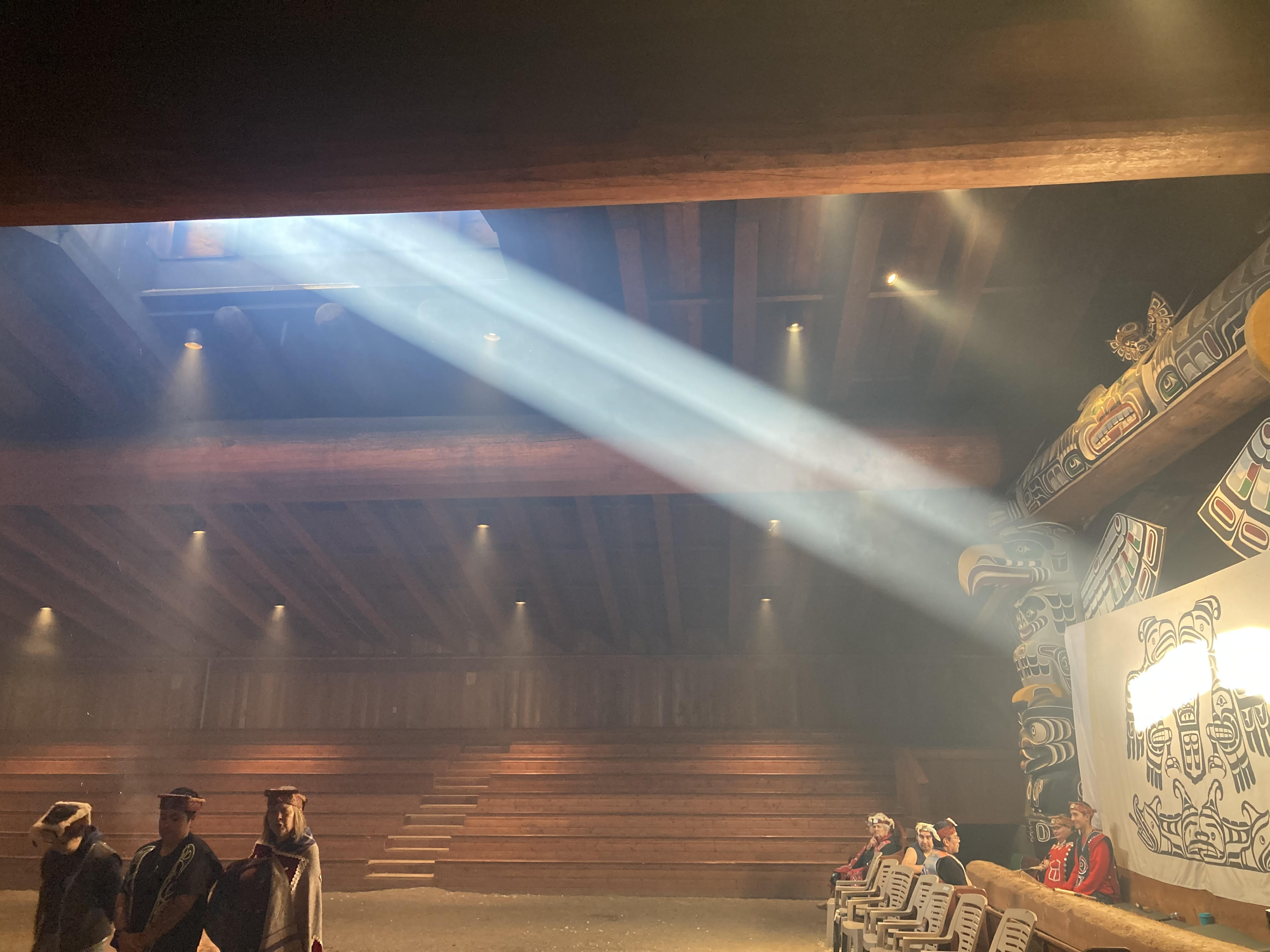
Smoke pours from the double doors. A fire lights up the dim interior of the Alert Bay Big House. A pair of totems adorned with thunderbirds glare from the far wall. Cedar logs crack and sparks lift skyward toward the hole in the roof.

I step away as the doors close and the thunderbirds disappear. I know what I’m missing: 60 minutes of the Northwest Coast brought to life through the songs, dances, and regalia of the Namgis First Nations. To the shock of no one, my favorite is the “Salmon Dance,” complete with a carved wooden orca that chases sockeye across the dirt floor with remarkable authenticity while nine community elders pound in unison on a booming drum.

 A steady mist falls. The muffled voices inside the walls go quiet. I turn and walk across a vacant soccer field and down a dirt road. I can see the islands beyond Cormorant Pass. All those names that make my heart pound and ache.

Plumper Islands. Weyton Pass. Robson Bight. Blackfish Sound. Hanson Island. Johnstone Straight. I am back where it all began.

I was born on the northeast coast of Vancouver Island, where the tides bottleneck through archipelagos and ancient fjords. Alaska may be home, but my dalliances with this place will never end.

Blackberry bushes infest the roadside ditches and stretch to the beach. Stacks of cedar and fir abandoned on the full moon tide guard a pebbled shore. I navigate the logs and turn left. I doubt what I’m looking for will still be there. I can’t decide if I want it to be. I glance at the note on my phone dated two years previous. Something kept me from exterminating this little artifact.

End of the road. Turn left. Approximately 100 paces. Look for a cedar tree with a split top. It’s a large piece of fir bark resting on the trunk.

“98… 99…100…”

There it is. The tree must be half a century old. The most precious commodity on the coast was and is an old-growth cedar. House posts, canoes, hats, clothing, baskets. It can be lived beneath, paddled, worn, and carried. No wonder Indigenous cultures revere it. I try to imagine a world older than this cedar. When the banks of the nearby Nimpkish River swelled with sockeye and the Namgis butterflied their fillets before cooking them over open fires. It must’ve felt like a miracle: food arriving at the front door every summer as the Tree of Life grew abundantly. The resources seemed limitless until we tried to feed and house the world instead of a community.

I put a hand on the cedar and stroke the sinewy outer bark. There aren’t many 500-year-old cedars left. This tree was a sapling when Columbus sailed the ocean blue. The forked trunk split as Washington crossed the Delaware. It listened to the chainsaw’s ceaseless roar as the forests of Cormorant Island fell in the name of siding and firewood.

I peer around the trunk and feel the familiar tugs of anxiety and longing. My teeth dig into my lips until I taste iron.

Pick it up. You’ve come this far.

I bend over and grab the slab of fir bark I placed here two years ago. It holds memories, just like everything on this coast. I can’t look at a fir tree and not remember combing Hanson Island’s shorelines for this bark known as “fisherman’s coal.” Stacked on top of a woodstove’s roaring flames, a couple of large pieces kept our cabin at Orca Lab toasty at night.

Memories domino: padding down the dark, narrow stairs to check the fire. The rabbit cage in the corner tucked beneath the windows. Penny nestled in her litter box, soft brown ears twitching. The hydrophone speaker above the bed and the ocean sounds bubbling through the cabin. Wind and rain on the roof. Deer on the beach. Harlequin ducks in the cove. The boat runs to Alert Bay to resupply. A hot bath. A sandwich and beer with my hero Paul Spong.

I pull myself from the past like a diver breaking the surface. Stalling, I look across the water at the islands I hold dearly. Hanson Island hovers on the horizon. Orca Lab, that cabin, is just a few miles away. I could be there in a few hours if I stole (excuse me, “borrowed”) a kayak.

The hypothetical brings me back to the slab of fir bark. I flip it over and run my fingers across the smooth brown surface. Someone has scrawled an untidy message into it. The penmanship is mine, but that’s where the similarities end.

I had vowed we’d return here and finish what we’d started. The Orca Lab caretaking era was supposed to be nothing more than a kayaking trip until it grew into so much more. But we never did get that paddle trip. Two years ago, when I returned to Alert Bay for the first time in five years, I scribbled this vow that we’d paddle here. I’d imagined finding this piece of bark and celebrating before we walked the familiar road to Paul and Helena’s house to laugh and reminisce.

The unfulfilled message has stuck in my mind like a sliver. Something insisted on finding it, making peace, and sending it on its way.

“Now what?” I ask the falling tide.

There’s no answer. No divine sign, magic rainbow, or miracle dorsal fin. I don’t expect one. I don’t need one. I flip the wood into the water and walk down the beach without a second glance. Not everything needs a proper burial.

***

Three hours later, the National Geographic Venture cruises east in Johnstone Strait, Hanson Island’s shoreline gliding past. I am giddy. My eyes ping pong between the spotting scope and my phone. I’m cheating. Thanks to Orca Lab’s streaming camera, I know orcas are swimming south towards Blackney Pass from Blackfish Sound. I watch them on my phone’s tiny screen before pushing my eyes to the scope. I find them at the east end of Hanson Island. Dorsal fins. Right where they’re supposed to be. One, two, three, four, five. I reflexively catalog them. Three females, one juvenile, and one adult male.

I should say something. It’s the only reason I’m on this boat. But I savor it a beat longer than I should. For 60 seconds, it’s just me and these five whales. They split the surface, the male raising his tail and slapping the surface. I permit a moment of anthropomorphism and tell myself he’s waving at me. Perhaps I am looking for that divine sign.

“Hey guys…” I radio to the bridge team. “We found them.”

A flurry of activity. An excited announcement rings through the boat. An orderly rush of binoculars and baseball bat-sized lenses arrive on the bow. But as the Venture turns into Blackney Pass, the orcas turn toward the Hanson Island shore.

I gaze across the pass toward Cracroft Point, remembering the dead wolf pup we found there. Off the bow is Parson Island, solar panels and remote camera visible on the cliff where I lugged eight backbreaking batteries, savoring every step and stumble.

We round the point… and there it is. From here, Orca Lab looks just as it did when I pulled away in April 2017. I think of that piece of fir bark floating in the current, reconciling memories, joy, and grief. How does one savor memories without drowning in them? And if those memories lead to stark regret, why would I watch?

The clicking of cameras fades into the ether. It’s still just me and those orcas. The Lab in the background with its observation deck and recording studio where I spent sleepless nights staring across a black ocean with chattering whales in my ears.

I step away from the scope, and my spot is immediately filled. The soothing bass of breathing orcas pirouettes across calm water and floats over the bow.

“If we’re quiet… we can hear them,” I say to no one in particular.

Why would I watch? Why do I watch? How long will I continue to watch?

The calf rockets from the water and hovers briefly before sending white water geysers high. I couldn’t stop watching, even if I wanted to. Couldn’t look away if my life depended on it. And if these animals, these places, these memories… if they bring a twinge of heartbreak syndrome from time to time… then that’s the bargain I’ll strike.

My fingers twitch, grasping at an invisible kayak paddle. The fir bark promise doesn’t need to go unfulfilled. The only thing keeping me from retracing these shorelines is the person rooted to the deck.

Wabi-Sabi

Eyes snap open, heart racing. Where am I? The boat vibrates, a cradle gently rocking, and I’m swaddled in the bunk of room 807. For the last three months, memories and reminders of what is and what is no longer come rushing in the morning. They have all the subtlety of a 747. A soft, blue light bleeds through the porthole. Along the British Columbia coast, mornings are coming later and later as the calendar flips to October.

My name is David. I am a naturalist aboard the National Geographic Venture. I am loved. I am treasured. I am ok.

I grope for my phone and pull up the GPS app. The islands, passes, and channels look up at me, friendly little faces with names that bring comfort and order to my life. Broughton and Blackfish. Johnstone and Harbledown. Parson, Blackney, and Robson Bight. My second home. My first home. The place where this human, whoever he is, was born. It was in the waters of Johnstone Strait that I bobbed in a kayak during the summer of 2007. The A36s came swimming by, stately tall dorsal fins guiding me. Not north like they do in all the stories, but south.

Aboard the National Geographic Venture, I return to these places every fall. Not as a caretaker or paddler or biologist, but something of an educator. A representative of this place that has meant so much to me. But like everything, this sanctuary comes with some baggage.

I step onto the bow with a coffee cup gripped in my hand and greet an early morning drizzle. The boat chugs through Blackfish Sound. Hanson Island is off the port, Orca Lab just a mile behind me, cloaked in morning fog.

And there are the Plumper Islands off north Hanson Island with their little passes and reefs I memorized during three winters of town runs from the Lab to Alert Bay. Another lifetime ago in so many ways.

I pull out the spotting scope and train it on the shoreline of the Plumpers. There they are. Humpback after humpback hits the surface and are greeted by flocks of greedy gulls that divebomb the forage fish pushed to the surface. The harsh edges of this clump of islands float in and out of the fog, the world blurry and slightly out of focus.

There’s a Japanese phrase, wabi-sabi. It means impermanent, imperfect, but aesthetically appreciated. A spoon’s wooden handle worn smooth from years of use. A torn and stained pair of Carharts with oil, blood, grease, dirt, and grass stains worn into the fiber. A stained cabinet edge from a beloved cat’s insistent nuzzling.

This stretch of coast is my, “wabi-sabi.” These islands, these whales, the tantalizing promise that a six-foot dorsal could appear at any moment. But inside I also feel wabi-sabi. Incomplete, under construction, and loved all the same.

I get to talk about it today. Share this place and this history with 80 people. They’ll give me a microphone and hang on my words. A chance not just to share but influence.

But there’s no way to speak of Hanson Island, Paul Spong, orcas, or quiet nights in Robson Bight without sharing my own history. And so that means opening a vein and scratching the scab that’s just starting to heal. How will it feel when I see the picture of us grinning at the camera with a rabbit and a cat clutched in our arms?

***

I step behind the little pulpit in the middle of the Venture’s forward lounge. I glance at the TV in front of me, my presentation loaded and staring back. There’s the lab, framed in cedar and fir. I remember the day I took this photo, a spring day in 2016 when I knew our time at the lab was coming to an end.

A down payment was soon due on 4.2 acres of Gustavus clay. An era was coming to an end. A final gulp of wanderlust. My tumbleweed wanted roots, and we were learning what it took to grow them. It meant saying goodbye to black nights with chatting orcas and salt spray on the windows.

I don’t know if I made the right choice.

I pick up the mic and begin to speak. There’s the photo of Paul next to the projector, focused and handsome. A black and white photo of Skana the orca he was hired to perform “research” on. Paul playing his flute to her beneath the headline “Friend Wants Orca Freed!”

I talk about Paul heading up Vancouver Island and setting off in a kayak around Hanson Island with nothing but a flute. Did he have a life jacket? I never asked. Something tells me he didn’t.

I tap a button and the calls of the northern Resident orcas’ blast through the lounge. A Clan and G Clan. Pings, squeaks, and whistles. Calling me home. I never truly left. This is still my home. My first love. And just because life has changed doesn’t make that love and time any less significant. It’s part of me. My journey. Part of my wabi-sabi. The lump rises in my throat. Damn it I miss this place.

A couple slides later and there we are. There she is. A smile on her faces as she looks out the lab over Blackney Pass. A photo of Brittney asleep in the cabin with Porter on her lap, Penny the bunny nestled in her little house. But opening this vein, scratching this scab isn’t bringing tears. The lump is gone from my chest. And I realize I am celebrating the adventure. The beautifully braided journey we made. My mind will not let my heart take that away.

The spoon’s worn handle feels comfortable in my hand.  

I finish with a crescendo. Underwater footage of orcas at the rubbing beaches. I love this shot. A female settles right in front of the camera and rests on the bottom. She gives a few happy wiggles along those smooth rocks that mean so much to them for reasons we don’t fully comprehend. Their calls once again ring through the lounge.

 I break.

A tear slides down my cheek, then another. I’ve been scared to think about my time in British Columbia, much less talk about it. But sometimes what we fear is what we need to do. Destigmatize our traumas and pain and instead glorify all that was great and beautiful and precious.

I catch a few wet eyes looking back at me.

“Thank you for your time. For letting me share this place and these animals that mean so much, that makes me who I am. It’s a pleasure to get to come back here. If you’ve had enough whale talk, I totally get it. But I’m happy to take questions and talk as long as you want.”

I suppress a grin and allow my ego a couple cartwheels as hands shoot into the air.

With a Single Breath

Several years ago, Brittney and I were walking along a trail in Juneau. Like most of city’s trails, it wasn’t far from the ocean. We worked our way through muskeg, over bogs, and past Devils Club when I heard it. I’d reached a point in my life where breathing whales stopped me in my tracks. Even if I wasn’t sure at first why. I stopped at the top of a hill, the water visible through the trees below.

“Did you hear—?”

A sound like a gunshot rips through the trees.

“Go.” She answers.

We’re gone. Half running half falling down the hillside. I stop on the edge of a bluff, my arms cartwheeling. I turn left and run parallel to the beach, that seductive sound carrying my feet. A small depression levels the drop off the bluff and I leap into nothing, my feet skidding on the soft mulch. I land on the rocks below. I look back up into the trees and my bride to be.

“Turn right at the big Spruce!”

The water is still fifty feet away, a minefield of rock between me in the water. I trip and stumble with every step. But I don’t want to take my eyes off the water. A small thump behind me tells me Brittney’s found the “slide.” She looks up, eyes alight, face mirroring my own.

“Where are they?”

A female Orca breaks the surface, her breath echoing off the rocks, off my soul. I tear down the beach after her. an impossible race I have no chance of winning. But in the company of Orcas, everything seems possible.

***

For the first time this year, it feels like Spring. We sprawl in the sun just behind the lab. Blackney Pass is glass, the water vibrant, the sea lions noisy as ever. Harlequin’s in the cove, eagles in the trees, the cat hunting mice in the Heather bush. Heaven on earth.

And we hear it.

After three years here, we’ve created a silent language of sorts when it comes to Orcas, whether we’re watching them or listening for them. When something whispers through the speaker our first glance is at each other, as if confirming that it wasn’t in our head or the creak of a chair. A silent debate begins, “was that what I think it was?”

We look at each other, a quiet intensity passes between us. Without a word we rise to our feet and walk onto the deck. Spend some time looking for whales and you start to scan the water without thought. There’s a smooth circle of ripples off to my left, just beyond the cliff that marks the far side of the cove. On a day as calm as this nothing can touch the water in secret. Nothing can slip past. It could have been a loud Sea Lion, or a boat or—.

Hello beautiful.

The Orca breaks the surface 150 yards off the shoreline. We turn as one and dive for the lab door. I grab the camera. Brittney taps frantically on the keyboard, willing the computer to life. With the miracle of technology, the whole world is about to know there were Orcas heading for Johnstone Strait. I hit the lab deck again and try to take a deep breath. My body’s shaking with excitement and my first set of pictures come away blurry.

I’ve lost count of the number of Orcas I’ve seen in my life. But they still do this to me. Last summer we found Orcas on a kayaking tour and I left Brittney and the clients in the dust. They give me tunnel vision. They’re my drug. It’s been this way for ten years, I’ve given up expecting it to change. I don’t want it to ever change.

The scientist in me reigns in the euphoric teenager. I begin to count, estimate speed, run my eyes along the trailing edge of the dorsal, looking for nicks and scars in the saddle patch. They’re spread out and moving fast on the flooding tide. When they surface after a dive I turn back and yell at Brittney so she knows where to point the remote camera.

“Hump of Harbledown! First Bay! Mid gap!”

What will I do with all this Blackney Pass geography when we’re gone?

The Orcas swim in twos and fours. A pair of big males bring up the rear and disappear around the southern corner bound for the strait. The camera system is now so intricate that we can almost literally hand the Orcas off from one camera to another as they go down the strait. Brittney’s already found them on the next camera off of Cracroft Point. And they’re beginning to talk.

We hear a melodic pin and we both give a shout. We know these guys. Or at least recognize them. Pings are a signature of G clan. I11, I15, and the G pods. A few minutes and several excited calls later Helena sends us a message. It’s the I15s. They’re a Johnstone Strait staple in the summer time. But maybe they’re making a February pilgrimage a tradition. They came through almost exactly a year ago.

Whether this is significant to the I15s or not, they sound happy to be here. Their calls echo off the underwater canyons and swirl through our heads. They always sound so happy. For the next hour we watch them push deeper into Johnstone Strait. There’s one final camera we can find them on, the Critical Point or Robson Bight camera. Situated on a cliff at the east edge of the Robson Bight Ecological Reserve we find half of the I15s mid channel.

But as I watch the calls intensify, they’re far too loud to be from the cluster I’m watching. I pull the camera back out and am rewarded with three Orcas breaking the surface just off the rocks. My body stiffens and I clumsily pan the camera from left to right, trying not to screw up the shot. Remotely it’s hard to track with them. Gauging distance is tough when you’re not in the flesh. It’s not the first time I’ve promised countless worldly possessions to spend a summer on the cliffs overlooking the Bight. Paul thinks I’m joking when I tell him I’m willing to spend a summer there as a “monitor.”

“That’s what the camera’s for.” He says.

“Yea… I know.”

Born too late. The wild west of Orca research has come and gone. No more hiding in the Salal at the Rubbing Beaches either. Passages of Erich Hoyt’s and Alex Morton’s books still make me green with jealousy.

The three Orcas—two females and a calf—are so loud the calls come through the headphones with static. But I don’t dare turn away for the few seconds it would take to turn it down. I grit my teeth and watch them break the surface again. I pan the camera further but can see nothing now but leaves and branches. End of the line. Two hours after sighting them, they’re out of sight.

The calls fade away as they leave the range of the hydrophone and I’m left with an empty expanse of water and the islands of Harbledown, Swanson, and Parson painted with a golden light that would make Midas envious. Snow still clings to the mountains on Vancouver Island, but with the warmth and the I15s, it feels like summer.

10463863_10153151080414852_7687963241185135048_n

Tumbleweeds, Home, and Root Vegetables

It hasn’t rained in days. The air has been crisp and cold. The window each day in which the shining sun brings substantial warmth is minimal. It’s fall in southeast Alaska. And when it’s not raining, there’s no more lovely time or place in the world. So this time when we leave, it’s hard. It’s never been hard before. Because for the first time we have a home. A home than can be measured in years instead of months.

And yet…

The island calls. That blissful, green, old growth island with Cedar and deer and mink. Our spot in Gustavus doesn’t have a wood stove. And there’s something about cracking cedar over your knee, the vapor of your breath floating above a knitted hat. Something about coffee on the porch, the ocean ten feet away, the sound of sea lions drifting on a growing wind. The promise of an afternoon gale. Hanson Island, Orca Lab, the promised land. I cannot bear to pull myself away from Gustavus, yet I’m giddy at the thought that I will be snug in that little cabin on the rocks in 72-hours, a fire roaring and the heat spreading to warm every crack and cranny. I wouldn’t be in Gustavus if it wasn’t for the island

For this is a place that changes lives. Starting with Paul Spong way back in 1970 and has continued for more than four decades. Hundreds, shoot, maybe thousands have made the pilgrimage to this place and had their lives rocked and upended. This place changes people the way glaciers change land. And I count myself as lucky to have spent two years of my life on Hanson. I would not be the man I am today without it. And it is that which will make the final goodbye so hard. It has sculpted me into someone that holds the final green and blue vestiges of this earth as valuable as any mineral man has ever valued. It is this lesson why I must someday let go.

Hank Lentfer is me in 20 years. Or maybe I’m Hank Lentfer 20 years ago. I’d like to think so. He’s the man I want to be in a couple decades at least, let’s leave it at that. The guy with the quick wit and busy hands that can build or fix anything. He built his house, starting with a 16×16 frame and turning it into a wooden work of art. In my non Hanson Island life I’d see someone driving a Ferrari or BMW down the street and feel an inkling of jealousy mixed with a desire to have one of my own. In the post Hanson Island life I have the same feeling when I see Hank’s garden and root cellar. Inside the cellar are two garbage cans (they’re clean) stuffed with carrots he grew. Another two garbage cans worth of potatoes are nearby. Mason jars are stacked like Jenga blocks on the shelves holding everything from Coho to cranberries. Call it root vegetable envy.

For years Hank and his wife Anya went without hot running water and still have no indoor plumbing to speak of. There’s an outhouse out back or you’re free to just let’er fly off the porch if you wish. Heat comes from a wood stove, the fridge in the arctic entryway is a new acquisition. All these choices were made not out of financial necessity but by choice. Because contrary to the modern world’s opinion, they aren’t necessities.

There’s something inspiring and beautiful about doing so much with so little. But even more, I think there’s something so beautiful about being so happy with so little. It’s a desire Brittney and I both have, all we have to do is learn how. And who better to teach us then Hank and Anya?

All of that however, means saying goodbye to where it all started. A tree’s roots cannot cover hundreds of miles, not matter how sweet the soil may be.

But not yet.

For tumbleweeds need no roots, they travel with the wind, blown south to that little halibut hook shaped island every fall. Where there’s no root cellar but humpbacks sing in the evening. No glaciers but dew clings to the boughs of Cedar branches like diamonds on a necklace. The very smell of Cedar will forever remind me of Paul, Helena, and the A30s calling in the dead of night. Hanson Island’s fingerprints are all over my heart and soul, and there they’ll stay until my final breath. Whatever my life may bring, whatever words are ever published and bound between two covers will be because of Paul’s smile and Helena’s cinnamon rolls. Every paddle stroke is because the A36s blessed me with a passion that will stand the test of time.

My heart feels light and my soul jitterbugs as the ferry cuts through Lynn Canal bound for Juneau. In 72 hours I’ll hear Paul’s laugh, see Helena’s face, and drag that infernal rabbit cage onto the rocks off the June Cove. Because we couldn’t have a dog like everyone else. Because we couldn’t sit still. Because Hanson Island will forever hold us under its spell.

Unexpected Good News is the Best News

I wanted to write about something happy. Something hopeful and uplifting. But for the last couple months, it’s been hard not to feel cynical. What with all the political news, the hate and xenophobia that has infested and captivated all of us whether we’re for it or against it. Even here, on Hanson Island. I quit social media cold turkey for a few days. Every time I logged on I got mad, frustrated, defeated.

But not today. Not tomorrow, probably not for the rest of the week. I needed good news, needed a victory, something to reinstall my faith in humanity. It was SeaWorld of all places, that delivered it. Yesterday the aquarium giant announced an end to the breeding of captive Orcas and “circus style” performances. The finish line is still in the distant future, but at least it’s now visible.

There is of course, a PR spin on this, pivoting around the tenants of “world class care” and “more natural encounters.” We can peruse and scrutinize this is we want, but it’s been clear since the moment that Tilikum grabbed Dawn Brancheau’s ponytail, that SeaWorld couldn’t continue in its current state. Ever since it’s been a gradual slide. From the proposed ending of the circus shows in San Diego, to the “Blue World” proposal. Yesterday, SeaWorld in a way, admitted defeat. Though they’ll never come out and say it, announcing an end to captive breeding and by association, an end to Orca’s in captivity is admitting what animal activists have been saying for years. There is no ethical or conceivable way to keep a massive and intelligent animal in captivity.

Tilikum’s pending death may have had something to do with the announcement. The loss of one of their few breeding males would make the genetic logistics of their breeding program even more difficult and SeaWorld may have been planning for such an announcement. This is all speculation of course. Maybe they looked at their plummeting stocks, attendance records, and a new generation raised on Free Willy and realized there was no future.

But today, I’m not concerned with why SeaWorld is doing what they’re doing, or what their motives were. Today is one of celebration with potential domino effects sweeping across the globe. The end of breeding includes SeaWorld subsidiary Lolo Parque, home to four other Orcas and puts added pressure on the Miami Seaquarium, a small aquarium that is home to  Lolita, a southern Resident who has been in captivity nearly as long as Corky of the northern Residents. Without big brother to hide behind, the spotlight falls more brightly on Miami to, if nothing else, end their performance shows.

With SeaWorld’s focus on low adrenaline and educational shows, the door remains cracked for Corky to come home. After more than 45-years in captivity the prospect of Corky rejoining the A5s and swimming a hundred miles a day seems daunting. But just west of OrcaLab is a long, deep cove called Dong Chong Bay. It was here that Springer, an orphaned and lost Orca was successfully reintroduced to the wild. It would be both poetic and fitting for Corky to live out her days in the bay, chasing wild fish, hearing and associating with her family under the excellent care and attention that SeaWorld has touted for years.

As we celebrate, it’s important to remember the war is not over. Dolphins, Sea Lions, otters, penguins, and polar bears remain large parts of the SeaWorld empire. And while Orcas have deserved the lion’s share of the activism and spotlight, the time has come to tell them that more can be done. The dolphin trade remains one of the more despicable and darker aspects of human kind, with the dolphins life in captivity no better than the Orcas.

I never thought this day would come. I assumed SeaWorld would go down with the ship, beating the drum of education and quality care until they disappeared from existence. But, out of nowhere, they did the right thing. And for that they need to be applauded, commended, and encouraged to do more.

Born too Late

One of my favorite TV shows is Futurama. It’s a weird,  stupid cartoon in which a slacker named Fry is cryogenically frozen in the year 2000 only to be unfrozen a thousand years later. He awakes to find that one eyed (and curvy)  female aliens and beer drinking robots are part of normal every day life.

In one episode Fry, his distant relative, a mad scientist named Professor Farnsworth (just go with it) and the beer drinking, fire belching robot go back in time. Like all TV shows, the plot and setting  completely reset by the end of the half hour run time with the exception that the professor stopped briefly in the year 1939 so that he can assassinate Hitler with a massive ray gun.

Isolated and surrounded by a forest hundreds and in some cases thousands of years old, the land here can feel as if it’s been frozen like Fry and we’re able to glance back in time by simply walking through the forest and counting the rings on fallen trees.

But it’s not static. Nothing is. There is no climax community where, if left undisturbed it will stand immaculate forever.

I often find myself obsessed with how the land and wildlife looked thirty years ago, a hundred years ago, a millennium, an epoch ago. So I scour the books and testimonies of those that have come before me. Offhand comments like one by Paul a couple months ago send my imagination into overdrive.

“There used to be a hotel on Parson Island,” he says offhandedly. “This place used to have a much denser population.”

No way. I stare up at the cliffs that form the southern border of Parson Island and try to imagine it dotted with buildings. The absurd image of a 30 story Hilton plays before my mind. Communities in Freshwater Bay, fish buying companies in every cove, hand loggers determinedly probing through the inlets looking for something bigger.

One of these men was Billy Procter. He’s something of a legend. Our Gandolf or Obi-Wan Kenobi if you’d prefer. He grew up in Freshwater Bay, a little indention in Swanson Island a five minute boat ride from where Orca Lab now sits. Of course in the 1920s there was no Orca Lab. No whale watching industry, Orca’s nothing more than competition for fish. For it was fish that pumped the blood of the north island and Billy talks endlessly of massive runs of salmon. So thick on the flooding tide that the air was inundated with their odor.

“The Blackfish used to follow them through Blackfish Sound in numbers so thick you could walk across there backs,” he relayed to Alexandra Morton.

It’s these phrases that make me yearn for a different time. “The good old days” as it were. When a 2 HP engine was nothing short of a miracle, and fishing was as easy as dropping a line in the water and jigging for a few minutes. Before clear cuts and climate change, before fishing stocks plummeted or tugs chugged in an endless relay up and down the strait.

“I was born too late,” I think, setting down Billy and Alex’s book, Heart of the Raincoast.

I want to see that sort of abundance. I want to fish, can, and gather my way to an existence. I want to live in a float house and tow it up and down Knight Inlet.

In the 70’s Erich Hoyt and two other filmmakers sailed up Johnstone Strait and settled in Robson Bight, spending the summer tracing the loving shorelines of Cracroft, Vancouver, and Hanson, following the whales. No rules, no regulations, no cares. I was born too late. They were camping in the bight, documenting the rubbing beaches for the first time. Rubbing shoulders with the parade of scientists who rewrote the book on the “savage killer whale” and helped us see them the way we do.

I want to dive off the rubbing beaches, follow an orca pod in my kayak with no boats blitzing past me at 30 knots. I want to ride the ebb out Blackfish and the flood through Weynton. I want the good old days. I want to steal Futurama’s time machine and sit on the rocks at the feet of an old growth forest that has never been cut. I’ll even agree to take out Hitler on my way.

No I don’t.

Because no one talks about the “bad old days.” No one dwells on the fact that everything that ate fish had a bounty on it sixty years ago. 2 bucks for a seal’s flippers, a dollar for a Raven’s beak or an eagle’s talons. That there’s a reason that the salmon don’t run so thick you can smell them followed by Blackfish that form a bridge across the sound. That the slow curve downward began somewhere.

Or that the 70’s were filled with the live capture trade for Orca’s and the cold blooded murder of several others. That there’s a reason that the beaches and bight are closed, that the minimum distance is 100 meters. That today we live with the decisions made during those days that were neither good nor old.

So I go to ask the one soul on this island that’s lived in it for a millennium. I walk to Grandma Cedar whose cedar boughs have seen it all. Has watched the salmon come and go, the glacier’s charge and retreat, and a lab be built at her feet.

Does she miss the good old days? The bad old days?

I stare up at her, my neck craning, trying to make out the branches that originate a hundred feet above me. But she is centered in the here and now. Focused on the simple task of taking the miracle of sunlight and carbon dioxide and turning it into oxygen. Perhaps if all she’s thinking about is today I should be too.

Maybe it’s one thing to read and admire history and another to yearn for a world I know virtually nothing about. One thing to devour old black and white photos and dig for artifacts on the shoreline and another to feel as if it will never be that good again. To let go of a history I can’t even begin to understand or control, and look to a future I can. You can keep your time machine Professor.

Cover photo credit: BC Archives. Freshwater Bay C.A 1916.


My Life as an Orca DJ

It starts with dolphins. They giggle like jackals, punctuated by the dull thuds of their echolocation. I shut my eyes and let the sounds of dolphins, crashing waves, and 30 knot winds rock me back to sleep. Moments later my eyes open. I sit up, Brittney’s feet swing out of the bed. The dolphins aren’t alone. The hee-haw of a donkey floats through the speaker that sits on the shelf just above our bed. G clan’s back.

1917778_229391884851_28180_n
“My turn,” Brittney mutters like the mother of a new born and staggers down the stairs, out the door, and to the lab. Moments later her voice comes out of the speaker as she begins the recording, mixing with the sounds of swirling water and cackling dolphins.

“This is Brittney, this is Hanson Island 2015, digital recording number…” my head hits the pillow and I drift away.

For the next few hours I fade in and out, coming to just long enough to see Brittney isn’t back and that the whales are still calling. They’re faint, maddeningly faint, but there. Three hours after they first pulled Brittney from the bed I rise. It’s a moonless December night with the clouds building for another low front, 7 am and still pitch black.

Brittney takes little convincing to go back to bed. She’s been at it since four and the whales seem to have barely moved. Their voices still distant in Johnstone Strait, at the limits of the Critical Point hydrophone. What compelled them to sit in one place and talk about it for so long? I wrap my sweater around me and feel the lab vibrate as another gust hits the south facing windows. I wipe the sleep from my eyes and brace myself as another tug rolls into range. The sound grows to a deafening roar, the orca’s voices extinguished. Feeling guilty I pull the headphones off and rub the headache emerging from my temple. If only they had such luxury.

The tug moves on and they’re still there. G clan somebody. I31s perhaps? Even Paul and Helena can’t say for sure. These late nights remind me of summer. When late night recording sessions were the norm rather than the exception. It’s warmer in July though. And the sun’s there to keep you company starting at about four in the morning. I am the night shift orca DJ, playing the hits of the A, G, and R clan on 92.1 the WHALE.

At long last the darkness lightens a shade, the whales almost inaudible, Vancouver Island distinguishable as a darker shade of black against a slowly lightening sky. The sun finds a gap and a splash of color transforms the world from black and grey. It’s all worth it. The water and mountains light up like ta water color and the orca’s go quiet. Maybe they too are watching the sun rise.

The sunrise doesn’t last long, extinguished by another fog bank rolling in. Waves topped with whitecaps intensify, the rain strikes like pebbles. Twenty minutes with no calls, than twenty-five, thirty, are they gone? A couple summers ago the A36s played a horrible trick on me, sitting silent in Robson Bight until I would end the recording before letting out a whispered giggle, letting me know that they were still awake and I should be too.
The I31s don’t have their sense of humor though. I end the recording and walk back to the cabin. The tree tops swirl and the waves thunder into the rocks twenty feet away on the high tide. My job, my office, my life. And to think a few years ago I was ready to work in a lab, studying herring bioenergetics. Let someone else wear the labcoat. I’ll go to the office in slippers and flannel.