Tag Archives: Alaska

Somewhere Unoccupied

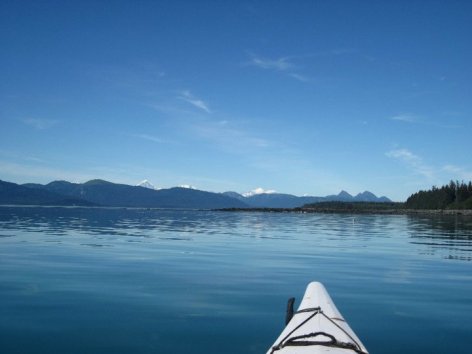
It’s good to be back. I squirm and fidget in the plastic seat, trying to make my life jacket sit against the combing. Again and again the jacket slides up. I give up, letting the combing press against my lower back. It doesn’t matter. Bartlett Cove is paper flat. Clouds are thrown across a deep blue sky at random. The only sound is my paddle in the water. Glacier Bay. I’d tell you to never change, but change is all you do.

On days like today I stop just beyond the dock. I look out into the mouth of the cove and drink in the lower bay. I stare out into Icy Strait, at the islands of Lemresier and Chichagof. I feel my heart slow down, my chest inflate, my body at peace. It’s a sensation that only a kayak can bring. Maybe it’s the angle, seeing this place from the vantage point of the Murre and Murrelet, otter and sea lion. Perhaps it has something to do with the knowledge that it is up to you and not diesel fuel and outboards to get where you want to go. Or maybe it’s something deeper. Something buried deep within our chromosomes. A treasure within each of us, waiting to be discovered.

Whatever it is, life is different from the seat of a kayak. It magnifies the soul while reminding you how small you are. What a wonderful reminder. There are no advertisements, no one telling you what you deserve or what you need. What you need is all around. Beyond Lester Point the upper portions of Glacier Bay come into view. The east and west arms beckon. A labyrinth of tide rips, adiabatic winds, and endless waves of mosquitoes await.

 Come on in. But leave security and your ego at the door. Leave your boots on. Keep your eyes open. Breath deep. Be free.

Some of the most memorable moments of my life have happened here. Just off the shore of Lester and Young Island. They’ve chiseled me like a piece of wood. Sculpted and refined me. A project never finished. There was the day the sea lion surfaced a foot behind me. That cunning, malevolent look in his eye, teeth curled into a snarl.     He still gives me the shivers. Still makes me tense when a sea lion approaches. Orcas in the middle of the channel. The perfect end to the perfect day. A humpback in the mist, the sound of his breath reaching out through the infinite nothingness. A siren, beckoning me closer. If I dare.

Swim with me. Commune with me. Guess where I’ll be next. Take another shifty look beneath your paddle. Look for my shadow.

The humpbacks. Too many memories and stories to retell them all.

“What’s the closest you’ve ever been?”

Such a simple question in theory. But mere numbers cannot begin to convey what it feels like to watch the water come alive. To watch it quiver as the head and back of a 40 ton creature breaks the surface ten feet away. To describe the simultaneous rush of euphoria and terror. Your gut screaming for you to run and to stand still. How three seconds can last lifetimes. What it’s like to watch a tail as wide as a Cessna break the surface. The sound of rushing and dripping water. And than… gone. Just like that. No trace, no markings save for some rippling water. It defies description. How does something so big just… disappear?

Somehow, through the beauty and grace of the universe, this became my job. To paddle among these animals. To learn the tides and eddies as intimately as a lover. And to pass that love on to others. To pull them gently from their comfort zones and into a world that continues to persevere. And above all, to show them that wilderness is something to worship. To love and cherish. That all we need to do is tap into those ancient desires deep within each of us. It’s not something to be feared, for respect and terror are not exclusive. Follow her rules, read her tides, understand her weather, and you will be rewarded beyond your wildest dreams.

This is home. Perhaps I cannot trace my ancestry back to the fog choked mountains of southeast Alaska. But I’ll love it as if I can.
These are the Places You Will Find me Hiding

In a land defined by mountains, Gustavus stands alone. Gustavus, prairie country. Well, as close as you can get to prairie country up here. At the mouth of Glacier Bay is a strip of land. An old glacial outwash that the glaciers of old used as a dumping ground for the remains of the rock they had ground to a pulp. What remains today is a stretch of land so flat the bubble on the level falls dead center. All around is regularly scheduled programming. Chichagof Island and its mountains to the south, the Fairweathers to the west, the Beartracks to the north, and the Chilkat mountains and Excursion ridge to the east. Distant yes, but never out of mind, even when shrouded in the blankets of clouds that dominate the sky.

It’s fitting that Gustavus is southeast Alaska’s little geographic rebel. One of the few towns that don’t have to concern themselves with building into a mountain or around pesky fjords or bays that jut into sharp cut glacial rock. Nothing but sand, trees, and moose to build around. Because like the land, the people of Gustavus are unique. A cast of people that have chosen love, laughter, cold beer, and blue grass over profit, capitalism, manifest destiny, and Justin Bieber.

This is a town where people still wave as they drive by, failure to do so the highest of insults. Where a run to the local store for a bag of oats turns into a 45-minute conversation about everything or nothing. No one brushes past with downcast eyes, avoiding contact. Smiles are plentiful, good vibes abundant, the people seem ageless. Yesterday I learned that a lady I’d took for somewhere between 30 and 35 was celebrating her fiftieth birthday by traveling to Iceland. In a nation obsessed with youth, with looking young, and banishing wrinkles, maybe Gustavus is the fountain of youth. Maybe smiles, a gracious heart, and a quick laugh can do what plastic surgery cannot, and for a much more reasonable price.

I will not pretend to be an expert on the normal American lifestyle. But from my limited exposure in what many would perceive to be a normal existence, the term community has become little more than window dressing. A way to lump together a group of people that happen to live in the same area. This is not Gustavus. Gustavus is a place where community is still community. To enter into this place is to become part of a family 400 strong. Want to spend a winter here? We’ll help you find a place, chop wood, fill the chest freezer with halibut, salmon, deer, and moose.

A couple of years ago a young man moved here. He knew no one. Two weeks after arriving, his house burned to the ground. Within hours, someone had moved a yurt onto his property for shelter. Food was left on the front porch, money and building materials donated.

“I don’t know any of you folks,” read the thank you letter he posted at the store, “but to all of you, thank you. I am truly moved and touched.”

Home. This is home. How can it not? How can we—myself and Brittney—not want to be a part of this? Suburbia? Fine for some I suppose. Who am I to say how others should live? But give me the place where I know everyone by name. Where, should the worst ever happen there will be 400 pair of hands to pick me back up. It’s impossible not to feel happy and blissful here. We’re isolated, but never alone. We are a people of guides, fisherman, businessmen, woodsmen, parkies, lodgies, seasonals, and locals. Democrats, Republicans, Christian, Mormon, Druid, Pagan, Atheist, John Muir apostles. But we are all residents of Gustavus. And in the end, that’s all that really matters.

Rolling the Dice

Every guiding company has them. A page of carefully worded phrases meticulously written out by a lawyer in some office, far removed from the natural world. The infamous risk waiver. A bucket of ice water at the start of the trip. A necessary reminder that the world we are traveling to is unscripted. That it can be harsh, dangerous, and unforgiving. That even the best of us, the most prepared, the most cautious, are not immune.

For those of us that live it every day, we have our own, unwritten risk waiver. Every time we go out our doors and into the woods, up the mountain, or onto the water, we sign it. It’s our unspoken agreement with the world we love. An acceptance that it can betray us at any moment. For if it can happen to Forest Wagner, it can happen to anyone.

Forest lives in the woods. There isn’t a mountain he can’t climb, a fjord he cannot paddle, a situation he can’t handle. Two weeks ago he was attacked by a bear while leading a group of students near Haines in southeast Alaska. He wasn’t been foolish or careless, disrespectful or arrogant. You roll the dice enough with Alaska, and sometimes it comes up snake eyes. What are the odds that there’s a mama bear with spring cubs over that blind ridge? 1 in 100? 1 in 1,000? How many blind ridges do you hike over before the odds catch up?
304523_10151351163614852_290551_n
Forest’s influence and inspiration stretches across the state, across the globe. He’s taught thousands how to survive in the back country, inspired many to follow their passions as mountaineers, kayakers, river rafters, and skiers. From all accounts, even after he’d been attacked and bitten along his side and leg and fallen off a cliff face, it was he who spoke to the medivac on the cell phone. Calm, clear, and collected, he talked his students through the whole process. His own Wilderness First Responder.

“I can climb down if you need me to.” He told the medivac. As if he’d done nothing more than sprain his ankle on a morning run through the suburbs.

Why him and not me? Two days ago I hiked the mountain ridge behind my parent’s house. Bear and moose sign coated the game trail. Again and again I rounded blind corners. Bear bells jingling and bear spray bumping against my leg offered little comfort. I’d be lying if I said I wasn’t thinking about Forest around every corner. Wrong place, wrong time. Our unspoken agreement, our signed risk waiver with the natural world.
37367_467283714851_8103409_n
I wouldn’t have it any other way. Beneath the sugary, frosted coating that reality TV has given Alaska, nothing has really changed. To truly experience this land, to know it with genuine intimacy means to throw ourselves at its mercy, and accept that we may not receive any. Forest knows this, I know this, Brittney knows this, and so does any other guide or outdoor enthusiast that climbs her mountains and paddles her shores. For if the wilderness was always safe it would not be wilderness. With risk comes appreciation and respect. How charismatic would the bears and wolves be if they were harmless? Would we love them, photograph them, even their tracks worthy of our marvel and imagination? Would glaciers be sublime if they didn’t send blocks of ice as big as buildings into the water to crush and reshape everything in their path?
37235_467271534851_7897543_n
So this summer I’ll strap on my boots and push my kayak into the water. I’ll grab my fishing pole and walk the salmon stream, knowing that I share the land with bears, moose, and whales. I’ll grab my dice, take the odds, and see what happens. The alternative is a life that is fraught with other dangers. Forest wouldn’t have it any other way.

He’ll be back, it’ll take more than a bear to pry him away from his natural habitat. I have no doubt he’ll summit Denali again, climb the alpine, and return stronger and more confident than ever. The wilderness needs ambassadors like Forest and the mountains of Alaska just wouldn’t be the same without him.

Cranky Border Guards and Getting Busted on the Ferry

If objects at rest tend to stay at rest, and objects in motion stay in motion, than it’s no wonder I feel exhausted. Our travel itinerary for the last twelve days has pulled us thousands of miles on every medium of transportation this side of sled dog on ice pack. Small boat from Hanson Island to Alert Bay, ferry to Port McNeil, drive to Nanaimo, ferry to Vancouver, drive to Seattle (and past the crankiest border guard), drive to Bellingham, ferry to Juneau, ferry to Gustavus, fly to Juneau, and lastly, fly to Anchorage.

After a winter of sitting quietly on a rock in the middle of nowhere with nothing more pressing than to run into town once every two weeks, our manic travel itinerary left us both in a haze. A haze that provided plenty of magical, confusing, and absurd moments. It all starts, I suppose at the B.C/U.S border. We’d spent the day driving south down Vancouver Island after pulling ourselves away from Hanson Island and watching the little cluster of cedar buildings disappear for the next for six months. But the weather turned sunny as we moved down island and spirits were as high as they could be at the prospect of reaching Seattle that evening and spending some time with Brittney’s aunt and uncle.

Joy was further magnified when we reached the border crossing to see four open stations and only a handful of cars in line. With Brittney behind the wheel we glided up to the kiosk, passports in hand.

“Hello!” called Brittney handing over the passports, speaking loud enough to be heard over the quiet whistle our precious pathfinder makes at low RPM.
The U.S border guard didn’t smile, didn’t nod, or in any other way acknowledge or return the most basic and acceptable of human greetings. Instead he snatched the passports from her hand and stared at them as if he’d just picked up something dead and repugnant. After X-raying them for several long moments, his head jerked violently to the side, a great bird of prey ready to grab us and the pets in his talons. His eyes stare into the tinted back window.
“Um, I can open that for you if you want…” Brittney offers.
“Ok.” It speaks!
She rolled the window down, exposing an embarrassing cluster of bags, boxes, and of course, a rabbit, her eyes wide and nose bouncing as the window slides down.
He stares into the labyrinth of our worldly possessions.
“Is that a rabbit?” He sounds disgusted, maybe a little amazed. Surely he’s asking ironically. What he must have been like in high school.
“Yes?” Brittney answers.
Why do we always seem to draw the nastiest of border guards?
“Why are you here?” He snarls.
Seriously? A little ember of rebellion catches some try tinder in my chest. What a hack. Just ask us where we’re from, what our business is, and let’s be on with it. You can be professional without being an asshat. I badly want to say, “why are any of us here man? What’s it all about, man?” But refrain.

Brittney tells him, and before the words are out of her mouth, he’s tossed the passports back into the car and turned away. Wherever he is right now, I’m willing to bet he isn’t smiling.

But we were free, that’s all that mattered. Free to pick up a six pack of glorious IPA after a winter of Kokanee. As we moved further south the road got wider, the trees fewer, the shopping malls greater, and the things I needed to possess to be happy more expensive. If the billboards were to be believed.

“Money doesn’t buy happiness,” Said comedian Daniel Tosh, “but it buys a Waverunner… try to frown on a Waverunner.” Fair point.

We enjoyed a few wonderful days in Seattle, and all too soon, were making the drive north again to the border town of Bellingham to catch the ferry. For the pets, it was the greatest hurdle. Three days cooped up in the car with each other for company. Twice a day we were allowed to go down to the car deck, feed them, and promise that we were almost there. Kind of.

The journey aboard the ferry Matanuska was not a lonely one. A bouncy, adorable two year old with no concept of personal space joined us on the covered back deck of the ferry known as the solarium. A gaggle of wilderness guides based in Haines, including some familiar faces were also aboard, and we prepared for a merry ride north. As we neared Ketchikan, the southernmost town in southeast Alaska however, a ferry employee gave us some grave news. 250 high school band members would be boarding in Ketchikan, swelling the ferry to the bursting point and undoubtedly putting us over the U.S Coast Guard regulated number of tubas. We did what guides do when they’re not on the ocean, the rivers, or the woods. We bought some beer.

Sure. I mean, technically no alcohol was supposed to be consumed in the solarium, but it’s Alaska, surely it’s more of a wink wink, nudge nudge sort of rule. Nope. Half an hour into what looked to be an enjoyable ride from Ketchikan to Petersburg, a lady in a uniform so starched it could stand up on its own materialized in front of us. I had taken the necessary precautions and poured my beer into a nalgene bottle, giving the impression that I was drinking the muddiest, nastiest water in the 49th state. But I remain amazed at how quickly bottles and cans disappeared as she appeared. It was like watching cockroaches scurrying from the sudden flick of a light.

“We had a chaperone complain that there was some open containers of alcohol up here.”
Dead silence.
“Is that true.”
Slowly we shook our heads, muttering “no” while failing to meet her steely gaze. Put us in the woods, in a kayak on four foot seas, and we wouldn’t bat an eye. But here, we were emasculated, or efemulated in Brittney’s case. When in doubt, deny.
“Really?” Stunning that she didn’t believe us. “Cause I don’t think that anyone would just complain for no reason.”
“Maybe they mistook a soda…” one of the other guides mutter.
The lady marches into the middle of the circle. Brittney’s bends her torso over her legs, her Arc’teryx jacket folded over a Sierra Nevada Celebration IPA. The lady tilts her head, “what’s that than?” She points to a big glass bottle beneath one of the lawn chairs someone had been sleeping on.
“That’s… creamer.” Someone says just above a whisper.
“Uh-huh.” She marches over, a soldier of marine enforcement and picks it up. Technically we weren’t lying. Bailey’s is indeed, a creamer. “Consumption of alcohol is not permitted on Alaska state ferries.” She says, much kinder than we probably deserve after lying to her face. “I have to take this, but you can have back when you leave the vessel. I just need to have a name.

Still we’re silent, no one willing to claim any responsibility. We’re all in college again, a militaristic RA confiscating our good time. At last, one of our friends raises his hand. “You can put Mike on it,” he says meekly.

Unexpected Good News is the Best News

I wanted to write about something happy. Something hopeful and uplifting. But for the last couple months, it’s been hard not to feel cynical. What with all the political news, the hate and xenophobia that has infested and captivated all of us whether we’re for it or against it. Even here, on Hanson Island. I quit social media cold turkey for a few days. Every time I logged on I got mad, frustrated, defeated.

But not today. Not tomorrow, probably not for the rest of the week. I needed good news, needed a victory, something to reinstall my faith in humanity. It was SeaWorld of all places, that delivered it. Yesterday the aquarium giant announced an end to the breeding of captive Orcas and “circus style” performances. The finish line is still in the distant future, but at least it’s now visible.

There is of course, a PR spin on this, pivoting around the tenants of “world class care” and “more natural encounters.” We can peruse and scrutinize this is we want, but it’s been clear since the moment that Tilikum grabbed Dawn Brancheau’s ponytail, that SeaWorld couldn’t continue in its current state. Ever since it’s been a gradual slide. From the proposed ending of the circus shows in San Diego, to the “Blue World” proposal. Yesterday, SeaWorld in a way, admitted defeat. Though they’ll never come out and say it, announcing an end to captive breeding and by association, an end to Orca’s in captivity is admitting what animal activists have been saying for years. There is no ethical or conceivable way to keep a massive and intelligent animal in captivity.

Tilikum’s pending death may have had something to do with the announcement. The loss of one of their few breeding males would make the genetic logistics of their breeding program even more difficult and SeaWorld may have been planning for such an announcement. This is all speculation of course. Maybe they looked at their plummeting stocks, attendance records, and a new generation raised on Free Willy and realized there was no future.

But today, I’m not concerned with why SeaWorld is doing what they’re doing, or what their motives were. Today is one of celebration with potential domino effects sweeping across the globe. The end of breeding includes SeaWorld subsidiary Lolo Parque, home to four other Orcas and puts added pressure on the Miami Seaquarium, a small aquarium that is home to  Lolita, a southern Resident who has been in captivity nearly as long as Corky of the northern Residents. Without big brother to hide behind, the spotlight falls more brightly on Miami to, if nothing else, end their performance shows.

With SeaWorld’s focus on low adrenaline and educational shows, the door remains cracked for Corky to come home. After more than 45-years in captivity the prospect of Corky rejoining the A5s and swimming a hundred miles a day seems daunting. But just west of OrcaLab is a long, deep cove called Dong Chong Bay. It was here that Springer, an orphaned and lost Orca was successfully reintroduced to the wild. It would be both poetic and fitting for Corky to live out her days in the bay, chasing wild fish, hearing and associating with her family under the excellent care and attention that SeaWorld has touted for years.

As we celebrate, it’s important to remember the war is not over. Dolphins, Sea Lions, otters, penguins, and polar bears remain large parts of the SeaWorld empire. And while Orcas have deserved the lion’s share of the activism and spotlight, the time has come to tell them that more can be done. The dolphin trade remains one of the more despicable and darker aspects of human kind, with the dolphins life in captivity no better than the Orcas.

I never thought this day would come. I assumed SeaWorld would go down with the ship, beating the drum of education and quality care until they disappeared from existence. But, out of nowhere, they did the right thing. And for that they need to be applauded, commended, and encouraged to do more.

The Garden: A Plea for our Parks, Monuments, and Refuges

I wonder if Abbey ever felt this way, or Muir, or Roosevelt. A sort of melancholy joy that all of this is fleeting. Perhaps I worry too much. It’s hard not to. In a time when we need wildness more than ever, it’s never been more threatened. One need look no further than the skulking figures of the right, elbowing and jostling each other for the opportunity to be commander and chief. Debates have become nothing more than four amateur comedians, dropping punchlines and waiting for the laughs that aren’t coming. But between the childish jokes of genitalia and chest thumping, they have declared war. Not on ISIS, hispanics, the middle class, or China. But on us. On the final fragments of American history.

The Party or Lincoln has become the Party of More. Blame it on Reagonomics, the Koch brothers, Ted Cruz’s jowls, it doesn’t really matter. Regulate a women’s body, regulate marriage, but God forbid that the steam rollers of industry should be slowed. Away with the EPA, usher in the era of fracking. What goes into the bank account matters more than what goes into our bodies. Away with the public lands, those worthless wastes of space, those dollar bills hanging from the branches, just waiting to be plucked.

“If you’ve seen one redwood, you’ve seen them.” Ronald Reagan said.

“If you’ve seen one hundred dollar bill, you’ve seen them all.” I say. “The only thing more foolish than trying to drink your money is trying to breath it.”
10329274_10152863254909852_4693130274254238988_n
Herein lies the danger. Herein lies the tragedy. Ted Cruz has already tried to put an end to the miracle that is public lands—our national parks, our monuments, and wildlife preserves. America’s greatest gift to itself. It twists my stomach into knots. Take my healthcare but not the bay, not Denali, not the Arctic Refuge, these shrines to the world that made us. I’ve met several people who, on their deathbed, ran north. To Alaska. To see the land wild and free. Not to see oil wells or mining sites. But that seems to mean little. Give him a big enough eraser and he’ll wipe them all out. Those wastes of space. All those trees and bays and wolves and bears. Refuges and refugees, two concepts that fall on deaf ears. Give me your poor, your tired, your weak… nevermind, some oil subsides will do fine. Conservative and conservation, similar in spelling alone.

This is our own fault. Nature, wilderness, is mythic to some, a fairy tale to many. Something that may or may not exist somewhere beyond the city limits where the concrete may or may not end. An ideological Bigfoot. It’s somewhere our phone’s don’t work and wi-fi fades away. Many never see them. And we’ve lost all connection to how bad we need them.

Air? It comes from the air of course. Food? From the grocery store. Water? It comes from the tap. Trace the journey of these substances and you arrive at the same place. Soil growing food, trees producing the air and filtering our water. Forgetting that relationship is toxic. Ask the children of Flint, Michigan. Ask the families of Butte, Montana about the “pennies from hell.”

“Growth for the sake of growth is a cancerous madness,” wrote Edward Abbey.

Let us define mankind not by what we can extract and obtain, but by what we can leave alone. Let us not define ourselves by our consumption, but by our self control. Do we have the courage, the willpower to push ourselves away from the petroleum feast, to announce that we’re full? There are bigger things, more worldly things, and yes, more Godly things than maximizing profit on every square foot of land.
10151271_10152867795959852_442814964723618859_n
What if we stopped looking at the world like a factory and instead like a garden? A plot that must be nurtured, cared for, fed, and watered. Treated with the understanding that what we take out must be replaced. Minerals and matter must be returned to ensure that the carrots, potatoes, and lettuce of life return bigger, fresher, and tastier next year. Foolish is the farmer who doesn’t renew his soil with fertilizer, who stuffs his rows of lettuce tightly together, believing that the highest quantity planted will equal the maximum yield. Shame to the farmer who doesn’t let a field go fallow. Let the land rest, let it breath, let it be land for a year. And like us after a deep breath, it will work harder, the benefits in a year outweighing the one that was lost.

But the world doesn’t work like this. We can’t stand the thought of letting a portion go fallow. Of not maximizing our yield right now. Forget the future. The future is now isn’t it? The TV told me so. Those that see the world as a garden are shouted down. We’re labeled as extremists, alarmist, other harmful -ists, standing in the way of progress. Good old progress the shield of the conservative politician. But you’ll never hear a politician, pounding the lectern, demanding that he be allowed to frack the tar sands of Utah labeled extremist. He’s just living in the real world. A world where the economy can grow forever. Infinite growth, finite world. His birthright. If we’re not moving forward we must be going backward.
10312681_10152863254884852_4060311875310743348_n.jpg
Will our offspring a century from now look back on us with admiration or disgust? Will we be revered like the minuteman or demonized like the slaveholder? The one’s that took a renewable world and saw it only for what it could do in that very moment. At least we made some money. But is that how we want to be remembered, is that what we want inscribed upon our gravestone?

 Here lies the modern world. The bottom line looked good.

Surely even the most selfish cannot desire to be remembered like this. Let’s be remembered for our love, for our sacrifice, for our restraint. Let a tree be a tree. A refuge a refuge. A fishery a fishery.

“Any fool can destroy trees,” wrote John Muir. “For they cannot run away.”

To which I add, any fool can do something for profit. It takes a man of true character, true conviction, to see a resource, to see personal wealth, and leave it where it is, acknowledging that there are some fields that should always be fallow. We’ll survive without it. The farmers to follow will thank us.

45543_488769164851_2875335_n

A Love Note for the Raincoast

Everyone has a natural habitat. A place that fuses perfectly with their soul, their love, their passions. Some may spend their entire life looking for it, opening and closing doors, rambling from place to place, searching for the location that moves in rhythm to their beating heart. I grew up in Eagle River, Alaska. A town that sits at the mouth of a valley, carved out by glaciers millennia ago. I loved watching the mountains turn the color of flames every fall as the birch trees downed their autumn best. Loved the female moose that would come down from those wise old mountains every spring to give birth in the safety of our neighbors yard. I loved my family, loved my friends, loved my school.

I had to get out.

Everyone needs to get out of their hometown, at least for a little while. If for nothing else than to look at some different mountains or buildings or street signs. I went north. To Fairbanks. 50 below and blowing snow.

“Not even close,” I thought.

I have since found a land where I fit snugly in its hand. In some ways, it’s not that much different from where I grew up. Glacier’s are the architect, but the valleys are filled with water, and rain falls more than snow. For years I hung a map of my natural habitat in my dorm room. Greens and blues dominated the map, towns and settlements little more than punctuation in the epic tale that requires nothing but imagination.
The raincoast, how I love it. From Vancouver Island up her spine of islands and into the shining face of the Alexander Archipelago, through southeast Alaska, following the march of the glaciers. And it is here that I pinball back and forth. From Hanson Island to southeast Alaska. Fjording fjords. Cruising past canals. Passing through passes. I could live a thousand years and never tire of exploring the silent coves and hidden secrets of this land, never camping in the same place twice, no two sunrises the same, each Orca encounter more enthralling and exhilarating than the last.

I love Alaska, I love British Columbia. For how can I refuse the chance to sit inches above the water and stare at the glacier’s that still stand guard at the headwaters of many an Alaskan fjord? And how can I ever turn away from the rich smell of cedar infused forest in the early morning light, the fog burning off of Blackfish Sound? The world becoming whole, feeling both old and new with each passing day.
8086_10151351163234852_1520975010_n
Early on in the winter we knew that six more months wouldn’t be enough. The glacier’s of our summer home beckon, our jobs as kayak guides await. But… what can I say? Hanson Island gets into your blood, syncs with your heart and spirit the way few places can. Can you love two places so fiercely you can’t live without either?

Early December, a rare calm day along the B.C coast. Brittney and I sit in the cabin, watching the sun struggle above the mountains of Vancouver Island. Before either of us open our mouths we know what the other will say. That two winters is not enough. That we need another winter with ears cocked to the speakers, waiting for the first whisper of an Orca’s voice. Another winter watching the deer trace the shoreline, sucking up every strand of kelp that washes ashore.
11008650_10155365472945858_1720255889708099310_o
“We’re so blessed,” Brittney says. “Our biggest problem is we can’t chose between the two places that we love.”

It’s true. For all our talk of buying property, settling down, being “normal,” Hanson Island doesn’t encourage normalcy. How can it? It’s founded on the tenants of faith in yourself, conviction, and passion. Pillars that don’t lead to nine to five jobs and mortgages in the suburbs. Every day I look out the window to where the lab stands on the rocks. I think of the time, the effort, the sacrifice, and risk that Paul, Helena, and countless others poured into this place. Out of a love for whales, for quiet places and open spaces, from a belief that man still can coexist with the world we seem determined to exterminate. To be a small piece in that, what a tremendous honor, to know these people not just as passing acquaintances, but as friends and mentors. It is this above all that pulls me back.

“I came for the place, I stayed for the people,” wrote Kim Heacox in The Only Kayak.

Ironically he was writing about Glacier Bay, the other place that pulls at our heartstrings. A place filled with beautiful people. A community defined by the bay, the Beatles, and bluegrass.
37367_467283714851_8103409_n
But we’re not ready to chose, not ready to force it. I want to drag myself out of bed at three in the morning because there’s Transients in Robson Bight. I want the tide and weather to determine when I go grocery shopping. I want to hear Paul’s smiling voice on the other end of the phone. When we walk away, we’ll never live like this again. Never have sea lions as neighbors, or have Harlequins knock on our front door. We are unique, we are blessed, we are insanely lucky.

Every day in the summer we’re asked the same question, “what do you do in the winter?”

And when we answer the follow up question is always the same, “what do you do there?”
292906_10151433415214852_720328661_n
How to explain that it is not what we do but why and for who we do it  that makes it so special. I watch the sun rise, listen to the ocean, talk to the trees, bond with the mink, and glorify the Orca. And above all, give thanks that I can have both places for another year.

Overcoming Doubt and Listening to Abbey (Not the Road)

It’s hard to imagine having a mid/early/late life crisis here. In a place where on any given morning the ocean turns sapphire, the forest yields every shade of green imaginable, and Orca’s call in the dead of night. But it happens. We’re reminded that our unconventional life is a societal outlier. 27-year old’s are supposed to have reliable mailing addresses. Maybe a mortgage and a baby room. Quaint, bustling, hard working, picturesque. It’s the American dream, the American way. At least it was until it wasn’t.

But this doesn’t stop us from considering that maybe we are doing this all wrong.  Seeds of doubt can germinate and grow quickly if we allow them to. Swimming upstream can be tiring. A writer? Who reads anymore? What makes you think that what flows from your mind and through your fingers will capture a world that would rather scroll Facebook than turn pages? This is all well and good, but shouldn’t you shelve the dream, move on, get a real job.

As an uninspiring “mentor” from my church going high school days told me, “you can’t ride the skateboard forever.” He admonished when I told him what I was doing with my life. “Have you ever seen a 60-year old on a skateboard? You’d think something was wrong with him.” Every now and than his voice gets in my head. My fingers tremble, my words seem trite, uninspiring. I pour another cup of coffee, sit with the Harlequins in the cove, take a deep breath, refocus.

Our fear and self doubt manifests itself in different ways. I bang my head against the writer’s block, Brittney scrolls through house plans. She looks at property, checks the bank account, shakes her head, and refreshes the Real Estate page. We have a target now, a landing strip. Gustavus, Alaska. 400 people, 400 moose, one life changing national park. Now if we could stop flying long enough to land. A body in motion stays in motion, one at rest stays at rest. After five years together, we’re still in motion. New Zealand, Juneau, Gustavus, Seattle, British Columbia. I love it. I’ve pushed past my fear, my self doubt, at least for now. Be a writer or starve to death trying. Brittney says she’s ready for the house. My little tumbleweed wants roots. I can’t blame her. Gustavus fits us as good as we do each other. A warm sweater on a crisp fall day.  I love sweaters, I’m wearing one right now. But at some point in the next hour I’ll want to take it off. I’m not ready to wear it forever.

I could have it all right now. The house, the mortgage, the lawn in need of trimming. But I wandered off that road a long time ago.

“Petroleum is Alaska’s present and future.” I was reminded throughout high school. The gateway to, if not fame, certainly fortune. On the backs of industrial giants, we will ride Alaska into an age of wealth and opportunity that we can only imagine. We’ll dig the spurs in deep, push her into a gallop. For nothing should stand in the way of growth, monetary opportunity. All this, I was told, could be mine.

“If you want to make money, live a comfortable existence, petroleum engineering is your best choice.” Grab a straw, stick it in the ground, suck that sweet nectar until it’s empty. Life, liberty, oil subsidies, and the pursuit of happiness.

 What if I don’t want a comfortable existence?

No one talked about what those that wanted to sit on the rocks and count Orca’s should do. Or if you loved the philosophy of fitting everything into one rusting Pathfinder that you prayed would start.  If it doesn’t fit? Give it away. You don’t need it. There was one definition of success, and it could be found in your bank statement.

Now? Oil is going for under $2 a gallon. The state is bankrupt, people panicking. The kids that grabbed their straws are realizing the glass is emptying fast. If the money disappears will they still enjoy what they do? I sincerely hope so. Will the industry rebound? Maybe, probably, I don’t know. Ask British Petroleum, Shell, or a state senator and they’ll say it has to. Alaska needs it, can’t live without it. The voice of the addict. Without oil, Alaska will be like Maine. A nice place to live but not a great place to make money.

As my friend (and writer) Kim Heacox says, “what’s wrong with that?”

I hold Brittney’s hand, squeeze it softly, pull the computer away from her. I know that look, know that fear, understand that desire to have a place to call home. She wants to build an apothecary, bring natural healing to Gustavus. She wants open mic nights, a vegetable garden, the slow bike race on the fourth of July. But she also wants Hanson Island, the open road, the freedom that we enjoy that we’re debt free. She admits she’s not ready to give that up yet. Maybe in a year or two, or three, or thirty. I want all those things too. But we can’t have both. Maybe if we invest those Permanent Fund checks our bankrupted state keeps giving us we can…

Not everyone is meant to live like this. That’s fine. That’s a relief. There aren’t enough Hanson Islands  or Gustavuses to go around. I ferried and drove to Orca Lab on the miracle of petroleum pulled from the ground and refined in a factory that pushes more carbon into the air than the globe has seen in millennia. Does that make me a hypocrite? Maybe, probably, I don’t know. Edward Abbey said the job of the freelance writer was to criticize and inspect the country in which he lived. Consider me his disciple, just trying to do what he expected. Good old Abbey. Doing what he loved until the very end. His buddies snuck him out of his death bed in the hospital he hated more than roads through national parks and let him say goodbye in the desert.

They inscribed on his tombstone: Edward Abbey. No comment. I like that.

Where do I want to say goodbye? Gustavus or Hanson Island? I can’t decide. Mercifully I don’t have to, and God willing, I won’t have to for a long time. We’ll see how far our skateboard carries us.

When The Storm Breaks

The weather breaks. The sun tears through the cloud curtain. First a lone ray of light strikes Parson Island, than another, and another as like fingers thousands of miles long, they creep across Blackney Pass until they fall on our windows. The aftermath of a 50 knot storm. Porter sticks his whiskered nose out the door. He’s suspicious and disgruntled after being confined to the cabin for two days as rain pelted the windows and the walls rattled.
We step onto a beach littered with logs washed ashore in the night. Fir bark, affectionately known as “fishermen’s coal” punctuates severed trunks of cedar and spruce. We pile the bark greedily in our arms. In a few days they would dry and capable of supercharging the fire at night when temperatures are dropping below freezing.
The bark drying on the sheltered picnic table near the cabin, I grab an ax and send splinters of wood flying. Heating by wood stove offers the luxury of warming you up twice. Once when you cut it, and again when you burn it.
I used to take heat for granted. Why wouldn’t you when for 25-years all you had to do was turn a knob, flip a switch and be rewarded with steamy warm air emitting from the magical grate in the floor? That heat, that energy had to come from somewhere. Coal? Hydropower? A wizard in the wall? I couldn’t tell you. But here I’m intimately connected to where my heat comes from, my electricity. Sunshine means the computers charge, the hydrophones switch on, Netflix is operational.
Too many cloudy days and we pay the price. Hydrophones flicker, cycle, and scream in their static voices until we turn them down. To keep the lights glowing and Orca Live streaming we turn to the massive red monstrosity in the shed. The generator, good old unleaded gasoline and 10W30 motor oil. As the unprecedented climate change intensifies, there’s a sensation of guilt each time I pull the choke, turn the key, and see pale white exhaust shoot into the atmosphere. At least I know where it’s coming from I guess. Thankfully, on sunny days, the generator sits unused, ignored. For what can be more renewable and reliable than those rays of sun beating down from above?
“When we know where our food, our energy comes from,” says Zachary Brown, founder of the Inian Island Institute in Alaska, “we no longer take them for granted. When we have an intimate connection to these commodities, we pay attention.”
Food for us is a different story. Banana’s from Belize, avocado’s from Mexico. At least the Kokanee and apple’s are Canadian. We do what we can. We grow kale, collard greens, and potatoes that are waiting patiently for Thanksgiving. It’s no different in the summer when we live in a town of 400 in southeast Alaska. A town with an award winning recycling program, where people have gardens instead of lawns, and avocado’s cost 5 bucks apiece. Avocados that arrive on the same barges that I shake my fist at in the winter time as the plod past the lab, filling the hydrophones with their roar, the air with their exhaust.
What’s the answer? What’s enough? Are my bananas and avocados ethically harvested? I’m vegetarian but should I be vegan? Maybe I should just eat the salal that grows between the cabin and the ocean.
Brittney used to agonize like this when she was in school. She’d come home from another humanities class: People and Plastics and Animal Rights courses. Nestle stealing groundwater, animals testing on rabbits, a fresh water crisis, orcas in captivity, taps running dry, corn fed factory farms. What to do, how to promote change, progress.
We aren’t superman. We can’t fight all of this. Instead we must select those injustices, those policies and acts that raise the hair on our neck. That quicken our pulse, that pull at our conscience. Whether it’s animal rights, oil pipelines, alternative energy, letting Corky come home, Syrian refugees. We must pick our battles, our medium for fighting them, and go to work.
Deep in the woods of Hanson Island lives a man. An anthropologist, a writer, an activist, a hero. He calls himself Walrus. As the forests of north Vancouver Island were leveled by the chainsaw, he took a stand by sitting down. He seated himself on a logging road that wound into the heart of Hanson Island, of Yukusam, and could not be moved. This was his fight, his passion. He won. He lives in a cabin now at the site of his barricade. “The longest active logging blockade in British Columbia,” he says.
This is the life of the activist. It’s Rachel Carson typing out Silent Spring as cancer ate at her because someone had to write it, Paul Spong camping in front of the Vancouver Aquarium, insisting that Skana go home, Michale Pollen and Food Inc, Marches for Lolita, Will Allen perfecting urban farming. Different people, different passions, huge change. May we someday be counted among them.

Why We Have Pets

Anyone who reads raincoastwanderings knows that Porter and Penny, our pet cat and rabbit are prominent characters in our life. No boat is too small, no car ride too long to prevent us from dragging them up and down the Pacific Northwest and to places no sane person would try to bring a rabbit cage. We do this, because to us, they’re as much a part of the family as we are. With all the inconsistencies and upheaval that our wanderlust driven lives create, they have become our anchor, stabilizing. Wherever we are is home. It wouldn’t be the same without them, there personalities, and the mystified looks of border guards and ferry passages exclaiming, “you have a rabbit?”
For me, this philosophy originated in my youth. We didn’t have cats or rabbits. We were dog people. Golden Retriever people to be precise. I learned to stand by pulling myself up on the hair of our dog Niki. She would stand patiently as I pulled out chunks of hair and tried to balance on wobbling legs. When I was about nine we got another retriever. We named him Buddy after Air Bud fame and he became my shadow. Sleeping on my bed, pulling me on my scooter, and catching the pancakes we balanced on his nose.
As sad as it was when Niki finally passed away peacefully in her sleep at 13, Buddy was the first real loss in my life I was old enough to comprehend and feel. Being far away and unable to say goodbye made it even harder. Between my tears, grief, and frustration, the concept of owning pets felt so pointless. I was angry that my dog had been taken after less than ten years. Why pour all this love and emotional attachment into something that you’ll outlive by decades?
Because when the garage door opened when I got home and there was no rusty red blur streaking from under the growing crack, I realized it was no longer a home. It was too empty, too quiet, too easy to walk across the backyard without the fear of tripping on tennis balls. Because Buddy had brought out the best I had. Unconditional love, acceptance, trust, a never-ending cauldron of joy. So with heavy hearts, we got another one. We never stopped missing Buddy, but we couldn’t stand a house without a dog.
We got a puppy. A rescue from a shelter a few miles north. We named him Jake though I can’t recall how we chose his name. I write all this because Jake passed away last night in my mother’s arms after fighting gallantly against Lymphoma for five months.
It’s not fair. It’s cruel. It’s a broken world. Jake was the unofficial third son. My brother and I nicknamed him Buster after the Arrested Development character. And in some ways he was Buster. He was a mama’s boy with two older brothers, and would go into fits of sorrow whenever Mom left the room. But you couldn’t deny his heart, his enthusiasm, and the patience that made him a wonderful service dog at Providence hospital. It was at the hospital that he shined brightest, touching the lives of countless sick and hurting people. He was everything you wanted your dog to be. And after seven years that went far too fast, there’s that painful emptiness in the Cannamore house again.
Why? We know we have to say goodbye before they do. There will be a last time I hold Penny in my arms, a final scratch behind Porter’s ears. There will be pain, there will be tears, there will be a hole in our life. But it’s better to recognize the hole than to walk around for the rest of my life pretending its not there.
The last thing Mom is thinking about today is another dog. It’s time to remember Jake. His bark, his irrational fear of heating grates, and those long gangly limbs that took up Dad’s side of the bed. But when the time comes to make the house a home again, there will be four more furry legs with floppy ears and golden fur. Armed with tennis balls and love. Rest soundly little brother. I’ll miss you.