Tag Archives: wilderness

The Hanson Island Equivalent of the Milk Run

Johnstone strait is empty. A gentle northwest wind ripples down the passage, pushing my tiny boat east. Have I ever seen the strait completely devoid of human existence? I can’t remember, I certainly haven’t in summer. There were nights when the the fishing fleet anchored against the Vancouver shoreline drowned out the stars with their anchor lights. I’d lay on the deck at the Cracroft Point outcamp looking across the strait, the lights bobbing like little lanterns from Robson Bight to Telegraph Cove.

But today it’s just me, in my glorified bathtub of a boat. The wind and damp air makes me shiver beneath my sweater. The strait feels odd in winter, devoid of boats, kayaks, and Orcas. I glance hopefully at the green carpeted shoreline of Vancouver Island, looking for the rhythmic rise and fall of a scimitar shaped fin.

The mountains free fall thousands of feet straight into the ocean. Their peaks smothering the sun as we pivot around the winter solstice. But their shadows turn the strait emerald green. It was this color that I remembered more than anything during my six year hiatus from this place. The trees bearded in lichen, their shadows falling into the water. They silhouette the black and white backs of the whales when they’re here. Complimenting each other perfectly, like the entwined fingers of two lovers.

The boat plows through a rain cloud and drops pepper the windshield. I’m on my way from Alert Bay to the lab, with a couple of pit stops along the way.

“On your way home, could you run the generators at CP and Parson Island?” Paul asks as if he’s asking me to pick up a gallon of milk at the store.

Our power issue has become something of a saga. With all of technologies marvels, line of sight is still tantamount to keeping our daisy chained internet connection established. The signal runs from Alert Bay and on a line above me and the boat to CP, its white lighthouse and the lab’s green shack materializing out of the fog. The signal is bounced from CP across the water a mile to Parson Island. This allows the connection to round the eastern corner of Hanson Island. From Parson it’s a straight shot to the lab. But if we lose power at either CP or Parson, the system crumbles like Jenga. And with the solar panels choked for sunlight, a spotty inverter at CP, and a cranky generator on Parson, keeping the HD cameras up and streaming has become a daily battle. The rain abates as the boat brushes up against the rocks at CP. The tide is low and I crawl on hands and knees up the rocks and into the woods where the generator lives, connected by extension cords to the insatiable solar batteries.

It’s only three in the afternoon but the sun long ago vanished behind Vancouver Island’s mountains. The rain cloud I’d passed is barreling for me. With little ceremony I pull the cord on the generator, set the choke, and climb back into the boat. The 50 hp Yamaha engine roars to life and I pull away from the rocks, leaving nothing but waves lapping against the shore.

The journey up Parson Island to the batteries takes you up a cliff face and through a rich display of Cedar, Spruce, and Hemlock, adorned in lichens that stick to your hat and drip water down your back. The fog settles in  as I step out onto the cliff face where the camera, radio, and batteries are stored. Hanson Island just a quarter mile away vanishes behind the veil. With much protesting the generator powers up. Its voice like that of a smoker, coughing, hacking, and wheezing as it dispels precious power to the battery bank.

The rain has caught up. I wrap my arms around my knees and pull my hat tight over my ears, waiting to see if the generator will run reliably. The calm water swirls with countless eddies and currents, bustling this way and that, their origin and destination no one’s business but their own. Atop them sit murres and murrelets, gulls and auklets. The land is silent save for the gull’s squawks and the exasperated yells of the murres. The weather threatens snow. It feels cold enough. In the distance I can make out the tendrils of smoke from our cabin through the fog. But as tired and cold as I am, I’m not ready to go home just yet. The sun slides clear of the mountain peaks for a moment and turns the fog gold, the rain drops glow like diamonds.

From my vantage point I can see out into Johnstone Strait, the stretch of water that has changed and defined my life, has changed so many lives. But not in winter. In winter the land and ocean seems to hibernate. Queuing up for another summer that will bring the boats, the kayaks, the people, and the animals that pull them like great magnets. But for now, it’s great to watch it sleep.

Finding Light

Brittney has a great capacity for love. This compassion stretches deep through the animal kingdom. Every feather, every ball of fluff. Whether they have no legs, four legs, or eight legs, she cares for them all. A couple years ago she stopped killing spiders (or more accurately having me kill spiders) and insisted that they be relocated outside. Her fear of our wall climbing, web spinning roommates was no justification for murder. She still scrolls through the Juneau Humane Society website, cooing over ever whiskered face while our cat Porter looks at her with a betrayed look on his face.

Factory farming, greyhound racing, the egg industry, and of course, captivity all have room for remorse in her heart. And while many would turn their head, or acknowledge their plight and move on, Brittney doesn’t seem capable of that. She won’t rest until every “fur baby” is safe, happy, healthy.
10329311_10152867795949852_7120445375934915455_n
“Do you think they know that there’s people in the world that care? She asks as she fills out another petition to abolish greyhound racing. That there are people trying to help them?”

“I hope they do,” I say. Though I don’t know how they can.
I look at the picture on the screen, a greyhound with dark empty eyes alone in a crate, it’s head resting on a beam. It looks defeated. I feel sadness when I see this, but anger is my primary emotion. Anger and disgust. At the greed of man. Our selfishness. At the lengths we will go for profit. Our obsession and worship for the man made ideal, money. Somehow it’s become the measuring stick for our species. We’ll obliterate whatever is in our way to obtain it. Greyhounds, orcas, the very world we live in. How is it that we’ve forgotten that we cannot live without the natural world we insist on pillaging? Infinite growth in a finite world. Not the American dream, but the global fantasy.

I look back down at the picture, my mind returning to the present. The knot in my chest tightens, my heart rate increases. How could man look at this and not be enraged? Yet here is the proof that ambivalence lives.

It’s another storm ridden night at the lab. Similar Paul points out, to the night Corky was captured. It was a wave capped, howling winter gale when her family innocently swam into Pender Harbour and had their life change forever. In the name of corporate gain and human entertainment. How can we look at ourselves in the mirror?

Do you think they know that there’s people in the world that care?

Corky seems to. Why else would she withstand this torture, humiliation, and pain for so long? Does she believe there are others beside the ignorant masses that stand on the other side of the glass and snap photos with their camera phones?

“Corky’s plight makes me sad,” says Brittney, “but I feel more impassioned by factory farming, by animal testing. There’s millions of animals that die inhumanely, that live terrible lives. It’s 2015, but we’re more barbaric than ever.”

“Look what we do to our own species.” I answer, “we can’t stop murdering each other and we’re asking that same species to have compassion for other animals?”

Yet this is where we are. I pour whiskey over ice and settle on the couch. Here I am, in the middle of the natural world, and I can’t escape. ISIS, immigration, Donald Trump, SeaWorld, climate change. Running to the woods won’t make them go away.

“It’s important,” I remind Brittney, “not to get bogged down in the negative.” I’m reminding her as much as myself. “Our media, our world feeds off of negativity. It gets clicks, draws traffic in a way that heart warming, positive stories don’t. Seek these out, hang on to them. Celebrate the victories, the joy, the beauty. Because it is there. Even in darkness there is always some light.”
537318_10152372664114852_545974904_n
The chainsaw roars. I follow the ebbing tide down the beach, accepting the sacrifice of a massive Fir tree. It’s a beautiful piece of wood, undoubtedly an escapee from a passing barge. It didn’t deserve to be cut, but at least its death won’t be in vain. The sharpened teeth on the saw litters the rocks with wood shavings as I cut into the sweet smelling wood.

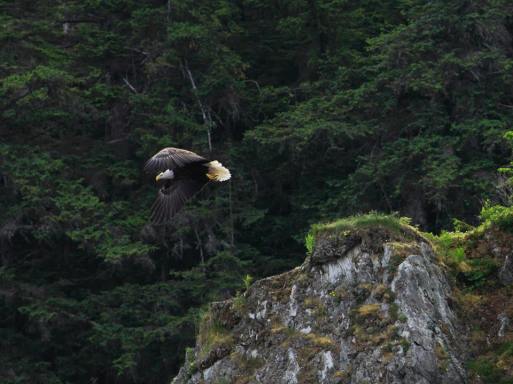
At the end of the log I stand and stretch the ache in my back, looking over Blackney Pass, over paradise. I drop the chainsaw and feel my heart lift. Blackney teems with life. Hundreds of gulls swarm a fifty yard patch of ocean in numbers so thick they look like a great feathered cloud. The bait ball has not gone unnoticed. An armada of eagles roar in from the trees, great black wings punctuating the ball of white. I count at least thirty eagles, shuttling back and forth between the trees near the cabin and the ocean. Again and again they swarm overhead, the silvery flashes of sand lance clasped tightly in their talons. Life, sustenance.
10540_10152009960619852_192033272_n
Brittney and I fall under their trance, the log lays forgotten at my feet. A lump rises in my throat. Why does this feeding frenzy have tears coming to my eyes? Because after everything the land has endured. Clear cutting, fish farms, live captures, predator control. They’re still here. The orca’s are still here. Is the world perfect? No. But here is a victory, here is joy. Here is a chance to celebrate.

“Do you know what I see?” I ask pointing out at the surging biomass before us.

Brittney looks at me, her eyes softened, the light glowing in her pupils.

“Hope.”


Glacier Rocks, Dirty Socks, Paradox, II

There’s an obvious fallacy, a selfish agenda to the prescription that can be found in the woods and secluded beaches. If the America public revolted against our vacation masters and went rogue. It we became independent travelers who once again slept on the ground and found our own way in lieu of setting foot on massive boats. How small 3.3 million acres of wilderness would become. The town of Gustavus swelling like a ballon and bursting as the masses flocked for the kayaks. The roads choked with car rentals, every Denali campground overbooked for years to come. In our lust for solitude, for wilderness, for our very roots, we eliminate any hope of finding it. There simply are not enough places left to support such a revolution.

We are no longer capable of supporting such a demand, hypothetical or not. Parks and wilderness areas are little more than satellites, little havens like Yosemite, Denali, and Yellowstone where wolves still roam and enjoy their birthright. But step outside these sacred borders and watch the canine be transformed. From symbol of wildness to pest, thief, scourge of the rancher and hunter. Fur, teeth, and claws mutating into a species not to be revered, but controlled. Our opposable thumbs giving us sovereign right to rule.

With so little acreage remaining, there is little choice for many but to blitz through with the concrete blurring beneath, the ocean rushing by ninety feet below.

“You can’t see anything from a car; you’ve got to get out of the gosh darn contraption,” wrote Edward Abbey using slightly more colorful language, “and walk, better yet crawl, on hands and knees, over the sandstone and through the thornbrush and cactus. When traces of blood begin to mark your trail, you’ll see something, maybe.”

But in the end, tourism won over the traveler. It’s cheaper, easier, safer. Certainly the first of these doesn’t garner enough attention. Many feel that financially the great white boats are the only way they’ll ever have a chance to see Alaska. Some combination of frugality and an unwillingness to endure the hardships of traveling cheaply and independently. Unwilling to sleep on a paperthin air mattress beneath canvas when a mattress and the rumble of engines beckons. The limitations of oats cooked above the gas stove compared to the all inclusive all you can eat, all you can drink, 24 hour a day buffet. The prepackaged, lowest common denominator overshadowing the simple and sublime.

But what do we come to Alaska for than? For the comforts of civilization? For floating casinos while the mountains cruise by? For bacon and eggs instead of oatmeal and peanut butter? Shouldn’t we be coming here to escape the familiar, the known, the comfortable? We have our whole lives to stay in pampered hotels, eat whatever we want, or play blackjack in Vegas. Hundreds of thousands of people migrate to Alaska every summer, their desire for the wild clearly not satiated. But something stops us short of truly acquainting ourselves at a deep, intimate, and personal level. How safe it is from the observation deck, where we can shelter when the wind gets too cold and there are no bears between us and the bacon. No worries, no cares, no magic. No John Muir epiphanies.

The revolution will never happen, we are tamed, domesticated. Skyscrapers block out the sun, roads smother the forests. We walk on pavement until the grass feels unnatural, the sun foreign and suspicious after years under fluorescence. Reality TV to forget our reality. Too much time looking for 3G, not enough tranquility. Facebook over of travel books.

Of course, we can’t afford to travel like this anymore anyway, so what’s the point of all this? To spend so much time prescribing a cure that people either don’t want or can’t have. I suppose it’s because every time I see a cruise ship pass by the lower bay I’m reminded of how much has changed, how there’s no going back. I feel no resentment towards those onboard, simply traveling the only way they know how.

I know the alternative, the west Arm overrun with fiberglass, a line waiting to pass through the Beardslee Cut on the high tide making my stomach turn all the more. The great contradiction of the wilderness guide. Secretly hoping not too many people listen to what he preaches, knowing his church cannot handle such a congregation.

“If everybody needed what you need, the wilderness would die.” Richard tells Kim Heacox in The Only Kayak.

“They do need it, but nobody’s telling them.”

“You are, with your writing.”

“Nobody reads my writing.”

“Good thing.”

Glacial rocks, dirty socks, the paradox.

Glacial Rocks, Dirty Sock, Paradox

Every spring the great migration resumes, animals of the sea and air swimming and winging their way north. In the recent decades a new species has taken up the route, plowing resolutely north with the hopeful promise of long summer days before retreating south as the waves build, the sun dims, and the rain pelts like daggers. Like the Arctic tern, many will shift their attention to the southern hemisphere, other rushing for the promise of lawn chairs, t-shirts, and mai thais of the Caribbean, following not the food but the money. The cruise ship has become the newest migratory species.

But from May through September they reside in the Pacific Northwest, their roosts in Seattle, Vancouver, and San Francisco, their feeding grounds the towns of Juneau, Ketchikan, and Skagway, sustaining on a diet of generic cotton t-shirts bearing the ports name, postcards, and diamonds mined on the other side of the world. Many pass by quiet Gustavus, its dock offering no hope or promise of future ports, the town’s walls barred against such an invasion of 1500 people into a town of 350. To reach Gustavus is a deliberate act, an independent flight or ferry ride from Juneau. One does not wake up, stagger down the ramp, and ask where their tour is meeting.

For most the true treasure is not in the town, but in the great mythical bay standing just to the west. Where 3.3 million acres of wilderness offers that many set out for. The open box on the bucket list begging to be checked (next year we’ll knock Europe off the list!). An Alaska devoid of t-shirt companies and concrete. This is the Alaska of John Muir and Jack London, wild, and free, an untamed land in an overdomesticated world. But from nine stories up, in a cabin bathed in artificial light, the heater blowing merrily, how tame it can all still feel.

Like an low budget nature documentary the acreage glides past. Mountains, bays, and glaciers in a 13-knot parade. There’s no struggle against the tide or wind, no resigned paddle onward as every promising beach contains another Grizzly landlord. In the bay at 8, Margerie Glacier by noon, Icy Strait by evening. Eight hours, 65 miles, and on to who knows where. Never touching, never tasting, scarfing it all down as quickly as possible. Fast food tourism.

Yet. Whether intentional or not. They’re here. The door to wilderness and the sublime left ajar. The cruise ship the keyhole with thousands elbowing each other out of the way to press their eye against it. To see, even if just for a day a sliver of the Alaska they’ve read about. And in that sliver, lies opportunity. To express that to see Glacier Bay is not the same as living it.

Here lies one of the last places on earth waiting not to be changed but to change. To recreate us like the glaciers did. A reminder that we are never complete. That like a river of ice, constant motion is necessary. That are own natural succession is always in progress. That it’s never to late to surge like like the Grand Pacific Glacier hundreds of years ago, charging south as fast as a running dog. All we have to do is let it.

Many will glance through the keyhole, snap a photo, shrug their shoulders, and move on. But for some, perhaps a cruise is the first step, leaving them in awe, thirsting for more, something authentic. Those eight hours will leave them wanting to meet the bay on its terms, on its level, from the seat of a kayak, at the feet of the glaciers, discovering their inner Muir. If they return it’ll be on their own journey of self discovery, with a can of bear spray in one hand and a tide chart crumpled in the other. And when they return to the bay, it won’t be by accident.

Making Alaska Safe for Cows

The concrete bends right, but straight ahead lies an unassuming road. Covered in dirt and gravel, trees arch across the entrance, casting deep shadows beneath the tunnel of greenery. No street sign marks the little road as we bypass the hairpin turn and shining sun for the shelter of the trees. Ten minutes later we reach the end of another skinny one lane road masquerading as a driveway, grass stubbornly growing down the middle track. A series of wooden buildings and a small stretch of lawn lay surrounded by the forest, the structures seeming to melt slowly into the woods’ outstretched arms.

The picnic table on the lawn groans under the weight of plates filled with venison, salad, rhubarb cobbler, and brownies. From the nearby trees the squirrels chatter jealously and I look up in down the table. I find myself surrounded by men of words, science, kayaks, and hilarity.

Across the table from me sits Kim Heacox, part John Muir part 13-year old boy though his birth certificate insists that he’s a few decades ahead. He’s the reason I’m here, the reason there’s a blog (I really don’t like the word blog, how about “Thought Journal”), the reason I write. On my left sits Hank Lentfer, responsible for the venison on my plate and several books in our library, followed by Zack Brown who had walked off the Stanford campus, PHD in hand and hiked and paddled until he reached the Gustavus shore. And finally, Peter Forbes, writer, non profit adviser, farmer. Nervously, I glance around the yard, undoubtedly there’s a kid’s table where I should be seated with my knees up to my ears.

Instead I find myself a part of a community that I have done nothing to become a member of. No initiation, no rights of passage, simply because of our deep love for this place, for the woods, for the future of the world. Because no one ends up in Gustavus by accident. You inherit a family you didn’t know you had. I cut my venison and listen as Kim’s boundless energy spirals the conversation from topic to topic.

“The best thing about visiting down south,” he says, “is the chance to watch all of those Alaska shows and see how we’re supposed to be living.” He finishes with such earnest sincerity that everyone looks up as if to confirm his sarcasm.

“I really like the one in Homer.”

“The guys with the cows! And the guns! Gotta move the herd across the flats before the tide comes in.” His voice twists into a passable southern accent, “is that a wolf?” he mimics a gun being fired, “got him!” And there’s humor in the tragedy of his recreation. “Gotta make Alaska safe for the cows!”

“The only problem, is that doesn’t look very good on a license plate. Alaska the Last Frontier sounds a lot better than: Alaska! Slowly Becoming Safe for Cows.” I say and his laughter is infectious.

It’s impossible to sit at the table and not be inspired. Hank and Kim’s books fill thousands of pages, tapestries of words and phrases I can only dream of writing. But here I was, doing my best to turn my mind into a sponge; listening, writing, and most important of all it seemed, laughing.

As the bugs fill the night sky and the sun ducks beneath the trees everyone slips into the house, the guitars come out, Zack pulls out a violin, and Eric Clapton makes the windows shake. I sit at the table, thumbing through an Orion magazine as Hank and Kim belt out Midnight Rider and as I glance out the window at the blue tinged yard in the evening twilight reach a beautiful epiphany.

It was Orca Lab all over again. A beautiful, undeserved gift. Replace the trees with ocean, the music with hydrophones, and it was the same. Emotion wells inside me at the incredible mentors, heroes, and now friends that had entered my life and the inspiration and motivation they’d filled within.

A Worthy Excuse

The sun finally glides below the outstretched tendrils of stand of spruce trees that line the yard, casting our house abruptly into twilight. A twilight that arrives at 8:00. Down the hall the washer growls and snarls as it tosses salt soaked wool and polyester in preparation for tomorrow.
On the edge of the couch I crouch, hunched over a laptop, back bent strangely as the muscles still struggle to loosen after digging into the seat of my kayak. The beer’s helping though as I take a sip, squint through my sun fatigued eyes, and type furiously.
Deadlines are never fun. What I really wanted to do was submit to the waterfall of hot water that Brittney was reveling in at that very moment. But the paper I’d snagged off the freelance website was basically done, good enough in fact.
The laptop snaps closed decisively and Porter raises his head a quarter of an inch, fully attuned to the room’s shifting energy. He shoots an optimistic look towards the sliding door and his playground beyond. A land of voles and dogs on what he hoped were reinforced tethers.
“And coyotes.” I remind him as I slip through the door and slide it shut behind me.     Too apathetic to even shoot me a steely eyed glare with his glacial eyes, he drops his head back to the edge of the couch, tail twitching indignantly.
In Gustavus virtually everything is within two miles and the Pathfinder sits neglected in the dandelion infested gravel driveway. A pair of easter green bikes lay haphazardly placed on the small concrete slab we’ve taken to calling a porch. 
    Brittney’s chain falls off reliably every half mile while the ring that holds my handlebars has been replaced by duct tape, the hand grips pointing down towards the ground, leaving me to grasp the very center of the handles like some lost and befuddled Lance Armstrong. But it moves when you peddle and the grocery store with our version of “lightening fast” internet isn’t far away.
How ironic, that in a few months, we’d be on an island in which we comprise two-thirds of the population and we’d be luxuriating in fiber optic cable internet. Granted, indoor plumbing and hot running water will have gone the way of the amish, but Netflix would be but a click away.
While here, in the crux of civilization, population 360, you had to bike a mile to reach a connection that would load your gmail sometime between now and sunrise.
The gravel road is inundated with dust. Even rain forests can have droughts, we just measure them in days instead of weeks and months while the salmon swim in holding patterns waiting for the rivers to rise and open the doorway home.
I glide through the stopsign at the lone intersection as the clock strikes nine and glance over my shoulder. Saturday night and the only restaurant in town was shutting down, another wild weekend. I look back ahead and hear my breaks squeak. Unbeknownst to me. My twilight cycle is not solitary.
A high patch of grass sits fifty yards ahead on the road’s left bank, a comma between two gravel driveways. Settled in the middle is a Gustavus lawn mower. The moose glances up nonchalantly, its mouth moving in the hypnotizing manner of ungulates, somehow horizontal and vertical simultaneously. At my sudden stop she takes an uncertain step towards me.
If she wants the road it’s all hers and I slide my bike to the left and onto the drive, opening up an avenue up the road or across toward the wooded ditch on the far side. She considers her options for a moment longer, and with an air of completely deserved entitlement begins to saunter across the road for the ditch, her hooves echoing on the concrete.
I watch her slow gait away, wishing she could stay longer instead of conceding to the higher powers of the willow on the far side that demanded her attention. Never breaking stride she vanishes into the wooded ditch, deceptively hidden from view like a magician’s illusion.
Hoping back aboard the bike I peddle past, she’s completely invisible, but this is not a stealthy phantom and her heavy footfalls let loose the crash and crack of brush cracking and bending to her will.
The yard in front of the store is thankfully moose free and I open the laptop to finish the days work, my mind already in a lava hot shower, steam billowing like campfire smoke.
“Here’s the assignment,” I scribble fast, “hope it works for you. Had to wait for a moose to clear the road before I could send it off.”
I smile at the beautiful inconveniences of my eden and hit the send button as the moose crashes through ditch 100 feet away.

Hanson Island Life Lessons

Every week and a half the fridge begins to look bare, the tortillas are gone, the beer and wine but a distant memory. The marine weather report is lit up in crimson, gale warning in Queen Charlotte, storm warning in Johnstone Strait, rain, wind, small craft advisories. On a good day Alert Bay is just thirty minutes by boat away, weaving through the Plumper and Pearce Islands, sending torrents of frothy white water over the deep green waters is nothing short of cathartic. It’s just finding enough of those days that can be the struggle.

And so we look for “windows.” Six hour blocks where the wind dies, the rain lessons, and the boat floats. As the storm inhales for another blow you run for town before the next exhalation. But after eight months of this game, pulling the boat up and down the beach so water lifts it off the rocks at just the right time, it feels commonplace. The fact that we once lived half a block from a Rainbow Foods absolutely absurd. We’ve traded the convenience of stores, bars, and restaurants for the simple tranquility of wilderness.

In a few weeks we’ll be gone, on our way back to civilization. At least our definition of it which entails residing in a town of 350 people. But right now that feels more like a metropolis than hamlet. Certainly there are things we’re looking forward to, I mean, we’ve talked to just a handful of people face to face this year. No longer having to correlate tide height and wind with fresh lettuce will be convenient. And I really do miss Alaskan IPA.

But more than anything, I’ve learned a lot about myself over the winter. I landed my first paid writing gig, wrote thousands of words for a novel that I’ll probably let no one ever see, and am just a season and a half away from watching the show, “Friends” all the way through.

Brittney loves the website, mindbodygreen.com and there are some great articles and information to be found. She hates me for pointing out however that the site is often flooded with “top 10” lists. Top 10 ways: to know your man has a good heart, yoga pants, fat burning foods, etc. Now it’s all she sees… she may never forgive me. But I’m going to conform, and walk through the ten things that I’ve learned this winter on Hanson Island.

1. How ever much time you think you have until the boat is aground, subtract by ten minutes. You’ll save yourself a lot of disappoint, frustration, and expletives.

2. Mice will find a way into your house. Steel wool, blockades, and a cat will only do so much. Accept the inevitable, keep the counters clean, and check under the propane stove frequently.

3. It is perfectly acceptable to wake up in a cold sweat because you just dreamed that you could hear orcas and aren’t recording.

10537056_10153151080044852_18244022817751455_n

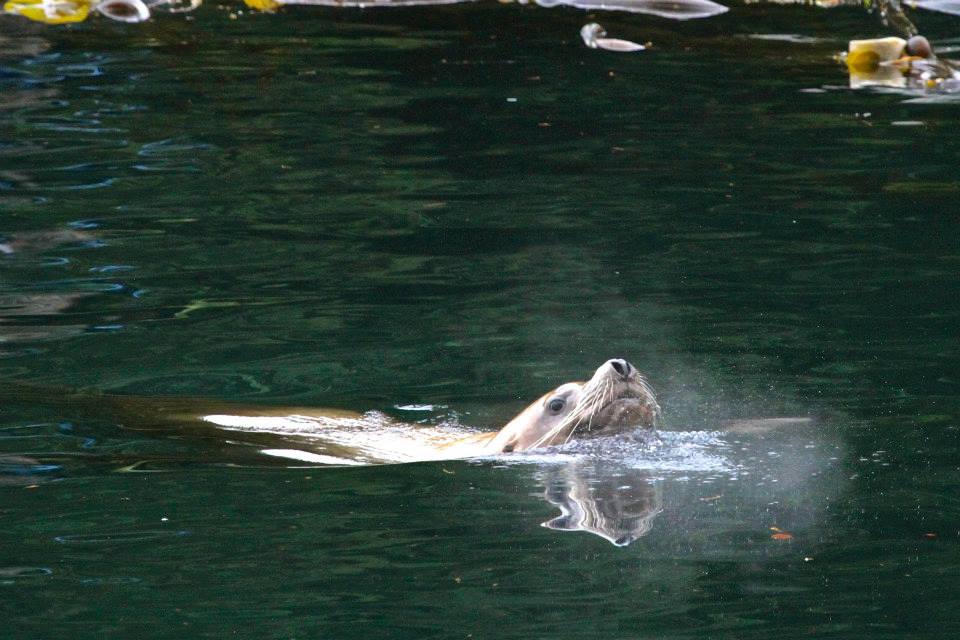
4. No matter how much you hoot and holler at them, Stellar Sea Lions will not give you the time of day.

10659202_10153342628774852_4448842526100652252_n

5. Orcas love to call at dinner time, so you stuff your plates into a plastic milk crate box and lug it all over to the lab and have dinner with headphones on.

1901153_10153342624724852_3285441612895050163_n

6. Bath Days are a gift from God and should be worshipped as such.

10995804_10153726757494852_7811731726412708212_n

7. Mink will live under the house, they’re cute but smell terrible, your cat will want to make friends, the mink will not acquiesce. 11081015_10155300238395858_6083581184589343527_n

8. Porch baths in December are a necessity. Treat them like a Nascar pit crew changes tires. If you’re not out and back inside in under five minutes you are a) doing it wrong and b) probably borderline hypothermic.

9. Bring pets. You’ll need someone to talk to when your wife gets mad at you for ruining her favorite website.

10994155_10153690504119852_621681021897676100_n

10. There is nowhere on earth like this place, nothing can replace it or come close. So enjoy every moment you have here regardless of the time of year.

_MG_9262

Quiet Places, Open Spaces

Shadows stretch across the bay, the surviving sunlight turning a deep gold against the water and trees on the far side. We sit on an old, rotting 2×4 propped up by rocks, watching the island in the middle of the bay transform into a peninsula as the tide ebbs away. Around us boxes of food stand in pyramids, accentuated by a case of beer and a bag of dog food like a massive sack of flour.

But Walrus is in no hurry to start the haul up the hillside to his cabin shrouded in the woods. So we sit, beers in hand, with nothing more pressing than watching the water slowly drain out of Dong Chong Bay.

A great blue heron materializes out of the woods, it’s prehistoric shrieks echoing off the steep vertical cliffs around us, alighting on the island. A raven swoops passed and alights on the branches of a birch tree above. He speaks softly to the bird in a tongue I don’t recognize. Undoubtedly it’s the native language of the First Nation people that called Yukusam (the native name for Hanson Island meaning “shaped like a halibut hook”) home. The words seem to permeate from the trees and ocean, as alive and authentic as the island itself. If the trees could talk, it would be in this voice. Not the voice of my ancestors who had arrived and hunted, logged, and eternally altered the very land we loved.

The large, rocky plateau we sat on was far too smooth to be the work of the ambitious and almighty glaciers that long ago preceded us. They deposited erratics and islands with the callous randomness of an artist flinging paint at the canvas. This was deliberate, a stronghold for the logging trucks and chainsaws that Walrus had fought and defeated.

Even in this beauty, in the perfect stillness, it seems pertinent to mention it and Walrus nods in affirmation, as if he needs any reminder of what took place here.

“In the U.S we put aside these pieces of land as wilderness that can’t be touched, developed, or mined.”

Walrus lets out his high pitched laugh, “but is anywhere untouched?”

“Exactly.”

I remembered camping in the Beardslee Islands in Glacier Bay. Alone, surrounded by acre upon acre of wilderness. Only to watch commercial jets rumble over, their contrails leaving white slashes across the blue sky. The cruise ships rumbling by, black exhaust spewing above the mountains, wakes unconcerned with the wilderness boundary. Untouched wilderness indeed.

He wanders over to the case of beer and hands me another, the crack of carbonation drifts across the water. With an indignant call the heron rises from the rocks, wings beating a slow rhythm as it vanishes.

“How can we even classify something as wilderness?” He asks.

“That’s the thing. Are we trying to recreate a land before Europeans? Or native Americans?”

Regardless, the ghosts of North America cannot be revived. The mammoth, the Stellar Sea Cow. We talk about how the great plains were once home to 12-foot bears, lions, and camels. An indescribable amount of biomass and apex predators. Until man arrived and claimed the top of the food web for him alone.

“Extinction started with the arrival of man, not Europeans of course.” He cautions.

“Of course. It’s a European arrogance, that we can put back together the pieces that we’ve ripped apart.” I say. “It’s the best we can do I suppose though.”

“When the Spaniards arrived in central America, they found the Mayans already had chickens.” He looks at me, his long grey beard crinkles into a smile, his eyes dazzle beneath long curling eyebrows, “they just assumed, hey, they’ve got chickens here just like back home!” He pauses and takes a drink, “of course they were Asian chickens,” he finishes laughing, letting the message sink in.

“You don’t read that in your history books. Or Columbus’ Haitian massacres, or the sculptures depicting people of African descent. We weren’t first, but we in some way won. So we get to claim credit, and dust our transgressions under the rug.”

He smiles again and we tilt our beers back, I’m talking conservation and anthropology with one of the founders of Greenpeace.

“That’s one of the difficult things about anthropology and natural history. It’s a lot of extrapolation and assumption, we can’t know much for sure.”

“Which is why we need time travel,” he says.

“I know where I’d go,” and I point out the mouth of the bay, to sparkling waters of Blackfish Sound, “right here.”

I talk about trying to imagine Dong Chong without logging roads, the orca lab site before the lab, my desire to see this place in as natural a setting as possible. “Post ice age of course,” I finish.

He nods, “I bet it’d be something.”

“Salmon so thick you can smell it on the wind,” the very thought gets me excited, “blackfish so thick you can walk across their backs,” I say quoting Billy Proctor, the legendary jack of all trades that had lived in and around the region since the 30s. “In another age of conservation maybe.”
We lapse into silence, drinking in the scenery, the peace and tranquility that cannot be quantified. No bottom line, no profit margin or material good could ever begin to explain what these places mean. Because they live not on paper but inside. The by products of the wind and trees, ocean and waves, saying more without a word than I ever can. Causing a spiritual upheaval I can only begin to explain.

It’s for this reason, that we’re coming back next winter I tell him. Like Paul, he’s spent decades on Yukusam, unable to find anywhere else that compares for the same unwritten reason.

“It’s going to be almost a year since I had a real job. It’s been incredible.”

A knowing smile pushes through the beard, “it’s hard to think about going back to it isn’t it?”

“You have no idea.” I answer, knowing full well he knew exactly what I was talking about.

My Declaration

I sit in paradise. The only sign of human life out the window is the lighthouse on Parson Rock two miles away. The storm rages, the wind blows, shaking the windows. The land is untamed, dangerous, and beautiful. Humpbacks stubbornly push through the waves to breath and feed. The gulls hover as if suspended like marionettes, riding the gusts above a churning ocean. Cougars prowl on Swanson and Cracroft Island, some have never laid eyes on a human being. It is the land that I’ve been drawn to my whole life. The freedom and the salt spray, the forest so full of life you can feel the energy of millions of lives all around you though they’ll never speak a word.

But how long will it stay like this if we elect people who don’t care? At what point does the environment become something that we’ll stand for. As a new wave of climate change deniers take center stage, America continues to fall further and further behind the rest of the world. We have spoken. Money, oil, and development mean more than quiet places and open spaces. A full wallet speaks louder than a full soul. I would say that we’ve lost our way. But it’s hard to find a time where we knew where we were going. It creates quotes such as this from James Inhofe: “The Genesis 8:22 that I use in there is that ‘as long as the earth remains there will be seed time and harvest, cold and heat, winter and summer, day and night.’ My point is, God’s still up there. The arrogance of people to think that we, human beings, would be able to change what He is doing in the climate is to me outrageous.”

The bible is not a shield Mr. Inhofe. Nor is it justification for development and pipe lines. We are charged as care takers of this world God created. That does not mean that it is our to be pillaged.

What would they think if they just visited some of these places. Not just saw them but experienced them. If they got down on their hands and knees and felt the rocks beneath their palms. Smelled the sea and the forest. Inhaled the oxygen straight from the trees. Took the time to sleep on the ground, watching the stars blossom into view, with no streetlights or car horns to invade the senses. Perhaps sleep with a root buried in the lower back. If they could be paralyzed by the perfect beauty of the sunrise climbing the peaks of the mountains, spilling out over the beach, intertwined with the crashing of the waves. Would they care than? Would they see that material riches are not enough to satisfy the human soul and spirit. That nature and wilderness is not a luxury. That it’s a necessity whether we realize it or not and all that experience it is never the same.

I am not Republican, I am not Democrat. This isn’t about us versus them, at least, it shouldn’t be. We all share this planet, we’re all on the same side whether we realize it or not. I am of the party of Teddy Roosevelt and Richard Nixon. Creators of National Parks and the Endangered Species Act. The party of John Muir and Rachel Carson, Kim Heacox and Lynn Schooler, writers who dare to speak for a world that cannot speak for itself. Because tragically the mountains cannot stand before congress, nor can the bears and whales. But we can, I will. And as I read the statements of those that now represent these places it has become clear what I will spend my life fighting for.

I could spend my whole life here, sitting suspended above the rocks, watching the sea crash against them. Or sitting in the old growth forest that has been growing and falling for millennia. But how selfish would that be of me. To live and enjoy while its future hangs in the balance. I want this place, these lands to change someones life the way that it has changed mine. I want someone to paddle in Glacier Bay, 100 years from now while humpbacks lunge feed around them and sea lions flash beneath their kayak. I pray to the same God as Mr. Inhofe for that, because in the end, we’re all on the same side.

Nothing Better

Rain streaks the windows, a melodious tap marks the origin of the leak near the fireplace. In the loft it’s cold, the fire’s warming prescence muffled by the stairs and small hallway. Above is the muffled pounding of millions of rain drops, waging an unceasing battle to break through the roof like their brethren traveling down the chimney. With great effort I pull myself out of bed, the chill sapping my body of the heat the blanket provided. But it’s at least five degrees warmer downstairs where the fire still smolders, hot coals glowing behind the window. I throw another log on the fire and check the temperature. 18.3 degrees celsius, not bad for a stormy 2 am. I remind myself that it’s only the beginning, that it’s going to get a lot colder before it gets warmer. Penny’s house is wrapped in Brittney’s 5 degree down sleeping bag, she might be warmer than any of us. Though Porter looks pretty content curled on the couch in front of the fire, nose buried in his fury paws.

The leak isn’t bad, just a slow but steady drip where the wood finish of the house meets the stone pillar of the chimney. But my common sense isn’t awake even if my body is, and I finally just put every pot from the kitchen at the base of the chimney. Let the drips fall where they may, some of them have to hit stainless steel.

It has become our nightly routine, the alarm going off every two or three hours. Get up, slip downstairs, check the temperature, fuel the fire, go back to bed. We’re long past the days of turning a dial for warmth, fiberglass insulation nonexistent, I prefer it this way. Because come morning there will be no commute, no time clock, no “I have tos.” I climb the stairs, every other step creaking, a stomping like a herd of elephants behind me announces that the cat has decided to move upstairs too. I crawl back under the down comforter, the rain pounds even harder. Porter curls up on Brittney’s pillow, almost smothering her face.

Our east facing windows stream early morning light into our room. A rouge sun beam storms through the thin curtains and crawls up the bed. But if there’s sun the storm may be over. The scattered clouds are ablaze with golds and reds as the sun slowly moves above the mountains on Vancouver Island. A whisper comes from the speaker connected to the hydrophone system next to our bed. Three pods of orcas past through in front of the lab yesterday but didn’t make a sound. They rose in a perfect resting line, a phalanx of fins rising and falling as one. Sixteen orcas in all, and not a boat to be seen anywhere. The boy in me wanted to get closer, to follow them for awhile, but I could find no justification for it. They’ve waited months to have the strait to themselves, let them have it.

The whisper grows, delicate ‘pings,’ begin to echo through the speakers, the trademark call of the G pods. Brittney is up like a shot, without a backward glance she runs for the lab while I’m still looking for socks. What have I done to her? I brew coffee, feed the pets, and listen as the calls come closer and closer, the bright red clouds streaking across the heavens, reflecting into a pink sky above. The water is flat as a pond, it’s going to be a glorious day.