Tag Archives: wilderness

Sights and Smells

I wonder what’s different.

The transportation for one. Greyhound no longer brings their gargantuan buses this far up Vancouver Island, and as we careen down the narrow two-lane road with six inches of shoulder, I can see why. The playlist blasting in my ears has changed, though I brought back some classics like Death Cab for Cuties’ Bixby Canyon Bridge and Snow Patrol’s Make This Go on Forever.

A myriad of greenery blurs outside the window. I watch these forests differently, too. Oh, my heart still flutters at the boughs of red cedar hiding secret pathways to 6,000-foot peaks. But I also see acres of young hemlocks scrunched together like matchsticks in neat little packages. Phrases like “stem exclusion” and “30-year harvest cycles” whisper with sullen voices. Countless watersheds line the east side of Vancouver, but the Tsitika River I just rumbled past is the only one that hasn’t been logged. Tsitiaka winds through the tallest mountains on the Island and reaches saltwater at a little place called Robson Bight.

Orcas. It always comes back to orcas.

For two days, I have ferried, flown, and ridden from Gustavus to Juneau to Seattle to Victoria and am now just an hour from Port McNeil. Despite my evolving playlist and old-growth forest opinions, it still feels impossible that my first trip to Port McNeil was 17 years ago. Surely it was just a couple of weeks ago that I hopped off the Greyhound. Wasn’t it last weekend that I drove a Nissan Pathfinder up this road with a cat and rabbit in the back seat?

These roads, islands, and waterways hold a lot of the stories and experiences that explain the evolution from basketball boy to kayaker, guide, naturalist, bum, redneck-hippy, writer, conservationist, and whale aficionado. I’m counting on it providing a few more.  

Ferried. Flown. Ridden.

I count the number of petroleum-driven vehicles that propelled me from Gustavus to the footsteps of Port McNeil, Johnstone Strait, and my precious Hanson Island. All to go on one more monkish retreat in the woods and waters of my youth. All to catch one more ride on a boat powered by an outboard motor or go paddling in a kayak made of, you guessed it, fossil fuels.

Too small to tip elections in favor of Mother Earth, I run to my favorite hiding place, sheltered by, you guessed it, Mother Earth.

Blackfish Sound

If the trees are passing judgment on my life choices, they keep it to themselves. If those replanted hemlocks are packed like matchsticks, what happens if one of them lights? I woke to the news that California was burning during the wet season.  A world getting drier, warmer, crazier, more unpredictable. Surely, it would be the earthquakes that doomed southern California. We beat San Andreas Fault to the punch.

***

Don’t cry. Whatever you do, don’t cry.

All those old names:

Blackfish Sound, Pearce Passage, Weyton Pass, Blackney Pass, Queen Charlotte Entrance.

Bold Head and Cracroft Point. Blinkhorn Peninsula and Kaikash Creek.

I know them all, have stared covetously at their little faces for eight years, promising I’d see them again. I’m sure they’ve been getting on just fine without me.

I confess I left my guilt on the Port McNeil dock, catching one more 45-minute ferry ride to Cormorant Island and the town of Alert Bay—the end of public transportation. I wait two days for a weather window that finally comes as low pressure turns to high and the wind pivots from southeast to northwest.

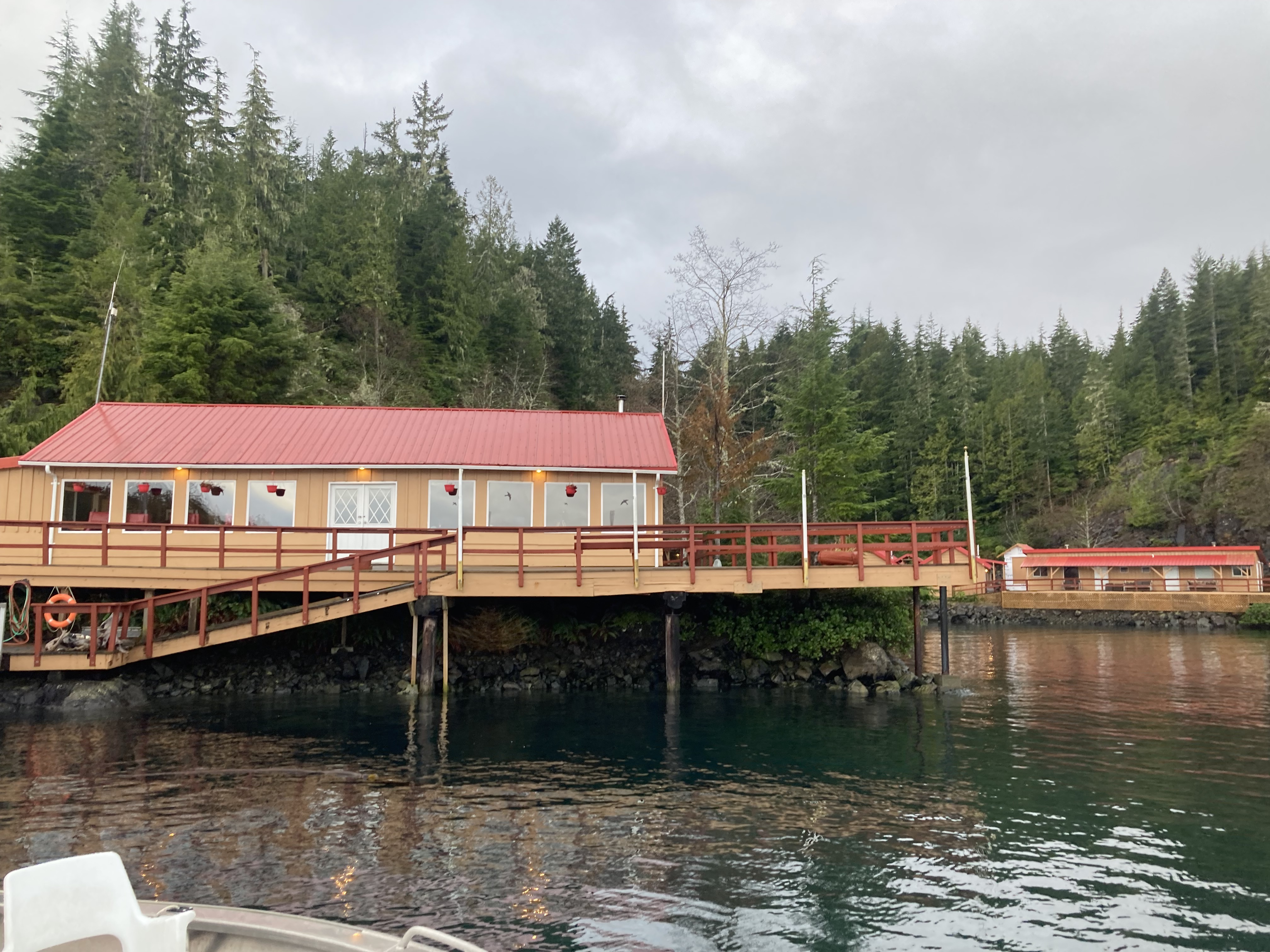
Every town run from Orca Lab to Alert Bay took me past Double Bay, its long boardwalk, floating dock, and cherry red rooftops. I shoulder my pack and follow the other caretaker, Laurene, up the dock. She directs me to a cabin on the right side of the horseshoe-shaped boardwalk, perched on the rocks with a view of Blackfish Sound and the first layer of the Broughton Archipelago’s islands.

The door opens, and the pack thumps from my shoulders. The cabin is bigger than my Gustavus design, with a half-loft upstairs, a functional shower, even a flush toilet. I would have settled for half-a-shabin and a cot. It’s not the high-end amenities that made the pack fall.

Don’t cry. Whatever you do, don’t cry.

Next to the kitchen table is a shelf. On it rests a radio receiver that looks all too familiar. Whether donated or purchased from Orca Lab, the ocean blares from the speakers—water gurgling, a distant boat engine, crackling shrimp. I swear I hear A pod.

“We have a hydrophone at the mouth of the cove,” Laurene explains, unaware I have been transported back in time. “There’s a volume knob on the right—”

“I know,” I interrupt. Not the best first impression.

I cross the room and crank the volume. How many nights did I fall asleep to this? She leaves me to unpack. I move quietly across the floor as if I’m in church. Clothes upstairs, tortillas and cheese in the fridge. Curry paste in the cabinet. I open the wood stove and smile. A pile of ash has calcified on the bottom and shrunk the stove’s space in half—a chronic problem with burning wood soaked in saltwater.

I pry the ash free and grab a handful of piled kindling. With eyes closed, I bring a stick of red cedar to my nose and inhale like an addict, listening to the hydrophone as my head spins and heart palpates. Our sense of smell pales in comparison to most mammals. Yet its ability to conjure memories is undisputed.

There is a smell to Hanson Island I have found nowhere else. Something in the ground, the water, the trees. Perhaps it’s as simple as it remains one of the few islands in the region that has not been clear-cut. Old-growth smells for a land that measures lifespans in centuries and seasons in seconds.

***

I weave between cedar and fir, balance on fallen skyscraper hemlocks, and plunge through salal undergrowth. I squish deer scat between fingers and spy on harlequin ducks perched on rocky beaches. Rumor has it a wolf has taken up residence on Hanson Island. I scan the hills with blind optimism for hazel eyes, ears cocked for the howl that proclaims that there are still things green and wild and true on this burning planet.

The rising northwesterly brings the forest to life with creaks and cracks. I settle against the hollowed-out trunk of a cedar, its innards charred from a long-ago lightning strike. Yes, even here, there can be fire from time to time. The stubborn cedars simply refuse to rot and fall, standing even in death in defiance of the decay and rebirth that comes for all.  

I scratch at the charred bark and sniff. Any smell of fire is gone. The forest around me vibrant and healing. I watch the treetops, content to let the afternoon crawl away. There will be time tomorrow to check in and learn what is expected of me here, how I can give back to this place that dreams of becoming a sanctuary and educational retreat. It took enough petroleum to get me here. I will live, write, and eat in a shelter made of wood. I’ll try to leave this place better than I found it.
Wet earth soaks into wool pants, a pleasant shiver travels up my spine. Ravens cackle, eagles retort. Somewhere, an orca explodes to the surface. I feared two months wouldn’t be enough time to find what I was looking for. But as eyes close and my soul rises to the island’s tallest canopy, I know it’s already been found.

Risk and Living

The tender splashes over the side, and the southeast breeze tugs at the bowline. I tie it to a cleat and give the anchor a firm pull. Find me a boat owner who’s more paranoid about their anchor than me.

Boat anchorages for this forecast don’t get much better than Lemesurier Island’s Hooter Cove. Tucked on the island’s west side beneath a steep hillside, it’s insulated from all but the worst southeasterlies.

Lemesurier Island on a nicer day

I wiggle into the little inflatable and paddle awkwardly for shore. I can’t imagine the designers of the Seahawk 2 had this in mind when they marketed her. Judging by the photo on the box, their grand plans included two full-grown men squeezing into this glorified raft for a magical day fishing on their favorite lake.

The raft zigzags at a glacial pace, and I keep glancing at the trees to confirm that I am indeed making progress. Even if I didn’t have my pack, rifle, and long legs, there doesn’t seem to be room for another dude in this thing, and I have no clue where you’d stash a fish bigger than a goldfish.

I nudge into the barnacle-coated rocks. Seahawk’s already sprung a pair of leaks, and we’ve agreed it’s a good idea to always take the hand pump. Despite the comical marketing and questionable durability, Zach and I have become strangely attached to the goofy inflatable that fits neatly in the back of our 20-foot skiff. I stash Seahawk above the tideline and, for the countless time this fall, pull my rifle from its drybag.

It’d be nice to have one more deer. The weather and daylight window for the day are tight, made worse by me forgetting my deer call on the bedside table and delaying our departure another 15 minutes. The ride to Lemesurier is just bumpy enough to remind me that the evening forecast calls for 20 knots and growing to 25 by Thanksgiving morning.

It’s mid-morning by the time I drop Tanner and Zach at their hunting spots and anchor. Four hours in the woods can vanish with astonishing speed. Depending on where you find deer and the difficulty of the drag, sometimes the day is done just as fast as it began.

I pause in spite of the tight schedule and look skeptically back at the skiff.

“It’s not drifting, is it?”

“No, it can’t be.”

“In your head. It’s all in your head.”

Some grow bolder the longer they tramp the woods, climb the mountains, and cross the straits, but I am not one of them. The more time out here, the more whitecaps and steep scrambles I traverse, the more cautious I’ve become. Too many close calls. Too many stories about boats with capable captains caught off guard by a rogue wave or experienced hikers disappearing on trails they’ve hiked dozens of times. I think about some of the stuff I got away with in my 20s and wonder how many of my nine lives remain.

Yet, here I am, boating across aptly named Icy Strait in weather that could best be described as “iffy,” and tramping down the beach after buck tracks in freshly fallen snow.

“Well,” I reason as I brush aside foliage and step into the forest. “There’s a balance between risk and living. Why live here if you’re going to be inside all day?”

I blink in the dim light and look around dumbfounded. I’ve never walked these woods despite passing this island dozens of times. This is Hank’s refuge, his go-to spot to hunt and shelter in a small, off-grid cabin. I’d heard him talk plenty of times about how much bigger and open the Lemesurier forest is compared to the Inian Islands, but I had to see it to believe it.  

Stately hemlocks with just a smattering of spruces tower high above an open floor devoid of menziesia, huckleberry, and devil’s club. The trees are spread wide, a myriad of deer trails weave hither and thither.

I look up the hill. I can see forever. So many great perches. I gain some elevation and settle on the soft moss, the rifle propped on a rotting deadfall.

I scan the full 360-degree view. This may not be as advantageous as I want. I can see forever, but so can the deer, and they’re a whole lot harder to see at 200 yards than me.

The big old trees give the impression of being watched. This place feels familiar, comfortable, like I’ve been here before. Not here exactly, but on an island pinned between the British Columbian mainland and Vancouver Island. A place I’ve thought about – for better or worse – every day for more than a decade.

It is no slight to Juneau, Gustavus, or southeast Alaska to say that the sweetest moments of my life came on Hanson Island, British Columbia, where I sat up nights starring over inky Blackfish Sound while orcas called from Robson Bight.

These Lemesurier trees echo Hanson Island’s mega old growth, where wizened red cedar and chunky fir trees persevere. Instead of looking for antlers, I daydream about magical harbor seal encounters and lugging batteries.

I can’t quit this place, and when I vowed to return, I had no idea it might happen so fast.

***

I had every intention of going somewhere warm for the winter. Hawaii sounded good, and I trolled the usual “workshare” websites and pestered my Hawaii friends for job opportunities. Something kept getting in the way. Schedules didn’t line up, the timeline either too long or too short (or too expensive).

Eventually, I did what usually happens when I have a new search engine open. I typed in “orca.” I scrolled through the workshare, and my heart skipped several beats when I saw Orca Lab’s profile staring back at me. After several minutes fantasizing about going full hobo and returning for the summer, I kept moving, scrolling past several opportunities along the B.C. coast that toted the chance of seeing “wild orcas.”

I stop at an overhead drone shot of red-roofed buildings and a floating dock. Orca Lab isn’t the only site of human habitation on Hanson Island. Double Bay is on the opposite side of the island in an appropriately named bay that cuts deep into the shore. It had been an inactive fishing lodge during my Orca Lab days and snapped up by a philanthropist some years ago with the ambitious idea of bringing Corky home. While far too old to ever go full ‘Free Willy’ and return to her pod, living out her final days in a large net pen adjacent to her native habitat seemed the least humanity and SeaWorld could offer after decades of imprisonment.

Help us Create an orca sanctuary. Caretakers needed for January and February.

***

Deer-less and cold, I hustle back to Hooter Bay, hoping Zach and Tanner saw more than my single doe/fawn pair. Knots of anxiety bend my stomach as the water comes into view. Terrible scenarios fill my head, including a broken anchor chain, a punctured Seahawk, a shifting low front, a chilly night, and a long walk to cell phone service.

But the skiff is there, and Seahawk is reasonably inflated. I paddle out and have to admit that the wind is picking up.

“There’s a balance between risk and living. Why live here if you’re going to be inside all day?”

The anchor pops off the bottom—big pull. Reset my grip—big pull. Reset. I pause, catch my breath, and look back at Lemesurier. It’s been several weeks since I reached out to Double Bay Sanctuary, and I’m dragging my feet on my final answer. Two months isn’t a big commitment, and it’s not like sitting in the middle of nowhere is some monumental life change. There’d even be two other people there. I wouldn’t have to go full hermit this time around.

Snow swirls around my head, and my fingers go numb. The anchor comes into view, and the skiff sways in the growing chop. I stare at the anchor, considering the balance between risk and living.

“Why do this?” I ask the cove.

“Why not do this?” the forest answers.

“Because… I don’t want to chase ghosts. I don’t want to be Uncle Rico.”

There’s no question who my celebrity lookalike is. While there are times I’d prefer to be comped to Damon or Pitt, at least Napolean Dynamite got to eat tater tots and dance. But it’s Napolean’s antagonizing Uncle Rico I’m scared of becoming.

Yes, I’d dreamed of going back, of cruising up Highway 19 in time to catch the evening ferry from Port McNeil to Alert Bay. Yet, if I was going to do this, it won’t be to relive some glory day or a feeble attempt to recapture my Orca Lab magic – the rambling equivalent of throwing a football over mountains or wondering what would have happened if coach put me in during the fourth quarter. After 18 months trying to look forward instead of backward, the last thing I needed was an excuse to relapse.

***

The anchor clangs, the boat drifts free, engine in gear. Choppy waves meet me at Lemesurier’s northwest corner. Low gray light and fog hide the setting sun. Tanner is right where he’s supposed to be, a marvelous 3×3 buck resting on the boulder-strewn beach. I abandon the helm and help lug his prize over the hull, trying to keep covetous envy out of my voice.

A deer of comparable (but still smaller) dimensions.

“Where’s Zach?”

Tanner drops his pack and checks the stern for rocks before we pull away.

“Just heard him on the radio, says he’s on a beach east of here.”

I shake my head: fading light, growing waves, temperature below freezing. We may find what our skiff can do on this 15-mile run home.  

I wouldn’t have given the crossing a second thought ten years ago. Invincible and drunk on life, I took Orca Lab’s teeny boat into all sorts of weather, tying it to the rocks off Cracroft Point and hustling to replace a battery or restart a generator while the tide fell and waves pounded. I took green water over the window and felt the hull wobble under an overloaded cargo of groceries, laundry, water, fuel, and batteries.

We cruise just offshore. Water sprays the windshield, and I taste salt.

“Where’d you find’em?” I ask, trying to take my mind off the weather.

“In a muskeg just a few hundred feet above the beach,” answers Tanner, not taking his eyes off the shore. He points towards a pebbly beach below a cliff. “There he is.”

Zach leaps aboard the lurching skiff with the ocean roaring in our ears. Spinning towards home, the bow dips unnervingly in the stacking four-footers. Tanner’s buck receives a dose of salt brine.

“We could use a little more weight in the stern,” I say grimly.

We shelter behind the little windshield and bounce like pool toys. I glance west into fading light. It’s gonna be close.

The boat goes quiet as we stare over sooty seas. My fingers go numb on the wheel, and we crawl forward. Home looks far away.

“There’s balance between risk and living. Why live here if you’re going to be inside all day?”

Lemesurier disappears in fog. Glacier Bay comes into view. I replay the route again and again. Lemesurier to Point Carolus. Across Sitakaday Narrows to Lester Point. Lester to Halibut Point. Halibut to the Bartlett Cove dock. The chop subsides near Carolus. Push the throttle down. 10 knots. 15 knots. 20 knots. The outboard purrs. We’re gonna make it.

I forget the weather and cold as my mind retraces another marine route that’s burned into my memory. A path that scoots across Cormorant Channel and through the Pearce Islands before hitting Weyton Pass at the slack. It meanders through the Plumper Islands and past a sea lion haul-out before navigating the tidal islets off Hanson Island. But instead of continuing down Blackfish Sound for Licka Point, I turn into a bay with two heads cutting deep into the island that will never let me go.

Hanson Island

***

Carolus’ rocky reef goes whizzing by. Sleet pelts our faces, but it seems that the worst is behind us. We breathe a little easier, our nervous jokes a little funnier. It’s impossible to always know where the line is between risk and living. The line moves without warning. A sunny day can be overrun with fog or variable seas replaced with small craft advisories.

We sprint across Sitakaday, and comprehension hits harder than the iciest salt spray. I cannot let fear stop me from loving the places that resonate. There are challenges around returning to Hanson Island. Memories and nostalgia would wiggle into my heart and try to drag me down—that oscillating line between risk and joy.

Bartlett Cove dock pokes out of the fog. Did I let the fear of a snapping anchor line or bouncing waves stop me? No, I tied the line tight, double-checked the weather, and trusted my skiff and friends. We cannot sit at home in fear of what may happen.

I am an unreliable narrator still learning the quirks and priorities of a reborn 36-year-old who stresses about his boat and runs after every report of orcas. Some things just won’t change. For 18 months, I looked forward, reclaimed home, and fell deeper in love with Icy Strait. I want the same for Hanson Island, for it to be part of past, present… perhaps future.

The skiff slides into the dock. The motor goes silent, and I flex my throbbing fingers as the blood returns and numbness fades. Did it—a bit of risk for another day in the woods. The sensation and payoff are inescapable, makes me thirsty for more. We walk up the ramp, keenly aware that we forgot to call for a ride home.

I pause against the railing and look across the water. Lemesurier and its big old trees peak out of the fog, and I give them a solemn nod, thankful not just for home but the opportunity to live a life that permits me to fiercely love two places. There is room for Hanson Island in this new life. Room to write a new chapter and make it part of home. I clap my stinging hands, heart filling with cautious excitement.

A great blue heron lands on the railing and stares with prehistoric eyes. The same bird that flew over the Shabin on my first visit and whose vestige now adorns the kitchen. I am not one for signs and imagery, but I take his presence as positive affirmation.

“Thanks,” I whisper. “It’s good to be going home.”

Hanson Island

Feed Me Twice

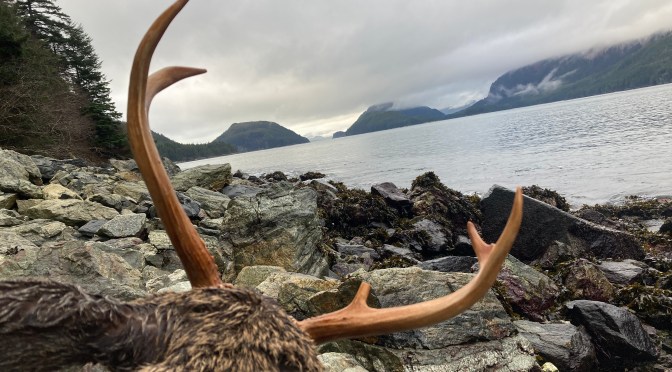
Time stops when antlers fill the scope. This muskeg looked empty before I crept behind a mossy tussock, blew the wooden deer call swinging from my neck, and summoned a doe from her hidden bed. I watch her unseen; a rare privilege to see a deer that doesn’t see you. A grunt grabs my attention. Forked antlers pad up the mossy hill.

“This is how it’s supposed to work,” my brain whispers. “Blow the call, attract a doe, and watch the buck come trotting in.”

The buck disappears beneath a slight depression and reappears at 20 yards. Either he doesn’t see me or doesn’t care. He’s full-grown – five years old in blacktail society – and lord of this expansive muskeg. Mature bucks aren’t supposed to show their faces in the middle of the day, but all bets are off when the rut is on. I have tricked him by imitating the call of a fawn in distress. Bleating fawns bring does, does bring bucks. As if a bolt-action 30.06 loaded with copper-tipped shells wasn’t enough of an advantage.

***

Yet, there is no moral ambiguity. My rifle misfired an hour ago when a large buck trotted past in pursuit of a pair of does. I can still see his startled expression when he looked up the hill. I reloaded in a panic and pulled the second shot. That had been enough. He’d bolted the way he’d come, and no bleating fawn would bring him back.

Hunting is challenging, even with a rifle, Google Earth, tide charts, and hand-carved deer calls. Blacktails camouflage beautifully into the brush and rarely move when the sun is high. Infinitely better ears and noses, they melt into the woods long before our primitive eyes spot them. I had patiently waited above their trail for that exact moment. It’s hard not to feel cheated. That life isn’t fair.

***

Minerva lays sprawled on the carpet. Her expression matches mine. Limp, apathetic, beaten, and lost. I refresh the New York Times, watch Wisconsin turn a little redder, shake my head, and close the laptop. I scratch behind her ears and pick up the guitar with an apology. Her eyes widen, and she bolts for her favorite hiding place beneath the bed. If I ever think my guitar playing is improving, I can rely on her to keep me humble.

I strum the opening chords to Brand New’s ‘137,’ a song about nuclear weaponry and destruction. Perhaps still a tad hyperbolic, but it feels appropriate at 9:00 pm on November 5th.

We’re so afraid. I prayed and prayed when God told me to love the bomb.

I want justice.

I want clean water, clean air. A habitable planet. For quiet spaces and open places to take precedence over fear, greed, and hatred. I gaze out the black windows toward the invisible willow sluice where moose nurse their calves and snipes build their nests. Closeted away on this swampy glacial outwash makes it hard to articulate or understand how people could choose profit and bigotry. I once yearned to understand. To comprehend and seek common ground with a sect that claimed Christ as lord but slammed their doors against anyone who didn’t look like them. Who chose to worship manifest destiny and convicted felons over the simple edict of “love thy neighbor” and “do unto others.”

Let’s all go and meet our maker. It won’t matter whose side you’re on.

I will not get justice. Any environmental or conservation progress has been reduced to fantasy. The best we can hope for is a fighting retreat. The Helm’s Deep culvert has been breached, and I don’t know if we can count on Gandalf arriving at first light on the fifth day.

***

Zach and I silently crack beers. Two days later and he’s still sporting the camo-tinged “Hunters for Harris & Walz” ballcap our buddy Sean made. There’s no reason to rehash what we already know. No need to talk about carbon levels, alternative energy, or the sixth extinction. What hope we had at reversing them has melted like so many glaciers.

We try to cheer each other up and allow one another to be angry. To curse and chuck an empty beer can at the hemlock paneling. It’s impossible not to think about Zach’s 18-month-old boy and what kind of world he’ll inherit. I feel guilty and selfish at my childless existence but thankful my parentage extends no further than a cuddly ragdoll cat.

Our vision narrows to the world we can comprehend: Icy Strait, Glacier Bay, Cross Sound. The mountains waiting to be explored and quiet mornings in the muskegs. Living at the north end of an ecosystem that runs from Alaska to northern California has some advantages in a warming world. Southeast Alaska is projected to receive more rain in the coming decades. A bit soggy, perhaps, but better than the well running dry or having the remaining reservoirs snapped up by corporations.

Mellower winters and protected old growth will be good for deer. Perhaps the salmon runs can persevere in the rivers free from clearcutting. We yearn to escape. To go on a wilderness bender. To return to one of the few places that makes sense. We pull up YouTube and watch videos of Sitka blacktail deer, counting the days until our turn to walk in the woods.

***

The buck fills the scope. Ten yards away, yet I receive only a sideways glance. The doe meandering up the hill has all his attention. He turns broadside. Crosshairs settle on his chest just behind the front leg. My finger flexes. The gun clicks. Panic returns. Another misfire. How old is this ammo? How many times have I taken it into the field? Even bullets have expiration dates.

Work the bolt, the dud flipping through the air and nesting in the moss. I didn’t reload after the previous mishap. I chamber my last shell. The buck takes an uncertain step towards the trees. Crosshairs on his heart.

“Please, please, please, please.”

The barrel recoils. I don’t hear the shot or the dull pain in my shoulder.

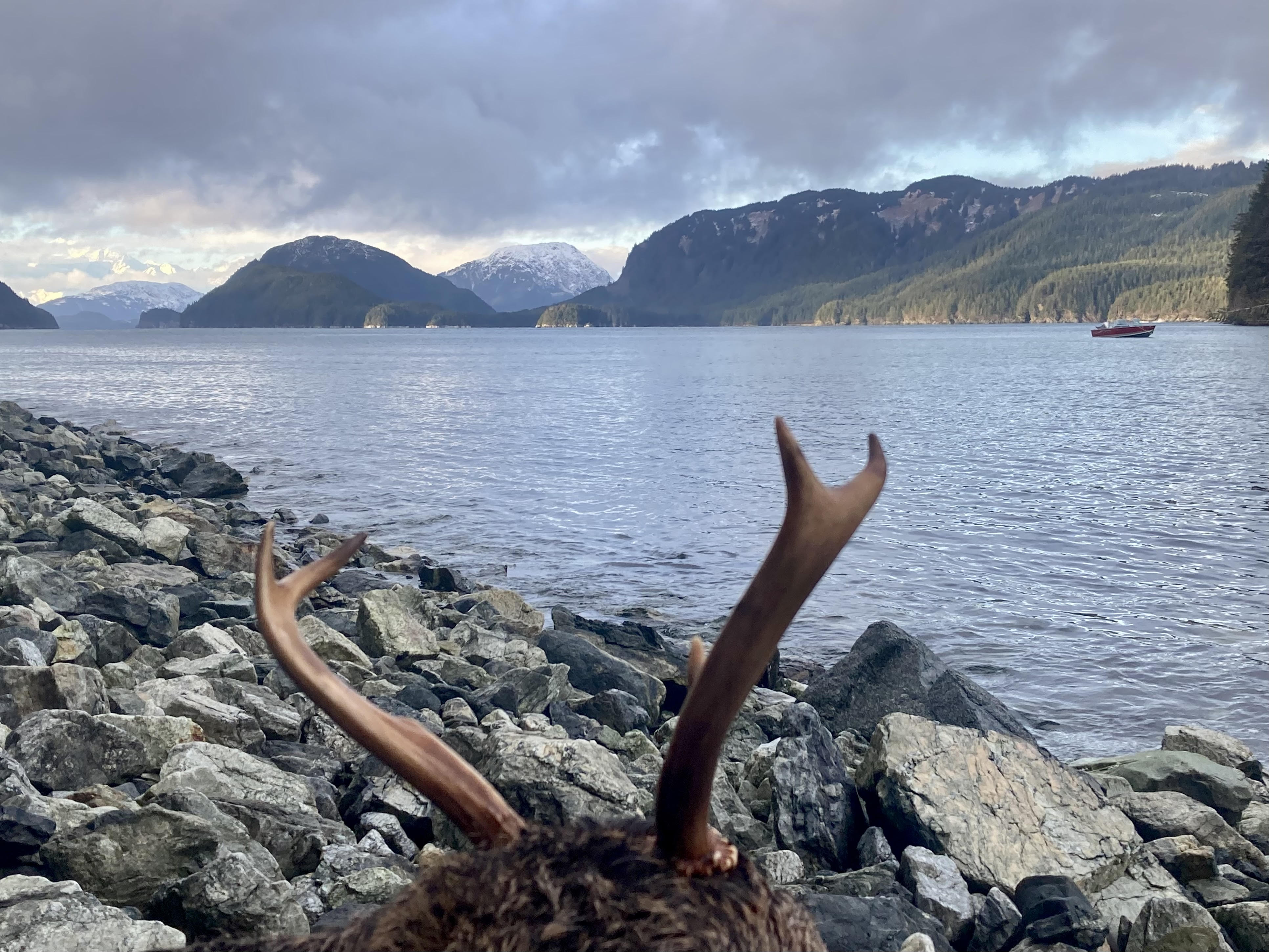
The doe glances over. There’s no fear in her face, only polite curiosity. Acrid smoke fills my nose. My heart pounds and my hands tremble. I’m no longer cold. No longer wet. A red mist envelops his chest as he collapses on the moss. Blood stains his soot-colored coat. His final breath escapes through the exit wound. The cloudy vapor hangs like a whale’s spout. But there is no arching back, no flipping tail, no pronouncement of life.

I collapse into the moss with ringing ears. My breath comes in tiny gasps, feeling relief more than anything. It’s only a few strides to his resting place. I grip the thick fur. My forehead touches his. Empty eyes, a pale tongue pokes from his mouth.

The doe saunters away, oblivious to the exchange that has taken place. Not comprehending or not understanding. She blissfully nuzzles at a the moss and comes up with a strand of something green and leafy.

I want my whole world to be this steep mountainside clinging to the north end of Chichagof Island, for every need and desire to be filled in the spaces between treeline and tideline. To watch the seasons come and go until the day I can no longer rise, and the snow gently covers what remains.

I guess I want to be a deer.

My knife slides across the belly’s white fur. His fading heat warms my fingers and steadies my hand.

I whisper my Deer Prayer, “You are the forest made flesh. I promise to think of you whenever I eat. To honor your memory. May wherever you are be peaceful and free of pain.”

I cup his heart in hands covered with blood and slippery with fat. My bullet pierced the aorta and pulmonary vein, but some of it may still be edible. The organ goes into a Ziploc along with the liver. Our hunting culture has few commandments, but one is to eat the heart and liver that evening while the story is told.

Field dressing complete, I sit on my heels and rub my hands clean. The doe has finally moved off, but I can still hear her rustling in the brush. There’s something eerie how, once a shot has been fired and a deer has fallen, how tame they become. In normal circumstances, the doe would have fled when she saw me. Now, she lingers. Paying her last respects? That sounds better than being oblivious.

There is contradiction in my hunting. Snuffing life from the very creature that represents all I crave and value. Their innocence and gentleness, self-sufficiency, and quiet beauty. The desire to get closer and closer, to reach out and almost touch this forest talisman and then decide which dies and which survives.

I stare into the dark eyes, already glassy with death.

“This isn’t fair,” I tell him. “Little in this life is.”

The muskeg faces the Fairweather Mountains. The Inian Islands and Hobbit Hole bow before them like fiefs declaring fealty. I grip the broad antlers and take a few unsteady steps up the hill. How can I feel enthralled and guilty at the same time?

Perhaps that’s why these muskegs and animals enthrall me but insist that I carry a rifle. The contradictions force me to examine my connection to place and attempt to comprehend it.

To understand how an easterly breeze catches my scent and how a northerly outflow bites the skin and sends deer running for cover. To examine the fairness in my own life and, most of all, escape. To connect with a part of me that pumps with vigor independent of elections, divorces, and frayed friendships. Because out here, deer or no deer, things make sense in a way they don’t where there’s cell phone service and wi-fi.

They say heating with wood warms you twice. Once when you split it and again when you burn it. If so, then deer feed me twice. Once in the woods and again on the plate. We depart the muskeg and dip into a small ravine. Sweat drips, and quads tremble. Hoof tracks crisscross snowy patches, ravens call on the wind, and squirrels chatter from hidden towers. Across another muskeg and down the mountain I wish I called home.

Of the Woods. With the Woods.

My boots crunch frozen grass and I grimace. There’s no quiet way to move from the intertidal to the woods in these conditions, the world softly frozen around me, beads of water suspended and solid on every blade. I tighten the straps on my backpack and try to think like a deer, move like a deer. I walk on the balls of my feet to soften my footfalls, body tensed and alert. I have been walking for only twenty minutes but sweat already beads beneath the bright orange hat.

I feel the blunt object slung around my shoulders slam against my hip. I adjust, brush aside the first layer of alder, and hear branches scratch against my pack. Breath thunders in my ears and boots squish into soft, wet earth. Inside the forest, nothing is disturbed. I take a moment to marvel at my good fortune.

As I child I read and reread every Calvin & Hobbes comic, staring enviously at the apparent national forest Calvin and his stuffed tiger had at their disposal to ride their red wagon in summer and toboggan in winter. Complete with cliffs, ravines, swamps, creeks, and lakes. Now, I have my own National Forest. Tongass, and the designated wilderness that is the Inians. Me, some deer, a curious raven, a chattering squirrel.

I move up a gently sloping hill until it meets the steep cliff that shoots up at a 90-degree angle to the summit of the island a thousand feet above. The forest abruptly ends, surrendering to gravity and salmonberry bushes clinging to this steep and harsh stretch of the island.

I have been here before, know where I’m trying to go. The forest frames this steep hillside for two miles before the cliffs jut out to meet the waters of North Inian Pass. By staying just inside the trees, I can have a full view of the big, west-facing woods below. A haven for deer regardless of the weather. I touch the object around my shoulder, to reassure myself it’s still there, and drop into a drainage to hide myself from view.

The sound of the creek covers my tracks and masks my scent as good as I can hope for. I follow the drainage for a quarter mile, allowing just my toes to touch earth. Quiet as I can be, crawling on hands and knees beneath fallen logs and feeling the water-soaked earth crawl up my pants. At last, the drainage meets the top of the hill, the little valley flattening out. I pause, crouched behind a fallen hemlock hiding me from view. Sometimes the first look is the only chance you get.

I ease myself around the root ball, turn, and am greeted by a flashing white tail and startled bleat. I freeze, and so does the deer. A young buck, his antlers nothing more than knobs on the top of his skull. I’ve caught him unawares, but he only bounds about ten feet before stopping. He looks back at me with a politely curious expression.

The object knocks against my shoulder, demands my attention. I don’t dare move. The deer remains frozen, obsidian eyes unblinking, impossible to imagine what is going through that young mind. He glances away from me, looking back down the hill. Very slowly, I move my right hand across my chest, feel the strap slide, come loose… and the binoculars slide into my hands.

My freezer is full. I am not here to harvest. I am here to learn. To soak up whatever secrets and knowledge my neighbors are willing to share.

“I sought fuller comprehension of an animal I am made from,” wrote writer and hunter Richard Nelson in his book Heart and Blood, “the life outside of me which becomes the life within me.”

As do I.

From the beginning, the deer of the Inians were more than “stock” or “herd” for us. They are revered and honored. And like anything we revere, I am innately curious about these phantoms of the woods. I love how they appear just when I’ve given up. When I get lazy and round a corner or snap a twig, rewarded with the sight of a whitetail trimmed with black bounding effortlessly through the wood with nary a sound.

I bring the binoculars to my eyes and drink him in. Even if I’d brought a rifle, even if the freezer was empty, I’d have a hard time pulling the trigger. He still has that “fawn face,” short and stumpy with all the characteristics of a baby animal that make us coo. In the low light, even though he is just feet away, he seems to evaporate into the woods around him. Perfectly camouflaged in the weak January sun and a forest floor free of snow.

Lowering the binoculars doesn’t startle him. He continues to oscillate between me and glancing down the hill. There have been several times over the last few years where I have sat in the company of deer. Many times, using the “call” brings either does, fawns, or both, leaving me to wait and hope that something with antlers will wander by. But in those moments my attention was never on them, instead scanning the woods beyond for something that would bring the scope to my eye.

Now, this little buck has my rapt attention, and I decide on a little experiment. I tap one nail against the glass of the binos, the sound barely registers in my ears from less than a foot away. The fawn responds instantly, tilting his head like a dog at the sound of the treat bin opening. He stares directly at my binoculars and takes a step towards me.

No way.

I tap again. A few more steps. 15-feet away. The closest I’ve been to a wild animal in a long time. I don’t dare breathe. Sweat drips down my face, every muscle tensed with the effort of staying perfectly still. Through it all, the fawn has not made a sound. Nature has perfectly sculpted him for a life of silence. What next? The seconds hang in the air. I hear footfalls behind me.

I turn my head instinctively and see something grayish and sleek move through the brush. The doe looks down on us and gives a disapproving huff. The fawn immediately snaps out of his trance, cantering over to mom and attempting to nurse, only to be forcibly rebuffed.

It’s not unusual for fawns to return to their mother for a time once the rut is concluded. And judging by his eagerness he is something of a mama’s boy. While not alarmed, the doe has no interest in this staring contest. She moves down the trail, her kiddo in tow. I don’t wait for an invitation and step softly into their trail and follow. The pair canter at a casual gait 30 feet ahead before weaving around a large spruce.

With them out of sight, I increase my pace, trying to keep them in sight as long as I can. I reach the spruce and slowly tilt my head around the corner. The forest is empty. Spruce, hemlock, blueberry, and menziesia trees and shrubs interspersed at intervals with no deer between their gaps. I bring my deer call to my lips, give two short bleats, and settle against the trunk. But there is nothing, no evidence that I share the woods.

I begin to make my way down the hillside, eyes still scanning for a pair of ears trained like satellites in my direction. But I once again walk alone. I’m getting cold and tired, ready for a mug of tea and a sandwich as the short winter days pass like sand through my fingers. But I cannot bring myself to crash through these woods. Every step needs to be quiet, as stealthy as I can be on the off chance that another of these creatures will wander into view. Can I not take a simple walk in the woods anymore?

“I wonder if hawks or herons, wolves and killer whales are ever astounded by the loveliness, the grace, the perfection of their prey,” Nelson continues.

I have often claimed orcas match us in intelligence, that they may be smarter than many humans. I include myself in that category. The corvids of the sky are whip-smart, anyone lucky enough to stare into the eyes of a wolf has seen a soul staring back. One could certainly argue that the intricate and complex languages these animals have room to marvel at and appreciate the voles, seals, and moose that sustain them.

But humans undeniably have this capacity, if we choose to acknowledge and accept the burden and gratitude that comes from appreciating the things we eat. It has forced me to come to terms with my omnivorous evolution, the power it has given me, and in turn, the responsibility to not abuse.

***

I open the freezer and retrieve a parcel of butcher paper. The outside is covered in brightly colored scribbles courtesy of Elm and Beth’s daughter, Claire who assists in butchering by making sure every piece of venison is lavishly wrapped in artwork. The antlers on her drawing of a deer are unmistakable. I set the meat on a plate to thaw with grand designs of spaghetti, meatballs, and a liberal dusting of parmesan.

I didn’t just come to the Hobbit Hole to grieve and rebuild. I came to explore, to learn the forests and muskegs and hills as intimately as an overcivilized and domesticated human can.

The “Hobbit Hole” from the far side of the inner lagoon.

To discover the trails and beaches and shortcuts through these marvelous, old, protected woods that will be standing long after I’m gone. To grow as close to this special patch of earth as I can over three months. A huge part of that education was the deer, one of the forest’s rightful tenants.

To eat of deer is to eat of the forest. Of blueberry and devil’s club. Skunk and deer cabbage. Alpine and beach. Forest and muskeg.

I never fancied myself a hunter, never imagined I’d walk into the woods with the intent of dragging something out. But it has granted me a gift I didn’t expect, drawing me closer to the wild places that sustain me like a spring welling up amongst forested acres.

It has turned me from an idle hiker to an explorer, asking questions and taking copious notes of the places I visit. The knowledge that I will never understand or grasp the intricacies and relationships of these animals and ecosystems only makes it more alluring. Be it a rifle or binoculars against my hip, my days of crashing woodland hikes are now a thing of the past.

This Must Be My Exit

I thought getting divorced was hard. Drawn out and complicated and bitter, with plenty of legal documents and court appearances that stretch for months or years. Instead, six short months since this began, it was over with a few scribbled signatures and a 15-minute phone call.

“Do you acknowledge that this is what you want?” The judge asks, her voice coming through the phone with a hint of static and echo.

I hesitate, the silence suspended in air. I can feel the boxing match going on between my heart, brain, and body.

How did this end so fast? Who am I? Who is that voice on the other end quietly answering, “Yes, ma’am” or “No, ma’am?” Where the hell do I go from here?

***

Blood drips from the tip of my nose, turns clean snow crimson. I partly run and mostly fall down the hill, sliding to a stop beside the fallen buck where my blood mixes with the deer’s. I am 1,000 feet above sea level in fading light with a deer at my feet and a deep gash on the bridge of my nose.

The technical term is “scoping yourself.” You hold the sight too close to your eye, and on the recoil, it slams into your face. I’m a repeat offender and judging by the throbbing pain in my forehead and steady, ‘drip, drip,’ this is a bad one. I dig into my bag and pull out my med kit, slapping gauze and tape onto the awkward area as best I can. I chug some water, mow down trail mix, and try to control my shaking hands.

My klutziness cannot take away from the exhilaration of the moment. As my world descended into chaos, I sought sanctuary in the woods. It wasn’t the fresh air and exercise that kept me sprinting back to the forest every chance I got. No, it was the reminder that even when life is turned upside down, the trees are still growing. Deer still forage. Ravens still chatter. The tide will rise and fall. Consistently, reliably, always there. If we permit it.

For years southeast Alaska has been my playground as well as home. The national forest and park that surround Gustavus brought adventure. But as I pull out my knife and prepare the deer for the drag to sea level, it’s now so much more. These places are keeping me sane, in control, alive.

***

“Mr. Cannamore, did you hear the question?”

I look around Dad’s office for a solution squeezed between framed photos of Alaska Airlines 737s and World War II aircraft. Where does all that love go when it no longer has an outlet? It seeks every corner, every alternative, desperately searching for a way home. There’s no home to go to.

“Truthfully, no.” I cannot bring myself to tacitly agree. “This isn’t what I want… but I have agreed to it.”

Good enough. A few more questions. A smattering of “yes’s” and “no’s.”

“Mr. Cannamore, you may hang up.”

I stare at the phone’s black screen and shock fills my body. Did I just hear her voice for the last time? It seems impossible.

Close my eyes, deep breath. Let go, just let go.

I am hovering above the water, retracing a paddle route down Chatham Strait. Every rock and point is vivid. Waves ricochet off cliffs. Humpbacks rise and fall in long summer light. Bear tracks in the sand. Loons greet the rising sun.

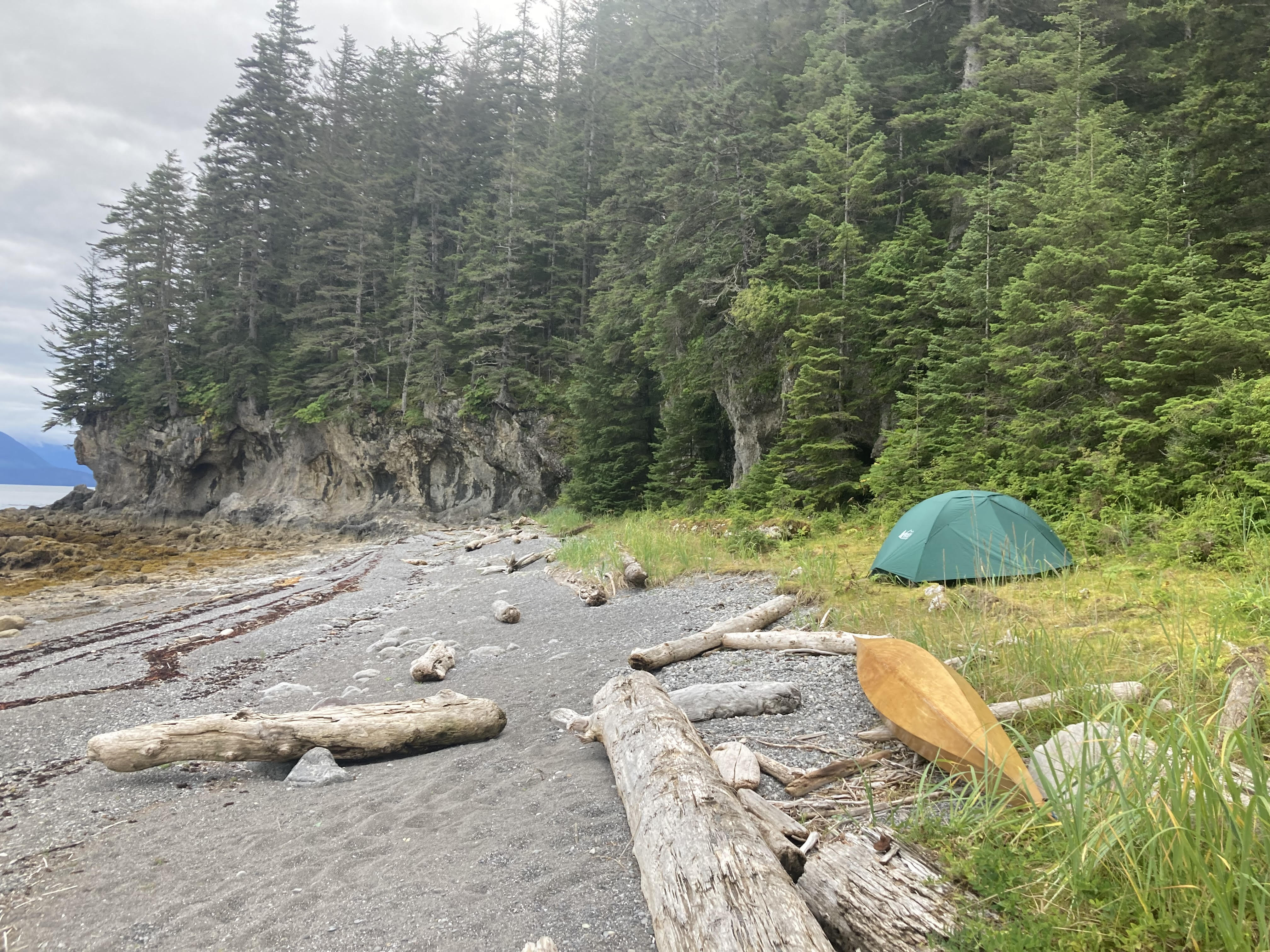
Camping in Chatham Strait

What’s the difference between distracting and coping? Running and rebuilding?

***

I lean against the shopping cart and ponder my cheese future. How much dairy does one human need for three months? I grab two large bags of mozzarella, hesitate, and drop a block of cheddar on top. Better safe than sorry.

I have agreed to go full Obi-Wan Kenobi and caretake the Hobbit Hole until March. The thought of long days exploring from the seat of my kayak and discovering more of the island’s secrets sounded like the perfect tonic. Lonely, yes, but necessary. But I’m not willing to risk running out of cheese.

I need a place to grieve, mourn, accept, rebuild, rewire, heal. Most importantly, learn to love myself. To be ok on my own and affirm that I don’t need another human to feel validated. What better way to face that than a little self-imposed exile? Sink or swim. Adapt or die.

The Hobbit Hole

How fortunate to have a place like the Hobbit Hole to retreat to. Through all of this, I have tried not to lose sight of the positives. The friends, family, and neighbors that have held me, fed me, and handed me beer. Solitude doesn’t mean I’m alone; the internet and phone means community will still be a click away. But the time has come to prove I can rely on myself.

For months I have worked to accept things outside my control and harness my energy into things I can.

Hanging up that phone meant the return of control over my life. I can sit and stew on the hard luck. I can rail that this is unfair, that life has done me dirty. That I don’t deserve this. Or I can acknowledge that this sucks and that I’m not ok. But I will be.

I may not have control over what has happened, but I control what comes next. And isn’t that one hell of a gift? Many on this planet go their entire lives without that sovereignty. But I get to look in the mirror and say whatever comes next is up to me.

I’ll take my cheese and venison and cat and retreat to the land that has always been there for me. Hike the mountains or search for orcas on the flooding tide. Commune with sea birds and argue with sea lions. Write, sleep, laugh, and indulge in the gift that is time set aside for me.

I speak of trauma and pain with no authority. All I can do is convey what it has felt and done to me, my situation, and how I’ve chosen to approach it. Hiding it, burying it, never felt like an option. It’s okay to struggle, to ask for help. I’m under no illusion that I can outrun this. The pain and hard days will find me in Gustavus, the Hobbit Hole, or Tijuana. It’s been a hard six months; more hard months await. That. Is. Ok. This is hard. It should be hard.

“If you were fine,” my friend Amy reassured, “it probably means you’re a sociopath.”

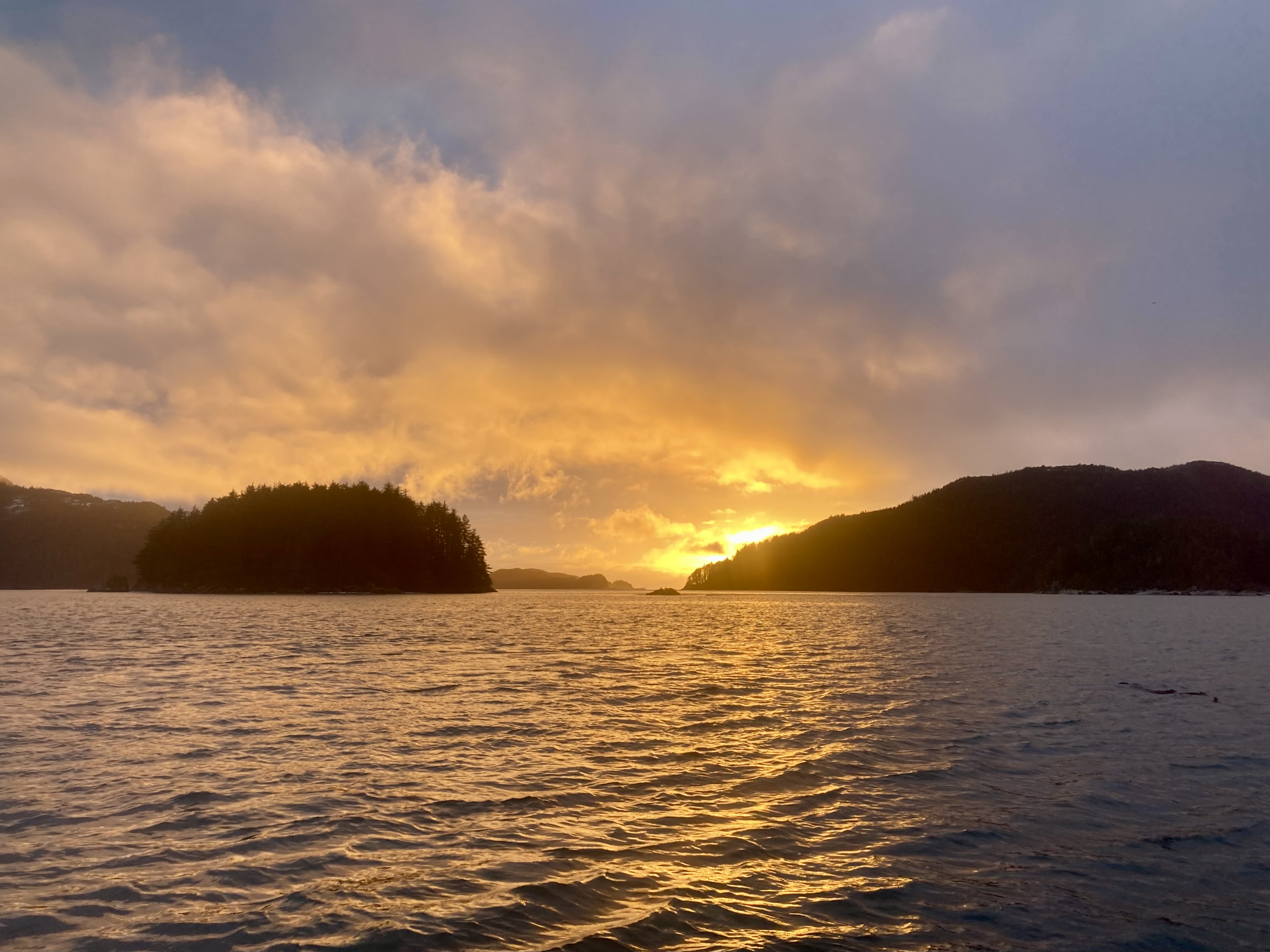
South Inian Pass at sunset

We don’t forget. I expect I’ll carry some sadness and melancholy the rest of my life. But I hope that my memories return. That these hard months do not outweigh 12 beautiful years that overflowed with joy and love. May these hard times not define me but become part of my story.

***

Smoke rises from my cabin chimney. The fire cracks, afternoon coffee in the French press. Minerva coils her body up against me and buries her face in my arm. Home. A deep love, a sense of place. The acceptance that my future is blurry and distorted. How intimidating, foreboding, and… exciting?

“To look forward, sometimes we must look back.” Has been one piece of advice. “Who was David before all of this?”

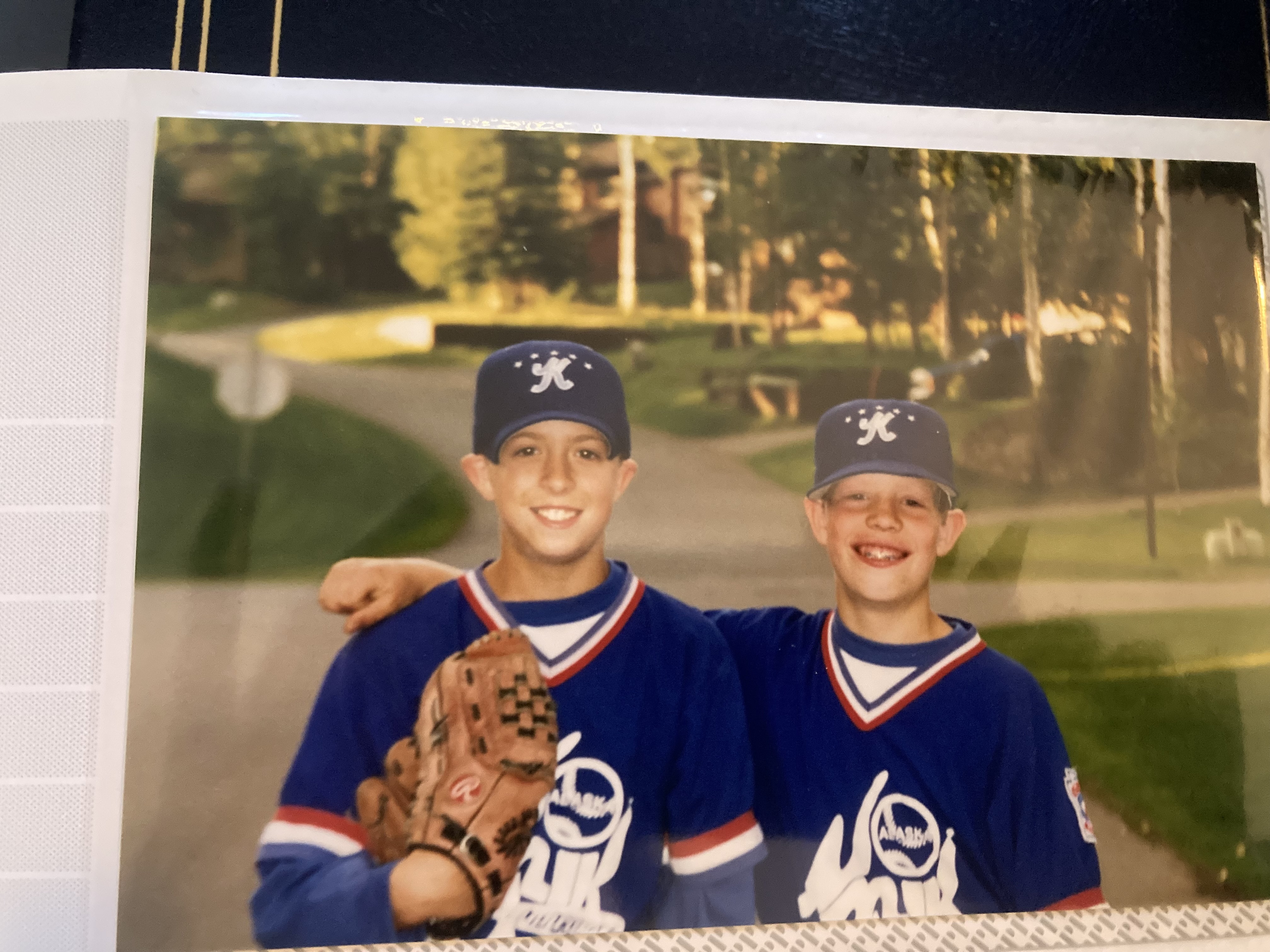
Before I left my parent’s house, I flipped through old photo albums and stared at that grinning goofball looking up at me. 13-year-old me seemed to think that giving someone “bunny ears” was about the funniest thing one could do during a photo.

But there’s something else. In nearly every photo, my arms are around someone. Squeezing my brother, best friend, girlfriend, parents. The desire to love and hold those dear to me close has been there for a long time. And as I feel that now-familiar ache in my heart, I know it still is.

I hope someday it finds another outlet. But for now, the time has come to turn it inward. To build what it can and put everything away in its proper mental file cabinet.

I take another deep breath and rub the wooden deer call I wear whether I’m hunting or not. Snow is falling in the field that still holds moose and snipes. I hear wolves when I step on my porch and see northern lights when the clouds break. I have changed, but this place perseveres. I will too.

Sometimes love means letting go. Sometimes love means holding tight. Sometimes it means doing both at the same time.

Rivers and Roads

Finding relics is hard on this coast. The rainforest is tenacious, hungry, and unrelenting. It devours anything made of wood, eager to absorb it back into the ground and turn it into mulch so the next generation of trees can grow, topple, and repeat. Abandoned houses quickly crumble as their metal roofs rust and fall away. Even cast iron and the alleged “stainless” steel can only resist the pounding rain and ever-present dampness for so long.

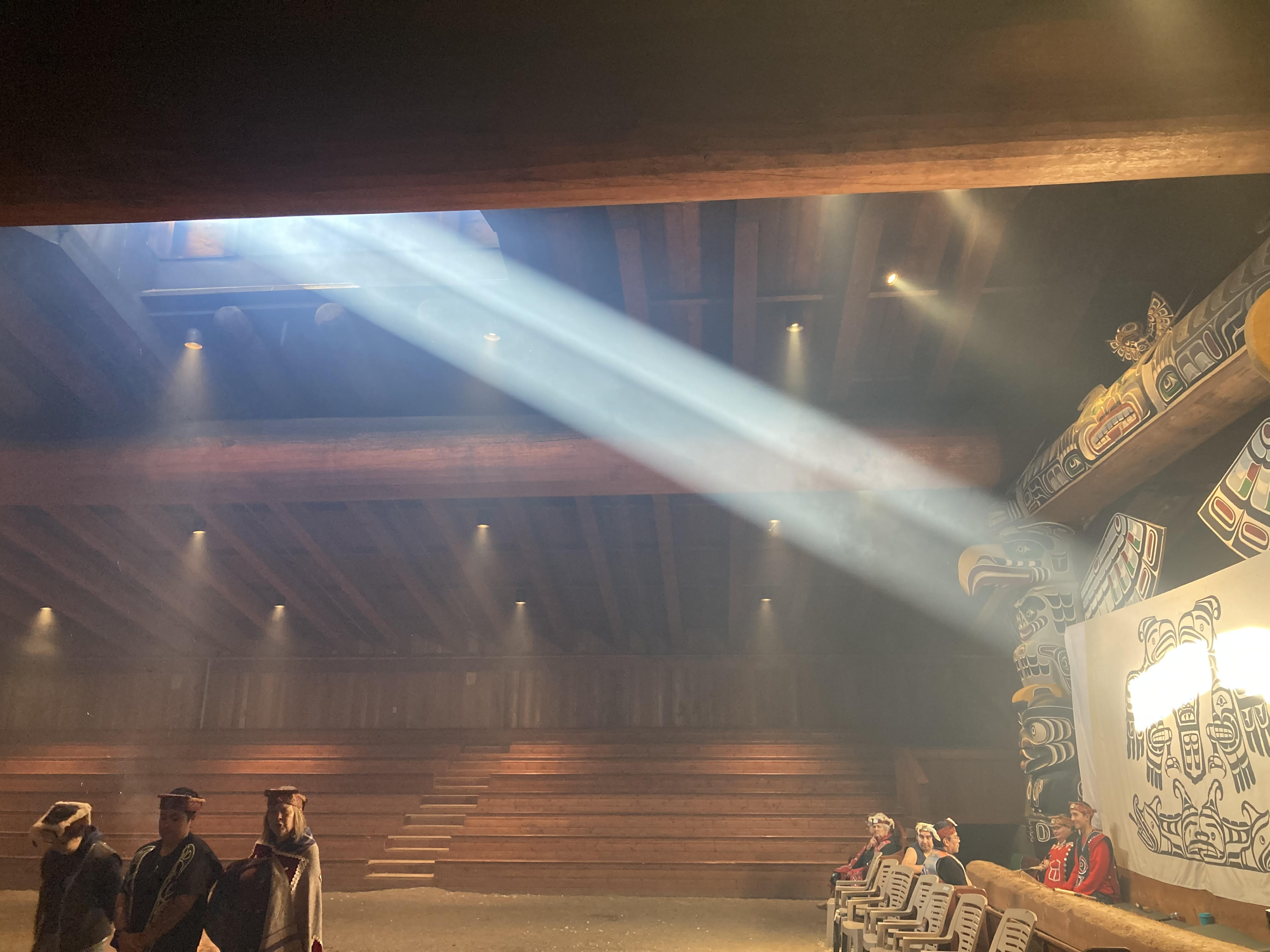
So, walking through a place like the U’Mista Cultural Center in Alert Bay feels like something of a miracle. Referred to by the Namgis First Nations elders as a “box of treasures” the museum is chock full of regalia, masks, and artifacts, some of them of pre-contact vintage. Some are so precious that they have been given a special room where photography is forbidden. Stepping into this space with the same layout as a traditional Big House feels akin to walking into any holy place.

The big house in Alert Bay, British Columbia.

You can feel the age. Hear the whispers, the songs, the banging of drums on a stormy winter night while the wind howls up Johnstone Strait. For decades, potlatch ceremonies were forbidden by the Canadian government. The gatherings led to arrests and the confiscation of artifacts, language, culture, a way of life. It wasn’t until the Cultural Center was built that the regalia and masks were returned.

I kneel in front of an ornately carved orca, done in the classic form line design of the Pacific Northwest. The calls of the northern residents ring in my ears. Oral histories tell us that the “blackfish” swam in pods so thick that you could leap across their backs from one side of the strait to the other. Guess who likes the sound of that?

Black and white photos of old village sites, many long abandoned, run along the hallway. I know a lot of the names, or at least the ODWG (Old Dead White Guy) names of these islands and channels and coves.

Even after years exploring this coastline and probing the beaches, I know nothing about this place. So many remain just names on a map and nothing else. I thought that my wandering would be satisfied with that. That I could leverage my new life and travel wherever Lindblad was willing to send me.

A Patagonia contract looms. What are southern hemisphere glaciers like? Or humpbacks? Orcas? Do penguins smell as bad as everyone says they do? I’m intrigued, excited, thankful. But there’s a bungee cord tied to my heart. Any time I step too far from the B.C. coast, the cord goes tight and springs me back.

It has been six years since I hugged Paul Spong on the Alert Bay dock, promised to keep in touch, and boarded the ferry. 12 years since I first shouldered my pack and boarded a bus in Vancouver for the region that is my birthplace. The symmetry is not lost on me. All it took was U’Mista, an orca carving, and some black and white photos, to tell me that I don’t need to travel the globe to find myself. To be fed. To heal.

There are places where I have left beached my kayak, stepped into the woods, and felt a presence. Without fail, I would find evidence of human life.

A scarred tree where pitch has been harvested for fires. A strip of bark peeled from a red cedar. The miracle tree that could be lived under, paddled, and worn. A flattened divot where a house once stood. Wooden poles of an ancient purse seiner.

I step outside and look over the water. A southeast squall is rolling up the strait, but the rain has stopped and the sun bleeds through. I can see my wooden kayak rolling in those waves, battling the passage from Port McNeil toward Alert Bay.

This place is full of memories. Many beautiful, a few painful, others bittersweet.

But something it is abundantly clear. This place isn’t done with me. In what capacity or function I don’t know. The time has come to migrate back. To step into these woods I want to know, to feel that presence and sleep on that moss. Hear the wolves and watch the seals. Rivers and roads led me north, but at some point, in some capacity, I always knew they’d lead me back here.  

The Changing World of Elfin Cove

Greg Howe seems to think the outboard is fine. I’m certainly not inclined to argue. He’s been here four decades, I’ve been here four days. If he thinks the engine is reliable enough to get us across South Inian Pass I’m going to believe him. But I’ve had an outboard die on me. Twice it’s put me on the rocks, once in British Columbia, another time north of Juneau. They make for great stories, but with an east wind of 25-knots and the open ocean an arm’s length away, I’m not ready to revisit the stomach dropping sensation of a coughing Yamaha.

Greg and Jane Button’s boat the Via has a covered helm with a bench seat for two people and another one directly behind that faces backward.

“Wear your rain pants. You’ll get wet.”

Brittney and I huddle on the seat and watch the Hobbit Hole disappear behind us. With no hesitation Greg takes us into Inian Pass, and for who knows what time, makes the 20-minute trip to Elfin Cove. In its heyday Elfin Cove was a commercial fishing hub. From there the treasures of the northern panhandle was at your feet. Salmon all summer, Kings in the winter, halibut right off the dock. Greg waxes about days with forty fishing boats in the Hobbit Hole’s inner cove. For not the first time I wonder if I was born too late. Trolling Inian Pass and Soapstone Point circa 1955 sounds like Nirvana. It’s a tale of tragedy told and retold up and down the coast. Even in Alaska, the last frontier, the land of opportunity, the land of inexhaustible natural wealth, locals can feel the spoon hitting the bottom of the bowl.

Elfin Cove is a shadow of its former self. The tale of west Icy Strait is not all that different from Northern British Columbia where we spent the last three winters. A place defined by fishing that has been strangled by dismal returns and a changing climate. Homesteads and outposts used to dot these places. Now they are only relics of an age come and gone. Another victim of the good old days. The Hobbit Hole and Elfin Cove stand as guardians of another time. And Elfin remains mostly as a seasonal town populated by sport fishing lodges.

The run across Inian Pass is eye opening. Steep cliffs are barren of vegetation thirty feet above sea level, marking the height merciless winter waves can hit. We hug the shoreline of Chichagof Island. I point across the pass to the mainland and the boundary of Glacier Bay National Park. The Brady Glacier glows in the gray light of winter. The open ocean, the swell visible as a steppe ten feet high awaits any foolish enough to run the outer coast. Hands down it is the wildest scene I’ve ever laid eyes on. How have I lived ignorantly at the step of this country for years and never ventured this far? This place is in my blood already.

We slip into Elfin Cove, a long narrow cut in the Chichagof Island shoreline where the wind funnels down the steep hillsides and adds frothy whitecaps to one-foot waves. Most of the buildings are up on pilings and hover over the water on high tide. A few are built into the mountainside, but it is a place of boardwalks. There are no cars here, there never will be. But beyond the charm of the place is the eerie vacancy. Clues of a previous grandeur are everywhere. A school, a post office, houses pockmarked up and down the inner cove. But there are no people.

That’s not entirely true. There are five people here in winter. The shop is open three hours a week. 1-2, Monday, Wednesday, and Friday. As we walk along the boardwalks I hop between feelings of awe and the eerie silence of another small community gone to seed. We pass fishing lodge after fishing lodge boarded up with No Trespassing signs hammered to the fence. Like their clients, the owners are South for the winter. They’ll arrive in the spring, fish the dickens out of Cross Sound, and then take their fish and money back South with them. It doesn’t feel right, the consumption of so much taken by so few. Greg’s an old commercial fisherman, a champion of Alaska’s fisheries, a commodity he calls, “the people’s resource.”

“Very few can afford to come up here and fish for a week.” he explains. “And those that do take more than they can eat. It gets thrown out in the spring, they come back, and do it all over again. More people can go to Costco and buy a fillet of Alaskan Halibut once a week. Which one is the better use?”

There’s a look of nostalgia on his face. Memories of people in Port Althorp and Gull Cove and Mud Bay. Of fishing boats working The Laundry and Soapstone and stopping at the Hobbit Hole for dinner. Like much of the old west, the big east has chewed it up and swallowed it. Three times he tells stories of the fishing life, the culture of “Icy Straits.” It’s a tradition I would love to see honored. Commercial fishing shaped southeast Alaska, for better or worse. It’s an occupation that brought many to Gustavus, Hoonah, Elfin Cove, and Pelican. It was our lifeblood, a means that opened the door to many of the current residents of this place.

Back at the Hole I poke through the detritus of the homestead. Countless fishing buoys, crab pots, line, and hooks fill a storage shed. There’s such a contrast between what this place was and what it will become. A place that feeds the bellies of humanity to one that feeds the mind. But indirectly, I believe the goal remains the same. To make people fall in love with this place. To keep them alive, and to convince the world that we cannot survive without them.

Westeros

The Inians are splayed out like a handful of watermarks. Inians. Such an odd name. Even Zach isn’t sure where it came from. Like someone started to write Indian and lost interest halfway through. But we know where Hobbit Hole comes from. Zach’s mother Carolyn christened it long ago because “The Pothole” was just too secular, and Hobbit Hole is a much better name.

The little archipelago is sandwiched between some of the wildest water on earth. To the west is Cross Sound, which should be renamed “Small Craft Advisory Pass.” Even on days where the wind blows from the east ten knots or less, the ocean swell sends six foot waves crashing against the westernmost islands.

Icy Strait lies to the east, an indomitable stretch of wild water in its own right. Bracketing and connecting these two bodies of water are North and South Inian Pass. The nautical map we’re studying holds a warning both exciting and intimidating.

“Tidal currents in north and south Inian Pass can reach 8-10 knots. Mariners should use extreme caution.”

Extreme caution? Who knew there were categories of caution. What exactly would constitute minor or moderate caution? Staying home would be exercising all the caution. But if that was the case, there’d be no reason to be here.

We load a pair of double kayaks. Brittney, Zach, Laura, and myself have the hair brained idea of exercising minimal caution and paddling to the westernmost island in the Inians, an unnamed chunk of land stretched vertically as if the very pounding of the oceans storms had flattened it. It’s an island that, as far as we know, hadn’t been walked on by Xtra-Tuffs in a long time.

We name it Westeros, which sounds like a rejected Middle Earth landmark, and set off. From atop the main island yesterday, Zach and I saw an exposed peak on Westeros. A peak that would offer a 360-degree view of open ocean, Chichagof Island, the Inians, and the Fairweather Range/Glacier Bay. We cross the half-mile wide channel between Westeros and the other unnamed island in the Inian cluster. This channel was nicknamed “the laundry” by commercial fisherman because trying to cast nets in the channel on the flood was like being in a washing machine. A rock cliff on the east side is covered in graffiti, the signatures and dates of the boats that had anchored here. A good luck charm they said, at least until a boat sunk the day after scrawling their name on the granite.

We find a beach to land, tie the kayaks to the alder, and disappear into Narnia. There is a sense of wildness here that is not captured many places. A sense, some sort of intimate knowledge that man has not treaded here. And if he did, he did so with a light touch, without staying long enough to leave a mark. We scramble up a hill covered in the loose shale of the island. Atop sits the bones of a fawn. The tiny scapula and ribs bleached, the white stained with the green of the forest that is consuming it. The ribs are the length of my middle finger, delicate and innocent.

Trails criss cross the hills and cliffs. The deer are here. Zach looks slightly disappointed at leaving the rifle behind. After our big Coho day in September, harvesting a deer seems like the next natural step.

We follow the trails whenever we can, trusting they know the easiest way up steep cliffs with loose rocks, rotten tree trunks, and squirrely roots. The vegetation is not what I expected. Banzai shaped mountain hemlock and shore pine dot the island, grasses grow on the south facing slopes, muskeg gives off the impression that we are walking through a frozen Serengeti.

“How many people,” I wonder aloud, “can say they have walked in a place where no one else ever has?” The percentage has to be less than 1%. For the frontier is no more. Google maps has plastered everything, for better or worse. But here one can escape this discouraging fact. Here there is just us, the deer, and a Rock Ptarmigan in winter plumage. White as a ghost it sits beneath a banzai hemlock, it’s head twitching back and forth as we creep past and above it for the summit.

It has been 24-hours since I stood on the peak of Westeros and it is that summit that has made me appreciate John Muir all the more. For Muir wrote beautifully of course, but his amazing ability to capture the natural wonderment of this place and convey it in words is second to none. I am simply not gifted enough to do it justice. But imagine a 360-degree view, each 90 degree turn offering a completely different vista of breath taking beauty. An open ocean view that spans to a horizon that is almost dizzying. Horizontal vertigo, it pulls in and pushes away at the same time, like the swell that pounds at Westeros.

Chichagof. Tall hills covered in snow, unpassable thickets of devils club. Streams thick with salmon eggs. Brown bears slumbering in caves and beneath deadfalls. The Inians and the Hobbit Hole, the last of the homesteads. And the Fairweathers. Oh those big snow coated mountains, shining so unashamedly bright they hurt the eyes. Brady Glacier flows at the feet of La Perouse and Crillion. Peaks that are over 11,000 feet high. All hail the glacier makers. What would the leaders of this world think if, just for an hour, they could sit here and do nothing but slowly spin. Would development, profits, winning, still feel tantamount? What if they ate the most delicious sandwich ever made? Ate the carrots of the victorious and guzzled the tea of salvation.

“I feel like this peak needs a name.”

“Not everything needs to be named.” Brittney says. True.

The wind whips from the east. Clouds form in eastern Icy Strait and begin to come our way. Laura points out a Lenticular cloud forming like a hat atop La Perouse. Zach wanders about and finds his favorite Alder tree. It’s chilly up here, it is January after all. It may snow tomorrow. I hope it does.

With a reluctant final glance at La Perouse and its headgear, we begin to make our way back down toward the kayaks. Past the Ptarmigan and along the trails of the deer. Returning the island to its rightful owners.

“This forest is old,” Zach quips, quoting Legolas’ description of Fangorn.

“How old is it?” I ask.

“Very old.”

May it always be that way. We linger on the bones of the fawn again before we slide down the final hill and return from our commune with the gods of Cross Sound. The reality of sea level. There is a shared sorrow at the passing of the little deer. The unspoken irony that Zach wishes to go hunting tomorrow. That we hope he gets one. The painful reminder that to live is to die. And to die is to feed another. I remember Laura landing her first Coho. The grim look on her face as it lay at our feet. Her hand reaching out for the fillet knife.

“I want to do it.”

Brittney repeating the same action a week later. Patrick running his hand down the lateral line of a Coho. The one Coho I landed, stared into its eyes, and then returned. Because for some reason I couldn’t swing the pliers, couldn’t cut the gills. This is life out here. How life should be. Forgive my arrogance.

We paddle out from shore and ride the swell like a couple of murrelets. A sea otter with its pup bobs in the chop. And I am grateful, profoundly grateful that my life includes these people, those mountains, this ocean. The opportunity to come home with dirty Carhartts, numb fingers, and red noses. Zach and Laura’s mission is to ensure that more young people can do the same. That this island cluster would change lives. And as we turn the corner and into the wind, I know it already has.

So This is the New Year

I still wake up hearing them. I still catch myself stopping on the creaking stair, ears cocked, listening to a speaker that’s hundreds of miles away. You don’t quit Hanson Island, and it doesn’t quit you. How can you?

It’s the only place I’ve ever looked up from a stove to see a dorsal fin emerging from the water. It is the place that breathed life into me. That held me close and let me go. That told me that I could do and be whatever I wanted to be.

Gustavus, Alaska feels tame. The biggest hardship is our cistern froze last week and the liquor store is open just six hours a week. Where’s the challenge in that? Where’s the thrill of grocery shopping knowing that if you forget it today you’ll go without for the next two weeks?I’m not entirely serious. Last week I interviewed for a job and the interviewer asked me what my favorite part of Gustavus was.

“Well having a 5,000 square mile national park right outside my door is pretty neat.”

It’s just… different. Not better, not worse. Hanson Island will always be where I cut my teeth. My introduction to the blue and green world. In that way it’ll always be significant. It still astonishes me that we spent three winters there. Approximately 20 months that feel like little more than a blink. Time close to the earth always seems to go fast. You sleep better, eat better, laugh harder, and scream louder. And the time slides by until you’re looking out the window at the rain, know Paul Spong will be there with the June Cove any minute, and wonder where the time went.

I’ve spent most of this winter reading “how to build a house” books, learning the difference between joists and beams, and why 2x6s make good frames (it’s all about insulation).  I’m editing a novel, preparing to send it off, and praying that someone out there digs it. It’s exciting. It’s just… different. Not better, not worse. The roots are sinking in, and most of the time it feels good. For the first time since leaving Juneau we’re surrounded by the people we love. Dear friends who like us have found sanctuary in the outwash of glaciers. But every now and then I walk the beach and stare south, beyond Icy Strait and Chichagof Island. My eyes see past the Myriads and Baranof, through Ketchikan and Bella Bella to rest on a little cedar cabin on the edge of the tideline.

And I see Harlequins bobbing in four foot chop. I smell the rich wood finish of the lab. I hear the ocean’s voice through the speaker next to my bed. I taste salt. I feel the waves pounding the little boat in Blackney Pass. And for a moment I can’t stand it. I’ve got to move, I’ve got to go back. Past one more bleary eyed Prince Rupert border guard and through the Great Bear Rainforest. Part of me will always be 17, crouched on the rocks of Cracroft Island in the dead of night, listening to the A4s swim west.

***

Kim Heacox is a writer, an activist, and will dance and sing at every available opportunity. He’s also my next door neighbor. And he has plans. Like most of us who give a rip about quiet places and open spaces, 2017 was not a pleasant experience. But that’s not stopping him. He and his wife Melanie have a beautiful house and a fantastic library. All their buildings are connected by boardwalk, the road to their house weaves through the forest to spare the largest trees.

They have no intentions of keeping it for themselves however. At some point it will become the John Muir Wilderness Leadership School, the house (one of the few in Gustavus built to code for this very reason) will become a flashpoint of young writers, activists, and leaders. In my head I imagine the place becoming for someone what Orca Lab was for me. A place to find yourself. A place of epiphanies and euphoria. A place of inspiration. A place where perhaps one day I can play the role of Paul Spong; teaching that if cold science doesn’t work, if you look into the world and see something looking back, the best thing to do is grab a flute and play a song. I’m not a scientist. I learned that long ago. But I could be a teacher.

Gustavus is full of people like Kim. Zach Brown is 31-years old and in three years raised more than a million dollars. Now he has the Inian Island Institute, an old homestead an hour west of Gustavus. The perfect place for young people to lose themselves of find themselves, whichever one they need. Because if more people could find their “Hanson Island” the better off the world could be. Reach’em while they’re young. Before the allure of profit margins and mansions can sink their teeth in.

***

It’s Christmas Eve. Gustavus is wrapped in snow. But over the last few days the temperature has plummeted toward 0°F. Just a little way out of town is the only uphill trail, on the flanks of Excursion Ridge. Patrick Hanson and Jen Gardner pick us up and we kick off our “orphan Christmas.” The sun peaks over the top of the ridge as we climb. The Fairweather Mountains, the tallest coastal range in the world lords over our little hamlet. Glacier Bay is just visible, crawling up to the mountain’s feet.

The freezing temperatures have coated everything in crystalline hoarfrost. Snow flakes stand out, perfect little gems. Delicate but incredible versatile. Recent research suggests that at the center of each flake is some sort of microorganism, some microbe the frozen liquid could glob onto. At the center of Gustavus is the people. Something that everyone that has arrived here can attach to. It’s not always easy, but if you allow this place to form you… what can you become?

We reach a shelf on the ridge and Patrick, as he always does, has snacks. A sip of coffee, a bite of gingerbread, a shot of whiskey. It is Christmas after all. From here Gustavus doesn’t appear to exist. Nothing but trees, mountains, and that bay. More than 100 years ago, A.L Parker climbed this same ridge, but from the other side. And when he looked down on the Gustavus plain, he knew that he had found his home.

I can understand why. Something in that smooth, flat plain surrounded by mountains screams at our most human instinct. I look out over the strait and south. I X-ray through the archipelago and Queen Charlotte Entrance. I still see that cabin. I always will. I’ll be back. Patrick cracks a beer and hands it to me. It is Christmas after all. And if I have my way, I won’t be coming back alone.

Owed Nothing, Given Less

It still doesn’t quite feel like Spring. At night the wind still blows and swoops beneath the elevated porch to chill the wooden floor. My toes are still perpetually cold, the rain still shivers as it runs down the spine. The ocean feels empty. I find relief in the cold. We inhabit the one thin band of North America that’s colder than average. While the rest of the continent is thrown into climate chaos it feels as if we’ve been set aside. The Raincoast anointed and protected. We shiver and run the woodstove while Gustavus is bombarded by blizzard after blizzard. It feels as it always has. And with it returns my desire to disappear from a world on the edge of chaos.

How many times through the history of man has a generation stood on the precipice and wondered if this is the end? We’ve had the Plague, Nazi’s, ice ages, a Cold war, and Vikings. Human history is littered with beastly actions and selfish desires. Perhaps that is what makes this whole affair so sour. It is but a cruel reminder that we are not improving. I have accepted that mankind will never be satiated. Whatever we can reach we will punch, scratch, and devour until we get it. Whether it’s oil in the Refuge or the last piece of cake at a wedding. Evolution has sculpted us to look out for ourselves first, our family second, and others never. That doesn’t make us different. That makes us animals.

But as our opposable thumbs allowed us to rise above the crushing weight of Darwin’s theory, the fundamentals of human ecology shifted. We no longer had to look out for just ourselves every waking moment. Civilization at its core is designed so that we would no longer have to live such a cut throat existence. We shouldn’t have to be like Brown Bears, who murder the cubs of others so they can mate with the sow and pass on their genes. We could rise as one. Carry each other and embrace our differences. Together we could be stronger, tougher, invincible.

Except that isn’t what happened.

For that DNA is still encrypted within us to get what’s ours, what we deserve, what we’re owed. We’re still trying to eat each other’s young.

“The world owes you nothing,” my Father once told me.

But what world was he speaking of? We talk about it not being a perfect world, a hard world, an ugly world, a difficult world. A world that is unfair and harsh and unforgiving. And when I walk the concrete world I agree. Indeed that world owes me nothing. In fact if I want anything from that world I must pry it from its cold dead hands.

A couple weeks ago my brother was in a car accident. He wasn’t hurt, but his car was totaled. In no way was he at fault for the accident. Yet at the end of the day his insurance company gouged him for $2,000 while he wound up with an older car than he had.

The world owes you nothing.

The world that profits from the misfortunes of others is a broken one. A world where pharmaceuticals and insurers dangle the carrots their patients need to survive over a pit of debt and overage bills. A world rich off the loans of millions of students. Forget owing you nothing. That world doesn’t even offer anything.

But as I sit at this table, in this little wooden house, and watch the tide rise and fall. I see a world that is not harsh or unforgiving. I see a world that is simply the way it is. The ocean is not out to profit from my misfortune. If I make a mistake while I paddle or ride on its surface, it will punish me. And punish me harshly. But not for the benefit of itself. The ocean is not getting rich off my mistakes. It is simply the ocean. The wind is howling, and at any moment a tree could come crashing through the window. It could shatter the glass, pin me to the ground, snap my back in two.

This I can live with. I’ve accepted that at some point this beautiful green and blue world could pull the oxygen from my lungs and extinguish my soul. Better them than the pharmaceuticals or Blue Cross/Blue Shield.

My world owes me nothing, because it’s already given me everything. It’s given me fresh air and clean water. Soil to grow my food and an ocean that brings me salmon. A forest full of lumber to build shelter and a never ending parade of adventure and mystery. The world we left provides more than the world we’ve created. It didn’t have to be that way. We could have done civilization right. But whether you believe we’ve been here 6,000 years or 600,000, whether it began in a garden with a snake or a puddle of primordial ooze, we have failed. And we are paying the ultimate price.

The older I get the more simplistic I wish to become. I dream of gardens, of water tight roofs and insulated walls that keep the heat in. I dream of late nights with my best friends drinking home brewed beer. I dream of big laughs, big dreams, and the irreplaceable joy of looking at life and saying “enough.” I dream of a world where land is not seen in terms of quantitative value but spiritual value. That we would discuss how a place feels instead of what we can squeeze from it. I dream of a people that sees a green and blue world and feels an innate desire to come home.

Because we’re coming home no matter what. This. This concrete world we’ve created, it’s going to come crashing down. It could be tomorrow, it could be in a century, but it’s going to happen. And we’ll go down with it. With one last weekend of football and a cold Bud Lite. And when the lights go out and the faucets run dry, what will be left? Will the world that owes you nothing be there to pick you up?

I’ve said it before and I’ll say it again. I’m not just trying to save the trees, whales, and bears. I’m trying to save myself. It’s a selfish fight. I’m still in this for myself. I’m not that different. In a few months the sound of a chainsaw will rip through our four acres of paradise. Cottonwood, Spruce, and Hemlock will fall with a crash so that I may build and live where they stood. Man is a destructive species.

I’m building to prove to myself that man can still do it. That self sufficiency is not just the stuff of hippy co-ops and and cheap jokes. But I’m also doing it because I don’t have a choice. I have been weighed and measured by the concrete world and found wanting. So I will build on the world that has accepted me, that will accept any of us. Mother nature is a forgiving caretaker. She makes but one request. Take care of me, respect me, and in turn, you will have all you’ll ever need. Don’t mistake need for want. There is no iPhone tree. When the lights go out and the cell towers fall, I’ll be looking for a carrot and a cistern.