Tag Archives: trees

Chop Wood and Haul Water

You don’t hike through salal; you swim through it. Buried in an acre-sized grove, I stand on tiptoe, gazing at the island of hemlock ahead. In my mind, salal was just a hybridized version of discount alder. A nitrogen fixer thriving wherever sunlight poked through the clouds.

I breaststroke another few feet, struggling against the plant’s willowy but strong branches. The individual plants weave together like plywood, forming dense barriers that feel like drowning. I try a few more desperate strokes, pause, and look around. There’s supposed to be a trail somewhere.

I plunge beneath the surface, crawling under branches instead of through. Things look clearer down here. Something resembling a deer trail cuts through the maze. More tunnel than path, it’ll have to do. I reach for my phone and stare at the little orange triangle. GPS tells me the Hanson Island summit is just a few hundred feet ahead. I wiggle a few more feet, wondering why I didn’t do this long ago.

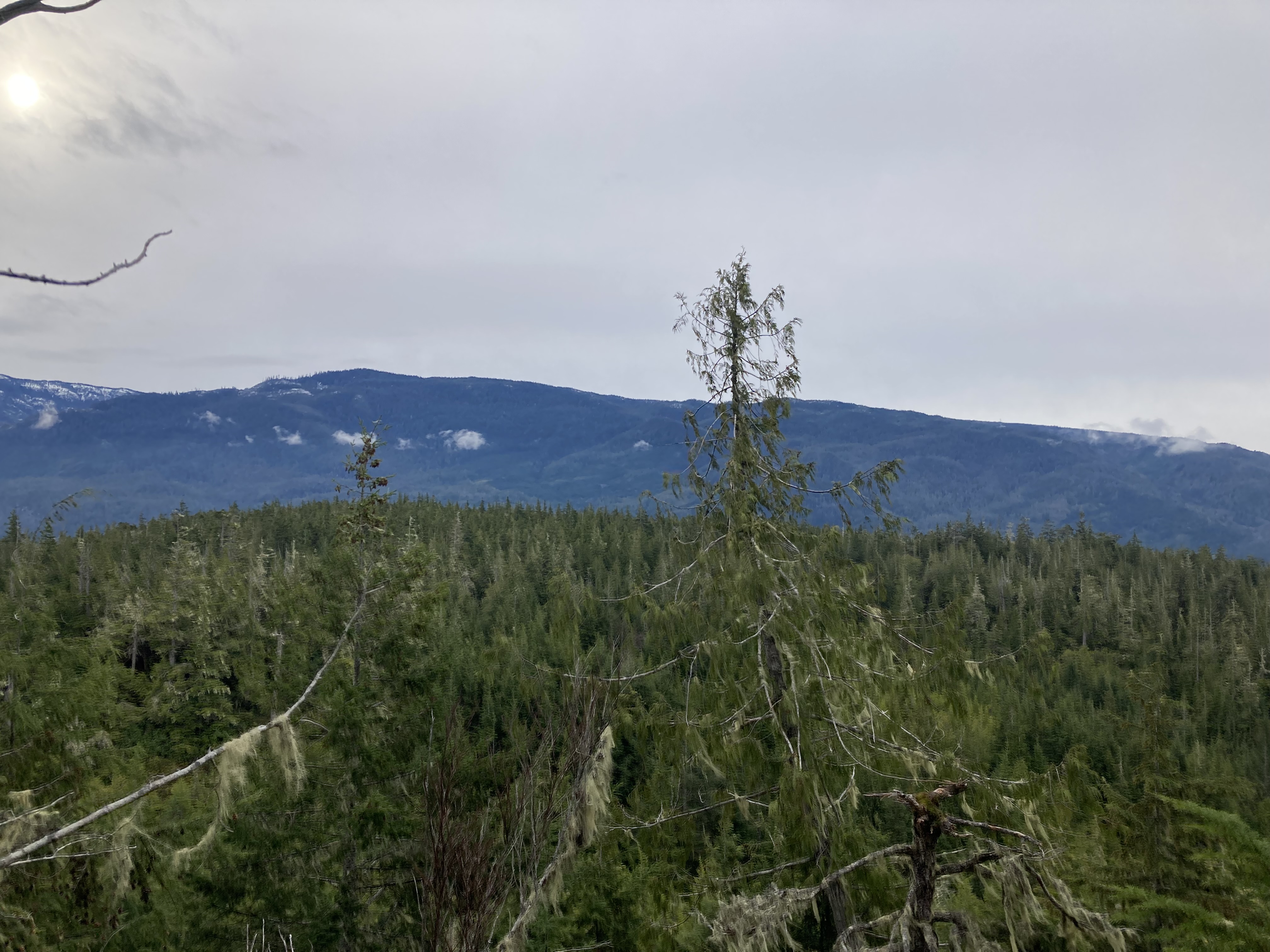
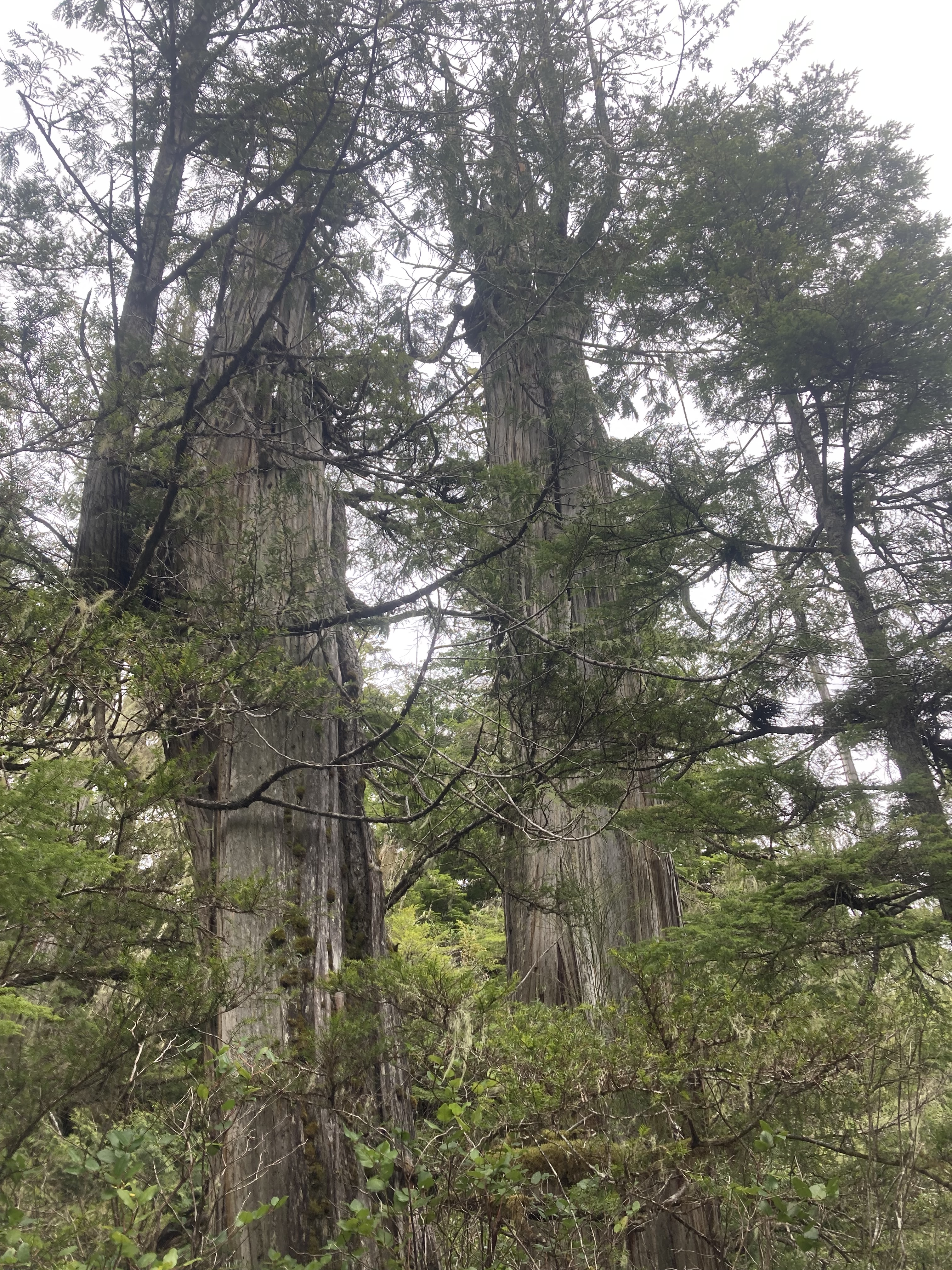
I’d be lost without my phone. It’s hard to admit, even by myself, without so much as a raven to judge me. The salal thicket blindfolded me, the small drainage spun me, and the few windows of sky reveal nothing. I follow the crutch in my hand, allowing it to guide me up one more embankment. A trio of big cedars with intertwined limbs shade a clearing festooned with deer beds. I push through one more wall of salal and gaze from the summit at Vancouver Island’s distant ridges. The hillside steepens, leaving just enough room for a viewshed and a clearing of rocks and lichen. I squeeze fatigued legs to my chest and stare at undulating greens and blues.
***

Harlequin ducks squeak in protest as I paddle by. They take to the water, necks bobbing forward and back as if to give themselves the illusion of more speed. Their rubber ducky chatter conceals their daredevil hobby of surfing southeasterly waves seconds before they break on the rocks. They dive like seals and fly like puffins, frantically beating their wings centimeters above the water. Every tidal rock holds another cluster of them, chattering away and admonishing the yellow kayak gliding past.

(C) Oregon Department of Fish & Game

Hanson Island crawls by. Every beach beckons to be explored, and twice, I slide into cobbled shores and poke into the woods. I’ve boated these waters dozens of times, always in too much of a hurry to pause. Always hustling either to Alert Bay or back to Orca Lab, usually in fading light or racing the next low-pressure system barreling up Johnstone Strait.

I’m hell-bent on savoring; I linger in non-descript woods for no reason other than they exist. At last, I swing into a narrow bay with steep shores plastered with ochre stars. A lone white buoy bobs at the head, and I pull into a small beach pockmarked with softball-sized rocks.

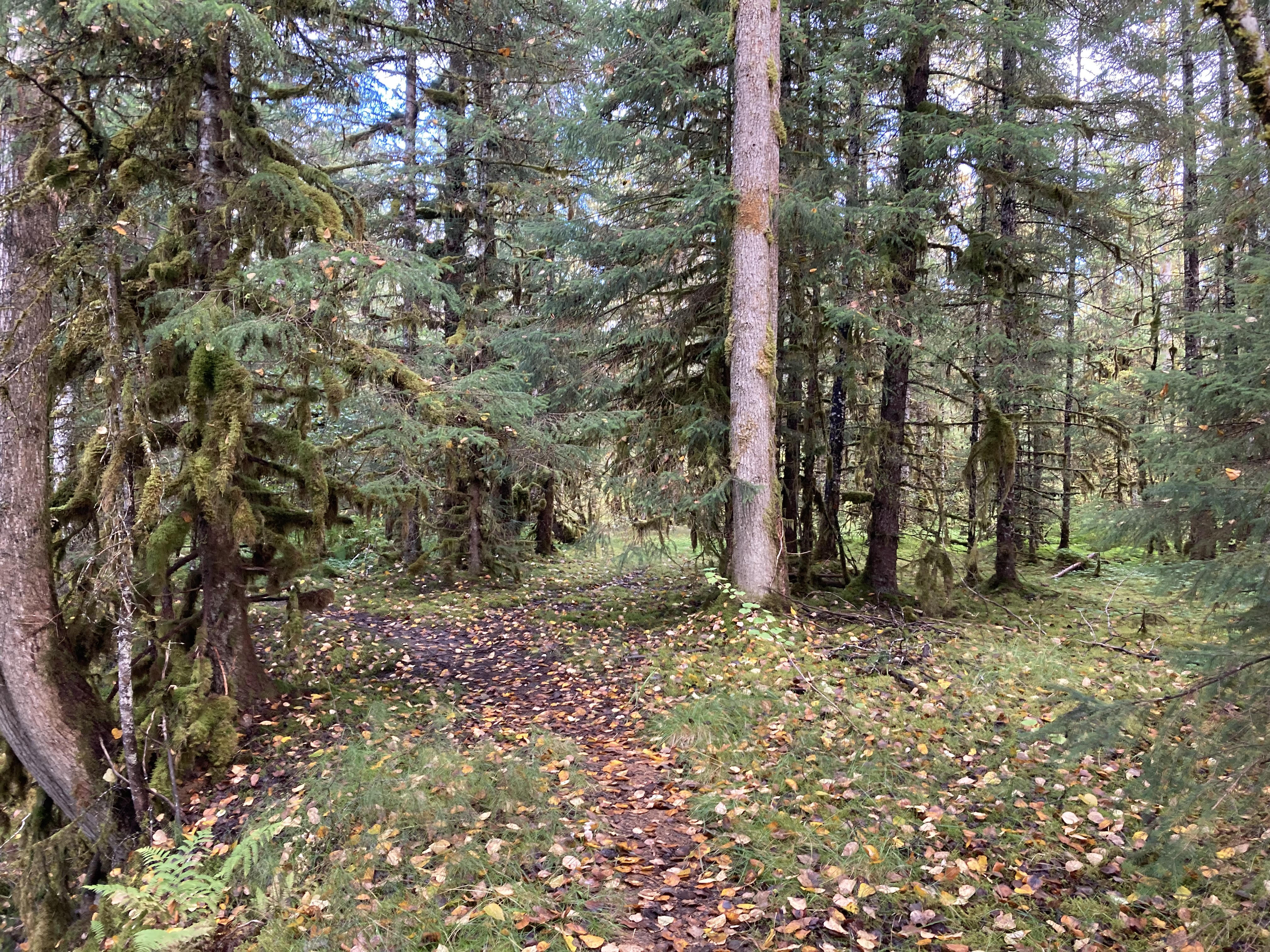
There’s the trail, just as I’d left it, through stands of alder and up a single-lane logging road recolonized by hip-tall hemlocks. I follow the steady incline under fallen trees and around puddles. A smattering of fish cut from plywood marks the trail with engraved names like “Bobby ‘Sparkplug’ Joseph” that demand exposition.

Past a slippery “bridge.” Clear-cuts glare at me—old ghosts rotting in choking shadow from dozens of same-aged hemlocks racing for sunlight. I stop at one such graveyard and try to remember. Had I noticed these old fallen trees in 2015? ‘16? ‘17? Had I been too naïve and unencumbered? Did the umbrella of protection now stretching across the beloved island somehow nullify the millions of board feet already removed?

I continue past spindly young cedars and gurgling streams, stopping at a fence woven with alder and salal. The gate swings open at a touch and the rusty old bell rings. A cedar shingle sign with weathered words welcomes me to “Earth Embassy.”

Trees sway in the wind, but it’s peaceful in the small courtyard between the old ramshackle buildings. Amongst the weathered old shingled walls, fraying tarps, and a bulletin board tacked with water-stained pages stand two new metal signs.  

“Respect this property,” the first sign commands, going on to recognize the site as the home and resting sight of one, David “Walrus” Garrick.

I wait for the creak of a wooden door and Walrus’s long gray beard and mischievous eyes. I listen for the echo of his dog Kessler’s booming bark or the rattle of the steller Jay fed peanuts every morning. But it’s just me in this quiet shrine with the work of one man’s lifetime.

The closest thing we had to a neighbor, I frequently made the hour-long hike from Orca Lab to Walrus’s. Equal parts Gandalf and Dumbledore with a liberal sprinkling of Original Trilogy Obi-Wan, Walrus would crack beers and tell stories he’d undoubtedly told a million times.

Wide-eyed, I’d listen to this living oracle talk about the founding of Greenpeace, protesting seal hunting in the Arctic and working as a cook on the first anti-whaling vessel before the Discovery Channel and Sea Shepard mainstreamed it.

The stories culminated in this place. His final act. The one he’ll be remembered for.

“The longest active roadblock in Canadian history,” he boasted, gesturing at his uninsulated cabin with a leaky vapor barrier, no insulation, and a smoky woodstove.

As Swanson, Cracroft, Parson, and Vancouver Island were stripped clean of timber, Walrus crawled sans-GPS through the salal to document the one thing that could spare the island known in the Kwakwaka’wakw language as Yukusam (‘shaped like a halibut hook’).
***

Red cedar is more than a sweet-smelling, rot-resistant wood that burns hot. Christened the ‘Tree of Life’ by the B.C. Coast’s First Nations, the tree was both canoe, house post, clothing, and basket. Centuries before the idea of forestry was an Anglo-Saxon fantasy, a natural ethos of conservation was a mainstay in Indigenous culture.

Life may have revolved around salmon, but cedar was the tool. Young cedars growing straight and true were set aside. They could be a basket today but, in a few generations, may be large enough to become a canoe, totem, or a corner house post.

Other trees were selected for bark harvesting. Outer bark was collected by making long, skinny incisions, which could then be dried and weaved into water-resistant clothing, baskets, even hats. The same oils that make cedars rot exceedingly slow even served as a natural bug repellent.

Instead of killing it, the harvesting increased the growth rate as the tree covered the exposed area. A cedar could rebound, survive, and even thrive if not too much was taken. The most formative and compelling case for conservation. The best argument that sometimes the word “enough” is the most important.

Prospective logging companies brushed aside the importance of Yukusam’s, “culturally modified trees” (CMTs), claiming that their in-house research showed there were only a couple hundred. Walrus and his team lived out of their active roadblock and pushed into every unlogged nook and cranny, documenting over 2,000 CMTs. For a region and people that had endured disease, assimilation, fish farms, potlatch imprisonments, and the heinous era of residential schools, CMTs are one of the remaining cultural touchstones. Carpet bombing Yukusam would be akin to nuking one of the few remaining strongholds.

Lawyers lawyered. Judges judged. Juries… juried?

And in the end, the remaining Yukusam old-growth was set aside. Walrus continued to live on his active roadblock, building gardens, cultivating shiitake mushrooms, and befriending the local steller jay population. The next generation of Kwakwaka’wakw filtered through the homestead, where elders taught cedar bark harvesting techniques.

Photo courtesy of Sharon Eva Grainger

These same Alert Bay residents pushed fish farms out of much of Kwakwaka’wakw territory, spurring returns of chum and pink salmon not seen in decades. It would be foolish and irresponsible to credit Walrus with this local revolution, but I wonder if seeing the power of a small team of forest-dwelling activists was another dry piece of kindling on an already growing fire.

***

For three winters, Walrus told me to climb the trail to Yukusam’s highest point. I’d smile, nod, and instead would walk back down the abandoned logging road for Orca Lab, unable to ascertain why. As my final winter as caretaker came to a close, I hiked to Walrus’s for the last time with a backpack laden with groceries. A nasty cough was making it harder and harder for him to lug supplies from sea level to 350 feet. Every couple of weeks, I’d arrive with a loaf of bread, eggs, and a couple beers.

“Did you get up the hill?”

I shook my head, feeling his disappointment, before grasping his hand and wondering if I’d ever see the sweet, eccentric Jedi Master again.

The cough forced Walrus to leave the longest active roadblock a few years later. In 2023, he took his final breath, finally able to breathe deep again.

***

The trail back to Walrus’s is easier to follow on the way down. I tour the old garden and study the pages clinging to the bulletin board. There are maps of the island showing the arterial trails he used to get from one CMT grove to another. Pictures of trees in mid-harvest and cross-cuttings of felled cedars, their age measured in centuries—quotes and documentation of Springer’s homecoming (another story for another day).

Near the front door is a notebook tucked safely in a Ziploc. Inside the little guestbook are the words of those who have visited this place since he passed. I clutch the little memento and stand before his resting place.

Before enlightenment, chop wood and haul water.

After enlightenment, chop wood and haul water.

I open to the next blank page and stare for a long time at the empty lines beneath my scribbled, “Dear Walrus,”

 It is somehow lifetimes and seconds since I was here… the longest active roadblock remains intact.

I finally made it up the hill. You were right, it is beautiful. I should’ve done it sooner, but I’m thankful I could return and make it happen.

I’m not who I am without Yukusam. It was orcas that drew me, but that’s not what brought me back. This place is green because of you. Cedars stand because of you, though I’m sure you’d brush that aside with a laugh and a cracking beer.

Chop wood and haul water.

The phrase catches my heart; no five words better summarize my post-Orca Lab life. Wood for a fire, wood for 2x6s, and rafters and plywood. The promise of a warm house.
But the words are not simply literal. I repeat them like a mantra, a meditation, a reminder that some things must not be forgotten, no matter where in the journey we are. Ways of life that tether us to place and home and earth. Edicts as sturdy as a cedar house post.

Chop wood. Haul water. Climb the hills. Get dirty knees. Paddle the beaches. Drink the beer. Smile quickly. Laugh loudly. Forgive easy. Let go of anger.

A raindrop hits the page. I bend over and try to say goodbye.

Thank you for all you taught me. It took a while for some of it to sink in; I’ll never be done learning, never be done making mistakes, but I’ll never stop trying. I chop wood and carry water because of you. Rest easy, my friend. The beer is on me next time.

(C) Globe & Mail

I return the journal to a house built by trees to protect trees and retreat down a forgotten logging road that will never continue, forever stymied by a fence woven with sinewy salal and shaded by cedars growing in dignified defiance.  
Sights and Smells

I wonder what’s different.

The transportation for one. Greyhound no longer brings their gargantuan buses this far up Vancouver Island, and as we careen down the narrow two-lane road with six inches of shoulder, I can see why. The playlist blasting in my ears has changed, though I brought back some classics like Death Cab for Cuties’ Bixby Canyon Bridge and Snow Patrol’s Make This Go on Forever.

A myriad of greenery blurs outside the window. I watch these forests differently, too. Oh, my heart still flutters at the boughs of red cedar hiding secret pathways to 6,000-foot peaks. But I also see acres of young hemlocks scrunched together like matchsticks in neat little packages. Phrases like “stem exclusion” and “30-year harvest cycles” whisper with sullen voices. Countless watersheds line the east side of Vancouver, but the Tsitika River I just rumbled past is the only one that hasn’t been logged. Tsitiaka winds through the tallest mountains on the Island and reaches saltwater at a little place called Robson Bight.

Orcas. It always comes back to orcas.

For two days, I have ferried, flown, and ridden from Gustavus to Juneau to Seattle to Victoria and am now just an hour from Port McNeil. Despite my evolving playlist and old-growth forest opinions, it still feels impossible that my first trip to Port McNeil was 17 years ago. Surely it was just a couple of weeks ago that I hopped off the Greyhound. Wasn’t it last weekend that I drove a Nissan Pathfinder up this road with a cat and rabbit in the back seat?

These roads, islands, and waterways hold a lot of the stories and experiences that explain the evolution from basketball boy to kayaker, guide, naturalist, bum, redneck-hippy, writer, conservationist, and whale aficionado. I’m counting on it providing a few more.  

Ferried. Flown. Ridden.

I count the number of petroleum-driven vehicles that propelled me from Gustavus to the footsteps of Port McNeil, Johnstone Strait, and my precious Hanson Island. All to go on one more monkish retreat in the woods and waters of my youth. All to catch one more ride on a boat powered by an outboard motor or go paddling in a kayak made of, you guessed it, fossil fuels.

Too small to tip elections in favor of Mother Earth, I run to my favorite hiding place, sheltered by, you guessed it, Mother Earth.

Blackfish Sound

If the trees are passing judgment on my life choices, they keep it to themselves. If those replanted hemlocks are packed like matchsticks, what happens if one of them lights? I woke to the news that California was burning during the wet season.  A world getting drier, warmer, crazier, more unpredictable. Surely, it would be the earthquakes that doomed southern California. We beat San Andreas Fault to the punch.

***

Don’t cry. Whatever you do, don’t cry.

All those old names:

Blackfish Sound, Pearce Passage, Weyton Pass, Blackney Pass, Queen Charlotte Entrance.

Bold Head and Cracroft Point. Blinkhorn Peninsula and Kaikash Creek.

I know them all, have stared covetously at their little faces for eight years, promising I’d see them again. I’m sure they’ve been getting on just fine without me.

I confess I left my guilt on the Port McNeil dock, catching one more 45-minute ferry ride to Cormorant Island and the town of Alert Bay—the end of public transportation. I wait two days for a weather window that finally comes as low pressure turns to high and the wind pivots from southeast to northwest.

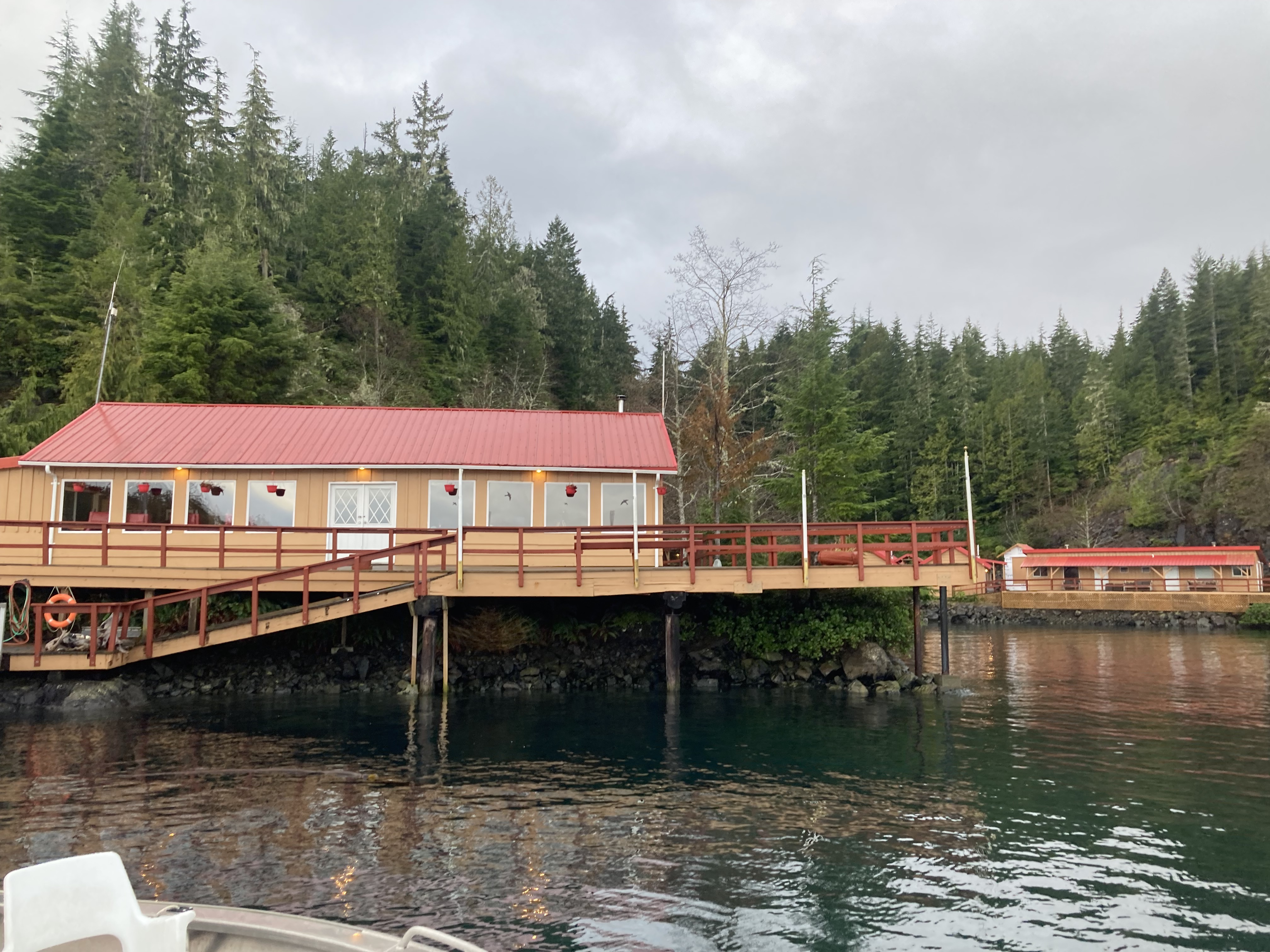
Every town run from Orca Lab to Alert Bay took me past Double Bay, its long boardwalk, floating dock, and cherry red rooftops. I shoulder my pack and follow the other caretaker, Laurene, up the dock. She directs me to a cabin on the right side of the horseshoe-shaped boardwalk, perched on the rocks with a view of Blackfish Sound and the first layer of the Broughton Archipelago’s islands.

The door opens, and the pack thumps from my shoulders. The cabin is bigger than my Gustavus design, with a half-loft upstairs, a functional shower, even a flush toilet. I would have settled for half-a-shabin and a cot. It’s not the high-end amenities that made the pack fall.

Don’t cry. Whatever you do, don’t cry.

Next to the kitchen table is a shelf. On it rests a radio receiver that looks all too familiar. Whether donated or purchased from Orca Lab, the ocean blares from the speakers—water gurgling, a distant boat engine, crackling shrimp. I swear I hear A pod.

“We have a hydrophone at the mouth of the cove,” Laurene explains, unaware I have been transported back in time. “There’s a volume knob on the right—”

“I know,” I interrupt. Not the best first impression.

I cross the room and crank the volume. How many nights did I fall asleep to this? She leaves me to unpack. I move quietly across the floor as if I’m in church. Clothes upstairs, tortillas and cheese in the fridge. Curry paste in the cabinet. I open the wood stove and smile. A pile of ash has calcified on the bottom and shrunk the stove’s space in half—a chronic problem with burning wood soaked in saltwater.

I pry the ash free and grab a handful of piled kindling. With eyes closed, I bring a stick of red cedar to my nose and inhale like an addict, listening to the hydrophone as my head spins and heart palpates. Our sense of smell pales in comparison to most mammals. Yet its ability to conjure memories is undisputed.

There is a smell to Hanson Island I have found nowhere else. Something in the ground, the water, the trees. Perhaps it’s as simple as it remains one of the few islands in the region that has not been clear-cut. Old-growth smells for a land that measures lifespans in centuries and seasons in seconds.

***

I weave between cedar and fir, balance on fallen skyscraper hemlocks, and plunge through salal undergrowth. I squish deer scat between fingers and spy on harlequin ducks perched on rocky beaches. Rumor has it a wolf has taken up residence on Hanson Island. I scan the hills with blind optimism for hazel eyes, ears cocked for the howl that proclaims that there are still things green and wild and true on this burning planet.

The rising northwesterly brings the forest to life with creaks and cracks. I settle against the hollowed-out trunk of a cedar, its innards charred from a long-ago lightning strike. Yes, even here, there can be fire from time to time. The stubborn cedars simply refuse to rot and fall, standing even in death in defiance of the decay and rebirth that comes for all.  

I scratch at the charred bark and sniff. Any smell of fire is gone. The forest around me vibrant and healing. I watch the treetops, content to let the afternoon crawl away. There will be time tomorrow to check in and learn what is expected of me here, how I can give back to this place that dreams of becoming a sanctuary and educational retreat. It took enough petroleum to get me here. I will live, write, and eat in a shelter made of wood. I’ll try to leave this place better than I found it.

Wet earth soaks into wool pants, a pleasant shiver travels up my spine. Ravens cackle, eagles retort. Somewhere, an orca explodes to the surface. I feared two months wouldn’t be enough time to find what I was looking for. But as eyes close and my soul rises to the island’s tallest canopy, I know it’s already been found.

Trails

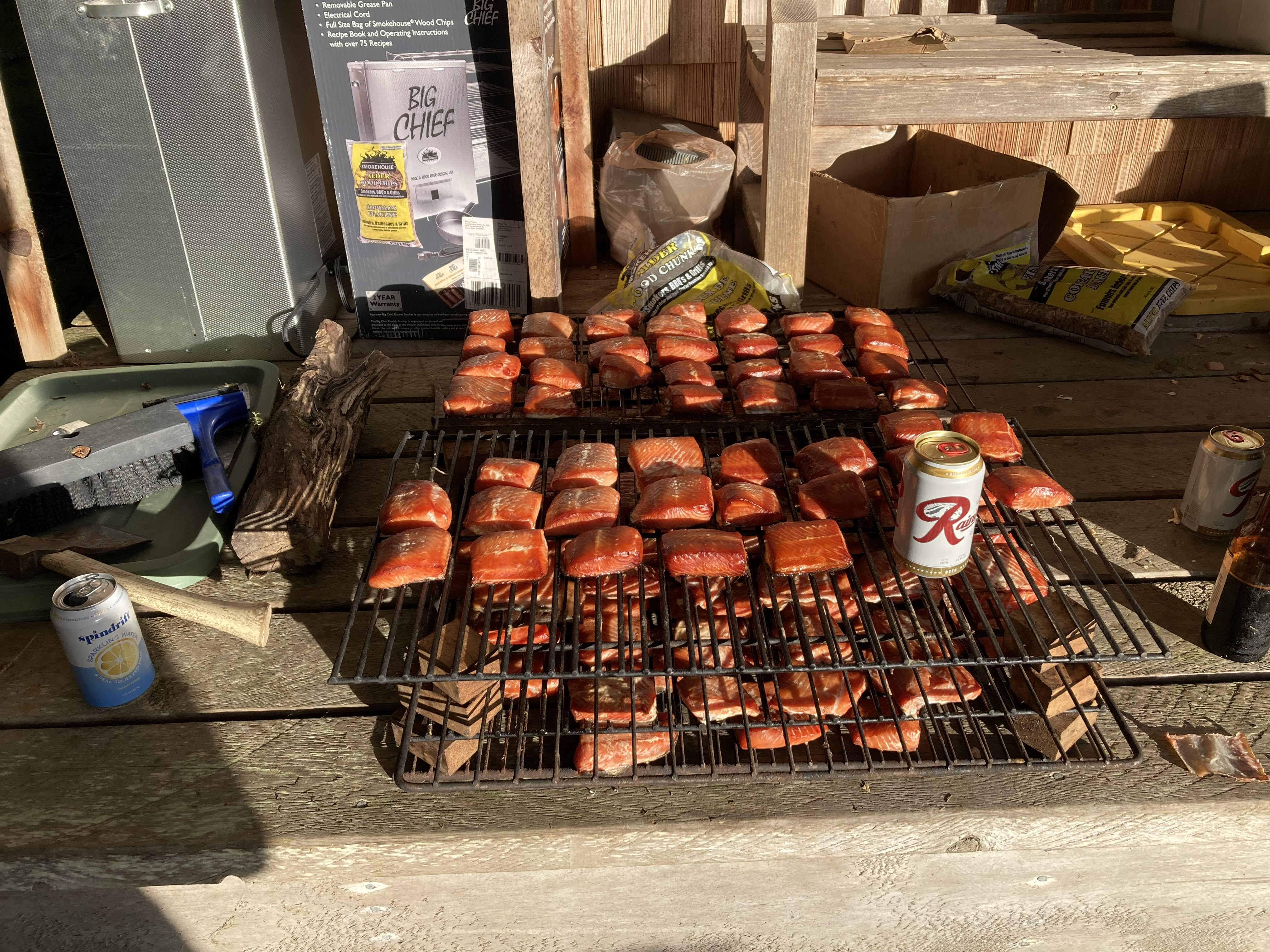
Golden light through golden leaves. Cottonwoods fluttering in a fall breeze are punctuated by random squalls that vanish before I can grab my raincoat. My fingers are greasy with salmon skin and stained with creosote. Sweet-smelling alder smoke billows from the smoker’s open door. I slide racks of salmon between the shelving and nihilistically rub stained hands on stained pants.

I close the door and watch the temperature tick towards 90 degrees. The smoked salmon recipe is as familiar as a warm blanket. Dry brine. Equal parts brown sugar and salt. Soak for four hours. Rinse. Let rest overnight. Into the smoker for four hours at 90 degrees. Bring to 180 over an hour. Hold for another hour. Eat the river.

I plop against a spruce and nestle into the mossy layers coating the ground around Hank Lentfer’s house like a Tempurpedic mattress. I walked past this spruce exactly one lifetime ago, drunk on the prospect of going full homesteader. With covetous eyes, I drank in Hank and Anya’s house and overflowing garden, convinced that this could someday be ours. Nevermind that I initially mistook the smoker for the outhouse.

“Rule number one,” Hank laughed as we walked by, “don’t shit in the smoker.”

So no, I haven’t shit in the smoker, but I have pulled racks of succulent salmon and one luscious deer leg from its innards with the overeager enthusiasm of children on Christmas morning. The temperature hits 90. Six hours begins… now. The stopwatch squeaks, and I set to work peeling bark from a waiting pile of alder.

There are easier ways. Electric smokers exist. Set it and forget it. I could fashion a hot plate and plywood box, eschewing the careful dance between wet and dry alder. Keeping the smoker at 90 degrees locks in the flavor. Slowly raising it to 180 keeps fat from bubbling to the fillet’s surface. I could stop there, slide them into an oven, and let them slow cook to completion. I’ve already hiked miles up the river, fished for hours, and shouldered them to the trailhead. It’s not cutting corners; it’s just practical.

Cottonwood leaves whisper on the gusts. The old rusting stove pops and cracks. Smoke escapes from the shiplap siding. I wander through the woods, sampling high-bush cranberries and following moose trails that terminate in dead ends as if their users apparated on the breeze.

Even in sleepy Gustavus, it’s easy to get wrapped up in the rat race.

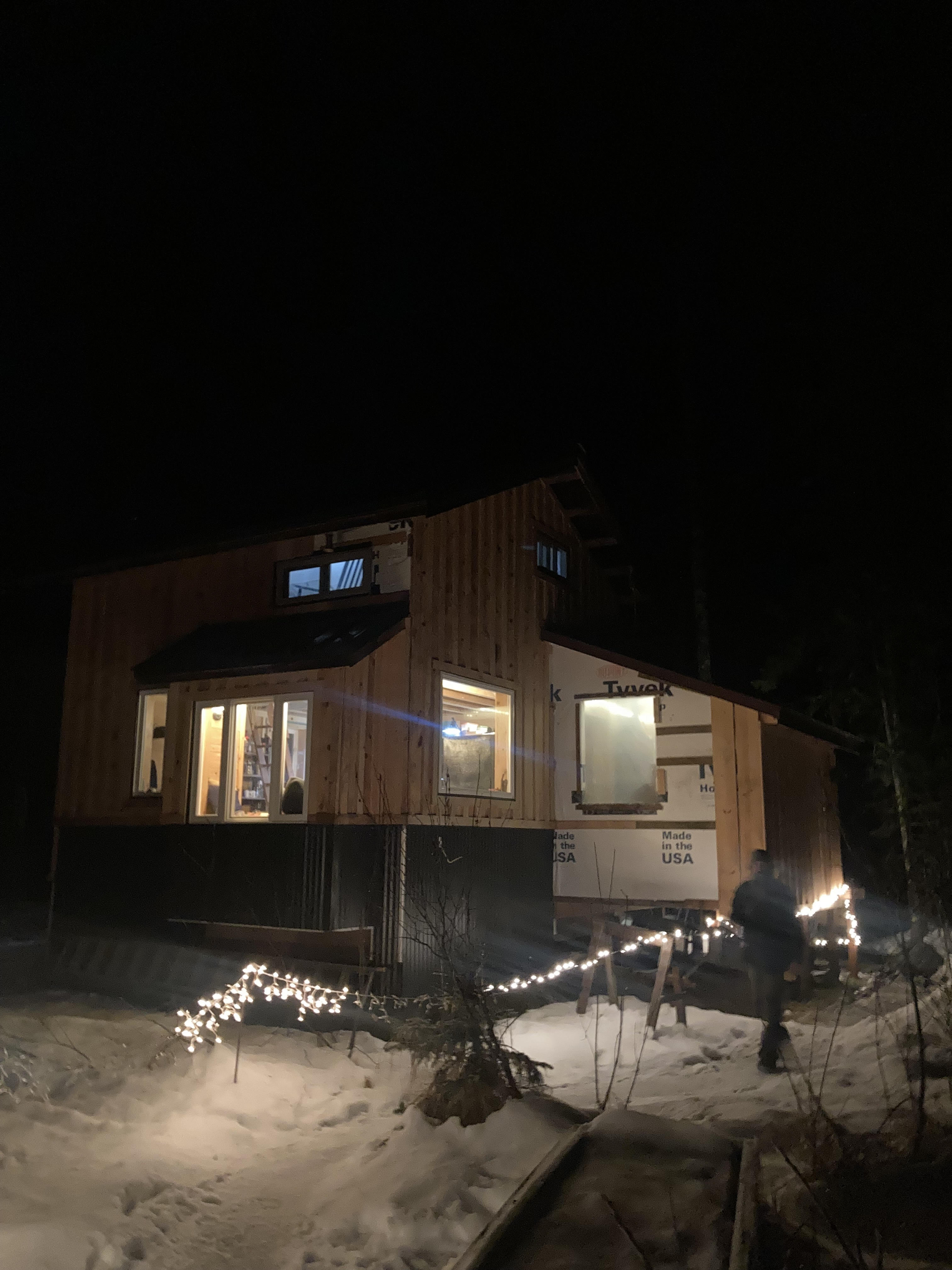
I don’t sit in traffic or attend budget meetings, but the “to-do” list never seems to shrink. A sliding scale of my own tolerance dictates the project list. Tyvek siding is acceptable until one day, I can’t stand to look at it another second. A kitchen faucet emptying into the same bucket for months is now intolerable. The cast iron tub that sat uselessly in the yard needs a home. A trail of washed rock appears and connects the driveway to the front steps. I returned in September, shocked to realize I’d been home less than four weeks since May. The house and property felt neglected. I set to work finding a place for the tub and slapping siding over Tyvek (kitchen sink bucket TBD).

But everything orbits around coho. A sunny day demands a journey up the river. The return of a birthday tradition of camping in the Bartlett River high meadow so I can roll out of my sleeping bag on the first day of my 36th year and cast into the river before I’ve sipped my coffee. It crescendos with this smoker that must be babied and attended to all day. It forces me to slow

All

The

Way  

Down

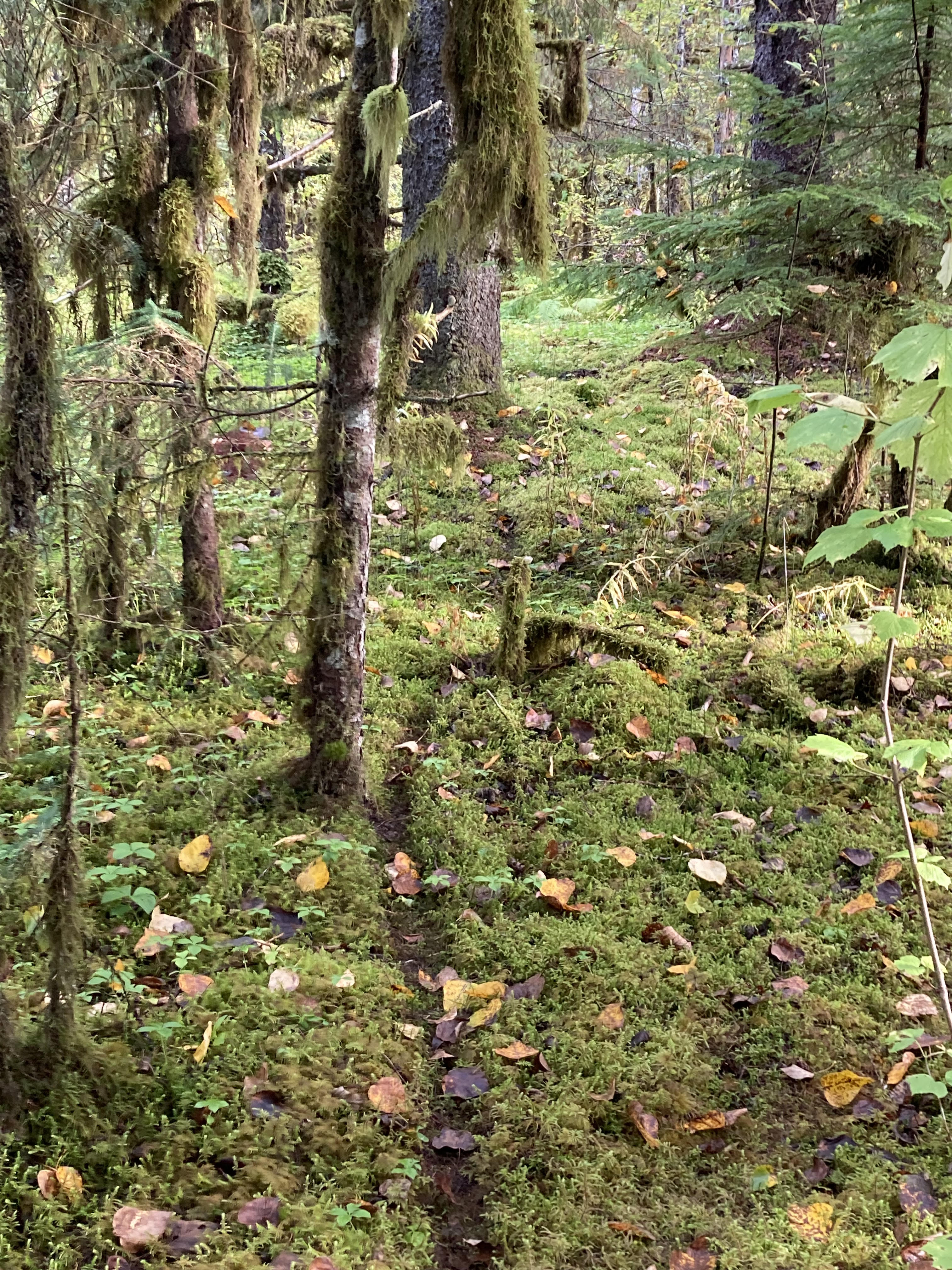
I kneel beside a well-worn trail traveling through the moss. It’s no wider than my forearm, but the moss has turned black and muddy from constant use. The trail connects two spruce trees. Their trunks covered with the shells of spruce cones. I don’t know how many squirrels ping pong between these two trees, but I’ve stumbled into somebody’s critical home. At least a couple of these chattering critters orbit their entire lives between these conifers. Up and down, back and forth, again and again. The patience, the time, the metronome-like consistency to make this trail speaks to a tradition no less significant than migrating cranes and howling wolves.

I run a hand down the trail. Is it possible to envy squirrels?

I think of the dozens of backbreaking trips with a wheelbarrow laden with rocks to form my own pale imitation. My attempt to reinforce the claim that I lived on and loved my swampy bit of land. But there is no substitute for time and the necessary pilgrimages between two trees that give these fast-twitch residents everything they need.

Hour number six slides by. I pop the door with poorly contained glee. Zach and Laura have arrived with their own tote heavy with brining salmon. Together, we shuttle the finished fillets to Hank’s porch, where their toddling son, Salix, is waiting. The door opens, and Hank appears with a quartet of Rainiers. He scoops a chunk of bronzed coho with one hand and flips a squealing Salix over his shoulder with the other.

The cooling salmon are irresistible, and we shovel handful-sized bites into our mouths. Salix takes some of us first uneasy steps, light brown curls reflecting the last of the day’s autumn light. Perhaps my trails will never be so defined. But this place has other sorts of worn and loved indentions to reinforce my connection to home. Spiritual footpaths matter more than worn footprints.

I take a final walk through the enchanted forest, gathering my things and trying not to forget anything. The universe dictates that I must always leave something behind. This week’s victim is a pair of rain pants.

“I’ll try not to tell anyone you left your pants at my place.” Hank texts.

“Appreciate that. That’s how rumors start.”

I pause at the base of the Squirrel Spruce and nestle a piece of salmon in the moss amongst their spruce cone pile. The forest breathes, bracing for a winter as inevitable as a sunset or falling tide. But not yet. We have a few more golden weeks to walk our trails, harvest food, and watch cottonwood leaves fall.

The Building Tree

The smell of two-stroke fuel fills the air. Hands slick with chain oil, metallic teeth glinting in the sun. Behind me the forest is calm, quiet, unassuming. The trail, marked in pink fluorescent tape, billows slightly in the wind. It’s only twenty yards from where I stand to our house site. A site that we’ve exterminated of stubborn willows and optimistic shrubs. I’d be lying if I said it felt good clipping them.

But it’s child’s play compared to what I’m about to do. I grab the chain saw, set the choke, and give the string a confident pull. I’m out of my league. 12 months ago I couldn’t have told you the difference between a joist and a stud. Now, tucked beneath the pages of The Independent Builder is a stack of graph paper, erase marks and crinkles bleeding into the pages. But somewhere along the way, a structure appeared, represented by lead to be built with wood. It looks so pretty and neat with those perfect squares and right angles. Making it come to life will be another matter.

The saw vibrates in my hands as I walk towards my first obstacle. I take no pleasure in felling these trees. But it’s something I’m familiar with. I know how to notch them, make them fall just so. If our winters in British Columbia and the Inian Islands taught me anything, it was how to make a Stihl roar. The first tree is a pine. It looks withered, old and bent. A few stubborn green needles continue to poke from the limbs. If it isn’t rotting already it will be soon. Whatever life it has left ends now. Because I said so. Because 18 months ago we walked onto this property and decided this was where we would live.

With a guttural growl Stihl comes to life, fine papery shreds of bark and wood fly into the air, the sweet savory smell of the forest. Within seconds it’s over. The pine tips and cracks. I lock the saw and scurry for cover. It falls where it’s supposed to, the concussion quieter than I could have anticipated. In the years to come we’re going to need help. Pouring concrete will be like speaking a foreign language; intimidating and embarrassing. At least our inevitable mistakes with wood can be fixed with a cat’s paw if we catch them fast enough.

But this, the Stihl digs into the next tree and it begins to sway, this I can do on my own. No one needs to coach me anymore. And for the first step, simply clearing a path to the house site, it means a lot. It displays at least a modicum of competence. And for my ego if nothing else, that feels good.

Within an hour the path is clear. The final tree falls atop its comrades, the Stihl is extinguished, the surviving forest quiet. I walk back down the gap I’ve created with the simple grip of a trigger and a bit of fuel. Right in the middle of the trail stands one final Charlie Brown tree. The hemlock is only five feet tall, not even worth the saw. But as I stare at it I can’t shake the sensation that it’s staring back. Our land is wet. Last September when the rain pounded Gustavus our water table was plus 18 inches in some spots. The price one pays for a glacial outwash. A few big spruce have bucked the odds to grow 100 feet high. But this is the only hemlock I’ve found. I would no sooner cut this tree than kick a kitten.

But it can’t stay here. The excavator comes in a matter of days, if I don’t take it now it will be run over by the wheel’s of our personal progress. There’s only one thing to do. It must be relocated. We’ll find a quiet and (relatively) dry spot for our building tree. I’m aware of the irony. Saving this little tree when I just felled ten. A home built with the old growth of Chichagof and Home Shore. In no way does rescuing the hemlock acquit me of my lumber consumption. I’m not sure why it means so much. I walk past the homesite to one of the big spruces. The spruce that we vowed we’d never cut. I run my hands along the bark, “I think you need a friend.” 

Concerning Snowflakes

The snow has been falling all night, silent and unassuming. It kisses its brethren as it completes its free fall. It has no control over where it plummets, it can be a glacier, a snow ball, a soft white ornament upon a tree limb, or it can land in the unforgiving waters of South Inian Pass, fusing with its liquid cousins.

In the last few years, being described as one of these little miracles has somehow become an insult. How dare someone feel unique? Special? Gifted? Perhaps they’d prefer us to be like raindrops, uniform and generic. Falling with a splatter onto grass or metal roof to be destroyed on impact.

By the time morning comes a foot and a half of miracles has fallen. Most times in southeast Alaska the snowfall is heavy with liquid as the forecast plays hopscotch with the freezing point. But it stayed cold last night and the flakes are as fine as sand and light as feathers. It’s been more than a month since it rained and the accumulation is getting out of hand. We’re running out of places to put it. I grab a shovelful and send it flying into the big drifts we’ve made. Last week wind gusts over fifty barreled into the archipelago like a battering ram. Just to the west we could hear the constant surf and wind like the constant roaring of a beast. Inclement weather is soothing, gives one purpose here. Tie down the boats, batten down the yurt and dock, bring everything that can be moved indoors. The snow is no different. It falls with the peace of doves but bites with consequence.

It’s a rough winter to be a deer, the second such winter in a row. We went up the mountain a few days ago to find the woods and clearings devoid of sign. Every deer on the island, perhaps in southeast is hugging the beach, walking the fine line of the tide that wipes the land clear of snow twice a day. They’re nibbling kelp and seaweed, trying to hang on till spring, whenever that’ll be. Winter has little interest in the calendar.

At the core of every snowflake is something real and organic that the crystals can glob onto. Like everything else, they need something to revolve around, some definition. It means that somehow, in some way, there’s a carbon based something floating with the clouds and moisture, waiting for the dew point to decide its fate. Without this organic compound, this purpose, the snowflake is doomed, it cannot form, cannot accumulate, its tremendous power and potential negated. Unlike their raindrop relatives, they must be defined by something real.

I continue to dig us out, wondering what it is that will define me. There’s a snow blower here. I could fire it up and complete the task in minutes. But it doesn’t seem sporting, doesn’t seem right to introduce the sonic domination of man to the scene. To remove the snow with the carbon dioxide byproducts that are making blizzards like this a shadow of the past. As my father would say, it’s the principle of the thing. Sweat clings to my sweater and drips from my wool hat.

The Hobbit Hole is still. Tiny ripples form in the wake of a merganser, a soft chortle of a raven floats among the trees. The clouds start to lift. I live in a world of soft pastel. White accentuates everything. Above the west end of the Hole looms North Island, frosted, frozen, and imposing in winter’s time machine. Spruce, hemlock, yellow cedar in a state of suspension. For years the yellow cedar of southeast Alaska has been fading. They rely on thick blankets of snow to insulate sensitive root systems. As our winters have turned to more rain than snow, they’ve suffered through every cold snap like tomatoes in an early frost. Even the mightiest are vulnerable at their roots. This is the power of snow, the ability to torment the deer but save the cedar. There is no middle ground.

I shovel over the bridge and down the dock. At some point the weather will warm. Probably sooner rather than later. And as beautiful as it is, it will bring some relief. Our hydro system is struggling to bring in even the bare minimum of electricity. Snow has a finite life. In time it will succumb to the elements and melt, evaporate, and be reincarnated. Maybe we’ll be so lucky. If we’re fortunate, we too will not simply die but be reabsorbed, willing participants in the cycles of the planet.

I scoop a handful of crystals and gaze at them. Snow has the unique ability to be beautiful  both by itself and surrounded by its brothers and sisters. Able to stand out alone and in a crowd. May all of us be so lucky. Alone we are stunning, but it is only when we come together that our presence can be felt. I wish we all had the power to determine where we landed. But a lot of us don’t. A lot are condemned to the waters to melt before they have a chance.

The red metal roof of the house is covered in snow, the dark green paint the same color as the water and trees around it. The low clouds and struggling sun hold a power humanity cannot tap into. A self-sustaining resource of the eyes and soul. The scene has the power to refresh and reinvigorate. I breath deep and feel the oxygen of the outer coast spread through my blood cells. What a place to have landed. What a place to reside until I melt.

Otters and Men; Lichen and Trees

For the first time in a week, the wind acquiesces. The temperature crawls above freezing, and like bears from their dens, we step out into a world defined by snow drifts and frozen salt spray. A week ago half a foot of snow fell, but in one of nature’s more curious quirks, the forest floor remains mostly barren. The snow has piled in the few open muskegs and clearings. The other alternative was to be blown callously into the intertidal and ocean where a biting 33 degrees still melts snow.

We step off the beach and into the forest. After years in Gustavus, the old growth of the Inians feels like a novelty. And in winter what little undergrowth there is has been extinguished. Skeletal stalks of Devil’s Club stand bunched together. In a few months electric green buds will emerge from the top of these spiny towers. A member of the Ginseng family, the forest will take on the herby odor of the buds that can be collected (very carefully) and cooked. Preferably fried in oil and served with Siracha mayo. Watermelon berries and salmon berries will appear, the blueberries a little bit behind. But for now, the land is comparatively barren. But far from empty.

A squirrel chatters. A chatter that shouldn’t be heard here. It’s a long swim across Inian Pass to here. The squirrels of the archipelago hitched a ride on a boat, either intentionally or by accident. Greg Howe seems to believe that it was by choice. Some homesteader who missed the incessant giggle of the little furry reds.

I can’t condemn though. We’ve brought our own little invasive species. There’s us of course on the three acre homestead, and our two furry companions. I don’t know if all cats will hike if given the opportunity, but Porter and Minerva do. In the woods they’re unlocked. Scaling hills, scrambling up rocks, and clutching to the bark of trees. Eyes wide and paws alight. Confining our cats to the house feels like confining humanity to the cities. Sure, they can survive, but they miss such a critical part of what it means to be human or feline. We’d prefer to not upset the song bird population. And while Porter has never been much of a birder, Minerva, like Walter before her, is tenacious. She sports a bird-b-gone. A fluorescent, multi-colored collar that fans around her neck to alert birds to her presence. She is part court jester and part Dilophosaurus.

The spell of the woods takes hold. The ground is frozen solid, like walking on chunky green asphalt. Rattlesnake plantain, club moss, and sphagnum moss are still a resilient green even after the cold that’s frozen the top of the creeks solid. Brittney carries a woven basket, collecting fallen hemlock boughs and old man’s beard. She advises me to keep an eye out for any of the teal-blue lichen that’s fallen to the floor.

“Why do you only want fallen old man’s beard?”

“Because it takes a long time to form on trees. It’s more sustainable to only harvest that which has fallen.”

Fair enough. I had no idea. Lichens are a prime indicator of the overall health of a forest and the cleanliness of the air. Stealing the indicator of a forest’s health feels sacrilegious. Yet I was ready to do so blindly. What else, I wonder have I callously taken which was not appropriate? A great glacial erratic has planted itself firmly on the hillside. The size of a small house, a pair of mountain hemlock have secured themselves to the top. Their roots as large as pythons slither down the rocks, seeking the forest floor below. One root has made a sweeping U-shape a foot above the ground and attached itself to another tree. I stare at the miracle for a long minute. What on earth compelled the tree to do that? Why make that U-turn so close to the ground? Unless… unless it knew the other tree was there and knew it’d be firmer if they were connected. But how did it know it was there?

The secret lives of trees are secret indeed.

Brittney finds a skeleton. Another deer, larger than the one we found on Westeros. The skull is half the length of my forearm, the molars the size of thumbnails. Brittney is incapable of passing the shadow of another spirit without paying respect. She kneels and examines the bones, cups the skull gently in her palm. The bones are bleached and white, whenever this deer said goodbye to the physical world was long before our arrival. But for Brittney that doesn’t matter. She keeps me grounded. My U-shaped root holding me fast when I’d rather climb my erratic and head for the sunnier canopy.

Maybe the secret lives of trees isn’t that secret. Maybe, like us, a tree’s life is best when you hold the hand of one you love.

We weave back down the hill, through a stand of alder, and onto the beach. To my surprise, the property is only a few hundred yards away. After an hour among the spruce and hemlock I thought we’d traveled much farther. There’s been a flock of twenty Canadian geese that have made the hole their base of operations for the last two weeks. They bounce from beach to beach, servants of the tidal whims. But it is the resident sea otter that catches my eye. He’s eating. As usual. He doesn’t have a choice.

What the coyote and wolf were to the homesteaders and ranchers of the west, the sea otter is to southeast Alaska. They are a villain, simply for their biology. Because they have no blubber, they must eat constantly to feed their feverish metabolic rate that keeps them warm. Walking the low tide with Zach, he pointed out how much the tidepools had changed over the last ten years. Ever since the otters got a foothold and began to devour the clams, mollusks, sea stars, and most importantly, the crab of the Inian Islands and the panhandle. The diversity of the pools has plummeted. More seaweed, less of everything else.

It’s not their fault. Like us, like every creature on earth, they’re simply trying to live. And unfortunately, tragically, their consumption falls in line with what we want to eat as well. There’s satire, an Onion headline in mankind criticizing the over-consumption of another creature. The otter is not always a pleasant critter. They eat everything that moves, their mating habits are… uncomfortable and inappropriate. Yet they are just critters. Incapable of having the moral and ethical choices that we have. They don’t have that convenience.

I’ve often thought that we love orcas because we see them as ideal reflections of ourselves. They’re born into air-tight family units. They want for nothing. They’re identity is in those they love and live with. Nothing troubles an orca. They are perfectly content, comfortable in their own skin. If orcas are humanity at are best, perhaps otters are us at our worse. Consuming every resource we can get our paws on. Changing every ecosystem we touch, eating ourselves out of house and home.

The otter continues to bob up and down, every few minutes he dives for another snack. I think of the lichen of the forest. Like me he doesn’t know any better. How does he know that his dinner is changing the tidepools at my feet? How was I supposed to know old man’s beard needed so long to grow and flourish? And there I have my difference. If my species was going to continue to sprint past the limitations of evolution, then it was my responsibility to limit myself if nature wasn’t going to do it. It’s a tall order. The hardest word in the English language for man to utter is, “enough.”

Someday, the Hobbit Hole will no longer be able to support the otter. He’ll eat himself out of house and home. And what will happen then? The sea otter population of Glacier Bay has finally crested. About time. There’s more of the furballs in the bay than the entire California coast. Nature has begun to regulate. The familiar peaks and valleys of populations. Lesson one of any Population Biology class, the lynx and the rabbit rising up and down together. I don’t worry about the otters, I don’t worry about the crab. It’ll all even out in the end. I continue to hope, that when it comes to man and nature, the ledger will someday even out too.

The Hemlock

The cabin shook. We watched the windows rattle and the walls accordion and had flashbacks of Alaska and earthquakes. But as quick as the tremor began, it ended. Throughout the winter we have been serenaded by the occasional blasts from Parson Bay as logging companies rip through the forests with dynamite to create logging roads. It’s a sobering reminder that we still live in the days of clear cuts and manifest destiny. When they blast with dynamite we feel the shock waves rolling across the water. But this one feels much closer, and instead of being directional, it seems to originate from within the house.

The next day I climb the hill behind the lab and into the labyrinth of saintly trees. The earth is saturated from two days of torrential downpour, the forest expelling the water as fast as it can. Every crevice and divot overflows. Water, there’s either too much of it or not enough. Shortages in California, flooding, erosion, and sea level rise on the north slope of Alaska. Every day Florida loses real estate. Florida, the state that literally has the most to lose from climate change voted for the one major political party that denies its existence.

I clamber over fallen trees that are rotting into the ground, their bark soft and squishy. Ahead of me is our water line. It snakes up the hillside to a stream that has turned into a roaring river. The line has been clogged more times than I can count this winter, and the walk up the hill is familiar and welcoming. But this time the solution is not as simple as digging river runoff out of the hose. I climb onto a ledge and stop, the explanation for the earth shattering concussion the day before in front of me. A massive Hemlock has fallen. Its body has cracked into three pieces, tumbling over the ledge to rest like a broken arm at twisted angles. The main piece has fallen at the perfect angle to bury the waterline for twenty feet, fluorescent green hose pokes meekly out at the bottom of the ledge.

With the Hemlock gone, light hits a forest floor that hasn’t seen the sun in decades. The patch of forest feels naked without the Hemlock. I sit down on the trunk and let the silence take me in. I think about the concussion the tree made when it fell, the sound of its death, the violence of it all. It doesn’t seem right, for a species that appears so peaceful and tranquil in life to die with such force. It is not an elegant farewell, but it is a noble one. There’s a lot of carbon in the forest, but it’s bottled up in the trees, squirreled away as bark and inaccessible to the life around it. For all the trees’ biomass, forests are comparatively empty when compared to transition zones like Alder thickets or Tundra. The trees dominate. So when one falls and begins to rot it is a gift. Organic matter slowly returns to the ecosystem after decades, sometimes centuries bottled up in the tree.

It’s a patience we either don’t have time for or can’t afford. This tree will still be rotting into the ground when I’m old, if mankind will allow it. Brittney returns with me the next day and we dig out the water line, repairing the punctures. It feels good to work in the forest. I considered bringing the chainsaw with me to cut the log up to make it easier to move, but the roar of destruction seems inappropriate in this cathedral. So we grunt and strain and finally move the tree to the side to rest and continue its noble work.

At the top of the water line I attach a new filter to keep the runoff out of the line. The water is icy cold and my forearms go numb as I fumble with clumsy fingers to secure the filter. I shiver as the rain begins again and sends icy tendrils down my back. It’s been a cold winter, and the constant freeze ups probably have a lot to do with the continuous clogs in the line. Most of North America seems to have been hit by the chilly outflows. It makes me wonder how the news that 2016 was the warmest on record will be taken. I doubt it will change much, if anything. If sea level rise and earthquakes in Oklahoma don’t raise alarm bells, I doubt more factual science will. Not when we can point out the window to the snow drift at the end of the driveway and boldly claim that there’s no way it can be true.

No patience to listen, no patience to learn. Like these trees we are rooted in place, unable or unwilling to move. But the day is coming, a day when we’ll be ripped free of those roots and sent to earth with a thundering crash. Perhaps then and we will see what we have reaped. What, I wonder, do Climate Change deniers think we have to gain from spouting falsehoods? What monetary kickback are we getting from wanting fewer Carbon emissions, more biodiversity, and a habitable world? How much of Florida has to disappear before they turn on their Conservative overlords? Or—as Kim Heacox theorizes—will we evolve and move forward.

“They’ll take their boats to the football stadium built on the highest ground.” He says only half in jest. “And cheer for their Dolphins, brought to you by Exxon Mobil.”

We walk back down the hill and past the fallen Hemlock. What kind of world will it be when she finally disappears into the forest. Will this still be a forest? God forbid they find a gold deposit in the creek. I wish I better understood mankind’s insatiable desire for growth and profit. It’s not like it’s a new phenomenon, our species has been driven by the thirst for more since time immemorial. But I just don’t get it. It has driven me into the forests and fjords of the world, searching for a place I understand. I suppose I should be grateful that I’ve found not one but two places that stare deep into my soul and hold me tight.

I want some idealistic and lost boy 60 years from now to find these places and love them the way I do. I want the next generation of Orca Lab to climb over that fallen Hemlock and feel its rot and age beneath their boots as she crumbles. I want them to walk into a clearing filled with saplings reaching for the sky to take the place of their predecessor. Some are born to live in the city. I won’t pretend to understand but I suppose I can respect it. All I want is for them to set aside places for us outliers to run to when we find we don’t belong on concrete.

The Question

There’s not much in the way of trails around here. Not that it’s too important on this island. Enough old growth is still around that the undergrowth is open in a lot of places. It’s easy to get lost, easy to get carried away walking through those big old trees. Especially on days like today after a heavy rain last night. The afternoon sun slashes through the trees like a sword through fabric, illuminating the mist rising from the moss choked floor. Water droplets cling to cedar needles like diamonds on a necklace. An iridescent glow in each one holding a little flicker of the sun.

Today I’m poking along a stretch that’s part trail part tree root. I hop a stream threatening to be promoted to class five rapids after the downpour. Soon after the trail becomes more defined. I take a deep breath. It feels so good buried in the woods. In Japan they have what they call forest bathing. In simple terms it is nothing more complicated than being in the presence of trees. The idea is that the air doesn’t just taste better in the woods, it actually is better. Essential oils like phytoncide found in trees actually improve immune system function. The forest isn’t just a tonic for the soul like the apostles Muir and Thoreau wrote about. It’s like taking vitamins.

I’m walking this trail to see someone who knows that better than anyone. I’ve written about Walrus several times before. For those that don’t know who this incredible man is, here’s the cliff notes version. Walrus is a walking talking hybrid of Radagast and Dumbledore. He inhabits what he likes to call, “Canada’s longest active logging road block.” He settled on Hanson Island after years in Greenpeace and helped Hanson Island—Yukusam in the Namgis tongue—gain protection from logging. Today he has a long white beard, eyebrows as long and thick as caterpillars, and a high pitched laugh that is infectious.

In my backpack is ten pounds of dog food for his creme colored bear of a dog named Kessler and fruit, carrots, and granola for his master. I tighten the straps of the pack and dig in my boots on the muddy trail as the incline steepens. Walrus’ road block came to rest about a hundred feet shy of the highest point on the island. Every now and then I hike food up the hill to him. It became dire last week when Walrus walked down the hill to the series of rubber totes he keeps near Dong Chong bay to collect some food he’d left only to find that something had gotten to Kessler’s food. 10 pounds worth. Be it bear or wolves we still don’t know. But neither of us has seen a deer in weeks. And deer don’t disappear because of mischievous black bears. So we’d brought Kessler an emergency bag of dog food last week. And had restocked for him in Alert Bay a couple days ago.

As I climb my mind drifts, thoughts mixing with the ravens and Stellar’s Jay above me, my mind drifting to what I’d been reading before I left the lab. In the last week a tanker ran aground near Bella Bella. The support vehicle sent to assist swamped. The containment booms set out to minimize the impact were as useful as a fishing net. The spill was minimal, as minimal as one can be at least, an insult to the very phrase, “low impact.” A low impact oil spill is like minor surgery. It isn’t minor if you’re the one getting cut open.

I’d followed the stories through a guy named Mark Worthing. A Walrus disciple and friend of Orca Lab who has committed his life  to keeping the final stands of old trees in British Columbia standing. In his free time he fights back against the proposed oil tanker line that would cut through the Great Bear Rainforest, one of the pearls of world. The only region in North America where wolves were not almost exterminated. It’s a place where people find Spirit Bears in the woods and God in a sunset. It’s also a maze of islands, reefs, and rocks that gets hammered by 50 knot winds in the winter. All it takes is one tanker. One mistake. One gashed hull. And it’s gone. Ask Prince William Sound. And so Mark fights, because life would seem pointless if he wasn’t fighting for something much bigger than himself.

And then there’s Zack Brown back in Alaska, founding a research and education institute on the Inian Islands to the west of Gustavus. He hiked and paddled from San Francisco to Gustavus in a tidy three months. He’s a voice for climate activism, a voice for change, and he does so eloquently, something that doesn’t always happen when we speak passionately. I used to idolize athletes, now I idolize activists. If only they made trading cards.

My legs are shaking. I set the backpack down on a rock and plop down in the mud next to it. Sweat runs down my face, steam rises from my back. What am I doing? I gave some money to Bernie Sanders, ride my bike when I can, talk about saving the world. But is that enough? It’s a question every conservationist has asked themselves. We see a world that’s in danger. In danger of being steam rolled over by the great construction firm of progress. Lumber over woods. Oil over spirit bears. And we wonder if what we’re doing is adequate. It’s hard when our efforts aren’t visible. Riding your bike doesn’t correlate to a healthy calf in the southern Resident Orcas. Nor does eating vegetarian ensure a healthy salmon run.

I pull the pack back on and start back up the incline. It’s a question I’m still struggling with as my breathing becomes more and more ragged. I spend my summers representing the natural world from the seat of my kayak, and the winter writing about it. My audience is only a couple hundred people, maybe that’s a start. Maybe the people I show sea lions and humpbacks to in the summer are starting dominoes back home. Maybe they took something back from Glacier Bay besides pictures and cover photos.

I round a final corner and Walrus’ cabin comes into view. His area is ringed with a Salal fence, the flexible trunks of the bush intricately bent and woven together to keep the deer away from the garden. Does it work? It does not. You would think a 90 pound dog would keep them out. But Kessler has been known to watch deer amble by ten feet away with nothing more than a sniff. He jogs up to me as I approach, ears up, tail down. We go through this song and dance every time. He can never remember me. He gives a half bark, turns and runs. From the cabin I hear Walrus call out and I smile. The question still lingers, but for today I have a purpose. I’m bringing the caretaker of Hanson Island lunch. And for now, that’s enough.

For His Old Branches II

The rain falls as a fine drizzle, turning the surface of each rock and log smooth and slick. My body feels unbalanced, the chainsaw in one hand, oil and two stroke fuel in the other. Beyond the crunch of my boots against the loose rock the world is silent. Blackney Pass stands calm and tranquil. The vista slows my heart and mind. This view. How easy to glance past it after all these months. The islands and channels are worn into my mind like the creases and callouses on my hands. Swanson, Harbledown, Baronet, Cracroft, Blackfish. What names. They stir the imagination, fall smoothly from lips and tongue like water over stones. For years I stared at maps, brushing my fingers over their namesakes, their crude imitations of green and blue put to paper. Now? I see them every day. May the novelty never fade.

I bend over the chainsaw and pull the cord. Through my ear muffs I can hear and feel the vibrating base of the saw as it comes to life. Oil, fuel, and metal. In my hands, with the simple pull of a trigger, I become master of the woods. Capable of felling trees that have patiently grown for a millennia, evicting squirrel, thrush, and deer as the roar of progress and the thunder of manifest destiny march through the woods. But for this I have no desire. I could no sooner fell a growing Cedar than take a man’s life.

I head down the beach. I’m searching for a sacrifice. For a gift willing to disappear from the physical world through the chimney of our cabin leaving only a small pile of ash as a talisman. The log is weathered and worn, maybe a little water logged. But its location is good, and cutting this one opens up space to negotiate the nicer, friendlier logs behind it. I pull the safety, click the button, and the war cry of humanity echoes off the standing trees. I cut with my head down, the trigger pressed halfway. The sharpened chain cuts clean and smooth. No knots. No warping. What a tree it must have been. Before it was reduced to this. Reduced to laying naked on the rocks, it’s branches stripped, its roots severed. I love reading the stories of the old hand loggers. The one’s that went up Tribune channel just north of here. Each tree was selected with care. It had to be. For each one had to be felled just right and rolled into the ocean. Clearcutting wasn’t just unnatural, it was impossible. Hard work. Anything but glamorous. That I could do. No one hand logs anymore. Carve a road into the hills and forests. Strip the forest. Every. Last. Tree. This log I’m cutting is nothing more than a refugee.

Brittney joins the ritual. She wraps her arms around the rounds as they roll free and patiently walks them up the beach, dropping them with a thud that shakes the forest floor. The rain continues to fall, mixing with the sweat on my brow and back. Cutting wood always makes me perspire. I have no idea why. I’m just standing here after all.

I work with my back to the water, the incline slightly uphill. After a time I stop and rise, stretch my back, and turn. A tug and its massive tow fills the strait. It chugs south with diligence. The rumble of the massive diesel engines echo in my chest. My eyes fall on the tow and a snarl spreads across my face. A log tow. Hundreds, maybe thousands of logs lay piled a hundred feet high. A hundred logs high and a hundred wide. Plucked from the raincoast, heading south to await their fate. As what? I’d be lying if I said I knew. Homes? Mulch? Toilet paper? It makes little difference in the moment as a wave of disgust washes over me.

The chainsaw vibrates and slides over the rocks, bumping against my foot, reminding me of my hypocrisy, that I’m standing in three inches of sawdust. That I live in a wooden cabin. That the kayak my father is lovingly crafting for me is made of it. What if the wood for my kayak was once on a barge like this? What if it had been pulled south, past this lab. So that I could one day paddle the inlets it had once looked over.

What’s enough? What is ethical? What is right? The oil companies had a field day a few years back when Shell’s big oil platform pulled into Seattle. Hundreds of big hearted, environmentally conscious people took to the water in kayaks, many of them plastic. Floating thanks to an industry that allowed them to be there. Does that make them hypocrites? Does it muffle or mute the cause they stand for? Do I have a right to feel angry when a log tow goes by? Is it enough to say that I’m doing what I can and accept that it’s impossible to not impact the environment negatively in some way?

There’s no answer from the ocean. Hard to hear with these ear muffs on and the saw rumbling. Avocados from Mexico, bananas from California. Oil, carbon, trees, methane, melting ice caps, Republicans. Dear God. And I’m worried about a couple of trees?

“Do what you can with what you have.”

Who said that? Roosevelt I think. Teddy or Franklin? I can’t remember.

A pillar of Christianity is that we are imperfect and that Jesus does not require us to be. We need forgiveness because we’ll keep screwing up. I look down at the log and feel a shiver run down my neck as the sweat and raindrops cool on my shirt. I think about the book I’m writing, that I want to see published. More than one if I can pull the wool over the eyes of an editor. Books that will be published… on paper since stone tablets went out of style years ago.

Just because I’m an imperfect environmentalist doesn’t mean I shouldn’t, or can’t talk about it. For if we wait until we’re not harming it at all, we’ll be delivering the message on horseback in between long treks through the forest, hunting with sharpened sticks and rocks. Next summer I’ll sit in my wooden kayak, and I’ll do so without guilt. From its seat I can be an agent of change. I can touch the lives of thousands of people as I lead them into the wonder of Glacier Bay. Reminding them gently, patiently, that if we lose this we lose ourselves.

I pick up the chainsaw. I’d be lying if I said I felt good about it as the sawdust started to fly again. One by one we carry the rounds up the hill and to the chopping block to where our woodshed (made of wood) stands. Beyond it is the forest. A forest rebounding from logging. At its heart stands Grandma Cedar, the ancient tree that has survived so much, has seen it all. A forest that, if we keep talking about it, will never hear the sound of a chainsaw in its depths again.

A Love Note for the Raincoast

Everyone has a natural habitat. A place that fuses perfectly with their soul, their love, their passions. Some may spend their entire life looking for it, opening and closing doors, rambling from place to place, searching for the location that moves in rhythm to their beating heart. I grew up in Eagle River, Alaska. A town that sits at the mouth of a valley, carved out by glaciers millennia ago. I loved watching the mountains turn the color of flames every fall as the birch trees downed their autumn best. Loved the female moose that would come down from those wise old mountains every spring to give birth in the safety of our neighbors yard. I loved my family, loved my friends, loved my school.

I had to get out.

Everyone needs to get out of their hometown, at least for a little while. If for nothing else than to look at some different mountains or buildings or street signs. I went north. To Fairbanks. 50 below and blowing snow.

“Not even close,” I thought.

I have since found a land where I fit snugly in its hand. In some ways, it’s not that much different from where I grew up. Glacier’s are the architect, but the valleys are filled with water, and rain falls more than snow. For years I hung a map of my natural habitat in my dorm room. Greens and blues dominated the map, towns and settlements little more than punctuation in the epic tale that requires nothing but imagination.
The raincoast, how I love it. From Vancouver Island up her spine of islands and into the shining face of the Alexander Archipelago, through southeast Alaska, following the march of the glaciers. And it is here that I pinball back and forth. From Hanson Island to southeast Alaska. Fjording fjords. Cruising past canals. Passing through passes. I could live a thousand years and never tire of exploring the silent coves and hidden secrets of this land, never camping in the same place twice, no two sunrises the same, each Orca encounter more enthralling and exhilarating than the last.

I love Alaska, I love British Columbia. For how can I refuse the chance to sit inches above the water and stare at the glacier’s that still stand guard at the headwaters of many an Alaskan fjord? And how can I ever turn away from the rich smell of cedar infused forest in the early morning light, the fog burning off of Blackfish Sound? The world becoming whole, feeling both old and new with each passing day.
8086_10151351163234852_1520975010_n
Early on in the winter we knew that six more months wouldn’t be enough. The glacier’s of our summer home beckon, our jobs as kayak guides await. But… what can I say? Hanson Island gets into your blood, syncs with your heart and spirit the way few places can. Can you love two places so fiercely you can’t live without either?

Early December, a rare calm day along the B.C coast. Brittney and I sit in the cabin, watching the sun struggle above the mountains of Vancouver Island. Before either of us open our mouths we know what the other will say. That two winters is not enough. That we need another winter with ears cocked to the speakers, waiting for the first whisper of an Orca’s voice. Another winter watching the deer trace the shoreline, sucking up every strand of kelp that washes ashore.
11008650_10155365472945858_1720255889708099310_o
“We’re so blessed,” Brittney says. “Our biggest problem is we can’t chose between the two places that we love.”

It’s true. For all our talk of buying property, settling down, being “normal,” Hanson Island doesn’t encourage normalcy. How can it? It’s founded on the tenants of faith in yourself, conviction, and passion. Pillars that don’t lead to nine to five jobs and mortgages in the suburbs. Every day I look out the window to where the lab stands on the rocks. I think of the time, the effort, the sacrifice, and risk that Paul, Helena, and countless others poured into this place. Out of a love for whales, for quiet places and open spaces, from a belief that man still can coexist with the world we seem determined to exterminate. To be a small piece in that, what a tremendous honor, to know these people not just as passing acquaintances, but as friends and mentors. It is this above all that pulls me back.

“I came for the place, I stayed for the people,” wrote Kim Heacox in The Only Kayak.

Ironically he was writing about Glacier Bay, the other place that pulls at our heartstrings. A place filled with beautiful people. A community defined by the bay, the Beatles, and bluegrass.
37367_467283714851_8103409_n
But we’re not ready to chose, not ready to force it. I want to drag myself out of bed at three in the morning because there’s Transients in Robson Bight. I want the tide and weather to determine when I go grocery shopping. I want to hear Paul’s smiling voice on the other end of the phone. When we walk away, we’ll never live like this again. Never have sea lions as neighbors, or have Harlequins knock on our front door. We are unique, we are blessed, we are insanely lucky.

Every day in the summer we’re asked the same question, “what do you do in the winter?”

And when we answer the follow up question is always the same, “what do you do there?”
292906_10151433415214852_720328661_n
How to explain that it is not what we do but why and for who we do it  that makes it so special. I watch the sun rise, listen to the ocean, talk to the trees, bond with the mink, and glorify the Orca. And above all, give thanks that I can have both places for another year.