Tag Archives: nature

Glacial Rocks, Dirty Sock, Paradox

Every spring the great migration resumes, animals of the sea and air swimming and winging their way north. In the recent decades a new species has taken up the route, plowing resolutely north with the hopeful promise of long summer days before retreating south as the waves build, the sun dims, and the rain pelts like daggers. Like the Arctic tern, many will shift their attention to the southern hemisphere, other rushing for the promise of lawn chairs, t-shirts, and mai thais of the Caribbean, following not the food but the money. The cruise ship has become the newest migratory species.

But from May through September they reside in the Pacific Northwest, their roosts in Seattle, Vancouver, and San Francisco, their feeding grounds the towns of Juneau, Ketchikan, and Skagway, sustaining on a diet of generic cotton t-shirts bearing the ports name, postcards, and diamonds mined on the other side of the world. Many pass by quiet Gustavus, its dock offering no hope or promise of future ports, the town’s walls barred against such an invasion of 1500 people into a town of 350. To reach Gustavus is a deliberate act, an independent flight or ferry ride from Juneau. One does not wake up, stagger down the ramp, and ask where their tour is meeting.

For most the true treasure is not in the town, but in the great mythical bay standing just to the west. Where 3.3 million acres of wilderness offers that many set out for. The open box on the bucket list begging to be checked (next year we’ll knock Europe off the list!). An Alaska devoid of t-shirt companies and concrete. This is the Alaska of John Muir and Jack London, wild, and free, an untamed land in an overdomesticated world. But from nine stories up, in a cabin bathed in artificial light, the heater blowing merrily, how tame it can all still feel.

Like an low budget nature documentary the acreage glides past. Mountains, bays, and glaciers in a 13-knot parade. There’s no struggle against the tide or wind, no resigned paddle onward as every promising beach contains another Grizzly landlord. In the bay at 8, Margerie Glacier by noon, Icy Strait by evening. Eight hours, 65 miles, and on to who knows where. Never touching, never tasting, scarfing it all down as quickly as possible. Fast food tourism.

Yet. Whether intentional or not. They’re here. The door to wilderness and the sublime left ajar. The cruise ship the keyhole with thousands elbowing each other out of the way to press their eye against it. To see, even if just for a day a sliver of the Alaska they’ve read about. And in that sliver, lies opportunity. To express that to see Glacier Bay is not the same as living it.

Here lies one of the last places on earth waiting not to be changed but to change. To recreate us like the glaciers did. A reminder that we are never complete. That like a river of ice, constant motion is necessary. That are own natural succession is always in progress. That it’s never to late to surge like like the Grand Pacific Glacier hundreds of years ago, charging south as fast as a running dog. All we have to do is let it.

Many will glance through the keyhole, snap a photo, shrug their shoulders, and move on. But for some, perhaps a cruise is the first step, leaving them in awe, thirsting for more, something authentic. Those eight hours will leave them wanting to meet the bay on its terms, on its level, from the seat of a kayak, at the feet of the glaciers, discovering their inner Muir. If they return it’ll be on their own journey of self discovery, with a can of bear spray in one hand and a tide chart crumpled in the other. And when they return to the bay, it won’t be by accident.

The Sorcerers

The swelling in my lower back has vanished. The shooting pain in my left shoulder blade melted away with an hour of squeezing into my kayak. Glaciers slide by, deities of a higher calling. They speak in languages well beyond my ability to translate. They groan and crack, their breath cool on my face, stirring the marble colored water that swirls at their feet. In my narrow, 17-foot kayak Glacier Bay towers above, beneath, and around me. Intimidating mountains thousands of feet high, obliging fjords thousands of feet deep, serac steeples, arete cathedrals.
It’s been mere hours since the boat deposited Brittney, Hannah, and I at Ptarmigan Creek in the west arm, leaving us with the Reid and Lamplugh glaciers as neighbors. Bears as our landlords, Oyster catchers the shrill neighbors. Harbor seals, their eyes still recalling the centuries as sustenance for the Tlingit’s slide cooly beneath the waves as we paddle south for Reid Inlet, its glacier, and the sublime. It was impossible not to grin. Surrounded by beauty man can only dream of matching. Reveling in our insignificance, the glaciers and mountains reminding us that our lives are but a shiver in the lives of the epoch.

One Day Later:

The deep bay juts deep into craggy rocks, giving way to gradual, sandy beaches in the back. In our kayaks we sit just feet offshore. With one hand I hold my paddle jammed into the rocks on the ocean side to keep the kayak from being swept into the bay. The other endures the harsh edges of the barnacle smothered rock, keeping the fiberglass hull off the bottom.
Twenty feet away the water depth plummets to thirty feet and at the moment all the riches on the Coral Princess couldn’t tempt me to uproot my paddle and drift into deeper seas. The calm water ripples and 20,000 volts shoot from adrenal glands to toes.
A lunge feeding humpback glides smoothly out of the water yards away, the leviathan’s coal black rostrum lingering at the surface, every bump, curve, and scratch visible, burning its image into the back of my head. The tip of his nose is big enough for me to sit on like a slippery fish encrusted lazy boy.
None of us speak afraid of breaking the spell. As if to verbally acknowledge the miracle will cause the whale to disappear. We didn’t want the water to be safe, we wanted to hover on the precipice of the cliff, leaning as far over as we dared forever at the very edge of his table.
For an hour the humpback glides back and forth within 30 yards, our eyes leaving the water just long enough to glance below us, to confirm we could still see the rocks and sand, that we hadn’t drifted onto the plate. Finally the obligation to photograph overwhelms and I pull the camera free of the drybag. Even with the wide angled lens pulled back, he fill the frame, capturing the image but failing miserably to capture the intimacy, the proximity, the enchantment.

Four Days Later:

The real world. At least as real as we allow it. Back to work, back in our green boats, vacation over. The waters of Bartlett Cove filled with wonder no matter how many day trips you led. Beneath the waves teemed otters, humpbacks, seals, porpoise, and today…
“Brittney, there’s an orca.”
I don’t mean to sound sharp, don’t mean for the intensity and fire to spit out my mouth like a dragon. But orcas do that to me. Give me tunnel vision, making the rest of the world vanish. From my seat inches above the water I watch the smooth 6-foot dorsal of a male slide back into the waves 500 yards away, making its way into the cove. This doesn’t happen.
Guiding instincts kick in long enough for me to point while the 17-year old within, the one that ran to British Columbia for this very moment screams to paddle and paddle hard.
Our five boats cut through the water toward the mouth of the cove, in the distance the Fairweather Mountains glow in the early morning light as around the point come a trio of gunshots, three more roll into view. Cationic with delight my boat slides across still water, every stroke bringing me closer, hot on my keel is Brittney and six incredibly fortunate clients.
I try to explain the magnitude, that this doesn’t happen. They aren’t supposed to come into the cove. In my mind I beg them to stay. Keep coming in, almost there, almost there.
Behind me Brittney calls out and our little flotilla stops paddling, our boats succumbing to the tide’s authority. We sit in a jumbled array as like fireworks, the orca’s break the surface. The male continues his course down the middle of the mile wide cove. While three more break the surface between us and Lester Island. Another breaks off from the male and swims toward the boats.
I should call the park, dig out my phone, document, tell someone, but I’m past words. I’m 17 again, bobbing in a kayak off Cracroft Island, watching the A36s swim by. Nearly ten years later they still hold unimaginable power over me. Keep me coming back to the water, always scanning, always listening.
They’re watching us. A juvenile no older than five materializes thirty feet off my port, the sun catching her eye before she disappears. Her mother rushes in, corralling the rebel and guiding her away. The windless day is filled with the sound of their breath. Explosive exhalation and the harsh rasp of every inhale clearly audible. There’s no boat engines, no hollering, no clicking cameras. Everyone watches in great silence, knowing nothing can even begin to do them justice.

Making Alaska Safe for Cows

The concrete bends right, but straight ahead lies an unassuming road. Covered in dirt and gravel, trees arch across the entrance, casting deep shadows beneath the tunnel of greenery. No street sign marks the little road as we bypass the hairpin turn and shining sun for the shelter of the trees. Ten minutes later we reach the end of another skinny one lane road masquerading as a driveway, grass stubbornly growing down the middle track. A series of wooden buildings and a small stretch of lawn lay surrounded by the forest, the structures seeming to melt slowly into the woods’ outstretched arms.

The picnic table on the lawn groans under the weight of plates filled with venison, salad, rhubarb cobbler, and brownies. From the nearby trees the squirrels chatter jealously and I look up in down the table. I find myself surrounded by men of words, science, kayaks, and hilarity.

Across the table from me sits Kim Heacox, part John Muir part 13-year old boy though his birth certificate insists that he’s a few decades ahead. He’s the reason I’m here, the reason there’s a blog (I really don’t like the word blog, how about “Thought Journal”), the reason I write. On my left sits Hank Lentfer, responsible for the venison on my plate and several books in our library, followed by Zack Brown who had walked off the Stanford campus, PHD in hand and hiked and paddled until he reached the Gustavus shore. And finally, Peter Forbes, writer, non profit adviser, farmer. Nervously, I glance around the yard, undoubtedly there’s a kid’s table where I should be seated with my knees up to my ears.

Instead I find myself a part of a community that I have done nothing to become a member of. No initiation, no rights of passage, simply because of our deep love for this place, for the woods, for the future of the world. Because no one ends up in Gustavus by accident. You inherit a family you didn’t know you had. I cut my venison and listen as Kim’s boundless energy spirals the conversation from topic to topic.

“The best thing about visiting down south,” he says, “is the chance to watch all of those Alaska shows and see how we’re supposed to be living.” He finishes with such earnest sincerity that everyone looks up as if to confirm his sarcasm.

“I really like the one in Homer.”

“The guys with the cows! And the guns! Gotta move the herd across the flats before the tide comes in.” His voice twists into a passable southern accent, “is that a wolf?” he mimics a gun being fired, “got him!” And there’s humor in the tragedy of his recreation. “Gotta make Alaska safe for the cows!”

“The only problem, is that doesn’t look very good on a license plate. Alaska the Last Frontier sounds a lot better than: Alaska! Slowly Becoming Safe for Cows.” I say and his laughter is infectious.

It’s impossible to sit at the table and not be inspired. Hank and Kim’s books fill thousands of pages, tapestries of words and phrases I can only dream of writing. But here I was, doing my best to turn my mind into a sponge; listening, writing, and most important of all it seemed, laughing.

As the bugs fill the night sky and the sun ducks beneath the trees everyone slips into the house, the guitars come out, Zack pulls out a violin, and Eric Clapton makes the windows shake. I sit at the table, thumbing through an Orion magazine as Hank and Kim belt out Midnight Rider and as I glance out the window at the blue tinged yard in the evening twilight reach a beautiful epiphany.

It was Orca Lab all over again. A beautiful, undeserved gift. Replace the trees with ocean, the music with hydrophones, and it was the same. Emotion wells inside me at the incredible mentors, heroes, and now friends that had entered my life and the inspiration and motivation they’d filled within.

Lessons of the Beardslees

Paddling in a double kayak is about rhythm, matching your stroke to your partners. The rise and fall in perfect synchrony: dip, push, pull, lift, switch. After a while it becomes meditative, the landscape and hours slipping by, the sun slowly pivoting across the blue sky. Feet in front of me Brittney sets a steady pace, the kayak’s bow cutting silently through the Beardslee Islands, briefly disturbing the calm surface of the ocean before the ripples dissipate, covering our tracks.
Eight inches below the water is glass. It’s surface reflecting the islands, the mountains, our very being back at us with the distortion of refraction. Twisting our reality ever so slightly but no less authentic. We cut across the mouth of Secret Bay and jut briefly north along the Young Island Peninsula. Strawberry Island stands at the mouth of the Beardslee Entrance. The gateway to a maze of homogenous islands. The birds eye view of our maps reveal their distinctive points, coves, and bays.
But when you paddle within them, their uniqueness vanishes, replaced by gradual rocky beaches leading up to forests of spruce, hemlock, alder, and cottonwood. Weaving through, it’s easy to imagine getting lost in a land of identical land masses that punctuate the water ways. Easy to get confused in a sea of conformity as you try to match the point on the map with the four similar ones you just paddled past.
But by the time we reach the entrance it all becomes clear. The lower bay leaps out from behind the islands and my eyes follow contours of the land north where the glaciers lay, advancing and retreating, never sleeping. You could spend years studying the geography of the bay and never know all of it. The price you pay for living in a land that is constantly changing. From the other boat Leah points toward a small cove that overlooks the entrance, the sun warming the rocks. I push down with my left foot and the boat concedes to my request, the stern swinging right.
A few hours ago we’d slipped through the cut on an uninspiring 10-foot high tide using the back door to slip into the Beardslee’s. In places the keel of our kayak whispered as it kissed the blue mussels and barnacles barely submerged at the high tide. A few years ago our boat would have safely passed through on a ten foot high, but with the land rising at three quarters of an inch per year, nothing can be taken for granted here. Maps routinely became obsolete within years, riverlets between islands viewed within varying degrees of suspicion, nothing was real until you’d paddled it, seen for yourself how much the bay had truly changed.
Our boat kisses off the rocks on the ebbing tide as we stretch stiff legs and backs like an old man rising from his favorite chair. A curtain of reed grass four feet high stands like a fence at the top of the beach. We stop and scan for a moment to see if our landing has stirred up a pair of black ears attached to a tan muzzle, but all is quiet save for the chorus of the birds, and the steady drone of a boat as it chugs north through Sitakaday Narrows, sharing the sound with the lower bay.
Names rattle off my tongue like long lost friends; Tlingit Point, Drake Island, Geikie Inlet, Marble Mountain. Somewhere above them are the glaciers of the west arm where undoubtedly, a pair of cruise ships throws wakes onto the beaches as they churn through Tarr Inlet.
“All that time on the water,” wrote Kim Heacox, “and never close to it.”
It made me sad to think about. How much of this place can’t be experienced from ten stories above. Isolated, withdrawn, with controlled heating, air conditioning, buffets, casinos and gift shops. But how many really did want to take a big drink of the land? Run their hands over the rocks, feel the laughter of the waves as they played with your boat, hear the Sea Lion roar, the Oystercatcher giggle? Unless things had changed drastically in the past few years, not many.
So we talk about what we can control, the people that do want to take a drink, see their reflection refracted back on the mirror of the ocean. Leah talks about finding common ground, guiding is more listening than speaking some times.
“No one ends up in Gustavus by accident,” I offer. “It’s deliberate.”
Leah nods, “a lot of the time we’re preaching to the choir. The people that want to go paddling care deeply about places like this, enough that they really want experience it. It’s up to us to inspire them to take what they see here and go home and in turn, inspire those that otherwise wouldn’t.”
It’s true, the climate change pharisee, the six figure oil employee isn’t the padding type. If they were they probably wouldn’t be what they are.
From the mouth of the west arm comes a great white monster, a cruise ship materializing, even dozens of miles away it plows south like a great floating skyscraper.
In the fall Leah travels to Canada and leads polar bear viewing trips. It is here, that she must fight to find common ground, to listen instead of speak.
“There are some that want to see the bears, but if they had to chose between their SUVs and oil development or polar bears, they’re taking the car. You have to find something in that moment they they’ll connect with, because for a lot of them, they’re not worried about what will happen to these places in the future.”
I feel cynicism and frustration rise in my chest. 70% of Americans claim to support environmental policies. But we’ve elected a congress that hasn’t passed a conservation policy in years.
Save the world. As long as it’s convenient.
I look back into the Beardslee’s the route we’d taken hidden and concealed by the optical illusions of dozens of points, coves, and forests. Every island looking the same, but in actuality so different.
The cruise ship grows larger, on board are thousands of people that look just like us, perched on the rocks. Perhaps that was the challenge, the goal of the naturalist and conservationist. To stop looking from above at these people where every difference was so obvious. To stop looking at the map of the Beardslee’s as it were, and to actually paddle it. So that we could both see that, we weren’t all that different.
“We have to find common ground,” Leah repeats, “even if it’s just for a moment.”

A Worthy Excuse

The sun finally glides below the outstretched tendrils of stand of spruce trees that line the yard, casting our house abruptly into twilight. A twilight that arrives at 8:00. Down the hall the washer growls and snarls as it tosses salt soaked wool and polyester in preparation for tomorrow.
On the edge of the couch I crouch, hunched over a laptop, back bent strangely as the muscles still struggle to loosen after digging into the seat of my kayak. The beer’s helping though as I take a sip, squint through my sun fatigued eyes, and type furiously.
Deadlines are never fun. What I really wanted to do was submit to the waterfall of hot water that Brittney was reveling in at that very moment. But the paper I’d snagged off the freelance website was basically done, good enough in fact.
The laptop snaps closed decisively and Porter raises his head a quarter of an inch, fully attuned to the room’s shifting energy. He shoots an optimistic look towards the sliding door and his playground beyond. A land of voles and dogs on what he hoped were reinforced tethers.
“And coyotes.” I remind him as I slip through the door and slide it shut behind me.     Too apathetic to even shoot me a steely eyed glare with his glacial eyes, he drops his head back to the edge of the couch, tail twitching indignantly.
In Gustavus virtually everything is within two miles and the Pathfinder sits neglected in the dandelion infested gravel driveway. A pair of easter green bikes lay haphazardly placed on the small concrete slab we’ve taken to calling a porch. 
    Brittney’s chain falls off reliably every half mile while the ring that holds my handlebars has been replaced by duct tape, the hand grips pointing down towards the ground, leaving me to grasp the very center of the handles like some lost and befuddled Lance Armstrong. But it moves when you peddle and the grocery store with our version of “lightening fast” internet isn’t far away.
How ironic, that in a few months, we’d be on an island in which we comprise two-thirds of the population and we’d be luxuriating in fiber optic cable internet. Granted, indoor plumbing and hot running water will have gone the way of the amish, but Netflix would be but a click away.
While here, in the crux of civilization, population 360, you had to bike a mile to reach a connection that would load your gmail sometime between now and sunrise.
The gravel road is inundated with dust. Even rain forests can have droughts, we just measure them in days instead of weeks and months while the salmon swim in holding patterns waiting for the rivers to rise and open the doorway home.
I glide through the stopsign at the lone intersection as the clock strikes nine and glance over my shoulder. Saturday night and the only restaurant in town was shutting down, another wild weekend. I look back ahead and hear my breaks squeak. Unbeknownst to me. My twilight cycle is not solitary.
A high patch of grass sits fifty yards ahead on the road’s left bank, a comma between two gravel driveways. Settled in the middle is a Gustavus lawn mower. The moose glances up nonchalantly, its mouth moving in the hypnotizing manner of ungulates, somehow horizontal and vertical simultaneously. At my sudden stop she takes an uncertain step towards me.
If she wants the road it’s all hers and I slide my bike to the left and onto the drive, opening up an avenue up the road or across toward the wooded ditch on the far side. She considers her options for a moment longer, and with an air of completely deserved entitlement begins to saunter across the road for the ditch, her hooves echoing on the concrete.
I watch her slow gait away, wishing she could stay longer instead of conceding to the higher powers of the willow on the far side that demanded her attention. Never breaking stride she vanishes into the wooded ditch, deceptively hidden from view like a magician’s illusion.
Hoping back aboard the bike I peddle past, she’s completely invisible, but this is not a stealthy phantom and her heavy footfalls let loose the crash and crack of brush cracking and bending to her will.
The yard in front of the store is thankfully moose free and I open the laptop to finish the days work, my mind already in a lava hot shower, steam billowing like campfire smoke.
“Here’s the assignment,” I scribble fast, “hope it works for you. Had to wait for a moose to clear the road before I could send it off.”
I smile at the beautiful inconveniences of my eden and hit the send button as the moose crashes through ditch 100 feet away.

Giving Up Control

Forty feet, forty tons, one ton per foot, half ton of herring per day each carrying as much fat as a Big Mac. For three summers I handed out quantitative factoids like science flavored tic tacs, sometimes three times a day with my brain sliding into auto pilot. I’d try to encompass the life history of a humpback whale before the engines roared above 3,000 RPMs, drowning out my voice.

And yet, there is a detached feeling from the bow of a boat, the railing a secure barrier between man and whale. You see them, hear them, hell, sometimes you can even smell them, the rotten smell of herring or the curiously enjoyable scent of cucumbers after they’ve been scarfing capelin. But you are separated, protected by that steel hull, the constant grumble of the boat engines. Yet the safety comes at the price of intimacy. There are memorable moments of course, the alarming sight of basketball sized bubbles encircling the boat, the high pitched scream of the feeding calls reverberating through my boots.

“John! We’re in the net!”

“Oh my,” the captain answered, sliding the boat smoothly into reverse, clearing the net just as ten mouths break the surface, herring and saltwater running down their throats.

But nothing compares to a humpback at sea level, from the seat of your kayak. With nowhere to run or hide, the whale in complete control of the encounter. The extraordinary recipe of fear, excitement, and pleasure as the tail rises, vanishes, and you realize that its pointed directly at you. Do you go forward? Backward? Turn towards or away? Is the whale going to swim straight or zig zag? Your mind pulls you deeper into the wormhole. Is it feeding? Lunging? Your stomach tightens, what if it lunges, you glance shiftily in the water below your boat, here? In your mind you see the massive maw, rocketing through the column like a rocket. There are no engines, no barriers, you are completely and entirely in their territory. What happens next is up to them.

“It’s not that I think they’d try to hurt me.” I explain, “it’s that they don’t have to try, all they have to do is shrug their shoulders and… you’re airborne.”

So you just bob in the currents, eyes shooting back and forth. You have five to ten long, spell binding, exhilarating minutes, like a drawn out suspense scene in a Hitchcock film, waiting. “You gotta breathe,” you whisper into the silence. No matter where the whale surfaces you just want it to happen, to break the tension.

On calm days you can see the shadow first, than a bulbous bulb of water as the whale rises, the water’s surface tension covering the body like cellophane. Until finally it breaks the surface, spent air shooting into the air like a volcano, the bass of the exhalation resonating in your chest.

And so a stupid grin spreads over your face, soft exclamations escape your lips as you sit under its spell until the back arches towards the sun, the tail hovers parallel to the sea for a brief moment, water dripping from the trailing edge, and finally vanishes, into the world that we cannot follow. For a few moments you bob in the whale’s wake, your heart pounding, fingers tingling, adrenaline coursing. And than you start to wonder… should I go forward? backward? The curtain has fallen, the next show will begin in ten minutes. Try to find something pretty to look at while you wait

Escape From Hanson Island

For a week the weather services proclaimed that Wednesday, April 15th would be calm, clear, and peaceful. It would be a fitting and tranquil journey from the lab to Alert Bay, a promising start to what would be a week long expedition that would eventually lead to Gustavus, Alaska. On Tuesday night I checked the weather one final time, more out of sentimentalism than anything else, and saw Johnstone Strait caked in red. “30 knot southeasterly winds,” it boldly proclaimed. I rolled my eyes and glanced out the window, the cedar boughs were fluttering in a benign and apathetic way, I shut the curtains and crawled under the covers.

The next morning we awoke to the windows rattling, though the rain showed merciful restraint. We packed and began to debate tersely the best strategy for placing a bulky rabbit cage, a squirming cat, and countless bags and boxes unto the deck of a pitching boat.

An hour later the June Cove pulled around the corner, bobbing in the churning bathtub that was Blackfish Sound. We threw our belongings unceremoniously aboard with rabbit and cat perched atop the pile, and watched the lab fade from view. In the stress and rush to load the boat before the waves could put it on the rocks, there was little time for nostalgia and farewells. Instead of casting a final look at the lab deck, where I had been bombarded by sun, rain, and a rotating cast of marine life, I diligently jabbed a long two by four into the rocks as the bow of the boat slowly turned toward open water.

The water deepened and waves broke over the bow, foam and white caps littering the ocean. Paul peers through the blurred windshield as we hit the crest of a wave and slide down, the screech of nails emanates from Penny the rabbits cage as she slides back and forth. Completely unperturbed, she continuously tries to stand on her hind legs as the boat rolls, dead set on glancing out the window.

Paul glances over at where I stand, staring out the window into the crashing waves, willing the boat forward. He catches my eye and grins, “the escape from Hanson Island!” he shouts and the tension breaks.

Perhaps it was best like this. No tears, no long, lingering hugs. Leaving Hanson Island is removing a band aid, it’s best to just rip it off. Thirty minutes later we reached the relative peace of the dock, the first of four boat rides behind us. Again there would be no lingering as Paul needed to rush back to the lab before the tide ebbed too far, exposing the June Cove to a night of gale force winds.

And just like that, it was done. We stood where we had eight months ago, with an overstuffed Nissan Pathfinder and a pair of pets staring confusedly out the window while the wind buffeted us.

To our immense relief, our reliable Pathfinder sputtered, coughed, and after several heart stopping seconds, roared to life and we wove along the shoreline to Paul and Helena’s home for the night.

We curled up in the lap of luxury. Hot baths, ice cream, cold beer, electric heat, baseball, it may as well have been the Ritz Carlton hotel for all we cared. But it was hard not glance out the massive windows down Johnstone Strait as the light slowly faded, the outline of Hanson Island still visible and know that it would be months before we were forced to contend with the beautiful inconveniences that only life on an island can bring.

Perhaps the weirdest moment came when we finally crawled into bed. The room was as silent as a tomb and it was completely unsettling. For months we’d been passively listening through the night as the hydrophones reported the sounds of the ocean. The rushing water of a gale, the crackle of a dragging hydrophone, the low pitched growl of a tug, the whistles of dolphins, and the call of an orca that sent you flying from the covers. Now it was all gone, the silence leaving a strange ringing in our ears.

Hanson Island Life Lessons

Every week and a half the fridge begins to look bare, the tortillas are gone, the beer and wine but a distant memory. The marine weather report is lit up in crimson, gale warning in Queen Charlotte, storm warning in Johnstone Strait, rain, wind, small craft advisories. On a good day Alert Bay is just thirty minutes by boat away, weaving through the Plumper and Pearce Islands, sending torrents of frothy white water over the deep green waters is nothing short of cathartic. It’s just finding enough of those days that can be the struggle.

And so we look for “windows.” Six hour blocks where the wind dies, the rain lessons, and the boat floats. As the storm inhales for another blow you run for town before the next exhalation. But after eight months of this game, pulling the boat up and down the beach so water lifts it off the rocks at just the right time, it feels commonplace. The fact that we once lived half a block from a Rainbow Foods absolutely absurd. We’ve traded the convenience of stores, bars, and restaurants for the simple tranquility of wilderness.

In a few weeks we’ll be gone, on our way back to civilization. At least our definition of it which entails residing in a town of 350 people. But right now that feels more like a metropolis than hamlet. Certainly there are things we’re looking forward to, I mean, we’ve talked to just a handful of people face to face this year. No longer having to correlate tide height and wind with fresh lettuce will be convenient. And I really do miss Alaskan IPA.

But more than anything, I’ve learned a lot about myself over the winter. I landed my first paid writing gig, wrote thousands of words for a novel that I’ll probably let no one ever see, and am just a season and a half away from watching the show, “Friends” all the way through.

Brittney loves the website, mindbodygreen.com and there are some great articles and information to be found. She hates me for pointing out however that the site is often flooded with “top 10” lists. Top 10 ways: to know your man has a good heart, yoga pants, fat burning foods, etc. Now it’s all she sees… she may never forgive me. But I’m going to conform, and walk through the ten things that I’ve learned this winter on Hanson Island.

1. How ever much time you think you have until the boat is aground, subtract by ten minutes. You’ll save yourself a lot of disappoint, frustration, and expletives.

2. Mice will find a way into your house. Steel wool, blockades, and a cat will only do so much. Accept the inevitable, keep the counters clean, and check under the propane stove frequently.

3. It is perfectly acceptable to wake up in a cold sweat because you just dreamed that you could hear orcas and aren’t recording.

10537056_10153151080044852_18244022817751455_n

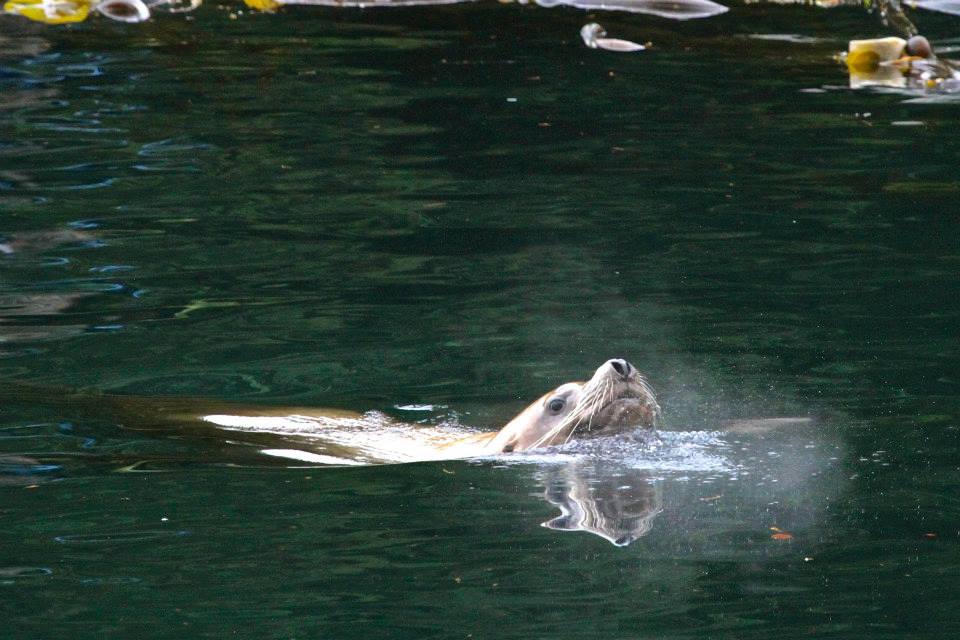
4. No matter how much you hoot and holler at them, Stellar Sea Lions will not give you the time of day.

10659202_10153342628774852_4448842526100652252_n

5. Orcas love to call at dinner time, so you stuff your plates into a plastic milk crate box and lug it all over to the lab and have dinner with headphones on.

1901153_10153342624724852_3285441612895050163_n

6. Bath Days are a gift from God and should be worshipped as such.

10995804_10153726757494852_7811731726412708212_n

7. Mink will live under the house, they’re cute but smell terrible, your cat will want to make friends, the mink will not acquiesce. 11081015_10155300238395858_6083581184589343527_n

8. Porch baths in December are a necessity. Treat them like a Nascar pit crew changes tires. If you’re not out and back inside in under five minutes you are a) doing it wrong and b) probably borderline hypothermic.

9. Bring pets. You’ll need someone to talk to when your wife gets mad at you for ruining her favorite website.

10994155_10153690504119852_621681021897676100_n

10. There is nowhere on earth like this place, nothing can replace it or come close. So enjoy every moment you have here regardless of the time of year.

_MG_9262

For His Old Branches

We push deeper into the middle of the island, weaving our way along the ridge. In an organized line the three of us hike, me in the lead, followed by Brittney, Porter the cat right on her heels. When she disappears over a small hill to look at a patch of moss that shines a fantastic neon green he plops on a fallen Hemlock and softly meows until she reappears. There are no machines, no airplanes, no cars. The only sounds are of the forest’s creation. Squirrels quarrel from their respective trees, all talk and no action. The Varied Thrush in between acts as a mediator, his single melodious note drowned out by their stubborn chatter.

It’s all therapy. The springy moss gives the sensation of walking on clouds, the world a tapestry of browns, golds, reds, and more shades of green than I knew existed. Fir, Hemlock, Spruce, and of course Cedar shield the sun. I stop at one Cedar and see a deep six foot slash that begins near my knees and travels up past my eyes. Long ago, someone cut into her. Not out of spite, anger, or the egotistical need to announce ones presence. But to weave a basket. By strategically stripping the bark in this way, the natives brought not death, but growth, their cuts encouraging the trees to grow at a faster rate. They’re known as culturally modified trees (CMT) and they litter the island. At least the parts that have never been logged, which is sadly less than half.

We stumble onto the scene of such a crime after plunging through a valley and onto the next ridge. Spruce dominant the scene here looking massive and impressive until our eyes fall upon the skeletons. Cedar trees twelve feet in diameter stand decapitated ten feet from the ground. Deep one foot notches denote where the logger stood and cut until the massive tree succumbed to gravity. Like the CMT, it says, “man was here” but with much more finality and violence. The cuts are from generations previously, the sun long ago blocked by the growth around us, the stumps being swallowed back into the earth, crumbling to powder. I look up at the spruce and feel relief and gratitude knowing neither them or the successors to follow will meet the same fate here. It’s progress. Hope. That their deaths were not in vain, that perhaps we’re moving forward.

Back home, I sharpen a chainsaw, fill it with oil and a 50:1 fuel to oil mixture. I can feel the trees watching me and Walrus’ words float into my head.

“When I got here, I could feel the pain this place had experienced. How many chainsaws these trees had heard, and I vowed never to use one on Yukusam.”

It’s a gesture that means sacrifice and plenty of extra work, though many I suppose would call it foolish, irrational, pointless. After all, trees can’t hear. At least, I don’t think they can. But his words, his dedication, his conviction stick in my head as I set the choke and begin to pull the handle, feeling the machine sputter before dying again. A magnificent piece of Fir has washed up along the beach, probably 50 feet long it offers nights of cozy warmth. But nearby, his brethren still stand. Branches coated in needles reach out towards me, their ends curved upwards toward the sun, like a crowd with outstretched arms, their palms skyward in peaceful protest. I sit the saw down and move up the beach a few steps. If they can hear, I want to make sure they hear me.

“This saw is not meant for you,” I whisper, and even in my solitude I glance behind me for human ears. “This tree can no longer grow, photosynthesize, or give life to the forest. If it could I would never touch it, just as I promise to never touch you. Forgive the sounds of the saw, I’ll leave you in peace as quickly as I can.”

I kneel by the saw and crank the handle again, it roars to life and soon, sawdust is flying from the tiny metallic teeth, forming neat golden piles on the beach. I move down the line, making cuts every foot and a half, dodging knots and pausing once to tighten the chain. In half an hour it’s over and true to my word I shut it off as soon as I’m done. Once again the cove and forest is filled with nothing but the sounds of the thrush and the squirrels.

An Expected Visit, An Unexpected Goodbye

Paul announced the news in his usual, casual way, “a few people may be visiting the lab in early March from Greenpeace.” Made sense, we knew Greenpeace was holding a ceremony in nearby Alert Bay, and given Paul’s and Walrus’ ties to the organization, we figured a couple would want to stop in. Truth be told, the thought of playing host and hostess was welcome.

A few days later we received a call from the organizer of the trip. “How many people are coming?” Brittney asked.

“15 to 20.”

Our eyes went big, after months of just the two of us and the occasional passing boat, 20 people felt like a full fledged invasion. We were gonna need to bake more bread.

For the next few days we scrambled, polishing and sweeping out the pine needles and cedar boughs from the corners and wiping away the months of salt spray thrown against the lab windows by 40 knot storms.

As the Naiad breezed around the corner and we picked our way down the rocks, slipping over exposed kelp and seaweed on the falling tide, it felt like summer. As if I was standing on the docks, waiting to pick up my group for a day of whale watching. One by one, a range of generations and ethnicities stepped onto the island, making their way towards the house. I heard Paul’s words escape my mouth, “please be careful, the rocks are incredibly treacherous.”

Walrus stepped off the boat and began to weave a path into the cedar as if he couldn’t stand another moment apart from his precious forest. There was no real plan, and people wondered hither and thither. It soon became clear what the first order of business had to be. Unbeknownst to me, Bob Hunter’s daughter held the last of her father’s cremated remains in her hands, wishing to lay part of him to rest in the quiet cove on the flooding tide.

Brittney and I stood amongst the crowd huddled along the shoreline as the now flooding tide shuffled us slowly back. We listened to the eulogies to the man I had never met, but heard so much about. One of the original founders of Greenpeace, Bob Hunter had led a life that turned my eyes blurry and my cheeks wet with tears. He’d battled the nuclear testing in Amchitka, Alaska on Greenpeace’s maiden voyage, seal hunters, whalers, published books, and who knows how much more that would lay unwritten and untold.

“It was Paul who convinced him to stick his head in Skana’s (a captive orca at the Vancouver aquarium back in the 1970s) mouth,” remembered one speaker. A small grin spread across my face, as in my mind I could see Paul goading him toward the edge of the tank, a mischievous grin on his face.

As the ashes fell in the gentle breeze onto the waters surface, a First Nations man banged on a traditional drum, the bass echoing across the water and ricocheting off the silent old growth that stood sentinel over the proceedings. Goosebumps erupted across my body to hear the soundtrack of the land revive and return. An eagle soared over and a sea lion poked its head out at the mouth of the cove. As if they too recognized the sound, the song that spilled into Blackfish Sound, resonating in their hearts, a reminder of simpler times.

The songs ended, Bob’s ashes scattered on the turquoise waters, piercing rays of sun cutting through the surface, a gentle breeze rustling the tips of the trees. They couldn’t have picked a better day to say goodbye and we felt incredibly honored to be allowed to bear witness to this intimate and precious moment.