Tag Archives: life

The Birthday Post

For the first time in a year, I got carded. Granted, some of that may have something to do with spending the last six months buying drinks from the same two people (not a lot of choices when there’s only two “bars” in town). But on the eve of my 28th birthday, it served as some sort of inverse reminder. Youth is fleeting. Now I know, my elders and betters will roll their eyes at such a proclamation.

“28? You have your whole life ahead of you.”

To which I say, of course. But we must all admit, that in a society obsessed with youth, with staying young, where waging war against wrinkles is a billion dollar industry, it’s hard not to look at your birthday as some sort of landmark. A road sign twisted and rusted on the highway of life, reminding us that this precious gift slides by far too fast.

I’ve spent the last few days in Seattle. A fine city as far as cities go. It’s big on brew pubs, grunge music, and Macklemore. Though it could do with some deer, perhaps a pack of wolves prowling along I-5. It’s my little snapshot of how normal people live. You know, the ones with satellite TV, high speed internet, and cars that don’t resemble the rusted hull of the Titantic.

I stood in a mall with glistening floors and walls. Music blared through speakers, a movie preview played on a loop from a cluster of wide screens, dozens of adds battled for my attention. But as I dutifully manned my post by the Old Navy entrance, I watched my fellow mall patrons and decided on a little sociological experiment. How many, I wondered, would be on their phones?

The answer was almost all of them. Eyeballs sucked to the screen as if Apple had designed a gravity app more powerful then the moon. What, I wondered could they all be looking at? I didn’t have the phone Brittney and I share. And I must admit there was a decent chance that if it had been in my pocket instead of her purse I may have pulled it out. And what would I have done? Jumped on the internet I guess. Refreshed espn.com even though I knew that there was nothing there I needed to see. People sat side by side on benches, heads bowed as if in prayer, not saying a word. Couples walked hand in hand, free hands holding the creations of Samsung. What are we doing on these things?

Which leads me back to my birthday road sign. If life is so precious, so fleeting and quick, why don’t we spend more time in the present? Why are we so quick to escape to an alternate reality? Later we pass by a Windows PC store. Near the door stood a man. He’s facing the big pane windows but he can’t see him. Something looking like a futuristic toaster is secured to his face. The heck?

“Alternate reality,” Uncle Chris explains to me.

No way.

Maybe it’s just the next wave of video games. Essentially that’s all it is. A really realistic game. And if they made a sports one? Heck yes I’d try that out. Again I must admit to my love of a certain baseball computer game. It’s my escape when I can’t read about Trump, climate change, or acidifying oceans anymore. My own, if you will, alternate reality where the Minnesota Twins finish above .500. So really I’m no different. And maybe that is the wakeup call.

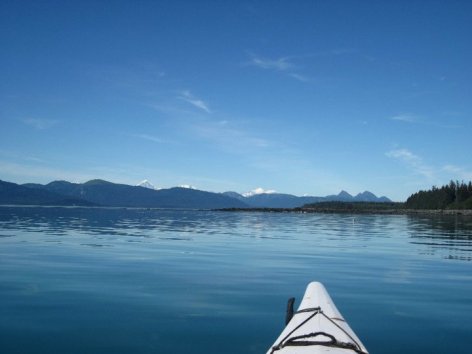
And perhaps that’s what I’ve learned in the last year. That despite my little migratory life from the seat of my kayak, I’m not all that different from the mall patrons and commuters of the city. And that’s ok, that’s a good thing. If I’m no different then those I want to reach, then getting them to listen, to put down their phone and read what comes out of my head should be easy. Maybe one of them will load raincoastwanderings from their phone! The irony.

Because I want the mall dwellers to read what I write. I want to inspire and touch people’s lives. The mall is not a bad place just as a phone that can tell you what time the Vikings play isn’t. What I want, what I aspire to, is to remind people that there’s a big blue and green world beyond the sliding doors. A world you can enter without strapping a toaster to your head. And that, most importantly, we cannot live without it. That the natural world, like every day we are gifted, is precious.
Fairweather Therapy

I run. I do it a lot, probably not as much as I should, but a respectable amount. I run to clear my head, to keep my heart happy, to think, to calm the hell down. Somedays it’s easy, somedays it’s hard. So in a lot of ways, running is like life.

Today it’s hard. It’s hard and it shouldn’t be. But I’m uncalibrated, a compass needing to realign to true north. I’m stressed, I’m worried, and somehow it feels easier to sit on the couch and not move. But it won’t make this any better. I drag myself out the door and lace up my shoes, slapping an escort of biting “no-see-em’ gnats that sprint to skin like moths to light.

In three minutes I’m glad I’m doing this. The world shifts back into focus, mind syncing with heart. I can think clearly as the trees scroll by and the music pounds in my ears. Sometimes I think about kayaking, other times writing, or I’ll indulge myself with thoughts of the ridiculous computer baseball game I’m too engrossed in. But not tonight. Tonight the Shabin dominates my mind. The Shabin and the 4.13 acres that comes with it.

The acreage is wet. But all land in Gustavus is wet isn’t it? It’s part of the deal. We can afford it. We’re ready. I think. Think. I’ve been doing too much of that. Thinking and projecting. Rubbing the grime off my crystal ball, trying to make damn sure I know what I’m doing.

I don’t know what I’m doing.

I don’t want to make a mistake. This isn’t a starter home, this is going to be home. Forever. When you got one bullet you need to be positive your aim is clear. And I’m not sure yet. It’s daunting, this home ownership thing. In a way it’s riskier then anything I’ve ever done. The consequences far reaching, the way out hard and difficult if we miscalculate. Hence the run, to let it all go for thirty minutes. At least that was the goal.

I reach four corners. That’s what we call the intersection here. The intersection. What a ridiculous way to describe the place where the four roads meet. Clove Hitch Cafe and Fireweed Gallery on my right, the gas station in front of me. Left to the airport, right to park, straight ahead to the ferry terminal. I go straight, don’t even bother to check for traffic. God I love it here.

Past the Sunnyside Cafe. I glance into the windows as I run by. Someone waves enthusiastically through the window as I pass. I’m pretty sure it’s my friend Jen. I wave back with all the enthusiasm I can muster, trying not to break stride. In Gustavus no one just goes to Sunnyside for groceries. You go to talk, to laugh. To be filled with something besides organic apples and romaine. Community. How man places can say they have that? What happens when most people get their groceries? A faceless cashier whose name you’ll never know.

“How are you?”
*beep*
“Good, you?”
*beep*
“Great.”
*beep*
“$8.95.”
*swipe*
“Have a great day.”
“Thanks, you too.”

That doesn’t happen here. Brittney and I stood in Sunnyside for 20 minutes last night. It took us three to find what we needed, another 17 to talk with Kristiann and Aishu behind the counter. I love that. Love that I leave every building a little happier then when I entered.

Past the Sunnyside and down the road. Through the trees on my right I can see the setting sun on fire in the western sky. The trees hide them but I know the Fairweather Mountains are out. That if I run far enough I’ll be rewarded with evening light and a setting sun behind the mountains. I pick up the pace and soon I’m even with the golf course.

You heard me right. Gustavus, population 443 has a freaking golf course. Because Morgan Deboer loves this place. For years he owned the waterfront that the Gustavus dock is built on. But as the land continued to rise, his property line was pushed inland. Morgan thought the new waterfront and acreage should be his, the state of Alaska didn’t. So he went to court with Gustavus behind him. And he won. His thank you? A golf course. And an open invitation to have bonfires on his beach. No charge. Thanks Morgan.

Ahead is the ferry dock. I look to my right and my spirit soars. The sky is a canvas painted with colors no artist can emulate. Life changing red. Soul lifting orange. Inspiration yellow. White cloaked Fairweathers in front set the scene.

I reach the end of the ferry dock and stop. Not by choice. Not by a conscious act. I cannot move. Cannot pull myself away from the atmospheric miracle that is this sunset. I drink it in like I’m dying of thirst. This may be the most beautiful thing I have ever seen. I pan to the right. There’s a sudden dip in the mountains and hills where the magic bay and her magic glaciers have carved them away, hanging valleys filled with water.

I pan left toward the mouth of the bay. What must it have been like? In 1794 George Vancouver was here. The bay was five miles deep, the glacier five miles wide. No northwest passage here. Just life altering ice. Gustavus wasn’t even a blink in her eye. Just a sandy outwash, a dumping ground for silt.

It feels like Gustavus was set aside. For the few lucky enough or blessed enough to fall under her spell. The little outliers. Flat land in southeast Alaska. Whoda thought? The acreage we’re looking at is flat. But here, with the Fairweather’s on fire with evening light and Gustavus splayed out before me, it feels insignificant. The most popular bumper sticker in Gustavus reads like this:

                                           “What’s your hurry? You’re already here.”
Gustavus, AK

I feel foolish. I’ve spent the last 48 hours agonizing over interest rates, mortgages, and price per acre.     Perhaps I’ve lost track of what makes this place magic. That no matter where we end up, what spot of land we call home, it’s going to be here. We get to be surrounded by these mountains, these people, forever. I feel so much better. John Muir talked about “glacier gospel,” finding God in nature. For a night I’ve found therapy in mountains and sunsets, a reminder of why I’m here.

The sun slides behind Mount La Perousse and as the rays of light disappear the chill of night arrives on the northerly breeze. It is late August after all. Time to get home. Home, how good it feels to say that and know that it’s at the throne of those mountains, in the tight embrace of that bay.

The Shabin

There’s not much left of the road. Just two indention’s overgrown with weeds and grass. Blink and tilt your head and you can almost make out the tire tracks. But alder trees are growing in between the divots and it’s clear that no one has driven a car back here in a long time.

In my hand is a scrap of printer paper, a series of hastily scribbled squares and rectangles drawn on it. One of those rectangles is my future home, maybe. Brittney follows along right behind me. Just ahead is a man I admire and love. A man I want to be like, but with my own flair, my own style. After all, there’s only one Kim Heacox just like there’s one David Cannamore. At the youthful age of 65, Kim’s enthusiasm remains boundless and I find myself wondering what he must have been like when he was 30. I know I wouldn’t have been able to keep up with him.

He leads us through the properties acres, referring to it over and over again as, “our property.”

Our property.

My god. Is it really possible? A small cabin sits near the land’s southern border next to the remnant of the road. The rest is Spruce and Pine forest with a bit of bog, a bit of marsh, and sprinkled with berries. Oh the berries. High bush cranberries, neigoon berries, even some low lying blueberries. I pass an alder no more than knee high. I run my hands through its branches. The leaves are manicured and nibbled. A moose has been here recently. It feels like home.

We can’t stay away. We drive the two miles back to the little slice of heaven. We forgot the tape measure, so we measure the cabin’s tiny room the only way we can. I lay down on the wood floor and so does Brittney, her feet brushing my scalp. We can almost lay down all the way. Calling it a studio  would be generous. No running water, no toilet.

I doubt many would understand the appeal of a dry cabin devoid of plumbing. Cabin may not be the best description. It’s part cabin part shack. A shabin as it were. But both of us see it for what it can be. Knock out a wall, raise the roof, put in a loft. Definitely a bathroom. What are we missing? A sink! Should install a sink at some point.

But for the right price… we’ve lived rustically long enough. What’s a few more years?

I think about the homes we walked past in the Seattle suburbs. 700,000 dollar monstrosities on a quarter acre in tidy suburbs. Each home copy and pasted from the last. Each subdivision given some charming name like Shady Acres or Pebbled Brook. I don’t want a 30-year mortgage. I don’t want property tax. I don’t want my neighbor’s music echoing through my walls.

Give me simple. Give me peace. Give me trees and blueberries. In our minds it’s already ours and we haven’t even called the owner yet. The owner we know is looking to sell. You’re crazy if you think I’m telling you where in Gustavus it is.

It’s scary. Sure we’ve talked about buying a house in this city filled with magic for three years. But to be this close, our feet draped over the edge, just one step from going over. Maybe buying a house is like having kids. If you wait until you’re ready you’ll never do it. But I also know that this is what we want. That we’re ready to make this home.

August Fog

For the first time this summer, there’s a bite to the breeze. When I step out the backdoor. The air tastes like Fall. It brings forth images of Cottonwood Trees changing color. The taste of Pumpkin flavored beer, pumpkin spice lattes, shoot, pumpkin flavored everything. Fall comes early in Alaska. The first week of August reminding us that each season but winter is short, to be savored.

With it comes rain. The rain that justifies our existence as a rainforest. A rain that makes everything green. A chilling nasty rain with curled lips and sharp teeth that bites at the back of your neck and crawls beneath the most impenetrable Gore-Tex.

But on days like today, when it doesn’t rain, oh what a beautiful setting. Bless the rare calm, and foggy mornings of August. Blue sky above, the land ensconced in curtains of fog.

There’s something magical about paddling in the fog. The shutters pulled over our eyes, every other sense becomes sharpened.

You smell your way through fog.

On low tide mornings like this one the odor of anoxic mud crawls into my nose. A rancid guide leading me back to shore when the trees disappear behind the milky white sheen. My ears orientate like a dogs, the cries of a crow lead me across the mouth of a cove. Land nowhere in site, paddle toward the crows.

As always I’m accompanied. Today it is the minimum two people. Mark and Laura. Middle aged, bouncy, and happy. The sort that are easy to talk to because the silences are never awkward. Everything is wonderful in their eyes. The fog, the water, the sea lion that interrupts my bear story. They make my job easy. The sort of people you wish you had every day. We paddle near the shoreline and let the fog wrap around us like a sweater. The smell of the beach and the noise of the crows guiding us.

Boats pass unseen in the fog. The intrusive foghorn of a cruise ship echoes off the mountains and trees every few minutes.

We float in a kelp bed two miles from the dock. Our paddling has been serene and relaxed. I’m in no hurry. If you’re in a hurry, kayaking isn’t for you. Easier to let the world come to you then to try to catch the world.

“Are you worried about the possibility of losing the glaciers because of global warming?”

The question comes from the husband Mark. It does after you talk about the retreat of the glaciers. How, in 1794, Glacier Bay was nothing more than a five mile divot on the north side of Icy Strait. Yes I know, no internal combustion engines spewing carbon into the atmosphere in the 18th century.

There’s something different about the way that Mark phrases the question though that gives me pause. Are you worried about the glaciers?

The glaciers? I mean, I guess so. It’s funny, I live in a land defined by them, created by them. If anyone should worry about the well being of the glaciers I guess it should be me. And I am, now that I think about it. For Glacier Bay with no glaciers is a sorry end indeed. What would we call it? Muir Bay National Park and Preserve?

But when I think about climate change, about the cliff that we’re either a) barreling towards or b) careening over (depends on who you ask), glaciers aren’t the first thing I think about.

“What I think about,” I say, “are murres.”

“Murres?”

“Murres, among other things.”

I explain about the blob, which they had never heard of. About thousands of murres washing ashore on the beaches of southeast and south-central Alaska. I describe their delightful noises, the joy of a muttering murres, their exasperated yells. We all seem to have that animal that touches us in a way no one else understands. Brittney loves Black Oyster Catchers. Hank Lentfer loves Sandhill Cranes. And I have Common and Thick Billed Murres.

“For me, Glacier Bay without Murres is no longer Glacier Bay.” I say. “Maybe that’s short sighted of me. But imagine if you stopped paddling, and it was quiet.”

We do just that and are serenaded by a timpani of birds. Marbled Murrelets, Canadian Geese, crow, raven, phalarope, and oyster catcher.

People talk about getting out in nature. “Getting away from it all.” We call it. The peace and quiet of wilderness. But here’s the thing, nature is never quiet. To walk into the woods and hear nothing would be… empty, desolate, unsatisfying. Nature isn’t supposed to be quiet. There should always be a squirrel rattling, a bird calling, a sea lion swimming.

What we’re really talking about, is getting away from ourselves. Away from the world we created. The artificial one sculpted from metal and concrete. The birds and squirrels and sea lions are not noise, they are music to our ears. And a world without them, glaciers or no, is no longer a world.

Snow

She lay in an old shipping container. The kind found on the back of trucks roaring up and down the concrete riverbeds we call interstates and highways. But this one had been laid to rest here. Tucked away in a corner of a lot in Bartlett Cove. Through the trees I can hear the wind, smell the air breeze, ear cocked for the sound of a humpback. How out of place the egg white box of metal looks here. No flowers or grasses growing around it. Just a strip of gravel turning dusty in the early July heat.

Inside lie her bones.

I feel a thrill of excitement as Chris Gabrielle pulls a key from her pocket and unlocks the deadbolt. Together we lift the big metal latch, its joints creaking and groaning as the big door slides open. I don’t notice the smell at first. But as Chris flicks a light switch and ignites a small bare bulb, it overwhelms me. It is musty, sweet but sickly. Something about it smells alive, even in her death. I walk into the container, breathing shallow, fighting the urge to cover my nose with my shirt.

After almost ten years, she still lives in some way. Organic matter and oils still seeping out of her ribs, humorous, and vertebrae. I can’t help myself. I reach out and touch one of the vertebrae. As big as a tire and bleached white, I run my hands up and down all that remains of Snow. Here along the racks and shelves, were all that was left of her forty-five foot, thirty-five ton body.

The year is 2001. Somewhere in the mouth of Glacier Bay swims Snow. Inside her new life is growing. Is she aware that she’s pregnant? That in half a year there will be a miniature her swimming and breathing? The baby will drink a milk that is 50% fat, the consistency of yogurt. I wonder if she heard the cruise ship. If she had any inkling of its approach. If she could have gotten out of the way. If the ship could have. The nose of a cruise ship is so far from the engines in the stern that they create “sound holes,” right off their bow. There’s a good chance Snow never knew what hit her.

Janet Neilson (then Janet Doherty) found her. Dead whales are rarely found. Usually they disappear. Sink to the bottom and vanish, presumed missing. But it’s as if Snow wanted to be found. Janet discovered her floating off Point Gustavus, not far from where an anonymous cruise ship passenger reported feeling a thump. They towed Snow to the beach, necropsied her body, and discovered a fractured brain case and crushed vertebrae.

Gustavus mourned, the park service gave press releases, security footage was seized, attorneys went to work.

“The crime wasn’t in accidentally striking the whale,” said a park employee, “the crime was in failing to report it.” I’m not sure Snow would agree. Neither do I.

In the middle of the shipping container is an old iron claw bathtub, the porcelain chipped and rusting. But it doesn’t leak, at least not yet. Chris hands me a great bucket of industrial kitchen degreaser and instructs me to fill the tub with the stuff and soak Snow’s bones one at a time. Oil, she explains, is still seeping out of her bones. The goal was to remove the rest of the organic matter from the bones so that they could be preserved for years. An exhibit was being prepared down by the beach. Where in a way, she could live forever.

On sunny days I climb onto the roof of the container, lining her ribs up neatly to bleach in the never ending Alaskan sun. I soak the vertebrae overnight in the degreaser, greeted each morning by the strong smell of leaching oil, a pearly iridescent sheen on the surface of the tub.

Down another road, behind a locked gate is her skull. My stomach twists the first time I see it. I run my hand across the deep fracture in the skull. If a passenger felt the collision, than surely the crew did as well. But who wants the headline: “Cruise Ship Kills Whale in National Park?” Bad for business. But thirty-five ton bodies don’t always disappear. I pressure wash her skull, obliviating the moss attempting to grow on her. When the yard empties I crawl beneath the skill and lay in her mouth, imagining. Rows of baleen, gallons of sea water, tons of wriggling herring.

And I’m indebted to them. The cruise ships I mean. Wouldn’t be here without them. Wouldn’t have had summer work in Juneau when I graduated from college. Would not be sitting at this wooden table in Gustavus watching the storms roll through, the moose calves grow up, and the rain pound on the roof. I owe my beautiful little life, in some way, to an industry that makes me uncomfortable. That kills whales, that leaves a massive carbon footprint. That shows a million people Alaska every year, even if it is a watered down, fast food version. 14,000 people a day in Juneau. But what’s the alternative? I can’t take 14,000 people kayaking in Bartlett Cove. Is seeing this place from ninth story better than not seeing it at all?

Edward Abbey would say no. But I should be confident enough to form my own opinion. But I can’t. Because like this bay, nothing is black and white. A single receding glacier does not signify climate change, just as an advancing one does not disprove it. We must step back, way back. Look at the big picture objectively, rationally. We don’t like the big picture. Step far enough back and we become mitigated, aware of how insignificant we are.

That’s the beauty of the kayak, the hiker, the backcountry camper. You have no choice but to confront your own significance. At how small you are away from the billboards and street lights. It’s uncomfortable. Change always is. Tough to be uncomfortable from the ninth story.

I don’t know what the answer is. Abbey wouldn’t be impressed.

Snow stands whole once again. Without her flesh she looks serpentine. Two tiny bones bent at obtuse angles are suspended by wires two thirds of the way along her vertebrae and a foot below it. They’re all that remains of her legs. In time evolution will remove them from whale’s entirely. Like our appendix they are vestigial, no longer of any use.

Every day a park ranger gathers a crowd in front of Snow to give a presentation. People flock to the talks until the trail is not passable. They are independent travels, for the cruise ships do not dock here. Our kayak sheds are right next to the skeleton and I often squeeze through the raptly listening crowd. Like the cruise ships and wilderness, the talk makes me uncomfortable. I hear the ranger joke about how Snow embarked on, “the longest over land migration a whale has ever done” to be rearranged and put back together by a professional.

The crowd titters and laughs, something about it makes my blood boil. I hear them talk about the collision as a horribly tragedy. But in the same way a loved one developing an illness is tragic. Unavoidable, no way to prevent it. Never have I heard a ranger say that the cruise ship failed to report the collision. That it was not until security footage was seized and viewed did they admit to striking the whale. Perhaps they do and I have simply missed it. I don’t wish to criticize or demean. For the rangers do a job I know I couldn’t. I don’t know why I think people need to know that part of the story, but leaving it out feels like an insult to her memory.

On one of the displays is a grainy picture showing the bow of the ship, a gray pixelated sliver in the water shows Snow, her back arched, attempting to dive. Maybe she did know.

“Snow moments before tragedy,” reads the caption. Meanwhile ten miles away two cruise ships a day enter the park, passing Point Gustavus, bound for the glaciers of the west arm. Do the passengers on board know the story? Do the rangers share that story when they board every morning at the south end of Sitakaday Narrows?

I don’t know what the answer is.

All I know is that it hurts my heart to have Snow here, condemned to life as a silent ambassador. How much more she could be, churning up the waters of Bartlett Cove.

Another sunny July day. Six years since Chris opened that container and introduced us. We walk the familiar trail toward the kayak sheds. Past the old Tlingit canoe, Snow’s display coming into view.

“Have you met Snow?” I ask.

Everyone has the same reaction, a quick intake of breath, mouth open, rooted to the spot. Their first view of Snow is head on, as if she’s diving right toward you, forcing you to confront her here and now. They snap pictures and lean across the ropes, aching to touch her. Invariably the question comes.

“How did she die?”

“A cruise ship hit her.” My guiding style is one of light hearted comments. Jokes and stories over facts and figures. But not here. No over land migration jokes at Snow’s expense. Here just the full truth. “They knew they hit her but didn’t report it.”

I don’t like starting the day with something so sad. But at the same time, what a reminder that we cannot expect to leave the world the way we found it. The warming acidic water of the world should be a good enough reminder. Every kayak on the beach crushes barnacles and mussels. The leave no trace etiquette is an impossible dream. From man to mosquito, no creature was meant to leave an environment as they found it.

We linger a moment longer and turn toward the beach where I hand out life jackets, spray skirts, boots, and paddles. The water is alive with life. Sea otters cracking open shells on their stomachs, sea lions growl in frustration, a timpani of birds. I slip into my kayak and feel the world slide into place. My heart rate slows and my breath becomes steady. I don’t know what the answer is, and in this moment I don’t need one.

Telling Stories

He wore cowboy boots. Amazing how quickly one can come to a whole list of conclusions by a shoe type, an accent. In this case the accent matched the boots. A drawl that can come from only one place. A drawl that says, “I will not be amused when you remind me that Alaska is three times bigger than Texas.”

So I skip it, not that it was ever funny. I worked with this boat captain several years back. Before every trip he would make the guests go around and say where they were from. When someone announced they were from Texas we’d burst out with all the pent up enthusiasm we could muster, “welcome to America my friend!” They either loved it or hated it. I haven’t used that line in forever. I gloss over that one too.

They introduce themselves. Bruce and Gail. Even their names sound like Texas. But they’re friendly, oh so friendly. Bubbly, energetic, polite, talkative. In their mid-60s and on their third trip to Alaska. They love it here. They’ll remind me of that ten more times before the day is done and I’ll appreciate it every time. They’ll marvel at the beauty, coo at sea lions and otters, stare with hungry eyes at a breaching whale a quarter mile away. To hear them talk it may as well have shaken their hand.

Perhaps they sensed it like I did. That when it came to politics, to life, our ethics, we stood on opposite ends of the spectrum. But here is the beauty, the magic, the power of this Bay. It makes all that stuff irrelevant. Here is common ground. The otters are arbitrators. What would it be like if our Senate and House of Representatives met here, inches above the water. Would some of this melt away? Let’s make a Republican paddle with a Democrat and see what happens. Forget crossing the aisle, see if you can cross Bartlett Cove.

For seven hours the talk is easy. The conversations are light. They own a ranch, 2,000 acres of Texas desert beauty. Bruce grass feeds his herd. He brings inner city kids out every year, teaches them to hunt the deer that flood their property. He show them everything from pulling the trigger to cleaning, packing, and preparing. Reminding them  that food does not appear on the Wal-Mart shelves through some sort of Harry Potter spell.

“Get’em away from their phones.” Says Gail. “Too many kids spend their whole lives doing this.” She mimes tapping away on an iPhone, her head bent low, chin to her chest. “They never look up to see the world. They walk right past it.”

They’re involved in wildlife conservation. Fighting to keep the areas near their ranch wild. Teddy Roosevelt Republicans. How amazing, that the father of conservation was conservative, was buddies with John Muir. I mention the parallels and Bruce nods.

“Amazing man. Did you know that while he was president he explored the Amazon? While he was their he got so sick that he told the others in his party to leave him behind. That they couldn’t afford to carry him… the president! Tell me if that’d ever happen now?”

The trip ends. But they’re not sick of me yet and invite me up to the lodge to have a drink. For a moment I hesitate. But I’m intrigued, so intrigued by what is happening here. By the opportunity to have what Melanie Heacox would call, “the interpretive moment.” Sometimes a cold beer in the revelry of a magic day is that moment.

Halfway through the first beer the door cracks.

“Where’s one place that you really want to visit in Alaska?” Gail asks.

“There’s a place,” I begin, “in the northeast corner of the state, the Arctic National Wildlife Refuge.” Only politicians use the acronym, slurring it into a gravelly, guttural grown, “Ahhnwarrrr.”

Gail’s face alights. “It looks beautiful.” She says. Like most people, she’s seen the pictures. They’ve been to Denali, the Alaskan Serengeti.

“This is supposed to be like Denali on steroids.” I say.

Bruce leans forward. He’s a talker, not one to sit back and listen. “What’s up there?” He asks.

“Everything and nothing.” The silence hangs for a moment and I step off the ledge. “In the refuge is the 1002 area. That’s where they want—”

“That’s where the oil fields are.” Bruce finishes. I nod but say nothing.

“That’s where it is?” Gail says with a gasp. “That’s where the oil is supposed to be?”

I nod again and watch her face change but don’t say anything, waiting for her to come to her own conclusion. But Bruce continues, “You could put what, five drilling platforms up there? Two acres each. Ten acres total. Take what you needed and… the land land grows back. We see it in Texas all the time. Three years after you leave you can barely tell they were there at all.”

Our talks all day have been civil. And even now there’s no threat in his voice. Nothing that’s inviting confrontation. If only we could always talk like this. Maybe we’d get somewhere.

“If it’s done responsibly—”

“Not always as easy as you’d think.” I say. I could talk about Caribou, I could talk about carbon dioxide in parts per million, sea level rise, or erosion. But something whispers in the back of my head. “Tell stories.”

“Let me tell you about how north slope oil exterminated a pod of Orcas. In Prince William Sound is a unique population of Orca Whales. They’re called the AT1 pod. When the Exxon Valdez struck Bligh Reef, the AT1’s swam through the slick the next day.”

“Orca’s have no sense of smell,” I explain, “they had no idea what they were passing through… they haven’t reproduced since. There’s only a handful of them left. Three or four I think. Within a few years, they’ll be all gone. For me, I can’t put a price on that.”

It’s hard to tell what sort of impact the story has.

“One drunk boat captain.” Bruce says.

“All it takes is one.” I answer, “Prince William Sound will never be the same.”

I point out over Bartlett Cove, in the distance beyond the forests of Lester Island are the Fairweather Mountains. The view the three of us have been marveling at them all day. “There’s precious few places like this left on the planet. We need them. We can’t exist without them.” They agree, they understand better than most that nature equals life.

“Beneath the Brady Icefield,” I continue, which is just beneath the Fairweather’s, are mineral deposits. Possibly oil. This view we’ve been raving about all day, what if there was an oil well at its feet? What if a mine tailling dam burst? If we drill in the refuge, what’s to stop this place from being next?”

I’m not expecting a deathbed conversion. Not expecting them to change their voter registration to democrat. To start a non profit climate change research association. But I want to be heard. Just like they do. Like we all do.

“We’re coming,” I say, “from completely different ends of the spectrum. That’s ok.”

“We have no love for Trump.” Gail interjects.

“Bless you,” I smile. “But it’s important that we can sit and talk civilly about these things. That we do it respectfully. This is how change happens. This is how we keep amazing places like Glacier Bay, like the refuge whole.”

I doubt I’ll ever see Bruce or Gail again. And at the end of the day, doubt that anything in their minds has changed. Strip all this stuff away and we’d be friends, were friends for an afternoon. They’re sweet people, loving people, giving people. They work hard, play hard, the sort of people that would pick you up and set you back on your feet without a second thought.

But that look in Gail’s eyes when she realized that Ahnwarrr was the refuge. That that was the place under siege. Maybe something stuck there, in the back of her head. And maybe next time it comes up she won’t see oil rigs, drills, or platforms. Maybe she’ll see the Caribou running across the tundra, and a young kayak guide, his eyes full of meaning talking about how badly he wants to run with them.

Somewhere Unoccupied

It’s good to be back. I squirm and fidget in the plastic seat, trying to make my life jacket sit against the combing. Again and again the jacket slides up. I give up, letting the combing press against my lower back. It doesn’t matter. Bartlett Cove is paper flat. Clouds are thrown across a deep blue sky at random. The only sound is my paddle in the water. Glacier Bay. I’d tell you to never change, but change is all you do.

On days like today I stop just beyond the dock. I look out into the mouth of the cove and drink in the lower bay. I stare out into Icy Strait, at the islands of Lemresier and Chichagof. I feel my heart slow down, my chest inflate, my body at peace. It’s a sensation that only a kayak can bring. Maybe it’s the angle, seeing this place from the vantage point of the Murre and Murrelet, otter and sea lion. Perhaps it has something to do with the knowledge that it is up to you and not diesel fuel and outboards to get where you want to go. Or maybe it’s something deeper. Something buried deep within our chromosomes. A treasure within each of us, waiting to be discovered.

Whatever it is, life is different from the seat of a kayak. It magnifies the soul while reminding you how small you are. What a wonderful reminder. There are no advertisements, no one telling you what you deserve or what you need. What you need is all around. Beyond Lester Point the upper portions of Glacier Bay come into view. The east and west arms beckon. A labyrinth of tide rips, adiabatic winds, and endless waves of mosquitoes await.

 Come on in. But leave security and your ego at the door. Leave your boots on. Keep your eyes open. Breath deep. Be free.

Some of the most memorable moments of my life have happened here. Just off the shore of Lester and Young Island. They’ve chiseled me like a piece of wood. Sculpted and refined me. A project never finished. There was the day the sea lion surfaced a foot behind me. That cunning, malevolent look in his eye, teeth curled into a snarl.     He still gives me the shivers. Still makes me tense when a sea lion approaches. Orcas in the middle of the channel. The perfect end to the perfect day. A humpback in the mist, the sound of his breath reaching out through the infinite nothingness. A siren, beckoning me closer. If I dare.

Swim with me. Commune with me. Guess where I’ll be next. Take another shifty look beneath your paddle. Look for my shadow.

The humpbacks. Too many memories and stories to retell them all.

“What’s the closest you’ve ever been?”

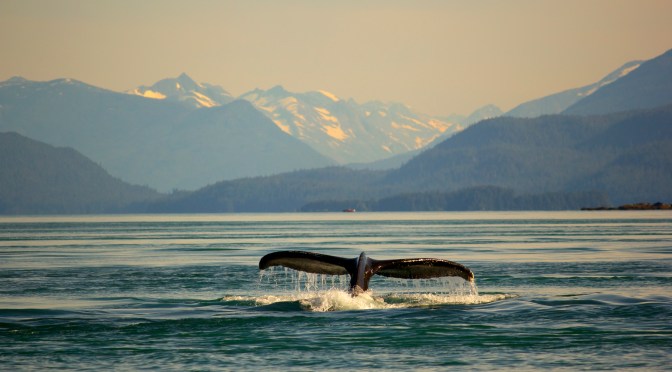
Such a simple question in theory. But mere numbers cannot begin to convey what it feels like to watch the water come alive. To watch it quiver as the head and back of a 40 ton creature breaks the surface ten feet away. To describe the simultaneous rush of euphoria and terror. Your gut screaming for you to run and to stand still. How three seconds can last lifetimes. What it’s like to watch a tail as wide as a Cessna break the surface. The sound of rushing and dripping water. And than… gone. Just like that. No trace, no markings save for some rippling water. It defies description. How does something so big just… disappear?

Somehow, through the beauty and grace of the universe, this became my job. To paddle among these animals. To learn the tides and eddies as intimately as a lover. And to pass that love on to others. To pull them gently from their comfort zones and into a world that continues to persevere. And above all, to show them that wilderness is something to worship. To love and cherish. That all we need to do is tap into those ancient desires deep within each of us. It’s not something to be feared, for respect and terror are not exclusive. Follow her rules, read her tides, understand her weather, and you will be rewarded beyond your wildest dreams.

This is home. Perhaps I cannot trace my ancestry back to the fog choked mountains of southeast Alaska. But I’ll love it as if I can.

These are the Places You Will Find me Hiding

In a land defined by mountains, Gustavus stands alone. Gustavus, prairie country. Well, as close as you can get to prairie country up here. At the mouth of Glacier Bay is a strip of land. An old glacial outwash that the glaciers of old used as a dumping ground for the remains of the rock they had ground to a pulp. What remains today is a stretch of land so flat the bubble on the level falls dead center. All around is regularly scheduled programming. Chichagof Island and its mountains to the south, the Fairweathers to the west, the Beartracks to the north, and the Chilkat mountains and Excursion ridge to the east. Distant yes, but never out of mind, even when shrouded in the blankets of clouds that dominate the sky.

It’s fitting that Gustavus is southeast Alaska’s little geographic rebel. One of the few towns that don’t have to concern themselves with building into a mountain or around pesky fjords or bays that jut into sharp cut glacial rock. Nothing but sand, trees, and moose to build around. Because like the land, the people of Gustavus are unique. A cast of people that have chosen love, laughter, cold beer, and blue grass over profit, capitalism, manifest destiny, and Justin Bieber.

This is a town where people still wave as they drive by, failure to do so the highest of insults. Where a run to the local store for a bag of oats turns into a 45-minute conversation about everything or nothing. No one brushes past with downcast eyes, avoiding contact. Smiles are plentiful, good vibes abundant, the people seem ageless. Yesterday I learned that a lady I’d took for somewhere between 30 and 35 was celebrating her fiftieth birthday by traveling to Iceland. In a nation obsessed with youth, with looking young, and banishing wrinkles, maybe Gustavus is the fountain of youth. Maybe smiles, a gracious heart, and a quick laugh can do what plastic surgery cannot, and for a much more reasonable price.

I will not pretend to be an expert on the normal American lifestyle. But from my limited exposure in what many would perceive to be a normal existence, the term community has become little more than window dressing. A way to lump together a group of people that happen to live in the same area. This is not Gustavus. Gustavus is a place where community is still community. To enter into this place is to become part of a family 400 strong. Want to spend a winter here? We’ll help you find a place, chop wood, fill the chest freezer with halibut, salmon, deer, and moose.

A couple of years ago a young man moved here. He knew no one. Two weeks after arriving, his house burned to the ground. Within hours, someone had moved a yurt onto his property for shelter. Food was left on the front porch, money and building materials donated.

“I don’t know any of you folks,” read the thank you letter he posted at the store, “but to all of you, thank you. I am truly moved and touched.”

Home. This is home. How can it not? How can we—myself and Brittney—not want to be a part of this? Suburbia? Fine for some I suppose. Who am I to say how others should live? But give me the place where I know everyone by name. Where, should the worst ever happen there will be 400 pair of hands to pick me back up. It’s impossible not to feel happy and blissful here. We’re isolated, but never alone. We are a people of guides, fisherman, businessmen, woodsmen, parkies, lodgies, seasonals, and locals. Democrats, Republicans, Christian, Mormon, Druid, Pagan, Atheist, John Muir apostles. But we are all residents of Gustavus. And in the end, that’s all that really matters.

For His Old Branches II

The rain falls as a fine drizzle, turning the surface of each rock and log smooth and slick. My body feels unbalanced, the chainsaw in one hand, oil and two stroke fuel in the other. Beyond the crunch of my boots against the loose rock the world is silent. Blackney Pass stands calm and tranquil. The vista slows my heart and mind. This view. How easy to glance past it after all these months. The islands and channels are worn into my mind like the creases and callouses on my hands. Swanson, Harbledown, Baronet, Cracroft, Blackfish. What names. They stir the imagination, fall smoothly from lips and tongue like water over stones. For years I stared at maps, brushing my fingers over their namesakes, their crude imitations of green and blue put to paper. Now? I see them every day. May the novelty never fade.

I bend over the chainsaw and pull the cord. Through my ear muffs I can hear and feel the vibrating base of the saw as it comes to life. Oil, fuel, and metal. In my hands, with the simple pull of a trigger, I become master of the woods. Capable of felling trees that have patiently grown for a millennia, evicting squirrel, thrush, and deer as the roar of progress and the thunder of manifest destiny march through the woods. But for this I have no desire. I could no sooner fell a growing Cedar than take a man’s life.

I head down the beach. I’m searching for a sacrifice. For a gift willing to disappear from the physical world through the chimney of our cabin leaving only a small pile of ash as a talisman. The log is weathered and worn, maybe a little water logged. But its location is good, and cutting this one opens up space to negotiate the nicer, friendlier logs behind it. I pull the safety, click the button, and the war cry of humanity echoes off the standing trees. I cut with my head down, the trigger pressed halfway. The sharpened chain cuts clean and smooth. No knots. No warping. What a tree it must have been. Before it was reduced to this. Reduced to laying naked on the rocks, it’s branches stripped, its roots severed. I love reading the stories of the old hand loggers. The one’s that went up Tribune channel just north of here. Each tree was selected with care. It had to be. For each one had to be felled just right and rolled into the ocean. Clearcutting wasn’t just unnatural, it was impossible. Hard work. Anything but glamorous. That I could do. No one hand logs anymore. Carve a road into the hills and forests. Strip the forest. Every. Last. Tree. This log I’m cutting is nothing more than a refugee.

Brittney joins the ritual. She wraps her arms around the rounds as they roll free and patiently walks them up the beach, dropping them with a thud that shakes the forest floor. The rain continues to fall, mixing with the sweat on my brow and back. Cutting wood always makes me perspire. I have no idea why. I’m just standing here after all.

I work with my back to the water, the incline slightly uphill. After a time I stop and rise, stretch my back, and turn. A tug and its massive tow fills the strait. It chugs south with diligence. The rumble of the massive diesel engines echo in my chest. My eyes fall on the tow and a snarl spreads across my face. A log tow. Hundreds, maybe thousands of logs lay piled a hundred feet high. A hundred logs high and a hundred wide. Plucked from the raincoast, heading south to await their fate. As what? I’d be lying if I said I knew. Homes? Mulch? Toilet paper? It makes little difference in the moment as a wave of disgust washes over me.

The chainsaw vibrates and slides over the rocks, bumping against my foot, reminding me of my hypocrisy, that I’m standing in three inches of sawdust. That I live in a wooden cabin. That the kayak my father is lovingly crafting for me is made of it. What if the wood for my kayak was once on a barge like this? What if it had been pulled south, past this lab. So that I could one day paddle the inlets it had once looked over.

What’s enough? What is ethical? What is right? The oil companies had a field day a few years back when Shell’s big oil platform pulled into Seattle. Hundreds of big hearted, environmentally conscious people took to the water in kayaks, many of them plastic. Floating thanks to an industry that allowed them to be there. Does that make them hypocrites? Does it muffle or mute the cause they stand for? Do I have a right to feel angry when a log tow goes by? Is it enough to say that I’m doing what I can and accept that it’s impossible to not impact the environment negatively in some way?

There’s no answer from the ocean. Hard to hear with these ear muffs on and the saw rumbling. Avocados from Mexico, bananas from California. Oil, carbon, trees, methane, melting ice caps, Republicans. Dear God. And I’m worried about a couple of trees?

“Do what you can with what you have.”

Who said that? Roosevelt I think. Teddy or Franklin? I can’t remember.

A pillar of Christianity is that we are imperfect and that Jesus does not require us to be. We need forgiveness because we’ll keep screwing up. I look down at the log and feel a shiver run down my neck as the sweat and raindrops cool on my shirt. I think about the book I’m writing, that I want to see published. More than one if I can pull the wool over the eyes of an editor. Books that will be published… on paper since stone tablets went out of style years ago.

Just because I’m an imperfect environmentalist doesn’t mean I shouldn’t, or can’t talk about it. For if we wait until we’re not harming it at all, we’ll be delivering the message on horseback in between long treks through the forest, hunting with sharpened sticks and rocks. Next summer I’ll sit in my wooden kayak, and I’ll do so without guilt. From its seat I can be an agent of change. I can touch the lives of thousands of people as I lead them into the wonder of Glacier Bay. Reminding them gently, patiently, that if we lose this we lose ourselves.

I pick up the chainsaw. I’d be lying if I said I felt good about it as the sawdust started to fly again. One by one we carry the rounds up the hill and to the chopping block to where our woodshed (made of wood) stands. Beyond it is the forest. A forest rebounding from logging. At its heart stands Grandma Cedar, the ancient tree that has survived so much, has seen it all. A forest that, if we keep talking about it, will never hear the sound of a chainsaw in its depths again.

The Garden: A Plea for our Parks, Monuments, and Refuges

I wonder if Abbey ever felt this way, or Muir, or Roosevelt. A sort of melancholy joy that all of this is fleeting. Perhaps I worry too much. It’s hard not to. In a time when we need wildness more than ever, it’s never been more threatened. One need look no further than the skulking figures of the right, elbowing and jostling each other for the opportunity to be commander and chief. Debates have become nothing more than four amateur comedians, dropping punchlines and waiting for the laughs that aren’t coming. But between the childish jokes of genitalia and chest thumping, they have declared war. Not on ISIS, hispanics, the middle class, or China. But on us. On the final fragments of American history.

The Party or Lincoln has become the Party of More. Blame it on Reagonomics, the Koch brothers, Ted Cruz’s jowls, it doesn’t really matter. Regulate a women’s body, regulate marriage, but God forbid that the steam rollers of industry should be slowed. Away with the EPA, usher in the era of fracking. What goes into the bank account matters more than what goes into our bodies. Away with the public lands, those worthless wastes of space, those dollar bills hanging from the branches, just waiting to be plucked.

“If you’ve seen one redwood, you’ve seen them.” Ronald Reagan said.

“If you’ve seen one hundred dollar bill, you’ve seen them all.” I say. “The only thing more foolish than trying to drink your money is trying to breath it.”
10329274_10152863254909852_4693130274254238988_n
Herein lies the danger. Herein lies the tragedy. Ted Cruz has already tried to put an end to the miracle that is public lands—our national parks, our monuments, and wildlife preserves. America’s greatest gift to itself. It twists my stomach into knots. Take my healthcare but not the bay, not Denali, not the Arctic Refuge, these shrines to the world that made us. I’ve met several people who, on their deathbed, ran north. To Alaska. To see the land wild and free. Not to see oil wells or mining sites. But that seems to mean little. Give him a big enough eraser and he’ll wipe them all out. Those wastes of space. All those trees and bays and wolves and bears. Refuges and refugees, two concepts that fall on deaf ears. Give me your poor, your tired, your weak… nevermind, some oil subsides will do fine. Conservative and conservation, similar in spelling alone.

This is our own fault. Nature, wilderness, is mythic to some, a fairy tale to many. Something that may or may not exist somewhere beyond the city limits where the concrete may or may not end. An ideological Bigfoot. It’s somewhere our phone’s don’t work and wi-fi fades away. Many never see them. And we’ve lost all connection to how bad we need them.

Air? It comes from the air of course. Food? From the grocery store. Water? It comes from the tap. Trace the journey of these substances and you arrive at the same place. Soil growing food, trees producing the air and filtering our water. Forgetting that relationship is toxic. Ask the children of Flint, Michigan. Ask the families of Butte, Montana about the “pennies from hell.”

“Growth for the sake of growth is a cancerous madness,” wrote Edward Abbey.

Let us define mankind not by what we can extract and obtain, but by what we can leave alone. Let us not define ourselves by our consumption, but by our self control. Do we have the courage, the willpower to push ourselves away from the petroleum feast, to announce that we’re full? There are bigger things, more worldly things, and yes, more Godly things than maximizing profit on every square foot of land.
10151271_10152867795959852_442814964723618859_n
What if we stopped looking at the world like a factory and instead like a garden? A plot that must be nurtured, cared for, fed, and watered. Treated with the understanding that what we take out must be replaced. Minerals and matter must be returned to ensure that the carrots, potatoes, and lettuce of life return bigger, fresher, and tastier next year. Foolish is the farmer who doesn’t renew his soil with fertilizer, who stuffs his rows of lettuce tightly together, believing that the highest quantity planted will equal the maximum yield. Shame to the farmer who doesn’t let a field go fallow. Let the land rest, let it breath, let it be land for a year. And like us after a deep breath, it will work harder, the benefits in a year outweighing the one that was lost.

But the world doesn’t work like this. We can’t stand the thought of letting a portion go fallow. Of not maximizing our yield right now. Forget the future. The future is now isn’t it? The TV told me so. Those that see the world as a garden are shouted down. We’re labeled as extremists, alarmist, other harmful -ists, standing in the way of progress. Good old progress the shield of the conservative politician. But you’ll never hear a politician, pounding the lectern, demanding that he be allowed to frack the tar sands of Utah labeled extremist. He’s just living in the real world. A world where the economy can grow forever. Infinite growth, finite world. His birthright. If we’re not moving forward we must be going backward.
10312681_10152863254884852_4060311875310743348_n.jpg
Will our offspring a century from now look back on us with admiration or disgust? Will we be revered like the minuteman or demonized like the slaveholder? The one’s that took a renewable world and saw it only for what it could do in that very moment. At least we made some money. But is that how we want to be remembered, is that what we want inscribed upon our gravestone?

 Here lies the modern world. The bottom line looked good.

Surely even the most selfish cannot desire to be remembered like this. Let’s be remembered for our love, for our sacrifice, for our restraint. Let a tree be a tree. A refuge a refuge. A fishery a fishery.

“Any fool can destroy trees,” wrote John Muir. “For they cannot run away.”

To which I add, any fool can do something for profit. It takes a man of true character, true conviction, to see a resource, to see personal wealth, and leave it where it is, acknowledging that there are some fields that should always be fallow. We’ll survive without it. The farmers to follow will thank us.

45543_488769164851_2875335_n