Tag Archives: kayak

The Sorcerers

The swelling in my lower back has vanished. The shooting pain in my left shoulder blade melted away with an hour of squeezing into my kayak. Glaciers slide by, deities of a higher calling. They speak in languages well beyond my ability to translate. They groan and crack, their breath cool on my face, stirring the marble colored water that swirls at their feet. In my narrow, 17-foot kayak Glacier Bay towers above, beneath, and around me. Intimidating mountains thousands of feet high, obliging fjords thousands of feet deep, serac steeples, arete cathedrals.
It’s been mere hours since the boat deposited Brittney, Hannah, and I at Ptarmigan Creek in the west arm, leaving us with the Reid and Lamplugh glaciers as neighbors. Bears as our landlords, Oyster catchers the shrill neighbors. Harbor seals, their eyes still recalling the centuries as sustenance for the Tlingit’s slide cooly beneath the waves as we paddle south for Reid Inlet, its glacier, and the sublime. It was impossible not to grin. Surrounded by beauty man can only dream of matching. Reveling in our insignificance, the glaciers and mountains reminding us that our lives are but a shiver in the lives of the epoch.

One Day Later:

The deep bay juts deep into craggy rocks, giving way to gradual, sandy beaches in the back. In our kayaks we sit just feet offshore. With one hand I hold my paddle jammed into the rocks on the ocean side to keep the kayak from being swept into the bay. The other endures the harsh edges of the barnacle smothered rock, keeping the fiberglass hull off the bottom.
Twenty feet away the water depth plummets to thirty feet and at the moment all the riches on the Coral Princess couldn’t tempt me to uproot my paddle and drift into deeper seas. The calm water ripples and 20,000 volts shoot from adrenal glands to toes.
A lunge feeding humpback glides smoothly out of the water yards away, the leviathan’s coal black rostrum lingering at the surface, every bump, curve, and scratch visible, burning its image into the back of my head. The tip of his nose is big enough for me to sit on like a slippery fish encrusted lazy boy.
None of us speak afraid of breaking the spell. As if to verbally acknowledge the miracle will cause the whale to disappear. We didn’t want the water to be safe, we wanted to hover on the precipice of the cliff, leaning as far over as we dared forever at the very edge of his table.
For an hour the humpback glides back and forth within 30 yards, our eyes leaving the water just long enough to glance below us, to confirm we could still see the rocks and sand, that we hadn’t drifted onto the plate. Finally the obligation to photograph overwhelms and I pull the camera free of the drybag. Even with the wide angled lens pulled back, he fill the frame, capturing the image but failing miserably to capture the intimacy, the proximity, the enchantment.

Four Days Later:

The real world. At least as real as we allow it. Back to work, back in our green boats, vacation over. The waters of Bartlett Cove filled with wonder no matter how many day trips you led. Beneath the waves teemed otters, humpbacks, seals, porpoise, and today…
“Brittney, there’s an orca.”
I don’t mean to sound sharp, don’t mean for the intensity and fire to spit out my mouth like a dragon. But orcas do that to me. Give me tunnel vision, making the rest of the world vanish. From my seat inches above the water I watch the smooth 6-foot dorsal of a male slide back into the waves 500 yards away, making its way into the cove. This doesn’t happen.
Guiding instincts kick in long enough for me to point while the 17-year old within, the one that ran to British Columbia for this very moment screams to paddle and paddle hard.
Our five boats cut through the water toward the mouth of the cove, in the distance the Fairweather Mountains glow in the early morning light as around the point come a trio of gunshots, three more roll into view. Cationic with delight my boat slides across still water, every stroke bringing me closer, hot on my keel is Brittney and six incredibly fortunate clients.
I try to explain the magnitude, that this doesn’t happen. They aren’t supposed to come into the cove. In my mind I beg them to stay. Keep coming in, almost there, almost there.
Behind me Brittney calls out and our little flotilla stops paddling, our boats succumbing to the tide’s authority. We sit in a jumbled array as like fireworks, the orca’s break the surface. The male continues his course down the middle of the mile wide cove. While three more break the surface between us and Lester Island. Another breaks off from the male and swims toward the boats.
I should call the park, dig out my phone, document, tell someone, but I’m past words. I’m 17 again, bobbing in a kayak off Cracroft Island, watching the A36s swim by. Nearly ten years later they still hold unimaginable power over me. Keep me coming back to the water, always scanning, always listening.
They’re watching us. A juvenile no older than five materializes thirty feet off my port, the sun catching her eye before she disappears. Her mother rushes in, corralling the rebel and guiding her away. The windless day is filled with the sound of their breath. Explosive exhalation and the harsh rasp of every inhale clearly audible. There’s no boat engines, no hollering, no clicking cameras. Everyone watches in great silence, knowing nothing can even begin to do them justice.
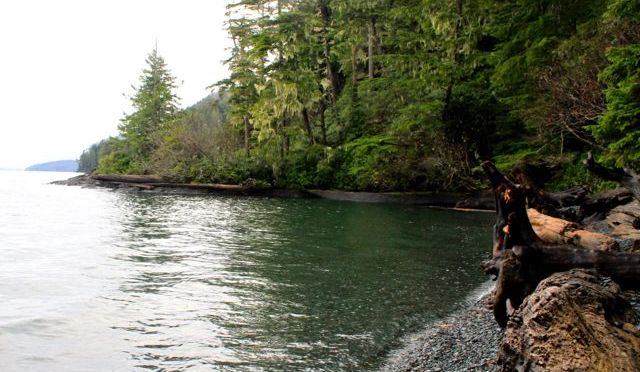
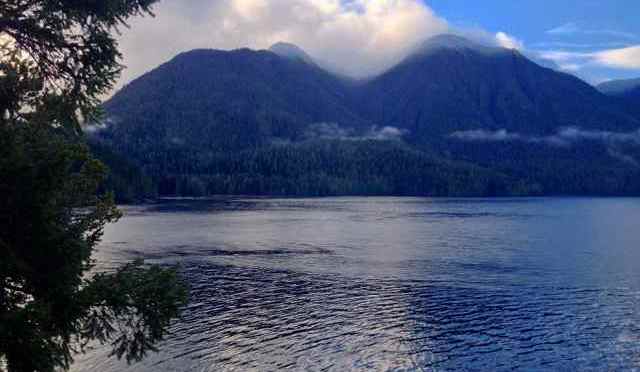
Making Alaska Safe for Cows

The concrete bends right, but straight ahead lies an unassuming road. Covered in dirt and gravel, trees arch across the entrance, casting deep shadows beneath the tunnel of greenery. No street sign marks the little road as we bypass the hairpin turn and shining sun for the shelter of the trees. Ten minutes later we reach the end of another skinny one lane road masquerading as a driveway, grass stubbornly growing down the middle track. A series of wooden buildings and a small stretch of lawn lay surrounded by the forest, the structures seeming to melt slowly into the woods’ outstretched arms.

The picnic table on the lawn groans under the weight of plates filled with venison, salad, rhubarb cobbler, and brownies. From the nearby trees the squirrels chatter jealously and I look up in down the table. I find myself surrounded by men of words, science, kayaks, and hilarity.

Across the table from me sits Kim Heacox, part John Muir part 13-year old boy though his birth certificate insists that he’s a few decades ahead. He’s the reason I’m here, the reason there’s a blog (I really don’t like the word blog, how about “Thought Journal”), the reason I write. On my left sits Hank Lentfer, responsible for the venison on my plate and several books in our library, followed by Zack Brown who had walked off the Stanford campus, PHD in hand and hiked and paddled until he reached the Gustavus shore. And finally, Peter Forbes, writer, non profit adviser, farmer. Nervously, I glance around the yard, undoubtedly there’s a kid’s table where I should be seated with my knees up to my ears.

Instead I find myself a part of a community that I have done nothing to become a member of. No initiation, no rights of passage, simply because of our deep love for this place, for the woods, for the future of the world. Because no one ends up in Gustavus by accident. You inherit a family you didn’t know you had. I cut my venison and listen as Kim’s boundless energy spirals the conversation from topic to topic.

“The best thing about visiting down south,” he says, “is the chance to watch all of those Alaska shows and see how we’re supposed to be living.” He finishes with such earnest sincerity that everyone looks up as if to confirm his sarcasm.

“I really like the one in Homer.”

“The guys with the cows! And the guns! Gotta move the herd across the flats before the tide comes in.” His voice twists into a passable southern accent, “is that a wolf?” he mimics a gun being fired, “got him!” And there’s humor in the tragedy of his recreation. “Gotta make Alaska safe for the cows!”

“The only problem, is that doesn’t look very good on a license plate. Alaska the Last Frontier sounds a lot better than: Alaska! Slowly Becoming Safe for Cows.” I say and his laughter is infectious.

It’s impossible to sit at the table and not be inspired. Hank and Kim’s books fill thousands of pages, tapestries of words and phrases I can only dream of writing. But here I was, doing my best to turn my mind into a sponge; listening, writing, and most important of all it seemed, laughing.

As the bugs fill the night sky and the sun ducks beneath the trees everyone slips into the house, the guitars come out, Zack pulls out a violin, and Eric Clapton makes the windows shake. I sit at the table, thumbing through an Orion magazine as Hank and Kim belt out Midnight Rider and as I glance out the window at the blue tinged yard in the evening twilight reach a beautiful epiphany.

It was Orca Lab all over again. A beautiful, undeserved gift. Replace the trees with ocean, the music with hydrophones, and it was the same. Emotion wells inside me at the incredible mentors, heroes, and now friends that had entered my life and the inspiration and motivation they’d filled within.

Lessons of the Beardslees

Paddling in a double kayak is about rhythm, matching your stroke to your partners. The rise and fall in perfect synchrony: dip, push, pull, lift, switch. After a while it becomes meditative, the landscape and hours slipping by, the sun slowly pivoting across the blue sky. Feet in front of me Brittney sets a steady pace, the kayak’s bow cutting silently through the Beardslee Islands, briefly disturbing the calm surface of the ocean before the ripples dissipate, covering our tracks.
Eight inches below the water is glass. It’s surface reflecting the islands, the mountains, our very being back at us with the distortion of refraction. Twisting our reality ever so slightly but no less authentic. We cut across the mouth of Secret Bay and jut briefly north along the Young Island Peninsula. Strawberry Island stands at the mouth of the Beardslee Entrance. The gateway to a maze of homogenous islands. The birds eye view of our maps reveal their distinctive points, coves, and bays.
But when you paddle within them, their uniqueness vanishes, replaced by gradual rocky beaches leading up to forests of spruce, hemlock, alder, and cottonwood. Weaving through, it’s easy to imagine getting lost in a land of identical land masses that punctuate the water ways. Easy to get confused in a sea of conformity as you try to match the point on the map with the four similar ones you just paddled past.
But by the time we reach the entrance it all becomes clear. The lower bay leaps out from behind the islands and my eyes follow contours of the land north where the glaciers lay, advancing and retreating, never sleeping. You could spend years studying the geography of the bay and never know all of it. The price you pay for living in a land that is constantly changing. From the other boat Leah points toward a small cove that overlooks the entrance, the sun warming the rocks. I push down with my left foot and the boat concedes to my request, the stern swinging right.
A few hours ago we’d slipped through the cut on an uninspiring 10-foot high tide using the back door to slip into the Beardslee’s. In places the keel of our kayak whispered as it kissed the blue mussels and barnacles barely submerged at the high tide. A few years ago our boat would have safely passed through on a ten foot high, but with the land rising at three quarters of an inch per year, nothing can be taken for granted here. Maps routinely became obsolete within years, riverlets between islands viewed within varying degrees of suspicion, nothing was real until you’d paddled it, seen for yourself how much the bay had truly changed.
Our boat kisses off the rocks on the ebbing tide as we stretch stiff legs and backs like an old man rising from his favorite chair. A curtain of reed grass four feet high stands like a fence at the top of the beach. We stop and scan for a moment to see if our landing has stirred up a pair of black ears attached to a tan muzzle, but all is quiet save for the chorus of the birds, and the steady drone of a boat as it chugs north through Sitakaday Narrows, sharing the sound with the lower bay.
Names rattle off my tongue like long lost friends; Tlingit Point, Drake Island, Geikie Inlet, Marble Mountain. Somewhere above them are the glaciers of the west arm where undoubtedly, a pair of cruise ships throws wakes onto the beaches as they churn through Tarr Inlet.
“All that time on the water,” wrote Kim Heacox, “and never close to it.”
It made me sad to think about. How much of this place can’t be experienced from ten stories above. Isolated, withdrawn, with controlled heating, air conditioning, buffets, casinos and gift shops. But how many really did want to take a big drink of the land? Run their hands over the rocks, feel the laughter of the waves as they played with your boat, hear the Sea Lion roar, the Oystercatcher giggle? Unless things had changed drastically in the past few years, not many.
So we talk about what we can control, the people that do want to take a drink, see their reflection refracted back on the mirror of the ocean. Leah talks about finding common ground, guiding is more listening than speaking some times.
“No one ends up in Gustavus by accident,” I offer. “It’s deliberate.”
Leah nods, “a lot of the time we’re preaching to the choir. The people that want to go paddling care deeply about places like this, enough that they really want experience it. It’s up to us to inspire them to take what they see here and go home and in turn, inspire those that otherwise wouldn’t.”
It’s true, the climate change pharisee, the six figure oil employee isn’t the padding type. If they were they probably wouldn’t be what they are.
From the mouth of the west arm comes a great white monster, a cruise ship materializing, even dozens of miles away it plows south like a great floating skyscraper.
In the fall Leah travels to Canada and leads polar bear viewing trips. It is here, that she must fight to find common ground, to listen instead of speak.
“There are some that want to see the bears, but if they had to chose between their SUVs and oil development or polar bears, they’re taking the car. You have to find something in that moment they they’ll connect with, because for a lot of them, they’re not worried about what will happen to these places in the future.”
I feel cynicism and frustration rise in my chest. 70% of Americans claim to support environmental policies. But we’ve elected a congress that hasn’t passed a conservation policy in years.
Save the world. As long as it’s convenient.
I look back into the Beardslee’s the route we’d taken hidden and concealed by the optical illusions of dozens of points, coves, and forests. Every island looking the same, but in actuality so different.
The cruise ship grows larger, on board are thousands of people that look just like us, perched on the rocks. Perhaps that was the challenge, the goal of the naturalist and conservationist. To stop looking from above at these people where every difference was so obvious. To stop looking at the map of the Beardslee’s as it were, and to actually paddle it. So that we could both see that, we weren’t all that different.
“We have to find common ground,” Leah repeats, “even if it’s just for a moment.”

A Worthy Excuse

The sun finally glides below the outstretched tendrils of stand of spruce trees that line the yard, casting our house abruptly into twilight. A twilight that arrives at 8:00. Down the hall the washer growls and snarls as it tosses salt soaked wool and polyester in preparation for tomorrow.
On the edge of the couch I crouch, hunched over a laptop, back bent strangely as the muscles still struggle to loosen after digging into the seat of my kayak. The beer’s helping though as I take a sip, squint through my sun fatigued eyes, and type furiously.
Deadlines are never fun. What I really wanted to do was submit to the waterfall of hot water that Brittney was reveling in at that very moment. But the paper I’d snagged off the freelance website was basically done, good enough in fact.
The laptop snaps closed decisively and Porter raises his head a quarter of an inch, fully attuned to the room’s shifting energy. He shoots an optimistic look towards the sliding door and his playground beyond. A land of voles and dogs on what he hoped were reinforced tethers.
“And coyotes.” I remind him as I slip through the door and slide it shut behind me.     Too apathetic to even shoot me a steely eyed glare with his glacial eyes, he drops his head back to the edge of the couch, tail twitching indignantly.
In Gustavus virtually everything is within two miles and the Pathfinder sits neglected in the dandelion infested gravel driveway. A pair of easter green bikes lay haphazardly placed on the small concrete slab we’ve taken to calling a porch. 
    Brittney’s chain falls off reliably every half mile while the ring that holds my handlebars has been replaced by duct tape, the hand grips pointing down towards the ground, leaving me to grasp the very center of the handles like some lost and befuddled Lance Armstrong. But it moves when you peddle and the grocery store with our version of “lightening fast” internet isn’t far away.
How ironic, that in a few months, we’d be on an island in which we comprise two-thirds of the population and we’d be luxuriating in fiber optic cable internet. Granted, indoor plumbing and hot running water will have gone the way of the amish, but Netflix would be but a click away.
While here, in the crux of civilization, population 360, you had to bike a mile to reach a connection that would load your gmail sometime between now and sunrise.
The gravel road is inundated with dust. Even rain forests can have droughts, we just measure them in days instead of weeks and months while the salmon swim in holding patterns waiting for the rivers to rise and open the doorway home.
I glide through the stopsign at the lone intersection as the clock strikes nine and glance over my shoulder. Saturday night and the only restaurant in town was shutting down, another wild weekend. I look back ahead and hear my breaks squeak. Unbeknownst to me. My twilight cycle is not solitary.
A high patch of grass sits fifty yards ahead on the road’s left bank, a comma between two gravel driveways. Settled in the middle is a Gustavus lawn mower. The moose glances up nonchalantly, its mouth moving in the hypnotizing manner of ungulates, somehow horizontal and vertical simultaneously. At my sudden stop she takes an uncertain step towards me.
If she wants the road it’s all hers and I slide my bike to the left and onto the drive, opening up an avenue up the road or across toward the wooded ditch on the far side. She considers her options for a moment longer, and with an air of completely deserved entitlement begins to saunter across the road for the ditch, her hooves echoing on the concrete.
I watch her slow gait away, wishing she could stay longer instead of conceding to the higher powers of the willow on the far side that demanded her attention. Never breaking stride she vanishes into the wooded ditch, deceptively hidden from view like a magician’s illusion.
Hoping back aboard the bike I peddle past, she’s completely invisible, but this is not a stealthy phantom and her heavy footfalls let loose the crash and crack of brush cracking and bending to her will.
The yard in front of the store is thankfully moose free and I open the laptop to finish the days work, my mind already in a lava hot shower, steam billowing like campfire smoke.
“Here’s the assignment,” I scribble fast, “hope it works for you. Had to wait for a moose to clear the road before I could send it off.”
I smile at the beautiful inconveniences of my eden and hit the send button as the moose crashes through ditch 100 feet away.

Giving Up Control

Forty feet, forty tons, one ton per foot, half ton of herring per day each carrying as much fat as a Big Mac. For three summers I handed out quantitative factoids like science flavored tic tacs, sometimes three times a day with my brain sliding into auto pilot. I’d try to encompass the life history of a humpback whale before the engines roared above 3,000 RPMs, drowning out my voice.

And yet, there is a detached feeling from the bow of a boat, the railing a secure barrier between man and whale. You see them, hear them, hell, sometimes you can even smell them, the rotten smell of herring or the curiously enjoyable scent of cucumbers after they’ve been scarfing capelin. But you are separated, protected by that steel hull, the constant grumble of the boat engines. Yet the safety comes at the price of intimacy. There are memorable moments of course, the alarming sight of basketball sized bubbles encircling the boat, the high pitched scream of the feeding calls reverberating through my boots.

“John! We’re in the net!”

“Oh my,” the captain answered, sliding the boat smoothly into reverse, clearing the net just as ten mouths break the surface, herring and saltwater running down their throats.

But nothing compares to a humpback at sea level, from the seat of your kayak. With nowhere to run or hide, the whale in complete control of the encounter. The extraordinary recipe of fear, excitement, and pleasure as the tail rises, vanishes, and you realize that its pointed directly at you. Do you go forward? Backward? Turn towards or away? Is the whale going to swim straight or zig zag? Your mind pulls you deeper into the wormhole. Is it feeding? Lunging? Your stomach tightens, what if it lunges, you glance shiftily in the water below your boat, here? In your mind you see the massive maw, rocketing through the column like a rocket. There are no engines, no barriers, you are completely and entirely in their territory. What happens next is up to them.

“It’s not that I think they’d try to hurt me.” I explain, “it’s that they don’t have to try, all they have to do is shrug their shoulders and… you’re airborne.”

So you just bob in the currents, eyes shooting back and forth. You have five to ten long, spell binding, exhilarating minutes, like a drawn out suspense scene in a Hitchcock film, waiting. “You gotta breathe,” you whisper into the silence. No matter where the whale surfaces you just want it to happen, to break the tension.

On calm days you can see the shadow first, than a bulbous bulb of water as the whale rises, the water’s surface tension covering the body like cellophane. Until finally it breaks the surface, spent air shooting into the air like a volcano, the bass of the exhalation resonating in your chest.

And so a stupid grin spreads over your face, soft exclamations escape your lips as you sit under its spell until the back arches towards the sun, the tail hovers parallel to the sea for a brief moment, water dripping from the trailing edge, and finally vanishes, into the world that we cannot follow. For a few moments you bob in the whale’s wake, your heart pounding, fingers tingling, adrenaline coursing. And than you start to wonder… should I go forward? backward? The curtain has fallen, the next show will begin in ten minutes. Try to find something pretty to look at while you wait

Different View, Same Soundtrack

I wake to the gust of cold wind on my face, the breeze a soothing tonic against my cheeks, encouraging me to dig deeper into my sleeping bag propped on the deck chair of the ferry’s solarium. It’s not even seven but the horizon already glows with rosy morning light, soothing confirmation that we’re still moving north. I poke my head out and look over the rails, my heartbeat slows. Gone are the buildings, the roads, the lights that had bombarded us from the shore as the sun went down with nothing more than the occasional lighthouse to interrupt the parade of rocky beaches and mighty cedars.

I stare out at the blue road ahead, the trees slowly melting by. Less than 24 hours ago we had been sitting in traffic, trapped on the I-5 with nothing but outlet malls and tail lights for company. I could feel my world realigning with the compass pointed resolutely north away from the alien world of cities, suburbs, and concrete. I return to my sleeping bag drinking in the cool spring air, and go right back to sleep.

The mountains feel like old friends, familiar faces as the ferry steams into Juneau. Auke, Thunder, and McGinnis, call out in greeting as we drive down the ramp, bleary eyed but exhilarated to be home. The Mendenhall Glacier still stands guard at the foot of the towers, with Thunder and McGinnis mountains guarding its’ flanks. How good it felt to be back, the comfort, the familiarity, the mountain’s friendly faces, extinguished any longing for Hanson Island. If I couldn’t be there, this was the next best thing.

24 hours later, we were finally done. The Pathfinder sputtered to life one final time, taking us up one final ramp and into the town of Gustavus. Town however, may be to generous. The lone stop sign lies a mile and a half inland from the ferry dock, affectionately known as, “four corners” the only intersection in town. Everywhere you look are mountains, but unlike Juneau, they lie benignly in the distance. The town is midwest prairie flat, a quirky anomaly in a region in which towns are built on, around, and through mountains. In spite of their distance, the mountain’s names come back to me easily like a familiar song that you haven’t heard in years. The mountain ranges of the Fairweather, Beartrack, and Chilkat surround us to the west, north, and east. To the south, across Icy Strait, is Chichagof Island, its own collection of mountains give the impression that we are in a massive bowl surrounded on all sides by distant peaks.

We slow to a stop and consider our options. Two of the four roads lead to the two ways out of town, the ferry behind us, and the airport, the third leads down a dirt road, the left hand turn is the longest, stretching north past unassuming roads dotted with log homes and protected by thick canopies of spruce and hemlock. Seven miles down later it ends in Glacier Bay, the crown jewel of southeast Alaska. It seems fitting, that in a land renown for its’ natural beauty, it’s most marvelous feature would lay, unassuming, next to a tiny hamlet accessible only by air and sea.

Here there would be no tour buses, no fleets of helicopters or airplanes, no navy of whale watching boats. If you wanted to be here, there would be no shortcuts. In the summer months a pair of cruise ships would ply the waters of the bay, rushing up the west arm of the Y shaped bay to sit in front of the Margerie Glacier. But for those that wanted to truly be here. To trace the footsteps of John Muir, Stickeen, and others, there would be no port of call.

It was perfect. Years ago someone asked me to describe what Glacier Bay and Gustavus was like: “like someone dropped a bunch of people here in the 70s, and airlifted in a bunch of Beatles vinyl.” Every passing car waves, every face lit into a smile. Moose poop frames our yard along with a gentle blanket of willow and baby birch trees. The scene is so different from the one we left on Hanson Island, but no less beautiful. No less peaceful, no less… us.

Our first morning brings a striking similarity. As I crack the door to let the cat resume his life of roaming through the forest, a Varied Thrush calls out from a nearby Spruce and is immediately answered by another. One week and a thousand miles later, the same birds continue to serenade us, reminding me, that, no matter which country we’re in. We’re home.

In the Holy of Holies

The boat slides into the rocks and triggers a memory. Not a visual one, or olfactory, but auditory. The sound of pebbles racking against the hull of the boat almost makes me turn around, half expecting to see a dorsal fin gliding across the water behind us. Both boat and orca move the smooth, tiny rocks of this beach sound the same way. But today we were alone, just the two of us cautiously approaching the main rubbing beach of the Northern Resident orcas.

I step to the stern of the boat and look back over the water. It’s weird to see for the first time a place I feel I already know so well. High atop an old weathered tree hangs a white box looking for all the world like a security camera. For a summer that was my keyhole. And I would press my eye against it as close as I could, drinking in the scene. But now, for just an afternoon, I got to stand here and see and smell and feel a piece of orca lore. If the bight is hallowed ground, this is the holy holies.

Twenty minutes east of Robson Bight as the orca swims lays this beach where, for all eternity as far as we know, the orcas have come. This beach, an outlier itself in a land of jagged rocks, steep cliffs, and deep water. The beach is smooth and gradual, the reflection of the trees turning the water turquoise, like some tropical paradise. In the shallows, sometimes with barely enough water to cover them, the whales come and rub vigorously on the smooth, quarter sized pebbles that compose the beach.

I step up and over the top of the boat and onto the bow, the waves rocking the boat gently against the shoreline, emitting the sound of rushing pebbles with every crest. I hop lightly off the bow and feel them crunch and slide under my feet. I step clear of the surf and see my footprints imprinted in the rocks. Damning evidence of my intrusion into this mystical place. I lay on the beach and, like the orcas, begin to squirm and roll back and forth on the pebbles, their sounds filling my ears. If it’s good enough for them it’s good enough to me. Brittney laughs and rolls her eyes as she steps gently from the boat. We talk in hushed voices, as if we’ve just entered a church, and prod slowly up the shore.

We had a reason to be here. The rubbing beaches are strictly closed off to the public, giving the orcas their own private sanctuary much like Robson Bight. But someone had to pull the batteries of the long defunct rubbing beach hydrophone, the victim of a fifty knot storm in October that had torn the cable free. Without this premise we’d go nowhere near this place, even in December, when the orcas hadn’t neared the beach in a month, it felt almost taboo to stand here.

A steep cliff makes up one edge of the beach and stretches out to a point into Johnstone Strait. I boulder up and walk to the edge, the bottom still visible even on this massive 17.1 foot high tide. I find the batteries and the second camera, the one that looks straight down into the water off the cliff face where the orcas would cruise right past just before they reached the pebbles. Like at Robson Bight I see them in my minds eye, cruising peacefully past, bound for their favorite spot in the strait. We get the batteries off the cliff and perch on a massive log washed against the shoreline. We dig out some food and stare out at the water, this unassuming little stretch of earth that means so much. Camera in hand I snap pictures while I eat, hoping to capture as much of it as possible and failing to do justice. It’s tough to think about leaving so soon, and I a great longing fills me to see the whales here, just once while I hide unseen in the bushes. It’s a dream that will have to remain a dream, and I look up at the camera, thankful that it gives me the opportunity to enjoy it from a distance. We climb into the boat and gently push back into the water, gliding across the brilliant blue/green waves, bound for the gray surf of the straight, the southeasterly starting to turn up the current.

Before we go home there’s one more place I want to find, and we shoot across Johnstone Straight, heading for Cracroft Island. As we reach the shore I slow down and and we move slowly west toward Hanson Island. I see the hollow wooden skeletons of a camp. Structures with no roofs or walls, tiny wooden platforms and benches on the rocks. This is it. I stop and look at this unassuming little kayak camp. “This is my birthplace,” I thought.

It was here, seven years ago that I had visited, kayaked, and fallen in love with this place. Straining my eyes for that elusive dorsal fin that has dictated so much of my life. I look behind me and remember the A36s, cruising west past our camp, oblivious to the life they were altering forever with every surface, every breath. A part of me wants to find a place to land, to step ashore here and crouch where I did those nights when the A4s swam by, allowing me to hear but not see. But the wind has other ideas, as does the quickly fading sun of the second shortest day of the year. We pick up speed and continue west, picking our way through the deadheads and kelp, tracing the footprints of the orcas that would be back to chase the salmon. Like they have every summer. For all eternity.

On Hallowed Ground

Traveling south from the lab and through the tiny bottleneck that is Blackney Entrance leads to the wide open expanse of Johnstone Strait. After almost four months and countless trips to Cracroft Point, the image springs to mind instantly. The high peaks of Vancouver Island casting a deep green shadow onto the water, turning it the color of jade as you approach the Vancouver shoreline. The mountain range seems to stretch on forever to the East down the strait, looming over the water with their mighty shadows extinguishing what little winter sun there is. It had been seven years since I had been in the strait past the edge of Cracroft Island. Yet I could still remember the shapes and curves of the shoreline.

Back home I would habitually pull out maps and trace the expanse of the strait, and mouth the names of places I hadn’t seen in years. Boat Bay, the Cliff, Robson Bight, the Rubbing Beaches. The bight and the beaches held a special lure, the forbidden fruit of the strait where no one was allowed save for the whales and the fishing boats. Locations I had listened to through headphones for hours but never saw. The bight is now an ecological reserve, set aside as critical habitat for the northern Residents, the boundaries expanding east to encompass the whales’ rubbing beaches. The maps show the bight as a subtle nick in the Vancouver Island shoreline. It’s as if the strait scooped out a chunk of the island with an ice cream scoop, leaving a crescent shaped divot. In the back of the bight sits the headwaters of the salmon rich Tsitika River.

From Cracroft Point, the lab’s out camp, you can almost make out the bight down the strait, straining your eyes through the glare of the sun, the small bay camouflaged by the steep slopes of the St. John, Tsitika, and Derby mountains, standing like sentinels, the guardians of the bay. It is in this unassuming bit of water, that so much of our understanding and knowledge of orcas has arisen. It is here that they have rested, played, and hunted for untold generations. The place holds an uncontrollable draw, a magnetic attraction pulling me in.

But of course, it is all closed off. Which, is probably for the best. And though the commercial fishing boats are still aloud to clog the bight as the sockeye run every year, it gives the whales at least some semblance of escape and privacy from those of us that perhaps love them too much. But there is no law against hydrophones, and on the east side of the bight hangs a crucial piece of Orca Lab’s research; the Critical Point hydrophone. Anything that makes a sound west of the hydrophone in Johnstone Strait is picked up and transmitted through a thin cord of wire, piping back to the lab the calls of orca, dolphins, and humpbacks as well as the drone of barges, fishing boats, and the abominable log tows.

As the days get shorter and the clouds thicker, the solar panels that power the hydrophones throughout the network begin to sputter. The batteries stationed are asked to supply more of the power each day until finally, they too begin to crack under the increased workload. Critical Point, shrouded in shade most of the time thanks to the mountains, was the first to begin to protest. Clicks and oscillations eventually giving way to hours of pure static, especially at night. The occasionally sunny day would give the batteries a brief reprieve but the only long term solution, was to replace them.

So last week, when Brittney and I came to town, we were met on the dock by Paul. Bouncing out of the car with his usually vigor, he excitedly announced that today was as good as any to take the one hour run from Alert Bay to the bight and replace the batteries. My chance to set foot in the hallowed ground had come and we climbed back into the minuscule boat thirty minutes later, prepared to battle an ebbing tide down the strait.

The sun broke through the clouds as we entered the bight, brilliant rays of sunshine stabbing through the gaps, illuminating the dark green of the mountain sides. The water becoming that brilliant jade on one side, sapphire blue on the other. Paul brought the boat to rest near the rocks on the far side and I clambered out, soaking in the beauty and silence. It was easy to see why the orcas loved it here so much. The water was calm and the bight would seem to funnel the fish toward the mouth of the river, giving them ample opportunity to catch dinner. The steep rock face we stood on fell directly into the ocean with no gradient. One step to many and you plunge feet down into the frigid waters of the channel. In my minds eye I saw an orca pass an arms length from the rocks, it’s massive body gyrating majestically feet below the surface as it cruised past, bound for the rubbing beaches.

It was, as I’d been told, “just trees and rocks and water.” But my prior knowledge of what lived here, what had happened here, made magic spring from the trees, rocks, and water. It was here that Erich Hoyt and his team had first dove with the orcas. Where Robin Morton had first filmed them rubbing their bodies on the smooth pebbles of the beaches. In these waters the A36s had swam during those nights when they kept me up in the lab, their calls echoing off these very rocks and into the hydrophone between my feet. And now, even if just for an afternoon devoid of orcas, I got to stand on this hallowed ground, staring up at the massive mountains and experience it all for myself.

One Day in the Bay

As many of you know, today marks the 45th anniversary of Corky’s (A23) capture and subsequent imprisonment. She currently resides in Sea World San Diego, hundreds of miles from her home that centers around Johnstone Strait, British Columbia. Her family was a consistent fixture in the straight this summer, and every sighting of them is a stark reminder that she deserves to be here so much more than I do. Much today has been written and shared about this amazing whale who continues to buck the odds and survive in her tiny bathtub after four and a half decades. Coming less than a week after the death and autopsy of Rhapsody of the southern Residents, one cannot be blamed for feeling discouraged and depressed about the state of these creatures.

There is however, hope and beauty that persists up and down this coast. There are miraculous encounters and moments shared between people and healthy wild whales. On this day, as we remember Corky, and all the others that have been captured, I’d like to share my most memorable whale experience of my life.

Summer 2012:

Glacier Bay National Park and Preserve lies just 30 minutes west of Juneau by plane. A magnificent playground for the outdoorsman with untold miles of not just the bay, but mountains, glaciers, and beaches. It is a place to grow and rejuvenate, just like the land that is still rebounding after years of dormancy beneath the oppressive weight of the massive glaciers that carved the bay.

I had a built in excuse to visit as often as I could as my soon to be wife Brittney lived and worked out of the bay in the summer where she worked as a kayak guide. Leaving the more commercial world of cruise ship tourism where I worked on a whale watch boat, I’d hop in a Cessna 206 and enjoy the breathtaking half hour flight over the Chilkat mountains to spend a few days with Brittney and the bay.

For whatever reason, I remember really needing a few days their his time. Perhaps I’d just had a bad run of ornery people on rainy days, or seen 20 boats around four humpbacks one time too many, but I was ready to get out and needed the silence and therapy that the bay could provide. I suppose it’s a sign that you truly do what you love when it’s all you want to do on your day off as well. There was no discussion of what we’d do as long as the weather cooperated, we were going paddling. It combined our two passions; the kayak and whales.

The next day dawned (at 4:30 am) with baby blue skies and a scattering of puffy white cumulus, the water was projected to be still, a rarity that summer that would wind up being one of the wettest on record. Giving the weather no time to change its mind, we leaped into an old rusty van owned by the kayak company, and drove the nine miles into the park to Glacier Bay’s gateway; Bartlett Cove. We grabbed a pair of fiberglass beauties from the companies rack and slipped them into the water. Unlike most sea kayaks decked out in bright and loud colors like aqua, yellow, and red, these boats were a dark forest green and seemed to blend into the landscape of evergreens and contrast beautifully with the deep blue water.

The north end of Bartlett Cove is lined by two islands, Young and Lester, and just beyond is a tiny archipelago known as the Beardslees. The islands were a veritable fantasy land for a kayaker with quiet coves, calm waters, and plenty of wildlife. The only danger was the similarity in the appearance of every island. They all followed the same recipe with rocky beaches, slight elevations, and plenty of trees. I’d traced a large circle around the archipelago two summers ago, but kept my eye on the map strapped to the boat all day.

We moved through the tiny gap between Lester Island and the mainland at the back of the cove known as “the cut,” timing our departure so that we flowed with the tide and the first half mile of our trip we barely had to paddle at all. We paddled for a couple hours through the islands, weaving through the tiny cuts and inlets, joined occasionally by gulls, murrelets, surf scoters, and the occasional harbor seal, their wide unblinking eyes staring at us with a mix of curiosity and skepticism. Finally we passed a wide channel, the tidal influence spewing out water and the islands on our right vanished, giving way to the wide expanse of Glacier Bay. The bay is shaped like a Y, with the upper arms holding the majority of the glaciers, most of them in retreat. The Beardslee’s and Bartlett Cove sit near the base of the Y, where the bay merges with Icy Strait.

We knew we’d passed Lester Island and the northern end of Young Island sat in front of us, a long point of land extended toward the upper reaches of the bay and we followed just off the rocks toward the point where we could make a U turn and begin to head south toward the mouth of Bartlett Cove and home. Brittney paddled some fifty yards ahead of me as I dawdled, trying to locate a Harbor Porpoise I’d been sure was following me when I noticed that she’d stopped paddling. Right at the point she was bobbing just a few feet from shore, paddle held gently across her lap. Coming up behind her I see why. A massive group of her favorite birds, Black Oystercatchers are congregated on the rocks, their sharp orange bills and matching eyes flashing back and forth against their dark silhouettes. I’d never seen so many in one place and they seemed completely unconcerned with the gawking humans in the water.

We watched them jaunt up and down the rocks, dipping their bills into the water until something larger, much larger, brought us back to reality. The point of land was to high to see over, but it was clear from the sound that something large had surfaced just on the other side. Leaving the oystercatchers we paddled cautiously around the point, taking care to stay on the beach side of the kelp bed that circled the island like an asteroid belt around a planet.

When a humpback surfaces in the calm water you can see the water displacement long before you see the whale, than a shadow, than a bulbous bulb of water, until finally the whale breaks the surface. The massive exhalation less than fifty yards away felt like a bass drum in my chest. The explosiveness of her surfacing made it clear she was feeding and I was thankful for the kelp bed between us. I didn’t want the whale to have to worry about us and her daily allotment of half a ton of herring. As the whale disappeared another explosion echoed off the rocks behind us. You can’t spin around in a kayak, but you can twist your head so fast that you sprain your neck. A second humpback had just materialized behind us, lunge feeding just as close as the first.

There was an exhilaration with a teaspoon of fear at seeing these whales so close and at their level with nothing between us and them but a few inches of fiberglass and some flimsy strands of bull kelp. But we weren’t moving, not for the world, as humpbacks broke the surface like fireworks up and down the shoreline, lunging out of the water, mouths agape, herring running down their throats. After thirty minutes of this incredible display, we finally conceded that we needed to start trying to get home. That meant paddling through the bay littered with whales exploding from the water like land mines. We took the long way, skirting the shoreline.

As we continued down Young Island, it seemed around every corner was another humpback. It was as if they were forming some massive 40 ton relay team to get us back to Bartlett Cove. There had to of been 25 in all, encouraging us to hug the shoreline, Brittney at times having to drag me along for I could have stopped and watched every single one. Finally we neared the mouth of Bartlett Cove, and as exhilarated as we were, the soreness and fatigue of 8 hours of paddling was setting in. We started to fantasize about sweet potato fries and Alaskan Summer beer at the lodge in the cove, and prepared for the last couple miles of hard paddling home.

But something stopped us. The tour boat that left daily from the cove and traveled up the west arm of the bay to the Margerie Glacier, had stopped in the channel when it should have been heading into the cove to meet its deadline. Daring to hope we watched and to my shock and absolute glee, a tall black fin broke the water a half mile from shore punctuated by three smaller fins as the tiny group of Transients headed into the bay. They were probably destined for John Hopkins Inlet where the pupping Harbor Seals were sprawled on the ice bergs.

Tears of gratitude formed in my eyes, it was almost too much. The bay had overwhelmed me. First the weather, than the oystercatchers, the never ending parade of humpbacks, and finally, this grand finale. Brittney and I rafted our boats together, her hand in mine as we floated together watching the orcas move further into the bay, completely unaware of the magnitude and power that their presence had just created in our lives. Finally they began to vanish from sight and we begin to paddle into the cove, our spirits full and our eyes glistening with tears of gratitude. I could paddle for the rest of my life and never see another whale and it would be ok. Because every time I pretzel myself into a kayak, I think of that day, the magic it brought, and what a gift it is to share the world with an animal as spectacular as them.

My Second Birthday

My eyes snap open and my legs kick me out of the sleeping bag. I’m instantly awake, sitting straight up, my head grazing the roof of the tent. Next, to me I can see Dad’s outline, sitting up as well. We both sit motionless, suspended in time. Neither of us speak, we know what we’re listening for. Thirty seconds go by before we hear it again. A series of gunshots retort from the strait just yards from us. The sounds echo off the trees, seeming to bounce off the very sides of our canvas tent. The noise fades, and still neither of us speak, not daring to mention what may be in the water next to us. Something very big is swimming by. Finally, I break the silence.
“I think it’s them.” I whisper. Dad doesn’t answer as the gunshots erupt again, this time we’re both counting. “Seven?” I ask.
“That’s what I had,” he answers, “Two really big ones, and four or five smaller ones.” His affirmation is all I need. I unzip the fly and climb out. The air is heavy with moisture, but it’s not the sticky humidity of the equator. This is the raincoast where precipitation falls daily. The very air seems saturated with it, turning the whole landscape green, making everything grow higher, bigger. But tonight it’s a little clearer and a smattering of stars poke around the clouds. But the moon remains under a blanket of thick cumulus as I grope my way cautiously toward the water’s edge. The strait is still and silent, cloaked in the night, revealing nothing.

I slowly put one foot in front of the other, not entirely sure where the rock ends and the ocean begins. There is no gradual increase in depth, step off the edge and into twenty feet of water. As I creep forward I keep my head up, eyes squinting, staring into the inky blackness. My feet reach the edge and test the tolerance of gravity. I lean as far over the side as I dare, trying to position myself as close to the ocean below as possible. Somewhere, probably less than 300 feet from me is a pod of orca whales.

And in this moment I am born. I fall to my knees, the carved rock digging into my legs. But I am in a place beyond a little discomfort in my bones. It took nearly two decades but I’d found my home. The damp chill, the smell of the forest, and the noise of these orcas as they surface infuse my whole body. The moment spins into my very DNA, I am where I belong.
All I have are my ears and I cup and orientate them every which way, not wanting to miss a thing. I want to stay here, frozen in time forever. People could come and go as they wish, seasons could change, as long as I’m permitted to stay. As my life spins and refocuses, part of me slowly dies. The basketball scholarship is suddenly irrelevant. College in general transforming from opportunity and necessity to pointless obstacle. I have everything I’d ever want or need right here. A tent, wilderness, ocean, whales. Rich beyond my wildest dreams.
Silently I beg the whales to come closer, to break the surface within my sight. But a family of orcas has a much higher calling than the desires of a boy leaning over the rocks that they’ve swam past for generations. As the blows grow faint I let the darkness and whales envelope me, change me. I sit on the rocks trying to catch every last sound, holding onto the dream of seeing them long after they’ve passed. Their breathing now barely audible over the lapping waves.
* * *
The water is fifty degrees, 500 feet deep, and rolling beneath me. Yet I feel safe, entombed in fiberglass. The Necky kayak stretches seven feet ahead of me and another seven behind. She is a blinding, pupil wrecking, turquoise color. But after four days on the water I feel confident with a paddle in hand working my way up and down Johnstone Strait, British Columbia.

We’ve barely left the beach when the rain begins anew. For three days the sky has rotated between gray and drab gray. We’re surrounded by water. Salt from below, fresh from above. The rain jacket has become a permanent accessory and those of us in the kayak tour have begun to recognize one another by the color of our rain gear. But I’m dry, or at least would be if I’d wiped out the cockpit of my boat. The puddle of water from last nights rain finds the wool lining of my pants and slowly begins to saturate it, the water greedily sucking at my body heat, leaving my skin cold and blue.
But no matter. It’s my last day in the strait and I intend on drinking as much of it as I can. Our group inches out of the small cove we’ve camped in. The place is nothing more than a tiny pinprick, a comma in the novel that is the shoreline of Cracroft Island. I’m not sure I could find it today if I tried. How is it that I have been here only days and it already feels as if I’ve known this place my whole life? The orcas have been absent since they crept by two nights ago. And now the boat to take us back to the world is on its way. Time is running out.
I glance east down the strait and my heart stops. I blink and it’s vanished. But if it’s already gone, than it must have been… and the fin appears. Tall and proud, like a sword being pulled from it’s sheath it rises. Higher and higher into the air, pulling a smooth jet black body out of the water. The orca’s blowhole snaps open and the exhalation ricochets off the cove, the trees, the mountains, my ears. His two brothers appear behind him, gliding past the kayaks, indifferent to our presence. That’s fine, I’d have all the time in the world for them.
* * *
The light fades and the islands across the channel become silhouettes. Seven years and three miles north of that soggy August day, I’m still here, another summer in Johnstone Strait. I’m not with a kayak group this time but working at a research lab, appropriately christened Orca Lab. A scruffy beard is physically all that’s changed from the wide eyed boy crouched on the rocks. Though, I have a porch to sit on now; no sore knees for me. Basketball is far behind me, college too, as I’d spent years trying to find anything that compared to hovering in the darkness, waiting for them. But it always came back to where it started: Johnstone Strait.

The last vestiges of sun disappear, the water becoming almost invisible. As if they’ve been waiting for darkness, the sound of gunshots reach me for the countless time. The blows come rapidly, too quick and numerous to count. The sounds of the orcas interlace with the array of life in the water before me. In front of the lab, dolphins splash, sea lions roar, humpbacks trumpet, and gulls squawk.

Like the pod that passed as phantoms in the night years ago, they have little time for me. Like this place they are wild and untamed. They have taught me it’s okay to feel the same. That I’d rather be here than have a career. That waking to squirrels dropping pine cones on your tent is much better than a neighbors music. That coffee and oatmeal on intertidal rocks beats an hour long commute. That warm running water, washers, and corner stores are overrated luxuries. That here I can be myself. That this is my home, born and raised.

The pod weaves through the throng of marine life and continues south, heading for the same tiny cove where it all began. I listen to them slowly fade away, leaving me with the sea lions and humpbacks splashing and diving in the night. And still, after years of whales swimming past, in sunshine and in rain, I can’t pull myself away just yet. My sleeping bag is waiting, beckoning just feet away. But I’m not ready to stop listening to the symphony of animals playing in front of me. They pulled me out of my tent seven years ago and they can still do it every time they pass. There’s a magic to hearing them in the dark, bringing me back to the night of my birth. Seven years ago all I wanted was to see them. But now something has changed. Now I’d be content just to listen forever. With all the light stripped away, leaving me in the total darkness. Where all I need are ears.