Tag Archives: home

Jello Shot Edicts

Sparks fly into inky sky, and the fire burns just bright enough to sharpen the pine tree’s silhouettes. Little tea lights in clear little buckets and mason jars lead the way down the road and through the trail like scattered jelly beans.

Breanna and I ping-pong between the cabin, shabin, and fire pit, toting folding tables, food, and tequila. I don’t remember what year the ‘Wassail’ tradition began in the Good River neighborhood. In essence, jolly residents travel from house to house for cocktails and food to celebrate the winter solstice and the promise of returning daylight. It’s the closest we get to a bar crawl around here. The tradition has steadily grown as friends from other Gustavus Neighborhoods make the pilgrimage down our meandering roads that this year are covered in an inch of ice.

The last time I hosted, the cabin had a single floor and no insulation. The wood stove was in place but not ready for installation. Everyone crowded on the plywood floor and gazed at exposed rafters, slapping me on the back and promising me it was going to be a beautiful home. I smiled and tried to imagine the place in some semblance of completion.  

***

Christmas lights complete the trail to the bonfire. Headlamps filter through the trees, laughter and song precede the incoming revelers. We’ve filled two tables with venison sliders, chips, cookies, punch, and lime-flavored Jello shots.

“I’m pretty sure we’re the first people in Wassailing history to serve Jello shots.” I say as we high-five.

We sample our handy work.

“Damn,” I wince, “we made’em strong.”

“Too strong?” Breanna asks.

“Nah. Perfect.”

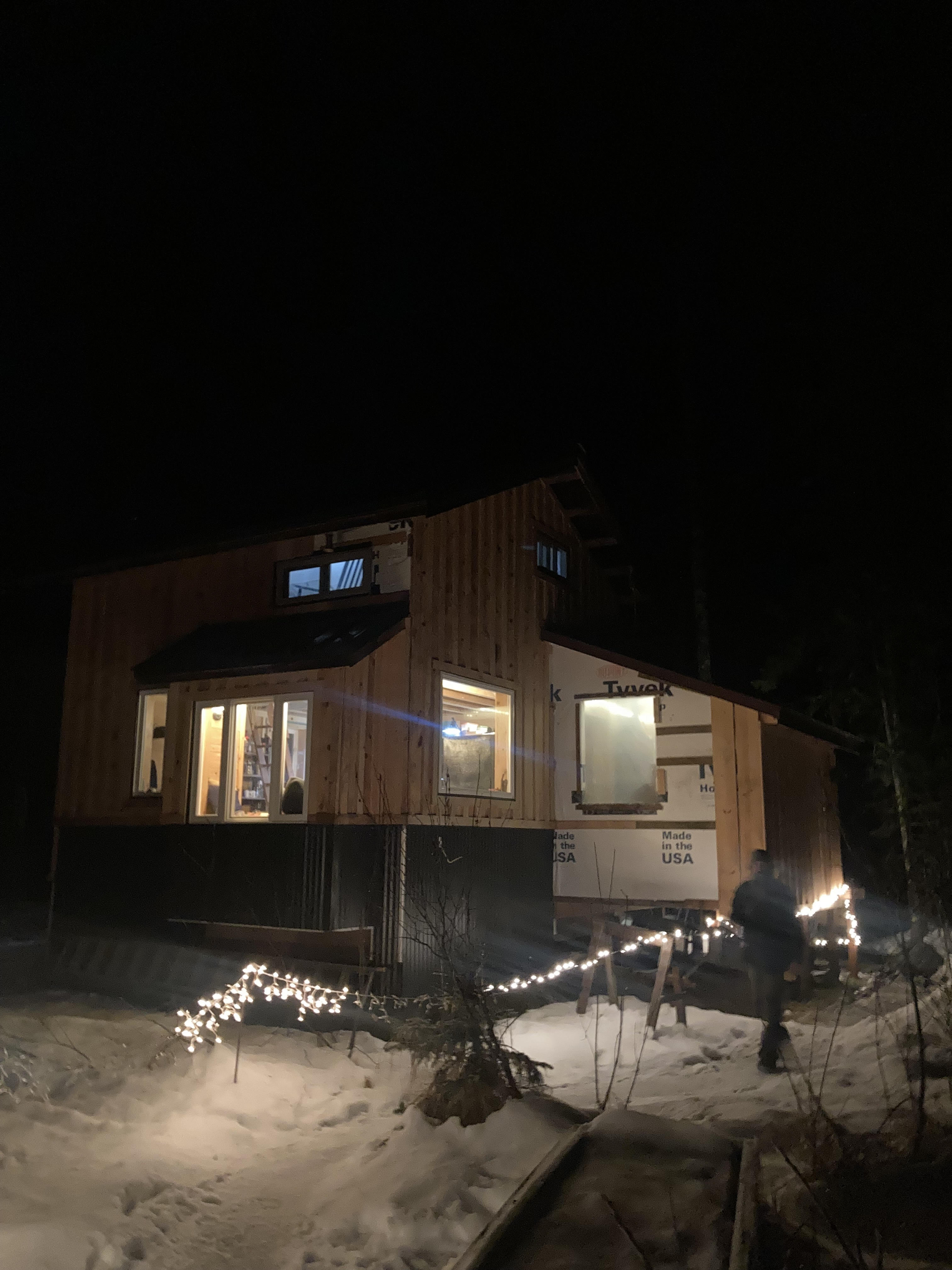
Breanna pours cocktails while I dispense food and keep stealing glances at the cabin. I love how it looks from this angle, with the soft glowing lights peering out the windows.

I missed this tradition last year, choosing to spend Christmas with my folks in Eagle River. I needed distance. Couldn’t wake up December 25th to Minerva and a quiet home. I listen to everyone’s laughter and watch the Jello shots steadily disappear. I was afraid we made too many, now it’s looking like we’re gonna run out before demand does.

The majority of the people slurping Jello and munching potato chips have picked me up in some capacity over the last year. Checked in on me, invited me to dinner, or simply listened. I breathe through a knot in my chest and join the crowd clustered around the fire.

Don’t get me wrong, I love these people. And man, does it feel good to be a part of this rambunctious neighborhood. I remember growing up and hearing some version of the phrase, “The holidays can be a difficult time of year.” That never made sense for a guy who never had much reason to be sad; it makes more sense now.

I crack a beer and chatter about where to find deer when the weather turns cold and windy, my favorite fishing spots on the Bartlett River, and if the rain will ever turn back into snow. Food and drink exhausted, the crowd rambles on. Breanna and I shove the remnants in the cabin and follow the footprints toward the next house.

It took a while to accept that someone else wasn’t going to fix this, share the weight, or better yet, remove it entirely from my shoulders. Grief and hardship don’t work that way. Contrary to Hollywood and countless musical tracks, burdens can’t be lifted by outside sources. But friends, family, laughter, jokes, hugs, and, yes, Jello shots make it a hell of a lot lighter. You’re not alone if the holidays feel a little heavy. It’s okay to ask for help, to lean on loved ones, it’s okay if you’re not okay. Believe that one day you will be.

***

“Slippery out here,” I mutter as we shuffle down the road for Tim and Katie’s.

There are no street lights in Gustavus. Stars and northern lights pop when the clouds allow. On overcast nights with little snow, the roads are just a different shade of black. Small candles lead the way, providing just enough illumination to see one foot in front of the other.

Darkness is the theme of the solstice, a celebration not of the lack of light but of the promise that brighter days are on the way. It may be imperceptible at first. What differences can a few seconds make? But those seconds add up, they turn to minutes, half an hour, an hour. Sometimes life emulates the pivoting sun: impossible to discern the longer days or if the sun is getting warmer. But those long, sun-kissed days are coming. Until then, there’s nothing to do but follow the candles down the road. May they lead you to a warm home.

The Shabin II

Varied thrush make me smile, but cranes make me stop. I look up at the throaty call. It cannot be a coincidence that we “crane” our necks skyward. The long V’s circle past, wingtips kissing the treetops as they descend for the marshy flats two miles from my front door. They are spring. They are fall. They are the rhythms of the changing seasons personified. As steady as the sprouting fiddleheads and sweet-smelling cottonwoods. Hank Lentfer wrote about having the “faith of cranes,” the unshakeable belief that their long flight will be rewarded with soft landings.

I balance on the ladder and wrestle a two-by-four into place. It’s amazing. I lived in The Shabin (a part shack and part cabin that was on the property when we purchased it) for almost four years but have done more work in the last week on the structure’s bones than I ever did. For those four years, we huddled around the little Toyo stove stubbornly set at 55 degrees as snow fell and wind blew. Squirrels invaded the rafters, and thin windows meant we heard wolves on quiet nights.

The floor tilts to the north – not much that can be done about that—but now I’m adding to the porch roof, replacing rotten trim, and installing metal flashing to make the stapled-on side room watertight—okay, semi-watertight.

It feels good to make this place livable again. I wasn’t looking for a renter, but when Breanna reached out in search of summer housing, I leapt at the idea.

“I warn you,” I wrote back. “The space is a mess. There’s no running water and an outhouse. Worst of all, you have to live next to me.”

“I don’t mind,” she said.

Awesome.

I promised a habitable space by mid-April. I’m ahead of schedule, sweeping out the floor, scrubbing the walls, and the previously mentioned carpentry. No one makes their bones in Gustavus by themselves. After years of subsisting on other people’s time and knowledge, having something tangible to offer the next Gustavus generation feels good.

I look down at the sound of nails being pulled from wood. The poor idiot is yanking rusty fasteners from a stack of 12-foot 1x4s that are littered with 8D nails, staples, and tar paper. I know the sap. He doesn’t know the first thing about homesteading, much less how to build a home. But there’s a look of grim determination beneath that curly nest of blond hair. His 30-year-old face is set in a stubborn grimace. He doesn’t know why he’s pulling nails, much less what he’ll do with his salvaged 1-bys. It doesn’t matter.

“Dave.”

He looks up, caught by surprise. He peers at me as if through a foggy window. Recognizing but on guard.

“You’re…?” he gestures toward the (mostly) finished cabin beside the willow grove 100 yards away. The new spruce siding glows in the sun.

“Yeah, man. We pull it off.”

“No shit?”

“No shit.”

He beams and sets the hammer down, scarcely daring to believe it. I reluctantly descend the ladder. I’ve been waiting for this ghost. There’s too much to tell. Too much to recap. How to explain it? How to begin? It’s useless.

“But where’s…?”

My stomach clinches. Minerva pads over, gives the familiar stranger a look, coils around his legs, and darts for the woods. I look at the house, remembering how I walked inside last July and found it empty. Every shadow held a memory I’d rather forget. How can a months-old house already be haunted?

My neighbors, friends, and family kept me afloat. Zach, Tanner, and Hank listened deep into the night while the level in the whiskey bottle dropped. Amy told me to meditate, to control what I could control, and to let go of everything I couldn’t. Laura squeezed me tight and promised better days. So many others offered time, love, support, words, and ears. Very slowly, home became home.

I take a deep breath and look at the kid.

“You want the good part first?”

“Yes, please.”

“This is home. I’m done speaking in absolutes, but this sure feels like it’s going to be home forever.”

He looks through me and closes his eyes. The images flashing through his mind break my heart.

“What did it cost?” he asks.

For a minute, I want to be mellow-dramatic and say, “Everything.” Yet… that’s just not true. But it wasn’t cheap.

“What did it cost?” I repeat. “I hope it’s the hardest thing we ever have to do. You will feel like you’re drowning. People will throw you anything and everything that floats. You will grab every one of them and kick and scramble and paddle.”

Deep breath, let it out.

“And you will fail. You will make mistakes. You will screw up. You will do such a good job of convincing others that you’re ok that you’ll believe it yourself. You will hurt people and find yourself trying to atone for things you cannot atone for.”

“None of this sounds like good news.”

I shrug. This is one person whose feelings I don’t mind ruffling. “Sorry, kinda pivoted straight to the other part.”

He looks at the hammer hanging limply in his hands. I watch his mind race.

“Don’t do that,” I say.

“What?”

I smile. “I know how our brain works. You’re looking for every answer in real time. Give up. You can’t do it.”

I scuff the 2×6 porch with a toe, bend over, and pull a long curling hair from between the boards. Snow Patrol lyrics barrel through my subconscious.

“Two weeks later like a surplus reprieve. I found a hair the length of yours on my sleeve. I wound it round and round my finger so tight; it turned to purple, and a pulse formed inside.”

“Then tell me what we’re atoning for?” he asks.

“Not everything needs to be said in the light of day. We’ll do that down the road.” Another deep breath. “I know you think you’ve cracked some code to life and understanding. Don’t deny it. I remember that feeling—safe, secure, confident, arrogant, and wide-eyed. Scour that from your mind and outlook. We know nothing. And the further we travel both physically and emotionally, the more convinced I am of that.”

“And I knew the beat because it matched my own beat…”

The cranes are back, flying their big, slow circles overhead, the croaking calls of tribe and community.

 “If loons are the voice of loneliness,” wrote Kim Heacox, “then cranes have the cry of togetherness.”

“So where do we go from here?”

“No clue.”

The answer terrifies him.

“What,” I challenge. “Weren’t we so proud of our tumbleweed lifestyle? Weren’t we so eager to talk about embracing the unknown and or seasonal jobs? Benefits, health care, and 401ks be damned? You’d certainly tell anyone within earshot about it.”

I shake my head. “That’s nothing in comparison. It is what it is. Strap in. Quit planning for every possibility, open those eyes, hang on tight, and be where your feet are.”

He gives a little nod and watches cranes go swooping by.

“You’re gonna learn a lot in these five years, and I’m not talking about home building, hunting, gardening, or homesteading. The more you learn, the less you’ll know.”

I’ve bummed this poor kid into silence. The hair around my finger snaps and breaks the spell.

“In the books,” he says, “these sorts of conversations generally lead to some sort of closure.”

“This isn’t a book, dude. It’s life. It’s happening, and it can be beautiful. Don’t waste it because of who’s gone.”

I take the hammer from his hands, clap him on the shoulder, and gesture to the cabin. “Take a break. Go look at what you built with the help of your neighbors and friends. People call it cozy. We like that. Maybe cozy is just a polite word for, ‘small’ but it sure feels cozy to us.”

He wanders up the narrow path. I tug a few nails from the one-bys, recognize the futility, and toss the hammer aside. I step inside the Shabin. It still smells the same despite the cleaning, and memories come flooding back. I know the house I built isn’t much bigger, but the Shabin feels tiny by comparison.

I like that someone else gets to add their story to this space. I’m looking forward to having a neighbor who likes cats, venison burgers, quiet places, and open spaces. After months of clinging to floatation devices, it’s nice to give instead of take.

In a few days, we’ll cram a dozen people in the Shabin, strike a match in the fire pit, and have an old-fashioned Gustavus potluck. The thought fills my bucket. May the doors always be unlocked (I don’t know where the key is anyway), the root cellar full, and the vibes immaculate. I think about Hank, Kim, Melanie, Miller, Justin, Craig, Kathy, Elm, Patrick, Zach, Laura, Patrick, Jen, Brittney, and the legacy of all the other people who helped this home become a reality. I crack the Shabin door and let a fresh breeze waft the scent of disinfectant away.

I watch that 30-year-old kid turn slow circles around the house, marveling at everything he has to learn. I glance over my shoulder, bracing for the spectral ghost of 40-year-old me waiting to dispense more life lessons with the gift of hindsight, warning me of mistakes made and mountains climbed. This time I won’t be caught off guard, won’t expect every answer to the test or a false sense of clairvoyant accomplishment.

I weave up the trail toward the willows, and more of Kim Heacox’s words wash over me like a warm summer day.

“I live in the shadows of glaciers and in the sunlight of friends.”

Ice may advance, it may recede, but it is never done changing, evolving, and sculpting. There is beauty in a charging glacier and infinite possibility in recently scoured earth. 36 inches of glacial clay rests beneath my feet, my world a product of dancing ice. It could have been anything, but it became this, a miracle in process.

Minerva returns from the woods, bounds up a shore pine, and pauses at eye level. I scoop her up and squeeze her close.

“What do you think?” I ask, gesturing at the house. Her purrs vibrate in my chest. “Yeah, I dig it too.”

Reinventing Your Exit

The water goes calm. A spring sun emerges from the clouds and reflects off my glasses. I set down the clipboard, and a breeze rustles the pages. Wind and blizzards battered the Inians for weeks. The hydro failed more than it functioned. The solar panels were dormant. For one heart-stopping morning, the diesel generator wouldn’t turn over.

Fifty degrees and sunny feels like Tahiti.

The manuscript dances in another gust. Minerva yowls from the top of the dock. She fears the dock, mistrusts anything that floats. But she’ll stand sentinel until I decide I’ve had enough. That won’t be for a while.

My head thuds against the sauna. I am “crouch to drink from a mountain stream and pinch a nerve in your neck” years old. It may be days before my Xtra-tuffs are dry, but it can’t stop me from vibing on yesterday’s ranging along the Inian hills.

***

I find the deer in a grassy muskeg the color of wheat. Catching my scent, he slips behind a gnarled pine. Something brings him back. He weaves through brush and poses on the hillock. His nostrils flare, mouth open to taste my scent. We stare for eons or several seconds—long enough to confirm he’s the biggest deer I’ve seen. My index finger instinctively twitches.

If it was November…

He has important deer business to attend to. He turns reluctantly, but once he’s committed, gracefully bounds away. Postholing snow be damned. I follow the winding tracks for a mile, give up, and turn south. Down a steep ridge and up the north side where wet drifts congregate beneath old growth. I pause. It was here, wasn’t it?

I lean against the log and look at the little valley. I see the spike buck wandering up the steep ravine with his head glued to the patchy snow. The rifle cold and shaking in my hands. The Ravens are gone. Whatever’s left of the gut pile is buried. It doesn’t feel like five months since I fired two shots on a misty November day. I still don’t know how the first one missed. Find me a hunter who doesn’t have one of those stories.

Snow soaks my wool pants. I recline and look at the spot where he fell. He has given me life, energy, and hope in the form of stews, meatballs, backstrap roasts, and way too many burgers.

“Thanks,” I whisper.

It sounds empty. Hollow. Throwaway gratitude. But maybe gratitude can’t always be measured in syllables.

***

I’ve read my book 15 stinking times. I can’t decide if it’s getting worse or if I’m just sick of these stupid characters. I hear an engine. Unless you count my five-minute conversation with the Elfin Cove fuel attendant (I don’t), I haven’t seen a human in ten weeks.

So when the cherry red skiff pops through the cut, I feel like Tom Hanks floating on a raft. What are the niceties of human interaction? Eye contact is good, right? And hugs? Ayla leaps off the boat, curly Q tail raised high, permitting me a cursory sniff. Salix dozes in Laura’s arms; Zach has that shit-eating grin on his face.

“What’re you doing on my property, Brown?”

He holds up a Sierra Nevada Pale as tribute. We hug around life jackets. After so many goodbyes, it’s nice to say hello.

They have brought love, laughter, and fresh produce. I grab a package of venison for dinner, and we cluster around the worn Hobbit Hole table.

Laura points to the thicket on my head, “I like the hair, D. A real homesteader vibe.”

The mop wobbles when I laugh. I’ll pay Kathy whatever it takes to draw her out of hair-cutting retirement and thatch this mess. I have to share everything at once, a faucet that can’t be turned off.

We move to the sunny deck with open beers. We’re regrouping. So many goodbyes and farewells over the last few years. A pack of friends that once ran so deep they couldn’t fit in the house has dwindled. Life changes, the sun sets, and things that once seemed permanent vanish like smoke. Neighbors move, friends break up and disappear, and spouses…

It can be hard to know when to hold on and when to let go. The three of us have experienced all these farewells differently, but Gustavus is still home. We want to fish the streams, harvest carrots, and hunt the woods. Heat our homes with wood and piss off our front porches. We vow to find others who want to do the same.  

“I won’t make grand statements or promises I can’t keep,” I tell them. “I won’t say I’m never leaving, but I have no intention of going anywhere. If that ever changes, you’ll be the first to know.

Deal.

***

I watch the skiff putter through the Gut and wave goodbye. My Hobbit Hole stint is winding down and time does that funny thing where it feels like I’ve just arrived and spent lifetimes here. I confess I don’t want to leave. I want the groundhog to see his shadow (or not see his shadow?) and grant me six more weeks of winter to write, hike, and paddle my way through this comfortable existence. Minerva doesn’t want to go either. Not that she’s explicitly told me, but the Hobbit Hole’s predator-free nooks and crannies are kitty heaven.

But if Gustavus is truly home, then it’s time to go. I won’t find what I’m looking for here. Here, I can reset and rip myself to the studs. But I cannot build. The skiff disappears, and my heart swells with gratitude for friends, family, and neighbors who make sure I never get too low and remind me sunnier days are coming.

The list of people, places, and critters that have kept me afloat could fill pages. I doubt I’ll ever be able to fully articulate how much it’s meant. Maybe gratitude can’t always be measured in syllables.

Minerva braves the dock and coils around my legs. The float accordions in the waves, and she beats a hasty retreat towards the house. If she’s brave enough to take on the dock, I suppose I can go home, dig through the totes and mementos that demand my attention, and keep on trucking. I follow Minerva but pause long enough to soak up evening sun and hooting spruce grouse. It’s time to stop tearing down and saying goodbye. I’m ready to build up and say hello.

A Prayer for Place

Fog to the waterline. Chichagof just a mile away, but all we see are the shores of Inian Island. The four of us stand on the stern of the Magister and pick up a bucket.

It has been a bountiful two weeks at the Hobbit Hole. Every hunter who has walked into the woods or landed on a beach has come back with at least one deer. The Hobbit Hole’s freezers are fit to burst with the promise of burgers, stews, and roasts that were born, raised, and harvested from the places we call home. They’re so full that Kathy, Bill, and I are going home with a load of venison to make room. The larders are packed, and winter has come in the form of 60-knot gusts and a foot of snow.

In the buckets are the final pieces of the deer, their bodies now sustenance for us that, as Zach vows, “will fuel good work.”

We whisper benedictions and watch the hides and scraps drift away on the tide of Inian Pass. It takes but a minute for a pair of eagles, a raven, gull, and otter to find our burial site. The eagles divebomb with precision. The otter swims away clutching a head with a piece of intestine trailing behind like a line. Nothing is wasted. Life is honored. Traditions are savored.

Zach puts the Magister in gear. We round the corner, and I watch the island fade into the fog. We travel in milk, but I know the way. Can clearly picture us zipping toward Lemesurier where more friends are communing and hunting. And ten miles beyond “Lem” is home. Home. I let the rock fill my stomach, stare at the fog, and convince myself that it’s simply mist making my cheeks wet.

I feel a hand on my shoulder and turn. Kathy’s eyes look through mine, and I can’t hide behind the smile that comes too late. When it comes to Catan, Kathy is ruthless. When it comes to matters of the heart, well, let’s say she won’t block your attempt at the Longest Road. She knows loss. Has experienced it herself. And I get the feeling her eyes have looked like mine before.

***

Dinner done. The dishes put away. A cake that took 13, yes 13 eggs and a pound of butter sits in the middle of the table. Full as we are, as rich as it is, we’re still eating. And I am waiting. Waiting for Zach to do what he does every Thanksgiving. We aren’t the only people who resort to that time-honored tradition of going around the table and saying what we’re thankful for. There’s nothing wrong with it. A lovely perspective to have, I admit. And it was a year of gratitude for many.

Kathy and Bill got married. Zach and Laura welcomed their son Salix into the world. Beth and Elm bought property and finally, after both were raised in Gustavus, have a piece of land to call their own. Very good years with blessings worthy of being celebrated and shared.

Beth finishes her gratitudes and looks at me. I stare at my coffee cup for several long seconds, feel the table’s eyes on me. Everything spoken and unspoken hovers in the room like smoke.

In years past, I haven’t taken this ritual seriously. It was simple to say the obvious. I was thankful for my little patch of Gustavus clay. For health that allowed me to tromp in the woods and look for deer. To have work that I loved.

I. I. I. I. I.

What sort of gratitude does one have when they’ve stripped that person to studs, dug deep beneath the foundation and asked, “Who am I?”

“Ahhhhh,” I finally say. “This has… not been the best year for me.”

Have you ever been the only person at a table to share bad news? Is it their pity I feel? As if I have contracted some terrible sickness that leaves those nearby speaking in hushed tones of sympathy and condolences.

No. It’s love. It’s acceptance. It’s… community. For Gustavus has that in spades. I forgot that at some point. Forgot that was the reason I wanted to call this place home in the first place. It wasn’t just whales and glaciers, salmon runs and quiet homes in the woods. Kim Heacox’s words materialize in my head.

I live in the shadow of glaciers, and in the sunlight of friends.

I remember now. I will never doubt it again.

It was people like this. People that are neighbors in the truest sense of the word. Not just someone you wave at when you grab the mail or need a cup of sugar. And neighbors close ranks and pick each other up, permitting vulnerability, intimacy, and, yes, a home.

“A few months ago… I wasn’t sure I’d be here. But it’s the people at this table that wouldn’t let me leave. I can’t quit you guys. I can’t quit this place. And as strange as this sounds, everything that’s happened has given me a firmer grasp and sense of place. How precious you are to me. And that is my gratitude. To know that I truly have a home. That I truly belong. That my love of this place was bigger than one person.”

“So…” I bang my coffee cup on the table and hear their mugs answer. “Thank you for being home.” 

We cheers, we smile. And we brush that intimacy aside, crack beers, and break out a game of “Liar’s Dice.”

Insults, quips, and jokes boomerang around the table. Elm’s laugh echoes off the walls. Beth giggles. Zach and I exchange movie quotes at a rapid-fire pace. Laura grins. Bill gives his quiet smile. And there’s Kathy’s piercing stare, trying to figure if there really are “six-fours” hidden under our hands.

***

Kathy and Bill leave me on my doorstep with two totes of frozen meat and a fire roaring in my wood stove. Minerva comes hopping out the cat door chittering and meowing. I scoop her up, bury my face in her fur, and step inside. I love how my house smells. The earthy richness of the hemlock paneling, the faint smell of stove ash. The promise of bright summer days piercing the south-facing window.

I load the meat in the freezer and put the kettle on for a pot of afternoon coffee. As the water boils, I look around the room. I’ve done some remodeling the last few weeks. Moved some pictures, bought some new dishes. Tossed an old blanket and regretted it when I felt the chill of winter.

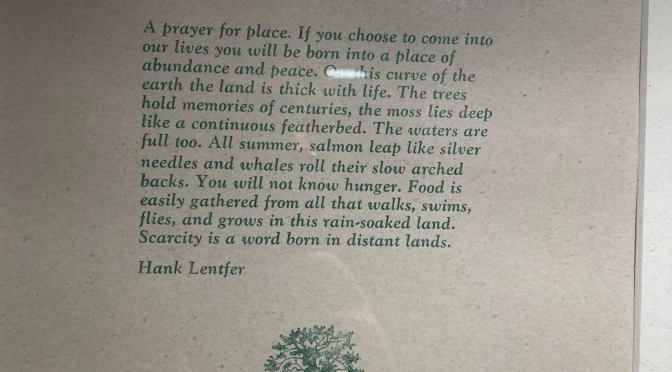
There’s more orca paraphernalia on the wall. Getting back to my roots. Maps of Icy Strait and the Broughton Archipelago have been promoted to artwork. But the frame I stare at now has neither animal nor geography. It is words, penned by my neighbor Hank Lentfer. A mantra. A creed. A promise. A prayer.

A prayer for place. If you choose to come into our lives you will be born into a place of abundance and peace. On this curve of the earth the land is thick with life. The trees hold memories of centuries, the moss lies deep like a continuous featherbed. The waters are full too. All summer, salmon leap like silver needles and whales roll their slow arched backs. You will not know hunger. Food is easily gathered from all that walks, swims, flies, and grows in this rain-soaked land. Scarcity is a word born in distant lands.

The kettle whistles and the smell of coffee sinks deeper into the drywall. I have chosen. I have been accepted. I have a hot wood stove, cold clean water, and a freezer fit to burst. And that is worth all my gratitude.

Board & Batten

I don’t like ladders. I don’t like the way they bend, I despise the way they rarely lay flush against the wall. Until they do, and then they inevitably lean at odd angles that defy gravity in a manner no self-respecting carpenter would trust. So, as I climb the rungs of my extension ladder and move high enough that there’s a single rung under foot, I feel every wobble. A gust of wind buffets my house, and I reach out to steady myself.

But at last, there’s something to hold besides Tyvek. There’s this tall, sturdy, 1×10 next to me, securely nailed to an equally sturdy wall of 2x6s sheathed in half-inch plywood.

Even when I moved in, it felt incomplete. To be fair, it was. But it was more complete than many homes in Gustavus when their owners move in. I received raise eyebrows and impressed compliments that I held off moving until the downstairs trim was completed.

But a voice kept needling. The same voice that sows self-doubt whispered that the outside was covered in DuPont logos. We are our own worst critics.

I warned Dad that if he visited, I’d put him to work. Board & Batten is one of the easier siding flavors to install. But it still involves muscling 14-foot boards vertically, with one person clinging to an end, whispering their favorite curses, and trying to stay level.

Clinging to an end, whispering curses, and trying to stay level describes much of the last few months.

In a role reversal that is both tender and bittersweet, it is now Dad holding the ladder while I reach out with a hammer to swing at a nail perched 20-feet above the ground. But that was the deal I made with Mom. No extension ladders for Dad.

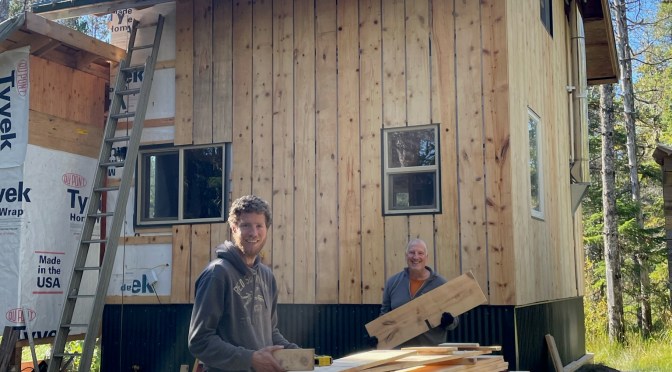
For four days we’ve worked in tandem. The rhythm easy and the tape measure yo-yoing up and down while measurements with quarters, eighths, and, when we want to get fancy, sixteenths are bandied back and forth. Notches around windows made the green metal trim pop, and the tone of pride when those complex cuts fit around rafters and flashing are palpable.

All the while, Mom is stationed at the sawhorses with a brush and a vat of Thompson’s Water Seal. She seals as fast as we install, and the pile of boards I’d picked up from Ernie King’s sawmill are shrinking at a rate I can’t believe.

I chose Board & Batten one for its simplicity, but two because I figured I could manage to install much of it on my own. The shift was not just practical, but prideful as well. I wanted to do this alone. To prove to myself that I could indeed carry on and finish a project I never imagined I’d tackle.

But no one goes through life alone. No one should, no one can. And sometimes all we have to do is advocate for what we need. In that moment I needed a sealer and a board holder. And here were Mom and Dad. Working for coho dinners and cold beer. Cold beer that many times they insisted on buying. And as I perch on top of that rickety ladder and nail a board snugly below the peak, I know there wasn’t a chance in hell I could have done this solo and kept my neck intact.

With every break, we take a step back and revel in our progress. The battens look sharp, the knots of the spruce popping against the metal skirting. It’s addicting. Every board makes the cabin look more like a home and less like a construction site.

Over the course of a week, through rain, sun, and periodic breaks to harvest potatoes or admire the Sandhill Cranes overhead, the Tyvek vanishes.

I want whoever enters this house to feel the warmth and love that went into this home. I want it to start the moment they set eyes on it. For it to feel like I always dreamed; a simple little box perched on the edge of a willow field that’s mowed by moose and shelter to snipes.

As an atmospheric river prepares to dump multiple inches of rain on an already soggy land, Dad and I rush to attach the first of the battens. I want them to see what the finished project will look like. Now that I can carry on by myself, mustering those tiny 1×4 battens into position. The first one slides between two trim boards, and I tap nails into place.

I can hear Dad below. “It looks so good, kid.”

I know he’s proud when he calls me kid. I scurry down the ladder and look at the first truly finished corner of my home. It does look good. No vinyl or hurried job. I’m glad I waited. I’m glad I asked for help. There’s no way it would look this straight or this sharp if I’d stubbornly tried to do it myself.

I hand my parents a carpenter pencil, I have one more task for them.

“Everyone who works on the cabin needs to leave a message, note, story, quote, or song lyric somewhere on the plywood or Tyvek. So that when everything is done, there’s a little piece of everyone who helped make this a reality.”

No one builds a house by themselves. No one goes through life alone. Wrapping the gifts, love, and time of those that help build, is what makes a house a home. And what in turn makes me whole.

The Building Tree

The smell of two-stroke fuel fills the air. Hands slick with chain oil, metallic teeth glinting in the sun. Behind me the forest is calm, quiet, unassuming. The trail, marked in pink fluorescent tape, billows slightly in the wind. It’s only twenty yards from where I stand to our house site. A site that we’ve exterminated of stubborn willows and optimistic shrubs. I’d be lying if I said it felt good clipping them.

But it’s child’s play compared to what I’m about to do. I grab the chain saw, set the choke, and give the string a confident pull. I’m out of my league. 12 months ago I couldn’t have told you the difference between a joist and a stud. Now, tucked beneath the pages of The Independent Builder is a stack of graph paper, erase marks and crinkles bleeding into the pages. But somewhere along the way, a structure appeared, represented by lead to be built with wood. It looks so pretty and neat with those perfect squares and right angles. Making it come to life will be another matter.

The saw vibrates in my hands as I walk towards my first obstacle. I take no pleasure in felling these trees. But it’s something I’m familiar with. I know how to notch them, make them fall just so. If our winters in British Columbia and the Inian Islands taught me anything, it was how to make a Stihl roar. The first tree is a pine. It looks withered, old and bent. A few stubborn green needles continue to poke from the limbs. If it isn’t rotting already it will be soon. Whatever life it has left ends now. Because I said so. Because 18 months ago we walked onto this property and decided this was where we would live.

With a guttural growl Stihl comes to life, fine papery shreds of bark and wood fly into the air, the sweet savory smell of the forest. Within seconds it’s over. The pine tips and cracks. I lock the saw and scurry for cover. It falls where it’s supposed to, the concussion quieter than I could have anticipated. In the years to come we’re going to need help. Pouring concrete will be like speaking a foreign language; intimidating and embarrassing. At least our inevitable mistakes with wood can be fixed with a cat’s paw if we catch them fast enough.

But this, the Stihl digs into the next tree and it begins to sway, this I can do on my own. No one needs to coach me anymore. And for the first step, simply clearing a path to the house site, it means a lot. It displays at least a modicum of competence. And for my ego if nothing else, that feels good.

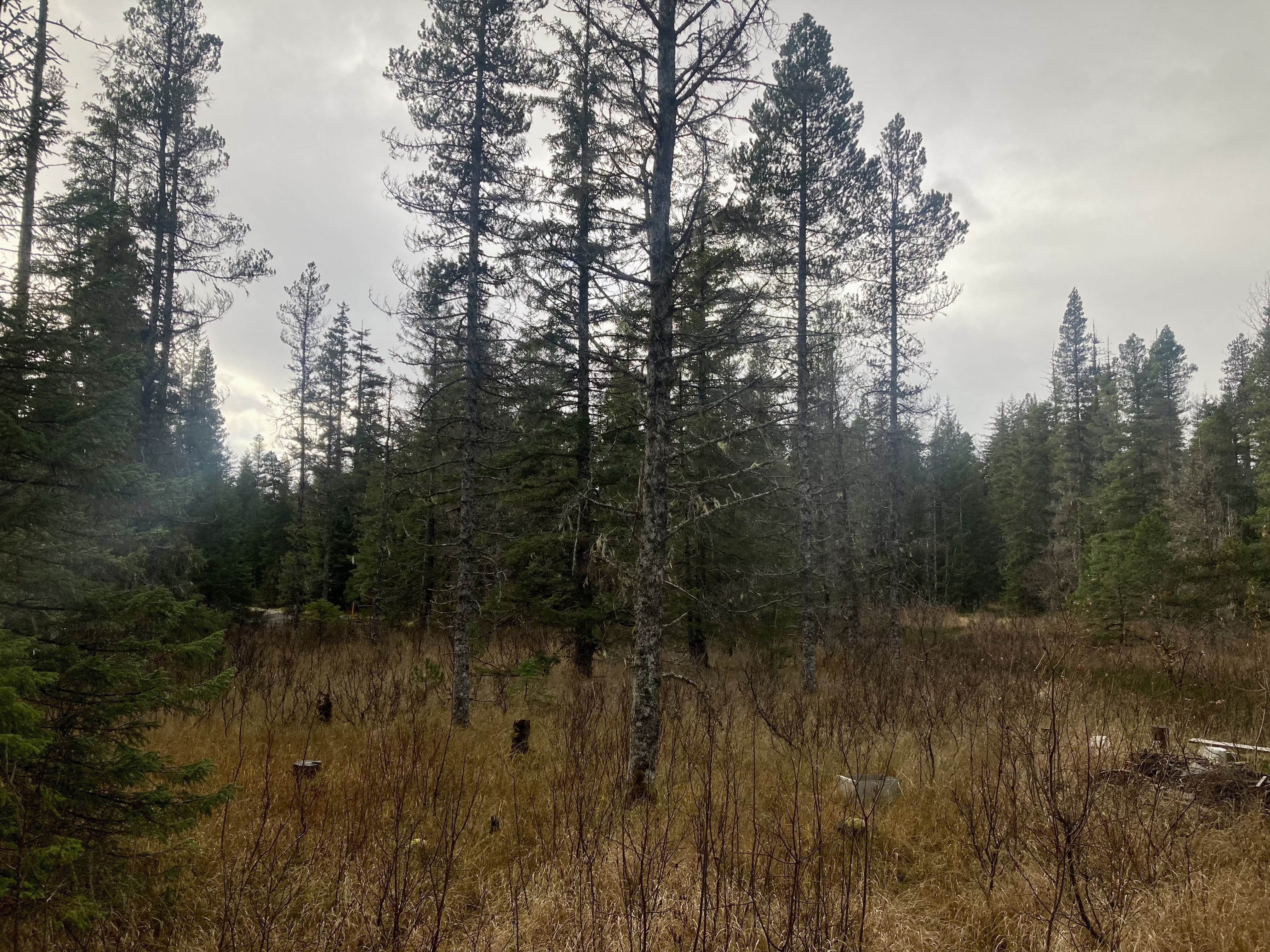
Within an hour the path is clear. The final tree falls atop its comrades, the Stihl is extinguished, the surviving forest quiet. I walk back down the gap I’ve created with the simple grip of a trigger and a bit of fuel. Right in the middle of the trail stands one final Charlie Brown tree. The hemlock is only five feet tall, not even worth the saw. But as I stare at it I can’t shake the sensation that it’s staring back. Our land is wet. Last September when the rain pounded Gustavus our water table was plus 18 inches in some spots. The price one pays for a glacial outwash. A few big spruce have bucked the odds to grow 100 feet high. But this is the only hemlock I’ve found. I would no sooner cut this tree than kick a kitten.

But it can’t stay here. The excavator comes in a matter of days, if I don’t take it now it will be run over by the wheel’s of our personal progress. There’s only one thing to do. It must be relocated. We’ll find a quiet and (relatively) dry spot for our building tree. I’m aware of the irony. Saving this little tree when I just felled ten. A home built with the old growth of Chichagof and Home Shore. In no way does rescuing the hemlock acquit me of my lumber consumption. I’m not sure why it means so much. I walk past the homesite to one of the big spruces. The spruce that we vowed we’d never cut. I run my hands along the bark, “I think you need a friend.” 

Standing Still

The April sunshine should feel good. I should be sprawled in the grass soaking up the rays like a hungry plant that’s been inside too long. But I feel none of it. What a picture I must make, a whiskey bottle hangs loosely in one hand, my gait awkward and uneven on the rocks. A cool ocean breeze floats through the hemlock but inside I’m stifled. I can’t breathe, a weight presses down on my chest that the liquor can’t alleviate. I stumble and collapse against a washed up log, long ago it was left high and dry, left to rot at the whims of the universe. I feel a kindred spirit with the rotting wood and crumbling bark. I savor another sip of the brown stuff, close my eyes, try to breath. How did I get here?

For most of my adult life I have rambled. A modern hobo with a 75 liter pack in place of a branch and tied handkerchief. I reveled in it. Up and down the coast. Again and again. British Columbia, Juneau, Gustavus, the Inian Islands. Surely this was the way to live; free and uninhibited. From one wood cabin to another. Again and again I scoffed at the “every man.” The poor saps in their cubicle jails. Shackles of security holding them down. Worker bees. Drones. The nine-to-fives. A pity.

If only more lived like me. Could find the bravery to cast aside their fears and leap into the unknown.

The ramblings of a young man.

A knot from the log presses into my back. It does little to alleviate the fear that clutches at my chest. For the past two months we’ve operated under the illusion that the Hobbit Hole would be our home for the next three years. Full time caretakers at last.

It would come with stinging consequences. Eleven months a year here meant precious little time with our tribe. We dreaded the conversations we’d have to have with our dearest friends. That we felt called to be here, to help the Inian Islands Institute get off the ground. That a growing desire to be educators had taken root. But there’d be no denying that three Gustavus-free years would change the bonds that we had tightly forged. Was it really a sacrifice we wanted to make?

This would be our last hurrah. The job as caretakers promised to pay well. Enough that we could return in three years and get the house built that existed only in SketchUp. We’d at last admitted that building a house on a guide’s wage wasn’t feasible.

But two hours ago Brittney walked down the stairs, terror and pain in every syllable, “we didn’t get it.”

***

Zach Brown and I sit in the garden. An afternoon sun playing over the water. He’s one of my best friends. I thought he’d be my boss for the next three years. But there was someone better. I’d heard the resume of the couple that got the position over us. They were what we had feared. They deserve to be here. The time has come to confront my failure, acknowledge that Zach and his board made the right decision. That Brittney and I never expected preferential treatment. That we still love him, Laura, this place, their vision. That we’re still in. But it’s hard to keep the bitter taste of disappointment out of my voice as we work through it.

Hank Lentfer, student of cranes and supplier of beer appears from the house and hands us each an IPA. It loosens our tongues, we say what needs to be said. It’s time to move on. It’s time to let go. I turn and look at the house, the deep green paint melding into the forest. The open lawn, the shop with the pool table on the second floor. It isn’t mine. It never was.

In the moments after we learned we hadn’t gotten the job I flew into a rage. I pounded the floor, screamed, and terrified the cats. Selfish words poured from my mouth. Phrases like, “we deserved this,” and “it was supposed to be ours” came fast and easy.

I didn’t deserve this. I didn’t earn this. Zach did. By hiking a thousand miles and paddling a thousand more. By fundraising and dreaming and believing. He may not have physically built the structures of the Hobbit Hole, but he has earned every stud, beam, and piling that they’re composed of.

***

Our final week at the Hobbit Hole. I’m back at the fallen log, my brain clearer and the pain a little easier. It still hurts, still in mourning, but I’m confronting the world with clear eyes and sound mind, perhaps for the first time. 

If only more lived like me. Could find the bravery to cast aside their fears and leap into the unknown.

I long for the days in our rusted Pathfinder. Waiting for the next ferry in the parking lot of a Prince Rupert Tim Hortons. The warmth and comfort of knowing that everything I need is in the car with me; Brittney, the cat, the rabbit, a laptop to write on, what more did I need? How liberating, how comforting, how… safe?

The realization slowly sinks in until I must acknowledge it. I’m not the risk taker I pretend to be. What exactly were the chances I was supposed to be taking? For most of my twenties I could have bailed out at any moment. Our careers and choices could zig-zag across the world if we wanted to. There was nothing stopping us. We could change our stars on a whim.

But we fell in love with 4.2 swampy acres of glacial Gustavus outwash and decided we were ready when I knew I wasn’t. Perhaps life’s greatest risks isn’t running but standing still. What if those worker bees were the brave ones? I was always running, moving. Becoming a full time caretaker would have provided the security I had denounced for so long. Now, with a mortgage and uninsulated cabin, I crave it. I’m more scared now than I’ve been in 10 years of rambling. The irony bites hard on the ego gland, devours it whole.

***

Home. Four corners, the Shabin, Excursion Ridge, nightly beers with Patrick Hanson.  The Fairweather mountains still punch holes in the clouds, defiant white peaks blockading a blue sky. When you miss out on what you thought was a dream job—the coronation of your twenties— and still have Gustavus, it’s time to give thanks.

For years I have coasted on what other’s have built and earned. Paul Spong’s Orca Lab, the Hobbit Hole, places I have occupied and never fully deserved. This spring the universe has grabbed me roughly by the shoulders and looked me square in the eye.

“David, it’s time to stop running. It’s time to build something of your own.”

Dear lord does that scare me. I just learned the difference between a stem wall and a slab-on-grade. Now I’m building something? Deep breaths, they come easier than they did a month ago. What do I need to do first? Foundation, get a good foundation. I open the construction book, a notepad on my lap and read about concrete pilings, my pencil scribbling notes with the fervor of a procrastinating grad student.

***

Down one of Gustavus’s many dirt roads is an art gallery. On some weekend evenings it doubles as a music hall. Tonight it triples as a potluck complete with free beer. The place is packed as one musician after another comes to the stage and belts our their best. This town has to have more musicians per capita than anywhere on earth. But as the evening begins to wind down, one man in particular makes his way to the stage.

Justin Smith has collar length hair, a ball cap pulled over his head, skinny torso, and a long gait that helps him cover the aisle in a few strides. A buzz fills the crowd, when his name is announced the place erupts. I’m crammed onto the floor next to Patrick. We’re both clutching a beer. It’s not our first or second, I don’t think it’s our third. We share a wild look.

“Dude, he’s gonna play.”

Open-mic nights go way back in the annals of Gustavus lore. As much a part of our culture as deer hunting on Pleasant Island and picking strawberries. Eight years ago, at my first music night I watched spellbound as Justin and Kim Heacox belted out Cream’s, ‘White Room.’ Kim pounded the piano keys so hard his fingers bled. Justin made his guitar do things I didn’t believe possible.

But as the years have gone by, Justin hasn’t played as much in public. He’s raising a son that is the apple of the Goode River Neighborhood’s eye and just moved into the house he and his wife Jesse built. Another in a long list of role-models and heroes. He speaks quietly into the microphone, his voice soft and understated. Humble eyes and a sheepish smile pan the crowd.

But those that have heard him play know what is coming. Patrick and I bounce on our knees like it’s Christmas Morning. And for the next fifteen minutes he plays. Three instrumentals of his own creation. Listening to Justin play guitar is like reading the climax of a novel. The crowd leans forward, hanging on every note like turning pages. And for the first time, I’m relieved we didn’t get the job. This is home. In the good times and bad, sickness and health. Whether I’m ready or not, this is where we need to be.

Westeros

The Inians are splayed out like a handful of watermarks. Inians. Such an odd name. Even Zach isn’t sure where it came from. Like someone started to write Indian and lost interest halfway through. But we know where Hobbit Hole comes from. Zach’s mother Carolyn christened it long ago because “The Pothole” was just too secular, and Hobbit Hole is a much better name.

The little archipelago is sandwiched between some of the wildest water on earth. To the west is Cross Sound, which should be renamed “Small Craft Advisory Pass.” Even on days where the wind blows from the east ten knots or less, the ocean swell sends six foot waves crashing against the westernmost islands.

Icy Strait lies to the east, an indomitable stretch of wild water in its own right. Bracketing and connecting these two bodies of water are North and South Inian Pass. The nautical map we’re studying holds a warning both exciting and intimidating.

“Tidal currents in north and south Inian Pass can reach 8-10 knots. Mariners should use extreme caution.”

Extreme caution? Who knew there were categories of caution. What exactly would constitute minor or moderate caution? Staying home would be exercising all the caution. But if that was the case, there’d be no reason to be here.

We load a pair of double kayaks. Brittney, Zach, Laura, and myself have the hair brained idea of exercising minimal caution and paddling to the westernmost island in the Inians, an unnamed chunk of land stretched vertically as if the very pounding of the oceans storms had flattened it. It’s an island that, as far as we know, hadn’t been walked on by Xtra-Tuffs in a long time.

We name it Westeros, which sounds like a rejected Middle Earth landmark, and set off. From atop the main island yesterday, Zach and I saw an exposed peak on Westeros. A peak that would offer a 360-degree view of open ocean, Chichagof Island, the Inians, and the Fairweather Range/Glacier Bay. We cross the half-mile wide channel between Westeros and the other unnamed island in the Inian cluster. This channel was nicknamed “the laundry” by commercial fisherman because trying to cast nets in the channel on the flood was like being in a washing machine. A rock cliff on the east side is covered in graffiti, the signatures and dates of the boats that had anchored here. A good luck charm they said, at least until a boat sunk the day after scrawling their name on the granite.

We find a beach to land, tie the kayaks to the alder, and disappear into Narnia. There is a sense of wildness here that is not captured many places. A sense, some sort of intimate knowledge that man has not treaded here. And if he did, he did so with a light touch, without staying long enough to leave a mark. We scramble up a hill covered in the loose shale of the island. Atop sits the bones of a fawn. The tiny scapula and ribs bleached, the white stained with the green of the forest that is consuming it. The ribs are the length of my middle finger, delicate and innocent.

Trails criss cross the hills and cliffs. The deer are here. Zach looks slightly disappointed at leaving the rifle behind. After our big Coho day in September, harvesting a deer seems like the next natural step.

We follow the trails whenever we can, trusting they know the easiest way up steep cliffs with loose rocks, rotten tree trunks, and squirrely roots. The vegetation is not what I expected. Banzai shaped mountain hemlock and shore pine dot the island, grasses grow on the south facing slopes, muskeg gives off the impression that we are walking through a frozen Serengeti.

“How many people,” I wonder aloud, “can say they have walked in a place where no one else ever has?” The percentage has to be less than 1%. For the frontier is no more. Google maps has plastered everything, for better or worse. But here one can escape this discouraging fact. Here there is just us, the deer, and a Rock Ptarmigan in winter plumage. White as a ghost it sits beneath a banzai hemlock, it’s head twitching back and forth as we creep past and above it for the summit.

It has been 24-hours since I stood on the peak of Westeros and it is that summit that has made me appreciate John Muir all the more. For Muir wrote beautifully of course, but his amazing ability to capture the natural wonderment of this place and convey it in words is second to none. I am simply not gifted enough to do it justice. But imagine a 360-degree view, each 90 degree turn offering a completely different vista of breath taking beauty. An open ocean view that spans to a horizon that is almost dizzying. Horizontal vertigo, it pulls in and pushes away at the same time, like the swell that pounds at Westeros.

Chichagof. Tall hills covered in snow, unpassable thickets of devils club. Streams thick with salmon eggs. Brown bears slumbering in caves and beneath deadfalls. The Inians and the Hobbit Hole, the last of the homesteads. And the Fairweathers. Oh those big snow coated mountains, shining so unashamedly bright they hurt the eyes. Brady Glacier flows at the feet of La Perouse and Crillion. Peaks that are over 11,000 feet high. All hail the glacier makers. What would the leaders of this world think if, just for an hour, they could sit here and do nothing but slowly spin. Would development, profits, winning, still feel tantamount? What if they ate the most delicious sandwich ever made? Ate the carrots of the victorious and guzzled the tea of salvation.

“I feel like this peak needs a name.”

“Not everything needs to be named.” Brittney says. True.

The wind whips from the east. Clouds form in eastern Icy Strait and begin to come our way. Laura points out a Lenticular cloud forming like a hat atop La Perouse. Zach wanders about and finds his favorite Alder tree. It’s chilly up here, it is January after all. It may snow tomorrow. I hope it does.

With a reluctant final glance at La Perouse and its headgear, we begin to make our way back down toward the kayaks. Past the Ptarmigan and along the trails of the deer. Returning the island to its rightful owners.

“This forest is old,” Zach quips, quoting Legolas’ description of Fangorn.

“How old is it?” I ask.

“Very old.”

May it always be that way. We linger on the bones of the fawn again before we slide down the final hill and return from our commune with the gods of Cross Sound. The reality of sea level. There is a shared sorrow at the passing of the little deer. The unspoken irony that Zach wishes to go hunting tomorrow. That we hope he gets one. The painful reminder that to live is to die. And to die is to feed another. I remember Laura landing her first Coho. The grim look on her face as it lay at our feet. Her hand reaching out for the fillet knife.

“I want to do it.”

Brittney repeating the same action a week later. Patrick running his hand down the lateral line of a Coho. The one Coho I landed, stared into its eyes, and then returned. Because for some reason I couldn’t swing the pliers, couldn’t cut the gills. This is life out here. How life should be. Forgive my arrogance.

We paddle out from shore and ride the swell like a couple of murrelets. A sea otter with its pup bobs in the chop. And I am grateful, profoundly grateful that my life includes these people, those mountains, this ocean. The opportunity to come home with dirty Carhartts, numb fingers, and red noses. Zach and Laura’s mission is to ensure that more young people can do the same. That this island cluster would change lives. And as we turn the corner and into the wind, I know it already has.

So This is the New Year

I still wake up hearing them. I still catch myself stopping on the creaking stair, ears cocked, listening to a speaker that’s hundreds of miles away. You don’t quit Hanson Island, and it doesn’t quit you. How can you?

It’s the only place I’ve ever looked up from a stove to see a dorsal fin emerging from the water. It is the place that breathed life into me. That held me close and let me go. That told me that I could do and be whatever I wanted to be.

Gustavus, Alaska feels tame. The biggest hardship is our cistern froze last week and the liquor store is open just six hours a week. Where’s the challenge in that? Where’s the thrill of grocery shopping knowing that if you forget it today you’ll go without for the next two weeks?I’m not entirely serious. Last week I interviewed for a job and the interviewer asked me what my favorite part of Gustavus was.

“Well having a 5,000 square mile national park right outside my door is pretty neat.”

It’s just… different. Not better, not worse. Hanson Island will always be where I cut my teeth. My introduction to the blue and green world. In that way it’ll always be significant. It still astonishes me that we spent three winters there. Approximately 20 months that feel like little more than a blink. Time close to the earth always seems to go fast. You sleep better, eat better, laugh harder, and scream louder. And the time slides by until you’re looking out the window at the rain, know Paul Spong will be there with the June Cove any minute, and wonder where the time went.

I’ve spent most of this winter reading “how to build a house” books, learning the difference between joists and beams, and why 2x6s make good frames (it’s all about insulation).  I’m editing a novel, preparing to send it off, and praying that someone out there digs it. It’s exciting. It’s just… different. Not better, not worse. The roots are sinking in, and most of the time it feels good. For the first time since leaving Juneau we’re surrounded by the people we love. Dear friends who like us have found sanctuary in the outwash of glaciers. But every now and then I walk the beach and stare south, beyond Icy Strait and Chichagof Island. My eyes see past the Myriads and Baranof, through Ketchikan and Bella Bella to rest on a little cedar cabin on the edge of the tideline.

And I see Harlequins bobbing in four foot chop. I smell the rich wood finish of the lab. I hear the ocean’s voice through the speaker next to my bed. I taste salt. I feel the waves pounding the little boat in Blackney Pass. And for a moment I can’t stand it. I’ve got to move, I’ve got to go back. Past one more bleary eyed Prince Rupert border guard and through the Great Bear Rainforest. Part of me will always be 17, crouched on the rocks of Cracroft Island in the dead of night, listening to the A4s swim west.

***

Kim Heacox is a writer, an activist, and will dance and sing at every available opportunity. He’s also my next door neighbor. And he has plans. Like most of us who give a rip about quiet places and open spaces, 2017 was not a pleasant experience. But that’s not stopping him. He and his wife Melanie have a beautiful house and a fantastic library. All their buildings are connected by boardwalk, the road to their house weaves through the forest to spare the largest trees.

They have no intentions of keeping it for themselves however. At some point it will become the John Muir Wilderness Leadership School, the house (one of the few in Gustavus built to code for this very reason) will become a flashpoint of young writers, activists, and leaders. In my head I imagine the place becoming for someone what Orca Lab was for me. A place to find yourself. A place of epiphanies and euphoria. A place of inspiration. A place where perhaps one day I can play the role of Paul Spong; teaching that if cold science doesn’t work, if you look into the world and see something looking back, the best thing to do is grab a flute and play a song. I’m not a scientist. I learned that long ago. But I could be a teacher.

Gustavus is full of people like Kim. Zach Brown is 31-years old and in three years raised more than a million dollars. Now he has the Inian Island Institute, an old homestead an hour west of Gustavus. The perfect place for young people to lose themselves of find themselves, whichever one they need. Because if more people could find their “Hanson Island” the better off the world could be. Reach’em while they’re young. Before the allure of profit margins and mansions can sink their teeth in.

***

It’s Christmas Eve. Gustavus is wrapped in snow. But over the last few days the temperature has plummeted toward 0°F. Just a little way out of town is the only uphill trail, on the flanks of Excursion Ridge. Patrick Hanson and Jen Gardner pick us up and we kick off our “orphan Christmas.” The sun peaks over the top of the ridge as we climb. The Fairweather Mountains, the tallest coastal range in the world lords over our little hamlet. Glacier Bay is just visible, crawling up to the mountain’s feet.

The freezing temperatures have coated everything in crystalline hoarfrost. Snow flakes stand out, perfect little gems. Delicate but incredible versatile. Recent research suggests that at the center of each flake is some sort of microorganism, some microbe the frozen liquid could glob onto. At the center of Gustavus is the people. Something that everyone that has arrived here can attach to. It’s not always easy, but if you allow this place to form you… what can you become?

We reach a shelf on the ridge and Patrick, as he always does, has snacks. A sip of coffee, a bite of gingerbread, a shot of whiskey. It is Christmas after all. From here Gustavus doesn’t appear to exist. Nothing but trees, mountains, and that bay. More than 100 years ago, A.L Parker climbed this same ridge, but from the other side. And when he looked down on the Gustavus plain, he knew that he had found his home.

I can understand why. Something in that smooth, flat plain surrounded by mountains screams at our most human instinct. I look out over the strait and south. I X-ray through the archipelago and Queen Charlotte Entrance. I still see that cabin. I always will. I’ll be back. Patrick cracks a beer and hands it to me. It is Christmas after all. And if I have my way, I won’t be coming back alone.

Above the Flood Plain

There’s only one hill in Gustavus. Like everything else it’s accessed via a dirt road, and only a dirt road. It’s known as The Hydro. Because it’s here, at the headwaters of Excursion Ridge that we get our power. The road leads up the ridge to the hydro damn and offers one of the only bird’s eye views of the surrounding country.

One can continue up over the top of the ridge and look down at the inlet with the same name. Or swing north, through the valley and up the Chilkat Mountains. And if one is especially endowed with testicular fortitude, they can continue north and follow those big beautiful mountains all the way to Haines. Among the young folk fly rumors about the old timers that have done just that. The same people who built there homes before the Hydro was even laid. Measuring and cutting wood by the light of oil lamps or barking generators. A different generation. The Jedi Knights of Gustavus. Tonight we have no desire to walk to Haines, much less view Excursion Inlet. Tonight all Brittney, Jen, Patrick, and I want to do is watch the sun set beyond Icy Strait.

The road is packed hard from several days of freezing. Winter set in with little warning. Summer’s swan song came in the form of the heaviest rain I’ve ever experienced this side of the Tropics. Six inches of rain in 24-hours. It flooded the very road that connects the Hydro to town. But it’s been a week of sun. Sun and cold that has kept the heater going and me questioning the viability of storing our dishwater outside where it happily freezes. No matter. Layered in wool and down, we push up the hill, using muscles that aren’t often utilized here.

In a world defined by glaciers, it seems incredible that only Gustavus would give way to a massive flood plain. Elsewhere the glaciers cut into the mountains and leave dramatic hanging glaciers, mountain pools, and rounded summits. Except here. From halfway up the uniqueness of our home stands out. We’re surrounded by mountains. Fairweathers to the west, Beartrack and Excursion to the north and east, Chichagof to the south beyond Icy Strait.

As the glacier pushed down in the late 1600s it stretched across the floodplain Gustavus now occupies, stopping short of Excursion Ridge but reaching Icy Strait at what is now the mouth of Glacier Bay. Gustavus and the Bay is virgin land. The ridge we climb is as old and wizened as the finest old growth in Juneau. In just a few short miles the world has changed from Shore Pine and Alder to Hemlock, Spruce, and even Yellow Cedar. An entirely different world.

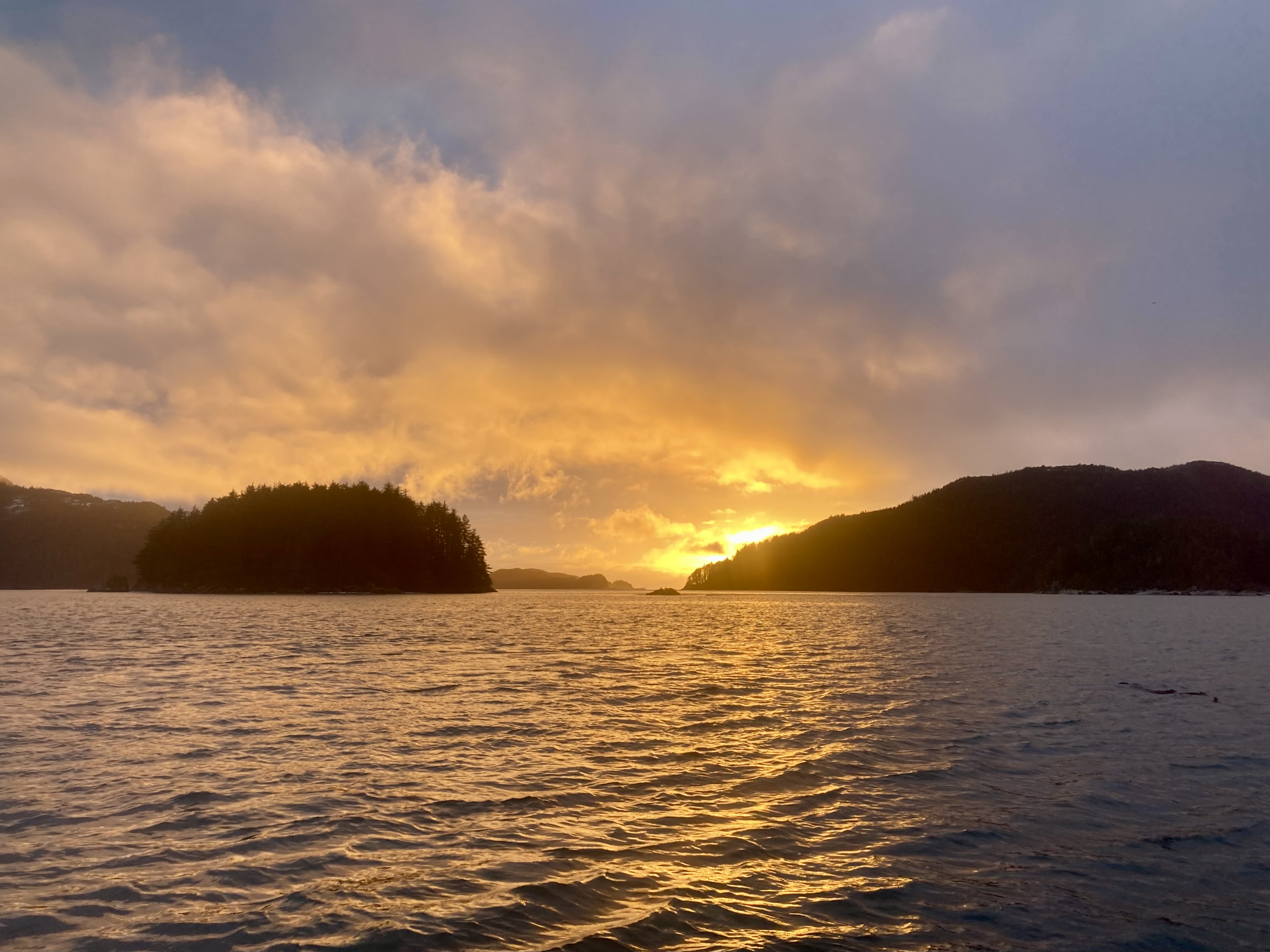
We reach the ledge where the trail cuts into the ridge and offers unobstructed views of home. The whole lower Bay, Gustavus, and Icy Strait stretch out like a tablecloth. Here is a perspective kayaking can’t offer. The sun plummets beneath Lemeursier Island, that big old sentinel in the middle of the strait, shielding us from the worst the Pacific Ocean’s winter storms have to offer. In centuries past it was a fort for the Huna Tlingit, giving them a vantage point and an early warning of visitors. Today it’s designated wilderness, combining with Pleasant and the Inian Islands to mark the southern border of an expanse of wild land that stretches all the way into Canada and back into Alaska.

I look at the flood plain that is my home. The home the glaciers made for us and can just as easily take away. Aside from a solitary tendril of smoke rising near the Salmon River, there is no sign of habitation. A community of nearly 500 people hidden in the pines. Placed next to the millions of acres of protected land it seems small and insignificant.

The sun disappears entirely and I wonder, not for the first time, what that glacial architect must have looked like. In 1750 the glacier (later named the Grand Pacific and still visible at the terminus of the West Arm) stretched 65-miles south of its current location and all the way into Icy Strait, stopping just short of “Lem” its fingers stretching out like a man in the dark, groping for the shore. What would have happened had it found a toe hold? Would it have been able to envelop the whole island? Or would the powerful currents of the strait ripped it apart? Having extended too far, she retreated, leaving us with a land rich in high bush cranberries and salmon.

As we watch the final vestiges of light fade away, I give a silent thanks to the glacier for this place. We talk, we laugh, we drink whiskey, we take the inevitable silhouette photos (I am unaware that it’s supposed to be a funny pose and stand stoically for the first one). And we utter the phrase we say almost every day. A phrase that reminds us how stinking lucky we are to have found our way here.

“We get to live here.”