Tag Archives: conservation

August Fog

For the first time this summer, there’s a bite to the breeze. When I step out the backdoor. The air tastes like Fall. It brings forth images of Cottonwood Trees changing color. The taste of Pumpkin flavored beer, pumpkin spice lattes, shoot, pumpkin flavored everything. Fall comes early in Alaska. The first week of August reminding us that each season but winter is short, to be savored.

With it comes rain. The rain that justifies our existence as a rainforest. A rain that makes everything green. A chilling nasty rain with curled lips and sharp teeth that bites at the back of your neck and crawls beneath the most impenetrable Gore-Tex.

But on days like today, when it doesn’t rain, oh what a beautiful setting. Bless the rare calm, and foggy mornings of August. Blue sky above, the land ensconced in curtains of fog.

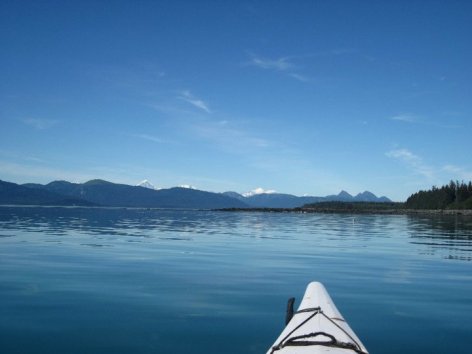
There’s something magical about paddling in the fog. The shutters pulled over our eyes, every other sense becomes sharpened.

You smell your way through fog.

On low tide mornings like this one the odor of anoxic mud crawls into my nose. A rancid guide leading me back to shore when the trees disappear behind the milky white sheen. My ears orientate like a dogs, the cries of a crow lead me across the mouth of a cove. Land nowhere in site, paddle toward the crows.

As always I’m accompanied. Today it is the minimum two people. Mark and Laura. Middle aged, bouncy, and happy. The sort that are easy to talk to because the silences are never awkward. Everything is wonderful in their eyes. The fog, the water, the sea lion that interrupts my bear story. They make my job easy. The sort of people you wish you had every day. We paddle near the shoreline and let the fog wrap around us like a sweater. The smell of the beach and the noise of the crows guiding us.

Boats pass unseen in the fog. The intrusive foghorn of a cruise ship echoes off the mountains and trees every few minutes.

We float in a kelp bed two miles from the dock. Our paddling has been serene and relaxed. I’m in no hurry. If you’re in a hurry, kayaking isn’t for you. Easier to let the world come to you then to try to catch the world.

“Are you worried about the possibility of losing the glaciers because of global warming?”

The question comes from the husband Mark. It does after you talk about the retreat of the glaciers. How, in 1794, Glacier Bay was nothing more than a five mile divot on the north side of Icy Strait. Yes I know, no internal combustion engines spewing carbon into the atmosphere in the 18th century.

There’s something different about the way that Mark phrases the question though that gives me pause. Are you worried about the glaciers?

The glaciers? I mean, I guess so. It’s funny, I live in a land defined by them, created by them. If anyone should worry about the well being of the glaciers I guess it should be me. And I am, now that I think about it. For Glacier Bay with no glaciers is a sorry end indeed. What would we call it? Muir Bay National Park and Preserve?

But when I think about climate change, about the cliff that we’re either a) barreling towards or b) careening over (depends on who you ask), glaciers aren’t the first thing I think about.

“What I think about,” I say, “are murres.”

“Murres?”

“Murres, among other things.”

I explain about the blob, which they had never heard of. About thousands of murres washing ashore on the beaches of southeast and south-central Alaska. I describe their delightful noises, the joy of a muttering murres, their exasperated yells. We all seem to have that animal that touches us in a way no one else understands. Brittney loves Black Oyster Catchers. Hank Lentfer loves Sandhill Cranes. And I have Common and Thick Billed Murres.

“For me, Glacier Bay without Murres is no longer Glacier Bay.” I say. “Maybe that’s short sighted of me. But imagine if you stopped paddling, and it was quiet.”

We do just that and are serenaded by a timpani of birds. Marbled Murrelets, Canadian Geese, crow, raven, phalarope, and oyster catcher.

People talk about getting out in nature. “Getting away from it all.” We call it. The peace and quiet of wilderness. But here’s the thing, nature is never quiet. To walk into the woods and hear nothing would be… empty, desolate, unsatisfying. Nature isn’t supposed to be quiet. There should always be a squirrel rattling, a bird calling, a sea lion swimming.

What we’re really talking about, is getting away from ourselves. Away from the world we created. The artificial one sculpted from metal and concrete. The birds and squirrels and sea lions are not noise, they are music to our ears. And a world without them, glaciers or no, is no longer a world.

Telling Stories

He wore cowboy boots. Amazing how quickly one can come to a whole list of conclusions by a shoe type, an accent. In this case the accent matched the boots. A drawl that can come from only one place. A drawl that says, “I will not be amused when you remind me that Alaska is three times bigger than Texas.”

So I skip it, not that it was ever funny. I worked with this boat captain several years back. Before every trip he would make the guests go around and say where they were from. When someone announced they were from Texas we’d burst out with all the pent up enthusiasm we could muster, “welcome to America my friend!” They either loved it or hated it. I haven’t used that line in forever. I gloss over that one too.

They introduce themselves. Bruce and Gail. Even their names sound like Texas. But they’re friendly, oh so friendly. Bubbly, energetic, polite, talkative. In their mid-60s and on their third trip to Alaska. They love it here. They’ll remind me of that ten more times before the day is done and I’ll appreciate it every time. They’ll marvel at the beauty, coo at sea lions and otters, stare with hungry eyes at a breaching whale a quarter mile away. To hear them talk it may as well have shaken their hand.

Perhaps they sensed it like I did. That when it came to politics, to life, our ethics, we stood on opposite ends of the spectrum. But here is the beauty, the magic, the power of this Bay. It makes all that stuff irrelevant. Here is common ground. The otters are arbitrators. What would it be like if our Senate and House of Representatives met here, inches above the water. Would some of this melt away? Let’s make a Republican paddle with a Democrat and see what happens. Forget crossing the aisle, see if you can cross Bartlett Cove.

For seven hours the talk is easy. The conversations are light. They own a ranch, 2,000 acres of Texas desert beauty. Bruce grass feeds his herd. He brings inner city kids out every year, teaches them to hunt the deer that flood their property. He show them everything from pulling the trigger to cleaning, packing, and preparing. Reminding them  that food does not appear on the Wal-Mart shelves through some sort of Harry Potter spell.

“Get’em away from their phones.” Says Gail. “Too many kids spend their whole lives doing this.” She mimes tapping away on an iPhone, her head bent low, chin to her chest. “They never look up to see the world. They walk right past it.”

They’re involved in wildlife conservation. Fighting to keep the areas near their ranch wild. Teddy Roosevelt Republicans. How amazing, that the father of conservation was conservative, was buddies with John Muir. I mention the parallels and Bruce nods.

“Amazing man. Did you know that while he was president he explored the Amazon? While he was their he got so sick that he told the others in his party to leave him behind. That they couldn’t afford to carry him… the president! Tell me if that’d ever happen now?”

The trip ends. But they’re not sick of me yet and invite me up to the lodge to have a drink. For a moment I hesitate. But I’m intrigued, so intrigued by what is happening here. By the opportunity to have what Melanie Heacox would call, “the interpretive moment.” Sometimes a cold beer in the revelry of a magic day is that moment.

Halfway through the first beer the door cracks.

“Where’s one place that you really want to visit in Alaska?” Gail asks.

“There’s a place,” I begin, “in the northeast corner of the state, the Arctic National Wildlife Refuge.” Only politicians use the acronym, slurring it into a gravelly, guttural grown, “Ahhnwarrrr.”

Gail’s face alights. “It looks beautiful.” She says. Like most people, she’s seen the pictures. They’ve been to Denali, the Alaskan Serengeti.

“This is supposed to be like Denali on steroids.” I say.

Bruce leans forward. He’s a talker, not one to sit back and listen. “What’s up there?” He asks.

“Everything and nothing.” The silence hangs for a moment and I step off the ledge. “In the refuge is the 1002 area. That’s where they want—”

“That’s where the oil fields are.” Bruce finishes. I nod but say nothing.

“That’s where it is?” Gail says with a gasp. “That’s where the oil is supposed to be?”

I nod again and watch her face change but don’t say anything, waiting for her to come to her own conclusion. But Bruce continues, “You could put what, five drilling platforms up there? Two acres each. Ten acres total. Take what you needed and… the land land grows back. We see it in Texas all the time. Three years after you leave you can barely tell they were there at all.”

Our talks all day have been civil. And even now there’s no threat in his voice. Nothing that’s inviting confrontation. If only we could always talk like this. Maybe we’d get somewhere.

“If it’s done responsibly—”

“Not always as easy as you’d think.” I say. I could talk about Caribou, I could talk about carbon dioxide in parts per million, sea level rise, or erosion. But something whispers in the back of my head. “Tell stories.”

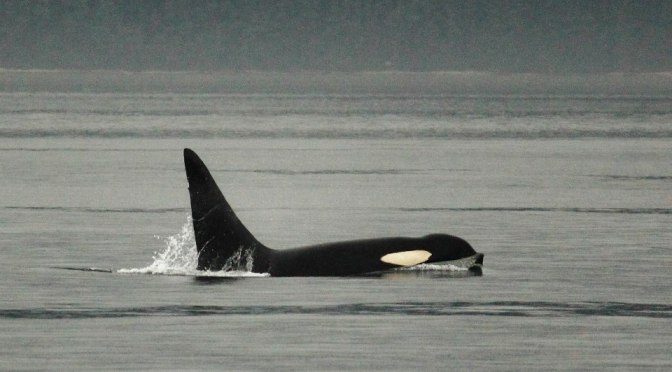
“Let me tell you about how north slope oil exterminated a pod of Orcas. In Prince William Sound is a unique population of Orca Whales. They’re called the AT1 pod. When the Exxon Valdez struck Bligh Reef, the AT1’s swam through the slick the next day.”

“Orca’s have no sense of smell,” I explain, “they had no idea what they were passing through… they haven’t reproduced since. There’s only a handful of them left. Three or four I think. Within a few years, they’ll be all gone. For me, I can’t put a price on that.”

It’s hard to tell what sort of impact the story has.

“One drunk boat captain.” Bruce says.

“All it takes is one.” I answer, “Prince William Sound will never be the same.”

I point out over Bartlett Cove, in the distance beyond the forests of Lester Island are the Fairweather Mountains. The view the three of us have been marveling at them all day. “There’s precious few places like this left on the planet. We need them. We can’t exist without them.” They agree, they understand better than most that nature equals life.

“Beneath the Brady Icefield,” I continue, which is just beneath the Fairweather’s, are mineral deposits. Possibly oil. This view we’ve been raving about all day, what if there was an oil well at its feet? What if a mine tailling dam burst? If we drill in the refuge, what’s to stop this place from being next?”

I’m not expecting a deathbed conversion. Not expecting them to change their voter registration to democrat. To start a non profit climate change research association. But I want to be heard. Just like they do. Like we all do.

“We’re coming,” I say, “from completely different ends of the spectrum. That’s ok.”

“We have no love for Trump.” Gail interjects.

“Bless you,” I smile. “But it’s important that we can sit and talk civilly about these things. That we do it respectfully. This is how change happens. This is how we keep amazing places like Glacier Bay, like the refuge whole.”

I doubt I’ll ever see Bruce or Gail again. And at the end of the day, doubt that anything in their minds has changed. Strip all this stuff away and we’d be friends, were friends for an afternoon. They’re sweet people, loving people, giving people. They work hard, play hard, the sort of people that would pick you up and set you back on your feet without a second thought.

But that look in Gail’s eyes when she realized that Ahnwarrr was the refuge. That that was the place under siege. Maybe something stuck there, in the back of her head. And maybe next time it comes up she won’t see oil rigs, drills, or platforms. Maybe she’ll see the Caribou running across the tundra, and a young kayak guide, his eyes full of meaning talking about how badly he wants to run with them.

The Garden: A Plea for our Parks, Monuments, and Refuges

I wonder if Abbey ever felt this way, or Muir, or Roosevelt. A sort of melancholy joy that all of this is fleeting. Perhaps I worry too much. It’s hard not to. In a time when we need wildness more than ever, it’s never been more threatened. One need look no further than the skulking figures of the right, elbowing and jostling each other for the opportunity to be commander and chief. Debates have become nothing more than four amateur comedians, dropping punchlines and waiting for the laughs that aren’t coming. But between the childish jokes of genitalia and chest thumping, they have declared war. Not on ISIS, hispanics, the middle class, or China. But on us. On the final fragments of American history.

The Party or Lincoln has become the Party of More. Blame it on Reagonomics, the Koch brothers, Ted Cruz’s jowls, it doesn’t really matter. Regulate a women’s body, regulate marriage, but God forbid that the steam rollers of industry should be slowed. Away with the EPA, usher in the era of fracking. What goes into the bank account matters more than what goes into our bodies. Away with the public lands, those worthless wastes of space, those dollar bills hanging from the branches, just waiting to be plucked.

“If you’ve seen one redwood, you’ve seen them.” Ronald Reagan said.

“If you’ve seen one hundred dollar bill, you’ve seen them all.” I say. “The only thing more foolish than trying to drink your money is trying to breath it.”
10329274_10152863254909852_4693130274254238988_n
Herein lies the danger. Herein lies the tragedy. Ted Cruz has already tried to put an end to the miracle that is public lands—our national parks, our monuments, and wildlife preserves. America’s greatest gift to itself. It twists my stomach into knots. Take my healthcare but not the bay, not Denali, not the Arctic Refuge, these shrines to the world that made us. I’ve met several people who, on their deathbed, ran north. To Alaska. To see the land wild and free. Not to see oil wells or mining sites. But that seems to mean little. Give him a big enough eraser and he’ll wipe them all out. Those wastes of space. All those trees and bays and wolves and bears. Refuges and refugees, two concepts that fall on deaf ears. Give me your poor, your tired, your weak… nevermind, some oil subsides will do fine. Conservative and conservation, similar in spelling alone.

This is our own fault. Nature, wilderness, is mythic to some, a fairy tale to many. Something that may or may not exist somewhere beyond the city limits where the concrete may or may not end. An ideological Bigfoot. It’s somewhere our phone’s don’t work and wi-fi fades away. Many never see them. And we’ve lost all connection to how bad we need them.

Air? It comes from the air of course. Food? From the grocery store. Water? It comes from the tap. Trace the journey of these substances and you arrive at the same place. Soil growing food, trees producing the air and filtering our water. Forgetting that relationship is toxic. Ask the children of Flint, Michigan. Ask the families of Butte, Montana about the “pennies from hell.”

“Growth for the sake of growth is a cancerous madness,” wrote Edward Abbey.

Let us define mankind not by what we can extract and obtain, but by what we can leave alone. Let us not define ourselves by our consumption, but by our self control. Do we have the courage, the willpower to push ourselves away from the petroleum feast, to announce that we’re full? There are bigger things, more worldly things, and yes, more Godly things than maximizing profit on every square foot of land.
10151271_10152867795959852_442814964723618859_n
What if we stopped looking at the world like a factory and instead like a garden? A plot that must be nurtured, cared for, fed, and watered. Treated with the understanding that what we take out must be replaced. Minerals and matter must be returned to ensure that the carrots, potatoes, and lettuce of life return bigger, fresher, and tastier next year. Foolish is the farmer who doesn’t renew his soil with fertilizer, who stuffs his rows of lettuce tightly together, believing that the highest quantity planted will equal the maximum yield. Shame to the farmer who doesn’t let a field go fallow. Let the land rest, let it breath, let it be land for a year. And like us after a deep breath, it will work harder, the benefits in a year outweighing the one that was lost.

But the world doesn’t work like this. We can’t stand the thought of letting a portion go fallow. Of not maximizing our yield right now. Forget the future. The future is now isn’t it? The TV told me so. Those that see the world as a garden are shouted down. We’re labeled as extremists, alarmist, other harmful -ists, standing in the way of progress. Good old progress the shield of the conservative politician. But you’ll never hear a politician, pounding the lectern, demanding that he be allowed to frack the tar sands of Utah labeled extremist. He’s just living in the real world. A world where the economy can grow forever. Infinite growth, finite world. His birthright. If we’re not moving forward we must be going backward.
10312681_10152863254884852_4060311875310743348_n.jpg
Will our offspring a century from now look back on us with admiration or disgust? Will we be revered like the minuteman or demonized like the slaveholder? The one’s that took a renewable world and saw it only for what it could do in that very moment. At least we made some money. But is that how we want to be remembered, is that what we want inscribed upon our gravestone?

 Here lies the modern world. The bottom line looked good.

Surely even the most selfish cannot desire to be remembered like this. Let’s be remembered for our love, for our sacrifice, for our restraint. Let a tree be a tree. A refuge a refuge. A fishery a fishery.

“Any fool can destroy trees,” wrote John Muir. “For they cannot run away.”

To which I add, any fool can do something for profit. It takes a man of true character, true conviction, to see a resource, to see personal wealth, and leave it where it is, acknowledging that there are some fields that should always be fallow. We’ll survive without it. The farmers to follow will thank us.

45543_488769164851_2875335_n

Here We Go Again

A couple of summer’s ago Brittney was in Seattle when she and a couple of friends stopped in a sushi restaurant for lunch. One of her friend’s asked the waitress before ordering if the salmon roll was made from farmed or wild salmon.

“Oh it’s farmed,” said the waitress without a sliver of embarrassment, “but that’s good because it doesn’t have any of the toxins or parasites of wild fish.”

You can’t make this stuff up. Nobody ordered the salmon.

It’s incredible that in an age where virtually every question can be answered by a piece of metal that fits in our pocket, we remain so uninformed, so ignorant, using the power of wi-fi for cat videos and time lapsed food recipes.

And while I’m sure the server was just trying to say what she thought Brittney and her friends wanted to hear. The farmed fish propaganda was far from true. Quite the opposite actually.

Since their arrival in the water’s off Vancouver Island in the early 80s, the salmon farm industry has been cloaked in a web of controversy, cover ups, and deceit. Fish farmers swore that with their technology, that the farmed Atlantic salmon could not escape.

They did.

When fisherman began to find Atlantic salmon in their nets, the industry promised that they could not procreate in the wild.

They did. The more aggressive Atlantic salmon rooting out their native Pacific brethren from their already threatened streams.

The location of the pens near estuaries has led to a decades long fight to bring attention to sea lice. These sea lice, while relatively benign to fully grown fish, latch on to young, defenseless salmon fry and have threatened the livelihood of several Pink salmon stocks.

The latest news from those on the front line is perhaps the most disturbing of all. A virus that decimated the farmed salmon industry in Chile back in 2007 has been found in both farmed and wild salmon along the B.C coast.

The good news is the whistle blower, biologist Alexandra Morton uncovered the virus early. “We never found the whole virus, just pieces of it,” she reported to the CBC. One reason for this though is the closed door policy of the farmed fish industry. A closed door and hush hush policy is never an indicator of respectable or ethical practices. There’s a reason slaughter houses run off anyone with a camera. Morton and her team were able to take samples from “healthy” farmed salmon, usually ones that were already on the market. Potentially sick or diseased salmon that could be in the pens as we speak are hidden from sight.

The fish farm industry’s silence in damning enough evidence and the latest in a line of embarrassing failures in which the Canadian government has looked the other way. No criminal charges were filed against Imperial Metal’s, the company responsible for the burst Mount Polley dam in August of 2014 https://raincoastwanderings.com/2015/03/07/worth-so-much-more/.

In fact, Imperial Metal’s is now refilling the site of the burst dam. That’s what happens when you “donate” $234,000 to B.C Liberals. Remind me of this the next time I complain about America’s corrupt political system.

“What evil, thieving people,” we say. We shake our fist and…. what? We go back to our cat videos, we look out the window and the world looks the same. A storm rages right now in Blackney Pass and shakes the window. If there is a deadly salmon virus rolling along the flooding tide right now, it’s not giving itself away. What will it take for change? Will we wait until it’s too late? Until wild salmon are nothing but a myth? Our grandchildren wondering if they ever really existed?

Let’s not let that happen. Boycott farmed salmon, hell, boycott the stores that sell farmed salmon. Take away the demand, destroy the supply. And speak up. Let Justin Trudeau and the Liberal Party know that what is happening in the water’s off B.C is bullshit. That no profit is worth the potential death of an entire ecosystem. Do it now, before you leave your computer, before your busy day continues and it slips from your mind. Let’s stand with Alex Morton and the tireless watch dogs that have been battling this for years. Write to the Liberal Party here: https://www.liberal.ca/contact/

To my American and global readers remember, the ocean is not a closed system. A pandemic doesn’t care about international boundaries, the distance from B.C to the southeast panhandle is not  great. If it breaks out here, there’s no reason that it can’t travel north, south, east, west. We must stop caring about just ourselves and what is happening just in our backyard. The natural resources of this planet belong to all of us. And when one stock is threatened, we are all threatened.

We are a race that has cut ourselves off from the natural world. But we are not above it. We are, in the end, at its mercy. We cannot survive without it.

Photo from: http://alexandramorton.typepad.com/.a/6a0120a56ab882970c01a73d74643c970d-pi6a0120a56ab882970c01a73d74643c970d

The Luxuries of Wilderness

The boat grazes the rocks and rocks and Brittney steps onto the bow. The gentle landing is short lived as a three foot wave picks us up and throws with a dull thud against the shore. Line in hand Brittney leaps clear of the bucking boat and lands nimbly on the jagged rocks of Cracroft Point. The engine pulled up and the line unsecured, the boat is at the mercy of Johnstone Strait, a strait that seems apathetic towards the BC weather’s promise of a calm afternoon. White caps dot the surface and their thunderous crashes against the point’s steep shore is intimidating. I grab the bag and leap for the shore as another wave lifts the boat and sets it down, landing just clear of the water as the wave swirls around my boots.

Brittney handles the line like a cowboy handling a mustang, goading the boat into a small crevice in the rocks and out of the path of the largest breakers. She’s got this. Without a backwards glance I scurry into the woods, wielding a bottle of oil in one hand and a flathead screw driver in the other. The generator demands an oil change. A few feet inside the treeline the sound of the wind and waves is muffled, as if I’m listening to it with a pillowcase pulled over my head. Trying not to rush, I flip the generator on its side and unscrew the covering.

It’s incredible how much goes into keeping this place running. And even more amazing how inept it can make you feel. Between the electronics, the power sources, and internet connections, not to mention the mechanical nuances of boat repair, tree climbing, diving, and deciphering whatever voodoo it is that allows us to stream the hydrophones 24/7. Paul and Helena are probably the only two people on earth that know how it all works. It’s staggering to imagine anyone else with the combination of skills they’ve acquired in thirty some years. In the last two winters I’ve learned how to set up inverters, decipher internet connections, and giving myself more than a couple of nice shocks as I learned the difference between AC and DC. I’ve nicked the tip of the iceberg.

The oil comes out as black as night and as thick as molasses. Better late than never I suppose. I funnel the remaining oil into an old bottle and refill the generator with clear, syrupy  10W-30. Brittney appears at my side, the boat nestled in its crib.

We glorify wilderness. We consider ourselves disciples from the school of John Muir and Edward Abbey. And yet… look at what goes into surviving out here. Granted, I wouldn’t be crouched over the generator if there wasn’t an internet connection to maintain. But I can’t imagine the time and effort that it would require without 50 horsepower strapped to the boat, or a grocery store 45-minutes away. Even the men that sparked my love of wilderness had some indulgences. Abbey spent a lot of time living in a trailer, a propane stove and cot at his disposal. Heck, even John Muir had a rotating cast of savvy and tree smart Tlingit’s escorting him on his paddle trips through the Alaskan archipelago. Is the glorification of wilderness a luxury? Would Travels in Alaska and Desert Solitaire been written without them?

The oil in the funnel burps and I sit the generator upright, dipping the dipstick into the oil reservoir, the pale gray plastic coming back with a clear, reassuring shine. Would I deify the forest and ocean if my days were dedicated to ensuring my survival? I don’t know. Muir was mortified at the audacity of his Tlingit guides to shoot at deer on the beach as they paddled past. He would rock the boat so that there shot would go wide. A respect and love of nature to be sure. But for his Tlingit guides, it had to be analogous to going to the fridge only to have someone slam it shut. Not everyone has the luxury of hardtack and tea.

I screw the covering back on the generator and pull the start cord. It roars to life on the second try, spitting blue/white exhaust into the air, the southeast breeze sending it into the forest. Is my love of nature threatened by the very things that help me adore it? The avocados from Mexico and bananas from Belize that spare me the cumbersome task of crawling through the woods in search for all that is edible. Would I miss the forest for the trees and the tasty mushrooms that grow on their trunks?

This isn’t meant to belittle Muir or Abbey, two men I admire as both writers and preservationists. But would such men have been the same if they’d stalked across the western frontier a century earlier? Would that convenience have existed if Muir had been born a seal hunter? The glaciers not a monument to be marveled but a threat to his existence? Perhaps it’s as simple as saying that they were the right people, at the right time, writing the words that needed to be written to stave off humanity’s insatiable consumption of the very thing that makes us whole.

I pull the boat out of its protective crevice and the ocean roars up around it. I hold her as steady as I can until Brittney leaps aboard. With a heave I push the boat clear of the rocks and slide across the ocean soaked bow, clamoring over the top and into the relative protection of the cabin. The engine roars to life. A marvel of human engineering and brilliance. But without the miracle of organic compounds slowly compressed over millions of years it would be nothing more than a five hundred pound paperweight.

Maybe the Tlingit and Kwakiutl Indians loved wilderness the same way the European nature writers did, simply in a different way. Perhaps their love had  matured after centuries of marriage to the natural world. Their love expressed in the familiar and comfortable way a couple does after being married for thirty years, while Muir, Abbey, Brittney and I are in the honeymoon stage, breaking free of the society and concrete that compresses our chests and sends us running for the woods.

Water rolls over the top of the boat as the nose dips into the trough of a wave. Blackney Pass is sheet of white caps. I steer for Parson Island, we’ll take the longer, more comfortable way home.


Waiting For Corky

“On no they’re not.”
“It’s true,” I answer, “they’re phasing out the circus performance bit. They say they’re going to do a more education and conservation based thing… of course, it’s SeaWorld, so who knows what that means.”

Paul and I stand on the rocks feet above Robson Bight. Two steps and we’d be free falling fifty feet to the bottom. Free whales swim here. They go right past the rocks we stand on, an arms length from shore. Every time I come here I try to will them into the bight. It’s never worked. Orcas are very into themselves.

But now our minds are not on the hydrophone resting in the kelp, or the batteries on the cliff that fuel it. They’re on a whale thousands of miles away that deserves to be here. Paul furrows his brow, there’s skepticism in his expression, doubt after decades of banging against the gates of SeaWorld, asking that Corky be allowed to come home.

“Maybe it’s just a spoof article,” he says. “Where did you read it?”
I confess that I can’t remember the source. But I’m convinced it wasn’t the Onion.
We pick our way down the rocks for the boat and the lab.
Paul lets out a laugh. “Wouldn’t that be something? SeaWorld stops performances, yesterday Obama vetoes the Keystone pipeline. What is happening?”
“Maybe we’ve been transported to a parallel universe.” I offer.
“That’s it. What’s going to happen tomorrow?”
    “Donald Trump is gonna get eaten by wolves.”
“And through a loophole in his will all his money gets donated to conservation.”
“He meant to write all proceeds to the conservative party but misspelled it.”

Deep down, SeaWorld hasn’t changed. Their orcas are still commodities, big swimming black and white dollar signs. SeaWorld isn’t changing. They’re rebranding. And what choice did they have? They’ve lost a third of their visitors. Their value is worth half what is was before Blackfish. The ship is sinking and there aren’t enough lifeboats. But rather than call for help, SeaWorld has decided to bail water until they’re six feet under. This isn’t surprising. It’s still despicable. But it’s encouraging. They’re grasping at straws.

SeaWorld continues to operate under the delusion that they will be relevant and profitable a decade from now. Accepting the Blue World proposal by the California Coastal Commission would have given the San Diego park an expiration date. No new orcas. The beginning of the end.

But SeaWorld has no intention of letting Corky, the captive northern Resident of A5 pod come home. It’s a step closer to retirement for her though as human commanded tricks will not be part of the new Orca show. But Corky doesn’t have time. She’s been in that tank for four decades. Her time, and a chance at a happy ending is running out. These new, low adrenaline performances won’t start until 2017. By the time SeaWorld determines that this new marketing scheme isn’t going to save the company, it may be too late.

But as SeaWorld circles the drain, perhaps they’ll be willing to accept anything that will salvage whatever positive PR reputation they have left. What better way to change hearts and minds than retire a whale?

I don’t know if Corky can survive in the true wild. She’s been swimming tight circles for so long, I don’t think she can physically stand up to the rigors of being a wild whale. But a net pen in her native land? Where she can taste the ocean. Hunt wild fish and hear the sounds of her family. Who wouldn’t get behind that?

“They can do Corky shows live from Dong Chong Bay (the bay just west of Orca Lab on Hanson Island) and broadcast it over the internet.” Paul offers as we pull into the cove next to the lab.
He’s says it like a joke but it’s not. What it would mean for her to come back. After all these years, and have her living next door. A few hours later all is quiet. The water calm, the sun setting. Paul is back in Alert Bay and it’s just me and Brittney.

Suddenly we both sit up, our heads cocked. When you live at OrcaLab you develop this passive listening. You aren’t aware that you’re tuned into the hydrophones but you always are. And when an orca makes a noise, it makes you jump.

And there they are. What are the odds? We tear over to the lab and pull on headphones, our trembling hands adjust the dials on the soundboard. They’re in the Bight, right where Paul and I stood talking about Corky just five hours ago. Now her family, A5 pod is there. Swimming feet off the rocks I’d been standing on.

Goosebumps spread up my arms. They shouldn’t be here in early November. But here the A5s were. Back in the strait on today of all days. Keeping Corky’s bed warm for her. As their calls echo off the underwater cliffs I fight back a lump in my throat, trying not to feel guilty. After all, it’s Corky that should be here, not me.

Worth So Much More

More than a century ago, steamers laden with starry eyed prospectors plied the inside passage in a desperate race to reach Skagway, Dyea, and the promise of massive gold deposits in the Yukon. Of the 40,000 to stampede across the permafrost, ten percent found gold, one percent struck it rich. The rush ended with hardly a whimper in just three years.

But thhe gold rush is not over. One hundred and fifteen years later, the human race continues to be seduced by the presence of minerals hidden in rock, with the promise of wealth and money. All in the name of happiness, security, prosperity. Once again, the sites lie within the Canadian boundary and once again the road runs through Alaskan waters. Instead of steamers and ferries crossing the border, it is salmon.

The Unuk, the Taku, and the Stikine represent three massive, salmon rearing, transboundary rivers that cross the border of Northern British Columbia and southeast Alaska. They represent one of the last few places on earth where the delicate balance between ocean and land remain in perfect symmetry with salmon serving as their powerful arbitrator. They draw life from the forest and in turn, rejuvenate the rivers, oceans, animals, and humans they touch. Directly and indirectly, they fuel a 2 billion dollar per year industry that radiates throughout the panhandle via tourism and fishing. And we are spitting in their face. Threatening to destroy a miraculous and beautiful gift that has been our heartbeat since the last glacier receded.

As Canada continues its rapid deregulation of environmental protections, tar sand developments, and other atrocities against the natural world, the policies begin to directly threaten us on the other side. Currently, no fewer than nine mines are either being proposed, developed, or are under review in northwest British Columbia. All of which are connected or adjacent to these  massive, life giving rivers. Mankind has gold in their hearts, and we cannot stand the thought of it laying uselessly in the earth. Not when there is profit to be made.

Many have pointed to the relevant and convincing argument that Alaskans stand to inherit none of the profit, and all of the risk of these mining projects. The money flows into Canada while acid mine drainage flows into the inlets and bays. Holding pits and dams would be responsible for holding millions of gallons of these toxic pollutants indefinitely. Indefinitely, is a hell of a long time.

And yet we hear assurances from involved mining companies such as NovaGold, Chieftan, and the now infamous Imperial Metals about their environmentally safe practices, technologically sound designs, and pride in their development and design. At least, that’s what Imperial Metals had to say about their Mount Polley mine.

On August 4th, 2014, around 1 am the Mount Polley dam in the Cariboo region of B.C burst. Four days later, the four kilometer sized tailings pond had sent its’ 10 billion liters of water and 4.5 million cubic meters of metals-laden fine sand into Polley Lake. Like a nightmarish game of dominoes, its impact was felt hundreds of kilometers away along the Fraser River, home to one of the largest Chinook runs on the west coast.

It’s been called the biggest environmental disaster in British Columbia’s history, and it could be decades before the full effects are felt and realized as the metals embed themselves in the environment and climb the stairs of the food chain, magnifying their impact with every step. This is the inheritance of the Cariboo region descendants. The guiltless victims of the four horsemen we worship; progress, profit, power, and greed. Like Prince William Sound, the region will never be the same again, the casualties of practices deemed safe and environmentally friendly.

“I apologize for what happened,” Imperial Metals president Brian Kynoch said following the breach. “If you asked me two weeks ago if this could have happened, I would have said it couldn’t.”

How hollow and pointless. Yet in not so many words he admits what we already knew, that open pit mines on this scale are incapable of ensuring the protection of the natural world around them. Since 2012, Imperial Metal had received five citations of violation, the engineering company that designed the pond warned them that the pond was operating beyond capacity and pulled out of the mine operation 3 years before the catastrophe with no explanation.

Mr. Kynoch, you knew this could happen, but it’s tough to hear with gold in your ears and copper in your eyes. All this done in a place with an exponentially larger population density than their recently open mine in Red Chris along a tributary of the Stikine River. Yes, no criminal charges, no moratorium on development, Imperial Metal was allowed to plow forward and put the well being of the salmon and the Alaskans that thrive on them in their greedy hands.

When it comes to environmental issues, Alaskans are often divided. The refuge, offshore oil, and other controversies have split us into the unyielding camps of Republican and Democrat, liberal and conservative, progressive and tree hugger. But when it comes to salmon, we have been united. We have pushed and will continue to fight the threat of the Pebble Mine development in Bristol Bay, saying no to short term financial gains in favor of the most productive and healthy Sockeye Salmon fishery in the world.

It is vital that we fight again, that these salmon streams, our home, our way of life remains as unspoiled and protected as possible. The alternative is unthinkable. A CEO two decades from now, standing at a podium, offering empty words of regret as mine tailings and acid drainages rush down the Taku to meet the Sockeye. For Imperial Metals they will simply state their sorrow, pack up, and head for the next deposit, leaving us and our descendants to pick up the shattered pieces of existence.

For Americans and Canadians alike who wish to get involved, visit.

http://www.salmonbeyondborders.org/what-you-can-do.html

Quiet Places, Open Spaces

Shadows stretch across the bay, the surviving sunlight turning a deep gold against the water and trees on the far side. We sit on an old, rotting 2×4 propped up by rocks, watching the island in the middle of the bay transform into a peninsula as the tide ebbs away. Around us boxes of food stand in pyramids, accentuated by a case of beer and a bag of dog food like a massive sack of flour.

But Walrus is in no hurry to start the haul up the hillside to his cabin shrouded in the woods. So we sit, beers in hand, with nothing more pressing than watching the water slowly drain out of Dong Chong Bay.

A great blue heron materializes out of the woods, it’s prehistoric shrieks echoing off the steep vertical cliffs around us, alighting on the island. A raven swoops passed and alights on the branches of a birch tree above. He speaks softly to the bird in a tongue I don’t recognize. Undoubtedly it’s the native language of the First Nation people that called Yukusam (the native name for Hanson Island meaning “shaped like a halibut hook”) home. The words seem to permeate from the trees and ocean, as alive and authentic as the island itself. If the trees could talk, it would be in this voice. Not the voice of my ancestors who had arrived and hunted, logged, and eternally altered the very land we loved.

The large, rocky plateau we sat on was far too smooth to be the work of the ambitious and almighty glaciers that long ago preceded us. They deposited erratics and islands with the callous randomness of an artist flinging paint at the canvas. This was deliberate, a stronghold for the logging trucks and chainsaws that Walrus had fought and defeated.

Even in this beauty, in the perfect stillness, it seems pertinent to mention it and Walrus nods in affirmation, as if he needs any reminder of what took place here.

“In the U.S we put aside these pieces of land as wilderness that can’t be touched, developed, or mined.”

Walrus lets out his high pitched laugh, “but is anywhere untouched?”

“Exactly.”

I remembered camping in the Beardslee Islands in Glacier Bay. Alone, surrounded by acre upon acre of wilderness. Only to watch commercial jets rumble over, their contrails leaving white slashes across the blue sky. The cruise ships rumbling by, black exhaust spewing above the mountains, wakes unconcerned with the wilderness boundary. Untouched wilderness indeed.

He wanders over to the case of beer and hands me another, the crack of carbonation drifts across the water. With an indignant call the heron rises from the rocks, wings beating a slow rhythm as it vanishes.

“How can we even classify something as wilderness?” He asks.

“That’s the thing. Are we trying to recreate a land before Europeans? Or native Americans?”

Regardless, the ghosts of North America cannot be revived. The mammoth, the Stellar Sea Cow. We talk about how the great plains were once home to 12-foot bears, lions, and camels. An indescribable amount of biomass and apex predators. Until man arrived and claimed the top of the food web for him alone.

“Extinction started with the arrival of man, not Europeans of course.” He cautions.

“Of course. It’s a European arrogance, that we can put back together the pieces that we’ve ripped apart.” I say. “It’s the best we can do I suppose though.”

“When the Spaniards arrived in central America, they found the Mayans already had chickens.” He looks at me, his long grey beard crinkles into a smile, his eyes dazzle beneath long curling eyebrows, “they just assumed, hey, they’ve got chickens here just like back home!” He pauses and takes a drink, “of course they were Asian chickens,” he finishes laughing, letting the message sink in.

“You don’t read that in your history books. Or Columbus’ Haitian massacres, or the sculptures depicting people of African descent. We weren’t first, but we in some way won. So we get to claim credit, and dust our transgressions under the rug.”

He smiles again and we tilt our beers back, I’m talking conservation and anthropology with one of the founders of Greenpeace.

“That’s one of the difficult things about anthropology and natural history. It’s a lot of extrapolation and assumption, we can’t know much for sure.”

“Which is why we need time travel,” he says.

“I know where I’d go,” and I point out the mouth of the bay, to sparkling waters of Blackfish Sound, “right here.”

I talk about trying to imagine Dong Chong without logging roads, the orca lab site before the lab, my desire to see this place in as natural a setting as possible. “Post ice age of course,” I finish.

He nods, “I bet it’d be something.”

“Salmon so thick you can smell it on the wind,” the very thought gets me excited, “blackfish so thick you can walk across their backs,” I say quoting Billy Proctor, the legendary jack of all trades that had lived in and around the region since the 30s. “In another age of conservation maybe.”
We lapse into silence, drinking in the scenery, the peace and tranquility that cannot be quantified. No bottom line, no profit margin or material good could ever begin to explain what these places mean. Because they live not on paper but inside. The by products of the wind and trees, ocean and waves, saying more without a word than I ever can. Causing a spiritual upheaval I can only begin to explain.

It’s for this reason, that we’re coming back next winter I tell him. Like Paul, he’s spent decades on Yukusam, unable to find anywhere else that compares for the same unwritten reason.

“It’s going to be almost a year since I had a real job. It’s been incredible.”

A knowing smile pushes through the beard, “it’s hard to think about going back to it isn’t it?”

“You have no idea.” I answer, knowing full well he knew exactly what I was talking about.

In the House of Tom Bombadil

The trail winds through new and second growth foliage, their branches stretching like eerie arms onto the skinny trail, refusing to be thwarted by mans’ fruitless trials to contain them. Rocks thrust out of the mud, their surfaces slick with moisture. The continual December rainfall creates a steady trickle downhill, creating mud poles that go halfway up our boots. The forest is quiet besides the steady drip of rain bouncing from one leaf to another as they plummet to the trail and moss. We push further and further into the middle of Hanson Island, a weak winter sun battling the clouds.

After fifteen minutes of steady uphill hiking we round a bend and are met with a fence composed of a brilliant maze of branches. A gate sits partway open and we slide through and step onto the well trodden ground of what the weather beaten sign nailed to a tree announces is the earth embassy, a small crown of willow branches hanging above it. A few small buildings and a woodshed dot the clearing as we approach slowly. It’s a peculiar thing, to march into someone elses isolation. With no way to warn them that you’re coming. After months of solitude, the echo of our feet pounding up the trail had to sound like thunder.

Passing the door to the first building we hear a call from inside, a growl, a bark, and the door creaks open, giving way to a massive mountain of orange and white fur. The fur ball is recognizable as Kessler, the Hanson Island dog that had been exiled from Alert Bay, and now lived with the man we’d come to see. A man known to me only as Walrus.

We step out of the rain and around Kessler and into a library. Books cover a massive shelf in the entrance and litter the walls, meticulously categorized by subject. Conservation, religion, and history with subcategories such as: Greenpeace, Animism, and Mayan culture. There’s just enough room for a desk nestled right next to the door where Walrus sits, a journal out. He’s everything an old man living in the woods should look like. A massive grey beard coats his face. Even his eyebrows are preternaturally long, sticking almost straight out as long as my pinkie before finally succumbing to gravity and curling at the tips.

A sweet, musty, woody, smell permeates the tiny shelter and stepping behind the massive bookcase reveals an open space with a wood stove and table covered in fruit, crackers, and a bottle of rum. While I’m sure somewhere out there lives a reclusive old hermit who cringes at the very thought of social interaction, Walrus is not that man. His life in the forest seemed to give him remarkable preservation, and despite having reached an age where many would be comfortably retired, he’s bouncy and quick witted with an easy laugh that seems to go on forever. He is a marvelous cross between Obi-Wan Kenobi and any assortment of bearded, woodsmen, Tolkien characters.

His house was a jigsaw puzzle of scrap wood that he had scrounged from the surrounding woods. Small and efficient it was easy to keep warm when the temperature dropped below freezing. The site had been picked for him he explained, when he’d pitched his tent directly on the path we had just walked up. Decades ago it had been a logging trail and Walrus had stood resolute, refusing to allow them to have the island.

Wielding an education in anthropology Walrus had scuttled over every nook and cranny of Hanson Island, learning the island’s history and secrets, searching for a way to save it. Culturally modified cedar trees (CMTs) cover the island, evidence of the first nations presence here long ago. They would cut long horizontal strips of bark from the tree, using the wood to form baskets and string. Their cutting encouraged the trees to grow even faster, creating a resource that renewed faster with use, a concept unheard of in our modern day “advanced” world.

Citing the CMTs for their cultural and historical significance, Walrus helped save the island from the carpet bombing that had befallen the nearby islands of Swanson and Cracroft. His camp quickly became something of a heritage site in addition to his year round home starting in the early 90s. A place where he welcomed grade school kids in the summer to learn about the history of the forest, and showed them around a massive garden where he grew everything from kale, to potatoes (if he can keep the jays out), to garlic. Garlic, he said, he’d give away as gifts. What a stocking stuffer.

There seemed to be little that he hadn’t done on the conservation battlefield. He’d fought wolf hunters in northern Canada, been a cook aboard the early Greenpeace boats that put themselves between whalers and their cetacean targets, and become something of a legend. His quiet manner and humbleness hid all of this though as he enthusiastically showed off his garden, Kessler constantly bumping against our shins waiting for his ears to be scratched.

We walked back down the trail toward Orca Lab a couple hours later, inspired and motivated. Someday I hoped that I could look back on the decades of my life and see the world a better place from my actions. I imagined the feeling of gratitude and joy Walrus had to feel when he woke up and looked about his forest home. Hearing the birds call, the deer trampling through the undergrowth, the leaves whispering in the wind, and knowing that it still stands because he had. His feet planted firmly on the trail, loggers and equipment barreling up the hill, unaware of the man they were about to face.

The Southern Residents and Repeating History

Off the waters of Washington state live the most magnificent, beautiful, and intelligent creature on the planet. A species that has learned to exist without wars or visible disputes of any kind. They maintain a peaceful, complex, and intricate social structure with bonds that we cannot even begin to fathom. And it is all in danger, of vanishing forever. For many it’s already too late. Like Rhapsody, whose body has gone to science in the hope of finding out what ended her life.

It is all so chilling because it’s not the first time that this story’s been told. In the serene and beautiful waters of Prince William Sound, hundreds of miles to the north, the same tragedy is playing with a 20-year head start. The genetically unique AT1 Transient pod, that has lived, stalked, and hunted within the sound for generations is just years from extinction as it comes up on three decades without a successful birth. For AT1, the prognosis is simple and obvious. On good Friday, 1989, the whole pod swam, unknowingly through the lethal slick of the Exxon Valdez oil spill. They have not reproduced since as friends and researchers like Eva Saulitis watch the pod disappear one by one, a slow tear jerking countdown to zero.

For the southern Residents, it’s more complicated. For decades they’ve endured live captures, bullets, overfishing, and the toxic runoff of the increasingly urban Puget Sound. In many ways it’s miraculous they’ve persevered for so long. They can still lay claim to, “Granny.” An orca that was born the same year the Titantic sank and is still seen every year off the San Juan Islands, a talisman to the resilience of the community. And yet, Orcas are dying that shouldn’t be. When Plumper (A37 of the northern Residents) finally vanished from the lab’s view in August 2014, there was such a finality to what we were seeing. It was his wake. His time had come, and all of us, including him and his brother Kaikash seemed to know it. But sweet 18-year old Rhapsody shouldn’t be washing up in Comox. She should be with her mother, siblings, Grandmother, and Aunts, with one or perhaps two calves to her name. This wasn’t her time and it’s hard not to feel guilt, knowing that our species shoulders the blame for her demise and dozens just like her, whether from captivity or PCBs.

The southern Residents are at 77 individuals. The time has come for drastic action before the genetic bottleneck tightens anymore. So that in 20 years, we’re not watching the last of the pod fade into darkness, leaving the waters of the San Juans and Puget Sound in great silence. How empty and desolate it would feel. Imagine Orcas Island with no Orcas. It’s not impossible, the only place in California you can find a brown bear is on the state flag.

It may mean sacrifices on the part of us as human beings. To surrender the pleasure and joy that only comes from watching a line of dorsals materialize off the bow of your boat or kayak. Or perhaps going without Chinook salmon in the freezer this winter. Or maybe as simple as riding the bus to work and reducing the carbon exhaust pumped into the atmosphere.

These aren’t tigers or elephants, we can’t just start captive breeding programs and reintroduce them. But they do need help, and we have a chance, maybe not to make amends, but to right some of the wrongs that we’ve brought against them. To even the playing field as best we can for a species that doesn’t deserve the cards we have dealt. North American progress, american history as a whole, has been filled with extinctions, manipulations, and destruction. We’ve hunted the Gray whales, sea otters, wolves, and now the Orca. But today sea otters again bob in the waters off of Monterey Bay, wolves run through the forests of Yellowstone, and North Pacific gray whales represent one of the healthiest and strongest whale populations in the world as they continue their amazing recovery from industrial whaling.

I don’t think it’s too late for Rhapsody’s kin. But it is time to try something different, because whatever help we’re giving them clearly isn’t working. They need time, space, and most importantly, the salmon that make up more than 90 percent of their diet. Save the whales doesn’t have to just revoke memories of Greenpeace and the 70s. The war is not over, and it is our time to fight for the animals we love.