Tag Archives: Canada

A Year of Transition

Dear God, I’m 27. I’m not sure what I thought I’d be when I looked through the crystal ball a decade or even five years ago, but this wasn’t it. I thought I’d have a steady job, a respectable career, and would be staring unblinkingly into the headlights of fatherhood. The reality couldn’t be more different. I’m a seasonal job hopping, wanna be John Muir apostle and nature writer who still spends far too much time playing this game. But for the first time since I walked off the UAS campus and had my respectable career tossed back in my face, I have direction. Or as close as my life comes to direction nowadays.

Last summer I went golfing with Brittney’s uncle in Washington. While we waited for the ferry home, I laid in the back of the car and my heart started pounding.
“I’m gonna be 26 this year,” I thought. “I’m closer to 30 than 20.” I had my first mini panic attack. “What am I doing with myself?”
My crisis followed me up the B.C coast, to Hanson Island, and hovered in the back of my mind like a dark fog. What are you going to do? I’d scoffed at the question when people asked me that. Loved the stunned look on their face when I’d airily toss back, “whatever I want to.”
But seriously, what was I going to do next? I was all too aware that our bank account was drying, that the coming spring would bring some serious questions and answers that would magnify like ripples on a lake.

The warm July sun worked its way across Orca Lab’s observation deck warming the weathered cedar planks. I sat cross legged on the deck, arms on top of the lowest railing, chin on my wrists, staring blankly out at the water. I was supposed to be counting humpbacks, noting sea lions, looking for the tell tale scimitar shape of a prowling orca. But the landscape swam before my eyes and I pondered the same persistent worry.
The breeze fluttered, I thought about how much I loved it here. Loved being on the water, near the whales, the cedar forest, and the people. That was what made Orca Lab what it was. Paul, Helena, the never ending parade of volunteers from every corner of the world that gave Hanson Island its unique flavor. Where else had people touched my spirit like that? What place had the potential and power to do it again and again?
Gustavus.
I sat upright, my head banging against the middle railing, a dull thunk rattling down the cedar. I let the bruise go unnoticed as I begin to pace from one end of the deck to the next. The breeze whispers in my ears, “Gustavus. You’re going to go back, you’re going to be a kayak guide, and you’re going to write.”
Moments later the stress and fear that had taken up residence in my lower stomach melted away, draining through my pores to be caught on the westerly breeze, never to be seen again. Was it God? The universe? My own fevered mind racing through the card catalog of the brain for something that would satisfy?
I grabbed my phone and with shaking hands, tapped out a message to Brittney. “We should go back to Gustavus.”
Minutes later I had my answer, “yep.”

People pay me to write now. Not a lot, in fact I make peanuts or less than peanuts most of the time. But my computer and note pad are never far away and I scribble down ideas for novels, blog entries, and ridiculous limericks I don’t let out into the daylight. This summer, with a ball of anxiety, I sent the first 3,000 words of my wanna be memoir to Kim Heacox.
“There’s work that needs to be done here.” He wrote back, “but there’s some good stuff too. Don’t get discouraged, everyone needs to rewrite…. except F. Scott Fitzgerald. There’s a lot of writers out there who don’t have the fire, keep writing.”
“I want to have the fire,” I answered.
I share my life with a beautiful women, two fantastic (fur) babies, and split my life between two places that pull at my heartstrings, demanding my eternal affection. Just fourteen months ago I didn’t know what I was going to do with my life. Now, I’m worried that I won’t have time to do it all.

Escape From Hanson Island

For a week the weather services proclaimed that Wednesday, April 15th would be calm, clear, and peaceful. It would be a fitting and tranquil journey from the lab to Alert Bay, a promising start to what would be a week long expedition that would eventually lead to Gustavus, Alaska. On Tuesday night I checked the weather one final time, more out of sentimentalism than anything else, and saw Johnstone Strait caked in red. “30 knot southeasterly winds,” it boldly proclaimed. I rolled my eyes and glanced out the window, the cedar boughs were fluttering in a benign and apathetic way, I shut the curtains and crawled under the covers.

The next morning we awoke to the windows rattling, though the rain showed merciful restraint. We packed and began to debate tersely the best strategy for placing a bulky rabbit cage, a squirming cat, and countless bags and boxes unto the deck of a pitching boat.

An hour later the June Cove pulled around the corner, bobbing in the churning bathtub that was Blackfish Sound. We threw our belongings unceremoniously aboard with rabbit and cat perched atop the pile, and watched the lab fade from view. In the stress and rush to load the boat before the waves could put it on the rocks, there was little time for nostalgia and farewells. Instead of casting a final look at the lab deck, where I had been bombarded by sun, rain, and a rotating cast of marine life, I diligently jabbed a long two by four into the rocks as the bow of the boat slowly turned toward open water.

The water deepened and waves broke over the bow, foam and white caps littering the ocean. Paul peers through the blurred windshield as we hit the crest of a wave and slide down, the screech of nails emanates from Penny the rabbits cage as she slides back and forth. Completely unperturbed, she continuously tries to stand on her hind legs as the boat rolls, dead set on glancing out the window.

Paul glances over at where I stand, staring out the window into the crashing waves, willing the boat forward. He catches my eye and grins, “the escape from Hanson Island!” he shouts and the tension breaks.

Perhaps it was best like this. No tears, no long, lingering hugs. Leaving Hanson Island is removing a band aid, it’s best to just rip it off. Thirty minutes later we reached the relative peace of the dock, the first of four boat rides behind us. Again there would be no lingering as Paul needed to rush back to the lab before the tide ebbed too far, exposing the June Cove to a night of gale force winds.

And just like that, it was done. We stood where we had eight months ago, with an overstuffed Nissan Pathfinder and a pair of pets staring confusedly out the window while the wind buffeted us.

To our immense relief, our reliable Pathfinder sputtered, coughed, and after several heart stopping seconds, roared to life and we wove along the shoreline to Paul and Helena’s home for the night.

We curled up in the lap of luxury. Hot baths, ice cream, cold beer, electric heat, baseball, it may as well have been the Ritz Carlton hotel for all we cared. But it was hard not glance out the massive windows down Johnstone Strait as the light slowly faded, the outline of Hanson Island still visible and know that it would be months before we were forced to contend with the beautiful inconveniences that only life on an island can bring.

Perhaps the weirdest moment came when we finally crawled into bed. The room was as silent as a tomb and it was completely unsettling. For months we’d been passively listening through the night as the hydrophones reported the sounds of the ocean. The rushing water of a gale, the crackle of a dragging hydrophone, the low pitched growl of a tug, the whistles of dolphins, and the call of an orca that sent you flying from the covers. Now it was all gone, the silence leaving a strange ringing in our ears.

Rubbing Beach Ideologies

The water’s perfect, with the aqua green reflection off Vancouver Island’s mountains that I love. It’s as calm as a puddle, the sun shining high above in a cloudless sky. In the past couple weeks, the sun has finally begun to radiate a warmth that can be felt through your jacket. It’s not the benign passive glow of January but the first hint of summer’s rays, and it feels euphoric. It streams through the back of the boat, warming our backs as we glide down Johnstone Strait towards the mammoth mountains above Robson bight that stand like kings on their thrones. The strait’s empty despite the summery weather and our boat is nothing more than a toy in a massive bathtub.

We angle across the strait, the bow pointed past the bight towards the rubbing beaches. Fuel levels running the cameras needed to be checked, and it behoves one to never pass up the chance to visit the orca’s holy place. But as we pass the mouth of Robson Bight, something makes me slide the boat into neutral. Many somethings are breaking the surface of the water, like ink blots on a clean sheet of paper, disappearing and reemerging. The disturbances are far too small to be the orcas we secretly prayed we’d come across, but it was the next best thing. The pod of dolphins meanders slowly across the strait toward Swaine Point on Cracroft Island and we fall into line on the left hand side of the massive group that easily numbers 100.

Brittney stands on the stern of the boat, one hand gripping the vessel, the other clamped on the camera. In response to a signal we cannot here, the mass of dolphins swerve left, pointing west, pointing towards us. I slide the boat back into neutral and turn the ignition, at the mercy of the currents we turn perpendicular to them and wait. A flash of white catches my eye as like a ghost, the first dolphin glides underneath us, his body turned sideways, an invisible eye staring up at me.

From behind me I hear Brittney gasp in awe as the flood surrounds us. The camera falls limply to her side, how do you even begin to capture this? Some surface calmly, their bodies barely breaking the surface, while others rocket clear of the ocean seeming to hover frozen in time for the briefest moment before slipping smoothly back beneath the waves with barely a splash. Dozens cruise beneath us, the calm seas and clear water of early spring enabling us see dozens of feet below as the torpedoes shoot past. It takes nearly five minutes for all of them to go by, the sounds of their blows and splashes rapidly fading as we bob in their chop still under the spell.

The boy in me tells me to start the engine, race ahead of them, and do it again. But what a insult to the gift we’d been given, it was good, but not enough, we need more. How human, selfish. I push the thought out of my head and we continue the other way, past the bight and minutes later, land with a soft crunch, land at the rubbing beach. With no idea when our next trip here will be, we linger on the beach, feeling the pebbles slide and crunch beneath us, coaxing the few rays of light that penetrate the trees onto our faces. With just a week left before our return to civilization, our imminent return continues to dominant our conversations.

“There’s some things I miss,” I admit, “unlimited bandwidth, Alaskan IPA, hot showers, other people… but I don’t, crave these things. It’s funny how many luxuries we begin to assume are necessities.”

“How many people think they can’t live without texting?” Brittney asks, “or hot running water, or electric heat, or indoor plumbing?”

“It’s a state of mind, it’s all we know, we’ve never lived without so we conclude that they’re essential. It makes sense.”

“But we clearly don’t need them.”

“We were willing to let go.”

“Think some people can’t?”

“I think they can… I just don’t think they want to. It took me awhile,” I say, “I’ve learned to sit quietly here, that my brain doesn’t have to be constantly entertained by outside influences, like mindlessly scrolling through Facebook, or netflix. That sitting on the rocks watching the tide ebb can be enough, it’s almost meditative.”

We sit in silence for a moment, “I still scroll through Facebook mindlessly,” I admit.

She laughs, “I know.”

Across the strait on Cracroft Island the sound of a saw floats across the strait, a sickening crack, and a boom as another tree meets its’ end, the clearcut steadily grows, the gash opening wider, the runoff like blood flowing downhill into the ocean.

We fall back into silence, the sound of machinery dominating our ears, the incessant hum of a tug motoring slowly westward becoming prominent. Suddenly the land feels too crowded, we’re hemmed in by people, a tug and a tree crew is all it takes.

“It’s funny,” I point toward the tug and the clearcut, “this feels full now.”

I pause and look instead down the beach where everything is pure, there are no right angles here, no perfect circles. For a moment I want to run into the woods, into the last unlogged watershed on east Vancouver Island and disappear. To hide out till summer, with nothing more to do than watch the orcas swim by.

Hanson Island Life Lessons

Every week and a half the fridge begins to look bare, the tortillas are gone, the beer and wine but a distant memory. The marine weather report is lit up in crimson, gale warning in Queen Charlotte, storm warning in Johnstone Strait, rain, wind, small craft advisories. On a good day Alert Bay is just thirty minutes by boat away, weaving through the Plumper and Pearce Islands, sending torrents of frothy white water over the deep green waters is nothing short of cathartic. It’s just finding enough of those days that can be the struggle.

And so we look for “windows.” Six hour blocks where the wind dies, the rain lessons, and the boat floats. As the storm inhales for another blow you run for town before the next exhalation. But after eight months of this game, pulling the boat up and down the beach so water lifts it off the rocks at just the right time, it feels commonplace. The fact that we once lived half a block from a Rainbow Foods absolutely absurd. We’ve traded the convenience of stores, bars, and restaurants for the simple tranquility of wilderness.

In a few weeks we’ll be gone, on our way back to civilization. At least our definition of it which entails residing in a town of 350 people. But right now that feels more like a metropolis than hamlet. Certainly there are things we’re looking forward to, I mean, we’ve talked to just a handful of people face to face this year. No longer having to correlate tide height and wind with fresh lettuce will be convenient. And I really do miss Alaskan IPA.

But more than anything, I’ve learned a lot about myself over the winter. I landed my first paid writing gig, wrote thousands of words for a novel that I’ll probably let no one ever see, and am just a season and a half away from watching the show, “Friends” all the way through.

Brittney loves the website, mindbodygreen.com and there are some great articles and information to be found. She hates me for pointing out however that the site is often flooded with “top 10” lists. Top 10 ways: to know your man has a good heart, yoga pants, fat burning foods, etc. Now it’s all she sees… she may never forgive me. But I’m going to conform, and walk through the ten things that I’ve learned this winter on Hanson Island.

1. How ever much time you think you have until the boat is aground, subtract by ten minutes. You’ll save yourself a lot of disappoint, frustration, and expletives.

2. Mice will find a way into your house. Steel wool, blockades, and a cat will only do so much. Accept the inevitable, keep the counters clean, and check under the propane stove frequently.

3. It is perfectly acceptable to wake up in a cold sweat because you just dreamed that you could hear orcas and aren’t recording.

10537056_10153151080044852_18244022817751455_n

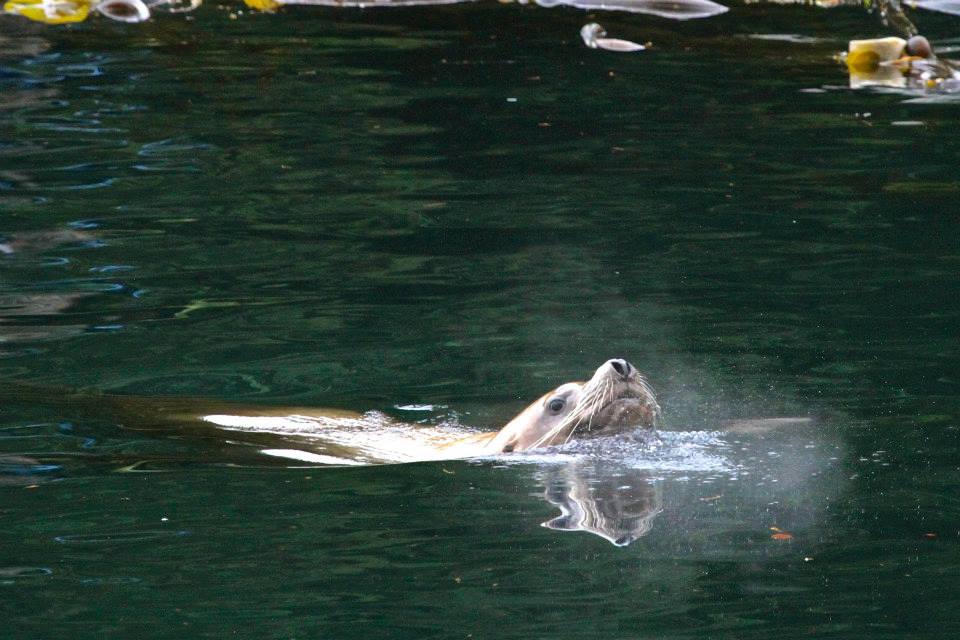
4. No matter how much you hoot and holler at them, Stellar Sea Lions will not give you the time of day.

10659202_10153342628774852_4448842526100652252_n

5. Orcas love to call at dinner time, so you stuff your plates into a plastic milk crate box and lug it all over to the lab and have dinner with headphones on.

1901153_10153342624724852_3285441612895050163_n

6. Bath Days are a gift from God and should be worshipped as such.

10995804_10153726757494852_7811731726412708212_n

7. Mink will live under the house, they’re cute but smell terrible, your cat will want to make friends, the mink will not acquiesce. 11081015_10155300238395858_6083581184589343527_n

8. Porch baths in December are a necessity. Treat them like a Nascar pit crew changes tires. If you’re not out and back inside in under five minutes you are a) doing it wrong and b) probably borderline hypothermic.

9. Bring pets. You’ll need someone to talk to when your wife gets mad at you for ruining her favorite website.

10994155_10153690504119852_621681021897676100_n

10. There is nowhere on earth like this place, nothing can replace it or come close. So enjoy every moment you have here regardless of the time of year.

_MG_9262

For His Old Branches

We push deeper into the middle of the island, weaving our way along the ridge. In an organized line the three of us hike, me in the lead, followed by Brittney, Porter the cat right on her heels. When she disappears over a small hill to look at a patch of moss that shines a fantastic neon green he plops on a fallen Hemlock and softly meows until she reappears. There are no machines, no airplanes, no cars. The only sounds are of the forest’s creation. Squirrels quarrel from their respective trees, all talk and no action. The Varied Thrush in between acts as a mediator, his single melodious note drowned out by their stubborn chatter.

It’s all therapy. The springy moss gives the sensation of walking on clouds, the world a tapestry of browns, golds, reds, and more shades of green than I knew existed. Fir, Hemlock, Spruce, and of course Cedar shield the sun. I stop at one Cedar and see a deep six foot slash that begins near my knees and travels up past my eyes. Long ago, someone cut into her. Not out of spite, anger, or the egotistical need to announce ones presence. But to weave a basket. By strategically stripping the bark in this way, the natives brought not death, but growth, their cuts encouraging the trees to grow at a faster rate. They’re known as culturally modified trees (CMT) and they litter the island. At least the parts that have never been logged, which is sadly less than half.

We stumble onto the scene of such a crime after plunging through a valley and onto the next ridge. Spruce dominant the scene here looking massive and impressive until our eyes fall upon the skeletons. Cedar trees twelve feet in diameter stand decapitated ten feet from the ground. Deep one foot notches denote where the logger stood and cut until the massive tree succumbed to gravity. Like the CMT, it says, “man was here” but with much more finality and violence. The cuts are from generations previously, the sun long ago blocked by the growth around us, the stumps being swallowed back into the earth, crumbling to powder. I look up at the spruce and feel relief and gratitude knowing neither them or the successors to follow will meet the same fate here. It’s progress. Hope. That their deaths were not in vain, that perhaps we’re moving forward.

Back home, I sharpen a chainsaw, fill it with oil and a 50:1 fuel to oil mixture. I can feel the trees watching me and Walrus’ words float into my head.

“When I got here, I could feel the pain this place had experienced. How many chainsaws these trees had heard, and I vowed never to use one on Yukusam.”

It’s a gesture that means sacrifice and plenty of extra work, though many I suppose would call it foolish, irrational, pointless. After all, trees can’t hear. At least, I don’t think they can. But his words, his dedication, his conviction stick in my head as I set the choke and begin to pull the handle, feeling the machine sputter before dying again. A magnificent piece of Fir has washed up along the beach, probably 50 feet long it offers nights of cozy warmth. But nearby, his brethren still stand. Branches coated in needles reach out towards me, their ends curved upwards toward the sun, like a crowd with outstretched arms, their palms skyward in peaceful protest. I sit the saw down and move up the beach a few steps. If they can hear, I want to make sure they hear me.

“This saw is not meant for you,” I whisper, and even in my solitude I glance behind me for human ears. “This tree can no longer grow, photosynthesize, or give life to the forest. If it could I would never touch it, just as I promise to never touch you. Forgive the sounds of the saw, I’ll leave you in peace as quickly as I can.”

I kneel by the saw and crank the handle again, it roars to life and soon, sawdust is flying from the tiny metallic teeth, forming neat golden piles on the beach. I move down the line, making cuts every foot and a half, dodging knots and pausing once to tighten the chain. In half an hour it’s over and true to my word I shut it off as soon as I’m done. Once again the cove and forest is filled with nothing but the sounds of the thrush and the squirrels.

An Expected Visit, An Unexpected Goodbye

Paul announced the news in his usual, casual way, “a few people may be visiting the lab in early March from Greenpeace.” Made sense, we knew Greenpeace was holding a ceremony in nearby Alert Bay, and given Paul’s and Walrus’ ties to the organization, we figured a couple would want to stop in. Truth be told, the thought of playing host and hostess was welcome.

A few days later we received a call from the organizer of the trip. “How many people are coming?” Brittney asked.

“15 to 20.”

Our eyes went big, after months of just the two of us and the occasional passing boat, 20 people felt like a full fledged invasion. We were gonna need to bake more bread.

For the next few days we scrambled, polishing and sweeping out the pine needles and cedar boughs from the corners and wiping away the months of salt spray thrown against the lab windows by 40 knot storms.

As the Naiad breezed around the corner and we picked our way down the rocks, slipping over exposed kelp and seaweed on the falling tide, it felt like summer. As if I was standing on the docks, waiting to pick up my group for a day of whale watching. One by one, a range of generations and ethnicities stepped onto the island, making their way towards the house. I heard Paul’s words escape my mouth, “please be careful, the rocks are incredibly treacherous.”

Walrus stepped off the boat and began to weave a path into the cedar as if he couldn’t stand another moment apart from his precious forest. There was no real plan, and people wondered hither and thither. It soon became clear what the first order of business had to be. Unbeknownst to me, Bob Hunter’s daughter held the last of her father’s cremated remains in her hands, wishing to lay part of him to rest in the quiet cove on the flooding tide.

Brittney and I stood amongst the crowd huddled along the shoreline as the now flooding tide shuffled us slowly back. We listened to the eulogies to the man I had never met, but heard so much about. One of the original founders of Greenpeace, Bob Hunter had led a life that turned my eyes blurry and my cheeks wet with tears. He’d battled the nuclear testing in Amchitka, Alaska on Greenpeace’s maiden voyage, seal hunters, whalers, published books, and who knows how much more that would lay unwritten and untold.

“It was Paul who convinced him to stick his head in Skana’s (a captive orca at the Vancouver aquarium back in the 1970s) mouth,” remembered one speaker. A small grin spread across my face, as in my mind I could see Paul goading him toward the edge of the tank, a mischievous grin on his face.

As the ashes fell in the gentle breeze onto the waters surface, a First Nations man banged on a traditional drum, the bass echoing across the water and ricocheting off the silent old growth that stood sentinel over the proceedings. Goosebumps erupted across my body to hear the soundtrack of the land revive and return. An eagle soared over and a sea lion poked its head out at the mouth of the cove. As if they too recognized the sound, the song that spilled into Blackfish Sound, resonating in their hearts, a reminder of simpler times.

The songs ended, Bob’s ashes scattered on the turquoise waters, piercing rays of sun cutting through the surface, a gentle breeze rustling the tips of the trees. They couldn’t have picked a better day to say goodbye and we felt incredibly honored to be allowed to bear witness to this intimate and precious moment.

Stepping Back

When I first came to Orca Lab in 2008, I expected some sort of sign. Some sort of intimate and personal encounter with the whales to justify the sacrifices, work, and effort I had gone through to reach this place. Orcas, it turns out, have little interest in storybook endings. They went about their lives as if I were invisible. It was odd, the orcas owed me absolutely nothing, but so convinced was I that some spectacular, “ah-ha” moment would arrive, that to leave without having gotten within 200 yards of a whale was, not a disappointment, but a hit to the ego.

“Don’t you ever get tired of watching whales?”

It was a common enough question working on a whale watching boat, and I suppose it should have been predictable. I mean, the majority of my clientele had work that they actually looked at as, well, work. I just saw it as a free whale watch every day, like someone had offered me season tickets along the third base line for free. How could you get sick of that?

The question would always rise to the surface just as the humpback was slipping below, meaning I had 5-7 minutes to explain why no, I don’t get sick of watching massive aquatic mammals breath. I’m nothing more than a commercial while the show dives 200 feet below us for another mouthful of herring. The guy who banters on stage while the band tunes their instruments.

“They’re like potato chips,” became my generic reply, “you can never say enough.”

But for those that would probe, that actually wanted to know and weren’t just making conversation after realizing that no, your iPhone will not get service out here, I’d go a step further.

“Because you never know what might happen. If someone calls and needs you to take a trip… you take the trip. The last thing you want is to come home to a phone call, and find out you missed the trip of the lifetime.”

But 100 yards stands between the deck and a trip of a lifetime. For the many who have read the stories of Erich Hoyt, Paul Spong, and Alex Morton, it’s a tantalizing distance. We want a moment like Morton had, being led by the A5s through the fog, or Erich Hoyt in his rowboat, bobbing in the bight, surrounded by whales.

But that age of orca research and watching has come to an end. With restrictions and limitations enforced, we’re at the mercy of the whales to swim that football field distance and set the stage for the sort of encounter we crave. Perhaps we love them too much. Our addiction as harmful to them as potato chips are to our arteries. We crave these moments, and stand breathless on the deck of a swaying boat, hoping for a flash of white, a bubbling surface, an eruption of carbon dioxide as the whale breaks the water feet from us.

And it does happen. After three years and countless hours on the water, I had a few holy s— moments; I was splashed by an orca, had one circle the boat, it’s oval eye patch staring into my soul, and had 14 humpbacks materialize from nowhere, surrounding us in a bubble net of desperate herring. And all it took was thousands of hours, and the sheer luck to be in the right place at the right time.

Six years later I returned to Hanson Island, reluctant to share some of the most intimate whale experiences with my fellow volunteers. I had been extraordinarily lucky to have a job that allowed me to buy a lottery ticket every day and cash in on the minuscule odds. But that summer, I found a much more rewarding and fulfilling experience. As much as I’d loved my time on the water, a wriggling feeling of guilt had grown as I thought about the deafening noise my coworkers and I made in their home.

The whale watch industry grew and with it, the pressure on the humpbacks and orcas until every daylight hour was spent in the company of at least one, and almost always several boats. I couldn’t measure how much of a disturbance I was causing, but the uneasy feeling in my stomach told me however much it was, my conscience was not ok with it. I began to despise the 700 HP engines on our stern, giving us the authority to decide when the whales could be free of us. Were these experiences worth the boat noise and fuel? The hours hovering above their kitchen table, knowing if it was up to them they’d probably have us disappear?

Instead of intimate face to face encounters, I craved anonymity. I wanted to see, but not touch, observe but not alter, be it from 5 yards or 500 didn’t matter. Perhaps I’m biased. After all, I can still see that orcas tail rising off the stern of the boat, sending water cascading over us. But nothing felt as rewarding or special as a misty, fog drenched morning at Cracroft point.

As the tide ebbed I inched down the rocks, slipping and sliding over the kelp, my camera slung over a shoulder, a lens the size of a baseball bat swaying ominously. Stopping just shy of the water I looked east down the strait, the sun cutting slashes in the clouds ahead of the oncoming rain storm. Right along the Cracroft shoreline I saw them, the A23s and A25s plowing through the strait, pointed directly at me. I raised the camera, Paul’s words ringing in my ears, “get A60s photo.”

The group filed past, exhalations like gunshots ricocheting off the rocks. An image of A60s dorsal flashed in my mind, like the face of someone I hadn’t seen in years, the big notch two thirds of the way up the dorsal made him easy to ID, and as the picture filled my head, his dorsal filled my lens.

I held my breath to steady the camera, and pushed the shutter, immortalizing Fife on a 6 GB chip. He couldn’t have been any closer than 150 yards, a distance many in the whale watch industry would yawn at. But a tear slid down my face as he disappeared. A few years ago I’d have wanted Fife to know I was there, to see some acknowledgement of my love and interest. Now… I wanted anything but that. Just to have a brief window into his world, and know that his calls were blowing out the speakers back at the lab was plenty.

The whales slipped by, milling briefly in the entrance of Blackney before steaming north. As if waiting for them to pass, the rain arrived, drenching me as I stood on the deck, reveling in the knowledge that they had no idea I was there. The group slowly faded from sight, there fins merging with the streaks of rain and background of the islands. But I continued to watch until they vanished from view. After all they’re like potato chips, you can never say “I’m full.”

John Muir, Stickeen, and the Biggest Decision of Our Lives

My favorite John Muir story involves a tiny dog named Stickeen. Fanatically loyal to Muir, Stickeen followed the famous naturalist everywhere, even the glaciers could not separate them. On one trip a storm hit. The light was fading, and they were still far from home. Between them and camp lay a large crevasse in the ice, a narrow bridge across offered the only hope of passage.
Muir scooted across and turned to find Stickeen still on the other side, sprinting back and forth as the wind howled, panicked and too terrified to follow. Muir knelt down and reach out his arms calling to his companion.
“Hush your fears little one, no right way is easy in this rough world, we must risk our lives in order to save them.”
For a moment Stickeen remained perched on the edge of the precipice, and in a flurry sprinted across the bridge, past Muir and began to yip and run in circles in ecstasy.
For years John Muir’s words have resonated inside me, echoing in my head with every major decision I make. I tried to avoid making decisions simply because they were safe or comfortable, probing deep inside for what I really wanted.
With this credo echoing in both our hearts, we walked, hiked, and hitched through New Zealand. Bounced from seasonal job to seasonal job. Crammed everything we owned into the Pathfinder and drove for five exhilarating days to Seattle. And of course, spent the last six months blissfully happy on Hanson Island.
Slowly we’ve watched our time remaining tick away, somehow, we have just two months left, and the thought of leaving already left a lump in our throats.
In our wildest dreams, where money is no object, we knew we’d come back. But even here, the financial demands of life can reach us. Student loans, IRAs, and that house in Gustavus beckon. It became our next goal, to save up and buy that house, if the elephant in the room (winter work in a town of 350) could be addressed.
Than Paul and Helena changed everything, offering to help us return for another winter if we wanted to. Thus began the hardest decision we’ve ever made together. We tried to imagine returning to Alaska, kayak guiding in Glacier Bay and than… what? Making coffee in Juneau I suppose. Which was all well and good, but we both knew that at night, crammed back into our shanty studio apartment, we’d look out the window to find ourselves surrounded by street lights. And our souls would ache for this place. For the sound of the waves on the rocks. The Harlequin ducks bobbing like rubber duckies into the cove every morning, the mischievous mink that taunts the cat from under the house.
We budgeted. We convinced each other that one decision was correct, and than the other. Finally, we would lapse back into fits of indecision. Pulled between starting to put down roots, and fearing that we’d eternally regret not returning to the island. We talked long into the night, unable to decide. Until this morning when Paul asked us if we’d reached a decision. We looked at each other across the table, a pained look on both our faces. We knew saying no meant we may never see this place again. And we knew that we couldn’t live with that.
There will be houses to save for later. Winter work questions to answer, money to make, roots to set down. But in our hearts, the wanderlust called for an encore. To sprint across that ice bridge one more time. To risk our lives. And to save them.

“We’re coming back!” we replied.
And like Stickeen a century ago, jumped and ran around the cabin while the wind and rain pelted the windows.

The Magic of the Town Run

The tide is ebbing, and the boat is stuck, like some hauled out metallic sea lion. An expletive escapes my lips and with one final push the boat slides over the rock and floats again. The vertical rock face seems to have just enough of these little ledges, and like some magnetic force, always seems to suck the boat right to them.
With the boat free, the loading begins. Empty gas cans, dead batteries, and garbage bag filled to burst with pungent clothes. Brittney appears, laden with more black hefty bags filled with trash and tied securely. The Hanson Island rule is: bags with garbage are tied, bags with laundry are left untied, an important step. Just ask the volunteer who tied his laundry bag, sentencing it to doom in the landfill.
By the time everything is piled in, there’s precious little room to reach the seats. The boat already makes me feel like Gandalf in a hobbit hole, but filled to the brim makes it feel like crawling through a cole mine. Finally I manage to pretzel my legs behind the wheel and the boat floats free, drifting into the middle of the cove.
The engine roars to life on the first turn and we idle slowly past the kelp bed and into Blackney Pass. Free of kelp and rock, the engine roars to life, struggling to break free of the water and get on step with the heavy load. But the water is a flat calm this morning and we hang a left, bound for Blackfish Sound, Weynton Pass, Pearse Passage, and finally Alert Bay.
It is the most magical of days, the town run. An afternoon of hot baths, Paul’s sandwiches, and people. So many people. Just up the street from the dock is a tiny lot where the beloved pathfinder has sat patiently all winter. Ever week and a half she resignedly comes to life so that we can drive the one mile along the shoreline to Paul and Helena’s house.
I feel like a kid coming home from college. A massive bag of laundry in hand, anticipating food, beer, and canned goods. After months of taps producing nothing but frigid water, feeling hot water spew into the tub makes me flinch. We had eschewed baths in favor of pouring hot water over ourselves a couple times a week on the deck. Scrubbing frantically while we shivered in the wind and the rain. So when it’s my turn, I nearly fall asleep, the hot water lapping at my face.
From the house you can see Johnstone Strait, the Hanson Island shoreline appears merged with the trees of Cracroft and the Plumper Islands. The water stays flat, but the sun is already beginning to set.
Alert Bay is far from bustling, but feels as congested as a city as we squeeze along the narrow road.
“So many people,” Brittney says as we wait for two cars to go by.
The grocery store is nearly sensory overload. For days we’d talked about the things that we’ve been craving but unable to reach. Now we just stare blankly at the shelves, a crumpled list in hand. Overwhelmed we pile heads of lettuce, carrots, potatoes, tortillas, and of course coffee into the quickly growing pile. Tragedy strikes when we reach the popcorn and find the shelves barren.  For a minute we’re too stunned to speak, mouth open in shock and horror. No popcorn? Why did we even come into town? Sadly we head for the checkout our overflowing cart suddenly feeling empty.
Loading the minuscule boat becomes a cramped game of tetris. Anything that can fit into the tiny hold in the bow is shoved unceremoniously in. Filled gas tanks and charged batteries bring the water’s surface a couple inches closer to the window. Bags of food, lettuce leafs poking curiously out the top are stacked as gently as possible on top of the clean laundry.
After some coaxing, the boat obediently gets up on plane and sends us rocketing home on the flooding tide. We reach the lab just as the light begins to fade but the slowly flooding tide has left us well short of the cove. Grabbing as much as we can, we walk and stumble up the rocks, dumping groceries and water jugs on the deck, leaving the batteries and fuel tanks for a higher tide.
Opening the door of our house, a white and brown blur shoots past as the cat sprints for freedom, incensed at his day long imprisonment inside. The rabbit is even more excited and wastes no time inspecting every bag until she finds the apples and attacks with the ferocity of a Great White Shark. By the time the boat is tied and the groceries stored, it’s dark, the fire slowly warming the house once again.
We collapse on the couch, town days always seem to wear us out, probably all the hot water. Now if only we could find a pizza place that delivered.

Collect Experiences. Not Things

For the first time in years I want something that I cannot have. The number in my bank account is woefully too small to buy the house that Brittney and I have been salivating over for the past two days. It’s not a mansion with enough square footage to fit a basketball court. Nor does it look out over some ridiculous ocean side vista. It’s just a humble, quaint, hobbit approved house on a tiny road in Gustavus, Alaska. And I can’t have it.

Since graduating from college, I’ve been rebelling against the status quo. Bouncing from seasonal jobs, spending months in New Zealand and Canada and loving every minute of a life that we seem to create one step at a time. But as we’ve wandered, we’ve begun to feel the need to have a home base. A place where kayak gear, camera equipment, and pets can pile up without fear of how on earth they will fit in the Nissan Tetris in a few months. So we looked up houses in Gustavus and began to covet really bad. Houses are never an impulse buy. Thank God. Because I was looking all over the screen for the, “buy now” button like it was ebay.

We took a little crash course in down payments, mortgages, and interest rates. What else are you going to do a 9 pm on an island where you represent 66% of the population? Slowly we began to accept the hard truth that the dream was a long ways away. Though it didn’t stop us from scrolling through the photos one more time (so much natural light!).

In Victoria, British Columbia is the Phillips Brewery, the only microbrew beer I can find in Alert Bay’s tiny liquor store. Besides having a Peanut Butter Stout, which is freaking amazing, the inside of their bottle caps have the phrase, “collect experiences, not things.” For the first time in a long time I want, “things,” or more accurately, “thing” in leu of, “experiences.” Weird.

Of course, if we hadn’t been jet setting, going to baseball games, and had, you know, worked the past seven months, we might be able to make it happen. But I sit in a house perched on the rocks over Blackney Pass. A storm beginning to build after a calm red sky morning. Yesterday was monopolized by calling orcas, sea lions bark and roar at all hours of the day, and the stars pop with no interference from streetlights. Sure, I could be sitting in that house today and I’m sure we’d love it. We’d also have a thirty year financial commitment that would really make it tough to live up to the website’s namesake.

I’m sure someday we’ll truly be ready for that sort of endeavor. But when we do, I want there to be no regrets, that it’s done on our terms, on our time. That we don’t sit in our house with fantastic natural lightening and wonder what could have been. Someday we’ll have a doormat that says, “Cannamore” and a sign that says, “all guests must be approved by the cat.” But until than, I’ll savor the adventure, the sweat, the and cursing as I try to cram one more duffel bag in the back of the car.

Collect experiences, not things. Experiences after all, don’t need a house to be stored in.