Tag Archives: adventure

Silent Nights in Robson Bight

IMG_5288It starts with the flutter of a Hemlock bough, almost imperceptible. It registers for the briefest moment and falls into some unlabeled file in the back of the mind. It’s subtle, quiet, it’s how every storm begins. Now two hours later the waters of Blackney are streaked with white caps and the young hemlock bends at the waist. Harlequin ducks make a desperate gambit from one cove to the other, riding breakers two to three times bigger than they are. They’re tough little things, impervious to the weather. Whatever is in the next cove over, I hope it’s worth it for them.
After a week and a half of sun, the clouds feel intrusive, cutting into our precious allotment of daylight.

The roar of the ocean feels deafening after a week of calm seas. A week that gave us the chance to return to the orca’s holy land, Robson Bight. On the map, Robson Bight appears as just a little divot in the Vancouver Island shoreline, unassuming and natural. But it’s here, in the back of the bight, where Erich Hoyt camped in the 70s. Fearless and casual, he’d sit in his row boat in the dead of night, floating on the tide, waiting for the orcas to swim by. As we cruise across the mouth of the bight for the site of the hydrophone on the east side, I try to imagine how I’d feel. What would it be like, to float on blackness, thin paneled wood between me, the ocean, and 15 behemoths? After hours with whales, many of them with nothing but fiberglass separating us, I’m not sure I’m ready to surrender my primary sense when we meet.

The site of the hydrophone in Robson Bight is on a steep cliff that drops straight into the ocean. It doesn’t descriminate, picking up the sound of tugs as soon as they clear Weynton Passage some five miles to the west. At Orca Lab we call it the Critical Point hydrophone. After the whales enter through Queen Charlotte Strait, it is on this end of the bight that they choose to either continue east into the strait, or turn back to the west toward the lab and open ocean.

But now, in the quiet stillness, nothing seems critical or pressing. Brittney and I relay the car batteries up the cliffside. Critical Point is the most vital but also the most susceptible hydrophone in the array. It has the widest range, but its solar panels are draped in shadow for most of the winter by the massive mountains at the back of the bight. For five nights we’ve been nudged awake by the unmistakable chirps of a hydrophone about to run out of power. Invariably it’s Critical Point that needs to be extinguished, leaving us sonically blind in most of the strait.

It’s easy enough to swap the batteries and install the new ones, all one needs is a wrench and an understanding that touching positive and negative terminals will lead to the shock of your life and possibly frayed eyebrows. Batteries firmly in place, I call Paul.

“Where are you now?” He asks, you can always hear a smile in his voice.

I grin back and fall into the moss putting my feet up on the rocks, drinking in Robson Bight, the rays of sun cutting through the mountains, anointing them with breathtaking halos.

“Just on the Critical Point cliff, soaking in the sun.” The honor and novelty of being here, of working for the guy that wrote the book on Orca behavior is never lost on me. This is so cool.

An hour later we’re riding the ebbing tide to the west, I’ve memorized the strait like some learn city blocks. There’s the cliff, always dead heads on the ebb coming around the corner. The Sophia’s, reef off the west end. Nice deep water off Cracroft Point.

We round the corner into Blackney Pass, the water churning as it rushes for the open maws of Blackfish Sound and Queen Charlotte Strait. Miniature whirlpools splatter the entrance, a heavy tide rip in the middle. I can count on one hand the number of times I’ve seen Blackney in a state that I’d be willing to kayak. The water never rests.

Gulls, murres, guillemots, and murrelets manipulate Blackney’s upwelling, dive bombing for forage fish pulled to the surface. Off to the right is Barontet Passage, a long slender channel that runs east on the northern end of Cracroft. The resident orcas never go that way, but occasionally the transients – what was that?

Without bothering to slow down I yank the wheel to the right, turning ninety degrees, the bow pointing toward the opening of Baronet. A hundred yards later I slow down. Something caught my eye. Something bigger than a sea lion. I think it was just a humpback, there’s been a couple hanging out between Parson and Cracroft.

There’s a dorsal fin.

“It’s an orca.” My heart stops, resets, and accelerates. Brittney’s already digging for the 400mm lens. I don’t mean to say it with such intensity, but I can’t help it. Eight years later, orcas still do this to me. May they always.

I turn the boat so they’re on our port side. The boat we’re in is only about ten feet long and when you sit, you’re barely four feet above the surface. You may as well be in Erich Hoyt’s row boat. And on the rambunctious currents of Blackney, you couldn’t ask for a worse platform to photograph.

“Can’t you keep it level?” Brittney asks as the orcas-four in all-break the surface.

The group heads the same direction we’ve just come from. I know we’re a land based research facility, but screw it. When is this going to happen again? We follow respectfully, years on the whale watch boats paying off, the camera whirs to life with every surfacing. I dig in my pocket, and one hand on the wheel, both eyes looking out the window, call Paul again.

“Hey Paul, guess what we found.”

I hear the smile in his voice as we round Cracroft Point and once again, travel east into the strait.

Same Destination, Different Path

The sun breaks through, faces turning upward, mouths open, drinking in the sunshine.  A respite, finally. No better way to leave. We’re on the Alaska Ferry’s equivalent of the milk run. The grand tour of southeast Alaska with little concern for time of day. Juneau at 4 am, Hoonah at 9, Sitka in the evening, in and out of Kake under the cover of night. Weaving through the mouse maze. West, east, and slowly, tantalizingly south.
We’re not alone. High school volleyball and wrestling teams are bedded down in every lounge when we stagger aboard in the early morning twilight. It had been my idea to stay up until our 4 am departure from Juneau, a decision I’ve been regretting since midnight. Through bleary eyes, sleep clinging to our eyelids we maneuver the minefield of snoozing adolescents, looking for any gap on the floor for a pair of sleeping pads.
Mercifully teenagers aren’t early risers, and most of us are still asleep when the purser’s desk begins to scold us over the intercom in a voice reminiscent of Mr. Feeny. “It’s time to turn these lounges back into lounges! Chaperones, get those lounges cleaned up!”
He must get a kick back every time he says lounge. But as I look around the room at the draped arms and legs protruding out of the corners and between seats, I’d say the room is living up to its name the way it is.
By the time we’re squeezing through the minuscule pass between Baranof and Chichagof Islands, the sun is burning through the fog, the day turning from Late October to June in minutes. With the shore just yards away from both sides of the boat we curl up on the solarium and let Alaska dazzle us for the countless time. Ravens chatter in the woods like invisible sentinels. A pair of Kingfisher’s chase each other above the treetops, their punk rock haircuts matching the throaty screeches perfectly. A humpback surfaces. The hemlocks grow tightly together. Every now and than a flash of red among the green, a Cedar. An outlier, we’ll be surrounded by them soon. As if magnetically drawn by the sun’s cameo, the high schoolers filter to the open deck.
Electronics are sparse among them. In the cafeteria playing cards appear, they talk, joke, laugh, are kids. Not drones with their head’s pulled down to an HD screen with the world around them invisible. It makes me smile. No cell service, unplugged from the world but not each other. When phones do appear it’s to take pictures of the scenery, often with them and their friends in the foreground.
Selfies are the new currency of flirting. All a boy must do to receive the attention of his chosen girl pack is leap into the photo, eager to participate in the immortalization of the moment through the magic of sim cards and 10 GB hard drives. Can’t say I’d so anything different if I was them.
The water stays calm as we leave Ketchikan in the evening and push into Canadian waters. Once again, we leave under the cover of night as the ferry pulls into Prince Rupert at 4 in the morning. This means crossing the border and explaining what the hell we’re doing in this country will be done through two sleep deprived and bloodshot eyes. We’re fourth in line getting off the ferry and I scarf down our remaining two apples for breakfast in lieu of turning them over.     We reach the customs lady and I roll down the window. Usually Porter sees any open window as a gateway to his god given freedom. And after two days confined to the car I expected Brittney to have to pin him down to keep him from crawling up the lady’s uniform. But he sits politely on Brittney’s lap, the perfect gentleman, as if understanding the gravity of the situation and our history with cranky and stoic border guards.
But they seem as groggy as us. The only loss is the little pink can of mace Brittney has had on her key chain since she worked mornings at a coffee shop. Bear spray, we’re told, would’ve been permissible, but since her mace was designed to use on humans, we were a threat to the unsuspecting Canadian citizens.
The inhabitants of Prince Rupert spared a terrible mace induced terrorist attack, we drive into the sleeping town. It’s too much to hope that our pet friendly hotel would leave their door unlocked at 5 am. So we grab coffee and hole up in the parking lot, waiting for the sun to rise and the lights to come on.
It feels good to be transient again. With our bags piled up behind Penny’s house in the back of the Pathfinder, the cat on our lap. Home is the four of us together. Two hours later the door unlocks and we record history’s earliest hotel check in, dropping our bags on the floor and collapsing onto the beds. Penny leaps euphorically as she hops into every corner, free of her house for the first time in 48 hours. Everything must be smelled, tasted… and chewed. With a $200 pet deposit we watch her like a hawk.
Brittney retreats to the shower, our hot water days numbered, and I watch Porter try to keep his eyes open as he curls up on the bed. The simplicity of my joy, my contentedness, brings peace. We search for happiness everywhere, sometimes demanding much, sometimes little. Sometimes, it’s as simple as an early check in, a sleeping cat, and the knowledge that no matter where I go with these three, I’m already home.

Porter Supertramp

Porter stares longingly out the sliding door. Like a kid with his face pressed against the glass, watching the rain fall in sheets for the second straight week. Frustrated, he paws at the door until we open it. Outside he stops short of the soaked grass, rain pelting the tin roof, reminding him, all of us, that summer is over. With a dejected look he walks back into the warmth.
It’s been that sort of fall in southeast Alaska. Sometime in August the heavens opened the floodgates and it hasn’t stopped raining since. Puddles litter the dirt roads and driveways like little lakes. Rivers flow between them, connecting them, turning the road into a washboard, car shocks moaning in protest, CDs skipping.
And once again, we’re on the move. Packing this, debating that, Porter and Penny wide eyed with alarm. Moving again? At least this time the posters can stay on the wall, unneeded clothes can hang in the closet. Last summer every box and duffel had to return to the exact same spot in the Pathfinder or it wouldn’t fit. Not this time. We have a whole year of our lives meticulously planned. We know where we’re coming back to. Where our next paycheck is coming from. Sell outs.
But for now it’s time to wander. To cheer silently when the beat up old Pathfinder coughs to life. The cat taking his position in the driver’s lap, Penny poking her nose through the gaps in her house, always looking forward. It’s time for ferries, lunches out of plastic bags, for Prince Rupert to have hotels with lenient pet policies. Most importantly, it’s time for Hanson Island. For quiet coves and sleepy sunrises, Harlequin ducks chittering good morning. For silent walks through the forest, listening to the whispered messages of the cedars. It’s felt like a lifetime since we were there, or maybe just yesterday, it varies.
How much longer do we want to do this? Whenever we talk about what we’re going to do “going forward,” the subject settles on buying property, settling, wrapping ourselves in Gustavus’ warm embrace. Hanson Island stops us cold. Reminding us of town runs, sea lion haul outs, and transients on Critical Point at 3:00 in the morning. And we know we’re stuck. That houses will have to wait. We have the rest of our lives to be domesticated. To fence ourselves in. We’ll be ready someday. Ready to drop our roots among the birch on the glacial outwash near the bay we love so much.
But not yet. We understand that what we have on that little island is a once in a lifetime opportunity. That a chance like this will never come around again. How do you willingly give that up? I don’t think we can. So when people ask if this is our last winter there we smile and shake our heads.
“Probably not.” We answer. “Paul and Helena may have to kick us out.”
When do you know that you’re ready? What if we’re destined to bounce between two places that we love forever, unable to commit? What a beautiful problem to have. Some winter it’ll feel right. We’ll stay put. We’ll go to every Gustavus potluck, every fundraiser, make new friends, discover what we never knew we had. But Hanson Island will forever be a part of us. An essential nutrient in our life. A place we’ll always long for, always love.
Right now I can’t wait to get back. To wrap myself in that island as long as I can, to enjoy it for as long as possible, knowing that our time there has an expiration date. That worrying about it won’t make it any better. Nothing to do but take as deep a breath as I can, savor every sunrise, every 50 knot storm, every night hauling the boat up the beach on the rising tide. Because we’ll never get to live like this again.

With All Five Senses

We are visual animals. What we see is what we get. Our sense of smell, taste, hearing, and touch takes a backseat to what hits the retina, is fragmented and sent to our brains. And yet the world is so much more than what we see. Or why would we ever get off the couch, board the plane and travel? We don’t want to just see it for ourselves, on a deeper level we want to taste, hear, touch, and smell. And yet… when we arrive our supporting senses again fall away.

For nearly half a decade I’ve watched the behemoth vessels of Princess, Holland America, Norwegian and (gulp) Disney, trace the inside passage. From ten stories up the panoramic view must be breath taking. Never ending acreages of trees, oceans, whales, birds, and bears drifting below the eyes of those that have never seen the natural world in its element. Before their eyes is what brought them here. Is that enough to make one appreciate the land? To change lives? To understand what all can be lost if we don’t change and change fast?

Do we need more? Trees and mountains may inspire as they roll by. But they are visual descriptions, easy to imagine, see, digest, and forget. From atop the ship or within the walls of the lodge, so much is lost. Layers upon layers of the natural world lay hidden just beneath the surface, invisible.

They require us to step off the gangway, out the door, and into the woods and fjords. When we do we find what was hidden was the smell of the ocean, masked by exhaust. The sound of the gulls covered by engine noise. The bite of glacially fed canals, the taste of salt drifting seductively below. We must leave behind 4G and wi-fi and sit in our ancestral home while we still can

I can’t pretend like I’ve always known this.

For three years I worked as a whale and bear guide in Juneau, side by side with the great white boats. While every day brought transcendent moments of beauty, a part of me felt empty. With the rumble of boat engines we felt compelled to add our own commentary and exclamations to the scene. It’s understandable as excitement bubbles over. But the anthropogenic noises of the boat, our feet, and the babble from other boats added layer upon layer to the acoustic scene until the sound of the whales was nearly extinguished. The click of the camera the running questions, the chirp of the iPhone removed the intimacy.

I didn’t think I could be a kayak guide. Didn’t think I’d be able to handle watching whales vanish over the horizon while I paddle slower than I walk. I went into the summer unsure of how I’d adapt. Many days I came home without seeing a plume of whale exhaust, or the shadow of a bear. But when I did, an extraordinary thing happened.

Without the white noise of man’s busy hands, we fell silent. No horsepower no clicking cameras, no thundering feet on metal, no screams and shouts. We were muted by the silence of the natural world. A world so still that from 50 yards you can hear a bear’s claws on the rocks as it turns over boulders. A moment so powerful you don’t as much hear the whale breath but feel it as it explodes from the deep end of the kelp bed yards from your bow.

Sometimes we’d just bob meditatively on the tide. Glacier Bay holding us in a trance, hearing the voices we needed to hear; Murrelet, sea lion, harbor porpoise. It would be rude to interrupt.

I began to understand.

It’s not the pictures of the whale that I need. It’s the sound of their breath, audible from miles away. The slimy comfort of the kelp fronds wrapped around my kayak. The smell of salmon so strong that it permeates the ocean’s surface as they pulse beneath the surface. It’s blueberries on my tongue, Common Murres in my ears, whale breath in my nose.

It took slowing down, not speeding up. Paddle strokes over four strokes. Smaller boats, smaller town, smaller mindset.

One of the first questions of the day is invariably, “what will we see today?”

“Nature is unscripted,” I explain, “I can only tell you what we may see.”

“But,” I go on, “I promise you’ll feel the tide, hear more than you ever imagined, and won’t get the smell of salt out of your nose for days. Believe me, in the end, that’s what you really want.”

The Spirit Walker II

That night he lay in his tent, flat on his back, watching the flimsy ceiling growing darker and darker as the sun vanished for its brief summer intermission. For the first time in decades he was scared to close his eyes. It was not fear of bears or the mystical kustaka that held his eyelids open but his own mind, a terror at what would happen to be transported again. The minutes moved leisurely by, apathetic to the knot of tension in his stomach and the anxiety in his head. As the first tendrils of morning light began to materialize Reed could fight it no longer, his eyes shut, blackness enveloped him, and his spirit left.
It was loud here. The foul smell of rotten fished filled his nostrils, his body crushed by the squirming masses on either side. The roars and barks of his neighbors seemed to travel from his ear flaps down his spine, the sound waves of the deepest calls rumbling in his chest. But he could breathe easy here. And when he opened his mouth he felt a deep bellow radiate from his chest, rushing up his wind pipe, past his massive canines and into the throng of brown fur surrounding him.
There was no peace here and he hated it. Couldn’t understand how those around him could sleep in the noise and smells that seemed to be their own living organisms. He looked across the passage to the distant beaches and rocks. It looked peaceful and quiet, perhaps there was even salmon. That was how haul outs started wasn’t it? One brave pathfinder seeking something bigger, better, more. He was that pathfinder, that rebel.
With a gigantic heave he leaped clear of the rocks, the sound of his peers echoing in his ears before being muted by the concussion of his splash. He let his body sink beneath the waves, worshipping the silence and peace. Finally he flapped his long flippers and felt his body glide forward. The water flowed smoothly past his long whiskers as he rose back to the medium of breath and life, thrusting his nose above the surface and exhaling.
The passage was not wide, surely it would take less than an hour to swim, and he lolled near the surface, rolling onto his back, letting the sun warm his outstretched flippers before turning back on his belly to swim a few feet more. Everything was quiet and still. A voice drifted across the water as he rose above the waves, orientating. There was his face, a hand outstretched pointing toward him, mouth open in exclamation. For a wild moment he considered swimming over in greeting, than the water exploded.
He felt his stomach burst, his spine snap, his body helicopter, his human face cartwheeling before his eyes. With a feeble splash he hit the water, saw the muscled black and white mass of supremacy dive into the ocean beside him. Desperately he swam for the shore, his breath coming in gasps, electric shooting pain radiating down both flippers. He had to make it. Had to reach the rocks, start the new rookery, prove it could be done. Behind him he could hear them breath, saw a flash of white slide beneath him, saw the fin cut the water beside him. And in the kayak he sat there. Helpless, unrecognizing, accepting that to live meant to die. That he was a living sacrifice so that his predator could live to swim another day. He closed his eyes, paddled furiously, and braced for the next strike from below.
The searing pain in his gut brought him back to consciousness. His chest heaving, his arms held out above him. still paddling furiously. But the pain was in his stomach, not his lungs. Where the orca had hit him? Where he had hit himself? Where he had watched the orca hit the sea lion? Were all three of them true? Were any of them? Light filled the tent as he unzipped the sleeping bag, pulling his wool shirt up to his neck to stare at his undulating belly. A great bruise covered his lower abdomen, shades of purple, blue, and yellow sprawled across his skin. With a shaking hand he brushed the wound and pulled his hand back as if seared. It was tender, as if he’d been head butted by a massive animal.
Reed brought both hands up to his eyes, rubbing them as if to clear his mind, to exorcise whatever sorcery had inhabited his body. He was alive, he was Reed Brown, 70 years old, male, and human. Not sea lion, not orca, human. As his life faded, the bay seemed set on absorbing what was left of it into its very being. Somehow the thought settled him, calmed him. He saw himself not as a visitor, or passerby, but a living and vibrant family member of the land he cherished. He took another steadying breath; feeling the ache flow from his lungs to his stomach, and unzipped the tent, on tenderhooks for whatever else the vision may have left for him.
But the stretch of bay was innocent and unassuming, and Reed swallowed his breakfast of oats and raisins without tasting a bite. As he paddled away from shore he glanced into the water, shining emerald today in the partly cloudy skies and let his mind drift, imagining the black and white thunderbolt rocketing toward daylight, the exhilaration of the hunt, the terror of the collision, the necessity of it all.
Reed looked ahead toward Tlingit Point where it stood at the base of the two arms and paddled on, pushing the fantasy and nightmare of swirling, unseen creatures from his mind.
He made good progress as he paddled resolutely onward, stubbornly insisting on paddling the full 65 miles from Bartlett Cove to Margerie Glacier at the northern tip of the West Arm. The paddling did what the medication had never been able to do and he once again began to feel invincible, half a century younger, pushing the ocean behind him with every stroke. The sun moved across the sky, dipping for an innumerable time beneath the Fairweather mountain range. Still he paddled on, savoring every stroke, ever riverlet of water that fell from his paddle’s blade, marveling at the perfect vortexes that materialized behind him as his paddle churned the surface. At long last fatigue reemerged from the muscles in his back and shoulders and he succumbed to the limitations of his body, bringing the kayak to rest near Tidal Inlet. The clouds had fallen away, leaving the sky the palest of blues in the late evening light. Eschewing the tent Reed curled up beneath the limbs of the alder and faded into sleep.
He awoke early, feeling surprised at his dreamless sleep. With the practiced movements of countless mornings he devoured breakfast and continued his vigil up the bay’s timeline of his life. He slipped past the “the bay the moose swam across,” the “mountain where the wolves howled,” and finally past, “the beach where she said yes.” Here he stopped in mid afternoon sun, walking the beach toward the massive glacial erratic. When he had asked it had stood at the top of the tideline. Fifty years later the rising land had pulled it into the meadow, the bay, like life, never stops changing.
But it would take more than her isostatic rebound to hide the memories Reed held here. He found the small groove in the rock where he had kneeled, holding out the small gold ring to her, could still see her face glowing even as the rain fell in torrents, their rain jackets like their lips pressed tightly together. Here he uttered his first words since setting out.
“I’ll see you soon, beautiful,” he whispered, a withering hand running down the rock, squeezing a hand he couldn’t see or feel.
Unable to stand in this place a moment longer he turned and sprinted for the kayak and pushed clear of the beach, apathetic to the crunch of fiberglass on the sharpened rocks as he paddled hard for Russell Island, Tarr Inlet, and Margerie.
He paddled in silence the rest of the day, watching the brush shrink away to bare rock that stood creased and scratched by the receding ice, leaving its own graffiti on the land’s geologic story. The east side of Russell Island was alive with life. Dozens of Marbled Murrelets bobbed in the sheltered water of the island, their peeps filling the landscape with the flawless communication of the mated pairs. With practiced grace they dove together only to be separated below by the allure of herring. Breaking the surface they would call to one another until their voices brought them back together. Not until they were side by side would they dive again, filling their bellies until they could barely fly, skipping over the water like flat stones, struggling to gain the lift that would take them to their homes in the old growth forest.
A small sandy spit crawled into view, an inviting bed of moss and shrubs just beyond the tide line. For the countless time Reed brought his kayak onto the beach where so much had happened. It was the beach with too many names to number. But this time there was no ambling bears, no screeching heron, no comfort in his empty tent. He sat up into the early morning hours, listening to the murrelet’s call, watching the lovers come together, suspended on the ocean’s surface tension for a second that lasted eternity, and than dive together once more.
The clouds crawled back over the mountains, the respite was over, and rain began to fall again, rainwater collecting in pools along the creases in his jacket. Finally he submitted to the call of the thermarest, and crawled into the shelter of the tent. Exhausted his eyelids fell like stones through the ocean and he felt his weightless body float through the soft tap of raindrops on the roof, tasting the sweet liquid on his tongue.
He bobbed gently on the water’s surface. The smallest ripple buffeting his body like four foot seas. But he glided with practiced grace over each crest, watching the horizon and mountains disappear from sight in the trough before coming into sight as the ocean held him above. She was near, and his head darted in precise and practiced movements back and forth, even in a crowd of their kin she was unmistakable with her lone patch of bright white feathers along her back.
Reed called out her name, his voice a singular note that peeped through the crowd of feathers, wings, and beaks, seeking out the only one who would know it was him. She answered instantly, the sound serenading his spirit and he paddled vigorously towards her, calling out her name again and again.
“Reed!” Came the reply, “Reed!”
And he saw her. Bright black eyes dilated with excitement as if they’d been apart for months in lieu of minutes. A tiny wave sent him barreling into her, their tiny torsos bumping together as he let out a final call of greeting. For a minute they sat still, staring into one anothers eyes, letting the higher powers of tide and current take them where they wished. Below their friends dived in the wake of herring that fled beneath the surface. He gazed into her face, his 8 ounce body feeling even lighter in her presence. With another call they dove, wings outstretched, brushing gently against each other they plunged into the frigid medium, lightening flashes of herring zipping past their vision. He dove away from her, turning hard to the right, following the fish down, weaving through schools of surging salmon, their eyes wide in surprise, constantly awaiting the next threat, the next predator.
A minute later, a single herring clenched tightly in his beak, he allowed buoyancy to pull him back to light. Even with his mouth full he called, the sound muffled by the dangling fish, saltwater dripping from its tail back to the ocean, the tiny ripples spreading out into the crowded cove. In a sudden rush she broke the surface next to him, her beak empty and he hurriedly forced the fish into her mouth, imploring her to eat, to nourish the egg steadily growing inside her. She let out a tiny bleat of thanks and nestled against his feathers, the current and tides resuming their control over their lives.

Glacial Rocks, Dirty Sock, Paradox

Every spring the great migration resumes, animals of the sea and air swimming and winging their way north. In the recent decades a new species has taken up the route, plowing resolutely north with the hopeful promise of long summer days before retreating south as the waves build, the sun dims, and the rain pelts like daggers. Like the Arctic tern, many will shift their attention to the southern hemisphere, other rushing for the promise of lawn chairs, t-shirts, and mai thais of the Caribbean, following not the food but the money. The cruise ship has become the newest migratory species.

But from May through September they reside in the Pacific Northwest, their roosts in Seattle, Vancouver, and San Francisco, their feeding grounds the towns of Juneau, Ketchikan, and Skagway, sustaining on a diet of generic cotton t-shirts bearing the ports name, postcards, and diamonds mined on the other side of the world. Many pass by quiet Gustavus, its dock offering no hope or promise of future ports, the town’s walls barred against such an invasion of 1500 people into a town of 350. To reach Gustavus is a deliberate act, an independent flight or ferry ride from Juneau. One does not wake up, stagger down the ramp, and ask where their tour is meeting.

For most the true treasure is not in the town, but in the great mythical bay standing just to the west. Where 3.3 million acres of wilderness offers that many set out for. The open box on the bucket list begging to be checked (next year we’ll knock Europe off the list!). An Alaska devoid of t-shirt companies and concrete. This is the Alaska of John Muir and Jack London, wild, and free, an untamed land in an overdomesticated world. But from nine stories up, in a cabin bathed in artificial light, the heater blowing merrily, how tame it can all still feel.

Like an low budget nature documentary the acreage glides past. Mountains, bays, and glaciers in a 13-knot parade. There’s no struggle against the tide or wind, no resigned paddle onward as every promising beach contains another Grizzly landlord. In the bay at 8, Margerie Glacier by noon, Icy Strait by evening. Eight hours, 65 miles, and on to who knows where. Never touching, never tasting, scarfing it all down as quickly as possible. Fast food tourism.

Yet. Whether intentional or not. They’re here. The door to wilderness and the sublime left ajar. The cruise ship the keyhole with thousands elbowing each other out of the way to press their eye against it. To see, even if just for a day a sliver of the Alaska they’ve read about. And in that sliver, lies opportunity. To express that to see Glacier Bay is not the same as living it.

Here lies one of the last places on earth waiting not to be changed but to change. To recreate us like the glaciers did. A reminder that we are never complete. That like a river of ice, constant motion is necessary. That are own natural succession is always in progress. That it’s never to late to surge like like the Grand Pacific Glacier hundreds of years ago, charging south as fast as a running dog. All we have to do is let it.

Many will glance through the keyhole, snap a photo, shrug their shoulders, and move on. But for some, perhaps a cruise is the first step, leaving them in awe, thirsting for more, something authentic. Those eight hours will leave them wanting to meet the bay on its terms, on its level, from the seat of a kayak, at the feet of the glaciers, discovering their inner Muir. If they return it’ll be on their own journey of self discovery, with a can of bear spray in one hand and a tide chart crumpled in the other. And when they return to the bay, it won’t be by accident.

The Sorcerers

The swelling in my lower back has vanished. The shooting pain in my left shoulder blade melted away with an hour of squeezing into my kayak. Glaciers slide by, deities of a higher calling. They speak in languages well beyond my ability to translate. They groan and crack, their breath cool on my face, stirring the marble colored water that swirls at their feet. In my narrow, 17-foot kayak Glacier Bay towers above, beneath, and around me. Intimidating mountains thousands of feet high, obliging fjords thousands of feet deep, serac steeples, arete cathedrals.
It’s been mere hours since the boat deposited Brittney, Hannah, and I at Ptarmigan Creek in the west arm, leaving us with the Reid and Lamplugh glaciers as neighbors. Bears as our landlords, Oyster catchers the shrill neighbors. Harbor seals, their eyes still recalling the centuries as sustenance for the Tlingit’s slide cooly beneath the waves as we paddle south for Reid Inlet, its glacier, and the sublime. It was impossible not to grin. Surrounded by beauty man can only dream of matching. Reveling in our insignificance, the glaciers and mountains reminding us that our lives are but a shiver in the lives of the epoch.

One Day Later:

The deep bay juts deep into craggy rocks, giving way to gradual, sandy beaches in the back. In our kayaks we sit just feet offshore. With one hand I hold my paddle jammed into the rocks on the ocean side to keep the kayak from being swept into the bay. The other endures the harsh edges of the barnacle smothered rock, keeping the fiberglass hull off the bottom.
Twenty feet away the water depth plummets to thirty feet and at the moment all the riches on the Coral Princess couldn’t tempt me to uproot my paddle and drift into deeper seas. The calm water ripples and 20,000 volts shoot from adrenal glands to toes.
A lunge feeding humpback glides smoothly out of the water yards away, the leviathan’s coal black rostrum lingering at the surface, every bump, curve, and scratch visible, burning its image into the back of my head. The tip of his nose is big enough for me to sit on like a slippery fish encrusted lazy boy.
None of us speak afraid of breaking the spell. As if to verbally acknowledge the miracle will cause the whale to disappear. We didn’t want the water to be safe, we wanted to hover on the precipice of the cliff, leaning as far over as we dared forever at the very edge of his table.
For an hour the humpback glides back and forth within 30 yards, our eyes leaving the water just long enough to glance below us, to confirm we could still see the rocks and sand, that we hadn’t drifted onto the plate. Finally the obligation to photograph overwhelms and I pull the camera free of the drybag. Even with the wide angled lens pulled back, he fill the frame, capturing the image but failing miserably to capture the intimacy, the proximity, the enchantment.

Four Days Later:

The real world. At least as real as we allow it. Back to work, back in our green boats, vacation over. The waters of Bartlett Cove filled with wonder no matter how many day trips you led. Beneath the waves teemed otters, humpbacks, seals, porpoise, and today…
“Brittney, there’s an orca.”
I don’t mean to sound sharp, don’t mean for the intensity and fire to spit out my mouth like a dragon. But orcas do that to me. Give me tunnel vision, making the rest of the world vanish. From my seat inches above the water I watch the smooth 6-foot dorsal of a male slide back into the waves 500 yards away, making its way into the cove. This doesn’t happen.
Guiding instincts kick in long enough for me to point while the 17-year old within, the one that ran to British Columbia for this very moment screams to paddle and paddle hard.
Our five boats cut through the water toward the mouth of the cove, in the distance the Fairweather Mountains glow in the early morning light as around the point come a trio of gunshots, three more roll into view. Cationic with delight my boat slides across still water, every stroke bringing me closer, hot on my keel is Brittney and six incredibly fortunate clients.
I try to explain the magnitude, that this doesn’t happen. They aren’t supposed to come into the cove. In my mind I beg them to stay. Keep coming in, almost there, almost there.
Behind me Brittney calls out and our little flotilla stops paddling, our boats succumbing to the tide’s authority. We sit in a jumbled array as like fireworks, the orca’s break the surface. The male continues his course down the middle of the mile wide cove. While three more break the surface between us and Lester Island. Another breaks off from the male and swims toward the boats.
I should call the park, dig out my phone, document, tell someone, but I’m past words. I’m 17 again, bobbing in a kayak off Cracroft Island, watching the A36s swim by. Nearly ten years later they still hold unimaginable power over me. Keep me coming back to the water, always scanning, always listening.
They’re watching us. A juvenile no older than five materializes thirty feet off my port, the sun catching her eye before she disappears. Her mother rushes in, corralling the rebel and guiding her away. The windless day is filled with the sound of their breath. Explosive exhalation and the harsh rasp of every inhale clearly audible. There’s no boat engines, no hollering, no clicking cameras. Everyone watches in great silence, knowing nothing can even begin to do them justice.

Different View, Same Soundtrack

I wake to the gust of cold wind on my face, the breeze a soothing tonic against my cheeks, encouraging me to dig deeper into my sleeping bag propped on the deck chair of the ferry’s solarium. It’s not even seven but the horizon already glows with rosy morning light, soothing confirmation that we’re still moving north. I poke my head out and look over the rails, my heartbeat slows. Gone are the buildings, the roads, the lights that had bombarded us from the shore as the sun went down with nothing more than the occasional lighthouse to interrupt the parade of rocky beaches and mighty cedars.

I stare out at the blue road ahead, the trees slowly melting by. Less than 24 hours ago we had been sitting in traffic, trapped on the I-5 with nothing but outlet malls and tail lights for company. I could feel my world realigning with the compass pointed resolutely north away from the alien world of cities, suburbs, and concrete. I return to my sleeping bag drinking in the cool spring air, and go right back to sleep.

The mountains feel like old friends, familiar faces as the ferry steams into Juneau. Auke, Thunder, and McGinnis, call out in greeting as we drive down the ramp, bleary eyed but exhilarated to be home. The Mendenhall Glacier still stands guard at the foot of the towers, with Thunder and McGinnis mountains guarding its’ flanks. How good it felt to be back, the comfort, the familiarity, the mountain’s friendly faces, extinguished any longing for Hanson Island. If I couldn’t be there, this was the next best thing.

24 hours later, we were finally done. The Pathfinder sputtered to life one final time, taking us up one final ramp and into the town of Gustavus. Town however, may be to generous. The lone stop sign lies a mile and a half inland from the ferry dock, affectionately known as, “four corners” the only intersection in town. Everywhere you look are mountains, but unlike Juneau, they lie benignly in the distance. The town is midwest prairie flat, a quirky anomaly in a region in which towns are built on, around, and through mountains. In spite of their distance, the mountain’s names come back to me easily like a familiar song that you haven’t heard in years. The mountain ranges of the Fairweather, Beartrack, and Chilkat surround us to the west, north, and east. To the south, across Icy Strait, is Chichagof Island, its own collection of mountains give the impression that we are in a massive bowl surrounded on all sides by distant peaks.

We slow to a stop and consider our options. Two of the four roads lead to the two ways out of town, the ferry behind us, and the airport, the third leads down a dirt road, the left hand turn is the longest, stretching north past unassuming roads dotted with log homes and protected by thick canopies of spruce and hemlock. Seven miles down later it ends in Glacier Bay, the crown jewel of southeast Alaska. It seems fitting, that in a land renown for its’ natural beauty, it’s most marvelous feature would lay, unassuming, next to a tiny hamlet accessible only by air and sea.

Here there would be no tour buses, no fleets of helicopters or airplanes, no navy of whale watching boats. If you wanted to be here, there would be no shortcuts. In the summer months a pair of cruise ships would ply the waters of the bay, rushing up the west arm of the Y shaped bay to sit in front of the Margerie Glacier. But for those that wanted to truly be here. To trace the footsteps of John Muir, Stickeen, and others, there would be no port of call.

It was perfect. Years ago someone asked me to describe what Glacier Bay and Gustavus was like: “like someone dropped a bunch of people here in the 70s, and airlifted in a bunch of Beatles vinyl.” Every passing car waves, every face lit into a smile. Moose poop frames our yard along with a gentle blanket of willow and baby birch trees. The scene is so different from the one we left on Hanson Island, but no less beautiful. No less peaceful, no less… us.

Our first morning brings a striking similarity. As I crack the door to let the cat resume his life of roaming through the forest, a Varied Thrush calls out from a nearby Spruce and is immediately answered by another. One week and a thousand miles later, the same birds continue to serenade us, reminding me, that, no matter which country we’re in. We’re home.

Escape From Hanson Island

For a week the weather services proclaimed that Wednesday, April 15th would be calm, clear, and peaceful. It would be a fitting and tranquil journey from the lab to Alert Bay, a promising start to what would be a week long expedition that would eventually lead to Gustavus, Alaska. On Tuesday night I checked the weather one final time, more out of sentimentalism than anything else, and saw Johnstone Strait caked in red. “30 knot southeasterly winds,” it boldly proclaimed. I rolled my eyes and glanced out the window, the cedar boughs were fluttering in a benign and apathetic way, I shut the curtains and crawled under the covers.

The next morning we awoke to the windows rattling, though the rain showed merciful restraint. We packed and began to debate tersely the best strategy for placing a bulky rabbit cage, a squirming cat, and countless bags and boxes unto the deck of a pitching boat.

An hour later the June Cove pulled around the corner, bobbing in the churning bathtub that was Blackfish Sound. We threw our belongings unceremoniously aboard with rabbit and cat perched atop the pile, and watched the lab fade from view. In the stress and rush to load the boat before the waves could put it on the rocks, there was little time for nostalgia and farewells. Instead of casting a final look at the lab deck, where I had been bombarded by sun, rain, and a rotating cast of marine life, I diligently jabbed a long two by four into the rocks as the bow of the boat slowly turned toward open water.

The water deepened and waves broke over the bow, foam and white caps littering the ocean. Paul peers through the blurred windshield as we hit the crest of a wave and slide down, the screech of nails emanates from Penny the rabbits cage as she slides back and forth. Completely unperturbed, she continuously tries to stand on her hind legs as the boat rolls, dead set on glancing out the window.

Paul glances over at where I stand, staring out the window into the crashing waves, willing the boat forward. He catches my eye and grins, “the escape from Hanson Island!” he shouts and the tension breaks.

Perhaps it was best like this. No tears, no long, lingering hugs. Leaving Hanson Island is removing a band aid, it’s best to just rip it off. Thirty minutes later we reached the relative peace of the dock, the first of four boat rides behind us. Again there would be no lingering as Paul needed to rush back to the lab before the tide ebbed too far, exposing the June Cove to a night of gale force winds.

And just like that, it was done. We stood where we had eight months ago, with an overstuffed Nissan Pathfinder and a pair of pets staring confusedly out the window while the wind buffeted us.

To our immense relief, our reliable Pathfinder sputtered, coughed, and after several heart stopping seconds, roared to life and we wove along the shoreline to Paul and Helena’s home for the night.

We curled up in the lap of luxury. Hot baths, ice cream, cold beer, electric heat, baseball, it may as well have been the Ritz Carlton hotel for all we cared. But it was hard not glance out the massive windows down Johnstone Strait as the light slowly faded, the outline of Hanson Island still visible and know that it would be months before we were forced to contend with the beautiful inconveniences that only life on an island can bring.

Perhaps the weirdest moment came when we finally crawled into bed. The room was as silent as a tomb and it was completely unsettling. For months we’d been passively listening through the night as the hydrophones reported the sounds of the ocean. The rushing water of a gale, the crackle of a dragging hydrophone, the low pitched growl of a tug, the whistles of dolphins, and the call of an orca that sent you flying from the covers. Now it was all gone, the silence leaving a strange ringing in our ears.

Hanson Island Life Lessons

Every week and a half the fridge begins to look bare, the tortillas are gone, the beer and wine but a distant memory. The marine weather report is lit up in crimson, gale warning in Queen Charlotte, storm warning in Johnstone Strait, rain, wind, small craft advisories. On a good day Alert Bay is just thirty minutes by boat away, weaving through the Plumper and Pearce Islands, sending torrents of frothy white water over the deep green waters is nothing short of cathartic. It’s just finding enough of those days that can be the struggle.

And so we look for “windows.” Six hour blocks where the wind dies, the rain lessons, and the boat floats. As the storm inhales for another blow you run for town before the next exhalation. But after eight months of this game, pulling the boat up and down the beach so water lifts it off the rocks at just the right time, it feels commonplace. The fact that we once lived half a block from a Rainbow Foods absolutely absurd. We’ve traded the convenience of stores, bars, and restaurants for the simple tranquility of wilderness.

In a few weeks we’ll be gone, on our way back to civilization. At least our definition of it which entails residing in a town of 350 people. But right now that feels more like a metropolis than hamlet. Certainly there are things we’re looking forward to, I mean, we’ve talked to just a handful of people face to face this year. No longer having to correlate tide height and wind with fresh lettuce will be convenient. And I really do miss Alaskan IPA.

But more than anything, I’ve learned a lot about myself over the winter. I landed my first paid writing gig, wrote thousands of words for a novel that I’ll probably let no one ever see, and am just a season and a half away from watching the show, “Friends” all the way through.

Brittney loves the website, mindbodygreen.com and there are some great articles and information to be found. She hates me for pointing out however that the site is often flooded with “top 10” lists. Top 10 ways: to know your man has a good heart, yoga pants, fat burning foods, etc. Now it’s all she sees… she may never forgive me. But I’m going to conform, and walk through the ten things that I’ve learned this winter on Hanson Island.

1. How ever much time you think you have until the boat is aground, subtract by ten minutes. You’ll save yourself a lot of disappoint, frustration, and expletives.

2. Mice will find a way into your house. Steel wool, blockades, and a cat will only do so much. Accept the inevitable, keep the counters clean, and check under the propane stove frequently.

3. It is perfectly acceptable to wake up in a cold sweat because you just dreamed that you could hear orcas and aren’t recording.

10537056_10153151080044852_18244022817751455_n

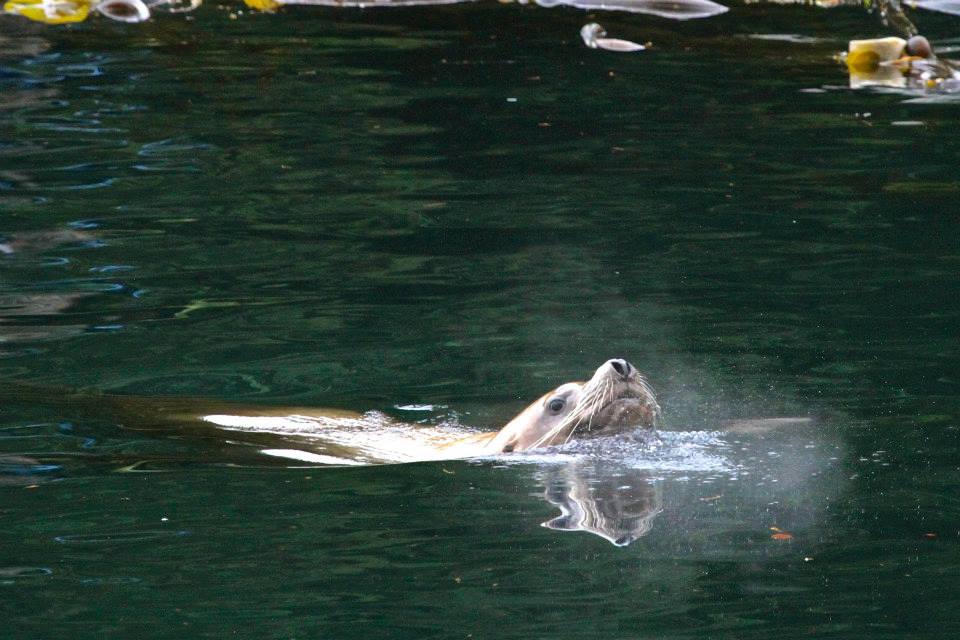
4. No matter how much you hoot and holler at them, Stellar Sea Lions will not give you the time of day.

10659202_10153342628774852_4448842526100652252_n

5. Orcas love to call at dinner time, so you stuff your plates into a plastic milk crate box and lug it all over to the lab and have dinner with headphones on.

1901153_10153342624724852_3285441612895050163_n

6. Bath Days are a gift from God and should be worshipped as such.

10995804_10153726757494852_7811731726412708212_n

7. Mink will live under the house, they’re cute but smell terrible, your cat will want to make friends, the mink will not acquiesce. 11081015_10155300238395858_6083581184589343527_n

8. Porch baths in December are a necessity. Treat them like a Nascar pit crew changes tires. If you’re not out and back inside in under five minutes you are a) doing it wrong and b) probably borderline hypothermic.

9. Bring pets. You’ll need someone to talk to when your wife gets mad at you for ruining her favorite website.

10994155_10153690504119852_621681021897676100_n

10. There is nowhere on earth like this place, nothing can replace it or come close. So enjoy every moment you have here regardless of the time of year.

_MG_9262