All posts by David Cannamore

Gustavus visitor on the ancestral homeland of the Huna Tlingit in the shadow of Glacier Bay. I try to write about my life and experiences, usually through the shaded tint of the wild world around me.

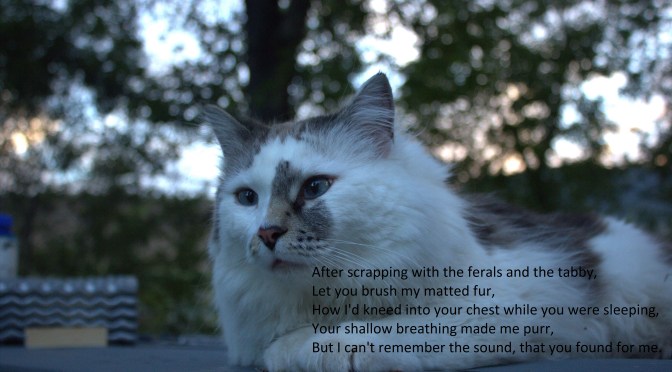
Porter the Cat Explains His Departure

When the Gastineau Humane Society hired me in the fall of 2011, I made a promise. No matter what cute and furry critter came across my path, I wouldn’t adopt it. My life was transient with a new girlfriend, a seasonal job as a deckhand, and a financial and housing picture that at best was out of focus.

Naturally, I adopted a little white bunny with brown spots within two weeks. Mistaking her for a boy, I originally called her Bilbo before a kindly veterinarian informed me that, if gender mattered in my naming choices, I’d fallen in love with a lady bunny. So, I pivoted to “Pennybright” after a female hare from the beloved “Redwall” series of my youth. As my infatuation with the Beatles grew, this eventually turned into Penny Lane for short.

Having failed to keep my simple bargain, Brittney reasoned that it was only fair that she got a pet too. She had eyes on a cat, my only stipulation being her cat wasn’t allowed to eat my bunny.

Throughout the winter Brittney would peruse the cat rooms of the Humane Society. I was closing most nights and took to letting a few choice kitties along with Penny roam the hallways for exercise. Two cats in particular got along well with Penny, but for Brittney, they weren’t the right fit.

***

December of 2011 was frigid with nighttime temperatures dropping into the single digits. I arrived at work one clear and chilly day to find a new cat in quarantine. He had been roaming the streets for weeks and had taken shelter in someone’s garage in search of relief from the cold. He’d been caught in a cat trap and had worn down his claws so badly trying to escape that we thought he’d been declawed.

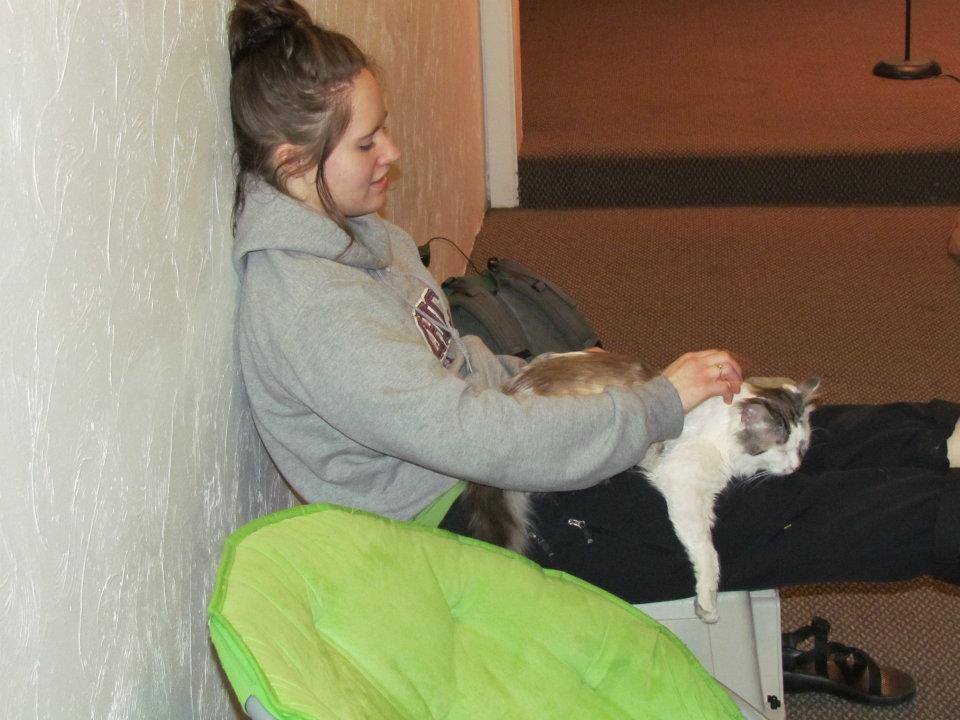
Beautiful blue eyes and striking white fur accented with brown streaks made for an attractive kitty. He seemed like Brittney’s vibe, so that night she stepped into quarantine to meet her kitty soulmate. But he wanted nothing to do with her, which made her try even harder to win his affection. Bit by bit, Porter came around. And on our first night in our first apartment, it was her lap he leaped on, stretching out his long legs and falling asleep.
***

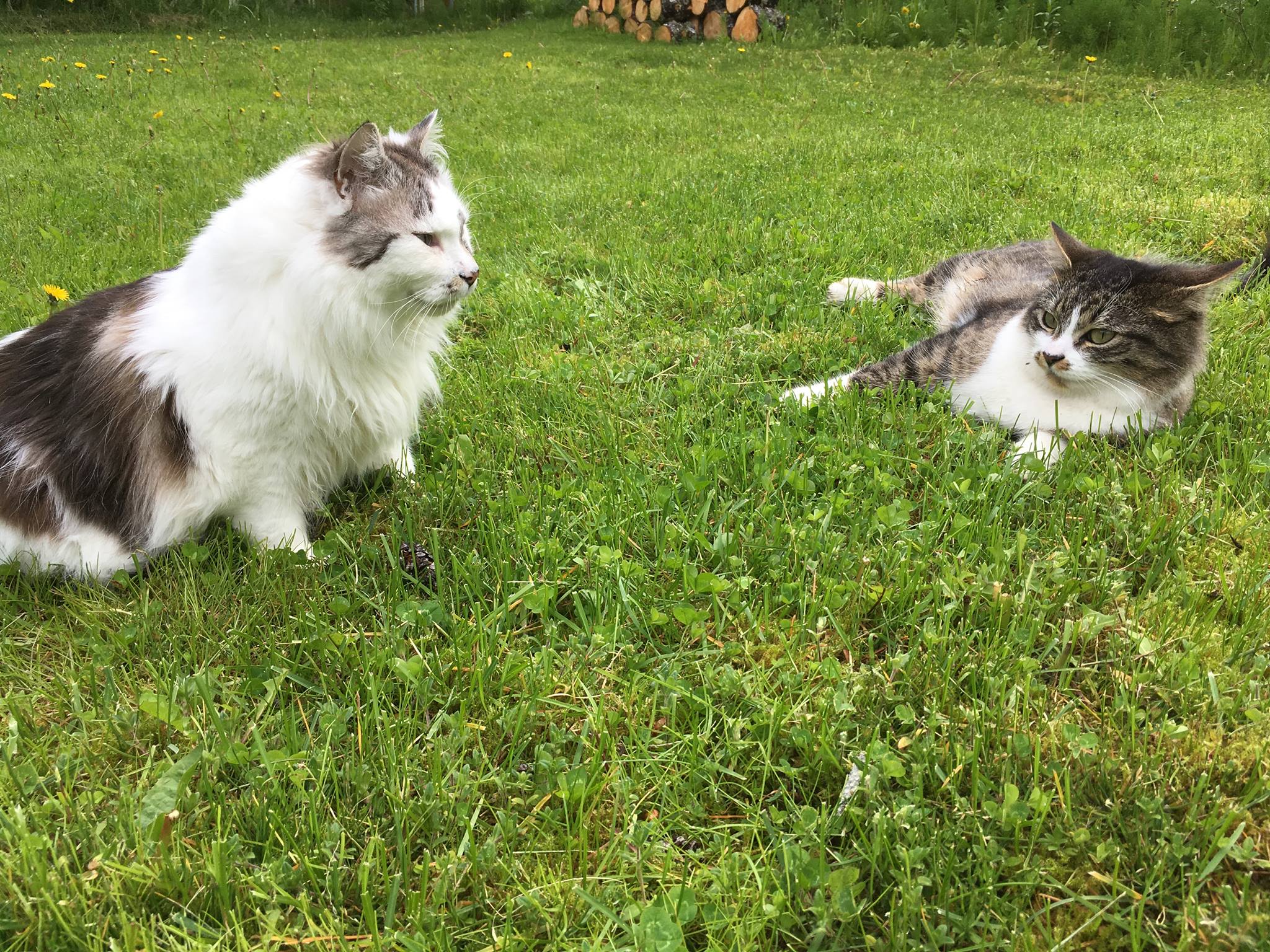
Over the following eleven and a half years, Porter has been a constant in my life. He has crossed the Canadian border no less than ten times. Gone on road trips and slept in tents. Ridden on ferries, skiffs, and sailboats Hiked to sea lion haulouts, battled mink, and dodged moose. His protective nature over Penny was heartwarming, on multiple occasions, he put himself between her and curious dogs.

He was there the day Penny passed away in 2017. And has tried without success to make my cat Minerva his best friend, though she has always had little interest in that arrangement.

On cold nights he’d fall asleep on our pillows or burrow between us like a little furry space heater.

A mason jar cannot be opened without him underfoot and expectant glances waiting for his portion of salmon skin or venison scraps. No unguarded stick of butter or leftover meat is safe. The kitchen counter was his domain whether we liked it or not.

The house was not deemed livable until I’d built a ramp that allowed the now creaky Porter to reach the bedroom and continue his tradition of sleeping on the bed.

Besides Brittney, no soul has defined and influenced my young adulthood as much as that stinking cat.

***

Today I say goodbye to one of my best friends. Porter is still healthy. He’s at least 13 years old, but he just keeps on cranking. He sleeps more than he used to, and his outdoor wanderings are getting shorter. But there’s no drop in his appetite and his fur remains soft and silky. But when I return home in six weeks, Porter will be gone. Like any separation, there’s the question of who the kids will live with.

In this case, the choice is easy. Porter is so clearly her cat first and foremost. Their bond has grown from his icy ambivalence into a love I truly believe he reciprocates. This is a cat that once leaped into 43-degree water to swim to her. That bond can’t be separated.

I’m thankful in a way. My last night with him was one where he was happy and healthy instead of sick, in pain, and scared. I got to leave him at his best. Purring and begging for food.
***

On our final evening together I pull two salmon tail fillets from the oven and Porter takes his usual position by his food bowl. He nuzzles the corner of the cabinet. In less than a year he has created a brown smudge on the plywood from his obsessive rubbing. He has left a legacy that will remain in the house for the rest of my life.

He expects a chunk of salmon skin, and indeed I tear a fillet of skin in half, handing half to him and half to Minerva. But as they begin to mow down, I go a step further. I flip a fillet onto a small plate and set it on the floor next to him. His eyes turn the size of saucers. Without stopping to purr, much less swallow, the feeding frenzy begins. It’s not a large fillet, but it’s still the equivalent of me eating a steak roughly the size of my head.

Porter downs it in less than five minutes. I’ve wondered if he would ever consider himself “full” or if he would just keep eating until he exploded. If I’d spent a chilly winter scrounging for voles in someone’s garage, maybe I’d never pass up food again.

This morning we took a final walk around the property. Porter’s steady plod isn’t as quick as it once was. But he will loyally follow until I turn around. Minerva prefers to wait until we’re ahead and then come tearing after us, rolling in the dirt and clambering up trees. But I love Porter’s steady gait. One step in front of the other, always just a few feet behind.
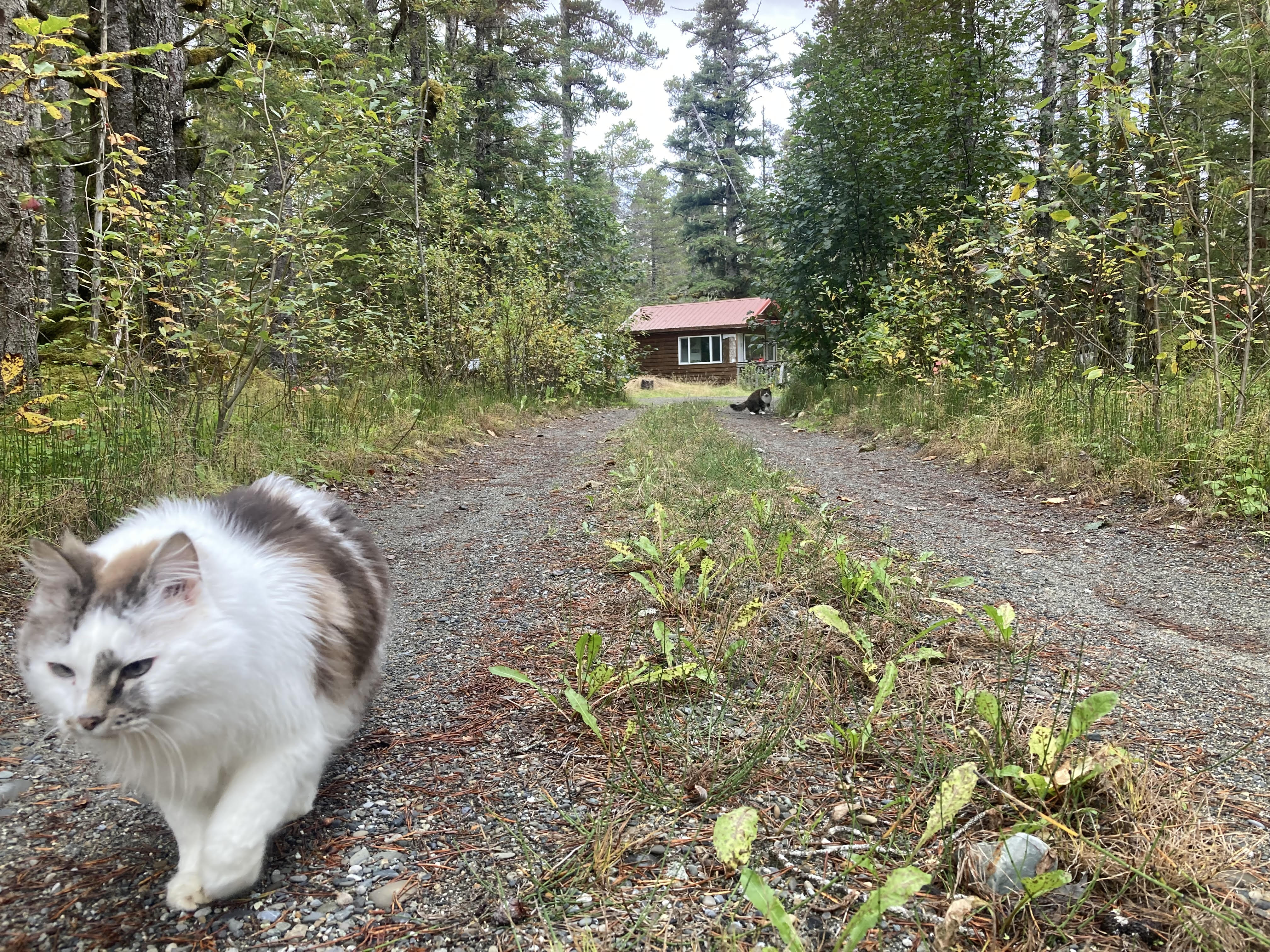
I kneel and he trots over, nudging my knee and purring, arching his back, and raising his face for chin scratches. I envy his ignorance. It’s just another walk. The backpacks in the mudroom are a mild inconvenience. I’ll come back. I always do. I scoop him up and bury my face in his fur. He always smells good. His purrs vibrate against my face.

“Being your dad has been one of my greatest pleasures.”

He begins to wiggle and squirm.

“I am always going to love you. You will always have my heart.”

Squirming intensifies.

“I hate that I have to say goodbye.”

Claws dig into my arm.

“And I hope you never forget me. Because I’ll never forget you.”

“Yowl!”

***

Back home I grab the treat bag. 11:40. I need to go. Porter looks up at me, purring away and waiting for the treats to rain down on him.

“One more time,” I whisper.

I scatter a handful around the room, and he proceeds to hunt them down one at a time. I open the door, grab my packs, and walk down the trail. In my pocket is a Ziploc with a few tufts of hair. I couldn’t resist giving him a haircut to ensure that – along with that smudged cabinet corner – there will always be a little piece of Porter in the house and in my heart.

Board & Batten

I don’t like ladders. I don’t like the way they bend, I despise the way they rarely lay flush against the wall. Until they do, and then they inevitably lean at odd angles that defy gravity in a manner no self-respecting carpenter would trust. So, as I climb the rungs of my extension ladder and move high enough that there’s a single rung under foot, I feel every wobble. A gust of wind buffets my house, and I reach out to steady myself.

But at last, there’s something to hold besides Tyvek. There’s this tall, sturdy, 1×10 next to me, securely nailed to an equally sturdy wall of 2x6s sheathed in half-inch plywood.

Even when I moved in, it felt incomplete. To be fair, it was. But it was more complete than many homes in Gustavus when their owners move in. I received raise eyebrows and impressed compliments that I held off moving until the downstairs trim was completed.

But a voice kept needling. The same voice that sows self-doubt whispered that the outside was covered in DuPont logos. We are our own worst critics.

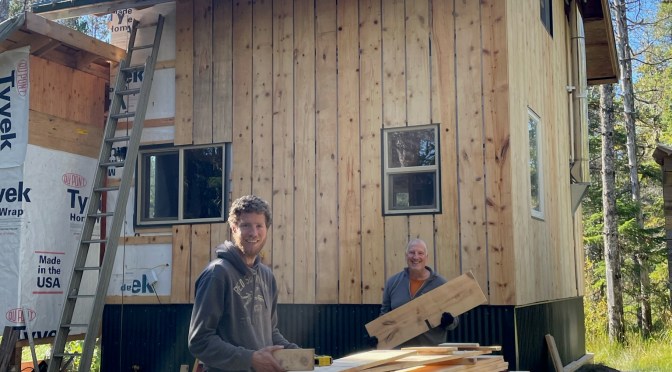
I warned Dad that if he visited, I’d put him to work. Board & Batten is one of the easier siding flavors to install. But it still involves muscling 14-foot boards vertically, with one person clinging to an end, whispering their favorite curses, and trying to stay level.

Clinging to an end, whispering curses, and trying to stay level describes much of the last few months.

In a role reversal that is both tender and bittersweet, it is now Dad holding the ladder while I reach out with a hammer to swing at a nail perched 20-feet above the ground. But that was the deal I made with Mom. No extension ladders for Dad.

For four days we’ve worked in tandem. The rhythm easy and the tape measure yo-yoing up and down while measurements with quarters, eighths, and, when we want to get fancy, sixteenths are bandied back and forth. Notches around windows made the green metal trim pop, and the tone of pride when those complex cuts fit around rafters and flashing are palpable.

All the while, Mom is stationed at the sawhorses with a brush and a vat of Thompson’s Water Seal. She seals as fast as we install, and the pile of boards I’d picked up from Ernie King’s sawmill are shrinking at a rate I can’t believe.

I chose Board & Batten one for its simplicity, but two because I figured I could manage to install much of it on my own. The shift was not just practical, but prideful as well. I wanted to do this alone. To prove to myself that I could indeed carry on and finish a project I never imagined I’d tackle.

But no one goes through life alone. No one should, no one can. And sometimes all we have to do is advocate for what we need. In that moment I needed a sealer and a board holder. And here were Mom and Dad. Working for coho dinners and cold beer. Cold beer that many times they insisted on buying. And as I perch on top of that rickety ladder and nail a board snugly below the peak, I know there wasn’t a chance in hell I could have done this solo and kept my neck intact.

With every break, we take a step back and revel in our progress. The battens look sharp, the knots of the spruce popping against the metal skirting. It’s addicting. Every board makes the cabin look more like a home and less like a construction site.

Over the course of a week, through rain, sun, and periodic breaks to harvest potatoes or admire the Sandhill Cranes overhead, the Tyvek vanishes.

I want whoever enters this house to feel the warmth and love that went into this home. I want it to start the moment they set eyes on it. For it to feel like I always dreamed; a simple little box perched on the edge of a willow field that’s mowed by moose and shelter to snipes.

As an atmospheric river prepares to dump multiple inches of rain on an already soggy land, Dad and I rush to attach the first of the battens. I want them to see what the finished project will look like. Now that I can carry on by myself, mustering those tiny 1×4 battens into position. The first one slides between two trim boards, and I tap nails into place.

I can hear Dad below. “It looks so good, kid.”

I know he’s proud when he calls me kid. I scurry down the ladder and look at the first truly finished corner of my home. It does look good. No vinyl or hurried job. I’m glad I waited. I’m glad I asked for help. There’s no way it would look this straight or this sharp if I’d stubbornly tried to do it myself.

I hand my parents a carpenter pencil, I have one more task for them.

“Everyone who works on the cabin needs to leave a message, note, story, quote, or song lyric somewhere on the plywood or Tyvek. So that when everything is done, there’s a little piece of everyone who helped make this a reality.”

No one builds a house by themselves. No one goes through life alone. Wrapping the gifts, love, and time of those that help build, is what makes a house a home. And what in turn makes me whole.

The Full Lentfer

One cat is curled on my hip. The other has decided my head is his preferred mattress. But when the alarm goes off, they both shoot off the bed like they were blasted by a cannon. It’s dark. I don’t want to. I let my eyes slam shut again and savor the warmth, the feeling made all the cozier by the patter of rain on the metal roof.

Feet out of the bed, wool socks. Crummy Carhartts, ragged Smartwool. Bartlett River Day. Salmon day. By mid-September millions of bright, silver, coiled balls of muscle are pulsing up countless southeast Alaska rivers. The region runs on them. The lifeblood of man, animal, forest, and the ecosystems they inhabit.

How many salmon does one person need to sustain them for a year? It’s a new question, but I know the answer is more than the twelve currently sitting in mason jars or the freezer. It was Zach and Laura’s idea to start before the sun had risen. Before even civil twilight we planned to hit the trail, letting our headlamps and the muscle memory of dozens of previous walks guide us to the river we know so well.

The Bartlett River mouth

We’ve come a long way from our first foray up this river together in 2017. There had been four of us that day too. Me, Zach, Laura, our buddy Patrick. Now Patrick lives in Anchorage. And the three of us feel like the last ones standing in a manner of speaking. Zach and Laura weren’t even engaged on that first hike up the river, their non-profit programs more theories than the vehicles for change they’ve become.

Now, they’re married. And four-month-old Salix has been left with Grandma for the morning in the hopes that we can recreate our Bartlett River Miracle. The fourth spot is Tal, young and wide-eyed. 26, a filmmaker making his second trip to Gustavus this summer to shoot footage for Zach and Laura’s Tideline Institute.

I pull in front of the house where he’s staying to find him waiting by the porch, backpack and fishing pole in hand. For 5:00 in the morning, he’s a ball of energy. A ray of innocent sunlight set on fire by this wild little hamlet clinging to the edge of glaciers and the outer coast.

“Where’s your sweetie?” He casts around the Honda Pilot as if expecting her to leap out of the backseat and yell surprise.

I put the car and gear and bump along the dirt road. “She’s not my sweetie anymore.”

***

This trail gets longer every year. 30 minutes to the mouth of the river. 50 minutes to the first good fishing hole. An exercise in patience. I came up yesterday and grinded my way to two fish. They’re in there. I watched them jump and rocket from one hole to the next. But no matter what I tossed in the water, nothing grabbed their attention. I’m more anxious than usual to get back up there, bring home the legal six, and feel their weight fill my pack.

Few things light Laura up like the prospect of coho. And the two of us practically sprint up the trail. When Salix was born, she and Zach had vowed that it wasn’t going to stop them from living, exploring and doing the things they loved. They hadn’t. With Salix in tow we’d explored the Mud Bay river valley, camped overnight on the Porpoise Islands, and delved into the Point Carolus watershed. But it’s hard to land a ten-pound coho and hold a baby at the same time.

The muddy trail along the river is strewn with the remnants of spawned-out pink salmon. Their sad little bodies turning mushy and rotten as they disappear into the soil. More than three-quarters of the nitrogen the Tongass Forest requires comes from the ocean. It comes from salmon struggling back up their streams only to spawn or be caught. Their bodies are dragged through the woods or consumed and deposited later deep in the trees. In this case, it’s important that a bear does indeed shit in the woods.

For a couple of weeks in July, I wondered if I could continue to live here. I feared the memories would be too sharp with every trail, beach, and bend in the shoreline containing memories of a love and life gone. But no. These streams and shores have been woven as deep into my heart and life as any love. I could no sooner walk away from the bounty of salmon, berries, deer, and garden veggies than remove my left hand. Hunt, catch, gather, and grow. A pressure canner rattling into the late night after a long day on the river.

We reach the first fishing hole at 6:15. The four of us, some bear scat, and a scattering of canine tracks. I free the hook from the pole and let it sing across the water. A sense of place. The intimate and hard-earned knowledge of this river.

Six years ago, I couldn’t tell you where to go on the Bartlett to find salmon. What was too high up. What was too close to salt water. Now? When I meditate, when I need a happy place, I float above this river, tracing its bends and shorelines like the lines in my hand. If the coho aren’t here, there many other places to check.

The line dances. The pole bends, pops, and bends again. There’s the flash of silver. Addicting. The head violently shakes back and forth and the coho bursts from the water, my pink lure hooked tightly in its mouth.

“First cast!” I yelp. Zach and Tal are still walking up the trail. The look on Tal’s face speaks of wonder and amazement. That places like this can still exist. That a bounty of food and magic are just an early alarm and hour hike away. I bring the fish to shore and guide it on the bank. I unsheathe my knife and look into its face. They are such beautiful animals. Brilliant sterling silver on the bottom and sides, an alluring emerald green on top.

I slide the knife beneath the gill plate and say in just above a whisper, “Thank you fish. For your gift. For sustaining me, my friends, and family through the winter. Please go peacefully into the next life.” There’s a spurt of blood and the fish quivers.

I don’t whisper my benediction because I’m afraid someone will hear me. But because what has happened is just between us. Only death can pay for life. I can choose to say that this fish “chose” this, that he offered himself to me. But he didn’t. He saw something pink and flashy, and instinct told him to bite it. His own DNA betrayed him. Now he’s food. Gratitude and joy mix with guilt.

It’s a bonanza. How many coho are in this little hole? Hundreds? Thousands? Lines whir, drags are adjusted, and fish go sprinting up and down the river with pink lures trailing from open mouths. We’re in them. The sort of day we dream about all winter. It’s Christmas morning and we can’t unwrap our presents fast enough.

I catch number six at 7:15. Six fish in an hour. We have a name for that, “The Lentfer,” in honor of our neighbor Hank Lentfer who routinely outfishes, hunts, and gardens us. With the other three still fishing, I start gutting and processing the catch. By the time it’s done, we have all hit our limit. 24 coho line the bank. How humbling. A reminder of the power we can yield, the food… and the destruction we can wreak in such little time.

We permit ourselves a couple of photos for posterity, for these days don’t come along very often. I keep glancing at Tal’s face. God, he’s really nine years younger than me. When did 35 feel old? When did 35 happen? I swear I’m still 23. I feel my position in life shift. I can no longer have that look of wide-eyed innocence and glee at the sight of 24 fish in 90 minutes.

But I can have a profound sense of joy and comfort, a grounding sense of place and home. There are precious few places left that afford this privilege. I have found one. It has wrapped me in its foggy and moisture-laden arms and held me tight. Told me to never let go. To trust it and I will never go hungry. Will never be cold. Will never be alone.

We load our packs and begin the slow walk home, talking of filleting and smoker loads and Lord of the Rings on in the background. It isn’t 2017. I will never again experience the Bartlett River Miracle for the first time. But I can share it. I can revel in it. And through Tal’s eyes, I can celebrate the sensation again.

Painkillers

I’m in a strait but I’m not paddling straight. Icy Strait. Looking for an island called Chichagof. Bound for Baranof. Or Kupernauf. Wanderoff. Timetofuckoff. Whatever. It doesn’t matter. I need to paddle. Wherever I’m going, it can’t be here.

It’s been 90 minutes since I left the Gustavus forelands buried in a layer of fog. I should have thought about it. Had some trepidation, fear, foreboding, one of those animal instincts that tells you this is risky.

I skipped that part.

I forgot or ignored the whisper that these seven miles of water, tide, sea lions and glacial moraine had served as a barrier to my paddling ambitions. But when your greatest fear comes true, what’s left to fear?

The closest body of land on Chichagof is Point Adolphus. But a rising easterly and an ebbing tide have other ideas. My kayak doesn’t have a rudder. While it glides across the water, maintaining a straight line for several miles can be difficult. I’m riding further east than I intend to keep the sloppy chop from nailing me broadside. It looks like I’ll miss Adolphus by more than a mile. But at least I’m getting pushed the right way. Shaving precious minutes off my 160-mile paddle to Sitka.

Icy Strait. Peril Strait. Chatham Strait. They’ve been strangers for years. Faces looking at me from the charts buried in a cabin filled with a lifetime of future memories.

I’m going to see them all.

Chichagof guards the southern end of Icy Strait and has been playing peek-a-boo with the fog for thirty minutes. The tide insists on pushing me towards Pinta Cove. I grip the paddle tight, feel the boat wobble beneath me, and push Icy Strait behind me.

What am I expecting to find? Do I plan on finding the secret to life, happiness, and recovery buried under a rock along these 160 miles of rainforest coastline? I want to feel alive. Be in control by giving up control. I don’t want to hurt. I want to paddle. Hard.

Two miles from shore, the sound of a boat engine bursts out of the fog. Ripping around the point comes a cookie-cutter catamaran laden with whale watchers. The captain dead set on taking the straightest line back to Hoonah. I am in that path.

At a quarter mile, I change course, but the flooding tide has me in its grips. Kelp, seafoam, and beach detritus swirl around me. The visibility drops. Can he see me? My legs quiver, panic rising in my throat.

200 yards. Paddle. Hard. Paddle, Dave, paddle. He’s bearing down. 100 yards. Is this how it ends? T-boned by a whale watch boat? The irony wouldn’t be lost on me.

I point my paddle skyward and shake it, feel the boat succumb to the tide, and turn broadside to the chop. The paddle helicopters above my head, anything to make my profile a little bigger. 50 yards. God, it’s huge. Do I turn towards the wake or dive out of the way? Out of ideas. Out of time. The panic explodes.

“Hey!”

He veers at the last second and I catch a glimpse of a silhouette in the wheelhouse. Without altering speed, the catamaran zooms by 20 yards to stern.

***

The kayak bumps against the shore and slides against a wall of kelp. I gingerly pry a boot free and extract myself from the cockpit. I groan when I step out of these things now. The first small vestiges of middle age are starting to creep up. The legs stay sore longer, the back hurts quicker, and the hangovers hit harder.

I turn and look back across the water. The weather has lifted, the mist is gone. And the Gustavus forelands are but a tiny bit of punctuation along the far shore. I look towards Adolphus and bark with laughter.

A rainbow runs from the point to the mouth of Glacier Bay. How poetic. Very Hollywood. It was meant to be. I am supposed to be here. Everything happens for a reason.

No. There’s no grand plan. No promised storybook ending. No magical hand promising everything will be okay. For two months I have practiced radical acceptance. Control what I can control. Let go of what I cannot. It’s terrifying to discover what I have no control over. My future, my love, my marriage.

At a youthful 34, I am finally being taught how to cope with anxiety and fear. It couldn’t be anger, with hackles raised like a cornered cat. It was with deep, slow breaths, love, and letting go of those things that I have no power over. I fail plenty.

***

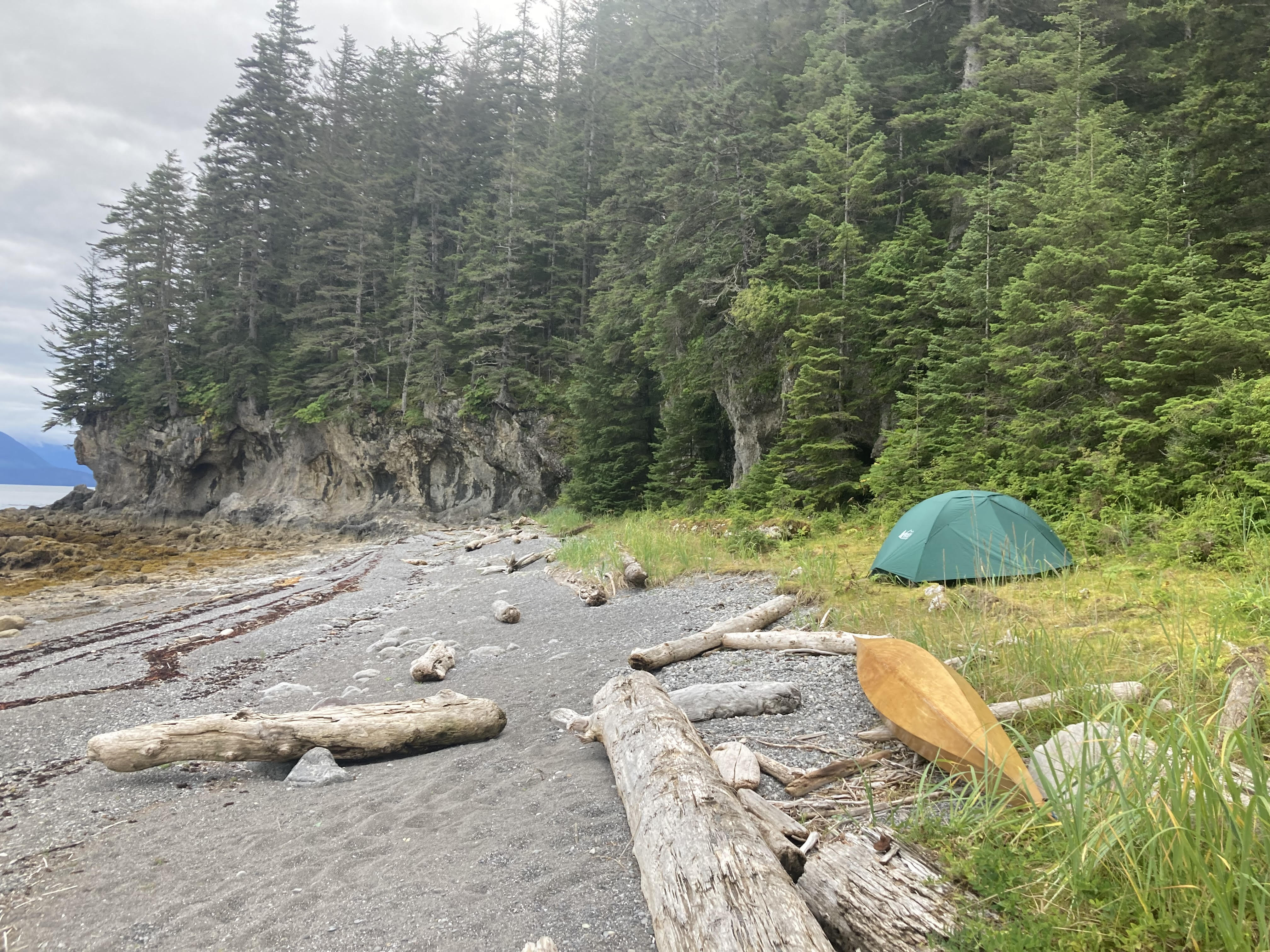
Halfway down Chatham Strait is Iyoukeen Cove. A long tendril of land extends from Chichagof Island and a mile into the Strait to form the cove’s southern perimeter. At the tip is a small pocket beach with enough moss and rye grass between tide line and tree line for a tired kayak and tent.

As the sun dips to the west, I gather driftwood, grass, and spruce pitch, arranging the tinder into an orderly stack. The pitch catches at the flick of a lighter and a small blaze grows. The narrow peninsula is dotted with small caves dug into the sandstone. Not for the first time, I sense the presence of others, distant but palpable through the centuries. I am not the first paddler to seek shelter in the wind shadow of Iyoukeen. Not the first to build a fire as much for company as warmth. Not the first who looked to quiet places and open spaces for comfort and meaning.

I am scared, lost, abandoned. The seven stages of grief are a crock of shit. I feel sadness, depression, anger, bargaining, and whatever the other ones are on a rotating basis like some sort of perverted roulette wheel.

No one goes into a marriage expecting it to end. But I really didn’t expect mine to. Now… for the first time in my blessed, perfect life, I deal with tragedy, trauma, and loss. What sort of man do I want to be? Can I look back on this with pride at my response? It won’t be binary. As many shades of gray as an October atmospheric river.

The same lyrics have been playing in my head for weeks. A sort of talisman to remind of what was and what may be yet to come.

Living just comes with a bit of heartache,

Heartache comes with a bit of young faith,

Faith stays young till your hearts gets broken,

Hope grows up to become someday.

I wrap my arms around my knees and squeeze. Who was I going to be? Who was David? It was a question I hadn’t asked myself in a long time. I think about the house. Five years of sweat equity that I had entered into gladly, with love and joy. I’d started building for us. I vow to finish for me.

Because I’m proud of what those swampy 4.2 acres of Gustavus glacial outwash are turning into. The garden beds that have grown into fertile soil thanks to compost and hundreds of pounds of kelp. Dozens of mason jars packed with greens, coho, venison, and pickled goodies. Deer antlers on the hearth and a bottle of whiskey on the shelf.

We don’t always get to choose when a chapter ends. Sometimes we don’t get to be the author of our story. Just because a chapter concludes, doesn’t mean the tale is over.

The sound makes me instinctively turn. Will there ever be a day when a whale’s breath doesn’t cause my head to spin like a dog whistle? There’s a squadron of them. Big billowing plumes of breath shoot 20 feet over the water. The humpbacks move casually around the point and into the cove. One by one they dive. One fluke after another rising out of the water and high into the air.

I abandon the fire and move down the beach, following the ebbing tide. I climb onto a rock and wait. Two minutes. Three minutes. Four minutes.

They hit the surface as a single organism. Twenty mouths agape, fifteen-foot flippers hanging limply in the air. I hesitate for a moment. My shoulders ache, there’s this knot in my lower back, I just got the feeling back in my legs. But that spark in my chest has found some dry driftwood of its own. Some systems are coming back online.

I sprint up the beach, toss my life jacket into the cockpit, and shoulder the kayak. The hull plops into the water. After days of paddling with hatches full, the empty boat moves like a mustang.

The humpbacks set another bubble net and I’m in hot pursuit, paddling joyfully along the shoreline, following those plumes like the north star. I have spent half my life following these critters. Up and down this coast. I have woken in the night to their breaths, calls, and breaches. I live how I live because of them. I call this place home because I was searching for big water, bigger trees, and the biggest whales. This part of me existed long before the chapter began. It will exist long into this one.

I bob in a kelp bed and watch the group set another net, hearing their breaths and the cries of gulls echoing off the trees and caves. I have control over more than I think. My future, my love, my home are under my power. They lay before me with a following tide and gentle breeze. All I need to do is keep paddling.   

Tangible Progress

Light is fading. Beneath the tarp the tape measure’s black dashes are starting to blur together. Brittney huddles over the top of the tape, her nose almost touching it. Every few seconds I hear the carpenter’s pencil scratch against a two by four. I bend another 20-foot piece of rebar and drop it into the forms. For the last two years the cabin has been a figment of our imagination. It exists on graph paper, our minds, our hearts. But soon it’s will be physical. A sign of what Melanie Heacox calls, “tangible progress.”

For the last hour snow has been falling. Under normal circumstances the first snowfall would be cause for celebration. An excuse to drink coffee and watch the world go white and quiet. Tonight I’m cursing it. Concrete needs to stay above freezing after it’s poured. Special blankets can be placed on top of the pour, holding the heat produced by the chemical reactions of the setting cement. All we need is four hours above freezing to mix, pour, and scree. Snow seems problematic. But maybe snow on concrete day is a sign of good luck, rain on a wedding day.

The light drains like water from a bowl. Brittney sets the tape measure on the table and we stand there for a moment. The forms are a foot wide and six inches high, a square trench 17-feet in length. Tomorrow they’ll be filled with 1.2 cubic yards of Portland cement, sand, and rock, we think. We hope. With a chill I remember Elm’s words a month ago when the house site was cleared and leveled.

“You screw up the concrete you may as well put the house somewhere else.”

Gulp.

We drive back to the little second story apartment we’re renting for the winter. We’ve brought the bags of concrete with us so we can put them in front of of the wood stove for the night and keep them as warm as possible. After a day of setting rebar, measuring, and general scrambling we’re both drained. The final act of lugging the 94-pound bags of concrete is a fitting conclusion. I’m struck by the irony of carrying our house in our arms, keeping it warm for one more night. It seems like a small penance to pay for what could be decades of faithful weight distribution and sturdiness beneath our feet.  I lie awake far too long. My head filled with 4:1 ratios, stem walls, square, level, right angles. Build a box.

Morning comes. The snow stuck but the day is dawning clear and crisp. A little too crisp. We lug the concrete back down the stairs to the car and wrap it in a tarp like Christmas presents. How bold it had felt to travel up and down the Pacific Northwest, all we owned in the back of our car. There had been times we didn’t know where we’d be in six months, where the next steady job was. I remember that freedom being more exciting than daunting, child’s play compared to this. As we close the car doors and back out the driveway I’m aware my mouth is dry, my stomach churns. There was no going back, no running now. We’ve never built a birdhouse. Now we’re building a cabin? What have we gotten ourselves into? Muir’s words float through my head, “we must risk our lives in order to save them…”

Gustavians are notoriously late. Like wizards they arrive precisely when they intend to. But when you tell them concrete pouring is at noon, they show up at 11:50 and bring wheelbarrows, shovels, soup, and beer. As I watch Craig, Emily, Zach, Laura, Elm, and Patrick walk up the clay infested trail towards the house site, the fear that has had a hold the last 24-hours disappears. We’re not alone. We’re never alone. Elm and Craig have poured concrete many times before. Elm fires up the small gas powered mixer and begins shoveling in sand, rock, and cement. He goes by feel, an artist who knows when it’s right.

When the recipe is just so we hurry wheelbarrows beneath the churning machine and half push half carry them to the forms. A curious dance begins, the clock begins to tick. One advantage to pouring in 39 degree weather is the concrete sets slower. More time to shore up a corner, fill an edge, scree it all flat. For the next hour and a half I don’t breath. I don’t think I blink. Wheelbarrow after wheelbarrow falls into the forms. My knees are soaked, gloves dripping with concrete. It’s going well though I’m insanely glad I bought one last bag of concrete that morning. Zach, Laura, and Craig have to leave at 1:30 to catch a boat. They stay until the final minute. So does Emily who’s late to her daughter’s parent-teacher conference and arrives with concrete on her forehead. As Patrick helps us dump the last wheelbarrow and Elm shuts off the mixer the gorgeous silence of this place returns.

We stop and breath. Elm cracks a beer, his voice carrying through the woods, he sounds as excited as we are. It’s level, it’s square, just let it sit for a few minutes he advises. Brittney can’t stop. She grabs a 2×4 and lovingly runs it over the top of the forms, leveling the concrete beautifully. Kim and Melanie show up with smoothies and smiles. Kim congratulates us on a successful pour and compliments us on our site selection that overlooks the willow sluice. I remind him that if it wasn’t for him we’d never know this spot existed. So much owed to so many.

Eventually Elm and the rest of our help return home, leaving the two of us to finish the leveling and wrapping it blankets to keep it warm. After this it’ll have to sit for a week. That’s fine with me, I’m ready to breath, turn my attention to wood and nails and table saws. The sun begins to set and we stand in the middle of our crawlspace, grinning at each other. It feels as if we’ve entered some sort of exclusive club. We’d earned our concrete badge. From here on out our mistakes can be corrected with a cat’s paw and hammer.

We pile the leftover food in the car and drive home. I glance at the weather forecast and one last grin crosses my face. There’s nothing but freezing temperatures for the weeks to come. We’d literally grabbed the last window of the year. Nothing like waiting to the final minute. Professional procrastinators.

The Building Tree

The smell of two-stroke fuel fills the air. Hands slick with chain oil, metallic teeth glinting in the sun. Behind me the forest is calm, quiet, unassuming. The trail, marked in pink fluorescent tape, billows slightly in the wind. It’s only twenty yards from where I stand to our house site. A site that we’ve exterminated of stubborn willows and optimistic shrubs. I’d be lying if I said it felt good clipping them.

But it’s child’s play compared to what I’m about to do. I grab the chain saw, set the choke, and give the string a confident pull. I’m out of my league. 12 months ago I couldn’t have told you the difference between a joist and a stud. Now, tucked beneath the pages of The Independent Builder is a stack of graph paper, erase marks and crinkles bleeding into the pages. But somewhere along the way, a structure appeared, represented by lead to be built with wood. It looks so pretty and neat with those perfect squares and right angles. Making it come to life will be another matter.

The saw vibrates in my hands as I walk towards my first obstacle. I take no pleasure in felling these trees. But it’s something I’m familiar with. I know how to notch them, make them fall just so. If our winters in British Columbia and the Inian Islands taught me anything, it was how to make a Stihl roar. The first tree is a pine. It looks withered, old and bent. A few stubborn green needles continue to poke from the limbs. If it isn’t rotting already it will be soon. Whatever life it has left ends now. Because I said so. Because 18 months ago we walked onto this property and decided this was where we would live.

With a guttural growl Stihl comes to life, fine papery shreds of bark and wood fly into the air, the sweet savory smell of the forest. Within seconds it’s over. The pine tips and cracks. I lock the saw and scurry for cover. It falls where it’s supposed to, the concussion quieter than I could have anticipated. In the years to come we’re going to need help. Pouring concrete will be like speaking a foreign language; intimidating and embarrassing. At least our inevitable mistakes with wood can be fixed with a cat’s paw if we catch them fast enough.

But this, the Stihl digs into the next tree and it begins to sway, this I can do on my own. No one needs to coach me anymore. And for the first step, simply clearing a path to the house site, it means a lot. It displays at least a modicum of competence. And for my ego if nothing else, that feels good.

Within an hour the path is clear. The final tree falls atop its comrades, the Stihl is extinguished, the surviving forest quiet. I walk back down the gap I’ve created with the simple grip of a trigger and a bit of fuel. Right in the middle of the trail stands one final Charlie Brown tree. The hemlock is only five feet tall, not even worth the saw. But as I stare at it I can’t shake the sensation that it’s staring back. Our land is wet. Last September when the rain pounded Gustavus our water table was plus 18 inches in some spots. The price one pays for a glacial outwash. A few big spruce have bucked the odds to grow 100 feet high. But this is the only hemlock I’ve found. I would no sooner cut this tree than kick a kitten.

But it can’t stay here. The excavator comes in a matter of days, if I don’t take it now it will be run over by the wheel’s of our personal progress. There’s only one thing to do. It must be relocated. We’ll find a quiet and (relatively) dry spot for our building tree. I’m aware of the irony. Saving this little tree when I just felled ten. A home built with the old growth of Chichagof and Home Shore. In no way does rescuing the hemlock acquit me of my lumber consumption. I’m not sure why it means so much. I walk past the homesite to one of the big spruces. The spruce that we vowed we’d never cut. I run my hands along the bark, “I think you need a friend.” 

Standing Still

The April sunshine should feel good. I should be sprawled in the grass soaking up the rays like a hungry plant that’s been inside too long. But I feel none of it. What a picture I must make, a whiskey bottle hangs loosely in one hand, my gait awkward and uneven on the rocks. A cool ocean breeze floats through the hemlock but inside I’m stifled. I can’t breathe, a weight presses down on my chest that the liquor can’t alleviate. I stumble and collapse against a washed up log, long ago it was left high and dry, left to rot at the whims of the universe. I feel a kindred spirit with the rotting wood and crumbling bark. I savor another sip of the brown stuff, close my eyes, try to breath. How did I get here?

For most of my adult life I have rambled. A modern hobo with a 75 liter pack in place of a branch and tied handkerchief. I reveled in it. Up and down the coast. Again and again. British Columbia, Juneau, Gustavus, the Inian Islands. Surely this was the way to live; free and uninhibited. From one wood cabin to another. Again and again I scoffed at the “every man.” The poor saps in their cubicle jails. Shackles of security holding them down. Worker bees. Drones. The nine-to-fives. A pity.

If only more lived like me. Could find the bravery to cast aside their fears and leap into the unknown.

The ramblings of a young man.

A knot from the log presses into my back. It does little to alleviate the fear that clutches at my chest. For the past two months we’ve operated under the illusion that the Hobbit Hole would be our home for the next three years. Full time caretakers at last.

It would come with stinging consequences. Eleven months a year here meant precious little time with our tribe. We dreaded the conversations we’d have to have with our dearest friends. That we felt called to be here, to help the Inian Islands Institute get off the ground. That a growing desire to be educators had taken root. But there’d be no denying that three Gustavus-free years would change the bonds that we had tightly forged. Was it really a sacrifice we wanted to make?

This would be our last hurrah. The job as caretakers promised to pay well. Enough that we could return in three years and get the house built that existed only in SketchUp. We’d at last admitted that building a house on a guide’s wage wasn’t feasible.

But two hours ago Brittney walked down the stairs, terror and pain in every syllable, “we didn’t get it.”

***

Zach Brown and I sit in the garden. An afternoon sun playing over the water. He’s one of my best friends. I thought he’d be my boss for the next three years. But there was someone better. I’d heard the resume of the couple that got the position over us. They were what we had feared. They deserve to be here. The time has come to confront my failure, acknowledge that Zach and his board made the right decision. That Brittney and I never expected preferential treatment. That we still love him, Laura, this place, their vision. That we’re still in. But it’s hard to keep the bitter taste of disappointment out of my voice as we work through it.

Hank Lentfer, student of cranes and supplier of beer appears from the house and hands us each an IPA. It loosens our tongues, we say what needs to be said. It’s time to move on. It’s time to let go. I turn and look at the house, the deep green paint melding into the forest. The open lawn, the shop with the pool table on the second floor. It isn’t mine. It never was.

In the moments after we learned we hadn’t gotten the job I flew into a rage. I pounded the floor, screamed, and terrified the cats. Selfish words poured from my mouth. Phrases like, “we deserved this,” and “it was supposed to be ours” came fast and easy.

I didn’t deserve this. I didn’t earn this. Zach did. By hiking a thousand miles and paddling a thousand more. By fundraising and dreaming and believing. He may not have physically built the structures of the Hobbit Hole, but he has earned every stud, beam, and piling that they’re composed of.

***

Our final week at the Hobbit Hole. I’m back at the fallen log, my brain clearer and the pain a little easier. It still hurts, still in mourning, but I’m confronting the world with clear eyes and sound mind, perhaps for the first time. 

If only more lived like me. Could find the bravery to cast aside their fears and leap into the unknown.

I long for the days in our rusted Pathfinder. Waiting for the next ferry in the parking lot of a Prince Rupert Tim Hortons. The warmth and comfort of knowing that everything I need is in the car with me; Brittney, the cat, the rabbit, a laptop to write on, what more did I need? How liberating, how comforting, how… safe?

The realization slowly sinks in until I must acknowledge it. I’m not the risk taker I pretend to be. What exactly were the chances I was supposed to be taking? For most of my twenties I could have bailed out at any moment. Our careers and choices could zig-zag across the world if we wanted to. There was nothing stopping us. We could change our stars on a whim.

But we fell in love with 4.2 swampy acres of glacial Gustavus outwash and decided we were ready when I knew I wasn’t. Perhaps life’s greatest risks isn’t running but standing still. What if those worker bees were the brave ones? I was always running, moving. Becoming a full time caretaker would have provided the security I had denounced for so long. Now, with a mortgage and uninsulated cabin, I crave it. I’m more scared now than I’ve been in 10 years of rambling. The irony bites hard on the ego gland, devours it whole.

***

Home. Four corners, the Shabin, Excursion Ridge, nightly beers with Patrick Hanson.  The Fairweather mountains still punch holes in the clouds, defiant white peaks blockading a blue sky. When you miss out on what you thought was a dream job—the coronation of your twenties— and still have Gustavus, it’s time to give thanks.

For years I have coasted on what other’s have built and earned. Paul Spong’s Orca Lab, the Hobbit Hole, places I have occupied and never fully deserved. This spring the universe has grabbed me roughly by the shoulders and looked me square in the eye.

“David, it’s time to stop running. It’s time to build something of your own.”

Dear lord does that scare me. I just learned the difference between a stem wall and a slab-on-grade. Now I’m building something? Deep breaths, they come easier than they did a month ago. What do I need to do first? Foundation, get a good foundation. I open the construction book, a notepad on my lap and read about concrete pilings, my pencil scribbling notes with the fervor of a procrastinating grad student.

***

Down one of Gustavus’s many dirt roads is an art gallery. On some weekend evenings it doubles as a music hall. Tonight it triples as a potluck complete with free beer. The place is packed as one musician after another comes to the stage and belts our their best. This town has to have more musicians per capita than anywhere on earth. But as the evening begins to wind down, one man in particular makes his way to the stage.

Justin Smith has collar length hair, a ball cap pulled over his head, skinny torso, and a long gait that helps him cover the aisle in a few strides. A buzz fills the crowd, when his name is announced the place erupts. I’m crammed onto the floor next to Patrick. We’re both clutching a beer. It’s not our first or second, I don’t think it’s our third. We share a wild look.

“Dude, he’s gonna play.”

Open-mic nights go way back in the annals of Gustavus lore. As much a part of our culture as deer hunting on Pleasant Island and picking strawberries. Eight years ago, at my first music night I watched spellbound as Justin and Kim Heacox belted out Cream’s, ‘White Room.’ Kim pounded the piano keys so hard his fingers bled. Justin made his guitar do things I didn’t believe possible.

But as the years have gone by, Justin hasn’t played as much in public. He’s raising a son that is the apple of the Goode River Neighborhood’s eye and just moved into the house he and his wife Jesse built. Another in a long list of role-models and heroes. He speaks quietly into the microphone, his voice soft and understated. Humble eyes and a sheepish smile pan the crowd.

But those that have heard him play know what is coming. Patrick and I bounce on our knees like it’s Christmas Morning. And for the next fifteen minutes he plays. Three instrumentals of his own creation. Listening to Justin play guitar is like reading the climax of a novel. The crowd leans forward, hanging on every note like turning pages. And for the first time, I’m relieved we didn’t get the job. This is home. In the good times and bad, sickness and health. Whether I’m ready or not, this is where we need to be.

Climb That Mountain

It’s been almost four years since the inception of Raincoastwanderings. I had no delusions of grandeur, of it drawing a large audience or translating into a job at Orion or Outside. It wasn’t going to make me Krakauer or Kerouac. And just as I predicted, it hasn’t. The biggest posts get maybe a couple hundred views, and I assume most of those are from my dear mother loyally visiting on different browsers to inflate the numbers. But that’s ok, for almost four years my mantra has been, “if one person is reading, I’ll keep writing.”

Raincoastwanderings has been a sort of public practice for me. If I knew one person was reading, that was enough for me to sit down and try to construct a narrative that was appealing and entertaining. Flooded with typos early on (and still making frequent appearances), I look back at some of those old posts and grimace. But this blog online journal marks the moment I sat down and vowed that I was going to make a legitimate go at this writing thing. The community that has supported and encouraged me over the years is humbling. So to all of you who have put up with me spamming your Facebook feed and inbox, thank you very much.

With that said, Raincoastwanderings is going on hiatus. Over the past few months it’s been difficult to give the site the attention it needs as I’ve been consumed with editing and submitting my first novel. That process is done for the moment and I’m now in the position of waiting and praying that some editor believes as much as I do in my 80,000 word baby. The good news and bad news is that for the next two months I still don’t foresee having much time for Wanderings.

I’ve been contracted by a travel company to edit and rewrite the Denali section of their upcoming travel book. The chapter is due in late June and it’s the opportunity that I’ve been working towards since I started writing. There is absolutely no way that I would have this chance without this forum and the people that have loyally followed it. So again, thank you for your encouragement, kind words, constructive critiques, and good humor. It has been a blast to keep this going all these years and I fully intend on returning to it once I hit ‘submit’ on the Denali chapter. Until then, I do intend on writing occasionally for the Inian Islands Institute and my work will hopefully be posted in their online journal. If you’re so inclined you can check here for occasional updates on the amazing work they’re doing.

Several Christmases ago, a certain individual (who rest assured is not reading this) climbed atop Mt. Soapbox and let me know that I couldn’t, “ride my skateboard forever.” Five years later I’m getting paid to ride the skateboard I’ve allegedly outgrown. And if the book ever gets published, he’s going to wake up to a box of them on his front porch, sitting on a skateboard.   

In the words of Jack Kerouac, “because in the end, you won’t remember the time you spent working in the office or mowing your lawn. Climb that damn mountain.”

Thank you all. Bless the harbor seals.

Concerning Snowflakes

The snow has been falling all night, silent and unassuming. It kisses its brethren as it completes its free fall. It has no control over where it plummets, it can be a glacier, a snow ball, a soft white ornament upon a tree limb, or it can land in the unforgiving waters of South Inian Pass, fusing with its liquid cousins.

In the last few years, being described as one of these little miracles has somehow become an insult. How dare someone feel unique? Special? Gifted? Perhaps they’d prefer us to be like raindrops, uniform and generic. Falling with a splatter onto grass or metal roof to be destroyed on impact.

By the time morning comes a foot and a half of miracles has fallen. Most times in southeast Alaska the snowfall is heavy with liquid as the forecast plays hopscotch with the freezing point. But it stayed cold last night and the flakes are as fine as sand and light as feathers. It’s been more than a month since it rained and the accumulation is getting out of hand. We’re running out of places to put it. I grab a shovelful and send it flying into the big drifts we’ve made. Last week wind gusts over fifty barreled into the archipelago like a battering ram. Just to the west we could hear the constant surf and wind like the constant roaring of a beast. Inclement weather is soothing, gives one purpose here. Tie down the boats, batten down the yurt and dock, bring everything that can be moved indoors. The snow is no different. It falls with the peace of doves but bites with consequence.

It’s a rough winter to be a deer, the second such winter in a row. We went up the mountain a few days ago to find the woods and clearings devoid of sign. Every deer on the island, perhaps in southeast is hugging the beach, walking the fine line of the tide that wipes the land clear of snow twice a day. They’re nibbling kelp and seaweed, trying to hang on till spring, whenever that’ll be. Winter has little interest in the calendar.

At the core of every snowflake is something real and organic that the crystals can glob onto. Like everything else, they need something to revolve around, some definition. It means that somehow, in some way, there’s a carbon based something floating with the clouds and moisture, waiting for the dew point to decide its fate. Without this organic compound, this purpose, the snowflake is doomed, it cannot form, cannot accumulate, its tremendous power and potential negated. Unlike their raindrop relatives, they must be defined by something real.

I continue to dig us out, wondering what it is that will define me. There’s a snow blower here. I could fire it up and complete the task in minutes. But it doesn’t seem sporting, doesn’t seem right to introduce the sonic domination of man to the scene. To remove the snow with the carbon dioxide byproducts that are making blizzards like this a shadow of the past. As my father would say, it’s the principle of the thing. Sweat clings to my sweater and drips from my wool hat.

The Hobbit Hole is still. Tiny ripples form in the wake of a merganser, a soft chortle of a raven floats among the trees. The clouds start to lift. I live in a world of soft pastel. White accentuates everything. Above the west end of the Hole looms North Island, frosted, frozen, and imposing in winter’s time machine. Spruce, hemlock, yellow cedar in a state of suspension. For years the yellow cedar of southeast Alaska has been fading. They rely on thick blankets of snow to insulate sensitive root systems. As our winters have turned to more rain than snow, they’ve suffered through every cold snap like tomatoes in an early frost. Even the mightiest are vulnerable at their roots. This is the power of snow, the ability to torment the deer but save the cedar. There is no middle ground.

I shovel over the bridge and down the dock. At some point the weather will warm. Probably sooner rather than later. And as beautiful as it is, it will bring some relief. Our hydro system is struggling to bring in even the bare minimum of electricity. Snow has a finite life. In time it will succumb to the elements and melt, evaporate, and be reincarnated. Maybe we’ll be so lucky. If we’re fortunate, we too will not simply die but be reabsorbed, willing participants in the cycles of the planet.

I scoop a handful of crystals and gaze at them. Snow has the unique ability to be beautiful  both by itself and surrounded by its brothers and sisters. Able to stand out alone and in a crowd. May all of us be so lucky. Alone we are stunning, but it is only when we come together that our presence can be felt. I wish we all had the power to determine where we landed. But a lot of us don’t. A lot are condemned to the waters to melt before they have a chance.

The red metal roof of the house is covered in snow, the dark green paint the same color as the water and trees around it. The low clouds and struggling sun hold a power humanity cannot tap into. A self-sustaining resource of the eyes and soul. The scene has the power to refresh and reinvigorate. I breath deep and feel the oxygen of the outer coast spread through my blood cells. What a place to have landed. What a place to reside until I melt.

Two Hikes

Several years ago, when I lived in Juneau, I rented a house near the Mendenhall Glacier. Framing the southern side of the valley was Thunder Mountain. A steep and imposing peak with impressive avalanche shoots and Spruce covered ridges. After a couple months living in its shadow I gave in to temptation and attempted to scramble up one of the avalanche paths. It was mid-summer and the foliage was thick with devil’s club, skunk cabbage, and alder. Halfway up, the moderate grade shoved me onto a near vertical pitch. Consumed with the climb and drunk on sunshine, I continued fifty feet further than I should have. By the time I realized what I had done, I had trapped myself in a stand of alder and was climbing their branches like a step ladder.

My 24-year old ignorance was replaced by genetically infused fear thousands of years old. Just a week ago, a seasonal had scrambled up the ridge near Eagle Glacier to the north of town. One false move, one slip in his Merrill’s and he fell to his death. Like him, I hadn’t told anyone where I was going. I’d broken the cardinal rule of the outdoorsman. My knees shook, my arms trembled. Somewhere to the west, 65 miles away, my fiancee was kayaking, oblivious to the fact that the love of her life was so recklessly risking his.

I began to downclimb. Most mountaineering accidents occur on the descent. I was no different. A foot slipped, a branch cracked, and I began to free fall towards a gully 60-feet below. I’ll never forget the sensation. As I fell my terror was replaced by a serene, almost disarming calm. I no longer felt afraid. I reached out with one hand and grabbed an alder branch as thick as my forearm. The branch bent, bobbed, cracked… and held. From above came a strange rustling followed moments later by a sharp pain on the back of my head. I watched the offending branch and my baseball hat complete the forty-foot plunge into the shoot. The branch gave a sickening crack as it struck the boulders. I hung, as weightless and helpless as an astronaut on his first spacewalk. Helicopters bound for the glacier zipped by. Cars roared by on a road a thousand feet below. And I gripped the branch that was preserving my life.

***

I throw rain pants, a sweater, and a vest into the backpack I’ve had since I was 21. The straps are fraying, several of the buckles are broken. But I can’t bear to give it up. She’s more duct tape than nylon at this point. But I carried my life in her through New Zealand, British Columbia, and southeast Alaska. Some things are more important than efficiency.

I no longer have a fiancee. But I do have a wife. And I make no bones about where I’m going today. I’m going up the peak to the south of the Hobbit Hole. There’s two feet of snow at sea level and who knows how much at the top. I’m dying to find out. Worst comes to worse, they can follow my footprints. It’s deliciously quiet here. We’re used to solitude. But even when we lived off the coast of B.C, boat traffic inundated our ear drums. Walks through the woods were often interrupted by the dull drone of a diesel engine as a tug plied the inside passage. Here we endure the occasional 737 flying at 20,000 feet but that’s it. The thick snow mutes the silence even more. No squirrels, no birds, just my boots stepping through the frozen crust.

I weave through hemlock, spruce, devils’s club. My breath comes in gasps, I sweat beneath the wool that keeps me warm when I stop. Deer tracks surround me, all pointed downhill. Perhaps they know something I don’t. Three days ago we woke up to blowing snow and flakes as big as thumbnails. It snowed for 16 hours straight, pushing the deer down from the ridges to the beaches. I reach a steppe and come out into the open. It’s like stepping into the deep end of the pool. My boot plunges deep into the snow and doesn’t stop until the crust is at my hip. I struggle out and throw the next step forward in an awkward plunge. I head for a steep ridge. It’s nearly vertical and this all begins to feel familiar.

***

I watch my shoes swing beneath me with a benign neglect. I’m hypnotized by my hat three dozen feet below, nestled between a couple of boulders and covered with dust. Blood drips from my left hand which grips the branch so tight my knuckles turn white. My body completes it’s flight of fight checklist, determines that I’m no longer in immediate danger of death, and give me permission to freak out. The change is instantaneous. I hyperventilate. My legs begin to shake. I have to move. My stupidity knocks at the back door of my sub-conscious, reminding me that I’m an idiot and lucky to not be laying in that gully with a shattered leg or two. I pull myself up and my feet search for a foothold. To my right is a thin ridge, just wide enough for a couple of spruce trees to get ahold.

I move hand over fist, my feet skittering madly to keep up. At last I feel dirt and root beneath them, I kneel and grip the ground. I want to curl up and never move. I’m never letting go. In my mind I imagine my body hitting the rocks. How far would I bounce? How damaged would I be when I finally came to rest. And with a shudder remember that no one would ever find me.

***

I stagger towards the ridge and stop at its feet. The snow four feet deep in places, more swimming than hiking. I look at the reassuring trail I leave behind. There’d be no mystery this time. I begin to climb, my feet digging for purchase beneath the snow while hands pull me up with the aid of salmon berry bushes and willow. There’s a melody to hiking through the snow mixed with the improvisation of jazz when a boot falls deeper than expected. I turn around halfway up to catch my breath and feel it catch in my throat. The view is bonkers. West facing, the ocean, the whole Pacific is sprawled at my feet. Three Hill Island and Soapstone Point guard the southern edge of Cross Sound. Cape Spencer to the north, just enough of a break in the clouds to see Mt. Crillion.

Already the landmarks feel like old friends. “Hello dear Port Althorp, hey Elfin Cove, how’s it going Middle Pass?”

I turn and continue to climb, by the time I reach the top I’m crawling. A thin ledge, two spruce tress wide greets me at the top.

***

I cling to each spruce and try to get my knees to stop quivering. I’m bleeding from four different spots, the pain beginning to whisper from beneath the adrenaline. There’s a welt on the back of my head where the branch made contact, my neck hurts. I’m a fool and Thunder Mountain was punishing me for my foolishness. The wild places teach harsh lessons, lessons you never forget if you survive. I prayed I’d have the chance to learn from my mistakes. As I climb down, the ridge I’m following widens until all I can see is trees on each side. The climb remains steep and down climbing is harder than going up. Gravity a much more willing participant.

To my left I hear something crashing through the bush. Bears litter the valley. Black bears primarily, though the odd brown bear will poke its nose in to chase the spawning salmon of Mendenhall River. But it’s a mountain goat that appears through a tangle of devil’s club. Branches of the bush stick to the thick tangled hair that’s somewhere between yellow and white. A pair of identical horns jut from the top of its head and curve forwards. The beast is maybe thirty feet away. It stops and turns its head slowly in my direction like a villain in a cheesy Hollywood production. Without a moment’s hesitation it begins to trot towards me. I stand at the edge of a drop of twenty feet, and the last thing I want to do is free fall yet again. But the goat seems to have every intention of running me off the ledge. More harsh lessons at the hand of Professor Thunder.

It’s at that moment, after twenty years in the woods and fjords of Alaska, that I realize that I don’t know anything about mountain goats. My body is drained, out of adrenaline, I do the only thing that feels logical and insane at the same time, I scream.

***

I follow the ridge up a little further. I’m having flashbacks of devilish goats, snapping branches, and serene free falls. The ridge takes a sharp turn to the right and into a thick tangle of spruce. This is far enough. A scattering of trees gives way to a wide open precipice that cuts between the summit I stand on and the next one to the north. I have no intention of looking over the ledge. I lean against the sturdy trunk of a tree, feel snow and dirt beneath my feet, and pull a water bottle from my backpack. Something small and blunt is still in the pocket, I dig deeper and pull out a small shooter of gin.

A smile becomes a grin. Miracle booze, the best kind. It’s barely eleven in the morning. But there are no man made rules in the forest. I crack the cap and empty the little bottle, savoring the burning liquid cooled by the ascent. It only makes sense to taste pine trees when surrounded by them. I give a silent thanks to Jen and Patrick who had filled my Christmas stocking with the little shooters and my own irresponsibility to stash one in my pack and forget all about it. I shoulder the pack and take one more longing look at the world around me. From here it was possible to see the world at its best. No mass shootings in Florida, no indictments in Washington, no missile tests in Korea. Just me, the trees, and that big ocean taking on all comers.

***

I want to go home. I want a hot shower, fluorescent lights, a big sandwich, a cold beer. The goat continues his advance, his hooves stick to the rock like velcro. I scream a tapestry of vulgarities that continue to hang over the mountain to this day. Five feet away his wild goat eyes weave to the right. He climbs onto the hillside a few feet above me. Those iris’s staring deep into me, mocking me, shaming me.

I step away, my eyes never leaving him, toes probing for the edge. I grab a root and scramble like a fireman down the rocks. I leap the last four feet and fall with a thud. Enough. I lean forward and half run, half fall down the mountainside, bloodied, beaten, and alive to climb another day.