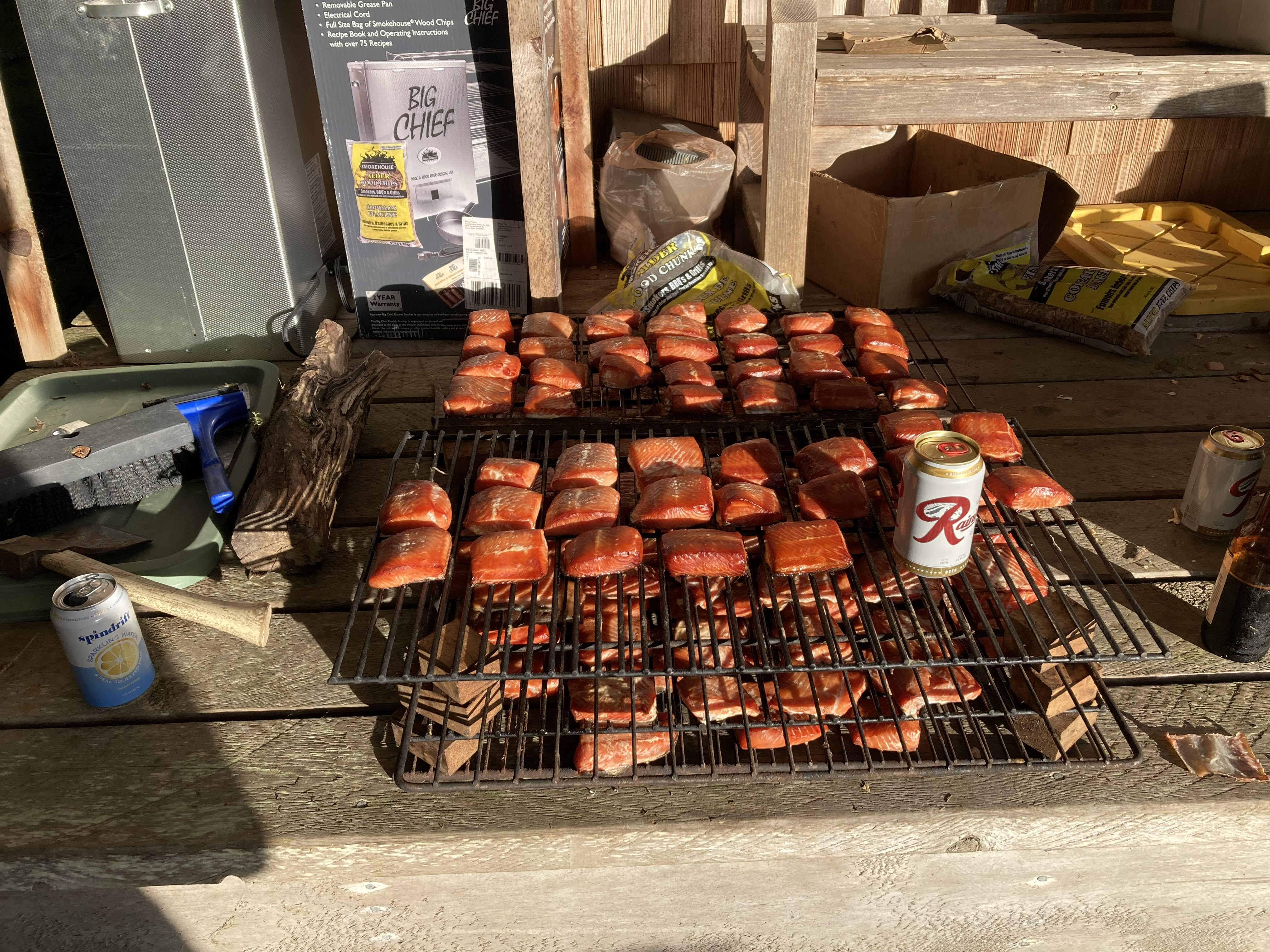
Golden light through golden leaves. Cottonwoods fluttering in a fall breeze are punctuated by random squalls that vanish before I can grab my raincoat. My fingers are greasy with salmon skin and stained with creosote. Sweet-smelling alder smoke billows from the smoker’s open door. I slide racks of salmon between the shelving and nihilistically rub stained hands on stained pants.
I close the door and watch the temperature tick towards 90 degrees. The smoked salmon recipe is as familiar as a warm blanket. Dry brine. Equal parts brown sugar and salt. Soak for four hours. Rinse. Let rest overnight. Into the smoker for four hours at 90 degrees. Bring to 180 over an hour. Hold for another hour. Eat the river.
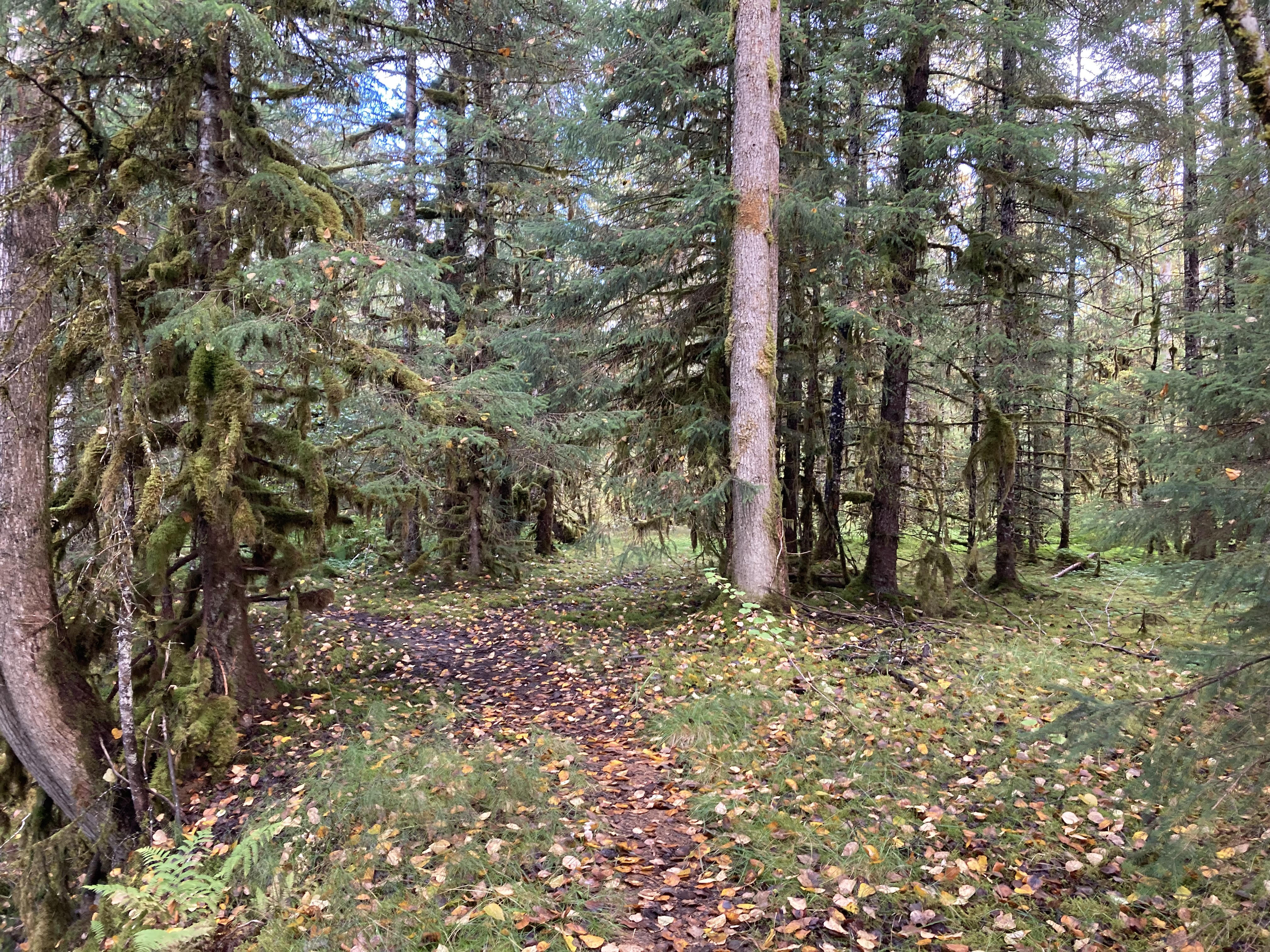
I plop against a spruce and nestle into the mossy layers coating the ground around Hank Lentfer’s house like a Tempurpedic mattress. I walked past this spruce exactly one lifetime ago, drunk on the prospect of going full homesteader. With covetous eyes, I drank in Hank and Anya’s house and overflowing garden, convinced that this could someday be ours. Nevermind that I initially mistook the smoker for the outhouse.
“Rule number one,” Hank laughed as we walked by, “don’t shit in the smoker.”
So no, I haven’t shit in the smoker, but I have pulled racks of succulent salmon and one luscious deer leg from its innards with the overeager enthusiasm of children on Christmas morning. The temperature hits 90. Six hours begins… now. The stopwatch squeaks, and I set to work peeling bark from a waiting pile of alder.
There are easier ways. Electric smokers exist. Set it and forget it. I could fashion a hot plate and plywood box, eschewing the careful dance between wet and dry alder. Keeping the smoker at 90 degrees locks in the flavor. Slowly raising it to 180 keeps fat from bubbling to the fillet’s surface. I could stop there, slide them into an oven, and let them slow cook to completion. I’ve already hiked miles up the river, fished for hours, and shouldered them to the trailhead. It’s not cutting corners; it’s just practical.
Cottonwood leaves whisper on the gusts. The old rusting stove pops and cracks. Smoke escapes from the shiplap siding. I wander through the woods, sampling high-bush cranberries and following moose trails that terminate in dead ends as if their users apparated on the breeze.
Even in sleepy Gustavus, it’s easy to get wrapped up in the rat race.
I don’t sit in traffic or attend budget meetings, but the “to-do” list never seems to shrink. A sliding scale of my own tolerance dictates the project list. Tyvek siding is acceptable until one day, I can’t stand to look at it another second. A kitchen faucet emptying into the same bucket for months is now intolerable. The cast iron tub that sat uselessly in the yard needs a home. A trail of washed rock appears and connects the driveway to the front steps. I returned in September, shocked to realize I’d been home less than four weeks since May. The house and property felt neglected. I set to work finding a place for the tub and slapping siding over Tyvek (kitchen sink bucket TBD).
But everything orbits around coho. A sunny day demands a journey up the river. The return of a birthday tradition of camping in the Bartlett River high meadow so I can roll out of my sleeping bag on the first day of my 36th year and cast into the river before I’ve sipped my coffee. It crescendos with this smoker that must be babied and attended to all day. It forces me to slow
All
The
Way
Down
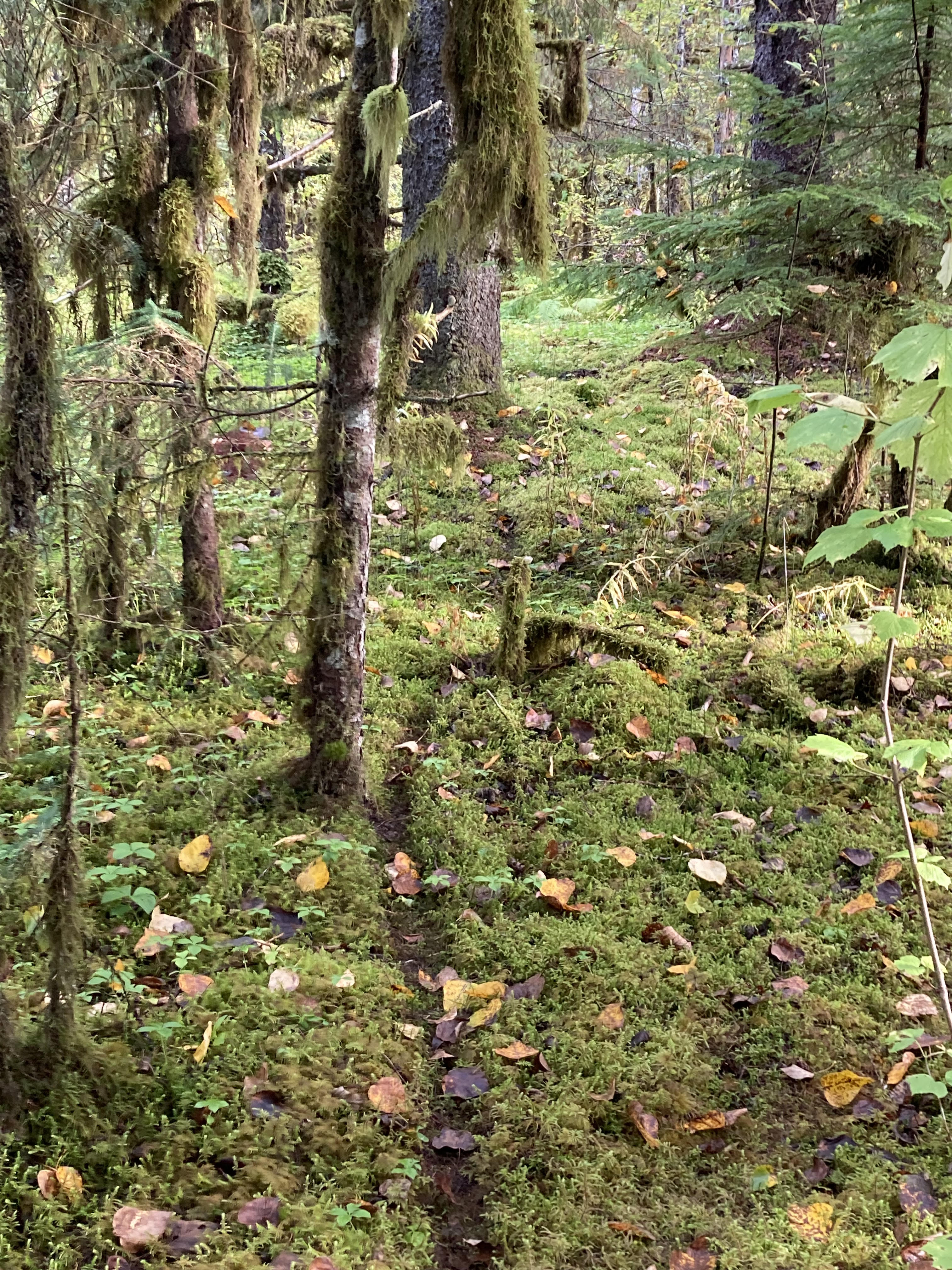
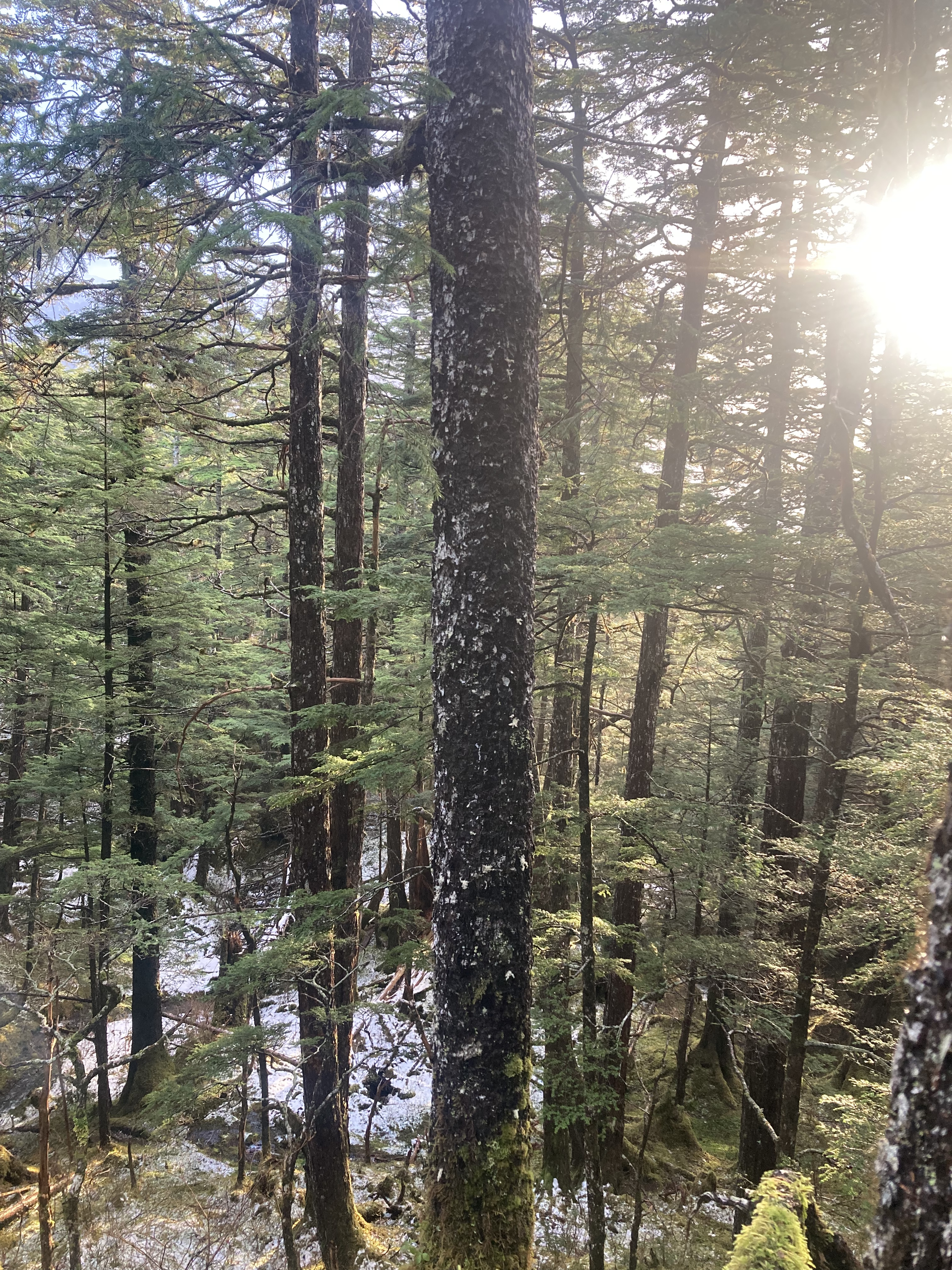
I kneel beside a well-worn trail traveling through the moss. It’s no wider than my forearm, but the moss has turned black and muddy from constant use. The trail connects two spruce trees. Their trunks covered with the shells of spruce cones. I don’t know how many squirrels ping pong between these two trees, but I’ve stumbled into somebody’s critical home. At least a couple of these chattering critters orbit their entire lives between these conifers. Up and down, back and forth, again and again. The patience, the time, the metronome-like consistency to make this trail speaks to a tradition no less significant than migrating cranes and howling wolves.
I run a hand down the trail. Is it possible to envy squirrels?
I think of the dozens of backbreaking trips with a wheelbarrow laden with rocks to form my own pale imitation. My attempt to reinforce the claim that I lived on and loved my swampy bit of land. But there is no substitute for time and the necessary pilgrimages between two trees that give these fast-twitch residents everything they need.
Hour number six slides by. I pop the door with poorly contained glee. Zach and Laura have arrived with their own tote heavy with brining salmon. Together, we shuttle the finished fillets to Hank’s porch, where their toddling son, Salix, is waiting. The door opens, and Hank appears with a quartet of Rainiers. He scoops a chunk of bronzed coho with one hand and flips a squealing Salix over his shoulder with the other.
The cooling salmon are irresistible, and we shovel handful-sized bites into our mouths. Salix takes some of us first uneasy steps, light brown curls reflecting the last of the day’s autumn light. Perhaps my trails will never be so defined. But this place has other sorts of worn and loved indentions to reinforce my connection to home. Spiritual footpaths matter more than worn footprints.
I take a final walk through the enchanted forest, gathering my things and trying not to forget anything. The universe dictates that I must always leave something behind. This week’s victim is a pair of rain pants.
“I’ll try not to tell anyone you left your pants at my place.” Hank texts.
“Appreciate that. That’s how rumors start.”
I pause at the base of the Squirrel Spruce and nestle a piece of salmon in the moss amongst their spruce cone pile. The forest breathes, bracing for a winter as inevitable as a sunset or falling tide. But not yet. We have a few more golden weeks to walk our trails, harvest food, and watch cottonwood leaves fall.
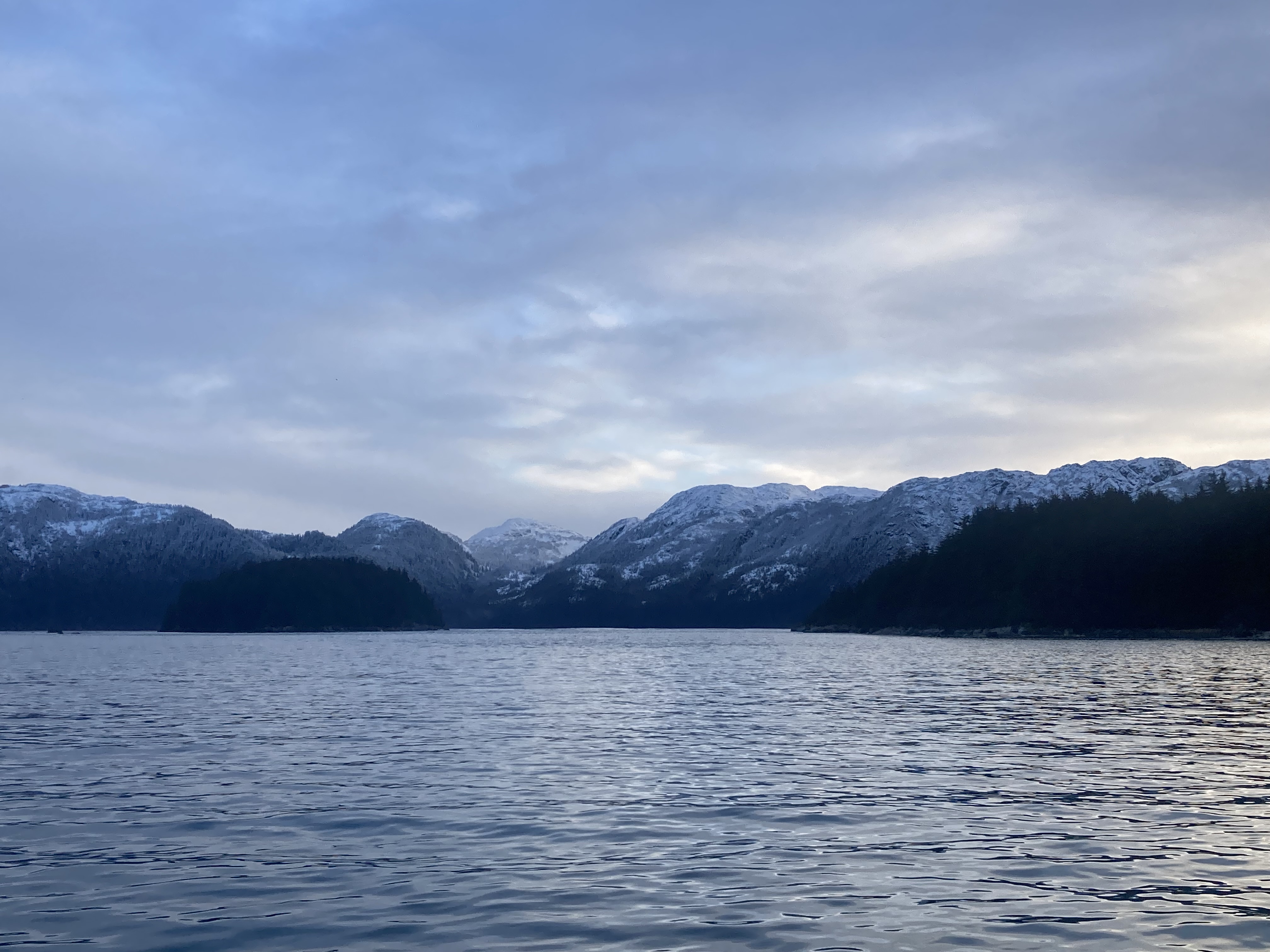
Ice. It always comes back to ice. Jagged, narrow inlets filled with saltwater hundreds of feet deep. Hills and mountains sculpted and rounded thousands of feet above the lapping waves. Humpback whales feed near the inlet’s shallow moraine, where the currents of Icy Strait and South Inian Pass meet. All because of glaciers that churned through thousands of years prior. The icy deserts have been replaced by a bounty of life that feels limitless in the calm August sunshine.
Our skiff glides down Idaho Inlet, cruising mid-channel and on course for the dogleg turn a couple of miles from the head of the inlet. Our heads crane upwards, eyes probing glowing green ridgelines and the hypothetical routes that lead to them. A few of these green fingers run towards sea level, a deceptive and alluring path that, in reality, is thick with salmonberry and alder. Better to take the wooded (albeit still thick) forests to reach that seductive alpine ridge.
Zach noses the boat towards a salmon stream and Seth leaps from the bow with a nod as he gives the boat a hearty shove. He disappears into the grass before the forest swallows him. I take the wheel, and Zach shoulders his own pack and rifle.
He points at a long rocky beach. “That one.”
I glance at the ridgeline. Sure. If I blink, squint hard enough, and imagine enough switchbacks, I can see a route through the trees to that coveted alpine. If Zach has any questions about the validity of his chosen mountain, he’s decided not to show it.
The keel scrapes the rocks, and he leaps clear.
“Good hunting.”
He waves in response. “See you tomorrow at noon.”
With a shout of, “Hey bear!” He vanishes into the trees.
I spin the skiff towards a small cove on the other side of the inlet. It’s an ideal anchorage in the shadow of another 2,000 peak that culminates in a long, straight ridge glowing in the setting sun.
For a third time, the skiff bumps the rocks. Out goes my pack and rifle before I putter away to lower the anchor. The anchor strikes bottom at 20 feet, and I spoon out several more feet before sliding the boat into reverse and feeling the anchor teeth dig into the soft mud. I brush my teeth and spit over the side, suddenly feeling oh so small.
It’s approaching 9 in the evening, and the mountain looks steep and foreboding. It will be disorientating in the woods. I pray for a game trail devoid of fallen trees and devil’s club. Idaho Inlet cuts into the north side of Chichagof Island, home to one of the largest brown bear populations on earth, and I left my bear spray sitting on the counter at the Hobbit Hole. I’d sooner wrestle a bear than rely on a round or two from a 30.06. It only makes me feel smaller.
I squeeze into a pack raft and splash for shore, shoulder the pack that feels too heavy, and crash into the darkening woods. Sweat soaks my sweater, and my breath comes in gasps as I hop from one deer trail to the next, yelling for the bears to keep clear every couple of minutes.
Why do this?
I pause and look at my GPS. 400 feet above sea level. 1600 feet to go. I’m not going to make it tonight. I look at the forest’s collection of blueberry, skunk cabbage, false azalea, and rotting tree trunks. Nothing looks remotely campable.
“Hey, bear!”
The words disappear with nary an echo. I am over my skis. A wanna-be Alaskan cosplaying as a hunter and homesteader. Discomfort wiggles in my mind, and whispers of self-doubt grow a little louder. I glance at the thickets below and, for a moment, consider retreating. I can camp at sea level and try for the alpine in the morning.
Why do this?
I tighten the pack’s belt and bush upwards. I can’t answer my own question, much less discern where I’m going to camp or how I’ll bear-proof my food while I sleep. Something keeps me climbing, keeps me gasping and sweating and pushing.
Tomorrow is Christmas morning. The allure of fat deer foraging on the cabbage that bears their name. The never-ending ridges of the island in the background. To stand where no one has stood for years (maybe longer). A reminder of the joy of public lands and wild places. The good health and fortune that lets me push higher and higher, one sweat-soaked step at a time.
At 800 feet, it’s too dark to climb any further. I cast around for anything resembling a campsite. I cram the tent against a hemlock perched on a ledge. At least the tree will catch me before I tumble should I roll over in the middle of the night. I’ve worn too many layers, and the bottom one is soaked through. I crawl into the tent without bothering to put on the fly. It’s been a soggy summer, but the last few days have been hot and dry, a forecast projected to continue tomorrow. I hear a stream tumbling down a gorge and murrelets returning to their nests. I brace against the hemlock and fall asleep.
Alarm at 4 am. I don’t bother packing the tent and hustle up the mountain with just the essentials: trail mix, rifle, extra shells, hunting knife, plastic bags, and Wild Berry Skittles. I pop out of the woods and into a mix of muskeg and yellow cedar, greeted by the rasping call of a doe.
My muscles tense as I slide rounds into the Springfield and watch the last one lock in the barrel. I squish through the muskeg, eyes trying to see everything at once. I am faced with the hunter’s dilemma, forced to choose between covering more ground or moving silently. Despite the doe’s call, the ground around me is sparse on sign, only a few trails and dry piles of scat. Discarding stealth, I bolt for the summit, already feeling a warm breeze as the sun inches towards the shady peaks. Idaho Inlet spills beneath me, a sinewy waterway that looks no bigger than a river. A jolt of anxiety runs through me as I imagine a poorly set anchor line and what it would be like to step out of the woods and into an empty cove. That’s a problem for Sea Level David hours down the road.
I bring the scope to my eye and work the ridges and meadows with as much patience as I can conjure. Two deer pop against the ridge 200 feet above. They weave through the rocks and grass, velvety antlers evident on the one in the lead.
My heartbeat quickens, but another peculiarly warm gust brings disappointment. The pair are traveling downwind, and the only approach for a biped is upwind. With no other deer visible, I begin to climb, hoping for a change in the wind.
I pause at the summit. The Fairweather Mountains explode from the other side of Icy Strait. Even from this distance, the 14,000-foot sentinel’s tower over my quaint little hill, blinding white peaks stretching north. Again, I feel small, but not in the diminished, intimidated manner of the day prior. The wildness of my home reverberates in my chest, and I barely mind when I realize the deer have disappeared around a steep and wooded point.
There’s no chance of following them without creating a ruckus, and the wind won’t stop blowing their direction. The ridgeline is a deceptive mix of mountain hemlock and yellow cedar the consistency of a hedge grove. I quietly push through them and feel the temperature drop. Minutes before 6 am, the promise of a sweltering summer day is already palpable. Too much sun means sheltering deer and poor hunting. The clock is ticking as I step out of the hedge on the west side. If I were a deer, this is where I’d be. Three mountains rim a bowl of alpine and sub-alpine habitat still sheltered from the rising sun.
I give the distant muskegs a scan, but a lip in the hillside keeps me from seeing the ground beneath me. I re-enter stealth mode, every step deliberate as I try to watch my feet and the emerging muskeg. I glance right, take another step, look down, and freeze.
A deer’s winter coat is grayish-brown and melts into the old growth, but its burnt orange summer one pops against alpine green.
The rifle jams against my shoulder. My god, he’s huge. A belly full of summer forage swings back and forth. He stands broadside to me, but when he raises his head, I can see broad, illustrious antlers culminating in three points on each side. The sort of deer Zach and I talk about after our fourth whiskey while snow falls on a gray January evening.
I take a breath, squeeze my eyes, and am overjoyed when the buck is still there when I open them. My mind freezes, and time slows to a halt as exhilaration mixes with the pressure not to blow this. He hasn’t seen me, but at this angle and distance, I’m not comfortable taking the shot without a brace. I can’t lay prone on this steep hill.
The pack slides from my shoulders, eyes on those antlers. The safety clicks. When I first started hunting, I anticipated some sort of moral conflict to play out inside me during these deliberate, pre-mediated actions. But there’s never room in my head for that. Once the safety is off, I’ve made my choice, my brain and heart acknowledging that we’re taking a shot. To take a life to sustain life. My inner monologue is filled with the same trite phrases:
Don’t blow this. Don’t blow this. Don’t blow this. It’s too hot. This is your one chance. The next 30 seconds will decide this.
I rest the barrel on my pack and kick my legs to the side. It’s awkward, but the rifle feels manageable with the pack holding the weight. I shift, and the buck looks up the hill. He fills the scope, and I stare covetously at his antlers. Ten minutes earlier or ten minutes later, and I would’ve missed him. I’d never claim to be a good hunter, but luck has been with me more often than not the last couple of years.
Deep breath, let it out. Wait. Wait. He keeps staring. Crosshairs split those beautiful, perfect antlers. Downhill shot, 200 yards. The bullet’s gonna drop. Compensate. I raise the barrel slightly just as the buck turns away to look at the alpine bowl beneath the mountains. The clock hits 6 am. A finger twitches. The blast echoes off peaceful peaks.
I unbolt the shell and catch the spinning casing. Another slides into place. Before I can stand, I know another shot won’t be necessary. His twitching slows as the nerves fire.
“Yes,” I breathe. “Oh, thank you, deer. Thank you.”
The safety clicks on. I fall more than run down the hill. The adrenaline letdown means everything is shaking. Balance and hand/eye coordination have become optional. My knees and hands tremble as I grip the fuzzy antlers that so filled my mind.
I mumble platitudes, take a deep breath, and get ahold of myself. As crucial as the last five minutes were, the next couple of hours are just as vital. The buck is too unwieldy to drag to sea level. The meat will need to be harvested here, the bones and fur left for scavengers. But not yet. I let the contradictions of my life run wild.
I’ve grown to fiercely love deer, finding them beautiful, gentle, charismatic, and, yes, delicious. To introduce violence and death upon a creature I treasure is something I fail to fully comprehend. Nothing is stopping me from climbing a mountain and simply watching these animals. No one would think less of me. I am not participating in some blind race for masculinity and affirmation.
Why do this?
I bury my fingers in his fur and bow my head. Because to eat of deer is to eat of the forest and mountains that make up my home. Because few things bring more pleasure than sliding a burger across the counter to a neighbor or loved one. Because there is something prehistoric and feral braided into my DNA that wants to hunt, catch, gather, and grow instead of blindly tossing deli meat in a shopping cart.
“I won’t call this a sacrifice,” I whisper, forcing myself to look into his empty eyes. “Because you didn’t wake up this morning set on giving your life. No, you were in the right place at the right time.” I pause, “or the wrong place at the wrong time. I hope your passing was as painless as it could possibly be. I promise to honor this gift and use as much as I can. I’ll think of you and this day every time I eat. I don’t know what the afterlife is like for a deer, but I hope it is peaceful and quiet and free of pain.”
I press my forehead against his. Velvet antlers rub my temples. The flies begin to buzz. No words can excuse the violence and bloodshed. But if my gratitude and respect can find a way into the calories I harvest… it matters how an animal dies. How it is treated even after it draws its final breath.
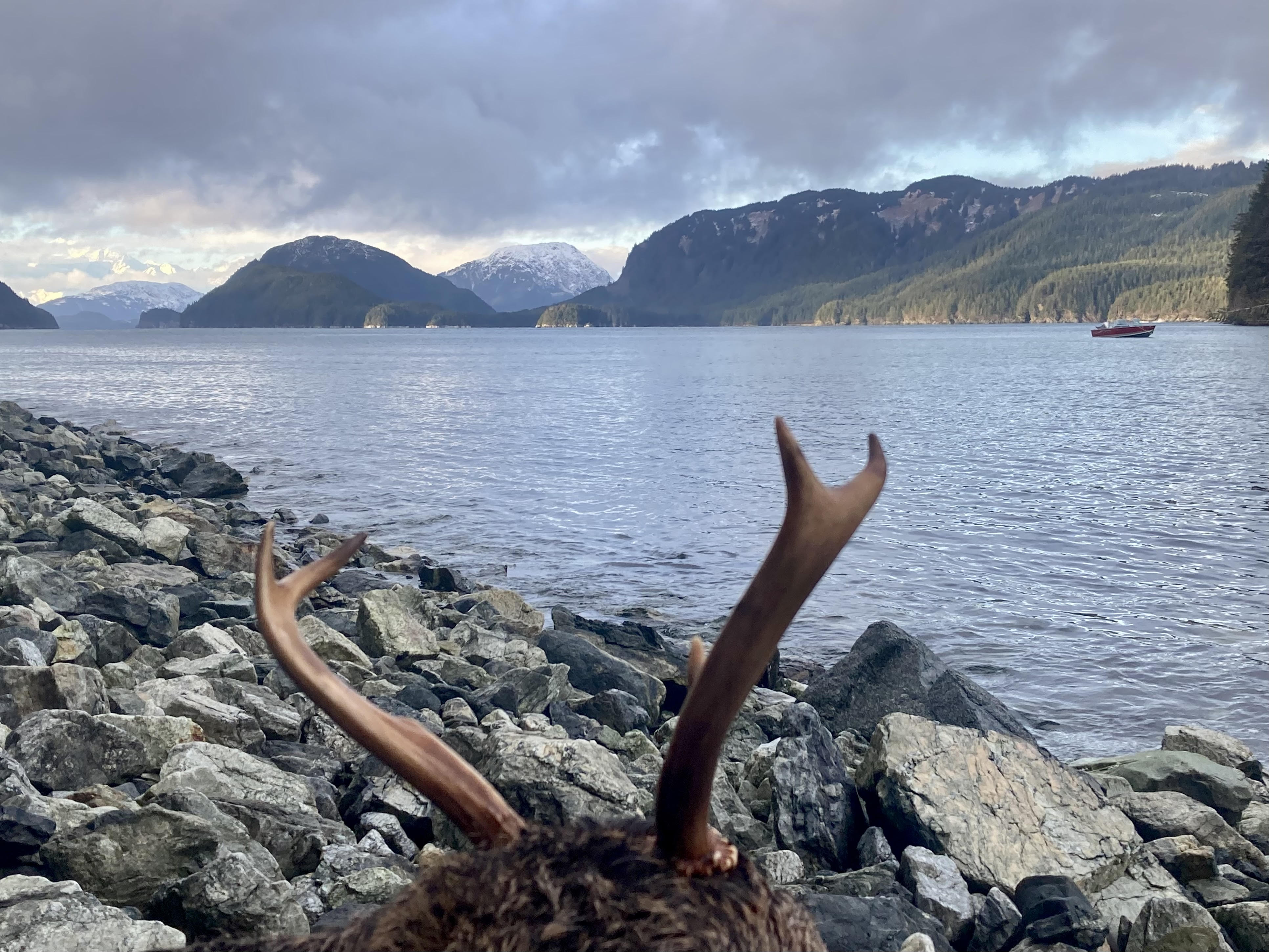
The muscles in my leg cramp, the plastic bags steadily filling with meat bound for canning jars. When the bags are bulging, and the work finished, I drag what’s left of the buck to a large rock, spreading the pelt across the top and resting the head to overlook the mountains he’d been watching. From behind, he could be sleeping.
I shovel Skittles into my mouth and wrestle the pack into position. My knees ache as I reach the ridge and appear in blinding sunshine. I glance back at the burnt orange fur and give him a final nod.
Why do this?
Idaho Inlet waits below. The Inian Islands and Hobbit Hole obscured from this angle. There will be stories to tell, beers to drink, a life to thank and remember as the pressure canner rattles. Tradition dictates that the heart of the deer must be eaten that night. The sort of meal that needs to be shared. Must be shared.
I take an uneasy step down the ridge. 1,998 feet to go. I may not be able to articulate how or why this has become the most integral part of my year, but there’s no going back . Home lays before me, rolling ridges behind, the biting straps of the pack a blessing in disguise.
Executive Directors shouldn’t be sweeping yurts. But Zach Brown does. Sawdust, spruce needles, and the detritus of countless Xtra-tuff boots fly before our brooms and billow out the door. Zach and Laura’s non-profit is already ten years old. Hundreds of students have already rolled through Gustavus and the Hobbit Hole. They are pebbles in a growing pool, ripples spreading across the globe in the name of climate justice and the dream of a world overflowing with clean water and a habitable climate.
Polishing a yurt and nailing rafters a few days before Tidelines Institute’s ten-year celebration bash is all part of a Friday afternoon for this guy. Never mind, he just got back from teaching a week-long course and has a sniffly one-year-old son at home.
I met this dude on a basketball court, politely flustered at his intensity on defense and speed that he pushed the ball up the floor. But that’s just how he operates. It doesn’t matter if it’s an open gym, thinning carrots, or a lecture on climate change. You’re going to get his best.
He pauses, broom in hand. “How you holding up, dude?”
I shrug. “Good days and bad. More good than bad.”
He strikes a Lebowski grin, “strikes and gutter balls?”
You can keep your love languages like “words of affirmation” or “quality time.” Zach and I speak in movie quotes. The highest form of affection.
“Well, you know,” I fire back, “sometimes you eat the bar, and sometimes…”
“You’re an injured fawn,” he continues, not missing a beat as he pivots from The Big Lebowski to Old School. “Nursed back to health and ready to be released back into the wild.”
“Speaking of deer… where are we going this August?”
There’s the gleam. Reserved for venison and adventures. “Ahhhh, well, I’ve got some ideas.”
Damn right, he does. Last August, we pitched a tent amongst the devil’s club near a tiny beach 40 miles west of Gustavus, falling asleep to fantasies of climbing into the alpine for big-antlered bucks. We awoke at 4 am to the type of rain that promises fog so thick you can’t see the glove in front of your hand. We stared at the roof for a few long minutes.
“Well,” Zach said, breaking the silence. “Guess I’ll go take a look.”
“This is no time for bravery. I’ll let ya.”
He pauses, hand on the rain fly. “Is that Cool Hand Luke?”
“Butch Cassidy.”
“Close enough.” He disappears, and I’m sorely tempted to fall back asleep, but he returns a few minutes later.
“What’s the verdict?” I ask.
“Well…” he’s already pulling on his wool pants. “What are we gonna do? Go back to sleep?”
We bushwhacked through 1500 feet of ferns, blueberry, cedar, and the aforementioned devil’s club before popping into paradise. Huddled against limestone rock and shoving Snickers bars in our mouths, we grinned like kids who’d broken into a candy store.
“Look at all the deer.” I breathed.
Zach’s binoculars were glued to his eyes, counting fuzzy brown specks as the fog rolled through. “There’s twenty on that ridge alone!”
I was hooked. In the same way I once dreamed of returning to British Columbia’s cedar-clad shores, I now dream of quiet mornings in the alpine, looking for the deer that fuel my soul and fill my body.
It was never about pulling the trigger. It was about last night’s rain soaking our knees, reflections in a mountain lake, deer cabbage sprouting past our shins, and fog lifting off Lisanski Strait. It’s the long hike home with heavy shoulders and the clinking of the best damn beers we’ve ever tasted when we reach sea level. It’s lengthy boat rides and late nights cramming cubes of venison into mason jars while The Fellowship of the Ring plays in the background. It’s squeezing around a laptop and pouring over ridgelines with Zapruder film intensity to plan the next alpine adventure.
I’m under no illusions. I’ve done the math. A huge percentage of my calories are brought to me via barge and airplane. There’s no “butter tree,” and I can’t grow chocolate chips no matter how many “seeds” I plant. But having a connection to my home and some of my food matters a lot.
The carrots and potatoes in the garden, the venison in the woods and mountains, the coho undulating silvery bodies up the streams. These creatures and opportunities, and the friends I share it with, have kept me tethered to this place, their braids winding tighter and tighter with every pound of potatoes and vibrating fishing pole on a September morning.
The relationships are evolving. When I look at those ridgelines, I feel the first vestiges of age in my knees. I now hobble the day after I play basketball and recently pinched a nerve in my neck while doing sit-ups. I have found gray hair in my comb and make groaning noises when I get off the couch. No, I’m not old, but I look at those ridgelines differently, reminded that there’s a finite number of Augusts in which we’ll be able to scamper up them and descend with 100-pound packs. God willing, that won’t be for decades. We don’t intend on wasting any of them.
“What if we spent a few days up there?” Zach asks, closing the door to the yurt and gazing at the cabin we’re building for the next wave of students.
“I was thinking the same thing. Getting into the alpine is so much work. I want to savor it.”
“We can roam the ridges, and on the third day, we each find a deer to bring home…” he pauses, “That means we’re lugging two deer and our camping gear down the mountain.”
“So we don’t bring the stove.”
“Peanut butter and jelly for every meal?”
“Exactly.” I slap him on the shoulder. “Thanks for asking about me,” I say, “August can’t get here soon enough.”
Our time together has been too sparse over the last year. It seems one of us is always running off somewhere. The Hobbit Hole, California, British Columbia, Sitka, Patagonia, another paddle trip, another fundraising obligation.
When we met, Zach didn’t own the Hobbit Hole. His non-profit was just a small kernel, one of those pebbles spreading across the lake. I look across the campus at the garden already overflowing with food, the clucking chickens in their neat little pen, and the new building that, at least to me, appeared overnight. What he and Laura have built in such a short time boggles my mind.
As life has waxed, waned, and changed, we still have, for better or worse, our alpine dreams.
I tighten my tool belt and clamber up the ladder. These barge rafters won’t install themselves. I wrestle one into position and yell up to Zach, who’s gripping the 2×6 jammed against the ridge board.
“Talk to me, Goose!”
I can hear his grin as much as hear it. “We’re going ballistic, Mav! Go get’em!” The nail gun echoes, a hammer bangs, and somewhere on a quiet mountain, a ridgeline waits to be explored.
My boots crunch frozen grass and I grimace. There’s no quiet way to move from the intertidal to the woods in these conditions, the world softly frozen around me, beads of water suspended and solid on every blade. I tighten the straps on my backpack and try to think like a deer, move like a deer. I walk on the balls of my feet to soften my footfalls, body tensed and alert. I have been walking for only twenty minutes but sweat already beads beneath the bright orange hat.
I feel the blunt object slung around my shoulders slam against my hip. I adjust, brush aside the first layer of alder, and hear branches scratch against my pack. Breath thunders in my ears and boots squish into soft, wet earth. Inside the forest, nothing is disturbed. I take a moment to marvel at my good fortune.
As I child I read and reread every Calvin & Hobbes comic, staring enviously at the apparent national forest Calvin and his stuffed tiger had at their disposal to ride their red wagon in summer and toboggan in winter. Complete with cliffs, ravines, swamps, creeks, and lakes. Now, I have my own National Forest. Tongass, and the designated wilderness that is the Inians. Me, some deer, a curious raven, a chattering squirrel.
I move up a gently sloping hill until it meets the steep cliff that shoots up at a 90-degree angle to the summit of the island a thousand feet above. The forest abruptly ends, surrendering to gravity and salmonberry bushes clinging to this steep and harsh stretch of the island.
I have been here before, know where I’m trying to go. The forest frames this steep hillside for two miles before the cliffs jut out to meet the waters of North Inian Pass. By staying just inside the trees, I can have a full view of the big, west-facing woods below. A haven for deer regardless of the weather. I touch the object around my shoulder, to reassure myself it’s still there, and drop into a drainage to hide myself from view.
The sound of the creek covers my tracks and masks my scent as good as I can hope for. I follow the drainage for a quarter mile, allowing just my toes to touch earth. Quiet as I can be, crawling on hands and knees beneath fallen logs and feeling the water-soaked earth crawl up my pants. At last, the drainage meets the top of the hill, the little valley flattening out. I pause, crouched behind a fallen hemlock hiding me from view. Sometimes the first look is the only chance you get.
I ease myself around the root ball, turn, and am greeted by a flashing white tail and startled bleat. I freeze, and so does the deer. A young buck, his antlers nothing more than knobs on the top of his skull. I’ve caught him unawares, but he only bounds about ten feet before stopping. He looks back at me with a politely curious expression.
The object knocks against my shoulder, demands my attention. I don’t dare move. The deer remains frozen, obsidian eyes unblinking, impossible to imagine what is going through that young mind. He glances away from me, looking back down the hill. Very slowly, I move my right hand across my chest, feel the strap slide, come loose… and the binoculars slide into my hands.
My freezer is full. I am not here to harvest. I am here to learn. To soak up whatever secrets and knowledge my neighbors are willing to share.
“I sought fuller comprehension of an animal I am made from,” wrote writer and hunter Richard Nelson in his book Heart and Blood, “the life outside of me which becomes the life within me.”
As do I.
From the beginning, the deer of the Inians were more than “stock” or “herd” for us. They are revered and honored. And like anything we revere, I am innately curious about these phantoms of the woods. I love how they appear just when I’ve given up. When I get lazy and round a corner or snap a twig, rewarded with the sight of a whitetail trimmed with black bounding effortlessly through the wood with nary a sound.
I bring the binoculars to my eyes and drink him in. Even if I’d brought a rifle, even if the freezer was empty, I’d have a hard time pulling the trigger. He still has that “fawn face,” short and stumpy with all the characteristics of a baby animal that make us coo. In the low light, even though he is just feet away, he seems to evaporate into the woods around him. Perfectly camouflaged in the weak January sun and a forest floor free of snow.
Lowering the binoculars doesn’t startle him. He continues to oscillate between me and glancing down the hill. There have been several times over the last few years where I have sat in the company of deer. Many times, using the “call” brings either does, fawns, or both, leaving me to wait and hope that something with antlers will wander by. But in those moments my attention was never on them, instead scanning the woods beyond for something that would bring the scope to my eye.
Now, this little buck has my rapt attention, and I decide on a little experiment. I tap one nail against the glass of the binos, the sound barely registers in my ears from less than a foot away. The fawn responds instantly, tilting his head like a dog at the sound of the treat bin opening. He stares directly at my binoculars and takes a step towards me.
No way.
I tap again. A few more steps. 15-feet away. The closest I’ve been to a wild animal in a long time. I don’t dare breathe. Sweat drips down my face, every muscle tensed with the effort of staying perfectly still. Through it all, the fawn has not made a sound. Nature has perfectly sculpted him for a life of silence. What next? The seconds hang in the air. I hear footfalls behind me.
I turn my head instinctively and see something grayish and sleek move through the brush. The doe looks down on us and gives a disapproving huff. The fawn immediately snaps out of his trance, cantering over to mom and attempting to nurse, only to be forcibly rebuffed.
It’s not unusual for fawns to return to their mother for a time once the rut is concluded. And judging by his eagerness he is something of a mama’s boy. While not alarmed, the doe has no interest in this staring contest. She moves down the trail, her kiddo in tow. I don’t wait for an invitation and step softly into their trail and follow. The pair canter at a casual gait 30 feet ahead before weaving around a large spruce.
With them out of sight, I increase my pace, trying to keep them in sight as long as I can. I reach the spruce and slowly tilt my head around the corner. The forest is empty. Spruce, hemlock, blueberry, and menziesia trees and shrubs interspersed at intervals with no deer between their gaps. I bring my deer call to my lips, give two short bleats, and settle against the trunk. But there is nothing, no evidence that I share the woods.
I begin to make my way down the hillside, eyes still scanning for a pair of ears trained like satellites in my direction. But I once again walk alone. I’m getting cold and tired, ready for a mug of tea and a sandwich as the short winter days pass like sand through my fingers. But I cannot bring myself to crash through these woods. Every step needs to be quiet, as stealthy as I can be on the off chance that another of these creatures will wander into view. Can I not take a simple walk in the woods anymore?
“I wonder if hawks or herons, wolves and killer whales are ever astounded by the loveliness, the grace, the perfection of their prey,” Nelson continues.
I have often claimed orcas match us in intelligence, that they may be smarter than many humans. I include myself in that category. The corvids of the sky are whip-smart, anyone lucky enough to stare into the eyes of a wolf has seen a soul staring back. One could certainly argue that the intricate and complex languages these animals have room to marvel at and appreciate the voles, seals, and moose that sustain them.
But humans undeniably have this capacity, if we choose to acknowledge and accept the burden and gratitude that comes from appreciating the things we eat. It has forced me to come to terms with my omnivorous evolution, the power it has given me, and in turn, the responsibility to not abuse.
***
I open the freezer and retrieve a parcel of butcher paper. The outside is covered in brightly colored scribbles courtesy of Elm and Beth’s daughter, Claire who assists in butchering by making sure every piece of venison is lavishly wrapped in artwork. The antlers on her drawing of a deer are unmistakable. I set the meat on a plate to thaw with grand designs of spaghetti, meatballs, and a liberal dusting of parmesan.
I didn’t just come to the Hobbit Hole to grieve and rebuild. I came to explore, to learn the forests and muskegs and hills as intimately as an overcivilized and domesticated human can.
The “Hobbit Hole” from the far side of the inner lagoon.
To discover the trails and beaches and shortcuts through these marvelous, old, protected woods that will be standing long after I’m gone. To grow as close to this special patch of earth as I can over three months. A huge part of that education was the deer, one of the forest’s rightful tenants.
To eat of deer is to eat of the forest. Of blueberry and devil’s club. Skunk and deer cabbage. Alpine and beach. Forest and muskeg.
I never fancied myself a hunter, never imagined I’d walk into the woods with the intent of dragging something out. But it has granted me a gift I didn’t expect, drawing me closer to the wild places that sustain me like a spring welling up amongst forested acres.
It has turned me from an idle hiker to an explorer, asking questions and taking copious notes of the places I visit. The knowledge that I will never understand or grasp the intricacies and relationships of these animals and ecosystems only makes it more alluring. Be it a rifle or binoculars against my hip, my days of crashing woodland hikes are now a thing of the past.
Snow coats the hemlock boughs like icing. At sea level, we’re oscillating between sleet and snow on a minute-by-minute basis. From South Pass, the Gulf of Alaska is visible and foreboding. The constant swell an undulating steppe that bottlenecks through this passage that in many places is just a half-mile wide.
My double kayak is sheltered by the biggest of the Inian Islands, the bow rising high in the air with each swell. Instead of another paddler, the bow seat is occupied by a rifle and dry bag. If all goes according to plan, there will be a four-legged occupant in that seat on the way home.
The Inians are four watermark islands at the west end of Icy Strait, a breakwater between the inside waters and open gulf. They’ve been designated as wilderness by the U.S Forest Service, with one exception – The Hobbit Hole.
How to describe the Hobbit Hole? It’s a picturesque homestead. Five acres of old growth nestled in an ideal harbor accessible through a narrow cut. A mile west can be some of the most dynamic, challenging, and downright dangerous waters on the coast. It’s the last harbor. The last shelter. The last hearth. And it has become a tradition to spend Thanksgiving here in the name of fellowship, deer, and gratitude.
I have a spot in mind. A little pocket beach near the south end of the island. It’s too shallow for a boat, but a kayak can squeeze in there when the swell allows. The kayak catches the surf and slides up the pebbled beach. I jam my paddle into the rocks and the boat holds fast as the ocean retreats. I scramble free and drag the kayak to the pile of drift logs at the feet of the forest.
I tie the kayak to the logs and step out of my raingear. I’m wrapped in wool. Not as dry, but quieter when creeping through the forest. Five shells slide into the magazine of the 30.06, the last one clicking into the chamber with a deathly click.
Safety on. Backpack shouldered, GPS tracker on.
I follow the drainage, letting the sound of crashing surf and running water muffle my footsteps. I am not a quiet hunter. If there’s a stick to crack or a rock to send down a hillside, I will find it. The deer I’m looking for can hear better, smell better, and probably see better. They have home-field advantage, and the myriad of deer trails tells me that there are multiple escape routes if they feel the need.
But the Springfield slung around my shoulders does a hell of a job at leveling the playing field. I prefer to sit and wait. Find a perch, try to get comfortable, and exercise some patience. It’s that last bit I struggle with. But the human eye doesn’t see well when it’s moving, and the odds of me seeing a deer before it sees me when I’m in motion are slim.
I find a small rise looking up the hillside. It’s reasonably open for the Inian Islands where the forest is defined by thick groves of blueberry, devils club, and muskeg. I bring a wooden deer call to my lips and give a few bleats. I’ve been wearing it every day since July. It’s become something of a talisman, a worry stone I can hold onto when the feelings get big. But I finally get to use it for something besides startling my cat when she falls asleep on my lap.
I settle in. All my tramping surely scared everything off, time to let the woods go quiet, to melt into the moss and pretend I’m not there, to give the – there’s a deer.
Top of the hill, to my left, moving right. Weaving along a well-worn trail. I bring the scope to my eyes. There are antlers. I’ve been in the woods thirty minutes, and I’ve found antlers. I blow the call. He keeps disappearing behind hummocks and thickets. But he’s moving towards me. My heart pounds and I’m embarrassed by how much my hands are shaking. Halfway down the hill, he vanishes behind a fallen spruce. I bring the scope to my eye, aiming to the left of the blowdown, and wait.
But a sound further down the hill distracts me. The raspy call of a doe echoes through the woods. The buck isn’t coming towards me. He’s heading for her. Can’t blame him. She’s much cuter than I am. But she has no interest in what he’s selling. For a moment I have them both in the scope, but the view is fleeting. The doe scrambles back up the hill and the buck vanishes. He doesn’t take the rejection very well.
For a while, I try to follow their tracks in the scattered snow. But they’re downwind of me and the trail is hard to follow. The wind blows from the southeast, so I turn around, still feeling the exhilaration of the sighting. The relationship I have with deer is often met with raised eyebrows and skepticism from those down south.
It’s hard for me to imagine deer as pests piling up on the side of the interstate or rummaging through petunias. They are the perfect forest emissary. Quiet, fragile, and mysterious. Beautiful and delicate. Surefooted and swift. Able to sprint straight uphill without making a sound. Simply finding deer in these woods can feel like a miracle. It makes every encounter intimate and unique. Hours of inactivity followed by seconds of exhilaration.
30 minutes later I find two more deer. This time a doe and a fawn rummaging through a muskeg. They paw at the snow and bury their noses in the earth. From my vantage point, I wait for something with antlers to wander out of the woods. A raven croaks from a branch above me and the doe’s head snaps up to scan the tree line.
What did that raven say? The bird takes off and lands on another branch closer to the pair. The call fits this place like the intertwined fingers of lovers. For centuries ravens and wolves have found deer together, ravens calling out locations like a beacon, drawing the pack in while the ravens get the carrion.
As we spend more and more time plying the forests of the Inians, are local ravens picking up on this? We don’t leave the scraps a wolfpack does, but a big gut pile is nothing to sneeze at. Whether it’s the call of the raven or the deep snow in the muskeg, the pair wanders off into the woods. I munch on a sandwich and watch the empty muskeg, still hoping a buck may appear and follow their trail. My patience disappears with my lunch. I shoulder the pack and rifle, continuing along the ridge.
I vaguely remember a hunt last fall in this area. There’s an open section where I saw a doe and fawn. I drop down another hill, acutely aware of the sound of crunching snow beneath my boots. I find a deer trail and follow it along the side of the hill. Lots of blueberry in the valley below and trees clustered together. I pause near a potential perch that offers a better view. The hill bends to the left ahead of me, and a raven calls around the corner. If a deer is the forest’s soul, then a raven is the voice. I must keep going, something insists on it. I stand and follow the croaking raven. The view is a little better around this bend, and a downed spruce makes a perfect brace.
I slide off my pack and look up at the branches for the raven, the forest quiet again. I bring the deer call to my mouth and look back down at the little valley. The call falls from my lips without making a sound. A deer. Walking straight towards me. Scope to my eye. Antlers. He’s what we call a “spike.” His antlers haven’t forked yet, they’re just two rigid pieces of bone sticking out behind his ears.
He continues to move towards me, and I hear the raven again. The buck seems unconcerned with the calls and continues to work toward me, nose to the ground. He reaches a small clearing 40 yards ahead. Now or never.
I miss.
One would expect a deer to bolt at the sound of a gunshot. But the sound is so sudden and foreign, that they often pause. That’s what he does, staring right down the barrel. The second shot is clean.
I sit near the deer and lay my hand on his chest. I stare at those little antlers, and he looks so tiny. Spikes tend to be two years old, and with a swell of guilt, I wonder if this is the fawn I saw the previous fall. Did he work this hillside his entire life? Walk this drainage countless times? It’s likely I’m the first human to set foot in this spot in a year.
That old mixture of gratitude, grief, and yes, pride swell up inside.
Wings beat above me. The raven perches along the bough, the call filling the empty woods that I have just filled with violence. As I prepare the deer for the half-mile drag to the beach, I listen to the raven. He sounds impatient. Can’t you do that faster? He’s soon joined by another, they touch beaks, and take turns calling through the woods. Not content to reap the bounty of the impending gut pile, it must be shared with their friends.
I remove the heart and liver and drop them in a Ziploc. I feel the same. Back at the Hobbit Hole, we’ll eat the organs tonight. Together. Sharing stories around mugs of cold beer and a sizzling blueberry crisp.
I am home. With soaked pants and a gentle rain melting the snow. The deer, this place, this life, it’s a miracle. Everything else falls away. I would not trade this moment, this sensation, for anything. Some hunter-gatherer DNA has its claws in me and will not let go.
The deer is ready. The ravens are too. 700 feet of elevation and a nasty drainage are between me and the kayak. But I’m not ready to leave the glen just yet. I lean against a tree and look at the birds, waiting so patiently.
“Did you know he was here? Did you know I was close?”
Black eyes stare. Revealing nothing.
“I’m going to pretend like you did. That we have this bond. That you watched me hunt this hillside a year ago, that you remember me. Things are different now. Things once in order now seems so strange. But this, this is my constant. This is my heartbeat. I hope you eat well. I hope this sustains you. Let’s waste nothing of this miracle. I’ll see you two soon.”
I shoulder the pack and grab the line tied around the neck. The rifle bangs against my hip, the deer slides across the snow. With a final caw, the ravens descend, and the forest goes silent once more.
September. In years past it’s meant digging out the crawlspace, filling the car, and early mornings in ferry terminals. But not this year. Or the year after this one. Or the next one. Now I’m digging out the fishing rod, filling the freezer, and spending mornings on the Bartlett River Trail.
Glacier Bay is a paddler’s park. There’s only a handful of maintained trails. The most popular of which is the Bartlett River Trail in Bartlett Cove. Just a few hundred yards from the lodge, it endures hundreds of footsteps as nervous visitors armed with bear spray make the mile and a half track to the mouth of the river.
But at seven in the morning in mid-September, we have the whole trail to ourselves. The speedometer on Dr. Zachary Brown’s pickup is busted, insisting that we’ve been going 115 m.p.h since he picked up me and Patrick Hanson. But car maintenance is never at the forefront of a Gustavian’s mind. Today we’re after something much more valuable. The three of us and Zach’s partner Laura Marcus park at the trailhead, grab our gear, and push into the woods. Our boots slosh through the mud, the only sound the creaks of backpack straps, the rattle of squirrels, and the quarrels of gulls.
We climb down a low sloping hill, an artifact of a different age, a glacial roadmap. Grand Pacific was here. Sitakaday, the ice bay is no more. But with loss comes life. We’re surrounded by Hemlock, Spruce, Devil’s Club, Blueberry, Hedgehog Mushrooms, dozens of species of moss and lichen. So much life, in large part thanks to the Sockeye, Pink, and Coho that run up the river every year with metronome-like precision. And I’ve come to take some of that life. We all have.
I spend my life in communion with this masterpiece, but as an observer. A silent watchman in the back of the room. But with the fishing pole clutched in the hand, I’m going to supplant myself in the middle of the performance. I’m no longer an audience member, I’m a player, and my role has the potential for catastrophe.
2017, a year that has infused those with a love of quiet places and open spaces with such terror, has a handful of marvelous anomalies. Bristol Bay in southwest Alaska had a banner year in the most abundant Sockeye fishery on earth. And the Coho of southeast are following suit. There are literally too many returning Coho for all of them to spawn. The commercial fisherman, sea lions, seals, bears, and eagles cannot eat them fast enough. Two vestiges of hope in a world where every environmental paper seems to be a harbinger of doom.
I lead our little quartet out onto the river. We’re a bunch of novices. Patrick carries a brand new rod he’s never casted and Laura landed her first Pink on the Salmon River the other day. Despite growing up in Alaska, neither Zach or myself are bursting with angling expertise. In fact I’d spent the better part of the month casting and retrieving with little to show for it. Thankfully Kyle Bishop took pity on me in a way few in the competitive world of fishing would have. He showed me his favorite fishing holes and advised me on everything from his preferred lures to proper vacuum packing techniques. From his generous shared knowledge and my tally of two Coho, I’m somehow the most “experienced.”
The first few times I’d fished the Bartlett I’d succumbed to an all too common mistake. As soon as I hit the river I’d begun to cast with the logic that all the fish must pass this spot. But Kyle had taught me differently. Don’t give in to temptation. Keep hiking, and when you think you’re there, hike a little more. And so we keep going, another forty minutes along the river bank. The trail shows signs of other commuters. River otter, black bear, coyote, and wolf. But the only occupants this morning are dozens if not hundred of Mergansers that lift off from the river as one, white wings shining in the early light.
We hop a tiny stream and past a wide river bed where hundreds of Pink salmon are spawning, carving long divots in the gravel stream to deposit eggs and sperm so there children can one day do the same. There work finished, they have nothing left to give. The flesh flaking from their bones, they succumb to the unrelenting current and drift back down the river until coming to rest on the bank.
At last I stop at the spot Kyle insists has been on fire all year. We begin the repetitive task of casting again and again. The high pitched whirl of line off the swivel, the gentle plop of the lure on the river, the click-clack-click-clack of the reel. For an hour we experience nothing but near misses. I nearly get one to the steep river bank but just as I reach for the salmon, the line snaps, taking the fish, my lure, and gear with it. We spread out up and down the shore, Zach disappears behind a big stand of Spruce. I’m situated between Patrick and Laura who stand about 200 yards away.
A huge splash comes from the river a dozen yards and front of Laura. I look over to see her reeling furiously, but nothing else comes of it. Assuming she either lost it or it was just one of the many leaping Pinks, I prepare another cast.
“David? Can you come help me?”
I drop my rod and, caution to the wind, grab my fillet knife and begin to run down the river towards her. There is a tension in our voices, a gritty determination with a tablespoon of excitement and, yes, fear. It’s a big fish. A big beautiful fish. And it runs on her, again and again making a break for the far side of the river. It’s undulating body sends up flashes of beautiful silver. But he’s no match for the rod of humanity. And at last he has nothing left to give. I hop down the bank ankle deep in water as she drags her catch over.
“Keep the tension on the line.”
I grab the line just above the Coho’s head and reach into my thigh pocket for my needle nose pliers. They’re small but heavy, and the thin handle gives me confidence I can land the blow that will end the fight once and for all. But before I do, I stare into his eyes.
Fish always look surprised. Those wide, unblinking eyes, mouth slightly open like someone has just jumped at them from a dark corner. I wonder how the hook feels in his mouth. How tired he must be to stop fighting. How I’m about to finish a miraculous story that started four years ago in this very stream. How this fish has been bucking the odds since before it was born when gulls were scooping up the eggs around him. How many nets, mouths, and lures it had dodged until, a dozen miles from home, he bit down on Laura’s. So close. There’s still time.
I swing.
The pliers make a dull hollow sound on his skull like a finished loaf of bread. I swing again. And again, and again. He stops squirming. I slip my fingers into his gills and out his mouth and with a final heave drop him on the river bank at Laura’s feet.
“What a beautiful fish.”
They truly are. Brighter than silver dollars on the sides and bellies, emerald green with black speckles on top. They seem to be fluorescent, the skin changing color as you turn them in the light. I explain how to cut the gills to ensure he bleeds out and doesn’t suffer.
“I want to do it.”
I expect nothing less of her. But before she does, Laura lays her hands on his head, whispers a few words of gratitudes, and with steady hands cuts the gills. I pull her lure out of his mouth and we set him on the grass.
“He may thrash a bit more,” I tell her, “but don’t worry, it’s just his nerves firing. He’s not suffering.”
Down the river the other way, a splash erupts in front of Patrick. Another one. I take off down the trail and the saga plays out again. Fight, let it run until it’s too tired to do anything but float in the current, bring to shore, lift, hit, gills, grass.
Patrick kneels before the fish and runs a hand down the lateral line. He strokes the fish, his head bowed as if in prayer. He cuts the gills, and sets it in the grass. We want every fish to die with dignity and grace, as little pain as possible. Each gift, each miracle treated with the upmost respect. Does it matter how an animal dies? I think so.
The bite is on. Again and again beautiful streaks of silver break the water. This is just the beginning. Hundreds of thousands, perhaps millions are behind these, some still queuing up in Cross Sound.
“How amazing that in 2017 there can still be this kind of abundance,” Zach marvels. In a few hours we have eighteen Coho on the river. We also have a three mile hike back. We line the fish up and take a picture to remember them buy. But no one wants to pose rod in hand over our kills. No one has designs of turning them into Facebook cover photos. Before we fill our backpacks, we sit down on the bank and eat lunch.
“I feel like we should say grace.” Says Laura. We agree. “Whether it be God, nature, or just plain luck, we thank you for this marvelous gift, that will sustain us through the winter and has brought us closer together as friends.”
The work is just beginning. Over the next two days we’ll dress, clean, fillet, package, smoke, and can every one of them. We’ll use the back bones for soup stock, take the scraps and sculpt them into burgers. But for now we sit and watch the river flow by and watch the Coho continue to swim by, pushing up against the tide so that, four years from now by God, nature, or just plain luck, we can do this again.







 Raincoast Wanderings