
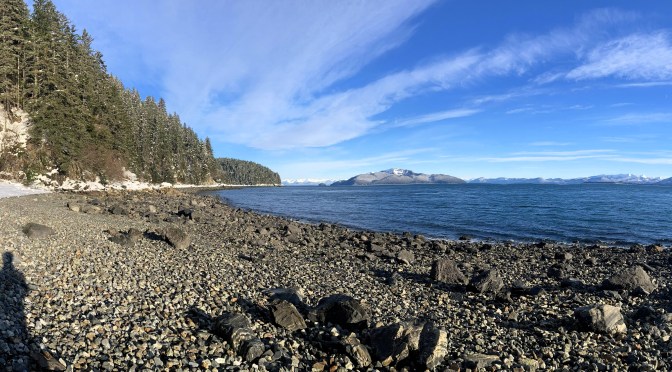
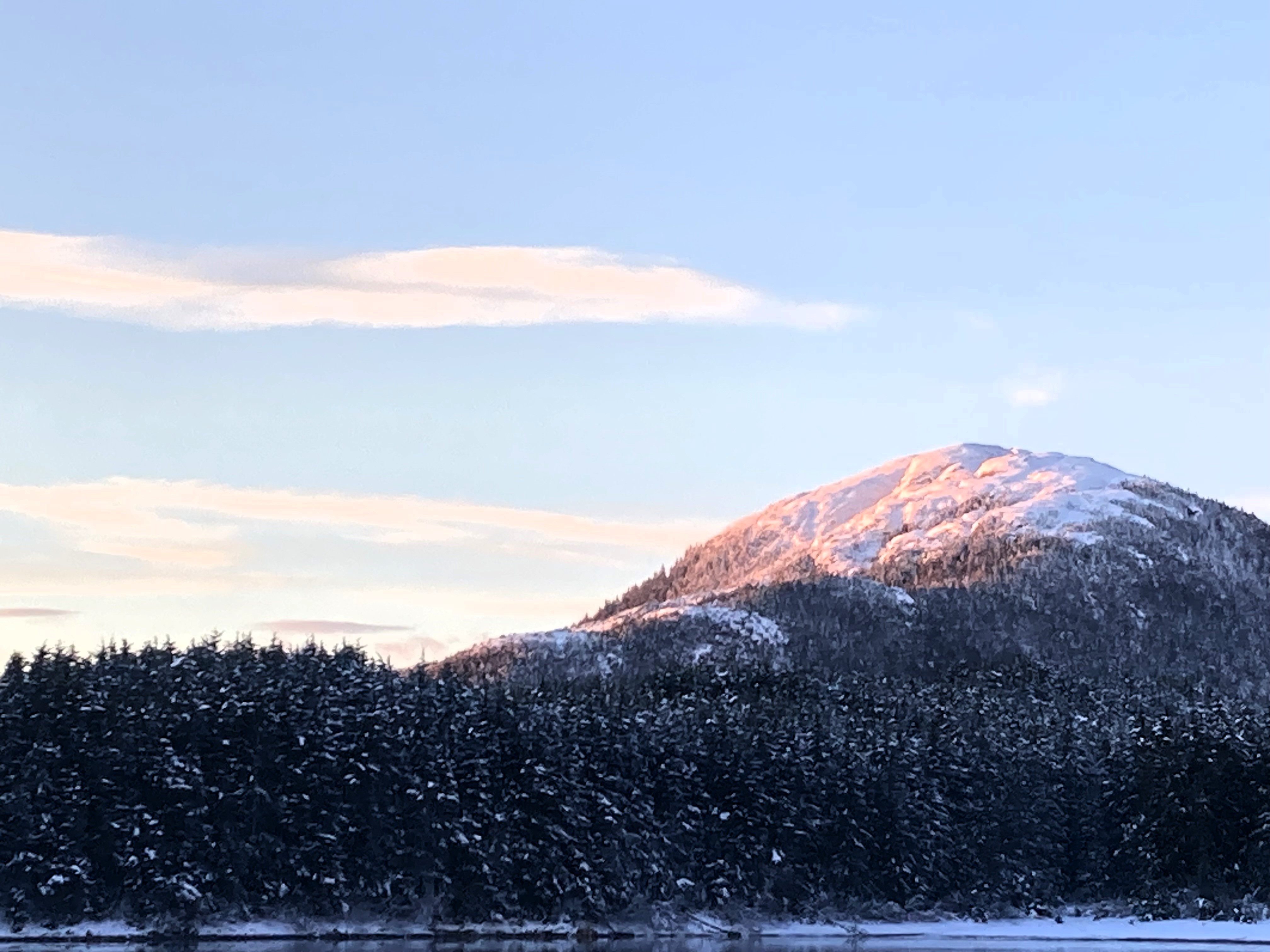
The rising sun turns the hillsides purple. My kayak cuts through the water, leaving an ever-expanding “V” in its wake. Even with a down jacket, I can feel the bite of morning cold. The low tide leaves an exposed strip of rocks and kelp, frozen and crunchy, patiently awaiting the sun and thaw.

For 72 hours the Icy Strait Corridor has endured an unrelenting snowfall. Winds buffeted the trees and left huge drifts piled along the beach meadows. I shoveled five times trying to keep up with the snow’s metronome consistency.
Boats in Juneau’s harbor sank, the land frozen in winter’s fist. Trees bend double beneath the load. Cracks echo through the forest as these proud sentinels break under the weight.
At last, we have a respite, a window of calm before the outflow returns with gusts of 40 knots.
I have waited for this day. Snug and warm next to the woodstove I would peer through the windows at the blizzard and wonder how any animal could survive such conditions. This is my chance to find out.

The benefits of old-growth forests could fill volumes of text. The contrast between the muskegs and woods is shocking. Four feet of snow fill the open areas of the island with perhaps half that amount beneath the trees. It is these big trees, their massive boughs enveloping the land in a protective embrace that give the deer a chance. These causeways give them routes to the beaches, where they can slog through the drifts and find relief below the tide line. The table is set. Rockweed and bull kelp torn from their holdfasts wash ashore and provide some of the only accessible forage when snow of this magnitude hits.
I paddle south along the island’s southern peninsula, scanning the beaches. The first one yields a doe and fawn that scatter into the woods as I glide past. Eight more deer congregate along a 300-yard stretch while a small cove no more than 50 yards wide holds another six.
I bring the binoculars to my eyes and watch, the boat bobbing in the gentle swell. The rut is over, and the bucks have dropped their antlers. It will be something of an easter egg hunt in the coming months to find them hidden in the moss.
These deer are in my parking spot. I’d planned on landing here and climbing to the other side of the island to inspect the long stretch of east-facing beaches bathed in morning light. I hover offshore and watch them through the binoculars. Five adults and a yearling. They look in good shape, still fat and healthy.
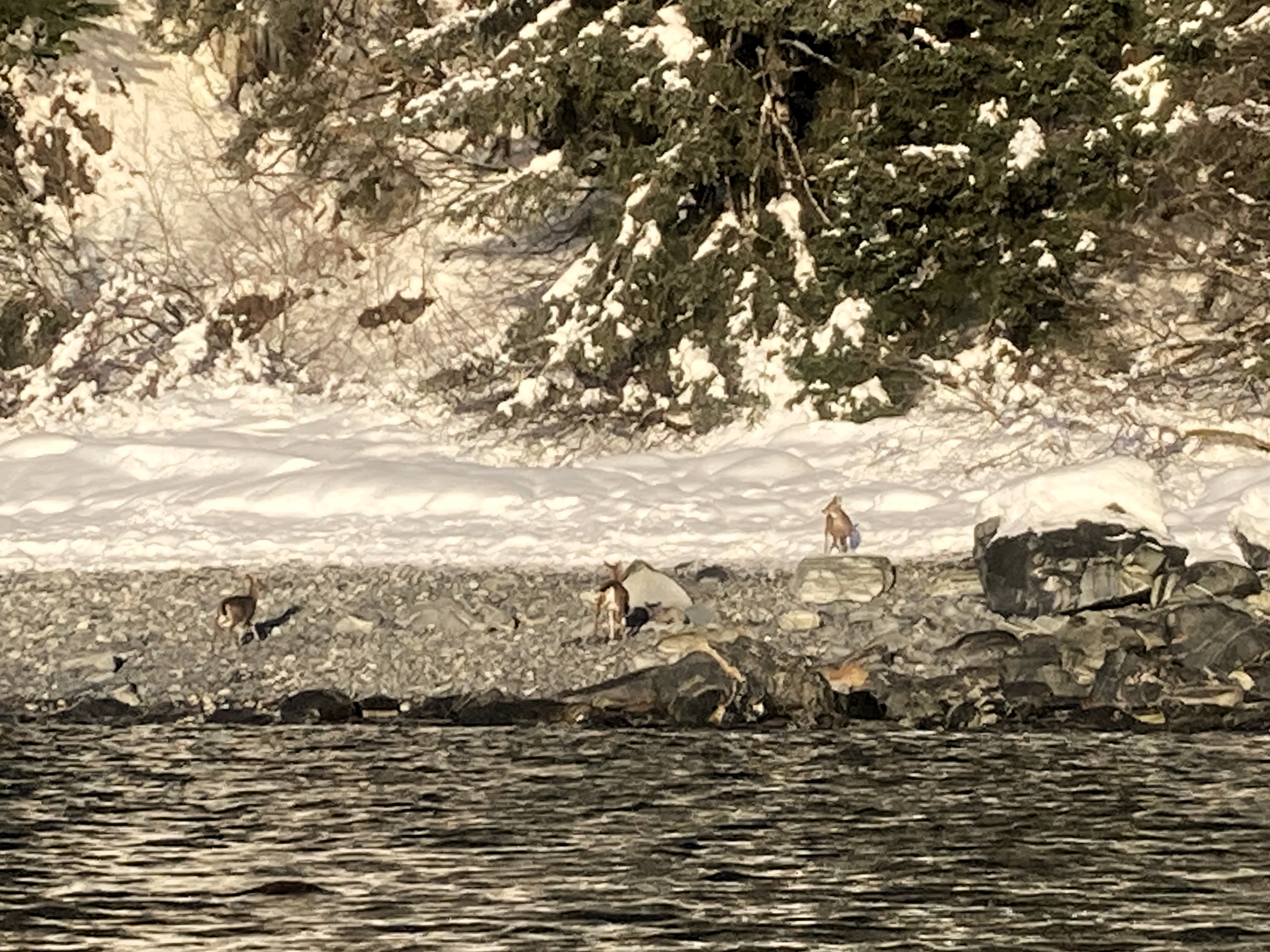
Deer are ruminants, meaning they chew their food multiple times and have specific bacteria in their gut to maximize their caloric intake. But every food type has its own bacteria, and there’s a delay as these new bacteria colonize the stomach. Switching overnight from a diet of forest groceries to kelp can have dire consequences. A deer can eat kelp all day, but until the bacteria catch up, they may as well be eating dirt.
The six are foraging voraciously along the shoreline. How long had they waited for this opportunity? It’s easy to imagine them hiding beneath large hemlocks, watching the never-ending snow pile among them with stomachs growling and fat metabolizing. Landing will scatter them back into those snow-laden woods and I can’t bring myself to do it.
I paddle onto the next little cove.
This one too is spoken for. Three more deer graze among the rockweed. They’re so engrossed in their work they don’t notice me for several minutes. A large rock cuts this cove in two, and when they move to the far side, I ease my kayak into the beach, step out, and drag it to the snowline. I peek over the rock and see three sets of ears tuned to my frequency. Upwind of them they maintain a curious demeanor. A shift in the wind will send them scurrying, perhaps getting a whiff of the venison meatballs I’d eaten the night before.

I step towards the woods, sink through the snow’s crust, and posthole to my hip. It’s a quarter mile to the other side and it takes fifteen minutes of panting, gasping, and trudging to reach it. Sweat drips down my face and my lungs burn. How do these deer do it? By the time I reach the edge of the woods, I’m exhausted. It takes several minutes before I feel ready to climb down the cliff face to the rocks below. I remind myself to look for snowshoes when I get home.
My clumsy ascent sounds like a gong on the beach below. I watch two more deer scatter through gaps in the trees.
Whitecaps adorn Icy Strait, and Lemesurier Island looms in the distance, its forest frosty and frozen. I glass the beach ahead and see a lone deer near a washed-up hemlock deadhead.

Surprising. I figured there’d be more. I hug the waterline as I pass the hemlock, the deer watching suspiciously. On the other side of the log, another deer materializes, I stop, look up the beach, and they seem to apparate. One, two, three, four… eight. Eight more clumped in two groups of four.
I never think of deer as social animals, but they are. They may not have reliable herds, but there’s no doubt they enjoy each other’s company. Clicks and loose friendships form, safety in numbers, community. It resonates. Reminds me how alone I am.
There’s a difference between alone and lonely. I have enjoyed my solitude, the quiet, and the reflection. But there is no denying that I still reflexively reach for my phone when I remember an old inside joke, hear a new song from one of our bands, or find an Instagram reel she needs to see. Old habits, they die hard.
The beach bends, and I creep among the boulders, peaking over the top of the last one. The 30th deer of the day has her head buried in the snow, rising every minute to slurp down another slippery string of kelp. I advance when her head’s down and freeze when it rises until I’m 50 feet away.
I settle on a boulder, open my backpack, and invite myself to lunch. As I munch trail mix and guzzle water a fawn stumbles out of the woods and joins its mother among the kelp. The scene brings an emotional response I wasn’t ready for. The pair moves to a young hemlock, and they strip the needles the way a bear forages for berries.

Icy Strait sparkles. The snow-covered mountains and hills pop. Eagles soar on the thermals. You can hear the land exhaling after the deluge of the previous days. There’s a tug at my heart, a desire to share this moment with someone. Some of House Stark’s words hover in my head.
“When the snows fall and the white winds blow, the lone wolf dies but the pack survives.”
The tide is rising, and the sun setting. I leave the little family to their work, padding back down the beach past watchful eyes and into the woods. Through the trees, I see a glimmer of red. No matter how far up the beach I bring my kayak, I never stop worrying until I see it right where I left it.

The trio of deer have disappeared, leaving the beach unoccupied. I launch and enjoy the sun on my face as it begins its downward trajectory over the Pacific. I feel full and content as I paddle for home, again overwhelmed by the incredible beauty of this place. The southern end of the Fairweather Range peaks above the islands to the north, with 14,000-foot peaks, and an icefield you can hide Rhode Island in.
I stop in front of the next cove and smile. The deer are still here. No longer foraging they lay among the sunbaked rocks. I can feel their contentment, their relief. The new bacteria in their stomachs beginning to work, metabolizing the kelp and hemlocks and blueberry twigs. Feeling warmth for the first time in days. A chance to breathe, to rest and recuperate.
I knew today was coming, had the 16th circled on my calendar even as the snow continued to pile up. The deer have no such luxury. What concept of time do they have? How long had the last three days felt for them? For those little fawns experiencing the first truly hard moment of their life? But now, the sun was out. More storms are coming, another foot of snow is expected in a few days.
Why worry now? With bellies full and warm rocks to rest on.
Storms come and storms go. We can’t always forecast when they’ll begin, end, or start again. Some may never end. Some may never come. I saw myself in these deer, huddled beneath a big hemlock, waiting for the blizzard to end, not knowing when. Clinging to the faith that the clouds will lift, the sun will return. There will be warm rocks and bull kelp for everyone.
I begin to feel that sun. Stepping out of the woods and powering through the drifts, knowing relief is near if I plunge forward just a little further. I can feel their eyes on me. And through the distance and isolation, sense the eyes and love of my own pack. The winds may howl, but I am not alone. The bow spins, the water parts around the keel and points for home, grateful that when the sun sets and the tide touches snow that I don’t have to retreat to the woods for shelter.
Inside the cabin, I pull out my notepad and consult my notes. 12 miles traveled in total, and somewhere between 38 and 45 deer depending on how confident I am I’m not double counting.
Minerva coils around my legs, reminding me it’s almost dinner time. I step outside and am greeted by a crescent moon. The hills are bathed in purple again. The winds have begun to rise, and the trees start to bend. I wrap my jacket around me, step back inside, and whisper thanks to the neighbors hovering somewhere between ocean and snow.


 Raincoast Wanderings