Tag Archives: orca

Escape From Hanson Island

For a week the weather services proclaimed that Wednesday, April 15th would be calm, clear, and peaceful. It would be a fitting and tranquil journey from the lab to Alert Bay, a promising start to what would be a week long expedition that would eventually lead to Gustavus, Alaska. On Tuesday night I checked the weather one final time, more out of sentimentalism than anything else, and saw Johnstone Strait caked in red. “30 knot southeasterly winds,” it boldly proclaimed. I rolled my eyes and glanced out the window, the cedar boughs were fluttering in a benign and apathetic way, I shut the curtains and crawled under the covers.

The next morning we awoke to the windows rattling, though the rain showed merciful restraint. We packed and began to debate tersely the best strategy for placing a bulky rabbit cage, a squirming cat, and countless bags and boxes unto the deck of a pitching boat.

An hour later the June Cove pulled around the corner, bobbing in the churning bathtub that was Blackfish Sound. We threw our belongings unceremoniously aboard with rabbit and cat perched atop the pile, and watched the lab fade from view. In the stress and rush to load the boat before the waves could put it on the rocks, there was little time for nostalgia and farewells. Instead of casting a final look at the lab deck, where I had been bombarded by sun, rain, and a rotating cast of marine life, I diligently jabbed a long two by four into the rocks as the bow of the boat slowly turned toward open water.

The water deepened and waves broke over the bow, foam and white caps littering the ocean. Paul peers through the blurred windshield as we hit the crest of a wave and slide down, the screech of nails emanates from Penny the rabbits cage as she slides back and forth. Completely unperturbed, she continuously tries to stand on her hind legs as the boat rolls, dead set on glancing out the window.

Paul glances over at where I stand, staring out the window into the crashing waves, willing the boat forward. He catches my eye and grins, “the escape from Hanson Island!” he shouts and the tension breaks.

Perhaps it was best like this. No tears, no long, lingering hugs. Leaving Hanson Island is removing a band aid, it’s best to just rip it off. Thirty minutes later we reached the relative peace of the dock, the first of four boat rides behind us. Again there would be no lingering as Paul needed to rush back to the lab before the tide ebbed too far, exposing the June Cove to a night of gale force winds.

And just like that, it was done. We stood where we had eight months ago, with an overstuffed Nissan Pathfinder and a pair of pets staring confusedly out the window while the wind buffeted us.

To our immense relief, our reliable Pathfinder sputtered, coughed, and after several heart stopping seconds, roared to life and we wove along the shoreline to Paul and Helena’s home for the night.

We curled up in the lap of luxury. Hot baths, ice cream, cold beer, electric heat, baseball, it may as well have been the Ritz Carlton hotel for all we cared. But it was hard not glance out the massive windows down Johnstone Strait as the light slowly faded, the outline of Hanson Island still visible and know that it would be months before we were forced to contend with the beautiful inconveniences that only life on an island can bring.

Perhaps the weirdest moment came when we finally crawled into bed. The room was as silent as a tomb and it was completely unsettling. For months we’d been passively listening through the night as the hydrophones reported the sounds of the ocean. The rushing water of a gale, the crackle of a dragging hydrophone, the low pitched growl of a tug, the whistles of dolphins, and the call of an orca that sent you flying from the covers. Now it was all gone, the silence leaving a strange ringing in our ears.

Rubbing Beach Ideologies

The water’s perfect, with the aqua green reflection off Vancouver Island’s mountains that I love. It’s as calm as a puddle, the sun shining high above in a cloudless sky. In the past couple weeks, the sun has finally begun to radiate a warmth that can be felt through your jacket. It’s not the benign passive glow of January but the first hint of summer’s rays, and it feels euphoric. It streams through the back of the boat, warming our backs as we glide down Johnstone Strait towards the mammoth mountains above Robson bight that stand like kings on their thrones. The strait’s empty despite the summery weather and our boat is nothing more than a toy in a massive bathtub.

We angle across the strait, the bow pointed past the bight towards the rubbing beaches. Fuel levels running the cameras needed to be checked, and it behoves one to never pass up the chance to visit the orca’s holy place. But as we pass the mouth of Robson Bight, something makes me slide the boat into neutral. Many somethings are breaking the surface of the water, like ink blots on a clean sheet of paper, disappearing and reemerging. The disturbances are far too small to be the orcas we secretly prayed we’d come across, but it was the next best thing. The pod of dolphins meanders slowly across the strait toward Swaine Point on Cracroft Island and we fall into line on the left hand side of the massive group that easily numbers 100.

Brittney stands on the stern of the boat, one hand gripping the vessel, the other clamped on the camera. In response to a signal we cannot here, the mass of dolphins swerve left, pointing west, pointing towards us. I slide the boat back into neutral and turn the ignition, at the mercy of the currents we turn perpendicular to them and wait. A flash of white catches my eye as like a ghost, the first dolphin glides underneath us, his body turned sideways, an invisible eye staring up at me.

From behind me I hear Brittney gasp in awe as the flood surrounds us. The camera falls limply to her side, how do you even begin to capture this? Some surface calmly, their bodies barely breaking the surface, while others rocket clear of the ocean seeming to hover frozen in time for the briefest moment before slipping smoothly back beneath the waves with barely a splash. Dozens cruise beneath us, the calm seas and clear water of early spring enabling us see dozens of feet below as the torpedoes shoot past. It takes nearly five minutes for all of them to go by, the sounds of their blows and splashes rapidly fading as we bob in their chop still under the spell.

The boy in me tells me to start the engine, race ahead of them, and do it again. But what a insult to the gift we’d been given, it was good, but not enough, we need more. How human, selfish. I push the thought out of my head and we continue the other way, past the bight and minutes later, land with a soft crunch, land at the rubbing beach. With no idea when our next trip here will be, we linger on the beach, feeling the pebbles slide and crunch beneath us, coaxing the few rays of light that penetrate the trees onto our faces. With just a week left before our return to civilization, our imminent return continues to dominant our conversations.

“There’s some things I miss,” I admit, “unlimited bandwidth, Alaskan IPA, hot showers, other people… but I don’t, crave these things. It’s funny how many luxuries we begin to assume are necessities.”

“How many people think they can’t live without texting?” Brittney asks, “or hot running water, or electric heat, or indoor plumbing?”

“It’s a state of mind, it’s all we know, we’ve never lived without so we conclude that they’re essential. It makes sense.”

“But we clearly don’t need them.”

“We were willing to let go.”

“Think some people can’t?”

“I think they can… I just don’t think they want to. It took me awhile,” I say, “I’ve learned to sit quietly here, that my brain doesn’t have to be constantly entertained by outside influences, like mindlessly scrolling through Facebook, or netflix. That sitting on the rocks watching the tide ebb can be enough, it’s almost meditative.”

We sit in silence for a moment, “I still scroll through Facebook mindlessly,” I admit.

She laughs, “I know.”

Across the strait on Cracroft Island the sound of a saw floats across the strait, a sickening crack, and a boom as another tree meets its’ end, the clearcut steadily grows, the gash opening wider, the runoff like blood flowing downhill into the ocean.

We fall back into silence, the sound of machinery dominating our ears, the incessant hum of a tug motoring slowly westward becoming prominent. Suddenly the land feels too crowded, we’re hemmed in by people, a tug and a tree crew is all it takes.

“It’s funny,” I point toward the tug and the clearcut, “this feels full now.”

I pause and look instead down the beach where everything is pure, there are no right angles here, no perfect circles. For a moment I want to run into the woods, into the last unlogged watershed on east Vancouver Island and disappear. To hide out till summer, with nothing more to do than watch the orcas swim by.

Hanson Island Life Lessons

Every week and a half the fridge begins to look bare, the tortillas are gone, the beer and wine but a distant memory. The marine weather report is lit up in crimson, gale warning in Queen Charlotte, storm warning in Johnstone Strait, rain, wind, small craft advisories. On a good day Alert Bay is just thirty minutes by boat away, weaving through the Plumper and Pearce Islands, sending torrents of frothy white water over the deep green waters is nothing short of cathartic. It’s just finding enough of those days that can be the struggle.

And so we look for “windows.” Six hour blocks where the wind dies, the rain lessons, and the boat floats. As the storm inhales for another blow you run for town before the next exhalation. But after eight months of this game, pulling the boat up and down the beach so water lifts it off the rocks at just the right time, it feels commonplace. The fact that we once lived half a block from a Rainbow Foods absolutely absurd. We’ve traded the convenience of stores, bars, and restaurants for the simple tranquility of wilderness.

In a few weeks we’ll be gone, on our way back to civilization. At least our definition of it which entails residing in a town of 350 people. But right now that feels more like a metropolis than hamlet. Certainly there are things we’re looking forward to, I mean, we’ve talked to just a handful of people face to face this year. No longer having to correlate tide height and wind with fresh lettuce will be convenient. And I really do miss Alaskan IPA.

But more than anything, I’ve learned a lot about myself over the winter. I landed my first paid writing gig, wrote thousands of words for a novel that I’ll probably let no one ever see, and am just a season and a half away from watching the show, “Friends” all the way through.

Brittney loves the website, mindbodygreen.com and there are some great articles and information to be found. She hates me for pointing out however that the site is often flooded with “top 10” lists. Top 10 ways: to know your man has a good heart, yoga pants, fat burning foods, etc. Now it’s all she sees… she may never forgive me. But I’m going to conform, and walk through the ten things that I’ve learned this winter on Hanson Island.

1. How ever much time you think you have until the boat is aground, subtract by ten minutes. You’ll save yourself a lot of disappoint, frustration, and expletives.

2. Mice will find a way into your house. Steel wool, blockades, and a cat will only do so much. Accept the inevitable, keep the counters clean, and check under the propane stove frequently.

3. It is perfectly acceptable to wake up in a cold sweat because you just dreamed that you could hear orcas and aren’t recording.

10537056_10153151080044852_18244022817751455_n

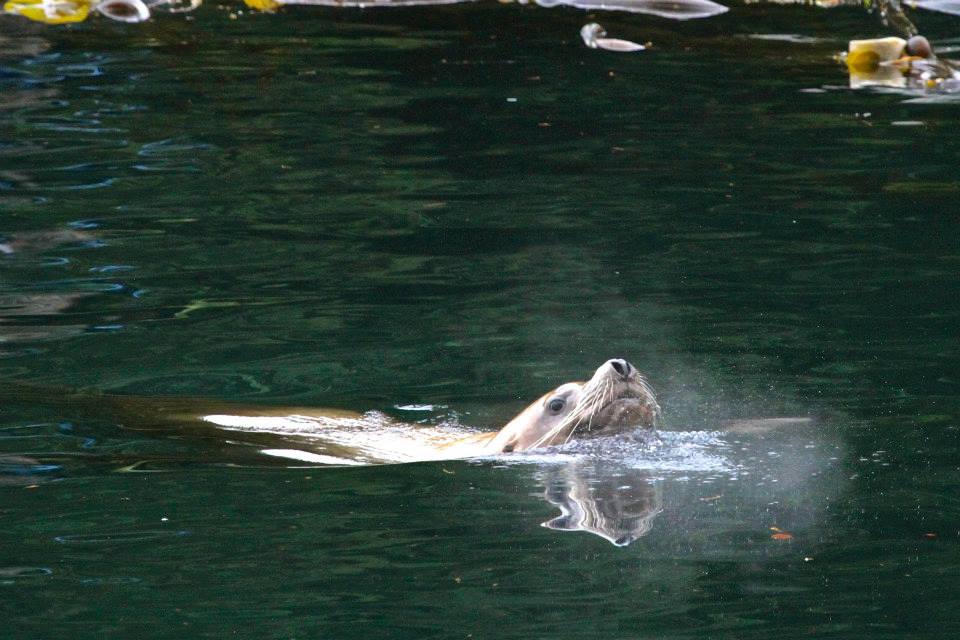
4. No matter how much you hoot and holler at them, Stellar Sea Lions will not give you the time of day.

10659202_10153342628774852_4448842526100652252_n

5. Orcas love to call at dinner time, so you stuff your plates into a plastic milk crate box and lug it all over to the lab and have dinner with headphones on.

1901153_10153342624724852_3285441612895050163_n

6. Bath Days are a gift from God and should be worshipped as such.

10995804_10153726757494852_7811731726412708212_n

7. Mink will live under the house, they’re cute but smell terrible, your cat will want to make friends, the mink will not acquiesce. 11081015_10155300238395858_6083581184589343527_n

8. Porch baths in December are a necessity. Treat them like a Nascar pit crew changes tires. If you’re not out and back inside in under five minutes you are a) doing it wrong and b) probably borderline hypothermic.

9. Bring pets. You’ll need someone to talk to when your wife gets mad at you for ruining her favorite website.

10994155_10153690504119852_621681021897676100_n

10. There is nowhere on earth like this place, nothing can replace it or come close. So enjoy every moment you have here regardless of the time of year.

_MG_9262

Stepping Back

When I first came to Orca Lab in 2008, I expected some sort of sign. Some sort of intimate and personal encounter with the whales to justify the sacrifices, work, and effort I had gone through to reach this place. Orcas, it turns out, have little interest in storybook endings. They went about their lives as if I were invisible. It was odd, the orcas owed me absolutely nothing, but so convinced was I that some spectacular, “ah-ha” moment would arrive, that to leave without having gotten within 200 yards of a whale was, not a disappointment, but a hit to the ego.

“Don’t you ever get tired of watching whales?”

It was a common enough question working on a whale watching boat, and I suppose it should have been predictable. I mean, the majority of my clientele had work that they actually looked at as, well, work. I just saw it as a free whale watch every day, like someone had offered me season tickets along the third base line for free. How could you get sick of that?

The question would always rise to the surface just as the humpback was slipping below, meaning I had 5-7 minutes to explain why no, I don’t get sick of watching massive aquatic mammals breath. I’m nothing more than a commercial while the show dives 200 feet below us for another mouthful of herring. The guy who banters on stage while the band tunes their instruments.

“They’re like potato chips,” became my generic reply, “you can never say enough.”

But for those that would probe, that actually wanted to know and weren’t just making conversation after realizing that no, your iPhone will not get service out here, I’d go a step further.

“Because you never know what might happen. If someone calls and needs you to take a trip… you take the trip. The last thing you want is to come home to a phone call, and find out you missed the trip of the lifetime.”

But 100 yards stands between the deck and a trip of a lifetime. For the many who have read the stories of Erich Hoyt, Paul Spong, and Alex Morton, it’s a tantalizing distance. We want a moment like Morton had, being led by the A5s through the fog, or Erich Hoyt in his rowboat, bobbing in the bight, surrounded by whales.

But that age of orca research and watching has come to an end. With restrictions and limitations enforced, we’re at the mercy of the whales to swim that football field distance and set the stage for the sort of encounter we crave. Perhaps we love them too much. Our addiction as harmful to them as potato chips are to our arteries. We crave these moments, and stand breathless on the deck of a swaying boat, hoping for a flash of white, a bubbling surface, an eruption of carbon dioxide as the whale breaks the water feet from us.

And it does happen. After three years and countless hours on the water, I had a few holy s— moments; I was splashed by an orca, had one circle the boat, it’s oval eye patch staring into my soul, and had 14 humpbacks materialize from nowhere, surrounding us in a bubble net of desperate herring. And all it took was thousands of hours, and the sheer luck to be in the right place at the right time.

Six years later I returned to Hanson Island, reluctant to share some of the most intimate whale experiences with my fellow volunteers. I had been extraordinarily lucky to have a job that allowed me to buy a lottery ticket every day and cash in on the minuscule odds. But that summer, I found a much more rewarding and fulfilling experience. As much as I’d loved my time on the water, a wriggling feeling of guilt had grown as I thought about the deafening noise my coworkers and I made in their home.

The whale watch industry grew and with it, the pressure on the humpbacks and orcas until every daylight hour was spent in the company of at least one, and almost always several boats. I couldn’t measure how much of a disturbance I was causing, but the uneasy feeling in my stomach told me however much it was, my conscience was not ok with it. I began to despise the 700 HP engines on our stern, giving us the authority to decide when the whales could be free of us. Were these experiences worth the boat noise and fuel? The hours hovering above their kitchen table, knowing if it was up to them they’d probably have us disappear?

Instead of intimate face to face encounters, I craved anonymity. I wanted to see, but not touch, observe but not alter, be it from 5 yards or 500 didn’t matter. Perhaps I’m biased. After all, I can still see that orcas tail rising off the stern of the boat, sending water cascading over us. But nothing felt as rewarding or special as a misty, fog drenched morning at Cracroft point.

As the tide ebbed I inched down the rocks, slipping and sliding over the kelp, my camera slung over a shoulder, a lens the size of a baseball bat swaying ominously. Stopping just shy of the water I looked east down the strait, the sun cutting slashes in the clouds ahead of the oncoming rain storm. Right along the Cracroft shoreline I saw them, the A23s and A25s plowing through the strait, pointed directly at me. I raised the camera, Paul’s words ringing in my ears, “get A60s photo.”

The group filed past, exhalations like gunshots ricocheting off the rocks. An image of A60s dorsal flashed in my mind, like the face of someone I hadn’t seen in years, the big notch two thirds of the way up the dorsal made him easy to ID, and as the picture filled my head, his dorsal filled my lens.

I held my breath to steady the camera, and pushed the shutter, immortalizing Fife on a 6 GB chip. He couldn’t have been any closer than 150 yards, a distance many in the whale watch industry would yawn at. But a tear slid down my face as he disappeared. A few years ago I’d have wanted Fife to know I was there, to see some acknowledgement of my love and interest. Now… I wanted anything but that. Just to have a brief window into his world, and know that his calls were blowing out the speakers back at the lab was plenty.

The whales slipped by, milling briefly in the entrance of Blackney before steaming north. As if waiting for them to pass, the rain arrived, drenching me as I stood on the deck, reveling in the knowledge that they had no idea I was there. The group slowly faded from sight, there fins merging with the streaks of rain and background of the islands. But I continued to watch until they vanished from view. After all they’re like potato chips, you can never say “I’m full.”

The Magic of the Town Run

The tide is ebbing, and the boat is stuck, like some hauled out metallic sea lion. An expletive escapes my lips and with one final push the boat slides over the rock and floats again. The vertical rock face seems to have just enough of these little ledges, and like some magnetic force, always seems to suck the boat right to them.
With the boat free, the loading begins. Empty gas cans, dead batteries, and garbage bag filled to burst with pungent clothes. Brittney appears, laden with more black hefty bags filled with trash and tied securely. The Hanson Island rule is: bags with garbage are tied, bags with laundry are left untied, an important step. Just ask the volunteer who tied his laundry bag, sentencing it to doom in the landfill.
By the time everything is piled in, there’s precious little room to reach the seats. The boat already makes me feel like Gandalf in a hobbit hole, but filled to the brim makes it feel like crawling through a cole mine. Finally I manage to pretzel my legs behind the wheel and the boat floats free, drifting into the middle of the cove.
The engine roars to life on the first turn and we idle slowly past the kelp bed and into Blackney Pass. Free of kelp and rock, the engine roars to life, struggling to break free of the water and get on step with the heavy load. But the water is a flat calm this morning and we hang a left, bound for Blackfish Sound, Weynton Pass, Pearse Passage, and finally Alert Bay.
It is the most magical of days, the town run. An afternoon of hot baths, Paul’s sandwiches, and people. So many people. Just up the street from the dock is a tiny lot where the beloved pathfinder has sat patiently all winter. Ever week and a half she resignedly comes to life so that we can drive the one mile along the shoreline to Paul and Helena’s house.
I feel like a kid coming home from college. A massive bag of laundry in hand, anticipating food, beer, and canned goods. After months of taps producing nothing but frigid water, feeling hot water spew into the tub makes me flinch. We had eschewed baths in favor of pouring hot water over ourselves a couple times a week on the deck. Scrubbing frantically while we shivered in the wind and the rain. So when it’s my turn, I nearly fall asleep, the hot water lapping at my face.
From the house you can see Johnstone Strait, the Hanson Island shoreline appears merged with the trees of Cracroft and the Plumper Islands. The water stays flat, but the sun is already beginning to set.
Alert Bay is far from bustling, but feels as congested as a city as we squeeze along the narrow road.
“So many people,” Brittney says as we wait for two cars to go by.
The grocery store is nearly sensory overload. For days we’d talked about the things that we’ve been craving but unable to reach. Now we just stare blankly at the shelves, a crumpled list in hand. Overwhelmed we pile heads of lettuce, carrots, potatoes, tortillas, and of course coffee into the quickly growing pile. Tragedy strikes when we reach the popcorn and find the shelves barren.  For a minute we’re too stunned to speak, mouth open in shock and horror. No popcorn? Why did we even come into town? Sadly we head for the checkout our overflowing cart suddenly feeling empty.
Loading the minuscule boat becomes a cramped game of tetris. Anything that can fit into the tiny hold in the bow is shoved unceremoniously in. Filled gas tanks and charged batteries bring the water’s surface a couple inches closer to the window. Bags of food, lettuce leafs poking curiously out the top are stacked as gently as possible on top of the clean laundry.
After some coaxing, the boat obediently gets up on plane and sends us rocketing home on the flooding tide. We reach the lab just as the light begins to fade but the slowly flooding tide has left us well short of the cove. Grabbing as much as we can, we walk and stumble up the rocks, dumping groceries and water jugs on the deck, leaving the batteries and fuel tanks for a higher tide.
Opening the door of our house, a white and brown blur shoots past as the cat sprints for freedom, incensed at his day long imprisonment inside. The rabbit is even more excited and wastes no time inspecting every bag until she finds the apples and attacks with the ferocity of a Great White Shark. By the time the boat is tied and the groceries stored, it’s dark, the fire slowly warming the house once again.
We collapse on the couch, town days always seem to wear us out, probably all the hot water. Now if only we could find a pizza place that delivered.

Collect Experiences. Not Things

For the first time in years I want something that I cannot have. The number in my bank account is woefully too small to buy the house that Brittney and I have been salivating over for the past two days. It’s not a mansion with enough square footage to fit a basketball court. Nor does it look out over some ridiculous ocean side vista. It’s just a humble, quaint, hobbit approved house on a tiny road in Gustavus, Alaska. And I can’t have it.

Since graduating from college, I’ve been rebelling against the status quo. Bouncing from seasonal jobs, spending months in New Zealand and Canada and loving every minute of a life that we seem to create one step at a time. But as we’ve wandered, we’ve begun to feel the need to have a home base. A place where kayak gear, camera equipment, and pets can pile up without fear of how on earth they will fit in the Nissan Tetris in a few months. So we looked up houses in Gustavus and began to covet really bad. Houses are never an impulse buy. Thank God. Because I was looking all over the screen for the, “buy now” button like it was ebay.

We took a little crash course in down payments, mortgages, and interest rates. What else are you going to do a 9 pm on an island where you represent 66% of the population? Slowly we began to accept the hard truth that the dream was a long ways away. Though it didn’t stop us from scrolling through the photos one more time (so much natural light!).

In Victoria, British Columbia is the Phillips Brewery, the only microbrew beer I can find in Alert Bay’s tiny liquor store. Besides having a Peanut Butter Stout, which is freaking amazing, the inside of their bottle caps have the phrase, “collect experiences, not things.” For the first time in a long time I want, “things,” or more accurately, “thing” in leu of, “experiences.” Weird.

Of course, if we hadn’t been jet setting, going to baseball games, and had, you know, worked the past seven months, we might be able to make it happen. But I sit in a house perched on the rocks over Blackney Pass. A storm beginning to build after a calm red sky morning. Yesterday was monopolized by calling orcas, sea lions bark and roar at all hours of the day, and the stars pop with no interference from streetlights. Sure, I could be sitting in that house today and I’m sure we’d love it. We’d also have a thirty year financial commitment that would really make it tough to live up to the website’s namesake.

I’m sure someday we’ll truly be ready for that sort of endeavor. But when we do, I want there to be no regrets, that it’s done on our terms, on our time. That we don’t sit in our house with fantastic natural lightening and wonder what could have been. Someday we’ll have a doormat that says, “Cannamore” and a sign that says, “all guests must be approved by the cat.” But until than, I’ll savor the adventure, the sweat, the and cursing as I try to cram one more duffel bag in the back of the car.

Collect experiences, not things. Experiences after all, don’t need a house to be stored in.

Envisioning a Happy Ending for Lolita

For the past few days my facebook feed has been inundated with posts concerning the protest on the behalf of Lolita, the imprisoned southern Resident orca at the Miami Seaquarium. The activism and awareness spurred from the documentary Blackfish continues to gain momentum and the pressure continues to mount on those that guard the tanks.

The scene of Lolita breaching in cold north pacific waters surrounded by her family, the San Juan islands in the background is certainly a powerful, and romantic one. An image and ending almost too good to be true. Yet we are many steps away from that reality, and on borrowed time.

The conversation unfortunately begins and ends with those that, for legal purposes, “own” Lolita. The proposals seem to be gravitating toward the idea of the aquarium deciding that the time has come to retire Lolita from the show business as a way of thanking her for her decades as a forced laborer. Some have suggested the positive media coverage would offset the loss of those that attend the aquarium solely to see the orca. It would be an incredible gesture, and sadly, a dramatic change in philosophy. She remains a massive source of income for them and it seems unlikely they would willingly part with her.

Just last year a U.S district judge threw out a case proposed by the orca network, PETA, and others protesting the United States Department of Agriculture’s (USDA) renewal of the aquarium’s license. Claiming that the marine parks tank was too small and in violation of the USDAs standards. The case was dismissed as the judge determined the animal welfare act (AMA) did not specify requirements for those already holding USDA permits. It is a frustrating and despicable minefield of red tape and bureaucracy that now seems firmly on the aquarium’s side. There appears to be no hope in the near future of government intervention forcing the release of Lolita.

Meanwhile National Ocean and Atmospheric Administration (NOAA) is proposing Lolita be included in the Endangered Species Act (ESA) since she remains a member of the Southern Resident Population. Public comment closes on the 24th of this month, if she does indeed qualify as a protected member of the population, the hope is that she would no longer be allowed to be used as a revenue stream. Should the motion pass, I’m confident the aquarium would fight tooth and nail to ensure that she remains where she is. A long legal battle would probably ensue, where, as we know, the system moves very slowly. The courts have already sided with the aquarium once for much flimsier reasons and I’m hesitant to believe that they would redeem themselves this time. I pray I’m wrong.

Which leads us back to the aquarium doing it on their own. Yes, Sea World stock is plummeting, marine park public opinion is at an all time low, and yet, Sea World’s response seems to be to throw more money at the problem and I imagine Miami’s response would be the same. It continues to confound me what my fellow man will do for profit but it is most likely the only voice that they will answer to. We must continue to ensure that revenue continues to fall, in hopes that they realize they must cut their losses and salvage what public opinion they can. They must reach a point however, where the cost of keeping Lolita is higher than what she brings in. It feels so taboo, dishonorable to make Lolilta’s case come down to money, but I fear it’s the only outcome with a happy ending.

So we will protest, we will hold signs and picket. Give copies of Blackfish to our friends that continue to attend the parks. Support animal advocacy groups, volunteer, and write our congressmen. Real change is happening and I pray that it comes before it is too late for Lolita, Corky, and the others.

The best case scenario may be a net pen, the waters of Juan de Fuca on her skin. After forty years of swimming in slow circles, it would be a miracle to see her travel hundreds of miles with her natal pod. She could hear the calls of her family, her relatives, and maybe remember what it means to be a wild whale after all these years. It’s hard to admit that she may have changed irrevocably, who wouldn’t after all those years alone. I may never buy a ticket to an aquarium, but would happily hand over my money to stand on the shore and see her in a cove, on the open water. No corny music, no tricks, no bleachers, no applause. Just a whale trying to be a whale again, chasing fish, and vocalizing without fear of the calls echoing off concrete walls. And know that the age of captivity, is coming to an end.

When the Outflow Arrives

Wool socks, down jackets, long underwear. All them and more have been deployed to combat the latest northeasterly outflow that has descended upon Hanson Island; freezing the intertidal pools, our waterline, and our toes. We had the bright idea last night of dragging our mattress downstairs from the loft and putting it at the base of the fireplace stacked with bark and fir, Penny’s house placed snugly in the corner. And while the cold seemed to paralyze us in the early morning light, numbing any motivation to rise from the comforters, the Orca’s seemed impervious to it all.

Shortly after nine we begin to hear the faintest Transient calls in Johnstone Strait, leading us to the lab where the temperature hovered just a couple degrees above freezing. After just half an hour of sporadic calling the sounds vanished as the whales disappeared into acoustic parts of the strait unknown. Silently I gave thanks that all I had to do to catch my breakfast was crack a couple eggs over a skillet. I don’t think I could catch a harbor seal in this weather.

But despite the cold, the view atones for it and than some. The palest of blue skies and the whispiest of clouds frame the mountains on Vancouver Island, their peaks clinging grimly to their traces of snow, illuminated in the weak December light. The solar panels greedily suck in the beams’ power, giving our generator a belated reprieve. Blackney Pass sits immobile, or at least as still as it can as the tides pull the waters north and south cutting trails in the surface like tiny intersecting roads. It’s still odd to have Orca Lab so quiet. Besides the occasional Transient celebrating its catch the speakers tell the story of cycling hydrophones, insistent tugs, and at low tide, the cries of eagles as they soar past.

The beauty and peace is priceless and there is little more soothing or funny than ten Harlequin ducks bobbing into the cove every morning chirping at one another as they cut tiny wakes through the water. They dive one at a time, vanishing in the blink of an eye, their bodies barely visible in the dark green water, wings flapping incessantly. When they come up for air they shoot clear of the water like little rubber duckies bouncing on the surface, tiny bits of food clasped in their beaks.

But the deep waters of Blackney feel empty with no Guardian or KC or any of the other humpbacks that felt like friends in September, leaving us with the thirty odd sea lions down the beach for company. Today they huddle like a single sentient being on their rocks, stinky but warm I’m sure. It leaves us with nothing left to do but read, drink tea, and chop wood at a frantic pace before running back inside to the warmth of the fire that has been dancing for three days straight. The thermal pane windows have been worth every penny, thank you: Paul and Helena.

In the Holy of Holies

The boat slides into the rocks and triggers a memory. Not a visual one, or olfactory, but auditory. The sound of pebbles racking against the hull of the boat almost makes me turn around, half expecting to see a dorsal fin gliding across the water behind us. Both boat and orca move the smooth, tiny rocks of this beach sound the same way. But today we were alone, just the two of us cautiously approaching the main rubbing beach of the Northern Resident orcas.

I step to the stern of the boat and look back over the water. It’s weird to see for the first time a place I feel I already know so well. High atop an old weathered tree hangs a white box looking for all the world like a security camera. For a summer that was my keyhole. And I would press my eye against it as close as I could, drinking in the scene. But now, for just an afternoon, I got to stand here and see and smell and feel a piece of orca lore. If the bight is hallowed ground, this is the holy holies.

Twenty minutes east of Robson Bight as the orca swims lays this beach where, for all eternity as far as we know, the orcas have come. This beach, an outlier itself in a land of jagged rocks, steep cliffs, and deep water. The beach is smooth and gradual, the reflection of the trees turning the water turquoise, like some tropical paradise. In the shallows, sometimes with barely enough water to cover them, the whales come and rub vigorously on the smooth, quarter sized pebbles that compose the beach.

I step up and over the top of the boat and onto the bow, the waves rocking the boat gently against the shoreline, emitting the sound of rushing pebbles with every crest. I hop lightly off the bow and feel them crunch and slide under my feet. I step clear of the surf and see my footprints imprinted in the rocks. Damning evidence of my intrusion into this mystical place. I lay on the beach and, like the orcas, begin to squirm and roll back and forth on the pebbles, their sounds filling my ears. If it’s good enough for them it’s good enough to me. Brittney laughs and rolls her eyes as she steps gently from the boat. We talk in hushed voices, as if we’ve just entered a church, and prod slowly up the shore.

We had a reason to be here. The rubbing beaches are strictly closed off to the public, giving the orcas their own private sanctuary much like Robson Bight. But someone had to pull the batteries of the long defunct rubbing beach hydrophone, the victim of a fifty knot storm in October that had torn the cable free. Without this premise we’d go nowhere near this place, even in December, when the orcas hadn’t neared the beach in a month, it felt almost taboo to stand here.

A steep cliff makes up one edge of the beach and stretches out to a point into Johnstone Strait. I boulder up and walk to the edge, the bottom still visible even on this massive 17.1 foot high tide. I find the batteries and the second camera, the one that looks straight down into the water off the cliff face where the orcas would cruise right past just before they reached the pebbles. Like at Robson Bight I see them in my minds eye, cruising peacefully past, bound for their favorite spot in the strait. We get the batteries off the cliff and perch on a massive log washed against the shoreline. We dig out some food and stare out at the water, this unassuming little stretch of earth that means so much. Camera in hand I snap pictures while I eat, hoping to capture as much of it as possible and failing to do justice. It’s tough to think about leaving so soon, and I a great longing fills me to see the whales here, just once while I hide unseen in the bushes. It’s a dream that will have to remain a dream, and I look up at the camera, thankful that it gives me the opportunity to enjoy it from a distance. We climb into the boat and gently push back into the water, gliding across the brilliant blue/green waves, bound for the gray surf of the straight, the southeasterly starting to turn up the current.

Before we go home there’s one more place I want to find, and we shoot across Johnstone Straight, heading for Cracroft Island. As we reach the shore I slow down and and we move slowly west toward Hanson Island. I see the hollow wooden skeletons of a camp. Structures with no roofs or walls, tiny wooden platforms and benches on the rocks. This is it. I stop and look at this unassuming little kayak camp. “This is my birthplace,” I thought.

It was here, seven years ago that I had visited, kayaked, and fallen in love with this place. Straining my eyes for that elusive dorsal fin that has dictated so much of my life. I look behind me and remember the A36s, cruising west past our camp, oblivious to the life they were altering forever with every surface, every breath. A part of me wants to find a place to land, to step ashore here and crouch where I did those nights when the A4s swam by, allowing me to hear but not see. But the wind has other ideas, as does the quickly fading sun of the second shortest day of the year. We pick up speed and continue west, picking our way through the deadheads and kelp, tracing the footprints of the orcas that would be back to chase the salmon. Like they have every summer. For all eternity.

On Hallowed Ground

Traveling south from the lab and through the tiny bottleneck that is Blackney Entrance leads to the wide open expanse of Johnstone Strait. After almost four months and countless trips to Cracroft Point, the image springs to mind instantly. The high peaks of Vancouver Island casting a deep green shadow onto the water, turning it the color of jade as you approach the Vancouver shoreline. The mountain range seems to stretch on forever to the East down the strait, looming over the water with their mighty shadows extinguishing what little winter sun there is. It had been seven years since I had been in the strait past the edge of Cracroft Island. Yet I could still remember the shapes and curves of the shoreline.

Back home I would habitually pull out maps and trace the expanse of the strait, and mouth the names of places I hadn’t seen in years. Boat Bay, the Cliff, Robson Bight, the Rubbing Beaches. The bight and the beaches held a special lure, the forbidden fruit of the strait where no one was allowed save for the whales and the fishing boats. Locations I had listened to through headphones for hours but never saw. The bight is now an ecological reserve, set aside as critical habitat for the northern Residents, the boundaries expanding east to encompass the whales’ rubbing beaches. The maps show the bight as a subtle nick in the Vancouver Island shoreline. It’s as if the strait scooped out a chunk of the island with an ice cream scoop, leaving a crescent shaped divot. In the back of the bight sits the headwaters of the salmon rich Tsitika River.

From Cracroft Point, the lab’s out camp, you can almost make out the bight down the strait, straining your eyes through the glare of the sun, the small bay camouflaged by the steep slopes of the St. John, Tsitika, and Derby mountains, standing like sentinels, the guardians of the bay. It is in this unassuming bit of water, that so much of our understanding and knowledge of orcas has arisen. It is here that they have rested, played, and hunted for untold generations. The place holds an uncontrollable draw, a magnetic attraction pulling me in.

But of course, it is all closed off. Which, is probably for the best. And though the commercial fishing boats are still aloud to clog the bight as the sockeye run every year, it gives the whales at least some semblance of escape and privacy from those of us that perhaps love them too much. But there is no law against hydrophones, and on the east side of the bight hangs a crucial piece of Orca Lab’s research; the Critical Point hydrophone. Anything that makes a sound west of the hydrophone in Johnstone Strait is picked up and transmitted through a thin cord of wire, piping back to the lab the calls of orca, dolphins, and humpbacks as well as the drone of barges, fishing boats, and the abominable log tows.

As the days get shorter and the clouds thicker, the solar panels that power the hydrophones throughout the network begin to sputter. The batteries stationed are asked to supply more of the power each day until finally, they too begin to crack under the increased workload. Critical Point, shrouded in shade most of the time thanks to the mountains, was the first to begin to protest. Clicks and oscillations eventually giving way to hours of pure static, especially at night. The occasionally sunny day would give the batteries a brief reprieve but the only long term solution, was to replace them.

So last week, when Brittney and I came to town, we were met on the dock by Paul. Bouncing out of the car with his usually vigor, he excitedly announced that today was as good as any to take the one hour run from Alert Bay to the bight and replace the batteries. My chance to set foot in the hallowed ground had come and we climbed back into the minuscule boat thirty minutes later, prepared to battle an ebbing tide down the strait.

The sun broke through the clouds as we entered the bight, brilliant rays of sunshine stabbing through the gaps, illuminating the dark green of the mountain sides. The water becoming that brilliant jade on one side, sapphire blue on the other. Paul brought the boat to rest near the rocks on the far side and I clambered out, soaking in the beauty and silence. It was easy to see why the orcas loved it here so much. The water was calm and the bight would seem to funnel the fish toward the mouth of the river, giving them ample opportunity to catch dinner. The steep rock face we stood on fell directly into the ocean with no gradient. One step to many and you plunge feet down into the frigid waters of the channel. In my minds eye I saw an orca pass an arms length from the rocks, it’s massive body gyrating majestically feet below the surface as it cruised past, bound for the rubbing beaches.

It was, as I’d been told, “just trees and rocks and water.” But my prior knowledge of what lived here, what had happened here, made magic spring from the trees, rocks, and water. It was here that Erich Hoyt and his team had first dove with the orcas. Where Robin Morton had first filmed them rubbing their bodies on the smooth pebbles of the beaches. In these waters the A36s had swam during those nights when they kept me up in the lab, their calls echoing off these very rocks and into the hydrophone between my feet. And now, even if just for an afternoon devoid of orcas, I got to stand on this hallowed ground, staring up at the massive mountains and experience it all for myself.