Tag Archives: nature

The Environment is Not A Luxury Cause

I’ve struggled to write the past week and a half. Most of what came out was the equivalent of literary tourrets. In the past I’ve contributed to the independent website, Elephant Journal. I’d never had a submission rejected before. I’ve had two returned with, “Thanks but no thanks” since the election. Because somewhere along the way I became a ranter. I was spewing anger at everyone from Trump supporters to Clinton to Russia to myself.

I had, in other words, a case of the “guilts.” I wanted to reach out and change and impact everyone’s lives immediately. I walked into the labyrinth of Facebook comment threads. I tried to be rational, accepting, understanding. Three adjectives that Americans haven’t had a lot of opportunities to use this year. I felt myself stretched thin.

There is simply too many things to be concerned about right now. Sorry to bum you out. My liberal Facebook scrolling made it worse. Thanks Huffington Post, Occupy Democrats, and the Other 98%.

So what do we do now?

It’s one thing to read articles from the liberal media, comment on them and share them. I’ve done plenty of that. But this is not enough. It’s not enough to post status updates supporting those that are oppressed or attach a paperclip to your clothes. These are nice gestures, they’re great reminders, but in the long run, paperclips are not going to save us.

In the past Brittney has felt the way we’re all feeling right now, overwhelmed by the needs of the many. She wants to save the greyhounds, rid the world of plastic, and put an end to factory farming and animal testing. Even a genetically engineered combination of Michael Pollan, Edward Abbey, and Rachel Carson can’t do that. At some point we must accept that we cannot save everything. That doesn’t mean that we cannot show empathy or support the work of others, but we cannot allow ourselves to be bogged down and discouraged by every injustice. This is not meant to sound callous or dismissive, but time and energy wasted worrying about everything is time we could spend pouring ourselves into that which we are most passionate. Please don’t misinterpret passionate for more important. Protecting undocumented immigrants, Muslims, and the environment are all noble and worthy causes. This is not my attempt to rank levels of importance.

But I will be—as you may have guessed—dedicating myself to preserving and protecting what wild places remain. I’ve written before about the huge majority of Americans that support the preserving of National Parks, Refuges, and Forests. 80% of Americans say they’d even be  willing to pay additional taxes to keep these places healthy and undisturbed. How many other causes would four out of five Americans agree are worthy of taking more money out of their pockets?

But at the end of the day, these sentiments weren’t enough. We elected not just a president but a congress that not only is dismissive of public lands but are willing to explore the possibility of doing away with them. Now articles on these reports are somewhat convoluted and unclear and I hesitate to believe that even the majority of Republican senators would support such a drastic change in policy. Just this morning I received an email from an aide to Alaskan senator Dan Sullivan (R) in response to a letter I wrote last week. In it he assured me that Sullivan was committed to protecting Alaska’s national parks. We can take from this what we want, but I found it heartening and reassuring that Denali, Glacier Bay, Yosemite, and the rest of them are not in danger of being bulldozed over, at least for the moment. The Arctic Refuge and its promise of oil may be a different story, but we’ll explore that some other time.

The biggest problem environmentalists have in America, is the perception that most Americans seem to have of wild places environmental policy. It is my hunch that most of the population sees environmental issues as “luxury causes.” We’ll save the endangered species, the old growth forests, and the clean air and water when it’s convenient for us. This election cycle, none of that was convenient enough. There were other more pressing and selfish issues that took priority.

What’s lost is how important the natural world is to all of us. I can understand how that can be lost on a lot of people. We have become more and more urbanized and disconnected from the world around us. Despite the level of technology we enjoy, we are disconnected from an incredible amount. We’ve walled ourselves off from everything that doesn’t directly concern us and it is this that has contributed to the great political divide in the country.

But it has also separated us from nature, our life blood. And it is this that is even more disastrous. Most Americans can turn any tap and be rewarded with potable water. Food shelves are always stocked, heat is available at the turn of a knob. Our lives are so convenient that we don’t have to think about the sources of these necessities. They are simply always there. We’re so consumed with our jobs, families, and luxuries that the resources that serve as the foundation have been forgotten. It is my fear that this foundation is cracking and rotting. And if it fails, everything propped on top of it—civilization as we know it—will come crumbling down.

This is why we must stop looking at clean air and water as luxuries. It’s ludicrous to write that phrase, but it’s true. Perhaps if it was laid out in these obvious terms we’d understand it better. But no, we spent all of our time discussing Trump’s hand size, Hillary’s emails, and whether or not the media was “biased.” We completely forgot to discuss what the hell we were going to do after November 8th.

This starts with us. I stand with Bernie Sanders when he says that climate change, not ISIS or China or TPP is the greatest threat to America and the world. It will be difficult to fight for the rights of women and good paying American jobs if we can no longer grow food or find safe water to drink. The only thing more foolish than trying to eat your money is trying to drink it.

So I have a challenge for us. I want people to find where their foundation comes from. This is a closed system, it all must come from somewhere. Is your electricity via hydropower? Solar? Coal? Natural gas? A house elf hiding in the wall? What’s your fresh water reservoir? How about your food and heat? This is not meant to be a guilt trip or my elitist little rant because my water source is 200 yards away at the top of the hill. It’s to get people plugged in and connected to what supports us. I’m genuinely curious so please share your findings if you’re so inclined.

For a long time environmentalists have been warning of the dangers of climate change. That’s all well and good, it’s factually correct. The only problem is that it’s not working. If it was then a man who claims it is a hoax perpetuated by the Chinese would have been laughed out of the room long ago. So here’s a different route. Let’s connect people with these resources so that they understand the impact the changing climate is having on them. Too many people have separated themselves from the consequences. Chalk it up to the “luxury causes” theory. It is tantamount that people recognize that climate change and environmental policy is not just something that affects Polar Bears and Common Murres but all of us, whether you live in Gustavus, Alaska or Atlanta, Georgia, the threat is real.

Let this be the start of a new revolution. The start of a more intimate connection between humanity and the resources that sustain us. Do not let another day of callously turning on the faucet or flicking on the lights go by. Research, educate, and teach. Do it with patience and love. Do not rise to baiting or sarcasm. And probably best not to utter the words climate change for a bit. Only when we understand what sustains, us we will be able to protect it.

Bless the Harbor Seals

The Death of Innocence

I was twelve when Bush “won” in 2000 and eighteen when the economy crashed. I was twenty-three when the Affordable Care Act passed and Osama Bin Laden was killed. But here’s the thing, every morning, no matter who was in the oval office, my day’s were the same. New York was on the other side of the country, so aside from long TSA lines 9/11 was but a shudder,  a TV show, separate from my suspended teenage reality.

When the market crashed I still got up and went to class. Because Dad had a good job and my parents had saved for my college tuition. I was privileged, and because of it, I was isolated and insulated from the tremors of the nation’s unrest. And when the Affordable Care Act was passed I was still on my parent’s health care, unable or incapable of wrapping my invincible young mind around the concept of not being able to afford the care I may need should my body fail me. I have been blessed enough to, up to this point, lead a sheltered, blessed, and innocent life.

But last night that life died.

I have spent much of my life doing things that don’t matter. On paper, that’s not a bad thing. “Time you enjoy wasting, was not wasted” said John Lennon.

I spent time playing computer baseball games, watching basketball, and, when I was young, flying little metal airplanes throughout the house shooting down bad guys.

This is the death of my innocence.

On this side of the election, there seems to be little time remaining for such trivial things. For last night, war was declared. Like our latest wars, it’s not a war of geography, but ideology. And this time, it’s on our own ground. An ideological civil war that will pit Caucasians versus minorities, the LGBT community, the Muslim religion, and the environment. All of which now need your help.

Complacency has led us this far, I urge all of us to make sure it takes us no further. Many of you I am sure are already involved in causes or programs that work to make the world a better place. To which I say thank you. But we’re all going to need to do more. I woke up this morning as scared as I’ve ever been. But I also awoke to a mind swirling with ideas. Ideas that I hope to share in the coming days. There’s two ways to take this. We can lie down and say they’ve won. Or we can work even harder. Today we’re mourning, we’re in shock. I get it. There’s this weird haze around my head right now. This toxic fog whose noxious fumes are gripping my heart and making it pound.

What’s done is done. We must move forward. And when we do, we will inevitably encounter those that not only don’t care, but are ecstatic over how last night ended. We’re vulnerable, we’re afraid. So let me quote Yoda.

“Fear leads to anger. Anger leads to hate. Hate leads to suffering.”

Sound familiar? It should because that’s the platform a certain someone just rode to the presidential ticket. Let’s not follow his example. Let us embrace the victors with love. Fight their intolerance with tolerance, their hatred with forgiveness. So today, smile at a stranger on the street. Walk to work. Sit in the woods, give your lunch to a homeless man, tell the people you love how much they matter, count your blessings, hug your cat.

This is not end. It is the beginning.

Bless the Harbor Seals.

We Must Speak for Those That Can’t

A few days ago I was sitting in my usual spot. During the winter that’s at the table, squeezed in a chair between table and couch. To my left is a great bay window and ten feet (depending on the tide) beyond that is the ocean. On this day I wasn’t writing, reading, or even watching basketball. I was refreshing fivethirtyeight.com, waiting for their election model to update. Like the rest of the world, I was waiting with baited breath, watching in terror as the odds slowly shifted closer to Donald Trump. The thought of a Trump presidency was unimaginable, but as it became more possible, the scenarios amplified in my head. I sat with an iron fist clenched within my chest, encircling my heart and crushing my lungs. Brittney walks by and sees the webpage refresh, the odds moving imperceptibly closer to Trump. I’m living and dying with every decimal point fluctuation.

“It’s going to be ok,” she says. From the beginning she’s maintained faith that, when the chips are down, America will do the right thing. That we won’t completely lose our minds. I’m not as confident. I’m terrified. But not necessarily for what will happen to me.

Out the window a trio of Sea Lions surface. Their loud breaths like snorts rumble along the cabin walls and into my head. A harbor seal rides the swells just off the rocks, sad puppy dog eyes wide and alert. The cutest rubber ducky ever made.

“I’m not worried about me.” I gesture out the window to the quartet of pinnipeds. “I’m worried about them.”

10659202_10153342628774852_4448842526100652252_n

(Stellar Sea Lion, British Columbia)

***

I fell in love with Bernie Sanders not because he was offering free state college tuition (Brittney and I have both graduated), or because of his health care plans (I’m on state medicaid), but because he alone said what environmentalists and scientists have been saying for years.

“The biggest threat to the country is climate change.”

It got lost in his message that revolved around health care, millennials, and the top 1%. But he returned to that subject as often as he could. Every time I felt a wave of relief.

“Here,” I thought, “was how you change the system. No super pacs, no Washington bandwagon, just a man, his army of donors, and a message that this is bigger than us.”

And it almost worked. Just a few super delegates short.

***

America is full of contradictions. Contradiction is the nice word for it. Hypocrisy may be the more honest one. Recent surveys show around 64% of Americans are concerned about global warming (from here forward called climate change). Fifty-nine percent believe climate change is already occurring with another 31% believing that changes will occur. Ninety percent of Americans in other words see climate change as an issue that needs to be addressed.

Other polls find the majority of Americans in favor of politicians who want to uphold environmental pillars like the Clean Air Act, the Clean Water Act, and the Endangered Species Act. Sixty-six percent of respondents said they don’t believe that we have to choose between the economy and the environment, and that it is necessary to preserve species from going extinct.

And yet…

Yet we have a man inches from the white house who is on record saying climate change is a hoax. Who has made threats to do away with any and all federal renewable energy programs. Yet this is never discussed. We’ll spend endless time on Donald Trump’s (henceforth known as he-who-must-not-be-named) hand size, Hillary Clinton’s foundation, and which candidate we dislike more (we have no room to complain, we nominated the dingbats).

What this says to me is a shocking truth that could be the end of it all. For Americans, the environment is a convenience. Brown bears, Humpback Whales, Timberwolves, and Sandhill Cranes are a luxury. The cherry on the Sunday when everything else fits together. If the tax break is right, if the Muslims are oppressed, if my house is big enough.

1016914_10152076989579852_539427979_n

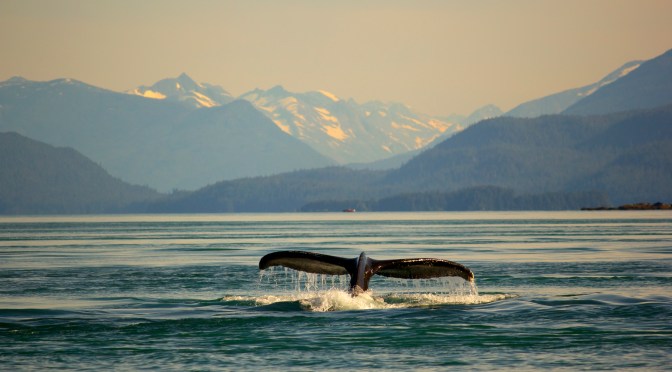
(Breaching humpback in North Pass near Juneau, AK. Humpbacks were removed from the Endangered list this summer).

I’m here to say it doesn’t work that way. As the North Dakota Pipeline Protestors have reminded us, “Water is life.” If we drill every well and level every tree, we’ll find that we haven’t just lost the charismatic megafauna we are privileged to share the earth with, we’ll have lost ourselves too. If we’re going to categorize wolves and cranes as conveniences, then we do the same to clean water, healthy food, and our quality of life.

***

10857837_10153488489199852_5980215313637848356_n

(OrcaLab, Hanson Island British Columbia)

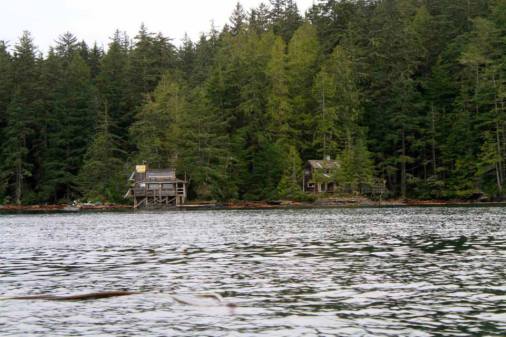
Beyond the cabin, hidden in the trees, is a series of hills. Between two hills runs a creek. For me, Brittney, the cat, and the rabbit, that creek is life. A garden hose runs from the creek’s mouth to the cistern and supplies us with more water than we could ever use. A filter in the main house gives us the sweetest drinking water I’ve ever had (albeit with a bit of a Cedar aftertaste at times). When the flow from the tap turns to a trickle we climb the hill, find the clog, and clear it out. It’s a wonderful gift to know exactly where your water comes from.

How many others can say this?

Here is the disconnect, and here is the danger. When water comes from the tap, food from the store, and light from the switch, we remove ourselves from their sources. Trace them back far enough and you end up in the woods, a natural well, maybe a hydroplant if you’re lucky. But many will never trace the metaphorical garden hose all the way to the beginning. When we don’t see it, it’s easy not to care. When we don’t see it, it’s easy to forget. Until the lights go out, the pipes go dry, or the shelves go empty.

***

Seattle’s fine as far as cities go. But after two days here I can feel an invisible pressure pushing down on my spine. I need to get out. Too much concrete, too many people, not enough deer. As we sit at a stoplight, a man in tattered clothes staggers along the side of a convenience store. His eyes look in opposite directions and he walks as if one leg is an inch shorter than the other. His cheeks look shrunken, whatever life is in him is waining fast. Meth will do that to you.

We watch horrified as he stoops and grabs a piece of bread off the concrete. He shoves it in his mouth and gums it down.

In the car we discuss how sad it is. How horrible and unfortunate that this young man has fallen into such a sad and helpless life.

Someone should really do something.

The light turns green, the car turns left, and the addict disappears in the rearview mirror. Having had our sixty-seconds of sorrow we pull into a brew pub and have dinner.

***

We are in the sixth extinction. We may not see it, as separated from the green portions of the world the way we are, but it’s true. Remember those movies you watched as a kid about dinosaurs? The one with the meteors that came down from the sky and sent waves of ash across the globe? Temperatures skyrocketing, creatures dying. We’re in one of those right now. Maybe not as dramatic a collision, but it’s still happening. Except now it is man instead of meteors. Yes, we are the environmental equivalent of a meteor landing in the Gulf of Mexico with so much force that it empties.

Many of us have read the articles about extinction rates; about deforestations, shrinking habitats, skyrocketing ocean temperatures and acidity.

How horrible and unfortunate that this species has fallen into such a sad and helpless life.

Someone should really do something.

The light turns green, we turn left, and we buy the cheapest apple or bag of coffee we can find, the threatened species’ disappearing in the rearview mirror of our subconscious.

common_murre_gr

(Common and Thick Billed Murres died in the hundreds of thousands last winter due to unusually warm waters in the Pacific. This winter is once again showing surface temperatures several degrees above normal).

***

I’ve stopped refreshing fivethirtyeight.com. Brittney gently pulled the computer away from me an hour ago, her eyes filled with alarm.

“When was the last time you laughed?” She asked.

I try to put Tuesday, November, 8th out of my mind. We make dinner, watch Friends, listen to John Mulaney’s stand up comedy. And I laugh. I laugh so hard I almost cry. Both hands on the counter, bent at the waist, nervous energy coming up as roaring barks of euphoria.

But inside I marinate. I still obsess with what the people of New Hampshire, North Carolina, and Nevada are thinking. And the knowledge that not many of them are thinking about the world the way I am is disheartening. I know that sounds elitist and arrogant. I’m a 28-year seasonal employee that plays jump rope with the poverty line. I have no right to get all holier than thou. But if we’re going to glorify a man who brags about sexual assault, I think I should have my say. Because what I want won’t benefit me monetarily. In fact it’ll probably lessen my income and raise my taxes. I don’t care.

I am here to speak for those that can’t. For the trees on the hill behind the cabin and the harbor seal in the kelp bed. They aren’t luxuries or conveniences or necessities. They are life. And if we lose them, we lose ourselves. Whether we see it or not right now, we need these places and the green and blue world to support the ever growing gray one we are sculpting out of concrete.

Which is why, on Tuesday, you must vote for Hillary Clinton.

“But she’s untrustworthy.”

“I don’t like her.”

“What’s in her emails?”

To which I answer:

“I know”

“I don’t really either.”

And “who knows? Hopefully just lots of cat videos.”

This is not the time for a “protest vote.” Gary Johnson supports fracking for crying out loud. Nor is it time to “shake up the system.”

I mean, it is, but Bernie Sanders is kind of busy trying to keep Emperor Palpatine/Sauron out of the white house.

No, it is time for America to put its vote where its mouth is. It’s time to end the hypocrisy and put the environment first. It is time to save ourselves before it’s too late. And if the harbor seals get to thrive along the way, I couldn’t be happier.

If you’re still on the fence. If you’re still struggling with the idea of graying in that little circle next to Hillary Clinton, think of it this way. Don’t do it for her. Do it for yourself. For the places you fell in love with as a child. For the places you want your children to fall in love with. For the national park your parents took you to, for the bird on the tree outside your window. For the wonder and spiritual healing you feel every time you step into the woods. Do it for clean water. A protest vote won’t save that, nor will it save you. Don’t vote just to speak your mind, vote to speak for those that can’t. Along the way we may just find a way to save ourselves.

45631_488778539851_6865631_n

(Quiet places and open spaces).

Sources:

http://earthjustice.org/news/press/2015/new-national-poll-finds-90-percent-of-american-voters-support-the-endangered-species-act

http://www.gallup.com/poll/190010/concern-global-warming-eight-year-high.aspx

Common Murre Photo: wsl.ch

Midnight Humpbacks

Another year with no trick or treaters on Hanson Island. I shudder to imagine what we’d do if we heard a knock on the door right now. We’d glance terrified at one another, bodies taut, legs weak, hands shaking. What the hell? No one whose ever knocked on the door of a cabin on the rocks at 10:00 at night has ever done so with good intentions. But the night is calm and seems to be low on ghoulish or spiritual skullduggery. After a stormy month, it’s nice to hear the quiet. There’s not even boat traffic. All that comes out of the hydrophones is the occasional gurgle of water and the unexplained static like crackles.

But despite the quiet and despite the darkness, we’re not alone. Outside the door are sea lions and seals and mink and dolphins, and tonight, humpbacks. They never seem to favor the Hanson shore during the day. When they could be photographed and possibly identified. No, they wait until the sun disappears and the clouds devour what little moon there is. But in the pitch black, we can hear them. Their deep booming breaths shake the window as they surface somewhere out beyond the curtain of night.

And time and time again I rise from my seat and step out onto the porch. It’s not like I can’t hear them from inside. But somewhere embedded in my DNA is an instinct as natural as breathing. Go to the whales. I stand on the edge of the porch, my bare feet gripping the slippery wood. Out of habit I count the blows. One… two… three… Three!? When was the last time there was three humpbacks in front of the lab? In between their surfacings is the sound of sea lions. Their exhalations are minuscule next to their cetacean neighbors. They’re like flies. They zip and dive around the humpbacks, why no one really knows. Maybe their picking off stray fish, using the whales for protection from Transients, or maybe it’s a game. Some sort of Sea Lion chicken to see who can get closest to a 15-foot flipper and not get bludgeoned to death.

There’s something about whales at night. I love whales at night. Let’s be honest, I love them at all hours, but something about hearing them but not seeing them hits me hard. Humpback or Orca, hydrophone or above water makes no difference. I love to listen. It goes back to a night more than ten years ago, not far from where I live and write.

Eleven Years Ago:

It’s past midnight. The only dark stretch of this July night. I’m asleep in a two man tent with my Father when my eyes snap open. I sit upright in my sleeping bag, that DNA kicking on for the first time. I know what I heard, the only question is; was it in my dream. I only have to wait a few seconds when I hear it again.

Blows. Lots of them.

I spring out of my sleeping bag—Dad right behind—and step out onto the rocks. Johnstone Strait is ten feet away and five feet down. And somewhere in that eternal blackness, they’re swimming. Orcas. I hear them but can’t see them. It’s infuriating. We’ve traveled hear to see them, not hear them swim tantalizingly by just feet away. From my knees I stretch out into the nothingness above the water, eyes straining, heart praying. But they’re moving on. Going west.

Two days later I got my wish when the A36s, a trio of male Orcas swim past in the morning. From the seat of my kayak I watched Kaikash, Plumper, and Cracroft cruise by. If only I’d known their names that day. I would have paddled out and introduced myself.

Today I don’t mind. Let them approach in the dark and scurry across to the shadow of Harbledown Island in the sun. Even as I write the humpbacks continue to move back and forth in Blackney Pass. Sometimes close, sometimes further away. But in the stillness I can hear them, mixing with the sounds of the hydrophone, the crackling of the fire, and the snoring of the cat.

Home.

Somewhere along the way, this place became home. One of them at least. It can be easy to take some of the miracles of Hanson Island for granted when it’s at your feet 24-hours a day. But not tonight. Not when the humpbacks surface and reawaken the boy inside that fell in love with it all eleven years ago.

The Question

There’s not much in the way of trails around here. Not that it’s too important on this island. Enough old growth is still around that the undergrowth is open in a lot of places. It’s easy to get lost, easy to get carried away walking through those big old trees. Especially on days like today after a heavy rain last night. The afternoon sun slashes through the trees like a sword through fabric, illuminating the mist rising from the moss choked floor. Water droplets cling to cedar needles like diamonds on a necklace. An iridescent glow in each one holding a little flicker of the sun.

Today I’m poking along a stretch that’s part trail part tree root. I hop a stream threatening to be promoted to class five rapids after the downpour. Soon after the trail becomes more defined. I take a deep breath. It feels so good buried in the woods. In Japan they have what they call forest bathing. In simple terms it is nothing more complicated than being in the presence of trees. The idea is that the air doesn’t just taste better in the woods, it actually is better. Essential oils like phytoncide found in trees actually improve immune system function. The forest isn’t just a tonic for the soul like the apostles Muir and Thoreau wrote about. It’s like taking vitamins.

I’m walking this trail to see someone who knows that better than anyone. I’ve written about Walrus several times before. For those that don’t know who this incredible man is, here’s the cliff notes version. Walrus is a walking talking hybrid of Radagast and Dumbledore. He inhabits what he likes to call, “Canada’s longest active logging road block.” He settled on Hanson Island after years in Greenpeace and helped Hanson Island—Yukusam in the Namgis tongue—gain protection from logging. Today he has a long white beard, eyebrows as long and thick as caterpillars, and a high pitched laugh that is infectious.

In my backpack is ten pounds of dog food for his creme colored bear of a dog named Kessler and fruit, carrots, and granola for his master. I tighten the straps of the pack and dig in my boots on the muddy trail as the incline steepens. Walrus’ road block came to rest about a hundred feet shy of the highest point on the island. Every now and then I hike food up the hill to him. It became dire last week when Walrus walked down the hill to the series of rubber totes he keeps near Dong Chong bay to collect some food he’d left only to find that something had gotten to Kessler’s food. 10 pounds worth. Be it bear or wolves we still don’t know. But neither of us has seen a deer in weeks. And deer don’t disappear because of mischievous black bears. So we’d brought Kessler an emergency bag of dog food last week. And had restocked for him in Alert Bay a couple days ago.

As I climb my mind drifts, thoughts mixing with the ravens and Stellar’s Jay above me, my mind drifting to what I’d been reading before I left the lab. In the last week a tanker ran aground near Bella Bella. The support vehicle sent to assist swamped. The containment booms set out to minimize the impact were as useful as a fishing net. The spill was minimal, as minimal as one can be at least, an insult to the very phrase, “low impact.” A low impact oil spill is like minor surgery. It isn’t minor if you’re the one getting cut open.

I’d followed the stories through a guy named Mark Worthing. A Walrus disciple and friend of Orca Lab who has committed his life  to keeping the final stands of old trees in British Columbia standing. In his free time he fights back against the proposed oil tanker line that would cut through the Great Bear Rainforest, one of the pearls of world. The only region in North America where wolves were not almost exterminated. It’s a place where people find Spirit Bears in the woods and God in a sunset. It’s also a maze of islands, reefs, and rocks that gets hammered by 50 knot winds in the winter. All it takes is one tanker. One mistake. One gashed hull. And it’s gone. Ask Prince William Sound. And so Mark fights, because life would seem pointless if he wasn’t fighting for something much bigger than himself.

And then there’s Zack Brown back in Alaska, founding a research and education institute on the Inian Islands to the west of Gustavus. He hiked and paddled from San Francisco to Gustavus in a tidy three months. He’s a voice for climate activism, a voice for change, and he does so eloquently, something that doesn’t always happen when we speak passionately. I used to idolize athletes, now I idolize activists. If only they made trading cards.

My legs are shaking. I set the backpack down on a rock and plop down in the mud next to it. Sweat runs down my face, steam rises from my back. What am I doing? I gave some money to Bernie Sanders, ride my bike when I can, talk about saving the world. But is that enough? It’s a question every conservationist has asked themselves. We see a world that’s in danger. In danger of being steam rolled over by the great construction firm of progress. Lumber over woods. Oil over spirit bears. And we wonder if what we’re doing is adequate. It’s hard when our efforts aren’t visible. Riding your bike doesn’t correlate to a healthy calf in the southern Resident Orcas. Nor does eating vegetarian ensure a healthy salmon run.

I pull the pack back on and start back up the incline. It’s a question I’m still struggling with as my breathing becomes more and more ragged. I spend my summers representing the natural world from the seat of my kayak, and the winter writing about it. My audience is only a couple hundred people, maybe that’s a start. Maybe the people I show sea lions and humpbacks to in the summer are starting dominoes back home. Maybe they took something back from Glacier Bay besides pictures and cover photos.

I round a final corner and Walrus’ cabin comes into view. His area is ringed with a Salal fence, the flexible trunks of the bush intricately bent and woven together to keep the deer away from the garden. Does it work? It does not. You would think a 90 pound dog would keep them out. But Kessler has been known to watch deer amble by ten feet away with nothing more than a sniff. He jogs up to me as I approach, ears up, tail down. We go through this song and dance every time. He can never remember me. He gives a half bark, turns and runs. From the cabin I hear Walrus call out and I smile. The question still lingers, but for today I have a purpose. I’m bringing the caretaker of Hanson Island lunch. And for now, that’s enough.

Hanson Heartbeat

The windows creak and groan. The world outside them is pitch black but I know tree branches the shape of withered arms stretch their wood clad fingers toward the cabin’s walls. The ocean pounds. It sounds so close I expect the next wave to come barreling over the porch and set us adrift in the sound. It’s the first storm of many, I’ve spent the summer dreaming about them. There’s something in the forty knot winds and blasting rain that’s soothing, secure. Hunkered down with the fire roaring and the cat asleep on the back of the couch. Just as long as the boat’s ok where it’s tied up in the back of the cove. It is isn’t it? I should go check.

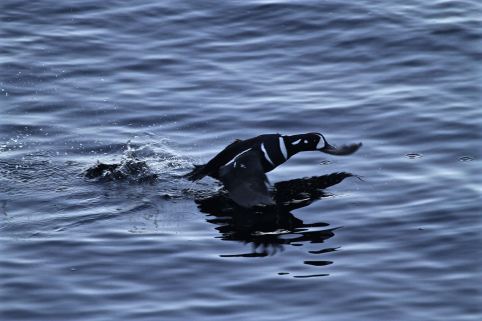
By morning it’s subsided. The low pressure monster taking a deep breath, preparing for the next exhale. Harlequin ducks poke their multi-colored heads out from behind the rocks, Sea Lions return to the haulout, Herons again perch on the worn out kelp that has been buffeted by waves for the last 12 hours. And like all the critters, we poke our heads out our door. All the roofs are still in place, the lab still humming along. All that’s changed is the growing collection of fallen branches and golden fingers of the Cedar trees that populate and soften the forest floor.
harlequin
If only the rest of the world was like this. Half a day of insanity and turmoil before everything returned to it’s relaxed state. Humpbacks in the pass, seals munching fish, deer scavenging for the kelp that just couldn’t hold on anymore. But human nature doesn’t work like this. Every day some new scandal flashes across the screen. It is the quintessential train wreck. I want to look away so bad but can’t. My stomach tightens as I scroll through article after article, my heart pounding against my ribs, eyes becoming glazed and unfocused.

How has it come to this?

Assault, repealing amendments, threats of political violence, the laundry list could go on for pages. Dear God, what century is this?

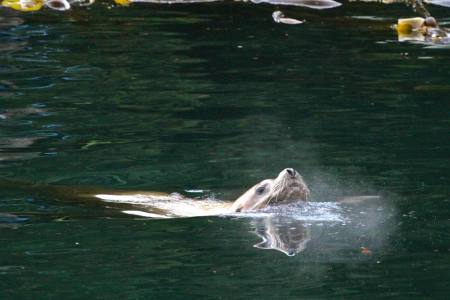
I step out onto the rocky face opposite the lab. The point here sticks out into Blackney Pass just a little further, but the difference is noticeable. Sea lions cruise by, calm and serene. They’re exhalations are like small explosions, as if there’s something stuck in their throat. After watching them gulp salmon whole it wouldn’t be a surprise. But it’s just business as usual for the pinnipeds. Eat salmon, have a nap, yell at your neighbor on the rocks.

Six big boys swim past not ten yards off the rocks. Even from the relative safety of the point I stiffen. I’ve spent enough time in a kayak to know these guys make me uneasy. I’ve been followed, growled at, and watched them zoom inches below my seat, feeling the kayak rise and fall as they passed. But they seem as unsure as I am. They stop off the rocks and we stare into each others eyes.

They’re a comical looking animal when you see them straight on, bobbing like corks. They have this perpetual look like they’re always surprised. Like the monster just jumped out of the shadows in a slasher movie. I wait for them to dive away and leave me be. But they stay. The curious magnetic quality of sea lion dynamics occurs, more and more appear out of nowhere. Appearing from their hidden trap door on the ocean floor. Seven, eight, nine, ten. We speak without making a sound.

There calmness unsettles me. I want to scream at them. “Do you realize what’s going on? Do you know what could happen on November 8th? Didn’t you read what he said now?”

The group blinks in polite puzzlement before disappearing beneath the waves. Thirty seconds later they’re back. My breathing is unsettled. I went for this walk for two reasons. To harvest mushrooms and leave the rest of the world behind for a bit. You’d think that’d be easy on Hanson Island, but it isn’t. There’s a sense of helplessness being so far away from it all in times like this. There’s nothing you can do but refresh the news and pray. I stare at the sea lions and they snort in my direction, nostrils flaring.

 I wish I could be more like you.

Wish I could be content with some salmon and a smooth rock to lay my head. Though I’m glad I don’t have to watch for a black pointed dorsal coming up behind me all the time.

    “So be like us,” they answer. “Just let go.”

    “I wish I could.”

    “It’s easy.”

    “I wish it was.”

    “Stop wishing and do. Control what you can control. Chop some wood, watch us swim, count the humpbacks. Be present.”

The sun streams in through the clouds. Vancouver Island is hidden but the clouds in front of it sparkle with late morning sun. There are chocolate pancakes in my belly. I write fifteen feet from the ocean. An ocean in which, right now there are two seals, a sea lion, and a humpback visible (who I should probably photograph and ID). I’m in control of our power, our fresh water, and some of our food supply. My heat comes not from propane but wood. I am in the most beautiful place on earth. If I cannot let go here, where can I?

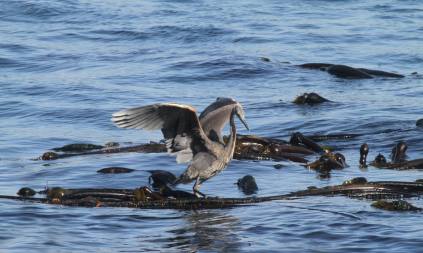
I think of the miracles of this world, of this place. That humpback will soon leave for Hawaii. A 3,000 mile journey without a Lonely Planet book or compass. He or she will hit it square on the dot. No questions asked. Amazing. I memorize the beauty in the sad eyes of the harbor seal and the bouncing optimism of the Harlequins. The prehistoric cackle of the heron, the Pterodactyl incarnate.
heron
Breathe, be still, be present.

I smile, inhaling salt air and high tide. My hands run up and down the trunk of a Cedar tree. I close my eyes, and feel myself, at long last, let go. Surrendering to the pulse of the island.

Photos By Brittney Cannamore

The Birthday Post

For the first time in a year, I got carded. Granted, some of that may have something to do with spending the last six months buying drinks from the same two people (not a lot of choices when there’s only two “bars” in town). But on the eve of my 28th birthday, it served as some sort of inverse reminder. Youth is fleeting. Now I know, my elders and betters will roll their eyes at such a proclamation.

“28? You have your whole life ahead of you.”

To which I say, of course. But we must all admit, that in a society obsessed with youth, with staying young, where waging war against wrinkles is a billion dollar industry, it’s hard not to look at your birthday as some sort of landmark. A road sign twisted and rusted on the highway of life, reminding us that this precious gift slides by far too fast.

I’ve spent the last few days in Seattle. A fine city as far as cities go. It’s big on brew pubs, grunge music, and Macklemore. Though it could do with some deer, perhaps a pack of wolves prowling along I-5. It’s my little snapshot of how normal people live. You know, the ones with satellite TV, high speed internet, and cars that don’t resemble the rusted hull of the Titantic.

I stood in a mall with glistening floors and walls. Music blared through speakers, a movie preview played on a loop from a cluster of wide screens, dozens of adds battled for my attention. But as I dutifully manned my post by the Old Navy entrance, I watched my fellow mall patrons and decided on a little sociological experiment. How many, I wondered, would be on their phones?

The answer was almost all of them. Eyeballs sucked to the screen as if Apple had designed a gravity app more powerful then the moon. What, I wondered could they all be looking at? I didn’t have the phone Brittney and I share. And I must admit there was a decent chance that if it had been in my pocket instead of her purse I may have pulled it out. And what would I have done? Jumped on the internet I guess. Refreshed espn.com even though I knew that there was nothing there I needed to see. People sat side by side on benches, heads bowed as if in prayer, not saying a word. Couples walked hand in hand, free hands holding the creations of Samsung. What are we doing on these things?

Which leads me back to my birthday road sign. If life is so precious, so fleeting and quick, why don’t we spend more time in the present? Why are we so quick to escape to an alternate reality? Later we pass by a Windows PC store. Near the door stood a man. He’s facing the big pane windows but he can’t see him. Something looking like a futuristic toaster is secured to his face. The heck?

“Alternate reality,” Uncle Chris explains to me.

No way.

Maybe it’s just the next wave of video games. Essentially that’s all it is. A really realistic game. And if they made a sports one? Heck yes I’d try that out. Again I must admit to my love of a certain baseball computer game. It’s my escape when I can’t read about Trump, climate change, or acidifying oceans anymore. My own, if you will, alternate reality where the Minnesota Twins finish above .500. So really I’m no different. And maybe that is the wakeup call.

And perhaps that’s what I’ve learned in the last year. That despite my little migratory life from the seat of my kayak, I’m not all that different from the mall patrons and commuters of the city. And that’s ok, that’s a good thing. If I’m no different then those I want to reach, then getting them to listen, to put down their phone and read what comes out of my head should be easy. Maybe one of them will load raincoastwanderings from their phone! The irony.

Because I want the mall dwellers to read what I write. I want to inspire and touch people’s lives. The mall is not a bad place just as a phone that can tell you what time the Vikings play isn’t. What I want, what I aspire to, is to remind people that there’s a big blue and green world beyond the sliding doors. A world you can enter without strapping a toaster to your head. And that, most importantly, we cannot live without it. That the natural world, like every day we are gifted, is precious.

The Shabin

There’s not much left of the road. Just two indention’s overgrown with weeds and grass. Blink and tilt your head and you can almost make out the tire tracks. But alder trees are growing in between the divots and it’s clear that no one has driven a car back here in a long time.

In my hand is a scrap of printer paper, a series of hastily scribbled squares and rectangles drawn on it. One of those rectangles is my future home, maybe. Brittney follows along right behind me. Just ahead is a man I admire and love. A man I want to be like, but with my own flair, my own style. After all, there’s only one Kim Heacox just like there’s one David Cannamore. At the youthful age of 65, Kim’s enthusiasm remains boundless and I find myself wondering what he must have been like when he was 30. I know I wouldn’t have been able to keep up with him.

He leads us through the properties acres, referring to it over and over again as, “our property.”

Our property.

My god. Is it really possible? A small cabin sits near the land’s southern border next to the remnant of the road. The rest is Spruce and Pine forest with a bit of bog, a bit of marsh, and sprinkled with berries. Oh the berries. High bush cranberries, neigoon berries, even some low lying blueberries. I pass an alder no more than knee high. I run my hands through its branches. The leaves are manicured and nibbled. A moose has been here recently. It feels like home.

We can’t stay away. We drive the two miles back to the little slice of heaven. We forgot the tape measure, so we measure the cabin’s tiny room the only way we can. I lay down on the wood floor and so does Brittney, her feet brushing my scalp. We can almost lay down all the way. Calling it a studio  would be generous. No running water, no toilet.

I doubt many would understand the appeal of a dry cabin devoid of plumbing. Cabin may not be the best description. It’s part cabin part shack. A shabin as it were. But both of us see it for what it can be. Knock out a wall, raise the roof, put in a loft. Definitely a bathroom. What are we missing? A sink! Should install a sink at some point.

But for the right price… we’ve lived rustically long enough. What’s a few more years?

I think about the homes we walked past in the Seattle suburbs. 700,000 dollar monstrosities on a quarter acre in tidy suburbs. Each home copy and pasted from the last. Each subdivision given some charming name like Shady Acres or Pebbled Brook. I don’t want a 30-year mortgage. I don’t want property tax. I don’t want my neighbor’s music echoing through my walls.

Give me simple. Give me peace. Give me trees and blueberries. In our minds it’s already ours and we haven’t even called the owner yet. The owner we know is looking to sell. You’re crazy if you think I’m telling you where in Gustavus it is.

It’s scary. Sure we’ve talked about buying a house in this city filled with magic for three years. But to be this close, our feet draped over the edge, just one step from going over. Maybe buying a house is like having kids. If you wait until you’re ready you’ll never do it. But I also know that this is what we want. That we’re ready to make this home.

August Fog

For the first time this summer, there’s a bite to the breeze. When I step out the backdoor. The air tastes like Fall. It brings forth images of Cottonwood Trees changing color. The taste of Pumpkin flavored beer, pumpkin spice lattes, shoot, pumpkin flavored everything. Fall comes early in Alaska. The first week of August reminding us that each season but winter is short, to be savored.

With it comes rain. The rain that justifies our existence as a rainforest. A rain that makes everything green. A chilling nasty rain with curled lips and sharp teeth that bites at the back of your neck and crawls beneath the most impenetrable Gore-Tex.

But on days like today, when it doesn’t rain, oh what a beautiful setting. Bless the rare calm, and foggy mornings of August. Blue sky above, the land ensconced in curtains of fog.

There’s something magical about paddling in the fog. The shutters pulled over our eyes, every other sense becomes sharpened.

You smell your way through fog.

On low tide mornings like this one the odor of anoxic mud crawls into my nose. A rancid guide leading me back to shore when the trees disappear behind the milky white sheen. My ears orientate like a dogs, the cries of a crow lead me across the mouth of a cove. Land nowhere in site, paddle toward the crows.

As always I’m accompanied. Today it is the minimum two people. Mark and Laura. Middle aged, bouncy, and happy. The sort that are easy to talk to because the silences are never awkward. Everything is wonderful in their eyes. The fog, the water, the sea lion that interrupts my bear story. They make my job easy. The sort of people you wish you had every day. We paddle near the shoreline and let the fog wrap around us like a sweater. The smell of the beach and the noise of the crows guiding us.

Boats pass unseen in the fog. The intrusive foghorn of a cruise ship echoes off the mountains and trees every few minutes.

We float in a kelp bed two miles from the dock. Our paddling has been serene and relaxed. I’m in no hurry. If you’re in a hurry, kayaking isn’t for you. Easier to let the world come to you then to try to catch the world.

“Are you worried about the possibility of losing the glaciers because of global warming?”

The question comes from the husband Mark. It does after you talk about the retreat of the glaciers. How, in 1794, Glacier Bay was nothing more than a five mile divot on the north side of Icy Strait. Yes I know, no internal combustion engines spewing carbon into the atmosphere in the 18th century.

There’s something different about the way that Mark phrases the question though that gives me pause. Are you worried about the glaciers?

The glaciers? I mean, I guess so. It’s funny, I live in a land defined by them, created by them. If anyone should worry about the well being of the glaciers I guess it should be me. And I am, now that I think about it. For Glacier Bay with no glaciers is a sorry end indeed. What would we call it? Muir Bay National Park and Preserve?

But when I think about climate change, about the cliff that we’re either a) barreling towards or b) careening over (depends on who you ask), glaciers aren’t the first thing I think about.

“What I think about,” I say, “are murres.”

“Murres?”

“Murres, among other things.”

I explain about the blob, which they had never heard of. About thousands of murres washing ashore on the beaches of southeast and south-central Alaska. I describe their delightful noises, the joy of a muttering murres, their exasperated yells. We all seem to have that animal that touches us in a way no one else understands. Brittney loves Black Oyster Catchers. Hank Lentfer loves Sandhill Cranes. And I have Common and Thick Billed Murres.

“For me, Glacier Bay without Murres is no longer Glacier Bay.” I say. “Maybe that’s short sighted of me. But imagine if you stopped paddling, and it was quiet.”

We do just that and are serenaded by a timpani of birds. Marbled Murrelets, Canadian Geese, crow, raven, phalarope, and oyster catcher.

People talk about getting out in nature. “Getting away from it all.” We call it. The peace and quiet of wilderness. But here’s the thing, nature is never quiet. To walk into the woods and hear nothing would be… empty, desolate, unsatisfying. Nature isn’t supposed to be quiet. There should always be a squirrel rattling, a bird calling, a sea lion swimming.

What we’re really talking about, is getting away from ourselves. Away from the world we created. The artificial one sculpted from metal and concrete. The birds and squirrels and sea lions are not noise, they are music to our ears. And a world without them, glaciers or no, is no longer a world.

Snow

She lay in an old shipping container. The kind found on the back of trucks roaring up and down the concrete riverbeds we call interstates and highways. But this one had been laid to rest here. Tucked away in a corner of a lot in Bartlett Cove. Through the trees I can hear the wind, smell the air breeze, ear cocked for the sound of a humpback. How out of place the egg white box of metal looks here. No flowers or grasses growing around it. Just a strip of gravel turning dusty in the early July heat.

Inside lie her bones.

I feel a thrill of excitement as Chris Gabrielle pulls a key from her pocket and unlocks the deadbolt. Together we lift the big metal latch, its joints creaking and groaning as the big door slides open. I don’t notice the smell at first. But as Chris flicks a light switch and ignites a small bare bulb, it overwhelms me. It is musty, sweet but sickly. Something about it smells alive, even in her death. I walk into the container, breathing shallow, fighting the urge to cover my nose with my shirt.

After almost ten years, she still lives in some way. Organic matter and oils still seeping out of her ribs, humorous, and vertebrae. I can’t help myself. I reach out and touch one of the vertebrae. As big as a tire and bleached white, I run my hands up and down all that remains of Snow. Here along the racks and shelves, were all that was left of her forty-five foot, thirty-five ton body.

The year is 2001. Somewhere in the mouth of Glacier Bay swims Snow. Inside her new life is growing. Is she aware that she’s pregnant? That in half a year there will be a miniature her swimming and breathing? The baby will drink a milk that is 50% fat, the consistency of yogurt. I wonder if she heard the cruise ship. If she had any inkling of its approach. If she could have gotten out of the way. If the ship could have. The nose of a cruise ship is so far from the engines in the stern that they create “sound holes,” right off their bow. There’s a good chance Snow never knew what hit her.

Janet Neilson (then Janet Doherty) found her. Dead whales are rarely found. Usually they disappear. Sink to the bottom and vanish, presumed missing. But it’s as if Snow wanted to be found. Janet discovered her floating off Point Gustavus, not far from where an anonymous cruise ship passenger reported feeling a thump. They towed Snow to the beach, necropsied her body, and discovered a fractured brain case and crushed vertebrae.

Gustavus mourned, the park service gave press releases, security footage was seized, attorneys went to work.

“The crime wasn’t in accidentally striking the whale,” said a park employee, “the crime was in failing to report it.” I’m not sure Snow would agree. Neither do I.

In the middle of the shipping container is an old iron claw bathtub, the porcelain chipped and rusting. But it doesn’t leak, at least not yet. Chris hands me a great bucket of industrial kitchen degreaser and instructs me to fill the tub with the stuff and soak Snow’s bones one at a time. Oil, she explains, is still seeping out of her bones. The goal was to remove the rest of the organic matter from the bones so that they could be preserved for years. An exhibit was being prepared down by the beach. Where in a way, she could live forever.

On sunny days I climb onto the roof of the container, lining her ribs up neatly to bleach in the never ending Alaskan sun. I soak the vertebrae overnight in the degreaser, greeted each morning by the strong smell of leaching oil, a pearly iridescent sheen on the surface of the tub.

Down another road, behind a locked gate is her skull. My stomach twists the first time I see it. I run my hand across the deep fracture in the skull. If a passenger felt the collision, than surely the crew did as well. But who wants the headline: “Cruise Ship Kills Whale in National Park?” Bad for business. But thirty-five ton bodies don’t always disappear. I pressure wash her skull, obliviating the moss attempting to grow on her. When the yard empties I crawl beneath the skill and lay in her mouth, imagining. Rows of baleen, gallons of sea water, tons of wriggling herring.

And I’m indebted to them. The cruise ships I mean. Wouldn’t be here without them. Wouldn’t have had summer work in Juneau when I graduated from college. Would not be sitting at this wooden table in Gustavus watching the storms roll through, the moose calves grow up, and the rain pound on the roof. I owe my beautiful little life, in some way, to an industry that makes me uncomfortable. That kills whales, that leaves a massive carbon footprint. That shows a million people Alaska every year, even if it is a watered down, fast food version. 14,000 people a day in Juneau. But what’s the alternative? I can’t take 14,000 people kayaking in Bartlett Cove. Is seeing this place from ninth story better than not seeing it at all?

Edward Abbey would say no. But I should be confident enough to form my own opinion. But I can’t. Because like this bay, nothing is black and white. A single receding glacier does not signify climate change, just as an advancing one does not disprove it. We must step back, way back. Look at the big picture objectively, rationally. We don’t like the big picture. Step far enough back and we become mitigated, aware of how insignificant we are.

That’s the beauty of the kayak, the hiker, the backcountry camper. You have no choice but to confront your own significance. At how small you are away from the billboards and street lights. It’s uncomfortable. Change always is. Tough to be uncomfortable from the ninth story.

I don’t know what the answer is. Abbey wouldn’t be impressed.

Snow stands whole once again. Without her flesh she looks serpentine. Two tiny bones bent at obtuse angles are suspended by wires two thirds of the way along her vertebrae and a foot below it. They’re all that remains of her legs. In time evolution will remove them from whale’s entirely. Like our appendix they are vestigial, no longer of any use.

Every day a park ranger gathers a crowd in front of Snow to give a presentation. People flock to the talks until the trail is not passable. They are independent travels, for the cruise ships do not dock here. Our kayak sheds are right next to the skeleton and I often squeeze through the raptly listening crowd. Like the cruise ships and wilderness, the talk makes me uncomfortable. I hear the ranger joke about how Snow embarked on, “the longest over land migration a whale has ever done” to be rearranged and put back together by a professional.

The crowd titters and laughs, something about it makes my blood boil. I hear them talk about the collision as a horribly tragedy. But in the same way a loved one developing an illness is tragic. Unavoidable, no way to prevent it. Never have I heard a ranger say that the cruise ship failed to report the collision. That it was not until security footage was seized and viewed did they admit to striking the whale. Perhaps they do and I have simply missed it. I don’t wish to criticize or demean. For the rangers do a job I know I couldn’t. I don’t know why I think people need to know that part of the story, but leaving it out feels like an insult to her memory.

On one of the displays is a grainy picture showing the bow of the ship, a gray pixelated sliver in the water shows Snow, her back arched, attempting to dive. Maybe she did know.

“Snow moments before tragedy,” reads the caption. Meanwhile ten miles away two cruise ships a day enter the park, passing Point Gustavus, bound for the glaciers of the west arm. Do the passengers on board know the story? Do the rangers share that story when they board every morning at the south end of Sitakaday Narrows?

I don’t know what the answer is.

All I know is that it hurts my heart to have Snow here, condemned to life as a silent ambassador. How much more she could be, churning up the waters of Bartlett Cove.

Another sunny July day. Six years since Chris opened that container and introduced us. We walk the familiar trail toward the kayak sheds. Past the old Tlingit canoe, Snow’s display coming into view.

“Have you met Snow?” I ask.

Everyone has the same reaction, a quick intake of breath, mouth open, rooted to the spot. Their first view of Snow is head on, as if she’s diving right toward you, forcing you to confront her here and now. They snap pictures and lean across the ropes, aching to touch her. Invariably the question comes.

“How did she die?”

“A cruise ship hit her.” My guiding style is one of light hearted comments. Jokes and stories over facts and figures. But not here. No over land migration jokes at Snow’s expense. Here just the full truth. “They knew they hit her but didn’t report it.”

I don’t like starting the day with something so sad. But at the same time, what a reminder that we cannot expect to leave the world the way we found it. The warming acidic water of the world should be a good enough reminder. Every kayak on the beach crushes barnacles and mussels. The leave no trace etiquette is an impossible dream. From man to mosquito, no creature was meant to leave an environment as they found it.

We linger a moment longer and turn toward the beach where I hand out life jackets, spray skirts, boots, and paddles. The water is alive with life. Sea otters cracking open shells on their stomachs, sea lions growl in frustration, a timpani of birds. I slip into my kayak and feel the world slide into place. My heart rate slows and my breath becomes steady. I don’t know what the answer is, and in this moment I don’t need one.