Tag Archives: homestead

Sights and Smells

I wonder what’s different.

The transportation for one. Greyhound no longer brings their gargantuan buses this far up Vancouver Island, and as we careen down the narrow two-lane road with six inches of shoulder, I can see why. The playlist blasting in my ears has changed, though I brought back some classics like Death Cab for Cuties’ Bixby Canyon Bridge and Snow Patrol’s Make This Go on Forever.

A myriad of greenery blurs outside the window. I watch these forests differently, too. Oh, my heart still flutters at the boughs of red cedar hiding secret pathways to 6,000-foot peaks. But I also see acres of young hemlocks scrunched together like matchsticks in neat little packages. Phrases like “stem exclusion” and “30-year harvest cycles” whisper with sullen voices. Countless watersheds line the east side of Vancouver, but the Tsitika River I just rumbled past is the only one that hasn’t been logged. Tsitiaka winds through the tallest mountains on the Island and reaches saltwater at a little place called Robson Bight.

Orcas. It always comes back to orcas.

For two days, I have ferried, flown, and ridden from Gustavus to Juneau to Seattle to Victoria and am now just an hour from Port McNeil. Despite my evolving playlist and old-growth forest opinions, it still feels impossible that my first trip to Port McNeil was 17 years ago. Surely it was just a couple of weeks ago that I hopped off the Greyhound. Wasn’t it last weekend that I drove a Nissan Pathfinder up this road with a cat and rabbit in the back seat?

These roads, islands, and waterways hold a lot of the stories and experiences that explain the evolution from basketball boy to kayaker, guide, naturalist, bum, redneck-hippy, writer, conservationist, and whale aficionado. I’m counting on it providing a few more.  

Ferried. Flown. Ridden.

I count the number of petroleum-driven vehicles that propelled me from Gustavus to the footsteps of Port McNeil, Johnstone Strait, and my precious Hanson Island. All to go on one more monkish retreat in the woods and waters of my youth. All to catch one more ride on a boat powered by an outboard motor or go paddling in a kayak made of, you guessed it, fossil fuels.

Too small to tip elections in favor of Mother Earth, I run to my favorite hiding place, sheltered by, you guessed it, Mother Earth.

Blackfish Sound

If the trees are passing judgment on my life choices, they keep it to themselves. If those replanted hemlocks are packed like matchsticks, what happens if one of them lights? I woke to the news that California was burning during the wet season.  A world getting drier, warmer, crazier, more unpredictable. Surely, it would be the earthquakes that doomed southern California. We beat San Andreas Fault to the punch.

***

Don’t cry. Whatever you do, don’t cry.

All those old names:

Blackfish Sound, Pearce Passage, Weyton Pass, Blackney Pass, Queen Charlotte Entrance.

Bold Head and Cracroft Point. Blinkhorn Peninsula and Kaikash Creek.

I know them all, have stared covetously at their little faces for eight years, promising I’d see them again. I’m sure they’ve been getting on just fine without me.

I confess I left my guilt on the Port McNeil dock, catching one more 45-minute ferry ride to Cormorant Island and the town of Alert Bay—the end of public transportation. I wait two days for a weather window that finally comes as low pressure turns to high and the wind pivots from southeast to northwest.

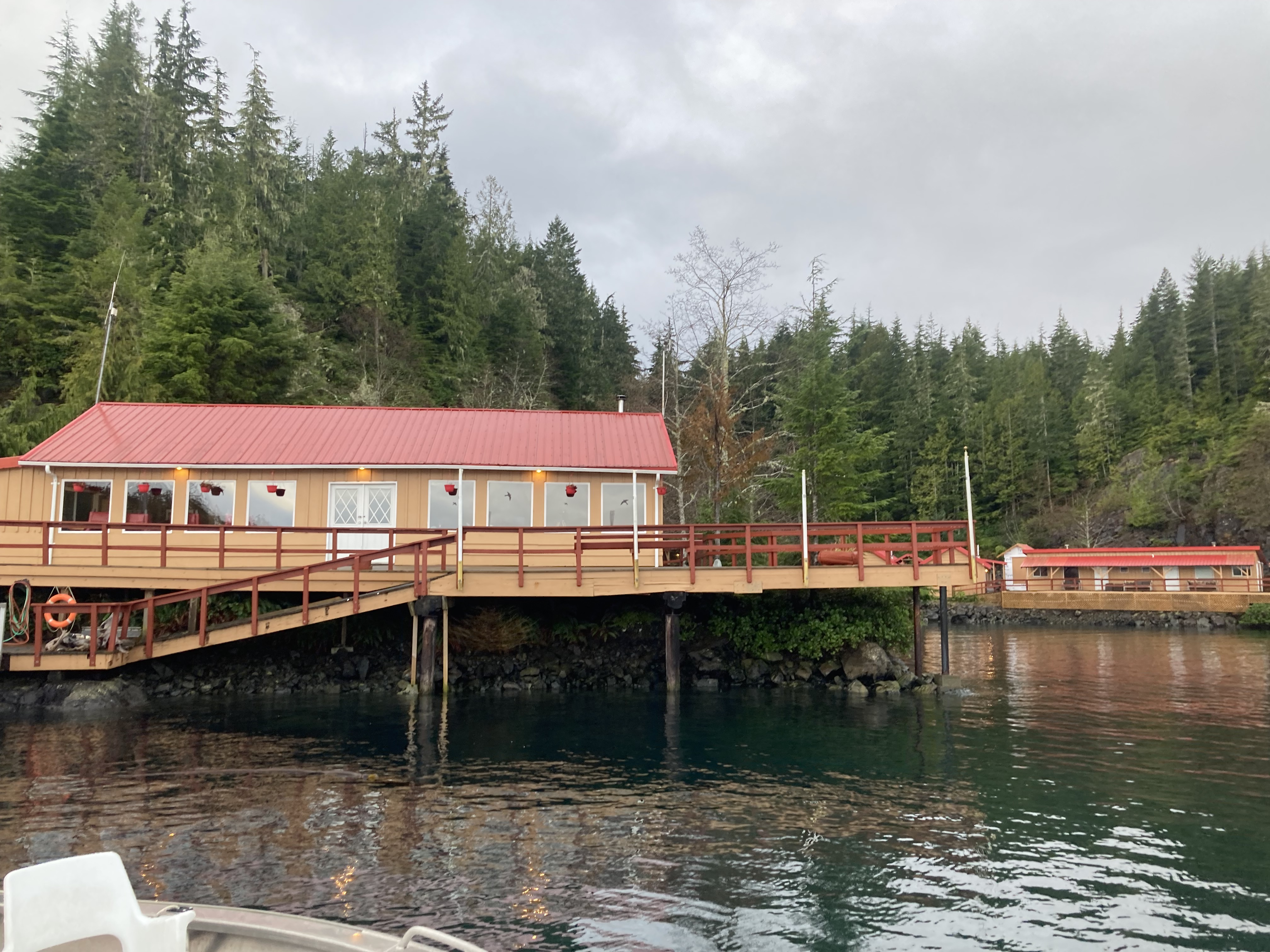
Every town run from Orca Lab to Alert Bay took me past Double Bay, its long boardwalk, floating dock, and cherry red rooftops. I shoulder my pack and follow the other caretaker, Laurene, up the dock. She directs me to a cabin on the right side of the horseshoe-shaped boardwalk, perched on the rocks with a view of Blackfish Sound and the first layer of the Broughton Archipelago’s islands.

The door opens, and the pack thumps from my shoulders. The cabin is bigger than my Gustavus design, with a half-loft upstairs, a functional shower, even a flush toilet. I would have settled for half-a-shabin and a cot. It’s not the high-end amenities that made the pack fall.

Don’t cry. Whatever you do, don’t cry.

Next to the kitchen table is a shelf. On it rests a radio receiver that looks all too familiar. Whether donated or purchased from Orca Lab, the ocean blares from the speakers—water gurgling, a distant boat engine, crackling shrimp. I swear I hear A pod.

“We have a hydrophone at the mouth of the cove,” Laurene explains, unaware I have been transported back in time. “There’s a volume knob on the right—”

“I know,” I interrupt. Not the best first impression.

I cross the room and crank the volume. How many nights did I fall asleep to this? She leaves me to unpack. I move quietly across the floor as if I’m in church. Clothes upstairs, tortillas and cheese in the fridge. Curry paste in the cabinet. I open the wood stove and smile. A pile of ash has calcified on the bottom and shrunk the stove’s space in half—a chronic problem with burning wood soaked in saltwater.

I pry the ash free and grab a handful of piled kindling. With eyes closed, I bring a stick of red cedar to my nose and inhale like an addict, listening to the hydrophone as my head spins and heart palpates. Our sense of smell pales in comparison to most mammals. Yet its ability to conjure memories is undisputed.

There is a smell to Hanson Island I have found nowhere else. Something in the ground, the water, the trees. Perhaps it’s as simple as it remains one of the few islands in the region that has not been clear-cut. Old-growth smells for a land that measures lifespans in centuries and seasons in seconds.

***

I weave between cedar and fir, balance on fallen skyscraper hemlocks, and plunge through salal undergrowth. I squish deer scat between fingers and spy on harlequin ducks perched on rocky beaches. Rumor has it a wolf has taken up residence on Hanson Island. I scan the hills with blind optimism for hazel eyes, ears cocked for the howl that proclaims that there are still things green and wild and true on this burning planet.

The rising northwesterly brings the forest to life with creaks and cracks. I settle against the hollowed-out trunk of a cedar, its innards charred from a long-ago lightning strike. Yes, even here, there can be fire from time to time. The stubborn cedars simply refuse to rot and fall, standing even in death in defiance of the decay and rebirth that comes for all.  

I scratch at the charred bark and sniff. Any smell of fire is gone. The forest around me vibrant and healing. I watch the treetops, content to let the afternoon crawl away. There will be time tomorrow to check in and learn what is expected of me here, how I can give back to this place that dreams of becoming a sanctuary and educational retreat. It took enough petroleum to get me here. I will live, write, and eat in a shelter made of wood. I’ll try to leave this place better than I found it.
Wet earth soaks into wool pants, a pleasant shiver travels up my spine. Ravens cackle, eagles retort. Somewhere, an orca explodes to the surface. I feared two months wouldn’t be enough time to find what I was looking for. But as eyes close and my soul rises to the island’s tallest canopy, I know it’s already been found.

Yurt Housekeeping

Executive Directors shouldn’t be sweeping yurts. But Zach Brown does. Sawdust, spruce needles, and the detritus of countless Xtra-tuff boots fly before our brooms and billow out the door. Zach and Laura’s non-profit is already ten years old. Hundreds of students have already rolled through Gustavus and the Hobbit Hole. They are pebbles in a growing pool, ripples spreading across the globe in the name of climate justice and the dream of a world overflowing with clean water and a habitable climate.

Polishing a yurt and nailing rafters a few days before Tidelines Institute’s ten-year celebration bash is all part of a Friday afternoon for this guy. Never mind, he just got back from teaching a week-long course and has a sniffly one-year-old son at home.

I met this dude on a basketball court, politely flustered at his intensity on defense and speed that he pushed the ball up the floor. But that’s just how he operates. It doesn’t matter if it’s an open gym, thinning carrots, or a lecture on climate change. You’re going to get his best.

He pauses, broom in hand. “How you holding up, dude?”

I shrug. “Good days and bad. More good than bad.”

He strikes a Lebowski grin, “strikes and gutter balls?”

You can keep your love languages like “words of affirmation” or “quality time.” Zach and I speak in movie quotes. The highest form of affection.

“Well, you know,” I fire back, “sometimes you eat the bar, and sometimes…”

“You’re an injured fawn,” he continues, not missing a beat as he pivots from The Big Lebowski to Old School. “Nursed back to health and ready to be released back into the wild.”

“Speaking of deer… where are we going this August?”

There’s the gleam. Reserved for venison and adventures. “Ahhhh, well, I’ve got some ideas.”

Damn right, he does. Last August, we pitched a tent amongst the devil’s club near a tiny beach 40 miles west of Gustavus, falling asleep to fantasies of climbing into the alpine for big-antlered bucks. We awoke at 4 am to the type of rain that promises fog so thick you can’t see the glove in front of your hand. We stared at the roof for a few long minutes.

“Well,” Zach said, breaking the silence. “Guess I’ll go take a look.”

“This is no time for bravery. I’ll let ya.”

He pauses, hand on the rain fly. “Is that Cool Hand Luke?”

“Butch Cassidy.”

“Close enough.” He disappears, and I’m sorely tempted to fall back asleep, but he returns a few minutes later.

“What’s the verdict?” I ask.

“Well…” he’s already pulling on his wool pants. “What are we gonna do? Go back to sleep?”

We bushwhacked through 1500 feet of ferns, blueberry, cedar, and the aforementioned devil’s club before popping into paradise. Huddled against limestone rock and shoving Snickers bars in our mouths, we grinned like kids who’d broken into a candy store.

“Look at all the deer.” I breathed.

Zach’s binoculars were glued to his eyes, counting fuzzy brown specks as the fog rolled through. “There’s twenty on that ridge alone!”

I was hooked. In the same way I once dreamed of returning to British Columbia’s cedar-clad shores, I now dream of quiet mornings in the alpine, looking for the deer that fuel my soul and fill my body.

It was never about pulling the trigger. It was about last night’s rain soaking our knees, reflections in a mountain lake, deer cabbage sprouting past our shins, and fog lifting off Lisanski Strait. It’s the long hike home with heavy shoulders and the clinking of the best damn beers we’ve ever tasted when we reach sea level. It’s lengthy boat rides and late nights cramming cubes of venison into mason jars while The Fellowship of the Ring plays in the background. It’s squeezing around a laptop and pouring over ridgelines with Zapruder film intensity to plan the next alpine adventure.

I’m under no illusions. I’ve done the math. A huge percentage of my calories are brought to me via barge and airplane. There’s no “butter tree,” and I can’t grow chocolate chips no matter how many “seeds” I plant. But having a connection to my home and some of my food matters a lot.

The carrots and potatoes in the garden, the venison in the woods and mountains, the coho undulating silvery bodies up the streams. These creatures and opportunities, and the friends I share it with, have kept me tethered to this place, their braids winding tighter and tighter with every pound of potatoes and vibrating fishing pole on a September morning.

The relationships are evolving. When I look at those ridgelines, I feel the first vestiges of age in my knees. I now hobble the day after I play basketball and recently pinched a nerve in my neck while doing sit-ups. I have found gray hair in my comb and make groaning noises when I get off the couch. No, I’m not old, but I look at those ridgelines differently, reminded that there’s a finite number of Augusts in which we’ll be able to scamper up them and descend with 100-pound packs. God willing, that won’t be for decades. We don’t intend on wasting any of them.

“What if we spent a few days up there?” Zach asks, closing the door to the yurt and gazing at the cabin we’re building for the next wave of students.

“I was thinking the same thing. Getting into the alpine is so much work. I want to savor it.”

“We can roam the ridges, and on the third day, we each find a deer to bring home…” he pauses, “That means we’re lugging two deer and our camping gear down the mountain.”

“So we don’t bring the stove.”

“Peanut butter and jelly for every meal?”

“Exactly.” I slap him on the shoulder. “Thanks for asking about me,” I say, “August can’t get here soon enough.”

Our time together has been too sparse over the last year. It seems one of us is always running off somewhere. The Hobbit Hole, California, British Columbia, Sitka, Patagonia, another paddle trip, another fundraising obligation.

When we met, Zach didn’t own the Hobbit Hole. His non-profit was just a small kernel, one of those pebbles spreading across the lake. I look across the campus at the garden already overflowing with food, the clucking chickens in their neat little pen, and the new building that, at least to me, appeared overnight. What he and Laura have built in such a short time boggles my mind.

As life has waxed, waned, and changed, we still have, for better or worse, our alpine dreams.

I tighten my tool belt and clamber up the ladder. These barge rafters won’t install themselves. I wrestle one into position and yell up to Zach, who’s gripping the 2×6 jammed against the ridge board.

“Talk to me, Goose!”

I can hear his grin as much as hear it. “We’re going ballistic, Mav! Go get’em!” The nail gun echoes, a hammer bangs, and somewhere on a quiet mountain, a ridgeline waits to be explored.

Clay and Rain

Rain beats on this cabin like a drum. Even gentle little sprinkles sound like an oncoming tropical storm. And when the October downpour begins we have our own personal Metallica concert complete with a double bass drum.

But this little Shabin heats up quick, even if it loses it just as fast through single pane windows. It’s windows look out on trees, trees, more trees, and occasionally moose. We’ve heard wolves howl, grouse bellow, and magpies chitter. We’ve picked the cranberries and begun to wage war on what will be a never ending drainage problem.

I’m not sure what most people do first when they buy their first home. But somehow I don’t think the first priority is digging up the front yard. Before a cabin, shoot, before running water, we want a garden. It’s not a quaint little hobby here or an excuse to get our hands dirty. In a town where a ripe Avocado recently went for five dollars and 22 cents it’s a necessity to supply as much of your own food as possible.

The problem is, Gustavus isn’t all that conducive to growing food. It supplies food at bountiful quantities with fish, moose, berries, and wild greens. But for those that want to do a little less Paleo and a little more Agro, the trouble lies two centimeters beneath the “topsoil.”

Clay. As thick and gray and heavy as you can imagine. Three feet of it in some places. Some places are drier than others of course and some are blessed with property jutting up against the Salmon or Goode Rivers which provide drainage and swap the clay for a more palatable sand. But we are not so lucky. We’re on the wet side of a wet town in a wet climate in a temperate rainforest. When it pours our front yard becomes a lake and the path to the outhouse a stream. All thanks to the impenetrable clay which could give Patagonia a run for their money in the water resistance category. Rainwater hits the clay, balloons back to the surface, and drains as fast as a grouse crossing the road (which isn’t very fast).

There’s a few options. We can build everything on stilts and resign ourselves to never wearing anything smaller than an Xtratuff, or we can try to drain it, raise it, and work around it.

***

The shovel goes into the ground with a satisfying crunch. One advantage to the clay layer is there’s little in the way of roots. I jump on the shovel and feel it sink all the way down. After carving out a square foot I try to pry it out of the ground. In my mind I can already see the little clearing as a finished project. My neat little ditch running parallel to a garden overflowing with food, the envy of Gustavus. I blink and return to reality.

At some point in the not that distant past someone cleared out this little area, probably to lend a little light to the Shabin that sits on the northwest side. And perhaps of accomplishing what Brittney and I are setting out to do: feed themselves. But if they ever considered draining it they didn’t get very far. A couple truckloads of fill (a fancy word for sand and dirt that you pay for) had been brought in on the premise of raising the ground and creating a drainable surface. Besides bringing in some invasive reed canary grass however, the strategy had failed.

Fall’s not the best time to assess your land quality around here, everything’s soaked through. Step off the concrete and you’re in boot territory regardless. But even a handful of sunny days has failed to drain our future garden site. Each step brings water to the surface. Our water table is literally zero.

I grip the shovel tightly and heave the first square foot of clay free. It’s so heavy and waterlogged that I have to squeeze the shovel and bend at the knees to keep it from slipping out of my hands. I chuck it into the canary grass behind me on the premise of someday cutting it with a more arable soil for the garden. As I become acquainted with ditch digging Brittney brings wheelbarrow after wheelbarrow of fill across scrap wood and dumps it on the roadcloth laid out in a rectangle. We figure a 17 x 17 foot garden is ambitious enough to start. Between the ditch and the fill we hope to drag the water down and rise above it, at least at this spot.

***

Since the glacier released it, our 4.2 acres have remained virtually untouched. Outside of the punched in road, the clearing, and the Shabin, not much in the way of “progress” has gone on here. We walk among the pines, watch them give way to hundred year old Spruce, and transition beautifully into an old Willow Sluice where Snipes nest in the Spring and Moose bring their calves. It may be wet and soggy, but they’ve managed just fine.

“We’re not owners, we’re guardians,” Brittney insists.

To her this is not our land simply because a piece of paper says so. Every jay, moose, and coyote is welcome in her domain. She has room for all of them and couldn’t sleep at night knowing she had displaced others for the betterment of herself.

“If you go with a stem wall (a building method where you build your house on a concrete pad),” Kim Heacox says, “they’ll come in and go to your home’s footprint and dig and dig and get all that clay out, and they’ll make it disappear.”

It sounds great on paper. A house built on sand and concrete. Contrary to the old bible parable, a house built on sand is just fine as it compresses nicely and doesn’t buck during frost heaves. We walk our home site and look behind us at the thick grove of trees that includes a couple of those hundred year old Spruce’s. We’re not sure how a Bobcat and Caterpillar gets through that, but it doesn’t bode well for our roommates. What if we did piers buried past the clay line and built our home on top of that? Working with nature instead of manipulating it.

***

By the end of the day we’ve carved out 170 square feet of garden space. We stand on our little gray island. Mud and water are incredibly still seeping up through the road cloth, but it’s a heck of a lot better. This is the only patch of land we plan on seriously altering. We figure feeding ourselves is a good enough reason.

That night I sit in at the table in our little Shabin. I look out the window and jump. Seven feet tall and chocolate brown, a moose stands feet from the ditch, munching away at the yellowing leaves of a Willow.

“Brittney.”

She creeps over and we peer out the window, speaking in whispers that she can probably hear.

“Welcome sweetheart.”

The moose strips the final branch clean and saunters down the driveway, her big hooves sinking in the gravel. A hundred feet down the trail she stops and resumes her grazing. I want her to stay forever.

The rain begins to fall again, that steady plunking against the metal roof. The ditch fills, the land seeps, the cranberries grow, and I watch from the shelter of our little porch.

Skid Row

There’s a lot they don’t tell you about home ownership. Perhaps the biggest surprise was how bloody expensive indoor plumbing is. I’m not sure what it’s like for those in a “real” town, but here it’s downright horrifying. There’s no sewer system in Gustavus. Nah, we value Icy Strait far too much to simply let our drains flow into the ocean. Our dinner comes out of there for crying out loud. So we learned about septic tanks, and that leech fields don’t involve nasty little critters that suck blood. This is much worse. In the immortal words of Hank Lentfer, “if you wanna shit indoors, it’ll cost yah 17 grand.”

But we have an ace up our sleeves. No building codes. That’s right. No codes, and no property tax. And that will be our saving grace. No home inspector will give us a loan, sure. But if we’re saving 17,000 on something we don’t value all that much, we’d consider that a win. I’ve spent a lot of time wondering where I’ll spend the next fifty years pooping. Before this summer I’d thought a lot about where my water came from, where my food originated and how it was treated before it reached me. But I’d given little thought to where it went after it exited and reached the porcelain throne.

Like a lot of our ideas and schemes, it originated with the aforementioned Hank Lentfer and Anya Maier. The same couple that just hooked up running water in the last handful of years, have the best garden I’ve ever laid eyes on, and are considered borderline superheroes in the Cannamore household. In what must be considered the highest of honors, Hank and Anya gifted us their old outhouse.

This thing is a beast. To say it’s overbuilt would be an understatement. That’s not a criticism, Hank is a hell of a wood worker, and when it came to this outhouse he cut no corners. It’s a freaking battering ram and weighs about as much as one.

“Oh yea, it’s all yours,” he says beaming. “We just… well I never imagined moving it.” After a couple decades of dedicated use, it sure doesn’t look like it’s in a hurry to move. Pier blocks are nailed into all four legs and embedded deep in the ground. Hank hands me a Cat’s Paw and a crow bar and we begin to swing at the nails. Bit by bit, the nails holding the blocks and a roof the size of a Cessna come loose.

By now Patrick Hanson has shown up and Hank’s daughter Linnea is overseeing the whole operation. We remove the roof without a hitch and stare at the structure. I give it a gentle push and feel the weight of multiple 2 X 6’s, 6 X 6’s and plywood.

“I’m glad you built this the way you did.” I tell Hank, “or there’s no way that we’re inheriting this.”

“Almost all of it.” Hank snatches a sign hanging above the throne that proudly anoints it as The Thunder Hole. “This stays.”

Fair enough.

At last we get the bright idea to put the outhouse on its side and rest it on the back of a boat trailer. Hank, Brittney, Patrick, Linnea, Anya, and myself drag it across the Lentfer/Maier’s meadow and hitch it to the back of the truck and endure the longest quarter mile drive in human history down the road to our place. Patrick, Brittney, and I follow in the Pathfinder while Linnea rides in the bed of the pickup, ensuring the Thunder Hole doesn’t tumble over the side. Together we make up the most ridiculous parade in humane history, sweet little Linnea the Queen of Thunder Holes.

Hank drops the structure in our driveway.

“Where you want it?”

That, is a great question. And we’ve been at it for three hours already, Patrick has to go, we’re all hungry, and most importantly, we’re out of beer.

“I… don’t know yet. We can figure that out later.”

No one argues, and so she sits for the next month, covered with a tarp as the never ending summer rain pummels southeast Alaska.

The outhouse is ten feet tall and five by four feet. Like I said, a battering ram. And our ideal location is over roots and rocks and moss. I don’t know if she can be carried. And I see no way a boat trailer can maneuver the route we have in mind.

***

Patrick Hanson is maybe six feet tall, has a curlier head of hair than me, wears glasses, and is my best friend. He is boundless energy and botanical knowledge. Part Hobbit, part six-year old, loyal IPA drinking buddy, and always generous with his time and enthusiasm. Which is why he now stands before Thunder Hole (currently accepting new name suggestions) with Brittney and myself. Also with us is Ellie. Ellie is in Gustavus for the same reason the rest of us are. Because the world left her wanting. Unlike most of us, she didn’t come here with a job lined up. She took an even bigger jump and simply showed up. She and her friend Jessie will be the first tenants of the Shabin. We’ve been homeowners for less than two months and we’re already slumlords. But first they need a place to poop. And we’ve agreed that the end of a driveway is not a savory location. It’s a bright quartet, but none of us have the faintest idea how to get a big, bulky, thousand pound piece of wood fifty through fifty yards of uneven forest floor.

Left behind at the Shabin is a cornucopia of goodies, including four car tires. Our original idea is supported by all, but that doesn’t mean it’s a good one. We try to balance the outhouse on the top of the upright tires and wheel it through the woods. As any engineer could have warned us, this fails miserably. The tires immediately wobble and the whole structure nearly crumbles to  the ground.

We need another brain session. And a moral boost. No one will accept straight payment for their help in Gustavus. But no one, NO ONE, will pass up free beer as compensation. We crack some Sierra Nevada IPA’s and like all good laborers, stare at the problem.

“I mean we could just lay it on the tires and and push it across.” Someone suggests.

“But with all that friction from the rubber?”

“It’d be a nightmare.”

We pick up a couple of 1 X 4’s Brittney and I had salvaged. “What if we laid these on top of the tires and shuffled the tires ahead when we needed to?”

No one has a better idea and our beers our empty. May as well try. What follows is one of the most innovative and redneck operations I’ve ever had the pleasure of working on. Patrick and I heave, Ellie and Brittney ho, and slowly, painfully, the outhouse slides across the wood, and along the tires. Every five feet we grab the tires and roll them forward to the girls who lay them down beneath fresh planks and the process repeats itself. It’s ridiculous, superfluous, and wonderful. We whoop and holler and cheer with every tire rotation. Patrick adopts a southern accent as he is known to do when he’s excited or fishing. And after a couple more beer breaks, the outhouse is situated next to the pier blocks. All that’s left to do is stand it upright and pray that the holes I dug the day before were measured correctly.

“But it still needs a name. We can’t finish if it doesn’t have a name.” Brittney insists.

“Skid row.” Patrick drawls in his accent. “Yee-ha, where you going? I’m going to Skid Row man.”

We look at the tires and the outrageous “road” we just took. No one’s going to top that. Skid Row it is. We stand Skid Row upright and wouldn’t you know it, three of the pier blocks are dead on. That’s 75%, I get a passing grade.

I adjust the final block, and we set old Row down. We step back and look at our creation. We’re covered in clay, sweat, dirt, and our hands are coated in some weird black paint that rubbed off one of the tires. We’re also elated.

“We just saved 17,000 dollars!” I yell as I drop a garbage can beneath the throne and shower the bottom with grass and sawdust. “Whose first?”

We finish our beer and begin to walk back out the road. We keep shooting covert glances to our right at the outhouse perched in the woods, still swelling with pride. But fifty yards down the road, just before it bends to the right we stop. I glance at Brittney and I can tell she’s thinking what I’m thinking. Patrick voices our thoughts.

“Wow, you can kinda see right in there can’t you?”

It’s my fault, 100% my fault. I’m the one that orientated the pier blocks. But sure enough, Skid Row’s seat is just visible from the road, meaning someday, eventually, one of us will be seated their when visitors come calling. And we laugh. Because what else can we do? No one has any desire to move Skid Row from its new home.

“That’s what tarps are for.” I insist as we walk away.

And a $20 tarp sounds a heck of a lot better than a $17,000 septic system.