Tag Archives: hiking

Chop Wood and Haul Water

You don’t hike through salal; you swim through it. Buried in an acre-sized grove, I stand on tiptoe, gazing at the island of hemlock ahead. In my mind, salal was just a hybridized version of discount alder. A nitrogen fixer thriving wherever sunlight poked through the clouds.

I breaststroke another few feet, struggling against the plant’s willowy but strong branches. The individual plants weave together like plywood, forming dense barriers that feel like drowning. I try a few more desperate strokes, pause, and look around. There’s supposed to be a trail somewhere.

I plunge beneath the surface, crawling under branches instead of through. Things look clearer down here. Something resembling a deer trail cuts through the maze. More tunnel than path, it’ll have to do. I reach for my phone and stare at the little orange triangle. GPS tells me the Hanson Island summit is just a few hundred feet ahead. I wiggle a few more feet, wondering why I didn’t do this long ago.

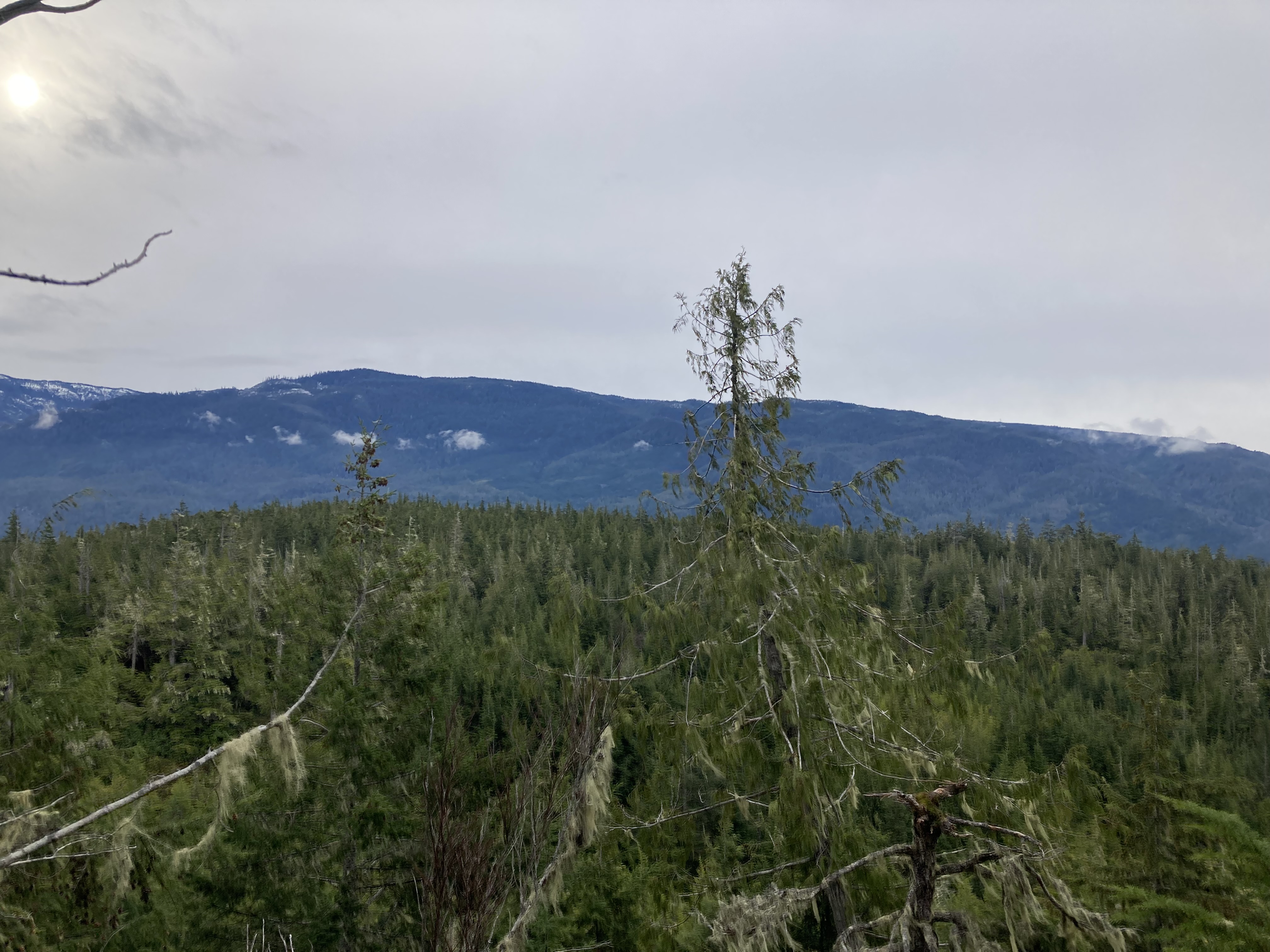
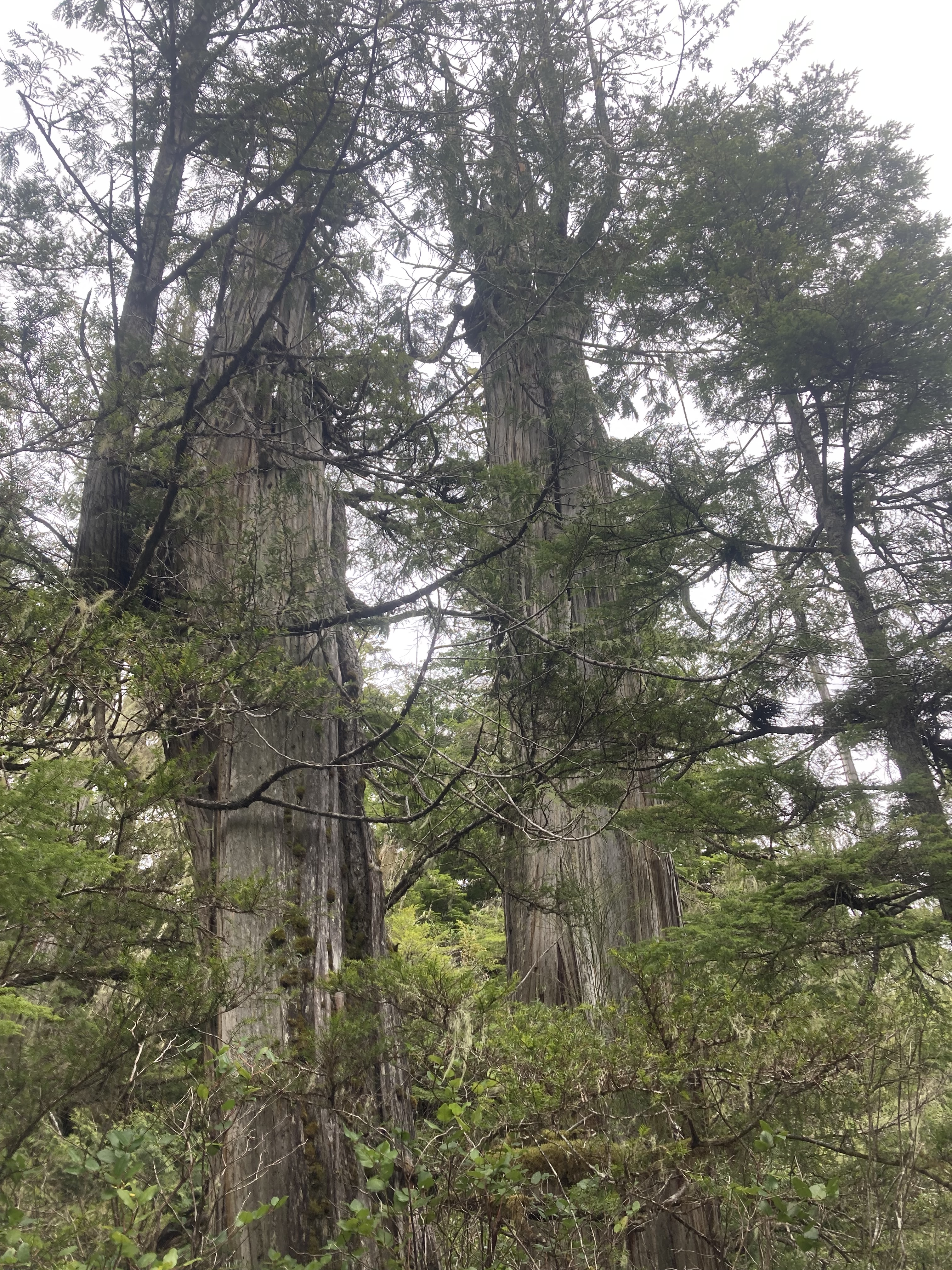
I’d be lost without my phone. It’s hard to admit, even by myself, without so much as a raven to judge me. The salal thicket blindfolded me, the small drainage spun me, and the few windows of sky reveal nothing. I follow the crutch in my hand, allowing it to guide me up one more embankment. A trio of big cedars with intertwined limbs shade a clearing festooned with deer beds. I push through one more wall of salal and gaze from the summit at Vancouver Island’s distant ridges. The hillside steepens, leaving just enough room for a viewshed and a clearing of rocks and lichen. I squeeze fatigued legs to my chest and stare at undulating greens and blues.
***

Harlequin ducks squeak in protest as I paddle by. They take to the water, necks bobbing forward and back as if to give themselves the illusion of more speed. Their rubber ducky chatter conceals their daredevil hobby of surfing southeasterly waves seconds before they break on the rocks. They dive like seals and fly like puffins, frantically beating their wings centimeters above the water. Every tidal rock holds another cluster of them, chattering away and admonishing the yellow kayak gliding past.

(C) Oregon Department of Fish & Game

Hanson Island crawls by. Every beach beckons to be explored, and twice, I slide into cobbled shores and poke into the woods. I’ve boated these waters dozens of times, always in too much of a hurry to pause. Always hustling either to Alert Bay or back to Orca Lab, usually in fading light or racing the next low-pressure system barreling up Johnstone Strait.

I’m hell-bent on savoring; I linger in non-descript woods for no reason other than they exist. At last, I swing into a narrow bay with steep shores plastered with ochre stars. A lone white buoy bobs at the head, and I pull into a small beach pockmarked with softball-sized rocks.

There’s the trail, just as I’d left it, through stands of alder and up a single-lane logging road recolonized by hip-tall hemlocks. I follow the steady incline under fallen trees and around puddles. A smattering of fish cut from plywood marks the trail with engraved names like “Bobby ‘Sparkplug’ Joseph” that demand exposition.

Past a slippery “bridge.” Clear-cuts glare at me—old ghosts rotting in choking shadow from dozens of same-aged hemlocks racing for sunlight. I stop at one such graveyard and try to remember. Had I noticed these old fallen trees in 2015? ‘16? ‘17? Had I been too naïve and unencumbered? Did the umbrella of protection now stretching across the beloved island somehow nullify the millions of board feet already removed?

I continue past spindly young cedars and gurgling streams, stopping at a fence woven with alder and salal. The gate swings open at a touch and the rusty old bell rings. A cedar shingle sign with weathered words welcomes me to “Earth Embassy.”

Trees sway in the wind, but it’s peaceful in the small courtyard between the old ramshackle buildings. Amongst the weathered old shingled walls, fraying tarps, and a bulletin board tacked with water-stained pages stand two new metal signs.  

“Respect this property,” the first sign commands, going on to recognize the site as the home and resting sight of one, David “Walrus” Garrick.

I wait for the creak of a wooden door and Walrus’s long gray beard and mischievous eyes. I listen for the echo of his dog Kessler’s booming bark or the rattle of the steller Jay fed peanuts every morning. But it’s just me in this quiet shrine with the work of one man’s lifetime.

The closest thing we had to a neighbor, I frequently made the hour-long hike from Orca Lab to Walrus’s. Equal parts Gandalf and Dumbledore with a liberal sprinkling of Original Trilogy Obi-Wan, Walrus would crack beers and tell stories he’d undoubtedly told a million times.

Wide-eyed, I’d listen to this living oracle talk about the founding of Greenpeace, protesting seal hunting in the Arctic and working as a cook on the first anti-whaling vessel before the Discovery Channel and Sea Shepard mainstreamed it.

The stories culminated in this place. His final act. The one he’ll be remembered for.

“The longest active roadblock in Canadian history,” he boasted, gesturing at his uninsulated cabin with a leaky vapor barrier, no insulation, and a smoky woodstove.

As Swanson, Cracroft, Parson, and Vancouver Island were stripped clean of timber, Walrus crawled sans-GPS through the salal to document the one thing that could spare the island known in the Kwakwaka’wakw language as Yukusam (‘shaped like a halibut hook’).
***

Red cedar is more than a sweet-smelling, rot-resistant wood that burns hot. Christened the ‘Tree of Life’ by the B.C. Coast’s First Nations, the tree was both canoe, house post, clothing, and basket. Centuries before the idea of forestry was an Anglo-Saxon fantasy, a natural ethos of conservation was a mainstay in Indigenous culture.

Life may have revolved around salmon, but cedar was the tool. Young cedars growing straight and true were set aside. They could be a basket today but, in a few generations, may be large enough to become a canoe, totem, or a corner house post.

Other trees were selected for bark harvesting. Outer bark was collected by making long, skinny incisions, which could then be dried and weaved into water-resistant clothing, baskets, even hats. The same oils that make cedars rot exceedingly slow even served as a natural bug repellent.

Instead of killing it, the harvesting increased the growth rate as the tree covered the exposed area. A cedar could rebound, survive, and even thrive if not too much was taken. The most formative and compelling case for conservation. The best argument that sometimes the word “enough” is the most important.

Prospective logging companies brushed aside the importance of Yukusam’s, “culturally modified trees” (CMTs), claiming that their in-house research showed there were only a couple hundred. Walrus and his team lived out of their active roadblock and pushed into every unlogged nook and cranny, documenting over 2,000 CMTs. For a region and people that had endured disease, assimilation, fish farms, potlatch imprisonments, and the heinous era of residential schools, CMTs are one of the remaining cultural touchstones. Carpet bombing Yukusam would be akin to nuking one of the few remaining strongholds.

Lawyers lawyered. Judges judged. Juries… juried?

And in the end, the remaining Yukusam old-growth was set aside. Walrus continued to live on his active roadblock, building gardens, cultivating shiitake mushrooms, and befriending the local steller jay population. The next generation of Kwakwaka’wakw filtered through the homestead, where elders taught cedar bark harvesting techniques.

Photo courtesy of Sharon Eva Grainger

These same Alert Bay residents pushed fish farms out of much of Kwakwaka’wakw territory, spurring returns of chum and pink salmon not seen in decades. It would be foolish and irresponsible to credit Walrus with this local revolution, but I wonder if seeing the power of a small team of forest-dwelling activists was another dry piece of kindling on an already growing fire.

***

For three winters, Walrus told me to climb the trail to Yukusam’s highest point. I’d smile, nod, and instead would walk back down the abandoned logging road for Orca Lab, unable to ascertain why. As my final winter as caretaker came to a close, I hiked to Walrus’s for the last time with a backpack laden with groceries. A nasty cough was making it harder and harder for him to lug supplies from sea level to 350 feet. Every couple of weeks, I’d arrive with a loaf of bread, eggs, and a couple beers.

“Did you get up the hill?”

I shook my head, feeling his disappointment, before grasping his hand and wondering if I’d ever see the sweet, eccentric Jedi Master again.

The cough forced Walrus to leave the longest active roadblock a few years later. In 2023, he took his final breath, finally able to breathe deep again.

***

The trail back to Walrus’s is easier to follow on the way down. I tour the old garden and study the pages clinging to the bulletin board. There are maps of the island showing the arterial trails he used to get from one CMT grove to another. Pictures of trees in mid-harvest and cross-cuttings of felled cedars, their age measured in centuries—quotes and documentation of Springer’s homecoming (another story for another day).

Near the front door is a notebook tucked safely in a Ziploc. Inside the little guestbook are the words of those who have visited this place since he passed. I clutch the little memento and stand before his resting place.

Before enlightenment, chop wood and haul water.

After enlightenment, chop wood and haul water.

I open to the next blank page and stare for a long time at the empty lines beneath my scribbled, “Dear Walrus,”

 It is somehow lifetimes and seconds since I was here… the longest active roadblock remains intact.

I finally made it up the hill. You were right, it is beautiful. I should’ve done it sooner, but I’m thankful I could return and make it happen.

I’m not who I am without Yukusam. It was orcas that drew me, but that’s not what brought me back. This place is green because of you. Cedars stand because of you, though I’m sure you’d brush that aside with a laugh and a cracking beer.

Chop wood and haul water.

The phrase catches my heart; no five words better summarize my post-Orca Lab life. Wood for a fire, wood for 2x6s, and rafters and plywood. The promise of a warm house.
But the words are not simply literal. I repeat them like a mantra, a meditation, a reminder that some things must not be forgotten, no matter where in the journey we are. Ways of life that tether us to place and home and earth. Edicts as sturdy as a cedar house post.

Chop wood. Haul water. Climb the hills. Get dirty knees. Paddle the beaches. Drink the beer. Smile quickly. Laugh loudly. Forgive easy. Let go of anger.

A raindrop hits the page. I bend over and try to say goodbye.

Thank you for all you taught me. It took a while for some of it to sink in; I’ll never be done learning, never be done making mistakes, but I’ll never stop trying. I chop wood and carry water because of you. Rest easy, my friend. The beer is on me next time.

(C) Globe & Mail

I return the journal to a house built by trees to protect trees and retreat down a forgotten logging road that will never continue, forever stymied by a fence woven with sinewy salal and shaded by cedars growing in dignified defiance.  
Sights and Smells

I wonder what’s different.

The transportation for one. Greyhound no longer brings their gargantuan buses this far up Vancouver Island, and as we careen down the narrow two-lane road with six inches of shoulder, I can see why. The playlist blasting in my ears has changed, though I brought back some classics like Death Cab for Cuties’ Bixby Canyon Bridge and Snow Patrol’s Make This Go on Forever.

A myriad of greenery blurs outside the window. I watch these forests differently, too. Oh, my heart still flutters at the boughs of red cedar hiding secret pathways to 6,000-foot peaks. But I also see acres of young hemlocks scrunched together like matchsticks in neat little packages. Phrases like “stem exclusion” and “30-year harvest cycles” whisper with sullen voices. Countless watersheds line the east side of Vancouver, but the Tsitika River I just rumbled past is the only one that hasn’t been logged. Tsitiaka winds through the tallest mountains on the Island and reaches saltwater at a little place called Robson Bight.

Orcas. It always comes back to orcas.

For two days, I have ferried, flown, and ridden from Gustavus to Juneau to Seattle to Victoria and am now just an hour from Port McNeil. Despite my evolving playlist and old-growth forest opinions, it still feels impossible that my first trip to Port McNeil was 17 years ago. Surely it was just a couple of weeks ago that I hopped off the Greyhound. Wasn’t it last weekend that I drove a Nissan Pathfinder up this road with a cat and rabbit in the back seat?

These roads, islands, and waterways hold a lot of the stories and experiences that explain the evolution from basketball boy to kayaker, guide, naturalist, bum, redneck-hippy, writer, conservationist, and whale aficionado. I’m counting on it providing a few more.  

Ferried. Flown. Ridden.

I count the number of petroleum-driven vehicles that propelled me from Gustavus to the footsteps of Port McNeil, Johnstone Strait, and my precious Hanson Island. All to go on one more monkish retreat in the woods and waters of my youth. All to catch one more ride on a boat powered by an outboard motor or go paddling in a kayak made of, you guessed it, fossil fuels.

Too small to tip elections in favor of Mother Earth, I run to my favorite hiding place, sheltered by, you guessed it, Mother Earth.

Blackfish Sound

If the trees are passing judgment on my life choices, they keep it to themselves. If those replanted hemlocks are packed like matchsticks, what happens if one of them lights? I woke to the news that California was burning during the wet season.  A world getting drier, warmer, crazier, more unpredictable. Surely, it would be the earthquakes that doomed southern California. We beat San Andreas Fault to the punch.

***

Don’t cry. Whatever you do, don’t cry.

All those old names:

Blackfish Sound, Pearce Passage, Weyton Pass, Blackney Pass, Queen Charlotte Entrance.

Bold Head and Cracroft Point. Blinkhorn Peninsula and Kaikash Creek.

I know them all, have stared covetously at their little faces for eight years, promising I’d see them again. I’m sure they’ve been getting on just fine without me.

I confess I left my guilt on the Port McNeil dock, catching one more 45-minute ferry ride to Cormorant Island and the town of Alert Bay—the end of public transportation. I wait two days for a weather window that finally comes as low pressure turns to high and the wind pivots from southeast to northwest.

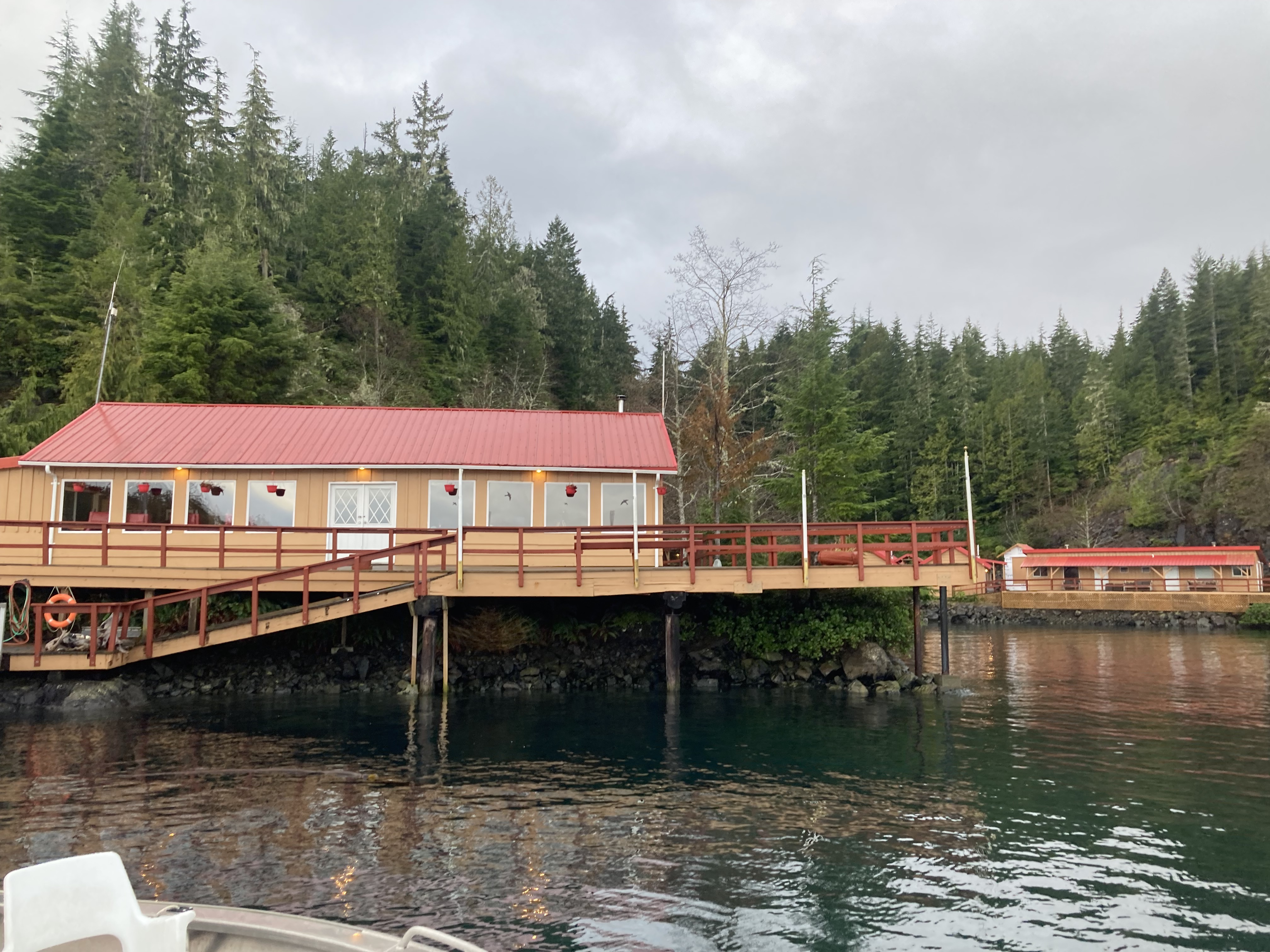
Every town run from Orca Lab to Alert Bay took me past Double Bay, its long boardwalk, floating dock, and cherry red rooftops. I shoulder my pack and follow the other caretaker, Laurene, up the dock. She directs me to a cabin on the right side of the horseshoe-shaped boardwalk, perched on the rocks with a view of Blackfish Sound and the first layer of the Broughton Archipelago’s islands.

The door opens, and the pack thumps from my shoulders. The cabin is bigger than my Gustavus design, with a half-loft upstairs, a functional shower, even a flush toilet. I would have settled for half-a-shabin and a cot. It’s not the high-end amenities that made the pack fall.

Don’t cry. Whatever you do, don’t cry.

Next to the kitchen table is a shelf. On it rests a radio receiver that looks all too familiar. Whether donated or purchased from Orca Lab, the ocean blares from the speakers—water gurgling, a distant boat engine, crackling shrimp. I swear I hear A pod.

“We have a hydrophone at the mouth of the cove,” Laurene explains, unaware I have been transported back in time. “There’s a volume knob on the right—”

“I know,” I interrupt. Not the best first impression.

I cross the room and crank the volume. How many nights did I fall asleep to this? She leaves me to unpack. I move quietly across the floor as if I’m in church. Clothes upstairs, tortillas and cheese in the fridge. Curry paste in the cabinet. I open the wood stove and smile. A pile of ash has calcified on the bottom and shrunk the stove’s space in half—a chronic problem with burning wood soaked in saltwater.

I pry the ash free and grab a handful of piled kindling. With eyes closed, I bring a stick of red cedar to my nose and inhale like an addict, listening to the hydrophone as my head spins and heart palpates. Our sense of smell pales in comparison to most mammals. Yet its ability to conjure memories is undisputed.

There is a smell to Hanson Island I have found nowhere else. Something in the ground, the water, the trees. Perhaps it’s as simple as it remains one of the few islands in the region that has not been clear-cut. Old-growth smells for a land that measures lifespans in centuries and seasons in seconds.

***

I weave between cedar and fir, balance on fallen skyscraper hemlocks, and plunge through salal undergrowth. I squish deer scat between fingers and spy on harlequin ducks perched on rocky beaches. Rumor has it a wolf has taken up residence on Hanson Island. I scan the hills with blind optimism for hazel eyes, ears cocked for the howl that proclaims that there are still things green and wild and true on this burning planet.

The rising northwesterly brings the forest to life with creaks and cracks. I settle against the hollowed-out trunk of a cedar, its innards charred from a long-ago lightning strike. Yes, even here, there can be fire from time to time. The stubborn cedars simply refuse to rot and fall, standing even in death in defiance of the decay and rebirth that comes for all.  

I scratch at the charred bark and sniff. Any smell of fire is gone. The forest around me vibrant and healing. I watch the treetops, content to let the afternoon crawl away. There will be time tomorrow to check in and learn what is expected of me here, how I can give back to this place that dreams of becoming a sanctuary and educational retreat. It took enough petroleum to get me here. I will live, write, and eat in a shelter made of wood. I’ll try to leave this place better than I found it.

Wet earth soaks into wool pants, a pleasant shiver travels up my spine. Ravens cackle, eagles retort. Somewhere, an orca explodes to the surface. I feared two months wouldn’t be enough time to find what I was looking for. But as eyes close and my soul rises to the island’s tallest canopy, I know it’s already been found.

Why Do This

Ice. It always comes back to ice. Jagged, narrow inlets filled with saltwater hundreds of feet deep. Hills and mountains sculpted and rounded thousands of feet above the lapping waves. Humpback whales feed near the inlet’s shallow moraine, where the currents of Icy Strait and South Inian Pass meet. All because of glaciers that churned through thousands of years prior. The icy deserts have been replaced by a bounty of life that feels limitless in the calm August sunshine.

Our skiff glides down Idaho Inlet, cruising mid-channel and on course for the dogleg turn a couple of miles from the head of the inlet. Our heads crane upwards, eyes probing glowing green ridgelines and the hypothetical routes that lead to them. A few of these green fingers run towards sea level, a deceptive and alluring path that, in reality, is thick with salmonberry and alder. Better to take the wooded (albeit still thick) forests to reach that seductive alpine ridge.

Zach noses the boat towards a salmon stream and Seth leaps from the bow with a nod as he gives the boat a hearty shove. He disappears into the grass before the forest swallows him. I take the wheel, and Zach shoulders his own pack and rifle.

He points at a long rocky beach. “That one.”

I glance at the ridgeline. Sure. If I blink, squint hard enough, and imagine enough switchbacks, I can see a route through the trees to that coveted alpine. If Zach has any questions about the validity of his chosen mountain, he’s decided not to show it.

The keel scrapes the rocks, and he leaps clear.

“Good hunting.”

He waves in response. “See you tomorrow at noon.”

With a shout of, “Hey bear!” He vanishes into the trees.

I spin the skiff towards a small cove on the other side of the inlet. It’s an ideal anchorage in the shadow of another 2,000 peak that culminates in a long, straight ridge glowing in the setting sun.

For a third time, the skiff bumps the rocks. Out goes my pack and rifle before I putter away to lower the anchor. The anchor strikes bottom at 20 feet, and I spoon out several more feet before sliding the boat into reverse and feeling the anchor teeth dig into the soft mud. I brush my teeth and spit over the side, suddenly feeling oh so small.

It’s approaching 9 in the evening, and the mountain looks steep and foreboding. It will be disorientating in the woods. I pray for a game trail devoid of fallen trees and devil’s club. Idaho Inlet cuts into the north side of Chichagof Island, home to one of the largest brown bear populations on earth, and I left my bear spray sitting on the counter at the Hobbit Hole. I’d sooner wrestle a bear than rely on a round or two from a 30.06. It only makes me feel smaller.

I squeeze into a pack raft and splash for shore, shoulder the pack that feels too heavy, and crash into the darkening woods. Sweat soaks my sweater, and my breath comes in gasps as I hop from one deer trail to the next, yelling for the bears to keep clear every couple of minutes.

Why do this?

I pause and look at my GPS. 400 feet above sea level. 1600 feet to go. I’m not going to make it tonight. I look at the forest’s collection of blueberry, skunk cabbage, false azalea, and rotting tree trunks. Nothing looks remotely campable.

“Hey, bear!”

The words disappear with nary an echo. I am over my skis. A wanna-be Alaskan cosplaying as a hunter and homesteader. Discomfort wiggles in my mind, and whispers of self-doubt grow a little louder. I glance at the thickets below and, for a moment, consider retreating. I can camp at sea level and try for the alpine in the morning.

Why do this?

I tighten the pack’s belt and bush upwards. I can’t answer my own question, much less discern where I’m going to camp or how I’ll bear-proof my food while I sleep. Something keeps me climbing, keeps me gasping and sweating and pushing.

Tomorrow is Christmas morning. The allure of fat deer foraging on the cabbage that bears their name. The never-ending ridges of the island in the background. To stand where no one has stood for years (maybe longer). A reminder of the joy of public lands and wild places. The good health and fortune that lets me push higher and higher, one sweat-soaked step at a time.

At 800 feet, it’s too dark to climb any further. I cast around for anything resembling a campsite. I cram the tent against a hemlock perched on a ledge. At least the tree will catch me before I tumble should I roll over in the middle of the night. I’ve worn too many layers, and the bottom one is soaked through. I crawl into the tent without bothering to put on the fly. It’s been a soggy summer, but the last few days have been hot and dry, a forecast projected to continue tomorrow. I hear a stream tumbling down a gorge and murrelets returning to their nests. I brace against the hemlock and fall asleep.

Alarm at 4 am. I don’t bother packing the tent and hustle up the mountain with just the essentials: trail mix, rifle, extra shells, hunting knife, plastic bags, and Wild Berry Skittles. I pop out of the woods and into a mix of muskeg and yellow cedar, greeted by the rasping call of a doe.

My muscles tense as I slide rounds into the Springfield and watch the last one lock in the barrel. I squish through the muskeg, eyes trying to see everything at once. I am faced with the hunter’s dilemma, forced to choose between covering more ground or moving silently. Despite the doe’s call, the ground around me is sparse on sign, only a few trails and dry piles of scat. Discarding stealth, I bolt for the summit, already feeling a warm breeze as the sun inches towards the shady peaks. Idaho Inlet spills beneath me, a sinewy waterway that looks no bigger than a river. A jolt of anxiety runs through me as I imagine a poorly set anchor line and what it would be like to step out of the woods and into an empty cove. That’s a problem for Sea Level David hours down the road.

I bring the scope to my eye and work the ridges and meadows with as much patience as I can conjure. Two deer pop against the ridge 200 feet above. They weave through the rocks and grass, velvety antlers evident on the one in the lead.

My heartbeat quickens, but another peculiarly warm gust brings disappointment. The pair are traveling downwind, and the only approach for a biped is upwind. With no other deer visible, I begin to climb, hoping for a change in the wind.

I pause at the summit. The Fairweather Mountains explode from the other side of Icy Strait. Even from this distance, the 14,000-foot sentinel’s tower over my quaint little hill, blinding white peaks stretching north. Again, I feel small, but not in the diminished, intimidated manner of the day prior.  The wildness of my home reverberates in my chest, and I barely mind when I realize the deer have disappeared around a steep and wooded point.

There’s no chance of following them without creating a ruckus, and the wind won’t stop blowing their direction. The ridgeline is a deceptive mix of mountain hemlock and yellow cedar the consistency of a hedge grove. I quietly push through them and feel the temperature drop. Minutes before 6 am, the promise of a sweltering summer day is already palpable. Too much sun means sheltering deer and poor hunting. The clock is ticking as I step out of the hedge on the west side. If I were a deer, this is where I’d be. Three mountains rim a bowl of alpine and sub-alpine habitat still sheltered from the rising sun.

I give the distant muskegs a scan, but a lip in the hillside keeps me from seeing the ground beneath me. I re-enter stealth mode, every step deliberate as I try to watch my feet and the emerging muskeg. I glance right, take another step, look down, and freeze.

A deer’s winter coat is grayish-brown and melts into the old growth, but its burnt orange summer one pops against alpine green.

The rifle jams against my shoulder. My god, he’s huge. A belly full of summer forage swings back and forth. He stands broadside to me, but when he raises his head, I can see broad, illustrious antlers culminating in three points on each side. The sort of deer Zach and I talk about after our fourth whiskey while snow falls on a gray January evening.

I take a breath, squeeze my eyes, and am overjoyed when the buck is still there when I open them. My mind freezes, and time slows to a halt as exhilaration mixes with the pressure not to blow this. He hasn’t seen me, but at this angle and distance, I’m not comfortable taking the shot without a brace. I can’t lay prone on this steep hill.

The pack slides from my shoulders, eyes on those antlers. The safety clicks. When I first started hunting, I anticipated some sort of moral conflict to play out inside me during these deliberate, pre-mediated actions. But there’s never room in my head for that. Once the safety is off, I’ve made my choice, my brain and heart acknowledging that we’re taking a shot. To take a life to sustain life. My inner monologue is filled with the same trite phrases:

Don’t blow this. Don’t blow this. Don’t blow this. It’s too hot. This is your one chance. The next 30 seconds will decide this.

I rest the barrel on my pack and kick my legs to the side. It’s awkward, but the rifle feels manageable with the pack holding the weight. I shift, and the buck looks up the hill. He fills the scope, and I stare covetously at his antlers. Ten minutes earlier or ten minutes later, and I would’ve missed him. I’d never claim to be a good hunter, but luck has been with me more often than not the last couple of years.

Deep breath, let it out. Wait. Wait. He keeps staring. Crosshairs split those beautiful, perfect antlers. Downhill shot, 200 yards. The bullet’s gonna drop. Compensate. I raise the barrel slightly just as the buck turns away to look at the alpine bowl beneath the mountains. The clock hits 6 am. A finger twitches. The blast echoes off peaceful peaks.

I unbolt the shell and catch the spinning casing. Another slides into place. Before I can stand, I know another shot won’t be necessary. His twitching slows as the nerves fire.

“Yes,” I breathe. “Oh, thank you, deer. Thank you.”

The safety clicks on. I fall more than run down the hill. The adrenaline letdown means everything is shaking. Balance and hand/eye coordination have become optional. My knees and hands tremble as I grip the fuzzy antlers that so filled my mind.

I mumble platitudes, take a deep breath, and get ahold of myself. As crucial as the last five minutes were, the next couple of hours are just as vital. The buck is too unwieldy to drag to sea level. The meat will need to be harvested here, the bones and fur left for scavengers. But not yet. I let the contradictions of my life run wild.

I’ve grown to fiercely love deer, finding them beautiful, gentle, charismatic, and, yes, delicious. To introduce violence and death upon a creature I treasure is something I fail to fully comprehend. Nothing is stopping me from climbing a mountain and simply watching these animals. No one would think less of me. I am not participating in some blind race for masculinity and affirmation.

Why do this?

I bury my fingers in his fur and bow my head. Because to eat of deer is to eat of the forest and mountains that make up my home. Because few things bring more pleasure than sliding a burger across the counter to a neighbor or loved one. Because there is something prehistoric and feral braided into my DNA that wants to hunt, catch, gather, and grow instead of blindly tossing deli meat in a shopping cart.

“I won’t call this a sacrifice,” I whisper, forcing myself to look into his empty eyes. “Because you didn’t wake up this morning set on giving your life. No, you were in the right place at the right time.” I pause, “or the wrong place at the wrong time. I hope your passing was as painless as it could possibly be. I promise to honor this gift and use as much as I can. I’ll think of you and this day every time I eat. I don’t know what the afterlife is like for a deer, but I hope it is peaceful and quiet and free of pain.”

I press my forehead against his. Velvet antlers rub my temples. The flies begin to buzz. No words can excuse the violence and bloodshed. But if my gratitude and respect can find a way into the calories I harvest… it matters how an animal dies. How it is treated even after it draws its final breath.

The muscles in my leg cramp, the plastic bags steadily filling with meat bound for canning jars. When the bags are bulging, and the work finished, I drag what’s left of the buck to a large rock, spreading the pelt across the top and resting the head to overlook the mountains he’d been watching. From behind, he could be sleeping.

I shovel Skittles into my mouth and wrestle the pack into position. My knees ache as I reach the ridge and appear in blinding sunshine. I glance back at the burnt orange fur and give him a final nod.

Why do this?

Idaho Inlet waits below. The Inian Islands and Hobbit Hole obscured from this angle. There will be stories to tell, beers to drink, a life to thank and remember as the pressure canner rattles. Tradition dictates that the heart of the deer must be eaten that night. The sort of meal that needs to be shared. Must be shared.

I take an uneasy step down the ridge. 1,998 feet to go. I may not be able to articulate how or why this has become the most integral part of my year, but there’s no going back . Home lays before me, rolling ridges behind, the biting straps of the pack a blessing in disguise.

Between Ocean and Snow

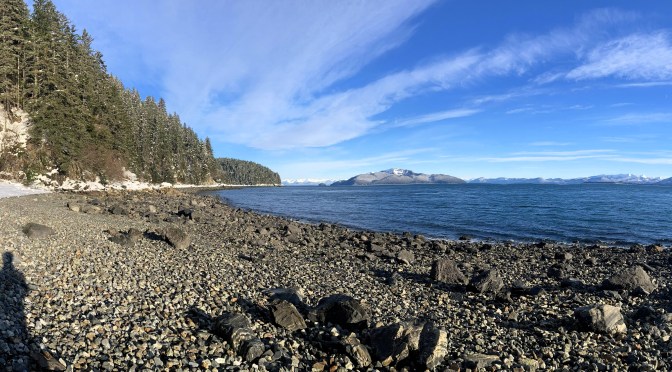
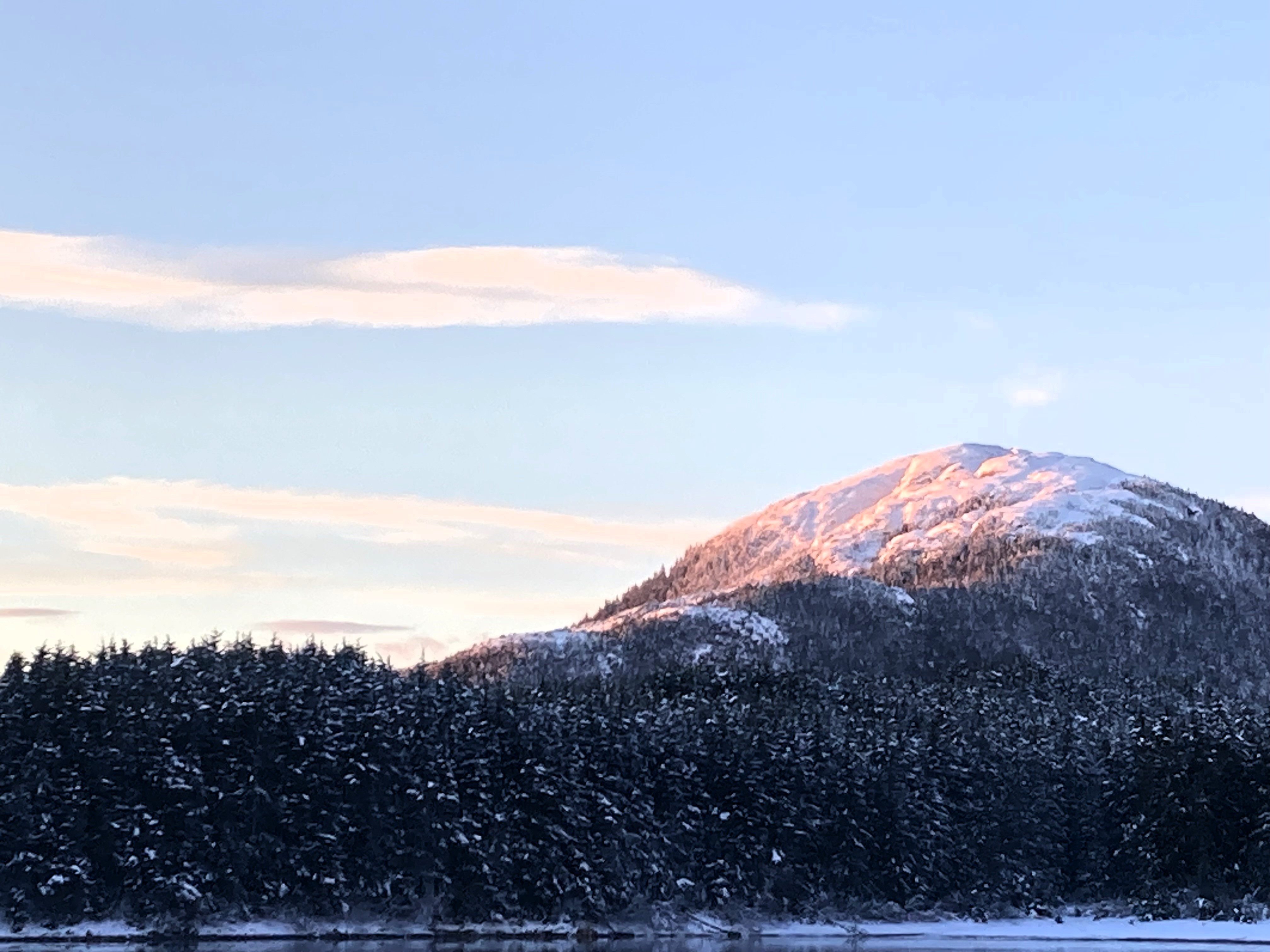
The rising sun turns the hillsides purple. My kayak cuts through the water, leaving an ever-expanding “V” in its wake. Even with a down jacket, I can feel the bite of morning cold. The low tide leaves an exposed strip of rocks and kelp, frozen and crunchy, patiently awaiting the sun and thaw.

For 72 hours the Icy Strait Corridor has endured an unrelenting snowfall. Winds buffeted the trees and left huge drifts piled along the beach meadows. I shoveled five times trying to keep up with the snow’s metronome consistency.

Boats in Juneau’s harbor sank, the land frozen in winter’s fist. Trees bend double beneath the load. Cracks echo through the forest as these proud sentinels break under the weight.

At last, we have a respite, a window of calm before the outflow returns with gusts of 40 knots.

I have waited for this day. Snug and warm next to the woodstove I would peer through the windows at the blizzard and wonder how any animal could survive such conditions. This is my chance to find out.

The benefits of old-growth forests could fill volumes of text. The contrast between the muskegs and woods is shocking. Four feet of snow fill the open areas of the island with perhaps half that amount beneath the trees. It is these big trees, their massive boughs enveloping the land in a protective embrace that give the deer a chance. These causeways give them routes to the beaches, where they can slog through the drifts and find relief below the tide line. The table is set. Rockweed and bull kelp torn from their holdfasts wash ashore and provide some of the only accessible forage when snow of this magnitude hits.

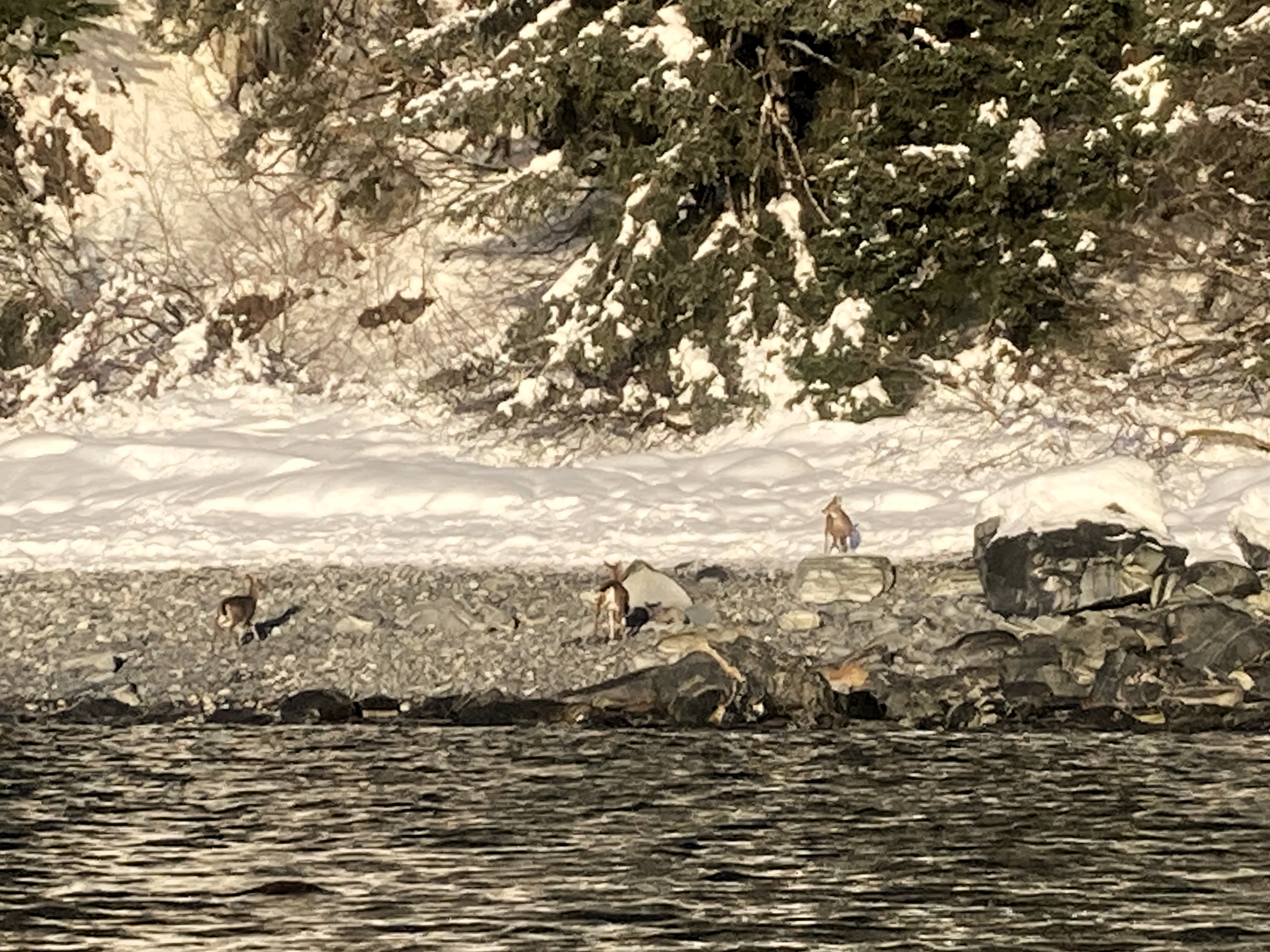
I paddle south along the island’s southern peninsula, scanning the beaches. The first one yields a doe and fawn that scatter into the woods as I glide past. Eight more deer congregate along a 300-yard stretch while a small cove no more than 50 yards wide holds another six.

I bring the binoculars to my eyes and watch, the boat bobbing in the gentle swell. The rut is over, and the bucks have dropped their antlers. It will be something of an easter egg hunt in the coming months to find them hidden in the moss.

These deer are in my parking spot. I’d planned on landing here and climbing to the other side of the island to inspect the long stretch of east-facing beaches bathed in morning light. I hover offshore and watch them through the binoculars. Five adults and a yearling. They look in good shape, still fat and healthy.

Deer are ruminants, meaning they chew their food multiple times and have specific bacteria in their gut to maximize their caloric intake. But every food type has its own bacteria, and there’s a delay as these new bacteria colonize the stomach. Switching overnight from a diet of forest groceries to kelp can have dire consequences. A deer can eat kelp all day, but until the bacteria catch up, they may as well be eating dirt.

The six are foraging voraciously along the shoreline. How long had they waited for this opportunity? It’s easy to imagine them hiding beneath large hemlocks, watching the never-ending snow pile among them with stomachs growling and fat metabolizing. Landing will scatter them back into those snow-laden woods and I can’t bring myself to do it.

I paddle onto the next little cove.

This one too is spoken for. Three more deer graze among the rockweed. They’re so engrossed in their work they don’t notice me for several minutes. A large rock cuts this cove in two, and when they move to the far side, I ease my kayak into the beach, step out, and drag it to the snowline. I peek over the rock and see three sets of ears tuned to my frequency. Upwind of them they maintain a curious demeanor. A shift in the wind will send them scurrying, perhaps getting a whiff of the venison meatballs I’d eaten the night before.

I step towards the woods, sink through the snow’s crust, and posthole to my hip. It’s a quarter mile to the other side and it takes fifteen minutes of panting, gasping, and trudging to reach it. Sweat drips down my face and my lungs burn. How do these deer do it? By the time I reach the edge of the woods, I’m exhausted. It takes several minutes before I feel ready to climb down the cliff face to the rocks below. I remind myself to look for snowshoes when I get home.

My clumsy ascent sounds like a gong on the beach below. I watch two more deer scatter through gaps in the trees.

Whitecaps adorn Icy Strait, and Lemesurier Island looms in the distance, its forest frosty and frozen. I glass the beach ahead and see a lone deer near a washed-up hemlock deadhead.

Surprising. I figured there’d be more. I hug the waterline as I pass the hemlock, the deer watching suspiciously. On the other side of the log, another deer materializes, I stop, look up the beach, and they seem to apparate. One, two, three, four… eight. Eight more clumped in two groups of four.

I never think of deer as social animals, but they are. They may not have reliable herds, but there’s no doubt they enjoy each other’s company. Clicks and loose friendships form, safety in numbers, community. It resonates. Reminds me how alone I am.

There’s a difference between alone and lonely. I have enjoyed my solitude, the quiet, and the reflection. But there is no denying that I still reflexively reach for my phone when I remember an old inside joke, hear a new song from one of our bands, or find an Instagram reel she needs to see. Old habits, they die hard.  

The beach bends, and I creep among the boulders, peaking over the top of the last one. The 30th deer of the day has her head buried in the snow, rising every minute to slurp down another slippery string of kelp. I advance when her head’s down and freeze when it rises until I’m 50 feet away.

I settle on a boulder, open my backpack, and invite myself to lunch. As I munch trail mix and guzzle water a fawn stumbles out of the woods and joins its mother among the kelp. The scene brings an emotional response I wasn’t ready for. The pair moves to a young hemlock, and they strip the needles the way a bear forages for berries.

Icy Strait sparkles. The snow-covered mountains and hills pop. Eagles soar on the thermals. You can hear the land exhaling after the deluge of the previous days. There’s a tug at my heart, a desire to share this moment with someone. Some of House Stark’s words hover in my head.

“When the snows fall and the white winds blow, the lone wolf dies but the pack survives.”

The tide is rising, and the sun setting. I leave the little family to their work, padding back down the beach past watchful eyes and into the woods. Through the trees, I see a glimmer of red. No matter how far up the beach I bring my kayak, I never stop worrying until I see it right where I left it.

The trio of deer have disappeared, leaving the beach unoccupied. I launch and enjoy the sun on my face as it begins its downward trajectory over the Pacific. I feel full and content as I paddle for home, again overwhelmed by the incredible beauty of this place. The southern end of the Fairweather Range peaks above the islands to the north, with 14,000-foot peaks, and an icefield you can hide Rhode Island in.

I stop in front of the next cove and smile. The deer are still here. No longer foraging they lay among the sunbaked rocks. I can feel their contentment, their relief. The new bacteria in their stomachs beginning to work, metabolizing the kelp and hemlocks and blueberry twigs. Feeling warmth for the first time in days. A chance to breathe, to rest and recuperate.

I knew today was coming, had the 16th circled on my calendar even as the snow continued to pile up. The deer have no such luxury. What concept of time do they have? How long had the last three days felt for them? For those little fawns experiencing the first truly hard moment of their life? But now, the sun was out. More storms are coming, another foot of snow is expected in a few days.

Why worry now? With bellies full and warm rocks to rest on.

Storms come and storms go. We can’t always forecast when they’ll begin, end, or start again. Some may never end. Some may never come. I saw myself in these deer, huddled beneath a big hemlock, waiting for the blizzard to end, not knowing when. Clinging to the faith that the clouds will lift, the sun will return. There will be warm rocks and bull kelp for everyone.

I begin to feel that sun. Stepping out of the woods and powering through the drifts, knowing relief is near if I plunge forward just a little further. I can feel their eyes on me. And through the distance and isolation, sense the eyes and love of my own pack. The winds may howl, but I am not alone. The bow spins, the water parts around the keel and points for home, grateful that when the sun sets and the tide touches snow that I don’t have to retreat to the woods for shelter.

Inside the cabin, I pull out my notepad and consult my notes. 12 miles traveled in total, and somewhere between 38 and 45 deer depending on how confident I am I’m not double counting.

Minerva coils around my legs, reminding me it’s almost dinner time. I step outside and am greeted by a crescent moon. The hills are bathed in purple again. The winds have begun to rise, and the trees start to bend. I wrap my jacket around me, step back inside, and whisper thanks to the neighbors hovering somewhere between ocean and snow.

Two Hikes

Several years ago, when I lived in Juneau, I rented a house near the Mendenhall Glacier. Framing the southern side of the valley was Thunder Mountain. A steep and imposing peak with impressive avalanche shoots and Spruce covered ridges. After a couple months living in its shadow I gave in to temptation and attempted to scramble up one of the avalanche paths. It was mid-summer and the foliage was thick with devil’s club, skunk cabbage, and alder. Halfway up, the moderate grade shoved me onto a near vertical pitch. Consumed with the climb and drunk on sunshine, I continued fifty feet further than I should have. By the time I realized what I had done, I had trapped myself in a stand of alder and was climbing their branches like a step ladder.

My 24-year old ignorance was replaced by genetically infused fear thousands of years old. Just a week ago, a seasonal had scrambled up the ridge near Eagle Glacier to the north of town. One false move, one slip in his Merrill’s and he fell to his death. Like him, I hadn’t told anyone where I was going. I’d broken the cardinal rule of the outdoorsman. My knees shook, my arms trembled. Somewhere to the west, 65 miles away, my fiancee was kayaking, oblivious to the fact that the love of her life was so recklessly risking his.

I began to downclimb. Most mountaineering accidents occur on the descent. I was no different. A foot slipped, a branch cracked, and I began to free fall towards a gully 60-feet below. I’ll never forget the sensation. As I fell my terror was replaced by a serene, almost disarming calm. I no longer felt afraid. I reached out with one hand and grabbed an alder branch as thick as my forearm. The branch bent, bobbed, cracked… and held. From above came a strange rustling followed moments later by a sharp pain on the back of my head. I watched the offending branch and my baseball hat complete the forty-foot plunge into the shoot. The branch gave a sickening crack as it struck the boulders. I hung, as weightless and helpless as an astronaut on his first spacewalk. Helicopters bound for the glacier zipped by. Cars roared by on a road a thousand feet below. And I gripped the branch that was preserving my life.

***

I throw rain pants, a sweater, and a vest into the backpack I’ve had since I was 21. The straps are fraying, several of the buckles are broken. But I can’t bear to give it up. She’s more duct tape than nylon at this point. But I carried my life in her through New Zealand, British Columbia, and southeast Alaska. Some things are more important than efficiency.

I no longer have a fiancee. But I do have a wife. And I make no bones about where I’m going today. I’m going up the peak to the south of the Hobbit Hole. There’s two feet of snow at sea level and who knows how much at the top. I’m dying to find out. Worst comes to worse, they can follow my footprints. It’s deliciously quiet here. We’re used to solitude. But even when we lived off the coast of B.C, boat traffic inundated our ear drums. Walks through the woods were often interrupted by the dull drone of a diesel engine as a tug plied the inside passage. Here we endure the occasional 737 flying at 20,000 feet but that’s it. The thick snow mutes the silence even more. No squirrels, no birds, just my boots stepping through the frozen crust.

I weave through hemlock, spruce, devils’s club. My breath comes in gasps, I sweat beneath the wool that keeps me warm when I stop. Deer tracks surround me, all pointed downhill. Perhaps they know something I don’t. Three days ago we woke up to blowing snow and flakes as big as thumbnails. It snowed for 16 hours straight, pushing the deer down from the ridges to the beaches. I reach a steppe and come out into the open. It’s like stepping into the deep end of the pool. My boot plunges deep into the snow and doesn’t stop until the crust is at my hip. I struggle out and throw the next step forward in an awkward plunge. I head for a steep ridge. It’s nearly vertical and this all begins to feel familiar.

***

I watch my shoes swing beneath me with a benign neglect. I’m hypnotized by my hat three dozen feet below, nestled between a couple of boulders and covered with dust. Blood drips from my left hand which grips the branch so tight my knuckles turn white. My body completes it’s flight of fight checklist, determines that I’m no longer in immediate danger of death, and give me permission to freak out. The change is instantaneous. I hyperventilate. My legs begin to shake. I have to move. My stupidity knocks at the back door of my sub-conscious, reminding me that I’m an idiot and lucky to not be laying in that gully with a shattered leg or two. I pull myself up and my feet search for a foothold. To my right is a thin ridge, just wide enough for a couple of spruce trees to get ahold.

I move hand over fist, my feet skittering madly to keep up. At last I feel dirt and root beneath them, I kneel and grip the ground. I want to curl up and never move. I’m never letting go. In my mind I imagine my body hitting the rocks. How far would I bounce? How damaged would I be when I finally came to rest. And with a shudder remember that no one would ever find me.

***

I stagger towards the ridge and stop at its feet. The snow four feet deep in places, more swimming than hiking. I look at the reassuring trail I leave behind. There’d be no mystery this time. I begin to climb, my feet digging for purchase beneath the snow while hands pull me up with the aid of salmon berry bushes and willow. There’s a melody to hiking through the snow mixed with the improvisation of jazz when a boot falls deeper than expected. I turn around halfway up to catch my breath and feel it catch in my throat. The view is bonkers. West facing, the ocean, the whole Pacific is sprawled at my feet. Three Hill Island and Soapstone Point guard the southern edge of Cross Sound. Cape Spencer to the north, just enough of a break in the clouds to see Mt. Crillion.

Already the landmarks feel like old friends. “Hello dear Port Althorp, hey Elfin Cove, how’s it going Middle Pass?”

I turn and continue to climb, by the time I reach the top I’m crawling. A thin ledge, two spruce tress wide greets me at the top.

***

I cling to each spruce and try to get my knees to stop quivering. I’m bleeding from four different spots, the pain beginning to whisper from beneath the adrenaline. There’s a welt on the back of my head where the branch made contact, my neck hurts. I’m a fool and Thunder Mountain was punishing me for my foolishness. The wild places teach harsh lessons, lessons you never forget if you survive. I prayed I’d have the chance to learn from my mistakes. As I climb down, the ridge I’m following widens until all I can see is trees on each side. The climb remains steep and down climbing is harder than going up. Gravity a much more willing participant.

To my left I hear something crashing through the bush. Bears litter the valley. Black bears primarily, though the odd brown bear will poke its nose in to chase the spawning salmon of Mendenhall River. But it’s a mountain goat that appears through a tangle of devil’s club. Branches of the bush stick to the thick tangled hair that’s somewhere between yellow and white. A pair of identical horns jut from the top of its head and curve forwards. The beast is maybe thirty feet away. It stops and turns its head slowly in my direction like a villain in a cheesy Hollywood production. Without a moment’s hesitation it begins to trot towards me. I stand at the edge of a drop of twenty feet, and the last thing I want to do is free fall yet again. But the goat seems to have every intention of running me off the ledge. More harsh lessons at the hand of Professor Thunder.

It’s at that moment, after twenty years in the woods and fjords of Alaska, that I realize that I don’t know anything about mountain goats. My body is drained, out of adrenaline, I do the only thing that feels logical and insane at the same time, I scream.

***

I follow the ridge up a little further. I’m having flashbacks of devilish goats, snapping branches, and serene free falls. The ridge takes a sharp turn to the right and into a thick tangle of spruce. This is far enough. A scattering of trees gives way to a wide open precipice that cuts between the summit I stand on and the next one to the north. I have no intention of looking over the ledge. I lean against the sturdy trunk of a tree, feel snow and dirt beneath my feet, and pull a water bottle from my backpack. Something small and blunt is still in the pocket, I dig deeper and pull out a small shooter of gin.

A smile becomes a grin. Miracle booze, the best kind. It’s barely eleven in the morning. But there are no man made rules in the forest. I crack the cap and empty the little bottle, savoring the burning liquid cooled by the ascent. It only makes sense to taste pine trees when surrounded by them. I give a silent thanks to Jen and Patrick who had filled my Christmas stocking with the little shooters and my own irresponsibility to stash one in my pack and forget all about it. I shoulder the pack and take one more longing look at the world around me. From here it was possible to see the world at its best. No mass shootings in Florida, no indictments in Washington, no missile tests in Korea. Just me, the trees, and that big ocean taking on all comers.

***

I want to go home. I want a hot shower, fluorescent lights, a big sandwich, a cold beer. The goat continues his advance, his hooves stick to the rock like velcro. I scream a tapestry of vulgarities that continue to hang over the mountain to this day. Five feet away his wild goat eyes weave to the right. He climbs onto the hillside a few feet above me. Those iris’s staring deep into me, mocking me, shaming me.

I step away, my eyes never leaving him, toes probing for the edge. I grab a root and scramble like a fireman down the rocks. I leap the last four feet and fall with a thud. Enough. I lean forward and half run, half fall down the mountainside, bloodied, beaten, and alive to climb another day.