Tag Archives: friends

Jello Shot Edicts

Sparks fly into inky sky, and the fire burns just bright enough to sharpen the pine tree’s silhouettes. Little tea lights in clear little buckets and mason jars lead the way down the road and through the trail like scattered jelly beans.

Breanna and I ping-pong between the cabin, shabin, and fire pit, toting folding tables, food, and tequila. I don’t remember what year the ‘Wassail’ tradition began in the Good River neighborhood. In essence, jolly residents travel from house to house for cocktails and food to celebrate the winter solstice and the promise of returning daylight. It’s the closest we get to a bar crawl around here. The tradition has steadily grown as friends from other Gustavus Neighborhoods make the pilgrimage down our meandering roads that this year are covered in an inch of ice.

The last time I hosted, the cabin had a single floor and no insulation. The wood stove was in place but not ready for installation. Everyone crowded on the plywood floor and gazed at exposed rafters, slapping me on the back and promising me it was going to be a beautiful home. I smiled and tried to imagine the place in some semblance of completion.  

***

Christmas lights complete the trail to the bonfire. Headlamps filter through the trees, laughter and song precede the incoming revelers. We’ve filled two tables with venison sliders, chips, cookies, punch, and lime-flavored Jello shots.

“I’m pretty sure we’re the first people in Wassailing history to serve Jello shots.” I say as we high-five.

We sample our handy work.

“Damn,” I wince, “we made’em strong.”

“Too strong?” Breanna asks.

“Nah. Perfect.”

Breanna pours cocktails while I dispense food and keep stealing glances at the cabin. I love how it looks from this angle, with the soft glowing lights peering out the windows.
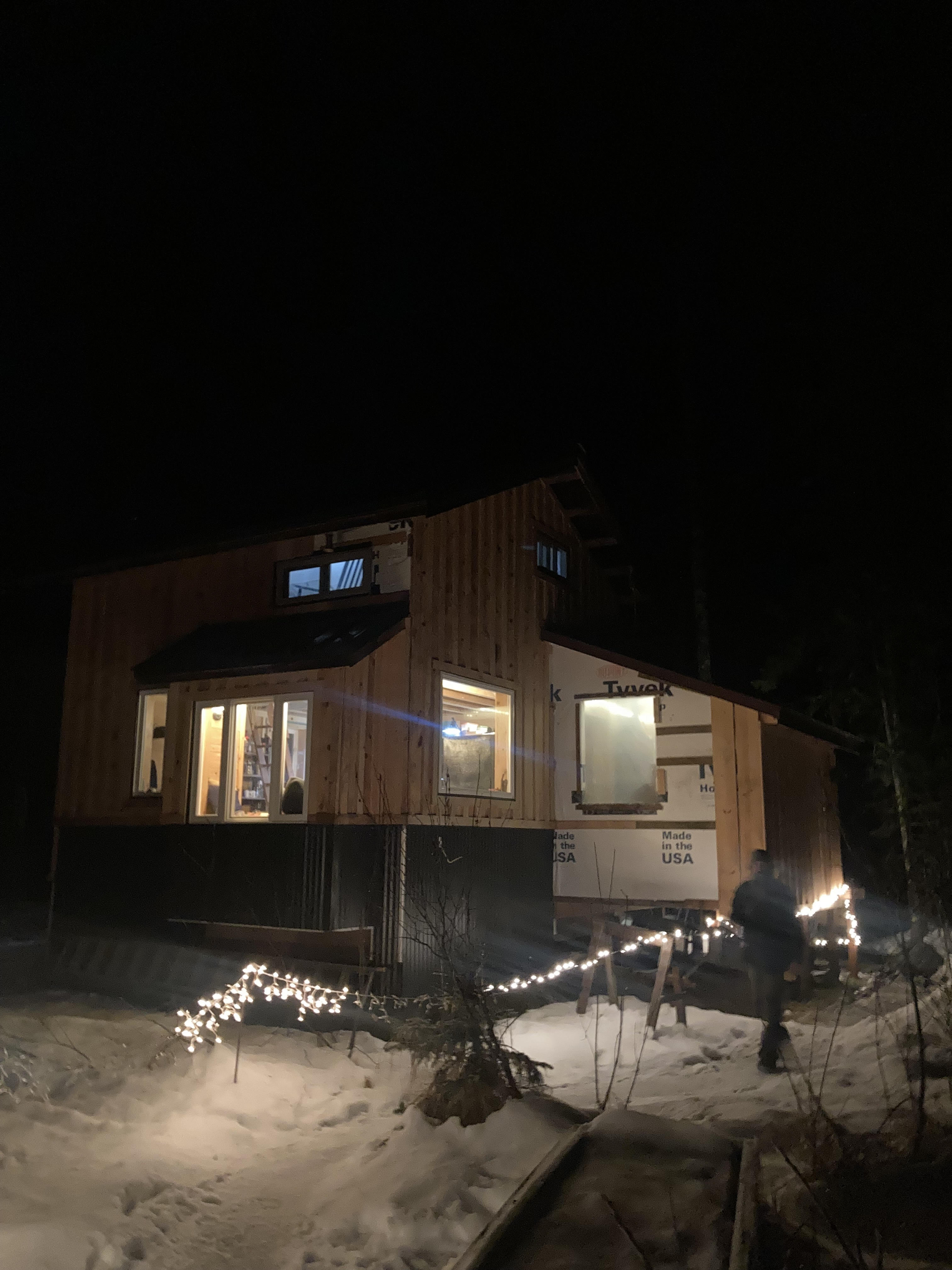
I missed this tradition last year, choosing to spend Christmas with my folks in Eagle River. I needed distance. Couldn’t wake up December 25th to Minerva and a quiet home. I listen to everyone’s laughter and watch the Jello shots steadily disappear. I was afraid we made too many, now it’s looking like we’re gonna run out before demand does.

The majority of the people slurping Jello and munching potato chips have picked me up in some capacity over the last year. Checked in on me, invited me to dinner, or simply listened. I breathe through a knot in my chest and join the crowd clustered around the fire.

Don’t get me wrong, I love these people. And man, does it feel good to be a part of this rambunctious neighborhood. I remember growing up and hearing some version of the phrase, “The holidays can be a difficult time of year.” That never made sense for a guy who never had much reason to be sad; it makes more sense now.

I crack a beer and chatter about where to find deer when the weather turns cold and windy, my favorite fishing spots on the Bartlett River, and if the rain will ever turn back into snow. Food and drink exhausted, the crowd rambles on. Breanna and I shove the remnants in the cabin and follow the footprints toward the next house.

It took a while to accept that someone else wasn’t going to fix this, share the weight, or better yet, remove it entirely from my shoulders. Grief and hardship don’t work that way. Contrary to Hollywood and countless musical tracks, burdens can’t be lifted by outside sources. But friends, family, laughter, jokes, hugs, and, yes, Jello shots make it a hell of a lot lighter. You’re not alone if the holidays feel a little heavy. It’s okay to ask for help, to lean on loved ones, it’s okay if you’re not okay. Believe that one day you will be.

***

“Slippery out here,” I mutter as we shuffle down the road for Tim and Katie’s.

There are no street lights in Gustavus. Stars and northern lights pop when the clouds allow. On overcast nights with little snow, the roads are just a different shade of black. Small candles lead the way, providing just enough illumination to see one foot in front of the other.

Darkness is the theme of the solstice, a celebration not of the lack of light but of the promise that brighter days are on the way. It may be imperceptible at first. What differences can a few seconds make? But those seconds add up, they turn to minutes, half an hour, an hour. Sometimes life emulates the pivoting sun: impossible to discern the longer days or if the sun is getting warmer. But those long, sun-kissed days are coming. Until then, there’s nothing to do but follow the candles down the road. May they lead you to a warm home.

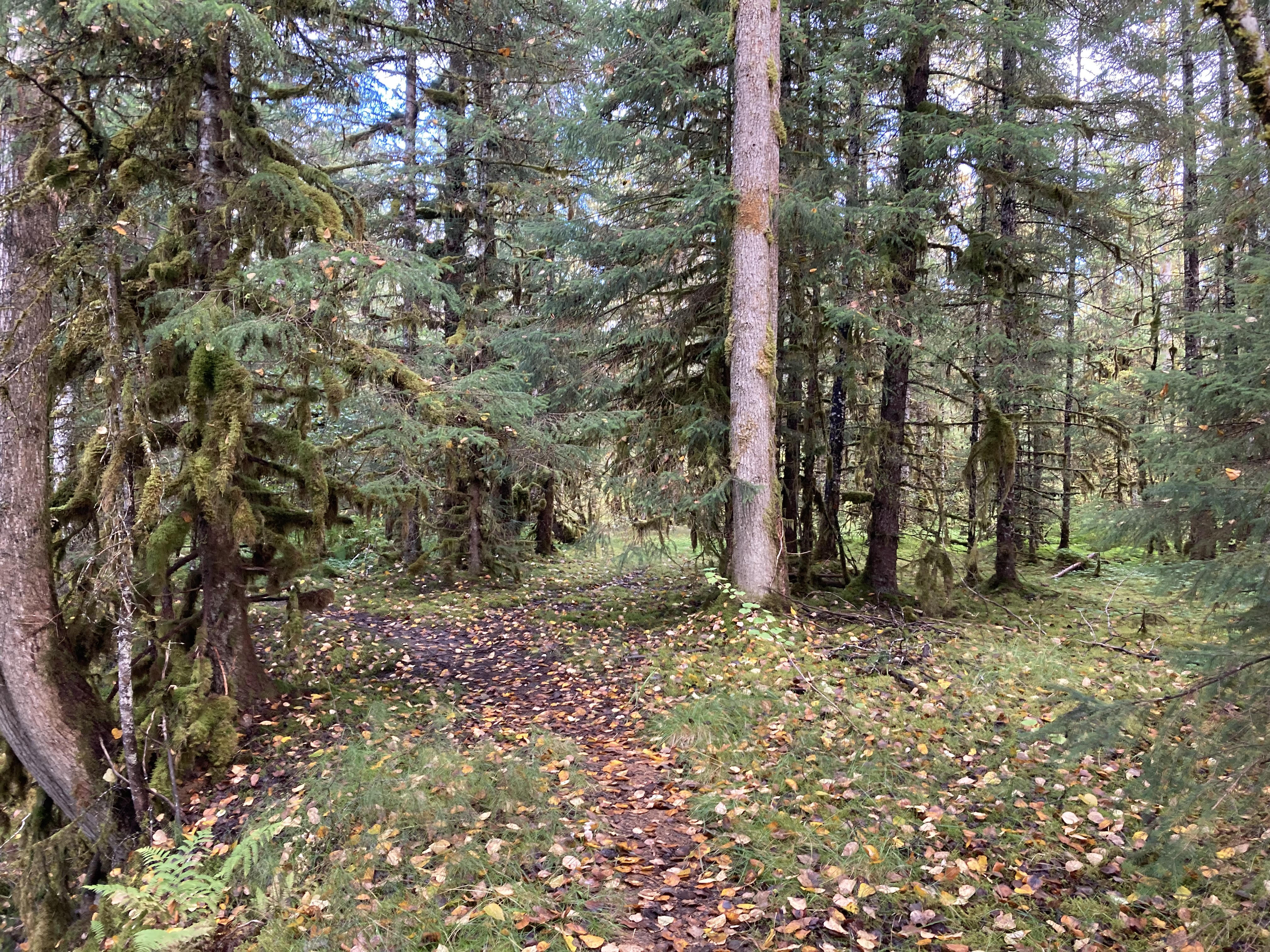
Trails

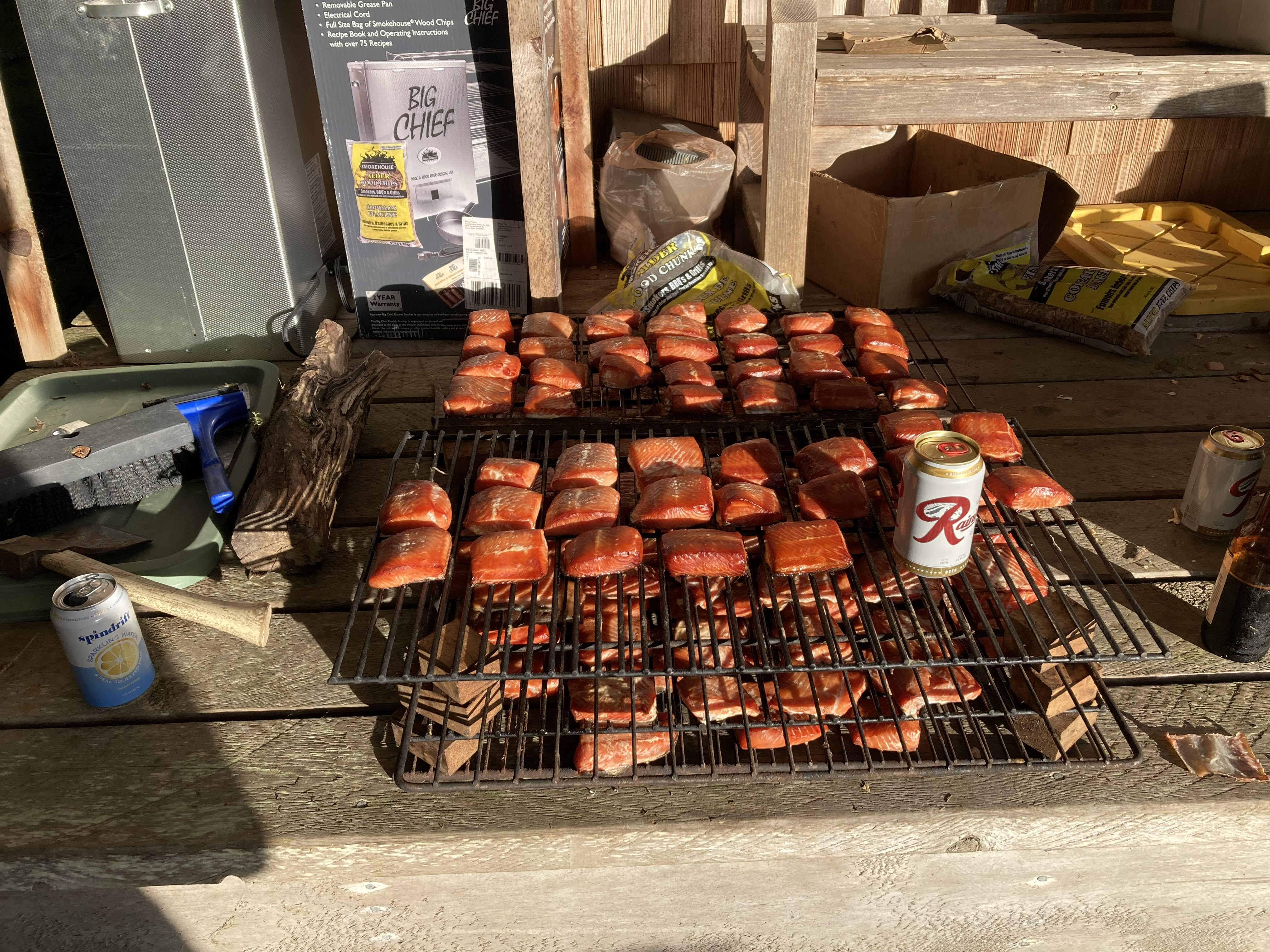
Golden light through golden leaves. Cottonwoods fluttering in a fall breeze are punctuated by random squalls that vanish before I can grab my raincoat. My fingers are greasy with salmon skin and stained with creosote. Sweet-smelling alder smoke billows from the smoker’s open door. I slide racks of salmon between the shelving and nihilistically rub stained hands on stained pants.

I close the door and watch the temperature tick towards 90 degrees. The smoked salmon recipe is as familiar as a warm blanket. Dry brine. Equal parts brown sugar and salt. Soak for four hours. Rinse. Let rest overnight. Into the smoker for four hours at 90 degrees. Bring to 180 over an hour. Hold for another hour. Eat the river.

I plop against a spruce and nestle into the mossy layers coating the ground around Hank Lentfer’s house like a Tempurpedic mattress. I walked past this spruce exactly one lifetime ago, drunk on the prospect of going full homesteader. With covetous eyes, I drank in Hank and Anya’s house and overflowing garden, convinced that this could someday be ours. Nevermind that I initially mistook the smoker for the outhouse.

“Rule number one,” Hank laughed as we walked by, “don’t shit in the smoker.”

So no, I haven’t shit in the smoker, but I have pulled racks of succulent salmon and one luscious deer leg from its innards with the overeager enthusiasm of children on Christmas morning. The temperature hits 90. Six hours begins… now. The stopwatch squeaks, and I set to work peeling bark from a waiting pile of alder.

There are easier ways. Electric smokers exist. Set it and forget it. I could fashion a hot plate and plywood box, eschewing the careful dance between wet and dry alder. Keeping the smoker at 90 degrees locks in the flavor. Slowly raising it to 180 keeps fat from bubbling to the fillet’s surface. I could stop there, slide them into an oven, and let them slow cook to completion. I’ve already hiked miles up the river, fished for hours, and shouldered them to the trailhead. It’s not cutting corners; it’s just practical.

Cottonwood leaves whisper on the gusts. The old rusting stove pops and cracks. Smoke escapes from the shiplap siding. I wander through the woods, sampling high-bush cranberries and following moose trails that terminate in dead ends as if their users apparated on the breeze.

Even in sleepy Gustavus, it’s easy to get wrapped up in the rat race.

I don’t sit in traffic or attend budget meetings, but the “to-do” list never seems to shrink. A sliding scale of my own tolerance dictates the project list. Tyvek siding is acceptable until one day, I can’t stand to look at it another second. A kitchen faucet emptying into the same bucket for months is now intolerable. The cast iron tub that sat uselessly in the yard needs a home. A trail of washed rock appears and connects the driveway to the front steps. I returned in September, shocked to realize I’d been home less than four weeks since May. The house and property felt neglected. I set to work finding a place for the tub and slapping siding over Tyvek (kitchen sink bucket TBD).

But everything orbits around coho. A sunny day demands a journey up the river. The return of a birthday tradition of camping in the Bartlett River high meadow so I can roll out of my sleeping bag on the first day of my 36th year and cast into the river before I’ve sipped my coffee. It crescendos with this smoker that must be babied and attended to all day. It forces me to slow

All

The

Way  

Down

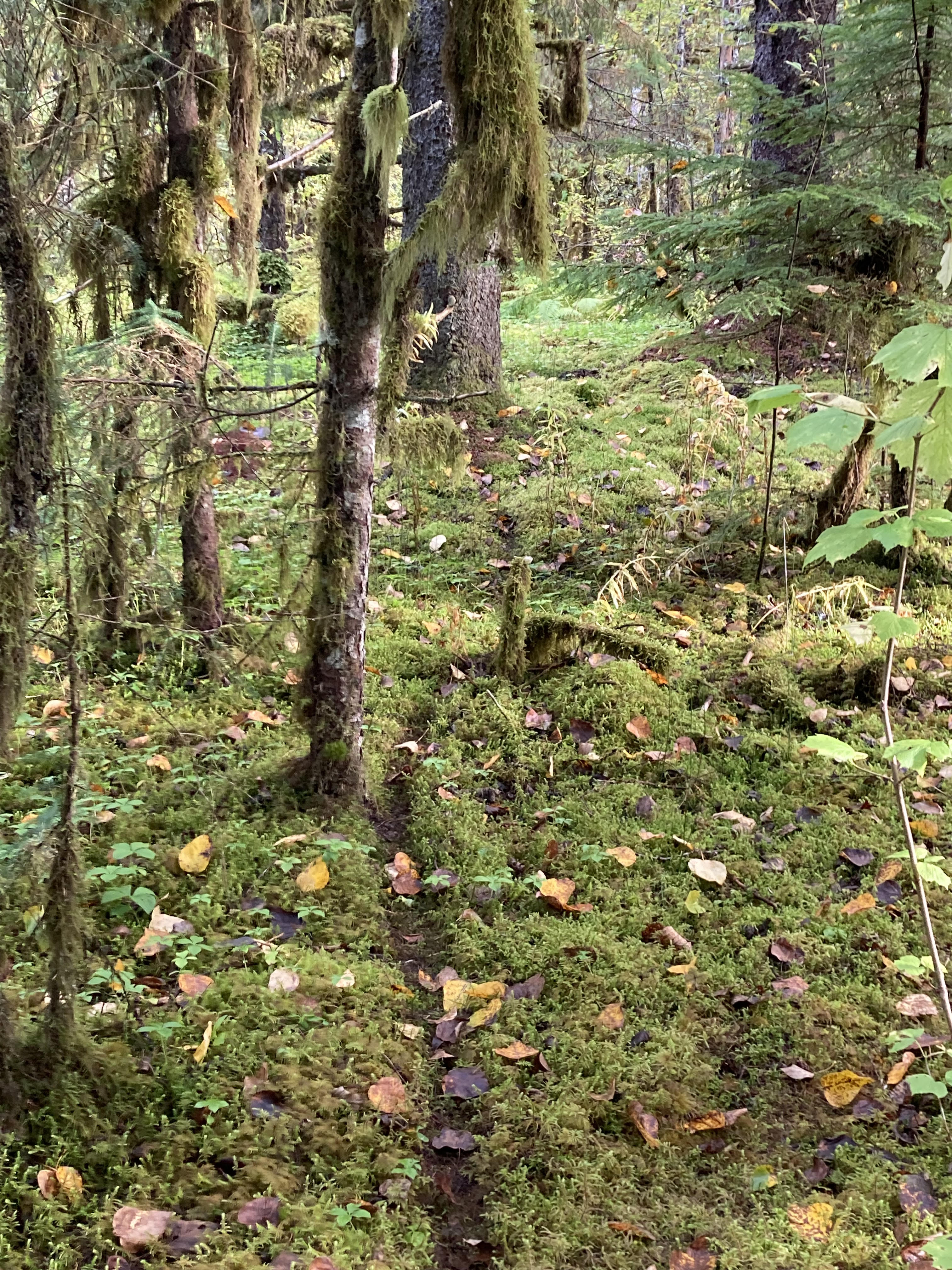
I kneel beside a well-worn trail traveling through the moss. It’s no wider than my forearm, but the moss has turned black and muddy from constant use. The trail connects two spruce trees. Their trunks covered with the shells of spruce cones. I don’t know how many squirrels ping pong between these two trees, but I’ve stumbled into somebody’s critical home. At least a couple of these chattering critters orbit their entire lives between these conifers. Up and down, back and forth, again and again. The patience, the time, the metronome-like consistency to make this trail speaks to a tradition no less significant than migrating cranes and howling wolves.

I run a hand down the trail. Is it possible to envy squirrels?

I think of the dozens of backbreaking trips with a wheelbarrow laden with rocks to form my own pale imitation. My attempt to reinforce the claim that I lived on and loved my swampy bit of land. But there is no substitute for time and the necessary pilgrimages between two trees that give these fast-twitch residents everything they need.

Hour number six slides by. I pop the door with poorly contained glee. Zach and Laura have arrived with their own tote heavy with brining salmon. Together, we shuttle the finished fillets to Hank’s porch, where their toddling son, Salix, is waiting. The door opens, and Hank appears with a quartet of Rainiers. He scoops a chunk of bronzed coho with one hand and flips a squealing Salix over his shoulder with the other.

The cooling salmon are irresistible, and we shovel handful-sized bites into our mouths. Salix takes some of us first uneasy steps, light brown curls reflecting the last of the day’s autumn light. Perhaps my trails will never be so defined. But this place has other sorts of worn and loved indentions to reinforce my connection to home. Spiritual footpaths matter more than worn footprints.

I take a final walk through the enchanted forest, gathering my things and trying not to forget anything. The universe dictates that I must always leave something behind. This week’s victim is a pair of rain pants.

“I’ll try not to tell anyone you left your pants at my place.” Hank texts.

“Appreciate that. That’s how rumors start.”

I pause at the base of the Squirrel Spruce and nestle a piece of salmon in the moss amongst their spruce cone pile. The forest breathes, bracing for a winter as inevitable as a sunset or falling tide. But not yet. We have a few more golden weeks to walk our trails, harvest food, and watch cottonwood leaves fall.

Heart Medicine

“Anyone here going to Gustavus?”

We cluster around the Carhartt-clad pilot, ballcap pulled low over short brown hair. He glances at a single sheet of people – the closest we get to a boarding pass around here – and calls last names like it’s the first day of school.

“Taylor, Taylor, Higgins, Parkins… Cannamore?”

We acknowledge our presence with nods. The paper disappears into a back pocket, and a key card opens the sliding doors. This is what amounts to security at Alaska Seaplanes. No TSA. No separate bag for your four ounces of liquids. No random bag checks or standing with arms above your head. Hell, you can carry your rifle onboard and barely get a second glance. It is almost moose season after all.

We ramble across the tarmac and squeeze into a plane with plywood floors and one giant propeller.

“Safety kit is in the nose hatch,” he calls over his shoulder as seatbelts click. “The back door has two latches. Open the top door by flipping the latch and turning the bottom handle like a car door. There’s a fire extinguisher under my seat.”

Flying to Gustavus costs as much as flying to Seattle. A fun piece of trivia that delights tourists until it’s time to drop their credit card on the table. After three weeks ping-ponging across southeast Alaska on the National Geographic Quest, I’d pay just about anything to be home.

The prop catches and roars to life—earbuds in my ears, volume up. The Lonely Forest belting out an anthem that speaks of home.

Give to me miles of tall evergreens, the smell of the ocean, and cool mountain breeze.

Juneau disappears beneath my feet. It has been several lifetimes since I called this place home. I still want to love and cherish it, for it is a beautiful place. How many other communities have more miles of hiking trails than paved roads? My stomach gives a little lurch that has nothing to do with the turbulence and confirms I still have some healing to do with that particular place.

The plane swings west, and Admiralty Island rolls past, wingtips level with the 3,000-foot peaks clad in September fog. Hank has teased the Admiralty Island alpine for years, describing an alpine so lush that the deer cluster in numbers too tantalizing to comprehend. I trace ridgelines, nose pressed to the glass.

Next year. It’s always next year.

Fatigue creeps in. I am tuckered and worn out. How many days off have I had since May? I replay the summer as Lynn Canal whitecaps replace Admiralty’s muskegs. The season’s workload looked reasonable in February. I said “yes” to everything I could, locking up weeks as a naturalist for Lindblad and multiple kayak trips. I added the paychecks in my head, stared at my bank account, shook my head, and added it again. I wanted to reach November feeling financially secure(ish) with the freedom to run somewhere warm if the opportunity allowed. Mission accomplished. I think.

Point Couverdon. Past the south end of the Chilkat Mountains. Porpoise Islands. Pleasant Island. The runway beckons. A little community hidden in the trees. Millions of tons of glacial clay beneath our feet and crisscrossed with the prints of bear, wolf, moose, and crane. Come January, a sunny beach may be preferable, but right now I want to drink coffee on my couch and watch the rain fall.

I just wanna live here, love here, and die here… Give to me miles of tall evergreens…

Breanna left the house spotless. I didn’t know a sink could be that clean. Minerva scurries down the ladder, and for a wild moment, I think it’s because I’m home. But it’s 5 pm, and niceties can wait until after dinner. I toss my backpack upstairs and collapse on the couch. Deep breath in. Deep breath out. This space hasn’t felt haunted in a while. I hear faded laughter echo off the walls and can feel that the space has been lived in and loved. Minerva licks her lips and permits me the honor of scooping her up and putting her on my chest. She purrs and nuzzles, wet food breath in my nostrils.

“You’ve had quite a few tenants this summer,” I tell her.

A consequence of the packed schedule has been I’ve been gone more than I’ve been home, and a rotating cast of house sitters have rolled through, spearheaded by Breanna, The Shabin’s current caretaker. Minerva has been the star of Swamp Castle Estates as Breanna and I have christened these four soggy acres.

“I didn’t know I liked cats.”

“I don’t like cats, but she’s the coolest.”

“Can we reinstall the Shabin’s cat door so she can come visit?”

I squeeze the ball of fluff. Three months together at the Hobbit Hole certainly knit us together, but it’s sweet to see her growing fan club and watch her adapt to the rotation of people who have occupied this space. We lay there for a long time, savoring the absence of anything pressing: no questions to answer, no hikes to lead, no presentations to give. My mind drifts to the potatoes in the garden, the cranes winging their way south, and the buzz of a fishing reel’s drag as spritely coho zip across the Bartlett River.

***

We tramp the familiar trail in a steady rain. If Gustavus held a fantasy football-style draft for the best Bartlett River angler, I might take my hiking companion with the first overall pick. Kyle Bishop’s chest waders are stained with mud, clay, and fish blood. Every year, we promise to spend more time together and carve out room in our schedules for dinner, drinks, and Mario Kart tournaments.

Next year. It’s always next year.

But come September, we’re inevitably drawn to this trail, this river, those coho. We can go months without exchanging a word or text and then chatter like squirrels when the cottonwood leaves turn yellow. We badger each other for life details and snigger at the passing out-of-towners lugging a five-gallon bucket to hold their theoretical catch.

Fifty minutes to the first decent fishing hole, but the place we really want to hit is further up. We weave past a well-mannered brown bear and drop our lines into a long, deep channel the coho favor. My rod tip bends, line runs out, and I see the beautiful flash of silver for the first time. The salmon breaks the water and thrashes. The hook sinks deep—elation skyrockets. I guide him to the shoreline, and the fillet knife ends the fight. I run cold, wet fingers down the scales, marveling at the miracle that is home.

The one place that offers the life I want happens to be where I can afford to live. Rain runs down my face, and the river’s cold presses against my waders. Kyle hoots, and white water materializes 30 feet in front of him. The season’s just beginning. The first of many pilgrimages to this spot. The first of many benedictions and prayers to the animals that feed us and bring us together.

I place the coho in the grass, reset the line, and let the hook sing across the water.

Yurt Housekeeping

Executive Directors shouldn’t be sweeping yurts. But Zach Brown does. Sawdust, spruce needles, and the detritus of countless Xtra-tuff boots fly before our brooms and billow out the door. Zach and Laura’s non-profit is already ten years old. Hundreds of students have already rolled through Gustavus and the Hobbit Hole. They are pebbles in a growing pool, ripples spreading across the globe in the name of climate justice and the dream of a world overflowing with clean water and a habitable climate.

Polishing a yurt and nailing rafters a few days before Tidelines Institute’s ten-year celebration bash is all part of a Friday afternoon for this guy. Never mind, he just got back from teaching a week-long course and has a sniffly one-year-old son at home.

I met this dude on a basketball court, politely flustered at his intensity on defense and speed that he pushed the ball up the floor. But that’s just how he operates. It doesn’t matter if it’s an open gym, thinning carrots, or a lecture on climate change. You’re going to get his best.

He pauses, broom in hand. “How you holding up, dude?”

I shrug. “Good days and bad. More good than bad.”

He strikes a Lebowski grin, “strikes and gutter balls?”

You can keep your love languages like “words of affirmation” or “quality time.” Zach and I speak in movie quotes. The highest form of affection.

“Well, you know,” I fire back, “sometimes you eat the bar, and sometimes…”

“You’re an injured fawn,” he continues, not missing a beat as he pivots from The Big Lebowski to Old School. “Nursed back to health and ready to be released back into the wild.”

“Speaking of deer… where are we going this August?”

There’s the gleam. Reserved for venison and adventures. “Ahhhh, well, I’ve got some ideas.”

Damn right, he does. Last August, we pitched a tent amongst the devil’s club near a tiny beach 40 miles west of Gustavus, falling asleep to fantasies of climbing into the alpine for big-antlered bucks. We awoke at 4 am to the type of rain that promises fog so thick you can’t see the glove in front of your hand. We stared at the roof for a few long minutes.

“Well,” Zach said, breaking the silence. “Guess I’ll go take a look.”

“This is no time for bravery. I’ll let ya.”

He pauses, hand on the rain fly. “Is that Cool Hand Luke?”

“Butch Cassidy.”

“Close enough.” He disappears, and I’m sorely tempted to fall back asleep, but he returns a few minutes later.

“What’s the verdict?” I ask.

“Well…” he’s already pulling on his wool pants. “What are we gonna do? Go back to sleep?”

We bushwhacked through 1500 feet of ferns, blueberry, cedar, and the aforementioned devil’s club before popping into paradise. Huddled against limestone rock and shoving Snickers bars in our mouths, we grinned like kids who’d broken into a candy store.

“Look at all the deer.” I breathed.

Zach’s binoculars were glued to his eyes, counting fuzzy brown specks as the fog rolled through. “There’s twenty on that ridge alone!”

I was hooked. In the same way I once dreamed of returning to British Columbia’s cedar-clad shores, I now dream of quiet mornings in the alpine, looking for the deer that fuel my soul and fill my body.

It was never about pulling the trigger. It was about last night’s rain soaking our knees, reflections in a mountain lake, deer cabbage sprouting past our shins, and fog lifting off Lisanski Strait. It’s the long hike home with heavy shoulders and the clinking of the best damn beers we’ve ever tasted when we reach sea level. It’s lengthy boat rides and late nights cramming cubes of venison into mason jars while The Fellowship of the Ring plays in the background. It’s squeezing around a laptop and pouring over ridgelines with Zapruder film intensity to plan the next alpine adventure.

I’m under no illusions. I’ve done the math. A huge percentage of my calories are brought to me via barge and airplane. There’s no “butter tree,” and I can’t grow chocolate chips no matter how many “seeds” I plant. But having a connection to my home and some of my food matters a lot.

The carrots and potatoes in the garden, the venison in the woods and mountains, the coho undulating silvery bodies up the streams. These creatures and opportunities, and the friends I share it with, have kept me tethered to this place, their braids winding tighter and tighter with every pound of potatoes and vibrating fishing pole on a September morning.

The relationships are evolving. When I look at those ridgelines, I feel the first vestiges of age in my knees. I now hobble the day after I play basketball and recently pinched a nerve in my neck while doing sit-ups. I have found gray hair in my comb and make groaning noises when I get off the couch. No, I’m not old, but I look at those ridgelines differently, reminded that there’s a finite number of Augusts in which we’ll be able to scamper up them and descend with 100-pound packs. God willing, that won’t be for decades. We don’t intend on wasting any of them.

“What if we spent a few days up there?” Zach asks, closing the door to the yurt and gazing at the cabin we’re building for the next wave of students.

“I was thinking the same thing. Getting into the alpine is so much work. I want to savor it.”

“We can roam the ridges, and on the third day, we each find a deer to bring home…” he pauses, “That means we’re lugging two deer and our camping gear down the mountain.”

“So we don’t bring the stove.”

“Peanut butter and jelly for every meal?”

“Exactly.” I slap him on the shoulder. “Thanks for asking about me,” I say, “August can’t get here soon enough.”

Our time together has been too sparse over the last year. It seems one of us is always running off somewhere. The Hobbit Hole, California, British Columbia, Sitka, Patagonia, another paddle trip, another fundraising obligation.

When we met, Zach didn’t own the Hobbit Hole. His non-profit was just a small kernel, one of those pebbles spreading across the lake. I look across the campus at the garden already overflowing with food, the clucking chickens in their neat little pen, and the new building that, at least to me, appeared overnight. What he and Laura have built in such a short time boggles my mind.

As life has waxed, waned, and changed, we still have, for better or worse, our alpine dreams.

I tighten my tool belt and clamber up the ladder. These barge rafters won’t install themselves. I wrestle one into position and yell up to Zach, who’s gripping the 2×6 jammed against the ridge board.

“Talk to me, Goose!”

I can hear his grin as much as hear it. “We’re going ballistic, Mav! Go get’em!” The nail gun echoes, a hammer bangs, and somewhere on a quiet mountain, a ridgeline waits to be explored.

So This is the New Year

I still wake up hearing them. I still catch myself stopping on the creaking stair, ears cocked, listening to a speaker that’s hundreds of miles away. You don’t quit Hanson Island, and it doesn’t quit you. How can you?

It’s the only place I’ve ever looked up from a stove to see a dorsal fin emerging from the water. It is the place that breathed life into me. That held me close and let me go. That told me that I could do and be whatever I wanted to be.

Gustavus, Alaska feels tame. The biggest hardship is our cistern froze last week and the liquor store is open just six hours a week. Where’s the challenge in that? Where’s the thrill of grocery shopping knowing that if you forget it today you’ll go without for the next two weeks?I’m not entirely serious. Last week I interviewed for a job and the interviewer asked me what my favorite part of Gustavus was.

“Well having a 5,000 square mile national park right outside my door is pretty neat.”

It’s just… different. Not better, not worse. Hanson Island will always be where I cut my teeth. My introduction to the blue and green world. In that way it’ll always be significant. It still astonishes me that we spent three winters there. Approximately 20 months that feel like little more than a blink. Time close to the earth always seems to go fast. You sleep better, eat better, laugh harder, and scream louder. And the time slides by until you’re looking out the window at the rain, know Paul Spong will be there with the June Cove any minute, and wonder where the time went.

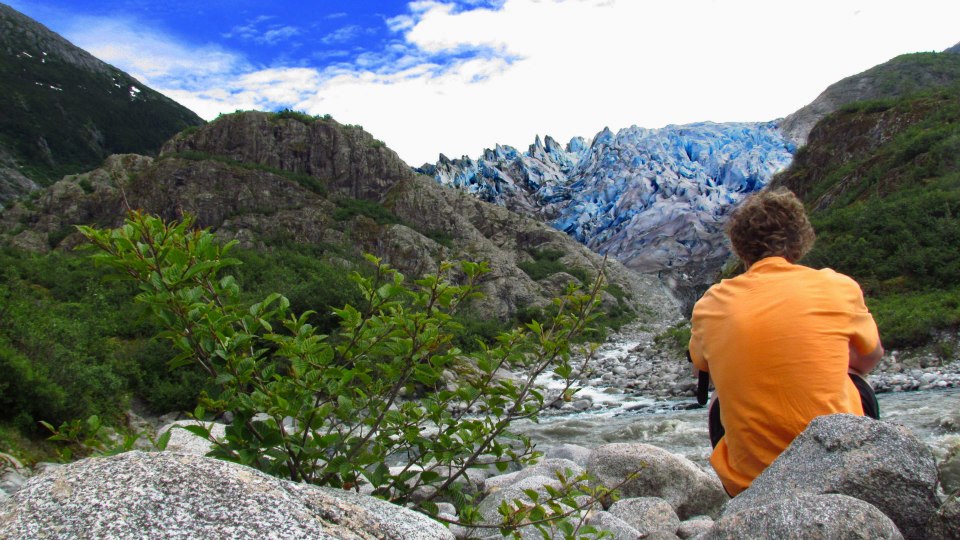
I’ve spent most of this winter reading “how to build a house” books, learning the difference between joists and beams, and why 2x6s make good frames (it’s all about insulation).  I’m editing a novel, preparing to send it off, and praying that someone out there digs it. It’s exciting. It’s just… different. Not better, not worse. The roots are sinking in, and most of the time it feels good. For the first time since leaving Juneau we’re surrounded by the people we love. Dear friends who like us have found sanctuary in the outwash of glaciers. But every now and then I walk the beach and stare south, beyond Icy Strait and Chichagof Island. My eyes see past the Myriads and Baranof, through Ketchikan and Bella Bella to rest on a little cedar cabin on the edge of the tideline.

And I see Harlequins bobbing in four foot chop. I smell the rich wood finish of the lab. I hear the ocean’s voice through the speaker next to my bed. I taste salt. I feel the waves pounding the little boat in Blackney Pass. And for a moment I can’t stand it. I’ve got to move, I’ve got to go back. Past one more bleary eyed Prince Rupert border guard and through the Great Bear Rainforest. Part of me will always be 17, crouched on the rocks of Cracroft Island in the dead of night, listening to the A4s swim west.

***

Kim Heacox is a writer, an activist, and will dance and sing at every available opportunity. He’s also my next door neighbor. And he has plans. Like most of us who give a rip about quiet places and open spaces, 2017 was not a pleasant experience. But that’s not stopping him. He and his wife Melanie have a beautiful house and a fantastic library. All their buildings are connected by boardwalk, the road to their house weaves through the forest to spare the largest trees.

They have no intentions of keeping it for themselves however. At some point it will become the John Muir Wilderness Leadership School, the house (one of the few in Gustavus built to code for this very reason) will become a flashpoint of young writers, activists, and leaders. In my head I imagine the place becoming for someone what Orca Lab was for me. A place to find yourself. A place of epiphanies and euphoria. A place of inspiration. A place where perhaps one day I can play the role of Paul Spong; teaching that if cold science doesn’t work, if you look into the world and see something looking back, the best thing to do is grab a flute and play a song. I’m not a scientist. I learned that long ago. But I could be a teacher.

Gustavus is full of people like Kim. Zach Brown is 31-years old and in three years raised more than a million dollars. Now he has the Inian Island Institute, an old homestead an hour west of Gustavus. The perfect place for young people to lose themselves of find themselves, whichever one they need. Because if more people could find their “Hanson Island” the better off the world could be. Reach’em while they’re young. Before the allure of profit margins and mansions can sink their teeth in.

***

It’s Christmas Eve. Gustavus is wrapped in snow. But over the last few days the temperature has plummeted toward 0°F. Just a little way out of town is the only uphill trail, on the flanks of Excursion Ridge. Patrick Hanson and Jen Gardner pick us up and we kick off our “orphan Christmas.” The sun peaks over the top of the ridge as we climb. The Fairweather Mountains, the tallest coastal range in the world lords over our little hamlet. Glacier Bay is just visible, crawling up to the mountain’s feet.

The freezing temperatures have coated everything in crystalline hoarfrost. Snow flakes stand out, perfect little gems. Delicate but incredible versatile. Recent research suggests that at the center of each flake is some sort of microorganism, some microbe the frozen liquid could glob onto. At the center of Gustavus is the people. Something that everyone that has arrived here can attach to. It’s not always easy, but if you allow this place to form you… what can you become?

We reach a shelf on the ridge and Patrick, as he always does, has snacks. A sip of coffee, a bite of gingerbread, a shot of whiskey. It is Christmas after all. From here Gustavus doesn’t appear to exist. Nothing but trees, mountains, and that bay. More than 100 years ago, A.L Parker climbed this same ridge, but from the other side. And when he looked down on the Gustavus plain, he knew that he had found his home.

I can understand why. Something in that smooth, flat plain surrounded by mountains screams at our most human instinct. I look out over the strait and south. I X-ray through the archipelago and Queen Charlotte Entrance. I still see that cabin. I always will. I’ll be back. Patrick cracks a beer and hands it to me. It is Christmas after all. And if I have my way, I won’t be coming back alone.

Making Alaska Safe for Cows

The concrete bends right, but straight ahead lies an unassuming road. Covered in dirt and gravel, trees arch across the entrance, casting deep shadows beneath the tunnel of greenery. No street sign marks the little road as we bypass the hairpin turn and shining sun for the shelter of the trees. Ten minutes later we reach the end of another skinny one lane road masquerading as a driveway, grass stubbornly growing down the middle track. A series of wooden buildings and a small stretch of lawn lay surrounded by the forest, the structures seeming to melt slowly into the woods’ outstretched arms.

The picnic table on the lawn groans under the weight of plates filled with venison, salad, rhubarb cobbler, and brownies. From the nearby trees the squirrels chatter jealously and I look up in down the table. I find myself surrounded by men of words, science, kayaks, and hilarity.

Across the table from me sits Kim Heacox, part John Muir part 13-year old boy though his birth certificate insists that he’s a few decades ahead. He’s the reason I’m here, the reason there’s a blog (I really don’t like the word blog, how about “Thought Journal”), the reason I write. On my left sits Hank Lentfer, responsible for the venison on my plate and several books in our library, followed by Zack Brown who had walked off the Stanford campus, PHD in hand and hiked and paddled until he reached the Gustavus shore. And finally, Peter Forbes, writer, non profit adviser, farmer. Nervously, I glance around the yard, undoubtedly there’s a kid’s table where I should be seated with my knees up to my ears.

Instead I find myself a part of a community that I have done nothing to become a member of. No initiation, no rights of passage, simply because of our deep love for this place, for the woods, for the future of the world. Because no one ends up in Gustavus by accident. You inherit a family you didn’t know you had. I cut my venison and listen as Kim’s boundless energy spirals the conversation from topic to topic.

“The best thing about visiting down south,” he says, “is the chance to watch all of those Alaska shows and see how we’re supposed to be living.” He finishes with such earnest sincerity that everyone looks up as if to confirm his sarcasm.

“I really like the one in Homer.”

“The guys with the cows! And the guns! Gotta move the herd across the flats before the tide comes in.” His voice twists into a passable southern accent, “is that a wolf?” he mimics a gun being fired, “got him!” And there’s humor in the tragedy of his recreation. “Gotta make Alaska safe for the cows!”

“The only problem, is that doesn’t look very good on a license plate. Alaska the Last Frontier sounds a lot better than: Alaska! Slowly Becoming Safe for Cows.” I say and his laughter is infectious.

It’s impossible to sit at the table and not be inspired. Hank and Kim’s books fill thousands of pages, tapestries of words and phrases I can only dream of writing. But here I was, doing my best to turn my mind into a sponge; listening, writing, and most important of all it seemed, laughing.

As the bugs fill the night sky and the sun ducks beneath the trees everyone slips into the house, the guitars come out, Zack pulls out a violin, and Eric Clapton makes the windows shake. I sit at the table, thumbing through an Orion magazine as Hank and Kim belt out Midnight Rider and as I glance out the window at the blue tinged yard in the evening twilight reach a beautiful epiphany.

It was Orca Lab all over again. A beautiful, undeserved gift. Replace the trees with ocean, the music with hydrophones, and it was the same. Emotion wells inside me at the incredible mentors, heroes, and now friends that had entered my life and the inspiration and motivation they’d filled within.