Tag Archives: camping

When the Outflow Arrives

Wool socks, down jackets, long underwear. All them and more have been deployed to combat the latest northeasterly outflow that has descended upon Hanson Island; freezing the intertidal pools, our waterline, and our toes. We had the bright idea last night of dragging our mattress downstairs from the loft and putting it at the base of the fireplace stacked with bark and fir, Penny’s house placed snugly in the corner. And while the cold seemed to paralyze us in the early morning light, numbing any motivation to rise from the comforters, the Orca’s seemed impervious to it all.

Shortly after nine we begin to hear the faintest Transient calls in Johnstone Strait, leading us to the lab where the temperature hovered just a couple degrees above freezing. After just half an hour of sporadic calling the sounds vanished as the whales disappeared into acoustic parts of the strait unknown. Silently I gave thanks that all I had to do to catch my breakfast was crack a couple eggs over a skillet. I don’t think I could catch a harbor seal in this weather.

But despite the cold, the view atones for it and than some. The palest of blue skies and the whispiest of clouds frame the mountains on Vancouver Island, their peaks clinging grimly to their traces of snow, illuminated in the weak December light. The solar panels greedily suck in the beams’ power, giving our generator a belated reprieve. Blackney Pass sits immobile, or at least as still as it can as the tides pull the waters north and south cutting trails in the surface like tiny intersecting roads. It’s still odd to have Orca Lab so quiet. Besides the occasional Transient celebrating its catch the speakers tell the story of cycling hydrophones, insistent tugs, and at low tide, the cries of eagles as they soar past.

The beauty and peace is priceless and there is little more soothing or funny than ten Harlequin ducks bobbing into the cove every morning chirping at one another as they cut tiny wakes through the water. They dive one at a time, vanishing in the blink of an eye, their bodies barely visible in the dark green water, wings flapping incessantly. When they come up for air they shoot clear of the water like little rubber duckies bouncing on the surface, tiny bits of food clasped in their beaks.

But the deep waters of Blackney feel empty with no Guardian or KC or any of the other humpbacks that felt like friends in September, leaving us with the thirty odd sea lions down the beach for company. Today they huddle like a single sentient being on their rocks, stinky but warm I’m sure. It leaves us with nothing left to do but read, drink tea, and chop wood at a frantic pace before running back inside to the warmth of the fire that has been dancing for three days straight. The thermal pane windows have been worth every penny, thank you: Paul and Helena.

In the Holy of Holies

The boat slides into the rocks and triggers a memory. Not a visual one, or olfactory, but auditory. The sound of pebbles racking against the hull of the boat almost makes me turn around, half expecting to see a dorsal fin gliding across the water behind us. Both boat and orca move the smooth, tiny rocks of this beach sound the same way. But today we were alone, just the two of us cautiously approaching the main rubbing beach of the Northern Resident orcas.

I step to the stern of the boat and look back over the water. It’s weird to see for the first time a place I feel I already know so well. High atop an old weathered tree hangs a white box looking for all the world like a security camera. For a summer that was my keyhole. And I would press my eye against it as close as I could, drinking in the scene. But now, for just an afternoon, I got to stand here and see and smell and feel a piece of orca lore. If the bight is hallowed ground, this is the holy holies.

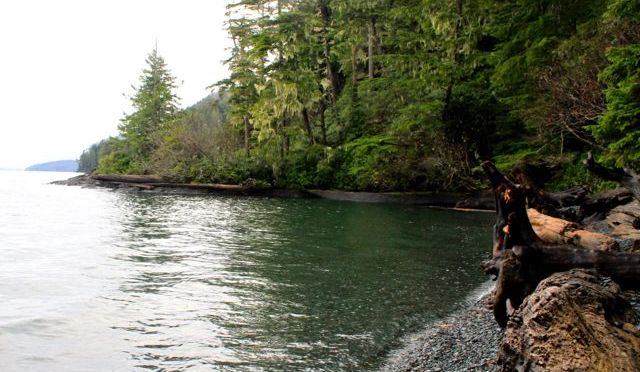
Twenty minutes east of Robson Bight as the orca swims lays this beach where, for all eternity as far as we know, the orcas have come. This beach, an outlier itself in a land of jagged rocks, steep cliffs, and deep water. The beach is smooth and gradual, the reflection of the trees turning the water turquoise, like some tropical paradise. In the shallows, sometimes with barely enough water to cover them, the whales come and rub vigorously on the smooth, quarter sized pebbles that compose the beach.

I step up and over the top of the boat and onto the bow, the waves rocking the boat gently against the shoreline, emitting the sound of rushing pebbles with every crest. I hop lightly off the bow and feel them crunch and slide under my feet. I step clear of the surf and see my footprints imprinted in the rocks. Damning evidence of my intrusion into this mystical place. I lay on the beach and, like the orcas, begin to squirm and roll back and forth on the pebbles, their sounds filling my ears. If it’s good enough for them it’s good enough to me. Brittney laughs and rolls her eyes as she steps gently from the boat. We talk in hushed voices, as if we’ve just entered a church, and prod slowly up the shore.

We had a reason to be here. The rubbing beaches are strictly closed off to the public, giving the orcas their own private sanctuary much like Robson Bight. But someone had to pull the batteries of the long defunct rubbing beach hydrophone, the victim of a fifty knot storm in October that had torn the cable free. Without this premise we’d go nowhere near this place, even in December, when the orcas hadn’t neared the beach in a month, it felt almost taboo to stand here.

A steep cliff makes up one edge of the beach and stretches out to a point into Johnstone Strait. I boulder up and walk to the edge, the bottom still visible even on this massive 17.1 foot high tide. I find the batteries and the second camera, the one that looks straight down into the water off the cliff face where the orcas would cruise right past just before they reached the pebbles. Like at Robson Bight I see them in my minds eye, cruising peacefully past, bound for their favorite spot in the strait. We get the batteries off the cliff and perch on a massive log washed against the shoreline. We dig out some food and stare out at the water, this unassuming little stretch of earth that means so much. Camera in hand I snap pictures while I eat, hoping to capture as much of it as possible and failing to do justice. It’s tough to think about leaving so soon, and I a great longing fills me to see the whales here, just once while I hide unseen in the bushes. It’s a dream that will have to remain a dream, and I look up at the camera, thankful that it gives me the opportunity to enjoy it from a distance. We climb into the boat and gently push back into the water, gliding across the brilliant blue/green waves, bound for the gray surf of the straight, the southeasterly starting to turn up the current.

Before we go home there’s one more place I want to find, and we shoot across Johnstone Straight, heading for Cracroft Island. As we reach the shore I slow down and and we move slowly west toward Hanson Island. I see the hollow wooden skeletons of a camp. Structures with no roofs or walls, tiny wooden platforms and benches on the rocks. This is it. I stop and look at this unassuming little kayak camp. “This is my birthplace,” I thought.

It was here, seven years ago that I had visited, kayaked, and fallen in love with this place. Straining my eyes for that elusive dorsal fin that has dictated so much of my life. I look behind me and remember the A36s, cruising west past our camp, oblivious to the life they were altering forever with every surface, every breath. A part of me wants to find a place to land, to step ashore here and crouch where I did those nights when the A4s swam by, allowing me to hear but not see. But the wind has other ideas, as does the quickly fading sun of the second shortest day of the year. We pick up speed and continue west, picking our way through the deadheads and kelp, tracing the footprints of the orcas that would be back to chase the salmon. Like they have every summer. For all eternity.

That Will Never Happen Again

    Throughout the summer and fall the bathtub perched on the towers of rocks just above the intertidal was our own form of luxury living. Often with a cold beer in hand, I would slip into the tub, perching carefully on the wooden slab on the bottom, the only defense between my butt and the burning fire just below. But once you were in and comfortable, it was hard to get out, especially after enough rain had fallen to justify using fresh water as opposed to the saltwater we’d been using all summer. Saltwater was fine, but had a tendency to leave you feeling as dehydrated as a tumbleweed.

After two days of torrential rain that turned the Hanson Island creeks from trickles to raging rivers, the sun came out, the wind shifted to the northeast, and the mercury sped past zero bound for the horrible land of below freezing. The time seemed right, to break out the tub again, and enjoy the sun and cold air from our very own hot tub. But the water we were filling the tub with was frigid. Bombarded from all sides by the freezing temperatures, our little fire underneath seemed woefully meager. Yet we were committed to this bathing adventure, and we resolutely threw every piece of relatively dry wood we could find onto the flames and watched as the water temperature rose by tenths of a degree. By 4 o’clock the sun had dipped behind the trees, and without the sun’s rays, a cruel chill swept into the cove as our numb fingers continued to feverishly feed the fire.

After four hours, I’d had enough. Plunging my cold hands into the bath water, I declared it hot and ready. Of course, after exposing them to the freezing air for the last 15 minutes, anything would have felt warm. I’d had a great idea for a photo though. One of us, in the tub, back to the camera, silhouetted by the setting sun with steam rising into the chilled air, a Kokanee in hand. In my minds eye it screamed Facebook profile picture. I stripped down and slid into the tub. The warmth my hands had felt moments before was all relative. While the water wasn’t cold, lukewarm may have been a little too generous. Any ideas of a photo shoot vanished as the first gust of cold wind hit my little bath. Every exposed inch of flesh erupting in goose bumps. Splashing water alleviated the chill for just seconds as the cold air pulled any warmth it created from my skin.

Screw this. At lightening pace, I scrubbed soap over my body and passed shampoo over my hair briefly, feeling my hair begin to freeze as I rinsed. As cold as it was, I knew getting out would be even worse, and contemplated curling up in the bottom of the tub with just my nose above the surface for the night like some pink, freshwater sea lion. With a gigantic effort I pulled myself out of the tub and began pulling on every article of clothing I could, dry body or not. Sprinting back to the house I threw open the door, greeted by the warmth of a roaring fire and the insulation of our fancy, new, thermal pane windows. The goose bumps began to recede, my hair thawed, the shiver rolling up and down my spine disappearing.

Form the table Brittney looked up, hands perched above her keyboard, eyeing me skeptically. “How was it?” She asked.

I gave a small smile, trying to think of a positive way to spin it, to convince her that it was worth it, and not to let our hours of fire feeding and frozen phalanges go to waste. “Well….” I start. “I’m glad I’m clean now.”

With a look of grim determination Brittney rose, grabbed her towels, and with a deep breath as if preparing to leap off the high dive, stepped outside and into the growing darkness.

New Zealand Thanksgiving

We were hot, sweaty, and exhausted. Sand and dirt coated our arms and legs. My skin that had been browning was beginning to look suspiciously red. We were miles along the Abel Tasman trail on the northern tip of the south island of New Zealand at the end of November. It was paradise with gorgeous tropical beaches falling into the turquoise waters of the channel between the two islands. Palm trees and ferns dotted the trail as we wove over the hills and along the beaches, never too far from the picturesque view of the water. The aches in our backs had long ago gone numb and we moved with the hunched postures of those with perhaps a little too much weight on their backs.

But despite the beauty and the freedom, it was hard not to feel homesick as we finally dropped our packs at the end of the day. It was Thanksgiving back home, and it was hard not to think of houses packed with friends, family, food, and football. Brittney and I knew this day would come when we had put together our three month trip to New Zealand. That we would be, first the first time, away from everything that made the holiday memorable. We sat on the beach watching hikers trudge up and down the beach and kayakers scooting back and forth at the mouth of the bay.

Digging through our packs we debated what should do the honor of being Thanksgiving dinner. There was a couple packages of some pre cooked pasta, and two boxes of curry; one red, one yellow, complete with compressed zip-locks of chicken and the smallest servings of rice I’d ever seen. We decided nothing could be more traditional than pre cooked curry as we had sadly polished off the macaroni and cheese two nights before. Unceremoniously we dropped our dinner into water suspended perilously on top of the camp stove and watched dinner roar to a boil.

We stretched out in the shade of the trees and polished off Thanksgiving dinner in about five minutes. Slowly the sun began to fade, and the stars, devoid of artificial lights began to creep out, the trees casting shadows from the full moon rising over the ocean. Exhausted with another 15-miles on our legs we crawled into our tent, putting an end to our first southern hemisphere Thanksgiving. Or at least, so we thought.

I was asleep before my head hit the canvas floor of the tent, my eyes felt like they had just closed when I felt Brittney shaking me awake again.

“Did you hear that?” She asked sitting upright in the tent, her head grazing the roof. “It sounded like an animal screaming outside.”

Groggily I listened for maybe half a second, muttered, “no,” and promptly fell back asleep. Minutes later something pulled me out of my sleep again, but this time it wasn’t my wife’s hand on my shoulder, but something outside, rustling around our tent. Our tent had an extended fly, allowing you to be outside the interior while staying out of the elements. It was in these small gaps that we’d been keeping our backpacks with our food, wallets, clothes, and everything else vital to our survival in this unexplored frontier that was New Zealand.
Just on the outside of the fly on my side, was the rustling. A million worst case scenarios begin rushing through my sleep addled brain. Was it the gruesome threesome from The Strangers? The aliens from Signs that had terrified me since I saw the movie when I was 11? Or just your typical escaped lunatic dead set on murdering innocent Alaskan raised hikers in there sleep? No, it had to be that German quartet that had set up there tent across the clearing from us. As my mind slowly slogged through the possibilities, the sound grew closer until the fly moved, whatever it was, it was inside the fly. I’d propped my pack upright, leaning against the tent, its’ silhouette dark against the light background of the fly. As I stared at the outline, it suddenly fell away from me toward the opening, the collision muffled by the grass.

I could hear the pack being rummaged through as I’d left the top open. Camping in a land devoid of bears, my packing had become plenty lazy. This was beyond fear now though. My trail mix, the elixir of life was in the top of the bag, it must be saved. I sat upright, my fingers fumbling for the zipper, and bellowed with as much intimidation as I could muster, “hey!” In a spasm Brittney came awake, flailing her arms and legs as she threw the sleeping bag from her.

I finally locate the zipper only to realize my legs are still pinned within my own bag, I kick, trying to free myself. In the moonlight I can see my bag of trail mix, seemingly pulled by an invisible hand free of the back pack.

“What is it?” Brittney asks, her voice filled with terror.

I search for words of comfort to reassure her, to let her know that I had the situation under control, that her husband was here to protect her. “I… I don’t know!” So much for bed side manner.

I break free of the sleeping bag and spring from the tent. A small shadow was dragging the bag of food toward the forest, with another yelp, the creature dropped the trail mix and retreated to the woods. Brittney was clambering over my shoulder trying to see, unsure if she should fight, run, or laugh at me. “It’s ok,” I say, searching for something reassuring “it’s… it’s kinda cute,” still with no idea what the heck it was.

Trail mix securely back in the backpack we dug out head lamps and looked into the trees to find at least seven pairs of glowing orange eyes emitting from the forest. We stare at each other, “what are they?”

“They don’t have lemurs here do they?” (Hey we were still basically still asleep).

Whatever they were, they were clearly not aliens, masked murderers, or lunatics. Food securely at our feet behind the impenetrable zipper we crawled back into our bags and tried to fall asleep to the pitter patter of the, “lemurs” (ok they were opossums).

Crawling the Last Few Miles: My First Trip to Hanson Island. Part: 3

24383_376048174851_4648308_n

The engine sputtered, coughed, and died as the June Cove glided slowly to a stop on the calm water, bobbing in the channel between Alert Bay and Hanson Island. From my seat atop the cabin I spun around and peered down at the stern deck. There was no smoke or flame, nothing that would indicate we would need to start practicing a frantic dog paddle. The door to the helm slid open and Paul opened the engine hood, looking down into a maze of wires and metallic mystery. He pulled his wool hat off, running his hands through his thinning, long dark hair. Years later Paul would describe the Mercury engine as a, “big bloody monstrous thing.”

But right now the monster was pissed, we were almost exactly halfway between the lab and the Alert Bay boat harbor, and the sun was setting. After performing what he hoped would be an accurate amount of mechanical wizardry Paul moved back to the helm and the engine coughed and sprang back to life. The four other volunteers and I smiled as the June Cove slowly picked up speed. Less than a minute later though the engine quit again.

Again Paul marched onto the deck, this time glancing up at me and the kiwi, Shane who was perched on the roof of the cabin with me, “how well can you boys paddle?” he asked, a little laugh in his eye. Shane and I exchanged uneasy grins and I smiled back nervously, imagining how my mother would feel if I was lost at sea my fourth night in Canada.

Three more times the June Cove roared to life and died. A pod of Pacific white sided dolphins had begun following the wounded vessel, giggling no doubt at mans’ vain attempt to conquer this aquatic medium. Finally Paul threw up his hands and told us to get comfortable, the engine would run as long as the RPM’s were kept painfully low, and we slowly puttered to the lab, I swear a kayak passed us along the way.

An hour later we rounded the final point, and there, perched heavenly on the rocks just above the cove was the lab. Tucked back and nearly invisible among the fir and cedar trees was the house. Big bay windows overlooked the cove and Blackney pass, a tiny chimney sat on top, silt gray smoke pouring out, it was the picturesque homesteaders cabin. A board walk ran just above the jagged rocks of the intertidal to the “lab.” Much smaller, the lab had a wraparound porch that overlooked the pass giving a 180 degree view of the water and anything that moved up or down it. On the board walk was Paul’s wife Helena, her slender frame and flyaway white hair visible even from the water, a large husky at her side sent booming bark after bark flying across the cove, a marvelous welcoming committee.

Six years later there is still so much that vividly stands out from that first night. The mac and cheese and garden salad we had for dinner. Watching the sun set through those big beautiful bay windows, and just how easy the conversation was.

There were seven of us around the table that night representing five countries and different walks of life. Shane the New Zealander, slowly traveling around the world. Tomoko and Momoko, two girls from Japan where Paul was revered by many for his anti-whaling stance (and obviously hated by some). And Evan Landy, who, like me, was a biology major with an orca fascination that, like me, boarded on obsession. Helena was, interestingly enough, the only Canadian born citizen among us, who had been a school teacher in Alert Bay before meeting Paul.

I fell asleep that night not in the tent I had lugged all those miles, but on the wraparound porch overlooking the ocean, the occasional waves lapping at the rocks and the soft underwater noises emitting from the speakers connected to the six hydrophones strategically placed around the lab. Passively listening for the orcas to come into range.
I dozed off almost instantly, reveling in the smell of salt on the air, the intimate sounds of the ocean, both above and below, and the magnificent realization that I was finally, actually, here.

Boats, Busses, and Cougars: My First Journey to Hanson Island. Part: 1

In the last nine months I’ve learned how to carry three plates of food at once, how to make a passable latte, and how to describe where the hell Hanson Island is in the amount of time it takes to make change for a tall caramel mocha with whip. But since there are no lines or lunch rush on the internet, I’ll happily go into more detail now about the island, the lab you can find there, and the man that started it all. There aren’t that many ways to reach the island, it’s not like Alaska Airlines and Northwest offer nonstop service or anything. So I’ll share the way 18-year old David got there in the summer of 2008:

A flight from Anchorage to Seattle, a celebratory cinnabon and a thirty minute flight got me to Vancouver with thirty pounds of sugar in my stomach and a maze of public transportation between me and my hostel. Three buses and two trains later, lugging a fifty pound Army duffel bag (I had yet to discover the miracle that is expedition backpacks) and I was in the heart of Vancouver. I couldn’t find that hostel again if I tried. My reward was a room the size of a closet, that had last been cleaned sometime during the Reagan Administration, and a broken air conditioner that seemed to welcome in the late June humidity with open arms; I’d never felt better.

The next morning, I boarded a greyhound bus leaving from the most stereotypical bus station of all time. Complete with filthy bathrooms, empty liquor bottles and an abandoned bag of weed under one trash can. The greyhound took me to the ferry and across the channel to Vancouver Island and another seven hours north to the tiny logging town of Port McNeil. The road along the eastern side of Vancouver Island is punctuated by coastal towns; Parksville, Courtenay, Fanny Bay (giggles), Cumberland, and Campbell River. Right after Campbell River though, highway 19 veers sharply inland through the rigid, majestic mountain range that composes Vancouver Island’s backbone. For two hours there are no towns or ocean views, just a never ending tunnel of trees, with whitecapped mountains peaking through the green framed windows. Port McNeil, is the second to last stop on the line, with only Port Hardy further to the north. It’s also the nearest the bus could get me to Hanson Island. With bus to submarine conversion technology still being decades away.

I planned to spend the night in Port McNeil and it was just another mile walk, dragging my duffel behind me to the campground and the campground host who, upon learning that I planned to sleep in a tent, felt it wise to inform me that there were three black bears…. and a cougar prowling about the campsites on a nightly basis.

Cougar? What the hell is a cougar? Black bears, fine. Alaska was filled with the mischievous spry critters. In the trees, in the undergrowth, occasionally in a garbage can. But cougars were a whole different animal, no pun intended. I was one year into a degree in wildlife biology and I had no clue what to do with a large cat. I could explain how it’s muscles received oxygen and how it’s cells had divided as it grew in it’s mother womb, but nothing that would help me if it came knocking on my tent flap at three in the morning.

But I was eighteen, naïve, and feeling invincible. I threw down my credit card and asked for one cougar free campsite. Walking to my site I passed two teenage girls, excitedly reliving their thrilling encounter last night with….. the cougar. I’m sure they were exaggerating its snarling and charging behavior though. My night was cougar free and I fell asleep with steak, potatoes, and rice in my belly thanks to the sympathetic retired couple across the camp who took pity on me after my bowl of cooking ramen fell into the fire. Putting my tent away the next day I happened to look up and found a black bear looking back as he stood near the dumpster fifty feet away. After all the jungle cat talk though a bear felt almost tame, I shrugged and went back to packing my tent.

All I had to do now was catch a ferry to Alert Bay, the miniscule village on the comma shaped island of Cormorant Island, just a couple miles to the east. But that was as far as B.C’s public transportation would take me. Because my final destination was not a city or a town, there is no dock, road, or parking lot. Just a tiny little unnamed cove with a trio of small buildings constructed in homage to the 1970’s back to the earth design.

This is the place known as Orca Lab. Paul Spong and Helena Symonds home and research station. Strategically placed at the mouth of Johnstone Strait, the lab overlooks Blackfish Sound, the highway in which 200+ orcas swim down every year, chasing salmon. I had arranged to meet Paul at the ferry terminal and sat on my duffel bag bouncing in anticipation watching cars drive onto the ferry bound for Alert Bay and realized that I had one small problem. I had no idea what Paul Spong looked like.