Tag Archives: adventure

John Muir, Stickeen, and the Biggest Decision of Our Lives

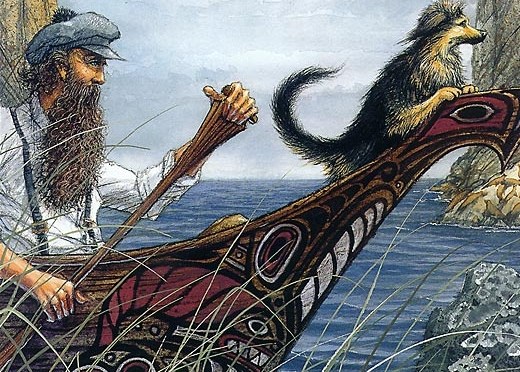
My favorite John Muir story involves a tiny dog named Stickeen. Fanatically loyal to Muir, Stickeen followed the famous naturalist everywhere, even the glaciers could not separate them. On one trip a storm hit. The light was fading, and they were still far from home. Between them and camp lay a large crevasse in the ice, a narrow bridge across offered the only hope of passage.
Muir scooted across and turned to find Stickeen still on the other side, sprinting back and forth as the wind howled, panicked and too terrified to follow. Muir knelt down and reach out his arms calling to his companion.
“Hush your fears little one, no right way is easy in this rough world, we must risk our lives in order to save them.”
For a moment Stickeen remained perched on the edge of the precipice, and in a flurry sprinted across the bridge, past Muir and began to yip and run in circles in ecstasy.
For years John Muir’s words have resonated inside me, echoing in my head with every major decision I make. I tried to avoid making decisions simply because they were safe or comfortable, probing deep inside for what I really wanted.
With this credo echoing in both our hearts, we walked, hiked, and hitched through New Zealand. Bounced from seasonal job to seasonal job. Crammed everything we owned into the Pathfinder and drove for five exhilarating days to Seattle. And of course, spent the last six months blissfully happy on Hanson Island.
Slowly we’ve watched our time remaining tick away, somehow, we have just two months left, and the thought of leaving already left a lump in our throats.
In our wildest dreams, where money is no object, we knew we’d come back. But even here, the financial demands of life can reach us. Student loans, IRAs, and that house in Gustavus beckon. It became our next goal, to save up and buy that house, if the elephant in the room (winter work in a town of 350) could be addressed.
Than Paul and Helena changed everything, offering to help us return for another winter if we wanted to. Thus began the hardest decision we’ve ever made together. We tried to imagine returning to Alaska, kayak guiding in Glacier Bay and than… what? Making coffee in Juneau I suppose. Which was all well and good, but we both knew that at night, crammed back into our shanty studio apartment, we’d look out the window to find ourselves surrounded by street lights. And our souls would ache for this place. For the sound of the waves on the rocks. The Harlequin ducks bobbing like rubber duckies into the cove every morning, the mischievous mink that taunts the cat from under the house.
We budgeted. We convinced each other that one decision was correct, and than the other. Finally, we would lapse back into fits of indecision. Pulled between starting to put down roots, and fearing that we’d eternally regret not returning to the island. We talked long into the night, unable to decide. Until this morning when Paul asked us if we’d reached a decision. We looked at each other across the table, a pained look on both our faces. We knew saying no meant we may never see this place again. And we knew that we couldn’t live with that.
There will be houses to save for later. Winter work questions to answer, money to make, roots to set down. But in our hearts, the wanderlust called for an encore. To sprint across that ice bridge one more time. To risk our lives. And to save them.

“We’re coming back!” we replied.
And like Stickeen a century ago, jumped and ran around the cabin while the wind and rain pelted the windows.
Collect Experiences. Not Things

For the first time in years I want something that I cannot have. The number in my bank account is woefully too small to buy the house that Brittney and I have been salivating over for the past two days. It’s not a mansion with enough square footage to fit a basketball court. Nor does it look out over some ridiculous ocean side vista. It’s just a humble, quaint, hobbit approved house on a tiny road in Gustavus, Alaska. And I can’t have it.

Since graduating from college, I’ve been rebelling against the status quo. Bouncing from seasonal jobs, spending months in New Zealand and Canada and loving every minute of a life that we seem to create one step at a time. But as we’ve wandered, we’ve begun to feel the need to have a home base. A place where kayak gear, camera equipment, and pets can pile up without fear of how on earth they will fit in the Nissan Tetris in a few months. So we looked up houses in Gustavus and began to covet really bad. Houses are never an impulse buy. Thank God. Because I was looking all over the screen for the, “buy now” button like it was ebay.

We took a little crash course in down payments, mortgages, and interest rates. What else are you going to do a 9 pm on an island where you represent 66% of the population? Slowly we began to accept the hard truth that the dream was a long ways away. Though it didn’t stop us from scrolling through the photos one more time (so much natural light!).

In Victoria, British Columbia is the Phillips Brewery, the only microbrew beer I can find in Alert Bay’s tiny liquor store. Besides having a Peanut Butter Stout, which is freaking amazing, the inside of their bottle caps have the phrase, “collect experiences, not things.” For the first time in a long time I want, “things,” or more accurately, “thing” in leu of, “experiences.” Weird.

Of course, if we hadn’t been jet setting, going to baseball games, and had, you know, worked the past seven months, we might be able to make it happen. But I sit in a house perched on the rocks over Blackney Pass. A storm beginning to build after a calm red sky morning. Yesterday was monopolized by calling orcas, sea lions bark and roar at all hours of the day, and the stars pop with no interference from streetlights. Sure, I could be sitting in that house today and I’m sure we’d love it. We’d also have a thirty year financial commitment that would really make it tough to live up to the website’s namesake.

I’m sure someday we’ll truly be ready for that sort of endeavor. But when we do, I want there to be no regrets, that it’s done on our terms, on our time. That we don’t sit in our house with fantastic natural lightening and wonder what could have been. Someday we’ll have a doormat that says, “Cannamore” and a sign that says, “all guests must be approved by the cat.” But until than, I’ll savor the adventure, the sweat, the and cursing as I try to cram one more duffel bag in the back of the car.

Collect experiences, not things. Experiences after all, don’t need a house to be stored in.

In the Holy of Holies

The boat slides into the rocks and triggers a memory. Not a visual one, or olfactory, but auditory. The sound of pebbles racking against the hull of the boat almost makes me turn around, half expecting to see a dorsal fin gliding across the water behind us. Both boat and orca move the smooth, tiny rocks of this beach sound the same way. But today we were alone, just the two of us cautiously approaching the main rubbing beach of the Northern Resident orcas.

I step to the stern of the boat and look back over the water. It’s weird to see for the first time a place I feel I already know so well. High atop an old weathered tree hangs a white box looking for all the world like a security camera. For a summer that was my keyhole. And I would press my eye against it as close as I could, drinking in the scene. But now, for just an afternoon, I got to stand here and see and smell and feel a piece of orca lore. If the bight is hallowed ground, this is the holy holies.

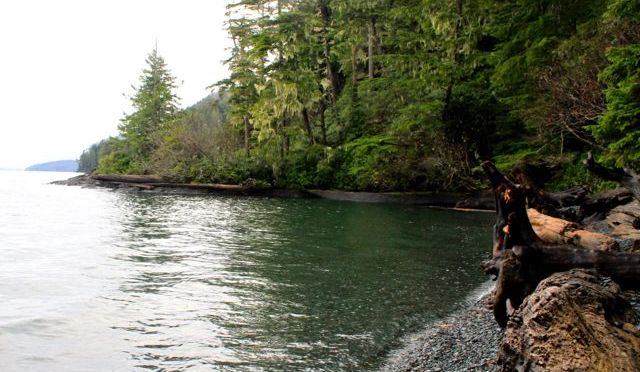
Twenty minutes east of Robson Bight as the orca swims lays this beach where, for all eternity as far as we know, the orcas have come. This beach, an outlier itself in a land of jagged rocks, steep cliffs, and deep water. The beach is smooth and gradual, the reflection of the trees turning the water turquoise, like some tropical paradise. In the shallows, sometimes with barely enough water to cover them, the whales come and rub vigorously on the smooth, quarter sized pebbles that compose the beach.

I step up and over the top of the boat and onto the bow, the waves rocking the boat gently against the shoreline, emitting the sound of rushing pebbles with every crest. I hop lightly off the bow and feel them crunch and slide under my feet. I step clear of the surf and see my footprints imprinted in the rocks. Damning evidence of my intrusion into this mystical place. I lay on the beach and, like the orcas, begin to squirm and roll back and forth on the pebbles, their sounds filling my ears. If it’s good enough for them it’s good enough to me. Brittney laughs and rolls her eyes as she steps gently from the boat. We talk in hushed voices, as if we’ve just entered a church, and prod slowly up the shore.

We had a reason to be here. The rubbing beaches are strictly closed off to the public, giving the orcas their own private sanctuary much like Robson Bight. But someone had to pull the batteries of the long defunct rubbing beach hydrophone, the victim of a fifty knot storm in October that had torn the cable free. Without this premise we’d go nowhere near this place, even in December, when the orcas hadn’t neared the beach in a month, it felt almost taboo to stand here.

A steep cliff makes up one edge of the beach and stretches out to a point into Johnstone Strait. I boulder up and walk to the edge, the bottom still visible even on this massive 17.1 foot high tide. I find the batteries and the second camera, the one that looks straight down into the water off the cliff face where the orcas would cruise right past just before they reached the pebbles. Like at Robson Bight I see them in my minds eye, cruising peacefully past, bound for their favorite spot in the strait. We get the batteries off the cliff and perch on a massive log washed against the shoreline. We dig out some food and stare out at the water, this unassuming little stretch of earth that means so much. Camera in hand I snap pictures while I eat, hoping to capture as much of it as possible and failing to do justice. It’s tough to think about leaving so soon, and I a great longing fills me to see the whales here, just once while I hide unseen in the bushes. It’s a dream that will have to remain a dream, and I look up at the camera, thankful that it gives me the opportunity to enjoy it from a distance. We climb into the boat and gently push back into the water, gliding across the brilliant blue/green waves, bound for the gray surf of the straight, the southeasterly starting to turn up the current.

Before we go home there’s one more place I want to find, and we shoot across Johnstone Straight, heading for Cracroft Island. As we reach the shore I slow down and and we move slowly west toward Hanson Island. I see the hollow wooden skeletons of a camp. Structures with no roofs or walls, tiny wooden platforms and benches on the rocks. This is it. I stop and look at this unassuming little kayak camp. “This is my birthplace,” I thought.

It was here, seven years ago that I had visited, kayaked, and fallen in love with this place. Straining my eyes for that elusive dorsal fin that has dictated so much of my life. I look behind me and remember the A36s, cruising west past our camp, oblivious to the life they were altering forever with every surface, every breath. A part of me wants to find a place to land, to step ashore here and crouch where I did those nights when the A4s swam by, allowing me to hear but not see. But the wind has other ideas, as does the quickly fading sun of the second shortest day of the year. We pick up speed and continue west, picking our way through the deadheads and kelp, tracing the footprints of the orcas that would be back to chase the salmon. Like they have every summer. For all eternity.

Nothing Better

Rain streaks the windows, a melodious tap marks the origin of the leak near the fireplace. In the loft it’s cold, the fire’s warming prescence muffled by the stairs and small hallway. Above is the muffled pounding of millions of rain drops, waging an unceasing battle to break through the roof like their brethren traveling down the chimney. With great effort I pull myself out of bed, the chill sapping my body of the heat the blanket provided. But it’s at least five degrees warmer downstairs where the fire still smolders, hot coals glowing behind the window. I throw another log on the fire and check the temperature. 18.3 degrees celsius, not bad for a stormy 2 am. I remind myself that it’s only the beginning, that it’s going to get a lot colder before it gets warmer. Penny’s house is wrapped in Brittney’s 5 degree down sleeping bag, she might be warmer than any of us. Though Porter looks pretty content curled on the couch in front of the fire, nose buried in his fury paws.

The leak isn’t bad, just a slow but steady drip where the wood finish of the house meets the stone pillar of the chimney. But my common sense isn’t awake even if my body is, and I finally just put every pot from the kitchen at the base of the chimney. Let the drips fall where they may, some of them have to hit stainless steel.

It has become our nightly routine, the alarm going off every two or three hours. Get up, slip downstairs, check the temperature, fuel the fire, go back to bed. We’re long past the days of turning a dial for warmth, fiberglass insulation nonexistent, I prefer it this way. Because come morning there will be no commute, no time clock, no “I have tos.” I climb the stairs, every other step creaking, a stomping like a herd of elephants behind me announces that the cat has decided to move upstairs too. I crawl back under the down comforter, the rain pounds even harder. Porter curls up on Brittney’s pillow, almost smothering her face.

Our east facing windows stream early morning light into our room. A rouge sun beam storms through the thin curtains and crawls up the bed. But if there’s sun the storm may be over. The scattered clouds are ablaze with golds and reds as the sun slowly moves above the mountains on Vancouver Island. A whisper comes from the speaker connected to the hydrophone system next to our bed. Three pods of orcas past through in front of the lab yesterday but didn’t make a sound. They rose in a perfect resting line, a phalanx of fins rising and falling as one. Sixteen orcas in all, and not a boat to be seen anywhere. The boy in me wanted to get closer, to follow them for awhile, but I could find no justification for it. They’ve waited months to have the strait to themselves, let them have it.

The whisper grows, delicate ‘pings,’ begin to echo through the speakers, the trademark call of the G pods. Brittney is up like a shot, without a backward glance she runs for the lab while I’m still looking for socks. What have I done to her? I brew coffee, feed the pets, and listen as the calls come closer and closer, the bright red clouds streaking across the heavens, reflecting into a pink sky above. The water is flat as a pond, it’s going to be a glorious day.

Our Greatest Fears

My first memory is knives. Millions of them, cutting through my body through every angle. My body sinking and air replaced by water before my life jacket pulls me back to the surface. The current carries me and I glance back toward the canoe, a snapshot burned into my memory. The leaves contrasted with the dark gray of the rocks and river, the mountains with their yearly dusting of termination dust. And the canoe, millions of miles away, my mother clutching the side, her eyes wide with a fear I should feel but don’t. All I feel is a numb detachment, as if I’m watching my body get swept down the Eagle River, my spirit already hovering above, ready to depart.

A splash interrupts my serene drift downstream, the sound comes closer and closer intermixed with the rush of the river and the gurgle of my breath as water and air combine in my mouth and lungs. Seconds later Dad has me in a vice like grip, holding me as high above the water as he can calling for mom and the canoe. Unceremoniously I am dumped, shivering and shaking into the boat, Dad gasping for breath and Mom paddling for the shore as hard as she can.

Years later, my first memory is still the closest I’ve been to my last. Perhaps my free fall down the mountain could qualify, though it likely would have resulted in just shattered limbs and intensive physical therapy. Now, decades removed, I still remember the knives, the frigid water immobilizing my arms and legs, and my mothers face, the look of terror and loss as I drifted away, and Dad’s courageous breaststroke, holding me above the water while he sank deeper.

All that has changed is my own fear and terror. The memory forms a pit in my stomach, my legs weak and mouth dry and drowning has become my greatest fear. Because at some point your body gives in, you stop fighting the current, you stop treading water. Your fatigue becomes greater than your desire to live, and you give in to the unrelenting attack of the ocean. Sinking below the surface your lungs begin to burn, millennia of evolution, screaming at you to open your mouth, to inhale, and eventually, you succumb. But there is no salvation, no relief, just gallons of water rushing in, pulling you deeper and deeper into the dark.

And yet I love the water, live on it, and follow at a fanatical level, the animals that have mastered the medium. I am an oxymoron, drawn to what I fear. As if I believe if I spend my life on it, in it, beneath it, that I will somehow master my fear. But perhaps it’s best if I never do, if I, for the rest of my life, had something holding me back just a little bit. That sensation of terror, for fear often fosters with it, a respect for that which also terrifies us. Reminds us to never underestimate it, take it for granted, or abuse it.

And yet I have seen mans fear of the of the world turned, not into respect, but into anger and violence. Fear the bear? Kill it, for you cannot fear what is exterminated. But with no bears a walk in the woods is no different than a walk down the street. Yet another disconnect from a past that we have already forgotten. Do not fear the wild, or what you don’t understand. Instead see it as an opportunity to grow, expand, change. Shooting a bear with a camera is infinitely more rewarding than with a gun. Killing one from 300 yards and putting it on your wall doesn’t make you a man, an Alaskan, or a bad ass. At least, it shouldn’t.

If we have nothing to fear we have nothing to respect, and if we have nothing to respect we have nothing to hold in awe. And if we have nothing to hold in awe, than what the hell are we doing out here anyway? We may as well move to the city, get real jobs, and refer to the local park as the great outdoors. Yet where is the excitement? The adrenaline? Our connection with the world that had been essential to our survival until just a couple brief centuries ago. It has been replaced by the 800 channel television, 3G networks, and quarter pounders with cheese.

Yet what is more dangerous, the brown bear in the forest or the type two diabetes, high blood pressure, and inevitable heart attack that awaits our constantly growing species. No one is picketing or protesting the quarter pounders or corn syrup laden drinks, calling them murders or killing machines. Perhaps we should implement fast food control much the way we have predator control. Helicopters circling over the golden arches, rifles poised, shooting carryout bags out of the hands of customers. Or for those that insist on fair chase methods, we can just run up behind them and grab the bags from their hands, throwing them to the ground.

These Are the Places I Will Always Go

So, why than, did it take me six years to go back? What could possibly have kept me away from orcas by moonlight, leaky kayaks, and nights rocked to sleep by the whisper of an ebbing tide? My problem? I listened. In the months after I returned home I was told by teachers, my peers, adults, and the world in general that, while my journey was a great story and adventure, that was all it could be. I needed a real job, security, a 401K, a mortgage and three mini David’s running around eventually. And for years afterward I bought it, and tried to push myself into that square peg.


I busted my butt my sophomore year, taking 35 credits and somehow got the highest GPA of my collegiate career. And for the second time in my life, I decided to take a chance, and transferred from 40 below and 18 hours of darkness, to the rain soaked, humpback infested world of Juneau. And while the scenery may have changed, I still felt an obligation to the same life goals, because, well, that’s what you were supposed to do. I got a job in Glacier Bay my first summer in southeast studying humpbacks. It should have been my dream job, a foot in the door to a career with the National Park Service. But, for whatever reason, I just couldn’t relight the fire. My bosses were great, the venue breathtaking, and the work challenging. But I struggled with the scientific and calculated way everything was done. Standing on the boat, bobbing in the chop created by a juvenile humpback breaching again and again. I wanted to cheer, to whoop, the nature worship bubbling just below the surface. But I felt I couldn’t. Maybe it was unfair to compare the whole situation to my brief time at OrcaLab two summers ago, but it just didn’t fit.


I remember the first time orcas swam past the lab that summer. Paul, camera in hand leaning so far over the rail of the porch I thought he’d fall into the ocean, hollering at the whales as if it was the first ones he’d ever seen. I wanted that raw emotion, that childlike wonder and joy that bubbled over like a pot on the stove. But I kept searching, opening doors and closing them.


I returned to Juneau, met the love of my life, and married her. Two months later we ran off to New Zealand for three months and lived. Spending way to much money, learning how to milk cows, and having the most important conversation of our life. In a town called Rotorua, over strawberry milkshakes, we finally voiced what both of us had been burying, maybe for years. We didn’t want careers, the idea of being tied down to one place to long terrified us, and as far as kids… a cat and a rabbit seemed like plenty right now.


For me, the next location was obvious. It had been in the back of my mind for years, waiting for its chance to emerge. We returned to our seasonal jobs in the tourist industry. Brittney a kayak guide, and me a guide on a whale watching boat, our third season in tourism. In July we hiked Mount Roberts, flying past the tram, trying to leave the masses of people as far behind as possible. We reach a small outcropping of rock and get comfortable, our dialog has been brief and abbreviated. After hours in the woods together we know what the other needs. If you passed us on the trail you’d assume we were fighting. We don’t hold hands, there’s never much joking, laughing, or talking, not on our hikes anyway. It was more of a joint meditation, taking solace and peace in knowing the other was healing with every step. I remember going hours on the Abel Tasman trail in New Zealand with us barely saying a word and being so thankful I wasn’t alone.


We talked about the cruise ships, sitting below us in Gastineau Channel, and our never ending discussion about how we feel about the industry. Were we exploiting the land we loved or were we ambassadors? Was standing on one of 35 boats, preaching the wonders and magnificence of a humpback worth the bellow of twin 350 engines in the water? Words start tumbling out of my mouth, frustration, confusion, and guilt. The words of a man who can’t do it anymore.


Like she always does, Brittney just listened. Letting my words and troubles wash over her as the yoke loosened from my shoulders. She let me go until I was spent, head in my hands, still staring down at the boats. How did they still look so big from up here?


“You need a break,” she finally said. “If you don’t know that what you’re doing is right, that it’s not helping, we need to find what is right, what is helping.”


I nod, the next question holding hopes, dreams, and fantasy in its answer. “I need to go back.” I say, it’s not a statement, it’s a question. We were a team, bound at the hip, and I could do nothing if she didn’t go with me.


“Back to Canada, to Paul’s?”


“Next summer, I can’t believe it’s been five years. I never thought I’d be gone so long. I guess I kind of lost my way, but that’s alright,” I turn and smile, “it led me to you. I want to show you this place that means so much to me.”


She just smiles, “if that’s where you need to go that’s where we’ll go. I want to see it with you.”


Words catch in my throat, the emotions dragging them back to my stomach. Fortunately I didn’t need any as my wife, confidant, and best friend laid her head on my shoulder and wrapped her arms around me. I looked, south down the channel, past the cruise ships and habitation, toward the wild and untamed Taku and Stephens Passage. I could almost hear the orca’s calls, ringing in my ears. I thought of mornings on the observation deck, runs in the woods, Helena’s cinnamon roles, and even the ornery June Cove. It may have taken me five years to figure out, and six to finally put it together, but I was finally going home. And this time, I wouldn’t be coming alone.