The Question

There’s not much in the way of trails around here. Not that it’s too important on this island. Enough old growth is still around that the undergrowth is open in a lot of places. It’s easy to get lost, easy to get carried away walking through those big old trees. Especially on days like today after a heavy rain last night. The afternoon sun slashes through the trees like a sword through fabric, illuminating the mist rising from the moss choked floor. Water droplets cling to cedar needles like diamonds on a necklace. An iridescent glow in each one holding a little flicker of the sun.

Today I’m poking along a stretch that’s part trail part tree root. I hop a stream threatening to be promoted to class five rapids after the downpour. Soon after the trail becomes more defined. I take a deep breath. It feels so good buried in the woods. In Japan they have what they call forest bathing. In simple terms it is nothing more complicated than being in the presence of trees. The idea is that the air doesn’t just taste better in the woods, it actually is better. Essential oils like phytoncide found in trees actually improve immune system function. The forest isn’t just a tonic for the soul like the apostles Muir and Thoreau wrote about. It’s like taking vitamins.

I’m walking this trail to see someone who knows that better than anyone. I’ve written about Walrus several times before. For those that don’t know who this incredible man is, here’s the cliff notes version. Walrus is a walking talking hybrid of Radagast and Dumbledore. He inhabits what he likes to call, “Canada’s longest active logging road block.” He settled on Hanson Island after years in Greenpeace and helped Hanson Island—Yukusam in the Namgis tongue—gain protection from logging. Today he has a long white beard, eyebrows as long and thick as caterpillars, and a high pitched laugh that is infectious.

In my backpack is ten pounds of dog food for his creme colored bear of a dog named Kessler and fruit, carrots, and granola for his master. I tighten the straps of the pack and dig in my boots on the muddy trail as the incline steepens. Walrus’ road block came to rest about a hundred feet shy of the highest point on the island. Every now and then I hike food up the hill to him. It became dire last week when Walrus walked down the hill to the series of rubber totes he keeps near Dong Chong bay to collect some food he’d left only to find that something had gotten to Kessler’s food. 10 pounds worth. Be it bear or wolves we still don’t know. But neither of us has seen a deer in weeks. And deer don’t disappear because of mischievous black bears. So we’d brought Kessler an emergency bag of dog food last week. And had restocked for him in Alert Bay a couple days ago.

As I climb my mind drifts, thoughts mixing with the ravens and Stellar’s Jay above me, my mind drifting to what I’d been reading before I left the lab. In the last week a tanker ran aground near Bella Bella. The support vehicle sent to assist swamped. The containment booms set out to minimize the impact were as useful as a fishing net. The spill was minimal, as minimal as one can be at least, an insult to the very phrase, “low impact.” A low impact oil spill is like minor surgery. It isn’t minor if you’re the one getting cut open.

I’d followed the stories through a guy named Mark Worthing. A Walrus disciple and friend of Orca Lab who has committed his life  to keeping the final stands of old trees in British Columbia standing. In his free time he fights back against the proposed oil tanker line that would cut through the Great Bear Rainforest, one of the pearls of world. The only region in North America where wolves were not almost exterminated. It’s a place where people find Spirit Bears in the woods and God in a sunset. It’s also a maze of islands, reefs, and rocks that gets hammered by 50 knot winds in the winter. All it takes is one tanker. One mistake. One gashed hull. And it’s gone. Ask Prince William Sound. And so Mark fights, because life would seem pointless if he wasn’t fighting for something much bigger than himself.

And then there’s Zack Brown back in Alaska, founding a research and education institute on the Inian Islands to the west of Gustavus. He hiked and paddled from San Francisco to Gustavus in a tidy three months. He’s a voice for climate activism, a voice for change, and he does so eloquently, something that doesn’t always happen when we speak passionately. I used to idolize athletes, now I idolize activists. If only they made trading cards.

My legs are shaking. I set the backpack down on a rock and plop down in the mud next to it. Sweat runs down my face, steam rises from my back. What am I doing? I gave some money to Bernie Sanders, ride my bike when I can, talk about saving the world. But is that enough? It’s a question every conservationist has asked themselves. We see a world that’s in danger. In danger of being steam rolled over by the great construction firm of progress. Lumber over woods. Oil over spirit bears. And we wonder if what we’re doing is adequate. It’s hard when our efforts aren’t visible. Riding your bike doesn’t correlate to a healthy calf in the southern Resident Orcas. Nor does eating vegetarian ensure a healthy salmon run.

I pull the pack back on and start back up the incline. It’s a question I’m still struggling with as my breathing becomes more and more ragged. I spend my summers representing the natural world from the seat of my kayak, and the winter writing about it. My audience is only a couple hundred people, maybe that’s a start. Maybe the people I show sea lions and humpbacks to in the summer are starting dominoes back home. Maybe they took something back from Glacier Bay besides pictures and cover photos.

I round a final corner and Walrus’ cabin comes into view. His area is ringed with a Salal fence, the flexible trunks of the bush intricately bent and woven together to keep the deer away from the garden. Does it work? It does not. You would think a 90 pound dog would keep them out. But Kessler has been known to watch deer amble by ten feet away with nothing more than a sniff. He jogs up to me as I approach, ears up, tail down. We go through this song and dance every time. He can never remember me. He gives a half bark, turns and runs. From the cabin I hear Walrus call out and I smile. The question still lingers, but for today I have a purpose. I’m bringing the caretaker of Hanson Island lunch. And for now, that’s enough.

Hanson Heartbeat

The windows creak and groan. The world outside them is pitch black but I know tree branches the shape of withered arms stretch their wood clad fingers toward the cabin’s walls. The ocean pounds. It sounds so close I expect the next wave to come barreling over the porch and set us adrift in the sound. It’s the first storm of many, I’ve spent the summer dreaming about them. There’s something in the forty knot winds and blasting rain that’s soothing, secure. Hunkered down with the fire roaring and the cat asleep on the back of the couch. Just as long as the boat’s ok where it’s tied up in the back of the cove. It is isn’t it? I should go check.

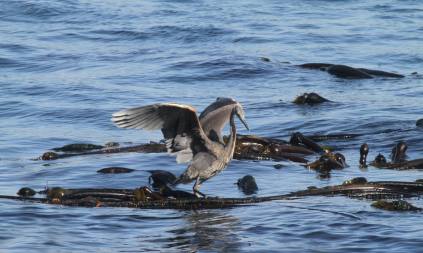
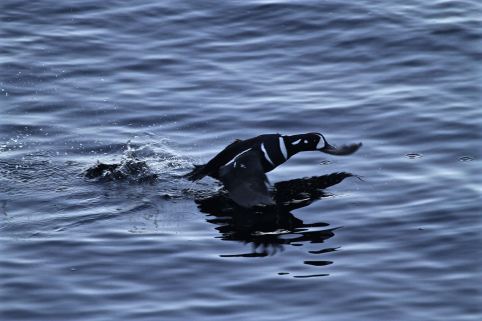
By morning it’s subsided. The low pressure monster taking a deep breath, preparing for the next exhale. Harlequin ducks poke their multi-colored heads out from behind the rocks, Sea Lions return to the haulout, Herons again perch on the worn out kelp that has been buffeted by waves for the last 12 hours. And like all the critters, we poke our heads out our door. All the roofs are still in place, the lab still humming along. All that’s changed is the growing collection of fallen branches and golden fingers of the Cedar trees that populate and soften the forest floor.
harlequin
If only the rest of the world was like this. Half a day of insanity and turmoil before everything returned to it’s relaxed state. Humpbacks in the pass, seals munching fish, deer scavenging for the kelp that just couldn’t hold on anymore. But human nature doesn’t work like this. Every day some new scandal flashes across the screen. It is the quintessential train wreck. I want to look away so bad but can’t. My stomach tightens as I scroll through article after article, my heart pounding against my ribs, eyes becoming glazed and unfocused.

How has it come to this?

Assault, repealing amendments, threats of political violence, the laundry list could go on for pages. Dear God, what century is this?

I step out onto the rocky face opposite the lab. The point here sticks out into Blackney Pass just a little further, but the difference is noticeable. Sea lions cruise by, calm and serene. They’re exhalations are like small explosions, as if there’s something stuck in their throat. After watching them gulp salmon whole it wouldn’t be a surprise. But it’s just business as usual for the pinnipeds. Eat salmon, have a nap, yell at your neighbor on the rocks.

Six big boys swim past not ten yards off the rocks. Even from the relative safety of the point I stiffen. I’ve spent enough time in a kayak to know these guys make me uneasy. I’ve been followed, growled at, and watched them zoom inches below my seat, feeling the kayak rise and fall as they passed. But they seem as unsure as I am. They stop off the rocks and we stare into each others eyes.

They’re a comical looking animal when you see them straight on, bobbing like corks. They have this perpetual look like they’re always surprised. Like the monster just jumped out of the shadows in a slasher movie. I wait for them to dive away and leave me be. But they stay. The curious magnetic quality of sea lion dynamics occurs, more and more appear out of nowhere. Appearing from their hidden trap door on the ocean floor. Seven, eight, nine, ten. We speak without making a sound.

There calmness unsettles me. I want to scream at them. “Do you realize what’s going on? Do you know what could happen on November 8th? Didn’t you read what he said now?”

The group blinks in polite puzzlement before disappearing beneath the waves. Thirty seconds later they’re back. My breathing is unsettled. I went for this walk for two reasons. To harvest mushrooms and leave the rest of the world behind for a bit. You’d think that’d be easy on Hanson Island, but it isn’t. There’s a sense of helplessness being so far away from it all in times like this. There’s nothing you can do but refresh the news and pray. I stare at the sea lions and they snort in my direction, nostrils flaring.

 I wish I could be more like you.

Wish I could be content with some salmon and a smooth rock to lay my head. Though I’m glad I don’t have to watch for a black pointed dorsal coming up behind me all the time.

    “So be like us,” they answer. “Just let go.”

    “I wish I could.”

    “It’s easy.”

    “I wish it was.”

    “Stop wishing and do. Control what you can control. Chop some wood, watch us swim, count the humpbacks. Be present.”

The sun streams in through the clouds. Vancouver Island is hidden but the clouds in front of it sparkle with late morning sun. There are chocolate pancakes in my belly. I write fifteen feet from the ocean. An ocean in which, right now there are two seals, a sea lion, and a humpback visible (who I should probably photograph and ID). I’m in control of our power, our fresh water, and some of our food supply. My heat comes not from propane but wood. I am in the most beautiful place on earth. If I cannot let go here, where can I?

I think of the miracles of this world, of this place. That humpback will soon leave for Hawaii. A 3,000 mile journey without a Lonely Planet book or compass. He or she will hit it square on the dot. No questions asked. Amazing. I memorize the beauty in the sad eyes of the harbor seal and the bouncing optimism of the Harlequins. The prehistoric cackle of the heron, the Pterodactyl incarnate.
heron
Breathe, be still, be present.

I smile, inhaling salt air and high tide. My hands run up and down the trunk of a Cedar tree. I close my eyes, and feel myself, at long last, let go. Surrendering to the pulse of the island.

Photos By Brittney Cannamore

Tumbleweeds, Home, and Root Vegetables

It hasn’t rained in days. The air has been crisp and cold. The window each day in which the shining sun brings substantial warmth is minimal. It’s fall in southeast Alaska. And when it’s not raining, there’s no more lovely time or place in the world. So this time when we leave, it’s hard. It’s never been hard before. Because for the first time we have a home. A home than can be measured in years instead of months.

And yet…

The island calls. That blissful, green, old growth island with Cedar and deer and mink. Our spot in Gustavus doesn’t have a wood stove. And there’s something about cracking cedar over your knee, the vapor of your breath floating above a knitted hat. Something about coffee on the porch, the ocean ten feet away, the sound of sea lions drifting on a growing wind. The promise of an afternoon gale. Hanson Island, Orca Lab, the promised land. I cannot bear to pull myself away from Gustavus, yet I’m giddy at the thought that I will be snug in that little cabin on the rocks in 72-hours, a fire roaring and the heat spreading to warm every crack and cranny. I wouldn’t be in Gustavus if it wasn’t for the island

For this is a place that changes lives. Starting with Paul Spong way back in 1970 and has continued for more than four decades. Hundreds, shoot, maybe thousands have made the pilgrimage to this place and had their lives rocked and upended. This place changes people the way glaciers change land. And I count myself as lucky to have spent two years of my life on Hanson. I would not be the man I am today without it. And it is that which will make the final goodbye so hard. It has sculpted me into someone that holds the final green and blue vestiges of this earth as valuable as any mineral man has ever valued. It is this lesson why I must someday let go.

Hank Lentfer is me in 20 years. Or maybe I’m Hank Lentfer 20 years ago. I’d like to think so. He’s the man I want to be in a couple decades at least, let’s leave it at that. The guy with the quick wit and busy hands that can build or fix anything. He built his house, starting with a 16×16 frame and turning it into a wooden work of art. In my non Hanson Island life I’d see someone driving a Ferrari or BMW down the street and feel an inkling of jealousy mixed with a desire to have one of my own. In the post Hanson Island life I have the same feeling when I see Hank’s garden and root cellar. Inside the cellar are two garbage cans (they’re clean) stuffed with carrots he grew. Another two garbage cans worth of potatoes are nearby. Mason jars are stacked like Jenga blocks on the shelves holding everything from Coho to cranberries. Call it root vegetable envy.

For years Hank and his wife Anya went without hot running water and still have no indoor plumbing to speak of. There’s an outhouse out back or you’re free to just let’er fly off the porch if you wish. Heat comes from a wood stove, the fridge in the arctic entryway is a new acquisition. All these choices were made not out of financial necessity but by choice. Because contrary to the modern world’s opinion, they aren’t necessities.

There’s something inspiring and beautiful about doing so much with so little. But even more, I think there’s something so beautiful about being so happy with so little. It’s a desire Brittney and I both have, all we have to do is learn how. And who better to teach us then Hank and Anya?

All of that however, means saying goodbye to where it all started. A tree’s roots cannot cover hundreds of miles, not matter how sweet the soil may be.

But not yet.

For tumbleweeds need no roots, they travel with the wind, blown south to that little halibut hook shaped island every fall. Where there’s no root cellar but humpbacks sing in the evening. No glaciers but dew clings to the boughs of Cedar branches like diamonds on a necklace. The very smell of Cedar will forever remind me of Paul, Helena, and the A30s calling in the dead of night. Hanson Island’s fingerprints are all over my heart and soul, and there they’ll stay until my final breath. Whatever my life may bring, whatever words are ever published and bound between two covers will be because of Paul’s smile and Helena’s cinnamon rolls. Every paddle stroke is because the A36s blessed me with a passion that will stand the test of time.

My heart feels light and my soul jitterbugs as the ferry cuts through Lynn Canal bound for Juneau. In 72 hours I’ll hear Paul’s laugh, see Helena’s face, and drag that infernal rabbit cage onto the rocks off the June Cove. Because we couldn’t have a dog like everyone else. Because we couldn’t sit still. Because Hanson Island will forever hold us under its spell.

The Birthday Post

For the first time in a year, I got carded. Granted, some of that may have something to do with spending the last six months buying drinks from the same two people (not a lot of choices when there’s only two “bars” in town). But on the eve of my 28th birthday, it served as some sort of inverse reminder. Youth is fleeting. Now I know, my elders and betters will roll their eyes at such a proclamation.

“28? You have your whole life ahead of you.”

To which I say, of course. But we must all admit, that in a society obsessed with youth, with staying young, where waging war against wrinkles is a billion dollar industry, it’s hard not to look at your birthday as some sort of landmark. A road sign twisted and rusted on the highway of life, reminding us that this precious gift slides by far too fast.

I’ve spent the last few days in Seattle. A fine city as far as cities go. It’s big on brew pubs, grunge music, and Macklemore. Though it could do with some deer, perhaps a pack of wolves prowling along I-5. It’s my little snapshot of how normal people live. You know, the ones with satellite TV, high speed internet, and cars that don’t resemble the rusted hull of the Titantic.

I stood in a mall with glistening floors and walls. Music blared through speakers, a movie preview played on a loop from a cluster of wide screens, dozens of adds battled for my attention. But as I dutifully manned my post by the Old Navy entrance, I watched my fellow mall patrons and decided on a little sociological experiment. How many, I wondered, would be on their phones?

The answer was almost all of them. Eyeballs sucked to the screen as if Apple had designed a gravity app more powerful then the moon. What, I wondered could they all be looking at? I didn’t have the phone Brittney and I share. And I must admit there was a decent chance that if it had been in my pocket instead of her purse I may have pulled it out. And what would I have done? Jumped on the internet I guess. Refreshed espn.com even though I knew that there was nothing there I needed to see. People sat side by side on benches, heads bowed as if in prayer, not saying a word. Couples walked hand in hand, free hands holding the creations of Samsung. What are we doing on these things?

Which leads me back to my birthday road sign. If life is so precious, so fleeting and quick, why don’t we spend more time in the present? Why are we so quick to escape to an alternate reality? Later we pass by a Windows PC store. Near the door stood a man. He’s facing the big pane windows but he can’t see him. Something looking like a futuristic toaster is secured to his face. The heck?

“Alternate reality,” Uncle Chris explains to me.

No way.

Maybe it’s just the next wave of video games. Essentially that’s all it is. A really realistic game. And if they made a sports one? Heck yes I’d try that out. Again I must admit to my love of a certain baseball computer game. It’s my escape when I can’t read about Trump, climate change, or acidifying oceans anymore. My own, if you will, alternate reality where the Minnesota Twins finish above .500. So really I’m no different. And maybe that is the wakeup call.

And perhaps that’s what I’ve learned in the last year. That despite my little migratory life from the seat of my kayak, I’m not all that different from the mall patrons and commuters of the city. And that’s ok, that’s a good thing. If I’m no different then those I want to reach, then getting them to listen, to put down their phone and read what comes out of my head should be easy. Maybe one of them will load raincoastwanderings from their phone! The irony.

Because I want the mall dwellers to read what I write. I want to inspire and touch people’s lives. The mall is not a bad place just as a phone that can tell you what time the Vikings play isn’t. What I want, what I aspire to, is to remind people that there’s a big blue and green world beyond the sliding doors. A world you can enter without strapping a toaster to your head. And that, most importantly, we cannot live without it. That the natural world, like every day we are gifted, is precious.

Fairweather Therapy

I run. I do it a lot, probably not as much as I should, but a respectable amount. I run to clear my head, to keep my heart happy, to think, to calm the hell down. Somedays it’s easy, somedays it’s hard. So in a lot of ways, running is like life.

Today it’s hard. It’s hard and it shouldn’t be. But I’m uncalibrated, a compass needing to realign to true north. I’m stressed, I’m worried, and somehow it feels easier to sit on the couch and not move. But it won’t make this any better. I drag myself out the door and lace up my shoes, slapping an escort of biting “no-see-em’ gnats that sprint to skin like moths to light.

In three minutes I’m glad I’m doing this. The world shifts back into focus, mind syncing with heart. I can think clearly as the trees scroll by and the music pounds in my ears. Sometimes I think about kayaking, other times writing, or I’ll indulge myself with thoughts of the ridiculous computer baseball game I’m too engrossed in. But not tonight. Tonight the Shabin dominates my mind. The Shabin and the 4.13 acres that comes with it.

The acreage is wet. But all land in Gustavus is wet isn’t it? It’s part of the deal. We can afford it. We’re ready. I think. Think. I’ve been doing too much of that. Thinking and projecting. Rubbing the grime off my crystal ball, trying to make damn sure I know what I’m doing.

I don’t know what I’m doing.

I don’t want to make a mistake. This isn’t a starter home, this is going to be home. Forever. When you got one bullet you need to be positive your aim is clear. And I’m not sure yet. It’s daunting, this home ownership thing. In a way it’s riskier then anything I’ve ever done. The consequences far reaching, the way out hard and difficult if we miscalculate. Hence the run, to let it all go for thirty minutes. At least that was the goal.

I reach four corners. That’s what we call the intersection here. The intersection. What a ridiculous way to describe the place where the four roads meet. Clove Hitch Cafe and Fireweed Gallery on my right, the gas station in front of me. Left to the airport, right to park, straight ahead to the ferry terminal. I go straight, don’t even bother to check for traffic. God I love it here.

Past the Sunnyside Cafe. I glance into the windows as I run by. Someone waves enthusiastically through the window as I pass. I’m pretty sure it’s my friend Jen. I wave back with all the enthusiasm I can muster, trying not to break stride. In Gustavus no one just goes to Sunnyside for groceries. You go to talk, to laugh. To be filled with something besides organic apples and romaine. Community. How man places can say they have that? What happens when most people get their groceries? A faceless cashier whose name you’ll never know.

“How are you?”
*beep*
“Good, you?”
*beep*
“Great.”
*beep*
“$8.95.”
*swipe*
“Have a great day.”
“Thanks, you too.”

That doesn’t happen here. Brittney and I stood in Sunnyside for 20 minutes last night. It took us three to find what we needed, another 17 to talk with Kristiann and Aishu behind the counter. I love that. Love that I leave every building a little happier then when I entered.

Past the Sunnyside and down the road. Through the trees on my right I can see the setting sun on fire in the western sky. The trees hide them but I know the Fairweather Mountains are out. That if I run far enough I’ll be rewarded with evening light and a setting sun behind the mountains. I pick up the pace and soon I’m even with the golf course.

You heard me right. Gustavus, population 443 has a freaking golf course. Because Morgan Deboer loves this place. For years he owned the waterfront that the Gustavus dock is built on. But as the land continued to rise, his property line was pushed inland. Morgan thought the new waterfront and acreage should be his, the state of Alaska didn’t. So he went to court with Gustavus behind him. And he won. His thank you? A golf course. And an open invitation to have bonfires on his beach. No charge. Thanks Morgan.

Ahead is the ferry dock. I look to my right and my spirit soars. The sky is a canvas painted with colors no artist can emulate. Life changing red. Soul lifting orange. Inspiration yellow. White cloaked Fairweathers in front set the scene.

I reach the end of the ferry dock and stop. Not by choice. Not by a conscious act. I cannot move. Cannot pull myself away from the atmospheric miracle that is this sunset. I drink it in like I’m dying of thirst. This may be the most beautiful thing I have ever seen. I pan to the right. There’s a sudden dip in the mountains and hills where the magic bay and her magic glaciers have carved them away, hanging valleys filled with water.

I pan left toward the mouth of the bay. What must it have been like? In 1794 George Vancouver was here. The bay was five miles deep, the glacier five miles wide. No northwest passage here. Just life altering ice. Gustavus wasn’t even a blink in her eye. Just a sandy outwash, a dumping ground for silt.

It feels like Gustavus was set aside. For the few lucky enough or blessed enough to fall under her spell. The little outliers. Flat land in southeast Alaska. Whoda thought? The acreage we’re looking at is flat. But here, with the Fairweather’s on fire with evening light and Gustavus splayed out before me, it feels insignificant. The most popular bumper sticker in Gustavus reads like this:

                                           “What’s your hurry? You’re already here.”
Gustavus, AK

I feel foolish. I’ve spent the last 48 hours agonizing over interest rates, mortgages, and price per acre.     Perhaps I’ve lost track of what makes this place magic. That no matter where we end up, what spot of land we call home, it’s going to be here. We get to be surrounded by these mountains, these people, forever. I feel so much better. John Muir talked about “glacier gospel,” finding God in nature. For a night I’ve found therapy in mountains and sunsets, a reminder of why I’m here.

The sun slides behind Mount La Perousse and as the rays of light disappear the chill of night arrives on the northerly breeze. It is late August after all. Time to get home. Home, how good it feels to say that and know that it’s at the throne of those mountains, in the tight embrace of that bay.

The Shabin

There’s not much left of the road. Just two indention’s overgrown with weeds and grass. Blink and tilt your head and you can almost make out the tire tracks. But alder trees are growing in between the divots and it’s clear that no one has driven a car back here in a long time.

In my hand is a scrap of printer paper, a series of hastily scribbled squares and rectangles drawn on it. One of those rectangles is my future home, maybe. Brittney follows along right behind me. Just ahead is a man I admire and love. A man I want to be like, but with my own flair, my own style. After all, there’s only one Kim Heacox just like there’s one David Cannamore. At the youthful age of 65, Kim’s enthusiasm remains boundless and I find myself wondering what he must have been like when he was 30. I know I wouldn’t have been able to keep up with him.

He leads us through the properties acres, referring to it over and over again as, “our property.”

Our property.

My god. Is it really possible? A small cabin sits near the land’s southern border next to the remnant of the road. The rest is Spruce and Pine forest with a bit of bog, a bit of marsh, and sprinkled with berries. Oh the berries. High bush cranberries, neigoon berries, even some low lying blueberries. I pass an alder no more than knee high. I run my hands through its branches. The leaves are manicured and nibbled. A moose has been here recently. It feels like home.

We can’t stay away. We drive the two miles back to the little slice of heaven. We forgot the tape measure, so we measure the cabin’s tiny room the only way we can. I lay down on the wood floor and so does Brittney, her feet brushing my scalp. We can almost lay down all the way. Calling it a studio  would be generous. No running water, no toilet.

I doubt many would understand the appeal of a dry cabin devoid of plumbing. Cabin may not be the best description. It’s part cabin part shack. A shabin as it were. But both of us see it for what it can be. Knock out a wall, raise the roof, put in a loft. Definitely a bathroom. What are we missing? A sink! Should install a sink at some point.

But for the right price… we’ve lived rustically long enough. What’s a few more years?

I think about the homes we walked past in the Seattle suburbs. 700,000 dollar monstrosities on a quarter acre in tidy suburbs. Each home copy and pasted from the last. Each subdivision given some charming name like Shady Acres or Pebbled Brook. I don’t want a 30-year mortgage. I don’t want property tax. I don’t want my neighbor’s music echoing through my walls.

Give me simple. Give me peace. Give me trees and blueberries. In our minds it’s already ours and we haven’t even called the owner yet. The owner we know is looking to sell. You’re crazy if you think I’m telling you where in Gustavus it is.

It’s scary. Sure we’ve talked about buying a house in this city filled with magic for three years. But to be this close, our feet draped over the edge, just one step from going over. Maybe buying a house is like having kids. If you wait until you’re ready you’ll never do it. But I also know that this is what we want. That we’re ready to make this home.

August Fog

For the first time this summer, there’s a bite to the breeze. When I step out the backdoor. The air tastes like Fall. It brings forth images of Cottonwood Trees changing color. The taste of Pumpkin flavored beer, pumpkin spice lattes, shoot, pumpkin flavored everything. Fall comes early in Alaska. The first week of August reminding us that each season but winter is short, to be savored.

With it comes rain. The rain that justifies our existence as a rainforest. A rain that makes everything green. A chilling nasty rain with curled lips and sharp teeth that bites at the back of your neck and crawls beneath the most impenetrable Gore-Tex.

But on days like today, when it doesn’t rain, oh what a beautiful setting. Bless the rare calm, and foggy mornings of August. Blue sky above, the land ensconced in curtains of fog.

There’s something magical about paddling in the fog. The shutters pulled over our eyes, every other sense becomes sharpened.

You smell your way through fog.

On low tide mornings like this one the odor of anoxic mud crawls into my nose. A rancid guide leading me back to shore when the trees disappear behind the milky white sheen. My ears orientate like a dogs, the cries of a crow lead me across the mouth of a cove. Land nowhere in site, paddle toward the crows.

As always I’m accompanied. Today it is the minimum two people. Mark and Laura. Middle aged, bouncy, and happy. The sort that are easy to talk to because the silences are never awkward. Everything is wonderful in their eyes. The fog, the water, the sea lion that interrupts my bear story. They make my job easy. The sort of people you wish you had every day. We paddle near the shoreline and let the fog wrap around us like a sweater. The smell of the beach and the noise of the crows guiding us.

Boats pass unseen in the fog. The intrusive foghorn of a cruise ship echoes off the mountains and trees every few minutes.

We float in a kelp bed two miles from the dock. Our paddling has been serene and relaxed. I’m in no hurry. If you’re in a hurry, kayaking isn’t for you. Easier to let the world come to you then to try to catch the world.

“Are you worried about the possibility of losing the glaciers because of global warming?”

The question comes from the husband Mark. It does after you talk about the retreat of the glaciers. How, in 1794, Glacier Bay was nothing more than a five mile divot on the north side of Icy Strait. Yes I know, no internal combustion engines spewing carbon into the atmosphere in the 18th century.

There’s something different about the way that Mark phrases the question though that gives me pause. Are you worried about the glaciers?

The glaciers? I mean, I guess so. It’s funny, I live in a land defined by them, created by them. If anyone should worry about the well being of the glaciers I guess it should be me. And I am, now that I think about it. For Glacier Bay with no glaciers is a sorry end indeed. What would we call it? Muir Bay National Park and Preserve?

But when I think about climate change, about the cliff that we’re either a) barreling towards or b) careening over (depends on who you ask), glaciers aren’t the first thing I think about.

“What I think about,” I say, “are murres.”

“Murres?”

“Murres, among other things.”

I explain about the blob, which they had never heard of. About thousands of murres washing ashore on the beaches of southeast and south-central Alaska. I describe their delightful noises, the joy of a muttering murres, their exasperated yells. We all seem to have that animal that touches us in a way no one else understands. Brittney loves Black Oyster Catchers. Hank Lentfer loves Sandhill Cranes. And I have Common and Thick Billed Murres.

“For me, Glacier Bay without Murres is no longer Glacier Bay.” I say. “Maybe that’s short sighted of me. But imagine if you stopped paddling, and it was quiet.”

We do just that and are serenaded by a timpani of birds. Marbled Murrelets, Canadian Geese, crow, raven, phalarope, and oyster catcher.

People talk about getting out in nature. “Getting away from it all.” We call it. The peace and quiet of wilderness. But here’s the thing, nature is never quiet. To walk into the woods and hear nothing would be… empty, desolate, unsatisfying. Nature isn’t supposed to be quiet. There should always be a squirrel rattling, a bird calling, a sea lion swimming.

What we’re really talking about, is getting away from ourselves. Away from the world we created. The artificial one sculpted from metal and concrete. The birds and squirrels and sea lions are not noise, they are music to our ears. And a world without them, glaciers or no, is no longer a world.

Snow

She lay in an old shipping container. The kind found on the back of trucks roaring up and down the concrete riverbeds we call interstates and highways. But this one had been laid to rest here. Tucked away in a corner of a lot in Bartlett Cove. Through the trees I can hear the wind, smell the air breeze, ear cocked for the sound of a humpback. How out of place the egg white box of metal looks here. No flowers or grasses growing around it. Just a strip of gravel turning dusty in the early July heat.

Inside lie her bones.

I feel a thrill of excitement as Chris Gabrielle pulls a key from her pocket and unlocks the deadbolt. Together we lift the big metal latch, its joints creaking and groaning as the big door slides open. I don’t notice the smell at first. But as Chris flicks a light switch and ignites a small bare bulb, it overwhelms me. It is musty, sweet but sickly. Something about it smells alive, even in her death. I walk into the container, breathing shallow, fighting the urge to cover my nose with my shirt.

After almost ten years, she still lives in some way. Organic matter and oils still seeping out of her ribs, humorous, and vertebrae. I can’t help myself. I reach out and touch one of the vertebrae. As big as a tire and bleached white, I run my hands up and down all that remains of Snow. Here along the racks and shelves, were all that was left of her forty-five foot, thirty-five ton body.

The year is 2001. Somewhere in the mouth of Glacier Bay swims Snow. Inside her new life is growing. Is she aware that she’s pregnant? That in half a year there will be a miniature her swimming and breathing? The baby will drink a milk that is 50% fat, the consistency of yogurt. I wonder if she heard the cruise ship. If she had any inkling of its approach. If she could have gotten out of the way. If the ship could have. The nose of a cruise ship is so far from the engines in the stern that they create “sound holes,” right off their bow. There’s a good chance Snow never knew what hit her.

Janet Neilson (then Janet Doherty) found her. Dead whales are rarely found. Usually they disappear. Sink to the bottom and vanish, presumed missing. But it’s as if Snow wanted to be found. Janet discovered her floating off Point Gustavus, not far from where an anonymous cruise ship passenger reported feeling a thump. They towed Snow to the beach, necropsied her body, and discovered a fractured brain case and crushed vertebrae.

Gustavus mourned, the park service gave press releases, security footage was seized, attorneys went to work.

“The crime wasn’t in accidentally striking the whale,” said a park employee, “the crime was in failing to report it.” I’m not sure Snow would agree. Neither do I.

In the middle of the shipping container is an old iron claw bathtub, the porcelain chipped and rusting. But it doesn’t leak, at least not yet. Chris hands me a great bucket of industrial kitchen degreaser and instructs me to fill the tub with the stuff and soak Snow’s bones one at a time. Oil, she explains, is still seeping out of her bones. The goal was to remove the rest of the organic matter from the bones so that they could be preserved for years. An exhibit was being prepared down by the beach. Where in a way, she could live forever.

On sunny days I climb onto the roof of the container, lining her ribs up neatly to bleach in the never ending Alaskan sun. I soak the vertebrae overnight in the degreaser, greeted each morning by the strong smell of leaching oil, a pearly iridescent sheen on the surface of the tub.

Down another road, behind a locked gate is her skull. My stomach twists the first time I see it. I run my hand across the deep fracture in the skull. If a passenger felt the collision, than surely the crew did as well. But who wants the headline: “Cruise Ship Kills Whale in National Park?” Bad for business. But thirty-five ton bodies don’t always disappear. I pressure wash her skull, obliviating the moss attempting to grow on her. When the yard empties I crawl beneath the skill and lay in her mouth, imagining. Rows of baleen, gallons of sea water, tons of wriggling herring.

And I’m indebted to them. The cruise ships I mean. Wouldn’t be here without them. Wouldn’t have had summer work in Juneau when I graduated from college. Would not be sitting at this wooden table in Gustavus watching the storms roll through, the moose calves grow up, and the rain pound on the roof. I owe my beautiful little life, in some way, to an industry that makes me uncomfortable. That kills whales, that leaves a massive carbon footprint. That shows a million people Alaska every year, even if it is a watered down, fast food version. 14,000 people a day in Juneau. But what’s the alternative? I can’t take 14,000 people kayaking in Bartlett Cove. Is seeing this place from ninth story better than not seeing it at all?

Edward Abbey would say no. But I should be confident enough to form my own opinion. But I can’t. Because like this bay, nothing is black and white. A single receding glacier does not signify climate change, just as an advancing one does not disprove it. We must step back, way back. Look at the big picture objectively, rationally. We don’t like the big picture. Step far enough back and we become mitigated, aware of how insignificant we are.

That’s the beauty of the kayak, the hiker, the backcountry camper. You have no choice but to confront your own significance. At how small you are away from the billboards and street lights. It’s uncomfortable. Change always is. Tough to be uncomfortable from the ninth story.

I don’t know what the answer is. Abbey wouldn’t be impressed.

Snow stands whole once again. Without her flesh she looks serpentine. Two tiny bones bent at obtuse angles are suspended by wires two thirds of the way along her vertebrae and a foot below it. They’re all that remains of her legs. In time evolution will remove them from whale’s entirely. Like our appendix they are vestigial, no longer of any use.

Every day a park ranger gathers a crowd in front of Snow to give a presentation. People flock to the talks until the trail is not passable. They are independent travels, for the cruise ships do not dock here. Our kayak sheds are right next to the skeleton and I often squeeze through the raptly listening crowd. Like the cruise ships and wilderness, the talk makes me uncomfortable. I hear the ranger joke about how Snow embarked on, “the longest over land migration a whale has ever done” to be rearranged and put back together by a professional.

The crowd titters and laughs, something about it makes my blood boil. I hear them talk about the collision as a horribly tragedy. But in the same way a loved one developing an illness is tragic. Unavoidable, no way to prevent it. Never have I heard a ranger say that the cruise ship failed to report the collision. That it was not until security footage was seized and viewed did they admit to striking the whale. Perhaps they do and I have simply missed it. I don’t wish to criticize or demean. For the rangers do a job I know I couldn’t. I don’t know why I think people need to know that part of the story, but leaving it out feels like an insult to her memory.

On one of the displays is a grainy picture showing the bow of the ship, a gray pixelated sliver in the water shows Snow, her back arched, attempting to dive. Maybe she did know.

“Snow moments before tragedy,” reads the caption. Meanwhile ten miles away two cruise ships a day enter the park, passing Point Gustavus, bound for the glaciers of the west arm. Do the passengers on board know the story? Do the rangers share that story when they board every morning at the south end of Sitakaday Narrows?

I don’t know what the answer is.

All I know is that it hurts my heart to have Snow here, condemned to life as a silent ambassador. How much more she could be, churning up the waters of Bartlett Cove.

Another sunny July day. Six years since Chris opened that container and introduced us. We walk the familiar trail toward the kayak sheds. Past the old Tlingit canoe, Snow’s display coming into view.

“Have you met Snow?” I ask.

Everyone has the same reaction, a quick intake of breath, mouth open, rooted to the spot. Their first view of Snow is head on, as if she’s diving right toward you, forcing you to confront her here and now. They snap pictures and lean across the ropes, aching to touch her. Invariably the question comes.

“How did she die?”

“A cruise ship hit her.” My guiding style is one of light hearted comments. Jokes and stories over facts and figures. But not here. No over land migration jokes at Snow’s expense. Here just the full truth. “They knew they hit her but didn’t report it.”

I don’t like starting the day with something so sad. But at the same time, what a reminder that we cannot expect to leave the world the way we found it. The warming acidic water of the world should be a good enough reminder. Every kayak on the beach crushes barnacles and mussels. The leave no trace etiquette is an impossible dream. From man to mosquito, no creature was meant to leave an environment as they found it.

We linger a moment longer and turn toward the beach where I hand out life jackets, spray skirts, boots, and paddles. The water is alive with life. Sea otters cracking open shells on their stomachs, sea lions growl in frustration, a timpani of birds. I slip into my kayak and feel the world slide into place. My heart rate slows and my breath becomes steady. I don’t know what the answer is, and in this moment I don’t need one.

Telling Stories

He wore cowboy boots. Amazing how quickly one can come to a whole list of conclusions by a shoe type, an accent. In this case the accent matched the boots. A drawl that can come from only one place. A drawl that says, “I will not be amused when you remind me that Alaska is three times bigger than Texas.”

So I skip it, not that it was ever funny. I worked with this boat captain several years back. Before every trip he would make the guests go around and say where they were from. When someone announced they were from Texas we’d burst out with all the pent up enthusiasm we could muster, “welcome to America my friend!” They either loved it or hated it. I haven’t used that line in forever. I gloss over that one too.

They introduce themselves. Bruce and Gail. Even their names sound like Texas. But they’re friendly, oh so friendly. Bubbly, energetic, polite, talkative. In their mid-60s and on their third trip to Alaska. They love it here. They’ll remind me of that ten more times before the day is done and I’ll appreciate it every time. They’ll marvel at the beauty, coo at sea lions and otters, stare with hungry eyes at a breaching whale a quarter mile away. To hear them talk it may as well have shaken their hand.

Perhaps they sensed it like I did. That when it came to politics, to life, our ethics, we stood on opposite ends of the spectrum. But here is the beauty, the magic, the power of this Bay. It makes all that stuff irrelevant. Here is common ground. The otters are arbitrators. What would it be like if our Senate and House of Representatives met here, inches above the water. Would some of this melt away? Let’s make a Republican paddle with a Democrat and see what happens. Forget crossing the aisle, see if you can cross Bartlett Cove.

For seven hours the talk is easy. The conversations are light. They own a ranch, 2,000 acres of Texas desert beauty. Bruce grass feeds his herd. He brings inner city kids out every year, teaches them to hunt the deer that flood their property. He show them everything from pulling the trigger to cleaning, packing, and preparing. Reminding them  that food does not appear on the Wal-Mart shelves through some sort of Harry Potter spell.

“Get’em away from their phones.” Says Gail. “Too many kids spend their whole lives doing this.” She mimes tapping away on an iPhone, her head bent low, chin to her chest. “They never look up to see the world. They walk right past it.”

They’re involved in wildlife conservation. Fighting to keep the areas near their ranch wild. Teddy Roosevelt Republicans. How amazing, that the father of conservation was conservative, was buddies with John Muir. I mention the parallels and Bruce nods.

“Amazing man. Did you know that while he was president he explored the Amazon? While he was their he got so sick that he told the others in his party to leave him behind. That they couldn’t afford to carry him… the president! Tell me if that’d ever happen now?”

The trip ends. But they’re not sick of me yet and invite me up to the lodge to have a drink. For a moment I hesitate. But I’m intrigued, so intrigued by what is happening here. By the opportunity to have what Melanie Heacox would call, “the interpretive moment.” Sometimes a cold beer in the revelry of a magic day is that moment.

Halfway through the first beer the door cracks.

“Where’s one place that you really want to visit in Alaska?” Gail asks.

“There’s a place,” I begin, “in the northeast corner of the state, the Arctic National Wildlife Refuge.” Only politicians use the acronym, slurring it into a gravelly, guttural grown, “Ahhnwarrrr.”

Gail’s face alights. “It looks beautiful.” She says. Like most people, she’s seen the pictures. They’ve been to Denali, the Alaskan Serengeti.

“This is supposed to be like Denali on steroids.” I say.

Bruce leans forward. He’s a talker, not one to sit back and listen. “What’s up there?” He asks.

“Everything and nothing.” The silence hangs for a moment and I step off the ledge. “In the refuge is the 1002 area. That’s where they want—”

“That’s where the oil fields are.” Bruce finishes. I nod but say nothing.

“That’s where it is?” Gail says with a gasp. “That’s where the oil is supposed to be?”

I nod again and watch her face change but don’t say anything, waiting for her to come to her own conclusion. But Bruce continues, “You could put what, five drilling platforms up there? Two acres each. Ten acres total. Take what you needed and… the land land grows back. We see it in Texas all the time. Three years after you leave you can barely tell they were there at all.”

Our talks all day have been civil. And even now there’s no threat in his voice. Nothing that’s inviting confrontation. If only we could always talk like this. Maybe we’d get somewhere.

“If it’s done responsibly—”

“Not always as easy as you’d think.” I say. I could talk about Caribou, I could talk about carbon dioxide in parts per million, sea level rise, or erosion. But something whispers in the back of my head. “Tell stories.”

“Let me tell you about how north slope oil exterminated a pod of Orcas. In Prince William Sound is a unique population of Orca Whales. They’re called the AT1 pod. When the Exxon Valdez struck Bligh Reef, the AT1’s swam through the slick the next day.”

“Orca’s have no sense of smell,” I explain, “they had no idea what they were passing through… they haven’t reproduced since. There’s only a handful of them left. Three or four I think. Within a few years, they’ll be all gone. For me, I can’t put a price on that.”

It’s hard to tell what sort of impact the story has.

“One drunk boat captain.” Bruce says.

“All it takes is one.” I answer, “Prince William Sound will never be the same.”

I point out over Bartlett Cove, in the distance beyond the forests of Lester Island are the Fairweather Mountains. The view the three of us have been marveling at them all day. “There’s precious few places like this left on the planet. We need them. We can’t exist without them.” They agree, they understand better than most that nature equals life.

“Beneath the Brady Icefield,” I continue, which is just beneath the Fairweather’s, are mineral deposits. Possibly oil. This view we’ve been raving about all day, what if there was an oil well at its feet? What if a mine tailling dam burst? If we drill in the refuge, what’s to stop this place from being next?”

I’m not expecting a deathbed conversion. Not expecting them to change their voter registration to democrat. To start a non profit climate change research association. But I want to be heard. Just like they do. Like we all do.

“We’re coming,” I say, “from completely different ends of the spectrum. That’s ok.”

“We have no love for Trump.” Gail interjects.

“Bless you,” I smile. “But it’s important that we can sit and talk civilly about these things. That we do it respectfully. This is how change happens. This is how we keep amazing places like Glacier Bay, like the refuge whole.”

I doubt I’ll ever see Bruce or Gail again. And at the end of the day, doubt that anything in their minds has changed. Strip all this stuff away and we’d be friends, were friends for an afternoon. They’re sweet people, loving people, giving people. They work hard, play hard, the sort of people that would pick you up and set you back on your feet without a second thought.

But that look in Gail’s eyes when she realized that Ahnwarrr was the refuge. That that was the place under siege. Maybe something stuck there, in the back of her head. And maybe next time it comes up she won’t see oil rigs, drills, or platforms. Maybe she’ll see the Caribou running across the tundra, and a young kayak guide, his eyes full of meaning talking about how badly he wants to run with them.

Subject to Change

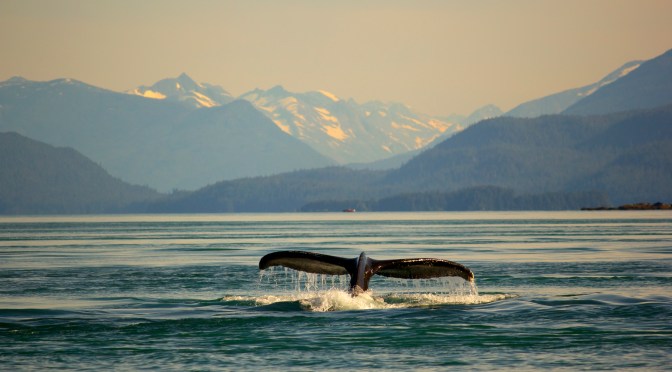
I’m paddling through a minefield. Not a dangerous one mind you. Not one that threatens me immediate harm. No, this is a magic minefield. A minefield of humpbacks. They’re serenading me, us. Every few seconds we hear another breathe. The water’s north of Young Island in Glacier Bay are full of them. How many? Five? Ten? Twenty? Thousands? It doesn’t matter. They are many. They are here. They are near.  To the left of our kayaks the latest whale breaks the surface. He’s fifty yards away, his nose pointed straight at us. My God. For the millionth time in my life I watch the back arch, the body hesitate, and the tail rise high in the air. As tall and proud as a Spanish clipper. She’s diving straight towards us. My heart pounds, my legs feel weak. I strike the surface with my paddle, my stroke noisy. I want him to know where I am. For there to be no doubt. We point the bows of our kayak towards the nearest point of land half a mile away. There’s nothing to do but paddle, our course subject to change.

Subject to change… I’ve heard that before. Or did I read it? I read it. Just this morning, killing time before the trip. Pouring over the nautical charts of Glacier Bay. The maps that make my mind race and imagination cartwheel. All of this magic bay’s coves and inlets. Here a delineation in the shoreline. A potential beach to pull out on. A potential site for a miracle to occur, for a life to change. At the base of a glacier, represented by white are the words: “area subject to change.” Subject to change, I love that. As if NOAA finally threw up their hands and gave up.

“Forget it, we’ll never get this right. Just tell them we don’t know.”

Perhaps the bay is still speaking to us. Out of the mouths of the epochs with the voice of the ice age. Reminding us, prodding us to not get comfortable. We need upheaval, to be subject to change. To not just wait for the significant calving events of life, but to embrace them. We need galloping glaciers but we need retreating ones too. The wisdom and strength to accept them.

Five minutes go by. Still no whale. He could be in front of us, behind us, below us. Every stroke could be bringing us into her path or away from it. In a kayak there’s nothing to do but paddle. With me is a family of four. Mom, Dad, their college aged son and daughter. From the mountains of Utah. But they paddle strong, their hearts are wild, their minds open. Glacier Bay is rocking some minds today. I hope it’s doing the same to them. Somewhere is a forty foot submarine. Carbon based, cloaked in blubber, eating half a ton of food per day. I don’t want to distract her. Attached to her tail is a muscle. The caudal peduncle. Fun to say, but it fails to give credit to what it can do. It’s the strongest muscle in the animal kingdom. To send a humpback rocketing from the water like a rocket it generates the same amount of energy a 747 does taking off. Anything carrying that sort of power needs respect, demands it. Teeth or baleen.

Three miles up the Lamplugh Glacier. The site of a massive rock slide. Last Sunday half a mountain fell onto the glacier. How much? 68 million SUV’s worth. Who knew a sport utility vehicle could be such a great unit of measurement. They’re the passenger of the glacier now. Of the most powerful geologic force nature can muster. You can have your volcanoes, your earthquakes. Give me the glacier. Carving, destroying, creating. In no hurry. For what artist works on any schedule but its own? The news makes me quiver. I take some radical steps, a few creative liberties. What happens when that rock reaches the glacier’s face? It will surely fall to its feet. 68 million SUVs worth. But I know how glacier’s advance. They need a protective layer of rock and dirt at their base. A lateral moraine that insulates from the salt water. If enough snowfall is accumulated above, the glacier can advance, impervious to the melting power of the saltwater. What if the Lamplugh charges… no, gallops, a galloping glacier sounds better. What if it charges across the west arm, obliviating Russell Island and roars south, changing everything about Glacier Bay that we’ve known for 50 years. What if this simple rock slides makes my world, this bay, subject to change?

Still no whale. I glance at my watch. Eight and a half minutes. The unknown more nerve wracking than the knowing. Every few strokes I tap the side of my boat.
“We’re here!” I think.
I hope my taping transmits this message. A rumble, a deep bass. I swivel around. There she is. Close, so close. Fifty yards. Pointed straight at us again. She’s massive. Of course she is. Humpbacks exhibit sexual dimorphism, the females bigger than the males. Guide mode switched on, I almost blurt out the factoid for no good reason.
“Right behind us!” I call. I try to keep my voice calm. But how are you calm with forty tons directed right at you? Ahead of us is the kelp, the closest thing to a sanctuary. This is my world. Wanting, desiring, craving to be close… but not too close. I still want control of the situation, to know that I’m out of the way. She couldn’t care less. We paddle hard, the whale invisible behind us. Forty feet that disappears with nary a ripple. Add it to the list of Glacier Bay miracles.

We reach the kelp’s open arms and I exhale. The family coasts in behind me. Their faces are alive. Exhilaration with a sprinkle of fear. Perfect, just the way it should be. Just the way Glacier Bay, Alaska as a whole expects it. I don’t want to feel safe out here. I don’t want to be in charge. Thank God there are still places where man does not dominate. We paddle on. For that’s all you do in a kayak.

I glance at the daughter. She’s in the back of the double kayak, her father in the front. She’s not that much older than I was on a certain misty and overcast day in Johnstone Strait, British Columbia. The day everything changed. When an Orca by the name of Kaikash surfaced off the bow of my kayak and sent the compass of my world spinning out of control. Who knows whose life will change with the flip of a switch, with a single surfacing, a single rock slide, a single galloping glacier. But when it does, who will be brave enough to accept it and embrace it with open arms.