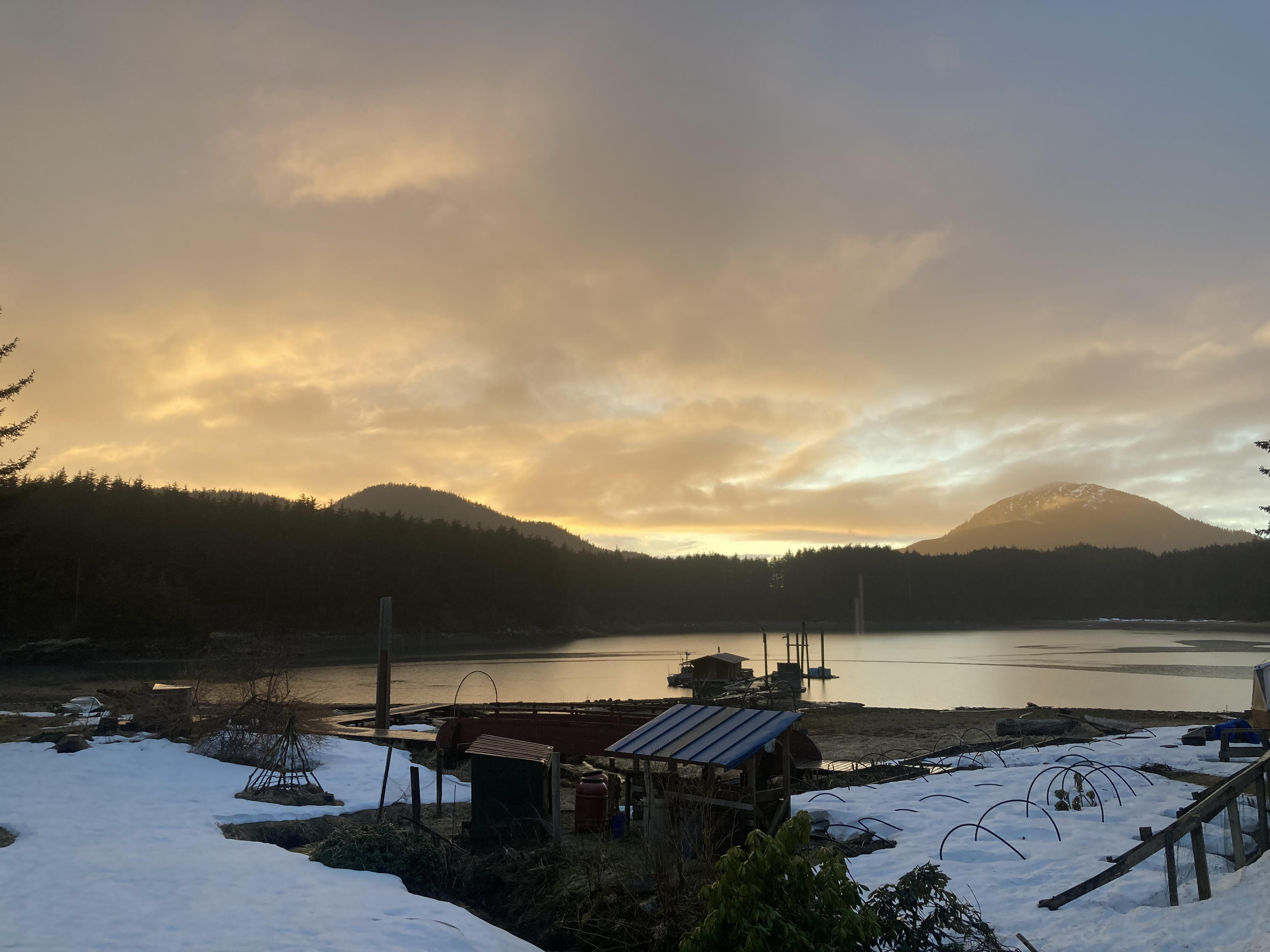
The Shabin II

Varied thrush make me smile, but cranes make me stop. I look up at the throaty call. It cannot be a coincidence that we “crane” our necks skyward. The long V’s circle past, wingtips kissing the treetops as they descend for the marshy flats two miles from my front door. They are spring. They are fall. They are the rhythms of the changing seasons personified. As steady as the sprouting fiddleheads and sweet-smelling cottonwoods. Hank Lentfer wrote about having the “faith of cranes,” the unshakeable belief that their long flight will be rewarded with soft landings.

I balance on the ladder and wrestle a two-by-four into place. It’s amazing. I lived in The Shabin (a part shack and part cabin that was on the property when we purchased it) for almost four years but have done more work in the last week on the structure’s bones than I ever did. For those four years, we huddled around the little Toyo stove stubbornly set at 55 degrees as snow fell and wind blew. Squirrels invaded the rafters, and thin windows meant we heard wolves on quiet nights.

The floor tilts to the north – not much that can be done about that—but now I’m adding to the porch roof, replacing rotten trim, and installing metal flashing to make the stapled-on side room watertight—okay, semi-watertight.

It feels good to make this place livable again. I wasn’t looking for a renter, but when Breanna reached out in search of summer housing, I leapt at the idea.

“I warn you,” I wrote back. “The space is a mess. There’s no running water and an outhouse. Worst of all, you have to live next to me.”

“I don’t mind,” she said.

Awesome.

I promised a habitable space by mid-April. I’m ahead of schedule, sweeping out the floor, scrubbing the walls, and the previously mentioned carpentry. No one makes their bones in Gustavus by themselves. After years of subsisting on other people’s time and knowledge, having something tangible to offer the next Gustavus generation feels good.

I look down at the sound of nails being pulled from wood. The poor idiot is yanking rusty fasteners from a stack of 12-foot 1x4s that are littered with 8D nails, staples, and tar paper. I know the sap. He doesn’t know the first thing about homesteading, much less how to build a home. But there’s a look of grim determination beneath that curly nest of blond hair. His 30-year-old face is set in a stubborn grimace. He doesn’t know why he’s pulling nails, much less what he’ll do with his salvaged 1-bys. It doesn’t matter.

“Dave.”

He looks up, caught by surprise. He peers at me as if through a foggy window. Recognizing but on guard.

“You’re…?” he gestures toward the (mostly) finished cabin beside the willow grove 100 yards away. The new spruce siding glows in the sun.

“Yeah, man. We pull it off.”

“No shit?”

“No shit.”

He beams and sets the hammer down, scarcely daring to believe it. I reluctantly descend the ladder. I’ve been waiting for this ghost. There’s too much to tell. Too much to recap. How to explain it? How to begin? It’s useless.

“But where’s…?”

My stomach clinches. Minerva pads over, gives the familiar stranger a look, coils around his legs, and darts for the woods. I look at the house, remembering how I walked inside last July and found it empty. Every shadow held a memory I’d rather forget. How can a months-old house already be haunted?

My neighbors, friends, and family kept me afloat. Zach, Tanner, and Hank listened deep into the night while the level in the whiskey bottle dropped. Amy told me to meditate, to control what I could control, and to let go of everything I couldn’t. Laura squeezed me tight and promised better days. So many others offered time, love, support, words, and ears. Very slowly, home became home.

I take a deep breath and look at the kid.

“You want the good part first?”

“Yes, please.”

“This is home. I’m done speaking in absolutes, but this sure feels like it’s going to be home forever.”

He looks through me and closes his eyes. The images flashing through his mind break my heart.

“What did it cost?” he asks.

For a minute, I want to be mellow-dramatic and say, “Everything.” Yet… that’s just not true. But it wasn’t cheap.

“What did it cost?” I repeat. “I hope it’s the hardest thing we ever have to do. You will feel like you’re drowning. People will throw you anything and everything that floats. You will grab every one of them and kick and scramble and paddle.”

Deep breath, let it out.

“And you will fail. You will make mistakes. You will screw up. You will do such a good job of convincing others that you’re ok that you’ll believe it yourself. You will hurt people and find yourself trying to atone for things you cannot atone for.”

“None of this sounds like good news.”

I shrug. This is one person whose feelings I don’t mind ruffling. “Sorry, kinda pivoted straight to the other part.”

He looks at the hammer hanging limply in his hands. I watch his mind race.

“Don’t do that,” I say.

“What?”

I smile. “I know how our brain works. You’re looking for every answer in real time. Give up. You can’t do it.”

I scuff the 2×6 porch with a toe, bend over, and pull a long curling hair from between the boards. Snow Patrol lyrics barrel through my subconscious.

“Two weeks later like a surplus reprieve. I found a hair the length of yours on my sleeve. I wound it round and round my finger so tight; it turned to purple, and a pulse formed inside.”

“Then tell me what we’re atoning for?” he asks.

“Not everything needs to be said in the light of day. We’ll do that down the road.” Another deep breath. “I know you think you’ve cracked some code to life and understanding. Don’t deny it. I remember that feeling—safe, secure, confident, arrogant, and wide-eyed. Scour that from your mind and outlook. We know nothing. And the further we travel both physically and emotionally, the more convinced I am of that.”

“And I knew the beat because it matched my own beat…”

The cranes are back, flying their big, slow circles overhead, the croaking calls of tribe and community.

 “If loons are the voice of loneliness,” wrote Kim Heacox, “then cranes have the cry of togetherness.”

“So where do we go from here?”

“No clue.”

The answer terrifies him.

“What,” I challenge. “Weren’t we so proud of our tumbleweed lifestyle? Weren’t we so eager to talk about embracing the unknown and or seasonal jobs? Benefits, health care, and 401ks be damned? You’d certainly tell anyone within earshot about it.”

I shake my head. “That’s nothing in comparison. It is what it is. Strap in. Quit planning for every possibility, open those eyes, hang on tight, and be where your feet are.”

He gives a little nod and watches cranes go swooping by.

“You’re gonna learn a lot in these five years, and I’m not talking about home building, hunting, gardening, or homesteading. The more you learn, the less you’ll know.”

I’ve bummed this poor kid into silence. The hair around my finger snaps and breaks the spell.

“In the books,” he says, “these sorts of conversations generally lead to some sort of closure.”

“This isn’t a book, dude. It’s life. It’s happening, and it can be beautiful. Don’t waste it because of who’s gone.”

I take the hammer from his hands, clap him on the shoulder, and gesture to the cabin. “Take a break. Go look at what you built with the help of your neighbors and friends. People call it cozy. We like that. Maybe cozy is just a polite word for, ‘small’ but it sure feels cozy to us.”

He wanders up the narrow path. I tug a few nails from the one-bys, recognize the futility, and toss the hammer aside. I step inside the Shabin. It still smells the same despite the cleaning, and memories come flooding back. I know the house I built isn’t much bigger, but the Shabin feels tiny by comparison.

I like that someone else gets to add their story to this space. I’m looking forward to having a neighbor who likes cats, venison burgers, quiet places, and open spaces. After months of clinging to floatation devices, it’s nice to give instead of take.

In a few days, we’ll cram a dozen people in the Shabin, strike a match in the fire pit, and have an old-fashioned Gustavus potluck. The thought fills my bucket. May the doors always be unlocked (I don’t know where the key is anyway), the root cellar full, and the vibes immaculate. I think about Hank, Kim, Melanie, Miller, Justin, Craig, Kathy, Elm, Patrick, Zach, Laura, Patrick, Jen, Brittney, and the legacy of all the other people who helped this home become a reality. I crack the Shabin door and let a fresh breeze waft the scent of disinfectant away.

I watch that 30-year-old kid turn slow circles around the house, marveling at everything he has to learn. I glance over my shoulder, bracing for the spectral ghost of 40-year-old me waiting to dispense more life lessons with the gift of hindsight, warning me of mistakes made and mountains climbed. This time I won’t be caught off guard, won’t expect every answer to the test or a false sense of clairvoyant accomplishment.

I weave up the trail toward the willows, and more of Kim Heacox’s words wash over me like a warm summer day.

“I live in the shadows of glaciers and in the sunlight of friends.”

Ice may advance, it may recede, but it is never done changing, evolving, and sculpting. There is beauty in a charging glacier and infinite possibility in recently scoured earth. 36 inches of glacial clay rests beneath my feet, my world a product of dancing ice. It could have been anything, but it became this, a miracle in process.

Minerva returns from the woods, bounds up a shore pine, and pauses at eye level. I scoop her up and squeeze her close.

“What do you think?” I ask, gesturing at the house. Her purrs vibrate in my chest. “Yeah, I dig it too.”
Reinventing Your Exit

The water goes calm. A spring sun emerges from the clouds and reflects off my glasses. I set down the clipboard, and a breeze rustles the pages. Wind and blizzards battered the Inians for weeks. The hydro failed more than it functioned. The solar panels were dormant. For one heart-stopping morning, the diesel generator wouldn’t turn over.

Fifty degrees and sunny feels like Tahiti.

The manuscript dances in another gust. Minerva yowls from the top of the dock. She fears the dock, mistrusts anything that floats. But she’ll stand sentinel until I decide I’ve had enough. That won’t be for a while.

My head thuds against the sauna. I am “crouch to drink from a mountain stream and pinch a nerve in your neck” years old. It may be days before my Xtra-tuffs are dry, but it can’t stop me from vibing on yesterday’s ranging along the Inian hills.

***

I find the deer in a grassy muskeg the color of wheat. Catching my scent, he slips behind a gnarled pine. Something brings him back. He weaves through brush and poses on the hillock. His nostrils flare, mouth open to taste my scent. We stare for eons or several seconds—long enough to confirm he’s the biggest deer I’ve seen. My index finger instinctively twitches.

If it was November…

He has important deer business to attend to. He turns reluctantly, but once he’s committed, gracefully bounds away. Postholing snow be damned. I follow the winding tracks for a mile, give up, and turn south. Down a steep ridge and up the north side where wet drifts congregate beneath old growth. I pause. It was here, wasn’t it?

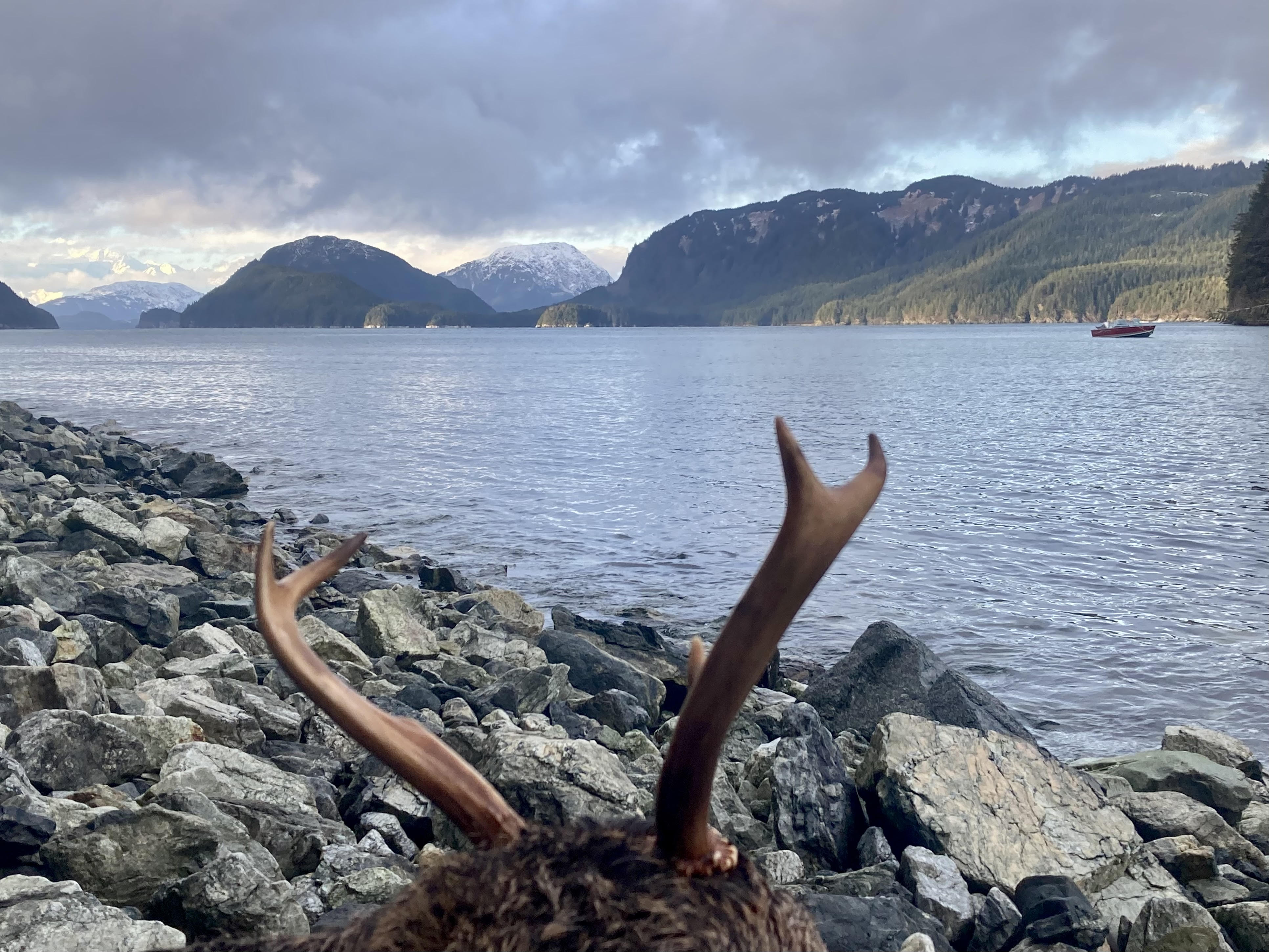
I lean against the log and look at the little valley. I see the spike buck wandering up the steep ravine with his head glued to the patchy snow. The rifle cold and shaking in my hands. The Ravens are gone. Whatever’s left of the gut pile is buried. It doesn’t feel like five months since I fired two shots on a misty November day. I still don’t know how the first one missed. Find me a hunter who doesn’t have one of those stories.

Snow soaks my wool pants. I recline and look at the spot where he fell. He has given me life, energy, and hope in the form of stews, meatballs, backstrap roasts, and way too many burgers.

“Thanks,” I whisper.

It sounds empty. Hollow. Throwaway gratitude. But maybe gratitude can’t always be measured in syllables.

***

I’ve read my book 15 stinking times. I can’t decide if it’s getting worse or if I’m just sick of these stupid characters. I hear an engine. Unless you count my five-minute conversation with the Elfin Cove fuel attendant (I don’t), I haven’t seen a human in ten weeks.

So when the cherry red skiff pops through the cut, I feel like Tom Hanks floating on a raft. What are the niceties of human interaction? Eye contact is good, right? And hugs? Ayla leaps off the boat, curly Q tail raised high, permitting me a cursory sniff. Salix dozes in Laura’s arms; Zach has that shit-eating grin on his face.

“What’re you doing on my property, Brown?”

He holds up a Sierra Nevada Pale as tribute. We hug around life jackets. After so many goodbyes, it’s nice to say hello.

They have brought love, laughter, and fresh produce. I grab a package of venison for dinner, and we cluster around the worn Hobbit Hole table.

Laura points to the thicket on my head, “I like the hair, D. A real homesteader vibe.”

The mop wobbles when I laugh. I’ll pay Kathy whatever it takes to draw her out of hair-cutting retirement and thatch this mess. I have to share everything at once, a faucet that can’t be turned off.

We move to the sunny deck with open beers. We’re regrouping. So many goodbyes and farewells over the last few years. A pack of friends that once ran so deep they couldn’t fit in the house has dwindled. Life changes, the sun sets, and things that once seemed permanent vanish like smoke. Neighbors move, friends break up and disappear, and spouses…

It can be hard to know when to hold on and when to let go. The three of us have experienced all these farewells differently, but Gustavus is still home. We want to fish the streams, harvest carrots, and hunt the woods. Heat our homes with wood and piss off our front porches. We vow to find others who want to do the same.  

“I won’t make grand statements or promises I can’t keep,” I tell them. “I won’t say I’m never leaving, but I have no intention of going anywhere. If that ever changes, you’ll be the first to know.

Deal.

***

I watch the skiff putter through the Gut and wave goodbye. My Hobbit Hole stint is winding down and time does that funny thing where it feels like I’ve just arrived and spent lifetimes here. I confess I don’t want to leave. I want the groundhog to see his shadow (or not see his shadow?) and grant me six more weeks of winter to write, hike, and paddle my way through this comfortable existence. Minerva doesn’t want to go either. Not that she’s explicitly told me, but the Hobbit Hole’s predator-free nooks and crannies are kitty heaven.

But if Gustavus is truly home, then it’s time to go. I won’t find what I’m looking for here. Here, I can reset and rip myself to the studs. But I cannot build. The skiff disappears, and my heart swells with gratitude for friends, family, and neighbors who make sure I never get too low and remind me sunnier days are coming.

The list of people, places, and critters that have kept me afloat could fill pages. I doubt I’ll ever be able to fully articulate how much it’s meant. Maybe gratitude can’t always be measured in syllables.

Minerva braves the dock and coils around my legs. The float accordions in the waves, and she beats a hasty retreat towards the house. If she’s brave enough to take on the dock, I suppose I can go home, dig through the totes and mementos that demand my attention, and keep on trucking. I follow Minerva but pause long enough to soak up evening sun and hooting spruce grouse. It’s time to stop tearing down and saying goodbye. I’m ready to build up and say hello.

Between Ocean and Snow

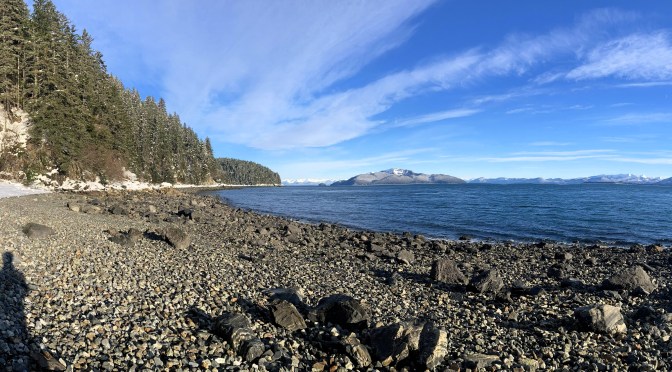
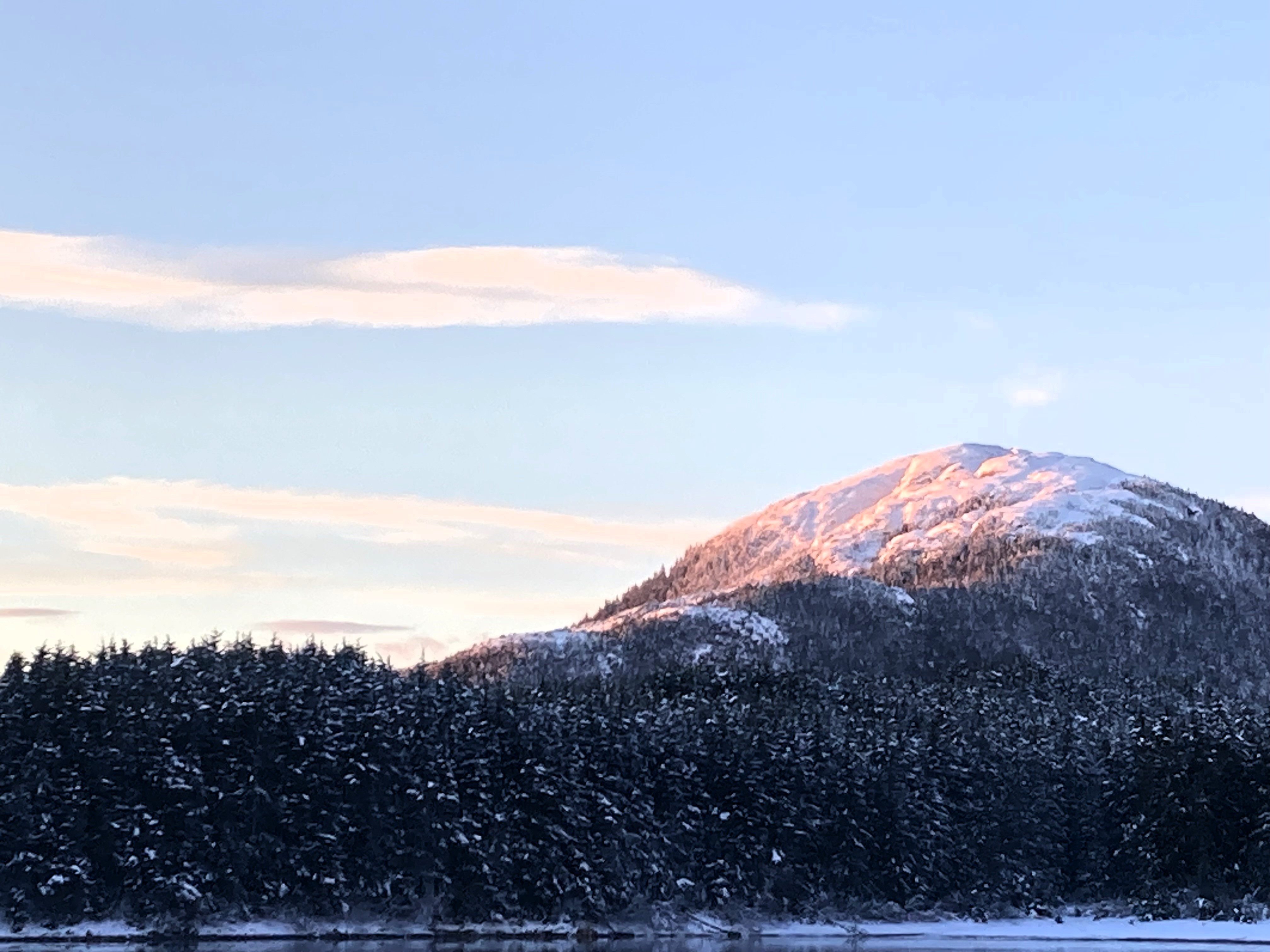
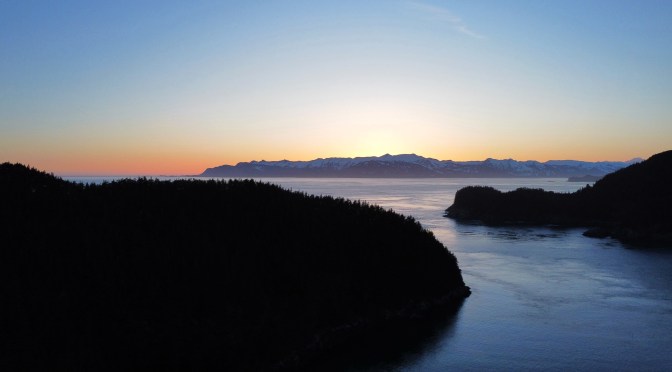
The rising sun turns the hillsides purple. My kayak cuts through the water, leaving an ever-expanding “V” in its wake. Even with a down jacket, I can feel the bite of morning cold. The low tide leaves an exposed strip of rocks and kelp, frozen and crunchy, patiently awaiting the sun and thaw.

For 72 hours the Icy Strait Corridor has endured an unrelenting snowfall. Winds buffeted the trees and left huge drifts piled along the beach meadows. I shoveled five times trying to keep up with the snow’s metronome consistency.

Boats in Juneau’s harbor sank, the land frozen in winter’s fist. Trees bend double beneath the load. Cracks echo through the forest as these proud sentinels break under the weight.

At last, we have a respite, a window of calm before the outflow returns with gusts of 40 knots.

I have waited for this day. Snug and warm next to the woodstove I would peer through the windows at the blizzard and wonder how any animal could survive such conditions. This is my chance to find out.

The benefits of old-growth forests could fill volumes of text. The contrast between the muskegs and woods is shocking. Four feet of snow fill the open areas of the island with perhaps half that amount beneath the trees. It is these big trees, their massive boughs enveloping the land in a protective embrace that give the deer a chance. These causeways give them routes to the beaches, where they can slog through the drifts and find relief below the tide line. The table is set. Rockweed and bull kelp torn from their holdfasts wash ashore and provide some of the only accessible forage when snow of this magnitude hits.

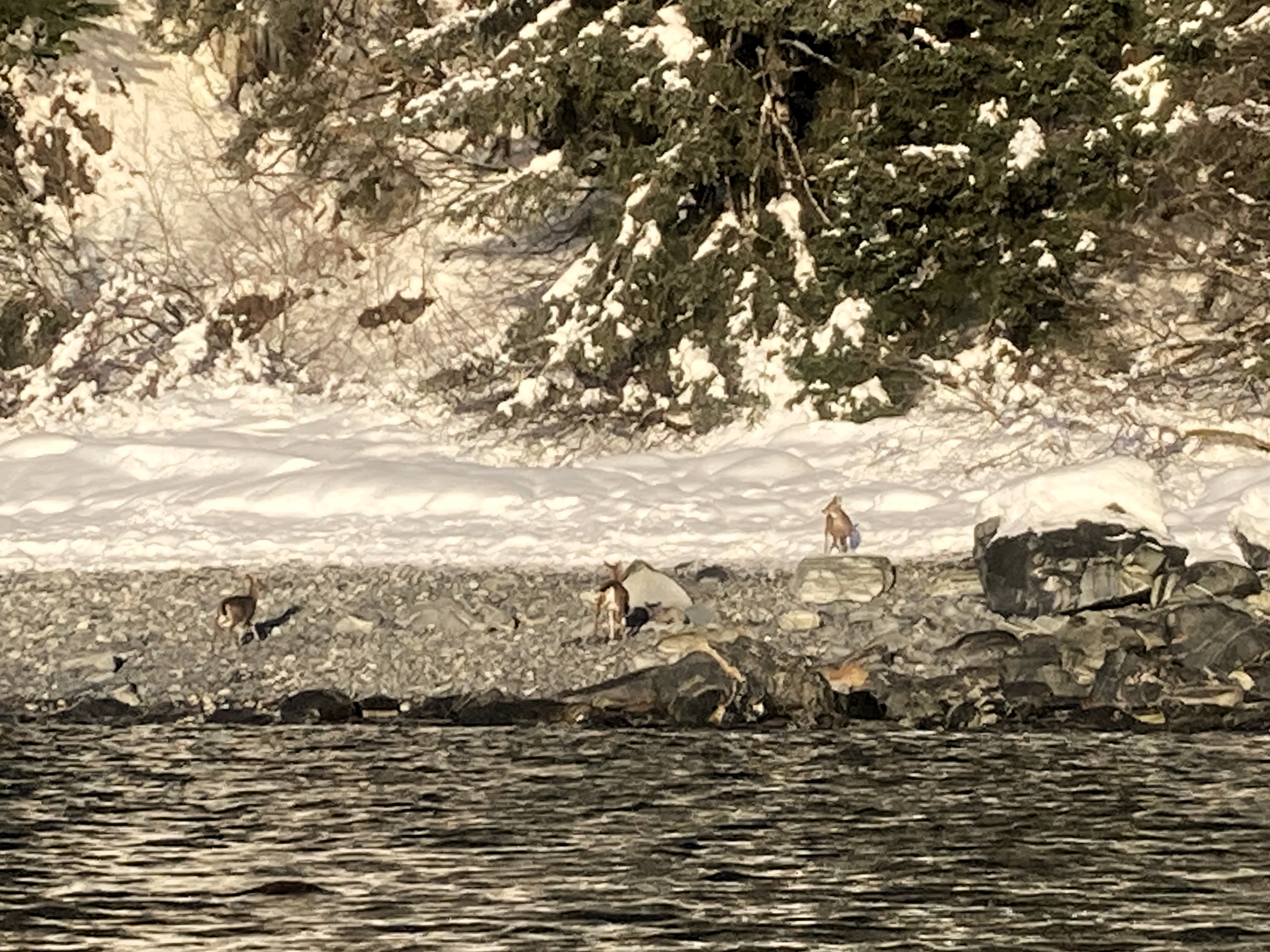
I paddle south along the island’s southern peninsula, scanning the beaches. The first one yields a doe and fawn that scatter into the woods as I glide past. Eight more deer congregate along a 300-yard stretch while a small cove no more than 50 yards wide holds another six.

I bring the binoculars to my eyes and watch, the boat bobbing in the gentle swell. The rut is over, and the bucks have dropped their antlers. It will be something of an easter egg hunt in the coming months to find them hidden in the moss.

These deer are in my parking spot. I’d planned on landing here and climbing to the other side of the island to inspect the long stretch of east-facing beaches bathed in morning light. I hover offshore and watch them through the binoculars. Five adults and a yearling. They look in good shape, still fat and healthy.

Deer are ruminants, meaning they chew their food multiple times and have specific bacteria in their gut to maximize their caloric intake. But every food type has its own bacteria, and there’s a delay as these new bacteria colonize the stomach. Switching overnight from a diet of forest groceries to kelp can have dire consequences. A deer can eat kelp all day, but until the bacteria catch up, they may as well be eating dirt.

The six are foraging voraciously along the shoreline. How long had they waited for this opportunity? It’s easy to imagine them hiding beneath large hemlocks, watching the never-ending snow pile among them with stomachs growling and fat metabolizing. Landing will scatter them back into those snow-laden woods and I can’t bring myself to do it.

I paddle onto the next little cove.

This one too is spoken for. Three more deer graze among the rockweed. They’re so engrossed in their work they don’t notice me for several minutes. A large rock cuts this cove in two, and when they move to the far side, I ease my kayak into the beach, step out, and drag it to the snowline. I peek over the rock and see three sets of ears tuned to my frequency. Upwind of them they maintain a curious demeanor. A shift in the wind will send them scurrying, perhaps getting a whiff of the venison meatballs I’d eaten the night before.

I step towards the woods, sink through the snow’s crust, and posthole to my hip. It’s a quarter mile to the other side and it takes fifteen minutes of panting, gasping, and trudging to reach it. Sweat drips down my face and my lungs burn. How do these deer do it? By the time I reach the edge of the woods, I’m exhausted. It takes several minutes before I feel ready to climb down the cliff face to the rocks below. I remind myself to look for snowshoes when I get home.

My clumsy ascent sounds like a gong on the beach below. I watch two more deer scatter through gaps in the trees.

Whitecaps adorn Icy Strait, and Lemesurier Island looms in the distance, its forest frosty and frozen. I glass the beach ahead and see a lone deer near a washed-up hemlock deadhead.

Surprising. I figured there’d be more. I hug the waterline as I pass the hemlock, the deer watching suspiciously. On the other side of the log, another deer materializes, I stop, look up the beach, and they seem to apparate. One, two, three, four… eight. Eight more clumped in two groups of four.

I never think of deer as social animals, but they are. They may not have reliable herds, but there’s no doubt they enjoy each other’s company. Clicks and loose friendships form, safety in numbers, community. It resonates. Reminds me how alone I am.

There’s a difference between alone and lonely. I have enjoyed my solitude, the quiet, and the reflection. But there is no denying that I still reflexively reach for my phone when I remember an old inside joke, hear a new song from one of our bands, or find an Instagram reel she needs to see. Old habits, they die hard.  

The beach bends, and I creep among the boulders, peaking over the top of the last one. The 30th deer of the day has her head buried in the snow, rising every minute to slurp down another slippery string of kelp. I advance when her head’s down and freeze when it rises until I’m 50 feet away.

I settle on a boulder, open my backpack, and invite myself to lunch. As I munch trail mix and guzzle water a fawn stumbles out of the woods and joins its mother among the kelp. The scene brings an emotional response I wasn’t ready for. The pair moves to a young hemlock, and they strip the needles the way a bear forages for berries.

Icy Strait sparkles. The snow-covered mountains and hills pop. Eagles soar on the thermals. You can hear the land exhaling after the deluge of the previous days. There’s a tug at my heart, a desire to share this moment with someone. Some of House Stark’s words hover in my head.

“When the snows fall and the white winds blow, the lone wolf dies but the pack survives.”

The tide is rising, and the sun setting. I leave the little family to their work, padding back down the beach past watchful eyes and into the woods. Through the trees, I see a glimmer of red. No matter how far up the beach I bring my kayak, I never stop worrying until I see it right where I left it.

The trio of deer have disappeared, leaving the beach unoccupied. I launch and enjoy the sun on my face as it begins its downward trajectory over the Pacific. I feel full and content as I paddle for home, again overwhelmed by the incredible beauty of this place. The southern end of the Fairweather Range peaks above the islands to the north, with 14,000-foot peaks, and an icefield you can hide Rhode Island in.

I stop in front of the next cove and smile. The deer are still here. No longer foraging they lay among the sunbaked rocks. I can feel their contentment, their relief. The new bacteria in their stomachs beginning to work, metabolizing the kelp and hemlocks and blueberry twigs. Feeling warmth for the first time in days. A chance to breathe, to rest and recuperate.

I knew today was coming, had the 16th circled on my calendar even as the snow continued to pile up. The deer have no such luxury. What concept of time do they have? How long had the last three days felt for them? For those little fawns experiencing the first truly hard moment of their life? But now, the sun was out. More storms are coming, another foot of snow is expected in a few days.

Why worry now? With bellies full and warm rocks to rest on.

Storms come and storms go. We can’t always forecast when they’ll begin, end, or start again. Some may never end. Some may never come. I saw myself in these deer, huddled beneath a big hemlock, waiting for the blizzard to end, not knowing when. Clinging to the faith that the clouds will lift, the sun will return. There will be warm rocks and bull kelp for everyone.

I begin to feel that sun. Stepping out of the woods and powering through the drifts, knowing relief is near if I plunge forward just a little further. I can feel their eyes on me. And through the distance and isolation, sense the eyes and love of my own pack. The winds may howl, but I am not alone. The bow spins, the water parts around the keel and points for home, grateful that when the sun sets and the tide touches snow that I don’t have to retreat to the woods for shelter.

Inside the cabin, I pull out my notepad and consult my notes. 12 miles traveled in total, and somewhere between 38 and 45 deer depending on how confident I am I’m not double counting.

Minerva coils around my legs, reminding me it’s almost dinner time. I step outside and am greeted by a crescent moon. The hills are bathed in purple again. The winds have begun to rise, and the trees start to bend. I wrap my jacket around me, step back inside, and whisper thanks to the neighbors hovering somewhere between ocean and snow.

Of the Woods. With the Woods.

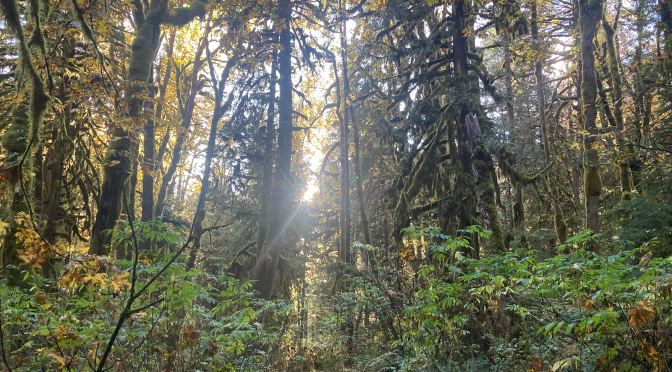
My boots crunch frozen grass and I grimace. There’s no quiet way to move from the intertidal to the woods in these conditions, the world softly frozen around me, beads of water suspended and solid on every blade. I tighten the straps on my backpack and try to think like a deer, move like a deer. I walk on the balls of my feet to soften my footfalls, body tensed and alert. I have been walking for only twenty minutes but sweat already beads beneath the bright orange hat.

I feel the blunt object slung around my shoulders slam against my hip. I adjust, brush aside the first layer of alder, and hear branches scratch against my pack. Breath thunders in my ears and boots squish into soft, wet earth. Inside the forest, nothing is disturbed. I take a moment to marvel at my good fortune.

As I child I read and reread every Calvin & Hobbes comic, staring enviously at the apparent national forest Calvin and his stuffed tiger had at their disposal to ride their red wagon in summer and toboggan in winter. Complete with cliffs, ravines, swamps, creeks, and lakes. Now, I have my own National Forest. Tongass, and the designated wilderness that is the Inians. Me, some deer, a curious raven, a chattering squirrel.

I move up a gently sloping hill until it meets the steep cliff that shoots up at a 90-degree angle to the summit of the island a thousand feet above. The forest abruptly ends, surrendering to gravity and salmonberry bushes clinging to this steep and harsh stretch of the island.

I have been here before, know where I’m trying to go. The forest frames this steep hillside for two miles before the cliffs jut out to meet the waters of North Inian Pass. By staying just inside the trees, I can have a full view of the big, west-facing woods below. A haven for deer regardless of the weather. I touch the object around my shoulder, to reassure myself it’s still there, and drop into a drainage to hide myself from view.

The sound of the creek covers my tracks and masks my scent as good as I can hope for. I follow the drainage for a quarter mile, allowing just my toes to touch earth. Quiet as I can be, crawling on hands and knees beneath fallen logs and feeling the water-soaked earth crawl up my pants. At last, the drainage meets the top of the hill, the little valley flattening out. I pause, crouched behind a fallen hemlock hiding me from view. Sometimes the first look is the only chance you get.

I ease myself around the root ball, turn, and am greeted by a flashing white tail and startled bleat. I freeze, and so does the deer. A young buck, his antlers nothing more than knobs on the top of his skull. I’ve caught him unawares, but he only bounds about ten feet before stopping. He looks back at me with a politely curious expression.

The object knocks against my shoulder, demands my attention. I don’t dare move. The deer remains frozen, obsidian eyes unblinking, impossible to imagine what is going through that young mind. He glances away from me, looking back down the hill. Very slowly, I move my right hand across my chest, feel the strap slide, come loose… and the binoculars slide into my hands.

My freezer is full. I am not here to harvest. I am here to learn. To soak up whatever secrets and knowledge my neighbors are willing to share.

“I sought fuller comprehension of an animal I am made from,” wrote writer and hunter Richard Nelson in his book Heart and Blood, “the life outside of me which becomes the life within me.”

As do I.

From the beginning, the deer of the Inians were more than “stock” or “herd” for us. They are revered and honored. And like anything we revere, I am innately curious about these phantoms of the woods. I love how they appear just when I’ve given up. When I get lazy and round a corner or snap a twig, rewarded with the sight of a whitetail trimmed with black bounding effortlessly through the wood with nary a sound.

I bring the binoculars to my eyes and drink him in. Even if I’d brought a rifle, even if the freezer was empty, I’d have a hard time pulling the trigger. He still has that “fawn face,” short and stumpy with all the characteristics of a baby animal that make us coo. In the low light, even though he is just feet away, he seems to evaporate into the woods around him. Perfectly camouflaged in the weak January sun and a forest floor free of snow.

Lowering the binoculars doesn’t startle him. He continues to oscillate between me and glancing down the hill. There have been several times over the last few years where I have sat in the company of deer. Many times, using the “call” brings either does, fawns, or both, leaving me to wait and hope that something with antlers will wander by. But in those moments my attention was never on them, instead scanning the woods beyond for something that would bring the scope to my eye.

Now, this little buck has my rapt attention, and I decide on a little experiment. I tap one nail against the glass of the binos, the sound barely registers in my ears from less than a foot away. The fawn responds instantly, tilting his head like a dog at the sound of the treat bin opening. He stares directly at my binoculars and takes a step towards me.

No way.

I tap again. A few more steps. 15-feet away. The closest I’ve been to a wild animal in a long time. I don’t dare breathe. Sweat drips down my face, every muscle tensed with the effort of staying perfectly still. Through it all, the fawn has not made a sound. Nature has perfectly sculpted him for a life of silence. What next? The seconds hang in the air. I hear footfalls behind me.

I turn my head instinctively and see something grayish and sleek move through the brush. The doe looks down on us and gives a disapproving huff. The fawn immediately snaps out of his trance, cantering over to mom and attempting to nurse, only to be forcibly rebuffed.

It’s not unusual for fawns to return to their mother for a time once the rut is concluded. And judging by his eagerness he is something of a mama’s boy. While not alarmed, the doe has no interest in this staring contest. She moves down the trail, her kiddo in tow. I don’t wait for an invitation and step softly into their trail and follow. The pair canter at a casual gait 30 feet ahead before weaving around a large spruce.

With them out of sight, I increase my pace, trying to keep them in sight as long as I can. I reach the spruce and slowly tilt my head around the corner. The forest is empty. Spruce, hemlock, blueberry, and menziesia trees and shrubs interspersed at intervals with no deer between their gaps. I bring my deer call to my lips, give two short bleats, and settle against the trunk. But there is nothing, no evidence that I share the woods.

I begin to make my way down the hillside, eyes still scanning for a pair of ears trained like satellites in my direction. But I once again walk alone. I’m getting cold and tired, ready for a mug of tea and a sandwich as the short winter days pass like sand through my fingers. But I cannot bring myself to crash through these woods. Every step needs to be quiet, as stealthy as I can be on the off chance that another of these creatures will wander into view. Can I not take a simple walk in the woods anymore?

“I wonder if hawks or herons, wolves and killer whales are ever astounded by the loveliness, the grace, the perfection of their prey,” Nelson continues.

I have often claimed orcas match us in intelligence, that they may be smarter than many humans. I include myself in that category. The corvids of the sky are whip-smart, anyone lucky enough to stare into the eyes of a wolf has seen a soul staring back. One could certainly argue that the intricate and complex languages these animals have room to marvel at and appreciate the voles, seals, and moose that sustain them.

But humans undeniably have this capacity, if we choose to acknowledge and accept the burden and gratitude that comes from appreciating the things we eat. It has forced me to come to terms with my omnivorous evolution, the power it has given me, and in turn, the responsibility to not abuse.

***

I open the freezer and retrieve a parcel of butcher paper. The outside is covered in brightly colored scribbles courtesy of Elm and Beth’s daughter, Claire who assists in butchering by making sure every piece of venison is lavishly wrapped in artwork. The antlers on her drawing of a deer are unmistakable. I set the meat on a plate to thaw with grand designs of spaghetti, meatballs, and a liberal dusting of parmesan.

I didn’t just come to the Hobbit Hole to grieve and rebuild. I came to explore, to learn the forests and muskegs and hills as intimately as an overcivilized and domesticated human can.

The “Hobbit Hole” from the far side of the inner lagoon.

To discover the trails and beaches and shortcuts through these marvelous, old, protected woods that will be standing long after I’m gone. To grow as close to this special patch of earth as I can over three months. A huge part of that education was the deer, one of the forest’s rightful tenants.

To eat of deer is to eat of the forest. Of blueberry and devil’s club. Skunk and deer cabbage. Alpine and beach. Forest and muskeg.

I never fancied myself a hunter, never imagined I’d walk into the woods with the intent of dragging something out. But it has granted me a gift I didn’t expect, drawing me closer to the wild places that sustain me like a spring welling up amongst forested acres.

It has turned me from an idle hiker to an explorer, asking questions and taking copious notes of the places I visit. The knowledge that I will never understand or grasp the intricacies and relationships of these animals and ecosystems only makes it more alluring. Be it a rifle or binoculars against my hip, my days of crashing woodland hikes are now a thing of the past.

This Must Be My Exit

I thought getting divorced was hard. Drawn out and complicated and bitter, with plenty of legal documents and court appearances that stretch for months or years. Instead, six short months since this began, it was over with a few scribbled signatures and a 15-minute phone call.

“Do you acknowledge that this is what you want?” The judge asks, her voice coming through the phone with a hint of static and echo.

I hesitate, the silence suspended in air. I can feel the boxing match going on between my heart, brain, and body.

How did this end so fast? Who am I? Who is that voice on the other end quietly answering, “Yes, ma’am” or “No, ma’am?” Where the hell do I go from here?

***

Blood drips from the tip of my nose, turns clean snow crimson. I partly run and mostly fall down the hill, sliding to a stop beside the fallen buck where my blood mixes with the deer’s. I am 1,000 feet above sea level in fading light with a deer at my feet and a deep gash on the bridge of my nose.

The technical term is “scoping yourself.” You hold the sight too close to your eye, and on the recoil, it slams into your face. I’m a repeat offender and judging by the throbbing pain in my forehead and steady, ‘drip, drip,’ this is a bad one. I dig into my bag and pull out my med kit, slapping gauze and tape onto the awkward area as best I can. I chug some water, mow down trail mix, and try to control my shaking hands.

My klutziness cannot take away from the exhilaration of the moment. As my world descended into chaos, I sought sanctuary in the woods. It wasn’t the fresh air and exercise that kept me sprinting back to the forest every chance I got. No, it was the reminder that even when life is turned upside down, the trees are still growing. Deer still forage. Ravens still chatter. The tide will rise and fall. Consistently, reliably, always there. If we permit it.

For years southeast Alaska has been my playground as well as home. The national forest and park that surround Gustavus brought adventure. But as I pull out my knife and prepare the deer for the drag to sea level, it’s now so much more. These places are keeping me sane, in control, alive.

***

“Mr. Cannamore, did you hear the question?”

I look around Dad’s office for a solution squeezed between framed photos of Alaska Airlines 737s and World War II aircraft. Where does all that love go when it no longer has an outlet? It seeks every corner, every alternative, desperately searching for a way home. There’s no home to go to.

“Truthfully, no.” I cannot bring myself to tacitly agree. “This isn’t what I want… but I have agreed to it.”

Good enough. A few more questions. A smattering of “yes’s” and “no’s.”
“Mr. Cannamore, you may hang up.”

I stare at the phone’s black screen and shock fills my body. Did I just hear her voice for the last time? It seems impossible.

Close my eyes, deep breath. Let go, just let go.

I am hovering above the water, retracing a paddle route down Chatham Strait. Every rock and point is vivid. Waves ricochet off cliffs. Humpbacks rise and fall in long summer light. Bear tracks in the sand. Loons greet the rising sun.

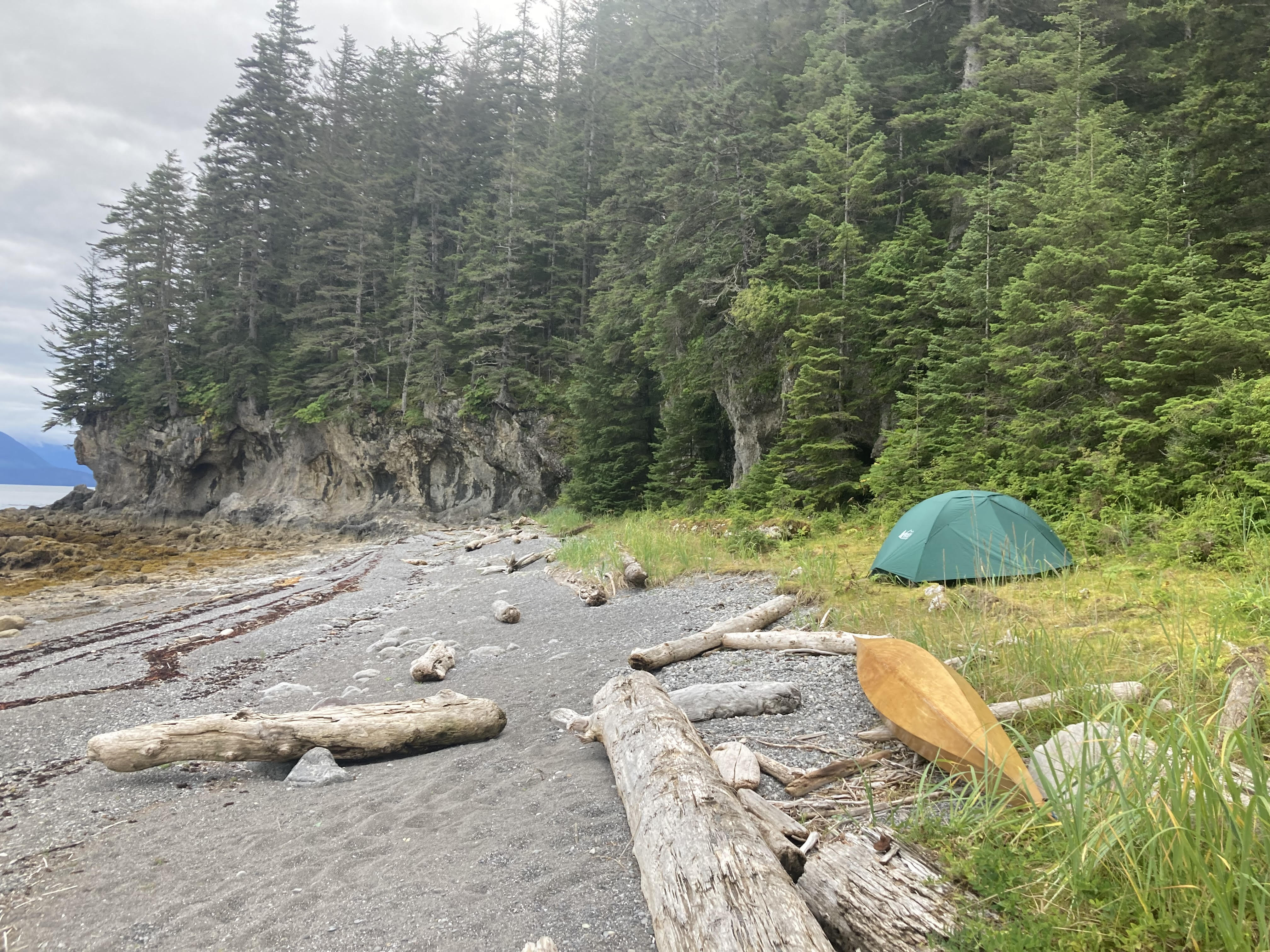
Camping in Chatham Strait

What’s the difference between distracting and coping? Running and rebuilding?

***

I lean against the shopping cart and ponder my cheese future. How much dairy does one human need for three months? I grab two large bags of mozzarella, hesitate, and drop a block of cheddar on top. Better safe than sorry.

I have agreed to go full Obi-Wan Kenobi and caretake the Hobbit Hole until March. The thought of long days exploring from the seat of my kayak and discovering more of the island’s secrets sounded like the perfect tonic. Lonely, yes, but necessary. But I’m not willing to risk running out of cheese.

I need a place to grieve, mourn, accept, rebuild, rewire, heal. Most importantly, learn to love myself. To be ok on my own and affirm that I don’t need another human to feel validated. What better way to face that than a little self-imposed exile? Sink or swim. Adapt or die.

The Hobbit Hole

How fortunate to have a place like the Hobbit Hole to retreat to. Through all of this, I have tried not to lose sight of the positives. The friends, family, and neighbors that have held me, fed me, and handed me beer. Solitude doesn’t mean I’m alone; the internet and phone means community will still be a click away. But the time has come to prove I can rely on myself.

For months I have worked to accept things outside my control and harness my energy into things I can.

Hanging up that phone meant the return of control over my life. I can sit and stew on the hard luck. I can rail that this is unfair, that life has done me dirty. That I don’t deserve this. Or I can acknowledge that this sucks and that I’m not ok. But I will be.

I may not have control over what has happened, but I control what comes next. And isn’t that one hell of a gift? Many on this planet go their entire lives without that sovereignty. But I get to look in the mirror and say whatever comes next is up to me.

I’ll take my cheese and venison and cat and retreat to the land that has always been there for me. Hike the mountains or search for orcas on the flooding tide. Commune with sea birds and argue with sea lions. Write, sleep, laugh, and indulge in the gift that is time set aside for me.

I speak of trauma and pain with no authority. All I can do is convey what it has felt and done to me, my situation, and how I’ve chosen to approach it. Hiding it, burying it, never felt like an option. It’s okay to struggle, to ask for help. I’m under no illusion that I can outrun this. The pain and hard days will find me in Gustavus, the Hobbit Hole, or Tijuana. It’s been a hard six months; more hard months await. That. Is. Ok. This is hard. It should be hard.

“If you were fine,” my friend Amy reassured, “it probably means you’re a sociopath.”

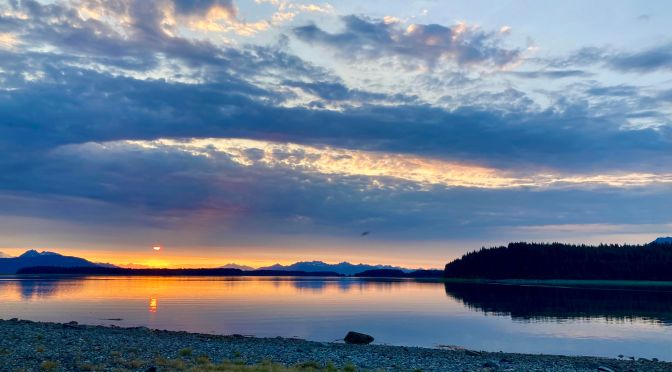
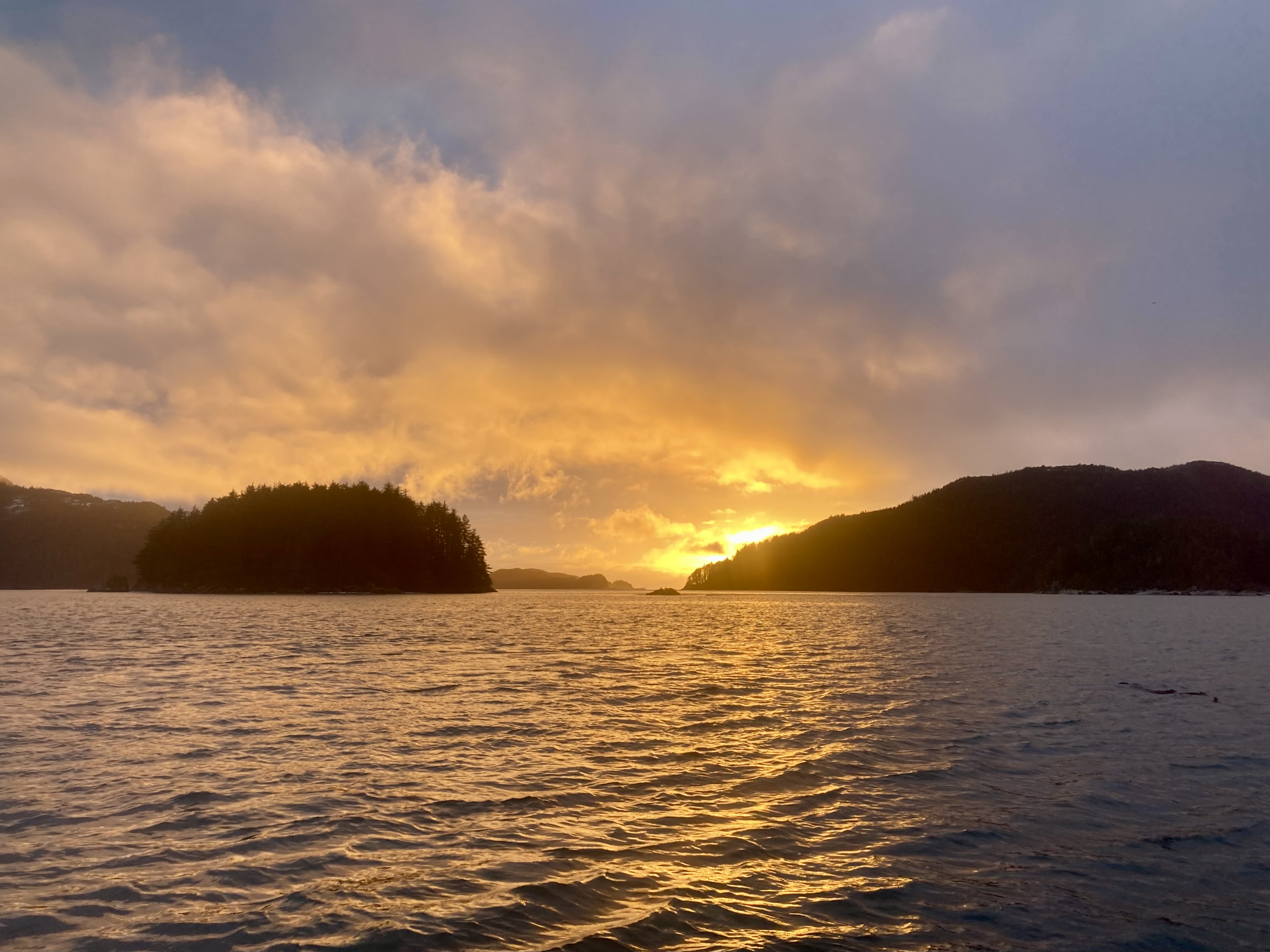
South Inian Pass at sunset

We don’t forget. I expect I’ll carry some sadness and melancholy the rest of my life. But I hope that my memories return. That these hard months do not outweigh 12 beautiful years that overflowed with joy and love. May these hard times not define me but become part of my story.

***

Smoke rises from my cabin chimney. The fire cracks, afternoon coffee in the French press. Minerva coils her body up against me and buries her face in my arm. Home. A deep love, a sense of place. The acceptance that my future is blurry and distorted. How intimidating, foreboding, and… exciting?

“To look forward, sometimes we must look back.” Has been one piece of advice. “Who was David before all of this?”

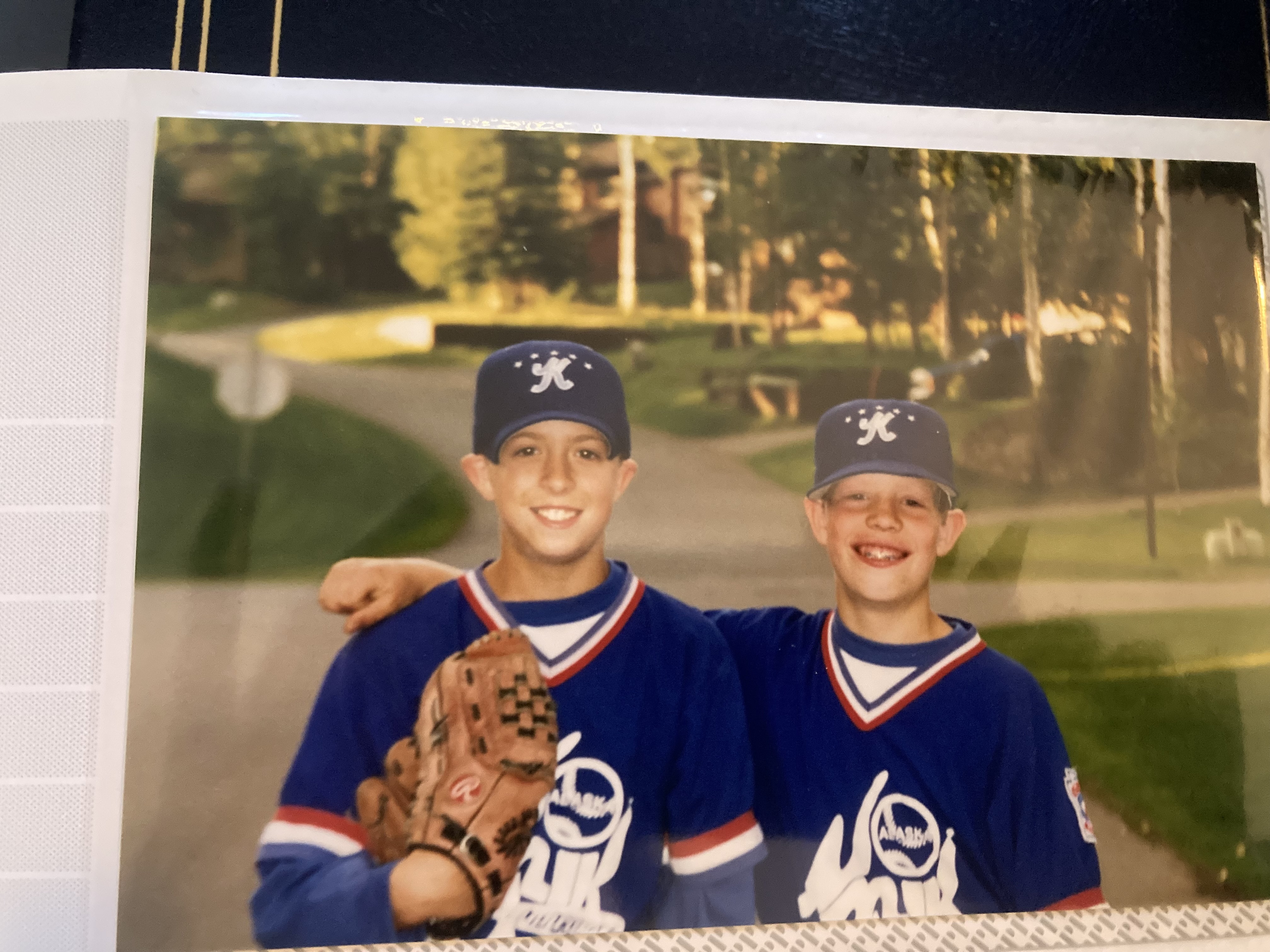
Before I left my parent’s house, I flipped through old photo albums and stared at that grinning goofball looking up at me. 13-year-old me seemed to think that giving someone “bunny ears” was about the funniest thing one could do during a photo.

But there’s something else. In nearly every photo, my arms are around someone. Squeezing my brother, best friend, girlfriend, parents. The desire to love and hold those dear to me close has been there for a long time. And as I feel that now-familiar ache in my heart, I know it still is.

I hope someday it finds another outlet. But for now, the time has come to turn it inward. To build what it can and put everything away in its proper mental file cabinet.

I take another deep breath and rub the wooden deer call I wear whether I’m hunting or not. Snow is falling in the field that still holds moose and snipes. I hear wolves when I step on my porch and see northern lights when the clouds break. I have changed, but this place perseveres. I will too.

Sometimes love means letting go. Sometimes love means holding tight. Sometimes it means doing both at the same time.

A Prayer for Place

Fog to the waterline. Chichagof just a mile away, but all we see are the shores of Inian Island. The four of us stand on the stern of the Magister and pick up a bucket.

It has been a bountiful two weeks at the Hobbit Hole. Every hunter who has walked into the woods or landed on a beach has come back with at least one deer. The Hobbit Hole’s freezers are fit to burst with the promise of burgers, stews, and roasts that were born, raised, and harvested from the places we call home. They’re so full that Kathy, Bill, and I are going home with a load of venison to make room. The larders are packed, and winter has come in the form of 60-knot gusts and a foot of snow.

In the buckets are the final pieces of the deer, their bodies now sustenance for us that, as Zach vows, “will fuel good work.”

We whisper benedictions and watch the hides and scraps drift away on the tide of Inian Pass. It takes but a minute for a pair of eagles, a raven, gull, and otter to find our burial site. The eagles divebomb with precision. The otter swims away clutching a head with a piece of intestine trailing behind like a line. Nothing is wasted. Life is honored. Traditions are savored.

Zach puts the Magister in gear. We round the corner, and I watch the island fade into the fog. We travel in milk, but I know the way. Can clearly picture us zipping toward Lemesurier where more friends are communing and hunting. And ten miles beyond “Lem” is home. Home. I let the rock fill my stomach, stare at the fog, and convince myself that it’s simply mist making my cheeks wet.

I feel a hand on my shoulder and turn. Kathy’s eyes look through mine, and I can’t hide behind the smile that comes too late. When it comes to Catan, Kathy is ruthless. When it comes to matters of the heart, well, let’s say she won’t block your attempt at the Longest Road. She knows loss. Has experienced it herself. And I get the feeling her eyes have looked like mine before.

***

Dinner done. The dishes put away. A cake that took 13, yes 13 eggs and a pound of butter sits in the middle of the table. Full as we are, as rich as it is, we’re still eating. And I am waiting. Waiting for Zach to do what he does every Thanksgiving. We aren’t the only people who resort to that time-honored tradition of going around the table and saying what we’re thankful for. There’s nothing wrong with it. A lovely perspective to have, I admit. And it was a year of gratitude for many.

Kathy and Bill got married. Zach and Laura welcomed their son Salix into the world. Beth and Elm bought property and finally, after both were raised in Gustavus, have a piece of land to call their own. Very good years with blessings worthy of being celebrated and shared.

Beth finishes her gratitudes and looks at me. I stare at my coffee cup for several long seconds, feel the table’s eyes on me. Everything spoken and unspoken hovers in the room like smoke.

In years past, I haven’t taken this ritual seriously. It was simple to say the obvious. I was thankful for my little patch of Gustavus clay. For health that allowed me to tromp in the woods and look for deer. To have work that I loved.

I. I. I. I. I.

What sort of gratitude does one have when they’ve stripped that person to studs, dug deep beneath the foundation and asked, “Who am I?”

“Ahhhhh,” I finally say. “This has… not been the best year for me.”

Have you ever been the only person at a table to share bad news? Is it their pity I feel? As if I have contracted some terrible sickness that leaves those nearby speaking in hushed tones of sympathy and condolences.

No. It’s love. It’s acceptance. It’s… community. For Gustavus has that in spades. I forgot that at some point. Forgot that was the reason I wanted to call this place home in the first place. It wasn’t just whales and glaciers, salmon runs and quiet homes in the woods. Kim Heacox’s words materialize in my head.

I live in the shadow of glaciers, and in the sunlight of friends.

I remember now. I will never doubt it again.

It was people like this. People that are neighbors in the truest sense of the word. Not just someone you wave at when you grab the mail or need a cup of sugar. And neighbors close ranks and pick each other up, permitting vulnerability, intimacy, and, yes, a home.

“A few months ago… I wasn’t sure I’d be here. But it’s the people at this table that wouldn’t let me leave. I can’t quit you guys. I can’t quit this place. And as strange as this sounds, everything that’s happened has given me a firmer grasp and sense of place. How precious you are to me. And that is my gratitude. To know that I truly have a home. That I truly belong. That my love of this place was bigger than one person.”

“So…” I bang my coffee cup on the table and hear their mugs answer. “Thank you for being home.” 

We cheers, we smile. And we brush that intimacy aside, crack beers, and break out a game of “Liar’s Dice.”

Insults, quips, and jokes boomerang around the table. Elm’s laugh echoes off the walls. Beth giggles. Zach and I exchange movie quotes at a rapid-fire pace. Laura grins. Bill gives his quiet smile. And there’s Kathy’s piercing stare, trying to figure if there really are “six-fours” hidden under our hands.

***

Kathy and Bill leave me on my doorstep with two totes of frozen meat and a fire roaring in my wood stove. Minerva comes hopping out the cat door chittering and meowing. I scoop her up, bury my face in her fur, and step inside. I love how my house smells. The earthy richness of the hemlock paneling, the faint smell of stove ash. The promise of bright summer days piercing the south-facing window.

I load the meat in the freezer and put the kettle on for a pot of afternoon coffee. As the water boils, I look around the room. I’ve done some remodeling the last few weeks. Moved some pictures, bought some new dishes. Tossed an old blanket and regretted it when I felt the chill of winter.

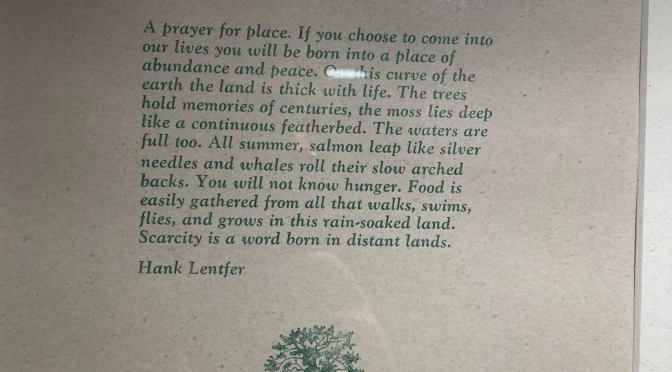
There’s more orca paraphernalia on the wall. Getting back to my roots. Maps of Icy Strait and the Broughton Archipelago have been promoted to artwork. But the frame I stare at now has neither animal nor geography. It is words, penned by my neighbor Hank Lentfer. A mantra. A creed. A promise. A prayer.

A prayer for place. If you choose to come into our lives you will be born into a place of abundance and peace. On this curve of the earth the land is thick with life. The trees hold memories of centuries, the moss lies deep like a continuous featherbed. The waters are full too. All summer, salmon leap like silver needles and whales roll their slow arched backs. You will not know hunger. Food is easily gathered from all that walks, swims, flies, and grows in this rain-soaked land. Scarcity is a word born in distant lands.

The kettle whistles and the smell of coffee sinks deeper into the drywall. I have chosen. I have been accepted. I have a hot wood stove, cold clean water, and a freezer fit to burst. And that is worth all my gratitude.

Ravens and Deer

Snow coats the hemlock boughs like icing. At sea level, we’re oscillating between sleet and snow on a minute-by-minute basis. From South Pass, the Gulf of Alaska is visible and foreboding. The constant swell an undulating steppe that bottlenecks through this passage that in many places is just a half-mile wide.

My double kayak is sheltered by the biggest of the Inian Islands, the bow rising high in the air with each swell. Instead of another paddler, the bow seat is occupied by a rifle and dry bag. If all goes according to plan, there will be a four-legged occupant in that seat on the way home.

The Inians are four watermark islands at the west end of Icy Strait, a breakwater between the inside waters and open gulf. They’ve been designated as wilderness by the U.S Forest Service, with one exception – The Hobbit Hole.

How to describe the Hobbit Hole? It’s a picturesque homestead. Five acres of old growth nestled in an ideal harbor accessible through a narrow cut. A mile west can be some of the most dynamic, challenging, and downright dangerous waters on the coast. It’s the last harbor. The last shelter. The last hearth. And it has become a tradition to spend Thanksgiving here in the name of fellowship, deer, and gratitude.

I have a spot in mind. A little pocket beach near the south end of the island. It’s too shallow for a boat, but a kayak can squeeze in there when the swell allows. The kayak catches the surf and slides up the pebbled beach. I jam my paddle into the rocks and the boat holds fast as the ocean retreats. I scramble free and drag the kayak to the pile of drift logs at the feet of the forest.

I tie the kayak to the logs and step out of my raingear. I’m wrapped in wool. Not as dry, but quieter when creeping through the forest. Five shells slide into the magazine of the 30.06, the last one clicking into the chamber with a deathly click.

Safety on. Backpack shouldered, GPS tracker on.

I follow the drainage, letting the sound of crashing surf and running water muffle my footsteps. I am not a quiet hunter. If there’s a stick to crack or a rock to send down a hillside, I will find it. The deer I’m looking for can hear better, smell better, and probably see better. They have home-field advantage, and the myriad of deer trails tells me that there are multiple escape routes if they feel the need.

But the Springfield slung around my shoulders does a hell of a job at leveling the playing field. I prefer to sit and wait. Find a perch, try to get comfortable, and exercise some patience. It’s that last bit I struggle with. But the human eye doesn’t see well when it’s moving, and the odds of me seeing a deer before it sees me when I’m in motion are slim.

I find a small rise looking up the hillside. It’s reasonably open for the Inian Islands where the forest is defined by thick groves of blueberry, devils club, and muskeg. I bring a wooden deer call to my lips and give a few bleats. I’ve been wearing it every day since July. It’s become something of a talisman, a worry stone I can hold onto when the feelings get big. But I finally get to use it for something besides startling my cat when she falls asleep on my lap.

I settle in. All my tramping surely scared everything off, time to let the woods go quiet, to melt into the moss and pretend I’m not there, to give the – there’s a deer.

Top of the hill, to my left, moving right. Weaving along a well-worn trail. I bring the scope to my eyes. There are antlers. I’ve been in the woods thirty minutes, and I’ve found antlers. I blow the call. He keeps disappearing behind hummocks and thickets. But he’s moving towards me. My heart pounds and I’m embarrassed by how much my hands are shaking. Halfway down the hill, he vanishes behind a fallen spruce. I bring the scope to my eye, aiming to the left of the blowdown, and wait.

But a sound further down the hill distracts me. The raspy call of a doe echoes through the woods. The buck isn’t coming towards me. He’s heading for her. Can’t blame him. She’s much cuter than I am. But she has no interest in what he’s selling. For a moment I have them both in the scope, but the view is fleeting. The doe scrambles back up the hill and the buck vanishes. He doesn’t take the rejection very well.

For a while, I try to follow their tracks in the scattered snow. But they’re downwind of me and the trail is hard to follow. The wind blows from the southeast, so I turn around, still feeling the exhilaration of the sighting. The relationship I have with deer is often met with raised eyebrows and skepticism from those down south.

It’s hard for me to imagine deer as pests piling up on the side of the interstate or rummaging through petunias. They are the perfect forest emissary. Quiet, fragile, and mysterious. Beautiful and delicate. Surefooted and swift. Able to sprint straight uphill without making a sound. Simply finding deer in these woods can feel like a miracle. It makes every encounter intimate and unique. Hours of inactivity followed by seconds of exhilaration.

30 minutes later I find two more deer. This time a doe and a fawn rummaging through a muskeg. They paw at the snow and bury their noses in the earth. From my vantage point, I wait for something with antlers to wander out of the woods. A raven croaks from a branch above me and the doe’s head snaps up to scan the tree line.

What did that raven say? The bird takes off and lands on another branch closer to the pair. The call fits this place like the intertwined fingers of lovers. For centuries ravens and wolves have found deer together, ravens calling out locations like a beacon, drawing the pack in while the ravens get the carrion.

As we spend more and more time plying the forests of the Inians, are local ravens picking up on this? We don’t leave the scraps a wolfpack does, but a big gut pile is nothing to sneeze at. Whether it’s the call of the raven or the deep snow in the muskeg, the pair wanders off into the woods. I munch on a sandwich and watch the empty muskeg, still hoping a buck may appear and follow their trail. My patience disappears with my lunch. I shoulder the pack and rifle, continuing along the ridge.

I vaguely remember a hunt last fall in this area. There’s an open section where I saw a doe and fawn. I drop down another hill, acutely aware of the sound of crunching snow beneath my boots. I find a deer trail and follow it along the side of the hill. Lots of blueberry in the valley below and trees clustered together. I pause near a potential perch that offers a better view. The hill bends to the left ahead of me, and a raven calls around the corner. If a deer is the forest’s soul, then a raven is the voice. I must keep going, something insists on it. I stand and follow the croaking raven. The view is a little better around this bend, and a downed spruce makes a perfect brace.

I slide off my pack and look up at the branches for the raven, the forest quiet again. I bring the deer call to my mouth and look back down at the little valley. The call falls from my lips without making a sound. A deer. Walking straight towards me. Scope to my eye. Antlers. He’s what we call a “spike.” His antlers haven’t forked yet, they’re just two rigid pieces of bone sticking out behind his ears.

He continues to move towards me, and I hear the raven again. The buck seems unconcerned with the calls and continues to work toward me, nose to the ground. He reaches a small clearing 40 yards ahead. Now or never.

I miss.

One would expect a deer to bolt at the sound of a gunshot. But the sound is so sudden and foreign, that they often pause. That’s what he does, staring right down the barrel. The second shot is clean.

I sit near the deer and lay my hand on his chest. I stare at those little antlers, and he looks so tiny. Spikes tend to be two years old, and with a swell of guilt, I wonder if this is the fawn I saw the previous fall. Did he work this hillside his entire life? Walk this drainage countless times? It’s likely I’m the first human to set foot in this spot in a year.

That old mixture of gratitude, grief, and yes, pride swell up inside.  

Wings beat above me. The raven perches along the bough, the call filling the empty woods that I have just filled with violence. As I prepare the deer for the half-mile drag to the beach, I listen to the raven. He sounds impatient. Can’t you do that faster? He’s soon joined by another, they touch beaks, and take turns calling through the woods. Not content to reap the bounty of the impending gut pile, it must be shared with their friends.

I remove the heart and liver and drop them in a Ziploc. I feel the same. Back at the Hobbit Hole, we’ll eat the organs tonight. Together. Sharing stories around mugs of cold beer and a sizzling blueberry crisp.

I am home. With soaked pants and a gentle rain melting the snow. The deer, this place, this life, it’s a miracle. Everything else falls away. I would not trade this moment, this sensation, for anything. Some hunter-gatherer DNA has its claws in me and will not let go.

The deer is ready. The ravens are too. 700 feet of elevation and a nasty drainage are between me and the kayak. But I’m not ready to leave the glen just yet. I lean against a tree and look at the birds, waiting so patiently.

“Did you know he was here? Did you know I was close?”

Black eyes stare. Revealing nothing.

“I’m going to pretend like you did. That we have this bond. That you watched me hunt this hillside a year ago, that you remember me. Things are different now. Things once in order now seems so strange. But this, this is my constant. This is my heartbeat. I hope you eat well. I hope this sustains you. Let’s waste nothing of this miracle. I’ll see you two soon.”

I shoulder the pack and grab the line tied around the neck. The rifle bangs against my hip, the deer slides across the snow. With a final caw, the ravens descend, and the forest goes silent once more.

Deeper Water

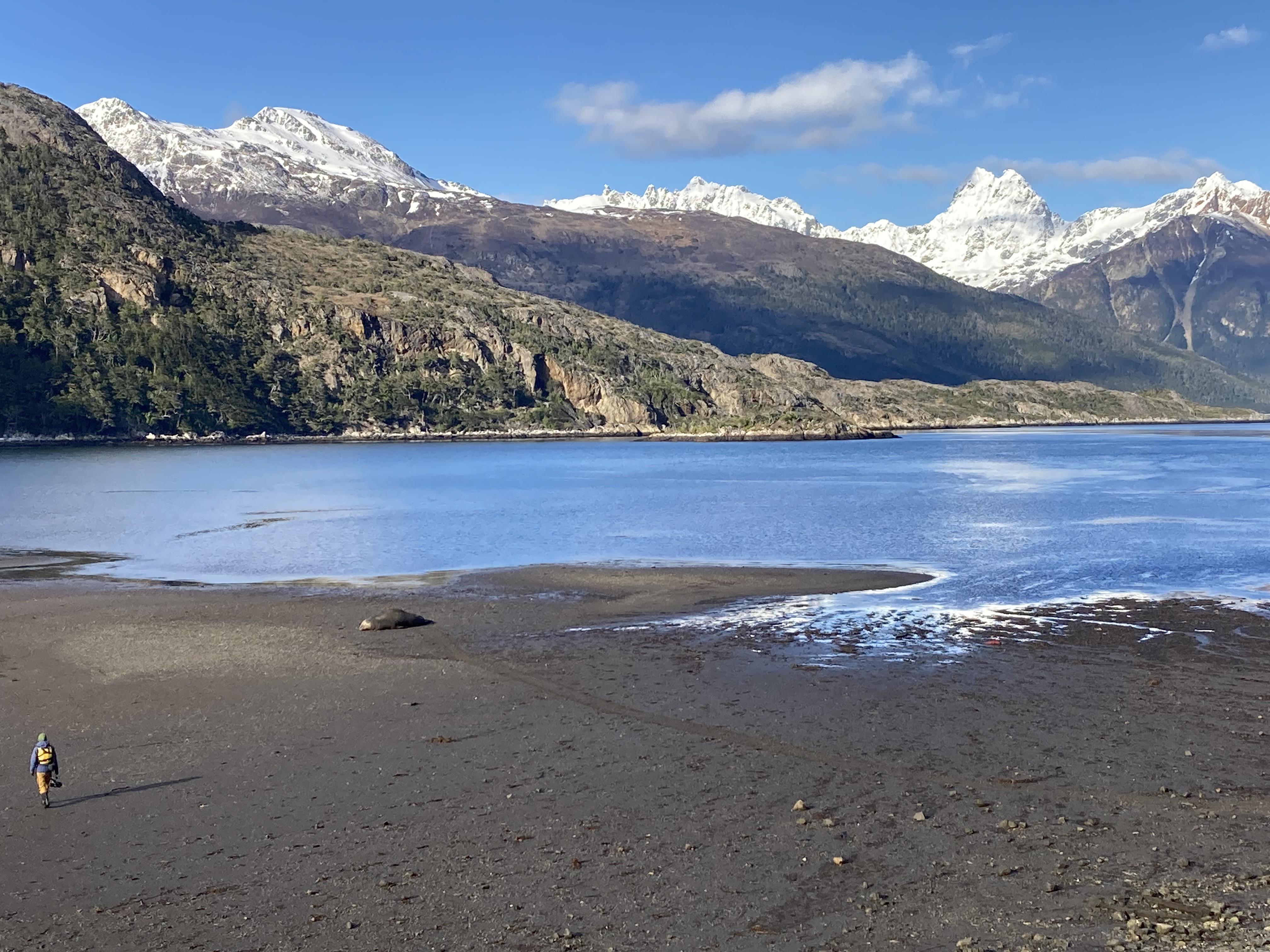
The zodiac skims across the water, the wind whips, and the disturbed water leaves a frothywhite “V” behind us. Another fjord. Tall stately mountains border a wide drainage at the head of the bay. Squint your eyes and it could be Mud Bay, Idaho Inlet, or any number of classic southeast Alaska drainages lined with bears awaiting the salmon. But those rivers are 8300 miles away. 

I have gone to the other end of the globe… to see glaciers. To see a land defined by ice and the frenetic and beautiful artwork they had carved. There are no bears here in the fjords of Patagonia. Though there are rumors that a puma or two occasionally makes its way down to the island of Tierra Del Fuego. Nor are there spruce or hemlock forests. Instead southern beech trees coat the shorelines and stretch up toward the alpine. 

Despite being at roughly the same latitude as north Vancouver Island, the fjords of Patagonia feel more like the Aleutions than they do the Pacific Northwest. It’s the price paid for a ceaseless wind that whips across the south Pacific with nothing between New Zealand and Chile to slow it down. 

Despite being 200 yards from the beach, the zodiac slows. I glance down to see mud beneath a couple feet of water. The long tide flat stretches deep into the fjord. Our landing may be more of a “storm the beaches” situation.

“Uno, dos, tres, quatro, cinco, seis, siete, ocho…” sings out Javier from behind me. 

I scan the shoreline. What’s he counting? I bring the binoculars to my eyes and train them on a massive boulder just above the waterline. That’s no rock. That’s an elephant seal. But… it can’t be. It’s too big to be anything that lives, breathes, and moves on land without being crushed uner its own weight. 

The zodiac can’t go any further. We splash over the side, holding bins for life jackets and other pieces of gear over our heads. In 30 minutes the guests aboard the National Geographic Explorer would be deposited on the beach, awaiting the quirky, entertaining, and informative knowledge of these skilled and capable naturalists that know the land so well.

A little secret, I’ve never been here before. Hadn’t set foot in South America, let alone Patagonia before a couple days ago. And there’s only so much one can absorb from books and documentaries before your Xtra-tuffs hit the beach. I’d joked about Patagonia just being “Alaska with penguins,” but it wasn’t. 

This was a wild, crazy country. A place humans had no business living. The wind. It blows constantly. Not a gentle breeze, but 40, 50, 60 knots with storm tossed waves that make the boat pitch and roll on every ocean crossing, sending me bouncing out of my bunk and water bottle clattering off the table. The plants were unfamiliar, the mountains held glaciers, but the inlets and bays were foreign. Even the dolphins and porpoises felt like strangers. With a pang I realize I’m homesick.

I lug the bins up the beach. The boulder turns, a grotesque snout flopping over its open mouth. It lets out a bellow that echoes off the mountains and thunders up the valley. The male elephant seal is massive. 4500 pounds easily. And we’re walking right past it. My fellow naturalists barely spare it a glance. Decades in the Alaska woods has trained me that anything this large should not be approached under any circumstances. Yet here we were. Trying to fit in I follow in Javier’s footsteps but can’t resist giving the monster a wide berth. 

I have stepped into Jurassic Park. The elephant seals are scattered across the mile wide beach. Females and pups cluster in groups while males wallow closer to the water, allowing the flooding tide to cover them up until only their snouts are exposed. The roars of the males and barks of the pups sharply ring out on the still, clear morning. 

In theory I should be “scouting” the three-mile long hike up the valley I was tasked with leading. But I can’t step away from the elephant seals. I perch on a rock and look down on a small cluster of females and pups. My eyes land on one pup pressed against his mothers belly and vibrating gently. He’s nursing, latched on tight and chugging away. 

A nearby male gives another roar. How on earth could this fluffy gray thing turn into that Jabba the Hutt wannabe? I hadn’t given much thought to elephant seals when I was offered the two week Patagonia contract. But now that I was here… there was something so peaceful, so grounding about these massive animals. I slip into a meditative state and let the world and everything in it slip away. 

These seals spend 90% of their life in the ocean. It was special to catch them on the beach like this. In their tenderest, most intimate moments they make landfall to give birth and nurse before setting out for months of traveling and foraging. The pup has no idea that his blissful little existence has an expiration date. In just a few short weeks, mom will leave him at the mercies of the ocean. No more milk made up of 40% fat to sustain him. He’ll have to head for open water where food dives deep and orcas lie in wait.

He doesn’t want to leave this beach. As homesick as I am, neither do I. For five weeks I have explored the deep woods of British Columbia and fantasized about kayak trips that varied from weekend getaways to starting in Seattle and not stopping until I saw Margerie Glacier. I’d flown to the other side of the world to see some of the most beautiful and dramatic fjords on earth. Alaska is gorgeous, but it doesn’t make glaciers the way they do down here.

Things would change rapidly for me and that little pup. But at some point, we’d have to wiggle over those drift logs, hit the water, and keep on swimming. 

The sound of an outboard wraps around the point. Right, there are people coming. I was supposed to find a trailhead. I scurry off the rock, leaving the pup to suckle and enjoy the sunshine that has finally crawled above the highest peak. In my mind I review the list of plants, birds, and stories I have learned. The list was growing every day, and luckily most of the flora and fauna had, “southern, Antarctic, or Magellanic” in its name. One could simply point at a clump of grass and declare with some authority that it was “Antarctic grass.” Not that I would ever.

The zodiac approaches, the elephant seals roar in greeting, and an Andean condor rides the thermals far above. The southern wind slams against my face, I close my eyes, taste salt, and revel in the unknown, the unexplored, and the prospect of following that pup into deeper water. 

Rivers and Roads

Finding relics is hard on this coast. The rainforest is tenacious, hungry, and unrelenting. It devours anything made of wood, eager to absorb it back into the ground and turn it into mulch so the next generation of trees can grow, topple, and repeat. Abandoned houses quickly crumble as their metal roofs rust and fall away. Even cast iron and the alleged “stainless” steel can only resist the pounding rain and ever-present dampness for so long.

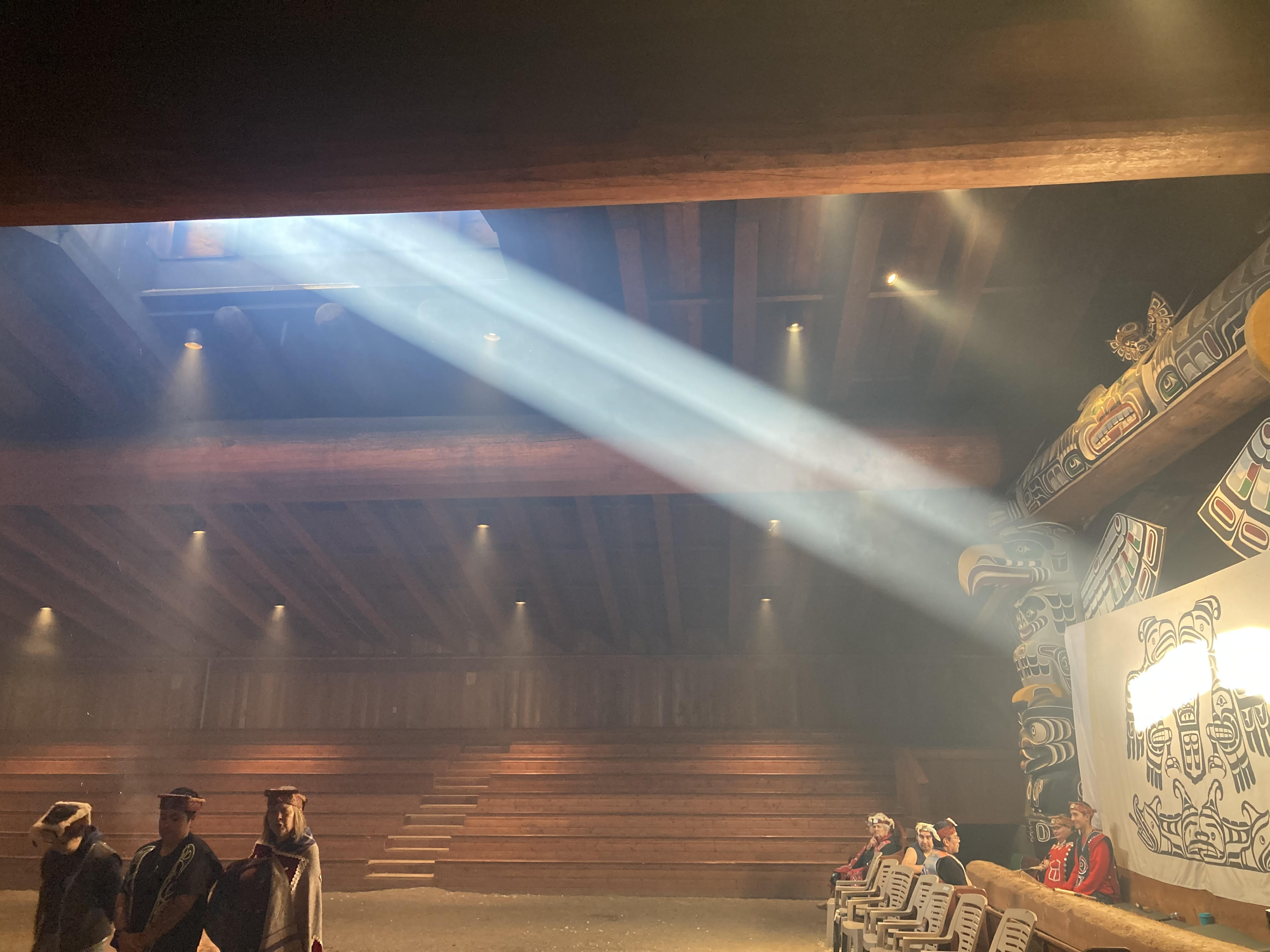
So, walking through a place like the U’Mista Cultural Center in Alert Bay feels like something of a miracle. Referred to by the Namgis First Nations elders as a “box of treasures” the museum is chock full of regalia, masks, and artifacts, some of them of pre-contact vintage. Some are so precious that they have been given a special room where photography is forbidden. Stepping into this space with the same layout as a traditional Big House feels akin to walking into any holy place.

The big house in Alert Bay, British Columbia.

You can feel the age. Hear the whispers, the songs, the banging of drums on a stormy winter night while the wind howls up Johnstone Strait. For decades, potlatch ceremonies were forbidden by the Canadian government. The gatherings led to arrests and the confiscation of artifacts, language, culture, a way of life. It wasn’t until the Cultural Center was built that the regalia and masks were returned.

I kneel in front of an ornately carved orca, done in the classic form line design of the Pacific Northwest. The calls of the northern residents ring in my ears. Oral histories tell us that the “blackfish” swam in pods so thick that you could leap across their backs from one side of the strait to the other. Guess who likes the sound of that?

Black and white photos of old village sites, many long abandoned, run along the hallway. I know a lot of the names, or at least the ODWG (Old Dead White Guy) names of these islands and channels and coves.

Even after years exploring this coastline and probing the beaches, I know nothing about this place. So many remain just names on a map and nothing else. I thought that my wandering would be satisfied with that. That I could leverage my new life and travel wherever Lindblad was willing to send me.

A Patagonia contract looms. What are southern hemisphere glaciers like? Or humpbacks? Orcas? Do penguins smell as bad as everyone says they do? I’m intrigued, excited, thankful. But there’s a bungee cord tied to my heart. Any time I step too far from the B.C. coast, the cord goes tight and springs me back.

It has been six years since I hugged Paul Spong on the Alert Bay dock, promised to keep in touch, and boarded the ferry. 12 years since I first shouldered my pack and boarded a bus in Vancouver for the region that is my birthplace. The symmetry is not lost on me. All it took was U’Mista, an orca carving, and some black and white photos, to tell me that I don’t need to travel the globe to find myself. To be fed. To heal.

There are places where I have left beached my kayak, stepped into the woods, and felt a presence. Without fail, I would find evidence of human life.

A scarred tree where pitch has been harvested for fires. A strip of bark peeled from a red cedar. The miracle tree that could be lived under, paddled, and worn. A flattened divot where a house once stood. Wooden poles of an ancient purse seiner.

I step outside and look over the water. A southeast squall is rolling up the strait, but the rain has stopped and the sun bleeds through. I can see my wooden kayak rolling in those waves, battling the passage from Port McNeil toward Alert Bay.

This place is full of memories. Many beautiful, a few painful, others bittersweet.

But something it is abundantly clear. This place isn’t done with me. In what capacity or function I don’t know. The time has come to migrate back. To step into these woods I want to know, to feel that presence and sleep on that moss. Hear the wolves and watch the seals. Rivers and roads led me north, but at some point, in some capacity, I always knew they’d lead me back here.  

Wabi-Sabi

Eyes snap open, heart racing. Where am I? The boat vibrates, a cradle gently rocking, and I’m swaddled in the bunk of room 807. For the last three months, memories and reminders of what is and what is no longer come rushing in the morning. They have all the subtlety of a 747. A soft, blue light bleeds through the porthole. Along the British Columbia coast, mornings are coming later and later as the calendar flips to October.

My name is David. I am a naturalist aboard the National Geographic Venture. I am loved. I am treasured. I am ok.

I grope for my phone and pull up the GPS app. The islands, passes, and channels look up at me, friendly little faces with names that bring comfort and order to my life. Broughton and Blackfish. Johnstone and Harbledown. Parson, Blackney, and Robson Bight. My second home. My first home. The place where this human, whoever he is, was born. It was in the waters of Johnstone Strait that I bobbed in a kayak during the summer of 2007. The A36s came swimming by, stately tall dorsal fins guiding me. Not north like they do in all the stories, but south.

Aboard the National Geographic Venture, I return to these places every fall. Not as a caretaker or paddler or biologist, but something of an educator. A representative of this place that has meant so much to me. But like everything, this sanctuary comes with some baggage.

I step onto the bow with a coffee cup gripped in my hand and greet an early morning drizzle. The boat chugs through Blackfish Sound. Hanson Island is off the port, Orca Lab just a mile behind me, cloaked in morning fog.

And there are the Plumper Islands off north Hanson Island with their little passes and reefs I memorized during three winters of town runs from the Lab to Alert Bay. Another lifetime ago in so many ways.

I pull out the spotting scope and train it on the shoreline of the Plumpers. There they are. Humpback after humpback hits the surface and are greeted by flocks of greedy gulls that divebomb the forage fish pushed to the surface. The harsh edges of this clump of islands float in and out of the fog, the world blurry and slightly out of focus.

There’s a Japanese phrase, wabi-sabi. It means impermanent, imperfect, but aesthetically appreciated. A spoon’s wooden handle worn smooth from years of use. A torn and stained pair of Carharts with oil, blood, grease, dirt, and grass stains worn into the fiber. A stained cabinet edge from a beloved cat’s insistent nuzzling.

This stretch of coast is my, “wabi-sabi.” These islands, these whales, the tantalizing promise that a six-foot dorsal could appear at any moment. But inside I also feel wabi-sabi. Incomplete, under construction, and loved all the same.

I get to talk about it today. Share this place and this history with 80 people. They’ll give me a microphone and hang on my words. A chance not just to share but influence.

But there’s no way to speak of Hanson Island, Paul Spong, orcas, or quiet nights in Robson Bight without sharing my own history. And so that means opening a vein and scratching the scab that’s just starting to heal. How will it feel when I see the picture of us grinning at the camera with a rabbit and a cat clutched in our arms?

***

I step behind the little pulpit in the middle of the Venture’s forward lounge. I glance at the TV in front of me, my presentation loaded and staring back. There’s the lab, framed in cedar and fir. I remember the day I took this photo, a spring day in 2016 when I knew our time at the lab was coming to an end.

A down payment was soon due on 4.2 acres of Gustavus clay. An era was coming to an end. A final gulp of wanderlust. My tumbleweed wanted roots, and we were learning what it took to grow them. It meant saying goodbye to black nights with chatting orcas and salt spray on the windows.

I don’t know if I made the right choice.

I pick up the mic and begin to speak. There’s the photo of Paul next to the projector, focused and handsome. A black and white photo of Skana the orca he was hired to perform “research” on. Paul playing his flute to her beneath the headline “Friend Wants Orca Freed!”

I talk about Paul heading up Vancouver Island and setting off in a kayak around Hanson Island with nothing but a flute. Did he have a life jacket? I never asked. Something tells me he didn’t.

I tap a button and the calls of the northern Resident orcas’ blast through the lounge. A Clan and G Clan. Pings, squeaks, and whistles. Calling me home. I never truly left. This is still my home. My first love. And just because life has changed doesn’t make that love and time any less significant. It’s part of me. My journey. Part of my wabi-sabi. The lump rises in my throat. Damn it I miss this place.

A couple slides later and there we are. There she is. A smile on her faces as she looks out the lab over Blackney Pass. A photo of Brittney asleep in the cabin with Porter on her lap, Penny the bunny nestled in her little house. But opening this vein, scratching this scab isn’t bringing tears. The lump is gone from my chest. And I realize I am celebrating the adventure. The beautifully braided journey we made. My mind will not let my heart take that away.

The spoon’s worn handle feels comfortable in my hand.  

I finish with a crescendo. Underwater footage of orcas at the rubbing beaches. I love this shot. A female settles right in front of the camera and rests on the bottom. She gives a few happy wiggles along those smooth rocks that mean so much to them for reasons we don’t fully comprehend. Their calls once again ring through the lounge.

 I break.

A tear slides down my cheek, then another. I’ve been scared to think about my time in British Columbia, much less talk about it. But sometimes what we fear is what we need to do. Destigmatize our traumas and pain and instead glorify all that was great and beautiful and precious.

I catch a few wet eyes looking back at me.

“Thank you for your time. For letting me share this place and these animals that mean so much, that makes me who I am. It’s a pleasure to get to come back here. If you’ve had enough whale talk, I totally get it. But I’m happy to take questions and talk as long as you want.”

I suppress a grin and allow my ego a couple cartwheels as hands shoot into the air.