Why Do They Only Breach Close at Night?

We may have to change the name of the blog. It hasn’t rained since we got here. After driving off the ferry in Nanaimo in a torrential downpour, it has been sun and blue sky ever since. It’s wonderful to sit on the deck in just a t-shirt as mid September approaches, though I’m already bracing myself for the inevitable monsoon  that I’m sure is coming. The raincoast has brainwashed me. Even when the sun shines, I’m sure mama nature is just piling up additional rain to make up for it. See what you’ve done to me Juneau!

There is the small problem as well as the water pressure in the sink has noticeably gotten weaker and weaker in the past few days. All our fresh water is gravity fed from a spring, connected by a never ending tube of garden hoses that wind their way up a hill and through the spruce and cedar trees. There’s just five of us here and any bathing is done via the salt water tub, so fortunately we’re not using much right now. Nevertheless, a nice steady day of rain would help me breathe a little easier.

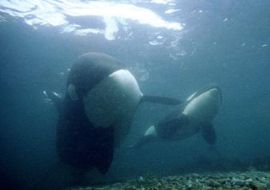
All has descended into relative quiet though. It has been nearly 24 hours since the orcas called, they’re somewhere to the north, suddenly reclusive and introverted after two weeks of tracing the shorelines of Johnstone and Blackfish. The water feels empty without them. Chelsea and I did seem them yesterday on the way into Alert Bay on the weekly pilgrimage to civilization for food and beer. Relaxed and at peace with the world, the A30s and A42s traced back in forth off the north end of Swanson Island near a place called Bold Head. We couldn’t resist stopping to watch. The contrast was shocking. Counting us three boats floated off the island, watching the two pods. I thought back to what whale watching was like in Juneau when someone saw a six foot dorsal fin. The never ending parade of boats, in a mob like blood thirsty consumers on black Friday. For a moment I felt guilty as I watched A38 rise to the surface off our bow, even from 100 yards he looked massive.  After all, I’d been part of it, had taken every opportunity to see the orcas when I could, because, try as I might, I just couldn’t look away. But here there was no ethical battle being waged inside. We were just one of three instead of thirty. We watched the families rise and fall for a few minutes and continued on our way.

Even the humpbacks have slowed down, after a week that saw double breaches and a even one surfacing in the cove just feet from shore, their prey must have shifted. But last night, as the tide ebbed and Brittney and I sat in the cabin, a sound like thunder roared from the ocean fifty feet away. There was only one thing that could make water sound like that. We stood on the deck as the moon broke the clouds, illuminating a single strip of the black water below, and a shadow, darker even than the ocean rose. The humpback’s blow echoed off the islands and we could just make out the back as it arched and pulled the flukes into the air. A minute passed before as silent as the night itself, there came a great rush, a blow, and the humpback flew out of the water, its silhouette framed by Parson Island across the pass, the frothy white splash illuminated beautifully in the dark leaped twenty feet in the air as gravity pulled the whale back to the surface. Just another small moment of joy in the world of Hanson Island.

There’s little planned between now and the 16th of September when we go from care takers and volunteers, to hosts. Throughout the year, Paul and Helena have been fund raising by offering what they call, “perks.” Donate X dollars, get a CD of orca calls. Donate 5X (see, algebra!) and get a trip to Orca Lab. Cindy and Gene put up 5X, and decided September 16th-18th would be the best time to visit. Paul and Helena politely explained that they’d be out of the country still at the IWC. “That’s ok,” they said.

Well than. Hopefully the whales come back and make an appearance for a few days, because theres only so many times we can show them the cedar trees and rubbing beach videos. Of course, if you’re willing to travel all this way, I’m willing to bet you’re perfectly happy to sit in what will still hopefully be sunny weather and watch the humpbacks, sea lions, and harbour seals cruise slowly back and forth in front of you. The night before they left, Paul  and Helena gave us a list of tasks and chores to keep the lab running in their absence as well as food and dinner ideas for when our guests arrived.

As the sun set and darkness claimed the living room and everyone began to clear the table, I asked the question I’d been meaning to for days. “These people that are coming,” I ask, “where are they from.”

Helena pauses for a moment, “the U.S,” she answers.

Something in her answer makes press further. “What state?”

A wry smile crosses her lips, Paul lets out a little chuckle. “Texas,” she answers.


The wisdom’s in the trees. Not the glass windows.

In a place where the earth moves slow and meticulously, the heaviness of my breath and the quick pace of my feet seem all too intrusive. As much as I try to steady my breathing and move with grace, I find that my feet get caught up in the rocks and stumps that thrust out from the soil. I fix my pace and tell myself to breathe, to listen. I know from my yoga practice how much more I gain when I learn to quiet my mind and breathe.

For all too long running has been anything but a spiritual practice. I’ve used it simply as a tool to improve the structure of my body. It has almost always been a way for me to compete with my former self, who I was the day before. How many calories can I burn today? How many more miles can I go? And through these thoughts, I learned to love the act of running. I’ve always enjoyed that inner competition.

But not today. Today there was no need for keeping track of time, miles, or calories. Today I found myself in the presence of Grandma Cedar. She is the oldest and wisest soul on this island. I stopped upon sight of her and stood in amazement. As I sat at her roots, she said to me “Granddaughter, let your breath be still. Listen. What do you hear?” I closed my eyes and touched her bark. All of a sudden my ears began to flood with sounds. Not the sounds that I’m used to though. There were no traces of highways or cyclists. There was only the forest. As I listened closer, I could hear Grandma Cedar growing just as she has for the past 1000 years.

As I closed my eyes tighter, I could here her gently whispering to me, “Here, you are perfect. This moment and all of the moments after are perfect. Steady your breath and clear your mind. You have much to learn, my granddaughter.”

God’s Cathedral

There is a place on the island where you can see history. Feel it travel through your feet, up your spine, sending tingles down your arms. You travel back a thousand years in the blink of an eye and remained rooted hundreds of years before Columbus even considered leaving. And yet all is quiet and still, the words whispered. The story and message imagined and interpreted within. The walk to the time machine is a short one. Winding through stands of rebellious young Hemlocks, shrouded in the shade of their brothers above, crawling year by year upward. I’ll be long gone by the time they see the sun. Here and there a strand of blue is wrapped around a tree, the words, “culturally modified” scrawled across it. They are not the largest, but they are the most important. The historical importance of these trees to the Namgis first nations people has saved the island from logging, a tiny shrine to the old growth stripped by the mountainside on Vancouver Island just a few miles away.

For all her size you don’t see her until you hop the stream, round the final corner, and the shadow towers above you. 12 feet in diameter, hundreds of feet high, she is more impressive than any building any architect could create. The land around her base is bare, her children, teenage trees, shurbs, and huckleberry rise up nearby in the protective shadow of her arms. All is still, the silence so complete you can hear mosquitoes on the other side of the clearing. It’s like walking into a church, you speak in whispers, move quietly, sit down silently. Holier than any church man could conceive. Gods first and true temple, standing, waiting to be worshiped in for a mellinium. Grandma cedar is the pulpit the trees her congregation, it would be arrogant to call us angels.

Everyone I take to see her has the same reaction. Visitors, cameraman, authors, journalists, stare upwards, mouth open, their necks craning farther and farther back, searching for the peak of her branches. Again and again the photographer falls to the floor turning his camera this way and that, trying every conceivable angle in a vain attempt to capture the beauty and tranquility of the scene. Every glance at the LCD screen leaves him shaking his head, hands running through his hair, than back to the forest floor for another attempt.

While the light reflects bright and harsh off the water a quarter mile away, here it is soft and green, the eyes and mind relax, and you drift to a time before anyone knew this existed. The clearing transforms and a sheet of ice replaces the trees. Creaking and groaning it moves, imperceptibly, year after year, resignedly giving way to bedrock, slate, and erratics. It drops a massive rock near the cove, an erratic that will someday be the wall of my home. Water fills the passes and straits that will become the homes of salmon and seal, humpback and herring. Grandma cedar begins to grow. When exactly is not important, what’s 100 years when we’re speaking of thousands? As she rises she sees and hears all. She sees the Namgis settle and camp. Catching salmon and seals, revering the orca and raven. There songs and fires echo and reflect off her face, the jumping light and songs drifting across what would someday be Blackney Pass. They may war with each other but they are at peace with nature. She sees the otter, the humpback, the people, obliterated, her landscape changed forever. Her kinfolk felled to make wooden tables like the one I write on now. The hypocrisy burns as I sit in a house made entirely of wood.

She sees a man in a kayak, a flute at his side, paddle into the cove at her feet. He walks to the erratic on the beach, running his hands down the cool stone, an image born in his head. A house appears, than another, yet the structures seem to melt into the forest. Wrapped in the cloak of grandma’s congregation. People come and go in the following years, nothing more than a fleeting second in her eyes. But whoever touches the shore is brought before her, to pay their respects, honor the matriarch of the forest and remember where we have come from. She changes lives without an audible word. She speaks in riddles, symbolism, and nothing more. The message you take away is the one you are looking for.

And now I stand before her, staring up at the tips of her branches that seem to reach to the heavens. Touch her trunk, feel her age, her power, a talisman of the past. Of how things were, how things can be if we allow them to. I fall to my knees, in silent worship and thanks for this place. For Muir had his glacier, Heacox has his kayak, and I have this island.

We’ll Sleep in November

Orcas have no concept of day and night. And as I wrote earlier this summer, sitting up, in the perfect darkness as calls echo through the headphones can be beautiful. Especially if you know in two hours you can crawl into a sleeping bag and sleep, knowing you don’t need to be back at the lab for eight hours. This is the luxury of Orca Lab in August, when there’s eight of you splitting shifts and ensuring nobody gets overworked and run into the ground. For a few days in late August and early September there were two, yes two, volunteers remaining as school drove most of the summer volunteers back to the city. Naturally, the northern residents decide that this would be the perfect time to start calling around the clock. For four days Tomoko and Momoko, both from Japan, were recording constantly, trading off every couple hours to eat, sleep, and than put the headphones back on.

So when myself, Brittney, and a girl named Chelsea arrived relief seemed to be in sight, kind of. As nice as it would be to be able to just sit down, fiddle with the soundboard, and immediately learn exactly how to follow a pod of orcas through a maze of six hydrophones, it’s not quite that easy. There’s a learning curve to understand what you’re hearing, on what hydrophone, and how to minimize that blasted boat noise. All while filling in the log book, and maybe operating a remote camera. And that learning curve gets even steeper at 3am when you’re wiping sleep from your eyes and trying to remember if you heard that last call in your left headphone or right. So for the first few days, nights fell to Tomoko, Momoko, and I. I’d doze from 10-11, get up, and drag myself back to the lab, Brittney tagging along to practice. From 11-2 we’d sit, perched on the high seats in the lab, straining our ears for orca. Nearly every night they’d arrive and the orca filled hours went by quickly. The orca free ones snailed by as you listened to the same tug chug slowly up Johnstone Strait knowing that it would pass from one hydrophone to the next over the next two hours. We’re back up at eight and at the lab as we tried to give Tomoko and Momoko the break they so richly deserved after days of sleep deprivation.

But for the two of us, the lab was just a fraction of our to do list. Since we’re going to be here for the winter, we couldn’t just know how to record and listen to whales. Our quick lesson in Orca Lab 101 was accelerated due to the fact that Paul and Helena left yesterday for two and a half weeks to attend the International Whaling Commission’s annual meeting in Europe. Being off the grid we don’t have the luxury of flipping a heater on, turning on the hot water tap, or running to the store for the butter we forgot to grab. If you want to be warm through the night you’d better be able to make a hot (and efficient) fire. Baking a loaf of bread means coaxing a wood stove to life and somehow knowing when it’s 350 degrees. A shower means heating water in the iron bath tub outside for four hours. And if you forgot something at the store, you’ll just have to find a way to live without it because it’s a 90 minute round trip by boat.

And yet, as I found myself handling the chainsaw, learning the safest route to town, and habitually checking the temperature in the house to make sure that it was warm enough for the pets I began to find it incredibly rewarding. Never before had turning the heat on or running to the store for lettuce felt so good. If anything they were burdens, born out of necessity. But all of that changes out here, where you are directly responsible for everything you need. Heat isn’t provided by some mythical source that pipes through those grates in your floor. It comes from the log you cut, split, and stacked, you’re there for every step and it gives you a new found appreciation for something as simple as keeping the house warm.

For many it may seem backwards, after all, we’re in many ways living the way people would have one hundred years ago (with some obvious technological exceptions: chainsaw, wireless internet, refrigerators, four stroke engines). Society has advanced, why would you want to go backwards? Maybe progress is overrated. We’ve lost touch with the origins of what we eat, how we stay warm, and where we came from. And are we really better off now than we were?

It’s obviously not a black and white answer. I’m very happy with the fact that I will never have to worry contracting the black plague or typhoid fever and that even in this remote location I know that the Vikings won yesterday 34-6. I don’t think everyone should drop everything, sell whatever doesn’t fit into a Nissan Pathfinder and head for the woods. I don’t have the world figured out and hope I never do. But there is value in reconnecting with the basic necessities of life: food, water, shelter, and playing a part in their acquisition besides running a credit card or turning a dial. There’s a beautiful simplicity in this, even if there is a ton of work that goes into maintaining it. I am supremely confident it is much less stressful than sitting in two hours of rush hour traffic.

After a crazy first four days on the island, following a crazy four days getting to the island, things finally seem to have slowed down. Wood is stockpiled, everyone’s fridge is full, and Brittney and Chelsea are handling the lab side of things splendidly. So last night, after heating salt water in the bath tub on the rocks outside all day, I climbed in, looking out over Blackney Pass as a humpback criss crossed in front of the cove. My adoring wife even brings me a beer (God I love her) and I lean back in the most magnificent hot tub ever conceived by man. In the cities of the world I’m sure there are some very happy, very satisfied people. But I contend, that for those blissful thirty minutes, no one on earth was happier than me.

The Last 500 Miles

It has been a four day tornado of awesome. Starting with Jonathan and Marissa flying to Seattle and somehow, in 96 hours cramming a soccer match, multiple concerts, packing, cleaning, driving, and boat riding. After hearing more live music in two days than I had, maybe in my life time we said good bye to the two of them at 11 pm on September 1st, and prepared for the alarm set to go off at 5:30. Bleary eyed, hungry, and under caffeinated, we crammed the pets and as much junk as we could fit into the pathfinder. After talking of little else for a year we finally began the final journey north. By 8:30, we were nearing the Canadian border, a knot growing in my stomach as we pulled up to an open booth and hand over our passports. The woman’s eyes narrow as I try to explain in a semi coherent manner, exactly what we would be doing in her country. After much writing, nodding, and cryptic questioning, she hands us a slip of paper. “Pull your car over to the side and give this paper to the officer.”

Not that I was surprised, wouldn’t drug smugglers have some story about house sitting for several months? With little choice we drop Porter in Penny’s cage, pray that he behaves himself, and walk into the border building. Where, I get to explain again, what the hell we’re doing. “What’s the name of the guy you’re house sitting for?” The guy behind the counter asks.

I take my eyes off the massive hand gun on his belt. “Paul Spong,” I answer, “he runs the research lab we’ll be walking.”

He scribbles, “and if I do a web search, will he come up?”

“He has his own wikipedia page,” I say. Brittney laughs nervously, the guy however, is not impressed. My humor never seems to pass mountie muster. After reiterating again the location and explaining that yes, technically we’re unemployed, and have been now for a length of time I’m ashamed to admit. We’re mercifully free to go.

We speed north, power sliding into the Tsawassen (don’t ask me how to pronounce it) ferry dock with five minutes to spare. We have two glorious hours to sleep and eat before the ferry hits Nanaimo on Vancouver Island at 12:15. And so begins another race. We have to be in Port McNeil by 5:15 to catch the ferry to Alert Bay to meet Paul to get a ride to the island on five hours of sleep and borderline delirium. We pass through a rain storm and into brilliant sunshine, reaching Port McNeil in golden late afternoon light with thirty minutes to spare. As we wait in line for our second ferry ride of the day, I stare at the white caps in the harbor. It looks rough. The ferry steams us into Alert Bay. Fatigue slowly beginning to set in, after two mosh pits and far to little sleep, interrogations, and a race up Vancouver Island we still had one more boat ride to go, with the pets of course, still in tow.

We reach Alert Bay with one goal in mind; find Paul. I look out toward the government dock as we slowly drive down the main road. There’s no sign of the silver June Cove. Actually there’s no boats at all. The dock is being pounded by waves making the whole structure swing side to side. There’d be no begging for directions at the information centre this time though. We drive straight to Paul’s house to find him in the kitchen. Calmly toasting bread and cheese, a polite look of surprise on his face as we stagger in the door, exhausted smiles on our faces. He hugs both of us and explains the water is far to rough to reach the island today. 12 hours after starting, we’re both fine with that. We throw a tent up in the yard and curl exhausted into our sleeping bags, Porter curled between us.

Now, for the first time in three months, we are settled. All four of us. There has been a lot of odd and peculiar things brought to Hanson Island since Paul first moved here in the early 70s, but I’m pretty confident in claiming that we are the first people to haul a rabbit cage off the boat and onto the rocks. In the chaos that was unloading the June Cove I failed to take a picture of what had to be a confused and shell shocked Penny, perched on her back legs ears up and eyes wide open as she rotated on the spot, the sea breeze blowing through her hair. As she always seems to though, she took everything in stride, if she ever panicked she certainly didn’t show it.

How I wish we could say the same for Porter. A healthy dose of kennel anxiety left us to terrified to put him in his own air kennel for fear of the unspeakable mess he is loath to create every time we try to cram him in one. We settled on putting him in Penny’s house with her for the 45-minute boat ride from Alert Bay to Hanson Island. Before the boat even left the dock, he peed. Two minutes after, well, you can probably guess what he did next. We dumped him rather unceremoniously in the guest house that will be our home for the coming winter with explicit directions to where his litter box was and he hasn’t stopped purring since. Whether he truly loves the house, or is simply ecstatic to be off the terrifying aquatic spaceship I honestly don’t know.

Our little cabin is magnificent. The cabin, also known as, “Yashi’s” after Paul’s son, sits just above the intertidal zone, with a small scattering of trees between the deck and the ocean. Giant bay windows on the ground floor open up to gorgeous Blackfish Sound with the usual activity of the neighbors; humpbacks, sea lions, and orcas. Come night time though the windows become somewhat less glamorous as they’re far to happy to let the heat out and the chill in. A tiny stairway lined with the expected orca paraphernalia of paintings and sculptures leads to the bed room whose small windows also look out over Blackfish.

Within two hours of hitting the beach and dropping the pets in the house, the main event arrived. For Brittney it was the first orcas she’d seen in a year and they didn’t disappoint. Plodding slowly against the tide the A30s and A42s paraded by, one hundred yards from the shore. Escorted by Pacific White Sided dolphins and humpbacks tracing back and forth0 on the far side of the channel. At long last everything was perfect. The wait, the driving, and the planning was all behind us now. As the A30s rose to the surface, fin after fin rising and falling I turned to Brittney with a grin, “don’t think it’s always this easy.”

When All You Have is Ears

In the blink of an eye, the summer is over. My four weeks on Hanson Island has come to an end. I’ll be in Seattle for the next two weeks, before Brittney and I will load up food, clothes, and pets for one more drive to Alert Bay and begin settling in for our winter on the island. Orca Lab left me with one last incredible moment though. A magical night that I will never forget.

My last few days at Orca Lab were spent at the tiny out camp on Cracoft Point, referred to simply as, “CP.” The camp is nothing more than a tiny little platform two paces by nine paces built at the very top of the rocky intertidal. A few stairs lead to the shelter. A room of roughly the same size and width as the platform. Crammed into it though is a bunk, desk, kitchen, and more electrical gear than radio shack. CP has housed underwater cameras, remote cameras, hand held cameras, and hydrophones. The reason, like in real estate, is location. An underwater cliff looms just off the platform, a good push and you’d be in 100 feet of water, surrounded by a vibrant kelp bed. As the orcas go by they often pass just meters off this kelp, sometimes just 20 yards from where you stand. I can’t think of anywhere else on earth where you can be so close to orcas without harassing them.

You can sleep in the shelter. But on rainless nights, there is nowhere better than the platform. Wrapped in my sleeping bag with it pulled over my head to keep offending mosquitoes and mice out of my hair, I was rocked to sleep by the sound of the waves crashing into the rocks ten feet below me. My slumber didn’t last long. As the tide rose the humpback moved closer and closer to CP. The vibration of his breathing reverberating off the rocks. I give up trying to sleep and lay there, listening to this behemoth. It was impossible to know how close he was in the darkness. There’s a rush of water, the briefest moment of silence, and than a tremendous concussion as the whales breach brought it back to the oceans surface. I leap to my feet just in time to see the conclusion of the splash, white water glowing in the darkness.

Leaning forward I strain my eyes, trying to make out the whale, searching for a black shape on black water on a cloudy night. For ten minutes the whale moves back and forth in front of me, just out of my range of vision. Initially I’m almost sad this isn’t happening in the daylight when I could stand, camera in hand, capturing every surfacing, preserving it forever. But in the middle of the night there was no pressure to photograph. There was nothing to do but sit in the stillness with my ears as my only guide.

The edge of the kelp bed is barely visible, perhaps thirty feet from where I sat, the water level just a couple feet below me as the tide finally begin to ebb. So it was nearly at eye level when this aquatic night owl roared past the surface, mouth agape just beyond the kelp, a jet black shadow passing left to right. For forty tons, he’s incredibly quiet. There’s a rush of water that sounds like rapids, and the splash at the end of the lunge, and that was all. It took maybe three seconds before the water swallowed him back up, covering his tracks, as if there had never been anything there but water and kelp. Heart pounding, adrenaline flying, eyes wide open, I wait breathlessly for the next plot twist.

The humpback breaches again, just out of sight, and the show’s over. For two hours he continues to move, back and forth off the platform feeding. I’ve been kept awake by roommates, music, the cat, and a rattling furnace. But this was the first time a whale refused to let me sleep and I’d never been so happy to be sleep deprived.

The Book That Changed Everything

Growing up my heroes were athletes. It made sense, as sports obsessed as I was and the best players on my favorite teams were nothing short of demi-gods. Kevin Garnett, Cris Carter, Joe Mauer, and countless others for their ability to play a game and get paid millions of dollars in the process. They seemed like nice enough people in my biased 12-year old eyes and that was more than enough for me to spend many hours on the couch watching them run, jump, and sprint. But as I grew up, my hero worship began to transition. Writer/biologist/conservationist Alexandra Morton became one when I was 18, her book “Listening to Whales” becoming something of my biological bible during my freshman year in college. Paul Spong of course, a scientist, pioneer, and now, for all intents and purposes, my boss as well as friend. And others, mostly in the whale/orca research community. People like John Ford, Mike Bigg, Jan Straley, and Dena Matkin, many of whom have been passionately following the whales of southeast Alaska and British Columbia for decades. Sometimes working on grants from the government or universities, other times dipping into their own pockets to fund the work that they just couldn’t stay away from. They’ve funded research programs and non profits, and some of them I’ve  had the honor of interacting with. Some just a passing email, and a few I’ve been fortunate enough to meet and work with.

But while I went to school to be a “scientist” I have found another group of people that are just as passionate about the wild as those aforementioned. They to, are protecting the open places and quiet spaces, but in a completely different way, with the power of pen and paper. The inside passage is dotted with inspiring authors creating beautiful literal tapestries about the magic of the raincoast. Authors like Lynn Schooler of Juneau, and Alex Morton who can fall into this category as well. If they made trading cards of these people I would avidly collect them like I once hoarded baseball cards. But, looking back at the last seven years of my life, when I began to transition from athlete to whatever the heck it is I am now, one mans work has altered my life more than any other.

I bought the book for my Dad, I think it was for his birthday or something. I briefly skimmed the synopsis on the back. I’d plucked it from the “Alaska” section in a bookstore I can’t remember, ran my credit card, and walked out the door. The book was, “The Only Kayak” by Kim Heacox. I’d never heard of her in my life. Months passed and I transferred to UAS in Juneau. That winter I applied for a job studying marine mammals in Glacier Bay National Park with the National Park Service. Two months, a rigorous background check, and one fingerprint (?!?!?) test later, and I was approved. I skipped back home to Eagle River briefly before the start of my summer job and desperate for new literature, scanned my parents bookshelf. There was the book, I’m not sure if Dad had read it or not. But examining it more closely discovered that Kim Heacox was a man, and the book centered around Glacier Bay. I must confess I “borrowed” the copy and still have not returned it.

That night as I jetted toward Juneau, I opened, “The Only Kayak” for the first time. I didn’t stop reading until the Mendenhall Glacier and Fred Meyer rolled into view and the plane touched down. I was hooked, devouring page after page as Kim opened up his entire life, as well as the bay and people he loved so deeply. The book came across as positively genuine and intimate. It begins with Kim’s first journey to Glacier Bay, his first kayak trip, and his subsequent evolution through the years from seasonal ranger, to photographer and writer, with his heart focused on the protection of Glacier Bay and Southeast Alaska. I finished my first reading and began a second, and have paged through it countless times since.

That summer in Glacier Bay I met Kim at the semi weekly music, pizza, beer drinking social at a pizza place in Gustavus that tragically no longer exists. With the same nerves that I may have had walking up to Kevin Garnett 15 years ago, I introduced myself and told him, rather cornily I’m sure, how much I loved his writing. He looked so humbled, almost embarrassed by my praise, and struck up a conversation with me. He told me how glad he was that I had found this place, that he hoped I would be happy here, and to enjoy every inch of the precious bay.

I found myself drawn to Kim and his work, because I see so much of myself in his story (or perhaps I just chose to see it that way). His coming of age epiphany occurred when he was 25 when he arrived in Glacier Bay. My momentous decision to return to Hanson Island, to continue down the path of vegabond occurred at the same age. He met the love of his life, married her, and the two of them are inseparable. And at my age he longed to be a writer and photographer.

“Don’t write about this place [Glacier Bay],” his friend Richard advises him, “it’ll never be the same.”

“No one reads my writing,” Kim answers.

“Good thing.”

Last summer my parents had the privilege of meeting him at a book signing in Palmer for his latest book, “John Muir and the Ice That Started a Fire.” They walked away with the same impression; a gentle, passionate, genuine man who truly cares about people and the future of Alaska. My Dad (ironically after I stole his copy of Kim’s book) mentioned me and Brittney, how we’d both worked in Glacier Bay and loved it. Kim remembered me. Kim Heacox, remembered me! I had bumped into him once since that night in Gustavus when he’d walked into The Rookery.

“Guess who just walked into the Rookery.” I texted Brittney assuming I’d spark some jealousy.

“Kim.” She replies.

“How on earth did you know?”

“Who else would you get so excited about?”

Kim recalled our brief exchange of words that slow October afternoon and went a step further with my father, offering to help us settle and move to Gustavus if we ever so desired. This gracious offer has sat in the back of my mind ever since, and Kim, if you ever read this, we may just take you up on that offer someday.

There’s No Rosetta Stone For Orca

In the inky blackness of night, a northern resident pod of orcas moves into Blackfish Sound and toward the lab, heading toward Johnstone Strait and the rubbing beaches. With no hope of identifying them visually, I lean against the railing of the lab, ears turned toward Burnt Point and Blackfish sound, listening for the sound of their blows, that echo like shotgun blasts for miles in the dead of night. There’s a whoop from behind me, muffled by the glass of the lab. I turn and in the dim light of the desk lamp, see Paul’s wife Helena, arms raised, a grin across her face. “R calls!” She hollers at us.

The R pod, rarely seen even in the summer, were on there way. There presence as unique as the noises they make which features several unique calls shared with none of the other northern residents. The celebration is short lived though. Over the next several minutes, as more and more calls move from orca to hydrophone to headphone, even Helena, who has listened to the residents for 30 years, is less convinced of what she’s hearing. The orcas turn before they reach the lab, the chance to listen and count the number of blows and add another piece to the puzzle is lost. We’d have to wait for morning to solve the mystery.

By 7 a.m we knew it was not the R’s that we had hoped for, but the I15s that had riled up Helena and all of the assistants in the early morning hours. The I15s were notorious for, “imitating” a pair of R calls and had been duping eavesdropping scientists for years. The following evening the I15s moved serenely by the lab at their slow, tranquil pace they were known for. Instead of just passing through they halted, almost directly in front of the lab and stayed for almost an hour. Spyhopping and surfacing, as if they were apologizing for the dirty trick they’d played on us the night before.

The I15s apologize for the previous nights skullduggery.

Two days later, we awoke to the real thing. The R4 pod entered Johnstone Strait and stayed for two days before departing to the west, attending to whatever business they have in the Queen Charlotte Strait and beyond. The I15s imitated the Rs calls, two days later the Rs arrived. Convenient coincidence or something at a much deeper level? Four decades into research and we still haven’t the foggiest idea.

There’s a fundamental problem with trying to understand what these orcas may be “saying” to each other. Each pod has roughly 12 calls in their repertoire and are used over a variety of behaviors. Some are used exclusively during social interactions, others primarily during resting, but their language is fluid and it is clear that the same call can have different meaning depending on the context that it was used. It leaves us with an almost impossible task. To watch an animal that spends only five percent of its life where we can visually observe it, and try to guess what’s going on beneath the waves as they call to one another. Paul believes the next step is to find out who in the pod is talking. Is it the matriarch doing most of the talking, calling the shots? Or are her sons, daughters, and grandchildren part of an open democratic forum? One thing is certain, there decisions are not random. They don’t just happen to chose to go past the lab, or leave the strait, or go for a rub. Those big developed brains are doing something, calculating, and analyzing their environment.

And so here we sit, forty years after Paul, Michael Bigg, and other orca pioneers started. We have discovered their tightly wound social bonds, the order and structure of their society, we know what they eat, and the sounds we make. But we may have pushed our research of these animals to the breaking point while we wait for technology to catch up. How can we determine who in the pod is talking? What are they doing

underwater when their calls are emitted? There are things such as the critter cam, a small camera that attaches via suction cup to the animal which would allow us to, “see” what the orca sees. It’s an obtrusive and ethically questionable idea. And in their murky, underwater world, how helpful would it be to try to see what an acoustically driven animal sees. What we need is a device, that could be somehow attached, unobtrusively to the animal that could record when the individual calls, its position in the water column and there location. If we could start to associate not necessarily their behavior, but their location in their three dimensional world, perhaps we could begin to take the next step in knowing exactly what the hell is going on down there. We are a visually driven species studying an equally intelligent acoustically driven species living in a medium completely alien to us. This could take awhile.

Secret Lives of Orcas

rubbing

One of the most common spells people fall under when viewing wildlife is anthropomorphizing the animals that they are watching. It is hard not to place human emotions, actions, and tendencies upon them. It helps us relate and and better understand the world among us. I’m as guilty as anyone, comparing bubble netting humpback whales to, “a bunch of buddies fishing together.” But in the scientific world, anthropomorphism can cloud your judgment, creates bias, and foul up even the most well thought out study. But when it comes to dolphins, orcas in particular, it’s hard not to make an exception to the rule.

Orca whales have the second largest brain on earth, behind only the sperm whale, a creature nearly twice its size. While we like to think of humans as the most intelligent race on earth, the orca’s brain contains a part even more well developed than our own. Orca have an extra fold of tissue between the limbic system and neocortex which humans do not posses. While research is still in the beginning stages, scientists like Dr. Lori Marino believe the additional lobe has something to do with processing emotions, thinking, and a heightened sense of self. The idea is fascinating, an animal that may be capable of recognizing itself from others, and may be processing the world in a way, while different than primates, could easily be equivalent or above us.

Which brings us to a question we may never be able to fully answer. If orcas have such a heightened sense of self, are emotionally and socially as advanced as us, isn’t it possible that they could, like us, have rituals and traditions? A whale equivalent of Christmas and the last day of school? In the northern resident community of orcas that make there way in front of Hanson Island every day, there is a behavior that is seen only in this population of 250 whales.

Just to the east of the lab on Vancouver Island is a series of beaches. Unlike the rocky steep coastline that dominates the intertidal here, the beaches are a gradual slope composed of tiny, thumb sized pebbles. On almost every pass by these beaches, the orcas stop, and rub themselves on the smooth tiny stones. Speculation runs rampant for why and when the northern residents started rubbing (it has gone on for at least 50 years). Some suggested they were sloughing off parasites, most just shrug there shoulders and assume they must like it. A creature, an entire population doing something just for the joy of it. Like it was a sport, a holiday, a tradition. Precious few people could tell you why we give presents at Christmas, have turkey at Thanksgiving, or hot dogs on the fourth of July. We just do. What if the northern residents were just like us. There ancestors did it, their mothers do it, so they follow suit as well.

For years the rubbing beaches have been walled off from humans, an ecological reserve giving the orcas a glorious respite from the boat noise in their favorite place in the strait. But there’s no rule about placing cameras there. And for the first time, Paul Spong and Orca Lab have set up two cameras over one of the rubbing beaches. When the sun shines down on them it looks like a tropical paradise. The shallows reflecting turquoise out from the shore line, the harsh rocks and steep edges at the points turn the strait back into its normal substrate. It’s like a private beach for orcas, with there own ecological wardens, chasing trespassers away. I had given up the hope of ever seeing them rub. Accepting that it would have to be something to read about, and listen to the sound of raking pebbles as they pass over the hydrophone.

But now there’s footage, probably a few hours already of orcas, gliding serenely into view slowly and gracefully pumping powerful flukes, blowing bubbles to become negatively buoyant, and sliding smoothly across the pebbles, in ten feet of water, a stones through from shore. Sometimes they stay for an hour, other times the family will pass through just once, but it’s all captured on film. Following every move of this tradition generations old, even if it’s just for a brief moment. We are peering through the key hole, getting the faintest glimpse at the private, personal lives of an animal, just as intelligent as us.

Photo Credit: Stefan Jacobs

Up All Night With the A’s and I’s

It feels like I’ve just closed my eyes when the hatch to the loft opens. “David, there’s calls,” Lily whispers. Not my problem, I’m not on until 3 am and I just fell asleep, it was just 10:30. I grope for my phone; 3:03. You have got to be kidding. I clamber down the ladder in the pitch black, probing with my toes before I commit to each step, trying to forget about the quarter sized spider that had been prowling the ladder before I drifted off to sleep. I reach the floor and open the door to the lab, like everything else here, it’s adorned with a huge painting of an orca whale against a blue “ocean” back drop. It’s pitch black outside, two small lamps on the desk illuminate the log book and the DAT tape recorder. Lily slips by, her 12-3 shift over and I slip on the headphones.

The lab has six hydrophones in the water, strategically placed around Hanson Island and to the east into Johnstone Strait. If an orca whispers within 20 miles, we know about it. Which is wonderful most of the time, right now I’d rather they just go away until the sun rises. For a few minutes there’s silence. No boat noise, no orcas. I press the headphones tight against my ears as the sound of water gurgling passes by the hydrophones. You listen to all six of them at once, manipulating the sound board so that ones without calls only come in the left or right headphone. Right now the hydrophone, “Critical Point,” is in the center. This particular area is to the east of Hanson Island in Johnstone Strait. Depending on they’re direction, they could be out of range in 20 minutes, or in range of the Cracroft Point hydrophone for hours.

A whisper of a noise fills both headphones, it’s them. Who and how many I don’t know, but I have three hours to figure it out. The first call is followed by a louder second one, the orcas’ voices echoing off the steep canyon walls of the strait. They’re answered by a different, beautiful call even closer to the mic. This call I know. Every pod has calls unique to it, this one belongs to a pod of 6, known as the A42s. Every orca in the population has an alphanumeric name (I76, A23, B15 etc) coded based on its pod. But we’ve given them common names as well (Current, Stormy, Eve, and Springer) as if we’re talking about our friends. The more distant calls answer, growing louder, excited, another unique call sounds like some sort of demented underwater donkey (HEE-HAW!).

And just like that the mystery is solved. Two pods, the A42s and I15s, are somewhere in Johnstone Strait, chatting back and forth, their conversation private save for one bleary eyed guy, staring out into absolute blackness five miles away. The fatigue slowly ebbs away and I fall into the rhythm of these two families. They’ve been traveling together, back and forth for the past three days, passing the lab occasionally. Now in the dead of night, their world is as quiet as I’ve heard it since I arrived. The whale watching boats are moored at the docks. The tugs, cruise ships, and fishing boats gloriously absent. It’s just them and me. For the next hour and a half they float on the flooding tide, slowly moving south.

In front of me, Blackney Pass slowly materializes, the sun slowly rising through the thick bank of clouds. The water is flat calm, the mountains and hills across the pass on Parsons, Harbledown, and Compton Island reflect and shimmer in the water in front of me. At 5:55 the door to the lab opens, my relief has arrived. “Are they calling,” Anaj asks, looking at my raccoon eyes. I nod and stifle a yawn. “Have you been here since three?”

“Yea, they’ve been quiet for about 15 minutes now,” I answer, suddenly I’m exhausted again.

“Oh no! I’m so sorry,” she answers, a look of pity on her face.

“It’s fine,” I reassure her, “it was perfect.”