
You don’t hike through salal; you swim through it. Buried in an acre-sized grove, I stand on tiptoe, gazing at the island of hemlock ahead. In my mind, salal was just a hybridized version of discount alder. A nitrogen fixer thriving wherever sunlight poked through the clouds.
I breaststroke another few feet, struggling against the plant’s willowy but strong branches. The individual plants weave together like plywood, forming dense barriers that feel like drowning. I try a few more desperate strokes, pause, and look around. There’s supposed to be a trail somewhere.

I plunge beneath the surface, crawling under branches instead of through. Things look clearer down here. Something resembling a deer trail cuts through the maze. More tunnel than path, it’ll have to do. I reach for my phone and stare at the little orange triangle. GPS tells me the Hanson Island summit is just a few hundred feet ahead. I wiggle a few more feet, wondering why I didn’t do this long ago.
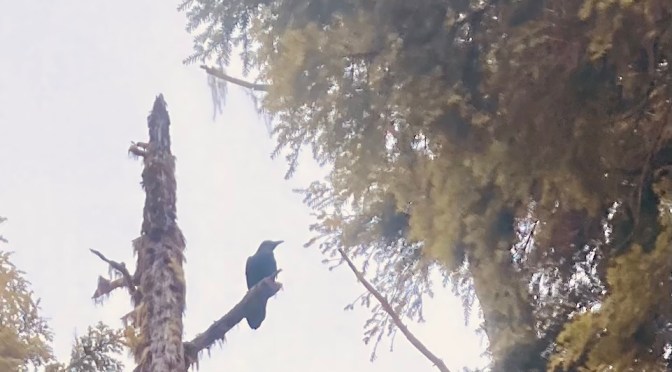
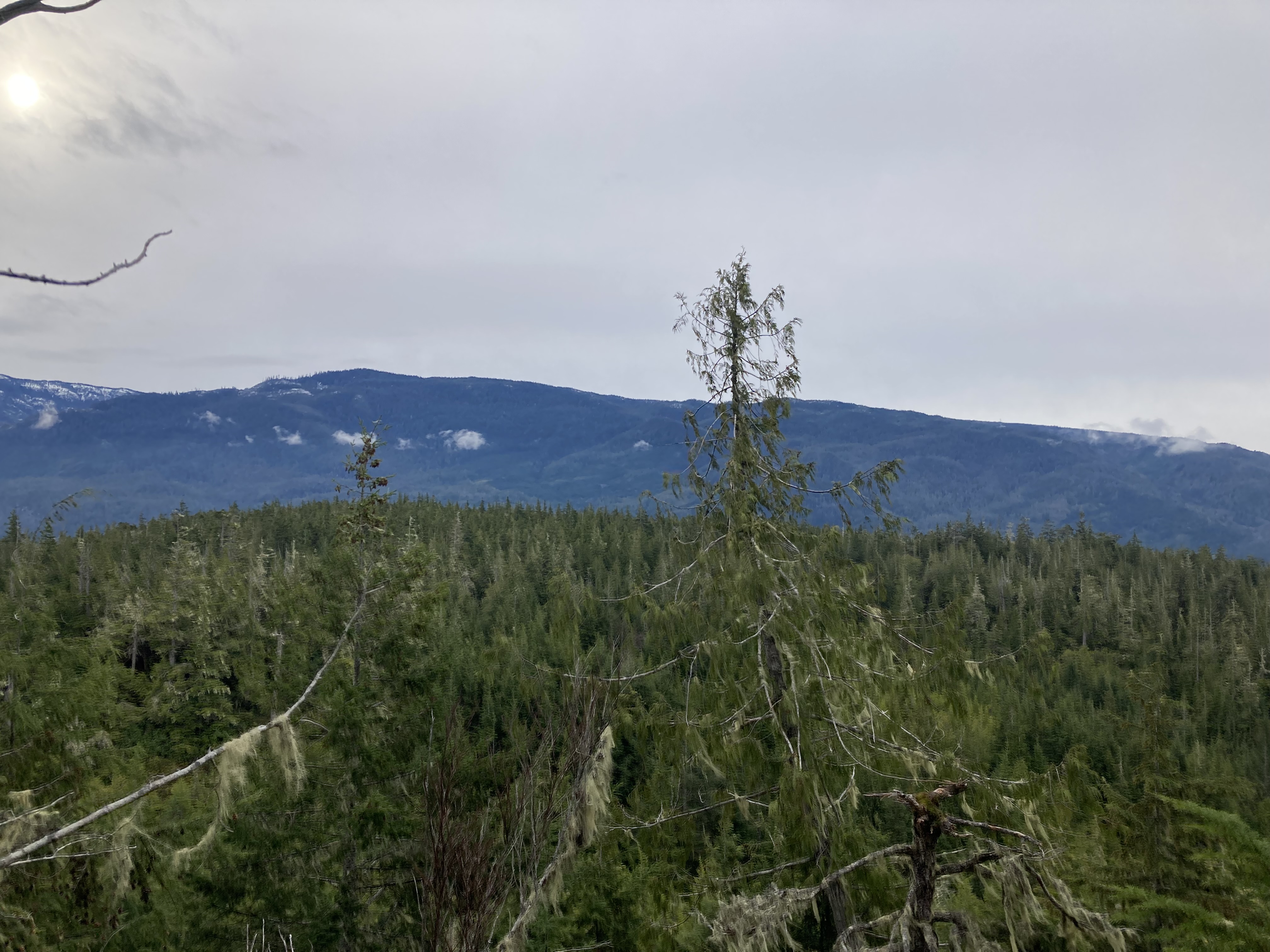
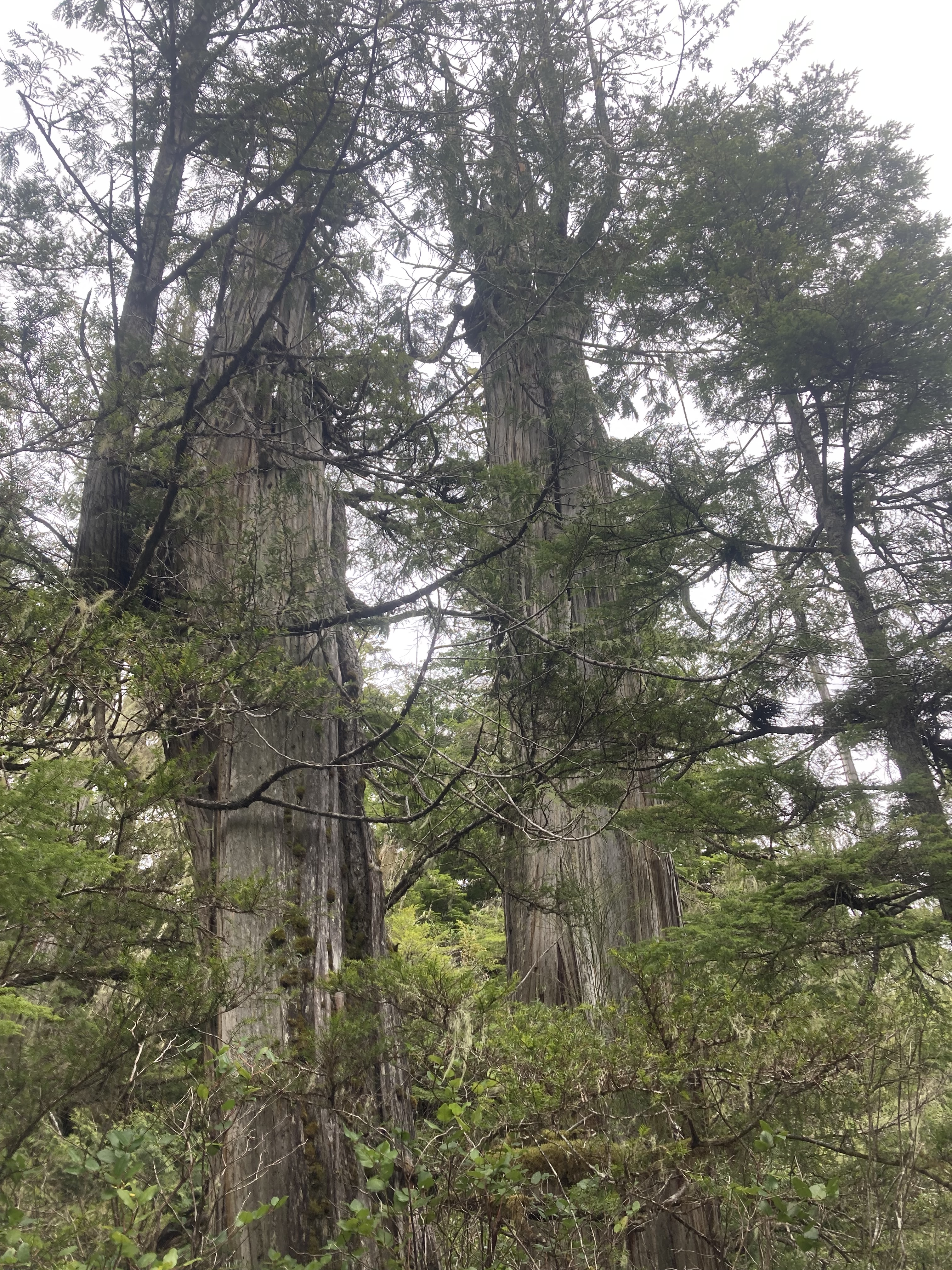
I’d be lost without my phone. It’s hard to admit, even by myself, without so much as a raven to judge me. The salal thicket blindfolded me, the small drainage spun me, and the few windows of sky reveal nothing. I follow the crutch in my hand, allowing it to guide me up one more embankment. A trio of big cedars with intertwined limbs shade a clearing festooned with deer beds. I push through one more wall of salal and gaze from the summit at Vancouver Island’s distant ridges. The hillside steepens, leaving just enough room for a viewshed and a clearing of rocks and lichen. I squeeze fatigued legs to my chest and stare at undulating greens and blues.
***
Harlequin ducks squeak in protest as I paddle by. They take to the water, necks bobbing forward and back as if to give themselves the illusion of more speed. Their rubber ducky chatter conceals their daredevil hobby of surfing southeasterly waves seconds before they break on the rocks. They dive like seals and fly like puffins, frantically beating their wings centimeters above the water. Every tidal rock holds another cluster of them, chattering away and admonishing the yellow kayak gliding past.

Hanson Island crawls by. Every beach beckons to be explored, and twice, I slide into cobbled shores and poke into the woods. I’ve boated these waters dozens of times, always in too much of a hurry to pause. Always hustling either to Alert Bay or back to Orca Lab, usually in fading light or racing the next low-pressure system barreling up Johnstone Strait.
I’m hell-bent on savoring; I linger in non-descript woods for no reason other than they exist. At last, I swing into a narrow bay with steep shores plastered with ochre stars. A lone white buoy bobs at the head, and I pull into a small beach pockmarked with softball-sized rocks.
There’s the trail, just as I’d left it, through stands of alder and up a single-lane logging road recolonized by hip-tall hemlocks. I follow the steady incline under fallen trees and around puddles. A smattering of fish cut from plywood marks the trail with engraved names like “Bobby ‘Sparkplug’ Joseph” that demand exposition.

Past a slippery “bridge.” Clear-cuts glare at me—old ghosts rotting in choking shadow from dozens of same-aged hemlocks racing for sunlight. I stop at one such graveyard and try to remember. Had I noticed these old fallen trees in 2015? ‘16? ‘17? Had I been too naïve and unencumbered? Did the umbrella of protection now stretching across the beloved island somehow nullify the millions of board feet already removed?

I continue past spindly young cedars and gurgling streams, stopping at a fence woven with alder and salal. The gate swings open at a touch and the rusty old bell rings. A cedar shingle sign with weathered words welcomes me to “Earth Embassy.”
Trees sway in the wind, but it’s peaceful in the small courtyard between the old ramshackle buildings. Amongst the weathered old shingled walls, fraying tarps, and a bulletin board tacked with water-stained pages stand two new metal signs.
“Respect this property,” the first sign commands, going on to recognize the site as the home and resting sight of one, David “Walrus” Garrick.
I wait for the creak of a wooden door and Walrus’s long gray beard and mischievous eyes. I listen for the echo of his dog Kessler’s booming bark or the rattle of the steller Jay fed peanuts every morning. But it’s just me in this quiet shrine with the work of one man’s lifetime.
The closest thing we had to a neighbor, I frequently made the hour-long hike from Orca Lab to Walrus’s. Equal parts Gandalf and Dumbledore with a liberal sprinkling of Original Trilogy Obi-Wan, Walrus would crack beers and tell stories he’d undoubtedly told a million times.
Wide-eyed, I’d listen to this living oracle talk about the founding of Greenpeace, protesting seal hunting in the Arctic and working as a cook on the first anti-whaling vessel before the Discovery Channel and Sea Shepard mainstreamed it.
The stories culminated in this place. His final act. The one he’ll be remembered for.
“The longest active roadblock in Canadian history,” he boasted, gesturing at his uninsulated cabin with a leaky vapor barrier, no insulation, and a smoky woodstove.
As Swanson, Cracroft, Parson, and Vancouver Island were stripped clean of timber, Walrus crawled sans-GPS through the salal to document the one thing that could spare the island known in the Kwakwaka’wakw language as Yukusam (‘shaped like a halibut hook’).
***
Red cedar is more than a sweet-smelling, rot-resistant wood that burns hot. Christened the ‘Tree of Life’ by the B.C. Coast’s First Nations, the tree was both canoe, house post, clothing, and basket. Centuries before the idea of forestry was an Anglo-Saxon fantasy, a natural ethos of conservation was a mainstay in Indigenous culture.
Life may have revolved around salmon, but cedar was the tool. Young cedars growing straight and true were set aside. They could be a basket today but, in a few generations, may be large enough to become a canoe, totem, or a corner house post.
Other trees were selected for bark harvesting. Outer bark was collected by making long, skinny incisions, which could then be dried and weaved into water-resistant clothing, baskets, even hats. The same oils that make cedars rot exceedingly slow even served as a natural bug repellent.

Instead of killing it, the harvesting increased the growth rate as the tree covered the exposed area. A cedar could rebound, survive, and even thrive if not too much was taken. The most formative and compelling case for conservation. The best argument that sometimes the word “enough” is the most important.
Prospective logging companies brushed aside the importance of Yukusam’s, “culturally modified trees” (CMTs), claiming that their in-house research showed there were only a couple hundred. Walrus and his team lived out of their active roadblock and pushed into every unlogged nook and cranny, documenting over 2,000 CMTs. For a region and people that had endured disease, assimilation, fish farms, potlatch imprisonments, and the heinous era of residential schools, CMTs are one of the remaining cultural touchstones. Carpet bombing Yukusam would be akin to nuking one of the few remaining strongholds.
Lawyers lawyered. Judges judged. Juries… juried?
And in the end, the remaining Yukusam old-growth was set aside. Walrus continued to live on his active roadblock, building gardens, cultivating shiitake mushrooms, and befriending the local steller jay population. The next generation of Kwakwaka’wakw filtered through the homestead, where elders taught cedar bark harvesting techniques.

These same Alert Bay residents pushed fish farms out of much of Kwakwaka’wakw territory, spurring returns of chum and pink salmon not seen in decades. It would be foolish and irresponsible to credit Walrus with this local revolution, but I wonder if seeing the power of a small team of forest-dwelling activists was another dry piece of kindling on an already growing fire.
***
For three winters, Walrus told me to climb the trail to Yukusam’s highest point. I’d smile, nod, and instead would walk back down the abandoned logging road for Orca Lab, unable to ascertain why. As my final winter as caretaker came to a close, I hiked to Walrus’s for the last time with a backpack laden with groceries. A nasty cough was making it harder and harder for him to lug supplies from sea level to 350 feet. Every couple of weeks, I’d arrive with a loaf of bread, eggs, and a couple beers.
“Did you get up the hill?”
I shook my head, feeling his disappointment, before grasping his hand and wondering if I’d ever see the sweet, eccentric Jedi Master again.
The cough forced Walrus to leave the longest active roadblock a few years later. In 2023, he took his final breath, finally able to breathe deep again.
***
The trail back to Walrus’s is easier to follow on the way down. I tour the old garden and study the pages clinging to the bulletin board. There are maps of the island showing the arterial trails he used to get from one CMT grove to another. Pictures of trees in mid-harvest and cross-cuttings of felled cedars, their age measured in centuries—quotes and documentation of Springer’s homecoming (another story for another day).

Near the front door is a notebook tucked safely in a Ziploc. Inside the little guestbook are the words of those who have visited this place since he passed. I clutch the little memento and stand before his resting place.
Before enlightenment, chop wood and haul water.
After enlightenment, chop wood and haul water.
I open to the next blank page and stare for a long time at the empty lines beneath my scribbled, “Dear Walrus,”
It is somehow lifetimes and seconds since I was here… the longest active roadblock remains intact.
I finally made it up the hill. You were right, it is beautiful. I should’ve done it sooner, but I’m thankful I could return and make it happen.
I’m not who I am without Yukusam. It was orcas that drew me, but that’s not what brought me back. This place is green because of you. Cedars stand because of you, though I’m sure you’d brush that aside with a laugh and a cracking beer.
Chop wood and haul water.
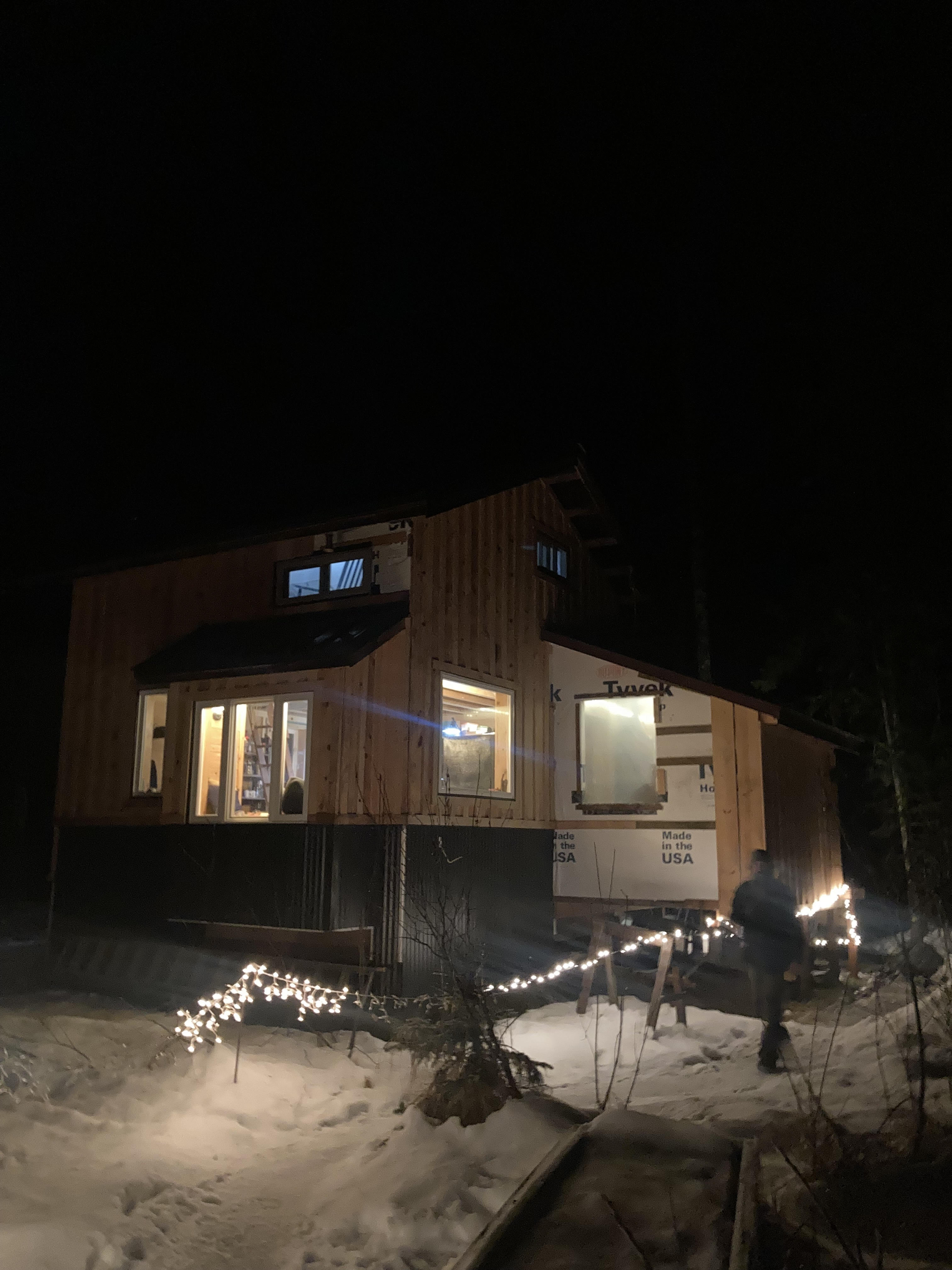
The phrase catches my heart; no five words better summarize my post-Orca Lab life. Wood for a fire, wood for 2x6s, and rafters and plywood. The promise of a warm house.
But the words are not simply literal. I repeat them like a mantra, a meditation, a reminder that some things must not be forgotten, no matter where in the journey we are. Ways of life that tether us to place and home and earth. Edicts as sturdy as a cedar house post.
Chop wood. Haul water. Climb the hills. Get dirty knees. Paddle the beaches. Drink the beer. Smile quickly. Laugh loudly. Forgive easy. Let go of anger.
A raindrop hits the page. I bend over and try to say goodbye.
Thank you for all you taught me. It took a while for some of it to sink in; I’ll never be done learning, never be done making mistakes, but I’ll never stop trying. I chop wood and carry water because of you. Rest easy, my friend. The beer is on me next time.

I return the journal to a house built by trees to protect trees and retreat down a forgotten logging road that will never continue, forever stymied by a fence woven with sinewy salal and shaded by cedars growing in dignified defiance.


 Raincoast Wanderings