Tag Archives: whales

With All Five Senses

We are visual animals. What we see is what we get. Our sense of smell, taste, hearing, and touch takes a backseat to what hits the retina, is fragmented and sent to our brains. And yet the world is so much more than what we see. Or why would we ever get off the couch, board the plane and travel? We don’t want to just see it for ourselves, on a deeper level we want to taste, hear, touch, and smell. And yet… when we arrive our supporting senses again fall away.

For nearly half a decade I’ve watched the behemoth vessels of Princess, Holland America, Norwegian and (gulp) Disney, trace the inside passage. From ten stories up the panoramic view must be breath taking. Never ending acreages of trees, oceans, whales, birds, and bears drifting below the eyes of those that have never seen the natural world in its element. Before their eyes is what brought them here. Is that enough to make one appreciate the land? To change lives? To understand what all can be lost if we don’t change and change fast?

Do we need more? Trees and mountains may inspire as they roll by. But they are visual descriptions, easy to imagine, see, digest, and forget. From atop the ship or within the walls of the lodge, so much is lost. Layers upon layers of the natural world lay hidden just beneath the surface, invisible.

They require us to step off the gangway, out the door, and into the woods and fjords. When we do we find what was hidden was the smell of the ocean, masked by exhaust. The sound of the gulls covered by engine noise. The bite of glacially fed canals, the taste of salt drifting seductively below. We must leave behind 4G and wi-fi and sit in our ancestral home while we still can

I can’t pretend like I’ve always known this.

For three years I worked as a whale and bear guide in Juneau, side by side with the great white boats. While every day brought transcendent moments of beauty, a part of me felt empty. With the rumble of boat engines we felt compelled to add our own commentary and exclamations to the scene. It’s understandable as excitement bubbles over. But the anthropogenic noises of the boat, our feet, and the babble from other boats added layer upon layer to the acoustic scene until the sound of the whales was nearly extinguished. The click of the camera the running questions, the chirp of the iPhone removed the intimacy.

I didn’t think I could be a kayak guide. Didn’t think I’d be able to handle watching whales vanish over the horizon while I paddle slower than I walk. I went into the summer unsure of how I’d adapt. Many days I came home without seeing a plume of whale exhaust, or the shadow of a bear. But when I did, an extraordinary thing happened.

Without the white noise of man’s busy hands, we fell silent. No horsepower no clicking cameras, no thundering feet on metal, no screams and shouts. We were muted by the silence of the natural world. A world so still that from 50 yards you can hear a bear’s claws on the rocks as it turns over boulders. A moment so powerful you don’t as much hear the whale breath but feel it as it explodes from the deep end of the kelp bed yards from your bow.

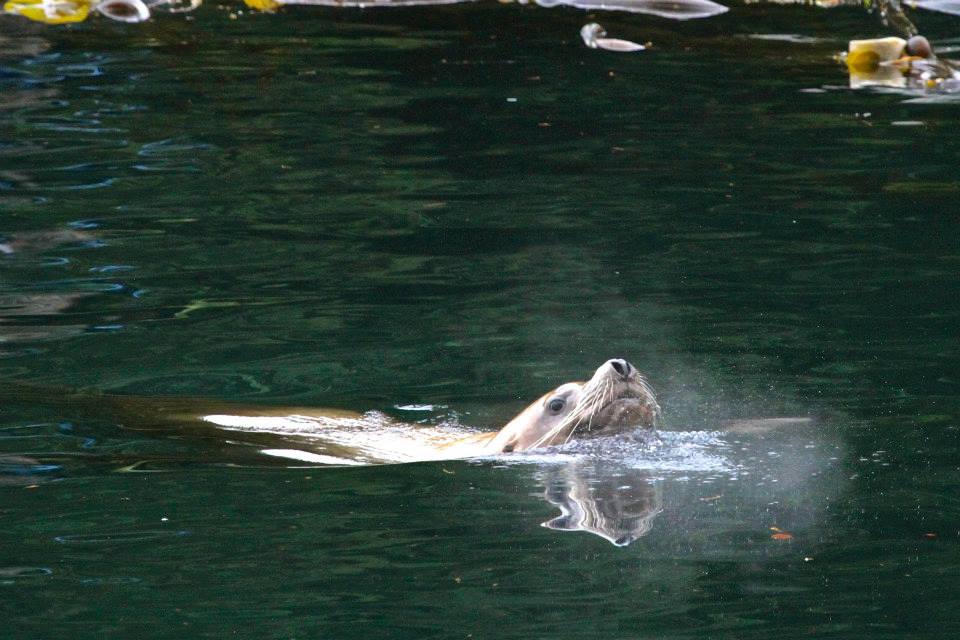
Sometimes we’d just bob meditatively on the tide. Glacier Bay holding us in a trance, hearing the voices we needed to hear; Murrelet, sea lion, harbor porpoise. It would be rude to interrupt.

I began to understand.

It’s not the pictures of the whale that I need. It’s the sound of their breath, audible from miles away. The slimy comfort of the kelp fronds wrapped around my kayak. The smell of salmon so strong that it permeates the ocean’s surface as they pulse beneath the surface. It’s blueberries on my tongue, Common Murres in my ears, whale breath in my nose.

It took slowing down, not speeding up. Paddle strokes over four strokes. Smaller boats, smaller town, smaller mindset.

One of the first questions of the day is invariably, “what will we see today?”

“Nature is unscripted,” I explain, “I can only tell you what we may see.”

“But,” I go on, “I promise you’ll feel the tide, hear more than you ever imagined, and won’t get the smell of salt out of your nose for days. Believe me, in the end, that’s what you really want.”

The Spirit Walker II

That night he lay in his tent, flat on his back, watching the flimsy ceiling growing darker and darker as the sun vanished for its brief summer intermission. For the first time in decades he was scared to close his eyes. It was not fear of bears or the mystical kustaka that held his eyelids open but his own mind, a terror at what would happen to be transported again. The minutes moved leisurely by, apathetic to the knot of tension in his stomach and the anxiety in his head. As the first tendrils of morning light began to materialize Reed could fight it no longer, his eyes shut, blackness enveloped him, and his spirit left.
It was loud here. The foul smell of rotten fished filled his nostrils, his body crushed by the squirming masses on either side. The roars and barks of his neighbors seemed to travel from his ear flaps down his spine, the sound waves of the deepest calls rumbling in his chest. But he could breathe easy here. And when he opened his mouth he felt a deep bellow radiate from his chest, rushing up his wind pipe, past his massive canines and into the throng of brown fur surrounding him.
There was no peace here and he hated it. Couldn’t understand how those around him could sleep in the noise and smells that seemed to be their own living organisms. He looked across the passage to the distant beaches and rocks. It looked peaceful and quiet, perhaps there was even salmon. That was how haul outs started wasn’t it? One brave pathfinder seeking something bigger, better, more. He was that pathfinder, that rebel.
With a gigantic heave he leaped clear of the rocks, the sound of his peers echoing in his ears before being muted by the concussion of his splash. He let his body sink beneath the waves, worshipping the silence and peace. Finally he flapped his long flippers and felt his body glide forward. The water flowed smoothly past his long whiskers as he rose back to the medium of breath and life, thrusting his nose above the surface and exhaling.
The passage was not wide, surely it would take less than an hour to swim, and he lolled near the surface, rolling onto his back, letting the sun warm his outstretched flippers before turning back on his belly to swim a few feet more. Everything was quiet and still. A voice drifted across the water as he rose above the waves, orientating. There was his face, a hand outstretched pointing toward him, mouth open in exclamation. For a wild moment he considered swimming over in greeting, than the water exploded.
He felt his stomach burst, his spine snap, his body helicopter, his human face cartwheeling before his eyes. With a feeble splash he hit the water, saw the muscled black and white mass of supremacy dive into the ocean beside him. Desperately he swam for the shore, his breath coming in gasps, electric shooting pain radiating down both flippers. He had to make it. Had to reach the rocks, start the new rookery, prove it could be done. Behind him he could hear them breath, saw a flash of white slide beneath him, saw the fin cut the water beside him. And in the kayak he sat there. Helpless, unrecognizing, accepting that to live meant to die. That he was a living sacrifice so that his predator could live to swim another day. He closed his eyes, paddled furiously, and braced for the next strike from below.
The searing pain in his gut brought him back to consciousness. His chest heaving, his arms held out above him. still paddling furiously. But the pain was in his stomach, not his lungs. Where the orca had hit him? Where he had hit himself? Where he had watched the orca hit the sea lion? Were all three of them true? Were any of them? Light filled the tent as he unzipped the sleeping bag, pulling his wool shirt up to his neck to stare at his undulating belly. A great bruise covered his lower abdomen, shades of purple, blue, and yellow sprawled across his skin. With a shaking hand he brushed the wound and pulled his hand back as if seared. It was tender, as if he’d been head butted by a massive animal.
Reed brought both hands up to his eyes, rubbing them as if to clear his mind, to exorcise whatever sorcery had inhabited his body. He was alive, he was Reed Brown, 70 years old, male, and human. Not sea lion, not orca, human. As his life faded, the bay seemed set on absorbing what was left of it into its very being. Somehow the thought settled him, calmed him. He saw himself not as a visitor, or passerby, but a living and vibrant family member of the land he cherished. He took another steadying breath; feeling the ache flow from his lungs to his stomach, and unzipped the tent, on tenderhooks for whatever else the vision may have left for him.
But the stretch of bay was innocent and unassuming, and Reed swallowed his breakfast of oats and raisins without tasting a bite. As he paddled away from shore he glanced into the water, shining emerald today in the partly cloudy skies and let his mind drift, imagining the black and white thunderbolt rocketing toward daylight, the exhilaration of the hunt, the terror of the collision, the necessity of it all.
Reed looked ahead toward Tlingit Point where it stood at the base of the two arms and paddled on, pushing the fantasy and nightmare of swirling, unseen creatures from his mind.
He made good progress as he paddled resolutely onward, stubbornly insisting on paddling the full 65 miles from Bartlett Cove to Margerie Glacier at the northern tip of the West Arm. The paddling did what the medication had never been able to do and he once again began to feel invincible, half a century younger, pushing the ocean behind him with every stroke. The sun moved across the sky, dipping for an innumerable time beneath the Fairweather mountain range. Still he paddled on, savoring every stroke, ever riverlet of water that fell from his paddle’s blade, marveling at the perfect vortexes that materialized behind him as his paddle churned the surface. At long last fatigue reemerged from the muscles in his back and shoulders and he succumbed to the limitations of his body, bringing the kayak to rest near Tidal Inlet. The clouds had fallen away, leaving the sky the palest of blues in the late evening light. Eschewing the tent Reed curled up beneath the limbs of the alder and faded into sleep.
He awoke early, feeling surprised at his dreamless sleep. With the practiced movements of countless mornings he devoured breakfast and continued his vigil up the bay’s timeline of his life. He slipped past the “the bay the moose swam across,” the “mountain where the wolves howled,” and finally past, “the beach where she said yes.” Here he stopped in mid afternoon sun, walking the beach toward the massive glacial erratic. When he had asked it had stood at the top of the tideline. Fifty years later the rising land had pulled it into the meadow, the bay, like life, never stops changing.
But it would take more than her isostatic rebound to hide the memories Reed held here. He found the small groove in the rock where he had kneeled, holding out the small gold ring to her, could still see her face glowing even as the rain fell in torrents, their rain jackets like their lips pressed tightly together. Here he uttered his first words since setting out.
“I’ll see you soon, beautiful,” he whispered, a withering hand running down the rock, squeezing a hand he couldn’t see or feel.
Unable to stand in this place a moment longer he turned and sprinted for the kayak and pushed clear of the beach, apathetic to the crunch of fiberglass on the sharpened rocks as he paddled hard for Russell Island, Tarr Inlet, and Margerie.
He paddled in silence the rest of the day, watching the brush shrink away to bare rock that stood creased and scratched by the receding ice, leaving its own graffiti on the land’s geologic story. The east side of Russell Island was alive with life. Dozens of Marbled Murrelets bobbed in the sheltered water of the island, their peeps filling the landscape with the flawless communication of the mated pairs. With practiced grace they dove together only to be separated below by the allure of herring. Breaking the surface they would call to one another until their voices brought them back together. Not until they were side by side would they dive again, filling their bellies until they could barely fly, skipping over the water like flat stones, struggling to gain the lift that would take them to their homes in the old growth forest.
A small sandy spit crawled into view, an inviting bed of moss and shrubs just beyond the tide line. For the countless time Reed brought his kayak onto the beach where so much had happened. It was the beach with too many names to number. But this time there was no ambling bears, no screeching heron, no comfort in his empty tent. He sat up into the early morning hours, listening to the murrelet’s call, watching the lovers come together, suspended on the ocean’s surface tension for a second that lasted eternity, and than dive together once more.
The clouds crawled back over the mountains, the respite was over, and rain began to fall again, rainwater collecting in pools along the creases in his jacket. Finally he submitted to the call of the thermarest, and crawled into the shelter of the tent. Exhausted his eyelids fell like stones through the ocean and he felt his weightless body float through the soft tap of raindrops on the roof, tasting the sweet liquid on his tongue.
He bobbed gently on the water’s surface. The smallest ripple buffeting his body like four foot seas. But he glided with practiced grace over each crest, watching the horizon and mountains disappear from sight in the trough before coming into sight as the ocean held him above. She was near, and his head darted in precise and practiced movements back and forth, even in a crowd of their kin she was unmistakable with her lone patch of bright white feathers along her back.
Reed called out her name, his voice a singular note that peeped through the crowd of feathers, wings, and beaks, seeking out the only one who would know it was him. She answered instantly, the sound serenading his spirit and he paddled vigorously towards her, calling out her name again and again.
“Reed!” Came the reply, “Reed!”
And he saw her. Bright black eyes dilated with excitement as if they’d been apart for months in lieu of minutes. A tiny wave sent him barreling into her, their tiny torsos bumping together as he let out a final call of greeting. For a minute they sat still, staring into one anothers eyes, letting the higher powers of tide and current take them where they wished. Below their friends dived in the wake of herring that fled beneath the surface. He gazed into her face, his 8 ounce body feeling even lighter in her presence. With another call they dove, wings outstretched, brushing gently against each other they plunged into the frigid medium, lightening flashes of herring zipping past their vision. He dove away from her, turning hard to the right, following the fish down, weaving through schools of surging salmon, their eyes wide in surprise, constantly awaiting the next threat, the next predator.
A minute later, a single herring clenched tightly in his beak, he allowed buoyancy to pull him back to light. Even with his mouth full he called, the sound muffled by the dangling fish, saltwater dripping from its tail back to the ocean, the tiny ripples spreading out into the crowded cove. In a sudden rush she broke the surface next to him, her beak empty and he hurriedly forced the fish into her mouth, imploring her to eat, to nourish the egg steadily growing inside her. She let out a tiny bleat of thanks and nestled against his feathers, the current and tides resuming their control over their lives.

The Spirit Walker I

The water shimmered, reflecting shades of gray and green in the morning light. Fog hugged the peaks of the Beartrack Mountains like a cloak, wrapping their peaks in an ever flowing blanket. A determined ray of sun stabbed through the fog and mist, its finger crawling along the liquid mirror of the ocean, moving up the barnacle covered rocks emerging from the midnight high tide. The ray moved beyond the rye grass, turning their grains gold as they floated past, their early morning dew glowing like flakes of gold. It moved past the strawberries above the tide line and the tattered remains of an unmade bear bed abandoned just hours ago, its mattress of moss still warm. From the flat plane beyond a trio of Spruce trees the light finally rested against pale yellow canvas.
Within the tiny tent came the rustles of early morning life, a cough and a groan emerged as cold, stiff appendages protested the early disturbance. Here it was warm, comfortable. Eventually the growl of a zipper floated across the landscape joining the early morning calls of the ravens, murrelets, and gulls. A head adorned in gray wool appeared, brown and white curls peaking beneath, emerald green eyes squinting even as the few fingers of light retreated back beyond the clouds.
Reed stepped clear of the tent and staggered slowly around the trees, ambling down the beach, his gait slow and uneven as he stumbled over loose rock. One hundred yards down, buried in the rye grass lay a pair of black, cylindrical bear cans. Prying the lid off one of them, Reed settled himself upon a broad flat rock and watched the sun struggle to reappear as water rose to a boil making the oats in the sauce pan quiver and dance.
Stretched before him lay the middle and upper segments of Glacier Bay. From his vantage point on Young Island the land opened out before him like a picture book. The long seductive legs of the Y shaped bay tapered off in the distance leading to the destructive and creating forces of the glaciers. After 50 years there were few estuaries, inlets, and passes that he had not explored, slept in, or felt the stinging ice of a sudden storm seeking out every weakness in his jacket and tent. In his mind he could trace the land like the lines on his weathered and wrinkled hands.
Today marked the beginning of his seventh decade on earth. Nearly every summer had been spent here. Biologist, writer, guide, educator, and student. The more time he spent with the bay the less he seemed to know. She was full of surprises. Storms the most skilled meteorologist would be flummoxed by. Dispatching bears, precipitation and tide rips to do her bidding. She weeded out the unprepared and those too quick to romanticize her beauty and splendor. She stole kayaks off the beach with 19 foot tides, hid armies of Devils Club beyond the tree line, and set loose armadas of mosquitos with every opportunity.
Reed had learned from her, evolving as the bay itself evolved. The ice that was her architect never ceasing to carve, create, and destroy its own work of art, biding its time until it grew tired of the masterpiece and sent glaciers charging south to wipe the canvas clean.
A fine mist began to fall and Reed tilted his head back, letting the minuscule droplets fall on his face, the water dripping from his long grey eyebrows, his bleach white beard absorbing the moisture like a sponge. He managed a deep breath and felt the stabbing pain in his chest again, the knife twisting into his lungs, the throbbing magnifying in intensity as it had been for months.
Thirty minutes later, his tent and gear stored fore and aft, he slid his kayak into the shallows sending out ripples that stretched before him to mark the trail he’d follow. With a grunt he struggled into his fiberglass boat, hearing and feeling his knees crack and pop as he manipulated his long legs, stretching them out before him, toes groping for the rudder pedals. Jamming his paddle into the fine sand he pushed clear of the beach, the keel whispering as it brushed over the rocks on the still falling tide. Working against the ebb he paddled north, into the bay that had dominated his life, it was fitting that it should end here.
The minutes bled into hours, time marked only by the creeping movement of the sun still hidden beyond the clouds. The rain came and went as a fine mist, too impatient or lazy to commit. As the day slowly passed, the years seemed to vanish, the pain in his back melting, the stiffness in his legs forgotten. The melody of his youth escaped his lips, the songs of John, Paul, George, and Ringo floating across the water to fall on the boughs of the spruce and hemlock he paddled past.
For lunch he joined the otters in the kelp bed, wrapping stalks of bull kelp around the hull, anchoring himself in place as he produced bread, peanut butter, and a carefully rationed beer. These aquatic forests reminded him of the Tlingit, the rightful tenants of the bay. It was in these forests that they had gone to seek shelter when the wind blew too hard, blanketing themselves in kelp to nestle within the hulls of their boats patiently waiting for the ocean to relax. Such was their faith in the sea, their breadbasket, livelihood, and highway, that even in her most angry moment they would not abandon her.
Freeing himself from the kelp, Reed paddled on, a laminated map pinned under bungee cords in front of him, spelling out the names long ago given to the land in a fruitless effort to bring human order to a world we cannot even begin to understand. Each one conjured up memories, a comfort food for the brain. Long ago he’d started to rename the points, bays, and coves for what he had experienced and witnessed. Just as the Tlingits had given the bay practical names, so had he. They had christened the bay with descriptions and stories. “Place where the glacier broke through,” and “giant rock beneath the green bluff.” He had followed their example, and as south Marble Island grew larger and larger he entered, “passage where the orca hunted sea lion.”
He continued north, infant waves growing in the mid afternoon that had long ago hidden any evidence of what had taken place on an early Spring day years ago. Reed had been just twenty-six, his first season as a kayak guide when they’d stumbled upon the dramatic production of the food chain. The watery wolf pack had exploded from nowhere; perhaps from the underworld in which they’re latin name was derived, to send torrents of white water high into the sharp blue sky. In the chop and whirlpools they rammed their victim, the sea lions eyes wide with terror as the four of orcas circled, dove, and resumed their attack, the youngest looking on.
There was no malice in these creatures, Reed thought as he sat paralyzed 200 yards away, no sadistic pleasure in their hunt. This was life. The only way to survive, to continue the game that had been set in motion eons ago when their parents had followed the retreating glaciers. Had watched as they pealed back the curtain to reveal the labyrinth of islands and channels that would be their home for centuries.
The battle raged for an hour but there was no debate over how the drama would unfold. No sudden plot twists, no unexpected hero overcoming the odds. Nature has little interest in theatrics. Minutes later the ocean had covered up the deed, washing away any evidence, and on the sea lion haul out a mile away, life continued, unchanged.
A gust of wind tugged him back to the present, the tide shifting to flood, the breeze bounding north with the current like a sled dog. The pain in his chest intensified, his toes numb from bracing against the boat. Aiming perpendicular to the rising waves Reed paddled gamely for shore, the trees gaining definition and height as he pulled closer.
By the time the keel had kissed the shore the sun had finally broken through the dissipating clouds, turning the ocean from gray to sapphire and punctuated with rising white caps as the wind grew in intensity. Reed hauled his kayak up the beach. His feet slipping over slick seaweed that held to the rocks like glue. With a final heave he laid the kayak to rest beyond the beach grass in the protective shadow of the alders that signified safety from even the most motivated high tide.
His gear stashed and food stowed down the beach, Reed stretched out on the smallest, smoothest rocks he could find, letting the wind dry the sweat from his cheeks and forehead. Removing the wool hat he ran his hands through his thin and wispy hair. The medication would have made the last of it fall out they’d told him. If he was going to go, he was going with every last strand of hair he could hold on to. The rocks felt more comfortable than any mattress, the pounding of the waves more soothing than any fan. He closed his eyes and laid back, and felt himself drift away.
The pain in his lungs was gone. His body smooth, muscular, and powerful. His legs felt fused together as they pumped in unison. In the darkness he could feel the cold, rushing liquid speed past his face. And though he knew the water could be no warmer than 50 degrees he felt no chill, no shiver radiating up his spine. Just out of sight to his left and right swam his family, his identity, his pod. A whispered voice, high pitched and authoritative floated through the currents and Reed angled his rostrum up as he felt a gentle burn building in his lungs. The water lightened, turning from black to deep blue, a rush of air and his nostrils flexed, opening his airway, spent oxygen returning to the atmosphere. With a gasp he sucked in a fresh breath, sinking below the waves, feeling his dorsal fin cutting the surface and tickling his back. His mother dove beneath him. Her call commanded him to follow and he obeyed without question feeling his sister and nephew behind him, somewhere ahead was his brother. From his moment of birth he wanted for nothing, had lusted for nothing, born into a family that would supply him with all he would ever want.
His mother whispered again and the chatter from his nephew died away, the pod went silent. Oxygen from his last breath would have to sustain him as it pounded through massive arteries. He could hear it now in the ocean’s stillness, a splashing straight ahead and above. The sea lion bobbed on the surface, paddling away from the haul out, bound for who knew what. His timing couldn’t have been worse. Reed’s mother was a master, a specialist in his kind, she had a family to sustain, and if the intuition in her womb was true, there would be another to feed in a matter of months. For five minutes they swam on, a single pump of his tail propelling him further than ten strokes would with his paddle. His mother’s flipper brushed against him, his brother’s dorsal fin grazing his stomach, everything he’d ever need was here.
With a single screeching yelp, they shot upward, bubbles rushing past his face, the light returning, a single ping forward bounced back in a heartbeat, it was a sea lion, it was above, it was dinner, it was survival. He hit it dead on, feeling it’s bones crack against his rostrum, felt it fall away as he broke clear of the water, into dazzling light, saw his own human face alight with shock, wonder, and amazement, the snapshot burning into the back of his head as he fell into the waves, heard his nephew’s excited chitters and dove into darkness for his next charge.
Reed’s eyes snapped open, with a great gasp he exhaled as if coming to the surface after a deep dive. For a moment his head jerked back and forth, orientating. The sun was dipping beneath the mountains of the upper bay, turning the sky crimson, the wind had submitted to the atmosphere’s higher calling, the ocean settling as it prepared for a restful night.
Reed stretched out his flippers…. no, his arms and reached up above his head, his fingers brushed against something that was not rock and his hand froze. He could feel something long and wiry, and another object, firm and pointed. He grabbed a handful of the artifacts and brought them to his face, eyes wide in shock. Rolling onto his side he stared at the sea lion whiskers and claws on the rocks next to him.
Reflexively he stared back out at “passage where orca hunted sea lion,” the memories flooding back. He shook his head and felt water drip down his neck. Bringing a hand to his thin hair he found it soaking wet. As he wiped the water from his mouth he let out a scream as his hand pulled back, a deep red red liquid staining his skin. The tide had risen several feet as he’d slept – is that what it was? – and he staggered to the waters edge. Cupping water in his palms he splashed his face watching the water turn red as he feverishly scrubbed his cheeks and beard clean.
Getting to his feet Reed felt his knees shuddering. With as deep a breath as his lungs would allow he tried to steady himself, to dam the tidal waves of adrenaline ripping through his body like the ocean in full flood on a spring tide. Climbing the beach he returned to the pile of claws and whiskers, each arranged in a neat pile between the rocks where he’d laid. For the longest time he stood on the beach until the water lapped at his feet. Finally Reed knelt down, water spilling over the top of his boots and gently plucked a whisker and claw between thumb and forefinger, carrying them above the water’s reach toward his camp, his mind spinning, his head dizzy.

The Sorcerers

The swelling in my lower back has vanished. The shooting pain in my left shoulder blade melted away with an hour of squeezing into my kayak. Glaciers slide by, deities of a higher calling. They speak in languages well beyond my ability to translate. They groan and crack, their breath cool on my face, stirring the marble colored water that swirls at their feet. In my narrow, 17-foot kayak Glacier Bay towers above, beneath, and around me. Intimidating mountains thousands of feet high, obliging fjords thousands of feet deep, serac steeples, arete cathedrals.
It’s been mere hours since the boat deposited Brittney, Hannah, and I at Ptarmigan Creek in the west arm, leaving us with the Reid and Lamplugh glaciers as neighbors. Bears as our landlords, Oyster catchers the shrill neighbors. Harbor seals, their eyes still recalling the centuries as sustenance for the Tlingit’s slide cooly beneath the waves as we paddle south for Reid Inlet, its glacier, and the sublime. It was impossible not to grin. Surrounded by beauty man can only dream of matching. Reveling in our insignificance, the glaciers and mountains reminding us that our lives are but a shiver in the lives of the epoch.

One Day Later:

The deep bay juts deep into craggy rocks, giving way to gradual, sandy beaches in the back. In our kayaks we sit just feet offshore. With one hand I hold my paddle jammed into the rocks on the ocean side to keep the kayak from being swept into the bay. The other endures the harsh edges of the barnacle smothered rock, keeping the fiberglass hull off the bottom.
Twenty feet away the water depth plummets to thirty feet and at the moment all the riches on the Coral Princess couldn’t tempt me to uproot my paddle and drift into deeper seas. The calm water ripples and 20,000 volts shoot from adrenal glands to toes.
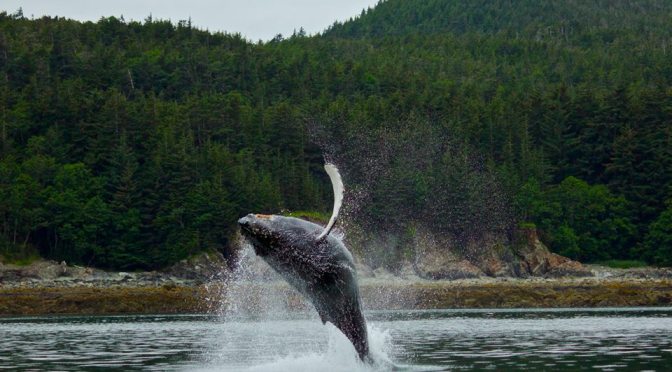
A lunge feeding humpback glides smoothly out of the water yards away, the leviathan’s coal black rostrum lingering at the surface, every bump, curve, and scratch visible, burning its image into the back of my head. The tip of his nose is big enough for me to sit on like a slippery fish encrusted lazy boy.
None of us speak afraid of breaking the spell. As if to verbally acknowledge the miracle will cause the whale to disappear. We didn’t want the water to be safe, we wanted to hover on the precipice of the cliff, leaning as far over as we dared forever at the very edge of his table.
For an hour the humpback glides back and forth within 30 yards, our eyes leaving the water just long enough to glance below us, to confirm we could still see the rocks and sand, that we hadn’t drifted onto the plate. Finally the obligation to photograph overwhelms and I pull the camera free of the drybag. Even with the wide angled lens pulled back, he fill the frame, capturing the image but failing miserably to capture the intimacy, the proximity, the enchantment.

Four Days Later:

The real world. At least as real as we allow it. Back to work, back in our green boats, vacation over. The waters of Bartlett Cove filled with wonder no matter how many day trips you led. Beneath the waves teemed otters, humpbacks, seals, porpoise, and today…
“Brittney, there’s an orca.”
I don’t mean to sound sharp, don’t mean for the intensity and fire to spit out my mouth like a dragon. But orcas do that to me. Give me tunnel vision, making the rest of the world vanish. From my seat inches above the water I watch the smooth 6-foot dorsal of a male slide back into the waves 500 yards away, making its way into the cove. This doesn’t happen.
Guiding instincts kick in long enough for me to point while the 17-year old within, the one that ran to British Columbia for this very moment screams to paddle and paddle hard.
Our five boats cut through the water toward the mouth of the cove, in the distance the Fairweather Mountains glow in the early morning light as around the point come a trio of gunshots, three more roll into view. Cationic with delight my boat slides across still water, every stroke bringing me closer, hot on my keel is Brittney and six incredibly fortunate clients.
I try to explain the magnitude, that this doesn’t happen. They aren’t supposed to come into the cove. In my mind I beg them to stay. Keep coming in, almost there, almost there.
Behind me Brittney calls out and our little flotilla stops paddling, our boats succumbing to the tide’s authority. We sit in a jumbled array as like fireworks, the orca’s break the surface. The male continues his course down the middle of the mile wide cove. While three more break the surface between us and Lester Island. Another breaks off from the male and swims toward the boats.
I should call the park, dig out my phone, document, tell someone, but I’m past words. I’m 17 again, bobbing in a kayak off Cracroft Island, watching the A36s swim by. Nearly ten years later they still hold unimaginable power over me. Keep me coming back to the water, always scanning, always listening.
They’re watching us. A juvenile no older than five materializes thirty feet off my port, the sun catching her eye before she disappears. Her mother rushes in, corralling the rebel and guiding her away. The windless day is filled with the sound of their breath. Explosive exhalation and the harsh rasp of every inhale clearly audible. There’s no boat engines, no hollering, no clicking cameras. Everyone watches in great silence, knowing nothing can even begin to do them justice.

Giving Up Control

Forty feet, forty tons, one ton per foot, half ton of herring per day each carrying as much fat as a Big Mac. For three summers I handed out quantitative factoids like science flavored tic tacs, sometimes three times a day with my brain sliding into auto pilot. I’d try to encompass the life history of a humpback whale before the engines roared above 3,000 RPMs, drowning out my voice.

And yet, there is a detached feeling from the bow of a boat, the railing a secure barrier between man and whale. You see them, hear them, hell, sometimes you can even smell them, the rotten smell of herring or the curiously enjoyable scent of cucumbers after they’ve been scarfing capelin. But you are separated, protected by that steel hull, the constant grumble of the boat engines. Yet the safety comes at the price of intimacy. There are memorable moments of course, the alarming sight of basketball sized bubbles encircling the boat, the high pitched scream of the feeding calls reverberating through my boots.

“John! We’re in the net!”

“Oh my,” the captain answered, sliding the boat smoothly into reverse, clearing the net just as ten mouths break the surface, herring and saltwater running down their throats.

But nothing compares to a humpback at sea level, from the seat of your kayak. With nowhere to run or hide, the whale in complete control of the encounter. The extraordinary recipe of fear, excitement, and pleasure as the tail rises, vanishes, and you realize that its pointed directly at you. Do you go forward? Backward? Turn towards or away? Is the whale going to swim straight or zig zag? Your mind pulls you deeper into the wormhole. Is it feeding? Lunging? Your stomach tightens, what if it lunges, you glance shiftily in the water below your boat, here? In your mind you see the massive maw, rocketing through the column like a rocket. There are no engines, no barriers, you are completely and entirely in their territory. What happens next is up to them.

“It’s not that I think they’d try to hurt me.” I explain, “it’s that they don’t have to try, all they have to do is shrug their shoulders and… you’re airborne.”

So you just bob in the currents, eyes shooting back and forth. You have five to ten long, spell binding, exhilarating minutes, like a drawn out suspense scene in a Hitchcock film, waiting. “You gotta breathe,” you whisper into the silence. No matter where the whale surfaces you just want it to happen, to break the tension.

On calm days you can see the shadow first, than a bulbous bulb of water as the whale rises, the water’s surface tension covering the body like cellophane. Until finally it breaks the surface, spent air shooting into the air like a volcano, the bass of the exhalation resonating in your chest.

And so a stupid grin spreads over your face, soft exclamations escape your lips as you sit under its spell until the back arches towards the sun, the tail hovers parallel to the sea for a brief moment, water dripping from the trailing edge, and finally vanishes, into the world that we cannot follow. For a few moments you bob in the whale’s wake, your heart pounding, fingers tingling, adrenaline coursing. And than you start to wonder… should I go forward? backward? The curtain has fallen, the next show will begin in ten minutes. Try to find something pretty to look at while you wait

Different View, Same Soundtrack

I wake to the gust of cold wind on my face, the breeze a soothing tonic against my cheeks, encouraging me to dig deeper into my sleeping bag propped on the deck chair of the ferry’s solarium. It’s not even seven but the horizon already glows with rosy morning light, soothing confirmation that we’re still moving north. I poke my head out and look over the rails, my heartbeat slows. Gone are the buildings, the roads, the lights that had bombarded us from the shore as the sun went down with nothing more than the occasional lighthouse to interrupt the parade of rocky beaches and mighty cedars.

I stare out at the blue road ahead, the trees slowly melting by. Less than 24 hours ago we had been sitting in traffic, trapped on the I-5 with nothing but outlet malls and tail lights for company. I could feel my world realigning with the compass pointed resolutely north away from the alien world of cities, suburbs, and concrete. I return to my sleeping bag drinking in the cool spring air, and go right back to sleep.

The mountains feel like old friends, familiar faces as the ferry steams into Juneau. Auke, Thunder, and McGinnis, call out in greeting as we drive down the ramp, bleary eyed but exhilarated to be home. The Mendenhall Glacier still stands guard at the foot of the towers, with Thunder and McGinnis mountains guarding its’ flanks. How good it felt to be back, the comfort, the familiarity, the mountain’s friendly faces, extinguished any longing for Hanson Island. If I couldn’t be there, this was the next best thing.

24 hours later, we were finally done. The Pathfinder sputtered to life one final time, taking us up one final ramp and into the town of Gustavus. Town however, may be to generous. The lone stop sign lies a mile and a half inland from the ferry dock, affectionately known as, “four corners” the only intersection in town. Everywhere you look are mountains, but unlike Juneau, they lie benignly in the distance. The town is midwest prairie flat, a quirky anomaly in a region in which towns are built on, around, and through mountains. In spite of their distance, the mountain’s names come back to me easily like a familiar song that you haven’t heard in years. The mountain ranges of the Fairweather, Beartrack, and Chilkat surround us to the west, north, and east. To the south, across Icy Strait, is Chichagof Island, its own collection of mountains give the impression that we are in a massive bowl surrounded on all sides by distant peaks.

We slow to a stop and consider our options. Two of the four roads lead to the two ways out of town, the ferry behind us, and the airport, the third leads down a dirt road, the left hand turn is the longest, stretching north past unassuming roads dotted with log homes and protected by thick canopies of spruce and hemlock. Seven miles down later it ends in Glacier Bay, the crown jewel of southeast Alaska. It seems fitting, that in a land renown for its’ natural beauty, it’s most marvelous feature would lay, unassuming, next to a tiny hamlet accessible only by air and sea.

Here there would be no tour buses, no fleets of helicopters or airplanes, no navy of whale watching boats. If you wanted to be here, there would be no shortcuts. In the summer months a pair of cruise ships would ply the waters of the bay, rushing up the west arm of the Y shaped bay to sit in front of the Margerie Glacier. But for those that wanted to truly be here. To trace the footsteps of John Muir, Stickeen, and others, there would be no port of call.

It was perfect. Years ago someone asked me to describe what Glacier Bay and Gustavus was like: “like someone dropped a bunch of people here in the 70s, and airlifted in a bunch of Beatles vinyl.” Every passing car waves, every face lit into a smile. Moose poop frames our yard along with a gentle blanket of willow and baby birch trees. The scene is so different from the one we left on Hanson Island, but no less beautiful. No less peaceful, no less… us.

Our first morning brings a striking similarity. As I crack the door to let the cat resume his life of roaming through the forest, a Varied Thrush calls out from a nearby Spruce and is immediately answered by another. One week and a thousand miles later, the same birds continue to serenade us, reminding me, that, no matter which country we’re in. We’re home.

Hanson Island Life Lessons

Every week and a half the fridge begins to look bare, the tortillas are gone, the beer and wine but a distant memory. The marine weather report is lit up in crimson, gale warning in Queen Charlotte, storm warning in Johnstone Strait, rain, wind, small craft advisories. On a good day Alert Bay is just thirty minutes by boat away, weaving through the Plumper and Pearce Islands, sending torrents of frothy white water over the deep green waters is nothing short of cathartic. It’s just finding enough of those days that can be the struggle.

And so we look for “windows.” Six hour blocks where the wind dies, the rain lessons, and the boat floats. As the storm inhales for another blow you run for town before the next exhalation. But after eight months of this game, pulling the boat up and down the beach so water lifts it off the rocks at just the right time, it feels commonplace. The fact that we once lived half a block from a Rainbow Foods absolutely absurd. We’ve traded the convenience of stores, bars, and restaurants for the simple tranquility of wilderness.

In a few weeks we’ll be gone, on our way back to civilization. At least our definition of it which entails residing in a town of 350 people. But right now that feels more like a metropolis than hamlet. Certainly there are things we’re looking forward to, I mean, we’ve talked to just a handful of people face to face this year. No longer having to correlate tide height and wind with fresh lettuce will be convenient. And I really do miss Alaskan IPA.

But more than anything, I’ve learned a lot about myself over the winter. I landed my first paid writing gig, wrote thousands of words for a novel that I’ll probably let no one ever see, and am just a season and a half away from watching the show, “Friends” all the way through.

Brittney loves the website, mindbodygreen.com and there are some great articles and information to be found. She hates me for pointing out however that the site is often flooded with “top 10” lists. Top 10 ways: to know your man has a good heart, yoga pants, fat burning foods, etc. Now it’s all she sees… she may never forgive me. But I’m going to conform, and walk through the ten things that I’ve learned this winter on Hanson Island.

1. How ever much time you think you have until the boat is aground, subtract by ten minutes. You’ll save yourself a lot of disappoint, frustration, and expletives.

2. Mice will find a way into your house. Steel wool, blockades, and a cat will only do so much. Accept the inevitable, keep the counters clean, and check under the propane stove frequently.

3. It is perfectly acceptable to wake up in a cold sweat because you just dreamed that you could hear orcas and aren’t recording.

10537056_10153151080044852_18244022817751455_n

4. No matter how much you hoot and holler at them, Stellar Sea Lions will not give you the time of day.

10659202_10153342628774852_4448842526100652252_n

5. Orcas love to call at dinner time, so you stuff your plates into a plastic milk crate box and lug it all over to the lab and have dinner with headphones on.

1901153_10153342624724852_3285441612895050163_n

6. Bath Days are a gift from God and should be worshipped as such.

10995804_10153726757494852_7811731726412708212_n

7. Mink will live under the house, they’re cute but smell terrible, your cat will want to make friends, the mink will not acquiesce. 11081015_10155300238395858_6083581184589343527_n

8. Porch baths in December are a necessity. Treat them like a Nascar pit crew changes tires. If you’re not out and back inside in under five minutes you are a) doing it wrong and b) probably borderline hypothermic.

9. Bring pets. You’ll need someone to talk to when your wife gets mad at you for ruining her favorite website.

10994155_10153690504119852_621681021897676100_n

10. There is nowhere on earth like this place, nothing can replace it or come close. So enjoy every moment you have here regardless of the time of year.

_MG_9262

Stepping Back

When I first came to Orca Lab in 2008, I expected some sort of sign. Some sort of intimate and personal encounter with the whales to justify the sacrifices, work, and effort I had gone through to reach this place. Orcas, it turns out, have little interest in storybook endings. They went about their lives as if I were invisible. It was odd, the orcas owed me absolutely nothing, but so convinced was I that some spectacular, “ah-ha” moment would arrive, that to leave without having gotten within 200 yards of a whale was, not a disappointment, but a hit to the ego.

“Don’t you ever get tired of watching whales?”

It was a common enough question working on a whale watching boat, and I suppose it should have been predictable. I mean, the majority of my clientele had work that they actually looked at as, well, work. I just saw it as a free whale watch every day, like someone had offered me season tickets along the third base line for free. How could you get sick of that?

The question would always rise to the surface just as the humpback was slipping below, meaning I had 5-7 minutes to explain why no, I don’t get sick of watching massive aquatic mammals breath. I’m nothing more than a commercial while the show dives 200 feet below us for another mouthful of herring. The guy who banters on stage while the band tunes their instruments.

“They’re like potato chips,” became my generic reply, “you can never say enough.”

But for those that would probe, that actually wanted to know and weren’t just making conversation after realizing that no, your iPhone will not get service out here, I’d go a step further.

“Because you never know what might happen. If someone calls and needs you to take a trip… you take the trip. The last thing you want is to come home to a phone call, and find out you missed the trip of the lifetime.”

But 100 yards stands between the deck and a trip of a lifetime. For the many who have read the stories of Erich Hoyt, Paul Spong, and Alex Morton, it’s a tantalizing distance. We want a moment like Morton had, being led by the A5s through the fog, or Erich Hoyt in his rowboat, bobbing in the bight, surrounded by whales.

But that age of orca research and watching has come to an end. With restrictions and limitations enforced, we’re at the mercy of the whales to swim that football field distance and set the stage for the sort of encounter we crave. Perhaps we love them too much. Our addiction as harmful to them as potato chips are to our arteries. We crave these moments, and stand breathless on the deck of a swaying boat, hoping for a flash of white, a bubbling surface, an eruption of carbon dioxide as the whale breaks the water feet from us.

And it does happen. After three years and countless hours on the water, I had a few holy s— moments; I was splashed by an orca, had one circle the boat, it’s oval eye patch staring into my soul, and had 14 humpbacks materialize from nowhere, surrounding us in a bubble net of desperate herring. And all it took was thousands of hours, and the sheer luck to be in the right place at the right time.

Six years later I returned to Hanson Island, reluctant to share some of the most intimate whale experiences with my fellow volunteers. I had been extraordinarily lucky to have a job that allowed me to buy a lottery ticket every day and cash in on the minuscule odds. But that summer, I found a much more rewarding and fulfilling experience. As much as I’d loved my time on the water, a wriggling feeling of guilt had grown as I thought about the deafening noise my coworkers and I made in their home.

The whale watch industry grew and with it, the pressure on the humpbacks and orcas until every daylight hour was spent in the company of at least one, and almost always several boats. I couldn’t measure how much of a disturbance I was causing, but the uneasy feeling in my stomach told me however much it was, my conscience was not ok with it. I began to despise the 700 HP engines on our stern, giving us the authority to decide when the whales could be free of us. Were these experiences worth the boat noise and fuel? The hours hovering above their kitchen table, knowing if it was up to them they’d probably have us disappear?

Instead of intimate face to face encounters, I craved anonymity. I wanted to see, but not touch, observe but not alter, be it from 5 yards or 500 didn’t matter. Perhaps I’m biased. After all, I can still see that orcas tail rising off the stern of the boat, sending water cascading over us. But nothing felt as rewarding or special as a misty, fog drenched morning at Cracroft point.

As the tide ebbed I inched down the rocks, slipping and sliding over the kelp, my camera slung over a shoulder, a lens the size of a baseball bat swaying ominously. Stopping just shy of the water I looked east down the strait, the sun cutting slashes in the clouds ahead of the oncoming rain storm. Right along the Cracroft shoreline I saw them, the A23s and A25s plowing through the strait, pointed directly at me. I raised the camera, Paul’s words ringing in my ears, “get A60s photo.”

The group filed past, exhalations like gunshots ricocheting off the rocks. An image of A60s dorsal flashed in my mind, like the face of someone I hadn’t seen in years, the big notch two thirds of the way up the dorsal made him easy to ID, and as the picture filled my head, his dorsal filled my lens.

I held my breath to steady the camera, and pushed the shutter, immortalizing Fife on a 6 GB chip. He couldn’t have been any closer than 150 yards, a distance many in the whale watch industry would yawn at. But a tear slid down my face as he disappeared. A few years ago I’d have wanted Fife to know I was there, to see some acknowledgement of my love and interest. Now… I wanted anything but that. Just to have a brief window into his world, and know that his calls were blowing out the speakers back at the lab was plenty.

The whales slipped by, milling briefly in the entrance of Blackney before steaming north. As if waiting for them to pass, the rain arrived, drenching me as I stood on the deck, reveling in the knowledge that they had no idea I was there. The group slowly faded from sight, there fins merging with the streaks of rain and background of the islands. But I continued to watch until they vanished from view. After all they’re like potato chips, you can never say “I’m full.”

Quiet Places, Open Spaces

Shadows stretch across the bay, the surviving sunlight turning a deep gold against the water and trees on the far side. We sit on an old, rotting 2×4 propped up by rocks, watching the island in the middle of the bay transform into a peninsula as the tide ebbs away. Around us boxes of food stand in pyramids, accentuated by a case of beer and a bag of dog food like a massive sack of flour.

But Walrus is in no hurry to start the haul up the hillside to his cabin shrouded in the woods. So we sit, beers in hand, with nothing more pressing than watching the water slowly drain out of Dong Chong Bay.

A great blue heron materializes out of the woods, it’s prehistoric shrieks echoing off the steep vertical cliffs around us, alighting on the island. A raven swoops passed and alights on the branches of a birch tree above. He speaks softly to the bird in a tongue I don’t recognize. Undoubtedly it’s the native language of the First Nation people that called Yukusam (the native name for Hanson Island meaning “shaped like a halibut hook”) home. The words seem to permeate from the trees and ocean, as alive and authentic as the island itself. If the trees could talk, it would be in this voice. Not the voice of my ancestors who had arrived and hunted, logged, and eternally altered the very land we loved.

The large, rocky plateau we sat on was far too smooth to be the work of the ambitious and almighty glaciers that long ago preceded us. They deposited erratics and islands with the callous randomness of an artist flinging paint at the canvas. This was deliberate, a stronghold for the logging trucks and chainsaws that Walrus had fought and defeated.

Even in this beauty, in the perfect stillness, it seems pertinent to mention it and Walrus nods in affirmation, as if he needs any reminder of what took place here.

“In the U.S we put aside these pieces of land as wilderness that can’t be touched, developed, or mined.”

Walrus lets out his high pitched laugh, “but is anywhere untouched?”

“Exactly.”

I remembered camping in the Beardslee Islands in Glacier Bay. Alone, surrounded by acre upon acre of wilderness. Only to watch commercial jets rumble over, their contrails leaving white slashes across the blue sky. The cruise ships rumbling by, black exhaust spewing above the mountains, wakes unconcerned with the wilderness boundary. Untouched wilderness indeed.

He wanders over to the case of beer and hands me another, the crack of carbonation drifts across the water. With an indignant call the heron rises from the rocks, wings beating a slow rhythm as it vanishes.

“How can we even classify something as wilderness?” He asks.

“That’s the thing. Are we trying to recreate a land before Europeans? Or native Americans?”

Regardless, the ghosts of North America cannot be revived. The mammoth, the Stellar Sea Cow. We talk about how the great plains were once home to 12-foot bears, lions, and camels. An indescribable amount of biomass and apex predators. Until man arrived and claimed the top of the food web for him alone.

“Extinction started with the arrival of man, not Europeans of course.” He cautions.

“Of course. It’s a European arrogance, that we can put back together the pieces that we’ve ripped apart.” I say. “It’s the best we can do I suppose though.”

“When the Spaniards arrived in central America, they found the Mayans already had chickens.” He looks at me, his long grey beard crinkles into a smile, his eyes dazzle beneath long curling eyebrows, “they just assumed, hey, they’ve got chickens here just like back home!” He pauses and takes a drink, “of course they were Asian chickens,” he finishes laughing, letting the message sink in.

“You don’t read that in your history books. Or Columbus’ Haitian massacres, or the sculptures depicting people of African descent. We weren’t first, but we in some way won. So we get to claim credit, and dust our transgressions under the rug.”

He smiles again and we tilt our beers back, I’m talking conservation and anthropology with one of the founders of Greenpeace.

“That’s one of the difficult things about anthropology and natural history. It’s a lot of extrapolation and assumption, we can’t know much for sure.”

“Which is why we need time travel,” he says.

“I know where I’d go,” and I point out the mouth of the bay, to sparkling waters of Blackfish Sound, “right here.”

I talk about trying to imagine Dong Chong without logging roads, the orca lab site before the lab, my desire to see this place in as natural a setting as possible. “Post ice age of course,” I finish.

He nods, “I bet it’d be something.”

“Salmon so thick you can smell it on the wind,” the very thought gets me excited, “blackfish so thick you can walk across their backs,” I say quoting Billy Proctor, the legendary jack of all trades that had lived in and around the region since the 30s. “In another age of conservation maybe.”
We lapse into silence, drinking in the scenery, the peace and tranquility that cannot be quantified. No bottom line, no profit margin or material good could ever begin to explain what these places mean. Because they live not on paper but inside. The by products of the wind and trees, ocean and waves, saying more without a word than I ever can. Causing a spiritual upheaval I can only begin to explain.

It’s for this reason, that we’re coming back next winter I tell him. Like Paul, he’s spent decades on Yukusam, unable to find anywhere else that compares for the same unwritten reason.

“It’s going to be almost a year since I had a real job. It’s been incredible.”

A knowing smile pushes through the beard, “it’s hard to think about going back to it isn’t it?”

“You have no idea.” I answer, knowing full well he knew exactly what I was talking about.

A Deathbed Lesson in Living

For my entire life I’ve been blessed to live in a place that other people visit. Not the Bahamas, or southern California, or Europe; Alaska. The Last Frontier, Land of the Midnight Sun and whatever other catchy tagline we’re using these days (Palin’s Pasture?).
For three summers I had a front row seat to those retracing the routes of John Muir, the gold rush and sled dogs. I worked in Alaska’s capital, Juneau as a whale watch guide, deckhand and bear guide (bear viewing that is, not hunting).
I was fresh out of college, and had just had the rug pulled out from underneath me. I had lined up an entry level position with NOAA (National Oceanic and Atmospheric Administration) only to have the federal budget frozen and my position unceremoniously tossed out four weeks before I was supposed to begin.
I didn’t know the first thing about guiding. But I knew whales, the ocean and my Dad had once been charged by a Grizzly so I felt qualified. Virtually the entire tourism industry in southeast Alaska centers around the cruise ship. The 2,000 passenger floating hotels that market themselves as holding everything you could ever want.     Upwards of 15,000 people can flood Juneau off the boats in the summer; a town with a population of about 33,000.
I fidget on the dock. Bright orange polo tucked into Carharts, black and orange ball cap jammed on top of curling blond hair. I feel like a 6’4” carrot. Slowly couples begin to gather around me; from Germany, Texas, Boston, and Australia. I hand out the weight sheets to ensure the planes are balanced for the flight portion of the tour and try to make conversation. A beer or two would’ve helped.
My last couple staggers slowly down the gangplank towards me. It’s immediately clear that all is not well. The husband’s steps are uneven, his breath ragged, he looks exhausted and beaten. Cancer will do that.
As we board the bus bound for the airport his wife pulls me aside. Yes, her husband was terminally ill, his life expectancy could be measured in months. But if I could, please, try to treat them as normally as possible.
I climb the steps behind her and collapse into my seat mind whirling. I was supposed to be in a lab, or a research boat measuring the bioenergetics of forage fish. Fish that couldn’t tell me their physical condition. That there last wish was to see the glaciers of Alaska.
What the hell had I gotten myself into? What did this man care how big a humpback whale was? How long a brown bear slept or how much fish they could devour in a day?
The trip slides by as the plane sends us over the glaciers and over to an island called Chichagof which has one of the largest concentrations of brown bears in the world. Naturally we see none. Nature doesn’t understand the concept of the storybook ending.
In the small native town of Hoonah, a boat collects us and we begin the three hour trip back to Juneau eyes scanning for whales. Slowly I begin to pluck up the courage to talk to him. His name is Dan, he’d lived his whole life in Houston, Texas and had just been diagnosed a couple of weeks ago.
He’d rejected chemotherapy and other treatments, emptied their bank account, and was seeing as many of the places he’d dreamed of experiencing before the sickness shackled him to a bed. Alaska had been his number one pick.
Juneau had been their boats first stop. “No pressure,” I told myself. I apologized that the bears hadn’t shown, that the glaciers had been partially obstructed by clouds.     He shrugs, “it’s just enough to know that I’m here.” he answers.
Twenty minutes later a humpback blasts out of the water like a rocket, sending a crescendo of foam across the surface and we cheer like our team just won the Super Bowl. There’s a spark in Dan’s eyes, a glint of joy and life that I can still see four years later. For a few seconds he looks reborn until another coughing fit sends him back into the boat’s cabin.
An hour later we’re within sight of Auke Bay, Juneau’s largest harbor. From the water, the Mendenhall Glacier looms over the boats bobbing along the dock. Even from two miles away it dominants the skyline like a giant frozen sky scraper. The boat captain screams the boat to a halt and ushers me onto the deck with Dan and his wife.
“Get their picture with the glacier,” he whispers.
They lean against the boat’s railing, the ice framed perfectly above them. I swallow a lump in my throat and blink away tears. For the second time Dan looks half his age as he dots a kiss on his wife’s cheek and wraps an arm around her as I click off a shot. The moment passes, the boat revs, and they slowly move back inside, wrapping their down jackets tightly against the wind.
Minutes later we’re on the bus, headed for the cruise ships 15 minutes away. I search for something comforting or inspiring to say. Some magic words that could somehow make their plight better. Instead I just listen as they talk about their kids, their work, their life. My ears doing more than my tongue ever could.
Feet from the dock Dan looks out the window and sighs, “it’s a magnificent place you have here, David.”
“Thanks, but it’s not mine, it’s all of ours. It grabs hold of something deep inside of us, resonates, makes us whole.”
He nods, “I wish I would have seen it sooner so I could climb the mountains. Maybe go fishing, you hunt?”
I confess that I’ve never killed anything bigger than a salmon.
“Well don’t wait,” he said, “live out your dreams while your young, don’t wait for your come to Jesus moment.” His wife sniffs and he gives her a little squeeze.
The bus stops, I shake Dan’s hand and hug his wife. Slowly they walk away, inching up the gangway, his last words echoing between my ears.
Don’t wait, live now. See what needs to be seen. Breath the air, walk the trails, climb the mountains, swim the rivers. Don’t let life get in the way of living.
Four years later I sit in a cabin perched on the shores of British Columbia, living. NOAA never called back, hallelujah. Maybe I’ll get a real job some day but I doubt it. Not after seeing that look in Dan’s eye as the humpback broke the surface, telling me everything I’d ever need to know.