
For my entire life I’ve been blessed to live in a place that other people visit. Not the Bahamas, or southern California, or Europe; Alaska. The Last Frontier, Land of the Midnight Sun and whatever other catchy tagline we’re using these days (Palin’s Pasture?).
For three summers I had a front row seat to those retracing the routes of John Muir, the gold rush and sled dogs. I worked in Alaska’s capital, Juneau as a whale watch guide, deckhand and bear guide (bear viewing that is, not hunting).
I was fresh out of college, and had just had the rug pulled out from underneath me. I had lined up an entry level position with NOAA (National Oceanic and Atmospheric Administration) only to have the federal budget frozen and my position unceremoniously tossed out four weeks before I was supposed to begin.
I didn’t know the first thing about guiding. But I knew whales, the ocean and my Dad had once been charged by a Grizzly so I felt qualified. Virtually the entire tourism industry in southeast Alaska centers around the cruise ship. The 2,000 passenger floating hotels that market themselves as holding everything you could ever want. Upwards of 15,000 people can flood Juneau off the boats in the summer; a town with a population of about 33,000.
I fidget on the dock. Bright orange polo tucked into Carharts, black and orange ball cap jammed on top of curling blond hair. I feel like a 6’4” carrot. Slowly couples begin to gather around me; from Germany, Texas, Boston, and Australia. I hand out the weight sheets to ensure the planes are balanced for the flight portion of the tour and try to make conversation. A beer or two would’ve helped.
My last couple staggers slowly down the gangplank towards me. It’s immediately clear that all is not well. The husband’s steps are uneven, his breath ragged, he looks exhausted and beaten. Cancer will do that.
As we board the bus bound for the airport his wife pulls me aside. Yes, her husband was terminally ill, his life expectancy could be measured in months. But if I could, please, try to treat them as normally as possible.
I climb the steps behind her and collapse into my seat mind whirling. I was supposed to be in a lab, or a research boat measuring the bioenergetics of forage fish. Fish that couldn’t tell me their physical condition. That there last wish was to see the glaciers of Alaska.
What the hell had I gotten myself into? What did this man care how big a humpback whale was? How long a brown bear slept or how much fish they could devour in a day?
The trip slides by as the plane sends us over the glaciers and over to an island called Chichagof which has one of the largest concentrations of brown bears in the world. Naturally we see none. Nature doesn’t understand the concept of the storybook ending.
In the small native town of Hoonah, a boat collects us and we begin the three hour trip back to Juneau eyes scanning for whales. Slowly I begin to pluck up the courage to talk to him. His name is Dan, he’d lived his whole life in Houston, Texas and had just been diagnosed a couple of weeks ago.
He’d rejected chemotherapy and other treatments, emptied their bank account, and was seeing as many of the places he’d dreamed of experiencing before the sickness shackled him to a bed. Alaska had been his number one pick.
Juneau had been their boats first stop. “No pressure,” I told myself. I apologized that the bears hadn’t shown, that the glaciers had been partially obstructed by clouds. He shrugs, “it’s just enough to know that I’m here.” he answers.
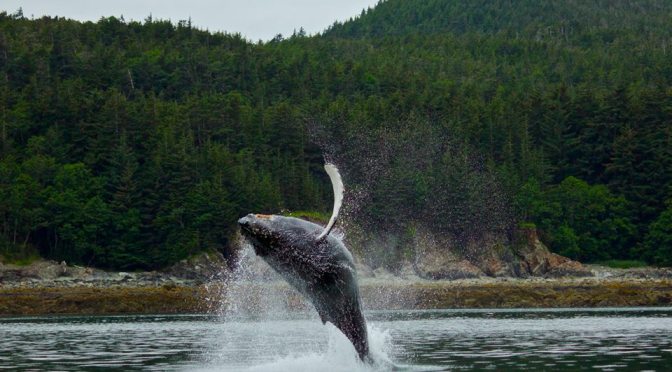
Twenty minutes later a humpback blasts out of the water like a rocket, sending a crescendo of foam across the surface and we cheer like our team just won the Super Bowl. There’s a spark in Dan’s eyes, a glint of joy and life that I can still see four years later. For a few seconds he looks reborn until another coughing fit sends him back into the boat’s cabin.
An hour later we’re within sight of Auke Bay, Juneau’s largest harbor. From the water, the Mendenhall Glacier looms over the boats bobbing along the dock. Even from two miles away it dominants the skyline like a giant frozen sky scraper. The boat captain screams the boat to a halt and ushers me onto the deck with Dan and his wife.
“Get their picture with the glacier,” he whispers.
They lean against the boat’s railing, the ice framed perfectly above them. I swallow a lump in my throat and blink away tears. For the second time Dan looks half his age as he dots a kiss on his wife’s cheek and wraps an arm around her as I click off a shot. The moment passes, the boat revs, and they slowly move back inside, wrapping their down jackets tightly against the wind.
Minutes later we’re on the bus, headed for the cruise ships 15 minutes away. I search for something comforting or inspiring to say. Some magic words that could somehow make their plight better. Instead I just listen as they talk about their kids, their work, their life. My ears doing more than my tongue ever could.
Feet from the dock Dan looks out the window and sighs, “it’s a magnificent place you have here, David.”
“Thanks, but it’s not mine, it’s all of ours. It grabs hold of something deep inside of us, resonates, makes us whole.”
He nods, “I wish I would have seen it sooner so I could climb the mountains. Maybe go fishing, you hunt?”
I confess that I’ve never killed anything bigger than a salmon.
“Well don’t wait,” he said, “live out your dreams while your young, don’t wait for your come to Jesus moment.” His wife sniffs and he gives her a little squeeze.
The bus stops, I shake Dan’s hand and hug his wife. Slowly they walk away, inching up the gangway, his last words echoing between my ears.
Don’t wait, live now. See what needs to be seen. Breath the air, walk the trails, climb the mountains, swim the rivers. Don’t let life get in the way of living.
Four years later I sit in a cabin perched on the shores of British Columbia, living. NOAA never called back, hallelujah. Maybe I’ll get a real job some day but I doubt it. Not after seeing that look in Dan’s eye as the humpback broke the surface, telling me everything I’d ever need to know.
Tag Archives: travel
The Magic of the Town Run
The tide is ebbing, and the boat is stuck, like some hauled out metallic sea lion. An expletive escapes my lips and with one final push the boat slides over the rock and floats again. The vertical rock face seems to have just enough of these little ledges, and like some magnetic force, always seems to suck the boat right to them.
With the boat free, the loading begins. Empty gas cans, dead batteries, and garbage bag filled to burst with pungent clothes. Brittney appears, laden with more black hefty bags filled with trash and tied securely. The Hanson Island rule is: bags with garbage are tied, bags with laundry are left untied, an important step. Just ask the volunteer who tied his laundry bag, sentencing it to doom in the landfill.
By the time everything is piled in, there’s precious little room to reach the seats. The boat already makes me feel like Gandalf in a hobbit hole, but filled to the brim makes it feel like crawling through a cole mine. Finally I manage to pretzel my legs behind the wheel and the boat floats free, drifting into the middle of the cove.
The engine roars to life on the first turn and we idle slowly past the kelp bed and into Blackney Pass. Free of kelp and rock, the engine roars to life, struggling to break free of the water and get on step with the heavy load. But the water is a flat calm this morning and we hang a left, bound for Blackfish Sound, Weynton Pass, Pearse Passage, and finally Alert Bay.
It is the most magical of days, the town run. An afternoon of hot baths, Paul’s sandwiches, and people. So many people. Just up the street from the dock is a tiny lot where the beloved pathfinder has sat patiently all winter. Ever week and a half she resignedly comes to life so that we can drive the one mile along the shoreline to Paul and Helena’s house.
I feel like a kid coming home from college. A massive bag of laundry in hand, anticipating food, beer, and canned goods. After months of taps producing nothing but frigid water, feeling hot water spew into the tub makes me flinch. We had eschewed baths in favor of pouring hot water over ourselves a couple times a week on the deck. Scrubbing frantically while we shivered in the wind and the rain. So when it’s my turn, I nearly fall asleep, the hot water lapping at my face.
From the house you can see Johnstone Strait, the Hanson Island shoreline appears merged with the trees of Cracroft and the Plumper Islands. The water stays flat, but the sun is already beginning to set.
Alert Bay is far from bustling, but feels as congested as a city as we squeeze along the narrow road.
“So many people,” Brittney says as we wait for two cars to go by.
The grocery store is nearly sensory overload. For days we’d talked about the things that we’ve been craving but unable to reach. Now we just stare blankly at the shelves, a crumpled list in hand. Overwhelmed we pile heads of lettuce, carrots, potatoes, tortillas, and of course coffee into the quickly growing pile. Tragedy strikes when we reach the popcorn and find the shelves barren. For a minute we’re too stunned to speak, mouth open in shock and horror. No popcorn? Why did we even come into town? Sadly we head for the checkout our overflowing cart suddenly feeling empty.
Loading the minuscule boat becomes a cramped game of tetris. Anything that can fit into the tiny hold in the bow is shoved unceremoniously in. Filled gas tanks and charged batteries bring the water’s surface a couple inches closer to the window. Bags of food, lettuce leafs poking curiously out the top are stacked as gently as possible on top of the clean laundry.
After some coaxing, the boat obediently gets up on plane and sends us rocketing home on the flooding tide. We reach the lab just as the light begins to fade but the slowly flooding tide has left us well short of the cove. Grabbing as much as we can, we walk and stumble up the rocks, dumping groceries and water jugs on the deck, leaving the batteries and fuel tanks for a higher tide.
Opening the door of our house, a white and brown blur shoots past as the cat sprints for freedom, incensed at his day long imprisonment inside. The rabbit is even more excited and wastes no time inspecting every bag until she finds the apples and attacks with the ferocity of a Great White Shark. By the time the boat is tied and the groceries stored, it’s dark, the fire slowly warming the house once again.
We collapse on the couch, town days always seem to wear us out, probably all the hot water. Now if only we could find a pizza place that delivered.
We Have Neither the Plans Nor Disguises
My last Christmas in Eagle River I went to the same holiday party that I’ve been going to for years. No longer though, was it acceptable for my friends and I to drag the TV into one of the bedrooms, hook up the Gamecube, and beat each other silly in Super Smash Brothers, taking time only to race back upstairs through the maze of grown ups for another piece of pie. Now in our mid 20s it was time to negotiate through the kitchen, making small talk and drinking enough to make it all seem interesting.
Balancing a plate of food I bumped into person after person I had hardly spoken to since high school. Time and again I would compress the last five years of my life into a succinct three minute presentation. That I had graduated college, was not in grad school, and was working seasonal jobs and globe trotting as much as possible. Most were receptive, some excited at the prospect of spending a winter on an island isolated from the rest of the world, understanding the romanticism and beauty of living a simplistic life for months at a time. Others, did not.
As the night wore on and we continued to shift conversation partners, I bumped into a man I hadn’t seen since high school. A middle aged father of two, he had for a time been a volunteer in the youth group of my church as I was growing up. And so I began my presentation, summarizing my summers on whale watch boats, farming in New Zealand, and my upcoming year in British Columbia and Orca Lab. Anyone whose ever given a presentation, at school or work has felt the wriggle of insecurity as you begin to talk, and know that it isn’t going to end well. His face evolved from one of surprise, than shock, and finally, condescending.
“How old are you now, David?” He asked.
“25.”
“When are you going to start taking life seriously?”
I pause, taken aback by his bluntness. What would constitute taking life seriously? Did I have to make X amount per year? Or own a house of a certain square footage? Or perhaps I had to have a job that I didn’t love. I avoid a philosophical debate and chose to just announce that I’m happy with my life, young, and having fun.
“Well, yeah,” he allows, “but it’s like riding a skateboard.”
A skateboard? Whatever he had in that glass I wanted some.
“You see those 13, 14 year olds riding around and that’s ok. But if you see, like a bunch of old guys riding around on them… you can’t do it forever. You start to wonder when they’re going to grow up.”
Convoluted and ambiguous metaphors aside, my pride began to flicker, my eyes narrow, the cocktail shrimp on my plate forgotten. It certainly wasn’t the first time I’d heard inquiries such as this. About once a week during the summer, some older man would try to explain to me why I couldn’t go on this way forever. But there was something about hearing it from a man who knew me, someone that I had been friendly with that made this time different.
But as I walked away a few minutes later, I began to feel pity instead of anger. I imagined if one of his kids came to him someday with the same wanderlust that had overtaken me. What kind of reception would he receive?
It is a very American ideology. That we must have a plan, that we must be secure, safe, comfortable. We build walls of comfort and safety and along the way, forget what it means to be alive. But it is all ok, because it has been deemed acceptable and normal to live this way. Go to school, get a job, get married, have kids, retire, die. It is a blueprint followed by most, and for many, perhaps that’s ok. For some, maybe they are perfectly happy and content to live in the same house and go to the same office every day for forty years, punctuated by their annual two week vacation.
But for a growing number of the younger generation, it isn’t. We’ve seen too many of those walls turn into bars, a prison with no escape. Guarded by the henchmen of mortgage, debt, and car payments. Maybe they’d be happier if they pulled their old skateboard out of the closet from time to time, gave it a whirl, and remembered what it felt like to be young and free. As I’d neared this age of reckoning and college wound down, I began to feel this noose begin to tighten. I wondered if there was another way, a different trail down the road of life. Bumpier, perhaps, but a lot more fun. Slowly I loosened the noose until finally I became ok announcing that there was no plan. That I wanted to be an environmentalist and a writer and as long as I was doing something to better the wild world and wasn’t curling up under park benches at night, it’d be ok.
And so to the man that I doubt will ever read this. I plan to ride that skateboard until a wheel snaps off and sends me careening into the briar patch. Who knows, maybe it’ll never happen, maybe it will. But every second is going to be a fulfilling ride that I wouldn’t trade for anything.
New Zealand Thanksgiving
We were hot, sweaty, and exhausted. Sand and dirt coated our arms and legs. My skin that had been browning was beginning to look suspiciously red. We were miles along the Abel Tasman trail on the northern tip of the south island of New Zealand at the end of November. It was paradise with gorgeous tropical beaches falling into the turquoise waters of the channel between the two islands. Palm trees and ferns dotted the trail as we wove over the hills and along the beaches, never too far from the picturesque view of the water. The aches in our backs had long ago gone numb and we moved with the hunched postures of those with perhaps a little too much weight on their backs.
But despite the beauty and the freedom, it was hard not to feel homesick as we finally dropped our packs at the end of the day. It was Thanksgiving back home, and it was hard not to think of houses packed with friends, family, food, and football. Brittney and I knew this day would come when we had put together our three month trip to New Zealand. That we would be, first the first time, away from everything that made the holiday memorable. We sat on the beach watching hikers trudge up and down the beach and kayakers scooting back and forth at the mouth of the bay.
Digging through our packs we debated what should do the honor of being Thanksgiving dinner. There was a couple packages of some pre cooked pasta, and two boxes of curry; one red, one yellow, complete with compressed zip-locks of chicken and the smallest servings of rice I’d ever seen. We decided nothing could be more traditional than pre cooked curry as we had sadly polished off the macaroni and cheese two nights before. Unceremoniously we dropped our dinner into water suspended perilously on top of the camp stove and watched dinner roar to a boil.
We stretched out in the shade of the trees and polished off Thanksgiving dinner in about five minutes. Slowly the sun began to fade, and the stars, devoid of artificial lights began to creep out, the trees casting shadows from the full moon rising over the ocean. Exhausted with another 15-miles on our legs we crawled into our tent, putting an end to our first southern hemisphere Thanksgiving. Or at least, so we thought.
I was asleep before my head hit the canvas floor of the tent, my eyes felt like they had just closed when I felt Brittney shaking me awake again.
“Did you hear that?” She asked sitting upright in the tent, her head grazing the roof. “It sounded like an animal screaming outside.”
Groggily I listened for maybe half a second, muttered, “no,” and promptly fell back asleep. Minutes later something pulled me out of my sleep again, but this time it wasn’t my wife’s hand on my shoulder, but something outside, rustling around our tent. Our tent had an extended fly, allowing you to be outside the interior while staying out of the elements. It was in these small gaps that we’d been keeping our backpacks with our food, wallets, clothes, and everything else vital to our survival in this unexplored frontier that was New Zealand.
Just on the outside of the fly on my side, was the rustling. A million worst case scenarios begin rushing through my sleep addled brain. Was it the gruesome threesome from The Strangers? The aliens from Signs that had terrified me since I saw the movie when I was 11? Or just your typical escaped lunatic dead set on murdering innocent Alaskan raised hikers in there sleep? No, it had to be that German quartet that had set up there tent across the clearing from us. As my mind slowly slogged through the possibilities, the sound grew closer until the fly moved, whatever it was, it was inside the fly. I’d propped my pack upright, leaning against the tent, its’ silhouette dark against the light background of the fly. As I stared at the outline, it suddenly fell away from me toward the opening, the collision muffled by the grass.
I could hear the pack being rummaged through as I’d left the top open. Camping in a land devoid of bears, my packing had become plenty lazy. This was beyond fear now though. My trail mix, the elixir of life was in the top of the bag, it must be saved. I sat upright, my fingers fumbling for the zipper, and bellowed with as much intimidation as I could muster, “hey!” In a spasm Brittney came awake, flailing her arms and legs as she threw the sleeping bag from her.
I finally locate the zipper only to realize my legs are still pinned within my own bag, I kick, trying to free myself. In the moonlight I can see my bag of trail mix, seemingly pulled by an invisible hand free of the back pack.
“What is it?” Brittney asks, her voice filled with terror.
I search for words of comfort to reassure her, to let her know that I had the situation under control, that her husband was here to protect her. “I… I don’t know!” So much for bed side manner.
I break free of the sleeping bag and spring from the tent. A small shadow was dragging the bag of food toward the forest, with another yelp, the creature dropped the trail mix and retreated to the woods. Brittney was clambering over my shoulder trying to see, unsure if she should fight, run, or laugh at me. “It’s ok,” I say, searching for something reassuring “it’s… it’s kinda cute,” still with no idea what the heck it was.
Trail mix securely back in the backpack we dug out head lamps and looked into the trees to find at least seven pairs of glowing orange eyes emitting from the forest. We stare at each other, “what are they?”
“They don’t have lemurs here do they?” (Hey we were still basically still asleep).
Whatever they were, they were clearly not aliens, masked murderers, or lunatics. Food securely at our feet behind the impenetrable zipper we crawled back into our bags and tried to fall asleep to the pitter patter of the, “lemurs” (ok they were opossums).
Wanderlust Knows No Age
Cindy moves slowly along the rocks, one hand on her cane the other in mine as we move slowly step by step up the tideline. The steps to the guest house are just feet away when we stop for a breather. There is no fear or discomfort on her face, no sound of frustration in her voice. She had come all the way from Houston, Texas, she knew what she was getting herself into. With a determined look, her jaw set, we begin again, down the jagged rock, feet probing for a flat spot laid smooth long ago, past the loose pebbles and with two quick steps, onto the deck. Her face relaxes immediately, a smile spreads across her features. The same look we all must have had when we finally realized we had made it. Her husband Gene follows and together we all climb the stairs into the guest house.
I’ll admit I was nervous. Not just because we were representing Paul and Helena’s life work, though that was reason enough to panic. But because I was still living in the dark and terrible corner of the stereotype. I had met countless couples from Texas, some with huge belt buckles and ten gallon hats as they ambled down the cruise ships gangway. Nearly all were courteous and friendly, that wasn’t my worry. Too many though, wanted to know how much it cost to kill a brown bear. Had I? Why not? Any of these mountains being mined? Tell me about this oil money you guys get every year. I’d find myself morphing into part car salesmen, part street corner evangelist. Trying to explain the non gun toting, non developing appeal of the Alaskan wilderness. That the world would not collapse if the Arctic Refuge remained what it was, a refuge. That shooting bears with a camera was a much more rewarding and intimate experience. And no, I don’t want to discuss any of Alaska’s governors, former or current. The worst was the climate change question. It was phrased the same nearly every time, “do you believe in global warming?” As if it was a religious cult akin to voodoo.
I’d explain that yes, the world is in a natural warming phase but that man kind was helping it along. “It’s like steroids in baseball,” I’d say (it always does come back to baseball). “Barry Bonds didn’t need to take them to hit homers, but it sure helped him.” I’d stare into their faces, as if hoping to see a flashing light bulb appear over their heads. More times than not though, it was a smirk, they’d heard “natural warming phase,” that’s all they needed to hear.
Cindy looks out the window, drinking in Blackney Pass, a humpback surfaces, a sea lion splashes, she looks born again. “I’ve waited 13 years to see this place!”
They had won the two night stay on Hanson Island for their contribution to the June Cove boat fund. And two bad knees and Gene’s replaced hip wasn’t going to stop them. I smile, instantly relaxing, I should have known I suppose. Anyone willing to work this hard to reach this place didn’t deserve to be lumped in with their geographic region. I remember travelling to New Zealand, how I would tell people in the hostels I was American and the reception I received. So I just started saying Alaska, half the people seemed to think that it was part of Canada anyway. I didn’t bother correcting them. Poor Tomoko and Momoko, our fellow volunteers had to have the same nightmare. They were from Japan and any mention of Japan and whales had to instantly lead to an avalanche of embarrassing issues. The Cove, Whale Wars, and the IWC, just to name a few. We were all victims of the stereotypes our homeland depicted. And all guilty of the same assumptions.
We walk into the lab after dinner, the place from which everything they had seen, heard, and read about Hanson Island originated. They move as if they’ve just entered a church, quietly, respectfully. Cindy looks down at the sheet of paper that diagrams the six hydrophones and our location, her fingers tracing the outline of the shore line. I show them where they saw the orcas earlier that day on their way to the lab and all three of us jump as a sea lion throws its whole body out of the kelp just feet from the shore again and again.
Quietly they began to share the stories of their lives. Not about home in Houston, but there travels north. “We just keep winding up going north for some reason.” Cindy says as she admits with a small smile that she picked a programming company not for its competence but because they were based in Vancouver. They were drawn to the same world as us. A world of water too cold to swim in but too beautiful to stay away from. Of islands, strung together like diamonds on a necklace, each hidden cove and bay full of mystery. And of course the whales. They’d seen more of southeast Alaska than I had it turned out and it was my turn to listen greedily of stories from Tenakee and remote lodges on the island of Admiralty.
“We got to Seattle and decided we weren’t ready to go home once,” Cindy recalled, “so I went to the ticket counter and asked for the next flight back to southeast. He wanted to know where I wanted to go, I told him I didn’t care. We’ve been all over, but always independent, we’ve never taken a cruise ship up there,” she proclaims proudly.
“Bless you.” I answer with a smile.
Here were people that found joy and beauty in the same way we did. There bodies may no longer allow them to sleep under the stars on the rocks or among the trees, but they weren’t about to let that stop them from exploring. To stop marvelling at the breath of a humpback, the wing span of an eagle, or the simple and perfect beauty of a sunrise over the water. “I wish we would have started doing stuff like this sooner,” she says, “you two keep exploring, do it while you’re young, there’ll be plenty of time to worry about life later.”
After two short nights here they were gone. Leaving the same way they’d come, determinedly and carefully moving down the rocks and onto the boat. Looking back I wish I would have thanked them for the impact they’d made. The barriers they’d torn down, that it was because of people like them that I loved guiding so much and find myself missing it since they’ve left. I want to share peoples discoveries again. To lead them carefully to the salmon stream with a bear poised on the beach. Around Point Retreat where I know orcas are waiting and turn with a big smile and ask, “you heard of Sea World? Do you want to see how it’s supposed to be.”
And than humbly step aside, my work completed. Allowing the animals, the smells, the sounds, the view to do the rest of the talking for me. Speaking more eloquently, beautifully or convincingly than I could ever dream.
But most importantly they left me with this. The next time I’m working a trip and the couple announces they’re from Texas, I won’t fear their questions on oil, brown bears, or the refuge. Instead I’ll think of Cindy, with tears in her eyes as she talks about watching A37 swim past the lab on what may have been his last night on earth. Of Gene’s insistence that, “we’re just going to stay here forever.” And of the two of them, refusing to let age stand in the way of their adventures, making their way up and down those rocks never wavering, knowing exactly where they want to be.
Our Best Ideas Are Imagained in Bars
I wrote Paul the next day, and after 48 hours of constantly refreshing my email, got the answer I needed, “you and Brittney are more than welcome to come work next summer.” We celebrated the only way Juneau folk no how. We threw on our nicest Xtra-tuffs, and found a bar. It was as if countless doors had just cracked open. We could do that expedition kayaking trip in Canada we’d always talked about, hike the Pacific Crest trail, move to Seattle, get a caretaking position. Caretaking, it always seemed to come back to that. There was such an idle romanticism about it. Imagining a winter in some tiny log cabin. The wind, snow, and waves buffeting and rattling the walls and windows, as we curled around the wood stove, spruce wood crackling heartily. It was an easy subject to get lost in by your third glass of wine and fourth IPA, but somehow, it just kept on returning to the front of our minds. Our best ideas are imagined in bars.
Shortly after Paul’s answer, I’d sent word to Evan, the British fellow I’d met at the lab, announcing I’d be making my triumphant return. What happened next can be credited to God, karma, or the universe, but regardless, remains one of the biggest miracles of my life.
“They’re looking for someone to watch their place over the winter,” he wrote, “how cool would it be to be there for a year?”
I stared at the computer screen. This was a movie, stuff like this doesn’t just happen. Your dream job doesn’t just randomly appear in your dream location, two weeks after you decide you’re going back. Brittney barely got in the door before the question was out of my mouth, and I still may have been hyperventilating to much to get out anything beyond, “Paul’s… lab… caretake…. winter.” But when I finally calmed down enough to speak coherently again, I still couldn’t get the entire question out entirely.
“Yes,” she interrupted, “why are we even discussing this? It’s happening.”
The one trouble with communicating with Paul and Helena is, even in the year 2013, the internet on Hanson Island has a tendency to self combust on a semi weekly basis. This can lead to unanswered facebook messages, missed skype calls, and at times, weeks between successful contact. This was one of those times as I crafted a carefully worded letter via facebook, hit send, and waited. Days passed. I watched whales, Brittney paddled, and I checked my messages as soon as my butt hit the sofa every night. And it is funny how we get our answer when we least expect it and need it the most.
Which is exactly what I needed on a rainy and foggy August day. There was no flying, the whales were far from caffeinated, and I was escorting 14 people that varied from disappointed to fuming that Alaska had the audacity not to reenact a National Geographic episode for them. But what I remember the most was the rain. It was the classic southeast Alaska drizzle, clouds wrapped snugly around the trees, everything you touch drenched. Brush against a devils club leaf and you’d be wringing your pants out the rest of the day. Even after you wiped your hands on a towel, the moisture seemed to cling to your fingers, beading up and evaporating, making your fingers awkward and clumsy. The van’s windows fogged up immediately so when I tried to dramatically point out the first view of the Mendenhall Glacier, all anyone saw was gray. I smiled sheepishly as they walked off into the mist and rain, praying they would find a bear in the salmon stream. As soon as the door closed I slumped onto one of the seats and pulled out my phone.
It was just habit now to load facebook and hold my breath, waiting for the little message sign to pop up. I glanced at the screen, double taked, and looked again. And there it was, the message that threw the door wide open, tearing it off its hinges. The pets were welcome and so were we, all winter long if we could handle it.
The rain didn’t matter anymore, or the grumpy people, the long diving whales, or the fact that I had just knocked a bottle of water over and into my boot. In my mind we were already Canadians, already taking the June Cove into Alert Bay for supplies, perched on a frosty observation deck watching the sun rise. It didn’t matter that it was more than a year away, we were closer than ever to living out a dream that we had only dared talk about deep into the adult beverage of our choice. But more than anything it was empowering. We didn’t need careers, 9-5’s or a house to do what we loved. Just a little spot on a rock to call are own. To challenge ourselves, and see what we were really capable of.
I can’t imagine how those people must have felt, climbing back onto the bus, cold, wet, and frustrated. They must be still trying to figure out, why was their guide was suddenly so damn happy and grinning from ear to ear.
These Are the Places I Will Always Go
So, why than, did it take me six years to go back? What could possibly have kept me away from orcas by moonlight, leaky kayaks, and nights rocked to sleep by the whisper of an ebbing tide? My problem? I listened. In the months after I returned home I was told by teachers, my peers, adults, and the world in general that, while my journey was a great story and adventure, that was all it could be. I needed a real job, security, a 401K, a mortgage and three mini David’s running around eventually. And for years afterward I bought it, and tried to push myself into that square peg.
I busted my butt my sophomore year, taking 35 credits and somehow got the highest GPA of my collegiate career. And for the second time in my life, I decided to take a chance, and transferred from 40 below and 18 hours of darkness, to the rain soaked, humpback infested world of Juneau. And while the scenery may have changed, I still felt an obligation to the same life goals, because, well, that’s what you were supposed to do. I got a job in Glacier Bay my first summer in southeast studying humpbacks. It should have been my dream job, a foot in the door to a career with the National Park Service. But, for whatever reason, I just couldn’t relight the fire. My bosses were great, the venue breathtaking, and the work challenging. But I struggled with the scientific and calculated way everything was done. Standing on the boat, bobbing in the chop created by a juvenile humpback breaching again and again. I wanted to cheer, to whoop, the nature worship bubbling just below the surface. But I felt I couldn’t. Maybe it was unfair to compare the whole situation to my brief time at OrcaLab two summers ago, but it just didn’t fit.
I remember the first time orcas swam past the lab that summer. Paul, camera in hand leaning so far over the rail of the porch I thought he’d fall into the ocean, hollering at the whales as if it was the first ones he’d ever seen. I wanted that raw emotion, that childlike wonder and joy that bubbled over like a pot on the stove. But I kept searching, opening doors and closing them.
I returned to Juneau, met the love of my life, and married her. Two months later we ran off to New Zealand for three months and lived. Spending way to much money, learning how to milk cows, and having the most important conversation of our life. In a town called Rotorua, over strawberry milkshakes, we finally voiced what both of us had been burying, maybe for years. We didn’t want careers, the idea of being tied down to one place to long terrified us, and as far as kids… a cat and a rabbit seemed like plenty right now.
For me, the next location was obvious. It had been in the back of my mind for years, waiting for its chance to emerge. We returned to our seasonal jobs in the tourist industry. Brittney a kayak guide, and me a guide on a whale watching boat, our third season in tourism. In July we hiked Mount Roberts, flying past the tram, trying to leave the masses of people as far behind as possible. We reach a small outcropping of rock and get comfortable, our dialog has been brief and abbreviated. After hours in the woods together we know what the other needs. If you passed us on the trail you’d assume we were fighting. We don’t hold hands, there’s never much joking, laughing, or talking, not on our hikes anyway. It was more of a joint meditation, taking solace and peace in knowing the other was healing with every step. I remember going hours on the Abel Tasman trail in New Zealand with us barely saying a word and being so thankful I wasn’t alone.
We talked about the cruise ships, sitting below us in Gastineau Channel, and our never ending discussion about how we feel about the industry. Were we exploiting the land we loved or were we ambassadors? Was standing on one of 35 boats, preaching the wonders and magnificence of a humpback worth the bellow of twin 350 engines in the water? Words start tumbling out of my mouth, frustration, confusion, and guilt. The words of a man who can’t do it anymore.
Like she always does, Brittney just listened. Letting my words and troubles wash over her as the yoke loosened from my shoulders. She let me go until I was spent, head in my hands, still staring down at the boats. How did they still look so big from up here?
“You need a break,” she finally said. “If you don’t know that what you’re doing is right, that it’s not helping, we need to find what is right, what is helping.”
I nod, the next question holding hopes, dreams, and fantasy in its answer. “I need to go back.” I say, it’s not a statement, it’s a question. We were a team, bound at the hip, and I could do nothing if she didn’t go with me.
“Back to Canada, to Paul’s?”
“Next summer, I can’t believe it’s been five years. I never thought I’d be gone so long. I guess I kind of lost my way, but that’s alright,” I turn and smile, “it led me to you. I want to show you this place that means so much to me.”
She just smiles, “if that’s where you need to go that’s where we’ll go. I want to see it with you.”
Words catch in my throat, the emotions dragging them back to my stomach. Fortunately I didn’t need any as my wife, confidant, and best friend laid her head on my shoulder and wrapped her arms around me. I looked, south down the channel, past the cruise ships and habitation, toward the wild and untamed Taku and Stephens Passage. I could almost hear the orca’s calls, ringing in my ears. I thought of mornings on the observation deck, runs in the woods, Helena’s cinnamon roles, and even the ornery June Cove. It may have taken me five years to figure out, and six to finally put it together, but I was finally going home. And this time, I wouldn’t be coming alone.
Crawling the Last Few Miles: My First Trip to Hanson Island. Part: 3

The engine sputtered, coughed, and died as the June Cove glided slowly to a stop on the calm water, bobbing in the channel between Alert Bay and Hanson Island. From my seat atop the cabin I spun around and peered down at the stern deck. There was no smoke or flame, nothing that would indicate we would need to start practicing a frantic dog paddle. The door to the helm slid open and Paul opened the engine hood, looking down into a maze of wires and metallic mystery. He pulled his wool hat off, running his hands through his thinning, long dark hair. Years later Paul would describe the Mercury engine as a, “big bloody monstrous thing.”
But right now the monster was pissed, we were almost exactly halfway between the lab and the Alert Bay boat harbor, and the sun was setting. After performing what he hoped would be an accurate amount of mechanical wizardry Paul moved back to the helm and the engine coughed and sprang back to life. The four other volunteers and I smiled as the June Cove slowly picked up speed. Less than a minute later though the engine quit again.
Again Paul marched onto the deck, this time glancing up at me and the kiwi, Shane who was perched on the roof of the cabin with me, “how well can you boys paddle?” he asked, a little laugh in his eye. Shane and I exchanged uneasy grins and I smiled back nervously, imagining how my mother would feel if I was lost at sea my fourth night in Canada.
Three more times the June Cove roared to life and died. A pod of Pacific white sided dolphins had begun following the wounded vessel, giggling no doubt at mans’ vain attempt to conquer this aquatic medium. Finally Paul threw up his hands and told us to get comfortable, the engine would run as long as the RPM’s were kept painfully low, and we slowly puttered to the lab, I swear a kayak passed us along the way.
An hour later we rounded the final point, and there, perched heavenly on the rocks just above the cove was the lab. Tucked back and nearly invisible among the fir and cedar trees was the house. Big bay windows overlooked the cove and Blackney pass, a tiny chimney sat on top, silt gray smoke pouring out, it was the picturesque homesteaders cabin. A board walk ran just above the jagged rocks of the intertidal to the “lab.” Much smaller, the lab had a wraparound porch that overlooked the pass giving a 180 degree view of the water and anything that moved up or down it. On the board walk was Paul’s wife Helena, her slender frame and flyaway white hair visible even from the water, a large husky at her side sent booming bark after bark flying across the cove, a marvelous welcoming committee.
Six years later there is still so much that vividly stands out from that first night. The mac and cheese and garden salad we had for dinner. Watching the sun set through those big beautiful bay windows, and just how easy the conversation was.
There were seven of us around the table that night representing five countries and different walks of life. Shane the New Zealander, slowly traveling around the world. Tomoko and Momoko, two girls from Japan where Paul was revered by many for his anti-whaling stance (and obviously hated by some). And Evan Landy, who, like me, was a biology major with an orca fascination that, like me, boarded on obsession. Helena was, interestingly enough, the only Canadian born citizen among us, who had been a school teacher in Alert Bay before meeting Paul.
I fell asleep that night not in the tent I had lugged all those miles, but on the wraparound porch overlooking the ocean, the occasional waves lapping at the rocks and the soft underwater noises emitting from the speakers connected to the six hydrophones strategically placed around the lab. Passively listening for the orcas to come into range.
I dozed off almost instantly, reveling in the smell of salt on the air, the intimate sounds of the ocean, both above and below, and the magnificent realization that I was finally, actually, here.
Orcas’ Love the Beatles Too: My First Trip to Hanson Island. Part: 2
Car after car drove slowly by, rolling to a stop at the ticket window, the line slowly growing until at least ten cars were waiting to catch the evening ferry from Port McNeil to Alert Bay. I was consciously aware that any car could have Paul Spong behind the wheel, and my lack of preparation was embarrassing. Briefly I considered just walking up to the counter and asking if they knew the good doctor. But some piece of pride, the same piece that insisted on camping on the ground with hungry cougars prowling about kept my butt firmly on my bag.
I stared into each car, in what I’m sure was a very creepy manner, trying to make out a silhouette, as if he’d be holding a sign to the window announcing: “Dr. Paul Spong! Orca Guy! All lost kids from Alaska please follow me!” I gave up trying to see inside the cars and instead started to wonder, “what sort of car would Paul Spong drive?”
Born in New Zealand, he’d earned a P.H.D in the neurological field at UCLA, and moved to Canada in the 70’s to take a position at the University of British Columbia. Part of the contract involved doing work with Skana, one of the first orcas to be successfully captured and was being kept at the Vancouver Aquarium. Paul devised a simple experiment intended to measure the visual acuity of the giant mammal. But his life changed forever when, after thousands of trials, Skana began to give the wrong answers. Not randomly, but one hundred percent incorrect.
For the first time, Paul found himself the subject or the experiment and he was enthralled. His workload piling up at the lab, he couldn’t pull himself away from the whale. He quickly learned that auditory stimulation was a much greater reward for Skana than food. What came in the following months was a melody of tunes as Paul played everything from the Beatles and Rolling Stones to Bach. Skana loved them all. Paul was forced to accept that Skana was much more intelligent than any other terrestrial mammal he’d come in contact with. She was almost certainly, going crazy in her little pool, her calls reverberating and echoing off the concrete walls, with just a few humans for company. Capable of speeds up to 30 knots, Skana was resigned to swimming in slow circles day after day. It was apparent to Paul what needed to be done: Skana needed to go home.
But when he did present his findings, a storm of controversy followed at the aquarium. They didn’t want Skana to be a sentient intelligent being. They wanted the equivalent of an aquatic dog that would do tricks and keep people coming through the turnstiles. Paul was quickly becoming public enemy number one and was finally given an ultimatum: “you can check into a psychiatric ward willingly or not.”Undaunted by his controversial findings (orcas were at the time considered little more than mindless killing machines), Paul walked out the door. Within months, he found what he was looking for. Wild and free orcas to follow and study, in their natural habitat.
Now, 30 years later, he was driving onto the Port McNeil ferry for what to be the thousandth time while I was desperately trying to decipher, what kind of car a pioneer in the world of orca research would drive. Finally an old slightly rusted Subaru looking car pulled onto the pier, every seat save the drivers’ was stuffed with boxes so high, I couldn’t see inside at all. There was something about it though, the character, the age, or just the fact that I couldn’t imagine Paul driving a huge lifted pickup with a bunch of logs in the back that convinced me.
The car stopped thirty feet in front of me. I walked over just as Paul got out to hand his ticket to the teller, “You’re Paul Spong aren’t you?” I asked. He turned and looked up at me.
“He’s shorter than I thought.” Was the first thought that crossed my mind.
“I’m sorry, do I know you,” he asked. For the briefest moment my stomach fell. There’d been a miscommunication, I wasn’t supposed to come, I had the wrong guy, I’d braved Cinnabon, the bus station, and cougars for nothing. But a look of recognition crossed his face, “Oh that’s right, you’re David, yes?” I smiled, and felt the jittery weak kneed feeling you get when you shake the hand of your hero.
“Yea Paul, I’m David, it’s great to meet you. I can’t believe I’m here.”
Boats, Busses, and Cougars: My First Journey to Hanson Island. Part: 1
In the last nine months I’ve learned how to carry three plates of food at once, how to make a passable latte, and how to describe where the hell Hanson Island is in the amount of time it takes to make change for a tall caramel mocha with whip. But since there are no lines or lunch rush on the internet, I’ll happily go into more detail now about the island, the lab you can find there, and the man that started it all. There aren’t that many ways to reach the island, it’s not like Alaska Airlines and Northwest offer nonstop service or anything. So I’ll share the way 18-year old David got there in the summer of 2008:
A flight from Anchorage to Seattle, a celebratory cinnabon and a thirty minute flight got me to Vancouver with thirty pounds of sugar in my stomach and a maze of public transportation between me and my hostel. Three buses and two trains later, lugging a fifty pound Army duffel bag (I had yet to discover the miracle that is expedition backpacks) and I was in the heart of Vancouver. I couldn’t find that hostel again if I tried. My reward was a room the size of a closet, that had last been cleaned sometime during the Reagan Administration, and a broken air conditioner that seemed to welcome in the late June humidity with open arms; I’d never felt better.
The next morning, I boarded a greyhound bus leaving from the most stereotypical bus station of all time. Complete with filthy bathrooms, empty liquor bottles and an abandoned bag of weed under one trash can. The greyhound took me to the ferry and across the channel to Vancouver Island and another seven hours north to the tiny logging town of Port McNeil. The road along the eastern side of Vancouver Island is punctuated by coastal towns; Parksville, Courtenay, Fanny Bay (giggles), Cumberland, and Campbell River. Right after Campbell River though, highway 19 veers sharply inland through the rigid, majestic mountain range that composes Vancouver Island’s backbone. For two hours there are no towns or ocean views, just a never ending tunnel of trees, with whitecapped mountains peaking through the green framed windows. Port McNeil, is the second to last stop on the line, with only Port Hardy further to the north. It’s also the nearest the bus could get me to Hanson Island. With bus to submarine conversion technology still being decades away.
I planned to spend the night in Port McNeil and it was just another mile walk, dragging my duffel behind me to the campground and the campground host who, upon learning that I planned to sleep in a tent, felt it wise to inform me that there were three black bears…. and a cougar prowling about the campsites on a nightly basis.
Cougar? What the hell is a cougar? Black bears, fine. Alaska was filled with the mischievous spry critters. In the trees, in the undergrowth, occasionally in a garbage can. But cougars were a whole different animal, no pun intended. I was one year into a degree in wildlife biology and I had no clue what to do with a large cat. I could explain how it’s muscles received oxygen and how it’s cells had divided as it grew in it’s mother womb, but nothing that would help me if it came knocking on my tent flap at three in the morning.
But I was eighteen, naïve, and feeling invincible. I threw down my credit card and asked for one cougar free campsite. Walking to my site I passed two teenage girls, excitedly reliving their thrilling encounter last night with….. the cougar. I’m sure they were exaggerating its snarling and charging behavior though. My night was cougar free and I fell asleep with steak, potatoes, and rice in my belly thanks to the sympathetic retired couple across the camp who took pity on me after my bowl of cooking ramen fell into the fire. Putting my tent away the next day I happened to look up and found a black bear looking back as he stood near the dumpster fifty feet away. After all the jungle cat talk though a bear felt almost tame, I shrugged and went back to packing my tent.
All I had to do now was catch a ferry to Alert Bay, the miniscule village on the comma shaped island of Cormorant Island, just a couple miles to the east. But that was as far as B.C’s public transportation would take me. Because my final destination was not a city or a town, there is no dock, road, or parking lot. Just a tiny little unnamed cove with a trio of small buildings constructed in homage to the 1970’s back to the earth design.
This is the place known as Orca Lab. Paul Spong and Helena Symonds home and research station. Strategically placed at the mouth of Johnstone Strait, the lab overlooks Blackfish Sound, the highway in which 200+ orcas swim down every year, chasing salmon. I had arranged to meet Paul at the ferry terminal and sat on my duffel bag bouncing in anticipation watching cars drive onto the ferry bound for Alert Bay and realized that I had one small problem. I had no idea what Paul Spong looked like.
 Raincoast Wanderings