
For my entire life I’ve been blessed to live in a place that other people visit. Not the Bahamas, or southern California, or Europe; Alaska. The Last Frontier, Land of the Midnight Sun and whatever other catchy tagline we’re using these days (Palin’s Pasture?).
For three summers I had a front row seat to those retracing the routes of John Muir, the gold rush and sled dogs. I worked in Alaska’s capital, Juneau as a whale watch guide, deckhand and bear guide (bear viewing that is, not hunting).
I was fresh out of college, and had just had the rug pulled out from underneath me. I had lined up an entry level position with NOAA (National Oceanic and Atmospheric Administration) only to have the federal budget frozen and my position unceremoniously tossed out four weeks before I was supposed to begin.
I didn’t know the first thing about guiding. But I knew whales, the ocean and my Dad had once been charged by a Grizzly so I felt qualified. Virtually the entire tourism industry in southeast Alaska centers around the cruise ship. The 2,000 passenger floating hotels that market themselves as holding everything you could ever want. Upwards of 15,000 people can flood Juneau off the boats in the summer; a town with a population of about 33,000.
I fidget on the dock. Bright orange polo tucked into Carharts, black and orange ball cap jammed on top of curling blond hair. I feel like a 6’4” carrot. Slowly couples begin to gather around me; from Germany, Texas, Boston, and Australia. I hand out the weight sheets to ensure the planes are balanced for the flight portion of the tour and try to make conversation. A beer or two would’ve helped.
My last couple staggers slowly down the gangplank towards me. It’s immediately clear that all is not well. The husband’s steps are uneven, his breath ragged, he looks exhausted and beaten. Cancer will do that.
As we board the bus bound for the airport his wife pulls me aside. Yes, her husband was terminally ill, his life expectancy could be measured in months. But if I could, please, try to treat them as normally as possible.
I climb the steps behind her and collapse into my seat mind whirling. I was supposed to be in a lab, or a research boat measuring the bioenergetics of forage fish. Fish that couldn’t tell me their physical condition. That there last wish was to see the glaciers of Alaska.
What the hell had I gotten myself into? What did this man care how big a humpback whale was? How long a brown bear slept or how much fish they could devour in a day?
The trip slides by as the plane sends us over the glaciers and over to an island called Chichagof which has one of the largest concentrations of brown bears in the world. Naturally we see none. Nature doesn’t understand the concept of the storybook ending.
In the small native town of Hoonah, a boat collects us and we begin the three hour trip back to Juneau eyes scanning for whales. Slowly I begin to pluck up the courage to talk to him. His name is Dan, he’d lived his whole life in Houston, Texas and had just been diagnosed a couple of weeks ago.
He’d rejected chemotherapy and other treatments, emptied their bank account, and was seeing as many of the places he’d dreamed of experiencing before the sickness shackled him to a bed. Alaska had been his number one pick.
Juneau had been their boats first stop. “No pressure,” I told myself. I apologized that the bears hadn’t shown, that the glaciers had been partially obstructed by clouds. He shrugs, “it’s just enough to know that I’m here.” he answers.
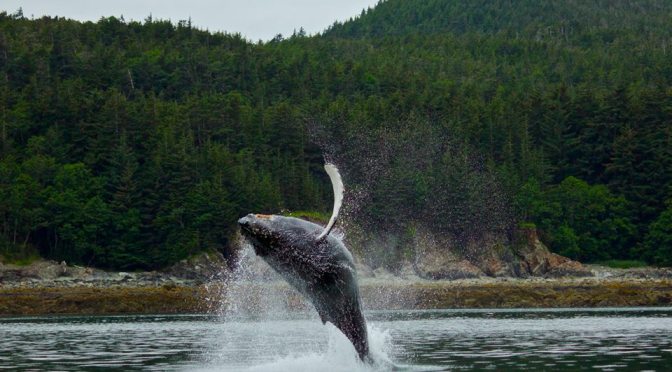
Twenty minutes later a humpback blasts out of the water like a rocket, sending a crescendo of foam across the surface and we cheer like our team just won the Super Bowl. There’s a spark in Dan’s eyes, a glint of joy and life that I can still see four years later. For a few seconds he looks reborn until another coughing fit sends him back into the boat’s cabin.
An hour later we’re within sight of Auke Bay, Juneau’s largest harbor. From the water, the Mendenhall Glacier looms over the boats bobbing along the dock. Even from two miles away it dominants the skyline like a giant frozen sky scraper. The boat captain screams the boat to a halt and ushers me onto the deck with Dan and his wife.
“Get their picture with the glacier,” he whispers.
They lean against the boat’s railing, the ice framed perfectly above them. I swallow a lump in my throat and blink away tears. For the second time Dan looks half his age as he dots a kiss on his wife’s cheek and wraps an arm around her as I click off a shot. The moment passes, the boat revs, and they slowly move back inside, wrapping their down jackets tightly against the wind.
Minutes later we’re on the bus, headed for the cruise ships 15 minutes away. I search for something comforting or inspiring to say. Some magic words that could somehow make their plight better. Instead I just listen as they talk about their kids, their work, their life. My ears doing more than my tongue ever could.
Feet from the dock Dan looks out the window and sighs, “it’s a magnificent place you have here, David.”
“Thanks, but it’s not mine, it’s all of ours. It grabs hold of something deep inside of us, resonates, makes us whole.”
He nods, “I wish I would have seen it sooner so I could climb the mountains. Maybe go fishing, you hunt?”
I confess that I’ve never killed anything bigger than a salmon.
“Well don’t wait,” he said, “live out your dreams while your young, don’t wait for your come to Jesus moment.” His wife sniffs and he gives her a little squeeze.
The bus stops, I shake Dan’s hand and hug his wife. Slowly they walk away, inching up the gangway, his last words echoing between my ears.
Don’t wait, live now. See what needs to be seen. Breath the air, walk the trails, climb the mountains, swim the rivers. Don’t let life get in the way of living.
Four years later I sit in a cabin perched on the shores of British Columbia, living. NOAA never called back, hallelujah. Maybe I’ll get a real job some day but I doubt it. Not after seeing that look in Dan’s eye as the humpback broke the surface, telling me everything I’d ever need to know.
Tag Archives: Alaska
Collect Experiences. Not Things
For the first time in years I want something that I cannot have. The number in my bank account is woefully too small to buy the house that Brittney and I have been salivating over for the past two days. It’s not a mansion with enough square footage to fit a basketball court. Nor does it look out over some ridiculous ocean side vista. It’s just a humble, quaint, hobbit approved house on a tiny road in Gustavus, Alaska. And I can’t have it.
Since graduating from college, I’ve been rebelling against the status quo. Bouncing from seasonal jobs, spending months in New Zealand and Canada and loving every minute of a life that we seem to create one step at a time. But as we’ve wandered, we’ve begun to feel the need to have a home base. A place where kayak gear, camera equipment, and pets can pile up without fear of how on earth they will fit in the Nissan Tetris in a few months. So we looked up houses in Gustavus and began to covet really bad. Houses are never an impulse buy. Thank God. Because I was looking all over the screen for the, “buy now” button like it was ebay.
We took a little crash course in down payments, mortgages, and interest rates. What else are you going to do a 9 pm on an island where you represent 66% of the population? Slowly we began to accept the hard truth that the dream was a long ways away. Though it didn’t stop us from scrolling through the photos one more time (so much natural light!).
In Victoria, British Columbia is the Phillips Brewery, the only microbrew beer I can find in Alert Bay’s tiny liquor store. Besides having a Peanut Butter Stout, which is freaking amazing, the inside of their bottle caps have the phrase, “collect experiences, not things.” For the first time in a long time I want, “things,” or more accurately, “thing” in leu of, “experiences.” Weird.
Of course, if we hadn’t been jet setting, going to baseball games, and had, you know, worked the past seven months, we might be able to make it happen. But I sit in a house perched on the rocks over Blackney Pass. A storm beginning to build after a calm red sky morning. Yesterday was monopolized by calling orcas, sea lions bark and roar at all hours of the day, and the stars pop with no interference from streetlights. Sure, I could be sitting in that house today and I’m sure we’d love it. We’d also have a thirty year financial commitment that would really make it tough to live up to the website’s namesake.
I’m sure someday we’ll truly be ready for that sort of endeavor. But when we do, I want there to be no regrets, that it’s done on our terms, on our time. That we don’t sit in our house with fantastic natural lightening and wonder what could have been. Someday we’ll have a doormat that says, “Cannamore” and a sign that says, “all guests must be approved by the cat.” But until than, I’ll savor the adventure, the sweat, the and cursing as I try to cram one more duffel bag in the back of the car.
Collect experiences, not things. Experiences after all, don’t need a house to be stored in.
One Day in the Bay
As many of you know, today marks the 45th anniversary of Corky’s (A23) capture and subsequent imprisonment. She currently resides in Sea World San Diego, hundreds of miles from her home that centers around Johnstone Strait, British Columbia. Her family was a consistent fixture in the straight this summer, and every sighting of them is a stark reminder that she deserves to be here so much more than I do. Much today has been written and shared about this amazing whale who continues to buck the odds and survive in her tiny bathtub after four and a half decades. Coming less than a week after the death and autopsy of Rhapsody of the southern Residents, one cannot be blamed for feeling discouraged and depressed about the state of these creatures.
There is however, hope and beauty that persists up and down this coast. There are miraculous encounters and moments shared between people and healthy wild whales. On this day, as we remember Corky, and all the others that have been captured, I’d like to share my most memorable whale experience of my life.
Summer 2012:
Glacier Bay National Park and Preserve lies just 30 minutes west of Juneau by plane. A magnificent playground for the outdoorsman with untold miles of not just the bay, but mountains, glaciers, and beaches. It is a place to grow and rejuvenate, just like the land that is still rebounding after years of dormancy beneath the oppressive weight of the massive glaciers that carved the bay.
I had a built in excuse to visit as often as I could as my soon to be wife Brittney lived and worked out of the bay in the summer where she worked as a kayak guide. Leaving the more commercial world of cruise ship tourism where I worked on a whale watch boat, I’d hop in a Cessna 206 and enjoy the breathtaking half hour flight over the Chilkat mountains to spend a few days with Brittney and the bay.
For whatever reason, I remember really needing a few days their his time. Perhaps I’d just had a bad run of ornery people on rainy days, or seen 20 boats around four humpbacks one time too many, but I was ready to get out and needed the silence and therapy that the bay could provide. I suppose it’s a sign that you truly do what you love when it’s all you want to do on your day off as well. There was no discussion of what we’d do as long as the weather cooperated, we were going paddling. It combined our two passions; the kayak and whales.
The next day dawned (at 4:30 am) with baby blue skies and a scattering of puffy white cumulus, the water was projected to be still, a rarity that summer that would wind up being one of the wettest on record. Giving the weather no time to change its mind, we leaped into an old rusty van owned by the kayak company, and drove the nine miles into the park to Glacier Bay’s gateway; Bartlett Cove. We grabbed a pair of fiberglass beauties from the companies rack and slipped them into the water. Unlike most sea kayaks decked out in bright and loud colors like aqua, yellow, and red, these boats were a dark forest green and seemed to blend into the landscape of evergreens and contrast beautifully with the deep blue water.
The north end of Bartlett Cove is lined by two islands, Young and Lester, and just beyond is a tiny archipelago known as the Beardslees. The islands were a veritable fantasy land for a kayaker with quiet coves, calm waters, and plenty of wildlife. The only danger was the similarity in the appearance of every island. They all followed the same recipe with rocky beaches, slight elevations, and plenty of trees. I’d traced a large circle around the archipelago two summers ago, but kept my eye on the map strapped to the boat all day.
We moved through the tiny gap between Lester Island and the mainland at the back of the cove known as “the cut,” timing our departure so that we flowed with the tide and the first half mile of our trip we barely had to paddle at all. We paddled for a couple hours through the islands, weaving through the tiny cuts and inlets, joined occasionally by gulls, murrelets, surf scoters, and the occasional harbor seal, their wide unblinking eyes staring at us with a mix of curiosity and skepticism. Finally we passed a wide channel, the tidal influence spewing out water and the islands on our right vanished, giving way to the wide expanse of Glacier Bay. The bay is shaped like a Y, with the upper arms holding the majority of the glaciers, most of them in retreat. The Beardslee’s and Bartlett Cove sit near the base of the Y, where the bay merges with Icy Strait.
We knew we’d passed Lester Island and the northern end of Young Island sat in front of us, a long point of land extended toward the upper reaches of the bay and we followed just off the rocks toward the point where we could make a U turn and begin to head south toward the mouth of Bartlett Cove and home. Brittney paddled some fifty yards ahead of me as I dawdled, trying to locate a Harbor Porpoise I’d been sure was following me when I noticed that she’d stopped paddling. Right at the point she was bobbing just a few feet from shore, paddle held gently across her lap. Coming up behind her I see why. A massive group of her favorite birds, Black Oystercatchers are congregated on the rocks, their sharp orange bills and matching eyes flashing back and forth against their dark silhouettes. I’d never seen so many in one place and they seemed completely unconcerned with the gawking humans in the water.
We watched them jaunt up and down the rocks, dipping their bills into the water until something larger, much larger, brought us back to reality. The point of land was to high to see over, but it was clear from the sound that something large had surfaced just on the other side. Leaving the oystercatchers we paddled cautiously around the point, taking care to stay on the beach side of the kelp bed that circled the island like an asteroid belt around a planet.
When a humpback surfaces in the calm water you can see the water displacement long before you see the whale, than a shadow, than a bulbous bulb of water, until finally the whale breaks the surface. The massive exhalation less than fifty yards away felt like a bass drum in my chest. The explosiveness of her surfacing made it clear she was feeding and I was thankful for the kelp bed between us. I didn’t want the whale to have to worry about us and her daily allotment of half a ton of herring. As the whale disappeared another explosion echoed off the rocks behind us. You can’t spin around in a kayak, but you can twist your head so fast that you sprain your neck. A second humpback had just materialized behind us, lunge feeding just as close as the first.
There was an exhilaration with a teaspoon of fear at seeing these whales so close and at their level with nothing between us and them but a few inches of fiberglass and some flimsy strands of bull kelp. But we weren’t moving, not for the world, as humpbacks broke the surface like fireworks up and down the shoreline, lunging out of the water, mouths agape, herring running down their throats. After thirty minutes of this incredible display, we finally conceded that we needed to start trying to get home. That meant paddling through the bay littered with whales exploding from the water like land mines. We took the long way, skirting the shoreline.
As we continued down Young Island, it seemed around every corner was another humpback. It was as if they were forming some massive 40 ton relay team to get us back to Bartlett Cove. There had to of been 25 in all, encouraging us to hug the shoreline, Brittney at times having to drag me along for I could have stopped and watched every single one. Finally we neared the mouth of Bartlett Cove, and as exhilarated as we were, the soreness and fatigue of 8 hours of paddling was setting in. We started to fantasize about sweet potato fries and Alaskan Summer beer at the lodge in the cove, and prepared for the last couple miles of hard paddling home.
But something stopped us. The tour boat that left daily from the cove and traveled up the west arm of the bay to the Margerie Glacier, had stopped in the channel when it should have been heading into the cove to meet its deadline. Daring to hope we watched and to my shock and absolute glee, a tall black fin broke the water a half mile from shore punctuated by three smaller fins as the tiny group of Transients headed into the bay. They were probably destined for John Hopkins Inlet where the pupping Harbor Seals were sprawled on the ice bergs.
Tears of gratitude formed in my eyes, it was almost too much. The bay had overwhelmed me. First the weather, than the oystercatchers, the never ending parade of humpbacks, and finally, this grand finale. Brittney and I rafted our boats together, her hand in mine as we floated together watching the orcas move further into the bay, completely unaware of the magnitude and power that their presence had just created in our lives. Finally they began to vanish from sight and we begin to paddle into the cove, our spirits full and our eyes glistening with tears of gratitude. I could paddle for the rest of my life and never see another whale and it would be ok. Because every time I pretzel myself into a kayak, I think of that day, the magic it brought, and what a gift it is to share the world with an animal as spectacular as them.
The Southern Residents and Repeating History
Off the waters of Washington state live the most magnificent, beautiful, and intelligent creature on the planet. A species that has learned to exist without wars or visible disputes of any kind. They maintain a peaceful, complex, and intricate social structure with bonds that we cannot even begin to fathom. And it is all in danger, of vanishing forever. For many it’s already too late. Like Rhapsody, whose body has gone to science in the hope of finding out what ended her life.
It is all so chilling because it’s not the first time that this story’s been told. In the serene and beautiful waters of Prince William Sound, hundreds of miles to the north, the same tragedy is playing with a 20-year head start. The genetically unique AT1 Transient pod, that has lived, stalked, and hunted within the sound for generations is just years from extinction as it comes up on three decades without a successful birth. For AT1, the prognosis is simple and obvious. On good Friday, 1989, the whole pod swam, unknowingly through the lethal slick of the Exxon Valdez oil spill. They have not reproduced since as friends and researchers like Eva Saulitis watch the pod disappear one by one, a slow tear jerking countdown to zero.
For the southern Residents, it’s more complicated. For decades they’ve endured live captures, bullets, overfishing, and the toxic runoff of the increasingly urban Puget Sound. In many ways it’s miraculous they’ve persevered for so long. They can still lay claim to, “Granny.” An orca that was born the same year the Titantic sank and is still seen every year off the San Juan Islands, a talisman to the resilience of the community. And yet, Orcas are dying that shouldn’t be. When Plumper (A37 of the northern Residents) finally vanished from the lab’s view in August 2014, there was such a finality to what we were seeing. It was his wake. His time had come, and all of us, including him and his brother Kaikash seemed to know it. But sweet 18-year old Rhapsody shouldn’t be washing up in Comox. She should be with her mother, siblings, Grandmother, and Aunts, with one or perhaps two calves to her name. This wasn’t her time and it’s hard not to feel guilt, knowing that our species shoulders the blame for her demise and dozens just like her, whether from captivity or PCBs.
The southern Residents are at 77 individuals. The time has come for drastic action before the genetic bottleneck tightens anymore. So that in 20 years, we’re not watching the last of the pod fade into darkness, leaving the waters of the San Juans and Puget Sound in great silence. How empty and desolate it would feel. Imagine Orcas Island with no Orcas. It’s not impossible, the only place in California you can find a brown bear is on the state flag.
It may mean sacrifices on the part of us as human beings. To surrender the pleasure and joy that only comes from watching a line of dorsals materialize off the bow of your boat or kayak. Or perhaps going without Chinook salmon in the freezer this winter. Or maybe as simple as riding the bus to work and reducing the carbon exhaust pumped into the atmosphere.
These aren’t tigers or elephants, we can’t just start captive breeding programs and reintroduce them. But they do need help, and we have a chance, maybe not to make amends, but to right some of the wrongs that we’ve brought against them. To even the playing field as best we can for a species that doesn’t deserve the cards we have dealt. North American progress, american history as a whole, has been filled with extinctions, manipulations, and destruction. We’ve hunted the Gray whales, sea otters, wolves, and now the Orca. But today sea otters again bob in the waters off of Monterey Bay, wolves run through the forests of Yellowstone, and North Pacific gray whales represent one of the healthiest and strongest whale populations in the world as they continue their amazing recovery from industrial whaling.
I don’t think it’s too late for Rhapsody’s kin. But it is time to try something different, because whatever help we’re giving them clearly isn’t working. They need time, space, and most importantly, the salmon that make up more than 90 percent of their diet. Save the whales doesn’t have to just revoke memories of Greenpeace and the 70s. The war is not over, and it is our time to fight for the animals we love.
When the East Wind Blows
I’m used to the cold, you kind of have to be if you lived in Alaska your whole life. Anything above 80 degrees shuts my body down, but the cold has never bothered me. After enduring two winters in Fairbanks and dragging my partly frozen carcass through 40 below weather to class, I’d never really considered anything else as, “cold.” I figured this winter would be more of the same. Sure, the weather would dip below freezing occasionally, or as the people of Fairbanks know it as; “September,” but between blankets, thick socks, and the fire I figured it wouldn’t be that bad. I even began to tell people back home that I was looking forward to a warm winter for once. Three days ago the wind shifted to the east and the clouds vanished, leaving us with brilliant blue skies, and a 15-knot gust on a direct flight from the frigid B.C. interior. The mercury began to plummet, and we began to shiver.
Forty below isn’t so bad when you have a heated, sixty-five degree classroom or dorm to duck into that can go from frozen to toasty with a simple turn of a dial. If we want to be warm, we were going to have to work for it. Our big downstairs windows don’t discriminate, letting the view and cold air in while sucking out the fire’s precious heat. We we’ve been chopping wood and kindling, hunched over the chopping block until our lower backs go numb, and scour the beach for bark. The bark from the fir tree comes off in slabs, some as small as your hand, some as big as your torso. Nothing burns hotter than a few dry slabs of bark, capable of sending the mercury skyrocketing ten degrees in an hour if you stack the wood just right.
And through it all, the world outside looks beautiful and cloudless. Just like a glorious sunny day in August, the sapphire and baby blues of the ocean and sky contrasting with the rich greens of the islands. Except of course stepping onto the deck now takes your breath away for a whole different reason. Perhaps the animals feel the change too. The humpbacks have suddenly started to filter out, leaving us with just a couple of sightings a day as opposed to dozens just a week ago. Even the sea lions don’t seem impervious as there’s been far fewer of them huddled on the rocks, though it’s hard to imagine that the water could be much warmer.
At night Brittney, the cat, and myself have huddled beneath a pair of comforters, keeping the draft away and the heat in. None of us are quite ready though, to share our bed with a rabbit that seems to use the bathroom once every thirty minutes. It is the frustrating thing about ensuring your pets comfort, you can never be sure if they’re too hot or too cold. Our solution to keeping the rabbit thawed has been tedious; involving climbing out of bed every hour and half to stoke the fire and add more wood to keep the temperature at a humane level. It’s not a bad routine, if I could just convince my groggy head to turn off the alarm and get up instead of just completing step one.
A reprieve lays insight, with clouds and rain returning in just a couple of days and with them, slightly warmer temperatures. I never thought I’d be happy to see the clouds and rain again, especially after our soggy October. I’ll miss the view with the spotted white capped mountains perched on the mainland to the east a fantastic sight, especially in the evening as the sun sets. But I’ll be relieved to no longer stress about potential frozen water lines, hypothermic bunnies, and habitually numb toes. From now on, Alaska will never feel quite as cold, as long as I have a house with whistling heater vents to come home to.
My Declaration
I sit in paradise. The only sign of human life out the window is the lighthouse on Parson Rock two miles away. The storm rages, the wind blows, shaking the windows. The land is untamed, dangerous, and beautiful. Humpbacks stubbornly push through the waves to breath and feed. The gulls hover as if suspended like marionettes, riding the gusts above a churning ocean. Cougars prowl on Swanson and Cracroft Island, some have never laid eyes on a human being. It is the land that I’ve been drawn to my whole life. The freedom and the salt spray, the forest so full of life you can feel the energy of millions of lives all around you though they’ll never speak a word.
But how long will it stay like this if we elect people who don’t care? At what point does the environment become something that we’ll stand for. As a new wave of climate change deniers take center stage, America continues to fall further and further behind the rest of the world. We have spoken. Money, oil, and development mean more than quiet places and open spaces. A full wallet speaks louder than a full soul. I would say that we’ve lost our way. But it’s hard to find a time where we knew where we were going. It creates quotes such as this from James Inhofe: “The Genesis 8:22 that I use in there is that ‘as long as the earth remains there will be seed time and harvest, cold and heat, winter and summer, day and night.’ My point is, God’s still up there. The arrogance of people to think that we, human beings, would be able to change what He is doing in the climate is to me outrageous.”
The bible is not a shield Mr. Inhofe. Nor is it justification for development and pipe lines. We are charged as care takers of this world God created. That does not mean that it is our to be pillaged.
What would they think if they just visited some of these places. Not just saw them but experienced them. If they got down on their hands and knees and felt the rocks beneath their palms. Smelled the sea and the forest. Inhaled the oxygen straight from the trees. Took the time to sleep on the ground, watching the stars blossom into view, with no streetlights or car horns to invade the senses. Perhaps sleep with a root buried in the lower back. If they could be paralyzed by the perfect beauty of the sunrise climbing the peaks of the mountains, spilling out over the beach, intertwined with the crashing of the waves. Would they care than? Would they see that material riches are not enough to satisfy the human soul and spirit. That nature and wilderness is not a luxury. That it’s a necessity whether we realize it or not and all that experience it is never the same.
I am not Republican, I am not Democrat. This isn’t about us versus them, at least, it shouldn’t be. We all share this planet, we’re all on the same side whether we realize it or not. I am of the party of Teddy Roosevelt and Richard Nixon. Creators of National Parks and the Endangered Species Act. The party of John Muir and Rachel Carson, Kim Heacox and Lynn Schooler, writers who dare to speak for a world that cannot speak for itself. Because tragically the mountains cannot stand before congress, nor can the bears and whales. But we can, I will. And as I read the statements of those that now represent these places it has become clear what I will spend my life fighting for.
I could spend my whole life here, sitting suspended above the rocks, watching the sea crash against them. Or sitting in the old growth forest that has been growing and falling for millennia. But how selfish would that be of me. To live and enjoy while its future hangs in the balance. I want this place, these lands to change someones life the way that it has changed mine. I want someone to paddle in Glacier Bay, 100 years from now while humpbacks lunge feed around them and sea lions flash beneath their kayak. I pray to the same God as Mr. Inhofe for that, because in the end, we’re all on the same side.
The Life I Never Wanted
The email was terse, to the point, and completely unhelpful. NOAA, after offering me a job upon my graduation from college in three weeks, was withdrawing their offer, citing a lack of funding. Fear courses through my blood, my knees weak, I reread the email, sure that I’d missed something. I hadn’t. It has to be one of the worst responses ever to the question, “when’s my first day?” I grab the phone and call the ladies office that I was, in theory working for. As the phone rang and rang I mentally calculated the deposit on the apartment I’d just put down and my bank account with a number that Bob Cratchit would be embarrassed by. For the next two days I wrote emails and left messages at the office, trying to get someone, anyone to return one, to explain what had happened, to give me any direction. I’m still waiting.
Things were going so well too, I’d gone to college, met the girl I’d marry, and had the, “get a job” step all figured out. I was going to graduate and work for NOAA, at least to start, make some money and than go to grad school. Well on my way to a nice respectable, safe career. My job, measuring the bioenergetics of herring. I’d even talked myself into being excited about it. Studying whales, well, it’d been a nice dream, but it was time to be realistic I told myself. Time to grow up. There can only be so many Paul Spongs and Alex Mortons in the world.
After three days of blind panic my heart rate slowly returned to normal, I began to think rationally again and deleted all those terrible emails I’d written but thankfully never sent. Life was going to take a detour, just a small one I told myself. I needed work, and I told myself not to be picky, just find something to keep a roof over your head. And in that process I learned an incredibly valuable lesson, no job is beneath you, and just because you’ve never thought about doing it, or don’t think you can, doesn’t mean you shouldn’t try.
I applied everywhere, restaurants, pizza delivery, tourism, I even swallowed what pride I had left and dropped an application off at Fred Meyer, the same place I’d worked after my freshman year of college. I felt like I was being pulled backwards. What happened next you could call God, or the universe, or karma, or just boring old luck. I landed the job I think I always wanted, was meant to have, I just couldn’t admit. I was going to be a whale watch guide.
Looking back it seems so obvious, such a natural route for life to take. But I was pulled into the American obsession of careers and security, my life filling up with, “had tos.” I had to have a year long job, I had to start saving money, I had to buy a house, I had to have a job with health insurance, all these things I had to have. And I’d bought it, swallowed the sales pitch, and had believed it my whole life. And I still did even after landing the job that paid me to watch orcas breach and humpbacks bubblenet. My destiny, I told myself still lay in herring bioenergetics. My clients encouraged such thoughts, a nice young man such as myself needed a real job eventually, needed to make something of himself. This whale watching thing is ok, just for right now.
So two months later, when three positions opened up at NOAA, I shined up my resume, and marched back into that building with the air of a conquering hero, ready to fulfill my destiny. A month later I’d heard nothing and finally picked up the phone, this time, someone returned my call. 18 people had applied for the three positions. Positions that required only an undergraduates degree in marine biology. Ten of the applicants had masters, four more had doctorates. I’d be shocked if my resume got a second look. I hung up the phone and headed for work, there were still whales to watch after all. What, I wondered, did the applicants look like for non entry level jobs? Did I really want to go to school for at least six more years so that I could find out the number of joules in a herring? To that moment I had never considered another possibility, never fathomed being anything besides a, “scientist.”
But by the time I’d pulled into the parking garage and dug out my rain jacket I’d decided; it wasn’t the life I wanted. I could do without the lab coats because I new, deep down, I couldn’t possibly be happy with one on. In five minutes there’d be twenty cruise ship passengers, looking up at me, expecting the answers to all of their Alaska questions, and I couldn’t even answer everyone’s first personal question, what’re going to do with your life?

A Terrifying Fascination
Game 7 of the world series has ended and I lay on the couch listening to the wind outside, contemplating going to bed. Another strong gust hits and the windows begin to tremble, the town run we have planned for tomorrow isn’t looking very promising. I stretch and yawn, glancing across the room at our rabbit, Penny. She’s already curled up on her bed, 12 hours of sleep clearly wasn’t enough for her. I’m ready to do the same when the speaker on the shelf above the sink changes everything.
Usually when orcas start calling it’s distant, subtle, a mere whisper as they enter the range of the hydrophone. That first call makes you pause, stop, and listen, unsure whether you really heard something or just imagined it. This time of year there’s always the debate of whether it’s a humpback or an orca calling, especially at night when the humpbacks do the majority of their singing. Tonight there was no debate, no passive listening, no questioning whether I had actually heard something or not. Calls erupt through the speaker, loud and excited, overlapping one another. It’s definitely not a humpback, and I’ve never had a residents call make my blood run cold. It’s transients, the phantoms, masters of stealth, who never utter a sound and yet concoct elaborate and ingenious methods of tracking and hunting down their prey; seals, sea lions, dolphins, and porpoise. But for once they’re aren’t quiet, whatever they’ve just eaten must have been delicious and they’re calling just as loud as their resident counterparts do.
By the time I reach the lab and punch the record button the calls have reached a fevered pitch, maybe it’s knowing what these creatures are capable of, what I’d seen them do in the past that made them sound so eerie. But to me, their happy calls will always remind me of the laughter of some villain in a movie. Sadistic, high pitched, the type of joy you can take no pleasure in, that nothing good could come out of them being so happy. I’m sure the sea lions and harbor seals would agree with me. But their calls, were not altogether unfamiliar to me. I’d heard this before.
I was supposed to be studying the humpbacks of Glacier Bay, but my orca obsessed reputation had long ago preceded me. So when the orca whale biologist, Dena Matkin recorded and documented the first known sea otter fatality by a transient in southeast Alaska, she graciously shared the recording with me. As she hit play and the calls begin to reverberate off the walls of the office, everyone froze, maybe its because we knew what the whales had just done, maybe it was something else, but it gave us all goosebumps. Now, four years later they elicited the same response from me. Fear, horror, and fascination, everything, after all, must eat I reminded myself the same way I had gently told my passengers that day on the whale watching boat.
The sky is blue, the ocean of Icy Strait incredibly flat. Two hours out from Juneau, our 33-foot whale watching boat, the Islander, cuts a slow and methodical path east towards home. Off our port are six orcas, calm and relaxed they too, make their way east. I stand at the bow relieved, ten excited passengers on the boat with me. But right now I’ve transformed from tour guide to burgeoning nature photographer. A splash right below the bow pulls my attention away from the pod. A group of Dall’s porpoise materialize right below the surface, riding our wake. The resident or transient debate ended. Surely, if they were transients over there, the porpoise would not be so willing to ride the waves. I glance back at the orcas, staring intently at the dorsal, trying to decide if they were pointed enough to possibly be transients. I look to check on the porpoises, they’re gone, and a scream comes from behind me.
The orcas had closed the distance to the boat in two heartbeats and rocketed out of the water on the other side of us. The porpoise were already gone, streaking away from the hard charging orcas. With no hesitation, our boat captain throws the boat in gear, trying to keep pace with this daily dance of the food chain playing out right in front of us. The boat barely bounces on the calm seas and I hold the camera to my eye, trying to follow the action. The Islander’s going 32 knots, and both species are outrunning us. The whales bear down on the fleeing porpoise, spreading out, trying to flank them and cut off their escape.
On the boat there’s chaos, the engine roaring, passengers screaming, the voice of my friend and boat captain, T, screaming at me, “get the shot, David! You better get that shot!” Without warning, the two orcas in the middle of the chase leap high into the air, their white bellies reflecting in the high summer sun. They jump again and again, trying to pin the porpoise beneath their massive bodies. The strength, power, and speed with which they reacted was amazing, awe inspiring. As quickly as it began, it’s over, the orcas suddenly milling, flashing back and forth over the same spot, the surviving porpoise still swimming as fast as they can. We come to a stop and bob at the surface again. Adrenaline pounds through my body and my fingers shake as I scroll through the photos, a few of them showing one of the whales frozen in time forever above the surface of the ocean.
“The sheer power of the scene amazed me….. I had until now, never realized the true power of the killer whale. I sat there feeling amazed and blessed that the orcas never loosed this power on humans.” – Alexandra Morton
Our Greatest Fears
My first memory is knives. Millions of them, cutting through my body through every angle. My body sinking and air replaced by water before my life jacket pulls me back to the surface. The current carries me and I glance back toward the canoe, a snapshot burned into my memory. The leaves contrasted with the dark gray of the rocks and river, the mountains with their yearly dusting of termination dust. And the canoe, millions of miles away, my mother clutching the side, her eyes wide with a fear I should feel but don’t. All I feel is a numb detachment, as if I’m watching my body get swept down the Eagle River, my spirit already hovering above, ready to depart.
A splash interrupts my serene drift downstream, the sound comes closer and closer intermixed with the rush of the river and the gurgle of my breath as water and air combine in my mouth and lungs. Seconds later Dad has me in a vice like grip, holding me as high above the water as he can calling for mom and the canoe. Unceremoniously I am dumped, shivering and shaking into the boat, Dad gasping for breath and Mom paddling for the shore as hard as she can.
Years later, my first memory is still the closest I’ve been to my last. Perhaps my free fall down the mountain could qualify, though it likely would have resulted in just shattered limbs and intensive physical therapy. Now, decades removed, I still remember the knives, the frigid water immobilizing my arms and legs, and my mothers face, the look of terror and loss as I drifted away, and Dad’s courageous breaststroke, holding me above the water while he sank deeper.
All that has changed is my own fear and terror. The memory forms a pit in my stomach, my legs weak and mouth dry and drowning has become my greatest fear. Because at some point your body gives in, you stop fighting the current, you stop treading water. Your fatigue becomes greater than your desire to live, and you give in to the unrelenting attack of the ocean. Sinking below the surface your lungs begin to burn, millennia of evolution, screaming at you to open your mouth, to inhale, and eventually, you succumb. But there is no salvation, no relief, just gallons of water rushing in, pulling you deeper and deeper into the dark.
And yet I love the water, live on it, and follow at a fanatical level, the animals that have mastered the medium. I am an oxymoron, drawn to what I fear. As if I believe if I spend my life on it, in it, beneath it, that I will somehow master my fear. But perhaps it’s best if I never do, if I, for the rest of my life, had something holding me back just a little bit. That sensation of terror, for fear often fosters with it, a respect for that which also terrifies us. Reminds us to never underestimate it, take it for granted, or abuse it.
And yet I have seen mans fear of the of the world turned, not into respect, but into anger and violence. Fear the bear? Kill it, for you cannot fear what is exterminated. But with no bears a walk in the woods is no different than a walk down the street. Yet another disconnect from a past that we have already forgotten. Do not fear the wild, or what you don’t understand. Instead see it as an opportunity to grow, expand, change. Shooting a bear with a camera is infinitely more rewarding than with a gun. Killing one from 300 yards and putting it on your wall doesn’t make you a man, an Alaskan, or a bad ass. At least, it shouldn’t.
If we have nothing to fear we have nothing to respect, and if we have nothing to respect we have nothing to hold in awe. And if we have nothing to hold in awe, than what the hell are we doing out here anyway? We may as well move to the city, get real jobs, and refer to the local park as the great outdoors. Yet where is the excitement? The adrenaline? Our connection with the world that had been essential to our survival until just a couple brief centuries ago. It has been replaced by the 800 channel television, 3G networks, and quarter pounders with cheese.
Yet what is more dangerous, the brown bear in the forest or the type two diabetes, high blood pressure, and inevitable heart attack that awaits our constantly growing species. No one is picketing or protesting the quarter pounders or corn syrup laden drinks, calling them murders or killing machines. Perhaps we should implement fast food control much the way we have predator control. Helicopters circling over the golden arches, rifles poised, shooting carryout bags out of the hands of customers. Or for those that insist on fair chase methods, we can just run up behind them and grab the bags from their hands, throwing them to the ground.
Wanderlust Knows No Age
Cindy moves slowly along the rocks, one hand on her cane the other in mine as we move slowly step by step up the tideline. The steps to the guest house are just feet away when we stop for a breather. There is no fear or discomfort on her face, no sound of frustration in her voice. She had come all the way from Houston, Texas, she knew what she was getting herself into. With a determined look, her jaw set, we begin again, down the jagged rock, feet probing for a flat spot laid smooth long ago, past the loose pebbles and with two quick steps, onto the deck. Her face relaxes immediately, a smile spreads across her features. The same look we all must have had when we finally realized we had made it. Her husband Gene follows and together we all climb the stairs into the guest house.
I’ll admit I was nervous. Not just because we were representing Paul and Helena’s life work, though that was reason enough to panic. But because I was still living in the dark and terrible corner of the stereotype. I had met countless couples from Texas, some with huge belt buckles and ten gallon hats as they ambled down the cruise ships gangway. Nearly all were courteous and friendly, that wasn’t my worry. Too many though, wanted to know how much it cost to kill a brown bear. Had I? Why not? Any of these mountains being mined? Tell me about this oil money you guys get every year. I’d find myself morphing into part car salesmen, part street corner evangelist. Trying to explain the non gun toting, non developing appeal of the Alaskan wilderness. That the world would not collapse if the Arctic Refuge remained what it was, a refuge. That shooting bears with a camera was a much more rewarding and intimate experience. And no, I don’t want to discuss any of Alaska’s governors, former or current. The worst was the climate change question. It was phrased the same nearly every time, “do you believe in global warming?” As if it was a religious cult akin to voodoo.
I’d explain that yes, the world is in a natural warming phase but that man kind was helping it along. “It’s like steroids in baseball,” I’d say (it always does come back to baseball). “Barry Bonds didn’t need to take them to hit homers, but it sure helped him.” I’d stare into their faces, as if hoping to see a flashing light bulb appear over their heads. More times than not though, it was a smirk, they’d heard “natural warming phase,” that’s all they needed to hear.
Cindy looks out the window, drinking in Blackney Pass, a humpback surfaces, a sea lion splashes, she looks born again. “I’ve waited 13 years to see this place!”
They had won the two night stay on Hanson Island for their contribution to the June Cove boat fund. And two bad knees and Gene’s replaced hip wasn’t going to stop them. I smile, instantly relaxing, I should have known I suppose. Anyone willing to work this hard to reach this place didn’t deserve to be lumped in with their geographic region. I remember travelling to New Zealand, how I would tell people in the hostels I was American and the reception I received. So I just started saying Alaska, half the people seemed to think that it was part of Canada anyway. I didn’t bother correcting them. Poor Tomoko and Momoko, our fellow volunteers had to have the same nightmare. They were from Japan and any mention of Japan and whales had to instantly lead to an avalanche of embarrassing issues. The Cove, Whale Wars, and the IWC, just to name a few. We were all victims of the stereotypes our homeland depicted. And all guilty of the same assumptions.
We walk into the lab after dinner, the place from which everything they had seen, heard, and read about Hanson Island originated. They move as if they’ve just entered a church, quietly, respectfully. Cindy looks down at the sheet of paper that diagrams the six hydrophones and our location, her fingers tracing the outline of the shore line. I show them where they saw the orcas earlier that day on their way to the lab and all three of us jump as a sea lion throws its whole body out of the kelp just feet from the shore again and again.
Quietly they began to share the stories of their lives. Not about home in Houston, but there travels north. “We just keep winding up going north for some reason.” Cindy says as she admits with a small smile that she picked a programming company not for its competence but because they were based in Vancouver. They were drawn to the same world as us. A world of water too cold to swim in but too beautiful to stay away from. Of islands, strung together like diamonds on a necklace, each hidden cove and bay full of mystery. And of course the whales. They’d seen more of southeast Alaska than I had it turned out and it was my turn to listen greedily of stories from Tenakee and remote lodges on the island of Admiralty.
“We got to Seattle and decided we weren’t ready to go home once,” Cindy recalled, “so I went to the ticket counter and asked for the next flight back to southeast. He wanted to know where I wanted to go, I told him I didn’t care. We’ve been all over, but always independent, we’ve never taken a cruise ship up there,” she proclaims proudly.
“Bless you.” I answer with a smile.
Here were people that found joy and beauty in the same way we did. There bodies may no longer allow them to sleep under the stars on the rocks or among the trees, but they weren’t about to let that stop them from exploring. To stop marvelling at the breath of a humpback, the wing span of an eagle, or the simple and perfect beauty of a sunrise over the water. “I wish we would have started doing stuff like this sooner,” she says, “you two keep exploring, do it while you’re young, there’ll be plenty of time to worry about life later.”
After two short nights here they were gone. Leaving the same way they’d come, determinedly and carefully moving down the rocks and onto the boat. Looking back I wish I would have thanked them for the impact they’d made. The barriers they’d torn down, that it was because of people like them that I loved guiding so much and find myself missing it since they’ve left. I want to share peoples discoveries again. To lead them carefully to the salmon stream with a bear poised on the beach. Around Point Retreat where I know orcas are waiting and turn with a big smile and ask, “you heard of Sea World? Do you want to see how it’s supposed to be.”
And than humbly step aside, my work completed. Allowing the animals, the smells, the sounds, the view to do the rest of the talking for me. Speaking more eloquently, beautifully or convincingly than I could ever dream.
But most importantly they left me with this. The next time I’m working a trip and the couple announces they’re from Texas, I won’t fear their questions on oil, brown bears, or the refuge. Instead I’ll think of Cindy, with tears in her eyes as she talks about watching A37 swim past the lab on what may have been his last night on earth. Of Gene’s insistence that, “we’re just going to stay here forever.” And of the two of them, refusing to let age stand in the way of their adventures, making their way up and down those rocks never wavering, knowing exactly where they want to be.
 Raincoast Wanderings