Category Archives: Uncategorized

Hunkering Down

The internet has returned. After scaling trees, swapping transmitters, and bushwhacking a new trail through a jungle that would do the Jurassic period proud, we have returned to the 21st century. It was something simple, it always seems to be with technological nightmares like these. So now we won’t have to trouble with 15 minute boat rides through three foot swells, praying that the weather holds long enough for Brittney to do her homework. After weeks of frustration, cursing, and gnashing of teeth, Paul announced the breakthrough much too casually, opening our door and quietly saying, “we have a connection,” before walking away as quickly as he came. Though now with the internet working I don’t know what we’ll talk about, brainstorming possible solutions has dominated our conversations for the last month. Our wood pile is full, the gas tanks are filled, and the stress of making it to Cracroft Point every day is gone. Perhaps now we can finally start to answer the question we’ve been trying to answer for a year, “what are you going to do all winter.”

The humpbacks continue to commute back and forth in front of the lab, and will for at least a couple more weeks so they’ll continue to keep us busy and entertained. We’ve come to know many of them well in the past two months; Ridge, Guardian, Inunkshunk, Ripple, Conger, and KC. The ocean will seem empty when they’re gone. The rest of the animal kingdom seems mostly unaffected by the oncoming winter months. Massive flocks of gulls continue to dive bomb innocent schools of herring, sometimes in numbers so thick the surface of the ocean becomes a white blur, their squawks and yells drowning out even the sea lions. The sea lions and seals will still trace the shoreline poking into and out of the coves, a constant hunt for the chum salmon that continue to resolutely run through Blackney Pass and into Johnstone Strait.

Besides snooping into the business of pinnipeds and gulls, I plan on spending a lot of time trying to stay warm by any means necessary. Tea, fire, Bailey’s and coffee, I’m sure we’ll try all of them before the winter is up. Besides that I’ll continue to write, try to read the while Alert Bay library, and follow the various Minnesota sports teams as they all finish in last place, again. It’s surreal to think about the fact that for the first time since I was five, I’m faced with a winter with no real obligations. No school, no job, nothing. There’ll be work around here of course, chopping wood, keeping the electronics going, praying to God the internet doesn’t explode again. But it’s hard to think of these as work when they’re tied to your survival.

Yet this is what we set out to do. To immerse ourselves in the challenge, the joy, and the beauty that surrounds us. Even when the fog clings to the islands until they disappear and the rain falls with no end in sight, this place still glows. It’s hard to imagine living in a city after a couple months here. Perhaps by the time the humpbacks return and the orcas call again I’ll have the novel written I’ve always wanted to complete. Maybe I’ll have mastered a yoga pose besides child’s pose. Perhaps I’ll manage not to drive Brittney completely crazy. Whatever happens, I want to come out changed and I hope it’s for the better.

Nothing Better

Rain streaks the windows, a melodious tap marks the origin of the leak near the fireplace. In the loft it’s cold, the fire’s warming prescence muffled by the stairs and small hallway. Above is the muffled pounding of millions of rain drops, waging an unceasing battle to break through the roof like their brethren traveling down the chimney. With great effort I pull myself out of bed, the chill sapping my body of the heat the blanket provided. But it’s at least five degrees warmer downstairs where the fire still smolders, hot coals glowing behind the window. I throw another log on the fire and check the temperature. 18.3 degrees celsius, not bad for a stormy 2 am. I remind myself that it’s only the beginning, that it’s going to get a lot colder before it gets warmer. Penny’s house is wrapped in Brittney’s 5 degree down sleeping bag, she might be warmer than any of us. Though Porter looks pretty content curled on the couch in front of the fire, nose buried in his fury paws.

The leak isn’t bad, just a slow but steady drip where the wood finish of the house meets the stone pillar of the chimney. But my common sense isn’t awake even if my body is, and I finally just put every pot from the kitchen at the base of the chimney. Let the drips fall where they may, some of them have to hit stainless steel.

It has become our nightly routine, the alarm going off every two or three hours. Get up, slip downstairs, check the temperature, fuel the fire, go back to bed. We’re long past the days of turning a dial for warmth, fiberglass insulation nonexistent, I prefer it this way. Because come morning there will be no commute, no time clock, no “I have tos.” I climb the stairs, every other step creaking, a stomping like a herd of elephants behind me announces that the cat has decided to move upstairs too. I crawl back under the down comforter, the rain pounds even harder. Porter curls up on Brittney’s pillow, almost smothering her face.

Our east facing windows stream early morning light into our room. A rouge sun beam storms through the thin curtains and crawls up the bed. But if there’s sun the storm may be over. The scattered clouds are ablaze with golds and reds as the sun slowly moves above the mountains on Vancouver Island. A whisper comes from the speaker connected to the hydrophone system next to our bed. Three pods of orcas past through in front of the lab yesterday but didn’t make a sound. They rose in a perfect resting line, a phalanx of fins rising and falling as one. Sixteen orcas in all, and not a boat to be seen anywhere. The boy in me wanted to get closer, to follow them for awhile, but I could find no justification for it. They’ve waited months to have the strait to themselves, let them have it.

The whisper grows, delicate ‘pings,’ begin to echo through the speakers, the trademark call of the G pods. Brittney is up like a shot, without a backward glance she runs for the lab while I’m still looking for socks. What have I done to her? I brew coffee, feed the pets, and listen as the calls come closer and closer, the bright red clouds streaking across the heavens, reflecting into a pink sky above. The water is flat as a pond, it’s going to be a glorious day.

Face to Face

A seal bobs in the shallows of the cove next to our house. Floating silently, big wide eyes fixed on the rocks and washed up logs in the back of the cove. Where there’s seals there’s usually fish and I rush out the door, grabbing the net leaning against the wall that we always have close at hand. I pick my way down the beach, stepping and sliding over logs, their surfaces slick with rain. I clamber over one and try to push myself up, my hand slips, coming away with some nasty slime coating my palm. But after wearing the same pants for a week a little tree slime seems irrelevant and I wipe it on my pants leg.

The fish love to take shelter in the shallows, even huddling under the logs when they float on the high tide. It’s an aquatic Easter egg hunt and I peer under log after log, looking for a dark shadow, a burst of blue, a hint of silver. I find nothing as I near the far side of the cove. I look out over the water, the seal has vanished like a phantom beneath the waves. There are no sea lions, no humpbacks, just the lapping of the waves. I balance on a floating log and continue to pry the water with my eyes, the net held loosely at my side. The rain that has been falling for three days begins again, and with it the rush of wind, the beginning of a 30 knot storm that would blow in before the night was done, pinning Paul and Helena in Alert Bay for another day.

I reach the last fallen tree and gingerly step off, hearing the rock crunch against my feet, my toes tingling from the cold. I’d gone over the top of my XtraTufs putting the boat away last night and the insides are still lined with sea water. The sun disappears behind the clouds, concluding it’s brief appearance for the day, the solar panels have had little to do this week, but we’ve been keeping the generator plenty busy.

Something large moves in the shallows, than a flash of silver. At my feet is a salmon. Adrenaline rushes, my eyes wide. The chum is laying on its side mouth working feverishly, passing as much water as possible through its gills. One wide unblinking eye stares up at the sky and into the heavens. He’s dinner. I pull the net out, and take a step towards him, this was too easy. But something large and gray slithers across the submerged portion of the nearest log, making me stop my approach.

It’s a harbor seal, maybe five feet away, it’s belly dragging against the rocks of the shallows, whiskers a yard from the fish. It had to know I was there, his sharp ears and wide eyes would have told him long before he reached this point. And yet there he floated, trusting me. For the briefest moment I’m conflicted. Two steps, a yell, and a quick move of the blue net and the fish was mine. And yet, what would that say about me? What kind of man would I be to callously shove this seal aside so that I could have what it had chased. How was that any different from the profit hungry oil company, banging on the doors of the refuge? The hunter on Baranof Island, murdering a bear for its fur. This fish wasn’t meant for me and I knew it. I may want it, but I didn’t need it. I look down at the seal, still floating there, a wave hits shore and almost carries the pinniped into my feet, I’ve gone over the tops of my boots again.

Finally, the seal turns his head, and looks straight into my eyes. For the briefest moment we’re connected. What must he be thinking. Many of my species would call him a pest, destroying nets, eating fish. God forbid that he live the way a seal’s supposed to live. And yet here he was, giving me a chance to do the right thing. Nature once again, giving us a chance to make amends. It was my turn to represent mankind to the animal kingdom, I didn’t want to disappoint.

“Go ahead,” I whisper, “take it, it’s your fish.” The seal turns away and with one movement, delicately grabs the fish by the tail and pulls it back into the deep water. I watch the little gray torpedo depart, gliding serenely through the waves, the fish clenched in his teeth. Ten feet from shore he surfaces, his head turned back toward shore. The tail hangs out one side of his mouth and he hovers for a second, starring at me, and is swallowed up by the sea.

Silly Trees

There are some things living in a city makes you take for granted. A wireless internet connection with enough bandwidth to withstand the greatest netflix addiction for one. Here it’s a different story. In many ways it’s an absolute miracle we ever have a connection at all. For now the connection is down, and the reason is trees. Yes, trees.

Our internet connection comes via a relay of Olympian proportions. From Alert Bay to the north, a radio tower sends a signal south down Johnstone Strait to the northern most point of Cracroft Island known as Cracroft Point (CP). Their a radio hangs from a gigantic fir tree, blinking green lights, a beacon of hope for facebook procrastination and football scores. It’s relayed to another 70 foot fir and from their the signal is passed over Blackney Pass and to Parson Island to the east. Mercifully, Parson Island is within line of sight of the lab, ending the marathon and giving us the wonderful gift of internet.

All it takes is one mishap, one bad connection, one depleted battery, one hungry squirrel that wants to find out what electrical current tastes like to bugger the whole thing up. For the entire summer the internet has cycled off and on. Like some sadistic deity that decides to make everyone nervous for an hour a day only to return it with no explanation. It was a problem Paul knew we’d have to tackle before winter. The connection is vital for streaming orca live, allowing people to listen to the hydrophone network 24 hours a day. So when it finally cut out completely a few days ago, Paul and I headed for CP, dead set on finding and fixing the problem once and for all. We knew the problem lay in one of the two trees that relayed the signal to Parson Island, the question was which one.

There is of course the question of how one maintains a radio signal bolted into the top of a tree as tall as an office building. Paul’s method is either simple, courageous, foolish, or some combination of the three. He hammered massive nails into the side of the trees making an impromptu step ladder to the top . Which meant I watched flabbergasted and terrified as this 75-year old man slipped into a climbing harness, and with a look of complete calm, began slowly working his way up the first tree. I am not scared of heights, but watching Paul move up that tree while bits of bark and branch plummeted around me was terrifying. Reaching the top he clips the harness in, and nonchalantly begins to fiddle with the radio. An hour of trouble shooting later, no connection. The next tree sits fifty yards away, a thick impenetrable garrison of alder forming a ring around the base. “It’s been awhile since I’ve been up that one,” Paul admits, “it makes me nervous climbing it. It’s so steep.” I crane my neck to look up the first tree that Paul just scurried up and down like an over caffeinated squirrel. There was nothing the man couldn’t do.

We enlisted Brittney the next day and returned, blazing a trail through the alder to the second tree. Without a backward glance Paul went up. I wanted to tell him it was ok, the blog’s not that good, Brittney doesn’t have to graduate, we can live without it. There’s no stopping him, like he’d just chugged a gallon from the fountain of youth. And still, after an hour of trail blazing and another hour of fiddling we’re right where we were two days ago, no internet. We have internet access at CP, a 20 minute boat ride, enabling us to maintain some contact with the outside world, write, and let Brittney work on school work. Far from a long term solution with hurricane force winds on the horizon. But while he hung so high above the ground that the sea gulls flew below him Paul found the potential villain.

“When I put this radio in ten years ago,” he explained, “we could see Parson Island across Blackney Pass. Now,” he gestures towards the stand of trees, “the trees have grown so high that I can’t see the island at all. I think some of the tallest ones are blocking the signal.” I stare through the thick brush, imagining hours of tree cutting the roar of the chainsaw already in my ears. I look at Paul, even at his age his energy and zeal are palpable, inspiring, his eyes gleam, “I see more trail cutting in our future!” So here we are trail blazing for internet. Never thought I’d write that sentence.

Wanderlust Knows No Age

Cindy moves slowly along the rocks, one hand on her cane the other in mine as we move slowly step by step up the tideline. The steps to the guest house are just feet away when we stop for a breather. There is no fear or discomfort on her face, no sound of frustration in her voice. She had come all the way from Houston, Texas, she knew what she was getting herself into. With a determined look, her jaw set, we begin again, down the jagged rock, feet probing for a flat spot laid smooth long ago, past the loose pebbles and with two quick steps, onto the deck. Her face relaxes immediately, a smile spreads across her features. The same look we all must have had when we finally realized we had made it. Her husband Gene follows and together we all climb the stairs into the guest house.

I’ll admit I was nervous. Not just because we were representing Paul and Helena’s life work, though that was reason enough to panic. But because I was still living in the dark and terrible corner of the stereotype. I had met countless couples from Texas, some with huge belt buckles and ten gallon hats as they ambled down the cruise ships gangway. Nearly all were courteous and friendly, that wasn’t my worry. Too many though, wanted to know how much it cost to kill a brown bear. Had I? Why not? Any of these mountains being mined? Tell me about this oil money you guys get every year. I’d find myself morphing into part car salesmen, part street corner evangelist. Trying to explain the non gun toting, non developing appeal of the Alaskan wilderness. That the world would not collapse if the Arctic Refuge remained what it was, a refuge. That shooting bears with a camera was a much more rewarding and intimate experience. And no, I don’t want to discuss any of Alaska’s governors, former or current. The worst was the climate change question. It was phrased the same nearly every time, “do you believe in global warming?” As if it was a religious cult akin to voodoo.

I’d explain that yes, the world is in a natural warming phase but that man kind was helping it along. “It’s like steroids in baseball,” I’d say (it always does come back to baseball). “Barry Bonds didn’t need to take them to hit homers, but it sure helped him.” I’d stare into their faces, as if hoping to see a flashing light bulb appear over their heads. More times than not though, it was a smirk, they’d heard “natural warming phase,” that’s all they needed to hear.

Cindy looks out the window, drinking in Blackney Pass, a humpback surfaces, a sea lion splashes, she looks born again. “I’ve waited 13 years to see this place!”

They had won the two night stay on Hanson Island for their contribution to the June Cove boat fund. And two bad knees and Gene’s replaced hip wasn’t going to stop them. I smile, instantly relaxing, I should have known I suppose. Anyone willing to work this hard to reach this place didn’t deserve to be lumped in with their geographic region. I remember travelling to New Zealand, how I would tell people in the hostels I was American and the reception I received. So I just started saying Alaska, half the people seemed to think that it was part of Canada anyway. I didn’t bother correcting them. Poor Tomoko and Momoko, our fellow volunteers had to have the same nightmare. They were from Japan and any mention of Japan and whales had to instantly lead to an avalanche of embarrassing issues. The Cove, Whale Wars, and the IWC, just to name a few. We were all victims of the stereotypes our homeland depicted. And all guilty of the same assumptions.

We walk into the lab after dinner, the place from which everything they had seen, heard, and read about Hanson Island originated. They move as if they’ve just entered a church, quietly, respectfully. Cindy looks down at the sheet of paper that diagrams the six hydrophones and our location, her fingers tracing the outline of the shore line. I show them where they saw the orcas earlier that day on their way to the lab and all three of us jump as a sea lion throws its whole body out of the kelp just feet from the shore again and again.

Quietly they began to share the stories of their lives. Not about home in Houston, but there travels north. “We just keep winding up going north for some reason.” Cindy says as she admits with a small smile that she picked a programming company not for its competence but because they were based in Vancouver. They were drawn to the same world as us. A world of water too cold to swim in but too beautiful to stay away from. Of islands, strung together like diamonds on a necklace, each hidden cove and bay full of mystery. And of course the whales. They’d seen more of southeast Alaska than I had it turned out and it was my turn to listen greedily of stories from Tenakee and remote lodges on the island of Admiralty.

“We got to Seattle and decided we weren’t ready to go home once,” Cindy recalled, “so I went to the ticket counter and asked for the next flight back to southeast. He wanted to know where I wanted to go, I told him I didn’t care. We’ve been all over, but always independent, we’ve never taken a cruise ship up there,” she proclaims proudly.

“Bless you.” I answer with a smile.

Here were people that found joy and beauty in the same way we did. There bodies may no longer allow them to sleep under the stars on the rocks or among the trees, but they weren’t about to let that stop them from exploring. To stop marvelling at the breath of a humpback, the wing span of an eagle, or the simple and perfect beauty of a sunrise over the water. “I wish we would have started doing stuff like this sooner,” she says, “you two keep exploring, do it while you’re young, there’ll be plenty of time to worry about life later.”

After two short nights here they were gone. Leaving the same way they’d come, determinedly and carefully moving down the rocks and onto the boat. Looking back I wish I would have thanked them for the impact they’d made. The barriers they’d torn down, that it was because of people like them that I loved guiding so much and find myself missing it since they’ve left. I want to share peoples discoveries again. To lead them carefully to the salmon stream with a bear poised on the beach. Around Point Retreat where I know orcas are waiting and turn with a big smile and ask, “you heard of Sea World? Do you want to see how it’s supposed to be.”

And than humbly step aside, my work completed. Allowing the animals, the smells, the sounds, the view to do the rest of the talking for me. Speaking more eloquently, beautifully or convincingly than I could ever dream.

But most importantly they left me with this. The next time I’m working a trip and the couple announces they’re from Texas, I won’t fear their questions on oil, brown bears, or the refuge. Instead I’ll think of Cindy, with tears in her eyes as she talks about watching A37 swim past the lab on what may have been his last night on earth. Of Gene’s insistence that, “we’re just going to stay here forever.” And of the two of them, refusing to let age stand in the way of their adventures, making their way up and down those rocks never wavering, knowing exactly where they want to be.

The wisdom’s in the trees. Not the glass windows.

In a place where the earth moves slow and meticulously, the heaviness of my breath and the quick pace of my feet seem all too intrusive. As much as I try to steady my breathing and move with grace, I find that my feet get caught up in the rocks and stumps that thrust out from the soil. I fix my pace and tell myself to breathe, to listen. I know from my yoga practice how much more I gain when I learn to quiet my mind and breathe.

For all too long running has been anything but a spiritual practice. I’ve used it simply as a tool to improve the structure of my body. It has almost always been a way for me to compete with my former self, who I was the day before. How many calories can I burn today? How many more miles can I go? And through these thoughts, I learned to love the act of running. I’ve always enjoyed that inner competition.

But not today. Today there was no need for keeping track of time, miles, or calories. Today I found myself in the presence of Grandma Cedar. She is the oldest and wisest soul on this island. I stopped upon sight of her and stood in amazement. As I sat at her roots, she said to me “Granddaughter, let your breath be still. Listen. What do you hear?” I closed my eyes and touched her bark. All of a sudden my ears began to flood with sounds. Not the sounds that I’m used to though. There were no traces of highways or cyclists. There was only the forest. As I listened closer, I could hear Grandma Cedar growing just as she has for the past 1000 years.

As I closed my eyes tighter, I could here her gently whispering to me, “Here, you are perfect. This moment and all of the moments after are perfect. Steady your breath and clear your mind. You have much to learn, my granddaughter.”

When All You Have is Ears

In the blink of an eye, the summer is over. My four weeks on Hanson Island has come to an end. I’ll be in Seattle for the next two weeks, before Brittney and I will load up food, clothes, and pets for one more drive to Alert Bay and begin settling in for our winter on the island. Orca Lab left me with one last incredible moment though. A magical night that I will never forget.

My last few days at Orca Lab were spent at the tiny out camp on Cracoft Point, referred to simply as, “CP.” The camp is nothing more than a tiny little platform two paces by nine paces built at the very top of the rocky intertidal. A few stairs lead to the shelter. A room of roughly the same size and width as the platform. Crammed into it though is a bunk, desk, kitchen, and more electrical gear than radio shack. CP has housed underwater cameras, remote cameras, hand held cameras, and hydrophones. The reason, like in real estate, is location. An underwater cliff looms just off the platform, a good push and you’d be in 100 feet of water, surrounded by a vibrant kelp bed. As the orcas go by they often pass just meters off this kelp, sometimes just 20 yards from where you stand. I can’t think of anywhere else on earth where you can be so close to orcas without harassing them.

You can sleep in the shelter. But on rainless nights, there is nowhere better than the platform. Wrapped in my sleeping bag with it pulled over my head to keep offending mosquitoes and mice out of my hair, I was rocked to sleep by the sound of the waves crashing into the rocks ten feet below me. My slumber didn’t last long. As the tide rose the humpback moved closer and closer to CP. The vibration of his breathing reverberating off the rocks. I give up trying to sleep and lay there, listening to this behemoth. It was impossible to know how close he was in the darkness. There’s a rush of water, the briefest moment of silence, and than a tremendous concussion as the whales breach brought it back to the oceans surface. I leap to my feet just in time to see the conclusion of the splash, white water glowing in the darkness.

Leaning forward I strain my eyes, trying to make out the whale, searching for a black shape on black water on a cloudy night. For ten minutes the whale moves back and forth in front of me, just out of my range of vision. Initially I’m almost sad this isn’t happening in the daylight when I could stand, camera in hand, capturing every surfacing, preserving it forever. But in the middle of the night there was no pressure to photograph. There was nothing to do but sit in the stillness with my ears as my only guide.

The edge of the kelp bed is barely visible, perhaps thirty feet from where I sat, the water level just a couple feet below me as the tide finally begin to ebb. So it was nearly at eye level when this aquatic night owl roared past the surface, mouth agape just beyond the kelp, a jet black shadow passing left to right. For forty tons, he’s incredibly quiet. There’s a rush of water that sounds like rapids, and the splash at the end of the lunge, and that was all. It took maybe three seconds before the water swallowed him back up, covering his tracks, as if there had never been anything there but water and kelp. Heart pounding, adrenaline flying, eyes wide open, I wait breathlessly for the next plot twist.

The humpback breaches again, just out of sight, and the show’s over. For two hours he continues to move, back and forth off the platform feeding. I’ve been kept awake by roommates, music, the cat, and a rattling furnace. But this was the first time a whale refused to let me sleep and I’d never been so happy to be sleep deprived.

The Book That Changed Everything

Growing up my heroes were athletes. It made sense, as sports obsessed as I was and the best players on my favorite teams were nothing short of demi-gods. Kevin Garnett, Cris Carter, Joe Mauer, and countless others for their ability to play a game and get paid millions of dollars in the process. They seemed like nice enough people in my biased 12-year old eyes and that was more than enough for me to spend many hours on the couch watching them run, jump, and sprint. But as I grew up, my hero worship began to transition. Writer/biologist/conservationist Alexandra Morton became one when I was 18, her book “Listening to Whales” becoming something of my biological bible during my freshman year in college. Paul Spong of course, a scientist, pioneer, and now, for all intents and purposes, my boss as well as friend. And others, mostly in the whale/orca research community. People like John Ford, Mike Bigg, Jan Straley, and Dena Matkin, many of whom have been passionately following the whales of southeast Alaska and British Columbia for decades. Sometimes working on grants from the government or universities, other times dipping into their own pockets to fund the work that they just couldn’t stay away from. They’ve funded research programs and non profits, and some of them I’ve  had the honor of interacting with. Some just a passing email, and a few I’ve been fortunate enough to meet and work with.

But while I went to school to be a “scientist” I have found another group of people that are just as passionate about the wild as those aforementioned. They to, are protecting the open places and quiet spaces, but in a completely different way, with the power of pen and paper. The inside passage is dotted with inspiring authors creating beautiful literal tapestries about the magic of the raincoast. Authors like Lynn Schooler of Juneau, and Alex Morton who can fall into this category as well. If they made trading cards of these people I would avidly collect them like I once hoarded baseball cards. But, looking back at the last seven years of my life, when I began to transition from athlete to whatever the heck it is I am now, one mans work has altered my life more than any other.

I bought the book for my Dad, I think it was for his birthday or something. I briefly skimmed the synopsis on the back. I’d plucked it from the “Alaska” section in a bookstore I can’t remember, ran my credit card, and walked out the door. The book was, “The Only Kayak” by Kim Heacox. I’d never heard of her in my life. Months passed and I transferred to UAS in Juneau. That winter I applied for a job studying marine mammals in Glacier Bay National Park with the National Park Service. Two months, a rigorous background check, and one fingerprint (?!?!?) test later, and I was approved. I skipped back home to Eagle River briefly before the start of my summer job and desperate for new literature, scanned my parents bookshelf. There was the book, I’m not sure if Dad had read it or not. But examining it more closely discovered that Kim Heacox was a man, and the book centered around Glacier Bay. I must confess I “borrowed” the copy and still have not returned it.

That night as I jetted toward Juneau, I opened, “The Only Kayak” for the first time. I didn’t stop reading until the Mendenhall Glacier and Fred Meyer rolled into view and the plane touched down. I was hooked, devouring page after page as Kim opened up his entire life, as well as the bay and people he loved so deeply. The book came across as positively genuine and intimate. It begins with Kim’s first journey to Glacier Bay, his first kayak trip, and his subsequent evolution through the years from seasonal ranger, to photographer and writer, with his heart focused on the protection of Glacier Bay and Southeast Alaska. I finished my first reading and began a second, and have paged through it countless times since.

That summer in Glacier Bay I met Kim at the semi weekly music, pizza, beer drinking social at a pizza place in Gustavus that tragically no longer exists. With the same nerves that I may have had walking up to Kevin Garnett 15 years ago, I introduced myself and told him, rather cornily I’m sure, how much I loved his writing. He looked so humbled, almost embarrassed by my praise, and struck up a conversation with me. He told me how glad he was that I had found this place, that he hoped I would be happy here, and to enjoy every inch of the precious bay.

I found myself drawn to Kim and his work, because I see so much of myself in his story (or perhaps I just chose to see it that way). His coming of age epiphany occurred when he was 25 when he arrived in Glacier Bay. My momentous decision to return to Hanson Island, to continue down the path of vegabond occurred at the same age. He met the love of his life, married her, and the two of them are inseparable. And at my age he longed to be a writer and photographer.

“Don’t write about this place [Glacier Bay],” his friend Richard advises him, “it’ll never be the same.”

“No one reads my writing,” Kim answers.

“Good thing.”

Last summer my parents had the privilege of meeting him at a book signing in Palmer for his latest book, “John Muir and the Ice That Started a Fire.” They walked away with the same impression; a gentle, passionate, genuine man who truly cares about people and the future of Alaska. My Dad (ironically after I stole his copy of Kim’s book) mentioned me and Brittney, how we’d both worked in Glacier Bay and loved it. Kim remembered me. Kim Heacox, remembered me! I had bumped into him once since that night in Gustavus when he’d walked into The Rookery.

“Guess who just walked into the Rookery.” I texted Brittney assuming I’d spark some jealousy.

“Kim.” She replies.

“How on earth did you know?”

“Who else would you get so excited about?”

Kim recalled our brief exchange of words that slow October afternoon and went a step further with my father, offering to help us settle and move to Gustavus if we ever so desired. This gracious offer has sat in the back of my mind ever since, and Kim, if you ever read this, we may just take you up on that offer someday.

There’s No Rosetta Stone For Orca

In the inky blackness of night, a northern resident pod of orcas moves into Blackfish Sound and toward the lab, heading toward Johnstone Strait and the rubbing beaches. With no hope of identifying them visually, I lean against the railing of the lab, ears turned toward Burnt Point and Blackfish sound, listening for the sound of their blows, that echo like shotgun blasts for miles in the dead of night. There’s a whoop from behind me, muffled by the glass of the lab. I turn and in the dim light of the desk lamp, see Paul’s wife Helena, arms raised, a grin across her face. “R calls!” She hollers at us.

The R pod, rarely seen even in the summer, were on there way. There presence as unique as the noises they make which features several unique calls shared with none of the other northern residents. The celebration is short lived though. Over the next several minutes, as more and more calls move from orca to hydrophone to headphone, even Helena, who has listened to the residents for 30 years, is less convinced of what she’s hearing. The orcas turn before they reach the lab, the chance to listen and count the number of blows and add another piece to the puzzle is lost. We’d have to wait for morning to solve the mystery.

By 7 a.m we knew it was not the R’s that we had hoped for, but the I15s that had riled up Helena and all of the assistants in the early morning hours. The I15s were notorious for, “imitating” a pair of R calls and had been duping eavesdropping scientists for years. The following evening the I15s moved serenely by the lab at their slow, tranquil pace they were known for. Instead of just passing through they halted, almost directly in front of the lab and stayed for almost an hour. Spyhopping and surfacing, as if they were apologizing for the dirty trick they’d played on us the night before.

The I15s apologize for the previous nights skullduggery.

Two days later, we awoke to the real thing. The R4 pod entered Johnstone Strait and stayed for two days before departing to the west, attending to whatever business they have in the Queen Charlotte Strait and beyond. The I15s imitated the Rs calls, two days later the Rs arrived. Convenient coincidence or something at a much deeper level? Four decades into research and we still haven’t the foggiest idea.

There’s a fundamental problem with trying to understand what these orcas may be “saying” to each other. Each pod has roughly 12 calls in their repertoire and are used over a variety of behaviors. Some are used exclusively during social interactions, others primarily during resting, but their language is fluid and it is clear that the same call can have different meaning depending on the context that it was used. It leaves us with an almost impossible task. To watch an animal that spends only five percent of its life where we can visually observe it, and try to guess what’s going on beneath the waves as they call to one another. Paul believes the next step is to find out who in the pod is talking. Is it the matriarch doing most of the talking, calling the shots? Or are her sons, daughters, and grandchildren part of an open democratic forum? One thing is certain, there decisions are not random. They don’t just happen to chose to go past the lab, or leave the strait, or go for a rub. Those big developed brains are doing something, calculating, and analyzing their environment.

And so here we sit, forty years after Paul, Michael Bigg, and other orca pioneers started. We have discovered their tightly wound social bonds, the order and structure of their society, we know what they eat, and the sounds we make. But we may have pushed our research of these animals to the breaking point while we wait for technology to catch up. How can we determine who in the pod is talking? What are they doing

underwater when their calls are emitted? There are things such as the critter cam, a small camera that attaches via suction cup to the animal which would allow us to, “see” what the orca sees. It’s an obtrusive and ethically questionable idea. And in their murky, underwater world, how helpful would it be to try to see what an acoustically driven animal sees. What we need is a device, that could be somehow attached, unobtrusively to the animal that could record when the individual calls, its position in the water column and there location. If we could start to associate not necessarily their behavior, but their location in their three dimensional world, perhaps we could begin to take the next step in knowing exactly what the hell is going on down there. We are a visually driven species studying an equally intelligent acoustically driven species living in a medium completely alien to us. This could take awhile.

Secret Lives of Orcas

rubbing

One of the most common spells people fall under when viewing wildlife is anthropomorphizing the animals that they are watching. It is hard not to place human emotions, actions, and tendencies upon them. It helps us relate and and better understand the world among us. I’m as guilty as anyone, comparing bubble netting humpback whales to, “a bunch of buddies fishing together.” But in the scientific world, anthropomorphism can cloud your judgment, creates bias, and foul up even the most well thought out study. But when it comes to dolphins, orcas in particular, it’s hard not to make an exception to the rule.

Orca whales have the second largest brain on earth, behind only the sperm whale, a creature nearly twice its size. While we like to think of humans as the most intelligent race on earth, the orca’s brain contains a part even more well developed than our own. Orca have an extra fold of tissue between the limbic system and neocortex which humans do not posses. While research is still in the beginning stages, scientists like Dr. Lori Marino believe the additional lobe has something to do with processing emotions, thinking, and a heightened sense of self. The idea is fascinating, an animal that may be capable of recognizing itself from others, and may be processing the world in a way, while different than primates, could easily be equivalent or above us.

Which brings us to a question we may never be able to fully answer. If orcas have such a heightened sense of self, are emotionally and socially as advanced as us, isn’t it possible that they could, like us, have rituals and traditions? A whale equivalent of Christmas and the last day of school? In the northern resident community of orcas that make there way in front of Hanson Island every day, there is a behavior that is seen only in this population of 250 whales.

Just to the east of the lab on Vancouver Island is a series of beaches. Unlike the rocky steep coastline that dominates the intertidal here, the beaches are a gradual slope composed of tiny, thumb sized pebbles. On almost every pass by these beaches, the orcas stop, and rub themselves on the smooth tiny stones. Speculation runs rampant for why and when the northern residents started rubbing (it has gone on for at least 50 years). Some suggested they were sloughing off parasites, most just shrug there shoulders and assume they must like it. A creature, an entire population doing something just for the joy of it. Like it was a sport, a holiday, a tradition. Precious few people could tell you why we give presents at Christmas, have turkey at Thanksgiving, or hot dogs on the fourth of July. We just do. What if the northern residents were just like us. There ancestors did it, their mothers do it, so they follow suit as well.

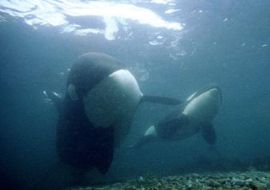
For years the rubbing beaches have been walled off from humans, an ecological reserve giving the orcas a glorious respite from the boat noise in their favorite place in the strait. But there’s no rule about placing cameras there. And for the first time, Paul Spong and Orca Lab have set up two cameras over one of the rubbing beaches. When the sun shines down on them it looks like a tropical paradise. The shallows reflecting turquoise out from the shore line, the harsh rocks and steep edges at the points turn the strait back into its normal substrate. It’s like a private beach for orcas, with there own ecological wardens, chasing trespassers away. I had given up the hope of ever seeing them rub. Accepting that it would have to be something to read about, and listen to the sound of raking pebbles as they pass over the hydrophone.

But now there’s footage, probably a few hours already of orcas, gliding serenely into view slowly and gracefully pumping powerful flukes, blowing bubbles to become negatively buoyant, and sliding smoothly across the pebbles, in ten feet of water, a stones through from shore. Sometimes they stay for an hour, other times the family will pass through just once, but it’s all captured on film. Following every move of this tradition generations old, even if it’s just for a brief moment. We are peering through the key hole, getting the faintest glimpse at the private, personal lives of an animal, just as intelligent as us.

Photo Credit: Stefan Jacobs