
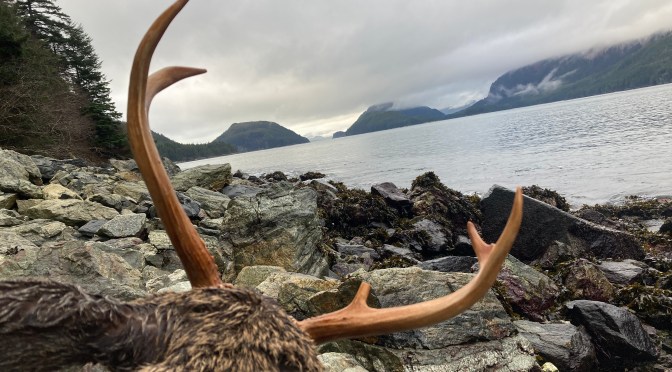
Time stops when antlers fill the scope. This muskeg looked empty before I crept behind a mossy tussock, blew the wooden deer call swinging from my neck, and summoned a doe from her hidden bed. I watch her unseen; a rare privilege to see a deer that doesn’t see you. A grunt grabs my attention. Forked antlers pad up the mossy hill.
“This is how it’s supposed to work,” my brain whispers. “Blow the call, attract a doe, and watch the buck come trotting in.”
The buck disappears beneath a slight depression and reappears at 20 yards. Either he doesn’t see me or doesn’t care. He’s full-grown – five years old in blacktail society – and lord of this expansive muskeg. Mature bucks aren’t supposed to show their faces in the middle of the day, but all bets are off when the rut is on. I have tricked him by imitating the call of a fawn in distress. Bleating fawns bring does, does bring bucks. As if a bolt-action 30.06 loaded with copper-tipped shells wasn’t enough of an advantage.
***
Yet, there is no moral ambiguity. My rifle misfired an hour ago when a large buck trotted past in pursuit of a pair of does. I can still see his startled expression when he looked up the hill. I reloaded in a panic and pulled the second shot. That had been enough. He’d bolted the way he’d come, and no bleating fawn would bring him back.
Hunting is challenging, even with a rifle, Google Earth, tide charts, and hand-carved deer calls. Blacktails camouflage beautifully into the brush and rarely move when the sun is high. Infinitely better ears and noses, they melt into the woods long before our primitive eyes spot them. I had patiently waited above their trail for that exact moment. It’s hard not to feel cheated. That life isn’t fair.
***
Minerva lays sprawled on the carpet. Her expression matches mine. Limp, apathetic, beaten, and lost. I refresh the New York Times, watch Wisconsin turn a little redder, shake my head, and close the laptop. I scratch behind her ears and pick up the guitar with an apology. Her eyes widen, and she bolts for her favorite hiding place beneath the bed. If I ever think my guitar playing is improving, I can rely on her to keep me humble.

I strum the opening chords to Brand New’s ‘137,’ a song about nuclear weaponry and destruction. Perhaps still a tad hyperbolic, but it feels appropriate at 9:00 pm on November 5th.
We’re so afraid. I prayed and prayed when God told me to love the bomb.
I want justice.
I want clean water, clean air. A habitable planet. For quiet spaces and open places to take precedence over fear, greed, and hatred. I gaze out the black windows toward the invisible willow sluice where moose nurse their calves and snipes build their nests. Closeted away on this swampy glacial outwash makes it hard to articulate or understand how people could choose profit and bigotry. I once yearned to understand. To comprehend and seek common ground with a sect that claimed Christ as lord but slammed their doors against anyone who didn’t look like them. Who chose to worship manifest destiny and convicted felons over the simple edict of “love thy neighbor” and “do unto others.”
Let’s all go and meet our maker. It won’t matter whose side you’re on.
I will not get justice. Any environmental or conservation progress has been reduced to fantasy. The best we can hope for is a fighting retreat. The Helm’s Deep culvert has been breached, and I don’t know if we can count on Gandalf arriving at first light on the fifth day.
***
Zach and I silently crack beers. Two days later and he’s still sporting the camo-tinged “Hunters for Harris & Walz” ballcap our buddy Sean made. There’s no reason to rehash what we already know. No need to talk about carbon levels, alternative energy, or the sixth extinction. What hope we had at reversing them has melted like so many glaciers.
We try to cheer each other up and allow one another to be angry. To curse and chuck an empty beer can at the hemlock paneling. It’s impossible not to think about Zach’s 18-month-old boy and what kind of world he’ll inherit. I feel guilty and selfish at my childless existence but thankful my parentage extends no further than a cuddly ragdoll cat.
Our vision narrows to the world we can comprehend: Icy Strait, Glacier Bay, Cross Sound. The mountains waiting to be explored and quiet mornings in the muskegs. Living at the north end of an ecosystem that runs from Alaska to northern California has some advantages in a warming world. Southeast Alaska is projected to receive more rain in the coming decades. A bit soggy, perhaps, but better than the well running dry or having the remaining reservoirs snapped up by corporations.

Mellower winters and protected old growth will be good for deer. Perhaps the salmon runs can persevere in the rivers free from clearcutting. We yearn to escape. To go on a wilderness bender. To return to one of the few places that makes sense. We pull up YouTube and watch videos of Sitka blacktail deer, counting the days until our turn to walk in the woods.
***
The buck fills the scope. Ten yards away, yet I receive only a sideways glance. The doe meandering up the hill has all his attention. He turns broadside. Crosshairs settle on his chest just behind the front leg. My finger flexes. The gun clicks. Panic returns. Another misfire. How old is this ammo? How many times have I taken it into the field? Even bullets have expiration dates.
Work the bolt, the dud flipping through the air and nesting in the moss. I didn’t reload after the previous mishap. I chamber my last shell. The buck takes an uncertain step towards the trees. Crosshairs on his heart.
“Please, please, please, please.”
The barrel recoils. I don’t hear the shot or the dull pain in my shoulder.
The doe glances over. There’s no fear in her face, only polite curiosity. Acrid smoke fills my nose. My heart pounds and my hands tremble. I’m no longer cold. No longer wet. A red mist envelops his chest as he collapses on the moss. Blood stains his soot-colored coat. His final breath escapes through the exit wound. The cloudy vapor hangs like a whale’s spout. But there is no arching back, no flipping tail, no pronouncement of life.
I collapse into the moss with ringing ears. My breath comes in tiny gasps, feeling relief more than anything. It’s only a few strides to his resting place. I grip the thick fur. My forehead touches his. Empty eyes, a pale tongue pokes from his mouth.
The doe saunters away, oblivious to the exchange that has taken place. Not comprehending or not understanding. She blissfully nuzzles at a the moss and comes up with a strand of something green and leafy.
I want my whole world to be this steep mountainside clinging to the north end of Chichagof Island, for every need and desire to be filled in the spaces between treeline and tideline. To watch the seasons come and go until the day I can no longer rise, and the snow gently covers what remains.
I guess I want to be a deer.

My knife slides across the belly’s white fur. His fading heat warms my fingers and steadies my hand.
I whisper my Deer Prayer, “You are the forest made flesh. I promise to think of you whenever I eat. To honor your memory. May wherever you are be peaceful and free of pain.”
I cup his heart in hands covered with blood and slippery with fat. My bullet pierced the aorta and pulmonary vein, but some of it may still be edible. The organ goes into a Ziploc along with the liver. Our hunting culture has few commandments, but one is to eat the heart and liver that evening while the story is told.
Field dressing complete, I sit on my heels and rub my hands clean. The doe has finally moved off, but I can still hear her rustling in the brush. There’s something eerie how, once a shot has been fired and a deer has fallen, how tame they become. In normal circumstances, the doe would have fled when she saw me. Now, she lingers. Paying her last respects? That sounds better than being oblivious.
There is contradiction in my hunting. Snuffing life from the very creature that represents all I crave and value. Their innocence and gentleness, self-sufficiency, and quiet beauty. The desire to get closer and closer, to reach out and almost touch this forest talisman and then decide which dies and which survives.
I stare into the dark eyes, already glassy with death.
“This isn’t fair,” I tell him. “Little in this life is.”
The muskeg faces the Fairweather Mountains. The Inian Islands and Hobbit Hole bow before them like fiefs declaring fealty. I grip the broad antlers and take a few unsteady steps up the hill. How can I feel enthralled and guilty at the same time?

Perhaps that’s why these muskegs and animals enthrall me but insist that I carry a rifle. The contradictions force me to examine my connection to place and attempt to comprehend it.
To understand how an easterly breeze catches my scent and how a northerly outflow bites the skin and sends deer running for cover. To examine the fairness in my own life and, most of all, escape. To connect with a part of me that pumps with vigor independent of elections, divorces, and frayed friendships. Because out here, deer or no deer, things make sense in a way they don’t where there’s cell phone service and wi-fi.
They say heating with wood warms you twice. Once when you split it and again when you burn it. If so, then deer feed me twice. Once in the woods and again on the plate. We depart the muskeg and dip into a small ravine. Sweat drips, and quads tremble. Hoof tracks crisscross snowy patches, ravens call on the wind, and squirrels chatter from hidden towers. Across another muskeg and down the mountain I wish I called home.
 Raincoast Wanderings