Trails

Golden light through golden leaves. Cottonwoods fluttering in a fall breeze are punctuated by random squalls that vanish before I can grab my raincoat. My fingers are greasy with salmon skin and stained with creosote. Sweet-smelling alder smoke billows from the smoker’s open door. I slide racks of salmon between the shelving and nihilistically rub stained hands on stained pants.

I close the door and watch the temperature tick towards 90 degrees. The smoked salmon recipe is as familiar as a warm blanket. Dry brine. Equal parts brown sugar and salt. Soak for four hours. Rinse. Let rest overnight. Into the smoker for four hours at 90 degrees. Bring to 180 over an hour. Hold for another hour. Eat the river.

I plop against a spruce and nestle into the mossy layers coating the ground around Hank Lentfer’s house like a Tempurpedic mattress. I walked past this spruce exactly one lifetime ago, drunk on the prospect of going full homesteader. With covetous eyes, I drank in Hank and Anya’s house and overflowing garden, convinced that this could someday be ours. Nevermind that I initially mistook the smoker for the outhouse.

“Rule number one,” Hank laughed as we walked by, “don’t shit in the smoker.”

So no, I haven’t shit in the smoker, but I have pulled racks of succulent salmon and one luscious deer leg from its innards with the overeager enthusiasm of children on Christmas morning. The temperature hits 90. Six hours begins… now. The stopwatch squeaks, and I set to work peeling bark from a waiting pile of alder.

There are easier ways. Electric smokers exist. Set it and forget it. I could fashion a hot plate and plywood box, eschewing the careful dance between wet and dry alder. Keeping the smoker at 90 degrees locks in the flavor. Slowly raising it to 180 keeps fat from bubbling to the fillet’s surface. I could stop there, slide them into an oven, and let them slow cook to completion. I’ve already hiked miles up the river, fished for hours, and shouldered them to the trailhead. It’s not cutting corners; it’s just practical.

Cottonwood leaves whisper on the gusts. The old rusting stove pops and cracks. Smoke escapes from the shiplap siding. I wander through the woods, sampling high-bush cranberries and following moose trails that terminate in dead ends as if their users apparated on the breeze.
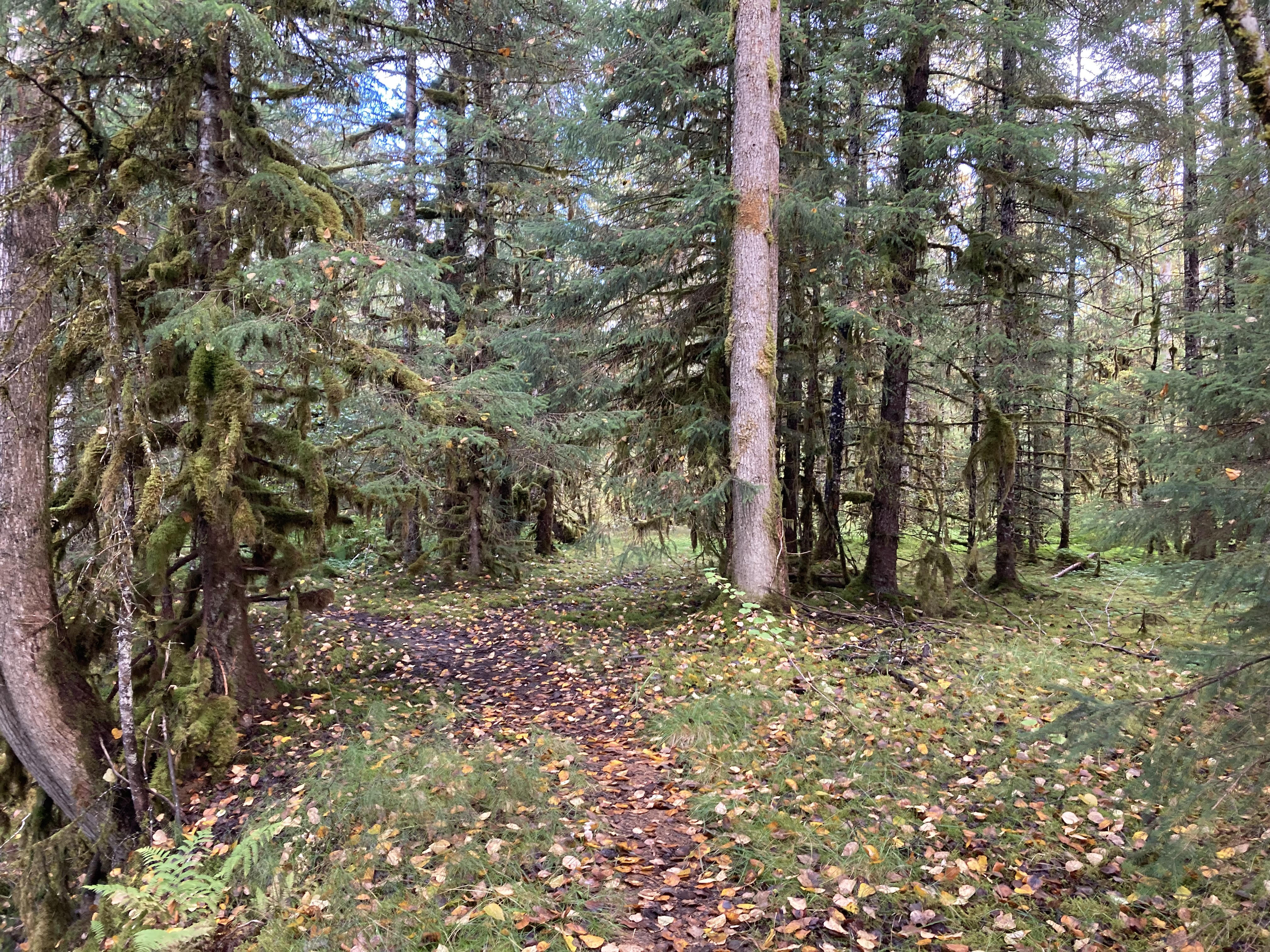
Even in sleepy Gustavus, it’s easy to get wrapped up in the rat race.

I don’t sit in traffic or attend budget meetings, but the “to-do” list never seems to shrink. A sliding scale of my own tolerance dictates the project list. Tyvek siding is acceptable until one day, I can’t stand to look at it another second. A kitchen faucet emptying into the same bucket for months is now intolerable. The cast iron tub that sat uselessly in the yard needs a home. A trail of washed rock appears and connects the driveway to the front steps. I returned in September, shocked to realize I’d been home less than four weeks since May. The house and property felt neglected. I set to work finding a place for the tub and slapping siding over Tyvek (kitchen sink bucket TBD).

But everything orbits around coho. A sunny day demands a journey up the river. The return of a birthday tradition of camping in the Bartlett River high meadow so I can roll out of my sleeping bag on the first day of my 36th year and cast into the river before I’ve sipped my coffee. It crescendos with this smoker that must be babied and attended to all day. It forces me to slow

All

The

Way  

Down

I kneel beside a well-worn trail traveling through the moss. It’s no wider than my forearm, but the moss has turned black and muddy from constant use. The trail connects two spruce trees. Their trunks covered with the shells of spruce cones. I don’t know how many squirrels ping pong between these two trees, but I’ve stumbled into somebody’s critical home. At least a couple of these chattering critters orbit their entire lives between these conifers. Up and down, back and forth, again and again. The patience, the time, the metronome-like consistency to make this trail speaks to a tradition no less significant than migrating cranes and howling wolves.

I run a hand down the trail. Is it possible to envy squirrels?
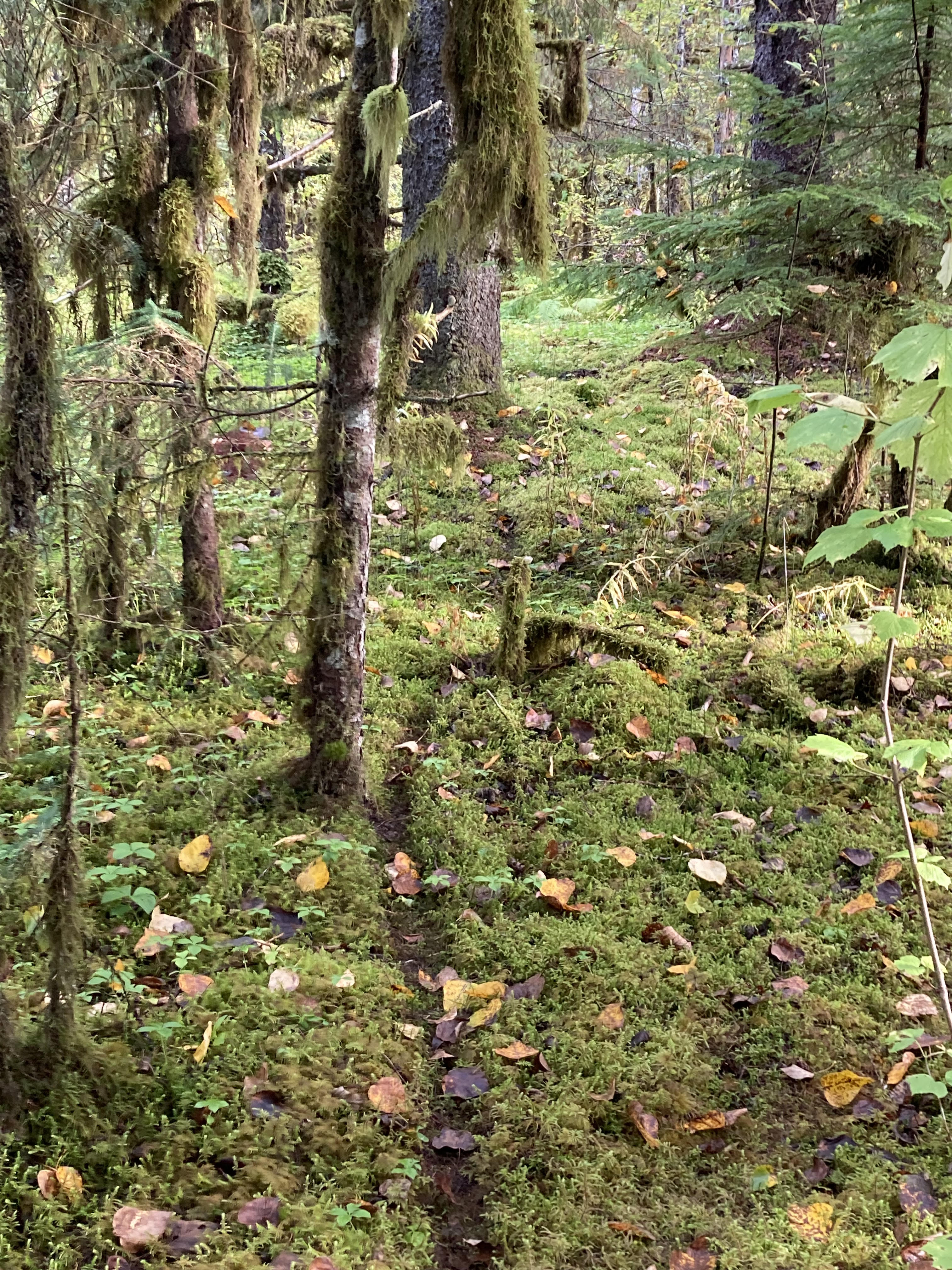
I think of the dozens of backbreaking trips with a wheelbarrow laden with rocks to form my own pale imitation. My attempt to reinforce the claim that I lived on and loved my swampy bit of land. But there is no substitute for time and the necessary pilgrimages between two trees that give these fast-twitch residents everything they need.

Hour number six slides by. I pop the door with poorly contained glee. Zach and Laura have arrived with their own tote heavy with brining salmon. Together, we shuttle the finished fillets to Hank’s porch, where their toddling son, Salix, is waiting. The door opens, and Hank appears with a quartet of Rainiers. He scoops a chunk of bronzed coho with one hand and flips a squealing Salix over his shoulder with the other.
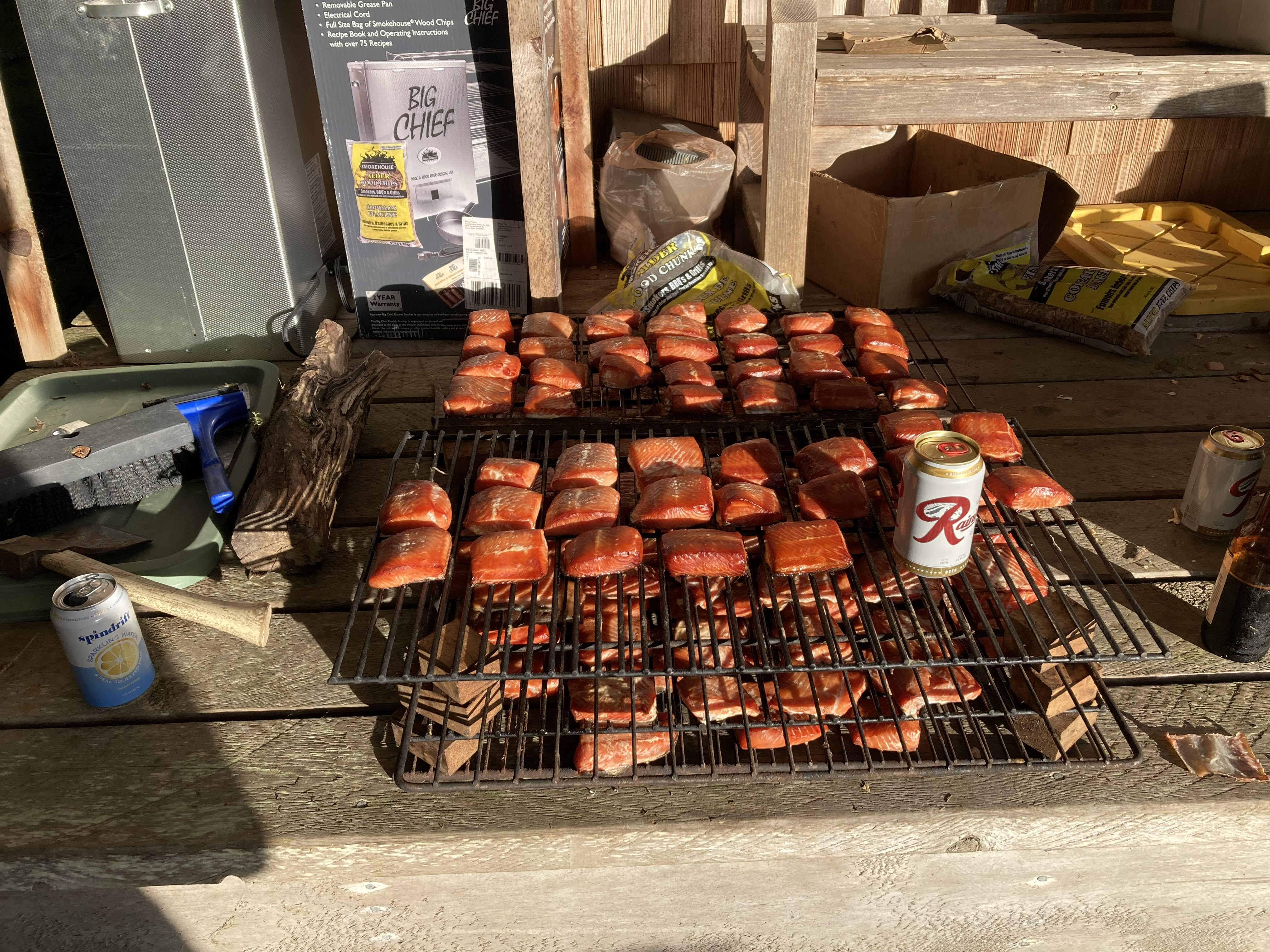
The cooling salmon are irresistible, and we shovel handful-sized bites into our mouths. Salix takes some of us first uneasy steps, light brown curls reflecting the last of the day’s autumn light. Perhaps my trails will never be so defined. But this place has other sorts of worn and loved indentions to reinforce my connection to home. Spiritual footpaths matter more than worn footprints.

I take a final walk through the enchanted forest, gathering my things and trying not to forget anything. The universe dictates that I must always leave something behind. This week’s victim is a pair of rain pants.

“I’ll try not to tell anyone you left your pants at my place.” Hank texts.

“Appreciate that. That’s how rumors start.”

I pause at the base of the Squirrel Spruce and nestle a piece of salmon in the moss amongst their spruce cone pile. The forest breathes, bracing for a winter as inevitable as a sunset or falling tide. But not yet. We have a few more golden weeks to walk our trails, harvest food, and watch cottonwood leaves fall.
Heart Medicine

“Anyone here going to Gustavus?”

We cluster around the Carhartt-clad pilot, ballcap pulled low over short brown hair. He glances at a single sheet of people – the closest we get to a boarding pass around here – and calls last names like it’s the first day of school.

“Taylor, Taylor, Higgins, Parkins… Cannamore?”

We acknowledge our presence with nods. The paper disappears into a back pocket, and a key card opens the sliding doors. This is what amounts to security at Alaska Seaplanes. No TSA. No separate bag for your four ounces of liquids. No random bag checks or standing with arms above your head. Hell, you can carry your rifle onboard and barely get a second glance. It is almost moose season after all.

We ramble across the tarmac and squeeze into a plane with plywood floors and one giant propeller.

“Safety kit is in the nose hatch,” he calls over his shoulder as seatbelts click. “The back door has two latches. Open the top door by flipping the latch and turning the bottom handle like a car door. There’s a fire extinguisher under my seat.”

Flying to Gustavus costs as much as flying to Seattle. A fun piece of trivia that delights tourists until it’s time to drop their credit card on the table. After three weeks ping-ponging across southeast Alaska on the National Geographic Quest, I’d pay just about anything to be home.

The prop catches and roars to life—earbuds in my ears, volume up. The Lonely Forest belting out an anthem that speaks of home.

Give to me miles of tall evergreens, the smell of the ocean, and cool mountain breeze.

Juneau disappears beneath my feet. It has been several lifetimes since I called this place home. I still want to love and cherish it, for it is a beautiful place. How many other communities have more miles of hiking trails than paved roads? My stomach gives a little lurch that has nothing to do with the turbulence and confirms I still have some healing to do with that particular place.

The plane swings west, and Admiralty Island rolls past, wingtips level with the 3,000-foot peaks clad in September fog. Hank has teased the Admiralty Island alpine for years, describing an alpine so lush that the deer cluster in numbers too tantalizing to comprehend. I trace ridgelines, nose pressed to the glass.

Next year. It’s always next year.

Fatigue creeps in. I am tuckered and worn out. How many days off have I had since May? I replay the summer as Lynn Canal whitecaps replace Admiralty’s muskegs. The season’s workload looked reasonable in February. I said “yes” to everything I could, locking up weeks as a naturalist for Lindblad and multiple kayak trips. I added the paychecks in my head, stared at my bank account, shook my head, and added it again. I wanted to reach November feeling financially secure(ish) with the freedom to run somewhere warm if the opportunity allowed. Mission accomplished. I think.

Point Couverdon. Past the south end of the Chilkat Mountains. Porpoise Islands. Pleasant Island. The runway beckons. A little community hidden in the trees. Millions of tons of glacial clay beneath our feet and crisscrossed with the prints of bear, wolf, moose, and crane. Come January, a sunny beach may be preferable, but right now I want to drink coffee on my couch and watch the rain fall.

I just wanna live here, love here, and die here… Give to me miles of tall evergreens…

Breanna left the house spotless. I didn’t know a sink could be that clean. Minerva scurries down the ladder, and for a wild moment, I think it’s because I’m home. But it’s 5 pm, and niceties can wait until after dinner. I toss my backpack upstairs and collapse on the couch. Deep breath in. Deep breath out. This space hasn’t felt haunted in a while. I hear faded laughter echo off the walls and can feel that the space has been lived in and loved. Minerva licks her lips and permits me the honor of scooping her up and putting her on my chest. She purrs and nuzzles, wet food breath in my nostrils.

“You’ve had quite a few tenants this summer,” I tell her.

A consequence of the packed schedule has been I’ve been gone more than I’ve been home, and a rotating cast of house sitters have rolled through, spearheaded by Breanna, The Shabin’s current caretaker. Minerva has been the star of Swamp Castle Estates as Breanna and I have christened these four soggy acres.

“I didn’t know I liked cats.”

“I don’t like cats, but she’s the coolest.”

“Can we reinstall the Shabin’s cat door so she can come visit?”

I squeeze the ball of fluff. Three months together at the Hobbit Hole certainly knit us together, but it’s sweet to see her growing fan club and watch her adapt to the rotation of people who have occupied this space. We lay there for a long time, savoring the absence of anything pressing: no questions to answer, no hikes to lead, no presentations to give. My mind drifts to the potatoes in the garden, the cranes winging their way south, and the buzz of a fishing reel’s drag as spritely coho zip across the Bartlett River.

***

We tramp the familiar trail in a steady rain. If Gustavus held a fantasy football-style draft for the best Bartlett River angler, I might take my hiking companion with the first overall pick. Kyle Bishop’s chest waders are stained with mud, clay, and fish blood. Every year, we promise to spend more time together and carve out room in our schedules for dinner, drinks, and Mario Kart tournaments.

Next year. It’s always next year.

But come September, we’re inevitably drawn to this trail, this river, those coho. We can go months without exchanging a word or text and then chatter like squirrels when the cottonwood leaves turn yellow. We badger each other for life details and snigger at the passing out-of-towners lugging a five-gallon bucket to hold their theoretical catch.

Fifty minutes to the first decent fishing hole, but the place we really want to hit is further up. We weave past a well-mannered brown bear and drop our lines into a long, deep channel the coho favor. My rod tip bends, line runs out, and I see the beautiful flash of silver for the first time. The salmon breaks the water and thrashes. The hook sinks deep—elation skyrockets. I guide him to the shoreline, and the fillet knife ends the fight. I run cold, wet fingers down the scales, marveling at the miracle that is home.

The one place that offers the life I want happens to be where I can afford to live. Rain runs down my face, and the river’s cold presses against my waders. Kyle hoots, and white water materializes 30 feet in front of him. The season’s just beginning. The first of many pilgrimages to this spot. The first of many benedictions and prayers to the animals that feed us and bring us together.

I place the coho in the grass, reset the line, and let the hook sing across the water.