

My boots crunch frozen grass and I grimace. There’s no quiet way to move from the intertidal to the woods in these conditions, the world softly frozen around me, beads of water suspended and solid on every blade. I tighten the straps on my backpack and try to think like a deer, move like a deer. I walk on the balls of my feet to soften my footfalls, body tensed and alert. I have been walking for only twenty minutes but sweat already beads beneath the bright orange hat.
I feel the blunt object slung around my shoulders slam against my hip. I adjust, brush aside the first layer of alder, and hear branches scratch against my pack. Breath thunders in my ears and boots squish into soft, wet earth. Inside the forest, nothing is disturbed. I take a moment to marvel at my good fortune.
As I child I read and reread every Calvin & Hobbes comic, staring enviously at the apparent national forest Calvin and his stuffed tiger had at their disposal to ride their red wagon in summer and toboggan in winter. Complete with cliffs, ravines, swamps, creeks, and lakes. Now, I have my own National Forest. Tongass, and the designated wilderness that is the Inians. Me, some deer, a curious raven, a chattering squirrel.
I move up a gently sloping hill until it meets the steep cliff that shoots up at a 90-degree angle to the summit of the island a thousand feet above. The forest abruptly ends, surrendering to gravity and salmonberry bushes clinging to this steep and harsh stretch of the island.
I have been here before, know where I’m trying to go. The forest frames this steep hillside for two miles before the cliffs jut out to meet the waters of North Inian Pass. By staying just inside the trees, I can have a full view of the big, west-facing woods below. A haven for deer regardless of the weather. I touch the object around my shoulder, to reassure myself it’s still there, and drop into a drainage to hide myself from view.
The sound of the creek covers my tracks and masks my scent as good as I can hope for. I follow the drainage for a quarter mile, allowing just my toes to touch earth. Quiet as I can be, crawling on hands and knees beneath fallen logs and feeling the water-soaked earth crawl up my pants. At last, the drainage meets the top of the hill, the little valley flattening out. I pause, crouched behind a fallen hemlock hiding me from view. Sometimes the first look is the only chance you get.
I ease myself around the root ball, turn, and am greeted by a flashing white tail and startled bleat. I freeze, and so does the deer. A young buck, his antlers nothing more than knobs on the top of his skull. I’ve caught him unawares, but he only bounds about ten feet before stopping. He looks back at me with a politely curious expression.
The object knocks against my shoulder, demands my attention. I don’t dare move. The deer remains frozen, obsidian eyes unblinking, impossible to imagine what is going through that young mind. He glances away from me, looking back down the hill. Very slowly, I move my right hand across my chest, feel the strap slide, come loose… and the binoculars slide into my hands.
My freezer is full. I am not here to harvest. I am here to learn. To soak up whatever secrets and knowledge my neighbors are willing to share.
“I sought fuller comprehension of an animal I am made from,” wrote writer and hunter Richard Nelson in his book Heart and Blood, “the life outside of me which becomes the life within me.”
As do I.

From the beginning, the deer of the Inians were more than “stock” or “herd” for us. They are revered and honored. And like anything we revere, I am innately curious about these phantoms of the woods. I love how they appear just when I’ve given up. When I get lazy and round a corner or snap a twig, rewarded with the sight of a whitetail trimmed with black bounding effortlessly through the wood with nary a sound.
I bring the binoculars to my eyes and drink him in. Even if I’d brought a rifle, even if the freezer was empty, I’d have a hard time pulling the trigger. He still has that “fawn face,” short and stumpy with all the characteristics of a baby animal that make us coo. In the low light, even though he is just feet away, he seems to evaporate into the woods around him. Perfectly camouflaged in the weak January sun and a forest floor free of snow.
Lowering the binoculars doesn’t startle him. He continues to oscillate between me and glancing down the hill. There have been several times over the last few years where I have sat in the company of deer. Many times, using the “call” brings either does, fawns, or both, leaving me to wait and hope that something with antlers will wander by. But in those moments my attention was never on them, instead scanning the woods beyond for something that would bring the scope to my eye.
Now, this little buck has my rapt attention, and I decide on a little experiment. I tap one nail against the glass of the binos, the sound barely registers in my ears from less than a foot away. The fawn responds instantly, tilting his head like a dog at the sound of the treat bin opening. He stares directly at my binoculars and takes a step towards me.
No way.
I tap again. A few more steps. 15-feet away. The closest I’ve been to a wild animal in a long time. I don’t dare breathe. Sweat drips down my face, every muscle tensed with the effort of staying perfectly still. Through it all, the fawn has not made a sound. Nature has perfectly sculpted him for a life of silence. What next? The seconds hang in the air. I hear footfalls behind me.
I turn my head instinctively and see something grayish and sleek move through the brush. The doe looks down on us and gives a disapproving huff. The fawn immediately snaps out of his trance, cantering over to mom and attempting to nurse, only to be forcibly rebuffed.
It’s not unusual for fawns to return to their mother for a time once the rut is concluded. And judging by his eagerness he is something of a mama’s boy. While not alarmed, the doe has no interest in this staring contest. She moves down the trail, her kiddo in tow. I don’t wait for an invitation and step softly into their trail and follow. The pair canter at a casual gait 30 feet ahead before weaving around a large spruce.
With them out of sight, I increase my pace, trying to keep them in sight as long as I can. I reach the spruce and slowly tilt my head around the corner. The forest is empty. Spruce, hemlock, blueberry, and menziesia trees and shrubs interspersed at intervals with no deer between their gaps. I bring my deer call to my lips, give two short bleats, and settle against the trunk. But there is nothing, no evidence that I share the woods.
I begin to make my way down the hillside, eyes still scanning for a pair of ears trained like satellites in my direction. But I once again walk alone. I’m getting cold and tired, ready for a mug of tea and a sandwich as the short winter days pass like sand through my fingers. But I cannot bring myself to crash through these woods. Every step needs to be quiet, as stealthy as I can be on the off chance that another of these creatures will wander into view. Can I not take a simple walk in the woods anymore?
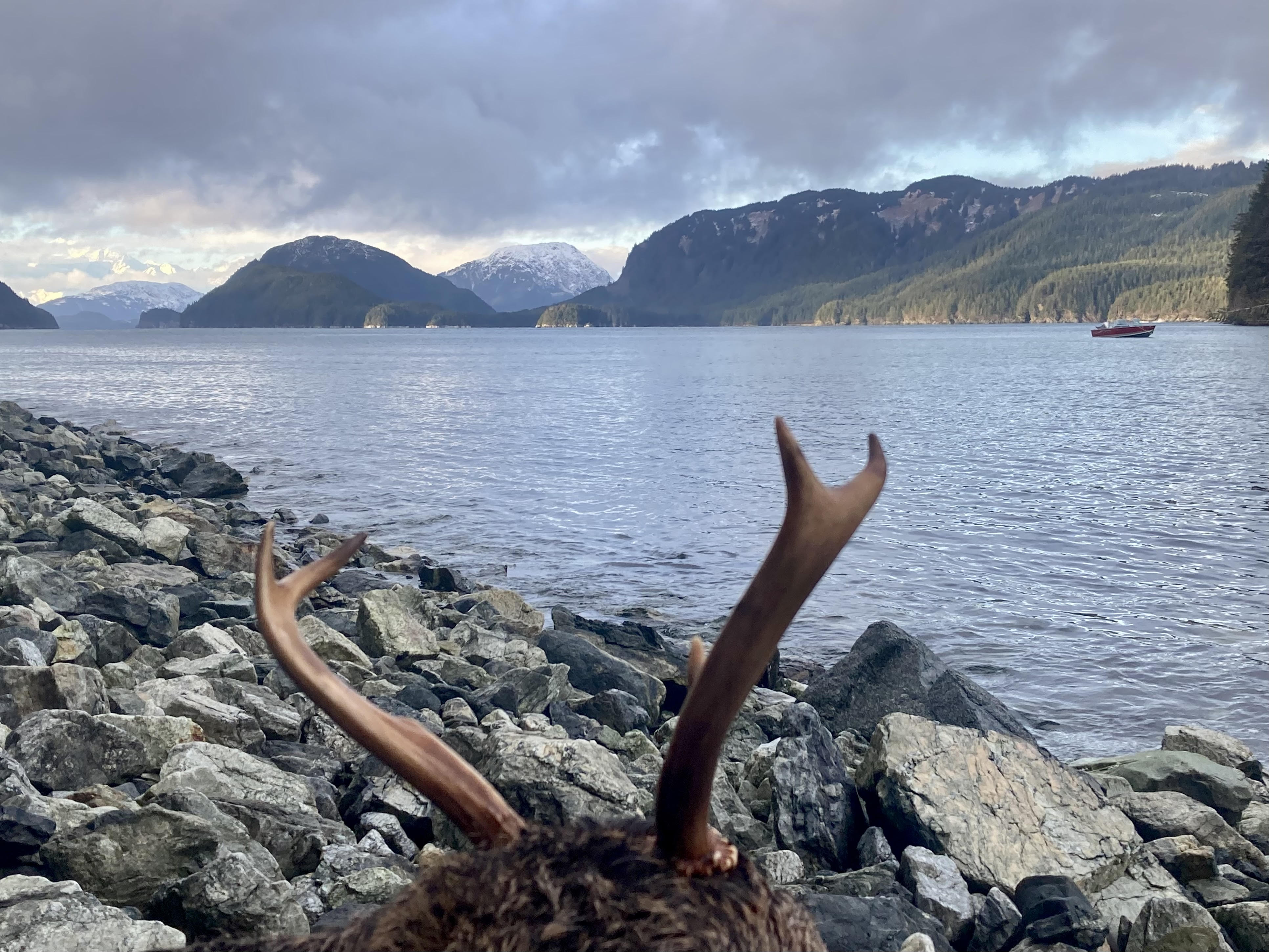
“I wonder if hawks or herons, wolves and killer whales are ever astounded by the loveliness, the grace, the perfection of their prey,” Nelson continues.
I have often claimed orcas match us in intelligence, that they may be smarter than many humans. I include myself in that category. The corvids of the sky are whip-smart, anyone lucky enough to stare into the eyes of a wolf has seen a soul staring back. One could certainly argue that the intricate and complex languages these animals have room to marvel at and appreciate the voles, seals, and moose that sustain them.
But humans undeniably have this capacity, if we choose to acknowledge and accept the burden and gratitude that comes from appreciating the things we eat. It has forced me to come to terms with my omnivorous evolution, the power it has given me, and in turn, the responsibility to not abuse.
***
I open the freezer and retrieve a parcel of butcher paper. The outside is covered in brightly colored scribbles courtesy of Elm and Beth’s daughter, Claire who assists in butchering by making sure every piece of venison is lavishly wrapped in artwork. The antlers on her drawing of a deer are unmistakable. I set the meat on a plate to thaw with grand designs of spaghetti, meatballs, and a liberal dusting of parmesan.
I didn’t just come to the Hobbit Hole to grieve and rebuild. I came to explore, to learn the forests and muskegs and hills as intimately as an overcivilized and domesticated human can.

The “Hobbit Hole” from the far side of the inner lagoon.
To discover the trails and beaches and shortcuts through these marvelous, old, protected woods that will be standing long after I’m gone. To grow as close to this special patch of earth as I can over three months. A huge part of that education was the deer, one of the forest’s rightful tenants.
To eat of deer is to eat of the forest. Of blueberry and devil’s club. Skunk and deer cabbage. Alpine and beach. Forest and muskeg.
I never fancied myself a hunter, never imagined I’d walk into the woods with the intent of dragging something out. But it has granted me a gift I didn’t expect, drawing me closer to the wild places that sustain me like a spring welling up amongst forested acres.
It has turned me from an idle hiker to an explorer, asking questions and taking copious notes of the places I visit. The knowledge that I will never understand or grasp the intricacies and relationships of these animals and ecosystems only makes it more alluring. Be it a rifle or binoculars against my hip, my days of crashing woodland hikes are now a thing of the past.
 Raincoast Wanderings