A Prayer for Place

Fog to the waterline. Chichagof just a mile away, but all we see are the shores of Inian Island. The four of us stand on the stern of the Magister and pick up a bucket.

It has been a bountiful two weeks at the Hobbit Hole. Every hunter who has walked into the woods or landed on a beach has come back with at least one deer. The Hobbit Hole’s freezers are fit to burst with the promise of burgers, stews, and roasts that were born, raised, and harvested from the places we call home. They’re so full that Kathy, Bill, and I are going home with a load of venison to make room. The larders are packed, and winter has come in the form of 60-knot gusts and a foot of snow.

In the buckets are the final pieces of the deer, their bodies now sustenance for us that, as Zach vows, “will fuel good work.”

We whisper benedictions and watch the hides and scraps drift away on the tide of Inian Pass. It takes but a minute for a pair of eagles, a raven, gull, and otter to find our burial site. The eagles divebomb with precision. The otter swims away clutching a head with a piece of intestine trailing behind like a line. Nothing is wasted. Life is honored. Traditions are savored.
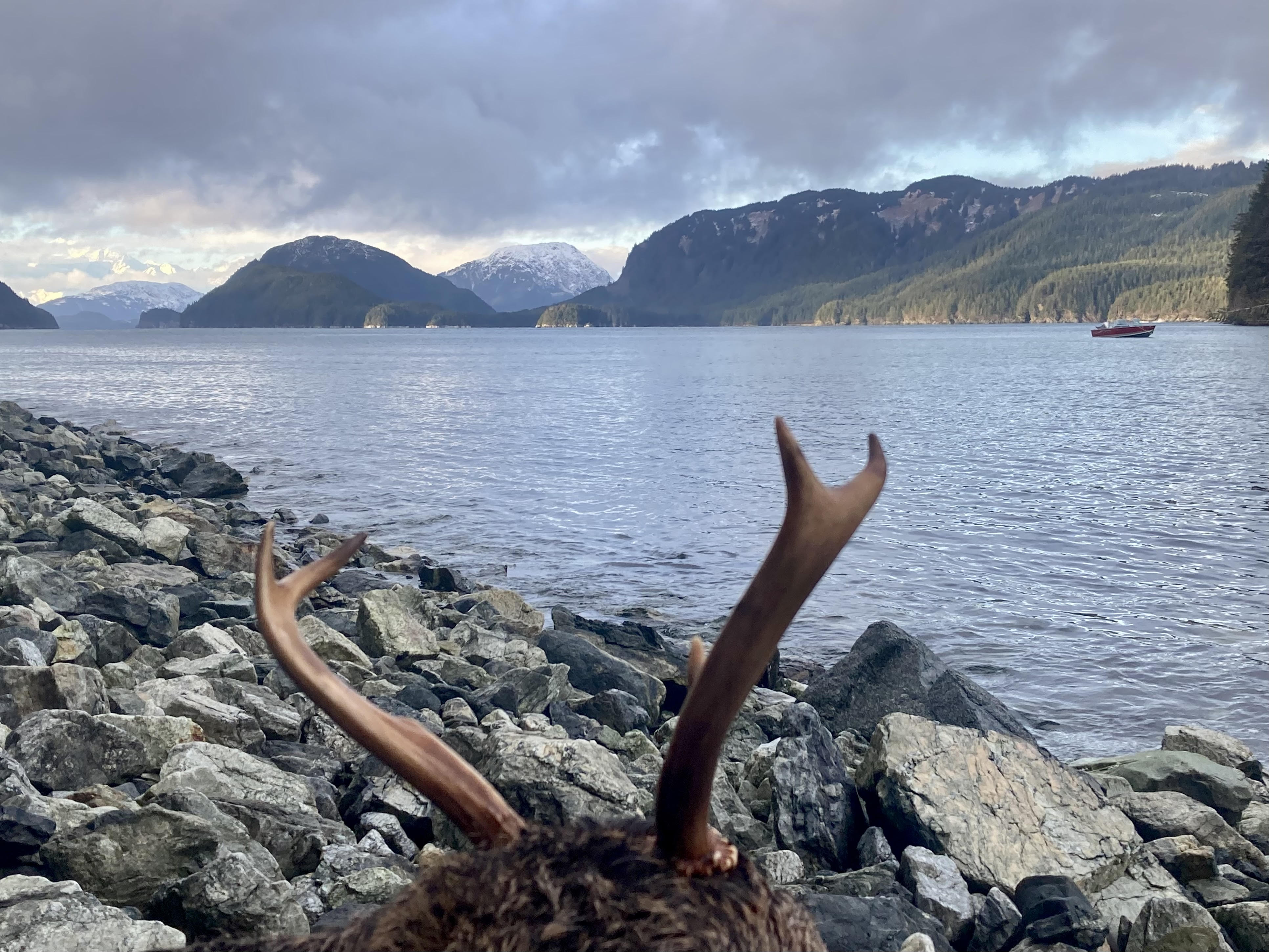
Zach puts the Magister in gear. We round the corner, and I watch the island fade into the fog. We travel in milk, but I know the way. Can clearly picture us zipping toward Lemesurier where more friends are communing and hunting. And ten miles beyond “Lem” is home. Home. I let the rock fill my stomach, stare at the fog, and convince myself that it’s simply mist making my cheeks wet.

I feel a hand on my shoulder and turn. Kathy’s eyes look through mine, and I can’t hide behind the smile that comes too late. When it comes to Catan, Kathy is ruthless. When it comes to matters of the heart, well, let’s say she won’t block your attempt at the Longest Road. She knows loss. Has experienced it herself. And I get the feeling her eyes have looked like mine before.

***

Dinner done. The dishes put away. A cake that took 13, yes 13 eggs and a pound of butter sits in the middle of the table. Full as we are, as rich as it is, we’re still eating. And I am waiting. Waiting for Zach to do what he does every Thanksgiving. We aren’t the only people who resort to that time-honored tradition of going around the table and saying what we’re thankful for. There’s nothing wrong with it. A lovely perspective to have, I admit. And it was a year of gratitude for many.
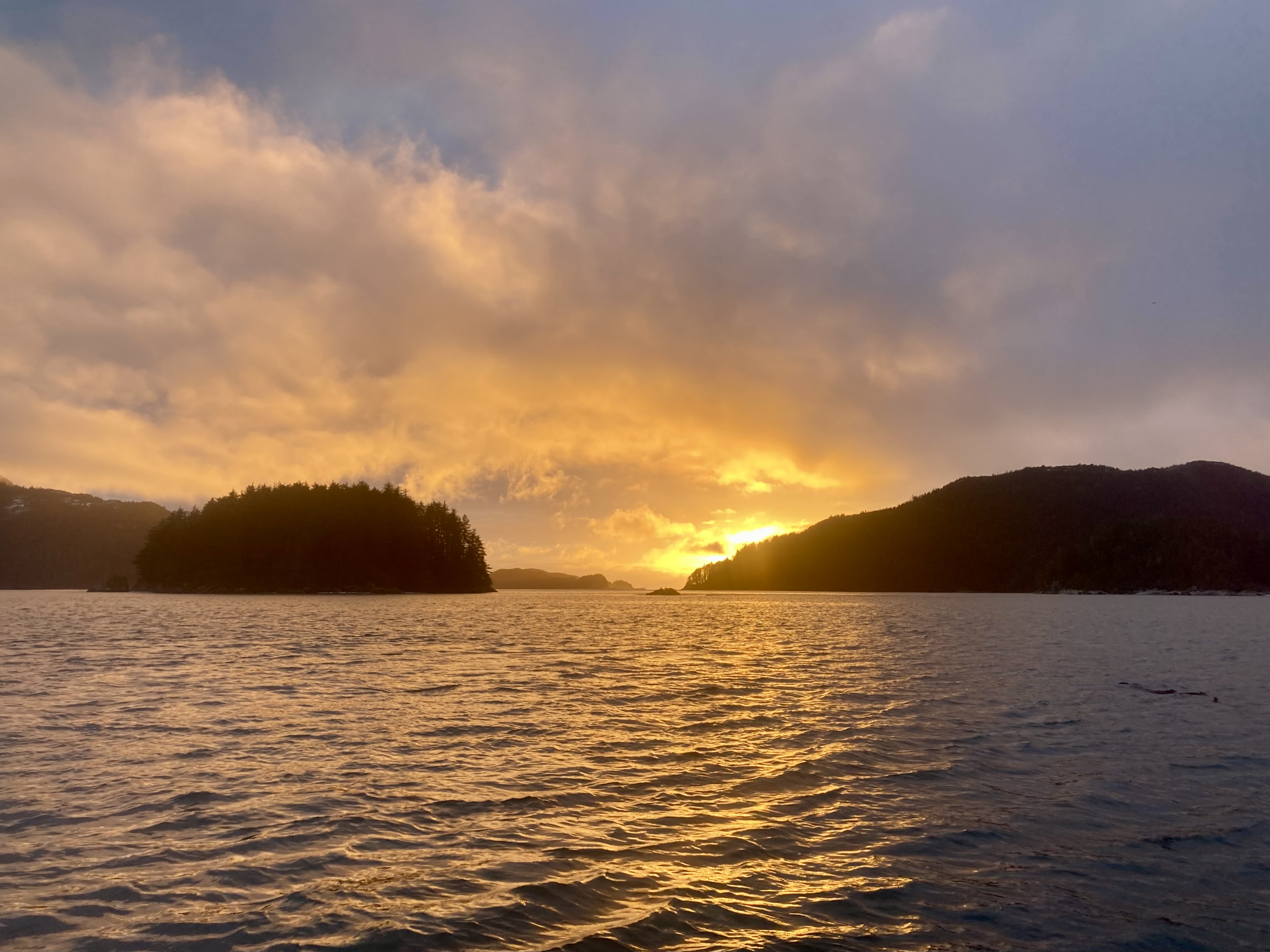
Kathy and Bill got married. Zach and Laura welcomed their son Salix into the world. Beth and Elm bought property and finally, after both were raised in Gustavus, have a piece of land to call their own. Very good years with blessings worthy of being celebrated and shared.

Beth finishes her gratitudes and looks at me. I stare at my coffee cup for several long seconds, feel the table’s eyes on me. Everything spoken and unspoken hovers in the room like smoke.

In years past, I haven’t taken this ritual seriously. It was simple to say the obvious. I was thankful for my little patch of Gustavus clay. For health that allowed me to tromp in the woods and look for deer. To have work that I loved.

I. I. I. I. I.

What sort of gratitude does one have when they’ve stripped that person to studs, dug deep beneath the foundation and asked, “Who am I?”

“Ahhhhh,” I finally say. “This has… not been the best year for me.”

Have you ever been the only person at a table to share bad news? Is it their pity I feel? As if I have contracted some terrible sickness that leaves those nearby speaking in hushed tones of sympathy and condolences.

No. It’s love. It’s acceptance. It’s… community. For Gustavus has that in spades. I forgot that at some point. Forgot that was the reason I wanted to call this place home in the first place. It wasn’t just whales and glaciers, salmon runs and quiet homes in the woods. Kim Heacox’s words materialize in my head.

I live in the shadow of glaciers, and in the sunlight of friends.
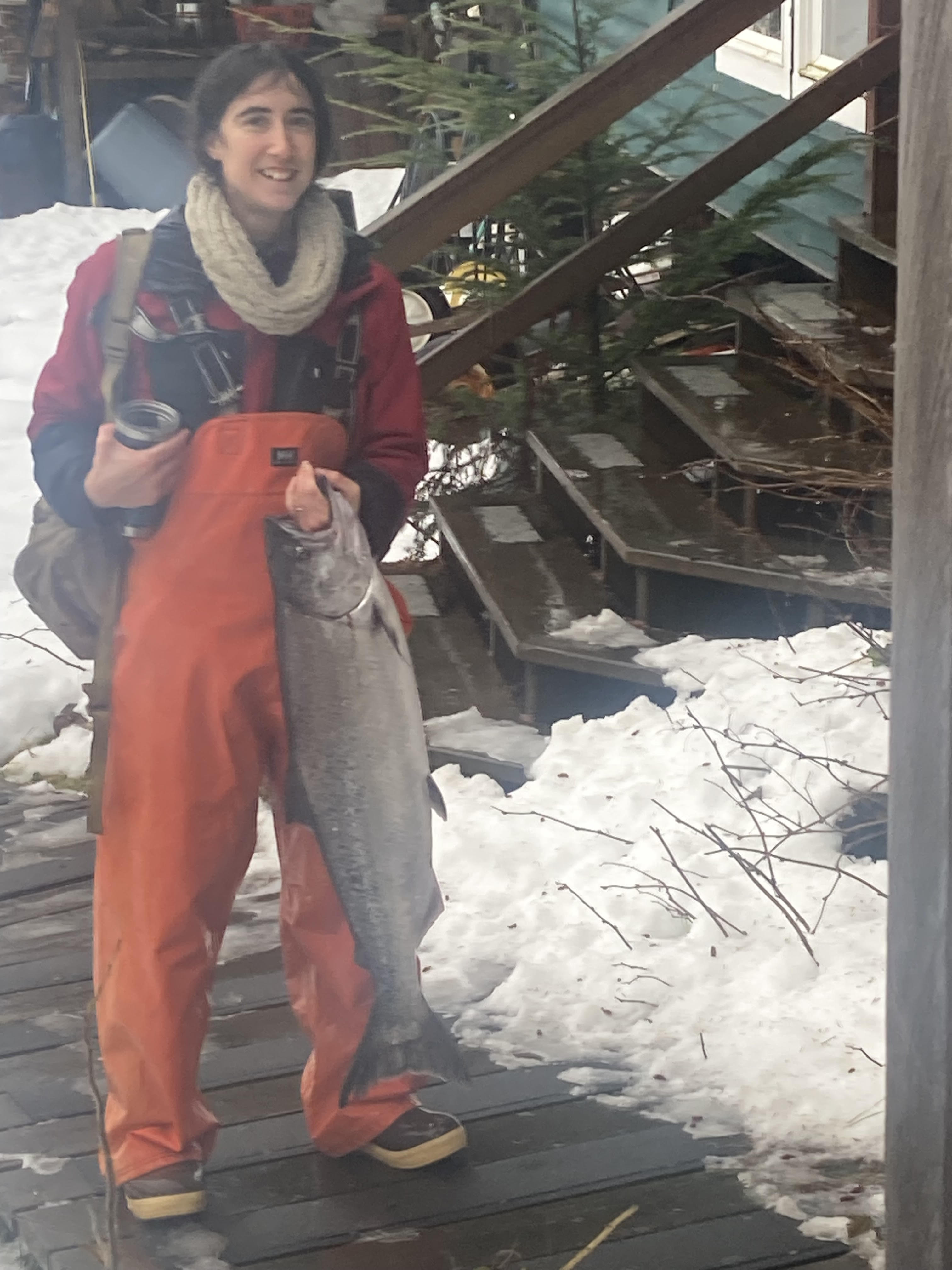
I remember now. I will never doubt it again.

It was people like this. People that are neighbors in the truest sense of the word. Not just someone you wave at when you grab the mail or need a cup of sugar. And neighbors close ranks and pick each other up, permitting vulnerability, intimacy, and, yes, a home.

“A few months ago… I wasn’t sure I’d be here. But it’s the people at this table that wouldn’t let me leave. I can’t quit you guys. I can’t quit this place. And as strange as this sounds, everything that’s happened has given me a firmer grasp and sense of place. How precious you are to me. And that is my gratitude. To know that I truly have a home. That I truly belong. That my love of this place was bigger than one person.”

“So…” I bang my coffee cup on the table and hear their mugs answer. “Thank you for being home.” 

We cheers, we smile. And we brush that intimacy aside, crack beers, and break out a game of “Liar’s Dice.”

Insults, quips, and jokes boomerang around the table. Elm’s laugh echoes off the walls. Beth giggles. Zach and I exchange movie quotes at a rapid-fire pace. Laura grins. Bill gives his quiet smile. And there’s Kathy’s piercing stare, trying to figure if there really are “six-fours” hidden under our hands.

***

Kathy and Bill leave me on my doorstep with two totes of frozen meat and a fire roaring in my wood stove. Minerva comes hopping out the cat door chittering and meowing. I scoop her up, bury my face in her fur, and step inside. I love how my house smells. The earthy richness of the hemlock paneling, the faint smell of stove ash. The promise of bright summer days piercing the south-facing window.
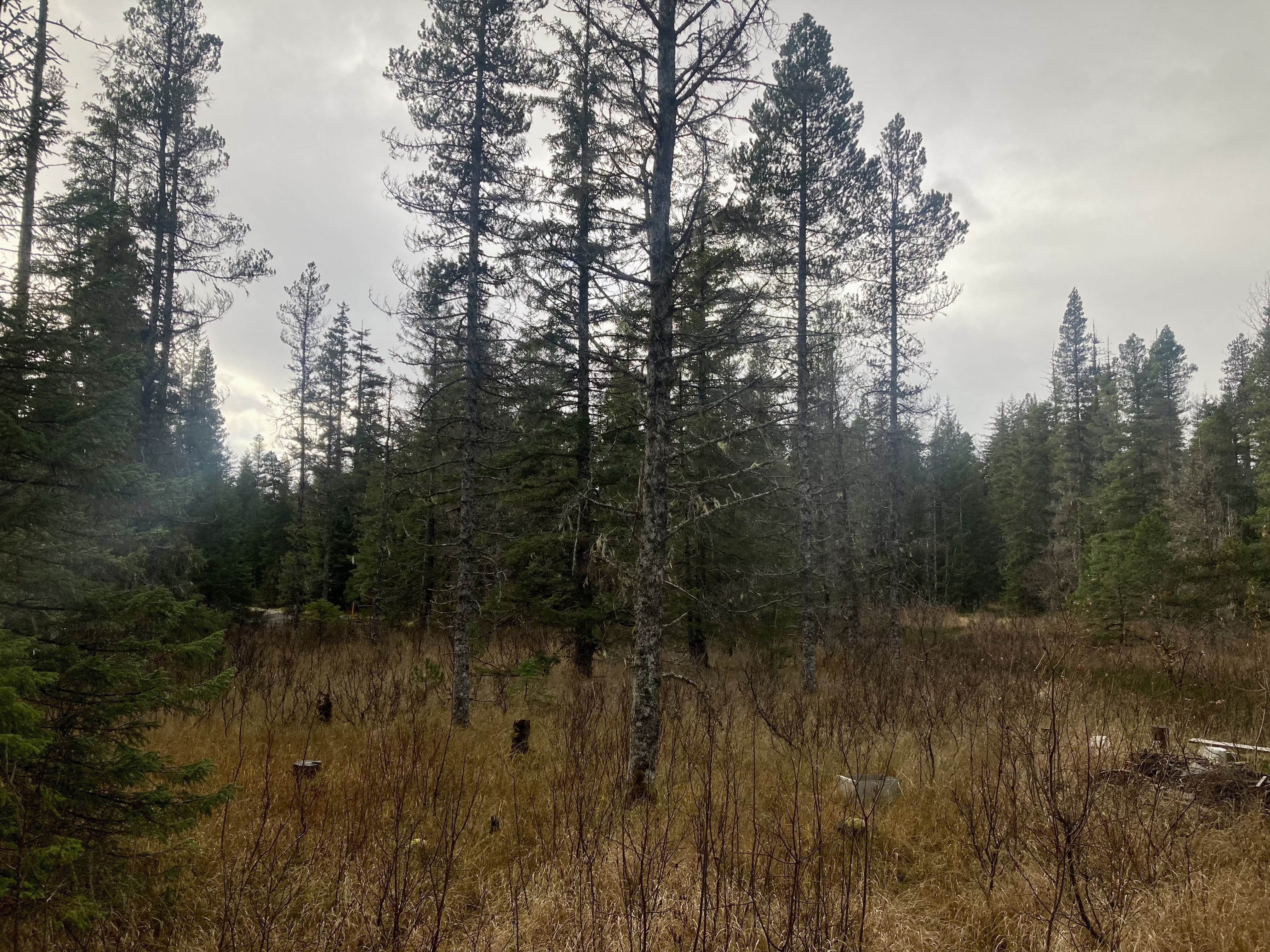
I load the meat in the freezer and put the kettle on for a pot of afternoon coffee. As the water boils, I look around the room. I’ve done some remodeling the last few weeks. Moved some pictures, bought some new dishes. Tossed an old blanket and regretted it when I felt the chill of winter.

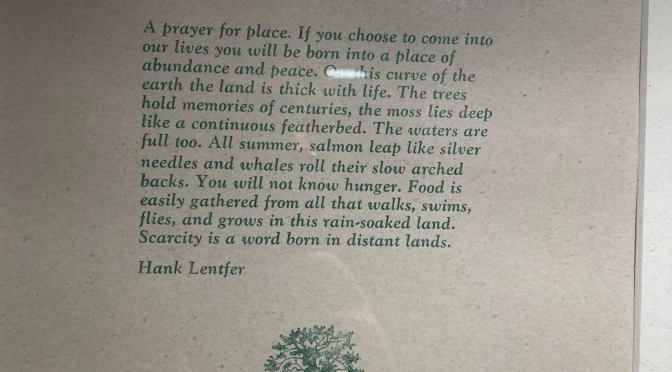
There’s more orca paraphernalia on the wall. Getting back to my roots. Maps of Icy Strait and the Broughton Archipelago have been promoted to artwork. But the frame I stare at now has neither animal nor geography. It is words, penned by my neighbor Hank Lentfer. A mantra. A creed. A promise. A prayer.

A prayer for place. If you choose to come into our lives you will be born into a place of abundance and peace. On this curve of the earth the land is thick with life. The trees hold memories of centuries, the moss lies deep like a continuous featherbed. The waters are full too. All summer, salmon leap like silver needles and whales roll their slow arched backs. You will not know hunger. Food is easily gathered from all that walks, swims, flies, and grows in this rain-soaked land. Scarcity is a word born in distant lands.

The kettle whistles and the smell of coffee sinks deeper into the drywall. I have chosen. I have been accepted. I have a hot wood stove, cold clean water, and a freezer fit to burst. And that is worth all my gratitude.
Ravens and Deer

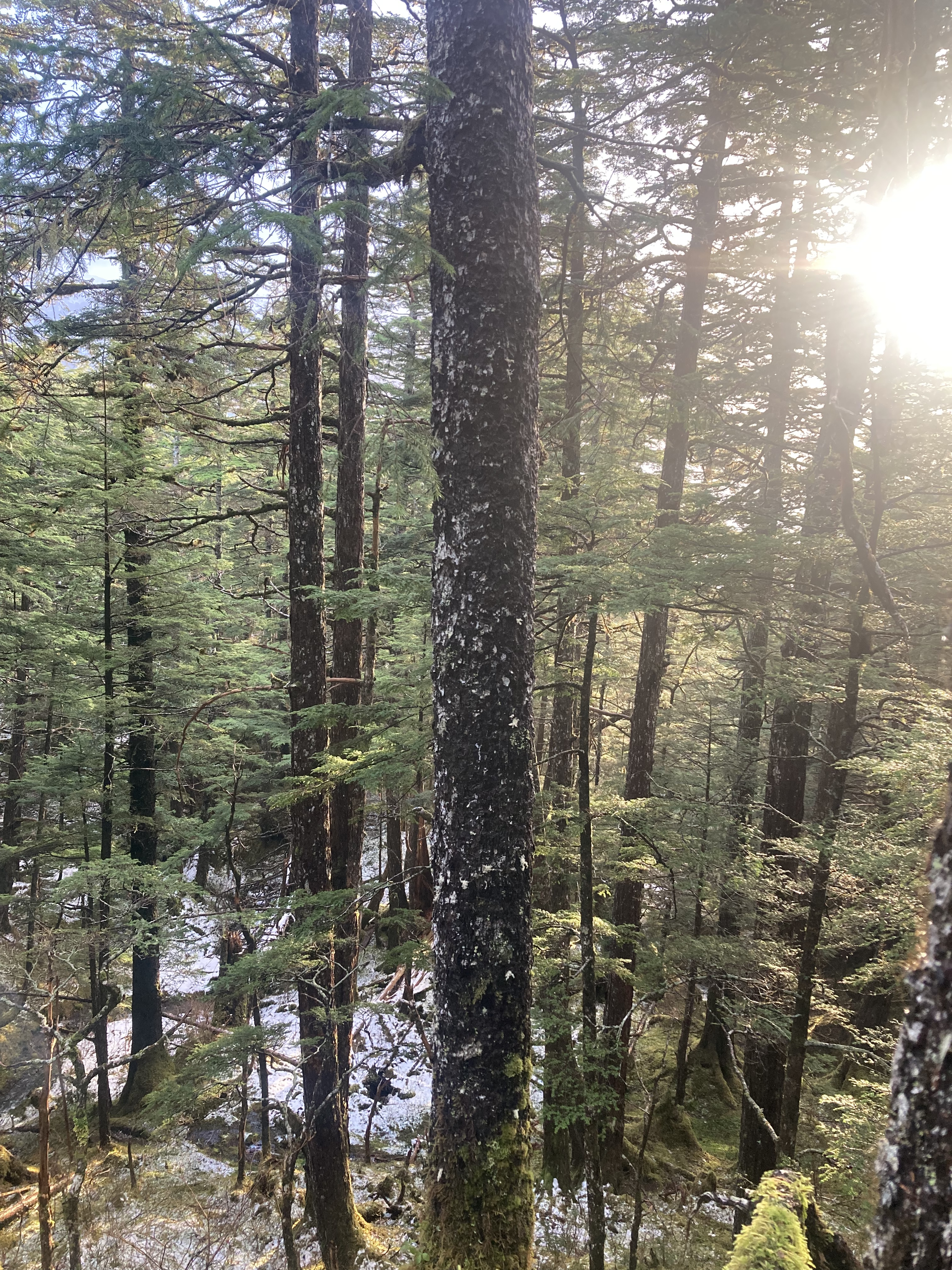
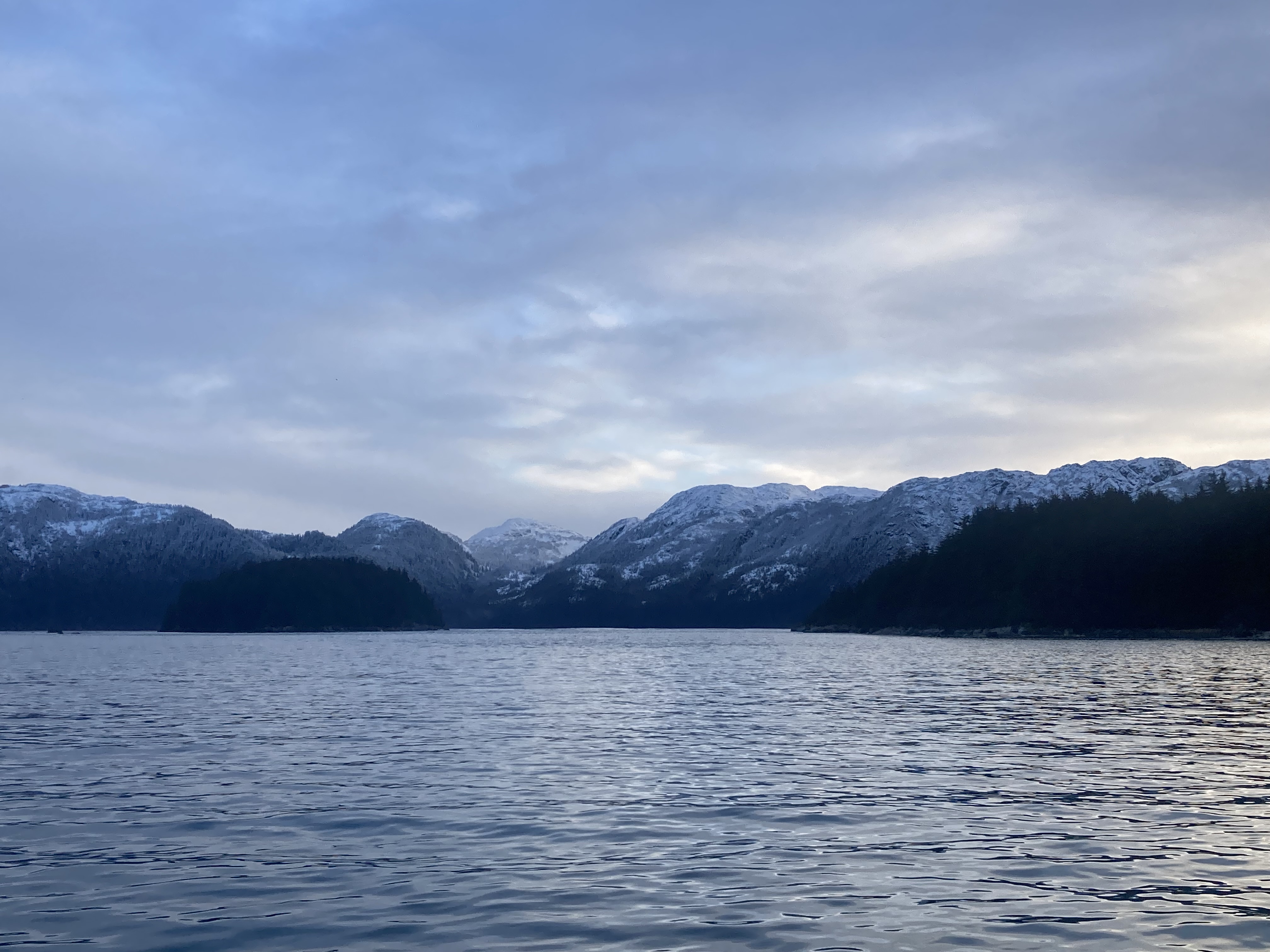
Snow coats the hemlock boughs like icing. At sea level, we’re oscillating between sleet and snow on a minute-by-minute basis. From South Pass, the Gulf of Alaska is visible and foreboding. The constant swell an undulating steppe that bottlenecks through this passage that in many places is just a half-mile wide.

My double kayak is sheltered by the biggest of the Inian Islands, the bow rising high in the air with each swell. Instead of another paddler, the bow seat is occupied by a rifle and dry bag. If all goes according to plan, there will be a four-legged occupant in that seat on the way home.

The Inians are four watermark islands at the west end of Icy Strait, a breakwater between the inside waters and open gulf. They’ve been designated as wilderness by the U.S Forest Service, with one exception – The Hobbit Hole.

How to describe the Hobbit Hole? It’s a picturesque homestead. Five acres of old growth nestled in an ideal harbor accessible through a narrow cut. A mile west can be some of the most dynamic, challenging, and downright dangerous waters on the coast. It’s the last harbor. The last shelter. The last hearth. And it has become a tradition to spend Thanksgiving here in the name of fellowship, deer, and gratitude.

I have a spot in mind. A little pocket beach near the south end of the island. It’s too shallow for a boat, but a kayak can squeeze in there when the swell allows. The kayak catches the surf and slides up the pebbled beach. I jam my paddle into the rocks and the boat holds fast as the ocean retreats. I scramble free and drag the kayak to the pile of drift logs at the feet of the forest.

I tie the kayak to the logs and step out of my raingear. I’m wrapped in wool. Not as dry, but quieter when creeping through the forest. Five shells slide into the magazine of the 30.06, the last one clicking into the chamber with a deathly click.

Safety on. Backpack shouldered, GPS tracker on.

I follow the drainage, letting the sound of crashing surf and running water muffle my footsteps. I am not a quiet hunter. If there’s a stick to crack or a rock to send down a hillside, I will find it. The deer I’m looking for can hear better, smell better, and probably see better. They have home-field advantage, and the myriad of deer trails tells me that there are multiple escape routes if they feel the need.

But the Springfield slung around my shoulders does a hell of a job at leveling the playing field. I prefer to sit and wait. Find a perch, try to get comfortable, and exercise some patience. It’s that last bit I struggle with. But the human eye doesn’t see well when it’s moving, and the odds of me seeing a deer before it sees me when I’m in motion are slim.

I find a small rise looking up the hillside. It’s reasonably open for the Inian Islands where the forest is defined by thick groves of blueberry, devils club, and muskeg. I bring a wooden deer call to my lips and give a few bleats. I’ve been wearing it every day since July. It’s become something of a talisman, a worry stone I can hold onto when the feelings get big. But I finally get to use it for something besides startling my cat when she falls asleep on my lap.

I settle in. All my tramping surely scared everything off, time to let the woods go quiet, to melt into the moss and pretend I’m not there, to give the – there’s a deer.

Top of the hill, to my left, moving right. Weaving along a well-worn trail. I bring the scope to my eyes. There are antlers. I’ve been in the woods thirty minutes, and I’ve found antlers. I blow the call. He keeps disappearing behind hummocks and thickets. But he’s moving towards me. My heart pounds and I’m embarrassed by how much my hands are shaking. Halfway down the hill, he vanishes behind a fallen spruce. I bring the scope to my eye, aiming to the left of the blowdown, and wait.

But a sound further down the hill distracts me. The raspy call of a doe echoes through the woods. The buck isn’t coming towards me. He’s heading for her. Can’t blame him. She’s much cuter than I am. But she has no interest in what he’s selling. For a moment I have them both in the scope, but the view is fleeting. The doe scrambles back up the hill and the buck vanishes. He doesn’t take the rejection very well.

For a while, I try to follow their tracks in the scattered snow. But they’re downwind of me and the trail is hard to follow. The wind blows from the southeast, so I turn around, still feeling the exhilaration of the sighting. The relationship I have with deer is often met with raised eyebrows and skepticism from those down south.

It’s hard for me to imagine deer as pests piling up on the side of the interstate or rummaging through petunias. They are the perfect forest emissary. Quiet, fragile, and mysterious. Beautiful and delicate. Surefooted and swift. Able to sprint straight uphill without making a sound. Simply finding deer in these woods can feel like a miracle. It makes every encounter intimate and unique. Hours of inactivity followed by seconds of exhilaration.

30 minutes later I find two more deer. This time a doe and a fawn rummaging through a muskeg. They paw at the snow and bury their noses in the earth. From my vantage point, I wait for something with antlers to wander out of the woods. A raven croaks from a branch above me and the doe’s head snaps up to scan the tree line.

What did that raven say? The bird takes off and lands on another branch closer to the pair. The call fits this place like the intertwined fingers of lovers. For centuries ravens and wolves have found deer together, ravens calling out locations like a beacon, drawing the pack in while the ravens get the carrion.

As we spend more and more time plying the forests of the Inians, are local ravens picking up on this? We don’t leave the scraps a wolfpack does, but a big gut pile is nothing to sneeze at. Whether it’s the call of the raven or the deep snow in the muskeg, the pair wanders off into the woods. I munch on a sandwich and watch the empty muskeg, still hoping a buck may appear and follow their trail. My patience disappears with my lunch. I shoulder the pack and rifle, continuing along the ridge.

I vaguely remember a hunt last fall in this area. There’s an open section where I saw a doe and fawn. I drop down another hill, acutely aware of the sound of crunching snow beneath my boots. I find a deer trail and follow it along the side of the hill. Lots of blueberry in the valley below and trees clustered together. I pause near a potential perch that offers a better view. The hill bends to the left ahead of me, and a raven calls around the corner. If a deer is the forest’s soul, then a raven is the voice. I must keep going, something insists on it. I stand and follow the croaking raven. The view is a little better around this bend, and a downed spruce makes a perfect brace.

I slide off my pack and look up at the branches for the raven, the forest quiet again. I bring the deer call to my mouth and look back down at the little valley. The call falls from my lips without making a sound. A deer. Walking straight towards me. Scope to my eye. Antlers. He’s what we call a “spike.” His antlers haven’t forked yet, they’re just two rigid pieces of bone sticking out behind his ears.

He continues to move towards me, and I hear the raven again. The buck seems unconcerned with the calls and continues to work toward me, nose to the ground. He reaches a small clearing 40 yards ahead. Now or never.

I miss.

One would expect a deer to bolt at the sound of a gunshot. But the sound is so sudden and foreign, that they often pause. That’s what he does, staring right down the barrel. The second shot is clean.

I sit near the deer and lay my hand on his chest. I stare at those little antlers, and he looks so tiny. Spikes tend to be two years old, and with a swell of guilt, I wonder if this is the fawn I saw the previous fall. Did he work this hillside his entire life? Walk this drainage countless times? It’s likely I’m the first human to set foot in this spot in a year.

That old mixture of gratitude, grief, and yes, pride swell up inside.  

Wings beat above me. The raven perches along the bough, the call filling the empty woods that I have just filled with violence. As I prepare the deer for the half-mile drag to the beach, I listen to the raven. He sounds impatient. Can’t you do that faster? He’s soon joined by another, they touch beaks, and take turns calling through the woods. Not content to reap the bounty of the impending gut pile, it must be shared with their friends.

I remove the heart and liver and drop them in a Ziploc. I feel the same. Back at the Hobbit Hole, we’ll eat the organs tonight. Together. Sharing stories around mugs of cold beer and a sizzling blueberry crisp.

I am home. With soaked pants and a gentle rain melting the snow. The deer, this place, this life, it’s a miracle. Everything else falls away. I would not trade this moment, this sensation, for anything. Some hunter-gatherer DNA has its claws in me and will not let go.

The deer is ready. The ravens are too. 700 feet of elevation and a nasty drainage are between me and the kayak. But I’m not ready to leave the glen just yet. I lean against a tree and look at the birds, waiting so patiently.

“Did you know he was here? Did you know I was close?”

Black eyes stare. Revealing nothing.

“I’m going to pretend like you did. That we have this bond. That you watched me hunt this hillside a year ago, that you remember me. Things are different now. Things once in order now seems so strange. But this, this is my constant. This is my heartbeat. I hope you eat well. I hope this sustains you. Let’s waste nothing of this miracle. I’ll see you two soon.”

I shoulder the pack and grab the line tied around the neck. The rifle bangs against my hip, the deer slides across the snow. With a final caw, the ravens descend, and the forest goes silent once more.

Deeper Water

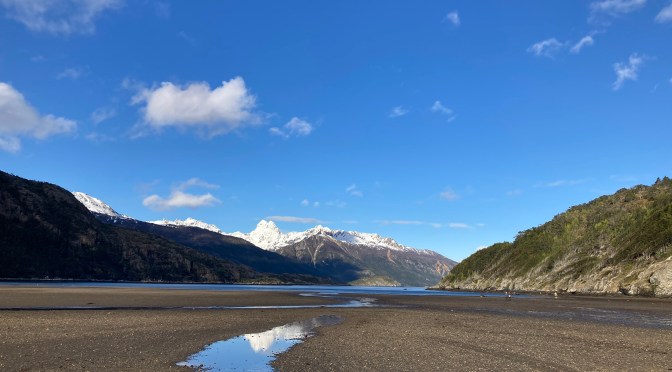
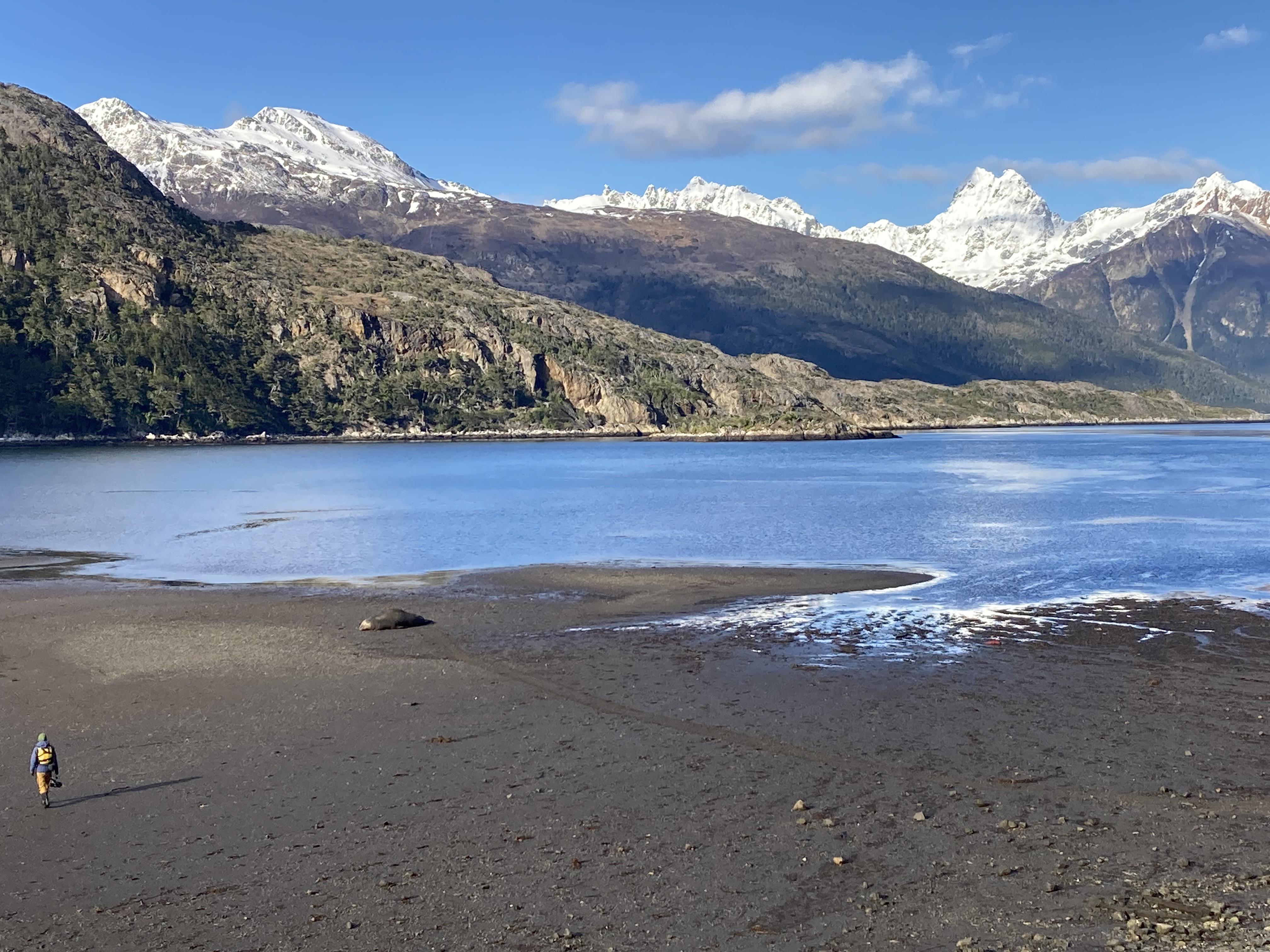
The zodiac skims across the water, the wind whips, and the disturbed water leaves a frothywhite “V” behind us. Another fjord. Tall stately mountains border a wide drainage at the head of the bay. Squint your eyes and it could be Mud Bay, Idaho Inlet, or any number of classic southeast Alaska drainages lined with bears awaiting the salmon. But those rivers are 8300 miles away. 

I have gone to the other end of the globe… to see glaciers. To see a land defined by ice and the frenetic and beautiful artwork they had carved. There are no bears here in the fjords of Patagonia. Though there are rumors that a puma or two occasionally makes its way down to the island of Tierra Del Fuego. Nor are there spruce or hemlock forests. Instead southern beech trees coat the shorelines and stretch up toward the alpine. 

Despite being at roughly the same latitude as north Vancouver Island, the fjords of Patagonia feel more like the Aleutions than they do the Pacific Northwest. It’s the price paid for a ceaseless wind that whips across the south Pacific with nothing between New Zealand and Chile to slow it down. 

Despite being 200 yards from the beach, the zodiac slows. I glance down to see mud beneath a couple feet of water. The long tide flat stretches deep into the fjord. Our landing may be more of a “storm the beaches” situation.

“Uno, dos, tres, quatro, cinco, seis, siete, ocho…” sings out Javier from behind me. 

I scan the shoreline. What’s he counting? I bring the binoculars to my eyes and train them on a massive boulder just above the waterline. That’s no rock. That’s an elephant seal. But… it can’t be. It’s too big to be anything that lives, breathes, and moves on land without being crushed uner its own weight. 

The zodiac can’t go any further. We splash over the side, holding bins for life jackets and other pieces of gear over our heads. In 30 minutes the guests aboard the National Geographic Explorer would be deposited on the beach, awaiting the quirky, entertaining, and informative knowledge of these skilled and capable naturalists that know the land so well.

A little secret, I’ve never been here before. Hadn’t set foot in South America, let alone Patagonia before a couple days ago. And there’s only so much one can absorb from books and documentaries before your Xtra-tuffs hit the beach. I’d joked about Patagonia just being “Alaska with penguins,” but it wasn’t. 

This was a wild, crazy country. A place humans had no business living. The wind. It blows constantly. Not a gentle breeze, but 40, 50, 60 knots with storm tossed waves that make the boat pitch and roll on every ocean crossing, sending me bouncing out of my bunk and water bottle clattering off the table. The plants were unfamiliar, the mountains held glaciers, but the inlets and bays were foreign. Even the dolphins and porpoises felt like strangers. With a pang I realize I’m homesick.

I lug the bins up the beach. The boulder turns, a grotesque snout flopping over its open mouth. It lets out a bellow that echoes off the mountains and thunders up the valley. The male elephant seal is massive. 4500 pounds easily. And we’re walking right past it. My fellow naturalists barely spare it a glance. Decades in the Alaska woods has trained me that anything this large should not be approached under any circumstances. Yet here we were. Trying to fit in I follow in Javier’s footsteps but can’t resist giving the monster a wide berth. 

I have stepped into Jurassic Park. The elephant seals are scattered across the mile wide beach. Females and pups cluster in groups while males wallow closer to the water, allowing the flooding tide to cover them up until only their snouts are exposed. The roars of the males and barks of the pups sharply ring out on the still, clear morning. 

In theory I should be “scouting” the three-mile long hike up the valley I was tasked with leading. But I can’t step away from the elephant seals. I perch on a rock and look down on a small cluster of females and pups. My eyes land on one pup pressed against his mothers belly and vibrating gently. He’s nursing, latched on tight and chugging away. 

A nearby male gives another roar. How on earth could this fluffy gray thing turn into that Jabba the Hutt wannabe? I hadn’t given much thought to elephant seals when I was offered the two week Patagonia contract. But now that I was here… there was something so peaceful, so grounding about these massive animals. I slip into a meditative state and let the world and everything in it slip away. 

These seals spend 90% of their life in the ocean. It was special to catch them on the beach like this. In their tenderest, most intimate moments they make landfall to give birth and nurse before setting out for months of traveling and foraging. The pup has no idea that his blissful little existence has an expiration date. In just a few short weeks, mom will leave him at the mercies of the ocean. No more milk made up of 40% fat to sustain him. He’ll have to head for open water where food dives deep and orcas lie in wait.

He doesn’t want to leave this beach. As homesick as I am, neither do I. For five weeks I have explored the deep woods of British Columbia and fantasized about kayak trips that varied from weekend getaways to starting in Seattle and not stopping until I saw Margerie Glacier. I’d flown to the other side of the world to see some of the most beautiful and dramatic fjords on earth. Alaska is gorgeous, but it doesn’t make glaciers the way they do down here.

Things would change rapidly for me and that little pup. But at some point, we’d have to wiggle over those drift logs, hit the water, and keep on swimming. 

The sound of an outboard wraps around the point. Right, there are people coming. I was supposed to find a trailhead. I scurry off the rock, leaving the pup to suckle and enjoy the sunshine that has finally crawled above the highest peak. In my mind I review the list of plants, birds, and stories I have learned. The list was growing every day, and luckily most of the flora and fauna had, “southern, Antarctic, or Magellanic” in its name. One could simply point at a clump of grass and declare with some authority that it was “Antarctic grass.” Not that I would ever.

The zodiac approaches, the elephant seals roar in greeting, and an Andean condor rides the thermals far above. The southern wind slams against my face, I close my eyes, taste salt, and revel in the unknown, the unexplored, and the prospect of following that pup into deeper water.