Porter the Cat Explains His Departure

When the Gastineau Humane Society hired me in the fall of 2011, I made a promise. No matter what cute and furry critter came across my path, I wouldn’t adopt it. My life was transient with a new girlfriend, a seasonal job as a deckhand, and a financial and housing picture that at best was out of focus.

Naturally, I adopted a little white bunny with brown spots within two weeks. Mistaking her for a boy, I originally called her Bilbo before a kindly veterinarian informed me that, if gender mattered in my naming choices, I’d fallen in love with a lady bunny. So, I pivoted to “Pennybright” after a female hare from the beloved “Redwall” series of my youth. As my infatuation with the Beatles grew, this eventually turned into Penny Lane for short.

Having failed to keep my simple bargain, Brittney reasoned that it was only fair that she got a pet too. She had eyes on a cat, my only stipulation being her cat wasn’t allowed to eat my bunny.

Throughout the winter Brittney would peruse the cat rooms of the Humane Society. I was closing most nights and took to letting a few choice kitties along with Penny roam the hallways for exercise. Two cats in particular got along well with Penny, but for Brittney, they weren’t the right fit.

***

December of 2011 was frigid with nighttime temperatures dropping into the single digits. I arrived at work one clear and chilly day to find a new cat in quarantine. He had been roaming the streets for weeks and had taken shelter in someone’s garage in search of relief from the cold. He’d been caught in a cat trap and had worn down his claws so badly trying to escape that we thought he’d been declawed.

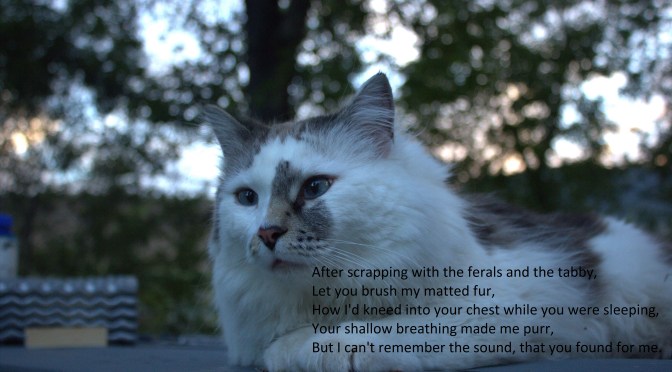
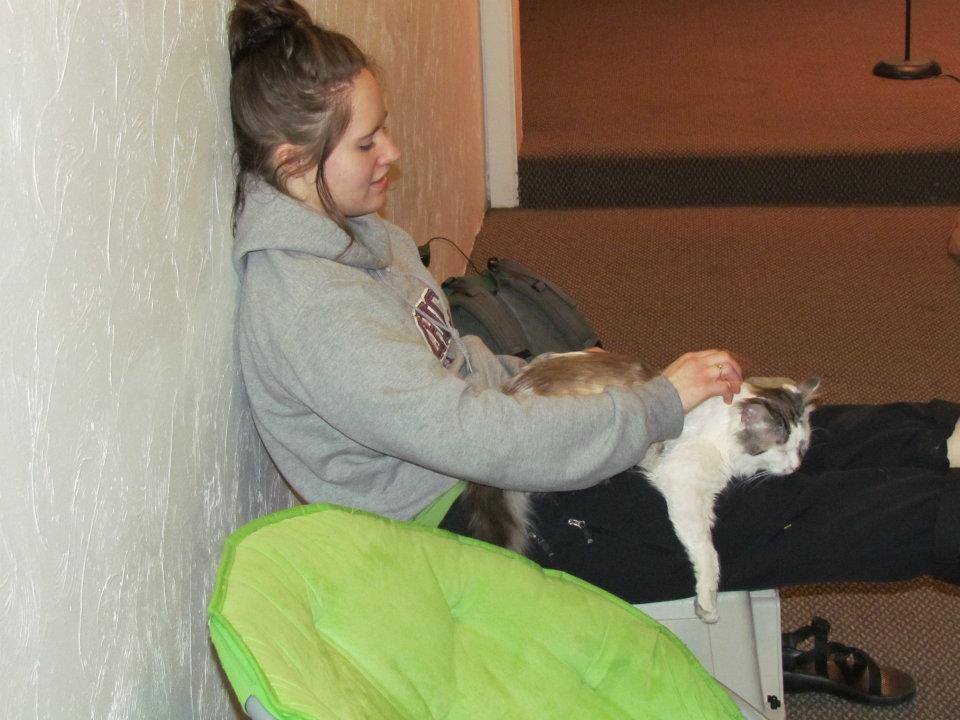
Beautiful blue eyes and striking white fur accented with brown streaks made for an attractive kitty. He seemed like Brittney’s vibe, so that night she stepped into quarantine to meet her kitty soulmate. But he wanted nothing to do with her, which made her try even harder to win his affection. Bit by bit, Porter came around. And on our first night in our first apartment, it was her lap he leaped on, stretching out his long legs and falling asleep.
***

Over the following eleven and a half years, Porter has been a constant in my life. He has crossed the Canadian border no less than ten times. Gone on road trips and slept in tents. Ridden on ferries, skiffs, and sailboats Hiked to sea lion haulouts, battled mink, and dodged moose. His protective nature over Penny was heartwarming, on multiple occasions, he put himself between her and curious dogs.

He was there the day Penny passed away in 2017. And has tried without success to make my cat Minerva his best friend, though she has always had little interest in that arrangement.

On cold nights he’d fall asleep on our pillows or burrow between us like a little furry space heater.

A mason jar cannot be opened without him underfoot and expectant glances waiting for his portion of salmon skin or venison scraps. No unguarded stick of butter or leftover meat is safe. The kitchen counter was his domain whether we liked it or not.

The house was not deemed livable until I’d built a ramp that allowed the now creaky Porter to reach the bedroom and continue his tradition of sleeping on the bed.

Besides Brittney, no soul has defined and influenced my young adulthood as much as that stinking cat.

***

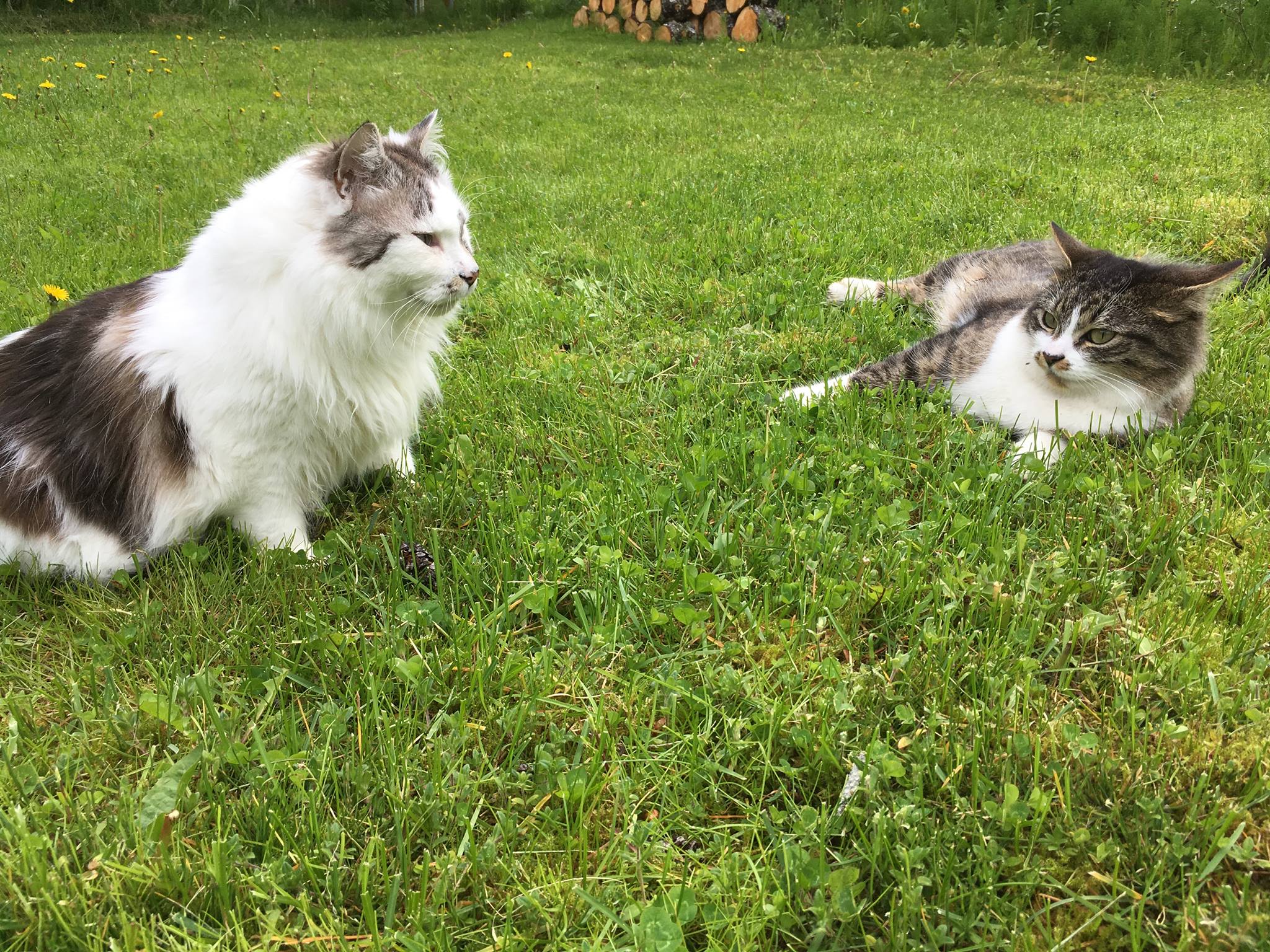
Today I say goodbye to one of my best friends. Porter is still healthy. He’s at least 13 years old, but he just keeps on cranking. He sleeps more than he used to, and his outdoor wanderings are getting shorter. But there’s no drop in his appetite and his fur remains soft and silky. But when I return home in six weeks, Porter will be gone. Like any separation, there’s the question of who the kids will live with.

In this case, the choice is easy. Porter is so clearly her cat first and foremost. Their bond has grown from his icy ambivalence into a love I truly believe he reciprocates. This is a cat that once leaped into 43-degree water to swim to her. That bond can’t be separated.

I’m thankful in a way. My last night with him was one where he was happy and healthy instead of sick, in pain, and scared. I got to leave him at his best. Purring and begging for food.
***

On our final evening together I pull two salmon tail fillets from the oven and Porter takes his usual position by his food bowl. He nuzzles the corner of the cabinet. In less than a year he has created a brown smudge on the plywood from his obsessive rubbing. He has left a legacy that will remain in the house for the rest of my life.

He expects a chunk of salmon skin, and indeed I tear a fillet of skin in half, handing half to him and half to Minerva. But as they begin to mow down, I go a step further. I flip a fillet onto a small plate and set it on the floor next to him. His eyes turn the size of saucers. Without stopping to purr, much less swallow, the feeding frenzy begins. It’s not a large fillet, but it’s still the equivalent of me eating a steak roughly the size of my head.

Porter downs it in less than five minutes. I’ve wondered if he would ever consider himself “full” or if he would just keep eating until he exploded. If I’d spent a chilly winter scrounging for voles in someone’s garage, maybe I’d never pass up food again.

This morning we took a final walk around the property. Porter’s steady plod isn’t as quick as it once was. But he will loyally follow until I turn around. Minerva prefers to wait until we’re ahead and then come tearing after us, rolling in the dirt and clambering up trees. But I love Porter’s steady gait. One step in front of the other, always just a few feet behind.
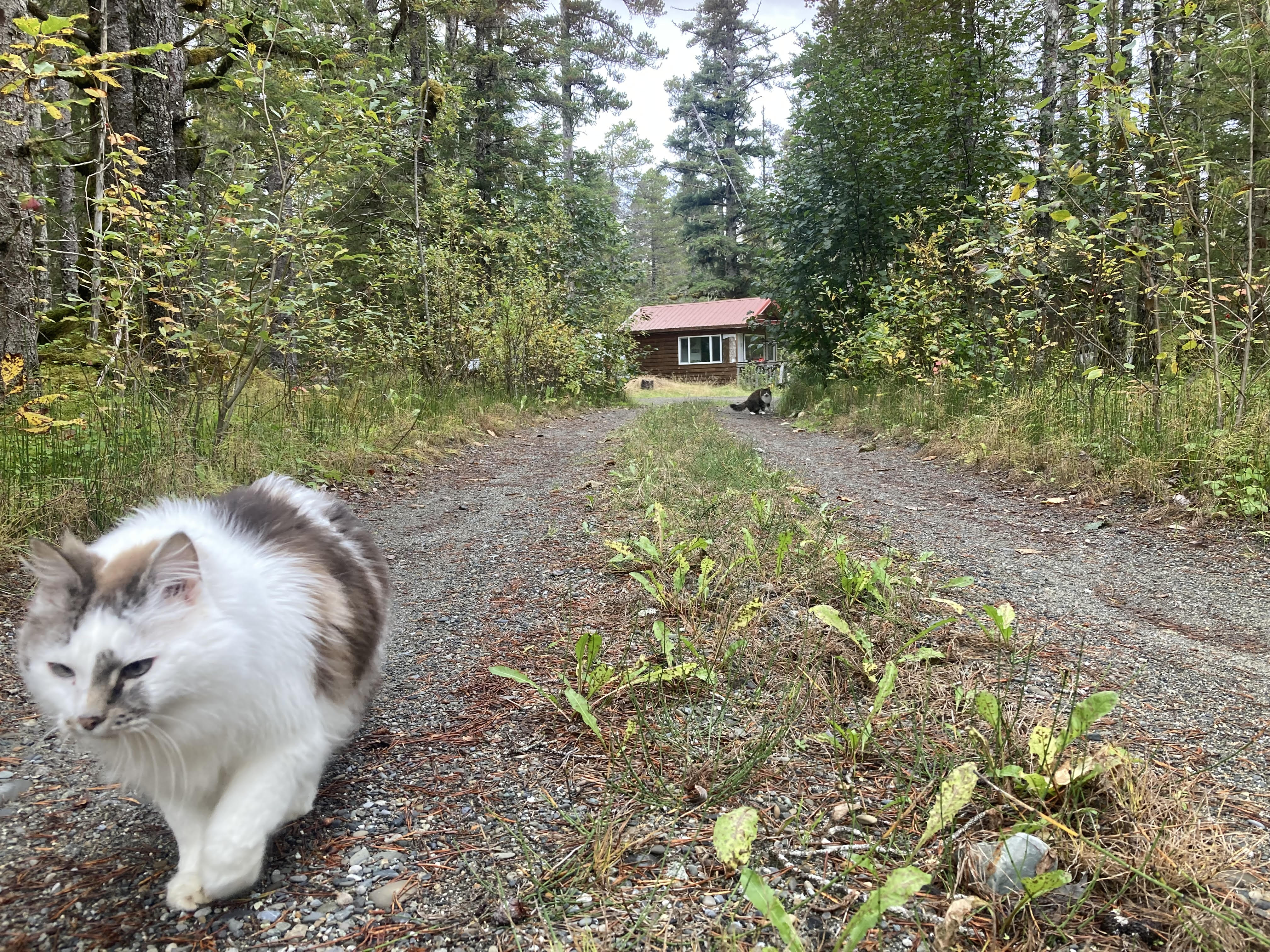
I kneel and he trots over, nudging my knee and purring, arching his back, and raising his face for chin scratches. I envy his ignorance. It’s just another walk. The backpacks in the mudroom are a mild inconvenience. I’ll come back. I always do. I scoop him up and bury my face in his fur. He always smells good. His purrs vibrate against my face.

“Being your dad has been one of my greatest pleasures.”

He begins to wiggle and squirm.

“I am always going to love you. You will always have my heart.”

Squirming intensifies.

“I hate that I have to say goodbye.”

Claws dig into my arm.

“And I hope you never forget me. Because I’ll never forget you.”

“Yowl!”

***

Back home I grab the treat bag. 11:40. I need to go. Porter looks up at me, purring away and waiting for the treats to rain down on him.

“One more time,” I whisper.

I scatter a handful around the room, and he proceeds to hunt them down one at a time. I open the door, grab my packs, and walk down the trail. In my pocket is a Ziploc with a few tufts of hair. I couldn’t resist giving him a haircut to ensure that – along with that smudged cabinet corner – there will always be a little piece of Porter in the house and in my heart.

Board & Batten

I don’t like ladders. I don’t like the way they bend, I despise the way they rarely lay flush against the wall. Until they do, and then they inevitably lean at odd angles that defy gravity in a manner no self-respecting carpenter would trust. So, as I climb the rungs of my extension ladder and move high enough that there’s a single rung under foot, I feel every wobble. A gust of wind buffets my house, and I reach out to steady myself.

But at last, there’s something to hold besides Tyvek. There’s this tall, sturdy, 1×10 next to me, securely nailed to an equally sturdy wall of 2x6s sheathed in half-inch plywood.

Even when I moved in, it felt incomplete. To be fair, it was. But it was more complete than many homes in Gustavus when their owners move in. I received raise eyebrows and impressed compliments that I held off moving until the downstairs trim was completed.

But a voice kept needling. The same voice that sows self-doubt whispered that the outside was covered in DuPont logos. We are our own worst critics.

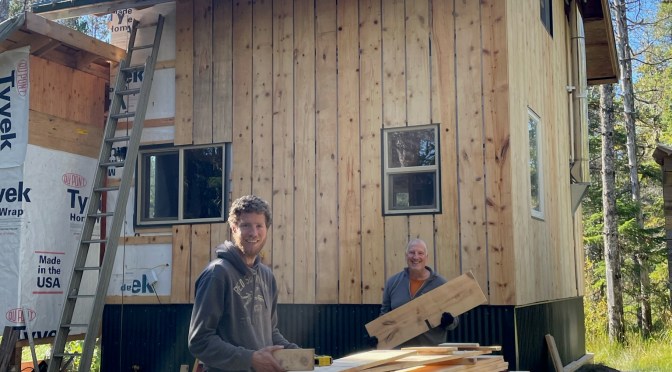
I warned Dad that if he visited, I’d put him to work. Board & Batten is one of the easier siding flavors to install. But it still involves muscling 14-foot boards vertically, with one person clinging to an end, whispering their favorite curses, and trying to stay level.

Clinging to an end, whispering curses, and trying to stay level describes much of the last few months.

In a role reversal that is both tender and bittersweet, it is now Dad holding the ladder while I reach out with a hammer to swing at a nail perched 20-feet above the ground. But that was the deal I made with Mom. No extension ladders for Dad.

For four days we’ve worked in tandem. The rhythm easy and the tape measure yo-yoing up and down while measurements with quarters, eighths, and, when we want to get fancy, sixteenths are bandied back and forth. Notches around windows made the green metal trim pop, and the tone of pride when those complex cuts fit around rafters and flashing are palpable.

All the while, Mom is stationed at the sawhorses with a brush and a vat of Thompson’s Water Seal. She seals as fast as we install, and the pile of boards I’d picked up from Ernie King’s sawmill are shrinking at a rate I can’t believe.

I chose Board & Batten one for its simplicity, but two because I figured I could manage to install much of it on my own. The shift was not just practical, but prideful as well. I wanted to do this alone. To prove to myself that I could indeed carry on and finish a project I never imagined I’d tackle.

But no one goes through life alone. No one should, no one can. And sometimes all we have to do is advocate for what we need. In that moment I needed a sealer and a board holder. And here were Mom and Dad. Working for coho dinners and cold beer. Cold beer that many times they insisted on buying. And as I perch on top of that rickety ladder and nail a board snugly below the peak, I know there wasn’t a chance in hell I could have done this solo and kept my neck intact.

With every break, we take a step back and revel in our progress. The battens look sharp, the knots of the spruce popping against the metal skirting. It’s addicting. Every board makes the cabin look more like a home and less like a construction site.

Over the course of a week, through rain, sun, and periodic breaks to harvest potatoes or admire the Sandhill Cranes overhead, the Tyvek vanishes.

I want whoever enters this house to feel the warmth and love that went into this home. I want it to start the moment they set eyes on it. For it to feel like I always dreamed; a simple little box perched on the edge of a willow field that’s mowed by moose and shelter to snipes.

As an atmospheric river prepares to dump multiple inches of rain on an already soggy land, Dad and I rush to attach the first of the battens. I want them to see what the finished project will look like. Now that I can carry on by myself, mustering those tiny 1×4 battens into position. The first one slides between two trim boards, and I tap nails into place.

I can hear Dad below. “It looks so good, kid.”

I know he’s proud when he calls me kid. I scurry down the ladder and look at the first truly finished corner of my home. It does look good. No vinyl or hurried job. I’m glad I waited. I’m glad I asked for help. There’s no way it would look this straight or this sharp if I’d stubbornly tried to do it myself.

I hand my parents a carpenter pencil, I have one more task for them.

“Everyone who works on the cabin needs to leave a message, note, story, quote, or song lyric somewhere on the plywood or Tyvek. So that when everything is done, there’s a little piece of everyone who helped make this a reality.”

No one builds a house by themselves. No one goes through life alone. Wrapping the gifts, love, and time of those that help build, is what makes a house a home. And what in turn makes me whole.

The Full Lentfer

One cat is curled on my hip. The other has decided my head is his preferred mattress. But when the alarm goes off, they both shoot off the bed like they were blasted by a cannon. It’s dark. I don’t want to. I let my eyes slam shut again and savor the warmth, the feeling made all the cozier by the patter of rain on the metal roof.

Feet out of the bed, wool socks. Crummy Carhartts, ragged Smartwool. Bartlett River Day. Salmon day. By mid-September millions of bright, silver, coiled balls of muscle are pulsing up countless southeast Alaska rivers. The region runs on them. The lifeblood of man, animal, forest, and the ecosystems they inhabit.

How many salmon does one person need to sustain them for a year? It’s a new question, but I know the answer is more than the twelve currently sitting in mason jars or the freezer. It was Zach and Laura’s idea to start before the sun had risen. Before even civil twilight we planned to hit the trail, letting our headlamps and the muscle memory of dozens of previous walks guide us to the river we know so well.

The Bartlett River mouth

We’ve come a long way from our first foray up this river together in 2017. There had been four of us that day too. Me, Zach, Laura, our buddy Patrick. Now Patrick lives in Anchorage. And the three of us feel like the last ones standing in a manner of speaking. Zach and Laura weren’t even engaged on that first hike up the river, their non-profit programs more theories than the vehicles for change they’ve become.

Now, they’re married. And four-month-old Salix has been left with Grandma for the morning in the hopes that we can recreate our Bartlett River Miracle. The fourth spot is Tal, young and wide-eyed. 26, a filmmaker making his second trip to Gustavus this summer to shoot footage for Zach and Laura’s Tideline Institute.

I pull in front of the house where he’s staying to find him waiting by the porch, backpack and fishing pole in hand. For 5:00 in the morning, he’s a ball of energy. A ray of innocent sunlight set on fire by this wild little hamlet clinging to the edge of glaciers and the outer coast.

“Where’s your sweetie?” He casts around the Honda Pilot as if expecting her to leap out of the backseat and yell surprise.

I put the car and gear and bump along the dirt road. “She’s not my sweetie anymore.”

***

This trail gets longer every year. 30 minutes to the mouth of the river. 50 minutes to the first good fishing hole. An exercise in patience. I came up yesterday and grinded my way to two fish. They’re in there. I watched them jump and rocket from one hole to the next. But no matter what I tossed in the water, nothing grabbed their attention. I’m more anxious than usual to get back up there, bring home the legal six, and feel their weight fill my pack.

Few things light Laura up like the prospect of coho. And the two of us practically sprint up the trail. When Salix was born, she and Zach had vowed that it wasn’t going to stop them from living, exploring and doing the things they loved. They hadn’t. With Salix in tow we’d explored the Mud Bay river valley, camped overnight on the Porpoise Islands, and delved into the Point Carolus watershed. But it’s hard to land a ten-pound coho and hold a baby at the same time.

The muddy trail along the river is strewn with the remnants of spawned-out pink salmon. Their sad little bodies turning mushy and rotten as they disappear into the soil. More than three-quarters of the nitrogen the Tongass Forest requires comes from the ocean. It comes from salmon struggling back up their streams only to spawn or be caught. Their bodies are dragged through the woods or consumed and deposited later deep in the trees. In this case, it’s important that a bear does indeed shit in the woods.

For a couple of weeks in July, I wondered if I could continue to live here. I feared the memories would be too sharp with every trail, beach, and bend in the shoreline containing memories of a love and life gone. But no. These streams and shores have been woven as deep into my heart and life as any love. I could no sooner walk away from the bounty of salmon, berries, deer, and garden veggies than remove my left hand. Hunt, catch, gather, and grow. A pressure canner rattling into the late night after a long day on the river.

We reach the first fishing hole at 6:15. The four of us, some bear scat, and a scattering of canine tracks. I free the hook from the pole and let it sing across the water. A sense of place. The intimate and hard-earned knowledge of this river.

Six years ago, I couldn’t tell you where to go on the Bartlett to find salmon. What was too high up. What was too close to salt water. Now? When I meditate, when I need a happy place, I float above this river, tracing its bends and shorelines like the lines in my hand. If the coho aren’t here, there many other places to check.

The line dances. The pole bends, pops, and bends again. There’s the flash of silver. Addicting. The head violently shakes back and forth and the coho bursts from the water, my pink lure hooked tightly in its mouth.

“First cast!” I yelp. Zach and Tal are still walking up the trail. The look on Tal’s face speaks of wonder and amazement. That places like this can still exist. That a bounty of food and magic are just an early alarm and hour hike away. I bring the fish to shore and guide it on the bank. I unsheathe my knife and look into its face. They are such beautiful animals. Brilliant sterling silver on the bottom and sides, an alluring emerald green on top.

I slide the knife beneath the gill plate and say in just above a whisper, “Thank you fish. For your gift. For sustaining me, my friends, and family through the winter. Please go peacefully into the next life.” There’s a spurt of blood and the fish quivers.

I don’t whisper my benediction because I’m afraid someone will hear me. But because what has happened is just between us. Only death can pay for life. I can choose to say that this fish “chose” this, that he offered himself to me. But he didn’t. He saw something pink and flashy, and instinct told him to bite it. His own DNA betrayed him. Now he’s food. Gratitude and joy mix with guilt.

It’s a bonanza. How many coho are in this little hole? Hundreds? Thousands? Lines whir, drags are adjusted, and fish go sprinting up and down the river with pink lures trailing from open mouths. We’re in them. The sort of day we dream about all winter. It’s Christmas morning and we can’t unwrap our presents fast enough.

I catch number six at 7:15. Six fish in an hour. We have a name for that, “The Lentfer,” in honor of our neighbor Hank Lentfer who routinely outfishes, hunts, and gardens us. With the other three still fishing, I start gutting and processing the catch. By the time it’s done, we have all hit our limit. 24 coho line the bank. How humbling. A reminder of the power we can yield, the food… and the destruction we can wreak in such little time.

We permit ourselves a couple of photos for posterity, for these days don’t come along very often. I keep glancing at Tal’s face. God, he’s really nine years younger than me. When did 35 feel old? When did 35 happen? I swear I’m still 23. I feel my position in life shift. I can no longer have that look of wide-eyed innocence and glee at the sight of 24 fish in 90 minutes.

But I can have a profound sense of joy and comfort, a grounding sense of place and home. There are precious few places left that afford this privilege. I have found one. It has wrapped me in its foggy and moisture-laden arms and held me tight. Told me to never let go. To trust it and I will never go hungry. Will never be cold. Will never be alone.

We load our packs and begin the slow walk home, talking of filleting and smoker loads and Lord of the Rings on in the background. It isn’t 2017. I will never again experience the Bartlett River Miracle for the first time. But I can share it. I can revel in it. And through Tal’s eyes, I can celebrate the sensation again.

Painkillers

I’m in a strait but I’m not paddling straight. Icy Strait. Looking for an island called Chichagof. Bound for Baranof. Or Kupernauf. Wanderoff. Timetofuckoff. Whatever. It doesn’t matter. I need to paddle. Wherever I’m going, it can’t be here.

It’s been 90 minutes since I left the Gustavus forelands buried in a layer of fog. I should have thought about it. Had some trepidation, fear, foreboding, one of those animal instincts that tells you this is risky.

I skipped that part.

I forgot or ignored the whisper that these seven miles of water, tide, sea lions and glacial moraine had served as a barrier to my paddling ambitions. But when your greatest fear comes true, what’s left to fear?

The closest body of land on Chichagof is Point Adolphus. But a rising easterly and an ebbing tide have other ideas. My kayak doesn’t have a rudder. While it glides across the water, maintaining a straight line for several miles can be difficult. I’m riding further east than I intend to keep the sloppy chop from nailing me broadside. It looks like I’ll miss Adolphus by more than a mile. But at least I’m getting pushed the right way. Shaving precious minutes off my 160-mile paddle to Sitka.

Icy Strait. Peril Strait. Chatham Strait. They’ve been strangers for years. Faces looking at me from the charts buried in a cabin filled with a lifetime of future memories.

I’m going to see them all.

Chichagof guards the southern end of Icy Strait and has been playing peek-a-boo with the fog for thirty minutes. The tide insists on pushing me towards Pinta Cove. I grip the paddle tight, feel the boat wobble beneath me, and push Icy Strait behind me.

What am I expecting to find? Do I plan on finding the secret to life, happiness, and recovery buried under a rock along these 160 miles of rainforest coastline? I want to feel alive. Be in control by giving up control. I don’t want to hurt. I want to paddle. Hard.

Two miles from shore, the sound of a boat engine bursts out of the fog. Ripping around the point comes a cookie-cutter catamaran laden with whale watchers. The captain dead set on taking the straightest line back to Hoonah. I am in that path.

At a quarter mile, I change course, but the flooding tide has me in its grips. Kelp, seafoam, and beach detritus swirl around me. The visibility drops. Can he see me? My legs quiver, panic rising in my throat.

200 yards. Paddle. Hard. Paddle, Dave, paddle. He’s bearing down. 100 yards. Is this how it ends? T-boned by a whale watch boat? The irony wouldn’t be lost on me.

I point my paddle skyward and shake it, feel the boat succumb to the tide, and turn broadside to the chop. The paddle helicopters above my head, anything to make my profile a little bigger. 50 yards. God, it’s huge. Do I turn towards the wake or dive out of the way? Out of ideas. Out of time. The panic explodes.

“Hey!”

He veers at the last second and I catch a glimpse of a silhouette in the wheelhouse. Without altering speed, the catamaran zooms by 20 yards to stern.

***

The kayak bumps against the shore and slides against a wall of kelp. I gingerly pry a boot free and extract myself from the cockpit. I groan when I step out of these things now. The first small vestiges of middle age are starting to creep up. The legs stay sore longer, the back hurts quicker, and the hangovers hit harder.

I turn and look back across the water. The weather has lifted, the mist is gone. And the Gustavus forelands are but a tiny bit of punctuation along the far shore. I look towards Adolphus and bark with laughter.

A rainbow runs from the point to the mouth of Glacier Bay. How poetic. Very Hollywood. It was meant to be. I am supposed to be here. Everything happens for a reason.

No. There’s no grand plan. No promised storybook ending. No magical hand promising everything will be okay. For two months I have practiced radical acceptance. Control what I can control. Let go of what I cannot. It’s terrifying to discover what I have no control over. My future, my love, my marriage.

At a youthful 34, I am finally being taught how to cope with anxiety and fear. It couldn’t be anger, with hackles raised like a cornered cat. It was with deep, slow breaths, love, and letting go of those things that I have no power over. I fail plenty.

***

Halfway down Chatham Strait is Iyoukeen Cove. A long tendril of land extends from Chichagof Island and a mile into the Strait to form the cove’s southern perimeter. At the tip is a small pocket beach with enough moss and rye grass between tide line and tree line for a tired kayak and tent.

As the sun dips to the west, I gather driftwood, grass, and spruce pitch, arranging the tinder into an orderly stack. The pitch catches at the flick of a lighter and a small blaze grows. The narrow peninsula is dotted with small caves dug into the sandstone. Not for the first time, I sense the presence of others, distant but palpable through the centuries. I am not the first paddler to seek shelter in the wind shadow of Iyoukeen. Not the first to build a fire as much for company as warmth. Not the first who looked to quiet places and open spaces for comfort and meaning.

I am scared, lost, abandoned. The seven stages of grief are a crock of shit. I feel sadness, depression, anger, bargaining, and whatever the other ones are on a rotating basis like some sort of perverted roulette wheel.

No one goes into a marriage expecting it to end. But I really didn’t expect mine to. Now… for the first time in my blessed, perfect life, I deal with tragedy, trauma, and loss. What sort of man do I want to be? Can I look back on this with pride at my response? It won’t be binary. As many shades of gray as an October atmospheric river.

The same lyrics have been playing in my head for weeks. A sort of talisman to remind of what was and what may be yet to come.

Living just comes with a bit of heartache,

Heartache comes with a bit of young faith,

Faith stays young till your hearts gets broken,

Hope grows up to become someday.

I wrap my arms around my knees and squeeze. Who was I going to be? Who was David? It was a question I hadn’t asked myself in a long time. I think about the house. Five years of sweat equity that I had entered into gladly, with love and joy. I’d started building for us. I vow to finish for me.

Because I’m proud of what those swampy 4.2 acres of Gustavus glacial outwash are turning into. The garden beds that have grown into fertile soil thanks to compost and hundreds of pounds of kelp. Dozens of mason jars packed with greens, coho, venison, and pickled goodies. Deer antlers on the hearth and a bottle of whiskey on the shelf.

We don’t always get to choose when a chapter ends. Sometimes we don’t get to be the author of our story. Just because a chapter concludes, doesn’t mean the tale is over.

The sound makes me instinctively turn. Will there ever be a day when a whale’s breath doesn’t cause my head to spin like a dog whistle? There’s a squadron of them. Big billowing plumes of breath shoot 20 feet over the water. The humpbacks move casually around the point and into the cove. One by one they dive. One fluke after another rising out of the water and high into the air.

I abandon the fire and move down the beach, following the ebbing tide. I climb onto a rock and wait. Two minutes. Three minutes. Four minutes.

They hit the surface as a single organism. Twenty mouths agape, fifteen-foot flippers hanging limply in the air. I hesitate for a moment. My shoulders ache, there’s this knot in my lower back, I just got the feeling back in my legs. But that spark in my chest has found some dry driftwood of its own. Some systems are coming back online.

I sprint up the beach, toss my life jacket into the cockpit, and shoulder the kayak. The hull plops into the water. After days of paddling with hatches full, the empty boat moves like a mustang.

The humpbacks set another bubble net and I’m in hot pursuit, paddling joyfully along the shoreline, following those plumes like the north star. I have spent half my life following these critters. Up and down this coast. I have woken in the night to their breaths, calls, and breaches. I live how I live because of them. I call this place home because I was searching for big water, bigger trees, and the biggest whales. This part of me existed long before the chapter began. It will exist long into this one.

I bob in a kelp bed and watch the group set another net, hearing their breaths and the cries of gulls echoing off the trees and caves. I have control over more than I think. My future, my love, my home are under my power. They lay before me with a following tide and gentle breeze. All I need to do is keep paddling.